
Sunday, June 06, 2021
Superhero Secret Identity Collectivism

This is our (Nishioka & Takemoto, 2021) survey that attempts to prove that while Western Heroes go from a "mild mannered" secret identity to an individualistic "man of steel" Japanese superheroes often start as odd-balls in their non-super form, and change to upstanding members of the community. Japanese super-hero "secret identities" are not secret. They transform to become strong, not to hide. It seems to me that additionally, the individualism espoused by Westerners and exemplified by their heroes, and the polysemic wa, which means acceptance of difference at least as much as it means conformance, are a sort of camouflage for the odd-ball and mild-mannered reality of Japan and anglophone West respectively.
The images of Kamen Rider Forze before and after transformation and Christopher Reeve (RIP) as Clark Kent and Superman are copyright their respective copyright holders and used for illustrative purposes. If you wish that I cease and desist, please leave a comment below or contact me via the email link on my homepage, nihonbunka.com. We will be collecting Japanese data soon.
Labels: cultural psychology, culture, japanese culture, nihonbunka, Super-Sentai, superhero


Tuesday, October 31, 2017
Heroes: All Mouth and No Mouth At All
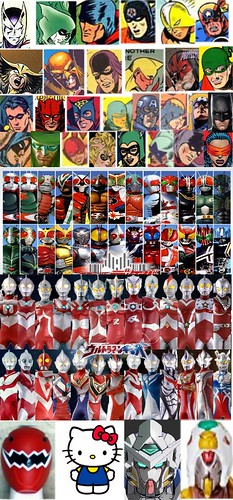
Western superheroes sometimes show their faces, like Superman and sometimes have a full faced mask like Iron man but when they wear a partial mask it always shows their mouth. They appear to be all mouth. On the other hand, Japanese super heroes often have no mouth at all. The mouth and the spoken word is not very important, or even avoided, in Japan but Westerners and their heroes are their pronouns, names and self-narratives. With heroes this different there may be reason to be concerned.
Derrida believes that the war to end all wars will be waged in the name of the name.
"But as it is in the name of something whose name, in this logic of total destruction, can no longer be borne, transmitted, inherited by anything living, that name in the name of which war would take place would be the name of nothing, it would be pure name, the "naked name." That war would be the first and the last war in the name of the name, with only the non-name of "name." It would be a war without a name, a nameless war, for it would no longer share even the name of war with other events of the same type, of the same family. Beyond all genealogy, a nameless war in the name of the name. That would be the End and the Revelation of the name itself, the Apocalypse of the Name. "(Derrida, 1984, p.30-31)
Western Heroes
Citizen V
Spectre
Phantom of the Fair
American Crusader
Keen Detective
Fighting Yank
Hawkgirl
Hawkman
Grim Reaper
Ray
Arrow
Green Mask
The Black Terror
Cat Man
Black Owl
Blue Beetle
New Invaders
Blue Diamond
Captain America
Batman
Father Time
Green Hornet
Flame
Blonde Platinum
Golden Girl
Captain Courageous
Mystic
Crimson Avenger
Japanese Heroes
Masked Riders
Ultramen (mouths suggested, but unmoving and non functional. They express the identity of the ultraman but do not speak.)
Super Sentai
Hell0 Kitty
Gundam
Evangelion
Derrida, J. (1984). No Apocalypse, Not Now (full speed ahead, seven missiles, seven missives). Translated by C. Porter, & P. Lewis, diacritics, 14(2), 20-31. www.uni-giessen.de/faculties/gcsc/media/workshop-feminism...
Labels: japanese culture, Nacalian, nihonbunka, superhero, 日本文化
Washida is Not his Face, Body or Clothes
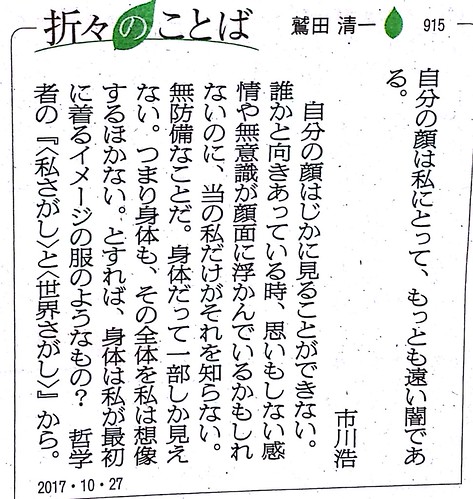
Professor Seichi Washida (2017) often rails against the centrality of face in Japanese perceptions of self (Watsuji. 2011). In this short piece on the front page of the Asahi Newspaper, Washida quotes Ichikawa Hiroshi, who in fact argues the unity of mind and body (Ichikawa, 1975) as saying that this face is that which is farthest from himself. I think perhaps Ichikawa draws a destinction between face, which can not be seen, and the body that can and the place in which it is perceived. Despite this fact, Washida does not distinguish between the body and face, and asks "is the body the first image clothes I wear perhaps?" This metaphor relating the body with clothing can be use to theorize superheroes who are light (Ultraman) or their clothes (Sentai/Power Rangers, Kamen/ Masked riders, Gundam, Eva, and Iron Man). Japanese people, as they become Japanese, grow into their clothes. Professor Washida remains unconvinced.
お取り下げご希望の場合は下記のコメント欄か、http://nihonbunka.comで掲示されるメールアドレスにご一筆ください。
Washida, S. 鷲田清一.(2017/10/27).折々のことば915.朝日新聞朝刊.
市川浩. (1975). 精神としての身体. 勁草書房.
Labels: japanese culture, nihonbunka, Super-Sentai, superhero
Monday, June 06, 2016
Masked Rider's Icon: Eye-soul

The latest masked rider symbolic transformation item from the 2016 series Masked Rider Ghost (仮面ライダーゴースト) is called an "icon" using the characters for eye and soul (目魂). That the transformation item is some sort of symbol is common to all the transformation items of super sentai (power rangers), ultraman, masked riders, Mirrorman, Mito Kōmon, real members of totemistic tribes such as the Aranda, as well as the symbol collecting Japanese Shinto practitioners. The Japanese traditionally believed they received their soul vectored by a symbol received from shines in the form of shinpu, ofuda,or omamori amulet. Mirrorman, the closest to the Shinto tradition, would transform to his super form thanks to a shrine amulet, while standing in front of a mirror.
That these iconic amulets vector something supernatural from the country of light (Ultraman) is also clear. With this particular symbolic transformation item it is becoming increasing clear that these icons vector an "eye" or perspective such that their wearer or consumer may be transformed into the heroic suit or mask, representing visual appearance. One could only identify with a visual appearance by also internalising another. In the case of masked rider Ghost, these others are heroes such as Isaac Newton, Miyamoto Musashi, and the protagonist's father. Internalising the icon of the father allows the protagonists to internalise the father's eye. The "icon" as "eye soul" pun is Tsuburaya genius.
Another commonality shared by many transformatory symbols, such as Masked Rider Orz Medals, Masked Rider Ghost's Icons, and the Tjurunga or "bull roarers" of the Aranda (I made one) is that they are symbols that make a noise, as if reading themselves. If there were ever a visual symbol that could read itself it would 'prove' that the symbol is not merely formal (arbitrary) but an ontological part of a real world, and perhaps that there is of necessity a third person viewer to read it. Intrinsic icons that combine sound and vision, introduce that gap or distance into the world required for self sight. Icons that can read themselves do indeed therefore contain (or would if such things existed) "eye souls," the eye of the soul, that allow those possessed to transform into the seen.
These symbolic catalysts have the same, but 'Nacalianly transformed,' function as the Lacanian mirror image which is or appears to be a image that sees itself. The Lacanian mirror image, Superman's suit and indeed our own faces, is something that misguides or conceals our whispered identity, but it is also the condition for linguistic self-hood. The catalyst or condition for the linguistic world is that two things are the same. That is the importance of Jackson's red, all the images that Western pilgrims go to see, or the wafer in mass. They prove identity. The catalyst or condition for the visual world is that there is something that is two things, a symbol that reads itself, that can intrinsically be read. The Japanese need to prove an intrinsic distance. Westerners need to prove an intrinsic identity.
Both world views are magical but which is best? Keeping ones symbols on the outside, on ones forehead, or in ones watch or belt, is imho a lot more healthy.
Labels: Bandai, japanese culture, Jaques Lacan, kamenrider, Masked Riders, religion, self, Shinto, Super-Sentai, superhero, スパー戦隊, 日本文化
Tuesday, April 26, 2016
Two Reasons For Gattai
Labels: blogger, Flickr, japaneseculture, nihonbunka, sentai, superhero, 日本文化
Thursday, December 06, 2012
Japanese Dconstruction

The same deconstruction may perhaps be applied to Western feelings towards dolphins and whales. Their "song" is another imperfect language, a pharmacon, that serves to purify our own. Perhaps Hitler is used in a similar way. Hitler is human. But Hitler was evil. Therefore there are good humans. But these real world examples are just an aside. Is there a Japanese cultural equivalent of deconstruction?
It seems to me that the Japanese, like their super heroes, want go in the opposite direction. Performing a Nacalian inversion of Derridean deconstruction, I propose that Japanese artists present to the viewer images that are sullied with signs, that is to say images that invite, come complete with, misinterpretation. Japanese artists show us gravel gardens that look like inland seas. Or drawings of rocks that turn out to be mountains. Or ink drawings that are so sparse that though we provided the interpretation ("that is a branch") we are brought back to the reality of the ink and paper. They show us room interiors that again, play with our sense of scale. And finally Haiku poetry never tires of presenting an image (such as an old lake) with a interpretation (that a frog has jumped in) that turns out to be no more than interpretation - whammy - all there was was the sound of the water. There are no end of haiku that show us images tainted with (mis)interpretations: snowflakes that turn out to be cherry blossom, or cherry blossoms that turns out to be snowflakes. Even Ezra Pound seemed to be aware of the trick, when in "In a Station of the Metro," he confounds petals with his apparition of faces. To achieve the Japanese image-purifying affect however, he need to title his haiku "A walk in the woods." In all cases the Japanese artists shows us tainted, sullied, images, in order to purify the image or place which, according to Nishida, is both self and world. This is Japan Dconstructed.
Western philosophers present their readers with signs sullied with the image, to purify the sacred sign: the holy living logos. Japanese artists, who are also philosophers, present their viewers with images sullied by signs, to purify the sacred image, its space or place: the mirror in their minds.
Image bottom left: Japanese house traditional style interior design / 和室(わしつ)の内装(ないそう) by TANAKA Juuyoh (田中十洋
Labels: culture, japan, japanese culture, superhero, theory, 日本文化
Kyari, Super Suits and Symbols

Eschewing telephone boxes and toilets, Japanese superheroes transform in front of everyone with great aplomb, sometimes on stage. They use symbols to transform. And they also have, and sometimes become, suits. Often what the Japanese Clark Kenta changes into is a super suit. Their super form that -- vectored by the symbol -- possess them is often a sort of exoskeleton. They have bug eyes, but no mouths. Speaking, even mumbling, is quite out of the question. Ultramen are pure body, pure light.
Both types of super hero use the image and the symbol but in different directions, with reversed means and ends. The Western suit is the *means* to conceal and continue the objective: the super identity that the hero always was. The Japanese transformatory symbol, and Kyari Pamyu Pamyu's choreographed "Kata," are a means to transforming into ones super suit, or assuming the visual three-eyed* identity that Kyari represents.
*Kyari has two eyes on her face and another, that looks at her sometimes a "riken no ken" (Zeami). Zeami emphasised too that the Kata, the ritualised symbolic movements, are a means. One learns the kata, one manipulates the symbols, to go beyond them. The Japanese stop narrating themselves almost as soon as they started, but hey are not zombies (Rudd, 2009).
Image top left: Superman frente al espejo by Greenog, bottom right HG 00 Gundam by Chag
Baudrillard, J. (1995). Simulcra and Simulation. (S. F. Glaser, Trans.). Univ of Michigan Pr.
Lacan, J. (2002). The mirror stage as formative of the function of the I as revealed in psychoanalytic experience. In B. Fink (Trans.), Ecrits (pp. 75–81). WW Norton & Company.
Rudd, A. (2009). In defence of narrative. European Journal of Philosophy, 17(1), 60–75. Retrieved from http://onlinelibrary.wiley.com/doi/10.1111/j.1468-0378.2007.00272.x/full
Labels: autoscopy, culture, eye, henshin, image, japan, japanese culture, Jaques Lacan, lacan, logos, Masked Riders, morph, occularcentrism, reversal, specular, superhero, 仮面ライダー, 変形, 自己視
Friday, February 10, 2012
Western Super-Friends as Pure Mind

"Transformers" started in Japan but has become popular in the US, which also has its own Gundam in "Iron Man". There is an "Iron Giant" based on Ted Hughes story ("The Iron Man"), and Lilo's friend Stitch.
In my opinion, however, the Western imaginary friends that mirror the many super robots in Japan, are the plague of ghosts that have been helping us out recently. The first one I saw was in 1969 on the BBC in the tv series "Randall and Hopkirk (Deceased)".
The basic pattern of Western 'human plus super-friend' dramas is that a detective is helped by a ghost or ghosts. The ghosts have no body only a message, a will, and the human's job is to let their will be done, so that the Ghost can disappear. The genre includes "The Sixth Sense," "The Dead Zone," "Tru Calling," "Ghost Wisperer," "The Medium," "Raines," and "The Listener." "A Gifted Man" though a doctor is along the same lines.
Their protagnoists have a lot in common with the geniuses that read minds in "Lie to Me," "The Mentalist," "Criminal Minds," and the various "CSI."
All of them, by their extrasensory, or extra sensitive powers of perception are able to read the message, the words, the will, of the superbeing that has not been said and act upon it.
The human heros are, contra the Japanese humans, the puppets of their super-natural friends. And yet it is they that are the titular characters. In almost all cases (Dr. Malcolm Crowe from Sixth Sense and Hopkirk as possible exceptions) it is the 'reader' that is the central character, or self with whom the audience identifies. Westerners, perhaps due to the Judeao Christian influence, like to see ourselves as 'readers' who carry out the will of supernatural friends.
In Japan, though the robots are controlled, they are heros, the eponimous/titual characters, the focus of attention. No one buys Amuro Rei dolls, or Nobita Posters. The Japanese robot superheros are body and self at the same time. Will, such as that of Nobita and Light is fallible, external, and leads people astray.
It is interesting, but probably conicidental that in Japan technology and robots are associated with the West, and that human-ghost interaction is the most famous theme in the traditional drama of Japan. It is as these culturals have found imaginary friends in each other. Again coincidentally, or due to the spread of TV, the super robot genre started, as far as I know, in the late 60's early seventies about the same time as Randall and Hopkirk (Deceased).
Images copyright their respective copyright holders. Please comment or contact me via the email link on nihonbunka.com to have this image removed from the Net.
Thanks to Ɲ for inspiring these observations.
Labels: culture, female, gender, henshin, horror, japan, japanese culture, logos, nihobunka, nihonbunka, reversal, self, superhero, theory, 変身, 日本文化
Thursday, February 09, 2012
Japanese Super Friends as pure Body

A sub-genre of superhero fiction are partnerships between super-friends, and a human (often a boy). This genre is particularly popular in Japan.
These super-friends are controlled by an otherwise ordinary mortal man or boy. Mazinger-Z was a giant robot radio controlled by a boy. Pokemon (pocket monster) Pikachu is kept in the pocket of his friend, ready to fight at his bidding. Doraemon, another robot, lives in the closet of a boy called Nobita, ready to help the latter in the many ways he can. Gundam is a robotic suit worn by a boy called Amuro Rei. Ultraman is an extraterestial giant that possesses and is possessed by a squadsman called Hayata; unlike Clark Kent and Superman, Hayata and Ultraman are not quite the same thing.
Others similar entities include Tetsujin-28, the god of death in "Death Note", the mother-possessed (!) suits in Evangelion, the giant mecha that appear in every series of Super-Sentai (Power Rangers), and duality observed in the Masked Riders such as Kamen Rider Denou.
Western superheroes are far more likely to be a unity that only appears dual due to the fact that for some of the time, the superhero poses as a normal, but "secret" "alter ego." Western superheroes are dual only epistemologically. Japanese superheroes are ontologically dual.
Japanese super friends are often but not always giants, and often but not always robots. They are also often unable to speak. Pikachu can only say its name, Ultraman can only pant. Many Japanese superheros and characters (such as hello kitty) do not have mouths at all, or have masks which cover their mouths.
Lacking in language, these super friends often carry out the will of their human partner. The super-friends are *all body* - taken to the extreme in Gundam and Evangelion - that provide the power, or technology to carry out the human will.
Western Imaginary friends on the other other hand, as I will argue in a seperate post, are often all mind and no body. They provide their human friend with information. Western super friends above all speak to their human partner. The human carries out the will of the imaginary super-being.
Images copyright Mazinger-z by joeszilvagyi, Doraemon by Wacko Photographer, Pikachu by ntang, HG 00 Gundam by Chag and ultrama photographed by me but all characters/images copyright their original creators.
取り下げご希望の場合はnihonbunka.comのメールリンクか下記のコメント欄からご連絡ください。
Labels: Bandai, Bokenger, Gao-Ranger, go-onger, henshin, nihonbunka, reversal, Super-Sentai, superhero, ultraman, スパー戦隊, 仮面ライダー, 合体, 変身, 日本文化
Tuesday, February 07, 2012
Varieties of Kamen Rider Forze
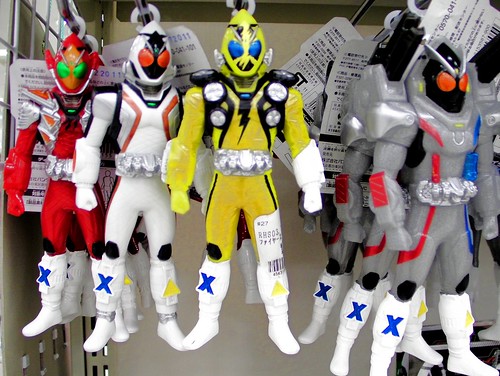
I am in the process of doing an experiment to find out who is more individualistic, the Japanese Superman or the Japanese Clark Kent. In the West it seems that the post-transformational Super form of superheroes is more individualistic than their "alter ego." In Japan on the other hand, folks like Hino Eii, Philip and the Elvis Hairstyled high school student who transform into Masked Riders are individualistic to the point of being weird. Super sentai too, cooperate more in the heroic rather than pre-transitonal (hennshin mae ) form. To understand the situation in Japan, imagine if Clark Kent, Bruce Banner, were really eccentric and that Superman and the Hulk were really square..
But on the other hand, Japanese superheros tend to have a variety of forms or modes, such as the various super forms of "Kamen Rider Forze" as depicted above. In Japan they are all different, but they are all perhaps more upstandingly harmonious than their "yankee" alter-ego. Imagine if Bruce Banner could transform in any of a Green, Red, Yellow and White Hulk, and all these Hulks were square.
Labels: collectivism, individualism, Masked Riders, nihonbunka, Super-Sentai, superhero, スパー戦隊, 仮面ライダー, 個人主義, 日本文化, 欧米化, 集団主義
Wednesday, December 28, 2011
Mophing Transforming Lego Scorpion and the Japanese Self
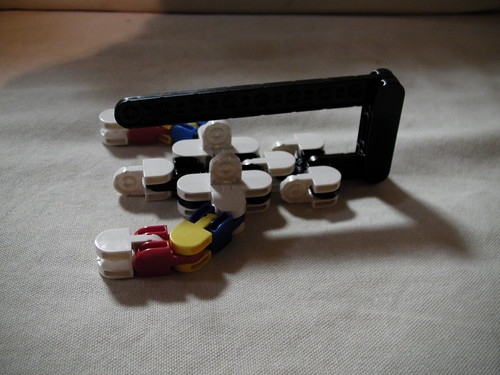
Jurat by Toyda is a kind of Lego for morphing robot makers.
I am not sure why Japanese children especially, and anyone who likes the movie series Transformers, are keen on transforming or morphing.
There is often a morph between something inanimate and something animate, between a something used, a tool or vechicle and a using thing living robot.
The above is a scorpion which morphs from/into a sword made by my son from Jurat morphin lego by Toyda.
I would like to suggest that Japanese children (and anyone fond of Transformers, which is most children everyhwere) but especially Japanese children because they remain in a "mirror stage," may be more aware of the Lacanian dictum that the ego or self, which originates in the self-image, is external, dead, a mere tool, and yet at the same time the only self we have. We see, we are, dead people: at best robots, at worst inanimate tools.
This dual nature of the self, (1) as a mere tool or representation to grasp a centre-less consiciousness, and (2) as the best -- though "robotic" or prosthetic -- self that we have, may be being played out in the morphining animation movies, and toys such as the one above.
Labels: Bandai, go-onger, henshin, japanese culture, Jaques Lacan, lacan, morph, nihobunka, nihonbunka, occularcentrism, self, specular, Super-Sentai, superhero, theory, 合体, 変形, 変身, 日本文化
Tuesday, June 07, 2011
Totem badges Old and New

Top row: Shinto shrine amulets (omamori)
Bottom row: Kamen Rider OOO medals, Kamen Rider W Gaia Memories
Please see also an even longer history of totem badges from Australian bull roarers, through shrine amulets, seals (mitokoumon's inro) to the seal of the Shinkenja- Super sentai.
My son plays with various totem badges that are said to transmit the spirit of a supernatural entity to a person allowing them to transform into a superman of sorts. These "totem badges" seem to have much in common with the good luck amulets (omamori) available at shrines.
The seem to contain some information (written - omamori, in an RFID chip - OOO's medals, in a USB memory - gaiai memory), connected with a super-human spirit (in the case of the omamori a shinto spirit or kami, in the case of OOO's medals and gaiai memory a super animal or 'ancestral' kamen rider). This information acts as a vector between the super-being and the holder, endowing the latter with power to conquer foes, such as exams diseases and enraged aliens. They often make a noise. Rattles are popular totem badges in North America (Levi-Strauss has a page of rattles in one of his books on totemism). Bull-roarers or Churinga roar when waved around ones head. Omamori are often fitted with bells. OOO's medals, and various transformatory cards make a noise when read with a special purpose reader. Gaiai memory (and engine souls) make a noise when a button is pushed or when inserted into a sort of reader.
Do amulets change (henshin!) people? Surely not?
They all contain a message, information, or symbols, representing a supernatural entity as noted above. They are also the double of their owners. Masked Rider OOO is the double of Hino Seiji. Shoutaro Hidari uses two Gaiai memory to transform into Kamen Rider "W" (double), his double, in more ways than one. Omamori are said to work as a self-replacement (migawari), taking on the bad luck that might otherwise befall their owner.
Shintoists believed that getting a totem badge from their shrine, the sacred space of their religion, gave them a life or self or spirit. The spirit was themselves and also it was the spirit of the shrine. About 70 years after they die, the spirit merged with the spirit of the shrine, or now Buddhist temple since the cycle of spirit has been broken.
Christians have "Christian names." My name is "Timothy", which is a name from the Bible. It is primarily a phoneme. I get it from the sacred space of my ancestor's religion, and I apply it to myself, thereby perhaps taking on board bit of the God, maybe. Does having a name change me? Does it give me anything, such as a self or life (no way, surely?).
The symbols, in all cases, come from the supernatural to give something special to their recipients.
One of the first Japanese superheroes that appeared on TV, was Mirror Man (Mira-man, 1971). Appearing at the same time as the original Ultraman, he shared many of the typical characteristics of Japanese superheroes, and with Shinto. He used a Transormatory item (henshin aitem) to transformed (henshin). Mirror man use a Shinto shrine amulet (omamori). He could only transform when in front of a reflective surface, usually a mirror. He was possessed, as it were, not by a giant from outer space, but his super-human father who lives in the world of two dimensions. (Thank you James)
Image top row far left: 貝で作られたお守り :) by kozika and far right: ハローキティのお守り :) by kozika
Labels: henshin, Masked Riders, nihobunka, nihonbunka, Shinto, superhero, totemism, トテミズム, 仮面ライダー, 変身, 日本文化, 神道
Tuesday, August 17, 2010
Savage Thought and Myth in the Structure of Japanese

Levi Strauss argued that "savages" are "bricoleurs" (people that use the tools and materials to hand to get a job done), in that they use things, usually found in the natural world, to categorise and organise their societies.
Thus *savages* in totemistic societies may have "Black Hawk" and "White Hawk" groups, and be called by names like "Sitting Bull." They use species of bird and animal as names for clans, families and individuals, because these things are useful to get the job of social categorisation done, and thus "good to think."
Had Levi-Strauss been more rigorous (I jest) he would have noted that some totemist use mythical and corporeal, artificial signs. There are "Water Flask" and "Dragon" tribes. Concentrating on these man-made signs Levi-Straus' definition of "the savage as bricoleur" starts to become rather vague. If the savage can make up entities (such as dragons) to use as names then how is the savage different from "Levi" named after some ancient Jews Straus? If the savage can use man made objects as names, then why not use patterns, and write his name "LEVI" and be done with it. And if he did, would he still be a savage? The problem with Levi-Strauss for me is that I can't find the place where he compares savages to himself, or where he explains what we are doing, and whether and in what way what they are doing is different. (As far as I am aware, I am a bricoleur too. My name is Timothy, the name of a semi-mythical 'beast' found in the Bible.)
Then Roland Barthes comes to the rescue with his theory of "Mythological" signs. I think that despite the fact Barthes analyses magazine covers and pasta advertisements,he uses the word "Mythologiges" because he is harking back to Levi-Strauss above, and providing a semiotic distinction between us and them, between anthropologist and the mythologist, the scientist and the bricoleur. The distinction of myth, mythological thought, and the savage mind is that it uses signs in combination at a two teired level of "denotation" and "connotation." The briocoleur/mythologists uses second level, connotative signs, that is to say signs in combination that are already signs for other things (see diagram, inset bottom right).
Hence, the black boy and the saluting (a flag) shown on the cover of Paris Match, are in themselves signs. We recognise them and their meanings, of respect, youth, and Africa etc. The cover becomes mythic because it combines these signs to present a new meaning: imperialism is good, all of France's colonial subjects respect the French flag.
Suzuki Takao argues that the Japanese language is appropriate for use as an International Language. I happen to agree. The principle reason he gives is interesting, one that I had not grasped, and relates to the discussion of myth, or savage thought above. Suzuki argues that the advantage of Japanese is in the two-teired way that it is "agglutinative". A simple definition of aggluntinative is that, in ancient greek (soci-ology) and modern German (auto-bahn) one can form words by joining other words together. In Japanese however, the situation is a little more mythological, the process of agglutination often involves an extra layer. In Japanese, while there are cases in which one simply joins words together (e.g. torihiki, pull-push meaning negotiations), one can form complex words by combining the signs, or Kanji, for everyday words.
This layering of Japanese can be discussed at two levels.
At the level of discussion of the merits of the Japanese language, or German and Japanese respectively, the layered nature of Japanese makes it a lot more compact. Complex German words are formed by joining shorter simple, everyday words together, resulting in some very long compound words. Japanese on the other hand uses the signs, or Kanji, for the everyday words and joins these together instead. Since the Kanji have shorter (kun yomi) names of their own, long compounds can be said using far fewer syllables. In Suzuki Takao's example the round lighting devise used above operating tables in hospitals is "Schattenfreie Lampe" (Shadow-Free-Lamp) in German, and "mu-kei-tou"(無影灯)in Japanese. It gets to be a lot shorter in Japanese because mu, kei and tou are the names for the signs that represents "no shadow lamp" (nai, kage, akari). So while learners of Japanese may think it a pain in the neck that Japanese not only has Kanji, but also has more than one name for each, Suzuki argues, quite successfully in my view, that it is this layered structure that makes Japanese so successful in expressing complicated meanings, using few simple buildings blocks, without resulting in some very long words.
At another level, it seems to mean that Japanese are always being "mythologists" or "bricoleuers" as defined by Roland Barthes and Levi-Strauss in that they are using the denotive signs for every-day things in combination to connote new meanings. They are still engaging in "savage thought."
And so what? I am not sure, but I think that it relates to:
Roland Barthes claim that Japan is "The Empire of the Signs"
Jane M. Bachnik's discussion of the prevalance and importance of "indexes" in Japan, in her opening chapter of "Situated Meaning." (Would Barthes have written "The empire of the indexes" had he been more precise? Are totems indexes? Are indexes always dual, dennotive and connotive?)
My claim that Shinto is a form of totemism that stopped using stones and branches and grass (as related in detail by Kunio Yanagita, back in the days when "everything used to talk") as their totemic badges, and started to use Kanji for their names (when, thanks to the ordered rule of the emperoro "everything stopped talking")
The fact that Japanese superheros are totemists.
Labels: nihobunka, nihonbunka, religion, superhero, theory, totemism, アニミズム, トテミズム, 宗教, 日本文化
Friday, May 21, 2010
Stamp Rally and Geographical Totemism
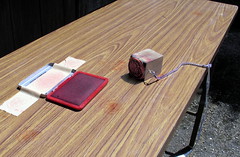
Like the aboriginies the Japanese feel themselves to have descended from a sacred land, created by the spirits in the dream time (mythic time of the Kojiki) and recieve their soul, their breath of life less from their father than from the local shrine spirit. In times past the totemic badge, or symbol which allowed Japanese to transform into living humans, whas a branch from a sacred tree, or a stone from a sacred river bed or mountain. Later, like the Churinga of the Australian aboriginal, and even far far more so, the totemic badges, or names of the Japanese evolved to encompas the use of ideographic language. The "primitive" totemists gradually moved with the times, and imported seals (such as shown in this photograph) from China. No longer did they get a sacred stone or branch from their local shrine, instead they got a piece of paper stamped with the seal of the shrine. These totemic badges live on in the form of Ihai for the dead, the tablets or fuda in household shrines, and the omamori that act as "migawari" or self-replacements, that most Japanese purchase at Shrines every new year.
But why do they need their sacred seals at all? Work in progress.
In the television series "Mirror Man," the hero goes into a mirror and comes back with an amulet. The symbols also seen in all the sumper sentai kamen rider (masked rider) and ultaraman tv programs from the land of the mirror are the meaningful images that allow japanese to identify with their mirror image. They are the images that are always the right way around. The images that have a third person perspective built into them as it were.
Transforming Symbols and Mirrors
Kamen Rider Decade's "Imagin" (Image people jin)
Kamen Rider Decade Mirror world where people are judged!
HImitsu no Akko's compact Mirror
Sailor Moon's compact mirror Chrisis Moon
Super Sentai Shinkenja-'s mirror writing
Super Sentain Shinkenja- inrou maru which shows your face until you insert the symbol, when it shows the super form.
Super Sentai Gaorenja- and the mother-like goddess like person that communicates by mobile phone while looking down through a relfecting surface of a pool of water.
Mirror Man's amulet and reflecting surface
Labels: culture, Jaques Lacan, manga, mirror, nihonbunka, occularcentrism, specular, Super-Sentai, superhero, 日本文化
Friday, January 15, 2010
Henshin Transformation Through The Ages

When Japanese superheroe transform they do not hide their true identity. They have a human identity but it is often no secret. If there is a secret, then their transformation serves to dispel secrecy, demonstrate a continuity, and reveal their true identity.
The transformation of Japanese superheroes often involves a sort of ritual. Heroes strike a specific pose, say a specific and individual trasnsformatory phrase, and or manipulate a symbol such as brandish a special card, or insert a speaking chip into a slot into their belt. Thus, Japanese superheroes transform, ontologically (please see previous post) after manipulating symbols in a codified way. Irrespective of whether or not there is an ontological change, the pose, invocation of the transformation phrase, and the manipulation of a concrete symbol, are the catalysts for the transformation.
A Typology of the mechanism of Heroic Transformation
The transformation (henshin変身) of Japanese superheroes is precipitated by the first three of the following elements or properies.
1) Transformation Pose
Japanese superheroes strike a pose to transform. Young Japanese boys often imitate these poses. Striking specific poses are popular in Japanese society. Like the "kata" of Noh performers, a "pose" often consists of a specific movement, which freezes, or almost freezes, into a specific bodily position. Japanese strike specified poses when they are having their photographs taken. Japanese baseball players strike specific poses when they come to bat (and not only Ichiro, the one legged stance of Sadaharu Oh is also immediately recognisable). Japanese comedians often have specific poses which draw laughs, such as Beat Takeshi's imitation of the attire of Nadia Comăneci , called the “Komanecchi" pose. Imagine Clark Kent, putting one fist to his chest and his other pointing up into the air.
2) Transformation Phrase
This phrase often designates the process of transformation, so the word "transform" (henshin変身) is commonly heard. Similarly, in the Tomika Rescue Fire series members all say "suits on” (chaku-sou) which is a name for the transformation itself. However, transformatory phrases are often individual and designate the being into which the hero is about to become. Thus the transformatory phrase is often sort of a self-naming. Imagine Clark Kent saying "Transform (me into) Superman."
3) Transformation Symbolic Artefact
Kamen Riders and the Tomika Rescue force used magnetic cards swiped into a reader on their belts. The Tomika Rescue fire heroes use a robot megaphone which on hearing the transformatory command (2) above. Super Sentai Go-Onger heroes insert a small electronic box that speaks certain phrases (called an "engine soul") which are also inserted into their belts. These same devices are used to transform their weapons and vehicles. Ultraman used a pen, spectacles, and even a toothbrush. These objects are signs comprising a physical signifying substrate and a significant, often linguistic, meaning. Taken together, imagine that Clark Kent must take out and present a Superman “S” sign, while performing a Superman salute, while shouting “Transform, Superman.”
4) Putting on a Super Suit
Western superheroes generally don a special costume when they transform. Batman is the "Caped Crusader." Clark Kent would be a strange sort of superhero without his Superman suit. A change in appearance is de rigueur for transformation into a Western style superhero. Japanese superheroes change their suits too but often from one super-suit, to another super equipped one. Further, this super-suiting-up, is the result of the transformation rather than its catalyst. In Japan, symbolic manipulations (posing, shouting, manipulating symbols) give rise to the change in appearance, rather than the change in appearance giving rise to the change to super-hero status.
Precidents
Japanese heroes use of symbols prior to transformation is nothing new. It is also a characteristic of the immensely popular Japanese "period dramas," viewed by adults, such as "Mitokoumon," "Touyama no Kin-san" and "MomoTaroZamurai." In all of these and more, just before the climatic fight or denouement, the heroes undergo a transformation precipitated by the manipulation and presentation of symbols.
Mitokoumon appears to be a harmless old man wandering the country with his companions. At crucial points in the narrative however, one of his companions takes out a badge and points to the seal thereupon, exclaiming “Stand down! Don't you see this seal!" ("Hikaero! konomondokoro ga me ni hairanu ka"控えろ!この紋所が目に入らぬかぁ"). The seal in question is that of the Shogun, indicating that the humble old man is in fact the Shogun's uncle. Mitokoumon and his entourage then proceed to fight, and dispatch a multitude of enemies with their swords.
Momotaro Samurai is similarly unassuming up to immediately prior to the sword-fighting scene where he strikes a pose, and announces his identity with a sort of poem about his origins. It transpires that he is in fact, like Mitokoumon, related to a feudal lord. His enemies quake at his name before Momotaro dispatches them with splendid, seemingly-bloodless, swordsmanship, and heavy handed music (itself another feature of this genre).
Touyama no Kin-san, another wandering would-be-harmless man, but this time a playboy, performs a double transition. Immediately prior to cutting up all but the most powerful of his enemies, he announces himself by showing his tattoos of a cherry blossom snowstorm. At the very end of the same episode however, when the leaders of the baddies kneel to receive judgement from the local feudal lord (?), the feudal lord bears his right shoulder exclaiming "Don't say you don't remember this cherry blossom," (この桜吹雪の刺青に見覚えがねえといわせねえぜ Kono sakura fubuki ni mioboe ga nee to iwasenee ze) at which point the baddies realise that he is none other than the "playboy" that dispatched their minions earlier with his sword, and that their fate is also sealed.
My wife used to wonder why no one attacked these heroes in that moment when they are performing their ritual. It is as if time freezes, all viewers stand agape.
These traditional period drama transformations are of the epistemological type popular in the West. The transformations are not ontological. The samurai are no better swordsmen as a result of their transformation. The transformation of Japanese period play heroes effects only what is known about them. However, in complete opposition to the cape wearing of Batman, the Caped Crusader, and the other super suits of Western superheroes, the transformation Japanese superheroes is always carried out in full view, and the symbols they use serve not to hide a secret identity but to inform enemies of their true identity, and to demonstrate its continuity.
Transformations preceded by Self-Referential Symbols in the Real Word.
Finally, in the real world, Japanese Samurai warriors were required to state their name before attacking their enemies. Before drawing their sword they said something like "I am Tanaka, a warrior retained by the enemy of your leader, Suzuki and I hereby challenge/attack you." While not preceding a transformation Japanese Yakuza were required to go and state their name, in a ritual self naming (knees bent, palm outstretch) to the heads of the Yakuza in the towns through which they pass. The self-naming of “Tora san” at the beginning of the Otoko wa tsurai yo (男はつらいよ, "It's tough being a man") is related to that tradition. While again there is no transformation, Japanese businessmen to this day get down to business after first manipulating their special symbol, their "meishi" or business card.
By Way of Conclusion
I am not at all sure what is going on, but from a structuralist perspective, the differences and similarities with Western heroes and their transformations seem to be systematic. Further in conformance with the Takemoto theory, I suggest that there is a topological shift in the visual-symbolic plane: Japanese superheroes use words and symbols to transform their appearance. Western superheroes use changes of appearance to transform their status and people’s perceptions of who there are.
I also compare the "symbolic transformation" of Japanese superheroes with the way in which Western monsters are outed by symbols, and Western love romances contain a symbolic outing, or declaration of love.
Labels: culture, henshin, japan, japanese culture, Jaques Lacan, nihonbunka, Super-Sentai, superhero, ultraman, 日本文化
Thursday, January 14, 2010
The Ontology and Epistemology of Superhero Transformations
Superheros transform.
Superheros have a tendency to transform, in some sense, the world over.
The transformation of Japanese superheroes has, in a matter of degreee at least, differences from that of those in the West.
Ontological or Epistemological transformation.
Western superheroes are more likely to transform by virtue of what is know about them, in the epistemological plane. Japanese superheros are more likely to transform in terms of what they are, in the ontological plane.
For example, Clark Kent is always super in his being. His transformation into Superman is an epistemoligical one, motivated only by the desire to protect his "secret identity." Clark Kent's being does not change. He is just as strong, just as super-powered, as Clark Kent as he is when he is Superman. Peter Parker likewise can be said to "transform" into Spiderman, but the change is purlely epstemological, one of cloaking, a change of appearance. Peter Parker is just as strong, just as super-powered, as Peter Parker as he is after he dons his spandex suit. His transformation is to protect the secrecy, the epistemoligical aspect of what people know about him. Bruce Wayne's transformation into Batman is predominantly epistemoligical, to protect his "secret identity" but thanks to the technology he dons, effects a change in his powers. His suit is not merely a charade, but change his ontology, who he is. Bruce Banner's epistemological identity as the Incredible Hulk is known to many in the films, but his being changes. He becomes far stronger. The X-men, such as Wolverine likewise transform in a predominantly ontological way. James Howlett or Logan is *known* by many, but not all, to be Wolverine. He changes predominantly in an ontological way; his body changes, he grows claws.
Japanese superheroes are far more likely to transform on the ontological end of the spectrum. The continuity of their two modes of being are more often not a secret. Epstemologically, the two modes of being are far more likely to be known as one and the same. Far more often, it is only their mode of being that changes. That Hayata is Ultraman is not so much a question of secrecy but of his mode of being. He changes at will to his superhuman form in order to fight, but not in order to keep a secret of who he is from day to day.
Many Japanese superheroes, such as those in the Super Sentai range, such as the Go-Onger five, make no secret of the fact that they are able to transform into their super-powered 'alter ego.' Even while human, they are in costume, they give away their identity completely. And yet they *transform*, ontologically, into a more powerful beings.
Labels: bug-eye, culture, Gao-Ranger, japan, japanese culture, Jaques Lacan, nihonbunka, Super-Sentai, superhero, 日本文化
Wednesday, January 13, 2010
Japanese Bug-Eyed-Superheroes Miming Speech
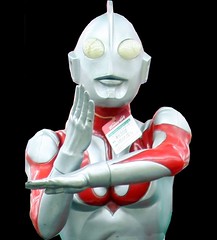
It has puzzled me for a long time why so many Japanese superheroes (Ultra-man, Kamen riders, Voltron or Golion, Go-Onger, Gao-ranger you name ‘em) have bug eyes, unmoving mouths, or no mouth at all and have a strong connection with mime.
I now have a theory about the connection between Japanese superheroes and mime.
Japanese superheroes make many gestures (see image right), like mime artists. And more, in a sense they also speak. But their mouths are always immovable. Often they do not have mouths at all. And yet they do speak: They mime speech!
Typicaly, a group of young males and one female strike poses, press buttons, or contact someone in heaven on a magical mobile phone, and change ("hensin") into a team of superheroes wearing colour coded wetsuits. Why should then even need to change into a super hero suit? There is no secret made of their identity. They then do stylised battle, reminiscent of badly choreographed pro-wrestling, with one or more wetsuited monsters, often with a conspicuously mobile jaw, in a car park.
As the superheroes fight they 'speak', or shout, encouraging each other. But where does their speech come from? Their mouths can not move, nor even open. They mime speech. They take out their magic mobile phones and put them to their motionless mouths. All eyes are focused toward the miming speaker.
In the mimicry of speech they are much like masked performers in the Noh Play. The body language of the players mimes speech to perfection, but the face does not move at all.
Nowhere is the mime aspect of Japanese superheroism more apparent than in the live stage shows performed for children. Performers in coloured mouthless wetsuits come on stage. Someone somewhere presses a button on a ghetto glaster, and off they go, miming their way through an Ultraman epic, never once saying a word, but all the while making it plain who is speaking.
The Japanese boys love it. They imitate the gestures, like the ultra-man laser beam pose above.
So why is miming speech so important?
According to Lacan the human self exists by virtue of two incomplete feedback loops: those provided by voice and vision.
We can look at ourselves in the mirror, but we can never see the minds eye. We can speak ourselves, but Lacan argues, the enunciated "I am" of self speech, never quite coheres with the self that would be saying it.
However, with two ways back to the self, we play a shell game, or two card monte, always satisfied that when the word does not hit the mark, we can see ourselves in a mirror. And when the mirror seems empty, we can call ourselves by name.
The problem remains however, in convincing ourselves that our speech comes from the same place as our mouth. Ventriloquists mime speech even with their lips. The people that we watch on television appear to be speaking when we know that the sound is coming from the speakers at the side of the box.
Sound and vision never come from the same place, but we get used to thinking that they do, and the scumble that links the two together, that overcomes the contradiction of a picture that is attached to words, is paramount in the production of self.
Japanese boys watch their superheroes mime speech. They know that, on the one hand, their heroes are not speaking. All the people at the show, everyone knows that Ultraman is dumb, that the emperor has no clothes. But the little boys also know that everyone loves and admires the superheroes and that everyone assumes that the superheroes are speaking. They learn that if they take up the mime too, then no one will out them, no one will ever say "Hey, you are only miming." Superheroes and humans mime speech. It is important that they do so.
But why the bug eyes? For me the bug-eyes of Japanese superheroes are seen but unseeing eyes. Their eyes are massive. Sometimes the Japanese superhero's face is all eye. But they have no pupils, no in-eye movement to suggest that they see. Their massive eyes emphasise their visuality, but with their lack of inner eye detail, it is though they can not see at all. These eyes are, I suggest, the eyes that stare at us from out of the mirror. Our eyes as reflected mirrors fascinate us, they draw our gaze, we attempt even to look into them, but we know that they are sightless.
As I have argued elsewhere, the Japanese are permanently in "the mirror stage" in that, by virtue of their training in and ability to take multiple visual perspectives upon themselves, they continue to identify with self as reflected. Growing up in an world of uninterrupted and loving gazes, mirror identification presents little problem for the Japanese. But in order to developed a self they must also integrate the voice, attach those vocal symbols to this reflection, and hence all this heroic speech-miming.
Addendum. Something similar should be going on in the West: there should be some attempt to link phoneme and imago being made. But in the West it is the identification with speech that is less fraught. Someone admirable and heroic should be 'speaking mime' rather than miming speech. Please see this post for an example of a Western hero It has puzzled me for a long time why so many Japanese superheroes (Ultraman, Kamen Riders, Voltron or Golion, Go-Onger, Gao-ranger, you name ‘em) have bug-eyes, unmoving mouths, or no mouth at all and have a strong connection with mime.
I now have a theory about the connection between Japanese superheroes and mime.
Japanese superheroes make many gestures (see image above), like mime artists. And more, in a sense they also speak. But their mouths are always immovable. Often they do not have mouths at all. And yet they do speak: They mime speech!
Typicaly, a group of young males and one female strike poses, press buttons, or contact someone in heaven on a magical mobile phone, and change ("hensin") into a team of superheroes wearing colour coded wetsuits. Why should then even need to change into a super hero suit? There is no secret made of their identity.
They then do stylised battle, reminiscent of badly choreographed pro-wrestling, with one or more wetsuited monsters, often with a conspicuously mobile jaw, in a car park.
As the superheroes fight they 'speak', or shout, encouraging each other. But where does their speech come from? Their mouths can not move, nor even open. They mime speech. They take out their magic mobile phones and put them to their motionless mouths. All eyes are focused toward the miming speaker.
In the mimicry of speech they are much like masked performers in the Noh Play. The body language of the players mimes speech to perfection, but the face does not move at all.
Nowhere is the mime aspect of Japanese superheroism more apparent than in the shows performed for children at Japanese festivals. Performers in bug-eye, multi-coloured mouthless wetsuits come on stage. Someone presses a button on a ghetto blaster, and off they go, miming their way through an ultra-man epic, never once saying a word, but all the while making it plain who is speaking.
The Japanese boys love it. They imitate the gestures, like the Ultraman laser beam pose above.
So why is miming speech so important?
According to Lacan the human self exists by virtue of two incomplete feedback loops: those provided by voice (or phonetic language) and vision.
We can look at ourselves in the mirror, but we can never see the minds eye. We can speak ourselves, but Lacan argues, the enunciated "I am" of my self speech, never quite coheres with the self that would be saying it.
However, with two ways back, two feedback paths, to the self, we play a shell game, or two card monte, always satisfied that when the word does not hit the mark, we can see ourselves in a mirror. And when the mirror seems empty, we can call ourselves by name.
The problem remains however, in convincing ourselves that our speech comes from the same place as our mouth. But we get used to it. Get used to thinking that sound and vision come from the same place. E.g. The people that we watch on television appear to be speaking the sounds, even though we know, if we think about it, that the sound is coming from the speakers at the side of the box.
Sound and vision never come from the same place, but we get used to thinking that they do, and the scumble that links the two together, that overcomes the contradiction of a picture that is attached to words, is paramount in the production of self.
Japanese boys watch their superheroes mime speech. They know that on the one hand their heroes are not speaking. All the people at the show, everyone knows that Ultraman is dumb, that emperor has no clothes. But the little boys also know that everyone loves the superheroes and assumes that the superheroes are speaking. They learn that if they take up the mime too, then no one will 'out them', no one will ever say "Hey, you are only miming." Superheroes and humans mime speech. It is important that they do so, and get away with it.
But why the bug eyes? For me, the bug-eyes of Japanese superheroes are seen but unseeing eyes. Their eyes are massive. Sometimes the Japanese superheroes face is all eye (Kamen rider Faizu/555). But they have no pupils, no in-eye movement to suggest that they see. Their massive eyes emphasise their visuality, but with their lack of inner eye detail, it is though they can not see at all. These eyes are, I suggest, the eyes that stare at us from out of the mirror. Our eyes as reflected mirrors fascinate us, they draw our gaze, we attempt even to look into them, but we know that they are sightless.
As I have argued elsewhere, the Japanese are permanently in "the mirror stage" in that, by virtue of their training in and ability to take multiple visual perspectives upon themselves, they continue to identify with self as reflected. Growing up in an world of uninterrupted and loving gazes, mirror identification presents little problem for the Japanese. But in order to develope a self they must also integrate the voice, attach those vocal symbols to this reflection, and hence all this heroic speech-miming.
Something similar should be going on in the West: there should be some attempt to link phoneme and imago being made. But in the West it is the identification with speech that is less fraught. So someone Western, admirable, and heroic should be 'speaking mime' rather than miming speech. I guess that this has something to do with the secret identities of Western Superheros, but for the time being, I don't know what "speaking mime" is.
Addendum. please see the next photo in my photostream. I think that "speaking mime" (the Western equivalent to the mimed speech we see Japanese superheros perform) is all the thought bubbles that we are able to see in Western superhero comics, and all the "hard boiled," coming-from-no-where, narrative that accompanies Western detective movies especially. In the West, the narrative pervades, it is the centre, the truth of the secret identityspeaking his mime
I think, therefore I am Batman.
PPS: Just after writing this I saw the trailer for Avatar, where a super-hero kinda guy controls an "Avatar" by remote control and feel like I am chanelling James Cameron.
Labels: Bandai, Bokenger, bug-eye, culture, eye, Gao-Ranger, go-onger, japan, japanese culture, Jaques Lacan, mime, nihonbunka, Super-Sentai, superhero, ultraman, 日本文化
Tuesday, January 05, 2010
Gattai! Merge!

"Gattai!" the Japanese word for "coalescence", or "merge!" is a common refrain in a number of cartoons/anime for 3 to 7 year old, predominantly male, Japanese children.
Usually, the heroes, or cars, whatever, meet a foe that is too strong for anyone of them to beat, so they shout "Gattai!" and merge together to form a super-unity to vanquish that foe.
My son is into the Tomika Heroes anime called "Rescue Fire," (previously Rescue Force?) in which usually 3 members of a team board vehicles that link together to form one larger, super, powerful vehicle. In fact their cars are stored in trucks, and it is the trucks that then merge to form the Rescue Fire Dragon, I think. There is a detailed article about the series on wikipedia. It seems that the enemy "gattai" too.
The "gattai" phenomina is not limited to this series. In many many children's anime over the years, cars and other vehicles, or even animals I think, link together to form a super unity, a robot, or super-life form. Teams of superheroes merge to form one body, with a clarion call of "Gattai!" In all cases, it really gets the viewers going. Ray's eyes light up, in an extasy of gattai-ing. What is going on?
There is the theory that this is something to do with sex. The trucks look a bit like they are at it, a la canine.
Can a prepubescent realisation of the physical nature of the libido be the root cause of the fascination with "Gattai!"? Is the fascination purely "libidinal"?
I don't think so.
For one thing, in many of these anime the merging beings are often of the same sex. I don't think that the viewers are gay, nor do I think that they are unaware of the sexual (i.e. male-female) nature of much sex. This is not sex. My son is (I am not bragging) one hundred percent hetrosexual, even at three. He has girlfriends. He finds girls attractive.
But the refrain of "Gattai" in this genre of cartoon/anime often or usually occurs when more than one male entity merges.
To cut a long story short, I wonder whether this joyful occurence represents the solidification, or merging of the parts of the self. I am not sure what these parts are. But it seems to me that the self is multi-parted. The games that these youngesters are playing may represent their glee, their desire for and achievement of coalescence. There may still be a libidinal element, but I think that the coalescence is intra-psychic.
That is just a guess. The "Gattai" phenomena is a myth of our times. It is profound.
Do American cartoon characters Gattai?
Labels: Bandai, Bokenger, culture, Gao-Ranger, henshin, japan, japanese culture, nihonbunka, Super-Sentai, superhero, 日本文化
This blog represents the opinions of the author, Timothy Takemoto, and not the opinions of his employer.