
Wednesday, November 02, 2016
Book Personification in Japan and America
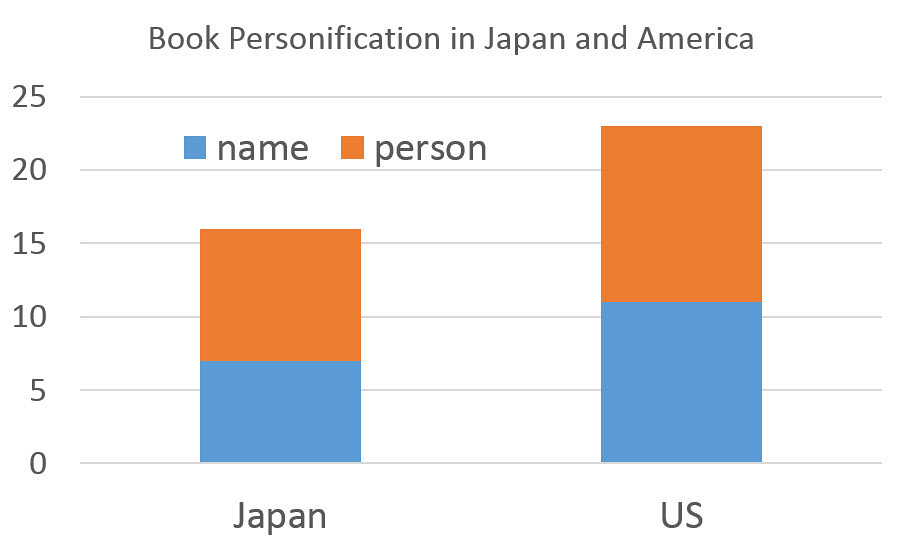
Marius Brill, an author who was in my class at primary school wrote "Making Love: A Conspiracy Of The Heart" about a book that is alive and speaks. I read it and thought that, at the very least, the idea of a living book about love was excellent. Bearing in mind that Westerners tend to have a "narrative self" (Bruner, Hermans and Kempen, Gottshcall, Denett and many others) believe themselves to be "the hero of their own self narrative" (Nisbett, in conversation) and come from a religious tradition in which "the Word was made flesh and dwelt amongst us", and that our lives are recorded in the book of Saint Peter, the personification of books is not without precedent. In Japan however, I argue the self is that which is portrayed by a mental manga, movie, or animation, centring upon the face or mask (Watsuji), the main God is a mirror made heart, and the Japanese version of St. Peter (Lord Enma) keeps only the names of the dead in his book; their lives recorded on a DVD-like mirror, and masks and statues are more often personified or animated. To test the hypothesis that Westerners would be more likely likely to personify books than Japanese I googled "top 100 English novels" choosing the top of the list and counted the number of books with then name of an individual (such as the first two on the list Ulysses and "The Great Gatsby) and people (such as "Sons and Lovers") and similar such titles in a list of 100 Japanese novels to find that yes, there are more personified Books in the Western tradition. There are quite a lot of personified novels in Japan too such as Bocchan, and the Dancer from Izu resulting in a non significant trend (Chi Squared p <.1).
Labels: blogger, japanese culture, japaneseculture, nihonbunka, 日本文化


Friday, October 28, 2016
Japanese Trick
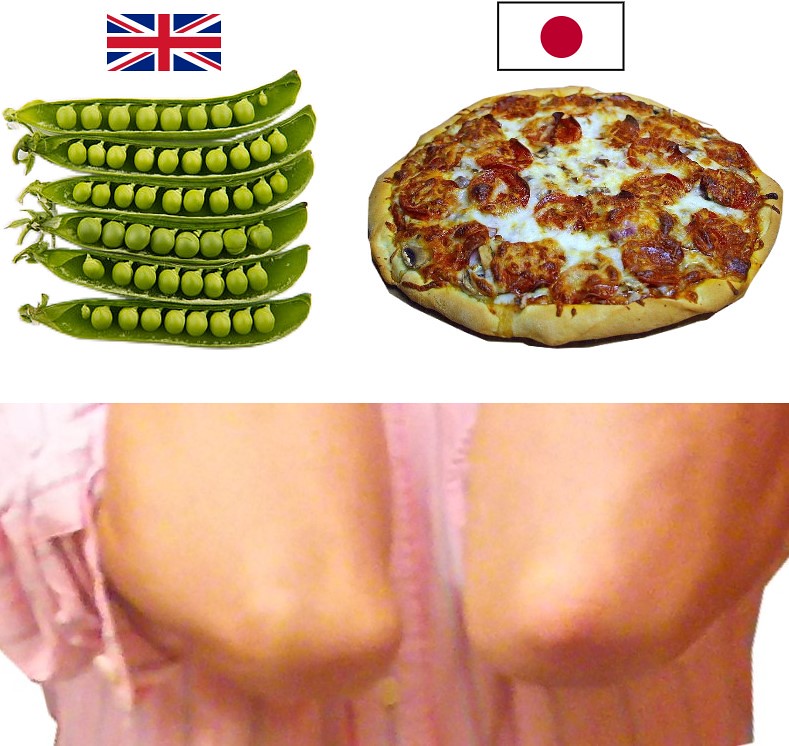
Name the food item below your flag, saying it aloud, ten times and then name the body part in the lower part of the picture. The Japanese for pizza (piza) rhymes with the Japanese for knees, and since elbows somewhat resemble knees in appearance and the word for knees and elbows is simiilar (hiza and hiji respectively), Japanese who have been made to say piza ten times are inclined to call their elbows knees. I don't think that even if a Briton were asked for say peas one hundred times before naming the body part they would ever call their elbows knees and not only because the two words are less similar but also because their is a greater phoneme to meaning connection felt by anglophones, compared to Japanese who feel meaning to be conveyed more strongly by images.
Labels: blogger, japanese culture, japaneseculture, nihonbunka, 日本文化
The Japanese Hate Puns
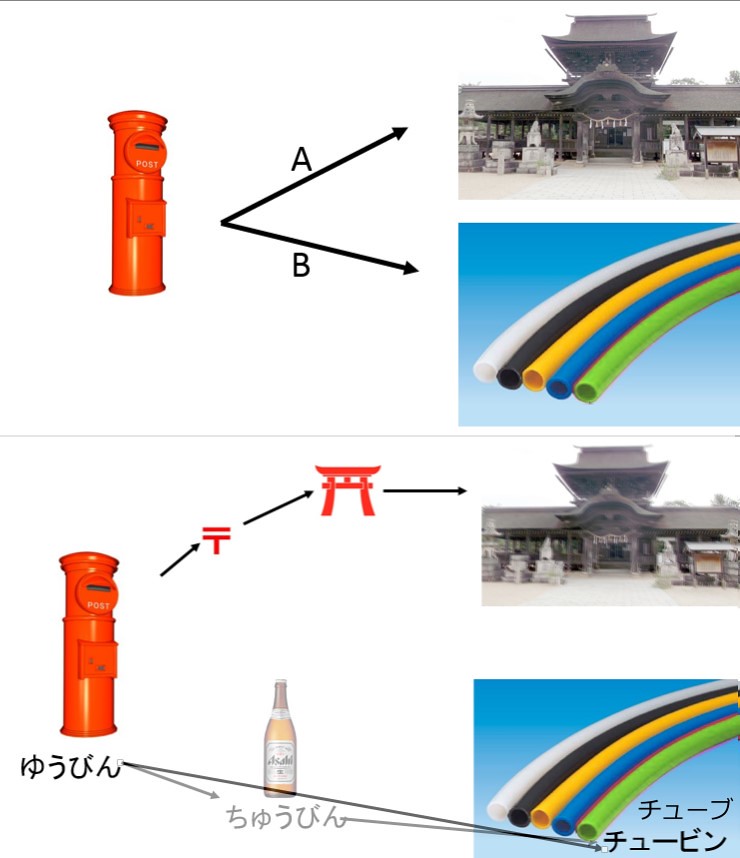
I used to marvel at the fact that one of the most famous brands of watch in Japan is a pun on coitus (Seikou) among a variety of other things. To the Japanese it is not the slightest bit notable nor amusing. There are too many homonyms and puns in the Japanese language for anyone to find them funny. Meaning is expressed by pictorial characters more than phonemes and many of these characters are read with the same phoneme so unless one calls to mind the character the phoneme is polysematic by itself. Making sequences of assocations to test the hypothesis is very difficult to make associations that do not run along more than one, both linguistic and visual, line. The linguistic association post box (yuubin posuto) to some tubing (chuubin) either vian a mid sized bottle (chuubin) to tube (chuubu) or not, could also be made visually and directly due to the fact that a post box is tubular. I am not sure if anyone else would associate the post office mark with the mark for shrines. And the post box could be associated directly with the shrine as both being associated with the Japanese state: as an instantiation of what was Japan post and the Japanese state religion. In any event, punning associations are likely to be weak in Japan. Japanese people generally just cringe when jokes are attempted with puns. Images from the Google image search. お取り下げご希望の場合は下記のコメント欄か、http://ift.tt/2doaLKR
Labels: blogger, japanese culture, japaneseculture, nihonbunka, 日本文化
Pizza Elbow Japan

It is my view that the Japanese mind may in fact have a stronger network of visual associations shown bottom left such that I hypothesise that pizza would be felt to visually resemble the Japanese flag, which is in turn associated with a map of Japan so, there is an indirect visual association between pizza and the shape of the Japanese archipelago. I hypothesize that these visual associations would be stronger than the former linguistic associations among Japanese compared to Westerners, but this would be difficult to prove since the same linguistic associations could not be made.
Instead of the elbow, an anglophone might be asked if they associate the pizza with a fridge symbol using the association by rhyme of pizza -> freezer and the association by first letter and physical similarity freezer -> fridge. But then pizza is kept in a fridge so even if anglophones chose it they might be doing so due to holistic associations of visual contiguity. I think I would need to use Japanese subjects and some sort of priming manipulation of culture.
The pizza elbow connection is used by Japanese school boys in a sort of trick where the victim is asked to say pizza ten times before being asked the name of the elbow, which instead of calling a hiji (elbow) is inclined to call a "hiza" having been influenced by the repetition of pizza (piza in Japanese). I think that this trick works also shows that Japanese are fairly insensitive to phonetic semantic connections. If I were told to repeat "pea" ten times I would not call my elbow my knee.
お取り下げ後希望の場合は下記のコメント欄か、http://nihonbunka.comで掲示されるメールアドレスに誤一筆ください。Should the owner of the copyright of the thumbnails used above wish that I stop using them then please be so kind as to drop me a note in the comments below or to the email link on my website nihonbunka.com
Labels: blogger, japanese culture, japaneseculture, nihonbunka, 日本文化
Pizza Elbow Japan
It is my view that the Japanese mind may in fact have a stronger network of visual associations shown bottom left such that I hypothesise that pizza would be felt to visually resemble the Japanese flag, which is in turn associated with a map of Japan so, there is an indirect visual association between pizza and the shape of the Japanese archipelago. I hypothesize that these visual associations would be stronger than the former linguistic associations among Japanese compared to Westerners, but this would be difficult to prove since the same linguistic associations could not be made.
Instead of the elbow, an anglophone might be asked if they associate the pizza with a fridge symbol using the association by rhyme of pizza -> freezer and the association by first letter and physical similarity freezer -> fridge. But then pizza is kept in a fridge so even if anglophones chose it they might be doing so due to holistic associations of visual contiguity. I think I would need to use Japanese subjects and some sort of priming manipulation of culture.
お取り下げ後希望の場合は下記のコメント欄か、http://nihonbunka.comで掲示されるメールアドレスに誤一筆ください。Should the owner of the copyright of the thumbnails used above wish that I stop using them then please be so kind as to drop me a note in the comments below or to the email link on my website nihonbunka.com
Labels: blogger, japanese culture, japaneseculture, nihonbunka, 日本文化
Thursday, October 27, 2016
No Need to Hear What They are Saying
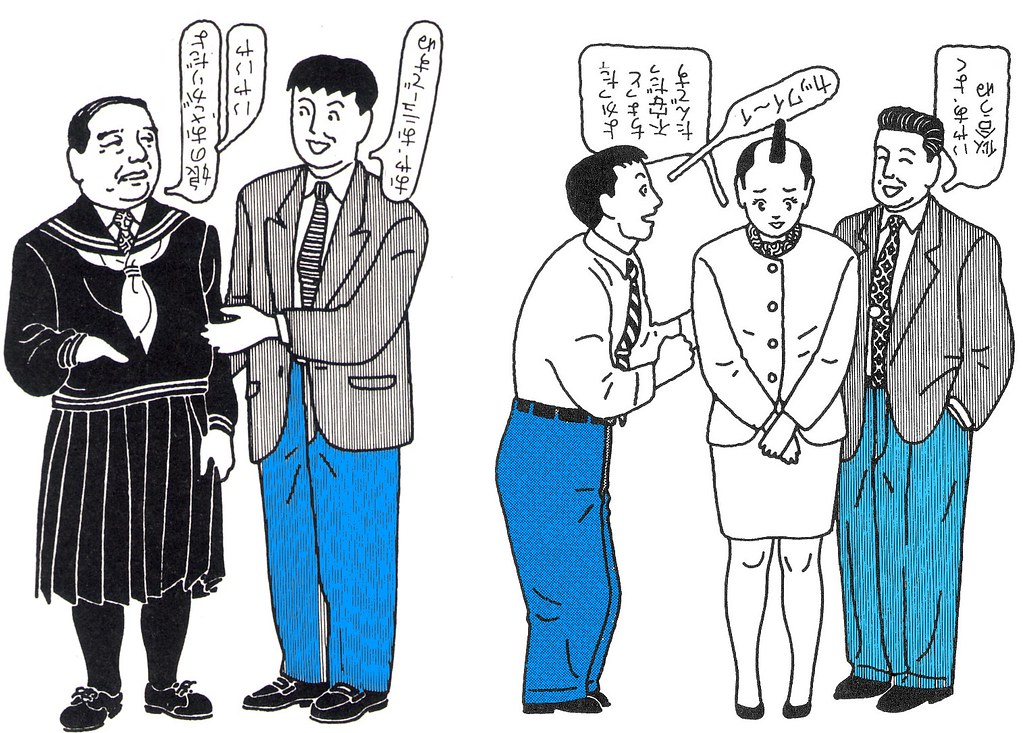
I confess that I am still inclined to say "thank you," and accept the linguistic content as if it were meant sincerely, socially inept as I am.
Images originally in black and white by Michio Hisauchi in Ishihara, 2006, p21 and p23
お取り下げご希望の場合は下記のコメント欄か、http://nihonbunka.comで掲示されるメールアドレスにご一筆ください。
Bibliography
Barthes, R. (1983). Empire of Signs. (R. Howard, Trans.). Hill and Wang.
Hall, E. T. (1976). Beyond Culture. Anchor Press.
Hendry, J. (1995). Wrapping Culture: Politeness, Presentation, and Power in Japan and Other Societies. Oxford University Press, USA.
Ishihara, S. 石原壮一郎. (2006). 大人養成講座 (PB版). 東京: 扶桑社.
McLuhan, M., & Fiore, Q. (1967). The Medium Is the Massage. JSTOR. Retrieved from www.jstor.org/stable/30217390
Labels: blogger, japanese culture, japaneseculture, nihonbunka, 日本文化
Wednesday, October 26, 2016
Reading the Customers Mind
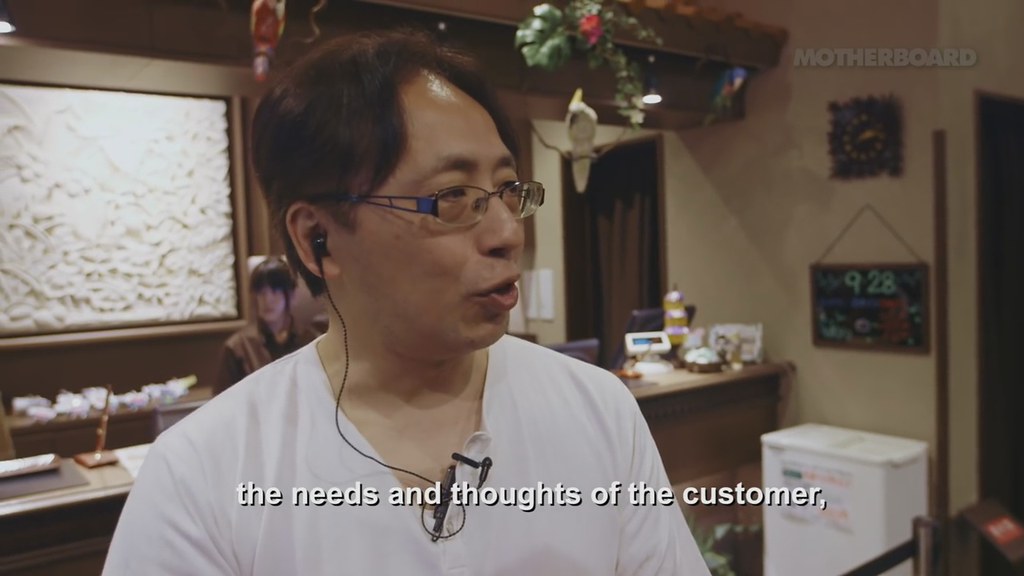
A Japanese capsule hotel manager, Akikazu Fukumoto, explains the essence of Japanese style hospitality (omotenashi) and why it would be impossible to replace his staff with robots in two sentences,
at the three minute mark in a video on robot staffed hotels in Japan by Motherboard.
My translation (for the original Japanese see below)
"Our hotel has the heart of Japanese hospitality (omotenashi no kokoro) and must therefore be staffed by humans. Our staff must be human because we behave proactively anticipating the thoughts and needs of the customer. "
The Motherboard translation is slightly off the mark since the hotelier does not "respond" to the needs and thoughts of the customer but pre-empt -- saki mawari, literally go around in front of -- them. If it were merely a case of "responding" to the needs and thoughts of their guests, the hotel could wait for the guests to express them verbally, and use robots, or untrained staff working to a manual, as is the case in Western style, customer makes overt choices, "help yourself" (Doi, 1973, p.13) hospitality.
Japanese hospitality is, when it works, a sort of "mirror dance" (Krieger, 1983) where the providers read the minds of their customers via their faces and behaviour, adjusting their own behaviour on the fly accordingly.
Contra what I have written elsewhere however, this hotelier seems to be implying that the thoughts of the customer are not expressed by their behaviour but come afterwards, perhaps in linguistic form. At its most effective, Japanese hospitality should preempt, and even prevent, the arrival of such thoughts by satisfying the need before the thought arises. The manager also mentions however, a "heart" (kokoro) that exist prior to the thought, at least in the hotelier. This Japanese heart has traditionally been refereed to as a mirror such as in the preface to the record of ancient matters (Kojiki).
Bibliography
Doi, T. (1973). The Anatomy of Dependence. Kodansha USA.
Krieger, S. (1983). The Mirror Dance: Identity in a Women’s Community. Philadelphia: Temple Univ Press.
うちのホテルにはおもてなしの心があるんで、人間じゃないとだめです。お客様のほしいこと、もしくは思っていることを先回りして考えてこうどうするんで、やっぱりおもてなしのこころは人間じゃないとだめだと
The "please help yourself" that Americans use so often had a rather unpleasant ring in my years before I became used to English conversation. The meaning, of course, is simply "please take what you want without hesitation," but literally translated it has some a flavour of "nobody else will help you," and I could not see how it came to be an expression of good will. The Japanese sensibility would demand that, in entertaining, a hose should should sensitivity in detecting what was required and should himself "help" his guests. To leave a guest unfamiliar with the house to "help himself" would seem excessively lacking in consideration. This increased still further my feelings that Americans were a people who did not show the same consideration and sensitivity towards others as the Japanese. As a result, my early days in American, which would have been lonely at any rate, so far from home, were made lonelier still. (Doi, 1973, p.13)
Labels: blogger, hospitality, japanese culture, japaneseculture, nihonbunka, 日本文化
Tuesday, October 25, 2016
Life Expectancy vs Health: A Liars Paradox
Life Expectancy vs Health: A Liars Paradox
It is quite difficult to get objective data about the well being and health of a nation. In research on perceived well being (Cummings, 1998) based upon Licket scaled linguistic tests developed by Diener (Diener, Emmons, Larsen, & Griffin, 1985), the Japanese are found to be among the most unhappy people in the world. There are a number of reasons for this. The reference group effect (Heine, Lehman, Peng, Greenholtz, 2002) encourages respondents to compare themselves to their ingroup peers, so if those surrounding the subject are happy it is going to be difficult to rate oneself as of above average well-being or happiness. And further, while Asians tend to be humble, Westerners tend to "self-enhance."
Alas however, despite the lack of reliability of self-report measures, the prime minister of Japan (Abe, 2013) is alarmed by the fact that Japanese children do not, like American children, self-report that they are "proud of their country. The lack of pride of the Japanese is seen as cause for concern.
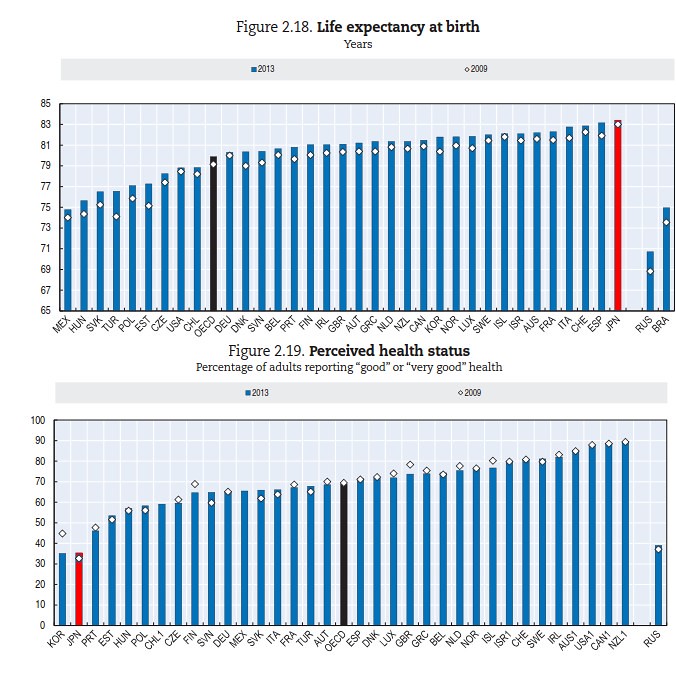
But the results to these self-report surveys should in my view be ignored. One of the most obvious ways to out the lack of veracity of the self report data is to compare life expectancy with self-reports of health. The Japanese have the highest life expectancy of any country in the OECD survey, but together with their Asian neighbour, the lowest response in rates of "good" or "very good" in answer to "“How is your health in general?”
That 35.4% of the Japanese report themselves to be in the top two categories of a five point scale is within 4.6% of the level that it should be assuming realism and an honest, parsimonious, even distribution of people responding with each of the five categories. More than 80% of people from the top four anglophone countries, however, find it meaningful to say that their health is "good" or "very good". What does "good" or "very good" mean to these people? It is clearly not an expression of the true state of their health. I suspect it is self encouragement, or auto-eroticism as Derrida (1976) likes to call it. In the Christian tradition pride was thought to be the origin of or equivalent to sin(Hastings, Mason, & Pyper, 2000) but these days positivity is king.
All these self-report scales should indicate is that the Japanese do not lie about their happiness and health. Alas there are many Japanese who believe the data, and believe that they are as a nation, living a long time in poor health compared to other nations. Concerned at these results Japanese children, and adults, are being encouraged to rate themselves more positively. The whispering is being imported to Japan.
Graphs from p.72 OECD (2015) How's Life? 2015 Measuring Well-being DOI:10.1787/how_life-2015-en
Bibliography
Abe. S., 安倍晋三. (2013). 新しい国へ 美しい国へ 完全版 (『美しい国へ』増補・再編集・改題書版). Tōkyō: 文藝春秋.
Cummins, R. A. (1998). The second approximation to an international standard for life satisfaction. Social Indicators Research, 43(3), 307–334. Retrieved from link.springer.com/article/10.1023/A:1006831107052
Derrida, J. (1976). Of grammatology, trans. G. Spivak. Baltimore: Johns Hopkins University.
Hastings, A., Mason, A., & Pyper, H. (2000). The Oxford Companion to Christian Thought. Oxford, England: Oxford University Press.
Heine, S. J., Lehman, D. R., Peng, K., & Greenholtz, J. (2002). What's wrong with cross-cultural comparisons of subjective Likert scales?: The reference-group effect. Journal of personality and social psychology, 82(6), 903.
Labels: blogger, japanese culture, japaneseculture, nihonbunka, 日本文化
Friday, October 14, 2016
Homicide in Japan
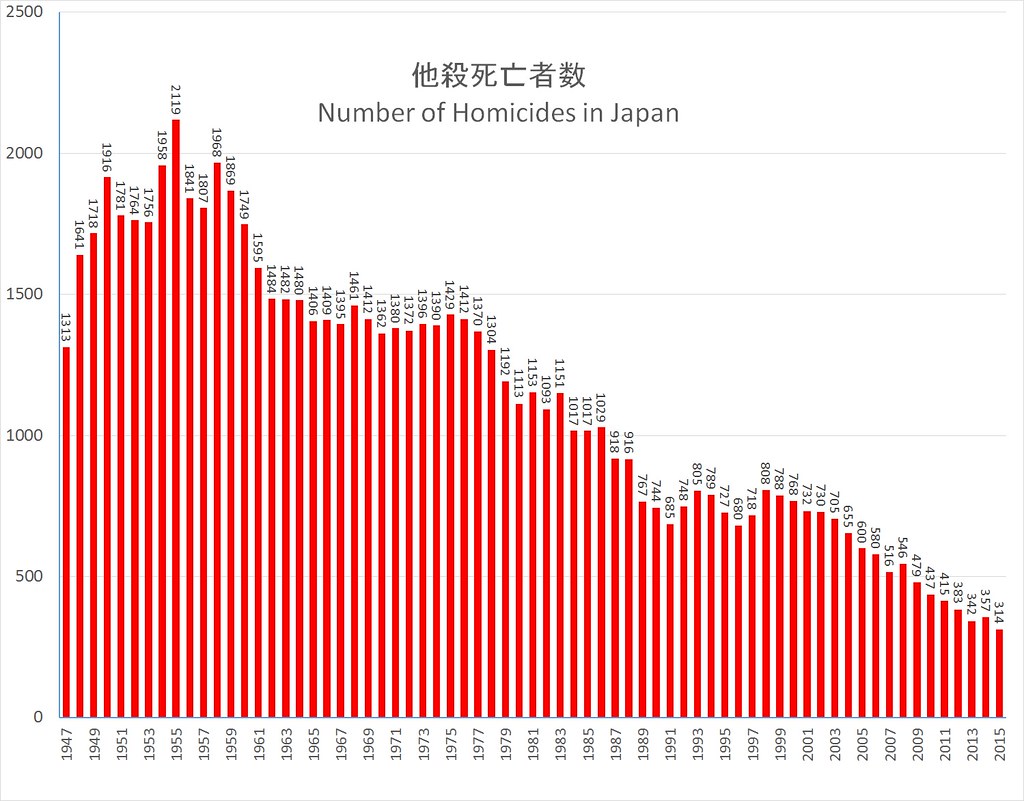
Japanese media, and indeed media around the world, become more effective in selling their products by alarming their audience, there is a tendency to believe that things are falling apart and that for instance, there is increased violence. In Japan the level of homicide has dropped by about 70 percent in the time that I have been here. Looking at Intentional Homicide Rates, Japan is now at a level bettered only by Andorra, Monaco, San Marino and Iceland. The next non small Island or City state of Austria has a muder rate almost twice that of Japan. In the UK the rate is about 3 times that of Japan and in the US thirteen times.
Labels: blogger, homicide, japanese culture, japaneseculture, murderrate, nihonbunka, 他殺, 推移, 日本文化
Wednesday, October 05, 2016
Shinto Prayer and the First Person Self

Japanese people traditionally prayed at Shinto shrines without words, but by bowing deeply twice, clapping twice, and bowing once again.
The bow before a shrine, and the spirit within it, is the most formal of bows otherwise reserved only for extremely respected persons, where the torso is brought to within 90 degrees of the legs. This is not quite as radical, perhaps, as a Tibetan Buddhist and Muslim prostration in which one brings ones forehead into contact with the ground but, first of all, it encourages those at prayer to feel humility which, at least in Japan, is generally thought to be a good thing.
The clapping part of the Shinto prayer struck me as a reminder of the fact that not only can I whisper (think) and speak but I can make noises with my body, so thus draws me away towards an active awareness of the autonomy of my embodiment: look, your body, your hands too speak.
But now it occurs to me that Shinto prayer may be a way of encouraging an awareness of the first person self: the self which sees itself.
As I often point out, there are a large number of scholars that emphasise the need for an intra-psychic other in order to be aware of self. In the words of many social scientific researchers we take in the perspective of another (Haidt, 2001; Hermans & Kempen, 1993; Markus & Kitayama, 1991; Mead, 1934/1967) such as when we address our thoughts to absent friends. This phraseology emphasising the interiorisation or internalisation of something sounds natural and persuasive.
Rochat (2009) however points out that the adult self, as represented by the pronoun "I" or as seen as reflected in the mirror, is a self for others: a "third-person self". The me in the mirror is not anything that I will ever see on this side of the glass, but only something that others can see. And though we use a different pronoun for "I" as opposed to "me," as Mori points out unless there is a "third person" the "I" is a "you for you," an explanation of me, for others. Though both are only representations, we get used to thinking that we are one or the other. Usually in the West we tend to identify with the hero of our self narrative as many scholars (e.g. Dennet, 1992) attest despite the fact that it is becoming plain that our self-narrative, this whispering that we listen to, is not "will" but an excuse after the event (Nisbett & Wilson, 1977).
Rochat (2009) takes a different view. He reminds us that children have a first person self prior to their third person representations of themselves. That is to say that we can hear, see, and touch ourselves, and in all cases become aware of our movements and distinguish between self originating movement - the double touch, sound variations that we have created, closed circuit videos - and other generated movement -- the single touch by another object, sounds created randomly, delayed movements on video tape. Rochat argues that our adult sense of self arises out of a "negotiation" between these two self positions. That is to say that the first person self remains, and it is from this perspective from which our third person self-representions are seen and heard.
In other words it less that we take the perspective of others into our heads as it were, or internalise, introject, internalise a mode of others in our minds, but really that we extroject a model of ourselves (as narrative and image) and forget the first person self that is watching.
How might we become aware of this first person self (assuming we want to)? I have suggested wearing spectacles, looking at ones nose, and touching ones face.
It also seems to me now that Shinto prayer encourages the worshipper to become aware of their first person self. Bowing deeply we see our own legs. Clapping we see our hands, their movement, their "double touch" as palms meet, and their self-created clapping sound. By so doing perhaps we remember just a little, the giant that we have forgotten is staring out of our eyes.
Perhaps I could use bowing and clapping as independent variables, or take up Shinto again.
Labels: blogger, japanese culture, japaneseculture, nihonbunka, philob, 日本文化
Friday, September 16, 2016
Cleaning Products Unstolen

Cleaning Products Unstolen
In many of the toilets in my university there are cupboards about half the size of a toilet cubicle containing cleaning products and utensils and toilet paper, the latter at the very least being of value to to university students. When it comes to thievery, as note by visitors to Japan since the Edo period(Bird, 1880; Cocks & Thompson, 2010; Coleridge, 1872; Golovnin, Rīkord, & Shishkov, 1824; Golovnin & Shishkov, 1819), the Japanese are the mist scrupulous people in the world.
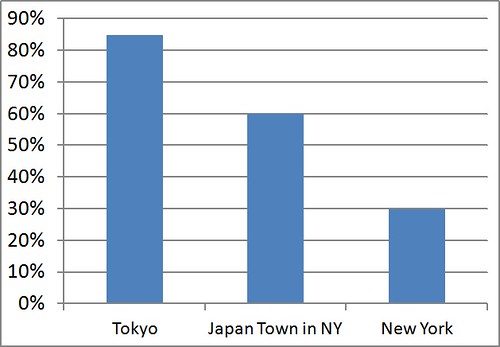
This scrupulousness extends to lost property where research has found that Tokyoites were for instance three times more likely than New Yorkers to return wallets containing money to the police (17 of 20 wallets in Tokyo, 6 of 20 in the Big Apple, see West, 2003 and the image above based upon Table 1, p. 374). Alas Japanese scrupulousness does not necessarily extend to all things, especially on occasion to speech acts which are assessed on their imagined consequences. I wonder if there is a way of creating a phonetic version of the Milgram Lost Letter experiment(Milgram, Mann, & Harter, 1965) to test Japanese verbal integrity.
In any event the Japanese are very kind in all ways towards visitors.
Bibliography (all online)
Bird, I. L. (1880). Unbeaten Tracks in Japan: An Account of Travels in the Interior Including Visits to the Aborigines of Yezo and the Shrines of Nikkô and Isé. J. Murray.
Cocks, R., & Thompson, E. M. (2010). Diary of Richard Cocks, Cape-Merchant in the English Factory in Japan, 1615–1622: With Correspondence. Cambridge: Cambridge University Press.
Coleridge, H. J. (1872). The life and letters of St. Francis Xavier : in two volumes. Asian Educational Services.
Golovnin, V. M., Rīkord, P. Ī., & Shishkov, A. S. (1824). Memoirs of a Captivity in Japan, During the Years 1811, 1812, and 1813: With Observations on the Country and the People. H. Colburn and Company.
Golovnin, V. M., & Shishkov, A. S. (1819). Recollections of Japan: Comprising a Particular Account of the Religion : Language : Government : Laws and Manners of the People : with Observations on the Geography : Climate : Population and Productions of the Country : to which are Pre-fixed Chronological Details of the Rise : Decline : and Renewal of British Commercial Intercourse with that Country.
Milgram, S., Mann, L., & Harter, S. (1965). The Lost-Letter Technique: A Tool of Social Research. Public Opinion Quarterly, 29(3), 437,438. Retrieved from http://www.communicationcache.com/uploads/1/0/8/8/10887248/the_lost-letter_technique-_a_tool_of_social_research.pdf
West, M. D. (2003). Losers: recovering lost property in Japan and the United States. Law & Society Review, 37(2), 369–424. Retrieved from bem.law.ui.ac.id/fhuiguide/uploads/materi/mark-d-west.......
Labels: blogger, japanese culture, japaneseculture, nihonbunka, 日本文化
Thursday, August 25, 2016
Abe and the Medallists

Labels: blogger, Flickr, japaneseculture, nihonbunka, 日本文化
Tuesday, August 09, 2016
Japanese Deities and Japanese Minds
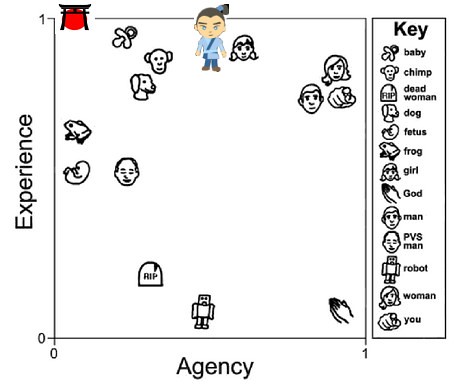
Is the mind of a robot, dog, or God something that (1) experiences pleasure and pain, and or (2) has agency in the sense of having the ability to 'think and plan'? Western respondents situated the abilities of their own other minds as shown in the image (adapted from Wegner and Gray, 2016, p7) above.
At the recent International Association of Cross Cultural Psychology conference in Nagoya, professor Yoshihisa Kashima introduced research (Kashima & Bain, 2016) using criterion for mind similar to that of Wegner and Gray (2016).
It seems to me however, that the Japanese see mind in a different way. The Japanese are famous for not planning but reacting to their environment so I think that that they would rate their own minds, according to these criterion, somewhere near the mind of the Western girl (see blue Ninja in the diagram above, added by me). Japanese deities are perhaps 'pure experience' (Nishida, 1992; see shrine gate and mirror icon added top-left by me), only acting when asked**. Japanese deities do not try to interfere, but watch over and protect the Japanese. Their protection is intentional but this intentionality is reactional, and not planned. The 'divine wind' that was felt to protect the Japanese from Mongol invasion was reciprocal to the launch of the Mongol invasion fleet. The watching and protecting (mimamoru) deities have no intrinsic intention to sink ships, but at the same time the ship sinking was quite deliberate.
Planning, future-intent, agency and analytic thought are things that occur when humans are unhappy. Humans whisper to themselves about a better future that they would like to get. The Japanese, being a happy lot, do such analytic thinking a lot less often. The Japanese use their minds, which are at one with their bodies (Yuasa & Kasulis, 1987) for other things.
In particular the Japanese minds use their "mirror neurons" to attend to the behaviour and bodies of themselves (Takemoto, 2012; Hino, 2016) and others. Japanese thinking and agency is typified by a form of visual, atemporal yet spatio-intentional visual attention and intervention, expressed by such words as "omoiyari" (do-thinking, where think, omou, takes a visual object), "kikubari," (share out spirit) "mekubari" (share out one's eyes), and "kitsukai," (use ones spirit). As a group these modes of Japanese thought might be termed 'proactive sympathy'.
Had the Japanese been asked the ability of other minds to perform proactive sympathy, animals may be ranked right up there near the Japanese. If the Japanese had any knowledge of Western minds then, alas, they might rate our ability to perform proactive sympathy somewhere near the level of the "dead woman"* (see image above). All our whispering to ourselves has made us blind.
Notes
*It is apt that the diagram above includes the mind of a "dead woman" in view of the fact that the Western mind is inhabited by a dead woman (Abraham & Torok, 2005; Derrida, 2005).
**This is not entirely true. Some Japanese deities intentions in the sense of teleological propensities. Aragami, or wild spirits, such as Susano no Mikoto, do act bringing about calamity unless they are appeased and pacified. Japanese leave rice and rice wine at their shrines. Since Yahweh is felt to be pure intent, and encourages His followers to sacrifice not rice or sake, but themselves, is He the ultimate 'wild spirit'?
Bibliography
Abraham, N., & Torok, M. (2005). The wolf man's magic word: A cryptonymy (Vol. 37). U of Minnesota Press.
Derrida, J. (2005). Foreward to The wolf man's magic word: A cryptonymy (Vol. 37). by Abraham, N., & Torok, M. U of Minnesota Press.
Kashima, Y & Bain, P. (2016, August, 3) "On Cultural Conceptions of Human-Nature Relationship." International Association of Cross Cultural Psychology Conference. WINC Conference Center, Nagoya, Japan.
Nishida, K., Abe, M., & Ives, C. (1992). An inquiry into the good. Yale University Press
Takemoto, T. (2002). 鏡の前の日本人. In 選書メチエ編集部, ニッポンは面白いか (講談社選書メチエ. 講談社.
Wegner, D. M., & Gray, K. (2016). The Mind Club: Who Thinks, What Feels, and Why It Matters. Viking.
Yuasa, Yasuo, and Thomas P. Kasulis. The body: Toward an Eastern mind-body theory. Suny Press, 1987.
Hino, A. 日野晃. (2016). 新世紀身体操作論【考えるな、体にきけ! 】本来誰もに備わっている“衰えない力"の作り方! BABジャパン.
Labels: blogger, Flickr, japaneseculture, nihonbunka, 日本文化
Monday, June 27, 2016
Sooth Pilgrimage
Labels: blogger, Flickr, japaneseculture, nihonbunka
Tuesday, June 07, 2016
US Doctors are Harder than Salary Men

Labels: attitudes, blogger, fever, Flickr, health, japaneseculture, work
Tuesday, May 17, 2016
Images of Japanese People

As reported in the Softbank Group's online news paper (ITmedia, 2012), the Japanese advertising and public relations company, Dentsu asked 3772 non-Japanese in 16 regions what they thought of the Japanese.
ソフトバンのオンライン新聞(ITmedia, 2012)電通が16地域の3772人の外国人に日本人に対して持たれているイメージを調査しました。
The results given above show that words associated with the Japanese are predominantly positive despite the fact, it seems to me, the Japanese pay little attention to public relations. Positive associations, such as "creative" were strongest in South East Asian countries, where, I presume, there is especially high consumption of Japanese produced media, such as popular music and manga. Despite the fact that these positive images I rather fear that the Japanese are going to throw all this love away.
上の図に示されている結果では、日本はそれほどPRに注意を払っていないのに、主に肯定的な言葉が思い浮かばれた。「想像的」など肯定的なイメージは、JPOPや漫画など日本のマスメディアが消費されている東南アジアでもっとも高い。こんなに肯定的なイメージがもたれているのに、日本人がこのような日本に対する愛を台無しにするという恐れがあります。
I would like to rate "meek" as positive but I have kept to the positive / negative ratings in the original article. Several of the items, such as "kodawari no aru" which I have translated as "discriminating," were rather difficult to translate. "Solidarity" is short for "have a sense or solidarity" which may be coextensive with words with a negative connotation in the West, such as "conformist" or "a herd." I wonder at how the items were selected and fear perhaps they were selected by the Japanese.
「おとなしい」を肯定的な項目として分類したいですが、元々の記事にあった肯否判断を尊重しました。"discriminating"と英訳してみた「こどなわりのある」などの項目は英訳しにくかった。項目選びはどのように行われていたかはわからず、日本人が選んだ恐れがあると思われます。「連帯間のある」は(Have a sense of)"Solidarity"と英訳してみましたが、「右へ倣え」「群れている」など少なくとも欧米では否定的なイメージのある言葉と重複するとも考えられる。
The Japanese are very interested in what people from other countries think about them since it seems to me, and as argued by Mori (1995), the Japanese lack a linguistic Other and so find it difficult to narrate themselves objectively. The Japanese have instead an autoscopic, mirror-mind, so they know what they look like and that Japan is beautiful.
日本人は一般的に海外でどのように思われているかについての関心が高い。それは森(1995)が論じるように、日本人は言語的な《他者》をもっておらず、自分らを客観的に物語ることが難しいからだと思われる。日本人は反省・自己視的な、鏡としての心をもっているので、自分らがどのように見えるかは日本が美しいということはご存知だと思います。
The original Dentsu News Release can be downloaded from the Dentsu website in pdf form here (in Japanese). The translations are mine.
元々の電通の調査はここからPDFファイルとしてダウンロードできます. 筆者訳.
お取り下げ後希望でありましたら、コメント欄・nihonbunka.comのメールリンクまでご連絡いただければ幸いです。
Mori, 森, 有正. (1999). 森有正エッセー集成〈5〉. 筑摩書房.
Labels: blogger, Flickr, japaneseculture, nihonbunka, 日本文化
Saturday, May 07, 2016
Fun Ramen Restaurant
Labels: blogger, Flickr, japaneseculture, nihonbunka
Tuesday, April 26, 2016
Two Reasons For Gattai
Labels: blogger, Flickr, japaneseculture, nihonbunka, sentai, superhero, 日本文化
Thursday, April 21, 2016
Japanese Translation of Sheeple
Labels: blogger, culturalpsychology, Flickr, japaneseculture, nihonbunka
Tuesday, April 19, 2016
Spring Night's Dream
Labels: blogger, Flickr, japaneseculture, nihonbunka, 日本文化
This blog represents the opinions of the author, Timothy Takemoto, and not the opinions of his employer.