
Thursday, December 06, 2012
Kyari, Super Suits and Symbols

Eschewing telephone boxes and toilets, Japanese superheroes transform in front of everyone with great aplomb, sometimes on stage. They use symbols to transform. And they also have, and sometimes become, suits. Often what the Japanese Clark Kenta changes into is a super suit. Their super form that -- vectored by the symbol -- possess them is often a sort of exoskeleton. They have bug eyes, but no mouths. Speaking, even mumbling, is quite out of the question. Ultramen are pure body, pure light.
Both types of super hero use the image and the symbol but in different directions, with reversed means and ends. The Western suit is the *means* to conceal and continue the objective: the super identity that the hero always was. The Japanese transformatory symbol, and Kyari Pamyu Pamyu's choreographed "Kata," are a means to transforming into ones super suit, or assuming the visual three-eyed* identity that Kyari represents.
*Kyari has two eyes on her face and another, that looks at her sometimes a "riken no ken" (Zeami). Zeami emphasised too that the Kata, the ritualised symbolic movements, are a means. One learns the kata, one manipulates the symbols, to go beyond them. The Japanese stop narrating themselves almost as soon as they started, but hey are not zombies (Rudd, 2009).
Image top left: Superman frente al espejo by Greenog, bottom right HG 00 Gundam by Chag
Baudrillard, J. (1995). Simulcra and Simulation. (S. F. Glaser, Trans.). Univ of Michigan Pr.
Lacan, J. (2002). The mirror stage as formative of the function of the I as revealed in psychoanalytic experience. In B. Fink (Trans.), Ecrits (pp. 75–81). WW Norton & Company.
Rudd, A. (2009). In defence of narrative. European Journal of Philosophy, 17(1), 60–75. Retrieved from http://onlinelibrary.wiley.com/doi/10.1111/j.1468-0378.2007.00272.x/full
Labels: autoscopy, culture, eye, henshin, image, japan, japanese culture, Jaques Lacan, lacan, logos, Masked Riders, morph, occularcentrism, reversal, specular, superhero, 仮面ライダー, 変形, 自己視


Thursday, November 29, 2012
The GAL in the Mirror and The Soul of Japan

The above image is from the cover of Koakuma Ageha (Little Devil Ageha), a fashion magazine for young Japanese women. It shows a certain style of Japanese woman ,or GAL, taking off a mask which is wearing blue contact lenses, white foundation, and red lipstick, to reveal an even more beautiful (so it is suggested) winking GAL.
Adjacent is the caption "This is how everyone creates fake faces," the title of an article on how to avoid being fake.
I have a brief documentary video on Youtube which talks despairingly about the Japanese practice of using glue on their eyes to create "double eyelids" (I call it a "crease") as a result in part of Western influence. Many viewers respond that they do not double their eye lids to look Western. I have gradually become more and more in agreement with my critics.
At the very least, the Japanese GAL has surpassed fakery and Western immitation. The GAL has been influenced by the West, but in true Japanese cultural style, GAL beauty has taken in Western facial aesthetics, mixed this with Japanese sense of facial beauty to create something - to the Japanese at least - better, more beautiful.
This story regarding the creative power of Japanese culture to take in the influence of others cultures, to mix it up and harmonise it with the Japanese sense of taste is to be found in a great many commentaries regarding Japanese culture. And it is not (just) hard cheese. Sure it does have to be admitted that the Japanese Culture owes a very great deal to Chinese culture, and more recently to Western culture. The Japanese are acutely aware of this. But they are right to point out that they are great at improving on things, to create something new, something that themselves at least like better. The GAL has done it again.
How do the Japanese achieve this assimilation-and-improvement ability? One of the best renditions of this theory is to be found in Watsuji's Climaticity (Fuudo) theory, which holds that the Japanese environment and climate was such that it did not create a division between humans and the environment but encouraged their unity. Further, this theory of the unity of the environment the human, of the world and self, finds it is best expression in Kitarou Nishida.
Nishda argues that if you perform phenomenological bracketing, that is to say if you remove all interpretation of your environment, if you silence your (annoying) inner voice, then you reach pure experience, and experience which is contradictorily, both self and the world. Nishida generally used visual metaphor and drew pictures of circles on his blackboard at Kyoto University.
I find it explanatory to consider Ernst Mach's "visual field". The visual field is generally considered to be view (a bounded opening onto something bigger), or at best a viel, but Mach, and Nishida, considered it to be the very stuff of the world and self.
The ability to identify with this mirror itself rather than any characteristic reflected in it, or abstract explanation of it, allows the Japanese to be almost infinitely malleable, almost infinitely good at assimilating. This does not mean that want to become Westerners. They taken in Western looks because they are also Western looks. And they stop taking in when they like what they see, because what they see, is themselves.
Video which may represent a Japanese GAL performing the above described process: Notes in lieu of a Bibliography
室瀬和美(2002)『漆の文化: 受け継がれる日本の美』角川選書. p207-208
文化を取り入れて、日本文化と融合させていけると確信している。どれほど受け入れても、自らを失うことがないと信じている。したがって現代の人々も世界各国と繰り返してきたように思う。飛躍があることは承知の上で、私は日本人が外国からの情報.文化をどれほど受け入れても、自らを見失うことがないと信じている。
鎌田東二(2000)『神道とは何か 自然の霊性を感じて生きる: 自然の霊性を感じて生きる』PHP研究所
自然界の姫産物も文化文明の姫産物も共に贈与と受けとめる感性と哲学があったのだ。その日本人の根本哲学に基づいて、大陸から様々な形で流入してきた新しい文化文明が取り入れられていった。またその混成と習合によって、独自の文化が洗練されていっった。そのプロセスの全体を私は神神習合ととらえている。
神神習合とは。。。様々な部族が奉じていた神々や習俗が、日本列島の特殊な風土条件の中で混血されていたったプロセスをいい、その混成的クレオール的文化を神神習合ととらえるのである。
高坂 節三(2000)『昭和の宿命を見つめた眼: 父・高坂正顕と兄・高坂正堯』PHP研究所
「わが国の風土そのものが人間否定的ではなく、人間と自然が一となるものであった。しかも東海の孤島に位置し、脅かされることはなかった。いかに外国文化を取り入れてもも、自己の民族的に生存を感じさせなかった。今日まで自由に外来文化を取り入れてきた所以のものもここにあると考えられる」として、改めて告ぎのように述べている。
---日本文化は、主体即環境、人間即自然として、自己同一的に発展したものということができ、東西文化の結合を日本に求めることができる (and we know where he got that from, down the corridoor in Kyoto University).
Labels: japan, japanese culture, mirror, morph, Nacalian, nihonbunka, specular, 日本文化
Sunday, April 15, 2012
Hand Size Estimates in Schizophrenic and Healthy Japanese

In the experiment we showed both groups a picture of a hand and asked them to zoom in or zoom out until the picture is the same as actual size. We found, contra previous research which find that schizophrenics have unrealistic self body views, that Japanese schizophrenics were more accurate than "healthy" Japanese people who consistently underestimated the size of their hands, as if subjective first person body views were affecting their size estimates.
This goes against my theory of Japanese culture; that the Japanese are particularly good at seeing themselves from a third person view having a visual generalised other (Heine, et al. 2008; Masuda, T., Gonzalez, R., Kwan, L., & Nisbett, R. E. 2008). Or does it?!
Westerners are good at seeing themselves from a third person linguistic perspective describing themselves in the same way irrespective of who they are talking to (Kanagawa, Cross & Markus, 2001) having a *linguistic* "super addressee" (Bakhtin, 1986. p126) or *linguistic* generalised other (Mead, 1967), unlike the Japanese for who lack a linguistic third person perspective on the self, and whom the first person is a "you for you" (Mori, 1999). According to our analysis, (Leuers and Sonoda, 1999b) Japanese, but not Canadian, even self-descriptions given in response to a paper based Twenty Statements Test showed "dialogical markers" suggesting that Japanese were describing themselves to imagined real others even when no other was present.
At the same time, despite this generalised view of self, Westerners and not Japanese are the ones to bend their self view to suit themselves - that is to say to present themselves linguistically in an unrealistically positive light (Heine, Lehman, Markus and Kitayama, 1999). Similarly it is Japanese and not Westerners that present themselves photographically in an unrealistic light ({Takemoto ne} Leuers and Sonoda, 1999a: see Heine, 2011, p?)
Having a generalised other in a certain media provides an objective view of the self but it is from the point of view of an other with which one identifies, is self-simulated or that loves the self. Thus, paradoxically, the presence of a "generalised other" (Mead, 1967) super addressee (Bakhtin, 1986. p126) , or third person perspective (Mori, 1999) can result in the most self-serving, subjective self-cognitions. And that may be what we are seeing here in the above experimental results. Perhaps.
Addendum (No the Opposite!?)
The healthy subjects are only worse than the SC (schizophrenic) subjects when the image was two metres from the eyes. At 30 cm (a typical distance when looking at ones hands) their was no difference between the two groups. One never normally sees ones hands at a distance of two metres. We asked subjects to make the images on the screen actual size (so that when they put their hand on the screen their hand would be the same size as the image). Healthy subjects made their hands consistently smaller.
On second thoughts I don't see how this can be attributed to the influence of a subjective, auto-genus, first person view since that view never exists of hands at 2m, and would tend to make hands larger since they always appear larger since they are always within 1m.
I did not need to invoke the tortuous paradox mentioned above. The paradox does exist. Both Americans in language, and Japanese in vision, do self-enhance even though they have an objective viewpoint on self. But I think that the paradox only comes into play when there is a difference in value. Americans enhance, linguistically, but they also strive for consistency, to be objective whereas Japanese do not.
But why are the Japanese seeing their hand smaller than it really is when 2m away? Do they have a view of themselves from a long way away (like the eye in the sky found by Masuda et. al)? I am confused.
Bibliography created using Zotero
Bakhtin, M. M. (1986). Speech Genres and Other Late Essays. (V. W. McGee, Trans.) (Second Printing.). University of Texas Press.
Cohen, D., & Gunz, A. (2002). As seen by the other...: perspectives on the self in the memories and emotional perceptions of Easterners and Westerners. Psychological Science, 13(1), 55–59.
Cohen, D., Hoshino-Browne, E., & Leung, A. K. (2007). Culture and the structure of personal experience: Insider and outsider phenomenologies of the self and social world. Advances in experimental social psychology, 39, 1–67.
Kanagawa, C., Cross, S. E., & Markus, H. R. (2001). ‘Who am I?’ The cultural psychology of the conceptual self. Personality and Social Psychology Bulletin, 27(1), 90–103.
Heine, S. J., Takemoto, T., Moskalenko, S., Lasaleta, J., & Henrich, J. (2008). Mirrors in the head: Cultural variation in objective self-awareness. Personality and Social Psychology Bulletin, 34(7), 879–887. http://www2.psych.ubc.ca/~henrich/Website/Papers/Mirrors-pspb4%5B1%5D.pdf
Heine, S., Lehman, D., Markus, H., & Kitayama, S. (1999). Is there a universal need for positive self-regard?. Psychological review.
Heine, S. J. (2011). Cultural Psychology (Second ed.). W. W. Norton & Company.
{Takemoto ne} Leuers, T., & Sonoda, N. (1999a). The eye of the other and the independent self of the Japanese. Symposium presentation at the 3rd Conference of the Asian Association of Social Psychology, Taipei, Taiwan.
Leuers, T. R. S., & Sonoda, N. (1999b). Independent self bias. Progress in asian social psychology, 3, 87–104.
Masuda, T., Gonzalez, R., Kwan, L., & Nisbett, R. E. (2008). Culture and aesthetic preference: comparing the attention to context of East Asians and Americans. Personality and Social Psychology Bulletin, 34(9), 1260–1275.
Mead, G. H. (1967). Mind, self, and society: From the standpoint of a social behaviorist (Vol. 1). The University of Chicago Press.
Mori, A. 森有正. (1999). 森有正エッセー集成〈5〉. 筑摩書房.
武本Timothy and 今村義臣(2001)"分裂病患者の身体像:身体の末梢部位と物体の 大きさの恒常性" 九州社会心理学会,佐賀大学
Labels: mirror, morph, nihobunka, occularcentrism, 日本文化
Wednesday, December 28, 2011
Mophing Transforming Lego Scorpion and the Japanese Self
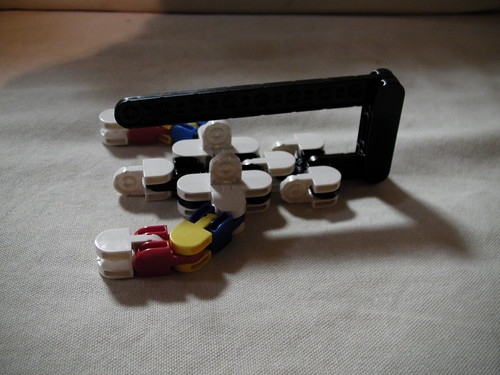
Jurat by Toyda is a kind of Lego for morphing robot makers.
I am not sure why Japanese children especially, and anyone who likes the movie series Transformers, are keen on transforming or morphing.
There is often a morph between something inanimate and something animate, between a something used, a tool or vechicle and a using thing living robot.
The above is a scorpion which morphs from/into a sword made by my son from Jurat morphin lego by Toyda.
I would like to suggest that Japanese children (and anyone fond of Transformers, which is most children everyhwere) but especially Japanese children because they remain in a "mirror stage," may be more aware of the Lacanian dictum that the ego or self, which originates in the self-image, is external, dead, a mere tool, and yet at the same time the only self we have. We see, we are, dead people: at best robots, at worst inanimate tools.
This dual nature of the self, (1) as a mere tool or representation to grasp a centre-less consiciousness, and (2) as the best -- though "robotic" or prosthetic -- self that we have, may be being played out in the morphining animation movies, and toys such as the one above.
Labels: Bandai, go-onger, henshin, japanese culture, Jaques Lacan, lacan, morph, nihobunka, nihonbunka, occularcentrism, self, specular, Super-Sentai, superhero, theory, 合体, 変形, 変身, 日本文化
Friday, May 21, 2010
Transformatory sacred items accross the ages
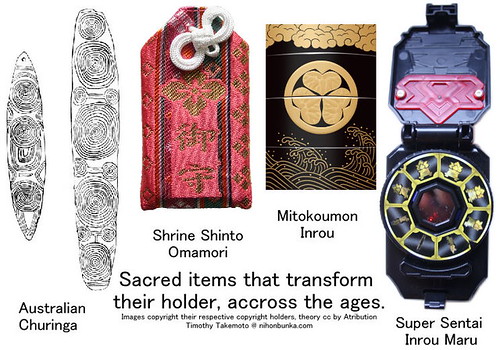
I noted in a previous post that the history of transofmatory items (変身アイテム) such as used by Ultraman (pens and glasses), Super Sentai (Power Rangers), Sailor Moon, Himitsu no Akko-chan, and Kamen Riders (Masked Riders), has a history in the transformatory symbols of Mitokoumon, Touyama no Kin and Samurai Momotarou. Japanese superheroes are always flashing a special symbol and transforming by means of its use.
The history is much older. I ague that Shinto is a geographical totemism, like that of the Arunda/Arunta/Arenda of Australia. In totemic religions the faithful recieve totemic badges which represent their owners and the ancestral spirits of their ancestors. The Arunda of the central Australia destert are one of many such groups found worldwide. Unlike most totemic religions, but in common with the Japanese, these "most primitive" (Freud, Durkheim) of totemists believed that the totem was associated with a place.
That the japanese recieve totemic badges from Shinto shrines almost goes un-noticed. More visible are the symbolic, soul containing badges that are given to the dead (mitama, Ihai). However, as Yanagita Kunio points out, once upon a time, there were "ikimitama" symbols given to the living. These were originally leaves branches of sacred trees and rocks from sacred mountains. They were believed to give their bearer life and were recieved from the time of first shrine visiting.
However in my view, and as Yanagita hints, the symbols were gradually replaced by kanji ideograms and piece of paper.
Yanagita writes, "in this reigion also the Nusa (gohei, zigzag strips of Shinto paper) were originally I think to be distributed among participants. This is similar to the leaves and branches of Japanese cedar and nagi (a evergreen tree/shrub) that were given to the faifthful from sacred trees on Mount Inari and Mount Ise" (Yanagita Kunio Collection No. 14 p 51, my translation.)
「この地方でも小さい幣を関係者に頒(わか)つのが本当の趣旨であったろうと思う。もししかりとすれば、後に言わんとする稲荷山の杉・伊豆山の梛(なぎ)のごとく、信者が神木の木の枝を追って行く風習と、著しく類似する点があるのである」柳田國夫全集14p51
These days Japanese still recieve omamori or amulets from shrines that are said to represent a stand-in or self-replacement and protect the bearer from bad luck and impurity.
And as shrines become less significant, Mitokoumon, Ultramen, Masked Riders, Super Sentai (Power rangers) brandish their sacred symbols and transforms with them.
Before we call the Japanese primitive bricoleurs, let us not forget that "in the beginning was the word," and that I have a "Christian name."Am I transformed by it?
Labels: henshin, Masked Riders, morph, nihobunka, religion, Shinto, specular, Super-Sentai, totemism, ultraman, アニミズム, スパー戦隊, トテミズム, 仮面ライダー, 変身, 宗教, 神道
This blog represents the opinions of the author, Timothy Takemoto, and not the opinions of his employer.