
Friday, July 06, 2012
Cosplay Mimics the Visual Visually, Impersonation Mimics the Voice Vocally

Cosplay refers to wearing a COStume to play or mimic a cartoon (anime) or comic (manga) character. It is particularly popular in Japan where there are large events held periodically where costumed people like the lady above, get together. Cosplayers can also be seen in the Harajuku area of Tokyo, and all over Asia, and now the world, since Cosplay has spread out from Japan. In Japan it is far from being a widespread phenomena. It is the sort of thing that like dancing, the Japanese would not want to do badly. Cosplayers will go to considerable lengths to get their clothes, hair, make up and poses just right.
Cosplay is doubly visual. Firstly, cosplayers rarely speak but rather just pose, often for photographs. Their mimicry is a visual art. Secondly the object of their mimicry - the cartoon and comic characters - are particularly visual existences. I will argue that Japanese comics are more visual, hyper-visual when compared with Western cartoons and graphic novels in another post but here I want to suggest that cosplay is the predominantly visual mimicry of the predominantly visual.
These Japanese cosplayers are strange eh? I can feel "conformist," tripping off readers' lips, because isn't copying always conformism? Yes, copying is always to an excent conformism but please see the last paragraph. And futher, the Japanese are not, Asians are not, particularly conformist. Does this lady look conformist to you? Doesn't she look weird? She may still look conformist because she is not speaking. Without speech it may seem as if she has less personality than an endless loop tape recorder (see previous post) but, that is because Westerners are logocentrist.
Performing a Nacalian transformation, the Japanese Cosplayer in the imaginary is equivalent to the Western voice player, more commonly refered to as the impersonator*.
Back when I lived in the UK I used to mimic vocally a purerly vocal existence: "Mr. Angry" of the "Steve Wright in the afternoon" radio show. I was the UK equivalent of a Japanese Cosplayer. I was as conformist, but probably not as good. I would not have done it had I thought my mimicry would not be recognised however. My voice (like the appearance of the Japanese) is not something that one plays with lightly.
It seems to me that Western impersonators are Nacalianly transformed Cosplayers because they predominantly vocally mimic predominantly vocal existences. This is not to argue that Japanese cosplayers say nothing at all, or the Western impersonators do not change their appearance at all, but there is a strong difference in emphasis. The personality or self that is mimicked and does the mimicking is felt to reside in the face and appearance in Japan, and the words and voice in the West.
Please have a look at some impersonators on Youtube. You will see that not only do they change their appearance very little, but also that they choose particularly characteristic voices to impersonate. For that reason, Christopher Walken, and Al Pachino are comon favourites. Cosplayers choose characters that are easily visually recognisable such as Hatsune Mikku above. While the days of radio - such as the Goon show - are gone, and all characters these days have visual and verbal aspects, the characters that are impersonated in the West are defined, as Westerners are defined, above all by our words and voice.
Here are some Western
Finally it should be noted that to a degree Westeners are all impersonations, and the Japanese are all cosplayers, because the self is nothibng more or less than self mimicry, there is not self, no individual other than in this attempt at duplication. The self is created through an attempt to visualise oneself, or narrativally impersonate oneself into existance.
This post was inspired by a kind question from Mudakun.
Notes
*There are also impersonators in Japan, just as their are fancy dress parties in the UK but I argue that Japanese impersonation (monomane) even or especially rakugo, is extremely visio-imaginary. Please see this introduction to rakugo in English.
Labels: authenticopy, collectivism, individualism, Jaques Lacan, mime, mirror, Nacalian, nihobunka, nihonbunka, reversal, specular, 日本文化


Thursday, July 22, 2010
Channels of Communication in the US and Japan
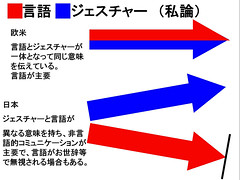
The upper arrow represents Western language and gesture, with the upper part, language dominant, and the gesture supporting, emphasising and clarifying the linguistic meaning to convey the same message. Kendon (Gesture: Visual Action as Utterance) seems to espouse the view that gestures is generally, or universally bound up with language, as shown by the red-blue arrow.
The lower two arrows represent my feeling about Japanese gesture and language. In Japanese culture which emphasises the split between real meaning (honne本音) and social pleasantry (tatemae 建前), and has lots of essentially non-linguistic fawning (amae 甘え) and ESP (ishindenshi 以心伝心), or extolls people to "read the air (or non-verbal cues?)" (KY, kuuki wo yomu, kuuki ga yomenai空気を読め、空気が読めない), it seems to me that the two channels, gesture and language can mean different things (hence two arrows), the non-verbal blue arrow can be the true/real/main channel, and the language can be phatic or supurfluous and ignored (hence the bar).
I used to get the feeling (real or imagined) that Japanese verbal and non-verbal communication was tearing me in two like Bateson's schizo producing "double bind," because while I was attempting to attend to the verbal message. It felt like the sender was sending, and other recievers were reading, correctly, the sender's non-verbal communication that meant something else entirely.
I feel that Britons do the same thing, when they are being sarcastic. On the other hand Americans especially tend to tell it to you straight, "watch my lips", with the two channels bound together.
It could be argued however, that Japanese real meaning (honne 本音) is transmitted equally in the verbal linguistic domain, and it was just that I was not able to decode these linguistic meanings correctly. Such as when someone says "thats good" (ii desu いいです) or "I'll think about it" (kangaemasu 考えます) then even in the absence of non-verbal cues, a Japanese person would decode these statements correctly to mean "no thank you" and "the answer to your request is no" respectively. Thus Japanese verbal communication may be at one with Japanese non-verbal communication, but that one should interpret certain verbal statements in a non-literal way.
In a series of papers (e.g. this interesting study) by Sotaro Kita, a professor at Birmingham University compared for instance, Japanese, Turkish and English speakers use of gesture to describe a cartoon showing someone on a swing. Dr. Kita points out that there is no verb "to swing" in Japanese or Turkish. He further found that English speakers moved their hands in an arc when saying "swing" but that Japanese and Turks, when using more general movement verbs meaning "go", moved their hands in a linear movement. Hence the lack of a verb "to swing" (to move in an arc) results in a lack of a arc motion, swinging gestures. If it really were the case that Japanese gestures were independent of speech then one would expect them to move their hand in a swinging arc even though they do not have the verb to express that motion. Since this is not the case, it seems to suggest that Japanese gesture is closely integrated with Japanese speech rather than being an fully independent channel. While some information (notably the direction of swing) was gestured but not spoken, suggesting that gesture is to some extent independent of speech, this tendency to encode extra-verbal data in gesture was the same for all languages in the study.
Hence, the diagram above seems to be demostrably wrong.
But I still get the feeling that Western gesture is more integrated with speech, and that language and gesture form a single/merged channel to a greater extent than in Japan.
Stop press. I have just read the final line of the Sotaro Kita paper linked above, which ends "There are initial findings that speech gesture synchrony differs accorss different languages"
referencing in particular research by Dr. Kita's colleague, Asli Özyürek:
Özyürek (2001) What Do Speech-Gesture Mismatches Reveal
about Speech and Gesture Integration? A Comparison of English
and Turkish. I am guessing that Dr. Özyürek found greater integration in English than Turkish and that this patter would also be found between English and Japanese.
Labels: mime, nihobunka, nihonbunka, 日本文化
Wednesday, January 13, 2010
Japanese Bug-Eyed-Superheroes Miming Speech
It has puzzled me for a long time why so many Japanese superheroes (Ultra-man, Kamen riders, Voltron or Golion, Go-Onger, Gao-ranger you name ‘em) have bug eyes, unmoving mouths, or no mouth at all and have a strong connection with mime.
I now have a theory about the connection between Japanese superheroes and mime.
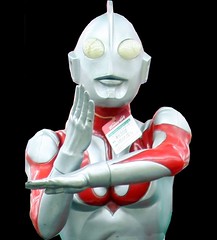
Japanese superheroes make many gestures (see image right), like mime artists. And more, in a sense they also speak. But their mouths are always immovable. Often they do not have mouths at all. And yet they do speak: They mime speech!
Typicaly, a group of young males and one female strike poses, press buttons, or contact someone in heaven on a magical mobile phone, and change ("hensin") into a team of superheroes wearing colour coded wetsuits. Why should then even need to change into a super hero suit? There is no secret made of their identity. They then do stylised battle, reminiscent of badly choreographed pro-wrestling, with one or more wetsuited monsters, often with a conspicuously mobile jaw, in a car park.
As the superheroes fight they 'speak', or shout, encouraging each other. But where does their speech come from? Their mouths can not move, nor even open. They mime speech. They take out their magic mobile phones and put them to their motionless mouths. All eyes are focused toward the miming speaker.
In the mimicry of speech they are much like masked performers in the Noh Play. The body language of the players mimes speech to perfection, but the face does not move at all.
Nowhere is the mime aspect of Japanese superheroism more apparent than in the live stage shows performed for children. Performers in coloured mouthless wetsuits come on stage. Someone somewhere presses a button on a ghetto glaster, and off they go, miming their way through an Ultraman epic, never once saying a word, but all the while making it plain who is speaking.
The Japanese boys love it. They imitate the gestures, like the ultra-man laser beam pose above.
So why is miming speech so important?
According to Lacan the human self exists by virtue of two incomplete feedback loops: those provided by voice and vision.
We can look at ourselves in the mirror, but we can never see the minds eye. We can speak ourselves, but Lacan argues, the enunciated "I am" of self speech, never quite coheres with the self that would be saying it.
However, with two ways back to the self, we play a shell game, or two card monte, always satisfied that when the word does not hit the mark, we can see ourselves in a mirror. And when the mirror seems empty, we can call ourselves by name.
The problem remains however, in convincing ourselves that our speech comes from the same place as our mouth. Ventriloquists mime speech even with their lips. The people that we watch on television appear to be speaking when we know that the sound is coming from the speakers at the side of the box.
Sound and vision never come from the same place, but we get used to thinking that they do, and the scumble that links the two together, that overcomes the contradiction of a picture that is attached to words, is paramount in the production of self.
Japanese boys watch their superheroes mime speech. They know that, on the one hand, their heroes are not speaking. All the people at the show, everyone knows that Ultraman is dumb, that the emperor has no clothes. But the little boys also know that everyone loves and admires the superheroes and that everyone assumes that the superheroes are speaking. They learn that if they take up the mime too, then no one will out them, no one will ever say "Hey, you are only miming." Superheroes and humans mime speech. It is important that they do so.
But why the bug eyes? For me the bug-eyes of Japanese superheroes are seen but unseeing eyes. Their eyes are massive. Sometimes the Japanese superhero's face is all eye. But they have no pupils, no in-eye movement to suggest that they see. Their massive eyes emphasise their visuality, but with their lack of inner eye detail, it is though they can not see at all. These eyes are, I suggest, the eyes that stare at us from out of the mirror. Our eyes as reflected mirrors fascinate us, they draw our gaze, we attempt even to look into them, but we know that they are sightless.
As I have argued elsewhere, the Japanese are permanently in "the mirror stage" in that, by virtue of their training in and ability to take multiple visual perspectives upon themselves, they continue to identify with self as reflected. Growing up in an world of uninterrupted and loving gazes, mirror identification presents little problem for the Japanese. But in order to developed a self they must also integrate the voice, attach those vocal symbols to this reflection, and hence all this heroic speech-miming.
Addendum. Something similar should be going on in the West: there should be some attempt to link phoneme and imago being made. But in the West it is the identification with speech that is less fraught. Someone admirable and heroic should be 'speaking mime' rather than miming speech. Please see this post for an example of a Western hero It has puzzled me for a long time why so many Japanese superheroes (Ultraman, Kamen Riders, Voltron or Golion, Go-Onger, Gao-ranger, you name ‘em) have bug-eyes, unmoving mouths, or no mouth at all and have a strong connection with mime.
I now have a theory about the connection between Japanese superheroes and mime.
Japanese superheroes make many gestures (see image above), like mime artists. And more, in a sense they also speak. But their mouths are always immovable. Often they do not have mouths at all. And yet they do speak: They mime speech!
Typicaly, a group of young males and one female strike poses, press buttons, or contact someone in heaven on a magical mobile phone, and change ("hensin") into a team of superheroes wearing colour coded wetsuits. Why should then even need to change into a super hero suit? There is no secret made of their identity.
They then do stylised battle, reminiscent of badly choreographed pro-wrestling, with one or more wetsuited monsters, often with a conspicuously mobile jaw, in a car park.
As the superheroes fight they 'speak', or shout, encouraging each other. But where does their speech come from? Their mouths can not move, nor even open. They mime speech. They take out their magic mobile phones and put them to their motionless mouths. All eyes are focused toward the miming speaker.
In the mimicry of speech they are much like masked performers in the Noh Play. The body language of the players mimes speech to perfection, but the face does not move at all.
Nowhere is the mime aspect of Japanese superheroism more apparent than in the shows performed for children at Japanese festivals. Performers in bug-eye, multi-coloured mouthless wetsuits come on stage. Someone presses a button on a ghetto blaster, and off they go, miming their way through an ultra-man epic, never once saying a word, but all the while making it plain who is speaking.
The Japanese boys love it. They imitate the gestures, like the Ultraman laser beam pose above.
So why is miming speech so important?
According to Lacan the human self exists by virtue of two incomplete feedback loops: those provided by voice (or phonetic language) and vision.
We can look at ourselves in the mirror, but we can never see the minds eye. We can speak ourselves, but Lacan argues, the enunciated "I am" of my self speech, never quite coheres with the self that would be saying it.
However, with two ways back, two feedback paths, to the self, we play a shell game, or two card monte, always satisfied that when the word does not hit the mark, we can see ourselves in a mirror. And when the mirror seems empty, we can call ourselves by name.
The problem remains however, in convincing ourselves that our speech comes from the same place as our mouth. But we get used to it. Get used to thinking that sound and vision come from the same place. E.g. The people that we watch on television appear to be speaking the sounds, even though we know, if we think about it, that the sound is coming from the speakers at the side of the box.
Sound and vision never come from the same place, but we get used to thinking that they do, and the scumble that links the two together, that overcomes the contradiction of a picture that is attached to words, is paramount in the production of self.
Japanese boys watch their superheroes mime speech. They know that on the one hand their heroes are not speaking. All the people at the show, everyone knows that Ultraman is dumb, that emperor has no clothes. But the little boys also know that everyone loves the superheroes and assumes that the superheroes are speaking. They learn that if they take up the mime too, then no one will 'out them', no one will ever say "Hey, you are only miming." Superheroes and humans mime speech. It is important that they do so, and get away with it.
But why the bug eyes? For me, the bug-eyes of Japanese superheroes are seen but unseeing eyes. Their eyes are massive. Sometimes the Japanese superheroes face is all eye (Kamen rider Faizu/555). But they have no pupils, no in-eye movement to suggest that they see. Their massive eyes emphasise their visuality, but with their lack of inner eye detail, it is though they can not see at all. These eyes are, I suggest, the eyes that stare at us from out of the mirror. Our eyes as reflected mirrors fascinate us, they draw our gaze, we attempt even to look into them, but we know that they are sightless.
As I have argued elsewhere, the Japanese are permanently in "the mirror stage" in that, by virtue of their training in and ability to take multiple visual perspectives upon themselves, they continue to identify with self as reflected. Growing up in an world of uninterrupted and loving gazes, mirror identification presents little problem for the Japanese. But in order to develope a self they must also integrate the voice, attach those vocal symbols to this reflection, and hence all this heroic speech-miming.
Something similar should be going on in the West: there should be some attempt to link phoneme and imago being made. But in the West it is the identification with speech that is less fraught. So someone Western, admirable, and heroic should be 'speaking mime' rather than miming speech. I guess that this has something to do with the secret identities of Western Superheros, but for the time being, I don't know what "speaking mime" is.
Addendum. please see the next photo in my photostream. I think that "speaking mime" (the Western equivalent to the mimed speech we see Japanese superheros perform) is all the thought bubbles that we are able to see in Western superhero comics, and all the "hard boiled," coming-from-no-where, narrative that accompanies Western detective movies especially. In the West, the narrative pervades, it is the centre, the truth of the secret identityspeaking his mime
I think, therefore I am Batman.
PPS: Just after writing this I saw the trailer for Avatar, where a super-hero kinda guy controls an "Avatar" by remote control and feel like I am chanelling James Cameron.
Labels: Bandai, Bokenger, bug-eye, culture, eye, Gao-Ranger, go-onger, japan, japanese culture, Jaques Lacan, mime, nihonbunka, Super-Sentai, superhero, ultraman, 日本文化
This blog represents the opinions of the author, Timothy Takemoto, and not the opinions of his employer.