
Monday, September 30, 2013
Ray Honing his Totemism: Pokémon

To think, totemists use "bons a penser", Levi-Strauss quipped (Those Frenchies are fond of puns and I am too) meaning "good to think" and "goods (things) to think (with)".
It is still not clear to me whether LS thought that phonemes are not "things" (bons).
His definition of "things" (bons), slips between the fingers of my mind. For the most part, the things that LS said totemist think with are real, as real as things get, such as bulls (or sitting bulls), and ant-eaters, eagles and other animal species. It is particularly animal species that totemists are thought and found to use. But not always. There are examples of peoples using manufactured things (gourds, even modern manufactured water containers). There are also examples (as found in Pokémon) of peoples using mythical/imaginary things such as dragons to denote their names, clans, tribes. And there is geographical totemism, where peoples named themselves using, and felt a familial bond, with features of the landscape. This seems prevalent in Japan, even though few would say, few seem to realise that the Japanese were geographical totemists.
LS's point seems to have been, however much he praises the noble savages, that since they use things, totemists were constrained by the morphology of the things that they were thinking with. A bull can sit. An eagle can be bald. There are various types of ant-eater. So the thinking of totemists is constrained. If a woman wanted to have two husbands, then rather than use the infinitely malleable world of phonetic signs (Polyandry) they would need to find a thing that mirrored the new category that they would, or could not, conceive. Totemists are botchers, hotch-potchers, or "bricoleurs" that use, or attempt to use, the variance in the world to convey, express and think of innovation. Compared to us modern thinkers, they are thus impaired by their inability to use the "arbitrary" - anything goes with anything in any way - sign.
Recent linguists have found that the phoneme is not entirely arbitrary. Phonemes for big things tend to be deeper more wide mouthed than phonemes for small things which are higher pitched and small mouthed. The word for "name" has a fascinating commonality amongst disparate cultures, often beginning with "N" (Even Japanese "na(mae)"). This may originate, it is argued, in some sort of nasal pointing "NNNN" to mean that which is in front of one.
Okay, let's say that the phoneme is pretty arbitrary. But what of the things-for-thinking of totemist?
The big problem for me is that it is clear, and documented in LS's books that mythical entities such as dragons were used as clan representing signs.
And so to Pokémon. I think my children are totemists.
There is a book chapter on the heroes of Japanese children, that are colour coded, generational, multi-classified, and thematic, which suggests a link between Japanese childhood thought and totemism. My son here above is memorising the types, appearance and (yes) phonetic names of Pokémon.
The Pokémon are mythical. They do not exist in the same way that an eagle exists, but they are as real as mythic dragons.
Does he think with them? I can not report and instance where he uses Pokémon monsters to classify his surroundings but he does use the categories of Pokémon to categorize other Pokémon: those that evolve, emerge from eggs, do martial arts, resemble animals. Pokémon are organised, in tribes or clades, and he takes pleasure in remembering them.
They are also highly arbitrary. The possibilities are largely, but not entirely, unrestricted.
What is the difference between organising entities according to phonemes and organising them totemistically, or Pokémon-style?
I get the feeling that there is a ('Nacalian') reversal in the phonetic vs visual domain.
Pokémon in the plural have a plethora of visal aspects, and they also speak, but when speak they generally only speak one word; their name. Their utterance of this their name. They step, 'narcissitically' for a brief instant upon their name, and return to their visual selves. Their name is (like the western visual face) the twist in their mobius strip, that allows them to think that they are looping the visual loop, and like self-views of western faces, it is unitary, and kind of naffly self loving.
I need a knew image to explain further.
Labels: japan, japanese culture, totemism, 日本文化


Sunday, January 27, 2013
Transforming Symbols and Totemism: In the beginning was the Kanji
In this video my son Ray demonstrates the use of a Japanese toy called a "Mojibake" which means a transforming or morphing letter. The toy transforms from being a Sino-Japanese ideograph (kanji) meaning tiger into a little plastic model of a tiger.
Japanese toys and superheroes are always transforming by means of a symbol. Masked riders put symbols to their belts, inject USB drives into their blood stream, or are bitten by cosmic bats. Power ranges manipulate symbols, including Kanji (Shinkenja-) that also allow them to transform in to super beings.
This use of symbols to produce living entities is similar to the way in which people in totemistic societies (such as Native Americans) received totem badges containing ancestral spirit to become their own soul.
While there are some that claim that Kanji only mean things via phonemes - that they need to be pronounced in order to have meaning, Chad Hansen (1993) a scholar of Chinese philosophy claims that Kanji not only mean but that they mean things not ideas. The Western signification system is triparite: words mean ideas which mean things. The Chinese system is dual: characters mean things.
If this is the case, then from a radical social constructivist or Sapir-Warphian perspective, the existence of the character provides a symbolic tool for the cognition, and perhaps existence of the lion. In the far East, in the beginning was the kanji.
Since Ray was about three years old he has spent countless hours symbolically transforming things into other things. I think that he has managed to become Japanese without my help.
Hansen, C. (1993). Chinese Ideographs and Western Ideas. The Journal of Asian Studies, 52(02), 373–399. doi:10.2307/2059652
Labels: Bokenger, culture, Gao-Ranger, go-onger, henshin, japan, japanese culture, Masked Riders, totemism, 日本文化
Sunday, May 27, 2012
Bakugan Transformation
The notion that heroes "transform" (change their form or body, henshin) using a symbol is a very common trope in Japanese superhero fiction from Mitokoumon (who changes when he gets out his seal) through mirror man (thanks JE), who changes when he gets out his omamori (amulet) in front of a mirror, super sentai, masked riders, and here bakugan, a sort of poket monster.
This tranformation provided by the use of a symbol here with Bakugan parallels that provided by named ancestors watching from hills. The ancestors in the hills spread the world of vision out into a landscape. This Bakugan toy however, transforming from a sphere into a hero of sorts by use of a symbol illustrates the way in which the imaginary, that circle or sphere (Heisig, Nishida) of "pure experience" spreads itself out to form the body of the person as "wrapping" (Hendry).
While I admire Hendry enourmously, I think that her use of the "wrapping" conceptualisation plays to prejudices of her Western readers and, perhaps, her own Western cultural preconsceptions. Though she avows otherwise (in reference to her critique of Barthes), the use of the word "wrapping" is bound to suggest to her readers that there is something, something else, something important but ignored, that is being wrapped.
Something is being "wrapped," but that something is more wrapping. The surface, the res-extensia, the plain-of-the-qualia, the tain of the mirror, wraps another mirror. The super suit of Japanese superheros, the masked riders super suit, bakugan body, contains another... (from a western perspective) "wrapping," another "surface." Inside the wrapping is only more wrapping. So the "wrapping" which suggests a duality of wrapping and content is fraught.
The image in Mary's world, ie the world of Western philosophers is, exists, only as a sort of boundary, a veil of perception. The interior world of Mary, herself as narrative, and the world as narrative also, as words, are seperated by a viel, a plane, of the 'qualia.' Words "wrap" words. The interior and the exterior are words. But in between there is an unspeakable, un-wordable, "viel" (of perception). This strange, abject, unspeakable viel seperates the two worlds of words. It is also a catalyst for their separation.
In Japan the word or name is similarly, a viel or boundary. Inside there is only image. Outside there is only image, but in between, that which spreads the interior out into a world is the word, made particular, the name, which has a place, the named place, the meisho, of which there are many.
Labels: japan, japanese culture, Jaques Lacan, nihobunka, nihonbunka, specular, totemism, スパー戦隊, トテミズム, 変身, 日本文化
Wednesday, May 16, 2012
Empire of the External Signs: Travelling to Sight and Symbol
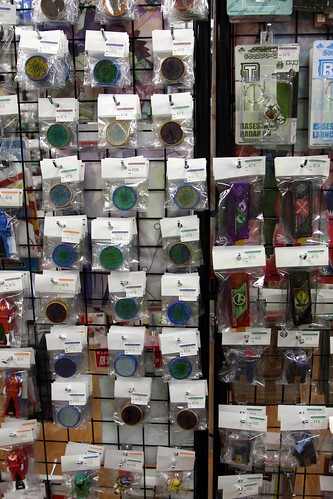
Not only when on holiday, but also when having fun as a child, the Japanese like to collect symbols. They are modern totemists, they "bricole."
Levi-Strauss in one of his last formulations defined those "primities" that have a "savage mind" -- the "bricoleurs", the botching, DIYers, that think with signs-they-have-to-hand (Levi-Strauss, 1966) -- as those that do not have writing.
"The way of thinking among people we call, usually and wrongly, ‘primitive’—let’s describe them rather as ‘without writing,’ because I think this is really the discriminatory factor between them and us" (Levi-Strauss, 1978, 5)
What he meant to say was that they do not have an alphabetic writing (see the brilliant paper by Chad Hansen, 1993, "It started with Phoneticians").
The important point is not the natural constraint that Levi-Strauss proposes that "savages" face. Like the Japanese, even the totemists in totemistic societies that Levi-Strauss himself reported, had started to create their own totems (e.g. gourds, mythical animals) and are not constrained by nature.
The important point, that Derrida stress(1998), is that the "savages" remain aware of the corporeality of the sign, aware of the "trace," they remain forever "post-modern," even more so than Derrida who claims phonocentrism is inevitable, and unable to believe in "presence" of meaning, of voice as thought. The "savage" (or perhaps savant) is aware that the sign is external.
They, the Japanese, are happy to travel, to the shrine, to the local toy shop, to the "named place" (meisho) abroad to collect external signs.
Derrida, J. (1998). Of grammatology. (G. C. Spivak, Trans.). JHU Press.
Hansen, C. (1993). Chinese Ideographs and Western Ideas. The Journal of Asian Studies, 52(02), 373–399. doi:10.2307/2059652
Levi-Strauss, C. (1978). Myth and Meaning. Routledge.
Lévi-Strauss, C. (1966). The science of the concrete. In G. Weidenfield (Trans.), The Savage Mind. University Of Chicago Press.
Labels: japan, japanese culture, mirror, occularcentrism, reversal, specular, theory, totemism, tourism, 日本文化
What Mary didn't Know, but the Japanese Tourist did

There are a number of theories of why tourists tour. The most famous four are perhaps those by Boorstin (1992), MacCannell (1976), Turner (Turner & Turner, 1995) (for a summary of these see Cohen, 1988), and Urry (2002). Culler's extended semiotic analysis (1988) of tourism is also well recommended.
Boorstin, in his book "The image: A guide to pseudo-events in America" (1992 [1961]), characterised the tourist as an inferior traveller, satisfied with "pseudo events" or in his word, images.
MacCannell's (1976) analysis positions the tourism as a religious (after Durkheim, 1965) activity that through the interpretation of signs (Barthes, 1972, 1977), allows the alienated (Marx, 1972) proletarian tourist to gain a picture of society as a whole, thanks to the presentational (Goffman,2002) activities of tourism providers. Rather than being happy with "pseudo-events", the tourist seeks authenticity. The apparent "pseudo event" status of the tourist experience is, MacCannel argues, merely an inevitable consequence of the structure of presentation and the sign, as Culler explains in more detail (1988).
Drawing upon a considerable oeuvre of anthropological research Turner (Turner and Turner, 1978) also sees the tourist as in search of a sense of wholeness, but in a less intellectual, more chaotic, ecstatic, "liminal" merging or communitas, as a result of the sacred or sacrelized images (a notion shared by MacCannel).
Urry (2002), turning back towards Boorstin while drawing on Turner, argues that authenticity is by no means an essential part of tourism. Tourism for Urry is "more playful" (p.11), and quoting Fiefer (1985) even allows for 'post-tourists' who are aware of the inauthentic nature of the sight, which is sometimes even virtual, but enjoy themselves anyway.
So, perhaps the most obvious controversy in tourism research is whether "authenticity" is required by tourists and if so in what sense? At one end of the extreme, one may wonder if someone watching a travel program on TV a (post) tourist? Surely not. But, when Urry's alienated telephone switchboard operator goes to see the Statue of Liberty, and sees in that sacralized site the meaning of her life, her work, and her society, in the support of the freedom there represented, does it matter that the statue in New York is a replica of then one in Paris? Would it matter if she were watching one of the many replica statues of liberty adorn Japanese "Love Hotels"(Cox, 2007, p224)? Or indeed if the receptionist were herself Japanese, or Russian in the Stalinist era, would her experience of that "freedom" still be authentic - teaching her by contrast the meaning of her arguably un-free life? Many of MacCannell's examples are of domestic US tourism, but as he points out that international tourism can teach us about ourselves through the comparisons we make between our own and other cultures, comparisons without which we would not be aware of our own culture at all.
Contra MacCannell however, we must at least accept Urry's assertion that in tourism, *kitsch abounds*.From Butlins, to Coney Island and on to Tokyo Disney Land (referred to as "rat" by some Japanese school children), tourist experience are often wallowing in kitsch, simulations, and "pseudo-events." And yet, even so, when a child sees Mickey, where-ever she sees Mickey, should we deny that some sort of experiential authenticity takes place? I will return to this point, but, first focus on the characteristic of tourism that the above theorists appear to share.
While there is some disagreement as to the "authenticity" of the tourist experience, all of these theorists stress the importance of the image and gaze. Tourism is sight-seeing, tourists go to gaze at images. The important praxis for tourists is above all to gaze.
But of course tourists do not only gaze. Far from it. As MacCannell and Culler point out, tourists are semiotics (Culler, 1988, p2.), theorists ((Van den Abbeele, 1980, reviewing MacCannell) or ethnologist (Culler, 1988, p11). Typically, they go to gaze at sights, the more unusual and out of their normal frame of reference the better, so long as they they are able to judge them authentic "That is Frenchiness,"(Culler, 1988, p2) "That is a Gondola," "It's Mickey!" Ethnography is a profession, but giving things, new things, names, is the one work that was required of Adam in the Garden of Eden before the fall. Tourists love to see new things, and yet, already know and say what they are. They go in search of these "translations" from sight as sign, to linguistic symbol or meaning.
Readers (not that I have any) that recognise the reference in my title will know where I am taking this but first, in order to gain a clearer picture of tourism, it will help to look at it from comparative perspective, from the gaze of the Japanese tourist. In order to introduce the Japanese tourist gaze, consider a type of tourism that most Western theorists consider to be exceptional.
MacCannell argues that for a sight to be sacralized markers (such as signs, maps, and viewing platforms) are set up, and at times these markers can become the central focus of the tourism destination. Likewise, Urry (2002, p13) citing Culler (1981, p139)
"Finally, there is the seeing of particular signs that indicate that a certain other object is indeed extraordinary, even though it does not seem to be so. A good example of such an object is moon rock which appears unremarkable. The attraction is not the object itself but the sign referring to it that marks it out as distinctive. Thus the marker becomes the distinctive sight (Culler,1981: 139). "
It is precisely these exceptions, that I think form the norm of Japanese tourism behaviour: Japanese tourists typically go to see "markers". Japanese tourism consists in is purest most characteristic form in the visiting and collection of markers.
Most Western tourism theorists agree that tourism is about seeing. People go to places to gaze (Urry, 2002) at images (Boorstin). Even the most semiotic of analyses (MacCannell, Culler) has (Western) tourists go to sites where they apply "markers" (guidebooks, signs, labels) to sights. Very occasionally MacCannell notes, such in the case of a piece of moonrock, the labels maybe of more interest than the sights themselves.
The Japanese have been going to see markers since time immemorial. The author of Japan most famous travelogue - The Narrow Road to the Deep North - went to see "Ruins of Identity" (Hudson) Matsuo Basho, places were once great things happened but where now there is no trace even of ruins, only the markers (such as a commemorative stone) remains. Basho wrote a poem and wept. This trope is continued in other Japanese travelogues, and tourism behaviour, which is often described as being "nostalgic".
This "nostalgia" is sometimes thought to be a reaction to Westernization, but it has clearly been going on for a lot longer. The Japanese have been waxing lyrical about ruins, since the beginning of recorded time. This practice originates in Shinto. Shinto shrines and visiting them - the central praxis of the Shinto religion - are themselves ruins, markers to events that, supposedly, took place in the time of the gods.
The first Tourist attraction that Matsuo Basho visitied Muro no Yashima, is a shrine to the a god that gave birth to one of the (divine) imperial ancestors in a doorless room (Muro) which was on fire. It has since been traditional to use the word "smoke" (kemuri) in poems about that location.
The Japanese worship markers. In Japan the sign has fully present and evident corporeality.
I thought at first that the Japanese were going to names to provide the sights, the images. In these days of television, sight is as portable as information. While (as described below) Westerners are inclined to believe in the spooky immateriality of the sign (used as they are to talking to themselves in the "silence" of their minds) so the thought of traveling to a sign is probably not very attractive. Signs are everywhere and no-where. Signs are within. We travel to see "it" that thing out there "with our own eyes".
But for the Japanese signs have to be transported. The first of these, the Mirror of the Sun godess was transported from heaven, to be the marker of the most important deity. The imperial ancestors then distributed mirrors to the regional rulers and some of these were enshrined. Subsequently Japanese gods have been be stamping their names on pieces of paper and being transported all around the country to be enshrined far and wide.
The Japanese do not travel for sights but for markers and since markers are portable, then one might think that it would be the Japanese that might stay at home. Why don't they set up a marker saying Paris and visit it instead? This is indeed what they do. As Hendry points out, throughout Japan there are markers to places abroad, Spanish towns, Shakespeare's birthplace "more authentic than the original!" (Hendry's exclamation mark). If the marker has been transported, and the sights have been provided, then the Japanese are happy to visit that transported marker instead, or in preference to the original. "Foriegn villages" (gaikoku mura) have a tremendous history stretching back as far as their have been shrines but more recently, again, the first tourist attraction that Matsuo Basho visited, as well as being associated with the actions of the gods, was also "the shrine of seven islands." In the grounds of the Muro no Yashiam (Room of Seven Islands) shrine there are miniature version of eight other shrines all around the country (in those days abroad). In other words, Basho's first destination of call was a "foriegn village." Likewise as Vaporis elucidates the most popular site in the Tourism City which was Edo (the place which all feudal lords had to travel to, the place with the most famous sites and still today the most visited place in Japan: Tokto) was Rakan-ji a temple in which all of the 88 Buddha statues of a famous pilgrimage were collected together. As if going to an international village, by going to that one temple, the Japanese were able to feel that they had completed a pilgrimage in the afternoon. The 88 stop pilgrimage has itself been copied into many smaller, pilgrimages all around Japan, sometimes at a single temple, including at my village of Aio Futajima. In sort of nested copying, the copied 88 sites of the larger pilgrimage are themselves copied to one of the temples where again, one can complete the pilgrimage at one visit.
The Japanese are also fond of post-tourism via the use of guidebooks and maps, which are like super-minature "foreign villages."
Taking a deconstructive turn, I associate the Western practice of going to see sights, such as Frenchyness and proclaiming them Frenchy, with the ongoing efforts of Western philosophers to promote dualism (Derrida). Derrida argues that the dualisms of mind and body, or thinking matter and extendend matter, locutionary and illoluctionary acts, speech and writing, etc, are all designed to purify the habit of listening to oneself speak, to frame this habit as thinking. As other deconstructive criticism has argued, the creation of dualities does not only take place at the Philosophers' desk but also in pictorial art, literature, mythology (Brenkman) and society. If the philosophers are interesting it is because they give us clues of to the tactics by which dualities can be preserved. One of the most recent such tactics is that provided by Jackson in his papers regarding Mary in a black and white room.
Mary grows up in a black and white room. She sees the world through black and white monitors. She knows everything there is to know, physically, about the world except she has never seen colour. When she leaves here room and sees some red flowers, she is (we are persuaded) surprised. "Wow, so that is what red is." This demonstrates to somewhat there is something non-physical about the world. Even if one has all the data, all the information, all the language about the world, there is something about the sights, the seeing, the images, that makes us go wow, and proves that the world is not only physical. This thought experiment persuades some of duality.
Tourists are all Mary. They go in search of Frenchiness and in a mass transcendental meditation, they see Frenchiness, the Niagara falls, and are assured that there there is a world out there, and a private world in here.
But what of the Japanese? The seem to be going to see the marker, the sign saying "This is red." I had thought perhaps they they then provide the sight from their imagination to go with it. I.e. we go to sights to mark them, Japanese go to markers to site them. But this is not entirely the case. Yes, there is some "image provision" going on on the part of the tourists. Someone intending to visit the site of the famous duel between Miyamto Musashi and XYZ in the straits of Kanmon -another completely empty ruin of a tourist attraction - said that the the place brought up many images (omoi wo haseru). Someone taking a super miniature foreign village style-tour aroud a map of Edo said that just looking at the map brought back "the mental image of the Edo capital" (omokage wo shinobaseta).
But that is not what is going on in Japanese tourism as I found out this weekend. Before writing about Japanese tourism I thought it would be a good idea to do some, so I visited some of the J-Tourism style ruins in my local village and was powerfully impressed.
In the local town there is a ruin of an ancient governmental site from about 1200 years ago. All that remains is a field and some commemorative stones. There are benches lined up beneath the trees at one side of the site, in front of the empty field with some "markers" explaining what used to be in the field. Imaging the tourists rather than the ancient town hall, I could not but laugh out loud.
In my village of Aio, there are ten tourist attractions, two of which are empty. One is to the early twentieth century European style Japanese painter Kobayashi Wasaku. There is a bust. Two commemorative stones and an empty area of tarmac. And finally and most movingly, close to our beach house, on the road on the way there is the site of the birthplace of one of the Choushu Five, Yamao Youzou a young revolutionary, who was sent to study in my hometown, London, towards the end of the nineteenth century. He studied engineering in London and Scotland and came back to Japan to lead the Westernization of its technology education, founding what is now the engineering department of the University of Tokyo. At the site of his birth place there is a large black stone upon which there is a poem.
There is a poem which goes something like
At the end of a long journey
Which is the heart
Is Japan
はるかなる心のすえはやまとなる
Nothing beside remains. Laughing at myself all the while, I had a Matsuo Basho moment and cried. It was not that I imagined the figure of Mr. Yamao but, as was suggested to the readers of a modern guide to Basho's work, he traveled all over Japan to the sites visited by the ancient so as too "commute with their hearts" (kokoro wo kayowaseru) and that we by visiting the same sites, or just reading the guide book can do the same through the filter of Basho. By the same logic, can you feel my heart in the above photo?
The attraction of the small hillock next to a stone surrounded by bamboo it was not the sights, or the marker, nor the tourists gaze (my gaze), but the gaze of Mr. Yamao who had also stood there well before setting off to London, and back to change the world. I felt I saw the world through Mr. Yamao's eyes.
Had I imagined things, then I might have attempted to keep up the dualism between name and vision. On the contrary however this destination seemed to have been designed to make me feel the gaze of another, together. I will have to use Kitayama Osamu's gazing together theory too.
Bibliography by Zotero
Boorstin, D. J., & Will, G. F. (1992). The image: A guide to pseudo-events in America. Vintage Books New York.
Barthes, R. (1972). Mythologies. (A. Lavers, Trans.). Farrar, Straus and Giroux.
Barthes, R. (1977). Elements of Semiology. Hill and Wang.
Cohen, E. (1988). Traditions in the qualitative sociology of tourism. Annals of tourism research, 15(1), 29–46.
Cox, R. (2007). The Culture of Copying in Japan: Critical and Historical Perspectives. Routledge.
Culler, J. D. (1988). The Semiotics of Tourism. Framing the sign. Univ. of Oklahoma Pr.
Durkheim, E. (2001). The Elementary Forms of Religious Life. New York: Free Press.
Feifer, M. (1987). Tourism in History: From Imperial Rome to the Present. Natl Book Network.
Goffman, E. (2002[1959]). The Presentation of Self in Everyday Life. Garden City, NY.
Heine, S. J., Proulx, T., & Vohs, K. D. (2006). The meaning maintenance model: On the coherence of social motivations. Personality and Social Psychology Review, 10(2), 88–110.
MacCannell, D. (1976). The tourist: A new theory of the leisure class. Univ of California Pr.
Marx, K. (1972[1844]). The marx-engels reader. WW Norton New York.
Turner, V., & Turner, E. (1995[1978]). Image and Pilgrimage in Christian Culture (0 ed.). Columbia University Press.
UN WTO. (2012). World Tourism Barometer: Volume 10. Advance Realease. Madrid: United Nations World Tourism Association. Retrieved from dtxtq4w60xqpw.cloudfront.net/sites/all/files/pdf/unwto_ba...
Urry, J. (2002). The Tourist Gaze. SAGE.
Van den Abbeele, G. (1980). Sightseers: The tourist as theorist. Diacritics, 10.
Labels: nihobunka, nihonbunka, occularcentrism, religion, theory, totemism, tourism, 日本文化
Wednesday, May 09, 2012
Collecting Symbols becoming a Dangerous Addiction in Japan

There is no financial reward to those that obtain the special symbols but the perceived value of these cards is so great that some Japanese are spending large amounts of money attempting to obtain them. This practice is called random-card-complete-set-collection or "conpugacha", and it has become an addiction. In the face of the dangers of this addiction, the Japanese government is thinking to impose restrictions on online game providers. The above article in today's Asahi newspaper reports the fears of online game providers in the face of proposed new regulations.
I suspect that the perceived value of the card - its fetishization - is at least in part in and of itself: the very act of collecting symbols is something that the Japanese find attractive since there is a long tradition of collecting symbols in Japan: from traditional sacred symbols (Yamada, 1965, 1966), pilgrimages (Reader, 2005), mass travel booms due to the belief that sacred symbols were falling from the sky (Nenzi, 2006) and stamp rallies (see Origin of the Stamp Rally), and various types of card and symbol collections for children (see Totem Badges Old and New).
At the same time the association of obtaining special symbols with interpersonal interactions (in this case in interactions in an online game community) is also found with more traditional symbols such as good luck amulets which are often an expression of love (Ayumu & Koshi, 2006) or perhaps a sort of assurance on the part of the giver (see Japanese Lucky Charm: Pubic hair). Often symbols give their holders the power to transform themselves, often including their appearance (see Transformatory Sacred Items Across the Ages).
For a long time the Japanese were thought to be "collectivists" because they travelled in groups, looking out the window when they reached the "named-place" (meisho). Today, the Japanese are more likely to travel on their own than Britons or Americans, but they still take with them their guidebooks (Goo Ranking, 2008), and travel to the named, symbolic places.
Ayumu, A., & Koshi, M. (2006). 「お守り」をもつことの機能 : 贈与者と被贈与者の関係に注目して[The function of having a ‘lucky charm’ : The relationships between donor and recipient]. Japanese Journal of Social Psychology ( Before 1996, Research in Social Psychology ), 22(1), 85–97. Retrieved from ci.nii.ac.jp/naid/110004798371
Goo Ranking. (2008). 海外旅行先でついやってしまう「日本人ぽい」行動ランキング - 旅行ランキング - goo ランキング. Retrieved May 9, 2012, from ranking.goo.ne.jp/ranking /011/sightseer_pattern (based on a JTB survey)
Nenzi, L. (2006). To ise at all costs: Religious and economic implications of early modern nukemairi. Japanese journal of religious studies, 75–114.
Reader, I. (2005). Making pilgrimages: Meaning and practice in Shikoku. University of Hawaii Press.
Yamada, T. (1965). Shinto Symbols (Parts 1-5). Contemporary Religions in Japan, 7(1), 3–39.
Yamada, T. (1966). Shinto Symbols (Parts 6-8). Contemporary Religions in Japan, 7(2), 89–142.
Labels: japanese culture, nihobunka, nihonbunka, religion, Shinto, theory, totemism, tourism, 日本文化, 集団主義
Tuesday, May 01, 2012
In the Margins of Basho

This pastime of adding ones own record to the record of others is not new. In a sense Basho himself was writing in the margins of the ancient poets when he wrote "The Narrow Road to the Deep North," since he only visited those places that had been written about previously (Watkings, 2008, p101).
Similar activities may include Midrash commentary, Derrida's book Glas (1990), the manifesto of Vorticism, "Blast," (Lewis, 1914) the practice of leaving stones on Shinto gateways (bearing in mind that stones predated amulets as totemic expressions of self), pasting a "senja fuda" with the symbol or characters for ones name on the entrance to shrines and temples, and more recently having ones photograph taken at famous named places. Japanese tourists write in the margins of their sacred symbol-scapes (Appadurai,1996) as if participating in a kind of rabbinical geography or wordy walkabout.
Bearing in mind, that the Japanese are not wordy (Kim, 2002, 2009; Kim & Ko, 2007), tremendously fond of travel photography, and informed by Ezra Pound's (Pound, 1960, 1970) interpretation Japanese poetry, I think that Japanese are engaging in "phanopoetic"1 mishna, or eschatological.geo-spatial "vorticism"2: the layering of interpretative images upon, interpretative images of sacred spaces.
Why people want to add layer symbols upon symbols, especially upon esteemed or sacred symbols I am not sure, but I think that I see it in the "semiotic" "ethnography" (Culler, 1988) of Western tourism, and what I am doing right now.
Notes
1 "phanopoea" - "the throwing of an image on the minds retina" (Pound, 1960, p52).
2 The image is not an idea. It is a radiant node or cluster; it is what I can, and must perforce, call a VORTEX, from which, and through which, and into which, ideas are constantly rushing’ (Pound, 1974, p. 92).
Appadurai, A. (1996). Modernity At Large: Cultural Dimensions of Globalization (1st ed.). Univ Of Minnesota Press.
Derrida, J. (1990). Glas. (J. P. L. Jr & R. Rand, Trans.). University of Nebraska Press.
Culler, J. D. (1988). The Semiotics of Tourism. Framing the sign. Univ. of Oklahoma Pr.
Kim, H. (2002). We talk, therefore we think? A cultural analysis of the effect of talking on thinking. Journal of Personality and Social Psychology.
Kim, H. (2009). Social Sharing of Emotion in Words and Otherwise. Emotion Review.
Kim, H., & Ko, D. (2007). Culture and self-expression. Frontiers of social psychology: The self.
Lewis, W. (1914). Blast. John Lane Company.
Pound, E. (1960). Abc of Reading. New Directions Publishing.
Pound, E. (1974). Gaudier-Brzeska: A Memoir. New Directions Publishing.
Watkins, L. (2008). Japanese Travel Culture: An Investigation of the Links between Early Japanese Pilgrimage and Modern Japanese Travel Behaviour. New Zealand Journal of Asian Studies, 10(2), 93–110.
Labels: nihobunka, nihonbunka, occularcentrism, totemism, tourism, 日本文化
Monday, April 02, 2012
Origin of The Stamp Rally and Japanese Pilgrimage

The stamp rally has more of a history than the goshuinbou (read stamp collection books) required by the Tokugawa government of those that took part in the pilgrimage of the 88 temples in Shikoku. Yes, pilgrims were required to get scrolls stamped at each temple, and yes this may be the direct ancestor of the stamp rally but, the history is considerably older.
The "God Body" (goshintai) or vector of the spirit of the deity received from Shinto shrines is a Shinpu, Ofuda or Spirit containing card as shown at the point of its creation by a shrine priest in the picture above. The most representative example are those of Ise Shrine, seen here in the above photo being created by stamping a pure white piece of Japanese paper with the holy seal (spirit seal) of the shrine.
The piece of paper stamped with a seal, being shown being created above, is a Jingu-Taima, the Shinto holy-of-hollies, representing or containing the spirit of the imperial ancestor; Amaterasu the Goddess of the Sun. When these pieces of paper were rumoured to have rained from the sky (as recently as the late nineteenth century) the Japanese took to mass pilgrimage, in their hundreds of thousands, dancing, and chanting, "there's nowt to complain about!" ("ee ja nai ka").
Prior to the great bureaucratisation of Japan in the ancient Ritsuryou legal system of 701, and for many centuries afterwards, Japanese would receive the spirit of their local diety vectored by the branches and leaves of sacred trees, or stones from around a sacred rock, as do other geographical totemist (Spencer and Gillan, Durkheim, Freud). The Japanese in their bureaucratic massive efficiency, updated this bricolage (Levi-Strauss) to allow shrines to print totem badges using seals. Totemism met and merged with the inkan, seal or stamp. And Japanese go and get these stamped sacred pieces of Japanese paper and card from Shrines to this day. To receive a piece of paper stamped with the name of the deity was the final purpose or proof of pilgrimage*. These totem badges were also, Yanagita argues, constituitive of self.
Japanese Tourists to this day go to famous places, special places with a name (Meisho). There the Japanese tourists receive symbols. The Japanese do not travel to see so much as to receive an indication (kuni no hikari wo shimesu), and in this way collect symbols. If, as Urry and McCannel say, Western travellers go to gaze upon sights and be seminologists, interpret sights, and provide the symbols pronouncing them "Japaneasy," the Japanese go to places where they may be no sight to provide the image go with the symbols.
This difference is due to a difference in the media of self. Westerners identify with the phonic linguistic media. Travel for Westerners is like Husserl's transcendental meditation, removing themselves from the sight as radically other, they return to their cogitus logocentricus, contemplate what they see and pronounce it such and such. The Japanese are on the other hand, a primordial space (Nishida, Watsuji), a mirror (Kurozumi). The Japanese go to places with a name, and provide the images either in their imagination, or their person taking their own picture thus superimposing themselves as image, on the named spot.
"It was just how I imagined it" said one 19th century Japanese pilgrim as she visited historic sites with little to see (Nenzi). Matsuo Basho wept at the rock commemorating the site of an ancient castle and was overjoyed to imagine the scene in times gone by while, borrowing Shelley, all around the lone and level grass stretched far away (Hudson).
Perhaps these Japanese seals are a little like the body of Christ as received at mass? Catholics ingest a little of the body in Church, or in front of a mirror? I am very confused.
*English pilgrims too, before they were stamped out by Protestantism would receive totem or pilgrim badges thought to have magical ( e.g. healing) power.
Labels: japanese culture, Shinto, theory, totemism, tourism, 日本文化, 神道
Tuesday, June 07, 2011
Totem badges Old and New

Top row: Shinto shrine amulets (omamori)
Bottom row: Kamen Rider OOO medals, Kamen Rider W Gaia Memories
Please see also an even longer history of totem badges from Australian bull roarers, through shrine amulets, seals (mitokoumon's inro) to the seal of the Shinkenja- Super sentai.
My son plays with various totem badges that are said to transmit the spirit of a supernatural entity to a person allowing them to transform into a superman of sorts. These "totem badges" seem to have much in common with the good luck amulets (omamori) available at shrines.
The seem to contain some information (written - omamori, in an RFID chip - OOO's medals, in a USB memory - gaiai memory), connected with a super-human spirit (in the case of the omamori a shinto spirit or kami, in the case of OOO's medals and gaiai memory a super animal or 'ancestral' kamen rider). This information acts as a vector between the super-being and the holder, endowing the latter with power to conquer foes, such as exams diseases and enraged aliens. They often make a noise. Rattles are popular totem badges in North America (Levi-Strauss has a page of rattles in one of his books on totemism). Bull-roarers or Churinga roar when waved around ones head. Omamori are often fitted with bells. OOO's medals, and various transformatory cards make a noise when read with a special purpose reader. Gaiai memory (and engine souls) make a noise when a button is pushed or when inserted into a sort of reader.
Do amulets change (henshin!) people? Surely not?
They all contain a message, information, or symbols, representing a supernatural entity as noted above. They are also the double of their owners. Masked Rider OOO is the double of Hino Seiji. Shoutaro Hidari uses two Gaiai memory to transform into Kamen Rider "W" (double), his double, in more ways than one. Omamori are said to work as a self-replacement (migawari), taking on the bad luck that might otherwise befall their owner.
Shintoists believed that getting a totem badge from their shrine, the sacred space of their religion, gave them a life or self or spirit. The spirit was themselves and also it was the spirit of the shrine. About 70 years after they die, the spirit merged with the spirit of the shrine, or now Buddhist temple since the cycle of spirit has been broken.
Christians have "Christian names." My name is "Timothy", which is a name from the Bible. It is primarily a phoneme. I get it from the sacred space of my ancestor's religion, and I apply it to myself, thereby perhaps taking on board bit of the God, maybe. Does having a name change me? Does it give me anything, such as a self or life (no way, surely?).
The symbols, in all cases, come from the supernatural to give something special to their recipients.
One of the first Japanese superheroes that appeared on TV, was Mirror Man (Mira-man, 1971). Appearing at the same time as the original Ultraman, he shared many of the typical characteristics of Japanese superheroes, and with Shinto. He used a Transormatory item (henshin aitem) to transformed (henshin). Mirror man use a Shinto shrine amulet (omamori). He could only transform when in front of a reflective surface, usually a mirror. He was possessed, as it were, not by a giant from outer space, but his super-human father who lives in the world of two dimensions. (Thank you James)
Image top row far left: 貝で作られたお守り :) by kozika and far right: ハローキティのお守り :) by kozika
Labels: henshin, Masked Riders, nihobunka, nihonbunka, Shinto, superhero, totemism, トテミズム, 仮面ライダー, 変身, 日本文化, 神道
Tuesday, August 17, 2010
Savage Thought and Myth in the Structure of Japanese

Levi Strauss argued that "savages" are "bricoleurs" (people that use the tools and materials to hand to get a job done), in that they use things, usually found in the natural world, to categorise and organise their societies.
Thus *savages* in totemistic societies may have "Black Hawk" and "White Hawk" groups, and be called by names like "Sitting Bull." They use species of bird and animal as names for clans, families and individuals, because these things are useful to get the job of social categorisation done, and thus "good to think."
Had Levi-Strauss been more rigorous (I jest) he would have noted that some totemist use mythical and corporeal, artificial signs. There are "Water Flask" and "Dragon" tribes. Concentrating on these man-made signs Levi-Straus' definition of "the savage as bricoleur" starts to become rather vague. If the savage can make up entities (such as dragons) to use as names then how is the savage different from "Levi" named after some ancient Jews Straus? If the savage can use man made objects as names, then why not use patterns, and write his name "LEVI" and be done with it. And if he did, would he still be a savage? The problem with Levi-Strauss for me is that I can't find the place where he compares savages to himself, or where he explains what we are doing, and whether and in what way what they are doing is different. (As far as I am aware, I am a bricoleur too. My name is Timothy, the name of a semi-mythical 'beast' found in the Bible.)
Then Roland Barthes comes to the rescue with his theory of "Mythological" signs. I think that despite the fact Barthes analyses magazine covers and pasta advertisements,he uses the word "Mythologiges" because he is harking back to Levi-Strauss above, and providing a semiotic distinction between us and them, between anthropologist and the mythologist, the scientist and the bricoleur. The distinction of myth, mythological thought, and the savage mind is that it uses signs in combination at a two teired level of "denotation" and "connotation." The briocoleur/mythologists uses second level, connotative signs, that is to say signs in combination that are already signs for other things (see diagram, inset bottom right).
Hence, the black boy and the saluting (a flag) shown on the cover of Paris Match, are in themselves signs. We recognise them and their meanings, of respect, youth, and Africa etc. The cover becomes mythic because it combines these signs to present a new meaning: imperialism is good, all of France's colonial subjects respect the French flag.
Suzuki Takao argues that the Japanese language is appropriate for use as an International Language. I happen to agree. The principle reason he gives is interesting, one that I had not grasped, and relates to the discussion of myth, or savage thought above. Suzuki argues that the advantage of Japanese is in the two-teired way that it is "agglutinative". A simple definition of aggluntinative is that, in ancient greek (soci-ology) and modern German (auto-bahn) one can form words by joining other words together. In Japanese however, the situation is a little more mythological, the process of agglutination often involves an extra layer. In Japanese, while there are cases in which one simply joins words together (e.g. torihiki, pull-push meaning negotiations), one can form complex words by combining the signs, or Kanji, for everyday words.
This layering of Japanese can be discussed at two levels.
At the level of discussion of the merits of the Japanese language, or German and Japanese respectively, the layered nature of Japanese makes it a lot more compact. Complex German words are formed by joining shorter simple, everyday words together, resulting in some very long compound words. Japanese on the other hand uses the signs, or Kanji, for the everyday words and joins these together instead. Since the Kanji have shorter (kun yomi) names of their own, long compounds can be said using far fewer syllables. In Suzuki Takao's example the round lighting devise used above operating tables in hospitals is "Schattenfreie Lampe" (Shadow-Free-Lamp) in German, and "mu-kei-tou"(無影灯)in Japanese. It gets to be a lot shorter in Japanese because mu, kei and tou are the names for the signs that represents "no shadow lamp" (nai, kage, akari). So while learners of Japanese may think it a pain in the neck that Japanese not only has Kanji, but also has more than one name for each, Suzuki argues, quite successfully in my view, that it is this layered structure that makes Japanese so successful in expressing complicated meanings, using few simple buildings blocks, without resulting in some very long words.
At another level, it seems to mean that Japanese are always being "mythologists" or "bricoleuers" as defined by Roland Barthes and Levi-Strauss in that they are using the denotive signs for every-day things in combination to connote new meanings. They are still engaging in "savage thought."
And so what? I am not sure, but I think that it relates to:
Roland Barthes claim that Japan is "The Empire of the Signs"
Jane M. Bachnik's discussion of the prevalance and importance of "indexes" in Japan, in her opening chapter of "Situated Meaning." (Would Barthes have written "The empire of the indexes" had he been more precise? Are totems indexes? Are indexes always dual, dennotive and connotive?)
My claim that Shinto is a form of totemism that stopped using stones and branches and grass (as related in detail by Kunio Yanagita, back in the days when "everything used to talk") as their totemic badges, and started to use Kanji for their names (when, thanks to the ordered rule of the emperoro "everything stopped talking")
The fact that Japanese superheros are totemists.
Labels: nihobunka, nihonbunka, religion, superhero, theory, totemism, アニミズム, トテミズム, 宗教, 日本文化
Friday, May 21, 2010
Transformatory sacred items accross the ages
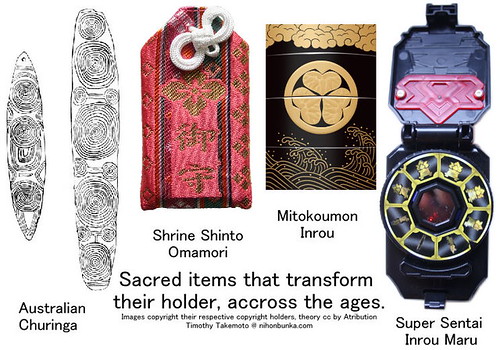
I noted in a previous post that the history of transofmatory items (変身アイテム) such as used by Ultraman (pens and glasses), Super Sentai (Power Rangers), Sailor Moon, Himitsu no Akko-chan, and Kamen Riders (Masked Riders), has a history in the transformatory symbols of Mitokoumon, Touyama no Kin and Samurai Momotarou. Japanese superheroes are always flashing a special symbol and transforming by means of its use.
The history is much older. I ague that Shinto is a geographical totemism, like that of the Arunda/Arunta/Arenda of Australia. In totemic religions the faithful recieve totemic badges which represent their owners and the ancestral spirits of their ancestors. The Arunda of the central Australia destert are one of many such groups found worldwide. Unlike most totemic religions, but in common with the Japanese, these "most primitive" (Freud, Durkheim) of totemists believed that the totem was associated with a place.
That the japanese recieve totemic badges from Shinto shrines almost goes un-noticed. More visible are the symbolic, soul containing badges that are given to the dead (mitama, Ihai). However, as Yanagita Kunio points out, once upon a time, there were "ikimitama" symbols given to the living. These were originally leaves branches of sacred trees and rocks from sacred mountains. They were believed to give their bearer life and were recieved from the time of first shrine visiting.
However in my view, and as Yanagita hints, the symbols were gradually replaced by kanji ideograms and piece of paper.
Yanagita writes, "in this reigion also the Nusa (gohei, zigzag strips of Shinto paper) were originally I think to be distributed among participants. This is similar to the leaves and branches of Japanese cedar and nagi (a evergreen tree/shrub) that were given to the faifthful from sacred trees on Mount Inari and Mount Ise" (Yanagita Kunio Collection No. 14 p 51, my translation.)
「この地方でも小さい幣を関係者に頒(わか)つのが本当の趣旨であったろうと思う。もししかりとすれば、後に言わんとする稲荷山の杉・伊豆山の梛(なぎ)のごとく、信者が神木の木の枝を追って行く風習と、著しく類似する点があるのである」柳田國夫全集14p51
These days Japanese still recieve omamori or amulets from shrines that are said to represent a stand-in or self-replacement and protect the bearer from bad luck and impurity.
And as shrines become less significant, Mitokoumon, Ultramen, Masked Riders, Super Sentai (Power rangers) brandish their sacred symbols and transforms with them.
Before we call the Japanese primitive bricoleurs, let us not forget that "in the beginning was the word," and that I have a "Christian name."Am I transformed by it?
Labels: henshin, Masked Riders, morph, nihobunka, religion, Shinto, specular, Super-Sentai, totemism, ultraman, アニミズム, スパー戦隊, トテミズム, 仮面ライダー, 変身, 宗教, 神道
This blog represents the opinions of the author, Timothy Takemoto, and not the opinions of his employer.