
Wednesday, July 20, 2016
The Chinese and The Japanese
Ruth Benedic's (1946) classic "Chrysanthemum and the Sword" has been popular in China (translated as 菊与刀) selling 70,000 copies in 2005 alone, since it would provide an explanation how the Japanese managed to kill so many Chinese and yet exhibit a level of remorse that the Chinese feel to be very inappropriate. Ruth Benedict's answer is that the Japanese lack a conscience, caring only what other's think about them. A great deal of Japanese believe this theory, which itself originates in a disgruntled Japanese called Robert Hashimoto (Lummis).
More contemporary Japanese detractors of Benedict's theory do not rarely argue that the Japanese do in fact have conscience, under the conventional meaning of that term, but rather that "conscience" in the sense of internal, self-directed, self-reproval simply does not exist. The main reason for this is that they are aware that they judge themselves visio-aesthetically, and this is not something that one can do from inside ones own head. The Japanese forget that the mind is not inside the head -- it is easy to do, I have -- but rather the other way around.
The Japanese are therefore in large part blissfully ignorant of the origin of their own morality, which is, the same as that of the Chinese. Both believe that in addition to the censure of other people, heaven is also judging.
In Japanese parlance the kind old sun is watching (otentou sama ga mite iru. お天道さまがみている。See e.g. Akagawa, 2015) and they'd feel her displeasure should they do anything bad.
This does not explain why the Japanese were able to kill so many Chinese, nor why they do not feel more remorse. In order to understand that one would have to read other books, mainly of a more historical nature.
I hope that the Chinese realise that in fact the Japanese do have a conscience before The Chinese and The Japanese come to blows again.
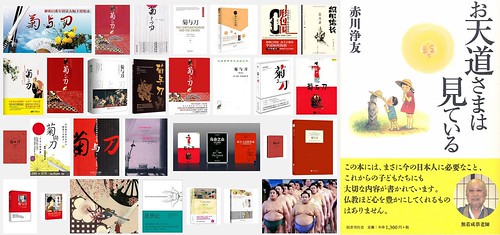
The images above left are the result of an image search for "”菊与刀” 销量" meaning "sales of 'Chrysanthemum and the Sword'" in Chinese, and the cover of a non-academic book entitled "The Kind Old Sun is Watching" (Akagawa, 2015)
Akagawa, J. 赤川浄友. (2015). お天道さまは見ている. 国書刊行会.
Benedict, R. (1946). The chrysanthemum and the sword; patterns of Japanese culture.
Labels: japanese culture, nihonbunka, occularcentrism, self, specular, 日本文化


Monday, July 27, 2015
Hoopa: The hooper that that could not loop
I thought "Pokémon the Movie: Hoopa and the Clash of Ages" was a Japanese commentary on Western culture personified in "Hoopa, the hooper that could not loop" (my subtitle).
Hoopa has two forms (as do many Pokémon), and as are believed to exist in the Buddhist view of ourselves: the small (unenlightened) and large (enlightened) self. We see the giant form of Hoopa first who uses giant hoops to move (or steal) things from anywhere in the world. Hoopa's power rests in this telekinetic ability. Herein lies the first parallel with Western culture. The Japanese have a bit of a tendency, in my limited experience, to see the British and their descendants as thieves, or "vikings" as they tactfully put it, conquering the world and taking it home. The seven hoops of Hoopa (one around each of his six arms, and one around his waist) may correspond to the sense of Buddhism (although there is one too many) which include the sense of the heart. From some Japanese points of view Westerners look upon nature and the world as a source of things to take, rather than as something with which one feels in harmony, to an extent unified.
Hoopa finds himself internally conflicted and unable to evolve into his large self who remains trapped in a bottle by a religious organisation that bears more than a passing resemblance to Judeo-Christianity. From a Japanese perspective Western culture separates God and humankind whereas in Japan, the enlightened, a supreme martial artist for instance, becomes one with God or the Buddha - which tend to be seen as the same things.
This inability to evolve into his large self, and being in conflict with it, parallels Hoopa's inability to pass through his own hoop. As we have seen Hoopa has six hoops (plus one around his body) that he uses to move or plunder the cosmos. He seems partially able to pass through one of his hoops (the one around his middle) but unable to pass through any of his others.
This inability to pass through his own hoops is due to Hoopa's lack of gratitude. Through his experience of growing up once again as small Hooper, however, Hoopa learns to love and feel gratitude and finally, when he does this he is able to pass through one of his own hoops. In this sequence, before the triumphant auto-looping-hooping the hoop, and overcoming self-conflict, Hoopa imagines himself growing up and all the love he has received. This introspection - literally seeing himself - works on a lot of levels as the defining characteristic of Japanese culture. The Japanese believe their heart to be a mirror, are found to literally have a mirror in their heart, they are (through the practice of Noh and Karate forms) able to see themselves from a perspective outside, and use this ability to see themselves from the points of view of others. Autoscopy is also especially noticeable in the last letters of suicide pilots and the Japanese version of psychoanalysis: Naikan therapy.
This self-seeing, or self perception may be what the whole "Pocket Monster" mythology is about as represented by the Pikachu Satoshi Diad. There is a monster within us, sitting on our shoulder, who sees us, but at some level, or in some way, Satoshi and Pikachu are one. Perhaps in a final Pokémon movie this fact will be revealed. Or perhaps it already has. I have only seen two Pokémon movies.
Reading perhaps far too much into the iconography, it seems proper that Hoopa should be appear from out of one of his hoops (little Hoopa), have hoops on his ears (little Hoopa) or have one of his hoops as a hole at his centre (Big Hoopa) since Westerners do feel able to perceive themselves, linguistically. Only being able to perceive ourselves through this especially dark mirror, we are able to wreck destruction on an unparalleled scale, believing that anything that can be linguistically justified is acceptable. Hence a Briton feels able in saying that the British enforced importation of narcotics into China, for more than a hundred years, was acceptable because "the Chinese chose to smoke (opium). Or, in my experience, Americans (and others from the allied nations) generally continue to approve of the bombings of Hiroshima and Nagasaki, as just since 'the Japanese started it.' It is only when one starts to see oneself, hear the crying children, smell the stench of results of what one does, it is only when one passes through other hoops, that such justifications become untenable. We need to learn other forms of insight fast.
Hoopa learns gratitude, becomes able to perceive himself, is no longer conflicted, walks in the light, or becomes Japanese, in harmony with, not apart from the world. In the last part of the movie giant Hoopa spends his time rebuilding that which he has destroyed, only plundering the occasional doughnut.
I was moved by the compassion with which Hoopa the destroyer was viewed. Even though he destroyed the humans that fed him, Hoopa was not punished with death, but merely part of him kept in a bottle, since after all, as grandfather says, Hoopa is one of the family.
(I have a Japanese family, and lack gratitude, so this notion moves me to tears.)
Labels: autoscopy, cultural psychology, culture, japan, japanese, nihonbunka, occularcentrism, self, specular, 日本文化
Monday, June 29, 2015
Outside Black Interior Pink

If you tried to have a conversation with this lady you might mistakenly think that she is alll and humble lacking in individuality. She has dressed up her car interior in vivid pink, leaving the outside black with only a hint of weird. The Japanese have an X-ray eye that can see even into their hearts. No Japanese can meet its gaze and live.
Vip Style Magazine (July, 2015) p. 131
お取り下げご希望でありましたら、下記のコメント欄かnihonbunka.comまでご連絡ください。
Labels: autoscopy, horror, japanese, japanese culture, nihonbunka, occularcentrism, ホラー, 日本文化
Thursday, June 25, 2015
Shame and the Male Gaze

The image on the left is from a book recommending Nudism to Westerners, in an attempt to "grow up without Shame". The genitals have been by me blurred to conform with current Japanese law. The image on the right is from Nakao (2010) "Since when did the Japanese find being naked embarrassing" and is one of the sketches by Heine in Admiral Perry's impressions of Japan at the end of the Edo period. According to Nakano (2012) and for that matter Isabella Bird, the Japanese did not have anything against the display of genitals until shocked Westerners arrived.
The Japanese did have words about the separation of the sexes however. It was said that Japanese males and females should only "share seats" (sit together) up to the age of 7 (Nakano, 2010, p. 18 「男女7歳にして席を同じうせず」) and that among samurai talking (yes!) to the opposite sex was avoided with males and females being kept strictly apart in the Edo period. (武士では男女が言葉すら交わすことも憚れた時代、男女の別厳しく問われた時代ではなかったか。」ibid).
I wonder if the Western nudists achieve their aim of growing up without shame. I went to a boarding school and managed to cease from being ashamed of my body, especially when as a late developer I had no pubic hair and a small penis compared to my peers. My shame was so great that I think that in order to beat it I had I no longer identified with my body at all. I can remember that the greatest time that I felt shame was when a house master, a father figure of sorts, came into the boys showers when I and some of my peers were there.
I guess that if the Japanese were in gaze of a mother then they would not feel ashamed, and it is only because the gaze felt is somewhat sexualised, that one might feel ashamed at all. Since Westerners feel shame towards their nudity and guilt about their moral behaviour, and Japanese felt shame about their moral behaviour but no shame or guilt about their nudity.
Does this suggest that a reversal therefore of the parent that looks and listens. As a boy I used to imagine that my father was watching, and cheering, me when I ran in cross country races.
Hypothesis
West it is felt that there is a
Motherly ear listening (according to Freud and Derrida at least)
Fatherly/Male gaze watching (which would make sense explaining the reason why nudity is so shameful)
Japan it is felt that there is a
Motherly gaze watching (hence the absence of shame towards nudity, since the mother gaze is non sexualised)
Fatherly/Male ear listening (hence the strictness with regard to talking to the opposite sex).
In my lectures I make Japanese men and women, who do not otherwise sit together, sit and talk to each other. What a Westernising devil! Perhaps I should cease and desist.
If anyone wishes I cease and desist with regard to the image on the left please leave a comment below or email me via nihonbunka.com.
Nakano, A. 中野明. (2010). 裸はいつから恥ずかしくなったか―日本人の羞恥心. Tōkyō: 新潮社.
Bird, I. L. (1880). Unbeaten Tracks in Japan: An Account of Travels in the Interior Including Visits to the Aborigines of Yezo and the Shrines of Nikkô and Isé. J. Murray.
Smith, D. C., & Sparks, W. (1986). Growing Up Without Shame. Elysium Growth Press, book.
Labels: japanese, japanese culture, nihonbunka, occularcentrism, sex, 日本文
Monday, June 08, 2015
Japanese Risk Taking: Irreligiousity
Most analyses of Japan behaviour argue that there are quantitative differences due to the lack of individualism or greater collectivism of the Japanese. Thus, I feel sure that the the risk aversion of Japanese has been explained in terms of their desire not to stand out because, as we are always being told, "the nail that stands out gets hit."
It seems to me rather that Japanese differ little from Westerners in terms of their desire for and achievement of individuality, but rather it is the modality in which they express it that is different. The Japanese express themselves visually since they have internalised and hidden a helper who sees (the mirror of the Sun Goddess) whereas Westerners tend to prefer to love themselves linguistically since they have internalised and hidden a helper or paraclete (Eve or Jesus) who hears.
When it comes to "risk taking behaviour," this usually refers to behaviours which result in physical harm to the body. Since the Japanese identify with their self-image, damaging their bodies is something that they are very averse to doing. The risky behaviours highlighted by Guzman and Pohlman (2014) : "Self-Injurious Behaviours, Violence, and Suicide, Substance Use, Risky Sexual Behaviour, and Behaviours Related to Obesity and Unhealthy Dieting," are all of this type. The Japanese avoid all of these risks.
Indeed the very definition of taking risk (doing dangerous things) usually relates to the lack of aversion to bodily harm so perhaps it is the case that the Japanese are generally less risk averse.
Fortunately there is a category of risks which the Japanese are prepared to take: those that relate to spiritual harm. According to Freese (2004, p88) "A clever and intriguing hypothesis in the sociology of religion is the idea that irreligiousness is analogous to other forms of risk-taking, and so variations in risk preferences play an important role in understanding variations in religiousness."
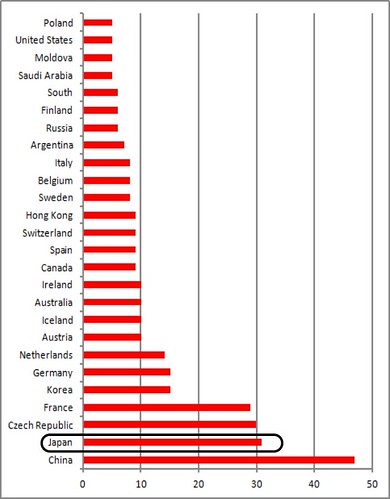
And at least according to Pascal, being religious can be considered to be a sort of insurance for ones soul. In this instance, the Japanese are found to be second only to the the Chinese is in their irreligiousity with 31% of Japanese claiming to be atheists. The Japanese take great care of their bodies, because they can be seen, but a large proportion of them care very much less about their soul since, at least on a naive view, it can't.
Again it should be noted that the Japanese claim to be atheists but involve themselves in a wide range of religio-cultural practices, such as shrine visiting and hiding their thumbs. In other words the Japanese are fairly happy to take risks when it comes to their lack of a linguistic avowal of some sort of creed or religion because no one is listening. But they are risk averse (as I found out with a survey) when it comes to skipping out on a shrine visit to praying for the health of their three, five, and seven year old children. Japanese behaviour thus appears to be paradoxical until one realises that what matters is how things appear, not what people say.
There should be many other linguistic risks that the Japanese take, at least if only by omission.
Image based on data from the Global Index of Religion and Atheism.
Labels: japanese culture, Nacalian, nihonbunka, occularcentrism, psychology, religion, reversal, Shinto, 日本文化
Friday, May 29, 2015
Sazae Tames the Lion

The lion, naked, prostrate and clearly lacking a womb, is scared. Sazae can tame anything and has tamed a sealion too, left. Like most Japanese women most of the time, Sazae appears to be on stage. She alone is fully aware of an audience. The lion is, like the Western wife perhaps, aware of the audience only through Sazae. The young chap with the ball, Katsuo I presume, is as yet oblivious. The audience constrains Sazae as it empowers her. In Japan phallogocentrism is replaced by wombimagocentrism*. When the audience watches, the women are in control, as they are controlled. Give up on the "different voice" (Gilligan, 1962) and get wombimagocentric now.
長谷川町子美術館の著作権です。おちりさげご希望でありましたら、下記のコメント欄かnihonbunka.comのメールリンクまでご連絡ください。
Gilligan, C. (1982). In a different voice. Harvard University Press.
Notes
* I think that this can be pronounced a bit like the Wombles, wom-bi-mago-centrism.
Addenda
What is it about logocentricism that is phallic?
Lacan mentions that mothers are often primary caregivers whereas males are fathers by virtue of their symbolic (linguistic) position in society, and often because of their work. In some societies the brothers are those which work to support sisters and their children and are treated much like fathers to those that they support.
In patriarchal societies, patriarchs may hope that their work, their significant acts, their money is rewarded on an exchange basis, with "presence" and "affection." The "philosophy of presence", where signifier are co-present with meaning in the "car-loving" mind, may be enacted in logocentric bedroom.
Logocentrists place themselves into the imagined dialogue between their parents.
"Car-loving" is one of Derrida's puns on "auto-affection", or onanism.
Labels: autoscopy, culture, feminism, japan, japanese, manga, Nacalian, occularcentrism, self, sex, specular, 日本文化
Tuesday, May 19, 2015
Big Ben: Japanese boasting and sex

Linguistic self-enhancement has generally been considered to be rather disgusting in Japan, or at least something that the Japanese have avoided. In my experience, and in historical accounts of Western impressions of Japan, boastfulness is almost completely, and notably, absent.
One of the few accounts of Japanese boastfulness is that of a highly Westernised scholar of things Western (rangakusha). After several months in captivity in Japan, the Russian spy Vasiliĭ Mikhaĭlovich Golovin remarked in 1811 that the Japanese geometrician and astronomer, Mamia Rinso (Mamiya Rinzo) "manifested his pride, however, by constant boasting of the deeds he had performed, and the labours he had endured." (Golovin, 1824, p284) but further that, "I must here remark, that this was the first Japanese ventured, in our presence, to swagger and assume // importance on account of his military skill, and his vapouring made not only us but even his own countrymen sometimes laugh at him. " (Golovin, 1824, pp. 285-286). In other words, the only Japanese person to boast, in Golovin's experience, was one who had been influenced by Western culture.
I have found two other records of instances of boastfulness in Japan in the pre-twentieth century historical record and both of them relate to sex.
"One old couple, who kept one of these shops, we were on intimate terms with; that is to say, we seldom passed without a few words to them. One day, seeing the old woman by herself, we asked her wherever husband was, and were told that she supposed 'he was after the girls', after which she laughed, as if delighted at the idea of having such a gay old dog for a spouse...
The next time we visited the shop, we rallied the old fellow on being such a gay Lothario; be he did not seem as proud of the reputation as his wife was, and indignantly declared the aspersion cast on him to be totally without foundation. We were half inclined to believe him, and even now think that the old woman's statement may have only been a vainglorious boast"(Cortazzi, 2013,, p67)
Edward de Fonblanque writes, in 1860, of another rare instance Japanese boastfulness, which is also sexual.
"Nor were business wants alone consulted, for the Government had considerately provide a magnificent building, all lacquer and caving and delicate painting, in which the Tojin [Foreigner] might pass their leisure hours in the company of painted musume [literally daughter, but the meaning her is girl], dressed in gorgeous robes, and coifées in the most wonderful manner.
I visited the Gankiro, taking the precaution to go there in broad day, and for my character's sake, in good company, and was a little startled at the systematic way in which the authorities conduct this establishment. Two officers showed us over the building, and pointed out its beauties which as much pride as if they were exhibiting an ancient temple sacred to their dearest gods. This was the court-yard; that was to be a fish-pond with fountains (the building was still incomplete at this time); in this room refreshments might be procured -that was the theatre; those little nooks into which you entered by a slide panel in the wall were dormitories, encumbered with no unnecessary furniture, there, affixed to the walls, was the tariff of charges, which I leave to the imagination; and in that house, across the court, seated in rows on the verandah, were the moosmes themselves. We were invited to step over for its was only under male escort that they might enter the main building? My curiosity had, however, been sufficiently gratified and I departed, quite ready to believe in anything that might hear as to the morals of the Japanese. (Cortazzi, 2013, p274.)
The Japanese are perhaps similarly reserved towards boastfulness and sexuality. Japanese humour, unlike that of the British, rarely revolves around innuendo. But in my experience (and research on the latter), both sexuality and boastfulness do appear when the Japanese have been drinking.
For example when attending a party with some Japanese sports persons, I found myself invited to drink at a table of similarly inebriated Japanese. It was late in the day, we had all had a few glasses of sake. One gentleman asked mischievously "So you are English? (omitting the subject and particles) England has Big Ben doesn't it? / You have a big ben don't you?" (イギリス人ですか。*ビッグ・ベン*はありますよね?). I think my host repeat "big ben", nodding in a conspiratorial way for emphasis. This was a very rare case of innuendo and inviting the opportunity to boast, once again on a sexual topic, which from a Japanese perspective may regarded, with some disdain - but at times enjoyment - to be of similar ilk.
Is there any inherent connection between linguistic self-enhancement and sex? Or on the contrary between visual self-enhancement and the storge appreciation of cuteness? Some theoreticians of language, its origins and merits suggest that it may have something do with peacocking. Derrida argues that linguistic thought, as self addressed love letter, is like onanism. One of the characteristics of linguistic as opposed to visual self-enhancement is that it takes places inside rather than outside the head. While linguistic self love becomes silent, ashamed, and interior (see Vigotsky on self-speech and the way it becomes hidden) visual self-love always presupposes an exterior, viewer. Does the interiority of self-serving interior dialogue, knowing oneself via ones self-narrative, imply or promote a sexual "autoaffection"? I tend to think so.
I think I told my hosts that I had not seen Big Ben. Lame!
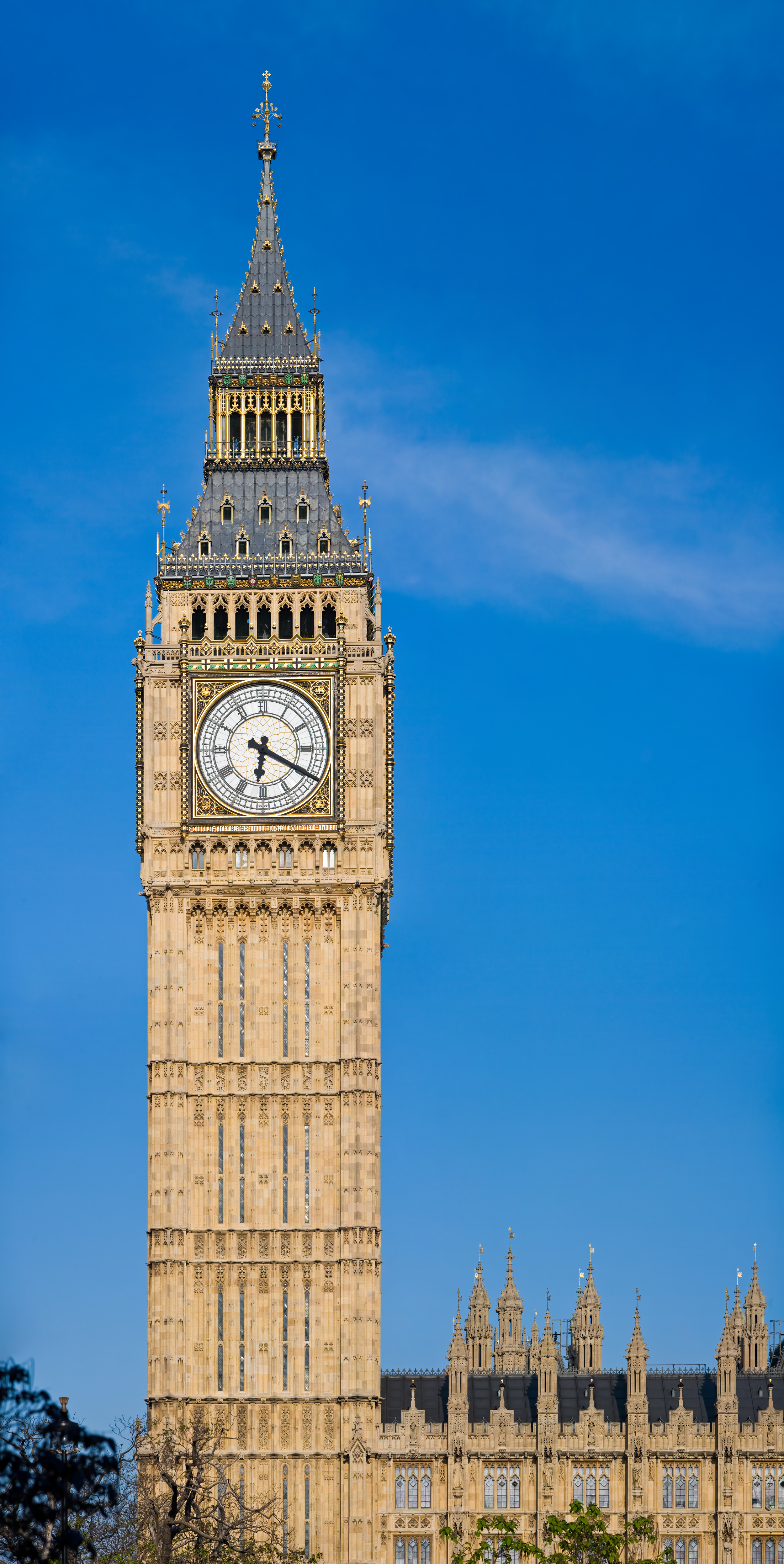
Image of Big Ben from Wikimedia
Cortazzi, H. (2013). Victorians in Japan: In and around the Treaty Ports. A&C Black.
Golovnin, V. M., Rīkord, P. Ī., & Shishkov, A. S. (1824). Memoirs of a Captivity in Japan, During the Years 1811, 1812, and 1813: With Observations on the Country and the People. H. Colburn and Company.
Labels: japanese, japanese culture, logos, occularcentrism, sex, 日本文化, 自己視
Wednesday, July 09, 2014
Visual Conscience Displayed Visually

In the DVD come mirror of her conscience the woman's face is transformed into that of an ogre.
The Japanese have a visual, rather than linguistic conscience, and their self esteem is stored and cognised largely in their self-appraisal (generalised other's/impartial spectator's/ superego's appraisal) of their own face.
Labels: autoscopy, crime, culture, japan, japanese culture, Jaques Lacan, mirror, Nacalian, occularcentrism, religion, reversal, specular, 日本文化, 自己視
Wednesday, January 15, 2014
Don't Do It: Preventing Suicide East and West
Self-awareness occurs in different modalities. Sometimes people engage in self-touching when feeling shy (Edelmann et al., 1989), and drink copious amounts of fluids thus becoming pneumatically aware of their digestive tract when suffering from psychosis (see: de Leon, Verghese, Tracy, Josiassen, & Simpson, 1994)*. But generally speaking, human self-awareness takes places in two channels or modalities: through language and though vision.
Typically, in Western literature the former, linguistic self awareness is privileged. Mead, the father of social psychology, argues that speech necessarily demands of speakers to hear themselves from the point of view of their listeners (plural), giving rise to the 'generalized other' (Mead, 1967), 'super-addressee' (Bakhtin,1986), 'Other' (Lacan, 2007), and 'impartial spectator' (Smith, 1812). Typically Western theorists argue, by application of common sense I presume, that in order to see oneself however, one needs a mirror. Mead writes "If we exclude vocal gestures, it is only by the use of the mirror that one could reach the position where he responds to his own gestures as other people respond" (Mead, 1967, p.66).
However, the recent discovery of 'mirror neurons' (Iacoboni, 2009a, 2009b) , the concomitant neural capability of 'autoscopy' (Blanke & Metzinger, 2009; Metzinger, 2009) and our own work demonstrating that the Japanese, but not North Americans, have "mirrors in their heads," (Heine, Takemoto, Moskalenko, Lasaleta, & Henrich, 2008) demonstrates that Mead's common sense assumptions about human inability to see themselves without a mirror is incorrect. Humans, especially if properly trained through the Japanese arts (Zeami; see Yusa, 1987; Ozawa, 2006) can activate their mirror neurons and hone their ability to learn to see themselves, just as Westerners can and do develop their debating skills and hone their ability to hear themselves from others' and then, importantly, the Other's objective point of view.
Cultures differ in the predominance of each type of self awareness. As we have seen, the Japanese have an ability and proclivity to be aware of themselves visually. This is demonstrated likewise by the tremendously positive way in which they portray themselves visually with their poses, fashion, and automatically corrected "puri-kura." That Americans are predominantly aware of themselves in the linguistic domain is, even if one does not believe theorists such as Mead (1967), Bruner, Lacan (2007), Hermans and Kempen (1993), Ricoeur (1990), Derrida(2011), McAdams, Bakhtin (1986)** to name but a few, adequately demonstrated by the way in which they have a strong and robust desire for positive linguistic self regard. All the studies showing positive self regard on the part of North Americans and and equivalent lack on the part of Japanese, for instance, are linguistic. The only studies to demonstrate a greater or equivalent positivity among Asians are visual: auto-photography (Leuers = Takémoto see Mukoyama, 2010, Ch.1), collage (Leuers = Takémoto & Sonoda, 2000), briefly presented flash cards (Yamaguchi et al., 2007), and positivity in recollection of photos.
What happens when the non-culturally preferred medium of self-awareness is promoted?
Among Westerners it has long been known that, unless they are feeling in a good mood, Mirrors tend to promote a novel mode of self-awareness making them aware of failure to meet social norms (Heine, Takemoto, Moskalenko, Lasaleta, & Henrich, 2008; Sedikides, 1992). The negative impact of mirrors is all the more pronounced when Westerners are in a state of negative affect. It is hardly surprising therefore that, as demonstrated by recent research (Selimbegović & Chatard, 2013), mirrors increases thoughts of suicide among Westerners. And, yet, mirrors are used as a means of preventing suicide in Japan (Oshimi, 1992).
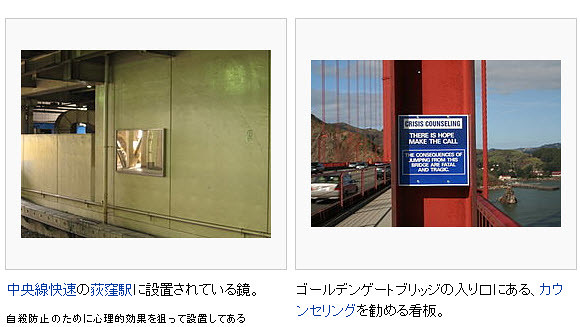
After more than two decades of economic stagnation, the level of suicide in Japan has reached historic highs. One way in which Japanese railway authorities have found effective in reducing the level of suicide by jumping in front of passing trains is to install mirrors on platforms. Mirrors are the culturally familiar mode of self-awareness in which the Japanese have learnt to self enhance. To see themselves as loved, lovable, even cute. Remembering the internalised gazes of their loved ones, the Japanese look at the mirror, see the side of themselves that they still love, don't do it and go home.
The equivalent stimulus for increasing positive self regard among Westerners has long been known - provide them with a telephone, a listening ear, and an opportunity to narrate themselves. Hearing ones self speak is enough to put your average Western, but not East Asians (Butler, Lee, & Gross, 2007, 2009; Butler, 2012), in a better, not a worse, mood.
As recent research (Selimbegović & Chatard, 2013) indicates, increase in the incidence of suicide might arise however if mirrors were situated on the Golden Gate Bridge, or I suggest, if suicidal Japanese were encouraged to narrate themselves***. This last possibility does not seem to be one which Japanese medical health professionals, even Mukoyama (2010), seem to have considered.
The image above is from the Wikipedia page on Infamous Suicide Spots, showing the suicide prevention mirror on the the platform of Ogikubo Station's Central Line, and a "Crisis Councelling" telephone on Sanfransisco's Golden Gate Bridge.
Inspired in the first instance by (Selimbegović & Chatard, 2013)
Bibliography
Bakhtin, M. M. (1986). Speech Genres and Other Late Essays. (V. W. McGee, Trans., C. Emerson & M. Holquist, Eds.) (Second Printing.). University of Texas Press.
Blanke, O., & Metzinger, T. (2009). Full-body illusions and minimal phenomenal selfhood. Trends in Cognitive Sciences, 13(1), 7–13. doi:10.1016/j.tics.2008.10.003
Butler, E. A. (2012). Emotion Regulation in Cultural Context: Implications for Wellness and Illness. In S. Barnow & N. Balkir (Eds.), Cultural Variations in Psychopathology: From Research to Practice. Hogrefe & Huber Pub. Retrieved from www.hogrefe.com/program/media/flyingbooks/600434/files/as...
Butler, E. A., Lee, T. L., & Gross, J. J. (2007). Emotion regulation and culture: Are the social consequences of emotion suppression culture-specific? Emotion, 7(1), 30.
Butler, E. A., Lee, T. L., & Gross, J. J. (2009). Does Expressing Your Emotions Raise or Lower Your Blood Pressure?: The Answer Depends on Cultural Context. Journal of Cross-Cultural Psychology, 40(3), 510–517. doi:10.1177/0022022109332845
Derrida, J. (2011). Voice and Phenomenon: Introduction to the Problem of the Sign in Husserl’s Phenomenology. Northwestern Univ Pr.
Hermans, H. J. M., & Kempen, H. J. G. (1993). The Dialogical Self: Meaning as Movement. Academic Press.
Heine, S. J., Takemoto, T., Moskalenko, S., Lasaleta, J., & Henrich, J. (2008). Mirrors in the head: Cultural variation in objective self-awareness. Personality and Social Psychology Bulletin, 34(7), 879–887. Retrieved from www2.psych.ubc.ca/~heine/docs/2008Mirrors.pdf
Iacoboni, M. (2009a). Imitation, Empathy, and Mirror Neurons. Annual Review of Psychology, 60(1), 653–670. doi:10.1146/annurev.psych.60.110707.163604
Iacoboni, M. (2009b). Mirroring people: the science of empathy and how we connect with others. New York, N.Y.: Picador.
Lacan, J. (2007). Ecrits: The First Complete Edition in English. (B. Fink, Trans.) (1st ed.). W W Norton & Co Inc.
Leuers = Takémoto, T. R. S., & Sonoda, N. (2000, November). 心像的自己に関する比較文化的研究(6) -メディア(言語とイメージ)の違いと日米比較― Cross Cultural Research on the Specular Self: Differences in Media (Language and Image) and comparison between Japan and America. Oral Presentation口頭発表 presented at the The 64th Annual Convention of the Japanese Psychologiocal Association English日本心理学第64回大会, Kyoto University. Retrieved from nihonbunka.com/docs/shinzoutekijiko6.docx
Mead, G. H. (1967). Mind, self, and society: From the standpoint of a social behaviorist (Vol. 1). The University of Chicago Press.Metzinger, T. (2009). The Ego Tunnel: The Science of the Mind and the Myth of the Self (1st ed.). Basic Books.
Mukuyama, Y. 向山泰代. (2010). 自叙写真法による自己認知の測定に関する研究. ナカニシヤ出版.
Oshimi, T. 押見輝男. (1992). 自分を見つめる自分: 自己フォーカスの社会心理学.
Ozawa, T. 小沢隆. (2006). 武道の心理学入門: 武道教育と無意識の世界. 東京: BABジャパン出版局.
Sedikides, C. (1992). Attentional effects on mood are moderated by chronic self-conception valence. Personality and Social Psychology Bulletin, 18(5), 580–584. Retrieved from psp.sagepub.com/content/18/5/580.short
Ricoeur, P. (1990). Time and Narrative. (K. Blamey, Trans.) (Reprint.). Univ of Chicago Pr (T). Selimbegović, L., & Chatard, A. (2013). The mirror effect: Self-awareness alone increases suicide thought accessibility. Consciousness and cognition, 22(3), 756-764.
Smith, A. (1812). The theory of moral sentiments. Retrieved from books.google.co.jp/books?hl=en&lr=&id=d-UUAAAAQAA...
Yamaguchi, S., Greenwald, A. G., Banaji, M. R., Murakami, F., Chen, D., Shiomura, K., … Krendl, A. (2007). Apparent universality of positive implicit self-esteem. Psychological Science, 18(6), 498.
Yusa, M. (1987). Riken no Ken. Zeami’s Theory of Acting and Theatrical Appreciation. Monumenta Nipponica, 42(3), 331–345. Retrieved from myweb.facstaff.wwu.edu/yusa/docs/riken.pdf
Notes
* This is the way I (and perhaps Derrida) see self speech, as a sort of self touching, self-comforting, auto 'hostipitality.'
**I know that I am ignoring Cooley and Goffman. It seems to me that the latter, and those that base there analyses on Goffman's approach such as McVeigh (Wearing Ideology) come closest to the position that this blog espouses but, in Goffman's and McVeigh's case at least it seems to me that their dramatological, 'looking glass self" is 'presentational.' That is to say that the Goffman and McVeigh (if not the Cooley) 'looking glass self" is an image of me for you, for another specific other. And this is the nub of the matter. The Japanese too hear their self speech from the ear of otherS but they lack the "generalized" (Mead, 1967), "super" (Bakhtin, 1986) Other (Lacan, 2006) and they have, and we lack, a generalized gaze of the world.
*** Based on Western practice, the Japanese have taken to situating telephones at suicide spots. It seems possible to me that a telephone to the Japanese is a bit like a mirror to Westerners. A telephone encourages people to narrate themselves, and in Japan that, among those that have debt, interpersonal problems, encourages them to narrate themselves negatively in the absence of Eve, a generalized other, super-addressee, or ear that loves them. I know that there is some (though very little) OSA research that uses voice, but I suggest that a telephone is a Nacalianly transformed mirror.
Labels: individualism, japan, japanese culture, Nacalian, nihonbunka, occularcentrism, reversal, 日本文化
Thursday, November 28, 2013
It was the Neck-tie! Culture and judgement of Causal Relevance

Choi and his collegues (2003) asked Korean and US subjects to consider a murder incident where a student had murdered his research supervisor. They were then shown a list of 40 factors and asked which of them were irrelevant in terms of motive.
The list included items such as the following: "The professor rejected the student's graduation thesis," "The professor criticised the student in front of others," "The professor used a PC not a Mac," "The graduate student did not like the professors' neck-tie." It was found that while North Americans considered only the big life changing factors (such as failing the student's thesis) relevant, the Korean subjects were significantly less likely to strike other items off list, considering in some case, factors such as the colour of professors' tie to be a contributing factor in the occurrence of the murder.
First of all, despite what Westerners say, I think that the Koreans are not being unrealistic. Take the weather for instance. The hero of Camus' The Outsider ended up killing an Arab partly because it was a hot sunny day, and there is well known relationship between elevated temperatures and violent crime. When conflict is brewing, the fact that it is a hot day can be the final straw.
Choi et al. (2003) explain East Asian sensitivity to the complexity of causality in terms of Masuda and Nisbett's (2001) brilliant theory of analytic and holistic thought. The Koreans are being holistic and taking more factors into consideration.
What Choi does not often mention (I asked him at a conference) is that when the method was reversed, and Koreans were asked, after they had imagined the murder, which factors out of this list are relevant, then they chose no more factors than the Americans. Why is this? Why do the Koreans cease to be more 'holistic' when the choice is presented in this way?
My answer is, as always, that the cultural divide hinges on the relative importance of language and vision. Westerners decide that a factor is relevant if they can construct a compelling narrative for the killing. "He murdered his professor because his professor failed his graduation thesis" is compelling, but "He murdered his professor because he did not like his tie" sounds like a joke.
The Koreans on the other hand are trying to get their imagination around the event, putting themselves into the position of the student. Using their visual imagination they can therefore neither reject factors which it is suggested were present - such as the weather, or the neck tie which might have been the breaking point - nor include factors which they had not imagined. This is because, in both Korea and Japan, language is subservient to vision. Language describes the visual world. On its own it is a lot of bumf (rikutsu).
Bibliography
Camus. A. (1942) L’Étranger. Libraire Gallimard.
Choi, I., Dalal, R., Kim-Prieto, C., & Park, H. (2003). Culture and judgement of causal relevance. Journal of personality and social psychology, 84(1), 46. Retrieved from psycnet.apa.org/journals/psp/84/1/46/
Labels: culture, image, japan, japanese culture, Jaques Lacan, Nacalian, nihonbunka, occularcentrism, 日本文化
Wednesday, November 27, 2013
Brought to the Courtroom

Japanese people are less likely to adorn their desk at work, or the shelves in their homes with pictures of their relatives, with one exception. Pictures of deceased relatives are often hung above the ancestral altar. This is because, I believe, pictures of people are felt to be so real that it is almost as if they are felt to be present in their picture, as they are felt to be present also inside the altar. Another example of this use of photographs to represent the deceased is the way in which surviving family members of victims and plaintiffs bring pictures of deceased relatives to Japanese courtrooms.
In the above photo (Asahi Newspaper, 17th April, 2013, Photograped by Nishibatake Shirou) Akio Mizoguchi has brought a picture of his mother, deceased, to the High Court of Japan, where it was decided that she was indeed a victim of minamata disease. Mr. Mizoguchi is shown celebrating his, and his mother's victory in the court case. He has brought the photo of his deceased mother so that she may share in the proceedings and eventual victory. Similarly, pictures of deceased victims are sometimes brought by their relatives to murder trials. These behaviours go to demonstrate that contra Westerners, who are meant to grow out of their "mirror stage," the Japanese continue to identify with images even in adult life, and even, in the case of others, post death.
The strong identification between visual images and person hood also explains why so many Japanese ghosts are felt to emerge from images such as hanging scrolls (1,2) lanterns (1,2, 3) and more recently television sets.
取り下げご希望でありましたら、下記のコメント欄またはnihonbunka.comのメールリンクからご連絡いただければ幸いです。Should anyone wish that I remove this image from the Internet, please post a comment below or send an email to me via the link on my homepage, nihonbunka.com.
Labels: autoscopy, culture, image, japan, japanese culture, Jaques Lacan, lacan, mirror, Nacalian, occularcentrism, religion, ring, ringu, specular, 日本文化, 自己視
Thursday, August 01, 2013
Japanese Wide Show Mock-up
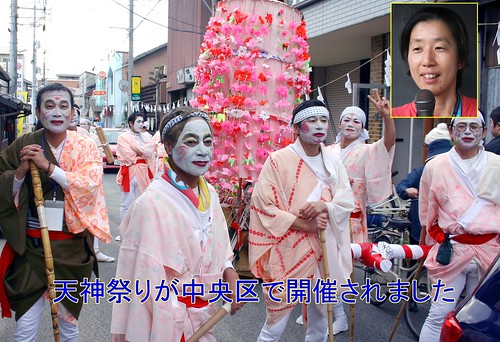
1) The faces of the commentators are seen displayed during the parts of the current affairs program that are filmed on location, so that viewers can SEE the expressions, and see the feelings that are being felt. (c.f. the face, in the top right hand corner)
2) The Japanese is given subtitles so that the viewers can *see* what is being said.
On the other hand, in the West, the viewers are provided with copious amounts of canned laughter so that so that they can know when to laugh. The principle is the same - the folks at home need to be told when to laugh - but while Japanese are stimulated by visual images, Westerners are comparatively "(logo) phonocentric" (Derrida, 1998).
In some Western News shows there are also teletypes providing extra linguistic information rather than a subtitles to what the presenters are saying. The majority of Westerners do not need to see what is being spoken, but they do like to feast upon as much linguistic information as possible.
Derrida, J. (1998). Of grammatology. JHU Press.
Labels: japan, japanese culture, Jaques Lacan, Nacalian, nihonbunka, occularcentrism, theory, 日本文化
Tuesday, July 02, 2013
Japanese Fashion in the Mirror of the Heart
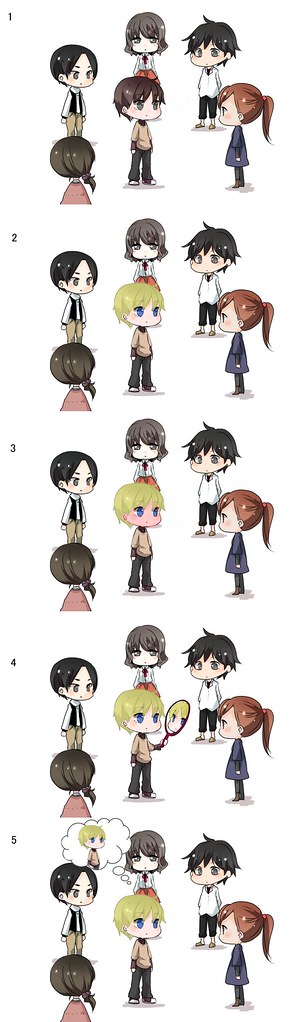
See Taro in the middle of a circle of his friends. The Japanese self is often described as being relational (Watsuji, Bendedict, Markus, Hamaguchi) which boils down to it being non-existent, or at best a nexus of self presentation concerns. The Japanese self is in the eye of the other, we are told.
If this were all there were to the Japanese self then how could the Japanese create and wear the zaniest fashion in the world? If this were the case, then if Taro dyed his hair blonde and wore blue contact lenses to college (picture 2), he would feel the harsh, judgemental gaze of his peers and become embarrassed (picture 3).
How could he avoid embarrassment? How could he remind himself of his preference for blonde hair and blue eyes? He could whip out his mirror (picture 4). As demonstrated by Carver ( 1975) and Carver & Scheier (2001) people with increased "objective self awareness" in front of mirrors, remain truer to their beliefs even in the face of social pressure. The trouble is, with all those eyes upon him, Taro would need to walk around looking in his mirror all the time.
But Taro has no need to do his, because Taro and all Japanese, especially those who have practised some kind of martial art or traditional path, has a mirror in his head (Heine, Takemoto, Moskalenko, Lasaleta, & Henrich, 2008). Taro can see himself without the aid of a mirror, avow his preference for blonde hair and blue eyes, and be done with the eyes of the world (picture 5).
It is because they have a mirror in their heart - originally a present from the Sun Goddess we are told - that the Japanese make the zaniest fashion in the world.
All five images based on an original by Miho Fujimura.
Carver, C. S. (1975). Physical aggression as a function of objective self-awareness and attitudes toward punishment. Journal of Experimental Social Psychology, 11(6), 510–519. Retrieved from www.sciencedirect.com/science/article/pii/0022103175900025
Carver, Charles S., & Scheier, M. F. (2001). On the Self-Regulation of Behavior. Cambridge University Press.
Heine, S. J., Takemoto, T., Moskalenko, S., Lasaleta, J., & Henrich, J. (2008). Mirrors in the head: Cultural variation in objective self-awareness. Personality and Social Psychology Bulletin, 34(7), 879–887. Retrieved from www2.psych.ubc.ca/~heine/docs/2008Mirrors.pdf
Labels: collectivism, individualism, japan, japanese culture, mirror, nihonbunka, occularcentrism, religion, specular, 個人主義, 宗教, 日本文化, 武道, 神道, 集団主義
Thursday, December 20, 2012
Noh, Kyari and Mario playing Call of Duty: Can you see your own back?

As concerns the dance, it is say that "the eyes look ahead and the spirit looks behind." This expression means that the actor looks in front of him with this physical eyes, but his inner concentration must be directed to the appearance of his movements from behind [think Super Mario, rather than Call of Duty (Masuda, 2010)]. This is a crucial element in the creation of what I have referred to above as the movement beyond consciousness. The appearance of the actor, seen from the spectator in the seating area, produces a different image than the actor can have of himself. What the spectators sees is the outer image of the actor. What an actor sees, on the other hand, forms his own internal image of himself. He must make still another effort in order to grasp his own internalized outer image, a step possible only through assiduous training [Kyari's dance routines may look easy but she too has done assiduous training.] Once he obtains this, the actor and the spectator can share the same image. Only then can it actually be said that an actor has truly grasped the nature his appearance. For an actor to grasp his true appearance implies that he has under his control the space to the left and to the right of him, and to the front and to the rear of him. In many cases, however, an average actor looks only to the front and to the side, and so never sees what he actually looks like from behind. If the actor can not somehow come to a sense of how he looks from behind, he will not be able to become conscious of any possible vulgarities in his performance. Therefore, an actor must look at himself using his internalised outer image, come to share the same view as the audience, examine his appearance with his spiritual eyes (see image above), and so maintain a graceful appearance with his entire body. Such an action truly represents "the eyes of the spirit looking behind." (p. 81)
Beautiful stuff! The genius, but more pedestrian, George Herbert Mead (1967), lacking the information that we now have regarding mirror neurons, claims that what Zeami proposes above is impossible (the below quoted from "Mind, Self and Society":
It is only the actor who uses bodily expressions as a means of looking as he wants others to feel. He gets a response which reveals to him how he looks by continually using a mirror. He registers anger, he registers love, he registers this that or the other attitude and he examines himself in a glass to see how he does so. (Mead, 1967, pp. 66-67)
and hence Mead argues that the creation of the self, can only be done in language.
"If we exclude vocal gestures, it is only by the use of the mirror that one could reach the position where he responds to his own gestures as other people respond." (Mead, 1967, p. 66)
"What is peculiar to the latter is that the individual responds to his own stimulus in the same way as the other person responds." p67 "It is only the vocal gesture that is fitted for this fort of communication, because it is only the vocal gesture to which one responds or tends to respond as another person tends to respond to it." p67 "The critical importance of language in the development of human experience lies in this fact, that the stimulus is one that can react upon the speaking individual as it reacts upon the other. " p69
Mead did not know that there are those who have a mirror in their heads (Heine et al. 2008), who are spacemen (間人, Nishida⇒Watsuji; see Hamaguchi, 1982), "res extensa."
Image top A Necessary Man by raichovak, on Flickr
Image centre, Kyari Pamyu Pamyu singing Pon Pon Pon copyright Kyari Pamyu Pamyu (きゃりーぱみゅぱみゅ) the director Jun Tajima, Masuda Sebastianone, and Warner Music Japan.
Image bottom, Mario playing Call of Duty (see Masuda, 2010)
Hamaguchi 浜口恵俊. (1982). 間人主義の社会日本. 東洋経済新報社.
Masuda 増田貴彦. (2010). ボスだけを見る欧米人 みんなの顔まで見る日本人. 講談社.
Mead, G. H. (1967). Mind, self, and society: From the standpoint of a social behaviorist (Vol. 1). The University of Chicago Press.
Zeami. (1984). On the art of the nō drama: the major treatises of Zeami ; translated by J. Thomas Rimer, Yamazaki Masakazu. Princeton, N.J: Princeton University Press.
Labels: culture, japan, occularcentrism, reversal, Shinto, specular, 日本文化
Wednesday, December 19, 2012
The Chinese are Japanese Too

Subjects, looking at the front (left) of the shelves is faced with a choice (A) of moving the block on the left up, or (B) the block on the right up. But if they think about it, they should be aware that the "instructor" can not see the darker block on their right, and must therefore mean the block on the left. American (and no doubt British) subjects are often too dumb to work this out!
Chinese are not so dumb. They almost never move the wrong block because they look at the shelves from the point of view of the "instructor." In other words, the researcher point out, the Chinese are good at "perspective taking". They are able to see things from an auto-focused or autoscopic perspective. The Chinese, like Kyari Pamyu Pamyu and Japanese martial artists, can look at themselves from the position of the world, as if they have extra eyes pointed inwards towards themselves.
Scholars such as Iacoboni (2009) and Metzinger (2009) show us that all humans can see themselves, take out of body perspectives (Blanke & Metzinger, 2009) but from the above research it is clear some cultures can see themselves more clearly.
This ability to see from autoscopic perspectives pointed towards oneself, as if equipped with a freely positionable mental mirror (Heine, Takemoto, Moskalenko, Lasaleta, & Henrich, 2008) is the defining characteristic of Japanese culture. It represents a different type of "perspective taking" to that refereed to by Mead (1967) since it is not carried out in language. It does, like Meadian linguistic perspective taking result in a sense of self and it may be encouraged by choreographed, repetitive (see Butler, 1993), set-behaviours (kata and dance routines) that through their performance turn the body into a sign and encourages the performer to see these signs from the point of view of the other, and to establish an auto-focused gaze.
This culture of the eye of the other, is due in part to the influence of the Shinto religion, the primary deity of which sees herself as, refers to herself as, and is represented as, a mirror. This mirror is said, by at least one Japanese religious leader (Kurozumi, 2000), to be in the heart of the Japanese.
The experimental evidence points to it being found in the hearts of Chinese too. The first mirrors that were treated with reverence in Japan were imported from China so it is probably fair to say that this ability, to take external auto-focused perspectives, is as Chinese as it is Japanese. I have no doubt that it is engendered as much by Taichi (太極拳) as it is by Karate, or Kyari's dancing. The Chinese and Japanese need to realise their similarities and learn to be friends.
Lower image copyright Kyari Pamyu Pamyu (きゃりーぱみゅぱみゅ) the director Jun Tajima, and Warner Music Japan.
Blanke, O., & Metzinger, T. (2009). Full-body illusions and minimal phenomenal selfhood. Trends in Cognitive Sciences, 13(1), 7–13. doi:10.1016/j.tics.2008.10.003
Butler, J. (1993). Bodies That Matter: On the Discursive Limits of "Sex. Routledge.
Heine, S. J., Takemoto, T., Moskalenko, S., Lasaleta, J., & Henrich, J. (2008). Mirrors in the head: Cultural variation in objective self-awareness. Personality and Social Psychology Bulletin, 34(7), 879–887. Retrieved from www2.psych.ubc.ca/~heine/docs/2008Mirrors.pdf
Iacoboni, M. (2009). Imitation, Empathy, and Mirror Neurons. Annual Review of Psychology, 60(1), 653–670. doi:10.1146/annurev.psych.60.110707.163604
Kurozumi, M. (2000). The Living Way: Stories of Kurozumi Munetada, a Shinto Founder. (W. Stoesz & S. Kamiya, Trans.). Altamira Pr.
Mead, G. H. (1967). Mind, self, and society: From the standpoint of a social behaviorist (Vol. 1). The University of Chicago Press.
Metzinger, T. (2009). The Ego Tunnel: The Science of the Mind and the Myth of the Self (1st ed.). Basic Books.
Wu, S., & Keysar, B. (2007). The effect of culture on perspective taking. Psychological science, 18(7), 600–606. Retrieved from pss.sagepub.com/content/18/7/600.short
Labels: autoscopy, eye, image, individualism, japan, japanese culture, mirror, Nacalian, nihonbunka, occularcentrism, Shinto, specular, 日本文化, 神道, 自己視
Friday, December 07, 2012
Dconstructing Haiku
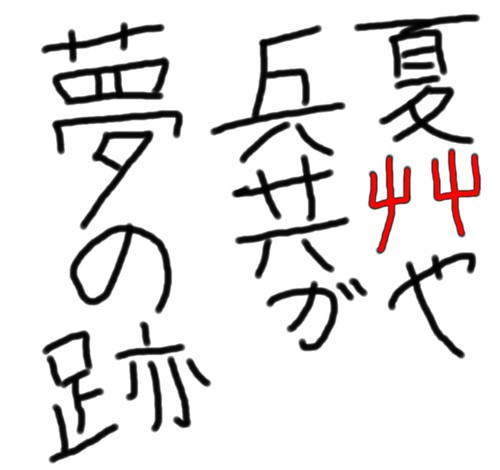
Here are some specific examples from the first few in this net selection of 100 famous Haiku (in Japanese).
As already discussed possibly the most famous Haiku is
古池や蛙飛び込む水の音
Furuikeya, Kawazu tobikomu, Mizu no oto
An old pond, frogs jump in, the sound of the water.
We are presented with a view of an old, and presumably over-grown, murky pond. The poet then assumes that a frog, or many frogs, have (probably) jumped into the water. This second phrase - frogs jump in - is pure interpretation. In the third phrase we are reminded, in quite shocking fashion, the grounds for second assumption: the sound of the water. The poet had provided an interpretation - that frogs had jumped in - and then shown it for what it was. All that has occurred in truth, in the immediate purity of the experience, was a view of a pond, and the sound of the water. From the image, the frogs -- dread signs that they were -- completely disappear, for they were never there in the first place. Plop!
In the poem
さみだれを集めて早し最上川,
May rain, Collected quick Mogami River,
is quite straightforward in telling us that there may not be any rain at all, only the river which has collected the rain and is running rapidly. The way in which the "quick" falls between the second and third phrase, at first appearing adverbial (to mean fast collection) but finally we realise is probably adjectival referring to the fast river, adds to the switchback, satorific, "vortex" of the poem. Bashou was looking at the river all along, but took us to an interpretation, which while in part true, was not the reality of his experience: a view of a river. As a Buddhist Bashou would not have needed Heraclitus to remind him that a river is all we are ever looking it, though we see so many things collected in it.
閑さや岩にしみ入る蝉の声
Shizukesaya, Iwa ni shimi-iru, Semi no koe
Silence Soaks into the Rocks Sound (or, rather, voice) of Cicadas,
Here it is all too clear that the initial "silence" is not silence at all. It is an interpretation of the monotonous summer sound-scape, the deafening (you need to listen to this if you have not lived in Japan) truth of which we are returned to in the last phrase.
Looking at a field of summer grass, at the site of a once great military castle in Hiraizumi, Bashou writes
夏草や 兵共が 夢の跡
Natsukusaya, Tsuwamono-domo ga, Yume no ato
Summer Grass Soldiers(') Remains of dreams
The usual interpretation is that the summer grass is all that is left of the the once lofty aspirations of the soldiers. I think that this interpretation is correct, but there is also another. The "ga" (が) or apostrophe (') in my translation can be read as linking word meaning that the dreams are of or possessed by the soldiers. But it also can be read as a subject marker, which is not used in English, hence the apostrophe is in brackets. Taking the "ga" to be a subject marker the final clause comes as a shock because instead of the soldiers being active subjects, or there present, we see that only their field of dreams remain. Further, almost as if the solders have been killed in the middle of the poem, it seems to me, gazing at the field, Bashou himself let his imagination run free, so the "dreams" are not only those of the soldiers but also the dreams Bashou himself who imagined (dreamt) the soldiers. Indeed the summer grass itself may have looked like legions of soldiers. In strong support of this hypothesis is the fact that Bashou wrote the word "kusa" or grass with the non-standard (even for Bashou, even in the same book) ideogram "艸" (Matuso, 1997, pX) which looks a little like soldiers standing in a line. I.e. Bashou realises, and makes us realise, that he has dreamed up solders from his image of the grass, to the truth of which he returns us. Like all the best haiku however, the poem has no incontrovertible interpretation. Basho could be talking about the dreams of the soldiers, or his own dream of soldiers, but we do know, all he sees is a field of grass. Bearing in mind the fact that Basho deliberately edits his poems for poetic effect, I would not be surprised if he thought this one up well before arriving in "the deep north." In any event, it was well worth the journey.
The usual interpretation of
荒海や佐渡に横たふ天の川
Araumiya, Sado ni Yokotau, Amanogawa
Routh Sea, Lies down in Sado, The milky way.
is that Basho is seeing the milky way above the rough waters around the island of Sado but to me the first phrase "荒海" is an optical illusion. First of all, from the historic record, and the fact that Bashou uses the word "milky way" this poem was written on the night of the festival of the Weaver stars who are said to cross the milky way to meat each other on 7th of July. This is the first hint to me that something is amiss. Despite adding this "season word," it would be a a little unseasonal for the sea to be rough on a summer night (though an early typhoon is not an impossibility). Secondly, while there are various interpretations of "lies down," taking a straight forward one, it suggests that rather being over the sea, the milky way is on the surface of the water. The natural explanation for this would be that the mily way is being reflected in the sea, a beautiful image appropriate for the romantic festival night. This would further suggest that the sea was flat, for the starts to be reflected, and therefore that the "rough sea" was an optical illusion created by the white light of the stars brilliantly reflected in the water's surface. What initially Bashou saw as white waves, turned out to be the light of stars lying on the water. Again we are fed a plausible misinterpretation to be returned to the truth of the image.
明けぼのやしら魚しろきこと一寸
Akebonoya, Shiraushirokikotoisun
Dawn! white fish, its whiteness one inch (or very briefly)
This poem was originally "雪薄し”or thin snow which Bashou changed to dawn, in my view because the optical illusion of seeing thin snow as a white fish was a bit too obvious. In other words the poem started out as an optical illusion where the poet claimed/thought he saw snow before realising it was the flash of a white fish in the water, to the optical illusion of thinking one has seen the first rays of sun on the sea, which turned out to be the flash of white fish. In either case the reader is taken from a misinterpretation to the purity of the image. The substitution of "dawn" for "thin snow" - which both might produce flashes of light - shows the deliberate way in which Bashou sets the reader up. What a trickster.
The excellent poem (which I read now for the first time)
この道や行く人なしに秋の暮
Konomichi Ikuhitonashini Akinokure
This road, no one goes along it, late autumn,
was written shortly before Bashou's death at an inn, when he had already fallen terminally ill. The road in question is thought to refer to the poetic path that Bashou had walked throughout his life. The lack of a road goer or goers is usually interpreted to refer to the solitude of the poetic path, but it may also refer to the breakdown of the ultimate illusion: the poets own absence as realised near death, "late autumn." If so then it is more upbeat than usually interpreted, as it implies a lack of fear of death, since Bashou feels himself absent from his own "road" already. Bashou is so cool.
Skipping the two poems related to death, and moving on to Buson
菜の花や月は東に日は西に
Nanoyanaya Tsukihahigashini, Hiha nishi ni
Field mustard (flowers), The moon is in the East, The sun in the West
This poem at first confused me since it could so easily have created an obvious interpretive illusion and return to the truth of the image (the pure experience), by reversing the order of the last two lines. Let me explain. Since the moon is unlikely to produce an affect on Buson's field of vision when behind him, I presume Buson is looking East at the moon over a field of mustard flowers, that are illuminated by the setting sun behind him in the West. In other words it would seem that the poem proceed towards interpretation rather than towards the pure image; The poet sees flowers, sees the moon, and interprets that the sun must be behind him.
Had Buson written instead
菜の花や日は西に月は東に
Field mustard (flowers), Sun in the West, Moon in the East
Then the second line would have created in the reader the impression that the poet was watching the setting sun, but with the final line the reader would be returned to the pure experience, with the realisation that the poet is in fact looking at the moon, and the second line regarding the sun was an interpretation of the setting sunlight falling on the flowers.
However, upon reflection and thinking more deeply regarding the direction that Buson was looking, it is important to ask whether he was looking at the son or the moon. Googling images related to this poem shows views facing both the moon and the setting sun. We are told that this poem was written on Mount Maya in the Rokkou range of mountains overlooking the Koube bay. The field mustard flowers were presumably on the bay (rather than mountainous) side. Since the Koube bay lies to the West of Mount Maya, this suggests that Buson was looking West at the setting sun. In other words, the second line regarding the moon, was an interpretation, based upon the time of day: sunset. The poem does indeed proceeds from image (the flowers) to interpretation, 'the moon (must be) in the East' to the return to purity of the experience, the setting sun in the West.
Reconsidering once again, however, since there is a plain to the East of [the very appropriately named, and conceivably deliberately chosen] Mt Maya, this poem is, like many of those above, left in interpretive abeyance. We know that Buson was looking at a something big and bright above a field of flowers. We know that he can not have been looking at towards both the East and the West, but we do not know in which direction he is looking. No definitive, incontrovertible interpretation is possible. We are left only with the visual experience: the sphere of light above a yellow field. Wow. Buson is very cool too.
Bibliography
Matsuo, B 松尾芭蕉. (1997). 芭蕉自筆奥の細道. (上野洋三 & 桜井武次郎, Eds.). 岩波書店.
Labels: buddhism, japan, japanese culture, Nacalian, nature, nihonbunka, occularcentrism, specular, 日本文化, 自然
Thursday, December 06, 2012
Kyari, Super Suits and Symbols

Eschewing telephone boxes and toilets, Japanese superheroes transform in front of everyone with great aplomb, sometimes on stage. They use symbols to transform. And they also have, and sometimes become, suits. Often what the Japanese Clark Kenta changes into is a super suit. Their super form that -- vectored by the symbol -- possess them is often a sort of exoskeleton. They have bug eyes, but no mouths. Speaking, even mumbling, is quite out of the question. Ultramen are pure body, pure light.
Both types of super hero use the image and the symbol but in different directions, with reversed means and ends. The Western suit is the *means* to conceal and continue the objective: the super identity that the hero always was. The Japanese transformatory symbol, and Kyari Pamyu Pamyu's choreographed "Kata," are a means to transforming into ones super suit, or assuming the visual three-eyed* identity that Kyari represents.
*Kyari has two eyes on her face and another, that looks at her sometimes a "riken no ken" (Zeami). Zeami emphasised too that the Kata, the ritualised symbolic movements, are a means. One learns the kata, one manipulates the symbols, to go beyond them. The Japanese stop narrating themselves almost as soon as they started, but hey are not zombies (Rudd, 2009).
Image top left: Superman frente al espejo by Greenog, bottom right HG 00 Gundam by Chag
Baudrillard, J. (1995). Simulcra and Simulation. (S. F. Glaser, Trans.). Univ of Michigan Pr.
Lacan, J. (2002). The mirror stage as formative of the function of the I as revealed in psychoanalytic experience. In B. Fink (Trans.), Ecrits (pp. 75–81). WW Norton & Company.
Rudd, A. (2009). In defence of narrative. European Journal of Philosophy, 17(1), 60–75. Retrieved from http://onlinelibrary.wiley.com/doi/10.1111/j.1468-0378.2007.00272.x/full
Labels: autoscopy, culture, eye, henshin, image, japan, japanese culture, Jaques Lacan, lacan, logos, Masked Riders, morph, occularcentrism, reversal, specular, superhero, 仮面ライダー, 変形, 自己視
Monday, November 26, 2012
Freud In Japanese

Freud's triparite division of the pysche into the super-ego ("over I"), ego ("I") and Id ("it"), translated into Japanese.
I believe that this tripartite division of the self applies to the Japanese too, but some (e.g. Kishida Shu) believe that the Japanese do not have a supereg. Not being a monotheistic society, and being instead collectivists, the Japanese equivalent of the super-ego is other people. Instead of guilt (or fear of god 対神恐怖症) the Japanese have social phobia (fear of other people 対人恐怖症).
Still others (such as Dov Cohen) claim that the Japanese have an even greater tendency to see themself from the position of a generalised other (Mead's version of the super-ego) and conversely that this suggests that they are collectivists.
I claim that the Japanese super ego or generalised other is alive and well. It may be a litle weaker, or softer than the Western version. It may be more granular or polytheistic, but that it exists in, or watching, "the imaginary" as represented by the dancing fat lady and the eyeballs in Kyari Pamyu Pamyu's video. For this reason I have added a red eyeball, not in Freud's original diagram.
The Japanese do not share their psyche with a listening father, but with a watching mother or perhaps even a watched mother, まぶたの母. I need to think more about this latter point.
Labels: japan, japanese culture, Jaques Lacan, lacan, Nacalian, occularcentrism, self, specular, theory, 日本文化
Thursday, November 22, 2012
Kyari Pamyu Pamyu through the Looking Glass of Lacan
A super cute character-girl, wearing a dress and gloves decorated with eyes, performs a highly choreographed song and dance routine ina room cluttered with the paraphernalia purchasable in her favourite fashion area. This is Kyari Pamyu Pamyu singing her world wide hit single "Pon Pon Pon". Just one of the several YouTube streams for this video has been viewed (as of 21 November 2012) 29 million times. The things that Kyari purchases, and even her dramatis persona, is not atypical for young girls that frequent Tokyo’s Harajuku shopping district where fashionista's go to parade their manga and anime inspired outfits, especially on Sunday afternoons.
But Kyari Pamyu Pamyu's music video, created by a team of Tokyo’s finest set designers, song and music writers, producers, animators, and the "air:ma"choreography team, goes a lot further way out, or way in, to the technicoloured mindspace of the Harajuku girl, and perhaps even to the heart of contemporary Japan.
Some of the features of this video are the inter-penetrating and strangely reversed duality of Kyari in her room, and pink Kyari shown in the mind outside her room. That her mind is outside her room, is indicated clearly by the descent of a red scull-less brain (0:15) that starts d dance.
The inside of the room is phantasmagorical enough with its mountain of consumer kitsch including glove puppets (0:11), a stuffed unicorn, plat-form shoes, many different stuffed characters, Christmas decorations, a tiger-cub decorated shoulder bag (0:25), a plastic elephant, plastic chains, knocked over chair (0:29),my little pony, 6 dolls, bags (0:32)
Kyari's mind, outside and occasionally overflowing inside her window, is even more outlandishly psychedelic nature of her pink persona that populates, together with one or more dancing fat old ladies, further serves to emphasise that, contra our expectations, outside is in, the psychological world seems to stand outside and encompass reality, rather than felt to be trapped within it.
Karyi's mind is very much in control. The psychedelic fantasies in Kyari's mind have been recreated in consumer purchases inside Kyari's room.Kyari's pink mental persona with even more virulently bleached blonde hair and even longer fake eyelashes only needs to speak in images (such as an apple,eyeballs, birds and a microphone – emerging from her ear) for these objects to appear inside the room.
Kyari in person is very much on stage, controlled, posed, forward facing, jittering, on strings, where as her celestial pink mental self revolves sublime, produces the microphone (0:7) to allow her to sing, and regurgitates the eyes that watch her dance. These eyes are perhaps the true protagonists, appearing everywhere, even after Kyari disappears after the final credits.
The words of the song appear to mean very little. The singer says in an interview that she is unaware of the title’s meaning, it having been presented to her on the day of her performance. None the less it is the words that hold the two worlds (mental and Harajuku) together: Kyari's persona’s sing in unison.
And, just as Kyari’s pink mental personal can produce things from often computer generated images, Harajuku Kyari can produce things by clapping, since the sounds in Japanese onomatopoeia is the same as that for the word for the slices of bread that appear.
Far more than the words, however, the images, symbols and gaze, the whole ocular structure of the video, speaks far more. Pink Kyari's computer generated simulacra, of strawberries, ducks, heart, scull, wasp, flowers, bones, banana, mask, pterodactyl, merry-go-round, red tank, fish, tortoise, dinosaurs, and especially the apple seem to represent her thoughts and desires. When Pink Kyari gets hungry she regurgitates a computer simulation of an apple from her mouth. The Kyri's mind speaks in images and watches her avatar, her character, through her bedroom window and TV set. The eyeballs that she spews surround Harajuku Kyari’s dance and adorn her dress. When pink Kyari arrives in the form of video tape played on a TV set, Harajuku Kyari’s head transforms into an amorphous pink mass.
So, what does it all mean? I shall argue that the video illustrates the Nacalian -- reversed-Lacanian-- theory of Japanese culture proposed by this blog.
I would like to draw attention to two things.
First of all that there are a lot of pretty creepy things going on. The aforementioned microphone appear from an ear, the dancing brain, regurgitated eyeballs (2:24),floating giant eyeball (2:28) , amorphous melty-head (2:42), are not gross enough, there are plenty of things that are conventionally accorded a negative valence, grotesque and horrifying things often associated with death, such as chequered one eyed skulls(0:40, 1:12) that come through the mirror into the room accompanied by a giant skeletal hand (1:17), a fossilized dinosaurs (0:41), giant bones (1:13), black birds flying out of pink Kyari’s mouth (1:18), melting eyes (1:23), a wasp (1:28) and a shark that again protrude fly into the room (2:47), Nightmare on Elm Street style mask (2:57), and what appears to be snot (3;32) . At least Pink Kyari does not attempt come through the window, our out of the TV set into the world. All these rather disgusting things, that originate in the external mental world are kept from being horrifying due to the consummate Harakuju cuteness of the heroine. Harajuku Kyari is so cute (kawaii) that she can turn even the most scary (kowai) into smorgasbordia of candy, flowers and bubblegum.
Secondly, I think it is important to ask, who is the dancing fat lady?
To be continued.
Labels: culture, eye, horror, image, japan, japanese culture, Jaques Lacan, lacan, nihonbunka, occularcentrism, reversal, specular, 日本文化
Monday, October 29, 2012
The Mirror of the Japanese is not the Gaze of others
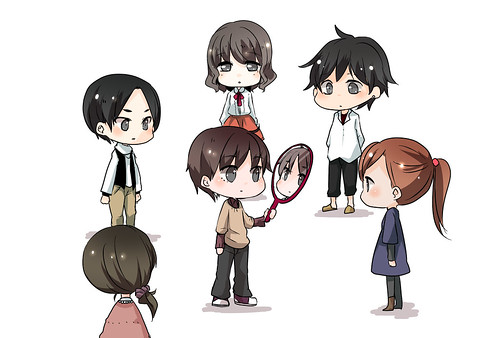
Indeed some research shows that looking at oneself in a mirror produces exactly the opposite effect as being looked at by others. Being looked at by others encourages people to conform to other's expectations. Looking at a mirror generally encourages people to conform to their own internal standards.
There is some research however, that has shown mirrors to increase private self awareness, and at least one paper that has argued that mirrors increase conformance.
So bearing in mind that Japanese are largely unaffected by mirrors (Heine et al, 2008), what does this suggest?
1) That as in the minority of experiments that show mirror's increase public self awareness, and increasing conformance (Diener & Srull, 1979; Govern & Marsch, 1997; Plant & Ryan, 2006; Wheeler, Morrison, DeMarree, & Petty, 2008; Wiekens & Stapel, 2008; Zanna, 1990) the mirror that they are mentally simulating is "the eyes of the world" (seken no me 世間の目). This is quite likely, and I predict in part true. Mirrors are found to increase both public AND private self awareness, so it seems likely that the mental mirror of the Japanese has both of these effects. The "Interdependent self" (Markus and Kitayama, 1991) of the Japanese is not an absense of self but a self that is both aware of itself, and aware of the impact of others upon itself. The dual influence of the Japanese mental mirror would explain the two aspects of the Japanese self.
2) Even if it were the case that the mental mirror of the Japanese is increase private self awareness there is research to suggest that Private self awareness is not a unitary phenomenon (Grant, Franklin, & Langford, 2002; Mittal & Balasubramanian, 1987; Trapnell & Campbell, 1999) but instead
2.1) motivated in different ways by curiosity (leading to self reflection) and a automatic, morbid desire to see the self (rumination)(Trapnell & Campbell, 1999).
2.2) It is also argued that Private self awareness has a motivational and cognitive aspect: on the one hand is an awareness of internal self states and attitudes, and on the other it is the desire to reflect upon the self(Grant, Franklin, & Langford, 2002).
It may be that the Japanese are high in the second ruminatory, motivational element of private self-awareness which is not coupled by an increase in self-cognition, as Ma-Kellams recent research tends to suggest.
3) The Japanese have a different type of independent self, that sees itself from the positition of a super-addressee, Other or God (known in Japan as Amaterasu the sungoddess) visually, with an aesthetic rather than logical impartiality ([Adam]Smith).
Whatever way you cut it however, seeing oneself in a mirror is different from being seen by an audience. In order to unpack this distinction, I claim it will be necessary to reject the argument that the Japanese are "collectivists" in the sense of being socially dependent, since the mirror that the Japanese carry with them also provides a impartial, objective, viewpoint because it is a "riken no ken," a view of self not from that of others, but from a self away from self.
The excellent, for my purposes, image is original artwork by Ms. Miho Fujimura.
Bibliography
Aaker, J. L. (2000). Accessibility Or Diagnosticity? Disentangling the Influence of Culture on Persuasion Processes and Attitudes. Journal of Consumer Research, 26(4), 340–357. doi:10.1086/209567
Brockner, J., Hjelle, L., & Plant, R. W. (1985). Self-focused attention, self-esteem, and the experience of state depression. Journal of personality, 53(3), 425–434.
Carver, C. S. (1975). Physical aggression as a function of objective self-awareness and attitudes toward punishment. Journal of Experimental Social Psychology, 11(6), 510–519. Retrieved from www.sciencedirect.com/science/article/pii/0022103175900025
Carver, Charles S. (1977). Self-awareness, perception of threat, and the expression of reactance through attitude change. Journal of Personality, 45(4), 501–512. doi:10.1111/j.1467-6494.1977.tb00167.x
Carver, Charles S., & Scheier, M. F. (1981). Self-Consciousness and Reactance. Journal of Research in Personality, 15(1), 16–29. Retrieved from www.eric.ed.gov/ERICWebPortal/detail?accno=EJ248215
Carver, Charles S., & Scheier, M. F. (2001). On the Self-Regulation of Behavior. Cambridge University Press.
Davies, M. F. (1982). Self-focused attention and belief perseverance. Journal of Experimental Social Psychology, 18(6), 595–605. doi:10.1016/0022-1031(82)90075-0
Diener, E., & Srull, T. K. (1979). Self-awareness, psychological perspective, and self-reinforcement in relation to personal and social standards. Journal of Personality and Social Psychology, 37(3), 413–423. doi:10.1037/0022-3514.37.3.413
Dijksterhuis, A., & Bargh, J. A. (2001). The perception-behavior expressway: Automatic effects of social perception on social behavior. Advances in experimental social psychology, 33, 1–40. Retrieved from www.sciencedirect.com/science/article/pii/S0065260101800034
Dijksterhuis, A. P., & Knippenberg, A. V. (2000). Behavioral indecision: Effects of self-focus on automatic behavoir. Social Cognition, 18(1), 55–74. Retrieved from search.proquest.com/docview/229595405/abstract/139CDA6646...
Fejfar, M. C., & Hoyle, R. H. (2000). Effect of Private Self-Awareness on Negative Affect and Self-Referent Attribution: A Quantitative Review. Personality and Social Psychology Review, 4(2), 132–142. doi:10.1207/S15327957PSPR0402_02
Froming, W. J., Walker, G. R., & Lopyan, K. J. (1982). Public and private self-awareness: When personal attitudes conflict with societal expectations. Journal of Experimental Social Psychology, 18(5), 476–487. Retrieved from www.sciencedirect.com/science/article/pii/0022103182900671
Froming, William J., & Carver, C. S. (1981). Divergent Influences of Private and Public Self-Consciousness in a Compliance Paradigm. Journal of Research in Personality, 15(2), 159–71. Retrieved from webcache.googleusercontent.com/search?q=cache:PueNQmlstsI...
Gibbons, F. X. (1978). Sexual standards and reactions to pornography: Enhancing behavioral consistency through self-focused attention. Journal of Personality and Social Psychology, 36(9), 976. Retrieved from psycnet.apa.org/journals/psp/36/9/976/
Gibbons, Frederick X., Carver, C. S., Scheier, M. F., & Hormuth, S. E. (1979). Self-focused attention and the placebo effect: Fooling some of the people some of the time. Journal of Experimental Social Psychology, 15(3), 263–274. doi:10.1016/0022-1031(79)90037-4
Gibbons, Frederick X., & Gaeddert, W. P. (1984). Focus of attention and placebo utility. Journal of Experimental Social Psychology, 20(2), 159–176. doi:10.1016/0022-1031(84)90018-0
Goukens, C., Dewitte, S., & Warlop, L. (2007). Me, myself, and my choices: The influence of private self-awareness on preference-behavior consistency. Available at SSRN 1094748. Retrieved from papers.ssrn.com/sol3/papers.cfm?abstract_id=1094748
Govern, J. M., & Marsch, L. A. (1997). Inducing Positive Mood Without Demand Characteristics. Psychological Reports, 81(3), 1027–1034. doi:10.2466/pr0.1997.81.3.1027
Heine, S. J., Takemoto, T., Moskalenko, S., Lasaleta, J., & Henrich, J. (2008). Mirrors in the head: Cultural variation in objective self-awareness. Personality and Social Psychology Bulletin, 34(7), 879–887. Retrieved from www2.psych.ubc.ca/~henrich/Website/Papers/Mirrors-pspb4%5...
Hormuth, S. E. (1982). Self-awareness and drive theory: Comparing internal standards and dominant responses. European Journal of Social Psychology, 12(1), 31–45. doi:10.1002/ejsp.2420120103
Hormuth, S. E. (1991). The Ecology of the Self: Relocation and Self-Concept Change. Cambridge University Press.
Macrae, C. N., Bodenhausen, G. V., & Milne, A. B. (1998). Saying no to unwanted thoughts: self-focus and the regulation of mental life. Journal of personality and social psychology, 74(3), 578–589.
Plant, R. W., & Ryan, R. M. (2006). Intrinsic motivation and the effects of self-consciousness, self-awareness, and ego-involvement: An investigation of internally controlling styles. Journal of Personality, 53(3), 435–449. Retrieved from onlinelibrary.wiley.com/doi/10.1111/j.1467-6494.1985.tb00...
Porterfield, A. L., Mayer, F. S., Dougherty, K. G., Kredich, K. E., Kronberg, M. M., Marsee, K. M., & Okazaki, Y. (1988). Private self-consciousness, canned laughter, and responses to humorous stimuli. Journal of Research in Personality, 22(4), 409–423. doi:10.1016/0092-6566(88)90001-3
Scheier, M. F., & Carver, C. S. (1980). Private and public self-attention, resistance to change, and dissonance reduction. Journal of Personality and Social Psychology, 39(3), 390. Retrieved from psycnet.apa.org/journals/psp/39/3/390/
Scheier, M. F., Carver, C. S., & Gibbons, F. X. (1979). Self-directed attention, awareness of bodily states, and suggestibility. Journal of Personality and Social Psychology, 37(9), 1576. Retrieved from psycnet.apa.org/psycinfo/1981-01346-001
Scheier, Michael F. (1976). Self-awareness, self-consciousness, and angry aggression. Journal of Personality, 44(4), 627–644. doi:10.1111/j.1467-6494.1976.tb00142.x
Scheier, Michael F., Carver, C. S., & Gibbons, F. X. (1981). Self-focused attention and reactions to fear. Journal of Research in Personality, 15(1), 1–15. doi:10.1016/0092-6566(81)90002-7
Sedikides, C. (1992). Attentional effects on mood are moderated by chronic self-conception valence. Personality and Social Psychology Bulletin, 18(5), 580–584. Retrieved from psp.sagepub.com/content/18/5/580.short
Spengler, S., Brass, M., Kühn, S., & Schutz-Bosbach, S. (2010). Minimizing motor mimicry by myself: self-focus enhances online action-control mechanisms during motor contagion. Consciousness and cognition, 19(1), 98–106. Retrieved from biblio.ugent.be/publication/1030838/file/1090307.pdf
Turco, R. M. (1996). Self-referencing, quality of argument, and persuasion. Current Psychology, 15(3), 258–276. Retrieved from www.springerlink.com/index/G43442LN62813201.pdf
Unconscious Facial Reactions to Emotional Facial Expressions. (n.d.). Retrieved October 16, 2012, from pss.sagepub.com/content/11/1/86.full.pdf+html
Wheeler, S. C., Morrison, K. R., DeMarree, K. G., & Petty, R. E. (2008). Does self-consciousness increase or decrease priming effects? It depends. Journal of Experimental Social Psychology, 44(3), 882–889. doi:10.1016/j.jesp.2007.09.002
Wiekens, C. J., & Stapel, D. A. (2008). The Mirror and I: When private opinions are in conflict with public norms. Journal of Experimental Social Psychology, 44(4), 1160–1166. doi:10.1016/j.jesp.2008.02.005
Zanna, M. P. (1990). Advances in Experimental Social Psychology. Academic Press.
Grant, A. M., Franklin, J., & Langford, P. (2002). The self-reflection and insight scale: A new measure of private self-consciousness. Social Behavior and Personality: an international journal, 30(8), 821–835. Retrieved from www.ingentaconnect.com/content/sbp/sbp/2002/00000030/0000...
Mittal, B., & Balasubramanian, S. K. (1987). Testing the dimensionality of the self-consciousness scales. Journal of Personality Assessment, 51(1), 53–68. Retrieved from www.tandfonline.com/doi/abs/10.1207/s15327752jpa5101_5
Trapnell, P. D., & Campbell, J. D. (1999). Private self-consciousness and the five-factor model of personality: distinguishing rumination from reflection. Journal of personality and social psychology, 76(2), 284. Retrieved from psycnet.apa.org/journals/psp/76/2/284/
Labels: eye, japan, japanese culture, mirror, Nacalian, nihonbunka, occularcentrism, reversal, 個人主義, 日本文化, 神道
This blog represents the opinions of the author, Timothy Takemoto, and not the opinions of his employer.