
Monday, November 26, 2012
Kyari Pamyu Pamyu, Kata and Seeing Yourself
 How is it that the Japanese are able to see themselves? Why does Kyari Pamyu Pamyu have eyeballs on her dress and why does her mental self spew them out. Why do these same eyeballs encircle her her corporeal body? Why is her dance so choreographed? Why does she move from one pose to the next, in a triptych of recognisable poses or kata?
And why do Japanese martial artists, such as Karate and Judo practitioners, or sumo wrestlers, stand in rows and make the same poses, or kata over and over again? Why are all Japanese path (michi or dou) practitioners, from martial artists to tea-ceremony aficionados and Noh actors, so keen on repeating one set forms, kata, over an over again? Are they clones? Are they unable to move freely, fluidly? What is the importance of repeating set actions over and over again, and does this have anything to do with Kyari Pamyu Pamyu's eyeballs?
George Herbert Mead argues that it is impossible to have a visual self unless one is an actor (with an audience to react) or unless one has a mirror. Generally speaking visual self representation are for others. Conversely it is only language, the logos, that allows ourselves to take the perspective of others, and create a generalised --other independent-- perspective of self. Language, mead says, is special in that it provides a mirror, because when transmitting a language, even to oneself, the word as stimulus can be understood from the perspective of others.
Derrida argues that the defining characteristic of language, and indeed any sign, is that it can be repeated. If I write a random squiggle on a page, that is not a sign. As soon as it is recognisable, and I or someone else, even in my my absence, can repeat it then the squiggle becomes a sign. Iterability is defining characteristic of signs.
In "Bodies that Matter" Judith Butler extends Derrida's observation to iterable bodily movements. Iterable bodily movements such as gestures, poses, and presumably the iterated movements - kata- of Japanese practitioners, are signs. Repeating and repeated acts allow the body to make signs. Martial artists perform an embodied narrative.
Returning to Mead, looking carefully he does admit that gestures, are also language. And these allow their performers to understand their acts as if from the perspective of others. Iterated and Iterable bodily movements, allow us to see the same from the perspective of others. The movements of the body become a language, a language that demands the eye of the Other.
Japanese martial art practitioners, all Japanese path practitioners, and Kyari Pamyu Pamyu, repeat set actions, practice their embodied language, and their bodies come to matter. Their bodies speak. They come to be able to see their bodies from the point of view of the other. They become able to have an objective view of self, and thus to have a visual self.
Practising the kata of the martial arts, and all other Japanese ways, the practitioner becomes able to see his body from a view apart (riken no ken), to have eyeballs inside her self that yet surround and are able to view her.
Image on right: adapted from Karate Practice by Robert Couse-Baker. Image on Left, Kyari Pamyu Pamyu singing Pon Pon Pon copyright Kyari Pamyu Pamyu (きゃりーぱみゅぱみゅ) the director Jun Tajima, Masuda Sebastianone, and Warner Music Japan.
Thanks to Ryosuke Matsumoto for emphasising the importance of Kyari Pamyu Pamyu, Professor Masamune for reminding me of Judith Butler, Tatsuya Hara for being a great interlocutor, and to Holy Whopper for encouraging me to keep writing.
Labels: culture, gender, image, japan, japanese culture, specular, 日本文化


Wednesday, May 23, 2012
The Loss of the Body in the Eye of the Other

There is something about Hiroko, and other Japanese girls, that shows they can see very well (contra Mary, see Jackson, 1986). Hiroko above can see so well she can even see herself.
Japanese ladies looks doll-like (Gerbert, 2001), perfect, presented, visio-dramatologically, because, I claim, they are continually presenting themselves to the Eye-of-the-Other: the generalised visual other than they simulate, that looks with them (Kitayama, 2005) in their minds.
You can always spot Japanese people, even abroad in Asian, especially Japanese ladies due to this oh 'so perfect' self-presentation.
While the Japanese could not care a hoot about how their self-narrative is heard (Heine, Lehman, Markus, & Kitayama, 1999), they care oh so much about how they appear. The above photo was one kindly taken in the research my auto-photography (Takememo ne Leuers & Sonoda, 1999) which demonstrated that Japanese auto-photography is as positive as the self-narratives and self-descriptions of Americans. Permanently in a height state of objective self awareness, this subject is always presenting her self, as if she is on strings. (This subject's name is not really "Hiroko" and I have blurred her face).
Back to the research of Ma-Kellams, Blascovich, & McCall (2012). They found that Japanese were more easily deceived as to bodily information; when misinformed that their heart rate had changed (raced) they changed their perceptions of stimuli whereas Americans did not. Japanese were more likely to mis-attribute arousal and think a confederate sexy in a virtual version of the classic scary "rope bridge" (Dutton & Aron, 1974) type situation. Japanese were also less accurate at estimating their own heart rate.
Furthermore this insensitivity to the body of correlated with the "contextual" (read visual?) ability found among Asians summarised in my last blog post.
In other words, the better Asians are at judging the relative lengths of rods in frames, the worse they are at being aware of the inside of their own body. Ma-Kellams, Blascovich, & McCall (2012) claim that East Asians are being distracted by contextual information that they are processing.
I believe however, that they are aware of their bodies in their self-directed, autoscopic gaze and it is this that interferes with their "visceral perception" of internal bodily events. This explanation contradicts research that suggests that increased objective self awareness in front of mirrors reduces the placebo effect (Gibbons, Carver, Scheier, & Hormuth, 1979; Gibbons & Gaeddert, 1984), but this may be due to an excesss of OSA, or depending on the supposed effect of the placebo.
I think that there may be exceptions to the findings in that the Japanese may be hyper sensitive to bodily changes that present themselves visually, such as blushing, sweating and appearing overweight.
Bibliography
Dutton, D. G., & Aron, A. P. (1974). Some evidence for heightened sexual attraction under conditions of high anxiety. Journal of personality and social psychology, 30(4), 510.
Gibbons, F. X., & Gaeddert, W. P. (1984). Focus of attention and placebo utility. Journal of Experimental Social Psychology, 20(2), 159–176. doi:10.1016/0022-1031(84)90018-0
Gibbons, F. X., Carver, C. S., Scheier, M. F., & Hormuth, S. E. (1979). Self-focused attention and the placebo effect: Fooling some of the people some of the time. Journal of Experimental Social Psychology, 15(3), 263–274. doi:10.1016/0022-1031(79)90037-4
Gerbert, E. (2001). Dolls in Japan. The Journal of Popular Culture, 35(3), 59–89. doi:10.1111/j.0022-3840.2001.3503_59.x
Jackson, F. (1986). What Mary didn’t know. The Journal of Philosophy, 83(5), 291–295. Retrieved from http://www.philosophicalturn.net/intro/Consciousness/Jackson_Mary_Know.pdf
Kasulis, T. P., & Ames, R. T. (1992). Self As Body in Asian Theory and Practice. (W. Dissanayake, Ed.). State Univ of New York Pr.
Kitayama, O. 北山修. (2005). 共視論. 講談社.
Leuers, T., & Sonoda, N. (1999). The eye of the other and the independent self of the Japanese. Symposium presentation at the 3rd Conference of the Asian Association of Social Psychology, Taipei, Taiwan.
Ma-Kellams, C., Blascovich, J., & McCall, C. (2012). Culture and the body: East–West differences in visceral perception. Journal of Personality and Social Psychology, 102(4), 718–728. doi:10.1037/a0027010
Labels: autoscopy, culture, eye, female, gender, image, japan, japanese culture, Jaques Lacan, mirror, nihobunka, nihonbunka, occularcentrism, specular, theory, 日本文化
Friday, February 17, 2012
Amotsuki, the old word for Mochi-Tsuki or Rice Cake Making is also a Metaphor for Coitus

Amotsuki, the old word for Mochi-Tsuki or Rice Cake Making is also a metaphor for Coitus, a photo by timtak on Flickr.
[Cross posted from Shinto Blog with additions]
The most important festival of the Shinto religion is the New Year Festival. At this time Japanese people will visit a shrine, give their children money, and eat certain foods one of which are rice cakes said to contain the spirit of Amaterasu, the mirror-sun-goddess. In traditional homes, such as farm houses, and in some schools and community centres, the rice cakes are made in a traditional way known as "mochi-tsuki" or rice beating.
In a well known Japanese dictionary (Koujien 4th edition) it says that, "Amotsuki" (餅搗), an old but not defunct word for "mochi-tsuki" which means beating rice to make rice cakes, was used as a metaphor for "boji"(房事) which means coitus.
The rice beating ritual performed at New Year gave me a impression of representing coitus when, as is traditional, a woman turns the rice while her husband beats it.
In the ritual that I saw performed, and took part in, a woman knelt or crouched down beside the "usu" (bowl) and make relatively high pitched noises encouraging a man wielding a big mallet to beat the rice cake, sometimes with a grunt. Apparently quite a lot of males die each year of heart attack as they wield their mallet. The ritual is quite hard work. The men build up a sweat. The rice cake becomes more and more gooey. The thwack, thwack of the mallet (kinu) hitting the gooey rice in the bowl resounds. Finally everyone rejoices partaking of the gooey white rice cake. It is quite a carbohydrate high after all that exertion. Bearing in mind the shape of the tools used, the gender division of labor, their relative positions, and the color and consistency of the final product, I made an interpretation which prompted my my Japanese friends to call me a pervert. Then one day I was reading my dictionary and came across the entry above.
These metaphors may be quite irrelevant and coincidental but since the Shinto-Amaterasu myth is represented in Shinto New-Year's festivities, the fact that a ritual seen as a metaphor for sex (at least in times past) should take a central role in the festivities suggests that perhaps there is a similarly metaphorical episode in the Susano Amaterasu myth. At least one researcher has suggested that the bit where Susano-O throws a backwards skinned horse into the clothing room of Amaterasu such that one of her weavers dies as a result of a shuttle entering her body, may be a metaphor for coitus.
It would not be unusual that sex is represented in Shinto festivities (examples, click with caution and or or parental advice). One commentator (essayist Ei Rokutsukel,2004) expressed the opinion that many or most Shinto festivities were related to sex.
Christian festivals (Christmas and Easter) represent birth and in the Shinto tradition birth is, or was, the dirtiest most defiled thing, as taboo as sex is in the Christian tradition.
With these reversals of the most sacred and the most defiled -- with Japanese and Western religion being so polar -- I used to think that war between Japan and the West would be inevitable.
Similar entries to that photographed above from an other edition of the same dictionary
餅つき 2男女交接の例え Amotsuki (rice beating) is a metaphor for sex
臼と杵 男女の仲がぴったり合うこと Usu to Kinu Pestle and Mortar/mallet very close male female relationship
臼から杵 臼は女、杵は男を象徴する。女から男に働きかけるのは逆であるの意で)逆であるさまにいう
Mortar to Pestle. Women should not approach/influence men.
Ei Rokutsuke et al (2004) "Matsuri ha Eros de Aru"(Festivals are Eros/Erotic), "Nihon no Matsuri" (Japanese Festivals). Asahi Newspaper. publications.asahi.com/ecs/detail/?item_id=6205
Labels: female, gender, male, religion, reversal, sex, Shinto, ジェンダー, 宗教, 日本文化
Thursday, February 16, 2012
NMB48 and Tarzan

The climax of the chorus of the recent chart topping song by teenage girl-band, 'idol group' NMB48 is "steel panties," refering to their collective intention not to take them off for their boyfriend until they are 20 years of age. The song's title, "Junjou U19" means "Pure (i.e. non sexual) emotion or affection, and the "U19" may mean under or equal to 19, since the lyrics mention adulthood which is considered to be from 20. The boyfriends are going to have a long wait in some instances because at least one of the members is 13 years old. Yes, indeed, only 13 years old.
Having seen the video, it seems that it has been created with the intention to include as many ways as possible of allowing the viewers to feel that they can or will see the "steel panties" refered to the in the lyrics, with low camera angles, miniskirts, rotating girls, somersaulting girls, girls lying down, hanging from wires, rolling over balls, on tightropes, a trapeze, podia, and finally fired from a circus cannon. I think it is very inventive, but not to my taste.
Japan is bursting at its creative seams. Donald Richie's "The Image Factory: Fads and fashions in Japan," details the many ways in which Japan is a powerhouse of creative image making. Alas, the myriad images that Japan makes are different, and often not popular among those with Western sensitivities.
A big problem for human society, perhaps the biggest, is encouraging men and women to cooperate. There are two extremely effective ways of doing this. 1) Persuade all members of society that they are neutred men. 2) Persuade all members of society that they are wombless, bloodless women. The West takes the former route, Japan the latter. In each case it is imperative that the unattractive parts of the idealised sex are banished: their desire in each case is taboo. Jesus was a man in his ability to lead, be righteous, brave, and strong but there was no one iota of lewdness about him. The idealised woman in Japan is similarly, self-sacrificing and supposedly berift of desire. The Western "gentle" man, and Japanese "idol" stop at the waist, they are castrated, spayed, anaemic, and perfect.
This repression however, gives rise to even greater desire for its disolution, for (in the West) a gentleman who is also an ape man; Tarzan/Earl Greystoke a combination of pure male sex and complete gentrified repression. I think that NMB48 are the Japanese equivalent of Tarzan/Greystoke, pure sex, and pure chasity rolled (often literally) into one steel pantie.
The idealized synthesis of purity and sexuality (Ranger, 2011) is also found to an extent in the British lady, such as portrayed by Audredy Hepburn (who was tremendously popular in Japan) in the naivity of the characters played by Marylyn Munroe (though she was a little too sexy, and not quite pure enough for Japanese taste) and the disembodied chamellion Lady Gaga who almost seems a little Japanese. However, In Japan there is a desire for a more extreme synthesis which is why we see thirteen year old chidren, in miniskirts, singing about sex, wearing "steel panties".
Other examples of Tarzan, that the Japanese need to import if they are to enjoy, include the macho heroes such portrayed by Arnold Schwarnegger, and Sylvester Stallone, who are an idealised synthesis of testosterone and righteousness.
NMB48 poster by MadAdminSkilz copyright Kyoraku Yoshimoto Holdings Co., Ltd.
とりさげご希望の場合は下記のコメント欄かnihonbunka.comのメールリンクからご連絡ください。
Labels: fashion, female, gender, male, nihobunka, nihonbunka, taboo, tabuu, theory, ジェンダー, 日本文化
Friday, February 10, 2012
Western Super-Friends as Pure Mind

"Transformers" started in Japan but has become popular in the US, which also has its own Gundam in "Iron Man". There is an "Iron Giant" based on Ted Hughes story ("The Iron Man"), and Lilo's friend Stitch.
In my opinion, however, the Western imaginary friends that mirror the many super robots in Japan, are the plague of ghosts that have been helping us out recently. The first one I saw was in 1969 on the BBC in the tv series "Randall and Hopkirk (Deceased)".
The basic pattern of Western 'human plus super-friend' dramas is that a detective is helped by a ghost or ghosts. The ghosts have no body only a message, a will, and the human's job is to let their will be done, so that the Ghost can disappear. The genre includes "The Sixth Sense," "The Dead Zone," "Tru Calling," "Ghost Wisperer," "The Medium," "Raines," and "The Listener." "A Gifted Man" though a doctor is along the same lines.
Their protagnoists have a lot in common with the geniuses that read minds in "Lie to Me," "The Mentalist," "Criminal Minds," and the various "CSI."
All of them, by their extrasensory, or extra sensitive powers of perception are able to read the message, the words, the will, of the superbeing that has not been said and act upon it.
The human heros are, contra the Japanese humans, the puppets of their super-natural friends. And yet it is they that are the titular characters. In almost all cases (Dr. Malcolm Crowe from Sixth Sense and Hopkirk as possible exceptions) it is the 'reader' that is the central character, or self with whom the audience identifies. Westerners, perhaps due to the Judeao Christian influence, like to see ourselves as 'readers' who carry out the will of supernatural friends.
In Japan, though the robots are controlled, they are heros, the eponimous/titual characters, the focus of attention. No one buys Amuro Rei dolls, or Nobita Posters. The Japanese robot superheros are body and self at the same time. Will, such as that of Nobita and Light is fallible, external, and leads people astray.
It is interesting, but probably conicidental that in Japan technology and robots are associated with the West, and that human-ghost interaction is the most famous theme in the traditional drama of Japan. It is as these culturals have found imaginary friends in each other. Again coincidentally, or due to the spread of TV, the super robot genre started, as far as I know, in the late 60's early seventies about the same time as Randall and Hopkirk (Deceased).
Images copyright their respective copyright holders. Please comment or contact me via the email link on nihonbunka.com to have this image removed from the Net.
Thanks to Ɲ for inspiring these observations.
Labels: culture, female, gender, henshin, horror, japan, japanese culture, logos, nihobunka, nihonbunka, reversal, self, superhero, theory, 変身, 日本文化
Wednesday, June 01, 2011
Baby Snot Sucker
Japanese mothers tend to be even more dedicated to the cleanliness of their children, bathing *with* them, cutting their nails, cleaning out their ears at a frequency that suggests that these acts go beyond a concern purely for physical hygene, pointing to a culture of hygene and motherly pruning to achieve it. One aspect of this mothering, is in the way that Japanese mother's remove their children's nasal mucus.
Devices to remove nasal mucus from the noses of babies with colds do exist in Europe and the USA, such as "Nosefrida The Snotsucker Nasal Aspirator
 " "the "Bulb Syringe Aspirator
 " which uses a bulb rather than oral sucking and the "Graco Nasal Clear Nasal Aspirator
 " which uses a battery powered vacuum pump. They are more likely to be powered by means other than oral aspiration - sucking -and those that do use the suck to clear the nasal mucus may be called "bizarre" by commentators in the US for instance. Bodily secretions, especially faeces but nasal mucus as well I believe, tend to be more taboo in the West, compared to Japan, as previously noted.
Please note that the snot does not go into the mouth of the mother but into a vial which can be washed out. In the old days, however, I am informed that Japanese mothers used to suck their baby's snot directly into their mouths.
Many animals engage in social grooming as a way of reinforcing social bonds. The grooming that is lavished upon Japanese children reminds me of the affectionate pruning that Western mothers may give to their husbands. Some Western mothers have a tendency to clean and scrape their husbands hands, nails and feet. It seems to me that in parallel with Richard Schweder's observations regarding "Who Sleeps by Whom," the recipient of maternal grooming is generally children in Japan, and more likely to be romantic partners, particularly male partners in romantic relationships in the West.
Refs
Schweder, R. (1995) "Who Sleeps by Whom Revisited: A Method for Extracting the Moral Goods Implicit in Practice."
Nelson and Geher (2007) "Mutual Grooming in Human Dyadic Relationships: An Ethological Perspective." URL
Labels: care-givers, family, female, feminism, gender, japanese culture, nihobunka, nihonbunka, reversal, sex, taboo, tabuu, ジェンダー, 日本文化
Wednesday, May 12, 2010
Children are Staples (Ko wa Kasugai)
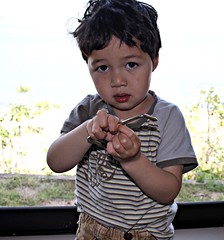
My son here is seen above holding a staple or "kasugai," shown in close up in photo bottom left, which is used to hold two pieces of wood together, see photo bottom right.
In Japanese culture, the love between men and women is seen as being beautiful and natural, but like most things in nature, not particularly permanent. Love, between women and men does not last forever. There is no bridge across forever, no soulmate, no happy end. Japanese love stories tend, or tended, to end in double suicide: the most romantic outcome that one can hope for, at least far more so than domestic bliss.
The love or at least the relationship between parents and children, between ancestors and their descendants is however seen as being eternal. Parents and offspring are considered to be indivisible. No one is born again. This goes for the relationship between children and both mothers and fathers.
So when a couple have a child, while their own emotions for each other may wax and wane, they will be irretrievable linked forever in the flesh of their flesh, their child.
Hence, just as a staple can be used to join two pieces of wood together, so a children are considered to be like staples that join their parents together forever.
Westerners on the other hand are more likely to believe in the possibility of enduring love between men and women, through the transcendence of sexual difference. This hope, that there can be a bridge across forever, is perhaps dependent upon the repression of sex (much less festivals which celebrate sex), which is taboo, repressed, something to be sublimated into a unisex, shareable, idealised "love". I don't think that I need to refer to any particular cultural phenomenon to persuade Anglophones that Western culture is awash dreams of love. Oh, love.
While the Japanese believe that their view is natural, it may be dependent upon the repression of childbirth (seeing it, the desire for it, expressions of child birth, much less festivals which celebrate childbirth), which is taboo, repressed, and sublimated into a unisex, shareable and idealised "parent-child-love". While ancestor worship, or ancestor veneration, is carried out behind closed doors, the clearest expression of the cult of parent child love in Japan, is in the "monstrous" hegemony of cute found in Japan.
Related there are
Children are the shackles of this world and the next (ko ha sankai no kubikase 子は三界の首枷, こはさんかいのくびかせ) which refers to pretty much the same thing.


Labels: family, gender, nihobunka, nihonbunka, sex, Shinto, 宗教, 日本文化
This blog represents the opinions of the author, Timothy Takemoto, and not the opinions of his employer.