
Monday, August 22, 2016
Augmented Irreality: World of Light
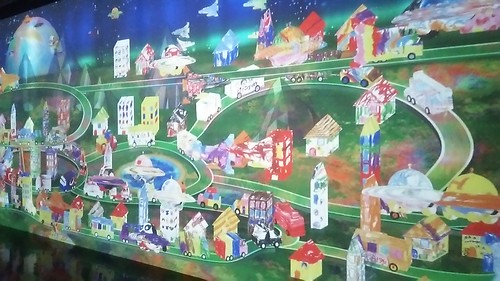
Japanese children paint cars, trucks, aircraft, including UFOs that then scanned into, and bounce or fly along in, a giant musical city scape traffic jam mural, with which the children can interact. The vehicles are ticklish to the tap. The Japanese children, including my own, go wild because they too are one with the fish: images come to life. Esse est percepi. Video ergo sum.
Before going home the children can have their pictures scanned into onto 3D paper model that they can fold into toy. Their pictures become alive and dwell amongst us.
My video explanation is here
and the production company's explanation is here.
Labels: interdependent, nihonbunka, self, shining, specular, tourism, visualization, 日本文化


Wednesday, July 20, 2016
The Chinese and The Japanese
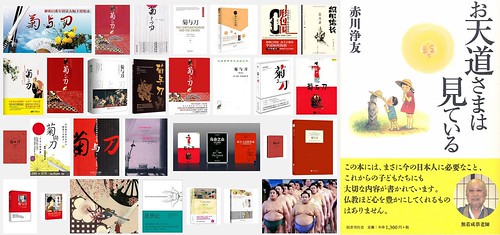
Ruth Benedic's (1946) classic "Chrysanthemum and the Sword" has been popular in China (translated as 菊与刀) selling 70,000 copies in 2005 alone, since it would provide an explanation how the Japanese managed to kill so many Chinese and yet exhibit a level of remorse that the Chinese feel to be very inappropriate. Ruth Benedict's answer is that the Japanese lack a conscience, caring only what other's think about them. A great deal of Japanese believe this theory, which itself originates in a disgruntled Japanese called Robert Hashimoto (Lummis).
More contemporary Japanese detractors of Benedict's theory do not rarely argue that the Japanese do in fact have conscience, under the conventional meaning of that term, but rather that "conscience" in the sense of internal, self-directed, self-reproval simply does not exist. The main reason for this is that they are aware that they judge themselves visio-aesthetically, and this is not something that one can do from inside ones own head. The Japanese forget that the mind is not inside the head -- it is easy to do, I have -- but rather the other way around.
The Japanese are therefore in large part blissfully ignorant of the origin of their own morality, which is, the same as that of the Chinese. Both believe that in addition to the censure of other people, heaven is also judging.
In Japanese parlance the kind old sun is watching (otentou sama ga mite iru. お天道さまがみている。See e.g. Akagawa, 2015) and they'd feel her displeasure should they do anything bad.
This does not explain why the Japanese were able to kill so many Chinese, nor why they do not feel more remorse. In order to understand that one would have to read other books, mainly of a more historical nature.
I hope that the Chinese realise that in fact the Japanese do have a conscience before The Chinese and The Japanese come to blows again.
The images above left are the result of an image search for "”菊与刀” 销量" meaning "sales of 'Chrysanthemum and the Sword'" in Chinese, and the cover of a non-academic book entitled "The Kind Old Sun is Watching" (Akagawa, 2015)
Akagawa, J. 赤川浄友. (2015). お天道さまは見ている. 国書刊行会.
Benedict, R. (1946). The chrysanthemum and the sword; patterns of Japanese culture.
Labels: japanese culture, nihonbunka, occularcentrism, self, specular, 日本文化
Monday, June 06, 2016
Masked Rider's Icon: Eye-soul

The latest masked rider symbolic transformation item from the 2016 series Masked Rider Ghost (仮面ライダーゴースト) is called an "icon" using the characters for eye and soul (目魂). That the transformation item is some sort of symbol is common to all the transformation items of super sentai (power rangers), ultraman, masked riders, Mirrorman, Mito Kōmon, real members of totemistic tribes such as the Aranda, as well as the symbol collecting Japanese Shinto practitioners. The Japanese traditionally believed they received their soul vectored by a symbol received from shines in the form of shinpu, ofuda,or omamori amulet. Mirrorman, the closest to the Shinto tradition, would transform to his super form thanks to a shrine amulet, while standing in front of a mirror.
That these iconic amulets vector something supernatural from the country of light (Ultraman) is also clear. With this particular symbolic transformation item it is becoming increasing clear that these icons vector an "eye" or perspective such that their wearer or consumer may be transformed into the heroic suit or mask, representing visual appearance. One could only identify with a visual appearance by also internalising another. In the case of masked rider Ghost, these others are heroes such as Isaac Newton, Miyamoto Musashi, and the protagonist's father. Internalising the icon of the father allows the protagonists to internalise the father's eye. The "icon" as "eye soul" pun is Tsuburaya genius.
Another commonality shared by many transformatory symbols, such as Masked Rider Orz Medals, Masked Rider Ghost's Icons, and the Tjurunga or "bull roarers" of the Aranda (I made one) is that they are symbols that make a noise, as if reading themselves. If there were ever a visual symbol that could read itself it would 'prove' that the symbol is not merely formal (arbitrary) but an ontological part of a real world, and perhaps that there is of necessity a third person viewer to read it. Intrinsic icons that combine sound and vision, introduce that gap or distance into the world required for self sight. Icons that can read themselves do indeed therefore contain (or would if such things existed) "eye souls," the eye of the soul, that allow those possessed to transform into the seen.
These symbolic catalysts have the same, but 'Nacalianly transformed,' function as the Lacanian mirror image which is or appears to be a image that sees itself. The Lacanian mirror image, Superman's suit and indeed our own faces, is something that misguides or conceals our whispered identity, but it is also the condition for linguistic self-hood. The catalyst or condition for the linguistic world is that two things are the same. That is the importance of Jackson's red, all the images that Western pilgrims go to see, or the wafer in mass. They prove identity. The catalyst or condition for the visual world is that there is something that is two things, a symbol that reads itself, that can intrinsically be read. The Japanese need to prove an intrinsic distance. Westerners need to prove an intrinsic identity.
Both world views are magical but which is best? Keeping ones symbols on the outside, on ones forehead, or in ones watch or belt, is imho a lot more healthy.
Labels: Bandai, japanese culture, Jaques Lacan, kamenrider, Masked Riders, religion, self, Shinto, Super-Sentai, superhero, スパー戦隊, 日本文化
Monday, February 29, 2016
62 Translations of Okonomi Yaki
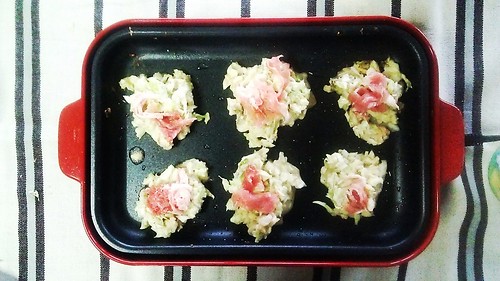
Fritters as you like them. Fritters to taste. Free fritters. Fritters freed. Japanese pan fried pizza. Savory pancakes. DIY fry-up. Griddled Goo. Individualistic johnnycakes. Selfish savories. Preference, predilection, prepossession, propensity, personalised or pet pancakes or paste. Pet preparation. Wished or whimsy waffles. What you will waffles. (Free)Will waffles. Flavour Flapjacks. Groove griddle cakes. Number one gunge, My cup of tea cakes. Croquette my way. Darling, dearest, desired, or druthers doughboys or dumplings. Liberty cakes. The cook is on holiday cakes. Be my batter cakes. Beloved batter cakes, Coagulated stir fry. Callous cutlets. Choice cabbage cakes. Liking or Love lump cakes. Main mush. Choice Concoction. My mix. Pan fried partiality. Pan-fried perfection. Caprice cakes. Hobby hotplate. Free-style fries. Fried fantasy. Freedom fries. My fry. Favourite fries. Hashed heaven. Hashed happiness.
My students always 'translate' the name for Japanese foods such as that pictured above (お好み焼き) using their phonetization, "okonomi yaki," which might just as well be kowwash firdight for all the meaning it would impart to the average anglophone. This is I think because people hate meaninglessness (Heine, Proulx, & Vohs, 2006) so if at least one word in Japanese is included in any sentence the sender knows that at least that one word will be meaningful in a Japanese context, and that their conversation partner will have some idea of what they are talking about. The reasons for this is anatta or no self. The self is just a representation (story or image): something with a meaning. The lack of meaning is self-annihilation, and English conversation practice almost deadly. I need to be nicer to my students, investigate Japanese hospice praxis, while insisting that students use non-phonetic translations.
Heine, S. J., Proulx, T., & Vohs, K. D. (2006). The meaning maintenance model: On the coherence of social motivations. Personality and Social Psychology Review, 10(2), 88-110.
www.google.co.jp/url?sa=t&rct=j&q=&esrc=s&...
Addendum Good Paper on Japanese hospice praxis emphasises the use of image-based measure (PAC analysis) rather than scales. Recommends, in addition to palliative care and listen: smiles and improved personal hygiene and health on the part of the carer. I try to always attend conversation class wearing a business shirt and tie.
對馬明美, Tsushima, A., 三上佳澄, Mikami, K., 西沢義子, & Nishizawa, Y. (2010). 死を意識している患者との対話場面における看護者の態度構造に関する研究. 日本看護研究学会雑誌, 33(5), 33-44. http://www.jsnr.jp/test/search/docs/103305003.pdf
内藤哲雄1997/2002PAC 分析実施法入門[改訂版]「個」を科学する新技法への招待ナカニシヤ出版 amazon link a student gave a presentation about this. I thought it came from outside of Japan.
内藤哲雄. (1997). PAC 分析の適用範囲と実施法. 信州大学人文学部人文科学論集< 人間情報学科編>, 31, 51-87.
https://soar-ir.repo.nii.ac.jp/index.php?action=pages_view_main&active_action=repository_action_common_download&item_id=707&item_no=1&attribute_id=65&file_no=1&page_id=13&block_id=45
Labels: els, english, englishconversation, nacalianism, nihobunka, self, 日本文化
Monday, July 27, 2015
Hoopa: The hooper that that could not loop
I thought "Pokémon the Movie: Hoopa and the Clash of Ages" was a Japanese commentary on Western culture personified in "Hoopa, the hooper that could not loop" (my subtitle).
Hoopa has two forms (as do many Pokémon), and as are believed to exist in the Buddhist view of ourselves: the small (unenlightened) and large (enlightened) self. We see the giant form of Hoopa first who uses giant hoops to move (or steal) things from anywhere in the world. Hoopa's power rests in this telekinetic ability. Herein lies the first parallel with Western culture. The Japanese have a bit of a tendency, in my limited experience, to see the British and their descendants as thieves, or "vikings" as they tactfully put it, conquering the world and taking it home. The seven hoops of Hoopa (one around each of his six arms, and one around his waist) may correspond to the sense of Buddhism (although there is one too many) which include the sense of the heart. From some Japanese points of view Westerners look upon nature and the world as a source of things to take, rather than as something with which one feels in harmony, to an extent unified.
Hoopa finds himself internally conflicted and unable to evolve into his large self who remains trapped in a bottle by a religious organisation that bears more than a passing resemblance to Judeo-Christianity. From a Japanese perspective Western culture separates God and humankind whereas in Japan, the enlightened, a supreme martial artist for instance, becomes one with God or the Buddha - which tend to be seen as the same things.
This inability to evolve into his large self, and being in conflict with it, parallels Hoopa's inability to pass through his own hoop. As we have seen Hoopa has six hoops (plus one around his body) that he uses to move or plunder the cosmos. He seems partially able to pass through one of his hoops (the one around his middle) but unable to pass through any of his others.
This inability to pass through his own hoops is due to Hoopa's lack of gratitude. Through his experience of growing up once again as small Hooper, however, Hoopa learns to love and feel gratitude and finally, when he does this he is able to pass through one of his own hoops. In this sequence, before the triumphant auto-looping-hooping the hoop, and overcoming self-conflict, Hoopa imagines himself growing up and all the love he has received. This introspection - literally seeing himself - works on a lot of levels as the defining characteristic of Japanese culture. The Japanese believe their heart to be a mirror, are found to literally have a mirror in their heart, they are (through the practice of Noh and Karate forms) able to see themselves from a perspective outside, and use this ability to see themselves from the points of view of others. Autoscopy is also especially noticeable in the last letters of suicide pilots and the Japanese version of psychoanalysis: Naikan therapy.
This self-seeing, or self perception may be what the whole "Pocket Monster" mythology is about as represented by the Pikachu Satoshi Diad. There is a monster within us, sitting on our shoulder, who sees us, but at some level, or in some way, Satoshi and Pikachu are one. Perhaps in a final Pokémon movie this fact will be revealed. Or perhaps it already has. I have only seen two Pokémon movies.
Reading perhaps far too much into the iconography, it seems proper that Hoopa should be appear from out of one of his hoops (little Hoopa), have hoops on his ears (little Hoopa) or have one of his hoops as a hole at his centre (Big Hoopa) since Westerners do feel able to perceive themselves, linguistically. Only being able to perceive ourselves through this especially dark mirror, we are able to wreck destruction on an unparalleled scale, believing that anything that can be linguistically justified is acceptable. Hence a Briton feels able in saying that the British enforced importation of narcotics into China, for more than a hundred years, was acceptable because "the Chinese chose to smoke (opium). Or, in my experience, Americans (and others from the allied nations) generally continue to approve of the bombings of Hiroshima and Nagasaki, as just since 'the Japanese started it.' It is only when one starts to see oneself, hear the crying children, smell the stench of results of what one does, it is only when one passes through other hoops, that such justifications become untenable. We need to learn other forms of insight fast.
Hoopa learns gratitude, becomes able to perceive himself, is no longer conflicted, walks in the light, or becomes Japanese, in harmony with, not apart from the world. In the last part of the movie giant Hoopa spends his time rebuilding that which he has destroyed, only plundering the occasional doughnut.
I was moved by the compassion with which Hoopa the destroyer was viewed. Even though he destroyed the humans that fed him, Hoopa was not punished with death, but merely part of him kept in a bottle, since after all, as grandfather says, Hoopa is one of the family.
(I have a Japanese family, and lack gratitude, so this notion moves me to tears.)
Labels: autoscopy, cultural psychology, culture, japan, japanese, nihonbunka, occularcentrism, self, specular, 日本文化
Thursday, July 02, 2015
A You for You and An Eye for an Eye
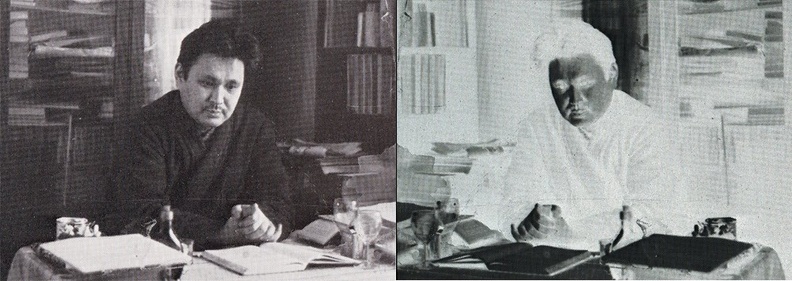
One of the simplest Nacalian transformations that I have yet to fully expand upon, is that of Mori Arimasa's theory of the Japanese first person pronoun. I have said most of this before, but I have not yet expressed the the rather bemused way in which Japanese view Western faces, or how we should conceptualise our faces in a Japanese frame of mind.
Mori argued that the Japanese first person pronoun is expressed in a variety of forms, in a variety of forms of language that always binds it into binary relationships with its interlocutor you, such that, expressed in a French frame of mind, the meaning of "I" in Japanese is merely "a you for a you" (汝の汝).
One half of Nacalian transformation of Mori's theory has, and had, already been argued by Lacan. Lacan argued that infants identify first with mirror images and as they mature, with their the first person of their self narrative. This progression is inevitable and desirable, Lacan claims, since in the "mirror stage" humans are locked into binary relationships with mirrors and others since the face is only face for another face, or rather in the same way that the Japanese I is (according to Mori, who was surely influenced by Lacan) another interlocutor for its interlocutor, the Western face is locked into a relationship with its 'visual interlocutor' or spectator. The Western face is in other words, just an eye for an eye. Just as the Japanese only hear their first person pronoun through the ears of the second person that they are addressing, Westerners can only see our eyes via mirrors or through the eyes of another. Lacan and Mori (and Bakhtin, Mead, Freud etc) further argue that, in France at least, language provides a third person perspective enabling Francophones to have an I which is objective.
The missing part of this "Nacalian" (Lacan backwards) transformation is my assertion that in Japan, the face is not merely a visual interlocutor for another interlocutor but felt to be observed by a third person generalised other (Senken no Me, Otentousama) that frees the Japanese face, and persona or self, from dependence upon binary relationships.
In each case the achievement of these freedom comes at a price. First of all, we are no longer our true selves. And futher, Derrida and I (!) argue that this extra other, in the West "The Ear of the Other," is uncanny (unheimlich): something once familiar that is now horrific and repressed (Derrida, 1985, p33), repressed and horrific.
Bearing in mind that Western faces are like eyes for eyes, it should appear to the Japanese that our faces are dependent upon the binary relationship in which we find ourselves. Indeed this is the case that Japanese perceive Westerners as always making rather grotesque (oogesa na) "faces" (and gestures) whereas their own facial expressions incline towards remaining objective, and 'composed'.
Bearing in mind that the objective and subjective is reversed - that is to say that the power relationship between the visual and the linguistic is reversed - leads to world views turned inside out, with completely different notions of time, space, travel, tourism and morality.
I prefer the Japanese method of self-reflection since I believe that that vision is somewhat less prone to "spin" or the self-enhancement that Westerners are so good at, and because matriarchy is more natural and effective than patriarchy. Indeed, patriarchy seems to me to be a sort of deviant version of matriarchy, where men somehow worked out how to use some of the natural control methods of matriarchs.
Image: kajap.hypotheses.org/450
Labels: blogger, Flickr, japaneseculture, nihonbunka, self, tourism, 日本文化
Thursday, June 11, 2015
Flashed Face Distortion Effect and Japanese Self-Caricaturization

What is it to identify with a self-representation? Many psychologists claim that in order to have or cognise a self we need to see it from the point of view of another within self, "the generalised other" of Mead, the "super-addressee" of Bakhtin, the "alter ego" of Derrida, the "Other" of Lacan, the "impartial spectator" of Smith, "the third person perspective" of Mori (1999), and the "super ego" of Freud.
Bataille (1992, p31) for example says "We do not know ourselves distinctly and clearly until the day we see ourselves from the outside as another."
The Flashed Face Distortion (FFD) effect (Tangen, Murphy, & Thompson, 2011) is a trippy newly discovered illusion in which when faces are flashed side by side we seem distorted, to an extent in caricature (see videos here and here).
It is not clear why. I suggest that it is probably that this caricaturization of faces is not limited to times when faces are flashed, but that we become aware of the caricaturisation when faces are flashed.
Still more recent brain neuro-imaging research (Wen and Kung, 2014) finds that the FFD effect is mediated by at least two neural networks: "one that is likely responsible for perception and another that is likely responsible for subjective feelings and engagement".
Why should subjective feelings and engagement processing take place? Again, it is not clear to me, but it seems likely that "subjective feelings and engagement" would differ for ones own face as opposed to the faces of others.
I created therefore a similar video except with my own face as one of the target faces. The video is far from ideal (as you can see) but it seems that the FFD is much weaker in this situation. The face that I am comparing various versions of my own face to is only slightly distorted or caricaturized whereas my own face does not appear to be caricaturized at all. I presume that this is a function of a variation in subjective feelings and engagement, and because I do not see my own face as the face of another, and either do not bother or feel inclined to caricaturize my own face. But then, I don't think of my face is my self. I think of that which is described by my self narrative as my self.
I hypothesize that from the way in which Japanese enhance their self representations, from the way it is claimed that their "mask" is the centre of their persona (Watsuji, 2011), and from in their self-enhancing self-manga ("jimanga") that Japanese will feel the Flashed Face Distortion (Tangen, Murphy, & Thompson, 2011) effect even when watching a video of their own faces. This is because they are seeing their own face as another and this is, paradoxically, a condition of seeing ones face as ones "self."
Bibliography
Bakhtin, M. M. (1986). Speech Genres and Other Late Essays. (C. Emerson & M. Holquist, Eds., V. W. McGee, Trans.) (Second Printing). University of Texas Press. Retrieved from pubpages.unh.edu/~jds/BAKHTINSG.htm
Bataille, G. (1992). Theory of Religion. (R. Hurley, Trans.). New York: Zone Books.
Derrida, J. (1978). Edmund Husserl’s origin of geometry: An introduction. U of Nebraska Press. Retrieved from books.google.co.jp/books?hl=en&lr=&id=pW9PQxAOo0s...
Freud, S. (1961). The ego and the id. Standard Edition, 19: 12-66. London: Hogarth Press.
Heine, S., Lehman, D., Markus, H., & Kitayama, S. (1999). Is there a universal need for positive self-regard?. Psychological Review. Lacan, J. (2007). Ecrits: The First Complete Edition in English. (B. Fink, Trans.) (1st ed.). W W Norton & Co Inc.
Leuers, T., & Sonoda, N. (1999). The eye of the other and the independent self of the Japanese. In Symposium presentation at the 3rd Conference of the Asian Association of Social Psychology, Taipei, Taiwan. Retrieved from nihonbunka.com/docs/aasp99.htm
Mead, G. H. (1967). Mind, self, and society: From the standpoint of a social behaviorist (Vol. 1). The University of Chicago Press. Nelson, T. O., Metzler, J., & Reed, D. A. (1974). Role of details in the long-term recognition of pictures and verbal descriptions. Journal of Experimental Psychology, 102(1), 184–186. doi.org/10.1037/h0035700
Mori, 森, 有正. (1999). 森有正エッセー集成〈5〉. 筑摩書房.
Smith, A. (1812). The theory of moral sentiments. Retrieved from books.google.co.jp/books?hl=en&lr=&id=d-UUAAAAQAA...
Takemoto, T. (2002). 鏡の前の日本人. In 選書メチエ編集部, ニッポンは面白いか (講談社選書メチエ. 講談社.
Tangen, J. M., Murphy, S. C., & Thompson, M. B. (2011). Flashed face distortion effect: Grotesque faces from relative spaces. Perception-London, 40(5), 628. Retrieved from expertiseandevidence.com/wp-content/uploads/2013/01/TanMu...
Tversky, B., & Baratz, D. (1985). Memory for faces: Are caricatures better than photographs? Memory & Cognition, 13(1), 45–49. Retrieved from link.springer.com/article/10.3758/BF03198442
Wen, T., & Kung, C. C. (2014). Using functional magnetic resonance imaging to explore the flashed face distortion. Retrieved from jov.arvojournals.org/data/Journals/JOV/933545/i1534-7362-...
Watsuji, T. (2011). Mask and Persona. Japan Studies Review, 15, 147–155. Retrieved from asian.fiu.edu/projects-and-grants/japan-studies-review/jo...
Labels: autoscopy, culture, japan, japanese culture, self, 日本文化, 自己, 自己視
Friday, May 29, 2015
Sazae Tames the Lion

The lion, naked, prostrate and clearly lacking a womb, is scared. Sazae can tame anything and has tamed a sealion too, left. Like most Japanese women most of the time, Sazae appears to be on stage. She alone is fully aware of an audience. The lion is, like the Western wife perhaps, aware of the audience only through Sazae. The young chap with the ball, Katsuo I presume, is as yet oblivious. The audience constrains Sazae as it empowers her. In Japan phallogocentrism is replaced by wombimagocentrism*. When the audience watches, the women are in control, as they are controlled. Give up on the "different voice" (Gilligan, 1962) and get wombimagocentric now.
長谷川町子美術館の著作権です。おちりさげご希望でありましたら、下記のコメント欄かnihonbunka.comのメールリンクまでご連絡ください。
Gilligan, C. (1982). In a different voice. Harvard University Press.
Notes
* I think that this can be pronounced a bit like the Wombles, wom-bi-mago-centrism.
Addenda
What is it about logocentricism that is phallic?
Lacan mentions that mothers are often primary caregivers whereas males are fathers by virtue of their symbolic (linguistic) position in society, and often because of their work. In some societies the brothers are those which work to support sisters and their children and are treated much like fathers to those that they support.
In patriarchal societies, patriarchs may hope that their work, their significant acts, their money is rewarded on an exchange basis, with "presence" and "affection." The "philosophy of presence", where signifier are co-present with meaning in the "car-loving" mind, may be enacted in logocentric bedroom.
Logocentrists place themselves into the imagined dialogue between their parents.
"Car-loving" is one of Derrida's puns on "auto-affection", or onanism.
Labels: autoscopy, culture, feminism, japan, japanese, manga, Nacalian, occularcentrism, self, sex, specular, 日本文化
Thursday, April 02, 2015
Honest Japanese, Proud Americans?

In linguistic scales of self worth, such as self esteem, Japanese are inclined to rate themselves on average a little above the median point of the scale. This is to be expected if they are rating their worth honestly and accurately.
The above results show the self-esteem distribution of Japanese (who have never been abroad, since just visiting the west is inclined to inflate pride) and for North Americans (Canadians, I believe a US sample would be even more extreme). In the USA the only population that evaluates themselves realistically are the clinically depressed (Taylor and Brown, 1988).
When Japanese are asked to rate themselves using manga - a visual test of self worth - there is a similar self-evaluation distribution to Americans, quewed towards the positive, boastful side of the graph.
The above image is reproduced without permission from pages 776 and 777 from Heine et. al. (1999). I am always quoting this research so I felt that it should be viewable on the Internet, as it already is in pdf form but, I will cease and desist immediately should you require m(_ _ )m.
Bibliography
Heine, S. J., Lehman, D. R., Markus, H. R., & Kitayama, S. (1999). Is there a universal need for positive self-regard?. Psychological review, 106(4), 766.
humancond.org/_media/papers/heine99_universal_positive_re...
www.psych.ubc.ca/~heine/docs/1999universal_need.pdf
Taylor, S. E., & Brown, J. D. (1994). Positive illusions and well-being revisited: separating fact from fiction.
Labels: cultural psychology, japanese culture, self, specular, 日本文化, 自己, 自己視
Tuesday, March 31, 2015
The Gates of Hell

I wrote recently about the creation myth of Guam. To recap, it goes like this.
Human souls were all slaves in hell but due to a conflagration, one soul managed to escape to Guam where he made a human child out of soften rock and gave it a soul made of the sun. When the king of hell came looking for his lost soul he thought it must be that of the child and tried to bring him back down to hell, but hard as he tried, he could take the child to hell, because its soul was made from the sun.
The creation myth of Guam is almost a paraphrase of that of the Japanese in the Kojiki where it relates that soul of the Japanese is also made from the sun -- the mirror of the sun -- and that the creator of this sun-mirror-soul went to hell - or the underworld - and came back.
Indeed, the deities and heroes of Japanese mythology are always going somewhere rather under-worldly. Susano'o visits the Sun who hides in a cave with hellish consequences. Yamasachi HIko goes down to the kingdom in the sea. But they always manage to come back. And their soul remains, according Heisig's reading of Nishida, visual, self-seeing, in the light, made of the sun. How did the Japanese achieve this?
Consider first the alternative. What is hell or "the underworld." Having at last worked out what Derrida means by "mourning," and what Freud was hinting at by his "acoustic cap," I now realize that hell is that which was nearest and dearest to me, and where in large part I live. Hell is a place where there are dead people. I don't see them, I talk to them. I talk principally to a dead woman, a woman who was never really alive, or even a woman, in my head. This is the essence of the narrative self. Mead calls it a Generalized other, Bakhtin a "super-addressee," Freud the super ego, Lacan (m)other, Adam Smith "the impartial spectator" and I think that the Bible refers to it at first as "Eve." A dead woman to keep you company, for you to get to know, and have relations with. Hell indeed. (There is a Christian solution, that involves replacing the internal interlocutor, with another "of Adam" and, quite understandably, hating on sex.)
So how did the Japanese manage to avoid talking to the dead woman? There are various scenes in the mythology. Izanagi runs throwing down garments which change into food (this chase with dropped objects turning into things that slow down ones attacker is repeated all over the world. I have no idea what it means). And in the next myth cycle, as mentioned recently, the proto-Japanese get the woman to come out of her cave with a sexy dance, a laugh, a mirror and a some zizag pieces of paper to stop her going back in again. In this post I concentrate on the last two, shown in the images above.
The mirror was for her to look at her self. She became convinced it was her self and told the Japanese to worship it as if it was her, which they had done every since, eating her mirror every New Year, until quite recently.
The zigzag pieces of paper have two functions. One in purification rituals where I think they are used to soak up words since the woes of humans are in large part the names given to those woes (e.g. of the proliferation of mental illnesses). As blank pieces of paper are waved over Japanese heads a priest may also chant a prayer about how impurities were written onto little pieces of wood which are used to take all them back to the underworld where they belong.
The other use of zigzag strips is that they can also be used for all the sacred stamped pieces of paper which are used to symbolize identity in Japan, and to encourage the Japanese to realise that words are things in the world - not things that should be in your head. And until recently (Kim, 2002) the Japanese managed to keep the words out of their mirror soul.
But alas it seems to me that the Gates of Hell are opening and the children of the sun are in danger of being sucked back in. How might this be achieved?
The following is the beginning of a recent Japanese journal article (Iwanaga, Kashiwagi, Arayama, Fujioka & Hashimoto, 2013) in my translation (the original is appended below) which, intentionally or not, aims to import Western psychology into Japan.
"As typified by the way in which the phrase "dropouts" (ochikobore) was reported in Japanese newspapers and became a social problem initiated by the report from the national educational research association in 1971, the remaining years of the 1970's saw the symbolic emergence of a variety of educational problems. Thereafter there was an increase in problems such as juvenile delinquency (shounen hikou), school violence (kounaibouryoku), vandalism (kibutsuhason), academic slacking (taigaku), the 1980s saw the arrival of problems such as the increasingly atrocious nature of adolescent crimes including the murder of parents with a metal baseball bat (kinzokubatto ni yoru ryoushin satugaijiken) and the attack and murder of homeless people in Yokohama (furoushashuugekijiken), domestic violence, and bullying, and then in the 1990's the seriousness of educational problems such as the dramatic increase in delinquency (futoukou), dropping out of high school (koukou chuutai), and a series of murders by adolescents steadily increased. "(Iwanaga, Kashiwagi, Arayama, Fujioka & Hashimoto, 2013, p.101)
As you can see the writers are partially aware that all the "problems" that have assailed Japan since the 1970's are in part an "emblematic emergence" or impurities. While some of these problem have worsened in fact, many of them are simply the sort of thing that should be tractable to purification. The Japanese are not for instance assailed by an increase in adolescent crime which as Youro (2003) in his book "the Wall of Foolishness" points out, has decreased and become less violent post war in Japan.
The Japanese are assailed by a variety of emblems - names of problems - which nonetheless cause real suffering.
If it were only this plague of names of social ailments swarming out of hell, then I think that the Japanese would be
fairly safe. The problem is that the above paper, Japanese Education Department, and a great many Japanese clinical psychologists and educators, are offering the Japanese the infernal equivalent of the mirror: self-esteem, a dialogue with the dead woman that allows one to enjoy "mourning," telling oneself for instance, that one is beautiful as one stuffs one's face. The title of the paper (Iwanaga, Kashiwagi, Arayama, Fujioka & Hashimoto, 2013) is "Research on the Determining Factors of the Present State of Childrens' Self-esteem," in which the authors blame the lack of Japanese self-esteem -- the Japanese hardly sext themselves at all-- on the emergence of all the social ailments. What fiendish genius: the cause is being represented as a cure! The Japanese may indeed be dragged back in.
Note Opening paragraph of (Iwanaga, Kashiwagi, Arayama, Fujioka & Hashimoto, 2013) in the original
1971年に出された全国教育研究所連盟の報告書(1を契機として,「落ちこぼれ」という言葉が新聞で報道され,社会問題化したことに象徴的に現れているように,1970年代以降,わが国においては教育問題が顕在化することになる.その後,少年非行,校内暴力,器物破損,怠学へと問題は拡散し,80年代には金属バットによる両親殺害事件,浮浪者襲撃事件など青少年犯罪の凶悪化が問題視され,家庭内暴力,いじめ問題が,そして90年代にはいると不登校の急増,高校の中途退学問題,連続的に起こった青少年の殺人事件など,教育問題は深刻さを増していく
Bibliography
Iwanaga, S., Kashiwagi, T., Arayama, A., Fujioka Y., & Hashimoto, H. 岩永定, 柏木智子, 芝山明義, 藤岡泰子, & 橋本洋治. (2013). 子どもの自己肯定意識の実態とその規定要因に関する研究. Retrieved from reposit.lib.kumamoto-
Yourou T. 養老孟司. (2003). バカの壁. 新潮社. Retrieved from 218.219.153.210/jsk02/jsk03_toshin_v1.pdf
Image bottom
お祓い串 by Una Pan, on Flickr
Labels: autoscopy, japan, japanese culture, nihonbunka, psychology, religion, reversal, self, sex, Shinto, specular, 宗教, 日本文化, 自己, 自己視
Friday, January 23, 2015
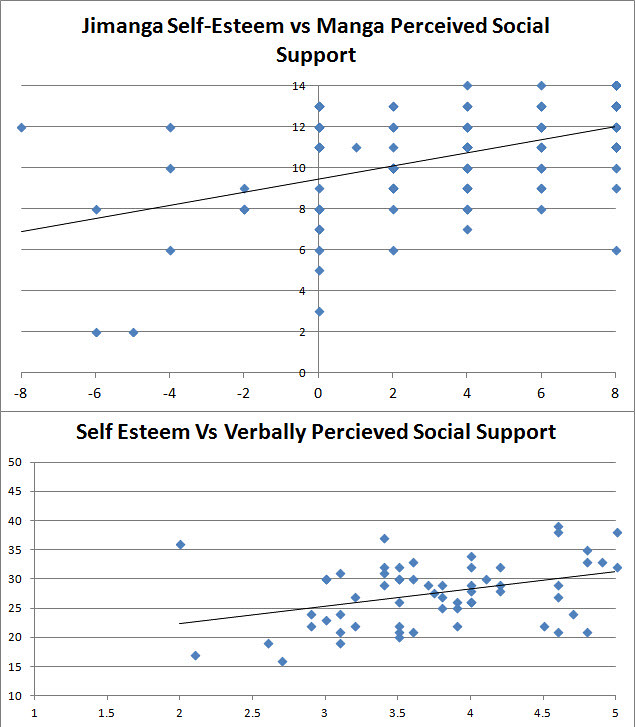
Jimanga Correlate more than verbal Measures
Labels: blogger, cultural psychology, japanese culture, nihonbunka, self, 日本文化
Wednesday, January 14, 2015
Kanji in the Mirror of the Heart

This ability to turn to view things from 180 degrees away from their line of sight, to see apart from sight (離見の見), enables Japanese people to have a visual self, which focussing as it does upon the surface of the body, is at the same time a reminder of the principle of interdependence. This visual self, is in my opinion the interdependent self (Markus and Kitayama, 1991).
Reminding Japanese as it does of the interdependence and externality of self - the Japanese see themselves in their games, dreams and memories - the Japanese visual self also allows the Japanese to change, chameleon-like, and have a set of selves, or characters , appropriate to the social milieu in which they are situated.
I hope that the ability to read these reflected Kanji will correlate with private shame, and interdependent self views but since both measures are linguistic, and the Japanese are not, I do not anticipate a strong correlation.
Sasaki & Watanabe 佐々木正人, & 渡辺章. (1984). 「空書」 行動の文化的起源. The Japanese Journal of Educational Psychology, 32(3), 182-190.
Labels: blogger, cultural psychology, Flickr, hazel markus, interdependent, japanese culture, mirror, Nacalian, nihonbunka, self, 日本文化
Saturday, December 27, 2014
Visualness Vs. Continuity
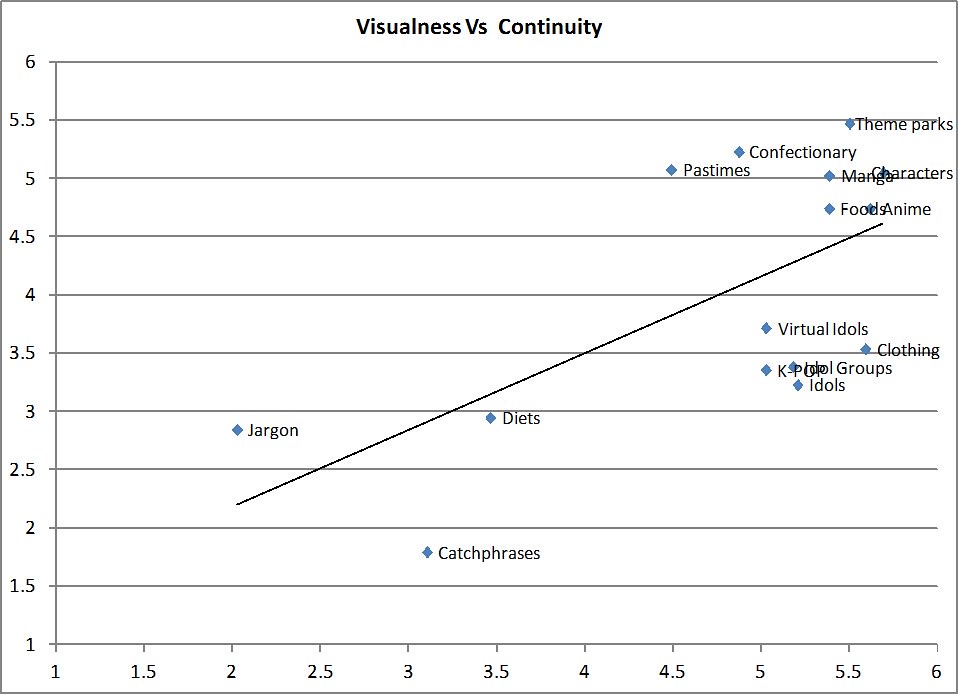
In Japan continuity, identity and soul resides in the visual and my seminar student, Masaki Abe (2014) appears to have proved it. In an initial experiment we asked for social phenomenon that have longevity and continuity and those that do not, those that are faddish. In a second experiment, subject were required to rate these phenomenon according to the extent to which they were visual and had continuity. It was found as predicted that there is a strong positive correlation (r=0.64) between visuality and continuity in Japan.
Jargon included also "modes of speech" such as speaking like a posh person, and was considered, along with diets, and the catch phrases of comedians to be the most faddish phenomenon there are. Maruyama Masao claimed that this faddishness extended to theories too. Perhaps my theory will have its day.
Hello Kitty, a recognisable face and little more, is 40 years old this year.
Abe, M. 安部将輝. (2015). 音と流行の心理学 (未発表卒論). 山口大学経済学部観光政策学科, 山口市.
Labels: blogger, Flickr, japanese culture, nihonbunka, self, 日本文化, 自己, 自己視
Friday, December 26, 2014
Spectre Watch's Bicultural Hero

The title (like many elements of the oeuvre) is a pun meaning (1) "spectre summoning wrist watch." This device is used by next generation Satoshi, to summon not Pokemon but Youkai - ghouls or spectres - and is not dissimilar to all the transformatory watches and belts used by Masked Riders and Power Rangers. Youkai Watch also means (2) the ability to see the same ghouls or spectres. It may also have the sense of "Neighbourhood Watch" in that Keita looks out for ghouls and spectres haunting his environs, based on the town of Tsukuba, in which I have lived. Importantly Keita Amano "watches" in both senses of the word/neologism: he sees and he plays with time.
I have argued that the dual nature of Japanese super heroes -- either they are possessed by something outside of them, or accompanied by a super friend --- reflects the way in which the Japanese self is visual, autoscopic (日人hito) rather than narrative (人間 ningen, "homonarans").
The Japanese super heroes' suit does not hide his mumbling 'secret identity," in which the Western super hero spends some of the time, but rather the Japanese super hero is spatially separate but often almost equivalent to the suit (Masked Riders, Evangelion, Gundam) and suiting up is done in public sometimes with great aplomb (Mitokoumon, Shinkenja). Traditionally, Words, names and symbols only have importance, as do images Lacanian theory, as transformatory 'stages' or catalysts. These medals, coins, cards with bar codes, etc. transform or summon the super visual form. The Japanese only need names to convince themselves that they are the sum total of their images (henshin! gattai!), their mask, or persona (Watsuji), as we only need images as a covering(Baudrillard), to convince ourselves that we are the hero of this narrative, behind that mask.
But Youkai Watch's Keita Amano is a little different. He is possessed or accompanied by two imaginary friends. The second, Jibanyan, a twin tailed cat, is strikingly similar to all the other cute but strong, round characters that accompany Japanese boys (from Doraemon to Pikachuu). The first friend above right, however, who provided the titular wrist watch, is more rare. This friend, "Whisper," is in name, constant attention to a encyclopaedic spectral i-Pad, very linguistic, garrulous. He is also fairly weak. In these respects he is pre-dated by Masked Rider Double, Philip, another weak, autodidactic wordy possessed or possessing familiar often seen walking around a spectral library or "Gaia Memory." I did not notice at that time, but I think that at least, after about 70 years of trying, the Japanese have succeed inviting the word to become flesh and dwell amongst them. Since originally in Shinto, words were things that one jumped in to rivers to wash out, this may be a bit of a shame.
But to today's bi-cultural Japanese children, raised in a mix of traditional Japanese and Western culture, to be concerned not only about how things look but how things narrate, Keita Amano and his two imaginary friends is a runaway cultural mega-phenomenon. Even more than Satoshi (who is accompanied, but off-stage, by a narrating professor) of Pokemen, Keita with his twin friends in Jibannyan and Whisper, should be successful in uniting children all over the globe.
I went to see the recent movie "Yo-Kai Watch the Movie: The Secret is Created, Nyan!" with my children. It featured the origins of the watch (previously appearing to be a present from Whisper, and at the same time random) in the promise of Keita's grandfather to his unborn grandson. It also featured a trinity of evil, industrial, villains that were always turning time backwards with horrific effect. In order to defeat these devils it was required that Jibanyan and Whisper merge. Bearing in mind that Derrida argues that the Western self is "deferred" in time (as opposed to displaced, seen from the outside) - we are always receiving spoken messages sent to ourselves, by ourselves from the past, the news is not all good. Keita Amano appeared to me to be a sort of Jappo-Western (和魂洋魂?) hybrid to beat nasty, industrial, watch-making Western culture.
Labels: blogger, Flickr, japanese culture, kamenrider, Nacalian, nihonbunka, psychology, self, 変身, 日本文化
Thursday, December 11, 2014
Omotenashi may be Unwelcome and Unwelcoming

Labels: blogger, Flickr, nihonbunka, self, tourism, おもてなし, 日本文化, 自己, 観光
21 Century Fumie

Labels: blogger, Flickr, japanese culture, Nacalian, nihonbunka, self, 日本文化, 自己
Sunday, June 09, 2013
Atractive Asian Girl and The cultural psychology of the concept of Self.
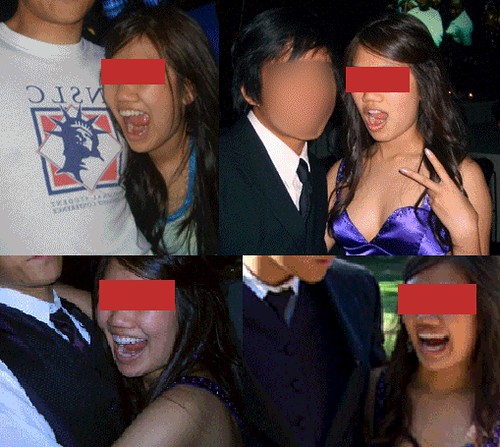
There is an Internet meme that has been doing the rounds for several years featuring pictures an attractive Asian girl who often appears with the same open-mouthed expression in a large number of photos. She has been ridiculed and called lots of offensive names (google) , merely because she chooses to take this pose in several photographs.
It seems clear to me that this attractive Asian young lady has simply decided that she likes this pose, that she looks good doing, and that it expresses her character. So why shouldn't she use the same pose in any or even all the photos that she appears in?
My parents in law are active tourists. The have visited the Pyramids in Egypt, Marble Arch in London, Leeds Castle in Kent, the Rocky Mountains USA, and various locations in Asian. At all of these locations they take a souvenir photograph of themselves, superimposed upon the location, which the same expression, and posing in the neutral, dignified way. Only in one photo that I have seen is even their order reversed: except in one photo in their extensive souvenir travel photo album, my father in law stands on the right.
In some cultures, including Japan, where people are more identified with their self image, people like to present a positive and self-consisistent image of self. For them, visual self-consistency is important.
In other cultures, it is important to present an unchanging narrative of self. Kanagawa, Markus and Cross (2001) demonstrated that when Japanese are asked "Who are you" by a friend, in a group situation, by a teacher, and on their own, their self representations change with the social situation. Presumably they anticipate that each interlocutor seeks different information, and they have no desire to present a consistent (or enhanced) narrative self (Leuers [Takemoto], & Sonoda, 1999). Americans on the other hand, were inclined to narrate themselves in almost exactly the same no matter who is asking, and even when they are on their own, since (like the Asian lady in the above photo) they are concerned to present a consistent and attractive linguistic representation of self.
This is due to the nature of their Gods (super addressees, imaginary friends, hidden intra-psychic others). In the West God is always listening, in Japan God (お天道さま, or the ancestors) are always watching and protecting (見守っている).
Kanagawa, C., Cross, S. E., & Markus, H. R. (2001). “Who am I?” The cultural psychology of the conceptual self. Personality and Social Psychology Bulletin, 27(1), 90-103.
Leuers, T. R., & Sonoda, N. (1999). Independent self bias. Progress in Asian social psychology, 3, 87-104.
Should anyone wish the above photo to be taken down, please leave a comment.
お取り下げご希望の場合は下記のコメント欄か、http://nihonbunka.comで掲示されるメールアドレスにご一筆ください。
Labels: image, japan, japanese culture, Nacalian, nihonbunka, self, 日本文化
Monday, November 26, 2012
Freud In Japanese

Freud's triparite division of the pysche into the super-ego ("over I"), ego ("I") and Id ("it"), translated into Japanese.
I believe that this tripartite division of the self applies to the Japanese too, but some (e.g. Kishida Shu) believe that the Japanese do not have a supereg. Not being a monotheistic society, and being instead collectivists, the Japanese equivalent of the super-ego is other people. Instead of guilt (or fear of god 対神恐怖症) the Japanese have social phobia (fear of other people 対人恐怖症).
Still others (such as Dov Cohen) claim that the Japanese have an even greater tendency to see themself from the position of a generalised other (Mead's version of the super-ego) and conversely that this suggests that they are collectivists.
I claim that the Japanese super ego or generalised other is alive and well. It may be a litle weaker, or softer than the Western version. It may be more granular or polytheistic, but that it exists in, or watching, "the imaginary" as represented by the dancing fat lady and the eyeballs in Kyari Pamyu Pamyu's video. For this reason I have added a red eyeball, not in Freud's original diagram.
The Japanese do not share their psyche with a listening father, but with a watching mother or perhaps even a watched mother, まぶたの母. I need to think more about this latter point.
Labels: japan, japanese culture, Jaques Lacan, lacan, Nacalian, occularcentrism, self, specular, theory, 日本文化
Sunday, November 04, 2012
The Chrysanthemum and the Bits of Wire
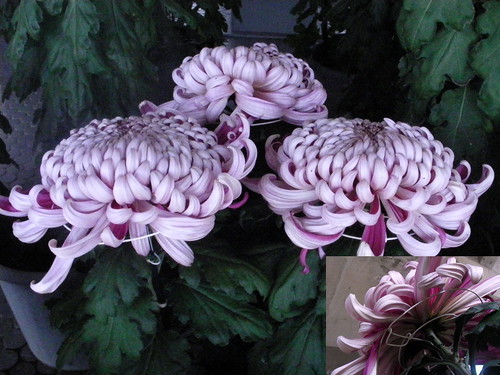
I argue that the Japanese are held in place not by the sword, or the bits of wire under these flowers, but by the beauty of the flowers on top. The Japanese love beauty, and desire to keep producing beautiful flowers, a beautiful people, and a beautiful country. It is in Japan as it is the USA. Society is held together by love, starting with self-love. It is just that visual beauty is of less importance than "good" narratives in the USA.
Benedict, R. (2006). The Chrysanthemum and the Sword (1st ed.). Mariner Books.
Lummis, D. (2007). Ruth Benedict’s Obituary for Japanese Culture. Japan Focus, 23. Retrieved from www.japanfocus.org/-C__Douglas-Lummis/2474
Labels: image, japan, japanese culture, nihonbunka, self, 日本文化
Cultures Amazing Consequences

It is so thick and so expensive that perhaps few people read Hofestede's incredibly famous "Culture's Consequences" (Hofsteded, 1980). This post is a repeat.
If you do read Culture's Consequences you will find that Hofestede's "Masculinity" factor, in which Japan came out way on top is defined in the same way as, and contains questionnaire items entirely applicable to Markus and Kitayama's (1991) Independent Self Construals, that is argued to be typical of Americans! E.g. "How important is it for you to work with people that cooperate well with one another?" or "How important is it for you to have a good working relationship with your manager?" are both items that correspond to femininity, that Japanese rated as being unimportant.
Markus and Hofesteded to agree however, that Independence is a masculine trait. Before she teamed up with Kitayama, Markus (Markus and Cross, 1990) wrote a very similar paper about the differences between men and women, even using most of the same data (such as Cousin's study) to support the assertion that there are two types of self construal, held by men and women. Personally I think that Markus is right on both counts, about the Japanese and about women. How could Hofstede get Japan so wrong? I guess it was because he was surveying Japanese IBM employees. Or is it because Japanese really are by far the most independent culture in the world?
In any event Hofsteded did a good job of spinning his surprising findings.
I admire all the people mentioned in this blog post.
Bibliography
Cousins, S. D. (1989). Culture and self-perception in Japan and the United States. Journal of Personality and Social Psychology, 56(1), 124.
Hofstede, G. (1980). Culture’s Consequences: Comparing Values, Behaviors, Institutions and Organizations Across Nations (2nd ed.). Sage Publications, Inc.
Markus, H. R., & Kitayama, S. (1991). Culture and the self: Implications for cognition, emotion, and motivation. Psychological Review; Psychological Review, 98(2), 224. Retrieved from www.biu.ac.il/PS/docs/diesendruck/2.pdf
Markus, H., & Cross, S. (1990). The interpersonal self.
Labels: collectivism, individualism, japan, japanese culture, self, 個人主義, 日本文化, 集団主義
This blog represents the opinions of the author, Timothy Takemoto, and not the opinions of his employer.