
Wednesday, December 28, 2016
How Unnverving is Conformance?
The American social news media site, Digg says that this video is unnerving. I guess that is because Westerners do not like conformance. On the other hand, the majority of Japanese comments on YouTube below the video are positive. This could be due to the prevalence of individualism vs collectivism and to an extent I would agree but, according to me, it is because Westerners lack individuality and must strive for difference lest they mind-meld, whereas Japanese are loaded with quirkiness -- as is clearly Professor Ikeguchi, the inventor -- and admire those individuals and metronomes that strive towards harmony.
See for example Masaki Yuki's research (Yuki, Brewer & Takemura, 2005) on Japanese and American groups for proof.
同調は不気味でしょうか。
ディッグというソーシャルニュースサイトによれば、このビデオは不気味です。同調するものが好きではないからでしょうかな。下記日本人のコメントは主に肯定的です。個人主義 対 集団主義で解釈されそうですが、それもありでしょうが、欧米人は個性が不足しているから努力して反発しなければ考えが同化してしまいそうですが、池口先生を初め、日本人は逆に個性に富むので協和に励む人間(やメトロノーム)を肯定的に思うというのは持論です。
結城雅樹(Yuki, Brewer & Takemura, 2005)の米国と日本の集団のあり方についての実証的研究をご参照ください。
Yuki, M., Maddux, W. W., Brewer, M. B., & Takemura, K. (2005). Cross-cultural differences in relationship-and group-based trust. Personality and Social Psychology Bulletin, 31(1), 48-62. Retrieved from http://kokoro.kyoto-u.ac.jp/en/cultureko_net/pdf/Yuki_et_al_2005PSPB.pdf
Labels: collectivism, individualism, japanese culture, 個人主義, 文化心理学, 日本文化, 集団主義


Sunday, October 09, 2016
Misunderstood Japan
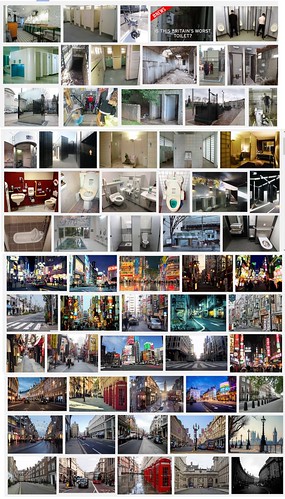
Someone asked on Quora what do foreigners misunderstand about Japan. I answered as I always do that Foreingers at least since Ruth Benedict (1946) think that Japanese shame is external, imposed on them from the outside, when in fact the Japanese live in the sight of the Sun God, Amaterasu, or Otendou-sama (Funahashi, 2008) who watches from within their hearts.
This explains why for instance, the Japanese do tidy up not only football stadia (even when their national team loses) but also tidy up in the privacy of their hotel rooms (Funahashi, 2008, p.166) and toilet cubicles which they leave as if unused, contra non-Japanese guests.
Conversely it is because Japanese care about how things look from a special perspective in their hearts, NOT from the point of view of other people, which is the reason why Japanese cities are a bristling, bubbling morass of individuality as opposed to rows of houses all looking the same.
The above images are the Google image search results, at half size, for:
I Top) British public toilet inside
2) Japan public toilet inside
3) Tokyo Street
4) London Street
お取り下げご希望でありましたら、下記のコメント欄かnihonbunka.comのメールリンクからご一筆ください。Should anyone want me to cease and desist please send me a note via the comments or to the mail link at nihonbunka.com
Labels: collectivism, individualism, japanese, japanese culture, nihonbunka, 個人主義, 日本文化, 集団主義
Wednesday, October 09, 2013
Capsule Hotel: Groupist or Individualist?

The thought of Japanese salaried employees getting into the their capsules and sleeping in air-conditioned pods like larvae in a hive may give the impression of the psychology of the herd, mindless groupism. On the other hand it may be an example of social atomism (Allison, 2006), and even individualism since, in a Western country, this scene -- like that of the ubiquitous Japanese student accommodation, "one room mansions" -- might be replaced by a that of a more friendly, communal dorm. Or the capsule hotel may be an example of social estrangement and collectivism since, like the prevalence of social withdrawal (hikikomori) and social phobia (taijinkyoufusho), it may be the result of as a result of greater social dependence (amae: See Doi, 2002), a concomitant inability to leave immediate family, (Kato et al., 2012) and as therefore demonstrating the lack of a developed, independent self.
My own feeling is that neither categorisation is particularly useful and that each are mutually dependent - the self is social - (Markus & Kitayama, 1991) but that Westerners tend to use this dichotomy due to the influence of Christianity, the main text of which is a series of vignettes where the hero ignores social and follows his conscience. The possibility that "conscience" is also social is generally refuted or ignored.
Allison, A. (2006). New-Age Fetishes, Monsters, and Friends: Pokêmon Capitalism at the Millennium. Ed. Tomiko Yoda and Harry D. Harootunian. Japan after Japan: Social and Cultural Life from the Recessionary 1990s to the Present. Durham & London: Duke UP, 331–57.
Doi, T. (2002). The Anatomy of Dependence. Kodansha USA.
Kato, T. A., Tateno, M., Shinfuku, N., Fujisawa, D., Teo, A. R., Sartorius, N., … Kanba, S. (2012). Does the ‘hikikomori’ syndrome of social withdrawal exist outside Japan? A preliminary international investigation. Social Psychiatry and Psychiatric Epidemiology, 47(7), 1061–1075. doi:10.1007/s00127-011-0411-7
Markus, H. R., & Kitayama, S. (1991). Culture and the self: Implications for cognition, emotion, and motivation. Psychological Review; Psychological Review, 98(2), 224. Retrieved from www.biu.ac.il/PS/docs/diesendruck/2.pdf
Mead, G. H. (1967). Mind, self, and society: From the standpoint of a social behaviorist (Vol. 1). The University of Chicago Press.
Labels: collectivism, individualism, japan, japanese culture, nihonbunka, 個人主義, 日本文化, 集団主義
Tuesday, July 02, 2013
Japanese Fashion in the Mirror of the Heart
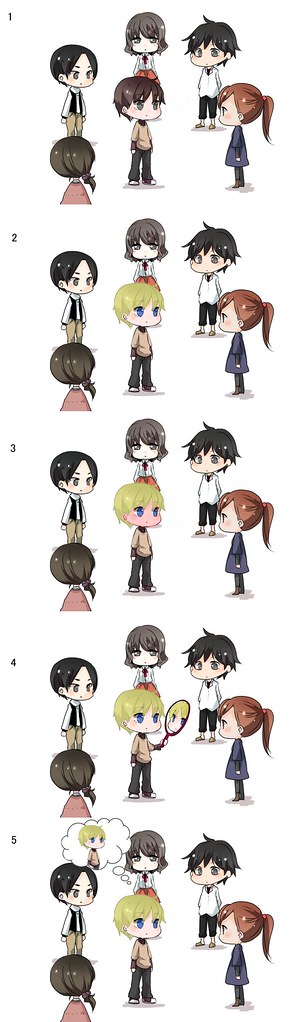
See Taro in the middle of a circle of his friends. The Japanese self is often described as being relational (Watsuji, Bendedict, Markus, Hamaguchi) which boils down to it being non-existent, or at best a nexus of self presentation concerns. The Japanese self is in the eye of the other, we are told.
If this were all there were to the Japanese self then how could the Japanese create and wear the zaniest fashion in the world? If this were the case, then if Taro dyed his hair blonde and wore blue contact lenses to college (picture 2), he would feel the harsh, judgemental gaze of his peers and become embarrassed (picture 3).
How could he avoid embarrassment? How could he remind himself of his preference for blonde hair and blue eyes? He could whip out his mirror (picture 4). As demonstrated by Carver ( 1975) and Carver & Scheier (2001) people with increased "objective self awareness" in front of mirrors, remain truer to their beliefs even in the face of social pressure. The trouble is, with all those eyes upon him, Taro would need to walk around looking in his mirror all the time.
But Taro has no need to do his, because Taro and all Japanese, especially those who have practised some kind of martial art or traditional path, has a mirror in his head (Heine, Takemoto, Moskalenko, Lasaleta, & Henrich, 2008). Taro can see himself without the aid of a mirror, avow his preference for blonde hair and blue eyes, and be done with the eyes of the world (picture 5).
It is because they have a mirror in their heart - originally a present from the Sun Goddess we are told - that the Japanese make the zaniest fashion in the world.
All five images based on an original by Miho Fujimura.
Carver, C. S. (1975). Physical aggression as a function of objective self-awareness and attitudes toward punishment. Journal of Experimental Social Psychology, 11(6), 510–519. Retrieved from www.sciencedirect.com/science/article/pii/0022103175900025
Carver, Charles S., & Scheier, M. F. (2001). On the Self-Regulation of Behavior. Cambridge University Press.
Heine, S. J., Takemoto, T., Moskalenko, S., Lasaleta, J., & Henrich, J. (2008). Mirrors in the head: Cultural variation in objective self-awareness. Personality and Social Psychology Bulletin, 34(7), 879–887. Retrieved from www2.psych.ubc.ca/~heine/docs/2008Mirrors.pdf
Labels: collectivism, individualism, japan, japanese culture, mirror, nihonbunka, occularcentrism, religion, specular, 個人主義, 宗教, 日本文化, 武道, 神道, 集団主義
Thursday, June 27, 2013
Intergroup Comparison versus Intragroup Relationships

The image above, adapted from Yuki (2003, p172) , shows how Americans and Japanese conceive of groups. Westerners concentrate on the name and set of central attributes of that group and all members feel themselves to share that attribute with all other members, in comparison with outgroups and their members who do not share the same attributes. These can be quite simple such as soccer fans may see membership of their teams fan base as derived from their belief that they "Want Chelse/Liverpool to win." They may chant "Chelsea, Chelsea," or "Liverpool, Liverpool," and they may mind merge with the social identity of their group becoming an outgroup hating herd animal. They do this to achieve vicarious self-enhancement through identification with the presumed superiority of their group. Their team wins, and the fans bask in reflected glory. Even if they loose they can believe that the fans are the most "loyal." And either way they can engage in an ego trip believing their group and/equals themselves to be superiority to others. Western group members therefore indulge in intergroup comparison, to enhance beliefs of the form "we are better than them" and "they are worse than us." This herd-like comparative group cognition is illustrated in the top diagram (a).
Japanese on the other hand pay attention to the many and various relationships and the network of relationships *within* their group. They have no interest in making downward comparison to the detriment of other groups. Their groups do not need a scapegoat, an other, to form at all. They are bonded by mutual cooperation, by "give and take" (a loan-expression from English into Japanese), obligation (giri) and ninjou (empathy) towards ingroup members. Rather than compare, they concentrate on maintaining ingroup harmony. Since the name of Japanese group game is cooperation, the individuality of the group members, their many and various talents that they can bring to the mix, are valued rather than ignored. So there is no moronic mind-merge, no hooligan herd, for the Japanese it would seem.
I love this theory and there is a lot of evidence to support it. Westerners are more likely to positively evaluate and be chummy with those that they are similar to (Heine, Foster, & Spina, 2009; Schug, Yuki, Horikawa, & Takemura, 2009), and more likely to remember information regarding inter-group rather than intra-group relationships (Takemura, Yuki, & Ohtsubo, 2010), whereas are more likely to trust someone in the same relationship network as themselves, rather than merely due to the fact of belonging to some nominal group (Yuki, Maddux, Brewer, & Takemura, 2005).
And as I have written before the emphasis for me is upon "nominal." Westerners like myself tend to conceive of others, their groups and themselves linguistically - in the latter case as having some shared characteristics. Whereas Japanese tend to conceive of groups in their imagination which results (as Lacan argues) in groups being conceived in terms of a network of binary relationships.
However, it occurred to me this morning, based upon the above argument, the group of "Americans" should also be that much more mind-merged, herdlike and amalgamous people - believing in common shared characteristics* - whereas the Japanese as a group, should, in so far as they understand themselves as a group at all, be bristling with individuals all cooperating together for the sake of synergy but never, for the sake of the same synergy, becoming the same. The motto of the Japanese group is, the words of Confuscious "harmonise not herd!" (和して同せず).
Thus in a culture with so great a respect for individuality, such as Japan under Yuki's theory, it is not surprising that "harmony" should be heralded and aspired towards. Likewise in a culture with so much mind-mulching, herdery, it is not surprising that individualism be that towards which its members are encouraged to aspire.
Does that satisfy? I think that I have gone a little too far and suggest a slight amendment to diagram (b) above. Yuki probably only drew the relationships as external to the group members in order to draw attention to them. He makes it entirely clear that intra-group attention is based upon the Interdependent model (Markus and Kitayama, 1991, diagram page 226) or in Kasulis (2010, diagram p 225) which provides philosophic, the relationships are shown interior to the selves. Implied by Yuki's analysis, I suggest therefore diagram (c) as a modification to diagram (b). Under this conception, the Japanese cease to be so radically individual, as compared to Americans, since they are aware that their individuality is fostered, created and maintained by virtue of their relationships with others which are self-forming and interpenetrate and overlap with the self.
How is this even possible? How can other person really be part of oneself? If that other person and your relationship is conceived in the visio-imaginary, then as Nishida (see Heisig, 2010) and Mach (1897), argue, it takes place in a place which is, paradoxically, both oneself and the world.
*The American Mantra: We hold these truths to be self-evident, that all men are created equal, that they are endowed by their Creator with certain unalienable Rights, that among these are Life, Liberty and the pursuit of Happiness.
Heine, S. J., Foster, J.-A. B., & Spina, R. (2009). Do birds of a feather universally flock together? Cultural variation in the similarity-attraction effect. Asian Journal of Social Psychology, 12(4), 247–258. Retrieved from onlinelibrary.wiley.com/doi/10.1111/j.1467-839X.2009.0128...
Heisig, J. W. (2010). Nishida’s Deodorized Basho and the Scent of Zeami’s Flower. In Frontiers of Japanese Philosophy 7: Classical Japanese Philosophy (pp. 247–73). Nagoya: Nanzan Institute for Religion and Culture. Retrieved from nirc.nanzan-u.ac.jp/staff/jheisig/pdf/Nishida%20and%20Zea...
Kasulis, T. P. (2010). Helping Western Readers Understand Japanese Philosophy. Dialogue, (34). Retrieved from nirc.nanzan-u.ac.jp/nfile/2124
Markus, H. R., & Kitayama, S. (1991). Culture and the self: Implications for cognition, emotion, and motivation. Psychological Review; Psychological Review, 98(2), 224. Retrieved from www.biu.ac.il/PS/docs/diesendruck/2.pdf
Schug, J., Yuki, M., Horikawa, H., & Takemura, K. (2009). Similarity attraction and actually selecting similar others: How cross-societal differences in relational mobility affect interpersonal similarity in Japan and the USA. Asian Journal of Social Psychology, 12(2), 95–103.
Takemura, K., Yuki, M., & Ohtsubo, Y. (2010). Attending inside or outside: A Japanese–US comparison of spontaneous memory of group information. Asian Journal of Social Psychology, 13(4), 303–307. doi:10.1111/j.1467-839X.2010.01327.x
Yuki, M. (2003). Intergroup comparison versus intragroup relationships: A cross-cultural examination of social identity theory in North American and East Asian cultural contexts. Social Psychology Quarterly, 166–183. Retrieved from www.jstor.org/stable/pdfplus/1519846.pdf
Yuki, Masaki, Maddux, W. W., Brewer, M. B., & Takemura, K. (2005). Cross-cultural differences in relationship-and group-based trust. Personality and Social Psychology Bulletin, 31(1), 48–62. Retrieved from psp.sagepub.com/content/31/1/48.short
Labels: collectivism, culture, image, individualism, japan, japanese culture, logos, Nacalian, 個人主義, 日本文化, 集団主義
Wednesday, April 24, 2013
The Invasion of Customized Goods Vs Masaki Yukism

Social and Cultural Psychologist Masaki Yuki, after a spell at Professor Marilynn Brewer 's (presumably Ohio State) university in the US was amazed at the extent to which Americans are proud of and merge with their groups, at least to the extent to which US university students wear university sweat shirts bearing the name of their own institution, and come the day of the university American football game, half the campus would come to the match dressed in the same, university colours, chanting the team name.
As professor Brewer argues, Americans join groups to gain a desirable social identity, as a member of a of a presumed elite with which they merge. Badges and uniforms of membership that enhance the group-individual mind meld, are thus desirable, as are negative evaluations of rival groups. "We are good and/because they are baaad."
The Japanese on the other hand are far more economic in their group membership, preferring to join groups in which they can cooperate to form a unity greater than the sum of its parts. The important thing is the network of exchange relationships between the individuals who physically enhance each other's welling through the synthesis of different skills and aptitudes. Group member uniformity is thus avoided and Japanese group members do not see other groups as rivals, paying little attention to them at all.
While there is a bit of Westernisation going on at my university, and there is a mini invasion of the self-snatching, clone-ware, customised goods, Yuki's cultural psychological theory is probably my favourite (after my own) since it has something qualitative to say about the Japanese side of the cultural equation. In most of the other great cultural theories, Japan is typified by a lack or absence: lack of a internal moral standard (Benedict), lack of individuality (Hofestede), lack of illusion of individuality (Markus and Kitayama), lack of a need for positive self-regard (Heine), lack of linguistic thought (Kim), lack of focus (Masuda and Nisbett).
This post in video: the film of the burogu. Bibliography
Yuki, M. (2003). Intergroup comparison versus intragroup relationships: A cross-cultural examination of social identity theory in North American and East Asian cultural contexts. Social Psychology Quarterly, 166–183. lynx.let.hokudai.ac.jp/COE21/workingpaper/no04abstract.pdf
Labels: collectivism, individualism, japan, japanese culture, nihonbunka, 個人主義, 日本文化, 集団主義
Thursday, November 08, 2012
The Face of Pachinko and the Illusion of Control by True-Grit

This series of films Pachipro Naniwa Ryouzanpaku 1-6 (1996-1998) stars Hiroyuki Watanabe playing the leader of a "professional" pachinko playing group. A gambling group by this name really existed. The name comes from a Chinese legend meaning a place where skilled, aficionado outlaws congregate. The Hole in the Wall meets Fu Man Chu.
Essentially all that Mr. Watanabe's character does is shoot little balls up into a hole. As you can see from his expression, however, Watanabe's character has true grit, guts, or balls, and can put them all out on the table and play to very last one.
The film series also builds on a group motif. The pachinko professionals fight as a team. I would not be surprised if those that are addicted to pachinko believe that they have the uncommon ability, uncommon konjo, to lay it all on the line for those they love, even as they waste their family finances pumping the pachinko machine.
The type of control that pachinko players hold the illusion of having, is almost as Morling (Morling, 2000; Morling & Epstein, 1997; Morling & Evered, 2006, 2007; Morling & Fiske, 1999) describes. Rather than actively changing their environment, the Japanese change or even rather negate the self, but throught doing so they wait out the storm and come through on the other side as, they delude themselves, winners.
I think that the Japanese may be engaging in true-grit-ism (konjoushugi, 根性主義; Yamagishi, 1979) a method of achieving external outcomes through self-control, rather than self-control for its own sake or harmony. No matter how much it may seem that Japanese aerobics is harmoniously self-controlling, it also achieves its stated environmental objective (Morling, 2000) of loosing weight. From the pachinko hall to the sumo stables (heya) and judo club (dojo) one can see Japanese engagining in collective self-denial, but I think that in all cases they have their eyes on the prize. Japanese self negation is not just collectivism, but a means to a personal end.
In any event, I hypothesise that gambling and problem gambling among Japanese will therefore correlate more with true-grit-ism (konjoushugi, 根性主義; Yamagishi, 1979) than illusions of (primary) control, for which scales exist (Moore & Ohtsuka, 1999; Raylu & Oei, 2004).
Possible Items for a True-Grit-ism(根性主義) scale taken from Yamagishi's paper (1979) above (English translations and some revision to the original Japanese are mine).
目標を速成するためには、禁欲すなわち己に克つことが最も大切である。
In order to achieve ones goals abstinence -- being able to achieve a victory over oneself -- is the most important thing.
目標を速成するためには、努力と精神力が大切である。
In order to achieve your goals, endurance and mental strenght are important.
忍耐と持続力、そして自己犠牲の精神があって、義務の遂行すれれば、目標を達成できる。
You will achieve your goals if you carry out your duties with endurance, the power to continue, and a spirit of self-sacrifice.
努力し、苦労すれば、幸福になることができる。
If you endure and toil you can achieve happiness.
幸福を得るためには、強い精神力が必要である。
In order to be happy you need to have a strong spirit.
持続性、つまり同じことを繰り返し行なうことにより人間形成がなされる。
One can grow as a person by persisting - doing the same thing over and over again. 自己犠牲の精神を発揮することにより人間形成がなされる。 One can grow a person through the application of the spirit of self-sacrifice.
精神力すなわち欲望を断ち切り己に克つことのできる力こそが大切なものである。
The most important strength to have is strength of sprit: the strenght to defeat ones desire, and achieve victory even over oneself.
精神力でオリンピックの金メダルを獲得することができる
You can win an olympic goald medal through strength of mind.
Under Langer's formulation those that have "an illusion of control" are those that suffer from the illusion that there is an easy way, a free lunch, a short cut to riches, that gamble. I suggest that in Japan it is precisely the opposite sort of people - those that believe that perseverence can get you anywhere - who end up in front of the pachinko machine. In that sense pachinko hits the best of us. I think that something should be done.
Bibliography
Heine, S. J. (2003). An exploration of cultural variation in self-enhancing and self-improving motivations. Nebraska symposium on motivation (Vol. 49, pp. 101–128). Retrieved from http://www2.psych.ubc.ca/~heine/docs/nebraska.rtf
Langer, E. J. (1975). The illusion of control. Journal of personality and social psychology, 32(2), 311. Retrieved from http://psycnet.apa.org/journals/psp/32/2/311/
Moore, S. M., & Ohtsuka, K. (1999). Beliefs about control over gambling among young people, and their relation to problem gambling. Psychology of Addictive Behaviors, 13(4), 339. Retrieved from http://psycnet.apa.org/journals/adb/13/4/339/
Morling, B. (2000). ‘Taking’ an Aerobics Class in the US and ‘Entering’ an Aerobics Class in Japan: Primary and Secondary Control in a Fitness Context. Asian Journal of Social Psychology, 3(1), 73–85.
Morling, B., & Epstein, S. (1997). Compromises produced by the dialectic between self-verification and self-enhancement. Journal of Personality and Social Psychology, 73(6), 1268.
Morling, B., & Evered, S. (2006). Secondary control reviewed and defined. Psychological Bulletin, 132(2), 269.
Morling, B., & Evered, S. (2007). The construct formerly known as secondary control: Reply to Skinner (2007).
Morling, B., & Fiske, S. T. (1999). Defining and measuring harmony control. Journal of Research in Personality, 33(4), 379–414.
Raylu, N., & Oei, T. P. S. (2004). The Gambling Related Cognitions Scale (GRCS): Development, confirmatory factor validation and psychometric properties. Addiction, 99(6), 757–769. Retrieved from http://onlinelibrary.wiley.com/doi/10.1111/j.1360-0443.2004.00753.x/full
Yamagishi, T. 山岸俊男. (1979). 根性主義-『おれについてこい!』 の内容分析. 一橋論叢, 81(2), 181–197. Retrieved from http://hermes-ir.lib.hit-u.ac.jp/rs/handle/10086/13228
The images are copyright their creators: "Pachipuro Naniwa Ryouzanpaku" (1996-1998) directed by Monna Katuso, starring Watabe HIroyuki, Ozawa Kazuyoshi, Yanagisawa Chou, Ishitsuka Hidehiko and Ishibashi Mamoru, based on a Manga by Hamada Fumio and Go Rikiya. Distributed by KSS 門奈克雄監督(1996-1998)『パチプロ浪花梁山泊(1-6)』。渡辺裕之、小沢和義、柳沢 超、石塚英彦、石橋 保 ほか主演。脚本(漫画)浜田 文太、 郷 力也 (1996)『パチプロ浪花梁山泊』。ケイエスエス
Labels: collectivism, individualism, japan, japanese culture, nihonbunka, 個人主義, 日本文化, 集団主義
Wednesday, November 07, 2012
The Effect of Social Support on Americans and Japanese

I like this paper and consider it relevant to those in the hospitality industry. When I first came to Japan, being a Westerner of low self-esteem, I did not like the way that Japanese hospitality providers would provide me with English language menus, forks or disposable chopsticks, since I felt that their kindness was saying, "you can't read Japanese," "you can't use ordinary chopsticks." I felt their kindness was an attack upon my self-esteem and independence. So, beware of helping Westerners. Some of them, are hinekureteiru or twisted.
At the same time, if the Japanese tendency to try to help prior to any demand (sasshi) is explained first, Japanese style hospitality, such as that provided by traditional inns (ryokan) providing luxury but choice-less food (kaiseki) with mothering helpers (nakai) can be a very rich cultural experience.
Bibliography
Uchida, Y., Kitayama, S., Mesquita, B., Reyes, J. A. S., & Morling, B. (2008). Is Perceived Emotional Support Beneficial? Well-Being and Health in Independent and Interdependent Cultures. Personality and Social Psychology Bulletin, 34(6), 741–754. doi:10.1177/0146167208315157 Retrieved from faculty.washington.edu/janleu/Courses/Cultural%20Psycholo...
Labels: care-givers, collectivism, individualism, japanese culture, nihonbunka, tourism, 個人主義, 日本文化, 集団主義
Sunday, November 04, 2012
Cultures Amazing Consequences

It is so thick and so expensive that perhaps few people read Hofestede's incredibly famous "Culture's Consequences" (Hofsteded, 1980). This post is a repeat.
If you do read Culture's Consequences you will find that Hofestede's "Masculinity" factor, in which Japan came out way on top is defined in the same way as, and contains questionnaire items entirely applicable to Markus and Kitayama's (1991) Independent Self Construals, that is argued to be typical of Americans! E.g. "How important is it for you to work with people that cooperate well with one another?" or "How important is it for you to have a good working relationship with your manager?" are both items that correspond to femininity, that Japanese rated as being unimportant.
Markus and Hofesteded to agree however, that Independence is a masculine trait. Before she teamed up with Kitayama, Markus (Markus and Cross, 1990) wrote a very similar paper about the differences between men and women, even using most of the same data (such as Cousin's study) to support the assertion that there are two types of self construal, held by men and women. Personally I think that Markus is right on both counts, about the Japanese and about women. How could Hofstede get Japan so wrong? I guess it was because he was surveying Japanese IBM employees. Or is it because Japanese really are by far the most independent culture in the world?
In any event Hofsteded did a good job of spinning his surprising findings.
I admire all the people mentioned in this blog post.
Bibliography
Cousins, S. D. (1989). Culture and self-perception in Japan and the United States. Journal of Personality and Social Psychology, 56(1), 124.
Hofstede, G. (1980). Culture’s Consequences: Comparing Values, Behaviors, Institutions and Organizations Across Nations (2nd ed.). Sage Publications, Inc.
Markus, H. R., & Kitayama, S. (1991). Culture and the self: Implications for cognition, emotion, and motivation. Psychological Review; Psychological Review, 98(2), 224. Retrieved from www.biu.ac.il/PS/docs/diesendruck/2.pdf
Markus, H., & Cross, S. (1990). The interpersonal self.
Labels: collectivism, individualism, japan, japanese culture, self, 個人主義, 日本文化, 集団主義
Friday, November 02, 2012
Heejung Kim vs Japanese Architects and Designers

However, one of my favourite cultural psychologists, Hejung Kim (Kim and Markus, 1999; Kim and Sherman, 2008) had demonstrated that Asians Americans have less of a preference for unque figures than European Americans.
She had Asian and European americans evaluate the 9 parts of each of the digrams in the top of the above photo (Kim and Sherman, 2008, Kim and Markus, 1999) and found that the European Americans were more likely to choose the unique parts (M = 5.36, SD = 2.12) than the Asian Americans (Mean = 4.39, SD = 2.17).
Why is this? Were there in sufficient Japanese in the Asian sample? Or am I am I wrong; Harajuku fashionistas, and product innovators are not-represtentative of Japan.
I think that Japanese self presentation is not only visual, but as such, aesthetic. Just as Americans do not strive to be linguistically unique in naff ways, the Japanese don't choose clothes and products just because they are unique, but also because they look good. Conversely, American visual expressions (think of their bodies!) and Japanese linguistic expressions (think of traditional Japanese politicians) can be....less appealing.
The difference is in which media of self expression is important. Americans believe that appearance is skin deep. Japanese have negative words for language (rikutsu). Both Japanese and Americans admire uniqueness, but it is only in unimportant media of self expresion are people prepared to be naff to achieve uniqueness. The American preference for the sole isoceles triangle among the array of regular triangles in the diagram top left is just not aesthetic. It does not look nice and the Americans know it but they don't care about looks. The American preference for this irregular triangle is comparable to the anti-conformism found in Takano's experiment in Japan but not America. Japanese were prepared to give an incorrect (linguistic) answer in order to be unique, when all the confederates were saying the right answer, whereas Americans were not. The Japanese wanted uniqueness and did not care about being "right." In a medium that mattered to them, the Americans were not prepared to go that far.
I predict that Japanese will prefer the parts that are for instance at the top of the piramid, or centre of a pattern, or which hold an aesthetically privelidged position within the overall form. The Japanese may also demonstrate a preference for figures that are in harmony with the rest of the parts, since in Japan, being unique and yet in harmony are (from the philosophy of interdependence) not contradictory.
Indeed the people that we call unique, such as conductors, fashionistas, designers, and architects of know a lot about and produce a lot of things which demonstrate harmony.
I am going to repeat the experiment in my class and see which parts of the above diagrams the students prefer.
Bibliography
Heine, S.J., Takemoto, T., Moskalenko, S., Lasaleta, J., & Henrich, J. (2008). Mirrors in the head: Cultural variation in objective self-awareness. Personality and Social Psychology Bulletin, 34(7), 879–887. Retrieved from http://www2.psych.ubc.ca/~heine/docs/2008Mirrors.pdf
Heine, Steven J. (2007). Cultural Psychology (First ed.). W. W. Norton & Company.
Kim, H., & Markus, H. R. (1999). Deviance or uniqueness, harmony or conformity? A cultural analysis. Journal of Personality and Social Psychology, 77(4), 785. Retrieved from http://www.psych.ucsb.edu/labs/kim/Site/Publications_files/Kim%26Sherman08.pdf
Kim, H. S., & Sherman, D. K. (2008). What Do We See in a Tilted Square? A Validation of the Figure Independence Scale. Personality and Social Psychology Bulletin, 34(1), 47–60. doi:10.1177/0146167207309198 Retrieved from http://www.psych.ucsb.edu/labs/kim/Site/Publications_files/Kim%26Sherman08.pdf
Leuers, T., & Sonoda, N. (1999). The eye of the other and the independent self of the Japanese. Symposium presentation at the 3rd Conference of the Asian Association of Social Psychology, Taipei, Taiwan. Retrieved from http://nihonbunka.com/docs/aasp99.htm
Labels: collectivism, culture, individualism, japan, japanese culture, Nacalian, nihonbunka, 個人主義, 日本文化, 集団主義
Monday, October 29, 2012
The Mirror of the Japanese is not the Gaze of others
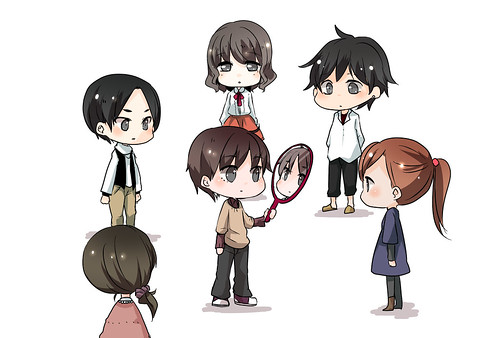
Indeed some research shows that looking at oneself in a mirror produces exactly the opposite effect as being looked at by others. Being looked at by others encourages people to conform to other's expectations. Looking at a mirror generally encourages people to conform to their own internal standards.
There is some research however, that has shown mirrors to increase private self awareness, and at least one paper that has argued that mirrors increase conformance.
So bearing in mind that Japanese are largely unaffected by mirrors (Heine et al, 2008), what does this suggest?
1) That as in the minority of experiments that show mirror's increase public self awareness, and increasing conformance (Diener & Srull, 1979; Govern & Marsch, 1997; Plant & Ryan, 2006; Wheeler, Morrison, DeMarree, & Petty, 2008; Wiekens & Stapel, 2008; Zanna, 1990) the mirror that they are mentally simulating is "the eyes of the world" (seken no me 世間の目). This is quite likely, and I predict in part true. Mirrors are found to increase both public AND private self awareness, so it seems likely that the mental mirror of the Japanese has both of these effects. The "Interdependent self" (Markus and Kitayama, 1991) of the Japanese is not an absense of self but a self that is both aware of itself, and aware of the impact of others upon itself. The dual influence of the Japanese mental mirror would explain the two aspects of the Japanese self.
2) Even if it were the case that the mental mirror of the Japanese is increase private self awareness there is research to suggest that Private self awareness is not a unitary phenomenon (Grant, Franklin, & Langford, 2002; Mittal & Balasubramanian, 1987; Trapnell & Campbell, 1999) but instead
2.1) motivated in different ways by curiosity (leading to self reflection) and a automatic, morbid desire to see the self (rumination)(Trapnell & Campbell, 1999).
2.2) It is also argued that Private self awareness has a motivational and cognitive aspect: on the one hand is an awareness of internal self states and attitudes, and on the other it is the desire to reflect upon the self(Grant, Franklin, & Langford, 2002).
It may be that the Japanese are high in the second ruminatory, motivational element of private self-awareness which is not coupled by an increase in self-cognition, as Ma-Kellams recent research tends to suggest.
3) The Japanese have a different type of independent self, that sees itself from the positition of a super-addressee, Other or God (known in Japan as Amaterasu the sungoddess) visually, with an aesthetic rather than logical impartiality ([Adam]Smith).
Whatever way you cut it however, seeing oneself in a mirror is different from being seen by an audience. In order to unpack this distinction, I claim it will be necessary to reject the argument that the Japanese are "collectivists" in the sense of being socially dependent, since the mirror that the Japanese carry with them also provides a impartial, objective, viewpoint because it is a "riken no ken," a view of self not from that of others, but from a self away from self.
The excellent, for my purposes, image is original artwork by Ms. Miho Fujimura.
Bibliography
Aaker, J. L. (2000). Accessibility Or Diagnosticity? Disentangling the Influence of Culture on Persuasion Processes and Attitudes. Journal of Consumer Research, 26(4), 340–357. doi:10.1086/209567
Brockner, J., Hjelle, L., & Plant, R. W. (1985). Self-focused attention, self-esteem, and the experience of state depression. Journal of personality, 53(3), 425–434.
Carver, C. S. (1975). Physical aggression as a function of objective self-awareness and attitudes toward punishment. Journal of Experimental Social Psychology, 11(6), 510–519. Retrieved from www.sciencedirect.com/science/article/pii/0022103175900025
Carver, Charles S. (1977). Self-awareness, perception of threat, and the expression of reactance through attitude change. Journal of Personality, 45(4), 501–512. doi:10.1111/j.1467-6494.1977.tb00167.x
Carver, Charles S., & Scheier, M. F. (1981). Self-Consciousness and Reactance. Journal of Research in Personality, 15(1), 16–29. Retrieved from www.eric.ed.gov/ERICWebPortal/detail?accno=EJ248215
Carver, Charles S., & Scheier, M. F. (2001). On the Self-Regulation of Behavior. Cambridge University Press.
Davies, M. F. (1982). Self-focused attention and belief perseverance. Journal of Experimental Social Psychology, 18(6), 595–605. doi:10.1016/0022-1031(82)90075-0
Diener, E., & Srull, T. K. (1979). Self-awareness, psychological perspective, and self-reinforcement in relation to personal and social standards. Journal of Personality and Social Psychology, 37(3), 413–423. doi:10.1037/0022-3514.37.3.413
Dijksterhuis, A., & Bargh, J. A. (2001). The perception-behavior expressway: Automatic effects of social perception on social behavior. Advances in experimental social psychology, 33, 1–40. Retrieved from www.sciencedirect.com/science/article/pii/S0065260101800034
Dijksterhuis, A. P., & Knippenberg, A. V. (2000). Behavioral indecision: Effects of self-focus on automatic behavoir. Social Cognition, 18(1), 55–74. Retrieved from search.proquest.com/docview/229595405/abstract/139CDA6646...
Fejfar, M. C., & Hoyle, R. H. (2000). Effect of Private Self-Awareness on Negative Affect and Self-Referent Attribution: A Quantitative Review. Personality and Social Psychology Review, 4(2), 132–142. doi:10.1207/S15327957PSPR0402_02
Froming, W. J., Walker, G. R., & Lopyan, K. J. (1982). Public and private self-awareness: When personal attitudes conflict with societal expectations. Journal of Experimental Social Psychology, 18(5), 476–487. Retrieved from www.sciencedirect.com/science/article/pii/0022103182900671
Froming, William J., & Carver, C. S. (1981). Divergent Influences of Private and Public Self-Consciousness in a Compliance Paradigm. Journal of Research in Personality, 15(2), 159–71. Retrieved from webcache.googleusercontent.com/search?q=cache:PueNQmlstsI...
Gibbons, F. X. (1978). Sexual standards and reactions to pornography: Enhancing behavioral consistency through self-focused attention. Journal of Personality and Social Psychology, 36(9), 976. Retrieved from psycnet.apa.org/journals/psp/36/9/976/
Gibbons, Frederick X., Carver, C. S., Scheier, M. F., & Hormuth, S. E. (1979). Self-focused attention and the placebo effect: Fooling some of the people some of the time. Journal of Experimental Social Psychology, 15(3), 263–274. doi:10.1016/0022-1031(79)90037-4
Gibbons, Frederick X., & Gaeddert, W. P. (1984). Focus of attention and placebo utility. Journal of Experimental Social Psychology, 20(2), 159–176. doi:10.1016/0022-1031(84)90018-0
Goukens, C., Dewitte, S., & Warlop, L. (2007). Me, myself, and my choices: The influence of private self-awareness on preference-behavior consistency. Available at SSRN 1094748. Retrieved from papers.ssrn.com/sol3/papers.cfm?abstract_id=1094748
Govern, J. M., & Marsch, L. A. (1997). Inducing Positive Mood Without Demand Characteristics. Psychological Reports, 81(3), 1027–1034. doi:10.2466/pr0.1997.81.3.1027
Heine, S. J., Takemoto, T., Moskalenko, S., Lasaleta, J., & Henrich, J. (2008). Mirrors in the head: Cultural variation in objective self-awareness. Personality and Social Psychology Bulletin, 34(7), 879–887. Retrieved from www2.psych.ubc.ca/~henrich/Website/Papers/Mirrors-pspb4%5...
Hormuth, S. E. (1982). Self-awareness and drive theory: Comparing internal standards and dominant responses. European Journal of Social Psychology, 12(1), 31–45. doi:10.1002/ejsp.2420120103
Hormuth, S. E. (1991). The Ecology of the Self: Relocation and Self-Concept Change. Cambridge University Press.
Macrae, C. N., Bodenhausen, G. V., & Milne, A. B. (1998). Saying no to unwanted thoughts: self-focus and the regulation of mental life. Journal of personality and social psychology, 74(3), 578–589.
Plant, R. W., & Ryan, R. M. (2006). Intrinsic motivation and the effects of self-consciousness, self-awareness, and ego-involvement: An investigation of internally controlling styles. Journal of Personality, 53(3), 435–449. Retrieved from onlinelibrary.wiley.com/doi/10.1111/j.1467-6494.1985.tb00...
Porterfield, A. L., Mayer, F. S., Dougherty, K. G., Kredich, K. E., Kronberg, M. M., Marsee, K. M., & Okazaki, Y. (1988). Private self-consciousness, canned laughter, and responses to humorous stimuli. Journal of Research in Personality, 22(4), 409–423. doi:10.1016/0092-6566(88)90001-3
Scheier, M. F., & Carver, C. S. (1980). Private and public self-attention, resistance to change, and dissonance reduction. Journal of Personality and Social Psychology, 39(3), 390. Retrieved from psycnet.apa.org/journals/psp/39/3/390/
Scheier, M. F., Carver, C. S., & Gibbons, F. X. (1979). Self-directed attention, awareness of bodily states, and suggestibility. Journal of Personality and Social Psychology, 37(9), 1576. Retrieved from psycnet.apa.org/psycinfo/1981-01346-001
Scheier, Michael F. (1976). Self-awareness, self-consciousness, and angry aggression. Journal of Personality, 44(4), 627–644. doi:10.1111/j.1467-6494.1976.tb00142.x
Scheier, Michael F., Carver, C. S., & Gibbons, F. X. (1981). Self-focused attention and reactions to fear. Journal of Research in Personality, 15(1), 1–15. doi:10.1016/0092-6566(81)90002-7
Sedikides, C. (1992). Attentional effects on mood are moderated by chronic self-conception valence. Personality and Social Psychology Bulletin, 18(5), 580–584. Retrieved from psp.sagepub.com/content/18/5/580.short
Spengler, S., Brass, M., Kühn, S., & Schutz-Bosbach, S. (2010). Minimizing motor mimicry by myself: self-focus enhances online action-control mechanisms during motor contagion. Consciousness and cognition, 19(1), 98–106. Retrieved from biblio.ugent.be/publication/1030838/file/1090307.pdf
Turco, R. M. (1996). Self-referencing, quality of argument, and persuasion. Current Psychology, 15(3), 258–276. Retrieved from www.springerlink.com/index/G43442LN62813201.pdf
Unconscious Facial Reactions to Emotional Facial Expressions. (n.d.). Retrieved October 16, 2012, from pss.sagepub.com/content/11/1/86.full.pdf+html
Wheeler, S. C., Morrison, K. R., DeMarree, K. G., & Petty, R. E. (2008). Does self-consciousness increase or decrease priming effects? It depends. Journal of Experimental Social Psychology, 44(3), 882–889. doi:10.1016/j.jesp.2007.09.002
Wiekens, C. J., & Stapel, D. A. (2008). The Mirror and I: When private opinions are in conflict with public norms. Journal of Experimental Social Psychology, 44(4), 1160–1166. doi:10.1016/j.jesp.2008.02.005
Zanna, M. P. (1990). Advances in Experimental Social Psychology. Academic Press.
Grant, A. M., Franklin, J., & Langford, P. (2002). The self-reflection and insight scale: A new measure of private self-consciousness. Social Behavior and Personality: an international journal, 30(8), 821–835. Retrieved from www.ingentaconnect.com/content/sbp/sbp/2002/00000030/0000...
Mittal, B., & Balasubramanian, S. K. (1987). Testing the dimensionality of the self-consciousness scales. Journal of Personality Assessment, 51(1), 53–68. Retrieved from www.tandfonline.com/doi/abs/10.1207/s15327752jpa5101_5
Trapnell, P. D., & Campbell, J. D. (1999). Private self-consciousness and the five-factor model of personality: distinguishing rumination from reflection. Journal of personality and social psychology, 76(2), 284. Retrieved from psycnet.apa.org/journals/psp/76/2/284/
Labels: eye, japan, japanese culture, mirror, Nacalian, nihonbunka, occularcentrism, reversal, 個人主義, 日本文化, 神道
Two Ways of Seeing a Mirror

The Japanese are found to be unaffected by mirrors (Heine, et al. 2008).
Social psychologists such as Dov Cohen, and Steven Heine, would, or do argue that mirrors are, for the Japanese who seem to have them in their heads, like the boy sees in them, a personification, internalistion of the other. In other words, mirrors can be understood to Japanese raise public self awareness. I argue that the mirror that the Japanese have in their heads is more like that of the girl in this comic.
The mirrors that Japanese do not need, and are are not influenced by, because they have intra-psychically simulated them to the piont that they have a mirror in their head, enables themselves to see themselves from their own point of view.
In other words, Japanese mental mirrors raise private self awareness and the Japanese are in a permanent state of high private self-awareness. This means, I predict that the same Japanese that are unaffected by mirrors are likely to conform less and be more aware of who they themselves are, two behaviour traits which are very inappropriate for collectivists.
Bibliography
Cohen, D., Hoshino-Browne, E., & Leung, A. K. (2007). Culture and the structure of personal experience: Insider and outsider phenomenologies of the self and social world. Advances in experimental social psychology, 39, 1–67.
Heine, S. J., Takemoto, T., Moskalenko, S., Lasaleta, J., & Henrich, J. (2008). Mirrors in the head: Cultural variation in objective self-awareness. Personality and Social Psychology Bulletin, 34(7), 879–887. Retrieved from www2.psych.ubc.ca/~henrich/Website/Papers/Mirrors-pspb4%5...
Labels: collectivism, individualism, japan, japanese culture, mirror, Nacalian, nihonbunka, occularcentrism, 個人主義, 日本文化, 集団主義
Sunday, October 28, 2012
Japanese Aquisitions and Masaki Yuki's Research

I guess that it will depend upon the industry. In manufacturing and hard (as in hardware) industries the Japanese will bring with them praxis that is successful and will be respected by their Western workforce. But in industries whose products are formal (read linguistic) constructions, such as finance, (non-game) software and to a significant extent, advertising, importing Japanese workways may be more fraught.
If the Japanese managers read up on the cultural differences between Westerners and Japanese they may be persuaded that their new British employees need to be taught to be more harmonious, to work better in teams. If they reach this conclusion then I think that they will have been, in my humble opinion, misguided.
I want to recommend to the management at Dentsu the only mainstream research that espouses a qualitative rather than quantitative difference between Western and Japanese ways of thinking: the excellent research by Masaki Yuki (2003).
For the most part Japanese are argued to be more sensitive to the group (Hofsteded, 1991) or more sensitive to context and more information (the varied and also excellent research of Nisbett and Masuda). The mainstream rhetoric regarding the differences between Western and Japanese culture, is quantitative: one of more rather than less.
Masaki Yuki however, argued that the difference between Japanese and Western social behaviour is a qualitative one. Westerners are not more individual or more collective but they interact with groups in different ways to Westerners. Indeed in their group behaviour, it is Westerners that are more inclined to loose their individuality since they identify with their groups, differentiating ingroup (e.g. my company) from outgroup (e.g. competitor company). Japanese on the other hand, in their group behaviour, pay little attention to other groups (other companies) but instead focus on the relationships with other ingroup members, and indeed upon the individuality of other ingroup members. The Japanese managers might therefore even encourage their new British employees to be more individual, to give each other more room for creative freedom and being themselves, as -- according to Yuki's theory -- occurs within Japanese groups.
Masaki Yuki (2003) argues that while Westerner groups have a tendency to focus upon shared group traits and ideals, and identifying with these lose a sense of who they are as individuals, Japanese groups have a tendency to focus upon the symbioses within the group: the fact that the group is made up of a network of many different individuals with different traits and skills.
Jacques Lacan argued that if one *imagines* ones interpersonal relationships then one *see* them as diadic, one-to-one, interpersonal relationships. What he failed to realised - or implicitly rejected - is that one can visualise a group as a whole, as a network, since he believed that it is only in language that one can simulate generalised third person viewpoint (ear-point, superaddressee, impartial auditor) or in his terminology, the "Other". Can one imagine a group? Sure one can, especially if one takes group photographs, as was recommended by recent research on the promotion of group efficiency.
Back in 2003, when I was still almost a researcher, Professor Yuki had me make English correction suggestions on his paper. I was honoured and excited. I recommended to him the connection with Lacan's theory of "diadic relationships" in the imaginaire (world of imaginable representations) but, of course, he did not take it up. Indeed, perhaps due to the extremely controversial nature of his paper, he has undertaken relatively little research in that paper's direction, despite the fact that it was great.
Bibliography
Yuki, M. (2003). Intergroup comparison versus intragroup relationships: A cross-cultural examination of social identity theory in North American and East Asian cultural contexts. Social Psychology Quarterly, 166–183.
Labels: individualism, japan, japanese culture, Nacalian, nihonbunka, 個人主義, 日本文化, 集団主義
Friday, October 26, 2012
Individualism and Collectivism in Magazine Photos

"Whatever nit-picking worries anyone has about the Opening Ceremony (for me, it was the almost total absence of the golden thread of British history, the fight for personal liberty), it set a tone that was amplified throughout the games. Could a nation of cussed individualists ever bring off an opening show to rival the spectacular we saw in Beijing?" [my emphasis] (Paxman, 2012)
There can be no doubt that at the level of linguistic philosophy, the Japanese espouse harmony and cooperation, whereas Westerners espouse personal liberty and individualism.
How about in the real world? I find the Japanese to as individual as the English. The excellent review paper by Beth Morling (Morling & Lamoreaux, 2008), "Culture outside the head," however reaches the opposite conclusion, so I thought I had better see what it had to say.
The first paper reviewed paper I could download, claimed that since Japnaese adverts used more imagery and were less likely to mention the product directly, they were therefore colectivistic; trying to build up a relationship with the purchaser (Javalgi, Cutler, & Malhotra, 1995). I thought that this analysis was unfair. Readers of this blog (?!) would know that it is my opinion that Japanese use imagery because they identify with images and have a God (or generalised other) that looks rather than listens (Leuers & Sonoda, 1999b).
While clicking around on analysises of print media, however, I cam up with a result that made me pleased. Wang (2006) noted that Taiwanese magazines are Westernised and that collectivist messages (table page 73) and individualist messages (table page 68) are aboult equal at the linguistic level in adverts in Taiwanese and American magazines. Let us assume that this result is due to Westernisation.
However, Wang also noted that when it comes to photographs, Taiwanese magazines are more likely to show individuals (Taiwan 73.1%, US 59%) and correspondingly far less likely to show groups (Taiwa 26.9%, US 41%) (see table page 65). This is not at all unusual. Japanese magazines are lonely (or narcissistic). Their protagonists are displayed on their own.
This result mirrors that found in my research on autophotography (Leuers & Sonoda, 1999b: see Heine 2007, p213). Japanese autophotography displays not only more positivity, but more pictures of self, whereas American photos show more pictures of other people.
Having a look at some Japanese and American fashion magazines, it seems that the same pattern is repeated. American women want to be kissed and appear with men in US Cosmopolitan. Japanese women are more self-reliant and rarely show men in their magazines (or collages) because men's demands for affection are rather annoying (uzai).
Westerners are linguistically individualist since they consider themselves to be linguistic entities (narratives) and try to differentiate their narratives from those of others (largely unsuccessfully, see Leuers & Sonoda, 1999a). Japanese see themselves as their self-images, first and foremost their face (Watsui), and as seperate embodied existances they yearn for communitas and harmony which they express in their "let's make friends" philosophy of harmony (Yamagishi, 2002).
In any event, I do feel that at a personal level the Japanese are extremely self~possessed, self-reliant and difficult to push around. Anyone married to a Japanese woman should know that, but despite the fact that some famous cultural psychologists are, they do not reach the same conclusion. I guess that they presume that they have married an unusual Japanese. (You know who I am thinking of...Fat chance that he reads my blog).
Bibliography
Heine, S. J. (2007). Cultural Psychology (First ed.). W. W. Norton & Company.
Javalgi, R. G., Cutler, B. D., & Malhotra, N. K. (1995). Print advertising at the component level: A cross-cultural comparison of the United States and Japan. Journal of Business Research, 34(2), 117–124. Retrieved from http://www.sciencedirect.com/science/article/pii/014829639400116V
Leuers, T. R. S., & Sonoda, N. (1999a). Independent self bias. Progress in asian social psychology, 3, 87–104. Retrieved from httyp://www.nihonbunka.com/docs/independent_self.rtf
Leuers, T., & Sonoda, N. (1999a). The eye of the other and the independent self of the Japanese. Symposium presentation at the 3rd Conference of the Asian Association of Social Psychology, Taipei, Taiwan. Retrieved from http://nihonbunka.com/docs/aasp99.htm
Morling, B., & Lamoreaux, M. (2008). Measuring culture outside the head: A meta-analysis of individualism—collectivism in cultural products. Personality and Social Psychology Review, 12(3), 199–221.
Paxman, J. (2012, August 12). London 2012 Olympics: Who thinks Britain is rubbish now? Telegraph.co.uk. Retrieved from http://www.telegraph.co.uk/sport/olympics/9469017/London-2012-Olympics-Who-thinks-Britain-is-rubbish-now.html
Wang, I. C. (2006). I‘ or’ WE"? A comparative analysis of individualism in Taiwanese and US print advertisements. Retrieved from http://etd.lib.nsysu.edu.tw/ETD-db/ETD-search/view_etd?URN=etd-0728106-154652
山岸俊男. (2002). 心でっかちな日本人―集団主義文化という幻想. 日本経済新聞社.
Labels: collectivism, image, individualism, japan, japanese culture, logos, Nacalian, nihonbunka, reversal, theory, 個人主義, 日本文化, 集団主義
Monday, October 22, 2012
Red Lights and Risky Shift
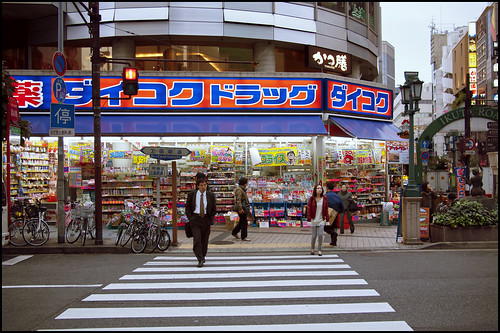
But when it comes to behaviour it seems to me that these labels are sometimes used unfairly since
1) The labels are always applied, in accordance with the stereotype, despite the fact that
2) All social behaviour has both aspects, and can be labelled in both ways.
First of all I would like to justify the second assertion. Markus and Kitayama (1991) in the paper that started cultural psychology, replaced the distinction between individualism and collectivism, with the following more complex distinction:
Westerners tend to think that the self is independent, and that groups are just for joining. The biggest distinction that groups have is that they are dangerous, in that they are seen as having the potential to de-individuate, or de-personalise; make their members forget about the unalienable individuality that they had in the first place.
I have heard cultural psychologists group collectivism with the latter interdependent view of self, not without just cause. But it should be remembered that there is a paradigm shift separating the old "Individualism Collectivism" theory from that of Markus and Kitayama. The latter is a theory about theories. This fact can be forgotten.
Importantly, from a "Interdependent" perspective, individualism and collectivism do not exist , or at least they are not opposed to one another. Every so called "individualist behaviour" is made possible by social relationships, and every collectivist behaviour is formative of and beneficial for individuals. In so far as every human behaviour is social (other than the most basic, and then even those), all behaviours therefore have a collective and individual aspect. Lets consider some examples.
Risky Shift (group polarisation: Stoner, 1961: see e.g. Isenberg, 1986) is something that is found in the US but far less so in Asia. Risky shift is the tendency for Western groups to behave more riskily after group discussion - such as the Bay of Pigs, Cuban invasion disaster. The generals that got together to discuss what to do about Cuba started out moderate but converged on an initially extreme, and risky decision, to invade Cuba.
In Asian on the other hand, Isozaki's research tried hard but failed to find persuasive evidence for risky shift in Japan. Sometimes the opposite -- cautious shift -- is found, in 1/3 of Isogaki (1981) experiments and cautious shift in groups (Hong, 1978) and just by giving reasons (Briley, Morris, & Simonson, 2000a, 2000b) is also found among Chinese.
In accordance with the stereotype, it is explained that extreme actions, appearing unique, are highly evaluated in Western culture so groups tend to converge on the most daring of options, whereas Japanese value harmony and converge on compromises.
On the other hand again, risky shift (group polarisation) may be more similar to the above "Red Light, If everyone crosses, We're not scared" phenomena. All those generals that got together and decided to invade Cuba may have been thinking"well everyone else here thinks it'll be okay". Indeed one explanation of risky shift is that people in groups feel less responsible and make riskier decisions due to the evasion of responsibility.
Both crossing the road in groups and risky shift have their negative aspects. The guy in the photo above may be in a daze too and a truck may be coming along. Unfortunately, there was a truck, called Castro, coming along and the bay of pigs invasion was a disaster.
1) Lack of individual uniqueness (not risky, moderate)
2) Lack of individual mindfulness (just goin' with the flow)
Both these came up in the same factor in a recent study on individualism.
Bibliography
Briley, D. A., Morris, M. W., & Simonson, I. (2000a). Reasons as Carriers of Culture: Dynamic versus Dispositional Models of Cultural Influence on Decision Making. Journal of Consumer Research, 27(2), 157–178. Retrieved from http://www.jstor.org/stable/10.1086/314318
Briley, D. A., Morris, M. W., & Simonson, I. (2000b). Reasons as Carriers of Culture: Dynamic vs. Dispositional Models of Cultural Influence on Decision Making. Journal of Consumer Research, 27(2), 157–178. Retrieved from http://works.bepress.com/briley/1
Hong, L. K. (1978). Risky Shift and Cautious Shift: Some Direct Evidence on the Culture-Value Theory. Social Psychology, 41(4), 342–346. doi:10.2307/3033587
Isenberg, D. J. (1986). Group polarization: A critical review and meta-analysis. Journal of Personality and Social Psychology, 50(6), 1141. Retrieved from http://psycnet.apa.org/psycinfo/1986-24477-001
Isozaki, M. (1984). The effect of discussion on polarization of judgments. Japanese Psychological Research, 26(4), 187–193.
Markus, H. R., & Kitayama, S. (1991). Culture and the self: Implications for cognition, emotion, and motivation. Psychological Review; Psychological Review, 98(2), 224. Retrieved from http://www.biu.ac.il/PS/docs/diesendruck/2.pdf
Stoner, J. A. F. (1961). A comparison of individual and group decisions involving risk Unpublished master’s thesis, School of Industrial Management. MIT.
磯崎三喜年. (1981). 集団分極化現象に関する研究. 心理学研究, 52(4), p248–251. Retrieved from http://ci.nii.ac.jp/naid/40001977542
磯崎三喜年. (1982). 集団分極化とその説明理論について. 愛知教育大学研究報告, 教育科学, p181–191. Retrieved from http://repository.aichi-edu.ac.jp/dspace/bitstream/10424/3474/1/kenkyo31181191.pdf
磯崎三喜年. (1995). 自己生成的態度変化としての極性化効果とその持続性に関する研究. 心理学研究, 66(3), p161–168. Retrieved from http://ci.nii.ac.jp/naid/40001978174
磯崎三喜年, 天根哲治, 上野徳美, & 横川和章. (1980). 521 集団分極化現象に関する研究(1)(社会3,社会). 日本教育心理学会総会発表論文集, (22), 640–641. Retrieved from http://ci.nii.ac.jp/naid/110008128465
岡本浩一. (1986). 社会心理学ショート・ショート―実験でとく心の謎. 新曜社.
橋口捷久. (1974). 集団内の意思決定者数とリスク・テイキングの水準. 実験社会心理学研究, 14(2), 123–131.
上野徳美, 横川和章, 天根哲治, & 磯崎三喜年. (1980). 522 集団分極化現象に関する研究(2)(社会3,社会). 日本教育心理学会総会発表論文集, (22), 642–643. Retrieved from http://ci.nii.ac.jp/naid/110008128466
Labels: collectivism, individualism, japanese culture, nihonbunka, 個人主義, 日本文化, 集団主義
Tuesday, October 16, 2012
Social Loafing in Japan Revisited
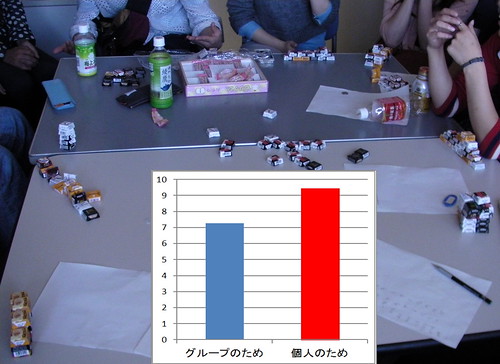
In Nakano's experiment, seminar students were asked to grab as many "BIS" chocolates as they could from a bag under two conditions
1) Being told that they would receive an equal share of the chocolates grabbed by the group as a whole
2) Being told that they would receive all the chocolates that they themselves grabbed.
The results were as shown above, with average number of chocolates grabbed were greater in the individual condition (9.45) than the group condition (7.27) indicating the existence of social loafing in Japan, with statistically significant tendency (p<0 .1=".1" despite="despite" n="11).<!--0--" sample="sample" size="size" small="small" the="the">
Fan as I am of the Koushien Baseball Tournament I was hoping my students to "become one circle," and try harder in the group condition but the conditions for Japanese social effort, did not seem to have been met. Only one student grabbed more chocolates in the group condition. The order of the grabbing and the degree of encouragement received from the experimenter (who was not blind to the experimental conditions, had been persuaded by social loafing research) may have affected the result.
Bibliography
Dick, R. van, Tissington, P. A., & Hertel, G. (2009). Do many hands make light work?: How to overcome social loafing and gain motivation in work teams. European Business Review, 21(3), 233–245. doi:10.1108/09555340910956621
Earley, P. C. (1993). East meets West meets Mideast: Further explorations of collectivistic and individualistic work groups. Academy of management journal, 319–348. Retrieved from http://www.jstor.org/stable/10.2307/256525
Gabrenya, W. K., Wang, Y.-E., & Latane, B. (1985). Social Loafing on an Optimizing Task Cross-Cultural Differences among Chinese and Americans. Journal of Cross-Cultural Psychology, 16(2), 223–242. doi:10.1177/0022002185016002006
Karau, S. J., & Williams, K. D. (1993). Social loafing: A meta-analytic review and theoretical integration. Journal of Personality and Social Psychology, 65(4), 681–706. doi:10.1037/0022-3514.65.4.681
Kravitz, D. A., & Martin, B. (1986). Ringelmann rediscovered: The original article. Journal of Personality and Social Psychology, 50(5), 936–941. doi:10.1037/0022-3514.50.5.936
Kugihara, N. (1999). Gender and social loafing in Japan. The Journal of social psychology, 139(4), 516–526. Retrieved from http://heldref-publications.metapress.com/index/3978hl6682r10877.pdf
Latane, B., Williams, K., & Harkins, S. (1979). Many hands make light the work: The causes and consequences of social loafing. Journal of Personality and Social Psychology; Journal of Personality and Social Psychology, 37(6), 822. Retrieved from http://psycnet.apa.org/journals/psp/37/6/822/
Markus, H. R., & Kitayama, S. (1991). Culture and the self: Implications for cognition, emotion, and motivation. Psychological Review; Psychological Review, 98(2), 224. Retrieved from http://www.biu.ac.il/PS/docs/diesendruck/2.pdf
Matsui, T., Kakuyama, T., & Onglatco, M. U. (1987). Effects of goals and feedback on performance in groups. Journal of Applied Psychology, 72(3), 407. Retrieved from http://psycnet.apa.org/journals/apl/72/3/407/
Shirakashi, S. (1984). Social loafing of Japanese students. Hiroshima Forum for Psychology, 10, 35–40.
Labels: collectivism, culture, economics, individualism, japan, japanese culture, nihonbunka, 個人主義, 日本文化, 集団主義
Friday, October 05, 2012
An Individualist Poem: Me, a Small Bird, and Bell
KANEKO Misuzu was a poet from Nagato in Northern Yamaguchi who lived at the beginning of the 20th century. She had a tough childhood, being sent to a foster home at the death of her father, then re-fostered by her mother's second husband, she found herself treated as a "foster child" even by her, by now estranged, mother. Leaving home, she ran a bookshop in Shimonoseki, the largest town in Yamaguchi Prefecture and wrote poetry, about 500 poems and songs mainly for children, of which 50 were published in her lifetime.
It was after her marriage however that her life became even more tragic in that her husband requested that she give up poetry and concentrate being a "housewife". When she refused, he took to having mistresses or at least prostitutes, and when he gave her a veneral disease she decided to leave him. At first she thought that she would have custody of her children but when they were taken from her, she committed suicide at the age of 27.
I imagine that she genuinely and fervently wished that her significant others would treat her on her merits, rather than according to her station or role (foster-child, housewife), so her most famous poem, in my translation below strikes me as being, very understated.
Me, a Little Bird, and a Bell
Even if I stretch out both my arms
I can't fly, not one flap, in the sky
But the little bird than can fly so well
Can't run on the ground fast, like I
Even if shake my body about
I won't make a beautiful sound
But the bell that can ring so beautifully
Doesn't know a whole heap of songs, like me
The bell, the small bird, and also me
All different, all good.
(It is much better in the original Japanese)
I often assert that the Japanese are just as individual as Westerners. I still think that this is true but it is also true that there are strong philosophical and cultural encouragements to fulfil ones roles. I think that this is because the Japanese are so individualist and full of self-love that their society would fall apart if they did not promote harmony and role-fulfilment. Perhaps Kaneko Misuzu was not so full of self-love. It is clear that she had a strong desire to be appreciated on her merits. I like to think her poems will become popular in the West.
Labels: collectivism, individualism, japan, japanese culture, 個人主義, 日本文化, 集団主義
Thursday, October 04, 2012
Hashimoto's Japan and the Monkeys

Hashimoto does not claim that anyone ever sprayed cold water on the Japanese. However, the situation described in the penultimate picture, bottom left in which all the members of society of monkeys refrain from doing what they desire because they are, justifiably, afraid of censure is essentially the same as that which Hashimoto claims to exist in Japan. The Japanese all want to behave like individualists, but they are scared to doing so due to their fear of censure. Their fear of censure is probably justified because Japanese believe that anyone who does not censure individualists will themselves be censured.
I don't think that this does in fact describe Japanese society, where both individual (e.g. Sumo and K1 MMA fights) and group (the Koushien baseball tournament) sports are highly admired. Returning to the Orwellian analogy, to the extent that Japanese have grown to love highly cooperative acts, they have learned to love "Big Brother." Learning to love big brother is not however, as sinister as the process described in George Orwell's book. It is rather that the Japanese see their 'ideal of individualism' as will o the wisp (nai mono denari) and are able to stand back and imagine a society in which everyone gave free reign to their individual desire, and realise that it would not look like the group of happy monkeys pictured in the final frame above.
Hashimoto, H. 橋本博文. (2011). 相互協調性の自己維持メカニズム. 実験社会心理学研究, 50(2), 182–193. Retrieved from japanlinkcenter.org/JST.JSTAGE/jjesp/50.182?from=Google
Labels: collectivism, individualism, japan, japanese culture, nihonbunka, 個人主義, 日本文化, 集団主義
Wednesday, October 03, 2012
Yamagishi in the Middle of the Cultural Psychology Feedback Loop

What alternative models are there? One of the most eloquent critics of cultural psychology, who nonetheless mixes with cultural psychologists and performs comparative cultural experiments, is Professor Toshio Yamagishi who has consistently claimed that what cultural psychologists are calling cultural psychology are really a product of "institutional" facets of the social environment.
For example, Yamagishi demonstrated that Japanese people behave cooperatively in a game when they believe that their actions can be observed by others, but not when their actions could not. Hence it is not that Japanese are cooperative per se but that they are employing a "group heuristic model" and anticipate certain patterns of censure and encouragement from their peers (Yamagishi, 2008).
Again, while Markus and Kim (2000) had shown that Japanese show a "preference" for majority and Americans for minority coloured pencils -- when given a choice of say one pencil from four blue and one red pencils -- this "preference" was found to be the result of, again, fear of censure and anticipation of gratitude from those yet to make a choice. Japanese reason to themselves "If I take the last red pencil no one else can. So if there are any others that wanted the red pencil then they are going to be upset with me for taking it, and grateful if I do not." When told that they are the last person to make the choice, or that they are in a shop purchasing a pencil, the Japanese chose the minority (red) pencil as frequently as Americans (Yamagishi, Hashimoto, & Schug, 2008).
Or again, as argued in Hashimoto's recent research (Hashimoto, 2011) why is that Japanese tend to censure individualistic behaviour? Not because they prefer cooperative behaviour (they prefer individualistic behaviour), but because they anticipate that those that praise individualistic behaviour will censured.
Hence, Yamagishi and his colleagues consistently and persuasively argue, there is nothing particularly cooperative about the Japanese psychology, it is just that they are playing a different game according to a different "heuristic," with different "default schema" because they are in a different "institution".
But hold on a second! That which was encouraging Japanese to be cooperative was thought to be psychology. Now we find that it is out there in institutions, in society. I think that in Yamagishi's anti-cultural psychological model, there is non-dual model of how psychology can be out there, in the world in psychology, in a pattern of anticipated interpersonal behaviours. Yamagishi's psychology collapses the duality in the cultural psychological feedback loop. In this sense, perhaps Professor Yamagishi is the most cultural of psychologists?
Yes and no. It could also be said, applying the theory proposed by this blog, that Professor Yamagishi is Japanese.
Speaking as a Westerner, when faced with for instance, the choice of which coloured pencil to choose, the narrative, "I know that someone coming after me may not be able to choose the colour of pencil that they wanted to choose but I know my rights, and I know that therefore I am within them to exercise my preference and that anyone who might censure me will know that I having behaved within my rights, I will choose the red pencil," i.e. the "default schema," "the heuristic" the analytic thought (Nisbett and Masuda) of my "institutional environment," are what I am. These machinations, this narrative, are the most important part of what it is to be me. To me they are, that narratival feedback loop is, "I", my self, my psychology.
Professor Yamagishi on the other hand is Japanese. As we can see from the above photo is about 65 going on 20. Professor Yamagishi is a mountain climber, and if you meet him you (and he) can see, tremendously fit. He does not not identify with such narratival machinations (heuristics, default schema, analyses of his institutional environment). Professor Yamagishi is to himself the man, the beautiful (Abe) man that one can see. All the these analytic/heuristic/schematic/narratival machinations are merely a product of his institutional environment.
Image of Toshio Yamagishi from his website reproduced here without permission. 取り下げご希望でありましたらご一筆いただけらば幸いです。
Yamagishi, T., Hashimoto, H., & Schug, J. (2008). Preferences versus strategies as explanations for culture-specific behavior. Psychological Science, 19(6), 579–584. Retrieved from pss.sagepub.com/content/19/6/579.short
Yamagishi, Toshio, Mifune, N., Liu, J. H., & Pauling, J. (2008). Exchanges of group-based favours: Ingroup bias in the prisoner’s dilemma game with minimal groups in Japan and New Zealand. Asian Journal of Social Psychology, 11(3), 196–207. doi:10.1111/j.1467-839X.2008.00258.x
橋本博文. (2011). 相互協調性の自己維持メカニズム. 実験社会心理学研究, 50(2), 182–193. Retrieved from japanlinkcenter.org/JST.JSTAGE/jjesp/50.182?from=Google
Labels: collectivism, individualism, japan, japanese culture, nihonbunka, 個人主義, 日本文化, 集団主義
Saturday, June 23, 2012
Nominal Individuation in Japanese Kindergatens

Allison (2000) points out that Japanese children have to take a lot of kit to school, of a certain type, and she sees this as an example of the extent to which Japanese kindergarten's (over) exercise control of their charges and even their mothers. At the same time however she may not have mentioned that this kit is displayed around the classroom labelled with the child's name. In my son's class there were
1) Named, individual registers of attendance, into which the children themselves affix a sticker (like a stamp) into a calendar on the days they attend.
2) A birthday poster showing who has a birthday on what day of which month.
3) Individually named shoe rack to store out-door shoes and slippers.
4) Individually named smock hook rack.
5) Individually named "lockers" without doors for the obligatory satchel. The satchel is the only uniform part of the children's attire.
6) A chart showing four class subgroups showing the insect themed groups, their members colour coded according the sex.
7) Named Children's artwork on the walls. This of course is common to UK classrooms.
8) A individually named change of clothes rack.
9) Individually named towel hook rack.
10) Individually named swimwear bag hook rack.
11) A rack containing the named individual drink flasks of all the children (I could imagine that all things that UK children bring to school are named, but then perhaps we might share the same source of drink. I have omitted this one from the collage.)
I can not remember my kindergarten classroom too well but I think that of these the artworks would have had names on them, lockers might have been numbered. I am not sure that my name would have been anywhere else on the walls or furniture of my kindergarten class. It seems Japanese children are encouraged to individuate themselves, their property, their hook, their lockers, using their name.
Names are very important in Japan (Plutschow, 1995), unlike words in general (have quotes), and are commonly included in self-descriptive Twenty Statements Test responses often near the top. Lacan (2007) argues that we (Westerners at least) should attempt to have as far as possible a symbolic, narrative awareness of self, but also argues that identification with body-image is a minimal essential, the lack of which leads to psychosis. I get the feeling that names are equivalent in an Nacalian culture to the image of a body in Lacanian culture: that minimal self-representation in the other channel required for completing the 'Möbius strip' -- a feedback loop which is twisted in the sense that self-perception is not quite possible within either channel -- of self-identity.
Bibliography
Allison, A. (2000). Permitted and Prohibited Desires: Mothers, Comics, and Censorship in Japan (1st ed.). University of California Press.
Lacan, J. (2002). The mirror stage as formative of the function of the I as revealed in psychoanalytic experience. In B. Fink (Trans.), Ecrits (pp. 75–81). WW Norton & Company.
Lacan, Jacques. (2007). Ecrits: The First Complete Edition in English. (B. Fink, Trans.) (1st ed.). W W Norton & Co Inc.
Plutschow, H. (1995). Japan’s name culture: the significance of names in a religious, political and social context. Japan Library Kent, CT. Retrieved from www.getcited.org/pub/100168851
Imao, K. 恵介今尾. (2005). 日本地図のたのしみ. 角川学芸出版.
I have blurred all the names in the pictures other than those of my son. 息子以外に名前は全てぼこしています。
Labels: collectivism, individualism, Jaques Lacan, nihonbunka, 個人主義, 日本文化, 集団主義
This blog represents the opinions of the author, Timothy Takemoto, and not the opinions of his employer.