
Sunday, May 27, 2012
Bakugan Transformation
The notion that heroes "transform" (change their form or body, henshin) using a symbol is a very common trope in Japanese superhero fiction from Mitokoumon (who changes when he gets out his seal) through mirror man (thanks JE), who changes when he gets out his omamori (amulet) in front of a mirror, super sentai, masked riders, and here bakugan, a sort of poket monster.
This tranformation provided by the use of a symbol here with Bakugan parallels that provided by named ancestors watching from hills. The ancestors in the hills spread the world of vision out into a landscape. This Bakugan toy however, transforming from a sphere into a hero of sorts by use of a symbol illustrates the way in which the imaginary, that circle or sphere (Heisig, Nishida) of "pure experience" spreads itself out to form the body of the person as "wrapping" (Hendry).
While I admire Hendry enourmously, I think that her use of the "wrapping" conceptualisation plays to prejudices of her Western readers and, perhaps, her own Western cultural preconsceptions. Though she avows otherwise (in reference to her critique of Barthes), the use of the word "wrapping" is bound to suggest to her readers that there is something, something else, something important but ignored, that is being wrapped.
Something is being "wrapped," but that something is more wrapping. The surface, the res-extensia, the plain-of-the-qualia, the tain of the mirror, wraps another mirror. The super suit of Japanese superheros, the masked riders super suit, bakugan body, contains another... (from a western perspective) "wrapping," another "surface." Inside the wrapping is only more wrapping. So the "wrapping" which suggests a duality of wrapping and content is fraught.
The image in Mary's world, ie the world of Western philosophers is, exists, only as a sort of boundary, a veil of perception. The interior world of Mary, herself as narrative, and the world as narrative also, as words, are seperated by a viel, a plane, of the 'qualia.' Words "wrap" words. The interior and the exterior are words. But in between there is an unspeakable, un-wordable, "viel" (of perception). This strange, abject, unspeakable viel seperates the two worlds of words. It is also a catalyst for their separation.
In Japan the word or name is similarly, a viel or boundary. Inside there is only image. Outside there is only image, but in between, that which spreads the interior out into a world is the word, made particular, the name, which has a place, the named place, the meisho, of which there are many.
Labels: japan, japanese culture, Jaques Lacan, nihobunka, nihonbunka, specular, totemism, スパー戦隊, トテミズム, 変身, 日本文化


Tuesday, June 07, 2011
Totem badges Old and New

Top row: Shinto shrine amulets (omamori)
Bottom row: Kamen Rider OOO medals, Kamen Rider W Gaia Memories
Please see also an even longer history of totem badges from Australian bull roarers, through shrine amulets, seals (mitokoumon's inro) to the seal of the Shinkenja- Super sentai.
My son plays with various totem badges that are said to transmit the spirit of a supernatural entity to a person allowing them to transform into a superman of sorts. These "totem badges" seem to have much in common with the good luck amulets (omamori) available at shrines.
The seem to contain some information (written - omamori, in an RFID chip - OOO's medals, in a USB memory - gaiai memory), connected with a super-human spirit (in the case of the omamori a shinto spirit or kami, in the case of OOO's medals and gaiai memory a super animal or 'ancestral' kamen rider). This information acts as a vector between the super-being and the holder, endowing the latter with power to conquer foes, such as exams diseases and enraged aliens. They often make a noise. Rattles are popular totem badges in North America (Levi-Strauss has a page of rattles in one of his books on totemism). Bull-roarers or Churinga roar when waved around ones head. Omamori are often fitted with bells. OOO's medals, and various transformatory cards make a noise when read with a special purpose reader. Gaiai memory (and engine souls) make a noise when a button is pushed or when inserted into a sort of reader.
Do amulets change (henshin!) people? Surely not?
They all contain a message, information, or symbols, representing a supernatural entity as noted above. They are also the double of their owners. Masked Rider OOO is the double of Hino Seiji. Shoutaro Hidari uses two Gaiai memory to transform into Kamen Rider "W" (double), his double, in more ways than one. Omamori are said to work as a self-replacement (migawari), taking on the bad luck that might otherwise befall their owner.
Shintoists believed that getting a totem badge from their shrine, the sacred space of their religion, gave them a life or self or spirit. The spirit was themselves and also it was the spirit of the shrine. About 70 years after they die, the spirit merged with the spirit of the shrine, or now Buddhist temple since the cycle of spirit has been broken.
Christians have "Christian names." My name is "Timothy", which is a name from the Bible. It is primarily a phoneme. I get it from the sacred space of my ancestor's religion, and I apply it to myself, thereby perhaps taking on board bit of the God, maybe. Does having a name change me? Does it give me anything, such as a self or life (no way, surely?).
The symbols, in all cases, come from the supernatural to give something special to their recipients.
One of the first Japanese superheroes that appeared on TV, was Mirror Man (Mira-man, 1971). Appearing at the same time as the original Ultraman, he shared many of the typical characteristics of Japanese superheroes, and with Shinto. He used a Transormatory item (henshin aitem) to transformed (henshin). Mirror man use a Shinto shrine amulet (omamori). He could only transform when in front of a reflective surface, usually a mirror. He was possessed, as it were, not by a giant from outer space, but his super-human father who lives in the world of two dimensions. (Thank you James)
Image top row far left: 貝で作られたお守り :) by kozika and far right: ハローキティのお守り :) by kozika
Labels: henshin, Masked Riders, nihobunka, nihonbunka, Shinto, superhero, totemism, トテミズム, 仮面ライダー, 変身, 日本文化, 神道
Tuesday, August 17, 2010
Savage Thought and Myth in the Structure of Japanese

Levi Strauss argued that "savages" are "bricoleurs" (people that use the tools and materials to hand to get a job done), in that they use things, usually found in the natural world, to categorise and organise their societies.
Thus *savages* in totemistic societies may have "Black Hawk" and "White Hawk" groups, and be called by names like "Sitting Bull." They use species of bird and animal as names for clans, families and individuals, because these things are useful to get the job of social categorisation done, and thus "good to think."
Had Levi-Strauss been more rigorous (I jest) he would have noted that some totemist use mythical and corporeal, artificial signs. There are "Water Flask" and "Dragon" tribes. Concentrating on these man-made signs Levi-Straus' definition of "the savage as bricoleur" starts to become rather vague. If the savage can make up entities (such as dragons) to use as names then how is the savage different from "Levi" named after some ancient Jews Straus? If the savage can use man made objects as names, then why not use patterns, and write his name "LEVI" and be done with it. And if he did, would he still be a savage? The problem with Levi-Strauss for me is that I can't find the place where he compares savages to himself, or where he explains what we are doing, and whether and in what way what they are doing is different. (As far as I am aware, I am a bricoleur too. My name is Timothy, the name of a semi-mythical 'beast' found in the Bible.)
Then Roland Barthes comes to the rescue with his theory of "Mythological" signs. I think that despite the fact Barthes analyses magazine covers and pasta advertisements,he uses the word "Mythologiges" because he is harking back to Levi-Strauss above, and providing a semiotic distinction between us and them, between anthropologist and the mythologist, the scientist and the bricoleur. The distinction of myth, mythological thought, and the savage mind is that it uses signs in combination at a two teired level of "denotation" and "connotation." The briocoleur/mythologists uses second level, connotative signs, that is to say signs in combination that are already signs for other things (see diagram, inset bottom right).
Hence, the black boy and the saluting (a flag) shown on the cover of Paris Match, are in themselves signs. We recognise them and their meanings, of respect, youth, and Africa etc. The cover becomes mythic because it combines these signs to present a new meaning: imperialism is good, all of France's colonial subjects respect the French flag.
Suzuki Takao argues that the Japanese language is appropriate for use as an International Language. I happen to agree. The principle reason he gives is interesting, one that I had not grasped, and relates to the discussion of myth, or savage thought above. Suzuki argues that the advantage of Japanese is in the two-teired way that it is "agglutinative". A simple definition of aggluntinative is that, in ancient greek (soci-ology) and modern German (auto-bahn) one can form words by joining other words together. In Japanese however, the situation is a little more mythological, the process of agglutination often involves an extra layer. In Japanese, while there are cases in which one simply joins words together (e.g. torihiki, pull-push meaning negotiations), one can form complex words by combining the signs, or Kanji, for everyday words.
This layering of Japanese can be discussed at two levels.
At the level of discussion of the merits of the Japanese language, or German and Japanese respectively, the layered nature of Japanese makes it a lot more compact. Complex German words are formed by joining shorter simple, everyday words together, resulting in some very long compound words. Japanese on the other hand uses the signs, or Kanji, for the everyday words and joins these together instead. Since the Kanji have shorter (kun yomi) names of their own, long compounds can be said using far fewer syllables. In Suzuki Takao's example the round lighting devise used above operating tables in hospitals is "Schattenfreie Lampe" (Shadow-Free-Lamp) in German, and "mu-kei-tou"(無影灯)in Japanese. It gets to be a lot shorter in Japanese because mu, kei and tou are the names for the signs that represents "no shadow lamp" (nai, kage, akari). So while learners of Japanese may think it a pain in the neck that Japanese not only has Kanji, but also has more than one name for each, Suzuki argues, quite successfully in my view, that it is this layered structure that makes Japanese so successful in expressing complicated meanings, using few simple buildings blocks, without resulting in some very long words.
At another level, it seems to mean that Japanese are always being "mythologists" or "bricoleuers" as defined by Roland Barthes and Levi-Strauss in that they are using the denotive signs for every-day things in combination to connote new meanings. They are still engaging in "savage thought."
And so what? I am not sure, but I think that it relates to:
Roland Barthes claim that Japan is "The Empire of the Signs"
Jane M. Bachnik's discussion of the prevalance and importance of "indexes" in Japan, in her opening chapter of "Situated Meaning." (Would Barthes have written "The empire of the indexes" had he been more precise? Are totems indexes? Are indexes always dual, dennotive and connotive?)
My claim that Shinto is a form of totemism that stopped using stones and branches and grass (as related in detail by Kunio Yanagita, back in the days when "everything used to talk") as their totemic badges, and started to use Kanji for their names (when, thanks to the ordered rule of the emperoro "everything stopped talking")
The fact that Japanese superheros are totemists.
Labels: nihobunka, nihonbunka, religion, superhero, theory, totemism, アニミズム, トテミズム, 宗教, 日本文化
Friday, May 21, 2010
Transformatory sacred items accross the ages
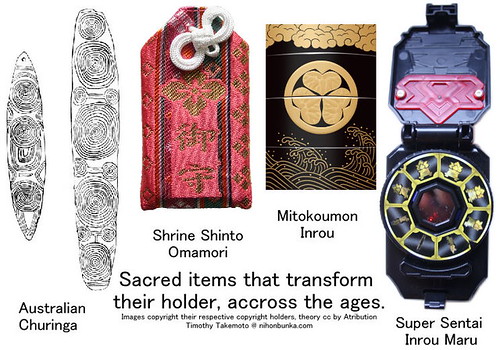
I noted in a previous post that the history of transofmatory items (変身アイテム) such as used by Ultraman (pens and glasses), Super Sentai (Power Rangers), Sailor Moon, Himitsu no Akko-chan, and Kamen Riders (Masked Riders), has a history in the transformatory symbols of Mitokoumon, Touyama no Kin and Samurai Momotarou. Japanese superheroes are always flashing a special symbol and transforming by means of its use.
The history is much older. I ague that Shinto is a geographical totemism, like that of the Arunda/Arunta/Arenda of Australia. In totemic religions the faithful recieve totemic badges which represent their owners and the ancestral spirits of their ancestors. The Arunda of the central Australia destert are one of many such groups found worldwide. Unlike most totemic religions, but in common with the Japanese, these "most primitive" (Freud, Durkheim) of totemists believed that the totem was associated with a place.
That the japanese recieve totemic badges from Shinto shrines almost goes un-noticed. More visible are the symbolic, soul containing badges that are given to the dead (mitama, Ihai). However, as Yanagita Kunio points out, once upon a time, there were "ikimitama" symbols given to the living. These were originally leaves branches of sacred trees and rocks from sacred mountains. They were believed to give their bearer life and were recieved from the time of first shrine visiting.
However in my view, and as Yanagita hints, the symbols were gradually replaced by kanji ideograms and piece of paper.
Yanagita writes, "in this reigion also the Nusa (gohei, zigzag strips of Shinto paper) were originally I think to be distributed among participants. This is similar to the leaves and branches of Japanese cedar and nagi (a evergreen tree/shrub) that were given to the faifthful from sacred trees on Mount Inari and Mount Ise" (Yanagita Kunio Collection No. 14 p 51, my translation.)
「この地方でも小さい幣を関係者に頒(わか)つのが本当の趣旨であったろうと思う。もししかりとすれば、後に言わんとする稲荷山の杉・伊豆山の梛(なぎ)のごとく、信者が神木の木の枝を追って行く風習と、著しく類似する点があるのである」柳田國夫全集14p51
These days Japanese still recieve omamori or amulets from shrines that are said to represent a stand-in or self-replacement and protect the bearer from bad luck and impurity.
And as shrines become less significant, Mitokoumon, Ultramen, Masked Riders, Super Sentai (Power rangers) brandish their sacred symbols and transforms with them.
Before we call the Japanese primitive bricoleurs, let us not forget that "in the beginning was the word," and that I have a "Christian name."Am I transformed by it?
Labels: henshin, Masked Riders, morph, nihobunka, religion, Shinto, specular, Super-Sentai, totemism, ultraman, アニミズム, スパー戦隊, トテミズム, 仮面ライダー, 変身, 宗教, 神道
This blog represents the opinions of the author, Timothy Takemoto, and not the opinions of his employer.