
Monday, June 08, 2015
Japanese Risk Taking: Irreligiousity
Most analyses of Japan behaviour argue that there are quantitative differences due to the lack of individualism or greater collectivism of the Japanese. Thus, I feel sure that the the risk aversion of Japanese has been explained in terms of their desire not to stand out because, as we are always being told, "the nail that stands out gets hit."
It seems to me rather that Japanese differ little from Westerners in terms of their desire for and achievement of individuality, but rather it is the modality in which they express it that is different. The Japanese express themselves visually since they have internalised and hidden a helper who sees (the mirror of the Sun Goddess) whereas Westerners tend to prefer to love themselves linguistically since they have internalised and hidden a helper or paraclete (Eve or Jesus) who hears.
When it comes to "risk taking behaviour," this usually refers to behaviours which result in physical harm to the body. Since the Japanese identify with their self-image, damaging their bodies is something that they are very averse to doing. The risky behaviours highlighted by Guzman and Pohlman (2014) : "Self-Injurious Behaviours, Violence, and Suicide, Substance Use, Risky Sexual Behaviour, and Behaviours Related to Obesity and Unhealthy Dieting," are all of this type. The Japanese avoid all of these risks.
Indeed the very definition of taking risk (doing dangerous things) usually relates to the lack of aversion to bodily harm so perhaps it is the case that the Japanese are generally less risk averse.
Fortunately there is a category of risks which the Japanese are prepared to take: those that relate to spiritual harm. According to Freese (2004, p88) "A clever and intriguing hypothesis in the sociology of religion is the idea that irreligiousness is analogous to other forms of risk-taking, and so variations in risk preferences play an important role in understanding variations in religiousness."
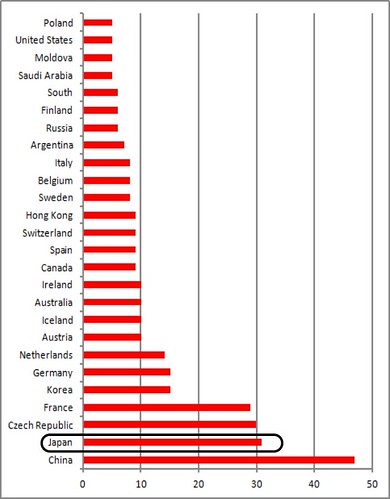
And at least according to Pascal, being religious can be considered to be a sort of insurance for ones soul. In this instance, the Japanese are found to be second only to the the Chinese is in their irreligiousity with 31% of Japanese claiming to be atheists. The Japanese take great care of their bodies, because they can be seen, but a large proportion of them care very much less about their soul since, at least on a naive view, it can't.
Again it should be noted that the Japanese claim to be atheists but involve themselves in a wide range of religio-cultural practices, such as shrine visiting and hiding their thumbs. In other words the Japanese are fairly happy to take risks when it comes to their lack of a linguistic avowal of some sort of creed or religion because no one is listening. But they are risk averse (as I found out with a survey) when it comes to skipping out on a shrine visit to praying for the health of their three, five, and seven year old children. Japanese behaviour thus appears to be paradoxical until one realises that what matters is how things appear, not what people say.
There should be many other linguistic risks that the Japanese take, at least if only by omission.
Image based on data from the Global Index of Religion and Atheism.
Labels: japanese culture, Nacalian, nihonbunka, occularcentrism, psychology, religion, reversal, Shinto, 日本文化


Sexual Risk Taking: Japan is Fairly Safe
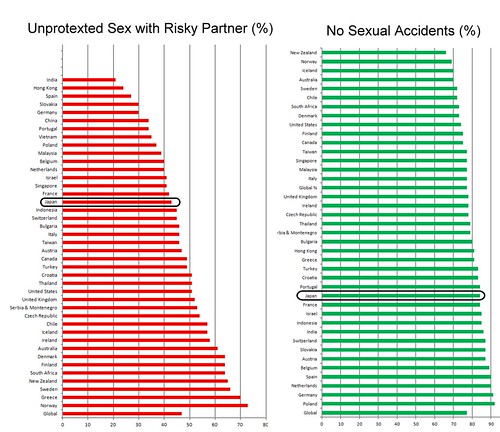
The Japanese rate themselves to be the most risk averse nation in the world with more than 70% of Japanese saying that they are NOT someone who enjoys taking risks (World Values Survey). I believe that the differences between Japan and other developed nations are qualitative rather than quantitative so there should be some area of Japanese behaviour in which they are shown to take risks. I think it unlikely that they would say that they enjoy taking risks since this would be similar to standing out in their linguistic self expressions - something that they have no interest in doing.
Eating blowfish and getting on roller coasters are both not very risky behaviours when compared to skydiving (the 5th most dangerous sport after BASE jumping, swimming, cycling and running).
Guzman and Pohlman (2014) highlight the following classes of risky behaviour among youth worldwide: "Self-Injurious Behaviours, Violence, and Suicide, Substance Use, Risky Sexual Behaviour, and Behaviours Related to Obesity and Unhealthy Dieting." Only suicide is clearly elevated in Japan but that is a special case of risky behaviour. I am not sure that self annihilation is actually "taking a risk," but may on the contrary be a way of avoiding risk, and heightening certainty. The only other risky behaviour on that list that might be high in Japan is risky sexual behaviour.
However, Japanese sexual behaviour does not appear to be all that risky. While no where near as risk averse as their self rating would appear to indicate, the Japanese are below the global average (47%) of percent of adults who have had unprotected sex with a person whose sexual history one is unaware at 42%. And the Japanese have better than the global average (77%) of persons who have never had a sexual accident, my term for unwanted pregnancy or sexually transmitted disease, at 84%. Both sets of data are from the Durex World Sex Survey (2005).
So where is Japanese risky behaviour?
Labels: cultural psychology, culture, japanese, japanese culture, nihonbunka, 日本文化
Blowfish (Fugu) is Safer than Skydiving: And Both are Very Safe
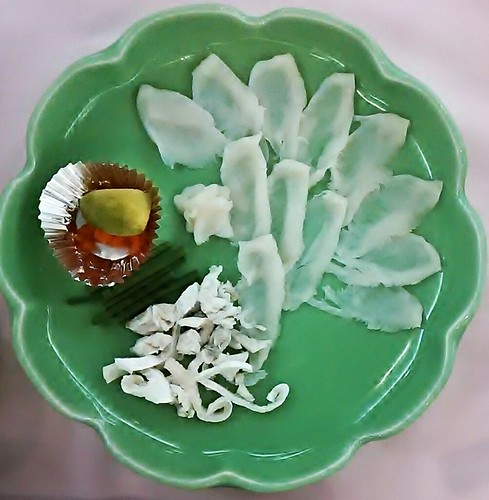
Further, the risk of deaths from eating fugu are even less than that of skydiving. The list below is from the Japanese wikipedia article on fugu, and claims to be comprehensive list of "main" deaths by fugu poisoning since 2000 (perhaps there were others that are not reported). Assuming that there have been 90 million servings a year for the past 14.5 years, or nearly 1300 million servings but only 13 deaths that makes the risk of dying from fugu poisoning to be about one in 100 million. So to compare the death rates, the risk of dying from skydiving according to one estimate is 25/3,000,000 per sky dive. Divided by 1/100,000,000 (my estimation) for the risk of dying as a result of eating a serving of fugu and, I think that we can cross off the millions, so that is 25/3 divided by 1/100. Or about 800. And the wikipedia article also notes that in the ten years from 1995 to 2005 31 people died of fugu poisoning in Japan in similar situations. That is about twice the rate of the 2000s, or 400 times less dangerous than skydiving.
And just as in estimation of the dangers of skydiving where we found that it was experienced, risk-taking skydivers that were dying, similarly, with fugu eating it is those taking risks (preparing, usually self-caught the fish without a licence, and eating the most dangerous parts, the liver or other innards), and not those eating it at fugu restaurants, who are dying.
So skydiving is about 400 to 800 times more dangerous than eating a serving of fugu, but both are very safe activities unless you really try your luck. Indeed, both activities are probably at least in part, enjoyable precisely because one appears to be (but one is not in fact) trying ones luck. This makes skydiving and eating blowfish similar to getting on a roller coaster ride, for thrills.
The Japanese rate themselves as being the most risk averse nation in the world and may only enjoy simulated risks.
From フグ - Wikipedia
April 2001 Tokyo, Person in 60s prepared sashimi from fugu self-caught
May 2002 Kagawa Prefecture, two persons in their 50s boiled self caught fugu
November 2002 Person in 60s ate poison containing fugu liver
November 2003 Person in 70s ate dried fugu received from a friend.
May 2005 Nagasaki Prefecture Person in 70s made miso soup from self-caught fugu.
September 2005 Aichi Prefecture ate poison containing fugu liver
March 2006 Miyazaki Prefecture. Person in 60s cooked fugu themselves
January 2007 Nagasaki Prefecture. Person in 60s made sashimi for themselves.
August 2007 Nagasaki Prefecture. person in their 40s made a stew of fugu innards containing poison.
December 2007 Hyougo Prefecture. Person in 50s prepared fugu that they had caught themselves.
January Aicii Prefecture. A sushi restaurant proprietor ate some fugu innards with a customer and died. The proprietor did not have a fugu preparation licence. Another person (presumably the customer) was hospitalized.
October 2014 Hyougo Prefecture. Person in their 50s took home the left overs from a colleague's fugu cooking practice and ate the liver and died.
Labels: culture, japanese, japanese culture, psychology, 日本文化
Monday, June 01, 2015
School Rules and the Wolf Cut

According many Japanese commentators such as Shiba Ryoutaro (1986) the rule of law, and laws themselves, are extremely important in the USA, in places where traditional praxes, ways of doing things may suffice in Japan. Indeed one of the ways in which Japan is now awash with Western culture is that it is being swamped with requirements to manualize everything. Wakamatsu (2007), a former Toyota line manager, argues that the recent glut of written materials (shiryou 資料) can kill efficiency with a lethal dose ([chi]shiryou)死量) of voluminous paper (shiryou 紙量). I think he is right. The recent lack of competitive efficiency of Japanese companies is I believe due to their sinking under mountains of shiryou with western sounding names (po-toforio, adomisshion porishi-, gurajue-shon porishi-), in an attempt to be as linguistically regulated as Western countries.
Despite the fact that the West, or at least the USA, is know as being the land of the "shiryou" Westerners at the same time like to draw attention to some of the places in which Japanese have traditionally been very strict, as in the above image, school student dress regulations. And these regulations certainly are very strict, attempting to define each measurement, each cloth colour, the types of hairstyle that are allowed. So why is it that in this particular area, the Japanese have voluminous regulations?
There are so many regulations on appearance because the Japanese desire to express themselves in their appearance so much, that regulations of this severity are required to prevent them from being outlandish (which somehow the Japanese are also claimed to be).
I do not mean to suggest that Japanese are any more or less collectivistic than Westerners. Elsewhere, however, always the focus is upon collectivism and individualism. The image above is from a paper entitled "The Nail That Came out all the Way," which suggests that Japanese outlandishness is individualistic aberration in the face of ruthless, 'militaristic', collectivism. Many people still hold this impression of Japan. Bearing in mind the way that individualism is valourised in the West, being thought a militantly collectivistic country is, needless to say not a positive impression.
The truth is that Japanese dress and dress codes are neither outlandishly individualistic nor collectivist to the point of being militaristic, but that the Japanese have a stronger desire to express themselves matri-visually, in their wombimagocentric culture. They care not a toss about daddy and his logos, but they want to look cool at least in large part for mummy, or at least originating in the pleasure of her simulated gaze.
The hairstyle shown above bottom (from Google image search) is called a "wolf cut" which is spiky at the front, with along wolf's mane hanging behind, is certainly pretty noticeable. No wolf cuts is one of the items of the above dress code. That Japanese schools wish to ban wolf-cuts does need to surprise. That British school do not have an explicit ban on the "wolf cut" is more to do with the lack of self-expression in the area, that liberal nature of British school dress codes. Correspondingly there are few hate speech laws, or other curbs on linguistic expression, since, for the most part, the Japanese do not desire to be radical in their speech, but they do have some wild haircuts.
Image top from Thorsten Morimoto, 1996, p206, originally from Sakamoto, 1986.
Image bottom from Google image search "ウルフカット"
Thorsten Morimoto, M. (1996). The Nail That Came Out All the Way. In W. Dissanayake (Ed.), Narratives of agency: Self-making in China, India, and Japan. U of Minnesota Press.
坂本秀夫. (1986). 「校則」の研究―だれのための生徒心得か. 東京: 三一書房.
司馬遼太郎. (1986). アメリカ素描. 読売新聞社.
若松義人. (2007). トヨタの上司は現場で何を伝えているのか. Tōkyō: PHP研究所.
Labels: blogger, culture, Flickr, japanese, nihonbunka, 日本文化
Friday, May 29, 2015
Sazae Tames the Lion

The lion, naked, prostrate and clearly lacking a womb, is scared. Sazae can tame anything and has tamed a sealion too, left. Like most Japanese women most of the time, Sazae appears to be on stage. She alone is fully aware of an audience. The lion is, like the Western wife perhaps, aware of the audience only through Sazae. The young chap with the ball, Katsuo I presume, is as yet oblivious. The audience constrains Sazae as it empowers her. In Japan phallogocentrism is replaced by wombimagocentrism*. When the audience watches, the women are in control, as they are controlled. Give up on the "different voice" (Gilligan, 1962) and get wombimagocentric now.
長谷川町子美術館の著作権です。おちりさげご希望でありましたら、下記のコメント欄かnihonbunka.comのメールリンクまでご連絡ください。
Gilligan, C. (1982). In a different voice. Harvard University Press.
Notes
* I think that this can be pronounced a bit like the Wombles, wom-bi-mago-centrism.
Addenda
What is it about logocentricism that is phallic?
Lacan mentions that mothers are often primary caregivers whereas males are fathers by virtue of their symbolic (linguistic) position in society, and often because of their work. In some societies the brothers are those which work to support sisters and their children and are treated much like fathers to those that they support.
In patriarchal societies, patriarchs may hope that their work, their significant acts, their money is rewarded on an exchange basis, with "presence" and "affection." The "philosophy of presence", where signifier are co-present with meaning in the "car-loving" mind, may be enacted in logocentric bedroom.
Logocentrists place themselves into the imagined dialogue between their parents.
"Car-loving" is one of Derrida's puns on "auto-affection", or onanism.
Labels: autoscopy, culture, feminism, japan, japanese, manga, Nacalian, occularcentrism, self, sex, specular, 日本文化
Thursday, May 28, 2015
Japanese and Western Expressions: The Japanese Fundamental Attribution Error, The Western Honne and Tatemae
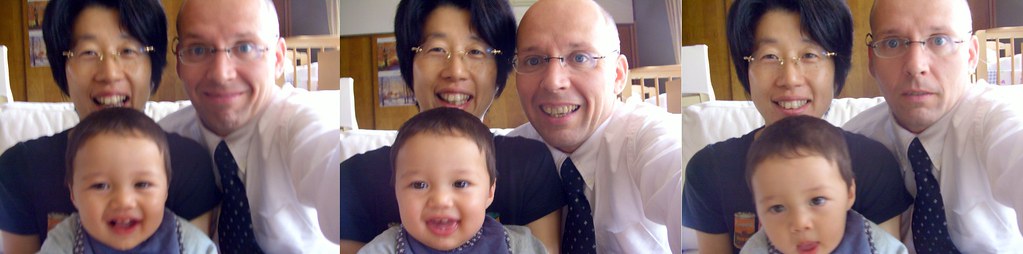
There have been several studies on Japanese and American facial expressions. Perhaps the most famous is that of David Matsumoto (see Gudykunst & Nishida, 1994) that found that Japanese were worse at recognising the four negative 'universal' expressions (fear, anger, disgust, sadness) not because these emotional expressions are not universal, but because negative emotions are repressed in Japanese culture where there is a greater stress upon harmony. This interpretation is plausible, but I remain rather unconvinced.
In this post I concentrate, however, on self-consistency in expression of emotions, but first a recap on linguistic self-expression. Westerners, or at least North Americans are almost always positive about themselves, irrespective of social situation (Kanagawa, Cross, & Markus, 2001) and even when what they are expressing is negative. Negative traits are "spun" to be positive ones.
Further, even though Americans "spin" or "enhance" their verbal expressions so that everything is positive, Americans nonetheless believe that the words of others represent their true feelings, even when they are told that the person they are listening to is reading a text that has been given to them whereas Japanese do not (Miyamoto & Kitayama, 2002).
The tendency for Westeners to believe in the consistency of verbal expressions and true feeling or self is called "The Fundamental Attribution Bias." In Japan it is however well-known and assumed that people say one thing in social situations (tatemae) whereas they mean another (honne).
I argue that this situation is reversed, or Nacalianly transformed, in Japan when one considers Japanese facial expressions.
The first phenomenon is equivocal.
Gundykunst and Nishida found that when Japanese and Americans were shown a negative film in the supposed absence of an observer (but in fact the subjects were videoed watching the film) both Americans and Japanese showed negative emotions. However, the Japanese, but not the Americans, affected positive facial expressions when describing the movie to an experimenter. This might be construed to suggest that the Japanese are less consistent in their facial expressions, but I suggest that the Japanese would attempt to affect the same smile whether they were describing a negative film or a horrible one, irrespective of who they are talking to.
It is clear at least that the Japanese have "spun" or "enahnced" their expression to make it positive when in some sense the reality was not.
Secondly when asked to rate emotion and expression of others, Gudykunst and Nishida (1994) found that Americans rated other's emotions and facial expressions differently, whereas Japanese rated emotions and facial expressions as being the same. The Japanese appeared to believe that faces expressed only true emotions.
This result is what I would call the Japanese Fundamental Attribution Bias, and the Western version of "honne and tatemae." In respect of the latter, "The face is no index to the heart," says an English proverb, "A fair face my hide a foul heart" says an American one, and the face - being potentiallly and often "two faced" - is the sine qua non of inconsistency.
These phenomena expose the same paradox: despite the fact that both Americans and Japanese "spin" their self-expressions in a positive direction in language and facial-expressions respectively, both Americans and Japanese believe in the consistency and truth of the modality that they are spinning or enhancing, and do not believe in the veridacy of the one that they are not.
This paradox is due to the modality or theatre (Weber, 2004) that matters. Americans are chronically exposed to the ear of the 'generalised other' (Mead, 1967), whereas Japanese to the 'eye of the world' (seken). In each of these theatres each attempts to appease and express their meaning, being, their selves to a hidden, intra-psychic other.
As mentioned in a previous post, Westerners claim that they are talking to only themselves, and Japanese that they are expressing themselves only to other people, but these explanations fall apart since Americans could be verbally honest if only to themselves, and Japanese would know that that they are facially dishonest to others.
The nature of self as being for Other makes us all bullshit and yet, believe it.
The image shows my wife, son and myself from some years ago and was chosen because the Westerner, and partial Westerner, are showing less consistency in their facial expressions.
Addenda
I am very stupid but disgusting and in a position to realise it. Japanese culture will teach even the most stupid and disgusting of people the truth.
Bibliography
Gudykunst, W. B., & Nishida, T. (1994). Bridging Japanese/North American differences (Vol. 1). Sage.
Kanagawa, C., Cross, S. E., & Markus, H. R. (2001). ‘Who am I?’ The cultural psychology of the conceptual self. Personality and Social Psychology Bulletin, 27(1), 90–103.
Mead, G. H. (1967). Mind, self, and society: From the standpoint of a social behaviorist (Vol. 1). The University of Chicago Press.
Miyamoto, Y., & Kitayama, S. (2002). Cultural variation in correspondence bias: The critical role of attitude diagnosticity of socially constrained behavior. Journal of Personality and Social Psychology, 83(5), 1239.
Weber, S. (2004). Theatricality as Medium. Fordham Univ Press. (as yet un-read, but I dig the term and I am a major fan)
Labels: blogger, culture, Flickr, japanese, nihonbunka, 日本文化
Wednesday, May 27, 2015
Comparative Morality and The Horrible Helper
In the USA when a child found some money (admittedly not inside a wallet) he was lauded for giving it to someone else.
Handing the money into lost property did not seem to cross anyone's mind in the USA.
Western commentators since the Edo period have marvelled at Japanese honesty with regard to personal possessions and the absence of theft. They also marvelled at the sexual mores (nakedness and the prevalence of prostitution), and speech crime (e.g. flattery, deceit, and creative accounting). That said I believe the Japanese to be the most moral nation on earth.
"The Lost Letter Technique" made famous by Milligram et. al. (1965) found that 70% of personally address letters but only 25 of Nazi/Communist party addressed "lost letters" were returned. Earlier research by Merritt and Fowler (1948: see Liggett, Blair, & Kennison, 2010) found that 85% of letters, but only 54% of letters presumed to contain money were returned.
And yes, there is comparative Lost Letter Technique research. West (2003) dropped phones and wallets containing cash in Tokyo and New York and the results were T 95% vs NY 77% for phones and T 85% vs NY30% for cash. That makes Tokyoites about three times more honest when it comes to returning wallets. Near Tokyo rates of return were obtained outside a Japanese supermarket in New York, so this is not something geographical. The Japanese are extremely honest when it comes to personal property.
In Japan stealing is almost absent, but creative accounting and linguistic obfuscation is reported to be prevalent. In the historical record numerous commentators report the low level of stealing (Bird, 1880; Cocks & Thompson, 2010; Coleridge, 1872; Golovnin, Rīkord, & Shishkov, 1824) and the strict way in which it is dealt with. At the same time, visitors have noted that linguistic misdemeanour's such as flattery, deceit, and "the squeeze" (taking a kickback of up to 100% to 200% of cost: see Bird 1880).
I claim, as always, that the amazing way in which the Japanese do not steal things but are at the same time able to "squeeze" double or triple the expenses from their employer relates to the nature of the Other (and horror) in Japanese culture.
Westerners have a horrible other that listens. This encourages us to be fairly honest, if very self-serving, in our self-narrative. Our narratives are self-enhancing but are constrained by the need for them to be palatable to another imagined human being. On the other hand, we feel no one is watching, so how we look, however, is far less fraught, ego-involved. We can get very fat, or even justify theft as redistribution of wealth (Robin Hood), since "property is [or can be argued, narrated to be] theft." We are good at promises and institutions of linguistic trust (such as insurance, and financial products) since we want to be heard to be, narrated to be, good.
The Japanese, on the other hand, have an Other (that is almost as horrifying) that looks, concealed not in the head but amongst the crowd. This encourages them to be fairly upstanding, if very self-serving, in their posture (sekentei). Their self-imaginings are self-enhancing but are constrained by the need for them to be palatable to another imagined human being. So the Japanese abhor crimes and misdemeanour's that can be seen, such as theft and physical violence. When it comes to linguistic malfeasance such as "the squeeze" or kick-back however, this can be seen as just a way of doing business involving no visual injury. The Japanese are good at creating things (monozukiri) since they want to be seen, imagined to be, good.
This modal -- language vs vision -- difference highlights one aspect of the origin of the myths of individualism and collectivism. It is not in fact the case that the Japanese are any more or less individualistic or collectivist, nor Westerners likewise. Both Japanese and Westerners care to an extent about real others and care more about their horrible intra psychic familiars, but in each case the horror of the familiar must be hidden.
It is only because our familiars, our imaginary friends, are horrible that they can remain hidden and continue to be familiar. Identity is a contradiction that depends upon horror, or sin, on a split that must be felt to be, but not be cognised as being. Identity or self is impossible (nothing can see or say itself) but the dream of its possibility is maintained by desire for, and abhorrence -- and resultant obfuscation -- of the duality required.
In the Western case the necessary, horrible imaginary friend is hidden *inside* the person as an interlocutor that, as inside the person, can only therefore be denied by being claimed to be part of, and one with the self. Eve, that gross "knowing" helper we have, is hidden by virtue of being thought of as just another me (see Levinas vs Derrida and "altrui"). She disappears because, as Adam Smith says, we are just splitting ourselves into two of ourselves. If there is just me and me, then there appears to be nothing disgusting going on. Westerners think, "I think to myself."
But if on the other hand the Other is external, as is required by any visual (self) cognition, there is little way of claiming that the Other is me. Spatial dualism, or rather distance, eye and surface, as required by visual cognition, becomes apparent, and undeniable. So the Japanese claim that all they are doing is being collectivist. The Japanese horrible Other is just another person, one of many other people. The Japanese hide the horror, their familiar, their imaginary friend, in the crowd.
Individualism and collectivism are myths by which means we hide Eve/Amaterasu, a part of our souls, our "helpmeets"or "paraclete" (John's term for Jesus).
In a similar way to paradox of Japanese morality in which Japanese will not steal your wallet even if you leave it on a table at a restaurant and walk out, but may (or did) charge a kickback doubling or tripling the price, the British will be utterly polite, honest and even humorous as they sell you narcotics and destroy your country, as we did to China for 150 years. Some estimate that the enforced import of opium into China resulted in the deaths of 100 million Chinese, but at least one British academic makes jokes about it .
Paraphrasing Isaiah, those that worship the logos have a tendency to smear over their eyes so that they cannot see, and those that worship idols have a tendency to smear over their hearts so they cannot comprehend.
Bibliography (all available online)
Bird, I. L. (1880). Unbeaten Tracks in Japan: An Account of Travels in the Interior Including Visits to the Aborigines of Yezo and the Shrines of Nikkô and Isé. J. Murray.
Cocks, R., & Thompson, E. M. (2010). Diary of Richard Cocks, Cape-Merchant in the English Factory in Japan, 1615–1622: With Correspondence. Cambridge: Cambridge University Press.
Coleridge, H. J. (1872). The life and letters of St. Francis Xavier : in two volumes. Asian Educational Services.
Golovnin, V. M., Rīkord, P. Ī., & Shishkov, A. S. (1824). Memoirs of a Captivity in Japan, During the Years 1811, 1812, and 1813: With Observations on the Country and the People. H. Colburn and Company.
Liggett, L., Blair, C., & Kennison, S. (2010). Measuring gender differences in attitudes using the lost-letter technique. Journal of Scientific Psychology, 16–24. Retrieved from http://www.psyencelab.com/images/Measuring_Gender_Differences_in_Attitudes_Using_the_Lost-Letter_Technique.pdf
Milgram, S., Mann, L., & Harter, S. (n.d.). The lost-letter technique: A tool of social research. Retrieved from http://www.communicationcache.com/uploads/1/0/8/8/10887248/the_lost-letter_technique-_a_tool_of_social_research.pdf
West, M. D. (2003). Losers: recovering lost property in Japan and the United States. Law & Society Review, 37(2), 369–424. Retrieved from http://onlinelibrary.wiley.com/doi/10.1111/1540-5893.3702007/full
Labels: autoscopy, collectivism, individualism, japanese, japanese culture, Nacalian, nihonbunka, reversal, sex, 日本文化
Tuesday, May 26, 2015
Self in Words and Pictures: TPT vs TST
Labels: autoscopy, blogger, culture, Flickr, japanese, nihonbunka, 日本文化
Make Up Makes Japanese Feel Good

If you identify with your face as the centre of your persona (Watsuji, 2011), point at it to indicate yourself (Leuers & Sonoda, 1998), then it is not surprising that make up has a very positive effect upon how you are feeling. Moritsuchi et al. (2006) separated female subjects into two groups one of which were given a full make over
by a professional make-up artist, the other who where asked to wait. The latter group showed little change except in a decrease in liveness and increased tiredness. The former group became less stress, less depressed, less angry (less animosity), more lively, less tired, and less confused. It is not surprising that Japan women spend the most per head on cosmetics.
That this spending data has an inverse correlation with well-being says less about how happy Japanese women are, than how those that identify with their self-narrative, rather than their faces, are inclined to think positively, and prevaricate about their level of happiness.
Indeed, in the same experiment (Moritsuchi et al., 2006), the make-up condition start in a state of more negative affect, and overall (bottom graph) while those that wore make up had significantly increased psychological well-being, whereas the control group remained the same, at the same time the made up group reported themselves as less happy than the un-made up group. Bearing in mind how make-up improved their state of mind, this difference is likely to be due to the way in which focus upon improving appearance may make people less inclined to "self-enhance" -- speak bs.
Conversely, pride, or linguistic self-esteem, takes people away from the light as is suggested by the strong correlation between self-esteem (self-bs) and calorie intake and obesity.
Image from page 114-115 in (Moritsuchi et al., 2006)
Morichi, Hirose, Tanaka, and Hisayo 森地恵理子, 広瀬統, 中田悟, & 久世淳子. (2006). メイクアップの心理的効果と生体防御機能に及ぼす影響. 日本福祉大学情報社会科学論集, 9, 111–116. Retrieved from research.n-fukushi.ac.jp/ps/research/usr/db/pdfs/00074-00...
Leuers = Takémoto, T. R. S., & Sonoda, N. (1998, October). 心像的自己に関する比較文化的研究(1) Cross Cultural Research on the Specular Self. Oral Presentation口頭発表 presented at the The 62th Annual Convention of the Japanese Psychologiocal Association English日本心理学第64回大会, Tokyo Gakugei Daigaku. Retrieved from http://nihonbunka.com/docs/shinzoutekijiko1.doc
Watsuji, T. (2011). Mask and Persona. Japan Studies Review, 15, 147–155. Retrieved from asian.fiu.edu/projects-and-grants/japan-studies-review/jo...
Labels: autoscopy, blogger, culture, Flickr, japanese, nihonbunka, 日本文化
Make Up Raises the Tone of Japanese Women's Voice

Yogo et. al. (1990) found that as women's make-up improved from no make, normal make up to make up provided by a make-up artist, their confidence and satisfaction increased, and their anxiety decreased. This is very much to be expected in a visual soul-as-mirror rather than soul-as-narrative country like Japan. Better make-up and other visual self-presentation in Japan corresponds to better self reports among Westerners and is likely to result in improved confidence and effect.
At the same time however, the pitch of their voice increased. Or because a high pitched voice is an indicator of positive effect like laughter or a smile? Or conversely is this because they were aware that a high pitched voice is desired by others - as suggested by the high pitched voice in which shop assistants and telephone operators are required to speak - and their increased confidence and positive affect allowed them to use that other-wise unpalatable falsetto? Finally, since it is found that Japanese use tone of voice in contradistinction to linguistic content does their higher pitched voice represent a greater emphasis on tone and a further de-emphasising of self-narrative? In any event higher tone of voice, together with thicker make up probably represent a greater identification with female gender stereotypes, which are generally viewed more positively, rather than negatively, in Japan. The Japanese are members of womankind.
Yogo 余語真夫, 浜治世, 津田兼六, 鈴木ゆかり, & 互恵子. (1990). 女性の精神的健康に与える化粧の効用. 健康心理学研究, 3, 28-32.
Labels: autoscopy, blogger, culture, Flickr, japanese, nihonbunka, 日本文化
Westerners Lack Visual Self Consistency: Clothing and Location

Kanagawa, Cross and Markus (2001) found that linguistic self expression depends upon social context for Japanese, but remained unchanging in the case of Americans who were equally self-enhancing whether they talked to groups, authority figures, peers, or described themselves to themselves on their own.
I have also noted that Asians may be inclined to maintain consistency in their visual self representation such as in the case of Asians who always pose in the same way, whatever the social context.
Bull and Gibson-Robinson (1981) found that the appropriate way to express oneself visually, via ones clothes, in the UK depended upon the social situation. Smartly dressed suited persons (line A) obtained more charitable donations when they visited terrace houses (place A or B), but more informal clothes (line B) obtained higher donations when asking at high rises blocks (place C) of flats. Visual self consistency is inappropriate in the UK as verbal self-consistency is inappropriate in Japan. I predict however that in Japan one formal suited kind of attire would be appropriate in all situations and obtain the most charitable donations.
Bull, R., & Gibson-Robinson, E. (1981). The influences of eye-gaze, style of dress, and locality on the amounts of money donated to a charity. Human Relations, 34(10), 895-905.
Kanagawa, C., Cross, S. E., & Markus, H. R. (2001). ‘Who am I?’ The cultural psychology of the conceptual self. Personality and Social Psychology Bulletin, 27(1), 90–103.
Labels: blogger, culture, Flickr, japanese, nihonbunka, 日本文化
Internal External Fashion
Quoting Yamabe(1993: See Hashimoto and Kashio), Yashimoto and Kashio note that dressing up or primping (oshare) has generally been studied from the perspective of outward appearance, but is in fact also an expression of identity. Hashimoto and Kashio (2003) went on to develop an internal and external dressing up questionnaire and found that the internal aspect of dressing up for oneself is more important than the extrinsic motivation to dress up for others overall, especially in older Japanese.
This is hardly surprising given that the Japanese are especially capable of and chronically inclined to autoscopy through the use of simulated intra-psychic other. Since the Japanese dress up for themselves, for a simulated self-directed gaze rather than real gaze, they pay more attention to underwear. Real others can not see underwear, but a simulated gaze can see inside things, as the Japanese are found to be able to do.
Strangely however, attention to underwear is an item on the both the internal and external motivation to dress up questionnaire, where wearing underwear that does not affect ones outer wear correlates with intrinsically motivated primping but paying attention to the visual design (デザイン) of ones underwear correlates with extrinsically motivated primping.
This implies, rather surprisingly to me, that Japanese wear visually designed underwear, that is popular in Japan, to show to others.
I have translated Hashimoto and Kashio's (2003) questionnaire as the Intrinsics and Extrinsic Primping Questionnaire which is available for download here, or in Japanese at their links below.
取り下げご希望でありましたら、下記のコメント欄かnihonbunka.comのメールリンクからご連絡ください。
橋本幸子 ・柏尾眞津子;日 本社会心理学会第
44会 大会発表論文集,(2003) Retrieved 2015/5/26 www.epjournal.net/wp-content/uploads/EP1208780887.pdf
尾田貴子, 橋本幸子, 柏尾眞津子, & 土肥伊都子. (2003). おしゃれの二面性に関する研究-被服・化粧行動, 心理的健康との関連. 繊維製品消費科学会誌, 44(11), 700-709. Retrieved 2015/5/26 from www.bunken.org/jssp/conf_archive/paper_download.php?s=200...
山辺知行,日本のおしゃれ(1993),日本経済新聞社.
Labels: autoscopy, blogger, culture, Flickr, japanese, nihonbunka, 日本文化
Tuesday, May 19, 2015
殺生石

Labels: blogger, culture, Flickr, japanese, nihonbunka, tourism, 日本文化
Doctor Willis on the Arrogance of the British

[Ernest Mason} "Satow's friend Dr. Willis, was critical of the arrogance of his fellow countrymen towards the Japanese.
A small foreign official will abuse a Japanese officer of equal rank with our Under-Secretary of State in a manner that, if it were countryman, he would be the laws the country either have to kill him, or kill himself. We bully and beat the lower orders, and respect in no way the higher classes. A great deal of this is common to all foreigners, but we especially sow the seeds of discord and dislike. The Japanese better classes grow quite alarmed t our customs, they fear they will lose all hold on their poorer countrymen, and though some Japanese may like you individually they hate your country. To the proud Japanese it must be painful to see the air of superiority the commonest foreigner assumes in his presence, and I have great doubt whether Brown or Japanese or Robertson would not go full gallop through a procession with the Tycoon at one end ad the Mikado at the other if sad experience [Namamugi Incident] had not proved the danger of such an experiment. We may disguise it as we like, we are a set of tyrants from the moment we set foot on Eastern soil and we cannot help it, it is I fear inherent in the nature of things, the less civilized man must suffer in the ratio of his ignorance by intercourse with his more intelligent brothers. "(Cortazzi, 2013, p.61)
I am not entirely sure to whom in the last clause the good doctor refers to. I hope, and believe, he is suggesting that the British were ignorant and uncivilised compared to the Japanese and "suffered" in the sense of being tyrants, insufferable.
Cortazzi, H. (2013). Victorians in Japan: In and around the Treaty Ports. A&C Black.
Labels: blogger, culture, Flickr, japanese, nihonbunka, 日本文化
Big Ben: Japanese boasting and sex

Linguistic self-enhancement has generally been considered to be rather disgusting in Japan, or at least something that the Japanese have avoided. In my experience, and in historical accounts of Western impressions of Japan, boastfulness is almost completely, and notably, absent.
One of the few accounts of Japanese boastfulness is that of a highly Westernised scholar of things Western (rangakusha). After several months in captivity in Japan, the Russian spy Vasiliĭ Mikhaĭlovich Golovin remarked in 1811 that the Japanese geometrician and astronomer, Mamia Rinso (Mamiya Rinzo) "manifested his pride, however, by constant boasting of the deeds he had performed, and the labours he had endured." (Golovin, 1824, p284) but further that, "I must here remark, that this was the first Japanese ventured, in our presence, to swagger and assume // importance on account of his military skill, and his vapouring made not only us but even his own countrymen sometimes laugh at him. " (Golovin, 1824, pp. 285-286). In other words, the only Japanese person to boast, in Golovin's experience, was one who had been influenced by Western culture.
I have found two other records of instances of boastfulness in Japan in the pre-twentieth century historical record and both of them relate to sex.
"One old couple, who kept one of these shops, we were on intimate terms with; that is to say, we seldom passed without a few words to them. One day, seeing the old woman by herself, we asked her wherever husband was, and were told that she supposed 'he was after the girls', after which she laughed, as if delighted at the idea of having such a gay old dog for a spouse...
The next time we visited the shop, we rallied the old fellow on being such a gay Lothario; be he did not seem as proud of the reputation as his wife was, and indignantly declared the aspersion cast on him to be totally without foundation. We were half inclined to believe him, and even now think that the old woman's statement may have only been a vainglorious boast"(Cortazzi, 2013,, p67)
Edward de Fonblanque writes, in 1860, of another rare instance Japanese boastfulness, which is also sexual.
"Nor were business wants alone consulted, for the Government had considerately provide a magnificent building, all lacquer and caving and delicate painting, in which the Tojin [Foreigner] might pass their leisure hours in the company of painted musume [literally daughter, but the meaning her is girl], dressed in gorgeous robes, and coifées in the most wonderful manner.
I visited the Gankiro, taking the precaution to go there in broad day, and for my character's sake, in good company, and was a little startled at the systematic way in which the authorities conduct this establishment. Two officers showed us over the building, and pointed out its beauties which as much pride as if they were exhibiting an ancient temple sacred to their dearest gods. This was the court-yard; that was to be a fish-pond with fountains (the building was still incomplete at this time); in this room refreshments might be procured -that was the theatre; those little nooks into which you entered by a slide panel in the wall were dormitories, encumbered with no unnecessary furniture, there, affixed to the walls, was the tariff of charges, which I leave to the imagination; and in that house, across the court, seated in rows on the verandah, were the moosmes themselves. We were invited to step over for its was only under male escort that they might enter the main building? My curiosity had, however, been sufficiently gratified and I departed, quite ready to believe in anything that might hear as to the morals of the Japanese. (Cortazzi, 2013, p274.)
The Japanese are perhaps similarly reserved towards boastfulness and sexuality. Japanese humour, unlike that of the British, rarely revolves around innuendo. But in my experience (and research on the latter), both sexuality and boastfulness do appear when the Japanese have been drinking.
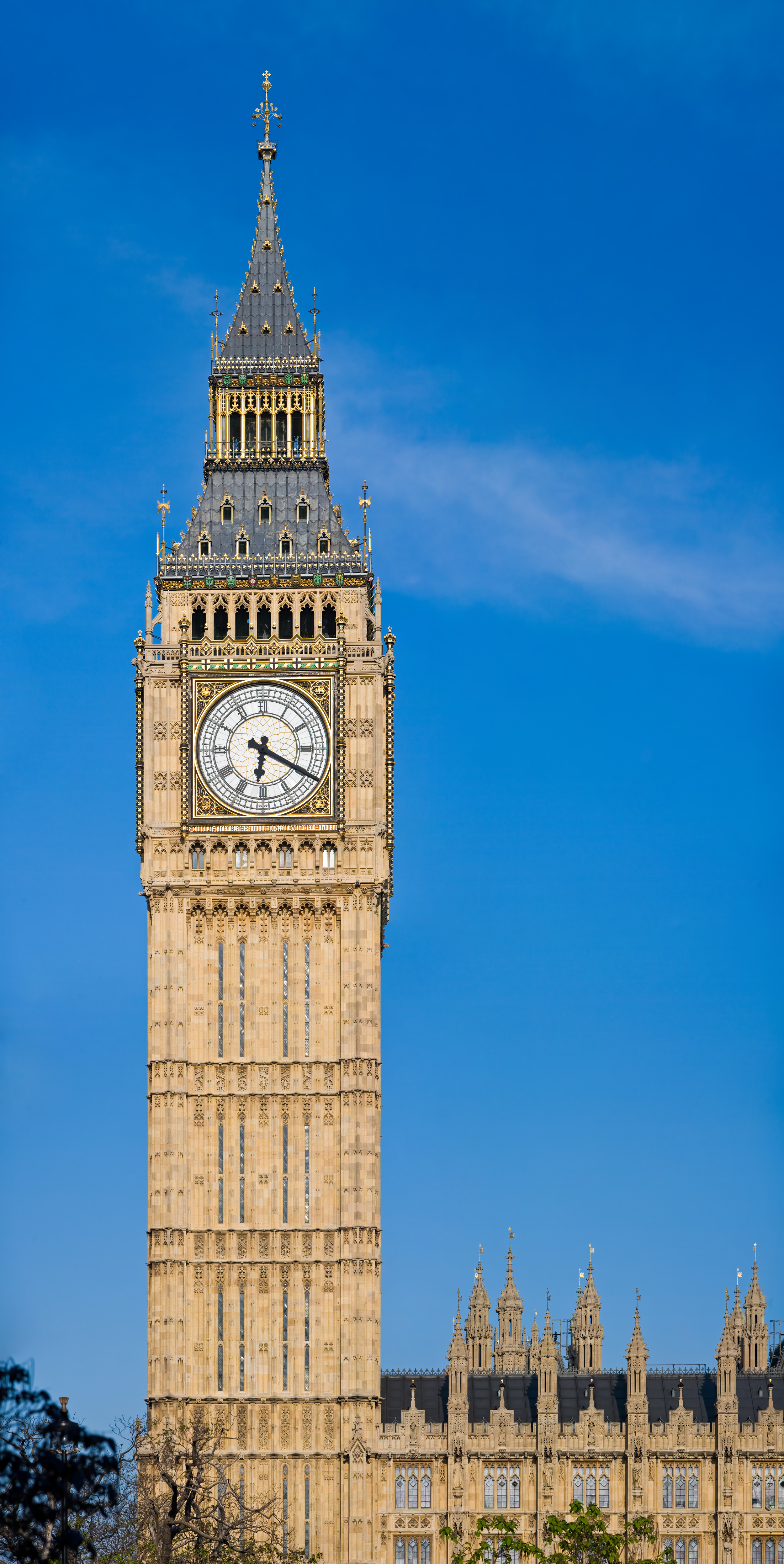
For example when attending a party with some Japanese sports persons, I found myself invited to drink at a table of similarly inebriated Japanese. It was late in the day, we had all had a few glasses of sake. One gentleman asked mischievously "So you are English? (omitting the subject and particles) England has Big Ben doesn't it? / You have a big ben don't you?" (イギリス人ですか。*ビッグ・ベン*はありますよね?). I think my host repeat "big ben", nodding in a conspiratorial way for emphasis. This was a very rare case of innuendo and inviting the opportunity to boast, once again on a sexual topic, which from a Japanese perspective may regarded, with some disdain - but at times enjoyment - to be of similar ilk.
Is there any inherent connection between linguistic self-enhancement and sex? Or on the contrary between visual self-enhancement and the storge appreciation of cuteness? Some theoreticians of language, its origins and merits suggest that it may have something do with peacocking. Derrida argues that linguistic thought, as self addressed love letter, is like onanism. One of the characteristics of linguistic as opposed to visual self-enhancement is that it takes places inside rather than outside the head. While linguistic self love becomes silent, ashamed, and interior (see Vigotsky on self-speech and the way it becomes hidden) visual self-love always presupposes an exterior, viewer. Does the interiority of self-serving interior dialogue, knowing oneself via ones self-narrative, imply or promote a sexual "autoaffection"? I tend to think so.
I think I told my hosts that I had not seen Big Ben. Lame!
Image of Big Ben from Wikimedia
Cortazzi, H. (2013). Victorians in Japan: In and around the Treaty Ports. A&C Black.
Golovnin, V. M., Rīkord, P. Ī., & Shishkov, A. S. (1824). Memoirs of a Captivity in Japan, During the Years 1811, 1812, and 1813: With Observations on the Country and the People. H. Colburn and Company.
Labels: japanese, japanese culture, logos, occularcentrism, sex, 日本文化, 自己視
Richard Cocks (1566–1624)

Labels: blogger, culture, Flickr, japanese, nihonbunka, 日本文化
Summer and Winter Costume

Labels: blogger, culture, Flickr, japanese, nihonbunka, 日本文化
Wednesday, May 13, 2015
Intimacy and Individuation

Labels: blogger, culture, Flickr, japanese, nihonbunka, 日本文化
Wednesday, April 29, 2015
Climaticity Quote
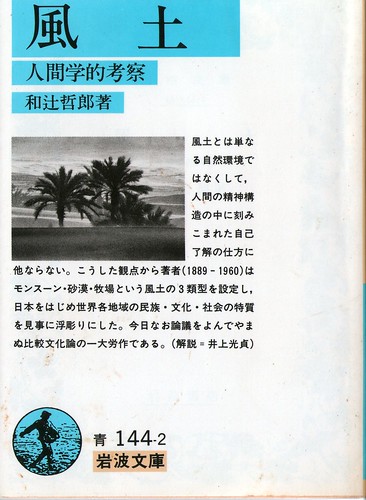
From the preface to Tetsuro Watsuji "Climaticity" (Fudo) by 自分が風土性の問題を考え始めたのは、1927年の初夏、ベルリンにおいてハイディがーの『有と時間』を読んだ時である。人の存在の構造を時間性として把握として活かされたときに、なぜ同時に空間性が同じく根源的な存在構造として、活かされて来ないのか、それが自分には問題であった。もちろんハイデッガーにおいても空間性が全然顔を出さないのではない。人の存在における具体的な空間への注意からして、ドイツ浪漫派の「行ける自然」が新しく蘇生させられるかに見えている。しかしそれは時間性の強い照明のなかでほどんど影をを失い去った。そこに自分はハイデッガーの仕組みの限界を見たのである。空間性に即せざる時間性はいまだ真に時間性ではない。ハイデッガーがそこに留ったのは彼のDaseinがあくまでも個人に過ぎなかったからである。彼は人間存在をただ人の存在として捉えた。それは人間存在の個人的・社会なる2重構造から見れば単に抽象的ななる一面に過ぎぬ。そこで人間存在がその具体的なる二重性において把握せられるとき、時間性は空間性と相即して来るのである。ハイデッガーにおいて充分具体的に現れて来ない歴史性もかくして初めてその深層を露呈する、とともに、その歴史性が風土性と相即するものであることも明らかとなるのである。 I started thinking about environmenticity/climaticity (fudo) in the early summer of 1947 when I read Heidegger's "Being and Time." It seemed problematic to me that when time was used to grasp the structure of human existence, spatiality was not used as a fundamental structure of existence as well. Of course it is not as if spatiality does not show its face at all. It seems to me that attention to "livable nature" is resurfacing in the form of German romanticism. However, under in the strong light of attention to temporality, it seems a pale attention to nature indeed. That is where I saw the limits of the Heideggerian thesis. Any temporality belonging to spatiality is not a real temporality. The reason why Heidegger stopped at this juncture is because his Dasein is no more that the individual. He perceived human existence to be the existence of the person. But that is no more than simply the symbolic half of the social personal nature of the individual. Thus when human existence is understood in its concrete duality, temporality will be seen to be equivalent to spatiality. Further, not only will the historicity that receives short shrift in Heidigger become apparent, this historicity will be comprehended to be equivalent to climaticity. Heidegger seems to have taken Descartes' "I think therefore I am" as starting point. Descartes argued that "res extensa", the spatial, this world that we see, can be doubted; it is a realm of fleeting uncertainty. But the thought, in language, that emerges from that morass of extended images exists. It is. Heidegger asked of the nature of this emergent existent and concluded afaik, the "meaning of being is time". Western, narrative entities, subsequently abstractions or fictions, are made of and in time. Watsuji argued that there is another side to humans - not only their self speech - and that rather, the time of the narrative is merely the historicity or movement of nature: everything can be subsumed to space in motion. He did not feel trapped at all. http://flic.kr/p/sndSfg
Labels: blogger, Flickr, japaneseculture, nihonbunka