
Monday, February 29, 2016
62 Translations of Okonomi Yaki
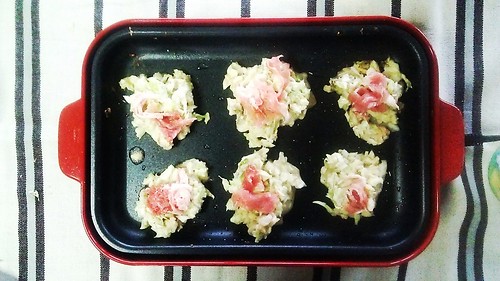
Fritters as you like them. Fritters to taste. Free fritters. Fritters freed. Japanese pan fried pizza. Savory pancakes. DIY fry-up. Griddled Goo. Individualistic johnnycakes. Selfish savories. Preference, predilection, prepossession, propensity, personalised or pet pancakes or paste. Pet preparation. Wished or whimsy waffles. What you will waffles. (Free)Will waffles. Flavour Flapjacks. Groove griddle cakes. Number one gunge, My cup of tea cakes. Croquette my way. Darling, dearest, desired, or druthers doughboys or dumplings. Liberty cakes. The cook is on holiday cakes. Be my batter cakes. Beloved batter cakes, Coagulated stir fry. Callous cutlets. Choice cabbage cakes. Liking or Love lump cakes. Main mush. Choice Concoction. My mix. Pan fried partiality. Pan-fried perfection. Caprice cakes. Hobby hotplate. Free-style fries. Fried fantasy. Freedom fries. My fry. Favourite fries. Hashed heaven. Hashed happiness.
My students always 'translate' the name for Japanese foods such as that pictured above (お好み焼き) using their phonetization, "okonomi yaki," which might just as well be kowwash firdight for all the meaning it would impart to the average anglophone. This is I think because people hate meaninglessness (Heine, Proulx, & Vohs, 2006) so if at least one word in Japanese is included in any sentence the sender knows that at least that one word will be meaningful in a Japanese context, and that their conversation partner will have some idea of what they are talking about. The reasons for this is anatta or no self. The self is just a representation (story or image): something with a meaning. The lack of meaning is self-annihilation, and English conversation practice almost deadly. I need to be nicer to my students, investigate Japanese hospice praxis, while insisting that students use non-phonetic translations.
Heine, S. J., Proulx, T., & Vohs, K. D. (2006). The meaning maintenance model: On the coherence of social motivations. Personality and Social Psychology Review, 10(2), 88-110.
www.google.co.jp/url?sa=t&rct=j&q=&esrc=s&...
Addendum Good Paper on Japanese hospice praxis emphasises the use of image-based measure (PAC analysis) rather than scales. Recommends, in addition to palliative care and listen: smiles and improved personal hygiene and health on the part of the carer. I try to always attend conversation class wearing a business shirt and tie.
對馬明美, Tsushima, A., 三上佳澄, Mikami, K., 西沢義子, & Nishizawa, Y. (2010). 死を意識している患者との対話場面における看護者の態度構造に関する研究. 日本看護研究学会雑誌, 33(5), 33-44. http://www.jsnr.jp/test/search/docs/103305003.pdf
内藤哲雄1997/2002PAC 分析実施法入門[改訂版]「個」を科学する新技法への招待ナカニシヤ出版 amazon link a student gave a presentation about this. I thought it came from outside of Japan.
内藤哲雄. (1997). PAC 分析の適用範囲と実施法. 信州大学人文学部人文科学論集< 人間情報学科編>, 31, 51-87.
https://soar-ir.repo.nii.ac.jp/index.php?action=pages_view_main&active_action=repository_action_common_download&item_id=707&item_no=1&attribute_id=65&file_no=1&page_id=13&block_id=45
Labels: els, english, englishconversation, nacalianism, nihobunka, self, 日本文化


Tuesday, December 22, 2015
English Classroom of Light: Ameterasu and Eikawa
The Japanese have a mirror in their hearts that loves them.
I have started applying my theory of Japanese culture, which I call Nacalianism - Lacanianism backwards - in my English conversation classes. I argue that the Japanese move from the symbolic stage to the mirror stage and remain there (or would, were it not for the efforts of Japan's leaders to Westernise Japan).
This means that when forced to speak English, they feel as bad as Westerners do when they are forced to sit in front of mirrors. The experience of focusing upon their speech creates in them an "objective self awareness" similar to that created in a Westerner in front of a mirror. Since the Japanese do not enhance in the linguistic modality, nor Westerners in the visual, they find it unpleasant.
In order to make English class more pleasant therefore it helps, I believe to increase Japanese students' visual self awareness still further such that they are so visually aware of themselves that they do not become depressed by their objectification in English conversation. This has in the past been achieved in at least two ways.
Before the famous English conversation school, Nova, was forced into bankruptcy I noticed that one of the features of Nova classrooms was that they had glass walls. There was a Nova classroom in Kyoto station where passengers could see students taking English conversation classes at Nova. At other Nova establishments in less public places the students in one class could see students in others. This sense of seeing and being seen increased, I believe, their visual self awareness such as overcome the negative affect of verbal objective self awareness in the land without a verbal Other.
Another thing that I have noticed in those rare Japanese that speak English well is their tendency to move their hands a lot. This may be simply in emulation of foreigners and to get into the spirit or culture of the English language but often these gestures appear rather different to those of English speakers, and more like the speaker is conducting himself. I think perhaps that this self-conduction encourages Japanese English speakers to visualize themselves and again, combat the negative affect of verbal objective self awareness.
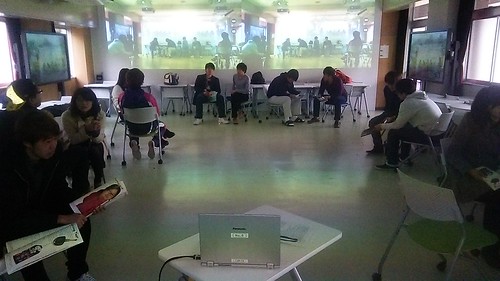
In my class today I failed to encourage students to conduct themselves, and could not take them to a glass walled classroom but I did set up a web camera so as to display a view of the students on the walls of the class. I found that this improved the overall atmosphere of the class and the students ability to speak English.
Video of the same class
Labels: blogger, els, englishconversation, Flickr, japaneseculture, nihonbunka, 日本文化, 英会話
This blog represents the opinions of the author, Timothy Takemoto, and not the opinions of his employer.