
Monday, June 06, 2016
Masked Rider's Icon: Eye-soul

The latest masked rider symbolic transformation item from the 2016 series Masked Rider Ghost (仮面ライダーゴースト) is called an "icon" using the characters for eye and soul (目魂). That the transformation item is some sort of symbol is common to all the transformation items of super sentai (power rangers), ultraman, masked riders, Mirrorman, Mito Kōmon, real members of totemistic tribes such as the Aranda, as well as the symbol collecting Japanese Shinto practitioners. The Japanese traditionally believed they received their soul vectored by a symbol received from shines in the form of shinpu, ofuda,or omamori amulet. Mirrorman, the closest to the Shinto tradition, would transform to his super form thanks to a shrine amulet, while standing in front of a mirror.
That these iconic amulets vector something supernatural from the country of light (Ultraman) is also clear. With this particular symbolic transformation item it is becoming increasing clear that these icons vector an "eye" or perspective such that their wearer or consumer may be transformed into the heroic suit or mask, representing visual appearance. One could only identify with a visual appearance by also internalising another. In the case of masked rider Ghost, these others are heroes such as Isaac Newton, Miyamoto Musashi, and the protagonist's father. Internalising the icon of the father allows the protagonists to internalise the father's eye. The "icon" as "eye soul" pun is Tsuburaya genius.
Another commonality shared by many transformatory symbols, such as Masked Rider Orz Medals, Masked Rider Ghost's Icons, and the Tjurunga or "bull roarers" of the Aranda (I made one) is that they are symbols that make a noise, as if reading themselves. If there were ever a visual symbol that could read itself it would 'prove' that the symbol is not merely formal (arbitrary) but an ontological part of a real world, and perhaps that there is of necessity a third person viewer to read it. Intrinsic icons that combine sound and vision, introduce that gap or distance into the world required for self sight. Icons that can read themselves do indeed therefore contain (or would if such things existed) "eye souls," the eye of the soul, that allow those possessed to transform into the seen.
These symbolic catalysts have the same, but 'Nacalianly transformed,' function as the Lacanian mirror image which is or appears to be a image that sees itself. The Lacanian mirror image, Superman's suit and indeed our own faces, is something that misguides or conceals our whispered identity, but it is also the condition for linguistic self-hood. The catalyst or condition for the linguistic world is that two things are the same. That is the importance of Jackson's red, all the images that Western pilgrims go to see, or the wafer in mass. They prove identity. The catalyst or condition for the visual world is that there is something that is two things, a symbol that reads itself, that can intrinsically be read. The Japanese need to prove an intrinsic distance. Westerners need to prove an intrinsic identity.
Both world views are magical but which is best? Keeping ones symbols on the outside, on ones forehead, or in ones watch or belt, is imho a lot more healthy.
Labels: Bandai, japanese culture, Jaques Lacan, kamenrider, Masked Riders, religion, self, Shinto, Super-Sentai, superhero, スパー戦隊, 日本文化


Tuesday, May 17, 2016
Images of Japanese People

As reported in the Softbank Group's online news paper (ITmedia, 2012), the Japanese advertising and public relations company, Dentsu asked 3772 non-Japanese in 16 regions what they thought of the Japanese.
ソフトバンのオンライン新聞(ITmedia, 2012)電通が16地域の3772人の外国人に日本人に対して持たれているイメージを調査しました。
The results given above show that words associated with the Japanese are predominantly positive despite the fact, it seems to me, the Japanese pay little attention to public relations. Positive associations, such as "creative" were strongest in South East Asian countries, where, I presume, there is especially high consumption of Japanese produced media, such as popular music and manga. Despite the fact that these positive images I rather fear that the Japanese are going to throw all this love away.
上の図に示されている結果では、日本はそれほどPRに注意を払っていないのに、主に肯定的な言葉が思い浮かばれた。「想像的」など肯定的なイメージは、JPOPや漫画など日本のマスメディアが消費されている東南アジアでもっとも高い。こんなに肯定的なイメージがもたれているのに、日本人がこのような日本に対する愛を台無しにするという恐れがあります。
I would like to rate "meek" as positive but I have kept to the positive / negative ratings in the original article. Several of the items, such as "kodawari no aru" which I have translated as "discriminating," were rather difficult to translate. "Solidarity" is short for "have a sense or solidarity" which may be coextensive with words with a negative connotation in the West, such as "conformist" or "a herd." I wonder at how the items were selected and fear perhaps they were selected by the Japanese.
「おとなしい」を肯定的な項目として分類したいですが、元々の記事にあった肯否判断を尊重しました。"discriminating"と英訳してみた「こどなわりのある」などの項目は英訳しにくかった。項目選びはどのように行われていたかはわからず、日本人が選んだ恐れがあると思われます。「連帯間のある」は(Have a sense of)"Solidarity"と英訳してみましたが、「右へ倣え」「群れている」など少なくとも欧米では否定的なイメージのある言葉と重複するとも考えられる。
The Japanese are very interested in what people from other countries think about them since it seems to me, and as argued by Mori (1995), the Japanese lack a linguistic Other and so find it difficult to narrate themselves objectively. The Japanese have instead an autoscopic, mirror-mind, so they know what they look like and that Japan is beautiful.
日本人は一般的に海外でどのように思われているかについての関心が高い。それは森(1995)が論じるように、日本人は言語的な《他者》をもっておらず、自分らを客観的に物語ることが難しいからだと思われる。日本人は反省・自己視的な、鏡としての心をもっているので、自分らがどのように見えるかは日本が美しいということはご存知だと思います。
The original Dentsu News Release can be downloaded from the Dentsu website in pdf form here (in Japanese). The translations are mine.
元々の電通の調査はここからPDFファイルとしてダウンロードできます. 筆者訳.
お取り下げ後希望でありましたら、コメント欄・nihonbunka.comのメールリンクまでご連絡いただければ幸いです。
Mori, 森, 有正. (1999). 森有正エッセー集成〈5〉. 筑摩書房.
Labels: blogger, Flickr, japaneseculture, nihonbunka, 日本文化
Tuesday, May 10, 2016
Mirrors Make Westerners Want to Kill Themselves
According to the central theory of this blog, the "comforter" of the self in Japan and the West observes the self in a different media. In either case the comforter is based upon the mother. Before we become aware of our mirror image or our names we identify our subjectivity with that of our mother and later learn to see (Japanese) or hear (Westerners) ourselves as an object of her subjectivity or in her frame of reference. In Japanese, more matriarchal society the mother looks and the self is seen. In the West the mother is more passive, she listens. Self expression in the dominant medium of self expression is enjoyable and enhanced, and self expression in the non dominant medium is in each case fraught. Japanese enjoy taking pictures of themselves, posing, and "making (visual corporeal) things". Westerners love expressing themselves, shooting their mouth off, and (as I am doing now) making up theories.
本部論の主たる理論によれば、日本や欧米における自己の慰安者は異なる媒体において自己を傍観している。いずれの場合でも慰安者は母に由来する。自分を物語り、鏡の中で確認できる前に自らの主観を母と同感同一視し、後に母の主観・母の間のなかで自分らを見て(日本)、あるいは聞く(欧米)。より母性原理の強い日本においては母は観る、自己は観られる。欧米での母はより受動的で聞くものとされる(Freud)。主たる優位にある媒体における自己表現は快楽的ですが、それぞれの文化の劣位にある媒体における自己表現は居心地悪い。日本人は自撮りやポーズをとることが好きで、(視覚的な)物づくりを得意とする。欧米人は言語的自己表現や偉そうに話すことも、理論を作ることがすきです。
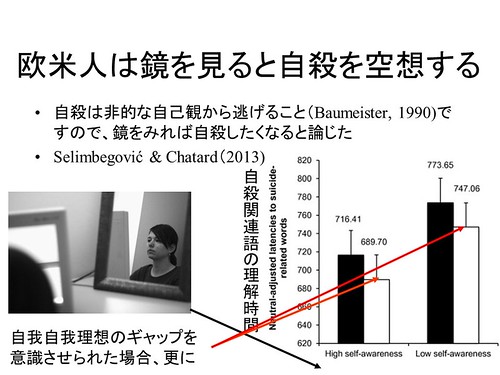
Japanese have a problem with linguistic self expression and Westerners have a problem with mirrors. Baumeister (1990) theorised that mirrors would increase the desire to escape from self in the most drastic way: suicide. Selimbegović & Chatard(2013) demonstrated this greater tendency towards suicide by testing the amount of time before subjects were able to recognise suicide related words (suicide, rope, wrist, hang, and attempt from nonsense words) in front of a mirror and in a control condition. It was found that subjects became quicker at recognising these words in front of the mirror and that this effect increased when the subjects were encouraged to think about how far they were from their own ideals.
一方、日本人は言語的自己表現が億劫で、欧米人は鏡が嫌い。Baumeister(1990)は鏡を見る欧米人は、「自己から逃げる」最も極端な手法である自殺に走らせると論じた。Selimbegović & Chatard(2013)は、自殺関連語(自殺・紐・手首・[首]吊り・未遂)をナンセンス語から見分けるまでの時間欧米の被験者において鏡の前で早くなるということで、自殺願望への傾向向上を示した。自我と自我理想のギャップを石示唆せられた被験者において鏡の効果がさらにつよくなりました。
In Japan mirrors are used on train platforms to prevent suicide. In the West telephones are used in same way but, as Butler (Butler, Lee, & Gross, 2009) demonstrates, linguistic expression tends to make Japanese MORE stressed.
日本では駅のホームでは鏡は自殺予防に一約を担っていますが、アメリカの自殺名所では電話が設置されます。Butler (Butler, Lee, & Gross, 2009) が示すように、日本が言語的表現をさせられると逆にストレスが増えます。
The recent use of telephones at Japanese suicide spots and Abe's initiative to make all 100 million Japanese verbalise their objectives and become "active" like Westerners (!) is from this perspective, a very bad idea. 日本の自殺名所での電話の設置や、日本人が自分らの行動を言語化し活躍する一億人総括という安倍首相の政策は、上述の立場から考えれば、名案だとは言えないと思われます。
www.flickr.com/photos/nihonbunka/11959516956
Bibliography
Baumeister, R. F. (1990). Suicide as escape from self. Psychological review, 97(1), 90.
Butler, E. A., Lee, T. L., & Gross, J. J. (2009). Does expressing your emotions raise or lower your blood pressure? The answer depends on cultural context. Journal of Cross-Cultural Psychology, 40(3), 510-517.
Selimbegović, L., & Chatard, A. (2013). The mirror effect: Self-awareness alone increases suicide thought accessibility. Consciousness and cognition, 22(3), 756-764.
Labels: japanese culture, nihonbunka, 日本文化
Saturday, May 07, 2016
Fun Ramen Restaurant
Labels: blogger, Flickr, japaneseculture, nihonbunka
Tuesday, April 26, 2016
Two Reasons For Gattai
Labels: blogger, Flickr, japaneseculture, nihonbunka, sentai, superhero, 日本文化
Thursday, April 21, 2016
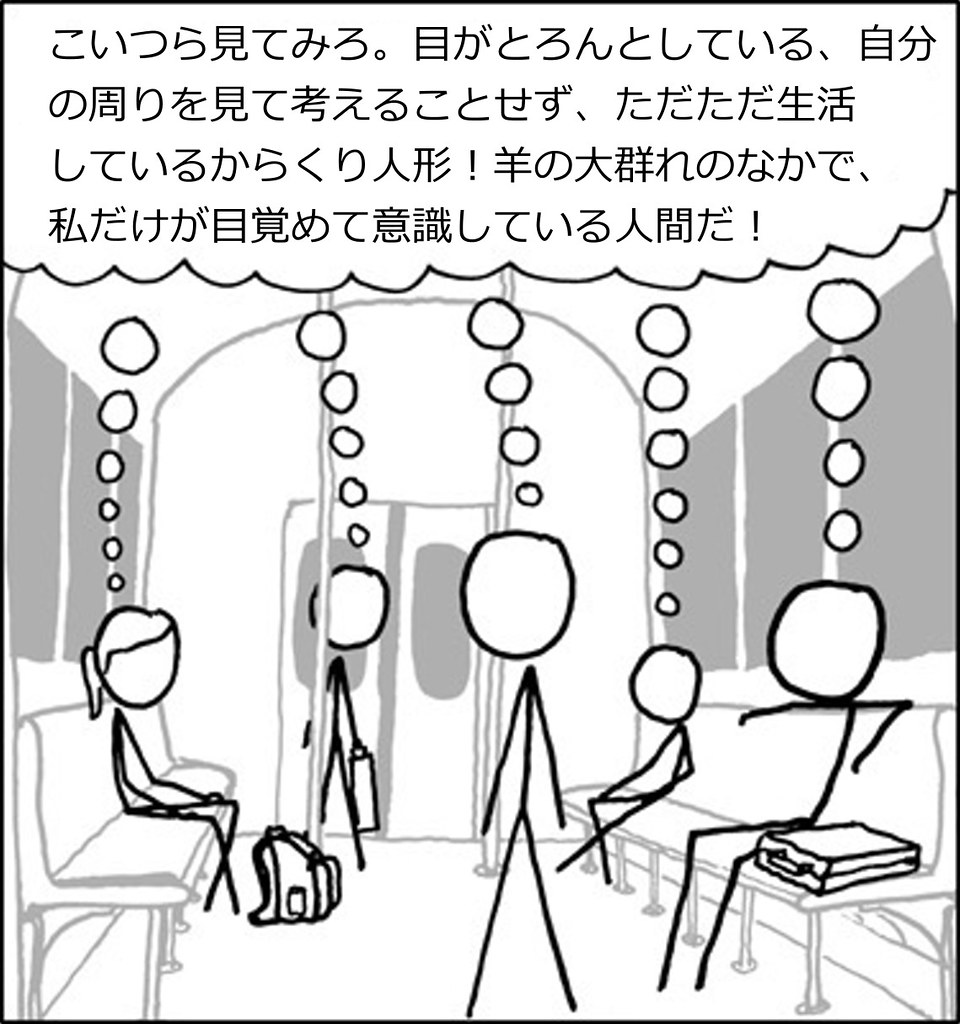
Japanese Translation of Sheeple
Labels: blogger, culturalpsychology, Flickr, japaneseculture, nihonbunka
Tuesday, April 19, 2016
Spring Night's Dream
Labels: blogger, Flickr, japaneseculture, nihonbunka, 日本文化
Wednesday, April 13, 2016
Will Jim be Helpful?
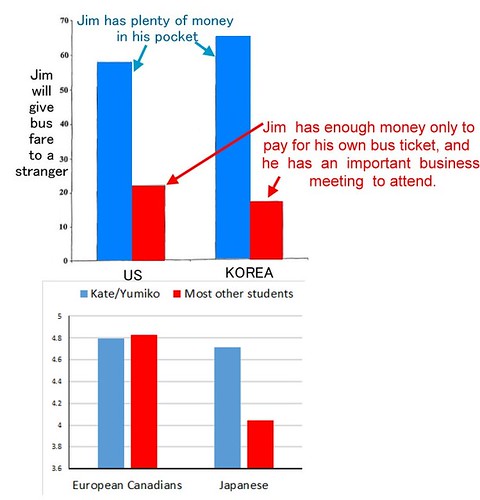
Choi, Nisbett, and Norenzayan (1999) that when Americans and Korean's were asked whether an individual, "Jim", would help a stranger in the situation where Jim either has plenty of money in his pocket, or where Jim has money only enough for his own fare and an important meeting to go to, the Koreans were found to be more influenced by the situation as in the above graph (based upon Choi, Nisbett, & Norenzayan, 1999, fig. 1. p. 52). It is argued that Asians are more contextual basing their decisions, and predictions of other's decisions, upon the context of the action rather than the character of the individual.
The experimental evidence is persuasive, and it fits in with stereotypes of East Asian "collectivists", lacking gumption, blown by the winds of societal, and contextual pressure.
At the same time, there is something wrong with this picture. Firstly I find that Koreans and Japanese are notably helpful, and non violent, to strangers across situations rather than showing behavioural swings, the helpful to mean, as shown in the graph above.
I suspect that there is another reason why the Koreans are being more "context" sensitive and that is that they are given no information about Jim other than his name. If the Koreans were given an equal amount of information regarding Jim, such as "Jim is a suited 25 year old business man working for a provincial bank", say, then the they would have been no more swayed by the context than the Americans because they, like the Japanese, base their decisions upon what they can imagine, animating the visio-imaginable rather than the phoneme "Jim".
In support of this hypothesis in other research it was found that when given a little more information ‘‘Kate (Yumiko in Japanese) age 20, is a student at your university," (Hamamura, Heine, & Takemoto, 2007, p.250) was given to Japanese and Canadian students, it was the Japanese and not the Canadians that gave a more outlier - further from "most other students" - appraisal of ‘Kat/Yumiko's personality (graph above bottom, based on Hamamura, Heine, & Takemoto, table 1). This difference was significant (p<.001). This is because, I believe, in this experiment the subjects were not just given a name, but also some information upon which to imagine the person that they were appraising.
The Japanese mind does not make decisions in words (Kim, 2002), but upon the surface of its mirror (Timothy Roland Scott Leuers = Takemoto & Sonoda, 1998, 2000; T.R.S. Leuers = Takemoto & Sonoda, 1999; T. Leuers = Takemoto & Sonoda, 1999; Takemoto, T., 2002, 2003; T. Takemoto, n.d.; Timothy Takemoto, 2011a, 2011b, 2012a, 2012b, 2014).
Choi, I., Nisbett, R. E., & Norenzayan, A. (1999). Causal attribution across cultures: Variation and universality. Psychological Bulletin, 125(1), 47. Retrieved from citeseerx.ist.psu.edu/viewdoc/download?doi=10.1.1.316.410...
Hamamura, T., Heine, S. J., & Takemoto, T. R. (2007). Why the better-than-average effect is a worse-than-average measure of self-enhancement: An investigation of conflicting findings from studies of East Asian self-evaluations. Motivation and Emotion, 31(4), 247–259. Retrieved from link.springer.com/article/10.1007/s11031-007-9072-y
Heine, S. J., Takemoto, T., Moskalenko, S., Lasaleta, J., & Henrich, J. (2008). Mirrors in the head: Cultural variation in objective self-awareness. Personality and Social Psychology Bulletin, 34(7), 879–887. Retrieved from www2.psych.ubc.ca/~heine/docs/2008Mirrors.pdf
Kim, H. S. (2002). We talk, therefore we think? A cultural analysis of the effect of talking on thinking. Journal of Personality and Social Psychology, 83(4), 828. Retrieved from labs.psych.ucsb.edu/kim/heejung/kim_2002.pdf
Leuers = Takemoto, T. R. S., & Sonoda, N. (1998, October). 心像的自己に関する比較文化的研究(1) Cross Cultural Research on the Specular Self. Oral Presentation口頭発表 presented at the The 62th Annual Convention of the Japanese Psychologiocal Association English日本心理学第64回大会, Tokyo Gakugei Daigaku. Retrieved from nihonbunka.com/docs/shinzoutekijiko1.doc
Leuers = Takemoto, T. R. S., & Sonoda, N. (1999). Independent self bias. Progress in Asian Social Psychology, 3, 87–104. Retrieved from httyp://www.nihonbunka.com/docs/independent_self.rtf
Leuers = Takemoto, T. R. S., & Sonoda, N. (2000, November). 心像的自己に関する比較文化的研究(6) -メディア(言語とイメージ)の違いと日米比較― Cross Cultural Research on the Specular Self: Differences in Media (Language and Image) and comparison between Japan and America. Oral Presentation口頭発表 presented at the The 64th Annual Convention of the Japanese Psychologiocal Association English日本心理学第64回大会, Kyoto University. Retrieved from nihonbunka.com/docs/shinzoutekijiko6.docx
Leuers = Takemoto, T., & Sonoda, N. (1999). The eye of the other and the independent self of the Japanese. In Symposium presentation at the 3rd Conference of the Asian Association of Social Psychology, Taipei, Taiwan. Retrieved from nihonbunka.com/docs/aasp99.htm
Takemoto, T. (2002). 鏡の前の日本人. In 選書メチエ編集部, ニッポンは面白いか (講談社選書メチエ. 講談社.
Takemoto, T. (2003). 言語の文化心理学―心の中のことばと映像(The Cultural Psychology of Language: Language and Image in the Heart). In 武本, ティモシー & 古賀,範理, あなたと私のことばと文化―共生する私たち―. 五絃舎.
Tuesday, April 05, 2016
Doutaku and Doguu: Destroying the internal Other

Doutak bells are a quite mystery to me.
They are found dating from the Yayoi period when, I believe the previous, indigenous Japanese Joumon ("rope pattern") Japanese culture that had existed in Japan for millennia was invaded by horse mounted invaders from the continent. These bells were probably originally horse-bells, to allow horse mounted warriors to know where their horses are in the dark for instance. They started out being about the size of the bell that Ray is holding in the above photo, but were gradually made in larger and larger sizes.
My guess is that these larger and larger bells were in part to prove regal (or invader) hereditary, "My father or (great great..) grandfather was a horse mounted warrior." And with each passing generation the bells were made in larger sizes, perhaps.
The Japanese themselves have a tendency to believe that there was no "invasion" and that the Joumon people evolved into Yayoi people, and subsequently Kofun people, due to the arrival of "technology" from the continent rather than due to subjugation. The Japanese tend to believe, traditionally at least, imho, that their culture is continuous or contiguous from the year dot. And they may be right.
The genetic record however seems to point to a considerable differences (in height for instance) with at the same time much overlap, so at least there was interbreeding between an indigenous and arriving race. On the other hand, I suppose that genes might also be described as a "technology," and Japanese culture may have survived changes to the gene pool. I think it very likely.
I imagine Yayoi warriors arriving and breeding (no offence intended) with the indigenous Joumon people, and then later a second wave of invaders (related to the first) arriving in the Kofun (ancient burial mound) period. This two wave hypothesis is suggested by some (Korean) historical interpretations of Japanese mythology. After the latter wave vast tombs were created. The creation of vast tombs, all around Japan, makes me think that there was great stratification within society. I imagine that those that were related to the invaders rounded up and forced vast numbers of indigenous and mulatto stock Japanese and had them build tombs the size of the Egyptian pyramids for their new masters. But this is all my imagination. Korean and Western historians tend to present a sort of "Japan was invaded" type of history, whereas, as I say, the Japanese tend to portray their history as one of continuous evolution with changes in society being attributed to the arrival of new technologies such as for rice farming. I guess that the difference in historical outlook is one of degree. The Japanese are, and their culture is, great at maintaining continuity, of which a great deal remains. This post is about the possibility of continuity between doutaku (as held by my son Ray) and dogu (pictured above right).
Returning to the dotaku bells, they have peculiar characteristics. They appear to have been kept, while not in use, buried in the ground, being unearthed at specific occasions. One theory has it that they were buried in order to soak up and be replenished with the spirit of the earth. The bells often have pictorial inscriptions that may be rebuses, punning on that which they represent. They seem to have a lot of water related imagery and a preponderance of images of deer.
Ah yes, I remember now (I make the same observations over and over again): it seems to me that these doutaku bells may be the origin of the temple bells that are used to ring in the new year in Japan in the "joya no kane" (除夜の鐘) ritual, which are even more massive than the largest doutak. They look similar. They are likewise inscribed. These "joya no kane" bells are now associated with Buddhist ritual to purify the ringers of sins, of which there are said to be 108.
The "rope pattern", Joumon culture indigenous Japanese, who existed for millennia, seem to have created first person body view (McDermott, 1996) figurines or dogū (土偶) which have similarities with the Venus figurines found all over the palaeolithic world. These figurines in Japan were often destroyed. I wonder if they were destroyed (and perhaps buried) in an attempt to exorcise their owners from the mother that occupied their, and perhaps all our, minds.
If so then, by a vast leap of conjecture, it might be argued that the practice of making first person body view figurines and then breaking and burying them, may have evolved into the practice of making vast bells and ringing then (at first) burying them.
This conjecture parallels the hypothesis of Lacanian (and Freudian but less explicitly) psychology which has it that the self evolves by first being represented visually as a body view, then narrativally in phonemes.
In each stage the self is paired with an other-of-the-self that witnesses the self representation.
Lacanian psychology seems to lack reference to self-person body views. The visual or "mirror-stage" is purported to be one in which the the mirror self, or third person body image such as represented in mirrors, and the form of other children with whom infants identify, is seen from the perspective of real others and is therefore groupist, and interpersonal, rather than intra-psychic (in the mind).
It is only, according to Lacan and Mead, with the arrival of language that humans internalise an imaginary friend or Other or ear (of the Other). In Lacan and Mead, and Western philosophers in general, ears are argued to be internalisable but eyes are not. They claim that one can speak, whisper and eventually "think" in words to "oneself," or rather that hidden friend, a generalised other, super ego, super addressee. Eyes are always, interpersonal, groupist, social, out there in the world.
Till the discovery of mirror neurons, our paper on Mirrors in the Head, McDermott's first person, Nishida's Mephistopheles in 'active direct vision', and the lyrics of David Bowie ("Your Eyes" in Blackstar) it was not realised that people can create a watcher within their minds.
Western theorists seem to have missed out on autoscopic potential of the mirror neuron, or McDermottian possibility that eyes are just as internalisable.
Until recently I had thought that the "eye of the Other" was internalised in an abstract, ineffable way. Japanese pictorial art is often represented from the perspective of "an eye apart," typically looking down, from the sky such as one can experience when playing Mariokart, Final Fantasy or other third person view Japanese video games (Masuda, et al., in preparation).
At the same time however, it also seems possible to model an eye within the self in a more concrete way, as the the first person view of self, such as may be represented by dogū, and the first person view that we have of their own brow nose and limbs. When I look at myself in the mirror I can see the noses and brow of the person on this side of the mirror. I can hold out my hand and caresses the surface of the mirror. Narcissus is portrayed attempting to scoop up his image from the surface of water, using his this-side-of-the-mirror hands.
In a sense perhaps the phonic equivalent of the nose and brow is the voice. I can narrate myself and when I do, when I call myself names, such as "Tim" or "I," the in that situation, there is likewise a "this side of the mirror" in the voice that expresses these names. Mead, and Derrida, rightly point out that hearing oneself speak (s'entendre parler in Derrida) introduces a believable duality. But I think that Nishida is right to point out (at least I think he is pointing out) that a similarly believable, or en-actable (kouiteki) duality exists in seeing. Since we can see our brow, and our nose(s), and often our hands, we see ourselves see. We do not even need a mirror to do so.
So, aware of the fact that self always presupposes and entails a self loving drama (with [less than/not?] one actor and two personae), in an attempt to rid themselves of their self-loving sin, the Japanese may have moved from destroying images of the self-person view in the act of destroying and burying dogū figurines, to destroying the phoneme in the act of a DONNGG, of a doutaku or joya no kane bell.
One can hear the sound of a bell on the Japanese joya no kane wikipedia page and in this Youtube Video.
Bibliography
McDermott, L. R. (1996). Self-representation in Upper Paleolithic female figurines. Current Anthropology, 37(2), 227–275. websites.rcc.edu/herrera/files/2011/04/PREHISTORIC-Self-R...
I have also argued that Japanese attempted to destroy inner ears (converting them to external ones) by snapping their earrings. The more you love others the less you love yourself, and vice versa.
Labels: autoscopy, cultural psychology, image, japanese culture, Jaques Lacan, nihonbunka, psychology, religion, reversal, 宗教, 日本文化
Thursday, March 31, 2016
Photo Props Boom in Japan

Rather than being "phono logo phallo centric" (Derrida) the Japanese are not so much animist (as they claim) but "Video Ergo Sum" (Lenggenhager, et al. 2007). This is due to the fact that the other of the Japanese is a gaze rather than an ear (Derrida). The Japanese mind is a mirror and the centre of gravity of the self is the face or "mask" (Wasuji). For that reason the Japanese have a fascination with photography and especially trick photography since if something looks like it is, then in a sense, it is. He I am photographed with Ray and May surrounded by "Photo Props" which are pieces of paper to change ones appearance in photos and are currently booming in Japan. Before the arrival of "photo props" of course, Puri Kura (Print Clubs) provided portrait photography post processing.
Friday, March 11, 2016
Stamped on their Person
Why is it that we feel that each and every instance of a word has the same meaning, and can be copied perfectly authentically such as to make copies equivalent, and redundant? Answers to this question vary, but according to Derrida they all imply a "presence," either of some entity such as a metaphysical world of ideas (Plato, e.g. Theaetetus), meanings that are hard-wired in the brain (Pinker, 2007) , or because they refer to a shared physical world (Pierce, 1973). Others posit an ongoing inter-subjective presence, of God, the super-ego, super-addressee who understands words in the same way. At the middle ground between these two extremes is perhaps an awareness of usage: an abstraction from inter-subjective communication (Wittgenstein, 1973).
The Japanese may believe, as argued by Mori (1999), that words exist in the absence of any shared additional presence across iterations. Japanese words may lack both shared system and the perspective of a "third person" intra-psychic imaginary friend . Words are contextual and imbued with the subjectivity of the situation in which they were received. In this case copies of words are no longer redundant any more than are views of colours, flowers or sunsets. Words thus conceived are not authentically copyable, but need to be received.
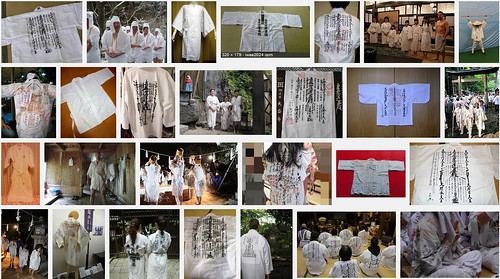
When on pilgrimage, Japanese have traditionally collected words from spatially separate sites. These words do not sink into a system, nor are consumed by any internal friend. They are collected by having them stamped into cards, or books that pilgrims hang around their necks, or as in the above image, onto the clothes that they wear upon their person.
I am again reminded of Revelation 22:4. "There will no longer be any curse..."
The above image is the Google image search page for pilgrim's clothes (gyoue)
Derrida, J. (2011). Voice and Phenomenon: Introduction to the Problem of the Sign in Husserl’s Phenomenology. Northwestern Univ Pr.
Mori, 森, 有正. (1999). 森有正エッセー集成〈5〉. 筑摩書房.
Peirce, C. S. (1894). What is a sign? Theorizing Communication: Readings across Traditions, 177. Retrieved from www.semioticadelprogetto.it/download/CSP%20-%20What%20is%...
Pinker, S. (2007). The language instinct: How the mind creates language. Harper Perennial Modern Classics.
Plato, 427? BCE-347? BCE. (1999). Theaetetus. (B. Jowett, Trans.). Retrieved from www.gutenberg.org/ebooks/1726
Wittgenstein, L. (1973). Philosophical Investigations (3rd ed.). Prentice Hall.
Labels: authenticopy, derrida, nihonbunka, 日本文化
Climbing Authenticopies
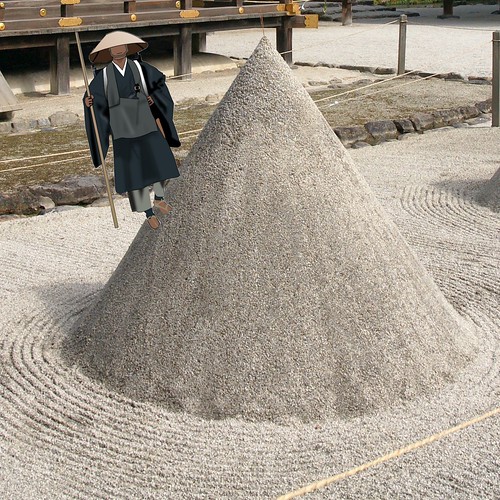
Edo period Japanese were fond of visiting Ise Shrine, other shrines and temples, and also famous mountains, none more so than Mount Fuji. However the purpose of visiting Mount Fuji was not to enjoy the view from the top, which as the saying goes is preferred only by stupid bigheads and smoke (baka ya kemuri ha takai tokoro ga suki). So instead of climbing the mountain, they more often chose to climb a model of the mountain, wearing full pilgrim's attire, at one of the shrines at the base of Mount Fuji (Ohwada, 2009, p. 40: quote in Japanese below).
There is no size information in the visual. A bonsai tree looks the same as a massive oak, and a model of Mount Fuji can look the same as the real thing. If you wear the right kit and walk up a model, then you might as well have walked up the actual mountain, because they will look the same way. In he land of the sun-goddess the authenti-copies or simulacra (Baudrillard, 1995) are not words, which Westerners feel to be perfectly copyable because we have a listening comforter, but visual replications such as of mountains in front of Shinto shrines.
Japanese culture is rife with authenticopies such as bonsai, model food in place of menus, dolls, horse and cow sculptures at shrines, masks, pictures of the deceased and his royal highness the emperor, and the god-head (goshintai) of the deities themselves that can be copied or split 'as one can split a fire' (Norinaga, see Herbert, 2010, p.99). The practice of visiting copies continues to this day in the form of creating foreign villages ("gaikoku mura") which fascinate foreign anthropologists and tourism theorists (Graburn, Ertl, & Tierney, 2010; J. Hendry, 2000; Joy Hendry, 2012; Nenzi, 2008). I don't think that they have noticed that the Japanese world is inside out yet, however.
If it were indeed the case, as argued here, that the Japanese world is that of light, an amalgam of images, seen and 'insured' by the watchful eye of the Sun goddess, then in order for someone to pass from Western to Japanese culture, from a Western to Japanese world, they would need to pass through the veil of perception. Perhaps all one really needs to do is find the dead girl that you are talking off to.
Perhaps that is what David Lynch (1992) meant by "Walk fire with me".
The above image is composed of a detail from the model mountains (though not of Mount Fuji) or standing sand (tatesuna) in Kamowake-Kazushi Shrine precinct by 663highland, and image of a monk in a straw hat from gatag copyright free image source.

富士山の場合は、富士山に実際に登山していわゆる富士山禅定(ぜんじょう・登る=修行)を行う者はむしろ砂苦、大多数はしないの富士山神社や諸社寺境内に設けられた箱庭式で模擬登山を行うのであった(大和田, 2009, p. 40)
Bibliography
Baudrillard, J. (1995). Simulcra and Simulation. (S. F. Glaser, Trans.). Univ of Michigan Pr.
Graburn, N., Ertl, J., & Tierney, R. K. (2010). Multiculturalism in the New Japan: Crossing the Boundaries Within. Berghahn Books.
Hendry, J. (2000). Foreign Country Theme Parks: A New Theme or an Old Japanese Pattern? Social Science Japan Journal, 3(2), 207–220. http://doi.org/10.1093/ssjj/3.2.207
Hendry, J. (2012). Understanding Japanese Society (4th ed.). Routledge.
Herbert, J. (2010). Shinto: At the Fountainhead of Japan. Taylor & Francis.
Lynch, D. (1992). Twin Peaks: Fire Walk with Me.
Nenzi, L. N. D. (2008). Excursions in identity: travel and the intersection of place, gender, and status in Edo Japan. University of Hawaii Press.
大和田守. (2009). こんなに面白い江戸の旅. (歴史の謎を探る会, Ed.). 東京: 河出書房新社.
Labels: authenticopy, japanese culture, Nacalian, nihobunka, Shinto, tourism, 日本文化
Monday, February 29, 2016
62 Translations of Okonomi Yaki
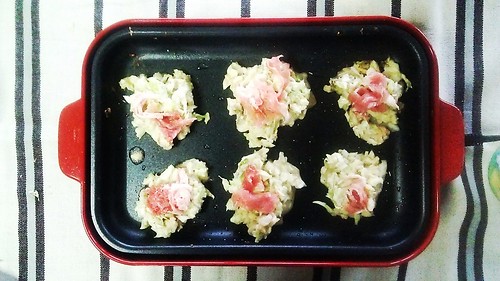
Fritters as you like them. Fritters to taste. Free fritters. Fritters freed. Japanese pan fried pizza. Savory pancakes. DIY fry-up. Griddled Goo. Individualistic johnnycakes. Selfish savories. Preference, predilection, prepossession, propensity, personalised or pet pancakes or paste. Pet preparation. Wished or whimsy waffles. What you will waffles. (Free)Will waffles. Flavour Flapjacks. Groove griddle cakes. Number one gunge, My cup of tea cakes. Croquette my way. Darling, dearest, desired, or druthers doughboys or dumplings. Liberty cakes. The cook is on holiday cakes. Be my batter cakes. Beloved batter cakes, Coagulated stir fry. Callous cutlets. Choice cabbage cakes. Liking or Love lump cakes. Main mush. Choice Concoction. My mix. Pan fried partiality. Pan-fried perfection. Caprice cakes. Hobby hotplate. Free-style fries. Fried fantasy. Freedom fries. My fry. Favourite fries. Hashed heaven. Hashed happiness.
My students always 'translate' the name for Japanese foods such as that pictured above (お好み焼き) using their phonetization, "okonomi yaki," which might just as well be kowwash firdight for all the meaning it would impart to the average anglophone. This is I think because people hate meaninglessness (Heine, Proulx, & Vohs, 2006) so if at least one word in Japanese is included in any sentence the sender knows that at least that one word will be meaningful in a Japanese context, and that their conversation partner will have some idea of what they are talking about. The reasons for this is anatta or no self. The self is just a representation (story or image): something with a meaning. The lack of meaning is self-annihilation, and English conversation practice almost deadly. I need to be nicer to my students, investigate Japanese hospice praxis, while insisting that students use non-phonetic translations.
Heine, S. J., Proulx, T., & Vohs, K. D. (2006). The meaning maintenance model: On the coherence of social motivations. Personality and Social Psychology Review, 10(2), 88-110.
www.google.co.jp/url?sa=t&rct=j&q=&esrc=s&...
Addendum Good Paper on Japanese hospice praxis emphasises the use of image-based measure (PAC analysis) rather than scales. Recommends, in addition to palliative care and listen: smiles and improved personal hygiene and health on the part of the carer. I try to always attend conversation class wearing a business shirt and tie.
對馬明美, Tsushima, A., 三上佳澄, Mikami, K., 西沢義子, & Nishizawa, Y. (2010). 死を意識している患者との対話場面における看護者の態度構造に関する研究. 日本看護研究学会雑誌, 33(5), 33-44. http://www.jsnr.jp/test/search/docs/103305003.pdf
内藤哲雄1997/2002PAC 分析実施法入門[改訂版]「個」を科学する新技法への招待ナカニシヤ出版 amazon link a student gave a presentation about this. I thought it came from outside of Japan.
内藤哲雄. (1997). PAC 分析の適用範囲と実施法. 信州大学人文学部人文科学論集< 人間情報学科編>, 31, 51-87.
https://soar-ir.repo.nii.ac.jp/index.php?action=pages_view_main&active_action=repository_action_common_download&item_id=707&item_no=1&attribute_id=65&file_no=1&page_id=13&block_id=45
Labels: els, english, englishconversation, nacalianism, nihobunka, self, 日本文化
Wednesday, February 24, 2016
Japanese Bragging: Self-Verification
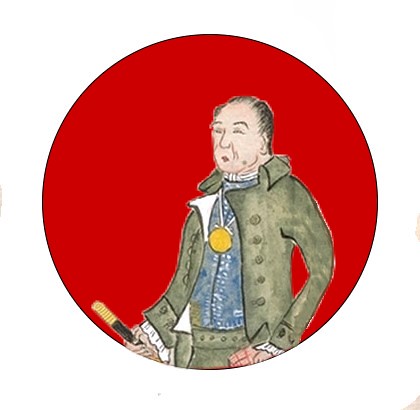
The Japanese very rarely brag (Heine, Lehman, Markus, & Kitayama, 1999), linguistically at least (Leuers = Takemoto & Sonoda, 1999). On the other hand the Japanese are "haughty" in their manner, posture and attire (Busk, 1841; Coleridge, 1872; Cortazzi, 2013; Golovnin & Shishkov, 1819; Krusenstern & Kruzenshtern, 1813). The Japanese eschew vocalising their superiority, which is left for others to do for them in flattery which, though void of linguistic meaning, as a form of obeisance is rife (Takemoto, in preparation).
Kōdayū (pictured above) spent 11 years in Russia as a castaway at a time when Japan was closed to the rest of the world. He returned full of "Western learning," and no doubt somewhat Westernised in manner, to obtain an audience with the shogun, the top man in Japan, about which Donald Keene writes,
"The shogun's questions were asked at random, and suggests that he was more interested in displaying his own knowledge of Russian than in learning new things from Kōdayū. The interrogation sometimes took the form: "There is a great clock in the castle tower of Moscow. Have you seen it?" Similar enquiries about the statue of Peter the Great and a famous Muscovian cannon were followed by, "Have you ever seen a camel?" (Keene, 1952, p.55)
The Japanese are not perfect. Looking, but not listening, with mother they expect to see those around them fawn and pay lip-service. Keene takes the shogun to task. I think that Kōdayū failed to flatter. Faced with such an ill-mannered subject the shogun had no choice but to ask rhetorical, self-answering questions for the purpose of self verification which is probably pan-cultural (Seih, Buhrmester, Lin, Huang, & Swann Jr., 2013) da yo ne?
Busk, M. M. (1841). Manners and Customs of the Japanese, in the Nineteenth Century: From Recent Dutch Visitors of Japan, and the German of Dr. Ph. Fr. Von Siebold. John Murray, Albemarle Street.
Coleridge, H. J. (1872). The life and letters of St. Francis Xavier : in two volumes. Asian Educational Services.
Cortazzi, H. (2013). Victorians in Japan: In and around the Treaty Ports. A&C Black.
Golovnin, V. M., & Shishkov, A. S. (1819). Recollections of Japan: Comprising a Particular Account of the Religion : Language : Government : Laws and Manners of the People : with Observations on the Geography : Climate : Population and Productions of the Country : to which are Pre-fixed Chronological Details of the Rise : Decline : and Renewal of British Commercial Intercourse with that Country.
Heine, S., Lehman, D., Markus, H., & Kitayama, S. (1999). Is there a universal need for positive self-regard?. Psychological Review. Retrieved from humancond.org/_media/papers/heine99_universal_positive_re...
Keene, D. (1952). The Japanese Discovery of Europe: Honda Toshiaki and Other Discoverers, 1720-1798. Routledge and Kegan Paul.
Krusenstern, A. J. von, & Kruzenshtern, I. F. (1813). Voyage Round the World, in the Years 1803, 1804, 1805, & 1806. C. Roworth.
Leuers = Takemoto, T., & Sonoda, N. (1999). The eye of the other and the independent self of the Japanese. In Symposium presentation at the 3rd Conference of the Asian Association of Social Psychology, Taipei, Taiwan. Retrieved from nihonbunka.com/docs/aasp99.htm
Seih, Y.-T., Buhrmester, M. D., Lin, Y.-C., Huang, C.-L., & Swann Jr., W. B. (2013). Do people want to be flattered or understood? The cross-cultural universality of self-verification. Journal of Experimental Social Psychology, 49(1), 169–172. doi.org/10.1016/j.jesp.2012.09.004
Labels: blogger, culturalpsychology, Flickr, heine, japaneseculture, jimanga, nihonbunka, selfenhancement, 日本文化
Friday, February 12, 2016
Autoscopy in the Martial Arts (Again, Summarized)
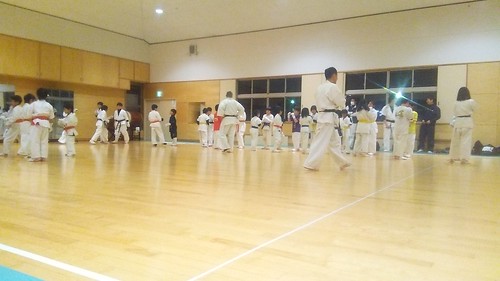
It seems to me that the key to Japanese culture is to realise that in the land of the rising mirror, the Japanese see themselves. This is evident in my opinion in the Japanese sense of private shame, Kyari Pamyu Pamyu eating eyeballs, Mariokart (Masuda, 2010), and birds eye view points in Ukiyoe (Masuda and Chang?) but above all, that this autoscopic ability may be closely linked with Budo and the Japanese arts.
At the moment however the only good reference I have for this is the theory of the eye apart in the 14th-15th century Noh actor and theoretician Zeami who says that repeated practice of Noh forms allows the creation of Eyes at a distance (Riken no Ken) that look back at oneself.
There is also a this book on the psychology of Budo by Takashi Ozawa (in Japanese) with a cover and belt (obi) that said that doing Budo one "obtains an other that looks at you" (but when I read the book and contacted the publisher it turned out that it was the publishers comment, rather than the author's). The cover image is great though.
Attachment 10901
Similarly also this "Onore wo mitsumeru" (Staring at oneself) in Japanese where Ryo Nagano claims that in Iaido one is always fighting, and seeing, an imaginary opponent and that eventually one realises that his opponent is oneself, thus Iaido is an autoscopic martial art.
And there is some research that a Kyudo practicing student of mine (Ikki Yamamoto) did that found that self-seeing or imagining correlated highly with archery ability (more than practice or anything else) since in archery as in Kendo, one is evaluated on form as well as lethality.
It could be argued that the strong sense of aesthetics or grace in Nitobe implies autoscopy.
The twofold gaze that Musashi Miyamoto in the Book of five rings does not mention autoscopy but it may well be especially "The Gaze in Strategy The gaze should be large and broad. This is the twofold gaze "Perception and Sight". Perception is strong and sight week. In strategy it is important to see distant things as if they were close and to take a distanced view of close things. " (近き所を遠く見る事 in the original) p14 "In large-scale strategy the area to watch is the enemy's strength."Perception" and "sight" are the two methods of seeing. Perception consists of concentrating strongly on the enemy's spirit, observing the condition of the battlefield, fixing the gaze strongly, seeing the progress of the fight and the changes of advantages. This is the sure way to win. In single combat you must not fix the eyes on the details. As I said before, if you fix your eyes on details and neglect important things, your spirit will become bewildered, and victory will escape you." p3 40 and on p23 "You must make the best of the situation, see through the enemy's spirit so that you grasp his strategy and defeat him." does not mean see using the enemies spirit but rather "look at the enemies heart" ("敵の心を見" in the original). Re-reading the final single page chapter on the Void, I wonder what I mean by "seeing yourself" because there isn't one! But still it could mean several things! 1) Imagining how one looks from the perspective of others. 2) Seeing ones self representations, such as mirror reflections and first person views as representations and therefore at a distance 3) Seeing the void, the non-self, in which these occur.
Judith Butler claims in "Bodies that Matter" that repeated (Derrida's "iterated") actions facilitate the creation of 'body as sign' which can be self-addressed, and be meaningful, "matter."
There is also work on the overlap between theatre ('dramaturgy) and martial arts but I would not wish to suggest that Martial arts are a *performance for others,* so I tend to steer away from things dramatological.
I do Karate a little and badly. I think that perhaps I may be able to see myself (with some pain!) more than than before. I don't know if Butler is right but it does seem to be, as Zeami can be read to say, that it is forms practice in Budo, tea, or 'radio exercises' (that all Japanese children do) that seems to be key. I find that doing forms in rows of other people helps in that I feel myself to be iterated in space as it were in the forms of the other people.
Do others know of any other sources regarding self sight, autoscopy, or "sight apart" in the martial arts?
Masuda 増田貴彦. (2010). ボスだけを見る欧米人 みんなの顔まで見る日本人. 講談社.
Thursday, February 11, 2016
Sassure via Maruyama Explains Yuki's Group Types
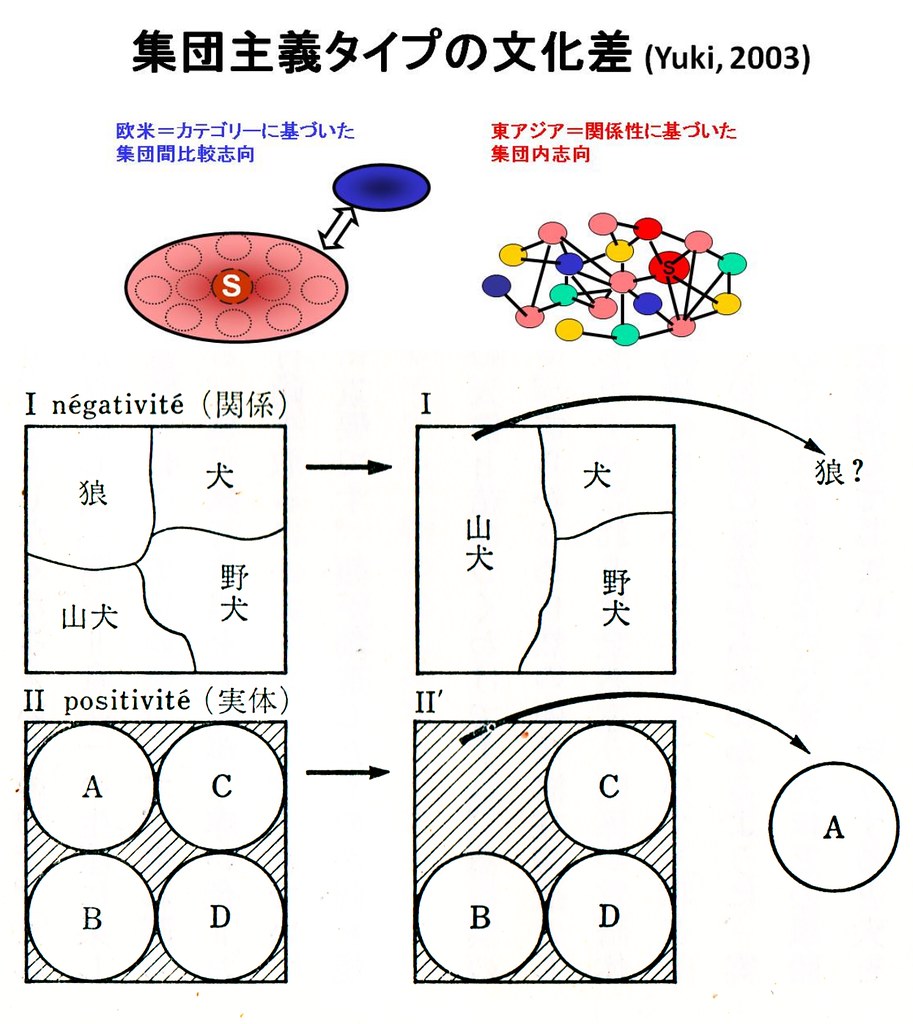
Labels: blogger, collectivism, culturalpsychology, Flickr, groups, individualism, japaneseculture, Nacalian
Friday, January 29, 2016
Naruto Whitestar

Why is it that we we feel ourselves to be watching a screen from inside our heads? We feel ourselves to inhabit the blackness in front of the light. One reason for this is because we talk to ourselves and, and possibly something else, in the this darkness. It has been demonstrated that East Asians are far less likely to engage in self speech at least while attempting to solve problems (Kim, 2002). Further Japanese deities and arguably the other of the Japanese self is felt to be something that watches from without (Heine et al. 2008). I notice that some of the best of them such as Naruto and hachimaki headband wearers may even have their names, or marks, not inside them, but upon their their foreheads like Rev 22:4. None of this muttering in the dark for them. In Japan the names are out there. I think that Japanese engage in tourism to "named places" to remind themselves of this fact.
The Japanese are Westernising furiously but it seems to me that the next stage in human development should be for the world to become Japanese, who are "meek" to boot. Bowie developed a mark for his last record. He nearly got there.
Image is drawn by me but the character is copyright Masashi Kishimoto, Hayato Date and Shueisha.
Heine, S. J., Takemoto, T., Moskalenko, S., Lasaleta, J., & Henrich, J. (2008). Mirrors in the head: Cultural variation in objective self-awareness. Personality and Social Psychology Bulletin, 34(7), 879–887. Retrieved from www2.psych.ubc.ca/~heine/docs/2008Mirrors.pdf
Kim, H. S. (2002). We talk, therefore we think? A cultural analysis of the effect of talking on thinking. Journal of Personality and Social Psychology, 83(4), 828. Retrieved from labs.psych.ucsb.edu/kim/heejung/kim_2002.pdf
Labels: japanese culture, tourism, 日本文化
Friday, January 22, 2016
Mr. Valentine: Bowie was Japanese

The sixties themed pop tune "Valentine's Day" has been argued to be a critique on gun violence (or the glamorisation and sexification of guns) since it starts and ends with the Charlton Heston pose (0:05 3:01, as above, guitar raised like a gun), shadows looking like a gun, guitar used as gun, bullet flying across the frets, his aiming and shooting of a make believe gun, the shadow of his guitar changing to that of a gun both during the Heston pose, and later in the song at 2:24 where the shadow of his guitar turns into a Tommy gun such as was used in "Valentine's Day Massacre".
There may be clues in the names. There were at least two massacres on Valentine's Day. "Teddy and Judy" may be gun shooting victims (I can find no real ones) or a reference to the pair in The Kinks "Waterloo Sunset" to which perhaps this song has a resemblance. Mr. Valentine is sometimes referred to as Johnny Valentine in an interview with a co-creator.
Someone else in the YouTube comments suggests that Valentine's Day may be about death in general which seems quite plausible to me, especially since the shadows behind Bowie sometimes seem to be that of a grim reaper (1:54) reaping Bowie (2:54).
The rest is my, rather off the wall, take in which I agree that the song is about death, but a self inflicted death, and possible rebirth.
First of all the Charlton Heston pose is also Heston's "my cold dead hands" pose: the pose of death.
I note that when Bowie sings about the face and hands of Mr. Valentine he is also showing us his own face (e.g. 0:55) or looking at his own hands (2:06 2:38), so I wonder if he may be referring to his own visual image which is icy and, like all images, dead. Our self images are also surprisingly "little" like Mr. Valentine (as one can convince oneself by drawing around the image of your face in a mirror, I think that this is why Noh masks see below are small).
This song reminds me of the first lines of his first pop video where he refers to himself as being small, and loving this image till a certain day "Love you till Tuesday"
Bearing in mind that Bowie is double, from the cover of Pinups and Hours, the smiling Asian Zaphod to whom he is conjoined at the head in "Where are we Now" and there are dead female eyes in all our minds, as claimed in Blackstar, Valentine's visual image may be paired up with the eyes. I.e. we love ourselves as images with the eyes of another in our minds. [ In this regard, I wonder if Bowie fell in love with his wife partly due to her name Iman, I man, eyeman, his Eve see below. ]
I claim that this is the structure of the Japanese self: the eye or mirror of the other Amaterasu and their face or "mask" (Watsuji). Usually Westerners however narrate themselves (Freud, Mead, Bruner, Bakhtin, etc) so the eyes in Blackstar would ordinarily be effeminate ears (c.f. Freud's "acoustic cap" "bonnet" or Nietzsche's ears, or Derrida's "Ear of the Other"). I think that Jones, Major Tom, Bowie, Ziggy, the Thin White Duke and Mr. Valentine had a tendency to narrate himself in the 3rd person, and identified with his image.
From this perspective we may be killing ourselves as we live, making a a dead image of ourselves, "falling to earth." Our true being is our consciousness but we believe that we are in the black hole that we believe to be in front of our light. Instead of living as our being, as the white star, we are turned inside out. In this situation death, "Valentines Day", or (Love you till) Tuesday, when we give up on that love affair, may conversely be life, a rebirth. Bowie may be alluding to this possibility in Lazarus.
The Biblical representation the eyes or ears in our heart may be Eve a comforter made out of our hearts, who we can replace with Jesus, or Amitabha for instance.
I should like to do a
Labels: autoscopy, blogger, Flickr, japaneseculture, Nacalian, nihonbunka, 日本文化
Thursday, January 21, 2016
Henro: Sightseen Tourism and Pilgrimage

Labels: autoscopy, blogger, Flickr, Nacalian, nihonbunka, tourism, 日本文化, 観光
Monday, January 04, 2016
Otsuka Laser Sneakers
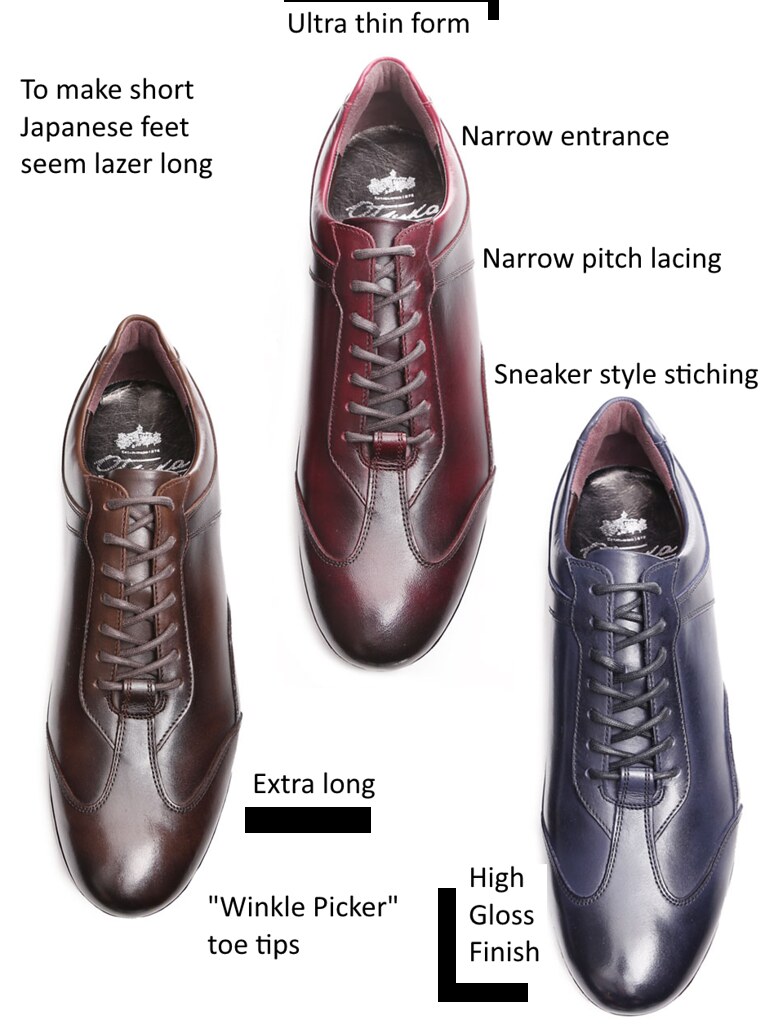
These Ostuka Lazer Sneakers are designed, I believe, to make Japanese feet - which are generally shorter than those of European descent - seem as long as a laser beam. They are long in the forefoot before the start of the laces and end in empty winkle picker toes. The laces, though they start higher on the foot, have a narrower pitch and also end higher on the foot to make it seem that the wearer is positively L shape. The whole shoe is as narrow as possible, in sporty sneaker style, but accentuates itself by the use of high gloss leather. These Japanese semi formal sneaker shoes are trying to tell us that their wearer has a body like a ballet dancer, with style, reserve, and finesse.
The Japanese are masters at visual self-enhancement. When you next meet a self-deprecating Japanese man, look at his feet.
You may also notice that he is standing in a Yohei pose to emphasize the thinness of one of this thighs.
Shoe design copyright Otsuka Shoe Manufacturers. お取り下げご希望でありましたら、下記のコメント欄、またはnihonbunka.comのメールリンクまでご連絡ください。
Labels: blogger, culturalpsychology, Flickr, heine, japaneseculture, Nacalian, nihonbunka, selfenhancement, 日本文化, 自己高揚
This blog represents the opinions of the author, Timothy Takemoto, and not the opinions of his employer.