
Thursday, April 21, 2016
Japanese Translation of Sheeple
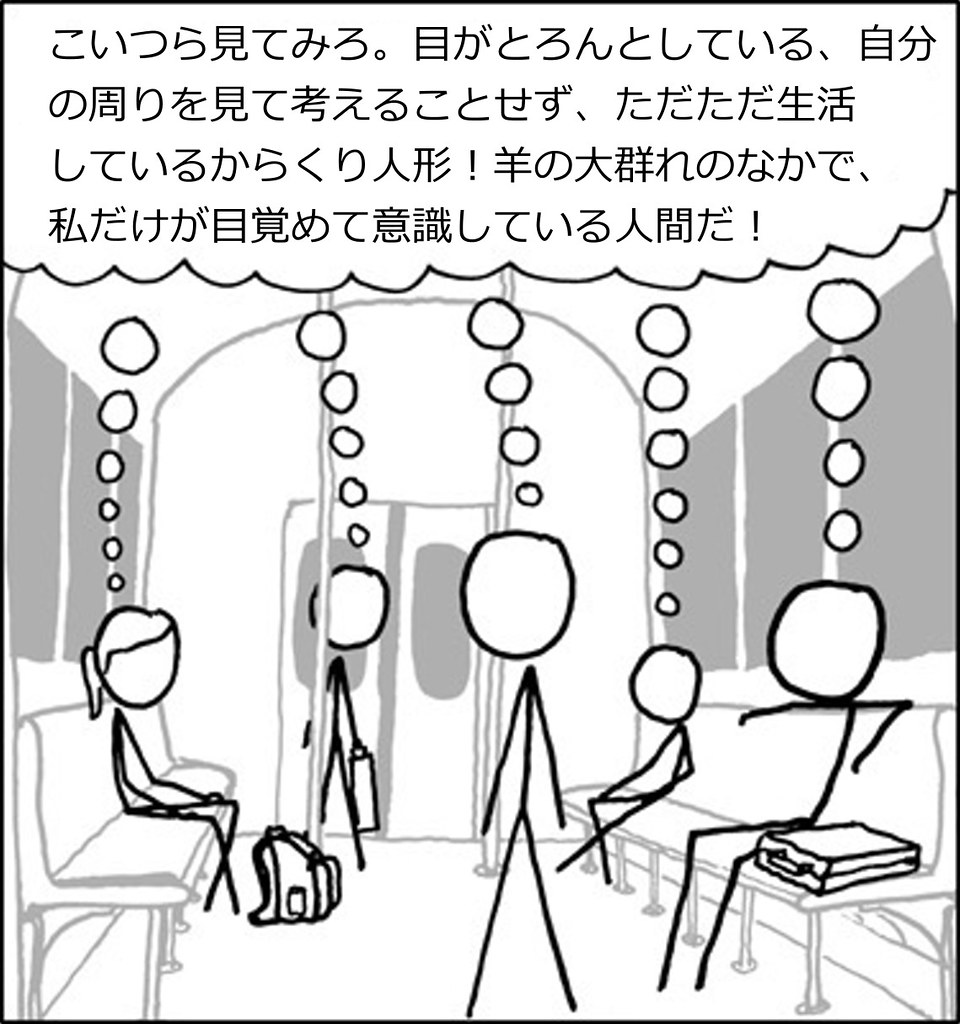
This the above is a Japanese translation of this illustration where everyone on a train thinks that all the others present are sheeple. Research (Leuers = Takemoto & Sonoda, 1999) shows that Westerners do have a false uniqueness bias, whereas Japanese are more likely to believe that they are more normal than they in fact are. Leuers = Takemoto, T. R. S., & Sonoda, N. (1999). Independent self bias. Progress in Asian Social Psychology, 3, 87–104. Retrieved from http://ift.tt/1ScThyE http://flic.kr/p/GmP39M
Labels: blogger, culturalpsychology, Flickr, japaneseculture, nihonbunka


Wednesday, February 24, 2016
Japanese Bragging: Self-Verification
The Japanese very rarely brag (Heine, Lehman, Markus, & Kitayama, 1999), linguistically at least (Leuers = Takemoto & Sonoda, 1999). On the other hand the Japanese are "haughty" in their manner, posture and attire (Busk, 1841; Coleridge, 1872; Cortazzi, 2013; Golovnin & Shishkov, 1819; Krusenstern & Kruzenshtern, 1813). The Japanese eschew vocalising their superiority, which is left for others to do for them in flattery which, though void of linguistic meaning, as a form of obeisance is rife (Takemoto, in preparation).
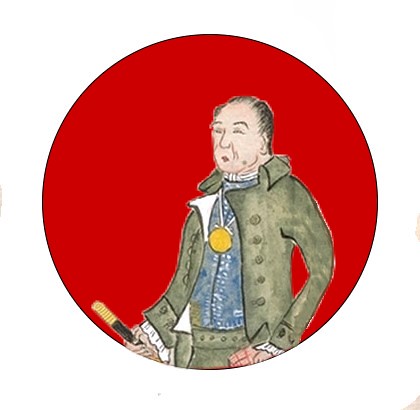
Kōdayū (pictured above) spent 11 years in Russia as a castaway at a time when Japan was closed to the rest of the world. He returned full of "Western learning," and no doubt somewhat Westernised in manner, to obtain an audience with the shogun, the top man in Japan, about which Donald Keene writes,
"The shogun's questions were asked at random, and suggests that he was more interested in displaying his own knowledge of Russian than in learning new things from Kōdayū. The interrogation sometimes took the form: "There is a great clock in the castle tower of Moscow. Have you seen it?" Similar enquiries about the statue of Peter the Great and a famous Muscovian cannon were followed by, "Have you ever seen a camel?" (Keene, 1952, p.55)
The Japanese are not perfect. Looking, but not listening, with mother they expect to see those around them fawn and pay lip-service. Keene takes the shogun to task. I think that Kōdayū failed to flatter. Faced with such an ill-mannered subject the shogun had no choice but to ask rhetorical, self-answering questions for the purpose of self verification which is probably pan-cultural (Seih, Buhrmester, Lin, Huang, & Swann Jr., 2013) da yo ne?
Busk, M. M. (1841). Manners and Customs of the Japanese, in the Nineteenth Century: From Recent Dutch Visitors of Japan, and the German of Dr. Ph. Fr. Von Siebold. John Murray, Albemarle Street.
Coleridge, H. J. (1872). The life and letters of St. Francis Xavier : in two volumes. Asian Educational Services.
Cortazzi, H. (2013). Victorians in Japan: In and around the Treaty Ports. A&C Black.
Golovnin, V. M., & Shishkov, A. S. (1819). Recollections of Japan: Comprising a Particular Account of the Religion : Language : Government : Laws and Manners of the People : with Observations on the Geography : Climate : Population and Productions of the Country : to which are Pre-fixed Chronological Details of the Rise : Decline : and Renewal of British Commercial Intercourse with that Country.
Heine, S., Lehman, D., Markus, H., & Kitayama, S. (1999). Is there a universal need for positive self-regard?. Psychological Review. Retrieved from humancond.org/_media/papers/heine99_universal_positive_re...
Keene, D. (1952). The Japanese Discovery of Europe: Honda Toshiaki and Other Discoverers, 1720-1798. Routledge and Kegan Paul.
Krusenstern, A. J. von, & Kruzenshtern, I. F. (1813). Voyage Round the World, in the Years 1803, 1804, 1805, & 1806. C. Roworth.
Leuers = Takemoto, T., & Sonoda, N. (1999). The eye of the other and the independent self of the Japanese. In Symposium presentation at the 3rd Conference of the Asian Association of Social Psychology, Taipei, Taiwan. Retrieved from nihonbunka.com/docs/aasp99.htm
Seih, Y.-T., Buhrmester, M. D., Lin, Y.-C., Huang, C.-L., & Swann Jr., W. B. (2013). Do people want to be flattered or understood? The cross-cultural universality of self-verification. Journal of Experimental Social Psychology, 49(1), 169–172. doi.org/10.1016/j.jesp.2012.09.004
Labels: blogger, culturalpsychology, Flickr, heine, japaneseculture, jimanga, nihonbunka, selfenhancement, 日本文化
Thursday, February 11, 2016
Sassure via Maruyama Explains Yuki's Group Types
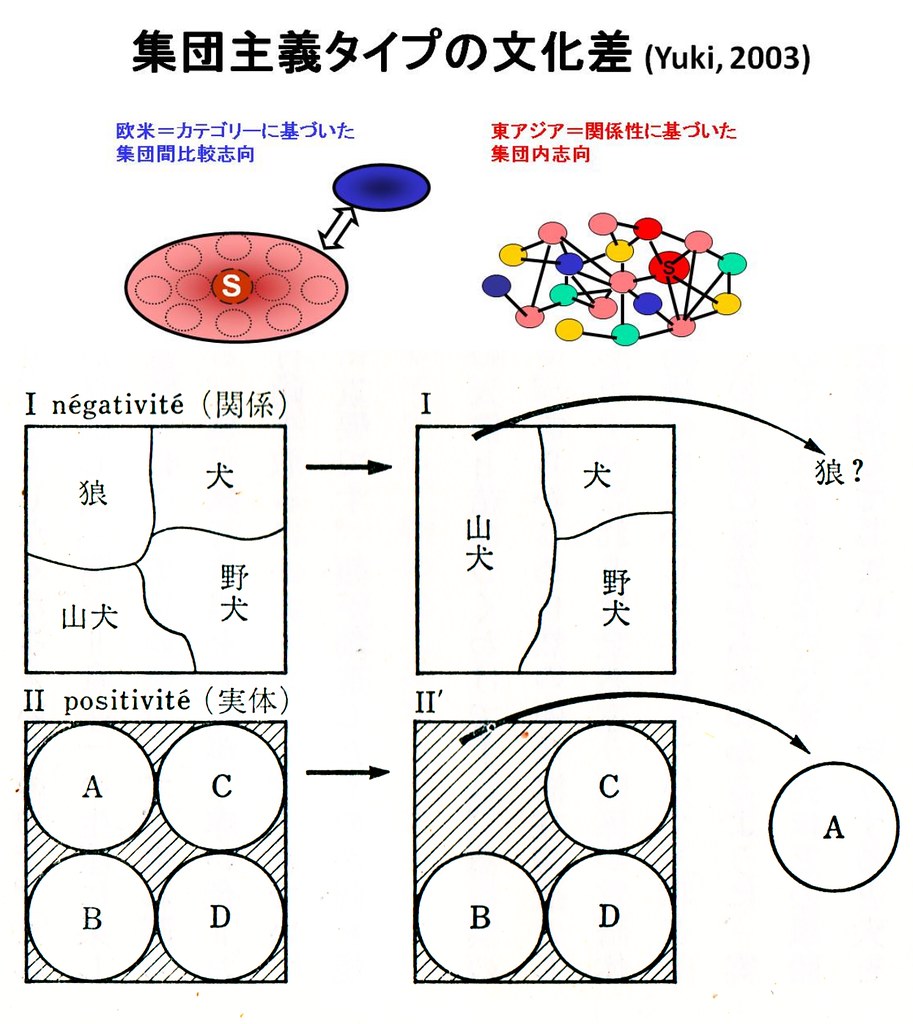
Possibly my favourite cultural psychological theory is that of Yuki (2003) who contends that westerners merge with their groups which they see in contradistinction to others, whereas Japanese form groups as networks conceived independently of any other group. This is a radical theory since if amplified it can be used to suggest that it is Westerners who are dependent upon their groups, whereas Japanese from groups in which individuality is nurtured. To a large extent I agree with this amplified formulation and have demonstrated that Americans though they may seem "individual" are all infact individualists, that is to say possessant of the same basket of culturally approved characteristics. None the less, I do believe that Japanese merge to a degree and that emphasis should be given to the way in which the selves in Japanese interpenetrate. Yuki (2003) in his diagram above shows the relationships penetrating the circles of the Japanese group members. I suggested a modification where the group members should overlap and explained the reason why they overlap - the imaginaire emphasises interdependence as explained here. Turning to Western groups however, it may appear puzzling that we find it so easy to merge with our groups, and require an outgroup to compare and disparage. One of the reasons for this is because, I believe, we cognise ourselves and our groups as narratives. Maruyama Masao illustrates the way Sassures theory of language implies that words can only be understood in their relation to other words. He contrasts categories of words with a box of coloured marbles (much like Masaki's asian group top right) which can be cognised even out of the box, and illustrates the way in which words can only be understood in contrast to other words with a box containing water with bubbles formed upon it. If a bubble in box is burst, if a language has no seperate word for wolf then that would be like bursting one of the bubbles (centre black and white diagram). Unless the word covers a meaning space in contrast to other words it has no meaning at all, whereas concrete (visible) things are what they are all on their lonesome. Japanese cognise themselves and their groups visually so they do not need to compare their groups with others. To love Japan they have no need of hating upon Koreans. Americans however tend to cognise themselves in linguistic terms, and therefore need a bogeyman-country with which to compare and enhance themselves. It is better in the light, but how to get there? http://flic.kr/p/DszxU2
Labels: blogger, collectivism, culturalpsychology, Flickr, groups, individualism, japaneseculture, Nacalian
Monday, January 04, 2016
Otsuka Laser Sneakers
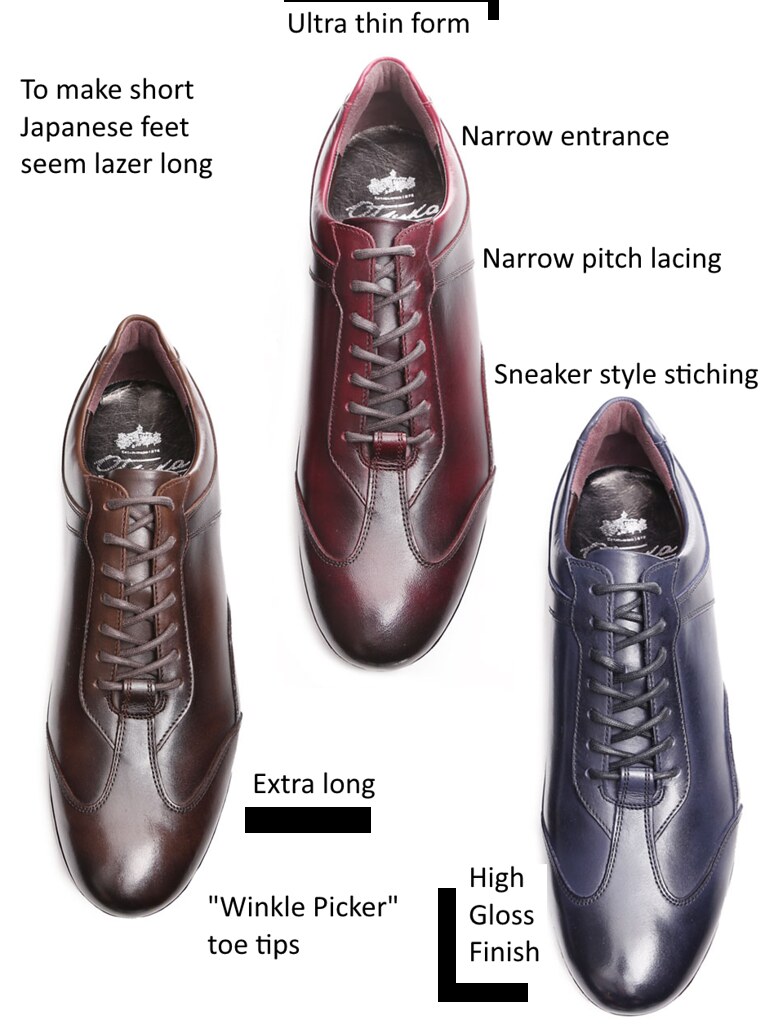
These Ostuka Lazer Sneakers are designed, I believe, to make Japanese feet - which are generally shorter than those of European descent - seem as long as a laser beam. They are long in the forefoot before the start of the laces and end in empty winkle picker toes. The laces, though they start higher on the foot, have a narrower pitch and also end higher on the foot to make it seem that the wearer is positively L shape. The whole shoe is as narrow as possible, in sporty sneaker style, but accentuates itself by the use of high gloss leather. These Japanese semi formal sneaker shoes are trying to tell us that their wearer has a body like a ballet dancer, with style, reserve, and finesse.
The Japanese are masters at visual self-enhancement. When you next meet a self-deprecating Japanese man, look at his feet.
You may also notice that he is standing in a Yohei pose to emphasize the thinness of one of this thighs.
Shoe design copyright Otsuka Shoe Manufacturers. お取り下げご希望でありましたら、下記のコメント欄、またはnihonbunka.comのメールリンクまでご連絡ください。
Labels: blogger, culturalpsychology, Flickr, heine, japaneseculture, Nacalian, nihonbunka, selfenhancement, 日本文化, 自己高揚
This blog represents the opinions of the author, Timothy Takemoto, and not the opinions of his employer.