
Wednesday, August 10, 2016
The Evil has Landed: Atarimae, Positive Psychology and Judo Bronze Medals
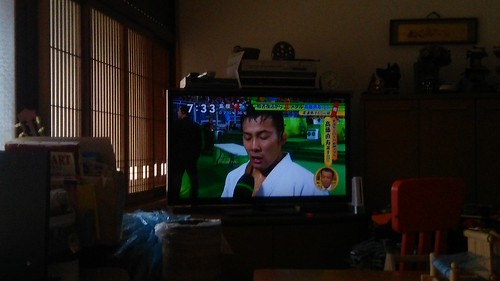
Japanese post match interviews are to cry for. Of her bronze medal Ami Kondou said, "I guess my parents will say 'well done,' (and for that I'm grateful) but I just feel regret." The judoka pictured above said the traditional, "I feel full of gratitude to all those that made my achievement possible," while clearly feeling other emotions, such as regret, at the same time.
However, while each individual judouka's emotions seem to be similar to those in previous years, several of them are voicing statements which, coming from judoka, are new to my ears.
Specifically, several Japanese Olympic judoka have mentioned that they "should have won (gold)" (勝って当たり前). Ami Kondou said that bearing in mind the large numbers of Japanese judoka, she "should have won." Even Shouhei Oono, who did in fact win gold mentioned, this phrase four times, but as the words of others, not thoughts of his own. Perhaps that is how he managed to break the curse (see below).
"I heard it said, from those around me, that "I should win gold. (Today) I reconfirmed the fact that it is difficult achieve that which one 'should achieve'." "周りの声、金メダルを獲得して当たり前という声が聞こえていた。当たり前のことを、当たり前にやる難しさを改めて感じた。(Kyoudou)(Youtube Video in Japanese)."
Other commentators have noted that this teams inability to be pleased at receiving bronze medals, together with the high number of bronze medals suggests that the team need to be freed from some sort of curse.
I agree. I fear that one or some of the Judo team coaches have been reading "positive psychology" (or Western whispering arrogance) books, and have been persuaded that telling yourself that you "should win" / "must win" will increase confidence, for the win.
As argued by cultural psychologists such as Steven Heine (Heine, Lehman, Markus, & Kitayama, 1999), this Mohammed Ali style self-praising, ego-boost is by no means a Japanese tradition. Cultural psychologists will tell you that Japanese are instead self-critical, and by focusing on their mistakes and errors (hansei) they go on to remove and improve themselves (kaizen). Certainly there is this aspect to Japanese psychology. Rather than telling themselves that they "should win" the Japanese Judo team should have maintained the challenger spirit that helps to drive Toyotistic cycles of Japanese self-improvement.
For example, the coach of the world beating Japanese women's soccer team showed a video of the Fukushima Disaster on the eve of their final match. Nothing could have been more convincing of their own weakness: anyone can lose everything. That coach, Asako Toyokura, is a genius.
It is not all deprecation, self-sour-grapes, in the Japanese psyche. As argued on this blog, the Japanese indulge in positive visual psychology. The late great Sumo Wrestler, Chiyonofuji, who died 11 days ago RIP, said in a television interview when asked how he recovered from injury, "I imagine myself winning and that there are a lot of girls cheering in the audience." This J-narcissism, rather than the collectivist expectation of gratitude alone, drives the amazing Japanese ability to self-criticise and improve.
The drawbacks to telling oneself we should win must win are not only that it puts a spanner in the Japanese self-improvement cycle. Linguistic self-praise which seems to take place both inside the heart and head, is particularly evil. Mohammed Ali knew, and was not arrogant at home. Whispering praises to oneself linguistically, one can become completely unaware of the need for others, such as "the girls cheering in the audience." As a consequence one can believe ones self-praise completely, as some sort of objective truth, WE MUST WIN, wipe other species (Kashima & Bain, 2016), and in the extreme, wipe out other humans.
Bibliography
Heine, S., Lehman, D., Markus, H., & Kitayama, S. (1999). Is there a universal need for positive self-regard?. Psychological Review. Retrieved from http://humancond.org/_media/papers/heine99_universal_positive_regard.pdf
Kashima, Y & Bain, P. (2016, August, 3) "On Cultural Conceptions of Human-Nature Relationship." International Association of Cross Cultural Psychology Conference. WINC Conference Center, Nagoya, Japan.
Labels: japanese culture, nihonbunka, psychology, selfenhancement, specular, 日本文化


Wednesday, February 24, 2016
Japanese Bragging: Self-Verification
The Japanese very rarely brag (Heine, Lehman, Markus, & Kitayama, 1999), linguistically at least (Leuers = Takemoto & Sonoda, 1999). On the other hand the Japanese are "haughty" in their manner, posture and attire (Busk, 1841; Coleridge, 1872; Cortazzi, 2013; Golovnin & Shishkov, 1819; Krusenstern & Kruzenshtern, 1813). The Japanese eschew vocalising their superiority, which is left for others to do for them in flattery which, though void of linguistic meaning, as a form of obeisance is rife (Takemoto, in preparation).
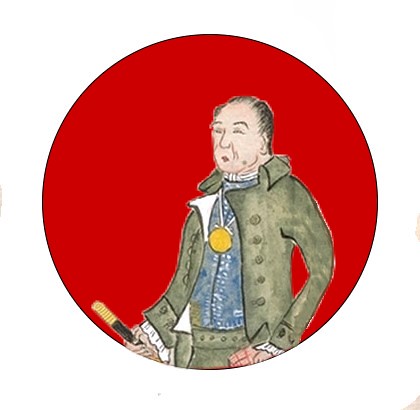
Kōdayū (pictured above) spent 11 years in Russia as a castaway at a time when Japan was closed to the rest of the world. He returned full of "Western learning," and no doubt somewhat Westernised in manner, to obtain an audience with the shogun, the top man in Japan, about which Donald Keene writes,
"The shogun's questions were asked at random, and suggests that he was more interested in displaying his own knowledge of Russian than in learning new things from Kōdayū. The interrogation sometimes took the form: "There is a great clock in the castle tower of Moscow. Have you seen it?" Similar enquiries about the statue of Peter the Great and a famous Muscovian cannon were followed by, "Have you ever seen a camel?" (Keene, 1952, p.55)
The Japanese are not perfect. Looking, but not listening, with mother they expect to see those around them fawn and pay lip-service. Keene takes the shogun to task. I think that Kōdayū failed to flatter. Faced with such an ill-mannered subject the shogun had no choice but to ask rhetorical, self-answering questions for the purpose of self verification which is probably pan-cultural (Seih, Buhrmester, Lin, Huang, & Swann Jr., 2013) da yo ne?
Busk, M. M. (1841). Manners and Customs of the Japanese, in the Nineteenth Century: From Recent Dutch Visitors of Japan, and the German of Dr. Ph. Fr. Von Siebold. John Murray, Albemarle Street.
Coleridge, H. J. (1872). The life and letters of St. Francis Xavier : in two volumes. Asian Educational Services.
Cortazzi, H. (2013). Victorians in Japan: In and around the Treaty Ports. A&C Black.
Golovnin, V. M., & Shishkov, A. S. (1819). Recollections of Japan: Comprising a Particular Account of the Religion : Language : Government : Laws and Manners of the People : with Observations on the Geography : Climate : Population and Productions of the Country : to which are Pre-fixed Chronological Details of the Rise : Decline : and Renewal of British Commercial Intercourse with that Country.
Heine, S., Lehman, D., Markus, H., & Kitayama, S. (1999). Is there a universal need for positive self-regard?. Psychological Review. Retrieved from humancond.org/_media/papers/heine99_universal_positive_re...
Keene, D. (1952). The Japanese Discovery of Europe: Honda Toshiaki and Other Discoverers, 1720-1798. Routledge and Kegan Paul.
Krusenstern, A. J. von, & Kruzenshtern, I. F. (1813). Voyage Round the World, in the Years 1803, 1804, 1805, & 1806. C. Roworth.
Leuers = Takemoto, T., & Sonoda, N. (1999). The eye of the other and the independent self of the Japanese. In Symposium presentation at the 3rd Conference of the Asian Association of Social Psychology, Taipei, Taiwan. Retrieved from nihonbunka.com/docs/aasp99.htm
Seih, Y.-T., Buhrmester, M. D., Lin, Y.-C., Huang, C.-L., & Swann Jr., W. B. (2013). Do people want to be flattered or understood? The cross-cultural universality of self-verification. Journal of Experimental Social Psychology, 49(1), 169–172. doi.org/10.1016/j.jesp.2012.09.004
Labels: blogger, culturalpsychology, Flickr, heine, japaneseculture, jimanga, nihonbunka, selfenhancement, 日本文化
Monday, January 04, 2016
Otsuka Laser Sneakers
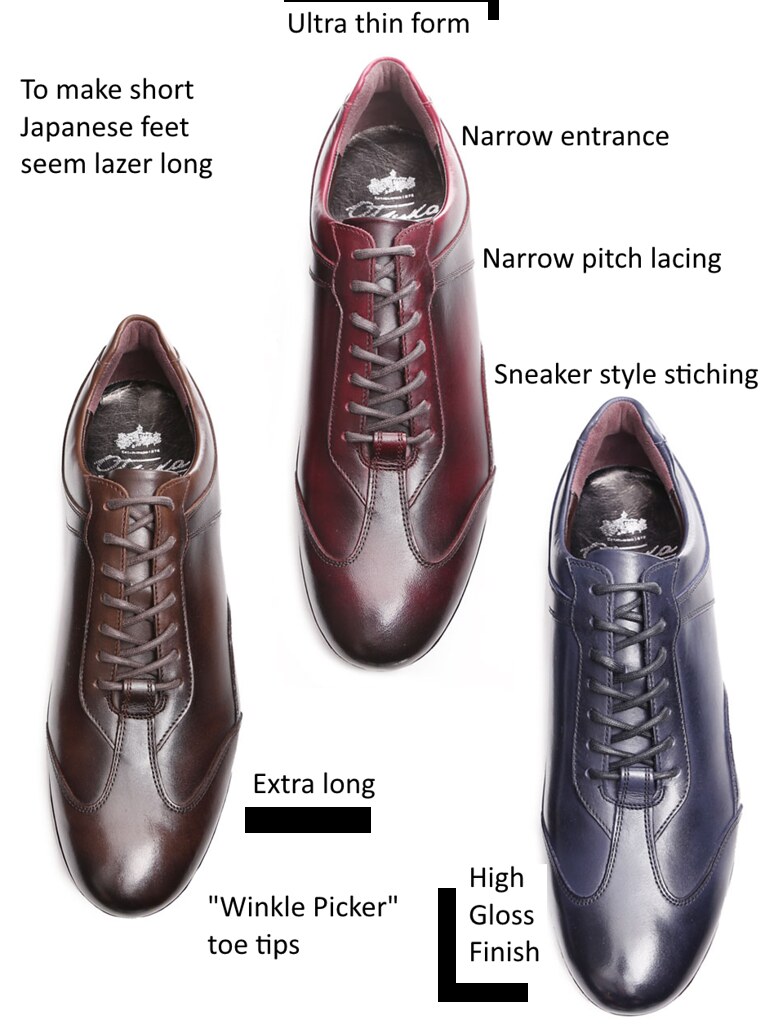
These Ostuka Lazer Sneakers are designed, I believe, to make Japanese feet - which are generally shorter than those of European descent - seem as long as a laser beam. They are long in the forefoot before the start of the laces and end in empty winkle picker toes. The laces, though they start higher on the foot, have a narrower pitch and also end higher on the foot to make it seem that the wearer is positively L shape. The whole shoe is as narrow as possible, in sporty sneaker style, but accentuates itself by the use of high gloss leather. These Japanese semi formal sneaker shoes are trying to tell us that their wearer has a body like a ballet dancer, with style, reserve, and finesse.
The Japanese are masters at visual self-enhancement. When you next meet a self-deprecating Japanese man, look at his feet.
You may also notice that he is standing in a Yohei pose to emphasize the thinness of one of this thighs.
Shoe design copyright Otsuka Shoe Manufacturers. お取り下げご希望でありましたら、下記のコメント欄、またはnihonbunka.comのメールリンクまでご連絡ください。
Labels: blogger, culturalpsychology, Flickr, heine, japaneseculture, Nacalian, nihonbunka, selfenhancement, 日本文化, 自己高揚
This blog represents the opinions of the author, Timothy Takemoto, and not the opinions of his employer.