
Thursday, May 17, 2012
Nacalianism and Climaticity

But then, I have a socio-historic theory of my own. It seems to me that Japan is Nacalian. Nacal is Lacan backwards, and Nacalian refers to the theory that Lacan's theory of the human explains Japanese behaviour quite well if it is turned upside down or back to front.
Lacan (2002, [1949]) argued that the human self is created as an external identification with the image, before later, as a result of being unable to demand their mothers affection, they identify with their symbolic parent - their father - and so we go on to narrate ourselves into existance. The advantage of this is is, Western theorist claim, the visual self representation is locked in binary relationships with real external others or mirrors, whereas language provides us with the means to hear ourselves speak, understand ourselves from the point of view of others (plural) and also finally, from the point of view of the Other (Lacan, 2002), the "generalised other," (Mead, 1967) the "superadressee" (Bakhtin, 1986).
Lacan's theory explains the Japanese self too, if topologically reversed. The Japanese self orginiates in an external identification with the symbol, before later, as a result of being unable to demand 'assimilation with their mother'*, Japanese identify with the their visual parent, and imagine, or animate, themselves into existence. The advantage of this is that while self-imagary requires that one visualise oneself from the outside, it is not as external as language which is external in both the spatial and social sense. As Wittenstien (1973) famously argued there can not be a private language, and meaning is realised in "language games" - that is to say communicative encounters that require not only an outside, but also other people**.
Whille there is no linguistic third person perspective (Mori, 1999) or even narrative (Kim, 2002) in the mind of the Japanese, a sort of capitalised/generalised Other, or super-addressee is also present in Japan: the Japanese simulate a mirror in their heads (Heine, Takemoto, Moskalenko, Lasaleta, & Henrich, 2008; Takemoto, 2002).
The universality of visio-imaginary self-apprehension may be more fractal, but it is no less objective. In addition to the temporal ephemerality of the linguistic sign (Derrida, 1998), it is the relative ease with which the noiseless ear, compared to the visible eye, can be merged and hidden that conceals the fact that it is no more easy to gain a universalised linguistic aprehension of oneself (through dialetic perhaps) than it is to gain a universalised apprehension of oneself through self imagination. At the very least as communication theorists (Mehrabian, 2007) and common knowledge teach us, a picture speaks... or signifies, at least as well as, words.
Though the best Western philosophers blithely assert that language provides, apriori, a means of perceiving oneself from the point of view of others, in fact to understand oneself from another persons' lnguistic point of view requires a simulation, of comparable complexity to that required by the act of simulating the literal, visual view of an other.
And so it is that Westerners narrate themselves into existance based around their "Je", whereas Japanese have a collage of self ways, a geography of self, not limited to, but centering on their face.
Convinced as I am of the limited power of language, the existence of my own cultural baggage, and the prevalence of contradiction in the world, the fact that Nacalianism is to some extent contradictory is to be expected. And one of the many applications of Nacalianism is as a metatheory that applies to, and to an extent contradicts, itself.
Due to their heighted powers of visual imagination, and their self indentificiation with their own image, the Japanese are inclined to open their eyes and look about them when they want to explain human behaviour. As a result, the Japanese, including Japanese academics, have a great love of theories of climaticity. Here climate refers to the visual environment including the weater and seasons. It is also translated as "environment", and "milleue." The originator of the term and the most famous examplar of which is that of Watsuji Tetsuro who argued that culture can be explained by the geo-climatic conditions of its origin, seperating cultures into desert cultures, monsoon cultures etc (Watsuji, 1961).
Other examples geo-climatic theories of human society include the following.
Tamaki's explanation of regional variations in Japanese culture by the geographically induced varieties of irrigation (Tamaki, 1979), such as collectivism and harmony among flatplain canal irrigationists, to individualism among those in more mountainous regions that use individual lakes to flood their rice fields.
Various scholars -- and the Japanese general public -- use Watsuji's divisions of people's into 'agriculturalists (The japanese) vs hunter gathers (the British!?)', or 'agriculturalists vs. herders.'
These geo-climatic theory of culture too sometimes touch on similarly self-contradictory meta-theories of theory. In the introduction to Tamaki's work in which he describes climatic theories as being Japanese. The geo-climatic theory of Aida (1990) below, also attempts to explain the origin of climaticity (which he refers to as attention to area).
"This tendency of Japanese (to think interms of areas as opposed to points and lines) originates in the Japanese geo-climatic environment and the characteristics of the type of agriculture theirin employed. Compared to Europe, Japanese land is clearly more fertile, and as a result the special Japanese agricultural style gave birth to a belief in the mysterious creative power in the land [the area] itself.
In European agriculture however, herding is always required [for crop rotation]. Europeans hardly ever believe in the mysterious creative power of the land. Herders are always like this. The supremacy of herders gives rise to [a philosophy of] points and lines, and not areas." (Aida, 1990,p 199, my rough translation, with omissions and [additions]).
The hightly influential Laurel Forest Culture theory proposed Sasaki Koumei (佐々木, 2007) and Nakao Sasuke's (Nakao, 2006) proposes that the form of forest found in places like Japan and Taiwan have resulted in considerable cultural similarity.
Yuki's use of the frontier mentality in the USA to explain behaviour in Hokkaidou, and generally to explain social beahviour by social mobility (how much people move around) and by implication I feel, the existance of space in which they are free to do so (e.g. Schug, Yuki, Horikawa, & Takemura, 2009). This theory too (and that of Nisbett below), uses space to explain valuations of space -- spatially defined relationships, or holistic thought patterns -- is as self-applicable and self-contradictory as my own theory, it seems to me.
Climatic theories are of course not absent in the West. Two of note are those of Richard Nisbett (2004) and Francesa Bray(1994), each coming to the opposite conclusion regarding the effect of rice agriculture upon culture. Nisbett argued that rice agriculture encouraged cooperation, whereas Bray argues that it encouraged independence, lack of cooperation and the late arrival of the industrial revolution in Japan.
To these climatic theories I would like to add my own, only partly toungue in cheek. In geographies which are fairly flat, and the horizon is low, humans can generally only see the sky, ground, and the immediate social environment, and as such tend to interpret the world in terms of sociological tendencies. In geographies where there are steep mountains, such as in the above photo, humans are always able to see nature, the movement of the seasons, and can but be aware of its impact upon their lives. Thus the Japanese are more inclined to interpret human behaviour in terms of geo-climatic theories. I am serious. Living in Japan, and always made forcefully aware of the presence of nature by being surrounded by sheer mountains, does make me more "area," spacially focused.
Westerner that I am, I prefer a social, historical theory -- Nacalianism -- to explain the prevalence of geo-visual theories of human behaviour in Japan, although I recognise the contradiction, and believe in that human behaviour can be explained in more than one way.
Notes
*I have struggled for a long time to explain why, in the absense of oedipal conflict, the Japanese bother to grow up at all. It seems to me that the Lacanian emphasis on possesion ones mother misses another, more Western (Schug, Yuki, Horikawa, & Takemura, 2009) aspect of love towards ones primary caregiver: the desire for similarity. Yes, in the Western family children are denied possession of the mother, especially by being ejected from the family bed. In Japan the children often possess, or monopolize the attention of their mother but, they are not able to identify with her, be similar to her. In Japan the apparent lack of conflict between the children and the father, combined with focus of both parents in the Japanese family towards the children, presents to the children the appearance of their having exaclty that two parents (even two mothers). This parentalism heightens the sense of dis-similarity between parents and children, and the generation gap, makes the family more "verticle" (Nakane) even as it makes it more peaceful. If Western children grow up because they want to possess their mothers, Japanese children grow up because they want to be them, become mothers/parents themselves.
**:Come to think of it, the logic here is flawed. Both Language and vision require simulation of other people in order to approach an objective general view of the self. I have engaged in a bit of polemic because I find it so difficult to get anglophones to realise that language is from outside the self.
Bibliography
Aida, Y. (1990). Nihonjin no ishiki. Tokyo: Kodansha.
Bakhtin, M. M. (1986). Speech Genres and Other Late Essays. (V. W. McGee, Trans.) (Second Printing.). University of Texas Press.
Bray, F. (1994). The Rice Economies: Technology and Development in Asian Societies. University of California Press.
Nisbett, R. (2004). The Geography of Thought: How Asians and Westerners Think Differently...and Why. Free Press.
Heine, S. J., Takemoto, T., Moskalenko, S., Lasaleta, J., & Henrich, J. (2008). Mirrors in the head: Cultural variation in objective self-awareness. Personality and Social Psychology Bulletin, 34(7), 879–887.Lacan, J. (2002 [1949]). The mirror stage as formative of the function of the I as revealed in psychoanalytic experience. In B. Fink (Trans.), Ecrits (pp. 75–81). WW Norton & Company.
Mead, G. H. (1967). Mind, self, and society: From the standpoint of a social behaviorist (Vol. 1). The University of Chicago Press.
Mehrabian, A. (2007). Nonverbal communication. Aldine.
Mori, 森有正. (1999). 森有正エッセー集成〈5〉. 筑摩書房.
Nakao, S. 中尾佐助. (2006). 中尾佐助著作集〈第6巻〉照葉樹林文化論. 北海道大学出版会.
Takemoto, T. (2002). 鏡の前の日本人. ニッポンは面白いか (講談社選書メチエ. 講談社.
Tamaki 玉城哲. (1979). 水の思想(A Philosophy of Water). 論創社.
Watsuji, T. (1961). A climate: a philosophical study. Print. Bureau, Japanese Govt.
Sasaki, K. 佐々木高明. (2007). 照葉樹林文化とは何か―東アジアの森が生み出した文明. 中央公論新社.
Schug, J., Yuki, M., Horikawa, H., & Takemura, K. (2009). Similarity attraction and actually selecting similar others: How cross-societal differences in relational mobility affect interpersonal similarity in Japan and the USA. Asian Journal of Social Psychology, 12(2), 95–103.
Labels: japan, japanese culture, Jaques Lacan, lacan, logos, Nacalian, nihobunka, nihonbunka, occularcentrism, reversal, self, specular, 日本文化


Wednesday, May 16, 2012
Empire of the External Signs: Travelling to Sight and Symbol
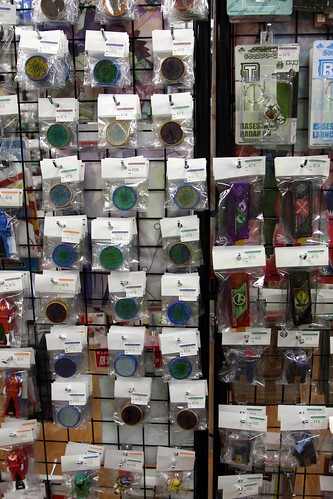
Not only when on holiday, but also when having fun as a child, the Japanese like to collect symbols. They are modern totemists, they "bricole."
Levi-Strauss in one of his last formulations defined those "primities" that have a "savage mind" -- the "bricoleurs", the botching, DIYers, that think with signs-they-have-to-hand (Levi-Strauss, 1966) -- as those that do not have writing.
"The way of thinking among people we call, usually and wrongly, ‘primitive’—let’s describe them rather as ‘without writing,’ because I think this is really the discriminatory factor between them and us" (Levi-Strauss, 1978, 5)
What he meant to say was that they do not have an alphabetic writing (see the brilliant paper by Chad Hansen, 1993, "It started with Phoneticians").
The important point is not the natural constraint that Levi-Strauss proposes that "savages" face. Like the Japanese, even the totemists in totemistic societies that Levi-Strauss himself reported, had started to create their own totems (e.g. gourds, mythical animals) and are not constrained by nature.
The important point, that Derrida stress(1998), is that the "savages" remain aware of the corporeality of the sign, aware of the "trace," they remain forever "post-modern," even more so than Derrida who claims phonocentrism is inevitable, and unable to believe in "presence" of meaning, of voice as thought. The "savage" (or perhaps savant) is aware that the sign is external.
They, the Japanese, are happy to travel, to the shrine, to the local toy shop, to the "named place" (meisho) abroad to collect external signs.
Derrida, J. (1998). Of grammatology. (G. C. Spivak, Trans.). JHU Press.
Hansen, C. (1993). Chinese Ideographs and Western Ideas. The Journal of Asian Studies, 52(02), 373–399. doi:10.2307/2059652
Levi-Strauss, C. (1978). Myth and Meaning. Routledge.
Lévi-Strauss, C. (1966). The science of the concrete. In G. Weidenfield (Trans.), The Savage Mind. University Of Chicago Press.
Labels: japan, japanese culture, mirror, occularcentrism, reversal, specular, theory, totemism, tourism, 日本文化
What Mary didn't Know, but the Japanese Tourist did

There are a number of theories of why tourists tour. The most famous four are perhaps those by Boorstin (1992), MacCannell (1976), Turner (Turner & Turner, 1995) (for a summary of these see Cohen, 1988), and Urry (2002). Culler's extended semiotic analysis (1988) of tourism is also well recommended.
Boorstin, in his book "The image: A guide to pseudo-events in America" (1992 [1961]), characterised the tourist as an inferior traveller, satisfied with "pseudo events" or in his word, images.
MacCannell's (1976) analysis positions the tourism as a religious (after Durkheim, 1965) activity that through the interpretation of signs (Barthes, 1972, 1977), allows the alienated (Marx, 1972) proletarian tourist to gain a picture of society as a whole, thanks to the presentational (Goffman,2002) activities of tourism providers. Rather than being happy with "pseudo-events", the tourist seeks authenticity. The apparent "pseudo event" status of the tourist experience is, MacCannel argues, merely an inevitable consequence of the structure of presentation and the sign, as Culler explains in more detail (1988).
Drawing upon a considerable oeuvre of anthropological research Turner (Turner and Turner, 1978) also sees the tourist as in search of a sense of wholeness, but in a less intellectual, more chaotic, ecstatic, "liminal" merging or communitas, as a result of the sacred or sacrelized images (a notion shared by MacCannel).
Urry (2002), turning back towards Boorstin while drawing on Turner, argues that authenticity is by no means an essential part of tourism. Tourism for Urry is "more playful" (p.11), and quoting Fiefer (1985) even allows for 'post-tourists' who are aware of the inauthentic nature of the sight, which is sometimes even virtual, but enjoy themselves anyway.
So, perhaps the most obvious controversy in tourism research is whether "authenticity" is required by tourists and if so in what sense? At one end of the extreme, one may wonder if someone watching a travel program on TV a (post) tourist? Surely not. But, when Urry's alienated telephone switchboard operator goes to see the Statue of Liberty, and sees in that sacralized site the meaning of her life, her work, and her society, in the support of the freedom there represented, does it matter that the statue in New York is a replica of then one in Paris? Would it matter if she were watching one of the many replica statues of liberty adorn Japanese "Love Hotels"(Cox, 2007, p224)? Or indeed if the receptionist were herself Japanese, or Russian in the Stalinist era, would her experience of that "freedom" still be authentic - teaching her by contrast the meaning of her arguably un-free life? Many of MacCannell's examples are of domestic US tourism, but as he points out that international tourism can teach us about ourselves through the comparisons we make between our own and other cultures, comparisons without which we would not be aware of our own culture at all.
Contra MacCannell however, we must at least accept Urry's assertion that in tourism, *kitsch abounds*.From Butlins, to Coney Island and on to Tokyo Disney Land (referred to as "rat" by some Japanese school children), tourist experience are often wallowing in kitsch, simulations, and "pseudo-events." And yet, even so, when a child sees Mickey, where-ever she sees Mickey, should we deny that some sort of experiential authenticity takes place? I will return to this point, but, first focus on the characteristic of tourism that the above theorists appear to share.
While there is some disagreement as to the "authenticity" of the tourist experience, all of these theorists stress the importance of the image and gaze. Tourism is sight-seeing, tourists go to gaze at images. The important praxis for tourists is above all to gaze.
But of course tourists do not only gaze. Far from it. As MacCannell and Culler point out, tourists are semiotics (Culler, 1988, p2.), theorists ((Van den Abbeele, 1980, reviewing MacCannell) or ethnologist (Culler, 1988, p11). Typically, they go to gaze at sights, the more unusual and out of their normal frame of reference the better, so long as they they are able to judge them authentic "That is Frenchiness,"(Culler, 1988, p2) "That is a Gondola," "It's Mickey!" Ethnography is a profession, but giving things, new things, names, is the one work that was required of Adam in the Garden of Eden before the fall. Tourists love to see new things, and yet, already know and say what they are. They go in search of these "translations" from sight as sign, to linguistic symbol or meaning.
Readers (not that I have any) that recognise the reference in my title will know where I am taking this but first, in order to gain a clearer picture of tourism, it will help to look at it from comparative perspective, from the gaze of the Japanese tourist. In order to introduce the Japanese tourist gaze, consider a type of tourism that most Western theorists consider to be exceptional.
MacCannell argues that for a sight to be sacralized markers (such as signs, maps, and viewing platforms) are set up, and at times these markers can become the central focus of the tourism destination. Likewise, Urry (2002, p13) citing Culler (1981, p139)
"Finally, there is the seeing of particular signs that indicate that a certain other object is indeed extraordinary, even though it does not seem to be so. A good example of such an object is moon rock which appears unremarkable. The attraction is not the object itself but the sign referring to it that marks it out as distinctive. Thus the marker becomes the distinctive sight (Culler,1981: 139). "
It is precisely these exceptions, that I think form the norm of Japanese tourism behaviour: Japanese tourists typically go to see "markers". Japanese tourism consists in is purest most characteristic form in the visiting and collection of markers.
Most Western tourism theorists agree that tourism is about seeing. People go to places to gaze (Urry, 2002) at images (Boorstin). Even the most semiotic of analyses (MacCannell, Culler) has (Western) tourists go to sites where they apply "markers" (guidebooks, signs, labels) to sights. Very occasionally MacCannell notes, such in the case of a piece of moonrock, the labels maybe of more interest than the sights themselves.
The Japanese have been going to see markers since time immemorial. The author of Japan most famous travelogue - The Narrow Road to the Deep North - went to see "Ruins of Identity" (Hudson) Matsuo Basho, places were once great things happened but where now there is no trace even of ruins, only the markers (such as a commemorative stone) remains. Basho wrote a poem and wept. This trope is continued in other Japanese travelogues, and tourism behaviour, which is often described as being "nostalgic".
This "nostalgia" is sometimes thought to be a reaction to Westernization, but it has clearly been going on for a lot longer. The Japanese have been waxing lyrical about ruins, since the beginning of recorded time. This practice originates in Shinto. Shinto shrines and visiting them - the central praxis of the Shinto religion - are themselves ruins, markers to events that, supposedly, took place in the time of the gods.
The first Tourist attraction that Matsuo Basho visitied Muro no Yashima, is a shrine to the a god that gave birth to one of the (divine) imperial ancestors in a doorless room (Muro) which was on fire. It has since been traditional to use the word "smoke" (kemuri) in poems about that location.
The Japanese worship markers. In Japan the sign has fully present and evident corporeality.
I thought at first that the Japanese were going to names to provide the sights, the images. In these days of television, sight is as portable as information. While (as described below) Westerners are inclined to believe in the spooky immateriality of the sign (used as they are to talking to themselves in the "silence" of their minds) so the thought of traveling to a sign is probably not very attractive. Signs are everywhere and no-where. Signs are within. We travel to see "it" that thing out there "with our own eyes".
But for the Japanese signs have to be transported. The first of these, the Mirror of the Sun godess was transported from heaven, to be the marker of the most important deity. The imperial ancestors then distributed mirrors to the regional rulers and some of these were enshrined. Subsequently Japanese gods have been be stamping their names on pieces of paper and being transported all around the country to be enshrined far and wide.
The Japanese do not travel for sights but for markers and since markers are portable, then one might think that it would be the Japanese that might stay at home. Why don't they set up a marker saying Paris and visit it instead? This is indeed what they do. As Hendry points out, throughout Japan there are markers to places abroad, Spanish towns, Shakespeare's birthplace "more authentic than the original!" (Hendry's exclamation mark). If the marker has been transported, and the sights have been provided, then the Japanese are happy to visit that transported marker instead, or in preference to the original. "Foriegn villages" (gaikoku mura) have a tremendous history stretching back as far as their have been shrines but more recently, again, the first tourist attraction that Matsuo Basho visited, as well as being associated with the actions of the gods, was also "the shrine of seven islands." In the grounds of the Muro no Yashiam (Room of Seven Islands) shrine there are miniature version of eight other shrines all around the country (in those days abroad). In other words, Basho's first destination of call was a "foriegn village." Likewise as Vaporis elucidates the most popular site in the Tourism City which was Edo (the place which all feudal lords had to travel to, the place with the most famous sites and still today the most visited place in Japan: Tokto) was Rakan-ji a temple in which all of the 88 Buddha statues of a famous pilgrimage were collected together. As if going to an international village, by going to that one temple, the Japanese were able to feel that they had completed a pilgrimage in the afternoon. The 88 stop pilgrimage has itself been copied into many smaller, pilgrimages all around Japan, sometimes at a single temple, including at my village of Aio Futajima. In sort of nested copying, the copied 88 sites of the larger pilgrimage are themselves copied to one of the temples where again, one can complete the pilgrimage at one visit.
The Japanese are also fond of post-tourism via the use of guidebooks and maps, which are like super-minature "foreign villages."
Taking a deconstructive turn, I associate the Western practice of going to see sights, such as Frenchyness and proclaiming them Frenchy, with the ongoing efforts of Western philosophers to promote dualism (Derrida). Derrida argues that the dualisms of mind and body, or thinking matter and extendend matter, locutionary and illoluctionary acts, speech and writing, etc, are all designed to purify the habit of listening to oneself speak, to frame this habit as thinking. As other deconstructive criticism has argued, the creation of dualities does not only take place at the Philosophers' desk but also in pictorial art, literature, mythology (Brenkman) and society. If the philosophers are interesting it is because they give us clues of to the tactics by which dualities can be preserved. One of the most recent such tactics is that provided by Jackson in his papers regarding Mary in a black and white room.
Mary grows up in a black and white room. She sees the world through black and white monitors. She knows everything there is to know, physically, about the world except she has never seen colour. When she leaves here room and sees some red flowers, she is (we are persuaded) surprised. "Wow, so that is what red is." This demonstrates to somewhat there is something non-physical about the world. Even if one has all the data, all the information, all the language about the world, there is something about the sights, the seeing, the images, that makes us go wow, and proves that the world is not only physical. This thought experiment persuades some of duality.
Tourists are all Mary. They go in search of Frenchiness and in a mass transcendental meditation, they see Frenchiness, the Niagara falls, and are assured that there there is a world out there, and a private world in here.
But what of the Japanese? The seem to be going to see the marker, the sign saying "This is red." I had thought perhaps they they then provide the sight from their imagination to go with it. I.e. we go to sights to mark them, Japanese go to markers to site them. But this is not entirely the case. Yes, there is some "image provision" going on on the part of the tourists. Someone intending to visit the site of the famous duel between Miyamto Musashi and XYZ in the straits of Kanmon -another completely empty ruin of a tourist attraction - said that the the place brought up many images (omoi wo haseru). Someone taking a super miniature foreign village style-tour aroud a map of Edo said that just looking at the map brought back "the mental image of the Edo capital" (omokage wo shinobaseta).
But that is not what is going on in Japanese tourism as I found out this weekend. Before writing about Japanese tourism I thought it would be a good idea to do some, so I visited some of the J-Tourism style ruins in my local village and was powerfully impressed.
In the local town there is a ruin of an ancient governmental site from about 1200 years ago. All that remains is a field and some commemorative stones. There are benches lined up beneath the trees at one side of the site, in front of the empty field with some "markers" explaining what used to be in the field. Imaging the tourists rather than the ancient town hall, I could not but laugh out loud.
In my village of Aio, there are ten tourist attractions, two of which are empty. One is to the early twentieth century European style Japanese painter Kobayashi Wasaku. There is a bust. Two commemorative stones and an empty area of tarmac. And finally and most movingly, close to our beach house, on the road on the way there is the site of the birthplace of one of the Choushu Five, Yamao Youzou a young revolutionary, who was sent to study in my hometown, London, towards the end of the nineteenth century. He studied engineering in London and Scotland and came back to Japan to lead the Westernization of its technology education, founding what is now the engineering department of the University of Tokyo. At the site of his birth place there is a large black stone upon which there is a poem.
There is a poem which goes something like
At the end of a long journey
Which is the heart
Is Japan
はるかなる心のすえはやまとなる
Nothing beside remains. Laughing at myself all the while, I had a Matsuo Basho moment and cried. It was not that I imagined the figure of Mr. Yamao but, as was suggested to the readers of a modern guide to Basho's work, he traveled all over Japan to the sites visited by the ancient so as too "commute with their hearts" (kokoro wo kayowaseru) and that we by visiting the same sites, or just reading the guide book can do the same through the filter of Basho. By the same logic, can you feel my heart in the above photo?
The attraction of the small hillock next to a stone surrounded by bamboo it was not the sights, or the marker, nor the tourists gaze (my gaze), but the gaze of Mr. Yamao who had also stood there well before setting off to London, and back to change the world. I felt I saw the world through Mr. Yamao's eyes.
Had I imagined things, then I might have attempted to keep up the dualism between name and vision. On the contrary however this destination seemed to have been designed to make me feel the gaze of another, together. I will have to use Kitayama Osamu's gazing together theory too.
Bibliography by Zotero
Boorstin, D. J., & Will, G. F. (1992). The image: A guide to pseudo-events in America. Vintage Books New York.
Barthes, R. (1972). Mythologies. (A. Lavers, Trans.). Farrar, Straus and Giroux.
Barthes, R. (1977). Elements of Semiology. Hill and Wang.
Cohen, E. (1988). Traditions in the qualitative sociology of tourism. Annals of tourism research, 15(1), 29–46.
Cox, R. (2007). The Culture of Copying in Japan: Critical and Historical Perspectives. Routledge.
Culler, J. D. (1988). The Semiotics of Tourism. Framing the sign. Univ. of Oklahoma Pr.
Durkheim, E. (2001). The Elementary Forms of Religious Life. New York: Free Press.
Feifer, M. (1987). Tourism in History: From Imperial Rome to the Present. Natl Book Network.
Goffman, E. (2002[1959]). The Presentation of Self in Everyday Life. Garden City, NY.
Heine, S. J., Proulx, T., & Vohs, K. D. (2006). The meaning maintenance model: On the coherence of social motivations. Personality and Social Psychology Review, 10(2), 88–110.
MacCannell, D. (1976). The tourist: A new theory of the leisure class. Univ of California Pr.
Marx, K. (1972[1844]). The marx-engels reader. WW Norton New York.
Turner, V., & Turner, E. (1995[1978]). Image and Pilgrimage in Christian Culture (0 ed.). Columbia University Press.
UN WTO. (2012). World Tourism Barometer: Volume 10. Advance Realease. Madrid: United Nations World Tourism Association. Retrieved from dtxtq4w60xqpw.cloudfront.net/sites/all/files/pdf/unwto_ba...
Urry, J. (2002). The Tourist Gaze. SAGE.
Van den Abbeele, G. (1980). Sightseers: The tourist as theorist. Diacritics, 10.
Labels: nihobunka, nihonbunka, occularcentrism, religion, theory, totemism, tourism, 日本文化
Wednesday, May 09, 2012
Collecting Symbols becoming a Dangerous Addiction in Japan

There is no financial reward to those that obtain the special symbols but the perceived value of these cards is so great that some Japanese are spending large amounts of money attempting to obtain them. This practice is called random-card-complete-set-collection or "conpugacha", and it has become an addiction. In the face of the dangers of this addiction, the Japanese government is thinking to impose restrictions on online game providers. The above article in today's Asahi newspaper reports the fears of online game providers in the face of proposed new regulations.
I suspect that the perceived value of the card - its fetishization - is at least in part in and of itself: the very act of collecting symbols is something that the Japanese find attractive since there is a long tradition of collecting symbols in Japan: from traditional sacred symbols (Yamada, 1965, 1966), pilgrimages (Reader, 2005), mass travel booms due to the belief that sacred symbols were falling from the sky (Nenzi, 2006) and stamp rallies (see Origin of the Stamp Rally), and various types of card and symbol collections for children (see Totem Badges Old and New).
At the same time the association of obtaining special symbols with interpersonal interactions (in this case in interactions in an online game community) is also found with more traditional symbols such as good luck amulets which are often an expression of love (Ayumu & Koshi, 2006) or perhaps a sort of assurance on the part of the giver (see Japanese Lucky Charm: Pubic hair). Often symbols give their holders the power to transform themselves, often including their appearance (see Transformatory Sacred Items Across the Ages).
For a long time the Japanese were thought to be "collectivists" because they travelled in groups, looking out the window when they reached the "named-place" (meisho). Today, the Japanese are more likely to travel on their own than Britons or Americans, but they still take with them their guidebooks (Goo Ranking, 2008), and travel to the named, symbolic places.
Ayumu, A., & Koshi, M. (2006). 「お守り」をもつことの機能 : 贈与者と被贈与者の関係に注目して[The function of having a ‘lucky charm’ : The relationships between donor and recipient]. Japanese Journal of Social Psychology ( Before 1996, Research in Social Psychology ), 22(1), 85–97. Retrieved from ci.nii.ac.jp/naid/110004798371
Goo Ranking. (2008). 海外旅行先でついやってしまう「日本人ぽい」行動ランキング - 旅行ランキング - goo ランキング. Retrieved May 9, 2012, from ranking.goo.ne.jp/ranking /011/sightseer_pattern (based on a JTB survey)
Nenzi, L. (2006). To ise at all costs: Religious and economic implications of early modern nukemairi. Japanese journal of religious studies, 75–114.
Reader, I. (2005). Making pilgrimages: Meaning and practice in Shikoku. University of Hawaii Press.
Yamada, T. (1965). Shinto Symbols (Parts 1-5). Contemporary Religions in Japan, 7(1), 3–39.
Yamada, T. (1966). Shinto Symbols (Parts 6-8). Contemporary Religions in Japan, 7(2), 89–142.
Labels: japanese culture, nihobunka, nihonbunka, religion, Shinto, theory, totemism, tourism, 日本文化, 集団主義
Tuesday, May 01, 2012
"I", Mindsets, Lets-be-friends-ism, and the Terribly Polite Self-Confindence of the Japanese

"I", Mindsets, Lets-be-friends-ism, and the Terrible Self-Confindence of the Japanese, a photo by timtak on Flickr.
Added to that there is priming research which shows that just reading and circling the pronoun "I", as opposed to the pronoun "we", encourages people to be more individualistic, and primes an individualistic mindset (Oyserman, 2011) that enables "I" sayers, to for instance, spot the odd one out (see image top right) more quickly (Oyserman, Sorensen, Reber, & Chen, 2009).
So when I read that there was research (Chung & Pennebaker, 2007; Pennebaker & Davis, 2006) on the use of pronouns among people of various social status, I presumed, quite wrongly, that people who use the first person pronoun would be more powerful, of higher status than those who did not. In fact the reverse is true. Americans who have a high status use the first person pronoun "I" far less (correlation -0.4) than those of a lower status (see here for a couple of examples).
That Japanese rarely use the first person pronoun might be explained by appeal to the theory of "Amae," (Doi, 2002) a word difficult to translate into English, which refers to an emotion and non-verbal appeal to others to love me and 'read my desire.' The Japanese are encouraged to read the desire of others, and thus, do not need to use first person pronouns to make personal demands, like high status Americans. Presumably non-I pronoun using powerful anglophones are seeing the world in a more Japanophone way.
More and more I feel that Japanese "collectivism" is as Yamagishi (2002) says in his book (cover bottom left), a "lets-be-friends-ism" philosophy, which although prevalent has nothing to do with being weak, conformist or altruistic. As Pennebaker's research suggest, the "collectivist" or "interdependent" mindset may go hand in hand with that of self-confidence, and power.
The image bottom right above is from the excellent animated video series "Peeping Life" (Mori, 2012) showing a Japanese man attempting to negotiate his, verbally very polite and seemingly humble, wife's removal of the chain from the door to let him in from the rain. Needless to say, he fails.
Bibliography
Doi, T. (2002). The Anatomy of Dependence. Kodansha USA.
Chung, C. K., & Pennebaker, J. W. (2007). The psychological function of function words. Social communication: Frontiers of social psychology, 343–359.
Kashima, E. S., & Kashima, Y. (1998). Culture and Language The Case of Cultural Dimensionsand Personal Pronoun Use. Journal of Cross-Cultural Psychology, 29(3), 461–486. doi:10.1177/0022022198293005
Gardner, W. L., Gabriel, S., & Lee, A. Y. (1999). ‘I’ value freedom, but ‘we’ value relationships: Self-construal priming mirrors cultural differences in judgment. Psychological Science, 10(4), 321–326.
Mori, R. 森りょう. (2012). Peeping Life -The Perfect Extension- #1 チェーンロック越しの夜編. Retrieved May 1, 2012,
Oyserman, D., & Lee, S. W. S. (2007). Priming‘ culture’: Culture as situated cognition.
Oyserman, D., Sorensen, N., Reber, R., & Chen, S. X. (2009). Connecting and separating mind-sets: Culture as situated cognition. Journal of Personality and Social Psychology, 97(2), 217.
Pennebaker, J. W., & Davis, M. (2006). Pronoun use and dominance. Unpublished data.
Yamagishi, T. 山岸俊男. (2002). 心でっかちな日本人―集団主義文化という幻想. 日本経済新聞社.
Labels: collectivism, culture, individualism, japan, japanese culture, 個人主義, 日本文化, 集団主義
Turning the Tables of Tourism

In the most recent data I could find (Canadian Tourism Commission, 2009a, 2009b, 2009c, 2009d, 2009e, 2009f, 2009g, 2009h, 2009i, 2009j, 2009k), that regarding overseas travel to Canada in 2008, East Asian tourists are now the most likely to be travelling alone. While less likely to travel with a spouse, the Japanese are (together with Australians) the most likely to be travelling in groups of two or less.
In Japan there is a long tradition of travelling on ones own, to appreciate the piquant lonliness (sabi) of the travel (tabi) experience. In the21st century 60% of walkers on the most famous pilgrimage route in Japan, the Shikoku Henro, travel alone (MacGregor, 2002, p17).
Bibliography (created Automatically Using Zotero)
Canadian Tourism Commission. (2009a). Australia Tourism Market Profile: 2009 update. Vancouver, British Columbia, Canada: Author. Retrieved from en-corporate.canada.travel/sites/default/files/pdf/Resear...
Canadian Tourism Commission. (2009b). Brazil: 2009 market analysis. Vancouver, British Columbia, Canada: Author. Retrieved from en-corporate.canada.travel/sites/default/files/pdf/Resear...
Canadian Tourism Commission. (2009c). China Tourism Market Profile: 2009 update. Vancouver, British Columbia, Canada: Author. Retrieved from en-corporate.canada.travel/sites/default/files/pdf/Resear...
Canadian Tourism Commission. (2009d). France Tourism Market Profile: 2009 update. Vancouver, British Columbia, Canada: Author. Retrieved from en-corporate.canada.travel/sites/default/files/pdf/Resear...
Canadian Tourism Commission. (2009e). German Tourism Market Profile: 2009 update. Vancouver, British Columbia, Canada: Author. Retrieved from en-corporate.canada.travel/sites/default/files/pdf/Resear...
Canadian Tourism Commission. (2009f). India: 2009 market analysis. Vancouver, British Columbia, Canada: Author. Retrieved from en-corporate.canada.travel/sites/default/files/pdf/Resear...
Canadian Tourism Commission. (2009g). Japan Tourism Market Profile: 2009 Update. Vancouver, British Columbia, Canada: Author. Retrieved from en-corporate.canada.travel/sites/default/files/pdf/Resear...
Canadian Tourism Commission. (2009h). Japan Tourism Market Profile: 2009 Update. Vancouver, British Columbia, Canada: Author. Retrieved from en-corporate.canada.travel/sites/default/files/pdf/Resear...
Canadian Tourism Commission. (2009i). South Korea Tourism Market Profile: 2009 update. Vancouver, British Columbia, Canada: Author. Retrieved from en-corporate.canada.travel/sites/default/files/pdf/Resear...
Canadian Tourism Commission. (2009j). United Kingdom Tourism Market Profile: 2009 update. Vancouver, British Columbia, Canada: Author. Retrieved from en-corporate.canada.travel/sites/default/files/pdf/Resear...
Canadian Tourism Commission. (2009k). United States Leisure Tourism Market Profile: 2009 update. Vancouver, British Columbia, Canada: Author. Retrieved from en-corporate.canada.travel/sites/default/files/pdf/Resear...
MacGregor, F. (2002). Shikoku Henro: A study of Japanese and western pilgrims on the Shikoku Eighty-Eight Sacred Places Pilgrimage (MA Thesis). The University of Sheffield.
Labels: collectivism, individualism, japanese culture, nihobunka, nihonbunka, 個人主義, 日本文化, 集団主義
Nakatsue still Loves Cameroon

8 Years after Nakatsue Villiage, Oita Prefecture, hosted the Cameroon football team during the 2002 world cup, the villagers were still supporting the Cameroon team in its match against Japan, in the 2010 South African World Cup competition.
Not only does this prove Yuki's assertion (Yuki,2003) that Japanese do not engage in intergroup comparison, do not enhance their in-groups nor deride out-groups, but also it says something above Japanese hospitality. Anthropologists have argued that guests in rural villages in Japan are kept at a certain distance (Martinez, 1992; Knight, 1995), but at the same time treated with such respect they may even feel like gods (Martinez, 1996).In this case, visitors to this rural village are remembered and venerated even by those who are too young to have met them.
Bibliography created with a few clicks
Knight, J. (2007). Tourist as stranger? Explaining tourism in rural Japan. Social Anthropology, 3(3), 219–234. doi:10.1111/j.1469-8676.1995.tb00304.x
Martinez, D. (1992). Tourism and the ama: the search for a real Japan. In E. Ben-Ari & B. Moeran (Eds.), Unwrapping Japan: Society and Culture in Anthropological Perspective. University of Hawaii Press.
Martinez, D. (1996). The tourist as deity: ancient continuities in Modern Japan.
Labels: collectivism, japanese culture, nihobunka, nihonbunka, tourism, 日本文化, 集団主義
In the Margins of Basho

This pastime of adding ones own record to the record of others is not new. In a sense Basho himself was writing in the margins of the ancient poets when he wrote "The Narrow Road to the Deep North," since he only visited those places that had been written about previously (Watkings, 2008, p101).
Similar activities may include Midrash commentary, Derrida's book Glas (1990), the manifesto of Vorticism, "Blast," (Lewis, 1914) the practice of leaving stones on Shinto gateways (bearing in mind that stones predated amulets as totemic expressions of self), pasting a "senja fuda" with the symbol or characters for ones name on the entrance to shrines and temples, and more recently having ones photograph taken at famous named places. Japanese tourists write in the margins of their sacred symbol-scapes (Appadurai,1996) as if participating in a kind of rabbinical geography or wordy walkabout.
Bearing in mind, that the Japanese are not wordy (Kim, 2002, 2009; Kim & Ko, 2007), tremendously fond of travel photography, and informed by Ezra Pound's (Pound, 1960, 1970) interpretation Japanese poetry, I think that Japanese are engaging in "phanopoetic"1 mishna, or eschatological.geo-spatial "vorticism"2: the layering of interpretative images upon, interpretative images of sacred spaces.
Why people want to add layer symbols upon symbols, especially upon esteemed or sacred symbols I am not sure, but I think that I see it in the "semiotic" "ethnography" (Culler, 1988) of Western tourism, and what I am doing right now.
Notes
1 "phanopoea" - "the throwing of an image on the minds retina" (Pound, 1960, p52).
2 The image is not an idea. It is a radiant node or cluster; it is what I can, and must perforce, call a VORTEX, from which, and through which, and into which, ideas are constantly rushing’ (Pound, 1974, p. 92).
Appadurai, A. (1996). Modernity At Large: Cultural Dimensions of Globalization (1st ed.). Univ Of Minnesota Press.
Derrida, J. (1990). Glas. (J. P. L. Jr & R. Rand, Trans.). University of Nebraska Press.
Culler, J. D. (1988). The Semiotics of Tourism. Framing the sign. Univ. of Oklahoma Pr.
Kim, H. (2002). We talk, therefore we think? A cultural analysis of the effect of talking on thinking. Journal of Personality and Social Psychology.
Kim, H. (2009). Social Sharing of Emotion in Words and Otherwise. Emotion Review.
Kim, H., & Ko, D. (2007). Culture and self-expression. Frontiers of social psychology: The self.
Lewis, W. (1914). Blast. John Lane Company.
Pound, E. (1960). Abc of Reading. New Directions Publishing.
Pound, E. (1974). Gaudier-Brzeska: A Memoir. New Directions Publishing.
Watkins, L. (2008). Japanese Travel Culture: An Investigation of the Links between Early Japanese Pilgrimage and Modern Japanese Travel Behaviour. New Zealand Journal of Asian Studies, 10(2), 93–110.
Labels: nihobunka, nihonbunka, occularcentrism, totemism, tourism, 日本文化
Sunday, April 29, 2012
The Beauty of Loneliness
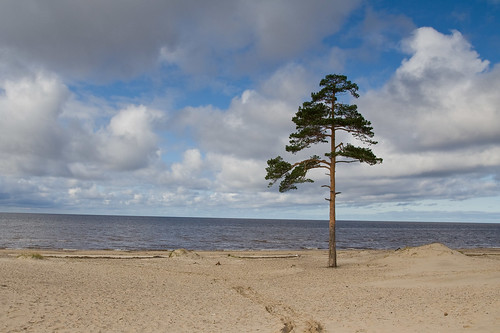
It is well known that
1) People generally travel with other people, such as their friends and family, rather than alone. There is a lot of data to support this.
2) Japanese tourists are more likely travel in group tours more than those from Western countries. In a survey of about 550 Chinese, Japanese, Korean, and North American tourists visiting Thailand and Australia by Linda Osti, in 2007. It was found that Japanese were second most likely to travel in package tours, after the Chinese, and approximately twice as likely to travel as part of a package tour when compared to US citizens (see green bars in the graph from Osti, 2007, p128, below).

Of visitors to Hungary in 1994, 25.3% of Japanese and only 6.1% of all other tourist were part of a package tour (Balaz & Mitsutake, 1998, p439). Of travellers to Melbourn Australian in 1996, Japanese were far more likely than Australian and, about twice as likely as US, Canadian and Chinese tourists to be travelling on a package tour (see graph compiled from the data in table 1, Turner, Reisinger, & McQuilken, 2002, below).

3) On the other hand, however, in answer to the survey question do you "Prefer to travel with friends rather than alone" only 59% of Japanese men replied in the affirmative. In the same survey as quoted first above, "the Japanese are the least likely to travel with a partner of with the family: only 3% travelled with the family and 16% with a partner, while 33% travelled alone and 41% with friends. North American travellers are most likely to travel with a partner (32%)" (Osti, 2007, p129) .In other words, perhaps, Japanese travel in groups but on their own. There are economic/convenience advantages to travelling in groups. There may be aesthetic, emotional and cultural advantages to travelling alone.
In Japanese literature, specifically Matsuo Basho's travelogue (Matsuo, 1997), there is an aesthetic of loneliness. Bashou writes寂しさや須磨に勝ちたる浜の秋 Lonliness, Even more than Suma, The pine on the beach
Suma is a famous place in what is now Hyogo prefecture, where one of the last of the Heike clan was defeated, and the pine is referred to in a poem written in the tenth century, to commemorate which Basho is visiting this lonely spot. Indeed, the whole travelogue expresses the famous sabi aesthetic (of wabi sabi fame), the central characteristics of which is the appreciation of loneliness.
Wabi and sabi are notoriously difficult to translate. Many Japanese are of the opinion that non-Japanese can not appreciate the emotions that these words express. They are related to Buddhism. It seems to me that they are not too complicated, but admittedly not mainstream outside of Japan (Powell, 2004).
The central part of this aesthetic is the appreciation of the ephemeral nature of existence. E.g. an early Japanese travel diary writer wrote, in about 975 AD (Ihonushi),
"Ideally, I would like watch flowers in spring, and the red leaves in autumn, smelling nature and yet without a wish to make any of these my own, and look upon the dew at dawn and the moon in the evenings sky and from them learn of the impermanence of the world. "
There are those that claim that culture or at least all mainstream traditional cultures attempt to hide mortality. No culture could fight wars (and thus win against other cultures) unless it hid mortality from its members (Solomon, Greenberg, Schimel, Arndt, & Pyszczynski, 2004).
Be that as it may, there is something about Japanese culture that seems to want to encourage its members to realise their mortality, to look at falling leaves, dew, and cherry blossom, and from them realise the impermanence of existence, including their own.
And part of this aesthetic seems to me to include, travelling alone, and realising ones loneliness. A painful, in a sense masochistic but at the same time honest, true, endeavour aimed at going beyond the illusions that culture usually provides us of our immortality. To break the illusion of our immortality we must face up to change and our solitude.
So, do you prefer to travel alone or with others? Is there a wabi sabi, honest, enlightenment-orientated beauty to travelling alone, to be lonely, to realise ones isolation. After all we all change, we all die, and we all die alone. Alone is where we are going, so to appreciate its plus side, its beauty, is to overcome fear of the culturally hidden inevitable.
Bibliography created with Zotero
Balaz, V., & Mitsutake, M. (1998). Japanese tourists in transition countries of Central Europe: present behaviour and future trends. Tourism Management, 19(5), 433–443.
Matsuo, B 松尾芭蕉. (1997). 芭蕉自筆奥の細道. (上野洋三 & 桜井武次郎, Eds.). 岩波書店.
Osti, L. (2007). Travel guidebooks and the independent traveller in the Asia Pacific Region (Ph.D. Thesis). VIctoria University, School of Applied Economics, Faculty of Business and Law, Victoria, NSW, Australia. Retrieved from http://vuir.vu.edu.au/1496/1/Osti.pdf
Powell, R. R. (2004). Wabi Sabi Simple: Create Beauty. Value Imperfection. Live Deeply. Adams Media.
Solomon, S., Greenberg, J., Schimel, J., Arndt, J., & Pyszczynski, T. (2004). Human awareness of mortality and the evolution of culture. In M. Schaller & C. S. Crandall (Eds.), The Psychological Foundations of Culture (pp. 15–40).
Turner, L. W., Reisinger, Y. V., & McQuilken, L. (2002). How Cultural Differences Cause Dimensions of Tourism Satisfaction. Journal of Travel & Tourism Marketing, 11(1), 79–101. doi:10.1300/J073v11n01_05
Labels: nihonbunka, 日本文化
Friday, April 27, 2012
Flower-place: Heisig, Nishida and Zeami

The plant on my window ledge
That I planted last autumn
Will bloom in spring
But there will be no body there
To see it
This is, literally, too sad! I will come back to this point at the end.
Yesterday I attempted to read two excellent articles by James Heisig, (Heisig, 2004 and 2010, both online) the renowned author of two of the most famous books for students of Japanese, "Learning the Kanji," and professor of philosophy at the Nanzan Institute of Religion and Culture. I am of course academically a million miles away, and yet I feel jealous. Fortunately, I was consoled by the fact that 'there is always someone above the person above' as they say in Japan, and in this case, that would be the subject of these two papers: Nishida Kitaro. Both papers were very interesting, very good introductions to Nishida but rather critical.
In the first, (Heisig, 2004) after expressing his doubts regarding the confidence with which Nishida expressed his ideas, professor Heisig likens Nishida's thought to medieval European mysticism, a genre of thought that he seems to feel is something from which we need to move on.
Heisig writes, "If I had to focus these general impressions on a single idea running through Nishida’s writings, it would be his almost superstitious belief in the fundamental unity of consciousness and reality: a belief never questioned, never proved, never even argued, and yet never very far from his mind. "
Heisig claims that like medieval European thinkers, such as Eckhart and Cusanus, Nishida located the infinite in the finite world, in the experience of a sphere without edges, a single world, or mental mirror, both terms given in the Latin of medieval scholars, ”unus mundus” and ”speculum mentis” respectively. Secondly Nishida finds a unity in the “identity of absolute contradictories,” which is shared by medieval philosophers though in a different way, the latter by appeal to an infinite god. Finally Heisig questions the purity of Nishida's pure experience, wondering I think whether from with the god of the medieval mystics it has yet to be distilled. Wow. I did not really understand, or agree, but I was very impressed.
Following on from this, I feel, in the second paper Heisig questions how Nishida's place, referred to several times as a mirror, can act as a unifying principle rather than the the 'blooming buzzing confusion' found in William James. Heisig complains (quite rightly in a way I think) about the lack of scent or smell in Nishida's 'place' despite the fact that it is found in Zeami's notion of "flower" which grows from the same Buddhist ground. Heisig finds Nishida's logic of place which "relies throughout on images of space and sight" (p.), "thanks the primacy given [to the] sense of sight."(p.)
I am just loving Heisig's version of Nishida and agree with everything that I understand, except the rather harsh criticism. I am looking forward to reading lots more Nishida. I was inspired to make a picture of a blooming, buzzing confusion, superimposed with Zeami's Kanji for flower, which I have called flower-place. I think that Heisig was spot on to point out the parallel between Zeami's flower, Nishida's place, and that both have something to do with an appreciation of Kanji - which Heisig has in abundance.
When reading the second paper, I was kind of trembling with excitement (!) because I thought that Heisig would come to the same conclusion as my own: that the unifying principle in Nishida's logic basho is indeed supplied by Zeami in riken no ken(Yusa, 1987), or the ability to see oneself. Zeami claimed that practising Noh allowed the actor to see himself from the perspective of the audience. In Heisig's discussion of Nishida's "mirror" it comes across as all blooming, and confusing, but perhaps that is to forget that Nishida's place is a flower-place: the sort of "mental mirror" that no only reflects but is seen, and means something.
Returning to the blooming confusion of William James, the Western answer to the provision of unity to the experience is as provided by Mead(1967), through the action of the rational intellect, or more precisely through speech. Speech enables us to express ourselves and hear, and understand, that which we express from the point of view of others, and thus to have meaning. Meaning is found in this our ability to hear from the point of view of others, ever more universal, in the sound box of our mind. Mead rejected the idea that humans could reflect visually without the aid of a mirror, and says that such visual introspection, and meaning making is limited to actors.
"Is is only the actor who uses bodily expressions as a means of looking as he wants others to feel. He gets a response which reveals to him how he looks by continually using a mirror. He registers anger, he registers love, he registers this that or the other attitude and he examines himself in a glass to see how he does so." Mead, 1987, p66-67)
In my own very limited research (Heine, Takemoto, Moskalenko, Lasaleta, & Henrich, 2008) we have shown that that the ability to see oneself is not limited to actors, Noh or otherwise, but to Japanese in general. A seminar student found that this ability was particularly prevalent among those who had mastered a Japanese martial art.
Many Western semioticians and linguists (Barthes, 1977; DeFrancis, 1989; McDonald, 2009; Unger, 1990) however, are quite categorical or even vehement in their dismissal of meaning in vision. They claim that for any meaning that is more than rudimentary, visual meanings have to be pass through the vector of spoken words. This debate has become positively passionate (see Lurie, 2006) in the field of sinology on the part of those that critique the "ideographic myth" (see Hansen, 1993).
In the Chinese language each Kanji has a different sound, so the phono-centric myth is more plausible. Japanese is perhaps alone in using Kanji alongside multiple readings. I do not know how Zeami pronounced the Kanji in the image above, "ka" or "hana," and I don't say either when I see it, but I do know that he used it to mean something like the background of the image. So when sinologists like DeFrancis (1989) claim that it visual meaning is "unthinkable," what I think that they mean is that they can not think see those characters from the viewpoint of another, and can not integrate them with the phonetic medium of their thought, their selfing (McAdams, 1997). For those in this mode of self, there can be no meaning, and no unifying principle in the visual.
It is this ability to simulate the consciousness of another that allows one to mean to oneself and create a self for oneself. At the limit the self may be expunged, but the ability to see or understand, the God part of the equation, is only subsequently expunged.
The important point is that it comes with practice. Language does not come with a mirror built into it, and nor are Japanese born with a mirror in their heads. Westerners learn to "express themselves," define their objectives, debate, and think objectively by thinking about how others would hear their expressions, definitions and oration. Japanese people, through different kinds of practice and attention learn to see from the eyes of the world. These different types of practice give rise to different types of unifying ability, different kinds of "God." Not that the Japanese do "God" exactly. In Japan the notion of God is more often replaced especially these days with the notion of loving 'ancestors' those by whom we have been predeceased.
I like to think that in a way Nishida's wife saw his flower when it came into bloom.
Bibliography
Barthes, R. (1977). Elements of Semiology. Hill and Wang.
Hansen, C. (1993). Chinese Ideographs and Western Ideas. The Journal of Asian Studies, 52(02), 373–399. doi:10.2307/2059652
Heine, S. J., Takemoto, T., Moskalenko, S., Lasaleta, J., & Henrich, J. (2008). Mirrors in the head: Cultural variation in objective self-awareness. Personality and Social Psychology Bulletin, 34(7), 879–887. doi:10.2307/2059652 http://www2.psych.ubc.ca/~henrich/Website/Papers/Mirrors-pspb4%5B1%5D.pdf
Heisig, J. W. (2004). Nishida’s medieval bent. Japanese journal of religious studies, 55–72. nirc.nanzan-u.ac.jp/publications/jjrs/pdf/674.pdf
Heisig, J. W. (2010). Nishida’s Deodorized Basho and the Scent of Zeami’s Flower. Frontiers of Japanese Philosophy 7: Classical Japanese Philosophy (p. 247–73). Nagoya: Nanzan Institute for Religion and Culture. Retrieved from nirc.nanzan-u.ac.jp/staff/jheisig/pdf/Nishida%20and%20Zea...
Lurie, D. B. (2006). Language, writing, and disciplinarity in the Critique of the ‘“Ideographic Myth”’: Some proleptical remarks. Language & Communication, (26), 25–269. Retrieved from www.columbia.edu/~dbl11/Lurie-LangWritingDisc.pdf
Mead, G. H. (1967). Mind, self, and society: From the standpoint of a social behaviorist (Vol. 1). The University of Chicago Press.
McAdams, D. P. (1997). The case for unity in the (post) modern self. Self and identity: Fundamental issues, 1, 46–78.
McDonald, E. (2009). Getting over the Walls of Discourse: ‘Character Fetishization’ in Chinese Studies. The Journal of Asian Studies, 68(04), 1189. doi:10.1017/S0021911809990763
Unger, J. M. (1990). The Very Idea. The Notion of Ideogram in China and Japan. Monumenta Nipponica, 45(4), 391–411.
Yusa, M. (1987). Riken no Ken. Zeami’s Theory of Acting and Theatrical Appreciation. Monumenta Nipponica, 42(3), 331–345.
Labels: buddhism, eye, image, japanese culture, mirror, nihobunka, nihonbunka, occularcentrism, reversal, Shinto, specular, 日本文化
Tuesday, April 24, 2012
Nostalgia in Premodern Japan

I claim that the the Japanese love of historical theme parks, such as Furusato (home-towns/villages), Heide in Switzerland, Beatrix Potter in the UK, Anne of Green Gables in Prince Edward Island Canada, is indeed because the Japanese are attracted to nostalgia. But I believe the Japanese always have been wallowing in nostalgia because nostalgia is just pandemic in Japan. In the UK nostalgia is for old folks like myself, but in Japan even young people - e.g. my students - like to proclaim that something is "natsukashii!" (nostalgic). Things do not need to be all that old to be nostalgic. Indeed it helps if they are not so that young people can remember them.
The Japanese love of nostalgia has nothing to do with the West.
The point I want to make is that the Japanese interest in nostalgia has little to do with a yearning for a pre-modernised, pre-Westernised Japan. The Japanese have been into nostalgia for a long time, well before anything that might be described as modern or western and an impact upon Japanese society. Nostalgia lies on the same emotional seam as wabi, sabi and aware, the wet, masochistic love of the unfolding of time, as manifested in solitude and decay, and the Japanese were into this aesthetic since the dawn of recorded history.
In one of the earliest travelogues (Zouki, c975) and the earliest poetic diary describing a pilgrimage the author visits places significant in Japanese mythology, and reminisces about the time of the gods all the while typically Japanese aesthetic enjoying the impermanence of things.
ねがはくはわれ、春は花を見、秋はもみぢを見るとも、にほひにふれ色にめでつる心なく、朝の露夕の月をみるとも、せけんのはかなきことををしへ給へ。
If possible I would like watch flowers in spring, and the red leaves in autumn, smelling nature and yet without a wish to make any of these my prize, look upon the dew at dawn and the moon in the evenings sky and from them learn of the impermanence of the world.
Seven hundred years later, in 1689, the post travelling poet, Matsuo Basho waxes lyrical about ancient "ruins" (see Hudson, 1999, p1-2) as mentioned in a previous post. Basho visits sites where there is nothing to see but grass, and is moved to weeping by a sense of nostalgic impermanence.
At a stone commemorating a castle long since destroyed, Basho writes, "Time passes and the world changes. The remains of the past are shrouded in uncertainty. And yet, here before my eyes was a monument which none would deny had lasted a thousand years. I felt as if I were looking into the minds of the men of old...I forgot the weariness of my journey and was moved to tears of Joy." (Keene, 1955, p366 in Hudson, 1999, p1) .
And in one of his most famous poems composed at site of a once famous samurai family, where now only summer grass remains, he writes (Basho, 1997):
夏艸や兵どもが夢の跡 Summer Grass, Warriors, Trace of their dreams
Donald Keene (1999) claims that Basho was so into nostalgia, or at least reliving literary precedent, that he only commented on scenes that had been mentioned by previous poets.
"He (Basho) had absolutely no desire to be the first ever to set foot atop a mountain peak or to notice some site that earlier poets had ignored. On the contrary, no matter how spectacular a landscape might be, unless it had attracted the attention of his predecessors, the lack of poetic overtones deprived it of charm for Basho. When, for example, he travelled along a stretch of the sear of Japan coast that inspired no important poems, he did not mention the scenery" (Keene, 1999, p 311 in Watkins, 2008, p101).
Another 250 years later a cultured traveller Kikushi Tamiko (1821) set off "in a cultural quest for the locations and events made famous by the texts that she had read"(Nenzi, 2004, p). Once again, her criteria of selection "in terms of its presence (or absence) in the pages of classical literature," (Ibid, p291). The innate beauty of the destination did not matter because, according to Nenzi (ibid), "For culture travellers, the essence of the experience of meisho [named-places] was to recover "the idea behind" rather than to delve into the present substance of the sight."
Basho was clearly not alone, but part of an immense tradition that he helped to perpetuate. When a lowly warrior was sent from Kurume City (my old town) to Tokyo, then Edo, in 1839 as part of the alternate attendance/hostage system (Sankinkoutai), he wrote in his diary "While in Edo, we may also go to see the places where Basho visited, and this brings on great nostalgia."(Aoki, 2005, in Vaporis, 1996, p296)
At about the same period, more than a decade before the opening of Japan to the Wet, the Suma Diary (Kagawa, 1847) details a trip to Sumaura in what is now Hyougo Prefecture, to the ruins of the palace of one of the poets whose poem was featured in the famous collection of 100 poets used on Japanese playing cards, originally from the second most famous old book of poetry (Saeki, 1981).
Here below is the excerpt from the travel diary above, translated with a little help from my Japanese wife, and with my attempt at a modern Japanese, non poetic version in brackets.
願ひし須磨の浦につく。 (願った行き先である須磨の浦に到着しました。)
I arrive at Suma Bay, the place I had been yearning to reach.
先ここよりの見渡し。海上のけしき。(この先からの見渡しは海上の景色)
The view from here is out over the sea.
更に類なし。只あはれあわれと見るのみ。(類がないほど、ただ哀れみな光景だけを見る)
There is nothing like it. Just a wilderness of water.
中々に事の葉に。言続けむも。今更びたり。(書き続けてもなかなか言葉になりません。)
It is not easy to put into words, even if I go on talking. And even now??
家毎に。かの竹簾かげ下ろして。故ありげに住みなしたる。(家ごとにその竹のすだれが下ろされて、理由があるかのように住み。。。。?)
At each house the bamboo blinds are down. As if they have a reason for (not) living here?? (Maybe suggesting that they are waiting).
いかでかゝげ寄らまほしきまで。なつかし。(さっぱり分かりません。懐かしい!)
???? Nostalgic.
案内の翁を雇ひ出たり。先にたして行く行く語らく。あれ見給へ。かの小さき山こそ。(おじいさんの案内者を雇って出発しました。語りながら先に進んでいった。あれ見てよ。この小さい山こそ!
I hired an old man guide. We went on together talking. Look at that. At that little mountain there.
中納言行平の君。この浦に汐くみしておはせし時。(中納言行平という昔の偉い詩人がこの浦から汐をくみにきたとき)
When Lord Yukihira Chunagon went to get water from the bay.
立帰りいなばの山のと。((百人一首にでる)「立ち別れの因幡の山」のことですよ!)
This is the Inaba Mountain in the poem (one of the 100 that are told at new year).
ながめ給し濱にて侍れ。(眺めて、濱においで??)
Stare and go (come?) from/to the beach.
いでとく書きとめ給へなどを。?えもあらぬくさぐさの事をいふなむ。(??)
?????
中々興ある。さるあひだ。(中々興味深い。???)
Very interesting! ???
須磨寺を始め。内裏の跡。一の谷。(須磨というお寺を始め、中納言の宮殿の奥の部分の跡。一の谷?)
Starting with Suma Temple, the ruins of the palace, and the Ichinotani battlefield.
上の秋草をさへ。かぞへ見廻りて。(その跡の上に生える草をさえ数えるかように見回っていた)
I even started to count the autumn grass above (the ruins) with my eyes.
海ばたの松陰なる。(海辺の松影になるように)
Becoming like the shadow of a pine (this may be another reference to the woman in the aforemented poem who was told to wait like a pine tree for her lord to come back to her.)
敦盛りぬしの塚を拝む。(あつもりの塚を拝む)
I prayed at the burial mound of Taira no Atsumori.
たえず浪風の音。ひヾき通ひて。(浪と風の音がたえず響き通って)
And all the while, the sounds of the wind and waves, runs through me.
昔のおもかげ。目の前に浮かびつ。(昔の面影が目の前に浮かびうがってきた)
And the memory of you, (my lord) rises before my eyes.
たちよれば君を忍ぶの草おひてあらぬ露さへおきそはりけり (たちよったら中納言の君を忍ぶ草にあった露さえ落ち添わった。)
Having paid my visit, even the dew on the grass that remembers you has increased.
(This is a reference to another ancient poem --kokinshuu, 545 -- and suggests that the author is crying and thus increasing the dew)
見る處なつかしかるぬはなし。(見るところ、光景は懐かしく思わずにいられない。)
I can't but be nostalgic about the place I am seeing.
(Corrections gratefully received!)
In other words, the author, went to some lonely spot on the coast of Japan in what is now Hyougo Prefecture, to the site of the residence of one of the poets who had been famous almost one thousand years years previously, and then, staring at sea and grass, he felt an image of that lonely, ancient, love-struck poet spring to mind. And imagining the ancient poet, this tourist wept, mega-nostalgically. Contra Urry (2002), in this most quintessentially Japanese touristic experience, there was nothing to be seen. There was only grass, only sea. There was nothing that the tourist or traveller could not have seen in many other places far nearer to home. But at the same time, the author did see, did experience nostalgia and the pity of things (mono no aware), because the traveller called images to mind.
Japanese "site-seeing" (thing seeing: kenbutsu, 見物) is about seeing but not of sights, not of external visual images, but rather of visions: physical absence juxtaposed with images in the heart.
Afterword
In order to bring the observations above back to a theory of the visual-imaginary (Takemoto, 2002), or "lococentrism" (Lebra, 2004) of the Japanese self, I might perhaps go via "phallocentrism"(Spivak, 1976). The narratival, linguistic self is that which is accompanies identification with the symbolic parent. whereas the visual-imaginary self is that which accompanies identification with the primary care giver (Lacan, 1949). I could then link nostalgia with "pay-forward" and pay-back families as I did in my last post. In order to link nostalgia with lococentrism directly, would have to create a deconstruction of the theory of place (Nishida, 1987)!
Western theorists (Mead, 1967; Lacan, 1949) insist that visual self-identification can only take place in the presence of a real other (mirror or person) and that the subject is thus never free to develop or simulate an objective, generalised view on self. While the visual is decried in this way language is seen to provide a "generalised" (Mead, 1967), capitalised (Other, Lacan, 1998), "super" (Bakhtin, 1986) objective 'perspective' on self a priori. Above all, visual self-views are almost always considered to be external (e.g. Cohen & Gunz, 2002), whereas linguistic representations of self are seen to be somehow inherently private or at least internalisable (for exceptions see Duranti, 1986; Koster, 2009; Wittgenstein, 1973, and to an extent Derrida).
Derrida sees nostalgia (Derrida, 1998, p240) as a desire for time before language, "[The] Dream of a mute society, of a society before the origin of languages, that is to say, strictly speaking, a society before society." From a position within the logocentric tradition that he is critiquing, Derrida, sees this nostalgic longing for self presence, or authenticity, as a longing for self before self. This critique is founded in the impossibility of non-linguistic self-reference (or even non-referential self-reference).
Accepting this contradiction, Nishida (1987) argues that a phenomenological -- and I would say viso-imaginary -- self-experience can be achieved even as, or especially once, language is expunged. Once language is externalised, it is possible to experience an "absolutely contradictory self indentity:" self as the immediate environment, self as place. Japanese tourists aim to achieve this kind of pre-symbolic authenticity, by visiting the symbolic sites, sights which have themselves become markers, deliciously, from a Japanese viewpoint, "encrusted with renown" (Culler, 1988, p8 in the online version).
Words do always result in "differance" (Derrida, 1998), but images are not "timed"(contra Fenollosa & Pound, 1936). Whereas words are always differed, mean something in the future, images are always of something recalled, already in the past. The Japanese tourist is not loving any image real or imagined, but the place in which it appears.
Hmm, really riffing here...Derrida says that the phoneme results in differance. But while phonemes do exist in time they only point forwards in time under the assumption of a static presence or place. If he insists on any before and after then Derrida is as nostalgic as Rousseau, or our tourist. It is the admixture of place that makes the phoneme forward speaking. Conversely it is the removal of temporally differing language that makes the place, the mirror shine brightest in recollection of the past.
Incidentally, the opposite of nostalgia is hope and we, Westerners, are awash with it. I am hoping I make sense one day:-)
Bibliography
Ashkenazi, M. (2001). Omiyage: Constructed Memories and Reconstructed Travel in Japan. In H. Walker (Ed.), Food and the Memory: Proceedings of the Oxford Symposium on Food and Cooking, 2000 (p. 31). Oxford Symposium.
Aoki, N. 青木直己. (2005). 幕末単身赴任 下級武士の食日記. 日本放送出版協会.
Askew, R. K. (2007). The politics of nostalgia: museum representations of Lafcadio Hearn in Japan. museum and society, 5(3), 131–147.
Bakhtin, M. M. (1986). Speech Genres and Other Late Essays. (V. W. McGee, Trans.) (Second Printing.). University of Texas Press.
Cohen, D., & Gunz, A. (2002). As seen by the other...: perspectives on the self in the memories and emotional perceptions of Easterners and Westerners. Psychological Science, 13(1), 55–59. Retrieved from http://web.missouri.edu/~ajgbp7/personal/Cohen_Gunz_2002.pdf
Culler, J. D. (1988). The Semiotics of Tourism. Framing the sign. Univ. of Oklahoma Pr.
Derrida, J. (1998). Of Grammatology. JHU Press.
Hudson, M. (1999). Ruins of identity: ethnogenesis in the Japanese Islands. University of Hawaii Press.
Fenollosa, E., & Pound, E. (1936). The Chinese written character as a medium for poetry: a critical edition. Fordham University Press.
Gerster, R. (2006). The past as a foreign country: nostalgia and nationalism in contemporary Japanese tourism. Tourism Review International, 9(3), 293–301.
Keene, D. (1999). Travelers of a Hundred Ages. Columbia University Press.
Koster, J. (n.d.). Meaning and the extended mind. 2009. Retrieved from http://www.let.rug.nl/koster/papers/extended%20mind.pdf
Lacan, J. (1949). The mirror stage as formative of the function of the I as revealed in psychoanalytic experience. Cultural Theory and Popular Culture. A Reader, 287–292.
Mead, G. H. (1967). Mind, self, and society: From the standpoint of a social behaviorist (Vol. 1). The University of Chicago Press.
Nishida, K. 西田幾多郎 (1987). 場所. in 上田閑照編 西田幾多郎哲学論集〈1〉場所・私と汝 他六篇. 岩波書店.
Nenzi, L. (2004). Cultured Travelers and Consumer Tourists in Edo-Period Sagami. Monumenta Nipponica, 59(3), 285–319.
Rea, M. H. (2000). A Furusato Away from Home. Annals of tourism research, 27(3), 638–660.
Robertson, J. (1988). Furusato Japan: the culture and politics of nostalgia. International Journal of Politics, Culture, and Society, 1(4), 494–518.
Saeki, U. 佐伯梅友. (1981). 古今和歌集. 岩波書店.
Spivak, G. C. (1976). Translator’s preface. Of Grammatology, 9–38.
Takemoto, T. (2002). 鏡の前の日本人. ニッポンは面白いか (講談社選書メチエ. 講談社.
Vaporis, C. N. (1996). A Tour of Duty: Kurume hanshi Edo kinban nagaya emaki. Monumenta Nipponica, 51(3), 279–307.
Urry, J. (2002). The Tourist Gaze. SAGE.
Watkins, L. (2008). Japanese Travel Culture: An Investigation of the Links between Early Japanese Pilgrimage and Modern Japanese Travel Behaviour. New Zealand Journal of Asian Studies, 10(2), 93–110.
Diary and Poems
Kagawa, K. 香川景周. (1847). 須磨日記 (Suma Diary my trans). In 岸上質賢 (Ed.) "續紀行文集". Retrieved from books.google.co.jp/books?id=qKk9as-h84kC&printsec=fro...
【百人一首講座】立ち別れいなばの山の峰に生ふる まつとしきかば今かへり来む─中納言行平 京都せんべい おかき専門店【長岡京小倉山荘】. (n.d.). Retrieved April 24, 2012, from www.ogurasansou.co.jp/site/hyakunin/016.html
Kokinshuu 古今和歌集の部屋. (n.d.). Retrieved April 25, 2012, from http://www.milord-club.com/Kokin/uta0545.htm
Matuso, B. 松尾 芭蕉. (1997). 芭蕉自筆奥の細道. (上野 洋三 & 桜井 武次郎, Eds.). 岩波書店.
Labels: image, japan, japanese culture, Jaques Lacan, lacan, logos, mirror, nihobunka, nihonbunka, occularcentrism, specular, westernisation, 日本文化
Tuesday, April 17, 2012
Retro Confectionary as Japanese Nostalgia
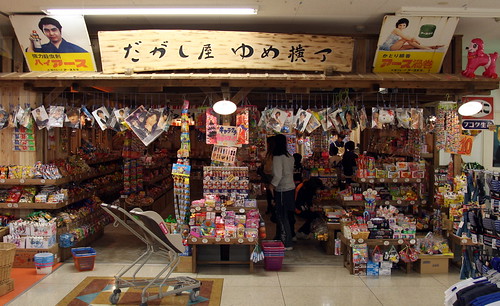
Tourism theorists (Creighton, 2009; Guichard-Anguis, 2009a, 2009b; Tomomitsu-Tomasson, 2005) point out that the Japanese want to visit hometown mountains (satoyama), "Edoic" (Creighton, 2009) places, and traditional Japanese hotels (ryokan, see Guichard-Anguis, 2009). This is due in part to the Westernisation of Japanese society, and the nostalgia for the lost traditions of Japan. This sweet shop is motivated in part by the same social phenomenon.
The problem with this theory, that Japanese nostalgia is for a Pre-Western(ized) authentic Japanese self, is that, as reported in the same literature (Hudson, 1999 see Plutschow, 1981, p1-2; Nenzi, 2994) the Japanese were into nostalgia, and travelling for the purpose of nostalgia from well before the arrival of Western influence. Matsuo Basho was wallowing in nostalgia in the seventeenth century, continuing a tradition that had continued for centuries before, well before Japan became Westernised. Nostalgia is and, for millennia, always has been big in Japan.
Another reason for the popularity of retro confectionery is because nostalgia is just big in Japan. I think this is partly because of the structure of the Japanese family. In the West we make our children sleep alone, prioritizing the relationship between the parents over that between parents and children. As the standard Freudian interpretation would have us know, Western children grow up looking forward to the time when they can have a home, and a bedroom of their own. British children are forced to invest in their future. They have a nest egg to look forward to.
In Japan however, the relationship between parents and children (or at least between mothers and children) is prioritised over that between the parents. The children are treated with considerable indulgence. Japan is overall a very child friendly society. The Japanese are kind to their children. This sounds all very well and good but, when Japanese adults grew up however, they are socially required to repay the debt that they incurred as children. Japanese children are forced to take out a loan. But what can they look forward to? Nostalgia, for the time when they were loved as children. I think that this is another reason why sweet shops that sell treats from the generation before are so popular.
This pack-back (Japan) v.s. pay-forward (the west) dichotomy is to my mind one of the biggest differences between Western and Japanese society. Of course, there are all sorts of variations within both cultures too.
Bibliography
Creighton, M. (2009). The Heroic Edo-ic: Travelling the History Highway in Today’s Tokugawa Japan. In A. Guichard-Anguis, O. Moon, & M. R. del Alisal (Eds.), Japanese Tourism and Travel Culture (1st ed., pp. 37–75). Routledge.
Guichard-Anguis, S. (2009). Japanese Inns (Ryokan) as Producers of Japanese Identity. In A. Guichard-Anguis, O. Moon, & M. R. del Alisal (Eds.), Japanese Tourism and Travel Culture (1st ed., pp. 76–101). Routledge.
Hudson, M. (1999). Ruins of identity: ethnogenesis in the Japanese Islands. University of Hawaii Press.
Nenzi, L. (2004). Cultured Travelers and Consumer Tourists in Edo-Period Sagami. Monumenta Nipponica, 59(3), 285–319.
Plutschow, H. (1981). Four Japanese Travel Diaries of the Middle Ages. Cornell Univ East Asia Program.
Tomomitsu-Tomasson, J. (2005). Furusato and Theme Parks: Cultural Authenticity and Domestic Tourism. Furusato and Theme Parks: Cultural Authenticity and Domestic Tourism. Unpublished essay submitted for coursework: The Tourist Gaze, Department of Sociology, Lancaster University. Retrieved April 15, 2012, from www.lancs.ac.uk/postgrad/tomomits/authenticity.pdf
Labels: nihobunka, nihonbunka, 日本文化
Tours Galore: The Variety of Japanese Domestic Tourism
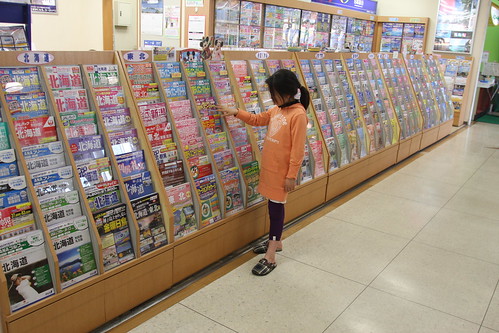
It can also be argued on the contrary (e.g. Hendry & Raveri, 2002) that Japanese leisure activities demonstrate the myth of Japanese homogeneity, and I agree. Just look at the choice available here and this is just domestic tourism. Furthermore, as Hendry (Hendry, 2009. p132) points out, with all the foreign country themed parks, it is possible to do a fantasy world tour with out leaving Japan. The variety of Japanese leisure activities are phenomenal.
A package tour does not necessary imply that one travels in a group only that the tour operator has purchased the elements of the package in bulk. As soon as one gets off the plane, bus, or train, one may act individually, almost unaware of the fact that there are others that have rooms at the same hotel, or tickets to the same museums.
It is true that the Japanese are more likely to go on package tours than American tourists, but there are more advantages to travelling in groups than collective conformism. No matter which way you cut it, package tours offer economies of scale (Mak, 2003) so unless you are so obsessed with "expressing your individuality", (Markus, Uchida, Omoregie, Townsend, & Kitayama, 2006) or have such fear of the collective, that you are prepared to pay through the nose to avoid a group tour, the straightforward individual who is not hung up on her individuality, will choose a package tour that suits her preferences because packages are cheaper, and Japanese tour operators offer variety in abundance.
Bibliography
Graburn, N. H. H. (1983). To pray, pay and play: the cultural structure of Japanese domestic tourism. Université de droit, d’économie et des sciences, Centre des hautes études touristiques.
Hendry, J., & Raveri, M. (2002). Japan at play: the ludic and the logic of power. Routledge.
Kato, A. (1994). Package tours, pilgrimages and pleasure trips’. The Electric Geisha: Exploring Japan’s Popular Culture. Tokyo: Kodansha International.
Mak, J. (2003). Tourism and the Economy: Understanding the Economics of Tourism. University of Hawaii Press.
Markus, H., & Kitayama, S. (1994). A Collective Fear of the Collective: Implications for Selves and Theories of Selves.
Markus, H. R., Uchida, Y., Omoregie, H., Townsend, S. S. M., & Kitayama, S. (2006). Going for the Gold Models of Agency in Japanese and American Contexts. Psychological Science, 17(2), 103–112. doi:10.1111/j.1467-9280.2006.01672.x
Labels: collectivism, individualism, japan, japanese culture, nihobunka, nihonbunka, 個人主義, 日本文化, 集団主義
This blog represents the opinions of the author, Timothy Takemoto, and not the opinions of his employer.