
Thursday, July 07, 2011
Sur-naturalism

Sur-naturalism is the Japanese tendency to attempt to make nature even more natural than nature itself. Here the branches of trees in our garden have been pruned in such a way as to make them more wiggly, by cutting off the main branch and allowing the branch to continue to grow along alternating sub-branches.
The same tendency to reduce the "human" "geometrical" and increase the persceived, natural majesty of plants may be present in the art of Bonsai and the way that garden conifers are cut into bobbly pagodas. In each case a smaller plant is made to emulate a larger one. Garden layouts also deliberate eschew lines and pursue "sur-random" pairings of plants and rocks.
Ruth Benedict pointed out this tendency to attempt to arrange nature to conform with human notions of what nature should be. Quoting from a "A Duahgter of the Samurai" Benedict writes, “every morning Jiya wiped off the stepping stones, and after sweeping beneath the pine trees, carefully scattered fresh pine needles gathered from the forest." (Benedict, 1946) Lummis (2007) points out that it was sur-naturalism that Benedict assumed the Japanese would be glad to be free of. Benedict could not have known how beautiful the Japanese thought it.
Labels: nature, nihobunka, nihonbunka, 日本文化, 自然


Thursday, June 30, 2011
Obake by Kyosai

Via Flickr:
Another Japanese monster comes out of the image from here. For others click on ringu.
I believe that Japanese are identified with their bodies, or self image from the perspective of their universalised eye of the other (e.g. secularly "Seken no me" or religiously, the sungoddess' mirror). Images of people are therefore, as well as being anthropomorphised to a far greater extent (consider Japanese virtual idols, such as Hajime Miku), inherently problematic in that they give the lie to the imaginary Japanese self. When in a horror morive an image becomes real, it promotes the realisation that the viewer is also an image, and "already dead" (Lacan, and Sixth Sense:-).
How quickly can I explain my understand of Lacan and Japanese culture?!
The internalisation of an other is essential for self. Humans gain their sense of self by internalising the perspectives of others, first their parents, and then more generally and learning to see themselves, and identify with these internalised-external perspectives. These "selves" give individuality just as they take it away. Self is gained at the price of internalising others, or the other. Self is gained at the price of morality.
Most Western theorists, such as George Herbert Mead, argue that the internalisation of the other is fully or effectively achieved only in Language. They assume this to be the case based on the fact that phonetic speech *only needs to be said to be heard*, it bends around, it does not need a mirror, they point out. The self therefore is found in the experience of hearing oneself speak (Derrida's s'entred parle?).
What these Western theorist fail to note is that
1) As a mental experience, self representations in language are no more inherently reflected than self-representations in images. One only needs to think "I" as to experience the thought, true. But one only needs to imagine oneself as to experience that imagining.
2) There is no necessity entailed in speech, vocal or mental, that requires the vocaliser or thinker to identify with self speach. This identification is cultural. We Westerners are taught to identify with ourselves as meanings. And people can be taught to identify with themselves as imaginings, as I argue they are in Japan.
In either case there needs to be cultural encouragement to agregate and care about the aggregation of either linguistic or imagined views upon self.
Lacan was a obscurantist, and I understand little of what he had to say but he says things that (alas!) I can't find in any other author.
1) That both linguistic and imagined self-representations are possible.
2) That the self is believed in due to the percieved intersection of these two forms of self-representation.
We ignore the fact that sound never comes from vision, that there is no essential difference between speech and miming (see the tragedy of those watching mimed songs in David Lynch's Blue Velvet and Mullholland Drive).
Even so, Lacan, like other Western theorists, decry the imagined. Lacan says that the imaginary world lacks the possibility of universalisation.
A person that lives in the imaginary is always trapped in binary relationships between themselves and a viewer. He is right in a way, but he did not take into account the skill with which Japanese people layer so many different imaginary self perspectives, so many eyes, to achieve as much autonomy, or almost as much autonomy, as those that aggregate the ear of the other.
In both Japanese and Western culture there is a drive towards purifying the self of either the linguistic or imaginary. Westerners "should" be purely worded. Japanese should be purely un-worded and imagined.
But in both cultures, the absence of the other-style of self-recognition is self-destroying; both are needed to maintain the illusion of self.
The Japanese are far happier with the realisation of truth. Their greatest and finest look the void in the eye. But for the rank and file, for anyone, loss of self is terrifying. To realise that ones self is only a self-represtantion, a dead thing, an externality, is both liberating, and the
greatest horror.
And here, in the above image, is that horror. The image comes to life, and tells us that the, our image, is only an image.
When the words stop, when the telephone is just a recording (chakushin ari), or noise (ringu), and the image comes to life (above), one is faced with the lie and the terrifying truth.
Another cool thing about Lacan is that he associated the visual with the motherly and language with the fatherly. We live in our mothers eye, and our father's ear. "Fathers" are a social linguistic construct and "mothers" are the people that looked at us, reared us. It is for that reason that the superego is dad, and the Lacanian Other is the topos of name of the father, and that the monsters that come out of the image in Japanese horror are women. I think that this ghost, in the above image, is a woman.
Labels: horror, nihobunka, nihonbunka, specular, taboo, tabuu, theory, 日本文化
Tuesday, June 28, 2011
The Mind of Manufacturers

Via Flickr:
This is a book intending to encourage university graduates to go into the "thing-making, " manufacturing industry, introducing the mindset of those in the industry. Manufacturing as a profession is popular in Japan, not considered back stage and a little dirty as it may be in the UK.
Japanese people that work in manufacturing are proud to wear their manufacturing workers uniforms, as shown on the image on this cover. Those that take pride in expressing themselves, their apititutes, their creations, and their affiliations visually, as the Japanese do, are good at making-things as the Japanese are.
While I love Brian McVeigh's book "Wearing Ideology" it tends to over-emphasise the external source and oppressiveness of the "ideology," (though he does talk about negotiation) rather than "wearing" as authentic, creative self-expression. If an American Lawyer or Computer programer were to say "I am (proud of being) a computer programmer," then this would be seen as an autonomous belief rather than a engendered ideology, because we logocentricists see words as spring from the mind. Images too spring from the mind, and find expression in Japanese manufactured goods, and uniforms.
This cover image is copyright of Recruit a Japanese recruiting company that edited and published this book.
Labels: nihobunka, nihonbunka, occularcentrism, self, specular, 日本文化, 武道, 神道
Tuesday, June 21, 2011
Externalized-Self-Gaze in Japanese Martial Arts
Noh Master Zeami points out that to master the art of Noh drama one must, through repeated attention to mimicry and form, cultivate a "Riken no Ken" (離見の見, see Yusa, 1987), a sort of out of body experience of Self.
Miayamoto Musashi in The Book of Five Rings (五輪書)says that the swordsman must learn to become and thus see himself from the point of view of his enemy (敵になると云ハ、我身を敵になり替りておもふべきと云所也).
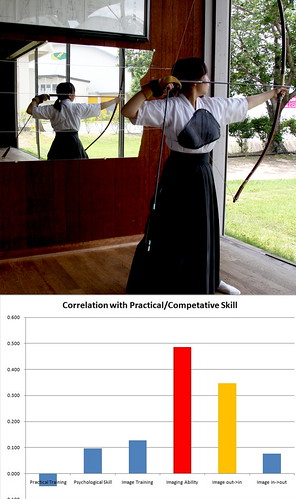
And in kyuudo (the Japanese art of archery), as demostrated by my seminar Student Ikki Yamamoto (2009) in this graduation thesis, nothing is more correlated with kyuudo performance than the ability to see oneself from the outside.
To achieve this end practioners of kyuudo practice form incessently, in front of mirros, using a sort of catapult device before they are even allowed to pick up a bow, and with a sort of brace to ensure that their feet are in the right position.
Through minute attention to form, and repeated mimicry of set positions, they gradually become so aware of their form that they are able to see it from what might be called a "third person perspective," or equally, an externalised self gaze. This ability to see oneself from what Mc Veigh aptly calls the poisition of an "invisible spook" (Wearing Ideaology, 2000) correlates most highly - more than frequency of psychical training or psychological skills and traits such as power of concentration, or desire to succeed, with the ability to do, and win at kyuudo.
I liken the Japanese martial, and Noh, "Path" (michi, 道, dou, do) to a 'different kind of trancendental dialetic." There are those such as Hegel, Plato and Lacan in the Western tradition that one can discourse ones way to a sort of higher plane. By stepping further and further back from the subjective position, one can, they claim, achieve a depersonalised, truer, transcendental. A similar thing may be going on in the Japanese martial arts.
Yamamoto, I. (2009) "Mental Training: Self Image in kyuudo." Unpublished Gradutation Thesis, The department of Tourism Studies, Faculty of Economics, Yamaguchi University.
山本一輝(2009)「メンタルトレーニング~弓道を通じた自己イメージのあり方~」未発表卒論。山口大学経済学部可能政策学科
Labels: image, japan, japanese culture, logos, martial art, nihobunka, nihonbunka, specular, theory, 宗教, 日本文化, 武道
Tuesday, June 14, 2011
Remember that Failure is Always Your Own Fault

Harsh sports philosophy from the country of "Hansei." There is no word for hansei (or "kaizen", other than "kaizen") in English. This T-shirt entitled "The Mind Set of Victors" encourages its wears to face up to their failings because it is only by facing up to them that one can improve.
Weiner, an American social psychologists on the other hand, encouraged people to pass the buck and believe that defeat was bad luck (or someone else's) fault. Martin Seligman's "Positive Psychology" encourages those that fail to blame someoone else, to pass the buck. The more that one learns to pass the buck, the more pumped and full of it one will feel, and the more that one can maintain self-esteem in the face of failiure. The more self-esteem one has the more motivated one will be, to try harded to win and improve.
The Japanese sportsman however, blames himself for his failings and thinks about how he can improve himself so that he can win next time. The most important thing is not how he sees himself (otherwise blaming himself would be painful) but winning itself, and perhaps the accolation that the winner receives from others.
These days (or perhaps for some time, for instance in the case of Naoko Takahashi's couch Koide), it is become more and more fashionable to use praise, and buck passing in Japan too. The new youth of today are not encouraged to think about their faults but are lavished with praise.
It seems to me that Japanese Educational theorists are washing Japanese culture down the toilet.
失敗の原因は常に自分の中にあると認識するべし
Shippai no genin ha tsune-ni jibun no naka ni aru to ninshiki suru beshi
Thursday, June 09, 2011
"Cut their Hands" & "Always Be Cutting": The Purity, and Ruthlessness of Miyamoto Musashi

Miyamoto Musashi remains Japan's most famous swordsman. He wrote"The Book of Five Rings," available freely on the net. Reading this excellent work, I was intrigued by its use of flexible, inductive reasoning (compare DiGrassi's five rules, which are deductive, almost laws of Physics and thus supremely intransient), and by its use of almost totemistic metaphor. Musashi recommends that swordsmen become running water, and a short-armed monkey. Above all I was struck by the by the purity, or sheer ruthlessness, of its author.
At least three (1, 3,4, and probably 5 which is a mirror of 4) of Musashi's five fundamental stances used in sword fighting, mention that their objective is to cut the hands of the opponent: no grandiose beheadings, and torso slashings for Musashi. Musashi's technique, contra that of the sports of foil and sabre, recommends "go for the corners" (extremities, p. 31), particularly cutting into an opponents arms and hands.
After explaining the fundamental five stances of sword fighting, in typical Zen influenced style, Musashi recommends "the stanceless-stance" because he says, it is not about the stance. No, on the contrary, do not think about parrying, hitting, or knocking but to paraphrase the "A.B.C" espoused by Alec Baldwin in Glengarry Glen Ross, Always Be Cutting.
Musashi writes, "whenever you cross swords with an enemy you must not think of cutting him either strongly or weakly; just think of cutting and killing him. Be intent solely upon killing the enemy."
All very good advice in a swordfight, I have no doubt.
Labels: nihobunka, nihonbunka, 日本文化
Tuesday, June 07, 2011
Totem badges Old and New

Top row: Shinto shrine amulets (omamori)
Bottom row: Kamen Rider OOO medals, Kamen Rider W Gaia Memories
Please see also an even longer history of totem badges from Australian bull roarers, through shrine amulets, seals (mitokoumon's inro) to the seal of the Shinkenja- Super sentai.
My son plays with various totem badges that are said to transmit the spirit of a supernatural entity to a person allowing them to transform into a superman of sorts. These "totem badges" seem to have much in common with the good luck amulets (omamori) available at shrines.
The seem to contain some information (written - omamori, in an RFID chip - OOO's medals, in a USB memory - gaiai memory), connected with a super-human spirit (in the case of the omamori a shinto spirit or kami, in the case of OOO's medals and gaiai memory a super animal or 'ancestral' kamen rider). This information acts as a vector between the super-being and the holder, endowing the latter with power to conquer foes, such as exams diseases and enraged aliens. They often make a noise. Rattles are popular totem badges in North America (Levi-Strauss has a page of rattles in one of his books on totemism). Bull-roarers or Churinga roar when waved around ones head. Omamori are often fitted with bells. OOO's medals, and various transformatory cards make a noise when read with a special purpose reader. Gaiai memory (and engine souls) make a noise when a button is pushed or when inserted into a sort of reader.
Do amulets change (henshin!) people? Surely not?
They all contain a message, information, or symbols, representing a supernatural entity as noted above. They are also the double of their owners. Masked Rider OOO is the double of Hino Seiji. Shoutaro Hidari uses two Gaiai memory to transform into Kamen Rider "W" (double), his double, in more ways than one. Omamori are said to work as a self-replacement (migawari), taking on the bad luck that might otherwise befall their owner.
Shintoists believed that getting a totem badge from their shrine, the sacred space of their religion, gave them a life or self or spirit. The spirit was themselves and also it was the spirit of the shrine. About 70 years after they die, the spirit merged with the spirit of the shrine, or now Buddhist temple since the cycle of spirit has been broken.
Christians have "Christian names." My name is "Timothy", which is a name from the Bible. It is primarily a phoneme. I get it from the sacred space of my ancestor's religion, and I apply it to myself, thereby perhaps taking on board bit of the God, maybe. Does having a name change me? Does it give me anything, such as a self or life (no way, surely?).
The symbols, in all cases, come from the supernatural to give something special to their recipients.
One of the first Japanese superheroes that appeared on TV, was Mirror Man (Mira-man, 1971). Appearing at the same time as the original Ultraman, he shared many of the typical characteristics of Japanese superheroes, and with Shinto. He used a Transormatory item (henshin aitem) to transformed (henshin). Mirror man use a Shinto shrine amulet (omamori). He could only transform when in front of a reflective surface, usually a mirror. He was possessed, as it were, not by a giant from outer space, but his super-human father who lives in the world of two dimensions. (Thank you James)
Image top row far left: 貝で作られたお守り :) by kozika and far right: ハローキティのお守り :) by kozika
Labels: henshin, Masked Riders, nihobunka, nihonbunka, Shinto, superhero, totemism, トテミズム, 仮面ライダー, 変身, 日本文化, 神道
Wednesday, June 01, 2011
Baby Snot Sucker
Japanese mothers tend to be even more dedicated to the cleanliness of their children, bathing *with* them, cutting their nails, cleaning out their ears at a frequency that suggests that these acts go beyond a concern purely for physical hygene, pointing to a culture of hygene and motherly pruning to achieve it. One aspect of this mothering, is in the way that Japanese mother's remove their children's nasal mucus.
Devices to remove nasal mucus from the noses of babies with colds do exist in Europe and the USA, such as "Nosefrida The Snotsucker Nasal Aspirator
 " "the "Bulb Syringe Aspirator
 " which uses a bulb rather than oral sucking and the "Graco Nasal Clear Nasal Aspirator
 " which uses a battery powered vacuum pump. They are more likely to be powered by means other than oral aspiration - sucking -and those that do use the suck to clear the nasal mucus may be called "bizarre" by commentators in the US for instance. Bodily secretions, especially faeces but nasal mucus as well I believe, tend to be more taboo in the West, compared to Japan, as previously noted.
Please note that the snot does not go into the mouth of the mother but into a vial which can be washed out. In the old days, however, I am informed that Japanese mothers used to suck their baby's snot directly into their mouths.
Many animals engage in social grooming as a way of reinforcing social bonds. The grooming that is lavished upon Japanese children reminds me of the affectionate pruning that Western mothers may give to their husbands. Some Western mothers have a tendency to clean and scrape their husbands hands, nails and feet. It seems to me that in parallel with Richard Schweder's observations regarding "Who Sleeps by Whom," the recipient of maternal grooming is generally children in Japan, and more likely to be romantic partners, particularly male partners in romantic relationships in the West.
Refs
Schweder, R. (1995) "Who Sleeps by Whom Revisited: A Method for Extracting the Moral Goods Implicit in Practice."
Nelson and Geher (2007) "Mutual Grooming in Human Dyadic Relationships: An Ethological Perspective." URL
Labels: care-givers, family, female, feminism, gender, japanese culture, nihobunka, nihonbunka, reversal, sex, taboo, tabuu, ジェンダー, 日本文化
Wednesday, May 11, 2011
The Great Wave off Kanagawa, Takahiko Masuda and Matsuo Basho

Beauty is life when life unveils her holy face.
But you are life and you are the veil.
Beauty is eternity gazing at itself in a mirror.
But you are eternity and you are the mirror.
(Bang on, Gibran!)
The commentary next to this painting in a local museum, however, seem to me to miss the mark. It claimed that The Great Wave was painted from the viewpoint of someone in another, a fourth, boat.
As Takahiko Masuda points out many of Hokusai's paintings of the floating world, and as is a common trope in Japanese art and even in the artworks of contemporary Japanese, The Great Wave off Kanagawa is a view from nowhere. Borrowing Gibran's words again, this "is an image which you see though you close your eyes." The Great Wave is, and it forces us to realise that it is, and image in the mind. "Pictures of the floating wold" are floating, in all their ephemeral-immobility (see below), cynical-romantic, valorous-vainglory, and because they are 'seen' as if from the point of view of someone floating a few metres in the air.
I also think that it is important that, in the above picture, Mount Fuji looks like a wave at first glance. Hokusai seems to conceal Mount Fuji in several of the pictures in this series so that some of them are almost a little like "Where's Wally." But this is no joke.
The wave is so striking, the peril of the people in the boat so great, and the similarity between the wave in the foreground with Mount Fuji so confusing, that one can lose site of Mount Fuji, the tallest mountain in Japan, even though it is almost bang in the centre of the picture. So at first glance, for a split second, everything is in motion. The image is filled with splashing waves, flung spray, blown spume and frantic seamen. And then whammy, right in the centre, a rock (no, wait!) a mountain so large that it makes a ripple of the wave that is, towering above (no, wait!), frothing far below it.
This picture invovles for me a return (as pointed out by Ezra Pound) like that experienced when reading Haiku, most famously in that of Matsuo Basho:
An old pond
A frog jumps in
The sound of the water
For me this poem describes Matsuo Basho, and vicariously, ourselves coming accross a pond, and seeing, a visual scene from a distance. We then presume (probably quite correctly) that a frog jumped into the pond, but then, whammy Basho points out that there was no frog, no movement, the scene did not change at all. All there is is the big old pond, and the sound of the water.
In both Hokusai's The Great Wave off Kanagawa and in Matsuo Basho's poem we are reminded that, despite our presumption of rapid change, there is something big and unmoving right in front of us! But what? I think Gibran answers that question, above, far better than I could.
The Great Wave off Kanagawa is part of this series. My choice of post processing is probably a bit too blue.
Tuesday, March 29, 2011
The Deaf and The Japanese

If there is any truth in the assertion that there is something visual rather than verbal, about the way that the Japanese sign, i.e. that Japanese culture leans toward the right hand side of the diagram of Dual Coding Theory, then one might expect them to share some similarities with those deaf that use visual sign systems (ASL and JSL). To investigate this hypothesis I read Oliver Sacks’ “Seeing Voices” an excellent, and even moving, introduction to the world of the deaf, and particularly their ability to communicate using sign language, from the perspective of a neurologist.
First of all, Sacks points out that deaf signers are better at interpreting Chinese characters signed in the air, and it is clear that Japanese people are far better at signing and reading characters in the air (p78) but that maybe the single case in point. Deaf people use Sign (ASL, JSL) which, though visual, has meaning. Japanese use Chinese characters which, though visual, have meaning.
Oliver Sacks points out that there are those that deny even this similarity, since there are those (including Roland Barthes) who deny that the visual can have meaning at all. But even accepting the premise of Sacks’ book, that language can be seen, perhaps the similarity between the deaf and the Japanese starts and ends with a trivial resemblance between Sign and Kanji.
Cutting to the chase, Sacks' book being a book about deaf, rather than a book about the deaf and the Japanese, does little to demonstrate similarities between deaf and Japanese culture. "Seeing Voices" does however, point to some possibilities and perhaps the most tantilising of these lies in Sacks observation that Sign language is not only a language for communicating with others, but also for thinking and for communicating with oneself. He provides clear evidence that the deaf Sign to themselves, and sign in their dreams. I have also noted that Japanese have a tendency to sign to themselves, such as Ichiro's famous baseball bat point, or more particularly the safety oriented pointing checks performed by those working on the Japanese railway system, for example. Sack's goes on assert, as a footnote (26) to page 59, given on page 161 of my version of the book, the use of sign as thought, not only to others but to and about oneself, by application of the Sapir-Whorph hyphotesis, may result in a "hypervisual cognitive style". I believe that this phrase may be appropriate to use about the Japanese as well.
Sacks claims that users of Sign, adept as they are at reading, and making (or is that speaking) visual meaning, often become “visual experts,” adept not just at “a visual language but [having] a special visual sensibility and intelligence as well.” (p84) Alas Sacks does not go into concrete cultural details of deaf visual expertise. Sacks does not mention that the deaf are good at anime, manga, computer games, architecture, manufacturing, visually stunning food preparation, becoming highly attractive idols, or many of the other things at which the Japanese may be argued to excel.
Sacks points out that deaf understanding of facial expressions may be better than that of the hearing. Alas research about Japanese interpretation of gesture is mixed. David Matsumoto points out Japanese inability to read “universal” emotions. Keiko Ishii demonstrates that Japanese can be more sensitive to the degree to which people smile (or at least when smiles disappear).
Most surprisingly, the neurological evidence that Sacks presents seems almost to directly contradict any assertion of similarities between the Japanese and the deaf. Sacks points out that deaf process Sign with their left brain, the same hemisphere that the hearing use to understand speec. He shows that deaf signers pull some seemingly non-linguistic (among hearers) processing, such as the processing of facial expressions, into their left/linguistic brain. Sacks further suggests that the left brain is well adapted to language and argues that there are deficiencies in right brain language. Research on neurological differences between Japanese and Westerners, is still fairly new or controversial, but, it is claimed that Japanese visual signs (Kanji) are processed at least in part by the right brain (E.g. Nakagawa 1993) and that Japanese pull the procession of phonic information (such as the sound of insect noises and music) into their linguistic left brain. If this is the case then, it would suggest that Kanji, processed as they are by the side of the brain not well suited to language, would have a deleterious affect upon Japanese language processing. And even that the Japanese are hyper-phonic, as oppose to hyper visual (like the deaf), since it is sounds that the Japanese process with the ‘linguistically superior,’ left hand side of the brain.
In order to achieve the sort of revolution that Sacks describes, being achieved by the deaf: that they, their visual culture, their Sign is not just a pantomime, but equally meaningful, one would have to go further even that Sacks avows. Sacks demonstrates that the visual and the deaf can be just as good as the oral/hearing, just that they do what they do in a different way. How much more difficult would it be to argue that the right brain is just as good at processing the world, but in a different way? This is not a path that Sacks, a Western neurologist, attempts to follow in this book at least (but see his "The Man who Mistook his Wife for a Hat").
Sacks’ description of the revolution underway in the world of the deaf, of how they are achieving a hard-won cultural autonomy, a reappraisal such that they are now different, rather than diseased was particularly moving. Perhaps I am romanticising Japanese culture too much, but it was in the description of the revolution, or the potential for one, that I found the greatest potential similarity between the deaf and the Japanese. It seems to me that being Japanese is not yet “depathologized” (p120), with commentators and educators in Japan still tending to present the West as being advanced, a model that Japan should still (after all these years) be aiming towards.
Sacks argues that deaf were initially non-receptive to the idea that Sign could be a language, or that it could be analysed, and were self-deprecating with regard to their visual culture (p114-115). I find that mystifying, empty-centred, self-deprecating theories of Japanese culture are still fairly mainstream, at least in academe. Will there one day be a Japanese cultural revolution, such as being experienced by the deaf or will Japan Westernise itself out of existence first? Or is this endeavour itself bogus, the product of another white male mind (my own), since the right brain, or where ever Japanese cultural excellence is situated may have no need of affirmative analysis.
Finally, Sacks makes the point that the deaf are not dumb, both in the sense that they are not stupid and in the sense that they can speak. In other words Sacks saves the deaf from perjorative appraisal, by pointing out that the deaf can in fact speak, in their own language, so they are not dumb -- in any sense but-- but rather different. Sacks writes "..for it is only through language that we enter fully into our human estate and culture, communicate freely with our fellows, aquire and share information. If we cannot do this....we may be so little able to realise our intellectual capabilities as to appear mentally defective. It was for this reason that the congenitally deaf, or "deaf and dumb" were considered "dumb" (stupid) for thousands of years...p8" This all sounds very brave and stirring, and it is, because Sacks succeeds in releasing the deaf from this derogatory appelation. But what of the "dumb"? People who can not speak, who are aphaisic, who do not have language remain in Sacks' view, unable to realise their intellectual capabilities. According to Sacks the dumb remain dumb; those without speech are intellectually impaired because speech is required for intellectual functioning.
This is a shame, and I believe unfair. in Sack's earlier book "The Man who Mistook his Wife for a Hat" in the essay "The Presidents' Speech" Sacks describes how even aphaisics, who do not have the ability to understand language, where nevertheless able to understand most of what is going on around them, even a presidential speech, perhaps even more than those that can hear and understand the words. What happened to the possibility that the ability to use language is just another one of many human abilities? Is the mastery of language essential to enter "our human estate" (whatever that may be) and culture? Is the use of a media of interpersonal communication for thought ("self-communication" as if it were not-an oxymoron) an essential prerequisite for thinking? Even assuming that that symbols are necessecessary for thought, is it a given that symbols that are good to think with, are also those that are good to communicate with. If the deaf can manage to think and communicate among themselves using sign and to communicate with the hearing using speech, then perhaps it is possible that the Japanese may be thinking in symbols that the are not using for speaking.
It seems that in the West at least, linguistic ability is considered to be a prerequisite, thinking is regarded as being self-communication using the same linguistic symbols that we use to speak to others, and thus those that can not speak are, even by Oliver Sacks, considered to be unable to think effectively. When reappraising a group that hithertoo been considered inferior, advocates posit the existance of another language (this work), a different voice (Gilligan, 1972 on women), their own words (Meltzer, 1987, on American Blacks) which, when we the outgroup understand it, will allow us to understand their excellence. But perhaps the Japanese do not have another language. Perhaps Japanese excellence is not to be found in any language. All the same the Japanese may be affirmative enough as they are. They just don't talk about it. The may not talk the talk, but they do walk the walk and always have.
The above image containts a cropped version of the cover design of Oliver Sacks' book "Seeing Voices" by Chipp Kidd
Labels: culture, japan, japanese culture, manga, nihobunka, nihonbunka, theory, westernisation, 日本文化, 欧米化
Sunday, March 27, 2011
Enma's Mirror and How to Pull People into the Two Dimensional
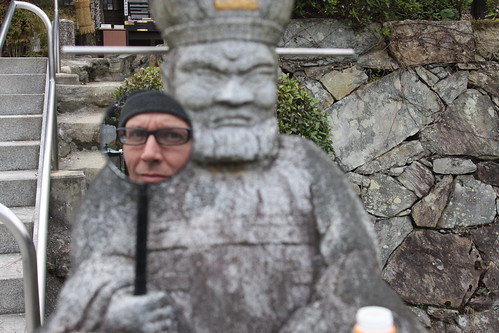
I feel a slight similarity between Enma and Sadako, from Ringu, and other Japanese horrors.
Sadako and her ilk often come out of the two dimensional world of image. Kayako in Juon appears out of mirrors, developing photographs (or a pool of developer), various nasties come out of scrolls (or are trappped in them) and Yotsuyakaidan's horrific woman, Oiwa, is thrown into water strapped to a fusuma or shouji (made two dimensional) but comes back. The Korean film "Mirrors," remade in the US, also has nasties come out of mirrors, in spades.
It seems to me that several of theses monsters pull their victims into the image. The freeze frame as Sanada Hiroyuki's character is killed by Sadako's stare suggests that to me. Perhaps Barutan Seijin's freezing gaze does the same thing. Kayako pulls people into the mirror and developer. Oiwa strapped to two dimensionality and put into water, pulls her lover into the watery (reflecting?) depths.
Enma too in a way pulls people into their mirror, even if/though he does not come out of it. He may come out of the mirror, since Buddhas are mirrors according to some.
Enma is also known for collecting tongues, of children that lie and for hooking those that fail the mirror test up by their tongue.
It seems to me that the "collecting of tongues," relates to the fact that just before Sadako kills (Sanada Hiroyuki's character and others) she seems to telephone them. But the telephone call is of only white noise.
And I wondered whether this telephone call, in Ringu is related to tongue collection. The horror first destroys language, and then sucks us, or us Japanese(d), into the two dimensional. Sadako telephones people with silence. Her phone call marks the end of language. Silencing the, she call her victims into her deathly two dimensional image world.
Sometimes I feel that a Japanese lady I love, does or attempts to do that, to me, with good reason of course. Something vaguely along the lines of "Oh, Excuses, cuses, oooses, booses, bubu, bubu" and then fixes me with her Sadakorical stare that says wordlessly, "see yourself!" Or perhaps as the ghost of Rokujouno-Miyasu-Dokoro says to Aoi, in a Noh play of the tale of Genji. Stamping her foot she says, "Omoishire!" Think and know. Reflect and know.
Lacan says that the self is the intersection between the real, language and image. Or that both linguistic and imaginary representations of self are essential to keep the self game going. Destroy one and the self collapses. Mute the voice or realise the otherness of the image, and one can achieve englightenment, madness, or hell, depending upon how one feels about it.
(The above, thanks to Shiensumisu's comment)
Saturday, March 26, 2011
Dual Coding Theory and Japanese Culture

The above diagram (click image to see Japanese translation) is Paivio's Dual Coding Theory, of meaningful images and sounds.
It is interesting that scholars like Unger, Barthes, Saussure and Plato believe that only the sounds can have meaning (I think).
It seems to me that Japanese culture emphasises the right hand side of this diagram, whereas Western culture emphasises the left, to the point of claiming that only logogens exist, and that characters do not really mean anything without being translated or read into phonetic, logogens.
Wednesday, March 23, 2011
Positive Present

This wall hanging is a sort of poem or sooth which explains why Japanese people may not need to set concrete goals. It reads:
If we try our hardest today, then a little happiness will surely, surely be waiting for us tomorrow.
Many Japnaese people prefer to use this philosophy of effort in the present and leaving the future to itself. They anticipate that their future will be happy - a desirable future - due to the way in which they involve themselves the present to create what Naoko Sonoda calls a "Positive Present (mae muki na genzai)."
Due to the influence of Western culture, Japanese are being encouraged to set goals. This has advantages in that it allows for more control, but the excercise of control will enevitably result in some reduction in ability to make the most of the present. Very few Japanese seem to be aware of the downside of importing Western "goal-orientend" styles of management, education, or human behaviour.
This philosophy is not the same as "Eat drink and be merry for tomorrow we die." It often involves a lot of hard work. This philosophy is perhaps more similar to "keep the ball rolling," recommending an ongoing attempt to keep ones life in motion towards unplanned, yet desirable events.
The theory was partly inspired by the management theory of Misumi Juuji who suggested that managers have two fundamental roles: to set goals and measure and reward goal achievement (performance), to create a positive working environment (maintenance). The above image would motto of the latter, environmentally focused "maintenence" managed workplace.
The wall hanging above was found in the toilet of a Japanese restaurant perhaps to encourage cleanly toilet behaviour.
Tuesday, March 22, 2011
Complaint Advert: We Are Hansei-ing

In this Fuji-Xerox advert, the catch-copy is from the words of a complaint from a customer. "Do you even know how we use your copiers?"
The advert goes onto explain how all the employees of Fuji-Xerox continually look into how customers use their copiers, paying *grateful* attention to customers complaints, thoughts and advice.
The copy also reads "we do not stand around holding buckets of water even for one second", which refers to the fact that the staff of Fuji-Zerox do not see complaints, or "being told off" by their customers as a punishment at all, even for one second. This metaphor works because being told to hold buckets of water is a traditional Japanese corporal punishment.
Even if there were a US/UK advert that proclaimed the fact that the company recieved comlaint, which is itself unlikely, then perhaps they would have been standing with books on their heads.
Fuji-Xerox are proud of the fact and advertise the fact that they recieve complaints and see them as a way to critically self-reflect (hansei) and self-improve.
This Japanese (?) philosophy of energetic self-critisism is also found in the cultural psychology of Steven Heine, the manufacturing philosophy of Kaizen, the managment philosophy of Yanai Tadashi (chairman of the First Retailing - Uniqlo - group), the way that Ichiro maintains his game, and the Japanese psychonanalysis called "Naikan."
Sunday, March 20, 2011
Why is the Japanese Minister of Defence Wearing Overalls?


In addtion to the subtitles to what the speaker is saying, and in addition to the fact that they both read from a written speech rather than pretend to extemporize, both these leaders (one the minister for defence, the other a prefectural representative) are wearing overalls. Do they think, do we think, does anyone think that they will or should be doing manual labour? No.
All three Japanes cultural phenomena, or non-book-religion, non-logocentric phenomena, attestify to the fact that in Japan visual signs, be they subtitles on what someone is saying, the script that the person is reading, or the clothes that they are wearing, are more important than the phonemes. And this in spite of the fact that there are many Westerners that say only phonemes have meaning.
But to show their solidarity with those that are engaged in manual labour at this time of crisis, Japanese leaders choose to wear overalls.
C.f. the fact that, Japanese sports persons, no mater how much of a novice or not they are will get the right gear. Japanese sports persons some times have all the gear and no idea? What is an "idea" and how does one express it?
My heartfelt sympathy is with the victims of the Japanese earthquake.
Monday, March 14, 2011
Earthquakes in Japanese Religion

[Originally posted to my Shinto Blog] Earthquakes - more horrifying than lightening and typhoons - were thought to be caused by the movements of a giant catfish.
While Typhoons and Lightening have patron gods (Fuujin and Raijin respectively) who are respected enough to be appeased, so cataclismic is the history of Japanese earthquake disasters perhaps, that they are not deified, but attributed to the maleficence of a big black fish.
Japanese catfish, or namazu, are or were thought to be, large lazy, bottom-dwelling fish with little culinary value who, for their part feel jealous of the admiration humans have for other fish species. Earthquakes were thought to be caused by the movements, or jealous malisciousness of giant catfish at the bottom of the sea, or beaneath the ground.
These catfish were held in place however by the god Takemikazuchi who is enshrined at two shrines in Ibaraki prefecture, including Kashima Jinguu (Imperial Shrine) in Kamisu City.
The Shinto deity uses an enourmous rock (whose tip can be seen in the shrine grounds - most of the rock is buried), his sword, or a giant gourd to prevent the catfish from moving.
The rock, the most famous means of keeping the catfish in places, is called a Kanameishi or keystone.
However, in moments of lapse, or while on holiday to Izumo in October - which is called the Godless-Month since all Shinto Kami are said to make the trip to Izumo.
In the 6th century book of poems, the Manyoshu (book of ten thousand verses) there is a poem which reads
"The keystone may wobble but it will not become unstuck so long as the Kami of Kashima Shrine is with us."
Reading this poem three times was believed to result in protection from earthquakes by 19th century dwellers in Edo (Tokyo).
The Giant Catfish was depicted in many Ukiyoe. The genre is known as Catfish-pictures but only 300 survive since they were banned by the Edo government.
As well as depicting the subjugation of the giant catfish by the God and the Key stone rock, they all so showed (as in the picture above) house builders taking a different attitude to the catfish. In the above picture the group of construction workers top left do not participate in subjugating the Catfish. In another picture they are shown worshiping or thanking the catfish for the profits that they earned.
After the great Tokyo earthquake of 1855 the catfish is also depicted as being responsible for redistributing wealth from rich to poor, and became regarded as a world repairing deity (Yonaoshi Daimyoujin).
So in the end it is probably true to say that Japanese religion, particularly Shinto, can be trusted to see a positive side to nature, even the most horrific, even in the face of great human loss and tragedy.
The above image is believed to be in the public domain. The above text is my interpretation of internet recsources such as Japanese wikipedia and these two blog posts (in english)
historyofgeology.blogspot.com/2011/01/namazu-earthshaker....
historyofgeology.blogspot.com/2011/03/historic-earthquake...
And the source of the above photo (in Japanese)
www.jcsw-lib.net/namazu/html/namazu/lime/006.html
Tuesday, March 01, 2011
Holy Mirrors!

Tuesday, February 08, 2011
Child Abduction, the Hague Convention and Japanese Culture 2
This issue is massive, and massively tragic. The agony and the outrage are palpable.
I beileve that if I were in the position of a parent whose child were 'abducted,' I would be feeling the same way, reacting in the same way, decrying, petitioning, lobbying and doing all that is in my power to affect change, in the same way, in any way, with all my heart and all my strength.
At the same time, I ask myself, do the Japanese believe in justice, law and the rights of their chidlren? I am sure that the Japanese do. And yet, there is a real tragedy.
I think there are important, equally massive, cultural differences.
If I were to put this opinion - that there are 'cultural differences' - to a Western estranged parent, I would expect them to say, "Oh cutural differences! What bull! Another name, another excuse for gross injustice."
So, I am not suggesting that nothing should change. But there are two ways of making change, two types of change that one might hope for:
1) That change be made at the national/cultural boundary.
If one believes that there are cultural differences, then one may strive for change at the boundary between cultures, such that parents from other nations be given rights under Japanese law that are not given to Japanese parents, due to the fact that the marriages were based in more than one culture, in more than one law.
2) That changes should be made universaly, applying in Japan too.
If one believes that the Japanese, as they stand, do not respect justice, law, and the rights of their children (as is argued by many estranged Western parents) then the change that needs to be made is of type (2): All parents, be they non-Japanese or Japanese, should be allowed dual custody because the present Japanese system is just bad, patently and universally bad.
I think that (1) is the answer, because it will be more likely to succeed, because the Japanese family system works, and because change at the former level will not destroy Japanese society. Change as an exception, for predominantly Western fathers, is more likey to succeed because it will not devastate Japanese culture. I think that dual custody if made law in Japan would have enourmously adverse effects.
It seems to me that in Japan people get married primarily in order to have custody of, that is to say to have relationships with, children. If dual custody were enforced, and the realisation of its enforcement were to sink in, to become a commonplace, become accepted from the outset, then that would be the end of the Japanese family. Kaput.
I suspect that the legitimization of dual custody in Japan would be akin to the legitimization of marital infidelity in the West. It would make the critical family bond in each culture meaningless. The concept of family would be negated.
Labels: culture, nihobunka, nihonbunka, sex, westernisation
Monday, January 17, 2011
The Centres of their World: Bureaucrats and Caregivers
Why is it that the Japanese are so tolerant of the power of bureaucrats, civil servants? Why is that so many young people want to become a bureaucrat, and do not feel shame about taking home a higher level of pay than their private-sector constituents, for doing less work?
Many young people (my students) are quite frank about wanting to avoid the world of private-sector, competitive work, to obtain a higher level of pay and job security (so they think at least) in the public sector, and go home earlier.
One reason is that the world of non-civil-servant, private-sector work is so hard in Japan. I guess that people can see the private sector, as being unacceptably harsh, and that it is therefore morally acceptable to go to work in the public sector where people to work acceptable hours for acceptable pay.
Another is that since the public sector is so desirable the public sector can take only the best (academic-hensachi-wise) so those that enter the public sector feel that they are the top of the heap, and therefore more deserving of a high salary.
And after all, someone has to be a bureaucrat, so 'why shouldn't it be me (especially if I have the best grades, can pass the strictest, public employee exams)?'
But more than that, there is little notion of public sector employees being "civil-*servants*;" people who exist to support the profit-making activities of the private sector. It seems to be felt that the public sector is rather the centre of society, or the centre of the economy, and the profit-making private sector is there to support those that perform the 'central role' of bureaucratic administration. I feel this to be the case in the macroscopic world of Japanese society, in the Japanese company, and in microscopic world of the Japanese family.
The (from a Western point of view) reversed view of the public and private sectors of the economy, may relate to the position of men and women, or rather their roles, in the Japanese family. The division between the public-administrative vs. private-profit-making sectors of the Japanese economy, map onto the care-giving (administrative?) vs. wage-earning roles in the Japanese family.
In the West wage earners tend to be seen as the central, respected, prime-movers of the family. Thus people, of both sexes, hanker after taking this role, whereas the caregiver is seen as merely a supporter, a servant. In Japan, I think that the situation is reversed. The caregiver, usually the mother, is the center of the Japanese family, and the wage earner is that beast of burden. If the Japanese family is a steam locomotive, the caregiver is the driver and the wage-earner is the 'fireman' who shovels the coal. Young people respect the central, administrative, rent-taking, role of their primary care giver and see the wage earner as an appendage that does that necessary, but rather tiresome and dirty, money-making-sarari-man-thing.
There is probably nothing objectively "central" about the private or public sectors, the "rent-taking" administrators, or the "profit making" labourers, each need each other, as do caregivers and wage earners. Without the latter there would be no one to pay the taxes, and without the former there would be to social structure to allow people to make a profit in the first place. In the family, there is nothing more central to being a care-giver, nor being a wage-earner. It all depends upon the cultural lens from which you look at it.
There are problems though:
First of all, of course, reversals can take some getting used to. It will take me all my life to get used to! I still try and break the rules (sorry folks!) Or perhaps I attempt to reach a compromise. Ahem.
Secondly, things can get extreme. A society can become over infatuated with the profit making side of things, and over infatuated with administration. I am not sure if that is what is happening in Japan, but the level of public debt makes me worry.
Thirdly, strange edge-effects can happen when rerversed cultures mingle, especially when one of them has a louder voice, and there is incomplete understanding of the situtations pertaining in each culture. For example, the Western feminist notion that Japanese caregivers are downtrodden, that they deserve even more, or the notion that the Japanese private sector is unduly harsh, find favour even among the elites, and may tip the balance in an unhealthy extreme directions.
Solutions? Japan may once have had a stronger Confucian-style sense of noblesse oblige amongst its central, administrators and caregivers. If I knew Confucius better I would be able to point to the sooth where Confucius recommends that leaders put their subjects welfare first. And are there still any supporters of dansonjohi(“honor men and belittle women.”)? The idea that a society should honor men and belittle women is abhorent to Western ears, because it is not understood as noblesse oblige. It is in fact no worse, nor better, nor different to "Ladies First."
Labels: bureacrats, care-givers, feminism, japanese culture, nihonbunka, reversal
Saturday, November 06, 2010
Ric O'Barry Saves Dolphins


I am strongly opposed to the opposition to Japanese dolphin hunting.
I think that dolphins are more intelligent than cows and pigs, and am sad about their death.
However,
1) I think that cows and pigs are intelligent,
2) I do not think that intelligence is an acid test of what should be killed. Sensitivity to suffering might be equally valid. I think that cows are very sensitive to their suffering.
3) I think that cows and pigs have a far, far, far worse life in and bred for, captivity, especially when boxed all their lives.
I think that slaughtering dolphins in coves appears appaling, because
1) It is
2) One can view it .
Essentially, hunting takes place in the place that the animals live, so it is viewable. Abbattoir slaughter takes place in closed environments controlled by the meat eaters.
The scenes from "The Cove" are unlike the scenes in abattoirs in many ways. But I believe that equally gruesome things are going on in abbatoirs, at vastly greater scale, especially after having visited one.
3) There is a contrast between the freedom of the animals and their death.
If an animal has been bred for food, and especially has lived all its life in a cage, the the horror of its demise may appear deminished. However this lack of contrast hides the true horror, that of living ones life in a box bound for slaughter. Battery farming of cattle, pigs and chickens is, in my view, so much more unpleasant than killing wild animals that it is difficult to compare. The slaughter of battery farmed animals is infinately more disgusting than the slaughter of wild species due to the hellishness of the life that the animals have lead prior to their death.
The slaughter of the hunt appears appalling from a third person perspective, because the third person sees the contrast between freedom and the death. But from the first person/animal perspective (which should be? what counts) the un-hunted, bred to die animal is vastly more miserable.
Ric O'Barry guy goes to Japanese supermarkets to lament the death of his "friends." Does he have no friends who are cows bred in cages for beefburgers? Does he not care for their thousands of times, hundreds of thousands of times, more miserable existance?
I deeply opposed to his group, bearing in mind the vastly, enourmously, grotesquely (I lack adverbs) greater suffering going on in other means of human protein production, compared to the yet tragic slaugher of dolpins.
It seems to me that this movement is a cultural defense mechanism. The movement is in part, I feel, an attempt to allow those that participate in the movement, or have sympathy with the movement, to forget the infinitely more profound horror of slaughtering animals bred and living in small cages, to die by a slightly quicker means.
Would you rather have been born a dolpin that died in Taji, or a cow that lived and died in a battery farm?
Is there even a question? The answer is no. There is no question. The horror of the "beef" (cow) that became a burger is so far worse, that there is no question, no viable comparison. The dolpin was hunted and killed, in pain. The cow's whole life was hell.
Weep by all means for the dolphins that die in Taji. And do not eat them. And do not go to dolphin shows in aquaria. And if you feel this sadness, or even if you don't, go wild, wild, wild with grief, and rage, for the life of the animal that made up your protein in the food that you will eat today.
Take out the plank in your own eye Mr. O'Barry. Take out the redwood tree in the eyes of your peers, before you point out the splinter in the eyes of others.
Disgusting. Ric O'Barry and his movement disgusts me.
This blog represents the opinions of the author, Timothy Takemoto, and not the opinions of his employer.