
Thursday, August 19, 2010
Situated Meaning in the Empire of the Indexes

However, lately I have been forced to realise that Jane Bachnik is right and I was wrong: It is not that the West is linguistic and Japan is "occular," nor even that Western signs are sounds rather than images, but rather it the difference is in the way that Japanese and Westerners use signs, or the type of signs that they use.
Jane Bachnik claims that Japan is (to paraphrase Barthes) "the empire of the *indexes*".
What are indexes? Indexes are a type of sign, in American linguist Pierce's taxonomy of signs. Their most famous subgroup are icons, such as on your computer screen. Icons are strictly speaking, indexes that have a resemblance to that which they represent, such as the famous trashcan which represents the deletion of computer files and thus has a likeness to its meaning. More purely indexical is the Nike logo, called a "swoosh," which gets to mean "Nike" by virtue of the fact that it is printed on all their products and displayed at the end of their adverts, rather than by its similarity to a running shoe. Indexes get their meaning by their "contiguous relationship" with the thing that they refer to. That means that they are often displayed at the same time in the same place, or immediately before or afterwards in time and space. Many of the typical examples of indexes are natural phenomena related causally, hence smoke is an index for fire, thunder an index for lightening (and vice versa), and the mercury in a thermometer is an index for the temperature. Perhaps the important thing about indexes is that they have a direct, one-to-one relationship with that which they represent. As mentioned in my previous post, indexical thought may have a lot in common with "savage thought" as defined by Levi-Strauss. Indexes are one part of the word, used as a sign for another part.
What other types of signs are there? That a sign has a direct one to one relationship with that which it represents may seem pretty much the way that all signs are. But Saussure, and even ancient Buddhists have pointed out that linguistic signs (at least in the West!) are defined by their relationship to other signs, "cat" is understood by its relationship to "bat," and "dog." Phonemic words (at least) mean, have meaning, by virtue of not being other words.
Returning to indexes, another famous example of an index is a pointing finger. It has meaning because you can see what it is pointing at. Jane Bachnik proposed the theory that indexes are important to the Japanese from consideration of the importance of such words such as inner and outer ("uchi" and "soto") or front and back ("omote" and "ura"), which are used extensively to describe social interactions. Like pointing fingers however, these spacio-metaphorical words have meaning in contextual locations, and shift their meaning depending upon who is saying them. Inner (uchi) e.g. my family, for me will be outer (soto) for you and vice versa. Bachnik struggles with this shifting aspect of indexes, and I believe emphasises their shiftiness more that I do. Indeed, I think that is were Bachnik and I differ. For Bachnik indexes are inherently shifty and subjective, but for me, I think it depends upon the culture from which one looks upon them. I will come back to this point but first I will introduce some examples of where Bachnik's theory of Japan as the empire of the indexes is useful.
A few days ago I was out in a river bay on my kayak and at 6 o’clock, or one or two minutes before or after came the sound of the tannoy sound system that announce this time (and perhaps that it is time for dinner, time to go home from the rice fields) to the local inhabitants. Some of the 6-oclock-sounds were simply sirens, others were the melodies from folk songs (often Scottish, for reasons unknown) and there was one sound of someone ringing a temple bell. Since they localities around the bay were slightly out of sync, the continued for about 5 minutes, before the bay returned to silence. These sounds can be heard at least twice a day, also at noon. In some rural prefectures the local town hall will make announcements such as "the primary school children have all safely returned from their school trip." Sticking to the noon and 6pm sirens, it is clear that that they are phonic not visual signs, so bang goes my theory that the Japanese are into their visuals. This is a very Japanese, very phonic sound. It is also an index. The sounds get their meanings (certain times of day) by occurring at those times of day, contiguously with the little hand of the clock pointing at six.
More importantly, it would be very untrue to suggest that the Japanese do not place considerable significance on language, but the way that they do it is different. It is easy to point to areas in which, from a Western, logocentric point of view, the Japanese do not seem to place a great deal of importance upon language. "Japan is a society without dialogue" as Nakajima points out, (Taiwa no Nai Shakai), in which university students never ask questions, decisions are made before committees deliberate (and debate) on the issues, political debate tends toward the grey with the manifestos of all parties being very much the same, rules are often reinterpreted in surprising ways (e.g. "scientific whaling"), there is a lot of flattery ("oseiji"), and there are books extolling the vagueness of the Japanese. At the same time however, there are some instances in which it is clear that Japanese take words *really* seriously.
Today there was a tragic story in the only English language "Japan Today" news site. An eight year old Japanese girl committed suicide apparently because she had been the victim of bullying. And the bullying consisted (perhaps solely, since the culprit remains unknown) in finding the word "die" written on her pencil case and books. As the father of a daughter my heart goes out to the parents. At the same time, as a Westerner I find myself confused. In Anglophone countries it has become vogue (and the subject of pop song lyrics) to tell people to go away and die in far more offensive language, but I doubt that many or any of the "victims" feel as traumaticised as this 8 year old did. It is clear that some words can be very offensive in Japan, and that the Japanese can take them very seriously with tragic results.
That Japanese take bad words seriously is supported by the fact that there are few expletives in Japanese. Instead of accusing someone you intensely dislike of being incestuously involved with their mother, one claims that their mothers belly button sticks out. The word for the female sex organs is felt to be so rude that it can not be used, so that Japanese sex educators have had to experiment with the use of "girl willy."
A Japanese teacher of debating skills bewails the aforementioned lack of debate in Japan, ascribing it to the belief in the spirit of words. He argues that debate requires that one examine the pros and cons, the positive and negative outcomes of an act. Japanese do not like to talk about negative outcomes, lest they come true as a result, so debate is often avoided. Hence it is precisely the belief in *the power of words* motivates the avoidance of dialogue.
This phenomena again relates to the theory of indexes. Indexes have meaning by their direct relationship with that which they mean, rather than by their position in a language or discourse. Thus the word death may conjure up the state and event of death far more strongly among Japanese (who avoid even homonyms of the word), than among Anglophones for whom death is associated with life and birth. Speaking the word "death" to an indexical thinker may even bring death upon them, but speaking the word death to a linguistic dialogic thinker may bring them to life.
That Japanese see words as being particularly disturbing is often related to their belief in "word-spirits" (kotodama, shinko). This is the ancient belief that words hare imbued with spirit such that their utterance can make the word come true. Hence for this reason, certain words weakly related to the concept of divorce (such as "go home") are avoided at Japanese weddings lest they encourage the bride to "go home to her parents" and divorce the groom.
Finally, returning to Bachniks feeling that indexes shift more than other types (our types) of sign, I can not agree. Words in western society, even those that underpin our society, such as freedom and justice, good and bad, are interpreted in many ways. That they share particular interpretations, and remain important to us, is the result of a cultural practice of internalising language via the "Other" "Generalised Other" or "Superaddressee" of language. This linguifying of the psyche does not have to be done, and the Japanese do not do it. On the other hand, that Japanese identify far more greatly with the visual self representations, theire face, and with "lococentric" (Lebra) clasifications of society such as inner and outer (uchi and soto) does not imply that Japanese society is more shifting, but rather that they have learnt to internalise a co-experiencer, a mirror in their head (Heine and Takemoto et al.), something with which to nail the context down, to sew the subjective worlds of experience, these fish-bowls together.


Tuesday, August 17, 2010
Savage Thought and Myth in the Structure of Japanese

Levi Strauss argued that "savages" are "bricoleurs" (people that use the tools and materials to hand to get a job done), in that they use things, usually found in the natural world, to categorise and organise their societies.
Thus *savages* in totemistic societies may have "Black Hawk" and "White Hawk" groups, and be called by names like "Sitting Bull." They use species of bird and animal as names for clans, families and individuals, because these things are useful to get the job of social categorisation done, and thus "good to think."
Had Levi-Strauss been more rigorous (I jest) he would have noted that some totemist use mythical and corporeal, artificial signs. There are "Water Flask" and "Dragon" tribes. Concentrating on these man-made signs Levi-Straus' definition of "the savage as bricoleur" starts to become rather vague. If the savage can make up entities (such as dragons) to use as names then how is the savage different from "Levi" named after some ancient Jews Straus? If the savage can use man made objects as names, then why not use patterns, and write his name "LEVI" and be done with it. And if he did, would he still be a savage? The problem with Levi-Strauss for me is that I can't find the place where he compares savages to himself, or where he explains what we are doing, and whether and in what way what they are doing is different. (As far as I am aware, I am a bricoleur too. My name is Timothy, the name of a semi-mythical 'beast' found in the Bible.)
Then Roland Barthes comes to the rescue with his theory of "Mythological" signs. I think that despite the fact Barthes analyses magazine covers and pasta advertisements,he uses the word "Mythologiges" because he is harking back to Levi-Strauss above, and providing a semiotic distinction between us and them, between anthropologist and the mythologist, the scientist and the bricoleur. The distinction of myth, mythological thought, and the savage mind is that it uses signs in combination at a two teired level of "denotation" and "connotation." The briocoleur/mythologists uses second level, connotative signs, that is to say signs in combination that are already signs for other things (see diagram, inset bottom right).
Hence, the black boy and the saluting (a flag) shown on the cover of Paris Match, are in themselves signs. We recognise them and their meanings, of respect, youth, and Africa etc. The cover becomes mythic because it combines these signs to present a new meaning: imperialism is good, all of France's colonial subjects respect the French flag.
Suzuki Takao argues that the Japanese language is appropriate for use as an International Language. I happen to agree. The principle reason he gives is interesting, one that I had not grasped, and relates to the discussion of myth, or savage thought above. Suzuki argues that the advantage of Japanese is in the two-teired way that it is "agglutinative". A simple definition of aggluntinative is that, in ancient greek (soci-ology) and modern German (auto-bahn) one can form words by joining other words together. In Japanese however, the situation is a little more mythological, the process of agglutination often involves an extra layer. In Japanese, while there are cases in which one simply joins words together (e.g. torihiki, pull-push meaning negotiations), one can form complex words by combining the signs, or Kanji, for everyday words.
This layering of Japanese can be discussed at two levels.
At the level of discussion of the merits of the Japanese language, or German and Japanese respectively, the layered nature of Japanese makes it a lot more compact. Complex German words are formed by joining shorter simple, everyday words together, resulting in some very long compound words. Japanese on the other hand uses the signs, or Kanji, for the everyday words and joins these together instead. Since the Kanji have shorter (kun yomi) names of their own, long compounds can be said using far fewer syllables. In Suzuki Takao's example the round lighting devise used above operating tables in hospitals is "Schattenfreie Lampe" (Shadow-Free-Lamp) in German, and "mu-kei-tou"(無影灯)in Japanese. It gets to be a lot shorter in Japanese because mu, kei and tou are the names for the signs that represents "no shadow lamp" (nai, kage, akari). So while learners of Japanese may think it a pain in the neck that Japanese not only has Kanji, but also has more than one name for each, Suzuki argues, quite successfully in my view, that it is this layered structure that makes Japanese so successful in expressing complicated meanings, using few simple buildings blocks, without resulting in some very long words.
At another level, it seems to mean that Japanese are always being "mythologists" or "bricoleuers" as defined by Roland Barthes and Levi-Strauss in that they are using the denotive signs for every-day things in combination to connote new meanings. They are still engaging in "savage thought."
And so what? I am not sure, but I think that it relates to:
Roland Barthes claim that Japan is "The Empire of the Signs"
Jane M. Bachnik's discussion of the prevalance and importance of "indexes" in Japan, in her opening chapter of "Situated Meaning." (Would Barthes have written "The empire of the indexes" had he been more precise? Are totems indexes? Are indexes always dual, dennotive and connotive?)
My claim that Shinto is a form of totemism that stopped using stones and branches and grass (as related in detail by Kunio Yanagita, back in the days when "everything used to talk") as their totemic badges, and started to use Kanji for their names (when, thanks to the ordered rule of the emperoro "everything stopped talking")
The fact that Japanese superheros are totemists.
Labels: nihobunka, nihonbunka, religion, superhero, theory, totemism, アニミズム, トテミズム, 宗教, 日本文化
Thursday, July 22, 2010
Channels of Communication in the US and Japan
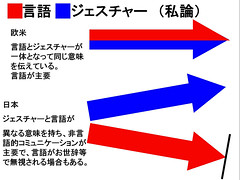
The upper arrow represents Western language and gesture, with the upper part, language dominant, and the gesture supporting, emphasising and clarifying the linguistic meaning to convey the same message. Kendon (Gesture: Visual Action as Utterance) seems to espouse the view that gestures is generally, or universally bound up with language, as shown by the red-blue arrow.
The lower two arrows represent my feeling about Japanese gesture and language. In Japanese culture which emphasises the split between real meaning (honne本音) and social pleasantry (tatemae 建前), and has lots of essentially non-linguistic fawning (amae 甘え) and ESP (ishindenshi 以心伝心), or extolls people to "read the air (or non-verbal cues?)" (KY, kuuki wo yomu, kuuki ga yomenai空気を読め、空気が読めない), it seems to me that the two channels, gesture and language can mean different things (hence two arrows), the non-verbal blue arrow can be the true/real/main channel, and the language can be phatic or supurfluous and ignored (hence the bar).
I used to get the feeling (real or imagined) that Japanese verbal and non-verbal communication was tearing me in two like Bateson's schizo producing "double bind," because while I was attempting to attend to the verbal message. It felt like the sender was sending, and other recievers were reading, correctly, the sender's non-verbal communication that meant something else entirely.
I feel that Britons do the same thing, when they are being sarcastic. On the other hand Americans especially tend to tell it to you straight, "watch my lips", with the two channels bound together.
It could be argued however, that Japanese real meaning (honne 本音) is transmitted equally in the verbal linguistic domain, and it was just that I was not able to decode these linguistic meanings correctly. Such as when someone says "thats good" (ii desu いいです) or "I'll think about it" (kangaemasu 考えます) then even in the absence of non-verbal cues, a Japanese person would decode these statements correctly to mean "no thank you" and "the answer to your request is no" respectively. Thus Japanese verbal communication may be at one with Japanese non-verbal communication, but that one should interpret certain verbal statements in a non-literal way.
In a series of papers (e.g. this interesting study) by Sotaro Kita, a professor at Birmingham University compared for instance, Japanese, Turkish and English speakers use of gesture to describe a cartoon showing someone on a swing. Dr. Kita points out that there is no verb "to swing" in Japanese or Turkish. He further found that English speakers moved their hands in an arc when saying "swing" but that Japanese and Turks, when using more general movement verbs meaning "go", moved their hands in a linear movement. Hence the lack of a verb "to swing" (to move in an arc) results in a lack of a arc motion, swinging gestures. If it really were the case that Japanese gestures were independent of speech then one would expect them to move their hand in a swinging arc even though they do not have the verb to express that motion. Since this is not the case, it seems to suggest that Japanese gesture is closely integrated with Japanese speech rather than being an fully independent channel. While some information (notably the direction of swing) was gestured but not spoken, suggesting that gesture is to some extent independent of speech, this tendency to encode extra-verbal data in gesture was the same for all languages in the study.
Hence, the diagram above seems to be demostrably wrong.
But I still get the feeling that Western gesture is more integrated with speech, and that language and gesture form a single/merged channel to a greater extent than in Japan.
Stop press. I have just read the final line of the Sotaro Kita paper linked above, which ends "There are initial findings that speech gesture synchrony differs accorss different languages"
referencing in particular research by Dr. Kita's colleague, Asli Özyürek:
Özyürek (2001) What Do Speech-Gesture Mismatches Reveal
about Speech and Gesture Integration? A Comparison of English
and Turkish. I am guessing that Dr. Özyürek found greater integration in English than Turkish and that this patter would also be found between English and Japanese.
Labels: mime, nihobunka, nihonbunka, 日本文化
Friday, July 16, 2010
The Cultural Psychology Japanese Hachimaki Headbands
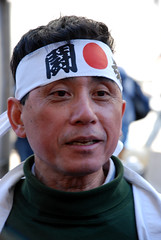
I am thinking in particular about the headbands worn by people studying, rather than the headband worn by the gentleman in this photo, who is taking part in a festival but the following might be applied to anyone wearing a headband with writing on it.
Perhaps those who want to concentrate on studying in a Western,
logo-culture, may make a pledge to others and themselves, and remind themselves of their intention to study using phonological thoughts (that is to say remembered and orally produced but silent phonemes) their mind "I've gotta study. I promised everyone I would study. This test is really important to me." Westerners are said to be able to simulate how they sound to others, that is to say they hear the words that the speak from the others point of view, and internalise the reactions that others would have upon hearing them. This is the essence of logocentrism: phonetic words are thought to provide "presence," (is that what Derrida calls it?) the immediate, inseparable, instantiation of their objective meaning. It all sounds so persuasive. Words just mean. But perhaps to some (to Japanese people) spoken words are communicative - allocentric, *for others*.
Perhaps the Hajimaki headband, which usually has ideograms written on it like "try hardest" "must win" is a bit like these pledges and resolutions. They seem to be more allocentric (is that the word?) in that the signs are all pointing outwards, to others. And to an extent this is the case. The headband is far more like a pledge to others. But I think that the wearer will also be made aware of the fact he or she is signing his or her intention to study hard, so the signs and the headbands, often worn in private, so they are also a message to self. Japanese are thought to be able to simulate how they appear to others, that is to say they see themselves from others' points of view and internalise the reactions that others would have upon hearing them. Hence, and I guess that this is the nub of imago-centrism, signs (visual ones) mean as soon as they are out there, like they are shouting a message, like they are one of those loop tapes that Japanese are so good at ignoring. The fact that signs are so "loud" (from a western point of view) may be why the japanese avoid Japanese writing on their T-Shirts. To have a T-shirt with "Frankie Says War" (this reference is probably way too ancient for you) would be like going around saying "Frankie Says War, Frankie Says War" to everyone they meet. The headband is like that. "I am studying, I am studying, I am studying" it is a sign of and a self-stimulation to persist.
C.f. Finger Pointing Checks (signing to the self)
http://www.burogu.com/2010/03/finger-pointing-and-specular-self-of.html
And my new take on why there is Engrish on T-Shirts
http://www.youtube.com/watch?v=SayQAPhdXMw
Howszat?
Looking on flickr I see that many hachimaki have nothing on them. In that case I suggest that they may signify a mental, spiritual purity, singularity of purpose and the absence of phonemes in the mind.
One of the scary things about Japan and the West is that each seems to hate they others signs/symbols. Derrida goes on about how much writing and visual signs are derided (he puns on his name I believe) in the West. I often get the feeling that a lot of the purification ritual in Shinto is aimed at a silence of mind. And Zen Buddhism is quite explicit about it: out out damn language.
And they shall see his face; and his name shall be in their foreheads.
Tuesday, June 29, 2010
Wearing, Wrapping, and Signing Culture

Using a “dramaturgical analysis” originating in Goffman ("The presentation of self in everyday life") McVeigh describes how selves can be constructed on stage, and consisting in and bounded by their presentations. If the self can be constructed on stage, then there is no need of a third term, the actor that with a narrative to grind. Meaning can be brought out onto the stage and be worn. This is wearing ideology.
Roland Barthes and Joy Hendry point out how visual signs and visual exteriors are important in Japan. But both expect there to be something else, a center, a something that is wrapped.
Barthes has already explained in "Mythologies" (inset bottom centre) how visual signs (magazine photos particularly) have the structure of an 'alibi'. "I was not there, I was somewhere else." Barthes does not believe in Mythology. Alibi's and signs, Barthes says, point off, salute a meaning somewhere else.
Then Barthes came to Japan and found that there are lots of signs, but they seem to point nowhere. For example, used to beautiful tasty French food, where the look indicates a different spicy flavour Barthes found Sushi in all its significant visual splendour, and all tasting the same, of wasabi and thick soy sauce. He found an empty space in the center of Tokyo signifying the massive power of an emperor, who does not rule. Japanese signs, Bathes says, have an empty center.
Likewise, Joy Hendry (in "Wrapping Culture" inset top right) points out the Japanese attraction for wrapping. But almost nowhere, except in her discussion of Barthes and towels given as gifts does she examine the possibility that Japanese "wrapping" is not exactly wrapping at all. The surface is not there to contain anything. The towels and the wrapping are consummatory. While the wrapping looks like a vector, or medium, it has meaning. The "wrapping" is the real Mcluhan.
Both Hendry and Barthes do not have a theory for explaining how symbols and surfaces can also be centers and selves. Brian Mc.Veigh however, using the self-on the stage tradition (of Goffman), proposes a mechanism for how the self, and meaning, can be constructed, consist and be bounded by presentation. Wearing is not an alibi for ideology somewhere off stage, but rather ideology is worn, and the visual is meaningful.
In his other great book, "Higher Education as Myth," Mc. Veigh weighs in against the lack of the logos in Japan. So I am not sure how much his revisionism in "Wearing Ideology" is intended. In any event this is the only book of Japanology that I can think of that seriously attempts to bring the center back on stage; the only book watching a mime show that presents a theory of mime, rather than harp on about the lack of a script.
Having said that, the book is not an easy read and feels a bit like a graduation thesis wherein the theory has been added because theses need theory, rather than that the author believes what he is writing. So perhaps, Mc. Veigh is an accidental apologist, a reluctant revisionist of the theory of Japan. Either way, his books are essential Japanology!
Finally, I don’t think that Mc.Veigh, or Goffman, go far enough. They still use the metaphor of a stage with its implied audience, and heteronomy. Actors live on stage, performig for the sake of others off stage, rather than for each other and themselves. As James Mead (Mind Self and Society) argues, actors can can only make visual gestures meaningful for themselves is if they see the faces of their audience or stand in front of a mirror. In my view, the actors in Japan carry their audience, or a mirror with them. The Japanese are wearing ideology, because they have mirrors in their heads.
A review of three of the best books about Japan
Joy Hendry "Wrapping Culture"
Roland Barthes "The Empire of the Signs"
Brian Mc.Veigh "Wearing Ideology"
written on the occasion of giving a lecture on Japanese fashion.
Friday, June 18, 2010
Just one Page of the Book of Television Personalities

Donald Ritchie does not mention that his ouvre, and indeed the very book he is writing, forms part of the output of that which might be called "the idea factory."Westerners, western culture pours out ideas, at a rate unknown in any other culture.
Every Japanese woman and her uncle becomes a "talent" (television personalty) if they make the big time. They get to have their face in the thick book of television personalities.
On the other hand, every Western man, or at least academic and his aunt, pump out an ism, that fill bookshelves in Japan.
The Japanese produce almost no ideas. Zen is the idea to end all izms.
Westerners produce surprisingly few fads, compared to Japan.
Donald Ritchie does not, I fear, quite make it into "the fountain of isms" but his theories of Japanese film may have made it into the encyclopedia of Western thought.
Japanese self-identify with their visual self expressions, especially their faces.
Westerners self-identify with their narratives, with their phono centric words, especially their names and the "isms" that they have coined. (You can tell I am a Westerner, trying herein to coin an "ism"). What shall I call it? Takemotoism?
Wednesday, June 16, 2010
Vuvuzela Advantage for Asia at FIFA WC 2010

Complaints about noise of the vuvuzela horns popular with South African soccer fans have been reported by the presss since the start of the 2010 Fifa World Cup. Various top players, such as Ronaldo and Messi, and coaches from European and South American teams have stated that they believe the deafening roar of the Vuvuezellas adversely effects their concentration.
But Japan (vs. Cameroon) and North Korea (vs. Brazil) have been playing very well.
According to Heejung Kim's ground breaking research on the relationship between culture, language and thought (2002 see pdf online), "atriculatory supression," or the suppression of human ability to think in phonetic language, has a greater impact on Eurpean Americans than it does upon Asian Americans. Kim claims that Europeans and their decendents have a stronger tendency to think, solve problems, and express themselves in phonetic language than Asians.
Comparing European American and Asian American performance on a problem solving task it was found that:
1) Making subjects talk about the task increased European performance but decreased Asian peformance (in the former case since talking stimulates Europeans' thinking, in the latter case because Asians were effectively being asked to perform two tasks at once)
2) Making subjects repeat the letters of the alphabet, effectively suppressing their ability to think in phonemes, had only a small negative effect upon Asians, but greately decreased (by about 20% more) Europeans' problem solving ability.
It is therefore unsurprising that the deafening roar of Vuvuzela at the 2010 FIFA world cup should adversely affect the concentration of European and South American teams. The surprising thing for some may be that the non-Western (non phono-logocentric) teams may not be adversely effected, or may even play better, concentrate more as a result of the roar.
Repeating the alphabet results a cognative load. The Vuvuzelas on the other hand have the effect of silencing the voice of the mind so I am predicting shockingly good results for Japanese, Korean and North Korean teams.
My advice to European and American teams is, wear ear plugs. The inability to communicate with team members is going to be less importantant than the inability to think.
Graph Copyright Kim, H. S. (2002). We talk, therefore we think? A cultural analysis of the effect of talking on thinking. Journal of Personality and Social Psychology, 83, 828-842.
Sunday, May 23, 2010
Japanese Nutritional Supplement Energy Drinks
The Japanese drink a lot of nutritional supplement energy drinks, containing royal jelly, ginseng, maka, various vitamins and minerals and their prime effective ingredient: caffine and nicotine. Their effect is I believe, therefore equivalent to the esspresso and cigarette so popular in Italy and France. These drinks are advertised on prime time television, on sale in prime locations even in convenience stores, and can be consumed on the premises of chemists. I think that the Japanese love of energy drinks may be related to the tradition of Eastern medicine and the herbal potions provided by its practioners.
Labels: japanese culture, nihonbunka, 日本文化
Engrish T-Shirts
About half of the T-shirts on sale in Japan have lettering on them. Of those that do, 99% have English or rather Engrish printed upon them. It is almost impossible to find T-shirts with Japanese language written on them. Imagine if it were impossible to purchase English language T-shirts in the UK, and that all lettering on them were in Bad Japanese. There would be riots.
Perhaps this is not just the effect of Westernization, but also something to do with the way in which Japanese have always imported languages from other nations? Perhaps even if there were no Western influence upon Japan, the Japanese would not wish to write in Japanese upon their own T-shirts. Be that as may, I find the Engrish T-shirts a little more troubling than many of the locals.
At the same time, lately, I have taken to wearing a T-shirt upon which is emblazoned "Do! Something on your own way."
Labels: westernisation, 日本文化, 欧米化
Medicines for Atheletes Foot or Dhobi Itch (Jock Itch)
Due to the high degree of humidity, particularly during the rainy season, many Japanese are afflicted with athlete's foot and Dohbi Itch (scrot rot, or jock itch) caused by bacteria infecting moist skin. Fortunately there are a lot of excellent medicines available over the counter that are capable of killing the bacteria with one application. Application can be quite painful, but these medicines often also contain painkillers that dumbs the affected region after the first few seconds. One of the reasons that Japanese use small one-use towels after having a bath is perhaps because bacteria can be stored on any towel that is used more than once.
Labels: athletes foot, culture, dhobi itch, japan, jock itch, たむし, 日本文化, 水虫, 薬
Friday, May 21, 2010
Transformatory sacred items accross the ages
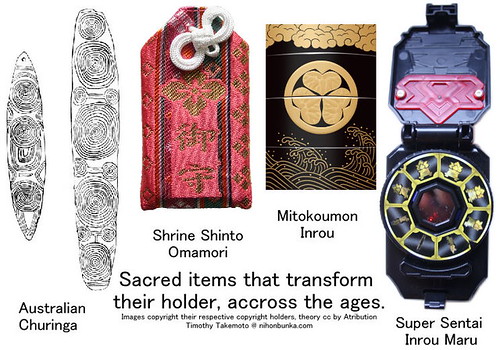
I noted in a previous post that the history of transofmatory items (変身アイテム) such as used by Ultraman (pens and glasses), Super Sentai (Power Rangers), Sailor Moon, Himitsu no Akko-chan, and Kamen Riders (Masked Riders), has a history in the transformatory symbols of Mitokoumon, Touyama no Kin and Samurai Momotarou. Japanese superheroes are always flashing a special symbol and transforming by means of its use.
The history is much older. I ague that Shinto is a geographical totemism, like that of the Arunda/Arunta/Arenda of Australia. In totemic religions the faithful recieve totemic badges which represent their owners and the ancestral spirits of their ancestors. The Arunda of the central Australia destert are one of many such groups found worldwide. Unlike most totemic religions, but in common with the Japanese, these "most primitive" (Freud, Durkheim) of totemists believed that the totem was associated with a place.
That the japanese recieve totemic badges from Shinto shrines almost goes un-noticed. More visible are the symbolic, soul containing badges that are given to the dead (mitama, Ihai). However, as Yanagita Kunio points out, once upon a time, there were "ikimitama" symbols given to the living. These were originally leaves branches of sacred trees and rocks from sacred mountains. They were believed to give their bearer life and were recieved from the time of first shrine visiting.
However in my view, and as Yanagita hints, the symbols were gradually replaced by kanji ideograms and piece of paper.
Yanagita writes, "in this reigion also the Nusa (gohei, zigzag strips of Shinto paper) were originally I think to be distributed among participants. This is similar to the leaves and branches of Japanese cedar and nagi (a evergreen tree/shrub) that were given to the faifthful from sacred trees on Mount Inari and Mount Ise" (Yanagita Kunio Collection No. 14 p 51, my translation.)
「この地方でも小さい幣を関係者に頒(わか)つのが本当の趣旨であったろうと思う。もししかりとすれば、後に言わんとする稲荷山の杉・伊豆山の梛(なぎ)のごとく、信者が神木の木の枝を追って行く風習と、著しく類似する点があるのである」柳田國夫全集14p51
These days Japanese still recieve omamori or amulets from shrines that are said to represent a stand-in or self-replacement and protect the bearer from bad luck and impurity.
And as shrines become less significant, Mitokoumon, Ultramen, Masked Riders, Super Sentai (Power rangers) brandish their sacred symbols and transforms with them.
Before we call the Japanese primitive bricoleurs, let us not forget that "in the beginning was the word," and that I have a "Christian name."Am I transformed by it?
Labels: henshin, Masked Riders, morph, nihobunka, religion, Shinto, specular, Super-Sentai, totemism, ultraman, アニミズム, スパー戦隊, トテミズム, 仮面ライダー, 変身, 宗教, 神道
Stamp Rally and Geographical Totemism
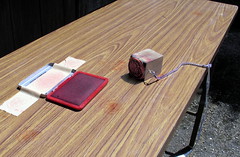
Like the aboriginies the Japanese feel themselves to have descended from a sacred land, created by the spirits in the dream time (mythic time of the Kojiki) and recieve their soul, their breath of life less from their father than from the local shrine spirit. In times past the totemic badge, or symbol which allowed Japanese to transform into living humans, whas a branch from a sacred tree, or a stone from a sacred river bed or mountain. Later, like the Churinga of the Australian aboriginal, and even far far more so, the totemic badges, or names of the Japanese evolved to encompas the use of ideographic language. The "primitive" totemists gradually moved with the times, and imported seals (such as shown in this photograph) from China. No longer did they get a sacred stone or branch from their local shrine, instead they got a piece of paper stamped with the seal of the shrine. These totemic badges live on in the form of Ihai for the dead, the tablets or fuda in household shrines, and the omamori that act as "migawari" or self-replacements, that most Japanese purchase at Shrines every new year.
But why do they need their sacred seals at all? Work in progress.
In the television series "Mirror Man," the hero goes into a mirror and comes back with an amulet. The symbols also seen in all the sumper sentai kamen rider (masked rider) and ultaraman tv programs from the land of the mirror are the meaningful images that allow japanese to identify with their mirror image. They are the images that are always the right way around. The images that have a third person perspective built into them as it were.
Transforming Symbols and Mirrors
Kamen Rider Decade's "Imagin" (Image people jin)
Kamen Rider Decade Mirror world where people are judged!
HImitsu no Akko's compact Mirror
Sailor Moon's compact mirror Chrisis Moon
Super Sentai Shinkenja-'s mirror writing
Super Sentain Shinkenja- inrou maru which shows your face until you insert the symbol, when it shows the super form.
Super Sentai Gaorenja- and the mother-like goddess like person that communicates by mobile phone while looking down through a relfecting surface of a pool of water.
Mirror Man's amulet and reflecting surface
Labels: culture, Jaques Lacan, manga, mirror, nihonbunka, occularcentrism, specular, Super-Sentai, superhero, 日本文化
Japanese Insecticides
I have long been confused by the name "no mat" or "no-matto" refering to a type of insectide product. In the video above there is a wrist attached device that takes small briquettes of insecticide. I therefore presumed that "no-matto" means "No! mat," a mat, or briquette of insecicide, that says "no!" to mosquitoes.
However, I am reliably informed by my wife that on the contrary, Earth (the company) started using the trademark "No-matto" to refer to the vaporisers containing liquid insecticide, rather than their banner product "Eart Matto" (see photo below) which were indeed little mats soaked in an insectide. Later,as shown in the video, even products which contain briquettes of insecticide are sold under the "No Mat" trademark.

All photos and trademarks copyright Earth chemical co Limited.
Labels: culture, japanese culture, 日本文化
Tuesday, May 18, 2010
Nature in Phallocentric and Uterocentric Cultures
Rural Japan is suffering from a lack of inhabitants because the Japanese prefer to live in cities. Upstart gaijin (foreigners) with only a modicum of income are able to purchase beach side houses.
Beaches are not visited.
City-central riverside parks are - apart from certail ritual times of year (such as hanami) - empty.
Riverside cafes and restaurants almost do not exist. There are mountains near and overlooking cities, without paths to their peaks.
The Japanese that love nature, do not go there, or do they?
Japan is a uterocentric (my term for Japan), not phallocentric (Lacan's term for the West), culture. Maybe the late great Hayao Kawaii's terms "boseigenri" (mother architypical) and fuseigenri (father architypical) are better. Not least because, in "phallocentric" cultures, phalli, are hidden. In uterocentric cultures the uterus and its doings are taboo.
"Phallocentric" refers to a idealisation of the male adult who, "castrated," made gentle, a gentleman, Christ-like, is everyone's friend and idol. The Father. Not allowed to be lewd and laviscious, he sublimates himself, kills dragons, champions causes, makes money, creates, becomes rich, fulfills the American dream, and as his (or her) reward, purchases a house in the "stockbroker belt," in nature, on a river, over-looking the sea.
Uterocentric refers to the idealisation of the female adult who is perfected, removed of any hint of womb or menstrual blood, has no desire to give birth, and is every Japanese persons' idol. The Mother. Not alllowed to be base and cowlike (forgive me) she sublimates herself and attends to her (or his) children. As a reward she surfs the ocean of "childhood animism," she sets sail into the uncharted waters of the less-than-seven-year-old infant who, as the Japanese saying goes, is "among the Gods."
Uterocentrists have no need of a haven. They can live in apartments by the station. But in those apartments, and in nearby parks, the Japanese infant Gods frolic, and there is nature in spades.
Labels: japan, japanese culture, Jaques Lacan, lacan, taboo, tabuu, theory, 日本文化
Wednesday, May 12, 2010
Children are Staples (Ko wa Kasugai)
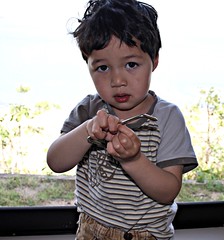
My son here is seen above holding a staple or "kasugai," shown in close up in photo bottom left, which is used to hold two pieces of wood together, see photo bottom right.
In Japanese culture, the love between men and women is seen as being beautiful and natural, but like most things in nature, not particularly permanent. Love, between women and men does not last forever. There is no bridge across forever, no soulmate, no happy end. Japanese love stories tend, or tended, to end in double suicide: the most romantic outcome that one can hope for, at least far more so than domestic bliss.
The love or at least the relationship between parents and children, between ancestors and their descendants is however seen as being eternal. Parents and offspring are considered to be indivisible. No one is born again. This goes for the relationship between children and both mothers and fathers.
So when a couple have a child, while their own emotions for each other may wax and wane, they will be irretrievable linked forever in the flesh of their flesh, their child.
Hence, just as a staple can be used to join two pieces of wood together, so a children are considered to be like staples that join their parents together forever.
Westerners on the other hand are more likely to believe in the possibility of enduring love between men and women, through the transcendence of sexual difference. This hope, that there can be a bridge across forever, is perhaps dependent upon the repression of sex (much less festivals which celebrate sex), which is taboo, repressed, something to be sublimated into a unisex, shareable, idealised "love". I don't think that I need to refer to any particular cultural phenomenon to persuade Anglophones that Western culture is awash dreams of love. Oh, love.
While the Japanese believe that their view is natural, it may be dependent upon the repression of childbirth (seeing it, the desire for it, expressions of child birth, much less festivals which celebrate childbirth), which is taboo, repressed, and sublimated into a unisex, shareable and idealised "parent-child-love". While ancestor worship, or ancestor veneration, is carried out behind closed doors, the clearest expression of the cult of parent child love in Japan, is in the "monstrous" hegemony of cute found in Japan.
Related there are
Children are the shackles of this world and the next (ko ha sankai no kubikase 子は三界の首枷, こはさんかいのくびかせ) which refers to pretty much the same thing.


Labels: family, gender, nihobunka, nihonbunka, sex, Shinto, 宗教, 日本文化
Wednesday, May 05, 2010
Achieving Three Dimensions by Spinning
If you you have a specular self, permanently in the mirror stage, like mirrorman, and according to me, all Japanese, then being three dimensional can present a conceptual problem, since images only have one dimension. Origami paper folding, so popular in Japan, allows one conceptualisation of the two dimensional becoming three - like cubism.
Another is the ability to spin. Spinning is rife among the heros of young Japanese such as the "Inrou Maru" of Shinkenger and the wheel helmets of Goonger (both types of Power Ranger or super sentai).
And as shown in the video above, young Japanese people like to spin. Later Japanese children perform these ("saka-agari") loops on horizontal steel bars, (tetsubou), provided at Japanese schools. I do not have to ask Ray to spin. At three, he seem to want to do it everyday.
The ability to perform a reverse spin (saka-agari) like this on the inverted U, steel bar (testubou) is a rite of passage, and a requirement of Japanese primary school children. Here is a 5 year old Japaense girl performing serial loops on a horizontal steel pole.
AFAIK we WASPs do not require our children to spin, nor do our children show much inclination to do so. I can't remember there being any spin bars at any of my schools in Britain but perhaps I am mistaken.
Until the Japanese child can, by perspective taking (but in a more literal sense that Mead had in mind), and developing the ability to mirror in the mind, she feels perhaps a sense of lonliness or unease at the back of her neck which she can touch but never see. She can overcome this sense of lack through the games mentioned above.
Labels: culture, japan, japanese culture, nihonbunka, occularcentrism, specular, theory, 日本文化
Japanese Buddhist Chanting
In the above video, some lay practioners chant Buddhist scripture. None of the people that are chanting know the meaning of what they are chanting, but they know it is meaningful. I am not sure which scripture they are chanting. Often it is Hanya Shinkyou or Lotus Heart Sutra, which is a pretty philosophical exposition about emptiness. I think that they are chanting to achieve a bit of enlightenment, purification.
I think that the fact that they do now know what they are saying is important and effective. They are destroying language. Repeat anything, even ones own name, even the most meaningful phonemes, and they will become meaningless after a while. By repeating, chanting, these Buddhists are entering, the mumbo-jumbo, language-free-land, and freeing themselves, purifying themselves of the symbol, the group, society, and returning to their un-symbolised, un-analysed Buddha nature.
They feel that they are praying to the Buddha enshrined here. I think that the Buddha here enshrined approves of their self-and-language-anihilation. They are generally older people. People who do not want to die with this-worldly-public things on their mind. They shake noise-makers, to remind themselves that the soul has many voices, not only the one that they are destroying in their heads.
If Japan is so occularcentric then wouldn't it be a good idea for these Japanese Buddhists to work on their self image more? To disassociate themselves from the image? This ia weak link in Takemoto Theorey of Japan. A great deal (but not all) Japanese Buddhist spiritual practice (shugyou) focuses upon eradicating language, via silence (Za-zen), chanting (all forms of Japanese Buddhism), and unsayable sayings (Zen Koans). At the present time my only answer is that perhaps language is the weakest link in the borromean knot that ties the Japanese self together.
Labels: buddhism, culture, japan, japanese culture, logos, nihonbunka, occularcentrism, theory, 日本文化
Japanese Election Posters
Japanese election posters are the other way (see previous post) in which the electorate gain information about the candidates.
In Japan actions speak louder than words. Indeed, I think that being wordy is viewed in a somewhat negative light. For this reason, none of the election posters contain any detail of policy. Many use the same brief phrases promising action, and at least one stating soley, "Action more than words." Instead, the electorate are provided with the names and large photographs of the candidates striking various positive poses. They were also treated to the greetings broadcast from sound trucks.
Those candidates 45 or so candiates, out of about 55, that were elected recieved only about 1500 votes each.
Bearing in mind the small number of votes required for election, those who were elected may have been successful not because their photo, or name was attractive, or because their sound trucks reached an audience persuadable in this way, but rather because of the votes from those with whom they are connected in one way or another. Thus both the posters, and the sound trucks may be a phatic act, going through the motions of canvassing, whereas the real canvassing may have occured in other ways, not herein described.
Labels: culture, japan, japanese culture, nihonbunka, specular, theory, 日本文化
Wednesday, April 21, 2010
Election Sound Trucks, Yoshimichi Nakajima, and Architecture
I can't blame this politician but I really used to hate these election cars. Twenty years ago, when I was learning Japanese these beasties would come by blaring someone’s name and saying thank you, I would, or did on one occasioning run after the truck shouting "Urusai!" (You are being loud/shut up!) to which the politician replied, with thanks.
These days, I have become used to the election cars. I almost feel fond of them.
The western part of me still feels, however, that these announcements would be okay if the politicians said something, such as what their policies are but in general all they say are greetings, the name of the politician and an appeal to vote for me.
There is also a "mythology"(Barthes) to these announcement in that their speech serves to tell the residents, through whose street the car travels, that the politician cares about that particular street.
This politician, running for office in the Yamaguchi City Town hall. Yamaguchi City is now very large. The politician whose sound truck appears in this video, comes from this particular part of town and has and will, I presume, represent the wishes of this his locality or "constituency." So in a sense it makes sense to vote for the politician whose name one hears blaring out of the most sound trucks. There, I never thought I would say it: election sound trucks make sense. If I had a vote, I might even vote for this politician )I do not have a vote because I am not a naturalised Japanese citizen).
The existence of sound trucks is another demonstration of the fact that Japanese do not care a flip about words, in the sense of what they mean - the locutionary act. The meaning of words is almost only in their illocutionary, performative aspect. The performative meaning of this speech at is loud and clear; "I, Mr. H, the politician am making an announcement in your street because I cares about getting the votes of its residents." The politician could simply repeat his name and some mumbo jumbo. Indeed, that is what the vast majority of Japanese politicians do.
Yoshimichi Nakajima’s Japanology which points out the prevalence of verbal announcements in Japan is very good. Not only does he point out the prevalence of linguistic pollution in Japan but also he goes on to show that words must be public, not private in Japan. The Japanese are very tolerant of all sorts of announcements and endless tapes and motto-signs (e.g. those that encourage road safety, or that we greet each other). At the same time they are very intolerant of the expression of personal opinion in a vocal way. E.g. it is the very worst of form to use a mobile phone in a public area, even if one talks in a low voice and I have to pay my students to ask a question in class.
However, what Nakashima does not point out is the Japanese equivalent of the word, or the Western equivalent of the suppression of private speech.
The latter (Western suppression of individual freedom), is observed, I believe in Western architecture. One is free to express oneself verbally in the UK, because speech is yours, it belongs to the individual. In Japan one can express oneself freely in ones house architecture and Japanese cities bristle with some of the most un-harmonious individualism known to man. But, in the UK, if you change anything about the appearance of your house, even the window sills, then you will be fined by the local council, because appearances are public. The situation is reversed in Japan: the word is public, but appearance belongs to the holder.
Labels: culture, image, japan, japanese culture, logos, nihonbunka, 日本文化
Monday, April 12, 2010
Uniqlo Management Theory
The chairman of Fast Retailing, the power behind the Uniqlo Clothing stores throughout Japan and the world, Yanai Tadashi has written a book called "Forget Your Successes in a Day," about the way that he runs his company: never becoming self satisfied. I mention chairman Yanai's philosophy in cultural psychology classes.
The cultural psychologist, Steven Heine has two interlinked theories about why the Japanese are more likely to engage in self-criticism (rather than pumping up their self-esteem).
1) The Japanese don't care so much about being there (because they are not "entity theorists) as getting there (becuase they are incremental theorists). Hence they don't mind forgetting their current success, an concentrating on their failiures for the purpose of continued self improvement.
2) The Japanese don't care much about being great as being loved. Being "successful" is just an ego trip. But making customers and employees happy, that is what success is really about. So they forget their successes and concentrate on their failiures because love, friendship and social relations is what life is really about.
I have another theory why Japanese do no mind cricising themselves, because if they do it linguistically, words are like is water off a ducks back. If they were to loose face however, to imagine themselves, visually, in a negative light then it is painful.
Generally speaking Western psychologists would be inclined to claim that Yanai's philosophy is very unhealthy and likely to lead to depression (Taylor and Brown). Zelligman, the former head of the American Association of Psychology and founder of "Positive Psychology" encourages passing the buck, blaming others, negating the contributions of others and the effect of chance, and doing pretty much anything to get a buzz out of ones successes.
Here is a man showing that remembering ones successes can work too.
And not all Western Psychologists recommend high self esteem, particularly "Sociemeter Theory" by Rory Baumeister and friends.
http://www.psychologicalscience.org/journals/pspi/pdf/pspi411.pdf
Labels: culture, japan, japanese culture, nihonbunka, theory, 日本文化
This blog represents the opinions of the author, Timothy Takemoto, and not the opinions of his employer.