
Wednesday, January 28, 2026
This domain is for sale burogu.com / bulogu.comを売ります。


Saturday, June 28, 2025
Francesca Bray, The Rice Economies' Individualists

Renowned comparative agriculture historian, Francesca Bray, now retired I believe, formerly of Oxford Brookes University has stopped even mentioning her highly recommended book, "The Rice Economies," on the publications page of her website. Her monograph is fading into the history that it elucidates. From a Japanese point of view however, it is mind-blowing.
The Japanese are taught at school from an early age that the long tradition of Japanese cooperation is rooted in the wet rice field agrarian economy, which required the use of irrigation channels which therefore required cooperation amongst Japanese agricultural villagers. This thesis is upheld by recent work in cultural psychology which argues that Japanese holism and Western analytic cognition is rooted in their agricultural traditions. Goat herding Greeks could wander down to the market and sell their meat and cheese without having to cooperate with anyone, whereas Japanese rice farmers were forced to irrigate their paddy fields using canels built with the cooperation of farms from other families. As a result, Greeks and other Europeans saw themselves and the world as being made up of individuals, persons and particles, whereas Japanese saw themselves as part of a community, and the world too as an interconnected whole.
I do not doubt that Japanese agricultural villagers were required to cooperate with each other, but as regards to the extent of cooperation compared to other styles of agriculture, particular that pertaining in the UK, and it was for this reason that the industrial revolution occured in the UK, rather than Japan, because the cooperation required of working in factories and production lines was cultivated among British but not East Asian rice growing peasants.
Bray argues that European farming, with its cooler climate requires the manure of cattle to provide the fertiliser to grow wheat. It is not that we are descended from roaming hunter gatherers (another romantic notion often heard in Japan) but that we needed cow dung to, to grow wheat, to make bread, to survive. This means, Bray argues that two very different types of farmer -- cattle farmers and wheat farmers had to work together using fields in crop rotation, typically one year grazing cattle, one year fallow and one year growing wheat before repeating the cycle again. Wheat farmers and cattle farmers have different skill sets so specialisation was encouraged and all the while cooperation was required. This mixture of specialisation and cooperation lead, Bray argues, to the advent of even greater specialisation and cooperation (later decried by Marx) in the Industrial Revolution in the UK.
In East Asian however, Bray claims, the warmer climate meant that farmers needed far less in the way of fertiliser, since a fermentation process occurring in wet rice fields results in the creation of the nitrates required plants, with only the necessity to provide the manure and left over waste from the farmers own toilets and kitchens. Further, while much is made of the requirement for irrigation channels, it was only in flat regions where these were canalls supplying water from distant rivers, were required to be constructed by communities of agricultural workers.
In the majority of cases, in the mountainous regions covering most of Japan for instance, water was not canalled from distant rivers but could be channelled from streams, or from small reservoir lakes on land owned by the rice farmer. In the latter situation especially, rice farming families were required to cooperate with no one other than their own family members, since they only needed the water from from their own reservoir and the nutrients from their own farmhouse. The were encouraged instead to become generalists, in charge of weeding, fertilising, harvesting and threshing the product of their self-sufficient and highly productive wet field rice paddies. In the absence of the cooperation required by crop rotating UK farmers, the splendid isolation of the Japanese rice farm resulted in highly individual farmers who did not think to create, nor were as suitable for working in the factories of the industrial revolution.
I could not agree more. There are few nations as individual, and independent as the Japanese, so much so that they required the ideology of "harmony" or "peace" (wa) to prevent them from getting at each other's throats at the intersections between their independent rice farms.
Ray, F. (1994). The Rice Economies. University of California Press (first published in 1986).
https://www.amazon.com/Rice-Economies-Francesca-Bray/dp/0520086201
Wednesday, June 25, 2025
The Fortune of the Commons

Here in Japan people treat the commons, such as their roads, not as something to take advantage of in the most selfish way possible (Hardin, 1968) but as something that they work together to preserve. In the photo above are a group of my neighbours, at least one from each household, including my wife, cleaning and weeding a street on which we live. There is some social pressure to participate, but not all that much. If you don't want to participate you can pay a yearly fee of 1000 yen which goes towards giving a small reward (a bottle of tea and some rubbish bags) to those that do. It seems to me that people just want their street to look good.
I claim that this is because the Japanese are autoscopic individualists (Takemoto & Iwaizono, 2016) by virtue of the mirror in their mind (Heine et al., 2008). When you see yourself, you are neither encouraged to compare your own utility with those of others (Hardin, 1968), as encouraged the "negativity" (De Saussure, 2011: see Maruyama, et al., 1993) of linguistic self representation and rational thought, nor is it even possible to isolate (think Photoshop) yourself out your environment. The autoscopic Japanese and their environment are one, in the "two shot" selfie (ツーショット・自撮り写真)of their mind.
I hoping that if AI has the means and desire to kill all the people, due to their tendencies to cause "tragedies," it will spare the Japanese.
Friday, February 14, 2025
Japan 2025
The Japanese are getting prettier and prettier, more and more focused upon prettiness (this man is 31),and eating together (Japanese TV always had a lot of food porn but now it is non stop)

and urbanisation (Over half of the population lives in the three biggest cities),

and they have stopped breeding.

This reminds me of Calhoun's Universe 25 in which the mice, provided with all the food and drink they needed, gathered together in the centre of their giant cage, preened themselves, ate together, stopped breeding and died out.

As I may have said before. But I noticed it again today.
Saturday, May 14, 2022

Professors Kuroishi and Sano are the doyens of normality research (Kuroishi & Sano, 2009; Sano & Kuroishi, 2009; Kuroishi and Sano, 2018). They rightly point out that the word "normal" has a positive connotation in Japan. In the UK and US however, to be called "normal" is far from positive.
As usual however, I claim that this is more about the ideologies present in Japan and the Anglosphere rather than the reality. Kuroishi and Sano (2016) seem to have provided evidence for this claim.
Kuroishi and Sano (2016) asked US American and Japanese respondents to imagine that they achieved better than, worse than, and about equal to their peers, and then asked how participants felt about their achievements. Participants were given a whole bundle of emotion words to evaluate, which the researchers subsequently separated into positive, negative and calm emotions.
They found that while in both cultures participants felt better when they had exceeded the norm, the middle, *normal* bar of the graphs shows that Americans feel better, less bad, and more calm about being normal, with the former two results reaching statistical significance (as indicated by the "*" but I am not sure of the exact level of significance it may be "**").
There are many reasons for this. One is that American big themselves up, linguistically, and say that they are feeling better than they would in fact feel, whereas Japanese may respond modestly saying how bad they would feel to only achieve normal results. I think, however, that the bundle of emotion words that participants were asked to evaluate may have reduced self-presentation effects, to achieve a far greater level of authenticity than asking questions such as "how do you feel about being 'normal'?" directly.Another reason, I claim, is because, while individualism and collectivism exist as ideologies in the US and Japan, they do not reflect the reality, but rather due to the lack of each in the opposite culture, the aspirations of each population at a notional level. Yes, that is right, it is Americans who are more embedded in their groups, and the Japanese who have a greater degree of rugged individualism, to the extent that each hanker after the opposite characteristics.
At the level of their emotions, however, it is the Japanese who are driven to excel in their lived reality, whereas the Americans are, if anything, driven to spin positive words about their situation while feeling quite positive, or at least not negative and calm about being part of the American herd.
Kuroishi, N., & Sano, Y. (2016, July). " Normality" at a Social Comparison: International Comparative Study between the United States and Japan. In International Journal of Psychology (Vol. 51, pp. 329-329). OXON, England: Routledge Journals, Taylor and Francis Ltd.
佐野予理子, & 黒石憲洋. (2009). 「ふつう」 であることの安心感 (1): 集団内における関係性の観点から. 国際基督教大学学報. IA 教育研究= Educational Studies, (51), 35-42.
黒石憲洋, & 佐野予理子. (2009). 「ふつう」であることの安心感(2)集団規範からの逸脱という観点から. 教育研究, 43–54. Retrieved from ci.nii.ac.jp/naid/40016762695
Kuroishi, N., & Sano, Y. (2018). Development of a descriptive/injunctive norm preference scale. Psychological Applications and Trends, 27(1), 355-357. お取下げご希望の場合はご一筆いただければ幸いです。
お取下げご希望の場合はコメント欄かnihonbunka.comのメールリンクまでご一筆いただければ幸いです。
Tuesday, February 22, 2022

I look nothing like this of course. The selfie photograph was processed with some smoothing algorithm, even before the cartoon application redrew me as a 30 something and really thin, when in fact I have spare tire.
This what I think replaces Western "self-esteem" (verbal self aggrandisement) among Japanese. When the Japanese imagine themselves, they imagine someone along these lines, far younger, cuter, and more attractive than they are because the Japanese love themselves too.
While I was taught to think that "narcissism," which is used to refer to both excessive self-agrandisement and visual (in the sense above) self aggrandisement, is both stupid and unpleasant, I think it has advantages.
1) It is generally more public (though it's importance and power can be overlooked)
2) It does not require "negativity" (Saussure) nor even comparison. I can stare at my selfie, in the mirror, of my mind, though I am the only person in the world. But to do the same in words entails, implicitly or explicitly that I compare myself with others, and whisper not only my positivity but also my superiority.
3) Not only does my toonme (jimanga: Takemoto, 2017) not involve "negativity," trashing someone else, but it also often involves basking in reflected glory, or spreading the toon. I take a selfie, with my camera, mirror, or my minds eye with someone or something else, because I am proud of myself and person or thing that I am two-shotting with. Our visual selfie representations are contained within a field, within which the halo-effect glows big-time.
4) Falling in love with ones image does not only imply tooning (falsifying ones self image) but also leads to a greater desire to make the reality match the toon. If, like Donald Trump, or Steven Fry, you can and do, blow your own trumpet, your obesity unimportant. On the other hand, though the Japanese linguistically rate their health the lowest of OECD nations, Japanese are the least obese OECD nation in the world, and the nation with the highest longevity.
5) For the same reason as (3), the located nature of vision, including autoscopy, requires that I take into account my environment. No one can preen themselves in a pool of detritus, nor take cheerful selfies in an apocalypse. The whisperers on the other hand, can, will, and even should keep whispering themselves to rational, logical, self-serving oblivion (Hardin, 1968*).
Toonme Selfie's could save the world, if it were not for the fact that with such nastiness as SDGs, linguistic self enhancement is being promoted on a global scale.
Hardin, G. (1968). The tragedy of the commons: the population problem has no technical solution; it requires a fundamental extension in morality. science, 162(3859), 1243-1248. Takemoto 武本. (2017). ジマンガ: 日本人の心像的自尊心を測る試み. 山口経済学雑誌= Yamaguchi journal of economics, business administrations & laws, 65(6), 457-488. nihonbunka.com/docs/Jimanga.pdf I also used these www.flickr.com/photos/nihonbunka/16105146857
*Hardin, rational homo-narans that he was, explicitly denies the thesis presented here as follows
In passing, it is worth noting that the morality of an act cannot be determined from a photograph. One does not know whether a man killing an elephant or setting flre to the grassland is harming others until one knows the total system in which his act appears. "One picture is worth a thousand words," said an ancient Chinese; but it may take 10,000 words to validate it. It is as tempting to ecologists as it is to reformers in general to try to persuade others by way of the photographic shortcut. But the essense of an argument cannot be photo-graphed: it must be presented rationally -in words (Hardin, 1968, p. 1245)
Thursday, January 06, 2022
The First Tsunami
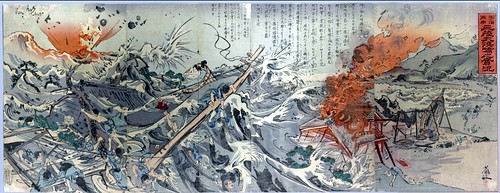
There are have been large waves created by earthquakes for as long as there have been seas and earthquakes but the first time that the word "tsunami," using the characters for harbor and wave was quite recently, sometime in the early Showa period (1930-1940) it seems.
Iwase (2020, p.2 ) says it was in 1940, when it was used to describe the effects of waves on Hawaiian islands. But Aoyama (2012, p.20) claims that it was a new word in 1933 citing Yoshimura. Yoshimura points out that "tsunami" was not used to describe the tsunami in Meiji 29 (1896), in which 21915 people died, with 44 missing, when “海嘯” kaishou or “sea spew/whistle” was used as in the title of the wood-block print by Oguni (1896) above. Kaishou was used to describe any large wave that makes a noise and was subsequently, I presume, used to refer to “tidal (as opposed to earthquake caused) tsunami.”
Were there tsunami before there was the word "tsunami"?
References
Aoyama, 青山咸康. (2012). 1.4 東日本大震災と津波 (未来へつなぐ地域環境づくり, 平成 23 年度石川県立大学公開講座). 石川県立大学年報: 生産・環境・食品: バイオテクノロジーを基礎として, 18-22.2011, www.jstage.jst.go.jp/article/aripu/2011/0/2011_KJ00007993... Iwase 岩瀬彩香. (2020). 大型浮体式津波シェルターにおける重心位置と耐津波特性の関係. core.ac.uk/download/pdf/344666115.pdf Oguni 小国政(1896). 明治丙申 三陸大海嘯之實況.東京大学地震研究所図書室特別資料データベースより wwweic.eri.u-tokyo.ac.jp/dl/meta_pub/G0000002erilib_L000472 Yoshimura Cited in Aoyama 吉村 昭.(2004).関東大震災,文芸春秋文庫,347 ページ 吉村 昭.(2004).三陸海岸大津波,文芸春秋文庫,191 ページ
Tuesday, January 04, 2022
Japanese Superstitions
I am not sure I have got these all right. Most of them are from this article in Japanese, but I hope and believe that they are in the public domain.
When crows cry someone is going to die.
If you eat too much curry your skin will become yellow.
When spiders build webs it is going to be fine.
If you eat watermelon seeds a shoot will grow out of your tummy and you’ll get appendicitis.
You’ll get a nosebleed if you eat too much chocolate.
When swallows fly low it is going to rain.
When catfish squirm there is going to be an earthquake (truth in this).
If you grow loquat (fruit) in your garden someone will get ill.
If you lie to the gate man, king of hell he will rip your tongue out.
If you can hear things a long way away it is going to rain.
If your bottom tooth falls out throw it on the roof, and if your top tooth falls out throw it under your floor.
Children who play with fire wet their bed.
If you drink milk you will grow big breasts.
If you drink milk you will grow to be tall.
If you break a mirror it is bad luck.
If you walk over the top of a comb you will not become a bride.
It is bad luck to sleep with your socks on.
If you meet a bear pretend to be dead.
People’s blood type determines their personality.
If swallows build nests in your eaves your business will do well.
When cherry blossom is only a pale pink it will be a cold year.
If three people take a photo together the one in the middle will die young.
When there is cloud on the mountain it will rain.
People with big ear lobes become rich.
If you put a discarded snake skin in your wallet you become rich.
If you write the kanji for “person” three times on your palm and then swallow (it) you can cure your jitters.
Don’t let your wife eat autumn aubergines.
If you eat things that are in season you will live 75 days longer.
You’ll have good luck if you see best Mt. Fuji. then an Eagle, or aubergines in your first dream of the year.
Don’t drink tea from the previous evening.
If you write the name of a person you love on an eraser and use it till there is nothing left, that person will love you back.
If you go to bed immediately after eating, you will become as fat as a cow.
If you drop food it is okay (to pick it up and eat it) within three seconds.
If you aren’t true to your parents, your skin ad the base of your nails will peel up.
If you forget to put “hina” (girls’ day) dolls away your daughter will take longer to find a husband.
If the stars twinkle then the day will have strong wind.
The pregnant woman that gives birth to twins is a beast.
There will be a good harvest after heavy snow.
Male and female twins were unconsummated lovers in a previous life.
If fish gulp at the surface of the water, then rain is coming.
You should not stick your chopsticks into bowls of rice.
If you can eat the last grain of rice it will rain, if it sticks to the bowl it will be fine.
If you hit your rice bowl hungry demons gather.
You should not sew in the mornings and before going out.
Morning spiders are lucky.
If there is mist in the mornings, it will be fine during the day.
Daughters will be born to strict husbands
and sons to mums who are in charge.
It isn’t good to eat tempura and watermelon.
You’ll be happy if you see a double rainbow.
If cat’s wash their faces it will rain.
Stupid people don’t catch colds.
If you eat the stones of dried plums, you be struck down (because the god of
heaven lives in the stones)
White snakes are lucky.
You should not pass food between people from chopsticks to chopsticks.
If you bring red higan, tiger lily flowers home your will have a house fire.
If you pick red higan, tiger lily flowers someone will die.
If you attach your house name plate with nails, you’ll be unsuccessful at work.
You’ll cold will get better if you infect someone else.
Women born in the year of the horse will make their husbands die young.
If you keep your toilet clean you will have good children.
Put urine on bee stings.
If you wear a hat all the time you’ll go bald.
It is unlucky to sleep with your cushion facing North.
You should not put your shoes out in the entrance hall at night.
Snakes will come if you whistle at night.
Drying clothes at night is bad luck.
If you cut your nails at night you will not live to see your parents die.
You should kill spiders that come out at night, even if you think it might be a reincarnation of your parents.
If you hear thunder hide your navel, lest the god of thunder comes to take it away.
Turquoise is poisonous.
Hide your thumbs (lit. parent fingers) if you see a hearse.
Sunday, June 06, 2021
Superhero Secret Identity Collectivism

This is our (Nishioka & Takemoto, 2021) survey that attempts to prove that while Western Heroes go from a "mild mannered" secret identity to an individualistic "man of steel" Japanese superheroes often start as odd-balls in their non-super form, and change to upstanding members of the community. Japanese super-hero "secret identities" are not secret. They transform to become strong, not to hide. It seems to me that additionally, the individualism espoused by Westerners and exemplified by their heroes, and the polysemic wa, which means acceptance of difference at least as much as it means conformance, are a sort of camouflage for the odd-ball and mild-mannered reality of Japan and anglophone West respectively.
The images of Kamen Rider Forze before and after transformation and Christopher Reeve (RIP) as Clark Kent and Superman are copyright their respective copyright holders and used for illustrative purposes. If you wish that I cease and desist, please leave a comment below or contact me via the email link on my homepage, nihonbunka.com. We will be collecting Japanese data soon.
Labels: cultural psychology, culture, japanese culture, nihonbunka, Super-Sentai, superhero
Monday, March 08, 2021
JMen's Day Suit

Today is International Women's day but I think it should be men's day in Japan due to the gender reversal pertaining in Japanese culture, including the culture of business suits, which exhibit Simone De Beavouir's theory of "The Second Sex" (1946) in reverse.
Simone De Beauvoir (1946) argued that, bearing mind in the teachings of Western religions, and such facts as that W ”l'homme" (man, mankind) refers to humans in general, the default, standard, archetypal, role model in Western society is male, whereas women are considered to be an inferior second or secondary sex.
In seems to me that in Japan this situation is reversed. For example, while the ratio of girls considering their role model to be their mother to their father is 2 to 1, only 30% more boys consider their role model to be their father (often a "salaryman" or salary delivery machine) than their mother.
Further, as shown in the above image, The main brand (by varieties of suit) of Aoyama one of the two the largest Japanese high street suit store (the other is Haruyama, the equivalents of Moss Bros and Burton in the UK) the majority of whose customers are men, is "Person's" for Men" where "Person's" is a brand of suit for women. The same company also sells two other (Mr. Junko think "Mr. Jane", and Yuki Torii Homme) similarly branded suits for men, whereas there are no such branded suits (XYZ for Women) in the Aoyama women suit range, nor any "XYZ for Men" in the Moss Bros or Burton suit brands.
This is probably due to the fact that Japanese women would not be seen dead in a man's suit, whereas Japanese men, respecting as they do the taste and style of women, are happy to wear a men's version of a "Person's" women's suit, because in Japan the default, model, archetypal role model, of the caring, sharing, autoscopic Jperson is a woman, as is the head of the Japanese pantheon is the Sun Goddess not the Father in Heaven.
Since the most important place in Japanese society is the home, where men generally play second fiddle, and increasingly outside of the home, women are being encouraged to take leading role as well, JMen's Day is likely to be a long time in coming.
Labels: female, feminism, japanese culture, male, nihonbunka, reversal
Wednesday, February 24, 2021
Snow-Watching Very Happy Rice Cake Ice Creams

Fusion!
The white vanilla "Snow-Watching Very Happy" (Yukimi Daifuku) rice cake ice creams have been around since my wife was a child, or before. According to a Japanese press article, however, the chocolate ones were released on 31st August 2020. This is the first time I have noticed chocolate ones. The layer of rice is very thin. They contain 77 calories per cake.
The chocolate ones may have taken so long to be released because there is an association between rice cakes and the Japanese religion, Shinto, wherein rice cakes are use to represent the Sun Goddess, or her mirror, which looks very much like her, are displayed at new year, and are eaten in order to consume and or merge with her, so pure white rice cakes tend to be preferred. But then grass (yomogi) flavored ones are traditionally available, and they are green, so perhaps not.
Labels: japanese culture, nihonbunka, 日本文化
Are the Japanese Dirty or Not?
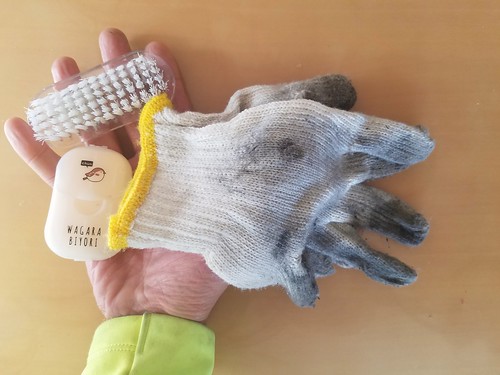
For about thirty years of living in Japan I thought that the Japanese were dirty because they did not have nail brushes (pictured above), before I realised that vast majority of Japanese do not get their hands dirty because they wear disposable cotton gloves (above right) to do dirty chores even when they are at home. I had thought that only taxi drivers, ticket inspectors and others that appear before other people wore these three for a dollar "soldier's gloves."
For even longer I thought that the lack of soap in Japanese public toilets to be a lapse in Japanese hygiene, and to a certain extent at least in so far as providing for ill-equipped foreigners it is, but then I realized that the fastidious Japanese have personal, portable dispensers containing sheets of one-use, "paper soap" (pictured above left) partly because they don't like to use bars of soap and dispensers that have been used by others.
I now use cotton gloves, and carry my own soap, so the lack of nail brushes, and soap in Japanese public toilets, no longer bothers me.
I still like my British nail brush (purchased from China) to scrub my hands, however, in these times of pestilence.
Labels: japanese culture, nihonbunka, 日本文化
Tuesday, February 09, 2021
Choice is a Chore
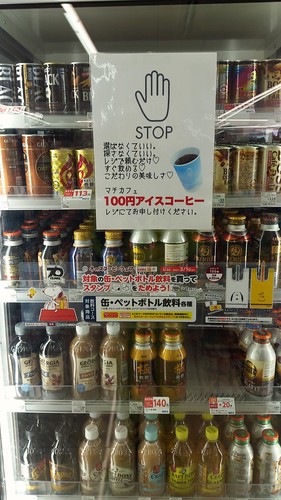
A poster in a convenience store promoting the store-brewed coffee over the wide variety of canned an bottled prepared coffee in the refrigerator, implying a negative, troublesome side to choice, which Japanese are more keenly aware of (Markus & Schwartz, 2010) but also leads to non-optimal outcomes in the West too (Schwartz & Ward, 2004).
My translation of the poster
No need to choose.
No need to search.
Just ask at the till ♡
You'll soon be able to drink ♡
Our specialty taste ♡
High-street Cafe
100 Yen Ice Coffee
Please order at the till.
The second, transparent poster says that customers can collect stamps by purchasing the drinks in the fridge.
Bibliography
Markus, H. R., & Schwartz, B. (2010). Does Choice mean Freedom and Well-Being?. Journal of Consumer Research, 37(2), 344-355.
Schwartz, B., & Ward, A. (2004). Doing Better but Feeling Worse: The paradox of choice. Positive psychology in practice, 86-104.
Labels: japanese culture, nihonbunka
Wednesday, January 27, 2021
Only in the Eyes of God, and Themselves
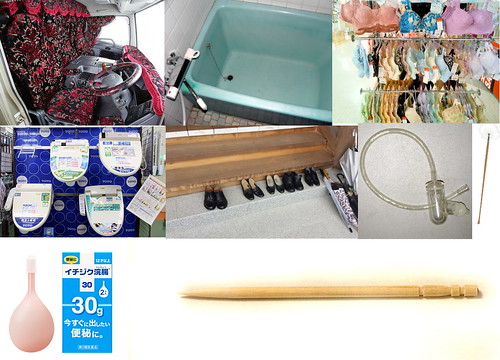
The Japanese are said to be hygienic because they care about how they look to others but many Japanese hygiene and prettifying behaviors such as, decorating the interiors of their cars and trucks, bathing at night, wearing fancy underwear (that sometimes becomes outer wear it is so fancy), bidets, not wearing shoes at home, snot suckers, enemas, the popularity of ear cleaning, the prevalence of toothpicks, and (not pictured) the use of flannels to clean ones hands and face before meals, toilet slippers, and disposable cotton gloves when doing dirty chores at home, are carried out in the eyes of God (the Sun Goddess and ancestors who are always watching) and themselves but are nearly invisible to other people.
The fig shaped enema above is from ichijiku.co.jp お取り下げご希望の場合は下記のコメント欄か、http://nihonbunka.comで掲示されるメールアドレスにご一筆ください。
Labels: autoscopy, japanese culture, Nacalian, 自己視
Monday, July 13, 2020
Mistranslated: Totality not Harmony
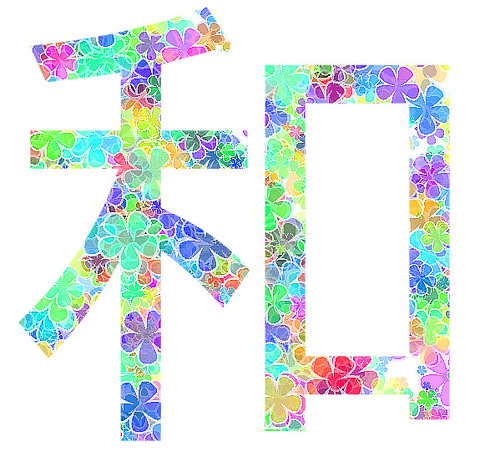
Japan is called groupist or collectivist partly because one name given to the the country is "wa," which is used in various expressions such as Wakoku (和国) meaning Japan, Wafuku (和服)Japanese clothing, Washoku (和食) Japanese food, and Wayaku (和訳)translation into Japanese. On its own however the character is generally translated as "harmony," and that is the way that I have translated, with an increasing sense of unease, until recently I found the character used in a math problem (see below) where it was used to represent the sum, or total of two numbers. This is more like it: Japan is the land of totality. Understanding "wa" as "harmony" one would be inclined to think that the Japanese were into compromise. Ha! Over their cold dead hands. The Japanese have groups which are tolerant of diversity (Yuki, 2003) which are not the harmony of their constituent parts, but the totality, given a vague, nice sounding, but generally irrelevant name.
When Akiko was born, her mother was half the age of her grandmother. Now her mother is four times her age. In two years time the wa, total (not harmony) of her mother's and grandmother's age will be eight times Akiko's age. How old is Akiko?* (Asahi Newspaper "Edu" section, 2020/7/12). Attempting to solve this problem translating "wa" as average (harmony of, compromise between) the two ages, results in Akiko having a negative age. As the true meaning of "wa" dawned on me, the moral of this mathematics problem was therefore, at least for me, if you understand Japanese "wa" as "harmony." you have not even been born.
That is not to suggest that Japan is totalitarian, quite the opposite: libertarian, anarchistic or minitarian in its tolerance of variety and summation, rather than harmonization, of its parts.
Yuki, M. (2003). Intergroup comparison versus intragroup relationships: A cross-cultural examination of social identity theory in North American and East Asian cultural contexts. Social Psychology Quarterly, 166-183.
*Akiko is seven.
Wednesday, July 01, 2020
Grit and Pride as Motivators
If you were not the apple of your mother's eye, then all is not lost. Get fit, in shape, and do a martial art or other physical exercise that involves the practice of forms since these may allow you to train your mirror neurons so that you learn to better see yourself, and like what you see.
https://www2.psych.ubc.ca/~heine/docs/2001persist.pdf
リティ研究, 24(2), 167-169. https://www.jstage.jst.go.jp/article/personality/24/2/24_167/_pdf
Another downside of grit, or the belief that one has it, may be that it can lead to pachinko addiction, which is very prevalent in Japan. Panchinko is a form of gambling that requires almost no choice, but a lot of grit.
Thursday, March 26, 2020
Survive the Pandemic by Turning Japanese
 Here are some of things that may have helped the Japanese to have suffered fewer deaths in the coronavirus pandemic so far include perhaps (I am not connected with medicine):
 1. wearing face masks which have been de rigueur for those who are suffering from respiratory illnesses perhaps since the influenza pandemic of 100 years ago,
2. a greater attention to covering ones mouth when one coughs (Japanese ladies cover their mouths even when they laugh),
3. far less dancing and discos,
4. bathing in the evening when arriving home dirty rather than the next morning (having passed the evening and night dirty at home!),
6. drying oneself using single use towels rather than bath towels that may not be washed for a week,
7. high interpersonal distance,
8. boiled sweets (candy) provided at customer service locations partly to reduce customer coughing,
9. generally lots of cleaning and sweeping by everyone from school children to monks,
10. food wrapping or the lack of unwrapped food sales, polythene bagging of unwrapped foods such as fruit at the checkout,
11. non-food product wrapping so that even if the packaging has been handled purchased products are sterile when unwrapped at home,
12. changing of clothing upon returning to the home and arriving at school (school uniforms are worn only on the way there. Pupils often change to track suits in class),
13. removal of shoes indoors,
14. use of a separate pair of slippers inside toilets,
15. passing things to other people with both hands thus interpersonal maintaining distance,
15. the use of semi disposable gunte cotton gloves by service personnel such as ticket inspectors, taxi drivers and anyone doing a dirty task even at home*,
11. the Japanese housewives' love of aprons which keep their clothes clean,
12. the way that Japanese taxi drivers open taxi doors for passengers so they don't need to touch the door handle**,
13. the predominance of uniforms in any job that may involve even a little dirt such as on any sort of manufacturing industry,
14. preference for the "one room mansion" over shared houses and flats,
15. more vending machines allowing purchases without human interaction,
16. the practice of sterilizing ones mattress (futon) by hanging it out in the sun,
17. taking rubbish home rather than littering or even using (non-existent) public waste bins,
18. plastic fairings along the sides of car windows to allow windows to be open a little refreshing car interior air even when it is pouring with rain,
19. a general preference for fresh air over closed air-conditioned rooms.
20. a preference for new things rather than second hand,
21. a greater belief that "cleanliness is next to godliness" and conversely that sin is a sort of defilement,
22,regarding cleaning is a sort of spiritual practice (that at least teaches the importance of cleanliness),
23. respect paid to homes, temples, martial arts gyms and other spaces with cleaning and bowing and greetings at the entrance to such spaces, emphasising the importance of keeping them in all ways good and pure,
24. traditionally according to Shinto scripture considering (skin) disease to be one of the deadly sins,
25. the integration of hand and mouth washing (chouzu, temizu) into Shinto prayer ritual,
26. shame-culture severity towards mistakes and not things that one does intentionally (infection is generally unintentional caused by a lack of vigilance such as in failing to cover ones mouth when one coughs),
27. the traditional provision of hot hand washing wet towels (oshibori) and disposable chopsticks at restaurants (that remain open even now),
28. individual bowls and chopsticks rather than sharing a common stock of cutlery even within the home,
29. sitting next to partners and friends rather than facing them and enjoying their company side by side (e.g. using counter seats),
30 enjoying the presence of others without feeling the need to keep talking all the time,
31. swallowing ones nasal mucus rather than blowing ones nose,
32. the consumption of many healthy foods. An urban myth has it that natto (rotten soya beans) is preventative but the notion that it may help has been rejected by Japanese specialists. Something about the Japanese diet (which is higher in rice, soy, and) may help. Natto contains a serine protease (nattokinease) which may encourage the production of serine protease inhibitors (serpins) which may block infection, or do the opposite. I am not a doctor.
33. Washlet (and other brand) bidets fitted to toilets keeping coronavirus from wiping hands,
34. the avoidance of touchy feely greetings such as handshakes, hugging and kissing,
35. less petting at least in public and less sex out of courtship and procreation, and a greater use of prophylactic sheaths,
36. a greater use of the seated position by males when urinating (sometimes by order in public toilets) thus avoiding urine on the floor and seat and hand to genital contact (male genitals may act as a fomites and while it is not a Japanese tradition, I have taken to washing my hands before and after using the toilet),
37. washing ones hands inside toilet cubicles using a raised flush-cistern faucet/spigot or tiny sinks before touching the toilet door handle,
38. the provision of disposable paper toilet seat covers and or disinfectant for cleaning toilet seats in public toilets,
39. spitting is unacceptable,
40. flatulence is beyond the pale,
41. drinking green tea and various medicinal teas,
42. perhaps the practice of getting neck deep in clean hot baths (Japanese wash before soaking) almost every night,
43. the use of hot spas as a folk treatment for almost everything.
The last two would be my Japan-influenced suggestions for attempting to treat the virus even in the face of WHO "myth busting", but I am not connected with medicine in any way.

I thought that the Japanese would be especially inclined to catch the coronavirus due to their genetics but Japanese culture proved me wrong.
I hope and pray that everyone worldwide stays safe. When Japanese schools reopen in April, the Japanese may face a resurgence of the coronavirus, so, I am praying for Japan too. Perhaps prayer should be added to the list of hygienic behaviours. Many Japanese people pray in the face of adversity (kamidanomi) even if they do not believe in the existence of that which they are praying to. This I think promotes awareness of the strength of ones yearning, and lack of ones power, thereby promoting a kind of humble diligence, hopefully.
The above inaccurate image was drawn freehand by me based on an accurate graph in the New York times.
*One hygiene product that I felt to be lacking Japan is the (Great British!) nail-brush. Upon reflection, however, I have come to realise that there are few nail brushes in Japan because Japanese would always wear gloves before performing a task that is so dirty as to result in dirt getting behind their nails. Oops.
**I now think back with regret at the number of times I have opened Japanese taxi doors for myself, in an expression of autonomy, as if to say I don't need you to open the door for me, and thereby putting my nasty germ ridden hands on the taxi probably forcing the taxi driver to get out and disinfect the door.
Labels: japan, sex, taboo, tourism, ホスピタリティ, 日本文化
Wednesday, December 04, 2019
Omotenashi and Weak-Mindedness
There is a tendency for Japanese hospitality providers to provide the type and frequency of hospitality that they consider appropriate to their customers without asking their customers, or waiting to be ordered by them. Ideally Japanese hospitality providers should read the non-verbal signals of their customers and provide the services to make their customers happy prior to having to be asked (Doi, 1973).
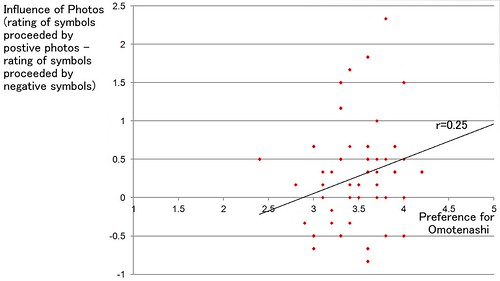
In a typically modest and collectivism-believing fashion, Ikeda (2020, in preparation), a seminar student hypothesised that this type of hospitality is popular in Japan since the Japanese are easily lead, or weak-minded. In order to test this hypothesis we showed students a series of positive and negative pictures (Dan-Glauser & Scherer, 2011) followed by abstract symbol asking them to rate the positivity of latter, measuring the extent they were influenced by the photographs (which they were told to ignore) and asked them the extent to which they enjoyed Japanese style hospitality (omotenashi).
In line with the graduate student's hypothesis, a weak positive correlation (r=0.25) was found between our test of weak-mindedness and the preference for omotenashi as shown in the graph above.The horizontal axis shows preference for omotenashi, whereas the vertical axis shows the extent to which abstracted symbols were rated as having the same valence as the photographs which proceeded them.
[I think that this is a very negative way of seeing Japanese hospitality which is rather motivated by trust in hosts, a desire to allow others (hosts) to be individuals and to express their individualism, a lack of desire to hear themselves think or speak, a preference for and belief in the efficacy of non verbal communication, and enjoyment of and tolerance to surprise and the unusual, and a lack of a hatred of the influence of others. I may attempt to test these other hypotheses in future research.]
Dan-Glauser, E. S., & Scherer, K. R. (2011). The Geneva affective picture database (GAPED): a new 730-picture database focusing on valence and normative significance. Behavior research methods, 43(2), 468.
Doi, T. (1973). The anatomy of dependence. Tokyo: Kodansha. Goldberg,
Ikeda, Y. 池田良生.(2020)「おもてなしとマインド・コントロール」山口大学経済学部卒業論文(準備中)
Wednesday, February 13, 2019
Miyuki Emond's Tongue
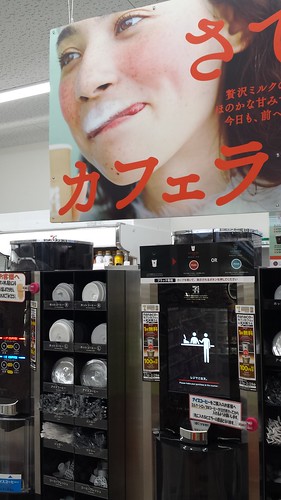
It is rare to see a Japanese woman in anything but tip-top preened perfection in the (non adult) media anyway. But Ms. Miyuki Emond appears to be happy to pose with with her tongue showing, presumably about to lick milk froth on her top lip in the caffè latte advertisement poster shown above Seven Eleven's coffee vending machines.
A female Japanese university student once left my English class in tears when I asked her to poke out her tongue just a little to pronounce the sound "th" of "froth". I am now very sorry. It was too personal and imperfect a disclosure to demand of a Japanese lady. Ms. Emond is half Canadian. Japanese opinions of the poster and television commercial are divided with some Japanese even expressing displeasure regarding her mouth. This is hardly surprising in a Japanese context bearing in mind that female expressions of desire have been taboo since the beginning of the Japanese world.
In the Japanese creation myth Izanami (female) told Izanagi (male) that he was "a fine man" or words to that effect. The child born as a result of their union was boneless like a jellyfish and floated away out to sea. It was afterwards ordained that the male should invite the female and not the other way around. Japanese ladies have been saying “no,” hiding their desire, and the inside of their mouths, ever since. At least that is, until Ms. Emond showed her tongue.
お取り下げご希望の場合は下記のコメント欄か、http://nihonbunka.comで掲示されるメールアドレスにご一筆ください。
If you would like this removed from the Net please leave a comment or send me an quick email to the address at the email link on my homepage: http://nihonbunka.com
Tuesday, November 06, 2018
The Beauty of Shazaikaiken

Shazaikaiken are press conferences held for the purpose of making a public apology and they can look pretty strange to Westerners such as Dave Spectre (Amano, 2008) and myself in the past.
In the West, the public linguistic announcement of mistakes, fines, reparations, and counter-measures can lead to regaining trust. For example the charity evaluation organisation Give Well, announces their mistakes, reparations and measures to prevent repetition in detail at the website below.
www.givewell.org/about/our-mistakes
However, Japanese shazaikaiken have an aspect visual communication or "performance" (Amano, 2008).
From a Western perspective, perhaps, mistakes, responsibility, and apologies (and indeed human existence, and the existence of the world) are inherently rational or linguistic, and substantive so there is no point or need of airing them in front of other people. And further, while no enjoyment will be gained from seeing a row of men bow awkwardly, the act of performing a public apology press conference may impact negatively upon the ’real’ linguistic reparation amount, and counter-measure policy. Japanese shazaikaiken, public apology press conferences can appear to be saying, "look, I am apologizing in front of everyone, so cut me some slack," and to be attempting to purchase forgiveness by performing an act.
From a my would-be, slightly Japanese perspective however,
Whether in language or via press conferences, all is communication. Repeated mistakes are, hopefully, prevented by making them public. There is nothing that exists, substantially, materially independently of communication, so the superiority of language with its pretence of substance is non-existent.
On the contrary, a public announcement solely in words is like a shazaikaiken made from behind a curtain. If the apologizers are genuinely sorry then they should show their bodies, their faces and communicate publicly via all channels not just from behind their fig leaf. The shazaikaiken is therefore thought to be more effective, than any veiled linguistic press conference in a closet, at preventing recidivism: the repeat of the undesirable behaviour.
Into the light.
失敗・罰金・弁償金と今後の対策を言語的に発表することは欧米でも信頼回復につながります。例えば、チャリティーを評価する段階は細かく
自分の失敗・弁償・対策をネット公開しています。
www.givewell.org/about/our-mistakes
しかし、日本の「謝罪会見」は視覚的なコミュニケーション、あるいは「パフォーマンス」という側面があります。
欧米人の考えでは、過失・責任・謝罪は全部(人間の存在、世界の存在もそう)言語的ですので言語的に発表するのはよいですが、人前でする必要はありません。さらに、謝罪会見で見苦しい姿を見せてもらっても何の喜びも得られませんが、謝罪を人前ですることによって、対策、弁償金額などの実態としての言葉への悪影響さえ考えられます。「皆の前で謝罪したから勘弁してください。」とでも言いたいか、パフォーマンスで許しを請っているという印象を持たれると思います。
日本人は?憶測ですが。。。少しだけ日本人のつもりとしての私は
言語であろうと、謝罪会見であろうと全てはコミュニケーションです。過失を公開することで、再発防止になります。
コミュニケーションしたなくても「実体」として存在するものはありません。ですので、そのパフォーマンス的な側面をぼかして、「実体性」をアピールする言葉の優越はありません。
逆に、言葉だけの公表は幕の裏からの謝罪会見のようなもので、本当に後悔・公開・謝罪しているのであれば、自分の言葉だけではなく、自分の体も顔も世界に見せて前面的に公言すればよいです。その方が一番、インチキ会見である言語的謝罪より、ちゃんとした日本流謝罪会見は再発防止の効果があると思われるからです。
あとがき
ルースベネディクトの『菊と刀』(罪の文化・恥の文化)は非常に関係しています。内的基準に依拠する「罪の文化」は日本の評論家が反論するように、存在しません。想定された他者(神・祖先)であろうと、実際の他者や世間であろうと、罪悪感も羞恥心も達者あって感じられる「社会的感情」ですが、米人はそして経済学者は個人主義を主張し、他人から切り離された実体的な「道徳」を信じています。
マッド・アマノ. (2008). マッド・アマノの「謝罪の品格」. 東京: 平凡社.
The above image, showing a shazaikaiken, is from today's (2018/11/06) Asahi Newspaper page 6
お取り下げご希望の場合は下記のコメント欄か、http://nihonbunka.comで掲示されるメールアドレスにご一筆ください。
This blog represents the opinions of the author, Timothy Takemoto, and not the opinions of his employer.