
Thursday, October 04, 2012
Hashimoto's Japan and the Monkeys

Hashimoto does not claim that anyone ever sprayed cold water on the Japanese. However, the situation described in the penultimate picture, bottom left in which all the members of society of monkeys refrain from doing what they desire because they are, justifiably, afraid of censure is essentially the same as that which Hashimoto claims to exist in Japan. The Japanese all want to behave like individualists, but they are scared to doing so due to their fear of censure. Their fear of censure is probably justified because Japanese believe that anyone who does not censure individualists will themselves be censured.
I don't think that this does in fact describe Japanese society, where both individual (e.g. Sumo and K1 MMA fights) and group (the Koushien baseball tournament) sports are highly admired. Returning to the Orwellian analogy, to the extent that Japanese have grown to love highly cooperative acts, they have learned to love "Big Brother." Learning to love big brother is not however, as sinister as the process described in George Orwell's book. It is rather that the Japanese see their 'ideal of individualism' as will o the wisp (nai mono denari) and are able to stand back and imagine a society in which everyone gave free reign to their individual desire, and realise that it would not look like the group of happy monkeys pictured in the final frame above.
Hashimoto, H. 橋本博文. (2011). 相互協調性の自己維持メカニズム. 実験社会心理学研究, 50(2), 182–193. Retrieved from japanlinkcenter.org/JST.JSTAGE/jjesp/50.182?from=Google
Labels: collectivism, individualism, japan, japanese culture, nihonbunka, 個人主義, 日本文化, 集団主義


Wednesday, October 03, 2012
Yamagishi in the Middle of the Cultural Psychology Feedback Loop

What alternative models are there? One of the most eloquent critics of cultural psychology, who nonetheless mixes with cultural psychologists and performs comparative cultural experiments, is Professor Toshio Yamagishi who has consistently claimed that what cultural psychologists are calling cultural psychology are really a product of "institutional" facets of the social environment.
For example, Yamagishi demonstrated that Japanese people behave cooperatively in a game when they believe that their actions can be observed by others, but not when their actions could not. Hence it is not that Japanese are cooperative per se but that they are employing a "group heuristic model" and anticipate certain patterns of censure and encouragement from their peers (Yamagishi, 2008).
Again, while Markus and Kim (2000) had shown that Japanese show a "preference" for majority and Americans for minority coloured pencils -- when given a choice of say one pencil from four blue and one red pencils -- this "preference" was found to be the result of, again, fear of censure and anticipation of gratitude from those yet to make a choice. Japanese reason to themselves "If I take the last red pencil no one else can. So if there are any others that wanted the red pencil then they are going to be upset with me for taking it, and grateful if I do not." When told that they are the last person to make the choice, or that they are in a shop purchasing a pencil, the Japanese chose the minority (red) pencil as frequently as Americans (Yamagishi, Hashimoto, & Schug, 2008).
Or again, as argued in Hashimoto's recent research (Hashimoto, 2011) why is that Japanese tend to censure individualistic behaviour? Not because they prefer cooperative behaviour (they prefer individualistic behaviour), but because they anticipate that those that praise individualistic behaviour will censured.
Hence, Yamagishi and his colleagues consistently and persuasively argue, there is nothing particularly cooperative about the Japanese psychology, it is just that they are playing a different game according to a different "heuristic," with different "default schema" because they are in a different "institution".
But hold on a second! That which was encouraging Japanese to be cooperative was thought to be psychology. Now we find that it is out there in institutions, in society. I think that in Yamagishi's anti-cultural psychological model, there is non-dual model of how psychology can be out there, in the world in psychology, in a pattern of anticipated interpersonal behaviours. Yamagishi's psychology collapses the duality in the cultural psychological feedback loop. In this sense, perhaps Professor Yamagishi is the most cultural of psychologists?
Yes and no. It could also be said, applying the theory proposed by this blog, that Professor Yamagishi is Japanese.
Speaking as a Westerner, when faced with for instance, the choice of which coloured pencil to choose, the narrative, "I know that someone coming after me may not be able to choose the colour of pencil that they wanted to choose but I know my rights, and I know that therefore I am within them to exercise my preference and that anyone who might censure me will know that I having behaved within my rights, I will choose the red pencil," i.e. the "default schema," "the heuristic" the analytic thought (Nisbett and Masuda) of my "institutional environment," are what I am. These machinations, this narrative, are the most important part of what it is to be me. To me they are, that narratival feedback loop is, "I", my self, my psychology.
Professor Yamagishi on the other hand is Japanese. As we can see from the above photo is about 65 going on 20. Professor Yamagishi is a mountain climber, and if you meet him you (and he) can see, tremendously fit. He does not not identify with such narratival machinations (heuristics, default schema, analyses of his institutional environment). Professor Yamagishi is to himself the man, the beautiful (Abe) man that one can see. All the these analytic/heuristic/schematic/narratival machinations are merely a product of his institutional environment.
Image of Toshio Yamagishi from his website reproduced here without permission. 取り下げご希望でありましたらご一筆いただけらば幸いです。
Yamagishi, T., Hashimoto, H., & Schug, J. (2008). Preferences versus strategies as explanations for culture-specific behavior. Psychological Science, 19(6), 579–584. Retrieved from pss.sagepub.com/content/19/6/579.short
Yamagishi, Toshio, Mifune, N., Liu, J. H., & Pauling, J. (2008). Exchanges of group-based favours: Ingroup bias in the prisoner’s dilemma game with minimal groups in Japan and New Zealand. Asian Journal of Social Psychology, 11(3), 196–207. doi:10.1111/j.1467-839X.2008.00258.x
橋本博文. (2011). 相互協調性の自己維持メカニズム. 実験社会心理学研究, 50(2), 182–193. Retrieved from japanlinkcenter.org/JST.JSTAGE/jjesp/50.182?from=Google
Labels: collectivism, individualism, japan, japanese culture, nihonbunka, 個人主義, 日本文化, 集団主義
Profesional Co-Sleepists

There are a lot of reasons why this services is available in Japan as opposed to anywhere else.
The central theory espoused by this blog (burogu.com) is that the Japanese live in the visio-imaginary. That is to say that the visual and imagined is the most important media/channel and felt to be the most real part of the world. This is because instead of having simulated/internalised a thou, super-addressee, Other, or generalised other of self-speech, the Japanese have internalised a generalised point of view. The Japanese can see themselves from the eye of the Other.
This means that things that look the same, are, for most practical purposes, the same. Thus shrines and temples, foreign villages (gaiku-mura), food (plastic food), art works, offerings (horse sculptures and drawings called ema), and people (robots, and co-sleepists) can be copied and will be felt to be the same as, or almost the same as the original.
This encourages the Japanese to purchase far more copyist services, such as women that sit next to your and laugh at your jokes (the main job of a snack hostess), people who clean our your ears (the typical behaviour of a mother or doting female) or someone to sleep next to you, the behaviour again of a girlfriend. The Japanese do not limit themselves to prostitution (which in its coital form is illegal) but purchase all sorts of soft services that people from Britain would only require from someone who had the correct "internal" states.
The tag line of the website says, "it is just enough to have you sleep next to me". Their major clientèle are tired men in their 30s to 40s.
This brings me to another reason that Japanese are more inclined to purchase co-sleeping services. The Japanese sleep with their children. Children sleep between their parents. They are brought up feeling very secure and loved. This means that the parents on the other hand far more rarely get to sleep with someone of their own size at least. Hence the need for this service.
Labels: authenticopy, image, japan, japanese culture, nihonbunka, sex, 日本文化
Tuesday, October 02, 2012
Hashimoto's Distopian Japan

Following on from research by his mentor, Toshio Yamagishi (e.g. Yamagishi, 2002), Hirofumi Hashimoto (2011) investigated Japanese attitudes towards cooperation and independence.
First he found that while Japanese think that (1a) other Japanese people like cooperation and (2a) they themselves cooperate, they would ideally like to be (3a) independent. In other words, the Japanese appear to be wearing a mask of Japanese cooperativeness over a heart of independence. They continue to wear this mask because they believe others have a dim view of individualists and they believe that they would be ostracised or worse if they came out of the closet. To demonstrate this Hashimoto showed that (1b) Japanese believe that others negatively evaluate individualists. However, he also showed that (2b) Japanese in fact positively evaluate individualistic others.
In research Hashimoto is currently writing, he goes on to ask, "so how does the system remain balanced or intact?" Why isn't there a small boy that says, "the emperor is wearing no clothes!" or rather "Actually, I admire independent people," bringing the ersatz "valuation of cooperation" down like a house of cards?
Hashimoto argues for, and demonstrates, another layer of sham. He further asked (1c) what other people thought of those that admire individulists and (2c) What the subjects thought of people that admire individualists. As closet admirers of individualists, it is not surprising that the subjects said that they liked others that also admire individualists. But once again, they said they believed that others negatively evaulate those that admire individualists. Hence even those that see through the sham, realise the emperor is naked, or at least that they can't see the clothes, and that they like individualists, are afraid to say so.
Hashimoto presumably believes that this web of fear is infinitely nested, lest someone should come out and say "Acutally, I like people that admire individualists," or "Actually, I like people that say that they like people who admire individualists," etc because at every level each individual presumes that they will be ostracised for saying so since at every level they believe that others do not admire individualism.
This situation is a little like that which I presume pertains in a dicatorship. The participants in the Valkerie plot to assinate Hilter where hampered by their (in part erroneous) belief that other people admired the Fuerer. Hashimoto's nested web of fear may have even more in common with that described in George Orwell's "1984," in which the feared dictator -- "big brother" -- may be dead, or may never even have existed.
According to Hashimoto's vision of Japan, collectivism as an aspiration, exists only as a bogeyman, that no one ever aspired towards but everyone was afraid to admit it due to fear of ostracism from others. And this view, inmho, plays towards Western views of Japanese, or indeed everyone else, and the commonly held Western belief that in fact everyone is a freedom and autonomy loving Westerner underneath.
Hashimoto and Yamagishi are very clever, and their data appears irrefutably sound. But, if they are right, that there is this disconnection between culture and psychology, that sheepish East Asians have the private life of woolves, then Cultural Psychology as a mutally constructing feedback system, (Markus and Kitayama, 1991) would need to be thrown out the window. The stakes are high.
Addendum
As usual my attempt to circumvent his dillemma is to argue that the apparent contradictions of the Japanese heart only exist when you are asking them to vocalise, or answer linguistically framed likert tests about cooperation and individualism. There is something so linguistically attractive or imperative about autonomy, that some economists have argued following Kant, that it has the status of a synthetic judgement a priori. How can one make a counter claim against the value of autonomy, without asserting that one does not want what one wants? One runs up into a modied form of the liar paradox, the last guardian of logocentrism.
Thus our words, including Japanese words, claim for themselves freedom, but what is the situation in the minds eye? Are independent people beautiful? Is independent behaviour beautiful? How about cooperation? Have you seen the Koshien Baseball Tournament, and why does anyone watch it? What of people that admire independent people, are they really beautiful too? The Japanese do love the way thinks are in Japan, and discount their unrealistic linguistic aspirations and admiration for independence as will o the wisp (the closest translation I could come up with of ) "nai mono denari" (ないものねだり).
Image above top modified from from Hashimoto, Ohashi and Yamagishi's 2010 presentation to the Social Psychology Association, which has now largely been published in Hashimoto, 2011 (see below).
Bibliography
Markus, H. R., & Kitayama, S. (1991). Culture and the self: Implications for cognition, emotion, and motivation. Psychological Review; Psychological Review, 98(2), 224. Retrieved from http://www.biu.ac.il/PS/docs/diesendruck/2.pdf
Orwell, G. (1949). Nineteen Eighty-four (No Edition Listed.). Harcourt Brace and Co.
Hashimoto, H. 橋本博文. (2011). 相互協調性の自己維持メカニズム. 実験社会心理学研究, 50(2), 182–193. Retrieved from japanlinkcenter.org/JST.JSTAGE/jjesp/50.182?from=Google
Yamagichi, T. 山岸俊男. (2002). 心でっかちな日本人: 集団主義文化という幻想. 日本経済新聞社.
橋本博文・大橋加奈子・山岸俊男 (2010, September). 相互協調行動を支える制度的基盤 第51回日本社会心理学会 (於:広島大学, 口頭発表)
Labels: collectivism, culture, individualism, japan, japanese culture, Nacalian, 日本文化, 集団主義
Saturday, September 29, 2012
The Purported Death of On-The-Job Training in Japan
There are those such as Dr. Greg Story, whose article was quoted in Japan Today, who argue that on the Job Training should be left to die. Dr. Story (shown in the above video) writes,
"Most countries have moved on from this model but, mainly thanks to the OJT, elements of the imperial forces linger here, in the form of giving orders not praise, condemning not complimenting, and criticising mistakes rather than motivating."
I think that Dr. Story, who is president of the Dale complement-people-to-win-friends Carnegie Institute, is trying to sell Western culture in Japan, marketing Western Culture as something that countries "move on" towards. In sum, ego-massage is the future.
First let's recap. Cultural psychologist, Steven Heine's theory of motivation in the USA and Japan is as follows.
Westerners see themselves as being independent "entityl theorists," seeing success or failure as largely a product of innate abilities. They attempt to find the field in which they shine. They are motivated by success and praise, particularly self-praise, which they do liberally and wholly unrealistically. The important thing is that they hype themselves up, win, and feel motivated to hype themselves up and win some more. Think Mohammed "I am the greatest" Ali, or indeed perhaps, Dr. Greg Story.
The Japanese are interdependent, "incremental theorists" believing that the self is malleable and success or failure is largely a product of effort. They attempt to find the ways in which they are not achieving (i.e. their failures) and by correcting them improve and recieve support and integration with their groups. Doing things for self-praise is considered pretty silly (jigajisan 自画自賛). The Japanese are motivated by failure, and the challenge to improve themselves so that they do not fail next time. A good examples of this sort of psychology is found in Japanese baseball players, who are the best in the world. Another is the business philosophy of Uniqlo president Tadashi Yanai who recommends that we forget about our successes and learn from our failures.
Steven Heine's website is here. And the paper which demonstrates that the Japanese are motivated by failure experiences is here.
Alas, legions of very self-confident people Greg Story have convinced Japanese university educators, and the Japanese Governmental Eucation Department that the Japanese need to have higher self esteem, and turn into self-enhancing Westerners, which has rather put a spanner in the works of Japanese culture, as noted in this article. Will the Japanese be able to become people like Mr. Story? Or will they chuck his advice out the window? Is there a third way?
I add a twist to Heine's theory as follows.
The Japanese are able to be self-critical, or "condemning" linguistically. They can take and dish out criticism in words liberally towards themselves and in-group members (e.g. spouses, and co-workers). But they are not completely self-less as the above theory would have it. In the visual domain, that is in their own reflection and reflective imagination (which the Japanese are very good at - as if they carry a mirror with them all the time), they have very positive self-representations.
This is the main reason for the importance of on the job training or "watching and stealing" (見て盗む), because it is only by seeing, doing, copying, and making it there own that the Japanese become ego involved.
Finally while there is a lot of linguistic criticism going around in Japanese companies, there is a lot of love if you turn off the sound as it were. Unfortunately people like Mr. Story can't feel the love, because what matters to him is his self-narrative, his cogito, or "ego".
The paper that shows Japanese are sort of always carrying a mirror with them is here.
I would like to argue that sense can be made of past and future prime minister Abe's policy of a "beautiful Japan," (美しい国) as the goal of perfection through "reflective imagination" (反省).
Labels: economics, japan, japanese culture, nihonbunka, occularcentrism, 日本文化
Tuesday, September 25, 2012
Runes and Rings

1) a characterful setting in an English village, seaside town or country estate; an ancient town in France, Denmark or Sweden; or a venerable abbey or university
2) a nondescript and rather naive gentleman-scholar as protagonist (often of a reserved nature)
3) the discovery of an old book or other antiquarian object that somehow unlocks, calls down the wrath, or at least attracts the unwelcome attention of a supernatural menace, usually from beyond, the grave such as the monster above top.
Casting the Runes was made into The Night of the Demon (The Curse of the Demon) and also inspired "Drag Me to Hell." and Kate Bush's single, The Hounds of Love.
The plot of the book and both movies is essentially similar. The protagonist provokes the anger of a person with supernatural power who casts runes, something written on a piece of paper, or object otherwise invested with symbols (a cursed button) which a certain period of time later, causes them to be dragged into hell.
The protagonist does not realise that the curse is real but the audience does since they have, at the start of the narrative, been shown the curse's effectiveness in killing a previous possessor. The only way to obviate the curse is to pass the symbol onto someone else, ideally the person from whom one received it, which the protagonists do with varying degrees of success.
This structure is exactly that of the famous Japanese horror movie,Ring (1998) (the climatic scene of which starts 4 minutes into this video) except the curse in Ring takes the form of a videotape rather than runes, and the monster, Sadako (above bottom) comes out of a TV screen rather than as called up by a linguistic curse. We are shown the effectiveness of the curse at the beginning of the movie. Some of the protagonists do not really believe the curse. Those that survive do so by passing the curse onto another. The ring continues.
But as predicted by Nacalianism, Western monsters are stored in language (runes, a piece of paper, a linguistic curse) whereas Japanese monsters are stored in images (scrolls, mirrors).
Drag Me to Hell takes on a bit of Asian motif in that in one scene the monster appears to be emerging from the image - the protagonists cell phone screen - and as in Asia, the genders are reversed. In "Drag Me to Hell" and most Asian horror, the monster is a woman.
What is going on? I am not sure but I feel like I have been passed the curse and I still have not passed it on. I am trying though.
Labels: female, horror, japan, japanese culture, Nacalian, nihonbunka, reversal, ring, ringu, 日本文化
Monday, September 24, 2012
The Japanese Love Nature Too
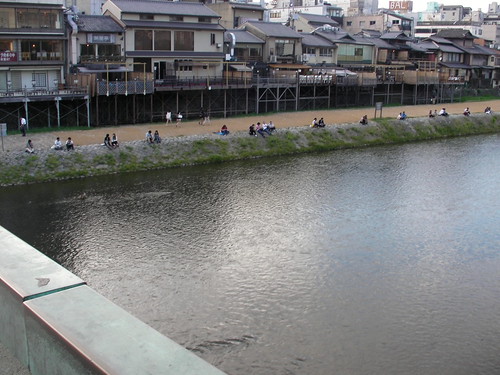
Kyoto is the exception but then Kyoto is also the second biggest tourist attraction in Japan (after Tokyo) which has presumably been influenced by Western culture. Western tourists may have promoted the construction of restaurants along side this river. I think that other cities may achieve increased inbound tourism if they followed suit.
I found that Kyoto citizens had a habit of ignoring red pedestrian traffic signals when there are no cars coming. In my experience, Japanese pedestrians wait, as is the law, even if there are no cars in other parts of Japan. I wonder if this Kyoto dwellers' behaviour is influenced by gaijin too.
Labels: japan, japanese culture, nature, nihonbunka, 日本文化, 自然
Thursday, September 13, 2012
Popteen Gals: The face of Japan

I gradually lean further towards the beauty in averageness hypothesis which holds that people find prototypical faces beautiful perhaps because they are easy to process (Winkielman, Halberstadt, Fazendeiro, and Catty, 2006). According to this theory, exposed as they are to both Asian and American images of beauty, the Japanese will become increasingly attracted towards and aspiring of the Asian-Caucasian average, mid Pacific, GAL looks. And here above they are, in all their average glory.
Images copyright Popteen magazine and their copyright holders. The above image is a screen shot of the result of searching for "Popteen" (ポップティーン) on Google images.
Bibliography
Winkielman, P., Halberstadt, J., Fazendeiro, T. & Catty, S. (2006). Prototypes are attractive because they are easy on the mind. Psychological Science, 17. 799-806. Retrieved from psy2.ucsd.edu/~pwinkiel/winkielman-halberstadt-fazendeiro...
Labels: eye, fashion, female, image, japan, japanese culture, nihonbunka, 日本文化
Monday, August 20, 2012
Manga-esque Mannekins

But the Japanese have Mannequins also partly because the Japanese are sort of animistic, or ego invested in their bodies to the extent that if there were a Japanese looking mannequin it would be so creepy that they would feel oblidged to greet it, or give it a funeral (like dolls) before throwing them away. Other ways of having mannequins that are acceptably non-human is to have headless mannequins or, recently, the manga-esque mannequins like those above. They also have ones with, to Western eyes, have very creepy expressions but in all cases I think it is important that the mannequinns be human enough to model the clothes, but not so realistic as to make the shoppers feel that the mannequins were human. I think that one of the reasons why Western mannequins are now less popular is due to the fact that with increasing numbers of westerners living in Japan, such manequinns, and indeed foreigners themselves, have started to look human.
Labels: japan, japanese culture, nihonbunka, 日本文化
Thursday, August 09, 2012
Face and Culture

In line with Yuki's research (Yuki, 2007), East Asians focus more upon the eyes while Westerners focus more upon the mouth while judging emotion. As Yuki (ibid) points out this difference can be seen in the way that Japanese and Westerners write emoticons as :-) or ^-^ for a happy face in the West and Japan respectively.
When it comes to facial recognition (Blais, Jack, Scheepers, Fiset, & Caldara, 2008), however, it is Westerners that focus more on eyes, and mouths, whereas Japanese focus more on noses (above left, where the parts of faces that Westerners concentrate on is shown in red, and the parts of faces that east Asians stare at is shown in blue). What is going on?
Are there parts of the face that are invariant and representative of character and personality and others that are temporallly variable that are used to convey emotion. If so do Japanese identify themselves and others with their noses!? This might explain the way that the traditional Japanese robber wore a scarf that concealed his nose but not his eyes or mouth. This is not the interpretation proposed by this research team.
Using a "spotlight" technique that allows subjects too see only what they are focusing upon however, Caldara, Zhou, & Miellet (2010) show that while East Asians look at people's noses when they can see normally, when they can only see what they are staring at, they look at eyes and mouth in the same way as Americans. In other words, when East Asians look at noses they are probably looking at the same facial parts but they are doing it wholistically (Masuda & Nisbett).
This centrally focused wholistic processing was found to extend to recognition of sheep faces and even of non-facial, or not very facial objects (Kelly, 2010) and these cultural tendencies are found to get stronger over ages 7-12 demonstrating that they are a result of nurture rather than purely nature (Kelly et al., 2011).
Image from Professor Caldara's website
www.socialinteraction.gla.ac.uk/pdfs/culture_faces.pdf
Bibliography
Blais, C., Jack, R. E., Scheepers, C., Fiset, D., & Caldara, R. (2008). Culture Shapes How We Look at Faces. (A. O. Holcombe, Ed.)PLoS ONE, 3(8), e3022. doi:10.1371/journal.pone.0003022
Caldara, R., Zhou, X., & Miellet, S. (2010). Putting Culture Under the ‘Spotlight’ Reveals Universal Information Use for Face Recognition. (J. Lauwereyns, Ed.)PLoS ONE, 5(3), e9708. doi:10.1371/journal.pone.0009708
Jack, R. E., Blais, C., Scheepers, C., Schyns, P. G., & Caldara, R. (2009). Cultural Confusions Show that Facial Expressions Are Not Universal. Current Biology, 19(18), 1543–1548. doi:10.1016/j.cub.2009.07.051
Kelly, D. (2010). Culture shapes eye movements for visually homogeneous objects. Frontiers in Psychology. doi:10.3389/fpsyg.2010.00006
Kelly, D. J., Liu, S., Rodger, H., Miellet, S., Ge, L., & Caldara, R. (2011). Developing cultural differences in face processing. Developmental Science, 14(5), 1176–1184. doi:10.1111/j.1467-7687.2011.01067.x
Yuki, M., Maddux, W., & Masuda, T. (2007). Are the windows to the soul the same in the East and West? Cultural differences in using the eyes and mouth as cues to recognize emotions in Japan and the United States. Journal of Experimental Social Psychology.
Labels: japan, japanese culture, nihonbunka, 日本文化
Wednesday, August 01, 2012
Cyclist Hand Signals in Japan: Their absence

The other thing I note is that I have never seen a Japanese cyclists make a hand signal! At least I have never seen a university students make a hand signal and this despite the fact that most of the students at my university commute by bicycle, and that most Japanese children are taught hand signals at primary school.
On the face of it, this phenomenon or the lack of it, is very bad for my theory that the Japanese interpersonal and intrapersonal communication particularly emphasises vision. Regarding the lattter intra-personal communication or "communicating to oneself", the Japanese do clearly engage in visual self-communication in the form of the finger pointing checks (please see my video) by transportation workers, and by baseball player Ichiro when he comes to the plate. These finger and bat pointings raise the pointers awareness of what he has done or is about to do and correspond, I believe, in large part to, self directed speech among Westerners. Western train drivers are encouraged to "call the road" saying the names of the colours of the signals that they pass for instance, but attempts to introduce finger pointing checks to Australia failed, despite dramatic increases in safety through their use in Japan.
So why don't the Japanese use cycling signals? Some factors include the fact that most Japanese ride on the pavement rather than the road, using low cross bar "shopper" (or "mother") bicycles at lower speeds. The need for singals increases with speed and the use of roads. But even in the busy roads in my university, I have yet to see anyone signal prior to a turn, and many perhaps most cyclists do not even look behind them either.
Another reason for this to my Western eyes, absurd, behaviour is the emphasis on "paying attention to what is in front of you (先方注意)" treated in a seperate post. As long as Japanese pay attention to their field of responsibility, their visual field in front of them, they feel, and Japanese law to a great extent requires, that it is up to others to ensure that they do not hit the cyclist from behind, even if they turn without making a signal or looking around.
Other possibilities include embarassment (but this was stated as a resason for the Australian train drivers dislike of finger pointing), and a need for visual-self-consistency, and visual-control which I think explain the lack of dancing in Japan (unless very practiced) and perhaps for lack of attention to and use of facial emotional expressions at least around the mouth (Yuki, Others).
A further possibility is that visual signals are thought of as being in some way private, intended for oneself, and people to whom they are addressed (second persons) rather than for otherS in general.
This possibility might mirror and reverse the claim (Nakajima) that in Japan spoken language, in the form of public announcements and signs, is encouraged when public but discouraged when private such as when private opinions are not to be made public in Japanese classrooms, or when mobile phones are not to be used on Japanese trains.
It is possible that there is a Nacalian reversal where Western visual signs are to be made only publically and not to second persons or to oneself. Certainly as already pointed out, finger pointing checks (a visual sign to self) is thought comical in the West, as is the practice of pointing at ones nose to indicate oneself.
This lack of a phenomena needs more thought. In the meantime I must be careful when following Japanese cyclists.
Images
Upper image "Left turn by ♔ Georgie R shows a cyclist signalling to turn left in my native UK.
Lower image: Found unattributed on a Japanese blog, please contact me via the comments below to have it removed. 影像取り下げ希望でありましたら、下記のコメント欄かnihonbunka.comのメールリンクからご連絡ください。
Labels: japan, japanese culture, occularcentrism, self, specular, 日本文化
Tuesday, July 31, 2012
Become One Circle

The Japanese phrase "become one circe," (一丸となる) refers to a group cooperating to the utmost degree, as if as one organism.
The North Saga High School (佐賀北高校) Baseball team did just that, and went on to achieve a breath-taking win in the 2007 summer Koshien Baseball tournament over much bigger, expensively coached opposition . The "Saga-Kita" team had a ritual that they performed before and some times after, "play ball" where they would get into a huddle on the mound and point at the sky. The meaning of this was to them that they would become as one circle, as one mind. They were so good they bring tears to my eyes.
Arimasa Mori says that the "experience" (keiken) of the Japanese always presupposes another. I am not sure I agree but, if this experience is the same as that referred to by Kitaro Nishida ([junsui]taiken) then I can see how "becoming one circle" may be more than just a metaphorical possibility. As Nishida argues, "pure experience" is "completely contradictory" since the primal place, or circle, is both oneself and the world, and therefore also ones team-mate.
Saga-Kita are playing again in this year's Koshien Tournament, once again as a result of becoming "one circle(一丸)."
Labels: collectivism, culture, nihonbunka, occularcentrism, specular, 日本文化, 集団主義
Monday, July 30, 2012
Empire of the Circles

The mirror of the Sun-Goddess, which she carries, represents her, is her or her mind, is eaten to ingest her, contains (in the form or Enma's mirror) ones whole life, represents Japan as its flag, its families in their crests, themselves in their seals, is used in numerous postive expressions for completeness and the absense of imperfection, is found emphasised in the faces of infants characters, and is the meaning of the word "yen."
To express good Americans use a circlular sign in the form of an okay sign. The Japanese use this sign as well as that made by making a circle using their arms surrounding their head. They also sit in circles, give people circular cards for their signature and all the other things in the image above which I will explain with reference to Nishida's place, or mental mirror (Heisig) which Westerners may understand as the visual field (bottom right) but in fact it remains, as ones heart, even when ones eyes are closed.
Third Row Image Credits
Mori Ranmaru kamon by aikao
Japanese flag by wisegie, on Flickr
Hanko ~ Japanese Signature by Jason Michael, on Flickr
Labels: japan, japanese culture, nihobunka, specular, 日本文化
Monday, July 23, 2012
Empire of the Sounds (continued from last post)
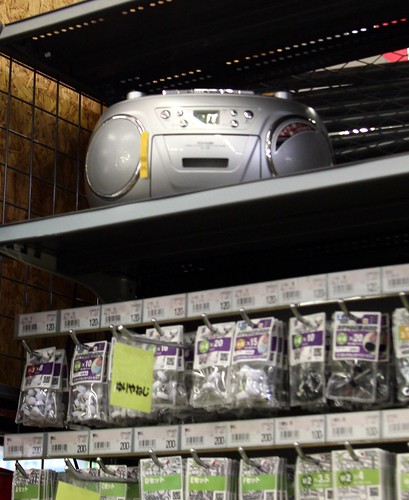
I will probably update my previous blog entry retitled as "Empire of the Sounds" since there is a lot to suggest that sounds mean more in Japan. In addition to the last post one might also mention the gangs of motorcyclists (Bousouzoku) that define themselves by their ability to make sounds, the prevalence of beefy exhaust pipes even on low power cars suggesting that the ability to make a noise means almost as much as being able to have the ability that comes with it. Then there is Tsunoda's research which argues that Japanese hear music and insects with the same part of their brain with which they process language, which he claims suggests that the Japanese hear more meaning in these sounds. Then there are the sirens that mark meal times, the song (a Japanese version of Auld Lang Syne) that marks the end of the business day, the prevalence of shop theme-tunes such as "Oh Happy Friend, Let's go Shopping...Mr. Max, Mr. Max, Mr. Max" which drive me insane, the tune playing pelican crossings, the Throat Pride (nodo jima) programme, and Fried Potatoe vending trucks.
However, if sounds were really meaningful, if sounds were felt to be imbued with self, then Japanese people would not be able to walk past these endless loop tape recorders that I still find rather arresting. "Someone is speaking to me"" I think, and stop.
Friday, July 13, 2012
The Japanese Feel Voices: Nacalian Meltdown and Oral-Centrism
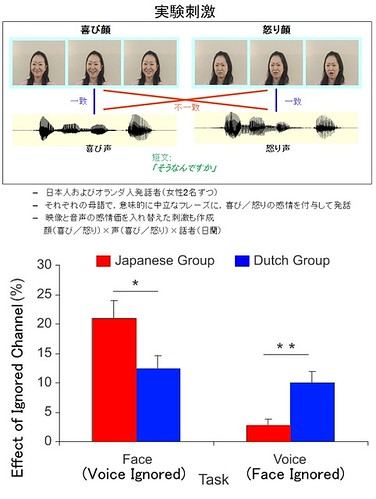
Tanaka and colleagues (Tanaka et al., 2010) first videoed a Japanese (as shown above) and Dutch woman say a linguistically neutral phrase ("is that so", "sou nan desuka") in a happy and angry voice. They then created voice-face incongruent stimuli by swapping the sound track between the two videos. Dutch and Japanese subjects were then asked to judge the emotion of the face (and ignore the voice) in the face task (left hand side of the graph) and to judge the emotion of the voice (ignoring the face) in the right hand side of the graph. The time to judge the emotion in the voice-face congruent video was substracted from the time to judge the emotion in the incongruent video, giving the extent to which the back-channel, to-be-ignored information (voice, or face) slowed the subjects responses. The above graphs show the size of the error that the ignored channel resulted in.
As can be seen, both groups found the voice more difficult to ignore but, the Japanese found it far more difficult to ignore voice than face. And the Dutch were significantly worse at ignoring faces and very significantly better at ignoring voices than Japanese.
Upon a straightforward Nacalian interpretation (that Westerners are logo-phono-centric, while Japanese are visio-centric), these results should have been reversed. These results would seem to agree with those of my previous post regarding the McGurk effect, which shows that Japanese are less effected by facial information, and more attentive to voice, when interpretting phonemes. Taken together with Ishii's research, which showed that Japanese pay more attention to voice than words, one might conclude that Japanese cultural communication is centered upon tone of voice: an oral culture.
I can think of other anecdotal evidence to support this view.
1) The Japanese are fond of stage plays featuring their (super) heroes, such as bean-bread-man (Anpanman), Power Rangers (supa-sentai), Ultraman, and Masked Riders (Kamen Raida-). When these plays are performed the stage actors dress up in the appropriate costumes and masks, and then mime to a audio recording of the authentic voice actors voices. I do not know of a similar genre of drama in the West, but if there were to be a play of Batman, Superman, Spiderman, or The Incredible Hulk, I presume that the viewers would be satisfied with seeing costumed actors play these heroes parts and would not mind if these actors used microphones to voice their own words rather than demanding that they mimed to the voices of the actors that play these parts in recent movies featuring the same heroes. The Japanese demand for vocal miming on the part of the stage players, suggest again that if the voice is different then the self or persona of the hero is different. At the same time it is notable that even the "authentic" heroes of Japanese TV programs, partly as a result of their faces or masks having NO MOUTH, are miming to voice actors themselves.
2) I feel that more traditional, or more-Japanesey- Japanese speech presentations, by older Japanese, who while remaining fairly straight faced use their tone of voice more than I was used to in the UK.
3) Similarly non-Japanese that have been acculturated to Japanese culture, use more vocal intonation than I am used to in my Western upbringing. I get this feeling when I watch David Spectre and the two Kents (Kent Derricot, and Kent Gilbert) all of whom, especially since they appear Western having Western faces, sound strange to me, or appropriately Japanese to me in that they vary their vocal intonation greatly.
4) When watching Western movies dubbed into Japanese the extent to which the Japanese voice actors vary their intonation far more (it seems to me) than the Western actor is striking. I had interpretted this (to my ears) excessive vocal intonation on the part of dubbing voice actors to Japanese perceptions of Westerners being more unihibited, and this may be part of the reason for this phenomena, but perhaps also the dubbing voice actors are simply giving the Western actors a more typically Japanese vocal-expressive range.
5) Again when watching Western movies dubbed into Japanese, the males are given deeper voices (especially if they are strong) and the women are given more 'feminine' higher voices exentuating their gender differences in voice.
6) Japanese men and women at least in the media, especially evident in period dramas (jidai geki) and Yakuza movies, and perhaps in real life tend to speak in more gender differentiated -- deeper for men, higher for women -- voices. I am not sure if Western men have a tendency to gender-neutralise their voices, or if Japanes men have a tendency to speak in deliberately more macho tones, or bothy. Certainly young (but not necessarily older) Japanese women have a tendency to speak in higher voices in order to be attractive, at least so it seems to me.
7) Japanese female shop assistants (I am not sure about the men) raise their tone an octave in an attempt to make their voice more polite and appealing. I find this affectation somewhat too self-debasing. I find myself wanting to say "No, please do not go so far as to alter your voice. I don't want you to be so ingratiating. Be your own voice. I am not so grumpy and authoritarian a customer as to require this degree of self-debasement."
8) The Japanese are more fond of singing, in the form of Karaoke, as a post alcohol consumption, probably courting, pleasure activity and this of course results in their using their voice as a means of self expression (whereas Westerners are more likely to dance in similar situations for similar reasons).
9) The Japanese use 'stomach drama' (hara-gei) to convince others of their point of view or their sincerity. This is something I have read. I am not sure if or when I have witnessed 'stomach drama', but the use of extreme vocal intonation in this form is well documented.
10) Japanese emotive expressions, such as those expressing cuteness (kawaii--) or delisciousness (oishii---) often sound to my ears as being over-the-top in their use of vocal tone.
Whatever the fate of my Nacalian theory, the research by Tanaka, Sekiyama, and Ishii, point to cultural differences in sense (oral/visual) or channel (oral/visual/linguistic). As such I find them very exciting: a break from the individualism vs collectivism mold. This genre of reseach raises the possibility that Japanese have a different type of communication, and a different type of non-logocentric, individual self.
Image top from monthly spotlight, Image bottom from (Tanaka et al., 2010, p1261)
Tanaka, A., Koizumi, A., Imai, H., Hiramatsu, S., Hiramoto, E., & De Gelder, B. (2010). I Feel Your Voice. Psychological science, 21(9), 1259.
The McGurk Effect Weaker in Japan: Nacalianism Defeated?
The McGurk Effect (McGurk & MacDonald, 1976) refers to the tendency for visual-speech (lip movements etc) to effect the sounds that we hear. As shown in the above video, Japanese people area also susceptible to the effect but, as comparative research (Sekiyama & Tohkura, 1993; Sekiyama, 1997) has shown, Japanese and Chinese are more auditory and less visual than Americans! The Nacalian theory - that Japanese are visio-occular-centric as opposed to logo-phono-centric - is thus disproved, game, set, match? Very possibly.
Some possible explanations for the weaker McGurk effect among Japanese include
1) The Japanese are more auditory than Westerners (c.f. Ishii, Reyes, & Kitayama, 2003)
2) The Japanese move their face less when speaking due to the nature of their language (unlikely due to experiments comparing spanish and Japanese)
3) The language has more tones (Sekiyama, 1997)
4) The Japanese move their faces less during speaking for cultural reasons.
5) The Japanese watch faces less, or in other words they are less "face-aversive" (Sekiyama, 1997) for cultural reasons.
I lean towards the latter two explanations - both of which seem true - but neither bode well for Nacalian interpretations of Japanese culture. Why do the Japanese move their faces less, and look at others faces less if they are really a visually sensitive culture?
Possible reasons for the apparent lack of attention to, and lack of facial information include
1) That the Japanese are paying attention to a different part of the face - eyes - rather than mouths, as demonstrated by Yuki's research (Yuki, Maddux, & Masuda, 2007).
2) Relatedly, that the Japanese do communicate with their face but not linguistically, and that their face is reserved for displaying purely visual, not language-supplemental, information. Consider for instance the close ups of people eating food shown so often on Japanese TV, or the insets of Japanese television personalities faces showing reacting non-verbally to the image on the screen.
3) That the Japanese identify more strongly with their faces and wish to maintain an unchanging persona or mask (Watsuji, 1937) for the sake of visual self-consistency. I claim that the Japanese are into visual self-consistency, and even a visual self-enhancement of sorts, in a big way.
Bibliography
Ishii, K., Reyes, J. A., & Kitayama, S. (2003). Spontaneous Attention to Word Content Versus Emotional Tone. Psychological Science, 39–46. Retrieved from http://php.scripts.psu.edu/users/n/x/nxy906/COMPS/indivdualismandcollectivism/culture%20lit/to%20print/Kitayma2003threecultures.pdf
McGurk, H., & MacDonald, J. (1976). Hearing lips and seeing voices. Retrieved from http://www.nature.com/nature/journal/v264/n5588/abs/264746a0.html
Sekiyama, K. (1997). Cultural and linguistic factors in audiovisual speech processing: The McGurk effect in Chinese subjects. Attention, Perception, & Psychophysics, 59(1), 73–80. Retrieved from http://www.springerlink.com/index/E867017U7J708970.pdf
Sekiyama, K., & Tohkura, Y. (1993). Inter-language differences in the influence of visual cues in speech perception. Journal of Phonetics. Retrieved from http://psycnet.apa.org/psycinfo/1994-12869-001
Shigeno, S. (1998). Cultural similarities and differences in the recognition of audio-visual speech stimuli. Fifth International Conference on Spoken Language Processing.
Spencer-Rodgers, J., Boucher, H. C., Mori, S. C., Lei Wang, & Kaiping Peng. (2009). The Dialectical Self-Concept: Contradiction, Change, and Holism in East Asian Cultures. Personality and Social Psychology Bulletin, 35(1), 29–44. doi:10.1177/0146167208325772
Thompson, M., & Hazan, V. (2010). The impact of visual cues and lexical knowledge on the perception of a non-native consonant contrast for Colombian adults. Retrieved from http://discovery.ucl.ac.uk/19505/
Yuki, M., Maddux, W., & Masuda, T. (2007). Are the windows to the soul the same in the East and West? Cultural differences in using the eyes and mouth as cues to recognize emotions in Japan and the United States. Journal of Experimental Social Psychology.
和辻哲郎. (1937). 面とぺルソナ. 岩波書店.
Labels: japan, japanese culture, nihonbunka, 日本文化
Japanese Entrance Hall (Genkan) with Sofa
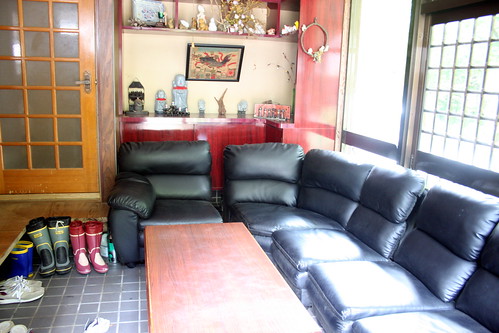
A genkan is a entrance hall, at a slightly lower level to the rest of the house which is raised, where people take off their shoes before entering the home. It is also used as a place to display ornaments and sometimes as a place to briefly entertain casual visitors. It is not uncommon for householders to kneel in the corridor just beyond their genkan, while their visitor stands on the lower genkan floor.
To make casual visitors feel more comfortable, this (very unusual) home in a Buddhist temple's grounds has a three piece suite in the genkan, so that the monk can entertain without allowing visitors into the home.
The home is considered more private in Japan and entrance to other people's homes is more often avoided. House parties are a rarity and generally limited to extended family members.
Entrance to another persons home, and the further one enters into that space, implies a greater degree of social intimacy. Nakane (1972) argues that Japanese groups, including the family, are considered to be bound together not by virtue of shared concepts such as common goals, or mutual love -- though of course they usually love each other -- but by their membership to, and ability to enter a shared frame, or place, such as the home. Family members refer to each other as "our place's bride' (uchi no yomesan) 'our place's granny," (uchi no obaasan), or "our place's leader" (uchi no danna) meaning husband or patriarch. Marriage ceremonies are said to take place between homes or houses in a way reminiscent of marriages between European aristocracy*. Entering a Japanese person's home, to its depths at least, implies that one is a member of the family (see Bachnik and Quinn, 1994). These customs are indicative of the way in which the home is considered to be a special, semi-sacred space centred around the household altars (kamidana and bustudan), and as such an important vector of social cohesion.
Notes
* see e.g. the marriage between the House of Burgundy and the House of La Marck
Bibliography
Bachnik, J. M., & Quinn, C. J. (Eds.). (1994). Situated Meaning: Inside and Outside in Japanese Self, Society, and Language. Princeton University Press.
Nakane, C. (1972). Japanese Society (1st pb ed.). University of California Press.
Labels: nihobunka, nihonbunka, 日本文化
Tuesday, July 10, 2012
Japanese Spaceless Space & Western Timeless Time

Additionally bottom left, it is well known that Japanese love to go and see the passing of time, autumn leaves, and spring cherry blossom, or fields were once great castles stood. This may very Buddhist, and profound of the Japanese but it is worth bearing in mind that not only do they pay attention to the "A series" of becoming, but also to "B series" objective points in time related to the seasons, and specific dates. Time is out there.
Westerners, on the other hand, like to emphasise the extensiveness and exteriority of space with geometrical patterns in gardens, white celings and bay windows in their rooms. Space is seen as extended, complete with the concepts, the symmetry and geometry, that keep it so.
Westerners like spatiousness, big rooms, big views, big spaces. But they are conflicted because at the same time they want to preserve the past in their rooms and in their cityscapes. Westerners like to present time as if it were stationary, as if the past is is in the here in now.
Space is the medium of the self as image and mental mirror (Heisig, Nishida). Time is the substrate of the self-narrative and language as thought (Derrida, Kim).
Addendum
The above is not right. And it is a make or break post.
Conventional wisdom has it that the Japanese are (Buddhist) relativists, and that Westerners are the objectivists that believe in the world and the world and themselves, due perhaps (though scientists would not agree) to their belief in a third person, an Other.
And I too thought/think that the Japanese fondness for scale trickery and their fondness for the changes in nature were both indications of a tendency towards anti-objectivity, and relativism.
But if that is the case, then my argument that the Japanese are like Westerners but in a different modality or channel, that they have a different kind of Other, a different kind of objectivity, would have to be rejected.
Because space is surely the plane, substrate, or place of the visual (self) and time is argued (by Derrida especially) to be the modality, medium, or (dare I say place? topos, axis?) of the phonetic narrative (self). Place is where vision takes place, time is where phonemes unfold. If so then attitudes towards space and place should exhibit a similar "Nacalian" reversals (if such exists) as between word and image. Attitudes to space and time would or should be related through a meta-Nacalian reversal.
I am having a problem seeing any such reversal. It still looks to me rather like Westerners are being objective, and Japanese are being relative, about both space and time but I hope not.
I was wrong to say that Japanese are into the B series of time. First of all, they use period names for dates rather than relating everything to a year dot. The period names encourage, I believe, a before after view of time rather than some objective temporo-cartesian coordinate (X years AD).
So okay, Westerners are into the year dot, the B series of time, whereas (other than Mecca and Jerusalem) there is little in the way in the West to speak of or identify a "B series of space". Our Western God is omnipresent. Japanese gods on the other hand have a "place dot," or many scared space that dot, anchor and objectify the space. On this basis it is Western, or at least Newtonian, space that is "indexical" (before me behind me) related to a inertial, three dimensional frame of reference.
But then this goes against
(1) Bachnik and Lebra's theories regarding the "indexical", relative nature of Japanese space perception, emphasising inside (uchi) and outside (soto), front (omote) and back (ura).
(2) The destruction of scale in Japanese plants (bonsai), gardens (zen gravel gardens), and interiors (if my observations regarding the tricks used to destroy perspective are correct).
Other observations
How should a comparison of Japanese and Western space and time perceptions be approached?
A) By considering the ways in which space and time perceptions inter-penetrate and dominate, arguing that the Japanese have a spatial view of time, and Westerners have a temporal view of space, perhaps.
Japanese time perceptions don't have the year dot but they have a sort of C-series, or rather C-loop, in that the fleeting nature of cherry blossom is not seen as solely a purely Heracleatean flux but as something that will repeat. Perhaps it could be argued that this cyclical view of time results in a the creation of a "time-space." the seasons of the year. Do Westerners have a temporal view of space? Does the geometry and regularity of Western gardens and architecture reflect the tick tock of a clock?
B) From the point of view of a conceptual abstraction capable of framing both time and space. E.g. by abstracting the "A series" and "B series" to apply to space as well as time? Or the use of words such as "flow" and "repetition," and "reference point" that may perhaps be applied to time and space?
The geometric gardens and Neo-georgian cityscapes emphasise the "flow of space" as cherry blossom emphasise the flow of time? Geometric gardens and cherry blossom may also emphasise a repetition. And finally, perhaps in both geometrical gardens and cherry blossom there is an absence of a spatial or temporal reference point respectively. How?
Do antiques present any sort of "trick" corresponding to the scale destroying 'trick' of gravel gardens, bonsai trees and Japanese interiors? Does "Neo-Classical" Georgian architecture of Bath present a similar sort of dillema: instead of an unanswerable "is this big or small", "is this old or new."? Does neoclassical architecture, or do shiny polished antiques forces their viewers to suspend judgements of time? Is there a British Zen!? I have never felt that Bath architecture was in any way Zen when I lived there but perhaps to a Japanese visitor it presents a similar "vortex" of conflicting, interpretation defying, agelessness.
If so this would help me to understand Japanese architecture. Japanese architecture confuses me, creates in me a vortex of trickery, but I am sure that Japanese that are used to it have suspended judgement already. To them it is peaceful, as Bath architecture was to me. Perhaps when I lived in Bath I had already suspended judgement as to whether buildings are old or new. Bath architecture was old AND new, as bonsai trees and gravel gardens and big and small.
If bonsai trees and Bath architecture are both a trick then, both should leave a pure experience of something. I can grasp, however fleetingly, the way in which Japanese architecture makes me "see the light," "the purity of experience" through "cessation" of interpretation. But what does Western architecture make anyone see (or hear?). Am I too anti-Western, anti-temporal. "Cessation" sounds profound, but is a very anti-temporal term. Perhaps "purity" is also linked with space. It is certainly linked with Shinto.
When Husserl and Nishida engage in 'bracketing' they experience different things. Nishida stopped (with all the anti-temporality that that implies) interpreting and saw the place/space/mirror. Husserl on the other hand discovered (with an implied anti visio-spatialness) the transcendent the "irreel," "forms". I have always been dismissive of the latter, dismissed Plato's spelunking satori as mere myth. The forms are fantasy, mere words, I thought. Or again I may have been too keen on vision. When Nishida or Zeami experience their place or flower, they might be the first to admit that there is nothing to see.
I need to change my title, which is now, "Japanese Space Unextended & Western Time That Does not Flow." Japanese space is still in some sense extended (how can space not be) but scale, big small, this in front of that distinctions are lacking. Western time, or at least the antiques, are old but here still, past but present. They both (Japanese space and Western time) lack something, and have something gained. Space-less Space and Timeless Time? I will go for that.
Anyway, am I an old structuralist dog chasing something or just a waffler?
More (thanks to Ms. Hajima)
Ryoutaro Shiba and Donald Keene point to similar differences but reach opposite conclusions in their discussion of the Japanese and Japanese Culture. They say that Europeans do not want to feel time (then why the obsession with antiques, even with rows of things evolving over time even), and are pleased if works are preserved completely as if it were made the day before. This is true, and great labour goes into preserving antiques I know as the son of a picture restorer. But at the same time, it is important that the antique is old. It is important to Europeans that an item looks both new and also it is important that it be old. In Japan however, very little importance appears to be given to preserving old things, or to age itself, with Ise Shrine and Japanese houses being rebuilt regularly. Donald Keene and Shiba also claim that Japanese prefer works that are broken a little or faded.
Top Left: Joueiji Temple Zen Gravel Garden by me
Top Right: Ham House Garden by neilalderney123
Middle Left Japanese house traditional style interior design / 和室(わしつ)の内装(ないそう) by TANAKA Juuyoh (田中十洋)
Middle Right: "Prospect Park Place West Victorian brownstone interior dining room fireplace mantle by techpro12. Techpro12's blog has many similar images.
Bottom Left: 紅葉 (red leaves)by jasohill
Bottom Right: Bath Crescent HDR by alex_smith1
Labels: Nacalian, nihobunka, nihonbunka, 日本文化
Friday, July 06, 2012
Cosplay Mimics the Visual Visually, Impersonation Mimics the Voice Vocally

Cosplay refers to wearing a COStume to play or mimic a cartoon (anime) or comic (manga) character. It is particularly popular in Japan where there are large events held periodically where costumed people like the lady above, get together. Cosplayers can also be seen in the Harajuku area of Tokyo, and all over Asia, and now the world, since Cosplay has spread out from Japan. In Japan it is far from being a widespread phenomena. It is the sort of thing that like dancing, the Japanese would not want to do badly. Cosplayers will go to considerable lengths to get their clothes, hair, make up and poses just right.
Cosplay is doubly visual. Firstly, cosplayers rarely speak but rather just pose, often for photographs. Their mimicry is a visual art. Secondly the object of their mimicry - the cartoon and comic characters - are particularly visual existences. I will argue that Japanese comics are more visual, hyper-visual when compared with Western cartoons and graphic novels in another post but here I want to suggest that cosplay is the predominantly visual mimicry of the predominantly visual.
These Japanese cosplayers are strange eh? I can feel "conformist," tripping off readers' lips, because isn't copying always conformism? Yes, copying is always to an excent conformism but please see the last paragraph. And futher, the Japanese are not, Asians are not, particularly conformist. Does this lady look conformist to you? Doesn't she look weird? She may still look conformist because she is not speaking. Without speech it may seem as if she has less personality than an endless loop tape recorder (see previous post) but, that is because Westerners are logocentrist.
Performing a Nacalian transformation, the Japanese Cosplayer in the imaginary is equivalent to the Western voice player, more commonly refered to as the impersonator*.
Back when I lived in the UK I used to mimic vocally a purerly vocal existence: "Mr. Angry" of the "Steve Wright in the afternoon" radio show. I was the UK equivalent of a Japanese Cosplayer. I was as conformist, but probably not as good. I would not have done it had I thought my mimicry would not be recognised however. My voice (like the appearance of the Japanese) is not something that one plays with lightly.
It seems to me that Western impersonators are Nacalianly transformed Cosplayers because they predominantly vocally mimic predominantly vocal existences. This is not to argue that Japanese cosplayers say nothing at all, or the Western impersonators do not change their appearance at all, but there is a strong difference in emphasis. The personality or self that is mimicked and does the mimicking is felt to reside in the face and appearance in Japan, and the words and voice in the West.
Please have a look at some impersonators on Youtube. You will see that not only do they change their appearance very little, but also that they choose particularly characteristic voices to impersonate. For that reason, Christopher Walken, and Al Pachino are comon favourites. Cosplayers choose characters that are easily visually recognisable such as Hatsune Mikku above. While the days of radio - such as the Goon show - are gone, and all characters these days have visual and verbal aspects, the characters that are impersonated in the West are defined, as Westerners are defined, above all by our words and voice.
Here are some Western
Finally it should be noted that to a degree Westeners are all impersonations, and the Japanese are all cosplayers, because the self is nothibng more or less than self mimicry, there is not self, no individual other than in this attempt at duplication. The self is created through an attempt to visualise oneself, or narrativally impersonate oneself into existance.
This post was inspired by a kind question from Mudakun.
Notes
*There are also impersonators in Japan, just as their are fancy dress parties in the UK but I argue that Japanese impersonation (monomane) even or especially rakugo, is extremely visio-imaginary. Please see this introduction to rakugo in English.
Labels: authenticopy, collectivism, individualism, Jaques Lacan, mime, mirror, Nacalian, nihobunka, nihonbunka, reversal, specular, 日本文化
Thursday, July 05, 2012
Fundamental Attribution Error, Nakajima, and Endless Loop Tapes


Professor Nakajima is a recently retired professor of Kantian philosophy. He is, I believe, highly Westernised. He spent a considerable amount of time in Germany, presumably speaks German, and studies and presumably loves one of the most Western of philosophers: Kant.
It takes leaving ones culture to know it. Normally ones own culture is so obviously-the-normal-way-of-doing-things that it is transparent. It is only those that have participated in other cultures that can see there own. Professor Nakajima was sufficiently deculturized to realise that public announcements of various sorts in Japan are strange.
Japan is awash with public announcements in the form of recorded or electronically simulated voices that blare out messages such as vending machines or cash dispensers that greet their customers, buses that announce that they are reversing, election trucks that blare out linguistically meaningless recordings of a politician thanking people for their support, and endless loop tape recorders that blare out the special offers in retail outlets as pictured in this photo. The endless loop tape recorder shown here stood at the entrance to a local electronics store endlessly shouting out the special offers on sale at the store.
In the first few years of living in Japan I used to stop in front of these endless loop tape recorders and attempt to understand what they were saying. One of the reasons that I did so was because my Japanese language ability was insufficient. But even when I was able to understand the language of the tape, I still stopped, and listened while Japanese store goers walked on by, seemingly oblivious. I found the endless loop tape recorder arresting, more worthy of attention, and very strange.
When I first arrived I arrived in Narita airport in Tokyo, I got on a horizontal escalator / conveyor belt walkway (what are they called?) and shortly before the walkway came to an end a voice came out at foot level warning me that the walkway would end. I picked up my feet as if I might step on the unseen announcer that must (I felt) be hiding underneath the moving hand rail. Shortly thereafter, when I first purchased a canned drink from a vending machine in Japan that spoke, I felt that there was a woman (in Japan it is generally a woman's voice) hiding inside the vending machine thanking me for my custom.
I am now used to all the depersonalised voices that one hears in Japan. It no longer surprises me when buses 'say' "reversing, reversing, reversing." It no longer surprises me when bullet trains 'say' "Please don't bring dangerous things onto this train."
Nakajima (brilliant though his observations are) explains this phenomenon -- the tendency for there to be disembodied voices in Japan and their strangeness -- using the same old same old collectivism vs individualism trope. He points out that private speech, such as by students in class, or by people using cell phones on trains (I am not sure if he used these examples) is repressed, not-allowed-in-Japan, and argues that speech is only allowed when it is a public, disembodied, announcement.
[He does not note for instance that Western city-scapes are required to be uniform by planning permission rules or that Japanese fashion is the zaniest in the world]
Nakajima also complains (if this is the right word) of the loudness of these announcements which prevent private speech, or western style (Kim, 2002) "thought".
It seems to me that my issue with these endless tape recorders, and other linguistic public announcements is rather directly associated with the Fundamental Attribution Error.
The Fundamental Attribution Error refers to the tendency of people to assume that behaviours are the result of traits.
According to this theory, we, humans, have an erroneous tendency to believe for instance that if a person is late to a meeting then that is because that person is not a punctual individual.
Most of the research on the fundamental attribution error, however, concentrates on one behaviour: reading out loud from texts that are constrained. When Westerners listen to someone read out loud, then even if they know that the text that the person they are listening to is reading a text which that person has been forced to read, Westerners still believe that the person in question believes in the purport of the text. The text as read out loud is felt to be expressive of the mind, person, self, of the individual.
Japanese people however are far less likely to feel that a reading out loud represents the true feelings of the person that is doing the reading.
This difference is ascribed to the purported fact that Japanese are, and realise themselves to be, less individual, more collectivist, more context dependent. When a Japanese person hears someone reading a text then they do not assume that the text represents that person, merely that the person is (as is the case under constrained conditions) merely conforming to pressure, because social pressure is rife in Japan, and free self expression is not allowed in Japan.
This, the conventional interpretation is hogwash (false). The Japanese are as free to express themselves as anyone else, or more so. But the medium or mode of their self expression is Nacalianly different. That the Japanese can create cityscapes, products, images, fashion in such zany abandon testifies to this fact.
The reason that Westerners (and Westernised Japanese) find mechanically produced, or constrained speech to be representative of traits is because that we Westerners believe that we are speech, that thinking is speech, that the person is speech. The Western self is a narrative. The strangeness of these endless tapes that announce products, and other announcements produced by machines, are the same as the reading-out-loud used in Fundamental (!) Attribution Error research, and their potency can be explained in the same way.
Westerners believe that they are themselves narrations, speeches. Speech is thought. Speech is felt to be accompanied by (chimerical) ideas. Speech is felt to be the product of, the essence of a person.
And so, Westerner that I am, when I heard those mechanical/recorded/computerised voices in Japan, I presumed them to be, or desired them to be, from a person. Japanese public announcements expose the lie of my being: speech does not imply an existence, nor is it necessarily accompanied by an existence. Speech is just speech. There are no "ideas." Speech is noise. With regard to speech (but not to self-representational images) Japanese people realise this.
Labels: collectivism, individualism, japan, japanese culture, Jaques Lacan, nihobunka, nihonbunka, reversal, self, specular, 日本文化
This blog represents the opinions of the author, Timothy Takemoto, and not the opinions of his employer.