
Wednesday, October 30, 2013
Faces Substantiate Emotions Too
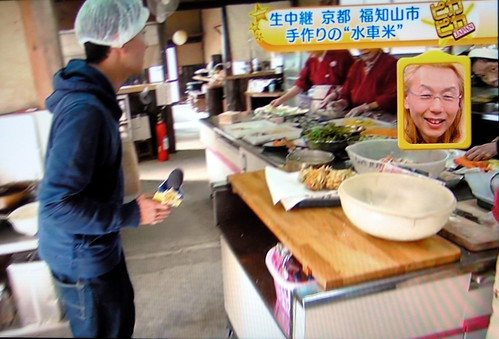
As Watsuji Tetsuro (2011) argues, it is faces and not phonemes (or "ideas," phaf) that substantiate, give a focus or "centre of gravity" to persons, and I would argue and groups, and in doing so, perhaps, give them existence. On Japanese television faces are used to give existence to, and communicate, other ephemerals too, such as emotions. As I have noted elsewhere there are always faces peering out of Japanese television sets telling the audience how to react (see the face of a television personality smiling, top right) in what is referred to as the "wipe" (waipu).
Some people believe that 'the face in the waipu' is there because the Japanese are more conformist, and less original, so they need to be shown how to react. Yes, they are being shown how to react, but no they are not more conformist.
In the West, ephemeral things such as selves, groups, and emotions are given substance by words, phonemes and "vocal gestures". Indeed, George Herbert Mead (1934) argued that it is only the vocal gesture that can be used in this way since it is the only one to bounce back. Mead did not know about mirror neurons but the majority of Japanese, Noh practitioners such as Zeami and martial artists such as those surveyed by Yamamoto (2009), are unaware that they can see themselves too.
On Western TV the audience is told what to think using phonemes, in the form not of words, and especially "canned laughter" and "oohs and ahs." There are some oohs and ahs on Japanese television, but I can't watch British television comedy shows any more for sheer volume of intrusive - "conform or else" - canned laughter. Give me a face in a waipu any day. I can ignore that. The preferences is personal, and cultural. The mechanism is the same. The medium is different.
Mead, George Herbert.(1934) Mind, Self and Society. University of Chicago Press.: Chicago.
brocku.ca/MeadProject/Mead/pubs2/mindself/Mead_1934_09.html
Watsuji, Tetsuro. (2011) "Mask and Persona." Trans. Carl M. Johnson. Japan Studies Review. XV: 147-155.
asian.fiu.edu/projects-and-grants/japan-studies-review/jo...
Yamamoto, I. (2009) "Mental Training: Self Image in Kendo." Unpublished Gradutation Thesis, The department of Tourism Studies, Faculty of Economics, Yamaguchi University. (in Japanese) 山本一輝(2009)「メンタルトレーニング~弓道を通じた自己イメージのあり方~」未発表卒論。山口大学経済学部可能政策学科
お取り下げ希望でございましたら、下記のコメント欄・nihonbunka.comのメールリンクまでご連絡ください。
The important George Herbert Mead quote is as follows
p. 65
The vocal gesture, then, has an importance which no other gesture has. We cannot see ourselves when our face assumes a certain expression. If we hear ourselves speak we are more apt to pay attention. One hears himself when he is irritated using a tone that is of an irritable quality, and so catches himself. But in the facial expression of irritation the stimulus is not one that calls out an expression in the individual which it calls out in the other. One is more apt to catch himself up and control himself in the vocal gesture than in the expression of the countenance.
It is only the actor who uses bodily expressions as a means of looking as he wants others to feel. He gets a response which reveals to him how he looks by continually using a mirror. He registers anger, he registers love, he registers this, that, or the (66) other attitude, and he examines himself in a glass to see how he does so. When he later makes use of the gesture it is present as a mental image. He realizes that that particular expression does call out fright. If we exclude vocal gestures, it is only by the use of the mirror that one could reach the position where he responds to his own gestures as other people respond. But the vocal gesture is one which does give one this capacity for answering to one's own stimulus as another would answer.
Labels: japan, japanese culture, 日本文化


Friday, October 25, 2013
The World Inside Out

Image from Voy et. al 2001, pp 57-58
That the Japanese have very little positive to say about themselves, while Americans do is one of the most robust, and well documented of cultural differences (see the irrefutable work of Steven Heine).
However, as I have demonstrate in a number of studies, when it comes to images the tables are turned. Here above is more proof, that when it comes to images, the positivity of Japanese self imagery blows that of Americans out of the water. Their authors are only seven years old but already, the Japanese are showing the self confidence that they will go on to retain throughout their lives, though they will never express it in words (rikutsu, phah, humbug).
Not only are the Japanese self-drawings more detailed, but also they are twice the size! And this despite the fact that self-image drawing size has been shown to correlate with self esteem. This has been shown in self-drawings, but also in drawings of other things. As demonstrate by Bruner and Goodman's work on the size of drawings of coins by rich children (who draw coins small) and poor children who value them and draw them big, people draw things that they think are big, and unimportant small .
Looking at their linguistic self representations, such as responses to the self-esteem scale, US respondents are about 1605 more self confident, self-valuing, than Japanese. Looking at response to this self-drawing test, the Japanese are about 160% more self-valuing as US respondents (Japanese average drawing size 18.4cm, US average drawing size 11.87).
The problem with this is that, as Derrida explains, we Westerners (and perhaps the Japanese too) are keen to believe that our own form of selfing is the only way to form a self. McAdams, Dennet, Pinker are keen to reassure us that self-narrative selves are hard-wired, that humans, where-ever they are are "homonarans" "The story-telling animal." But alas, the Japanese don't give a flying futon for narratives. They are not ego involved in their narratives.
The problem with the Japanese is that they force us to become aware that there are other ways of 'selfing', that self-narrating is contingent, that we do not have to do it. We nail ourselves to our narratives, but the Japanese are living proof that we did not have to.
Bruner, J. S., & Goodman, C. C. (1947). Value and need as organizing factors in perception. The journal of abnormal and social psychology, 42(1), 33. Retrieved from psycnet.apa.org/journals/abn/42/1/33/
La Voy, S. K., Pederson, W.C., Reitz, J.M., Brauch, A.A., Luxenburg, T.M., & Nofsinger, C.C. (2001). Children’s drawings: A cross-cultural analysis from Japan and the United States. School Psychology International, 22, 53-63.
Labels: culture, japan, japanese culture, mirror, Nacalian, nihonbunka, Shinto, specular, theory, 日本文化
Japanese Style Toilet
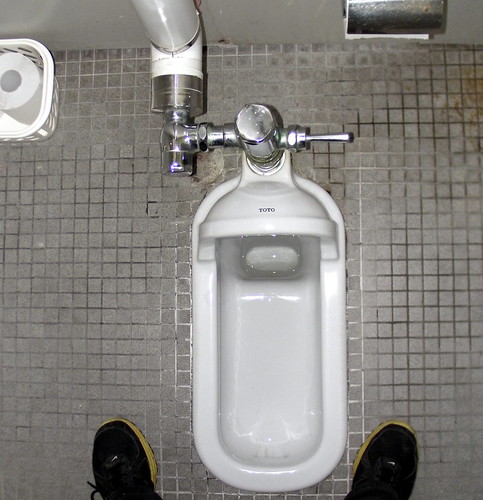
I like some aspects of Japanese toilet culture.
Japanese toilets are free, clean and plentiful. As well as being a relief in times of need, these restroom-facts tell us some thing about Japanese culture. While the Japanese lavatory has changed dramatically, there is still something fundamentally more practical about it. Take, for example, the mixed sex toilets that one still finds in small bars and restaurants. The use of one toilet for both sexes seems so mature, space saving and liberal, but often rather disconcerting. Again, the absence of a seat may be very hygienic but I find it difficult to keep my balance when made to squat. And while, for instance, the French too used to squat, the Japanese do not insert their stool into a small round hole but leave it to lie in a trench between their knees for some kind of inspection. "Very sensible", the colour is very indicative of the state of ones health, apparently. Which brings us to ask: why are "amenities" so rude in the West? Is it not perhaps to do with their connection with sex? Perhaps for the French, the briefly dangling stool was a phallus: deft but dark and fleeting. By contrast, the Japanese have a more tolerant, maternal toilet culture. The stool, resplendent in its narrow china cot - thoughtfully padded with toilet paper - represents a pseudo-baby? In a traditional Japanese toilet, the flush must follow breathless awe in the face of mother nature's proud creation and even the direction of the squat is reversed: Westerners, face the door, as if ready to fight back other would be occupants; the more community spirited, trusting Japanese face the interior toilet wall, their buttocks bare, absorbed in meditation.
In the past ten years however, the Japanese toilet has been "advancing". Corrupted and alienated by the impact of the West, they have developed scatophobia. They too do it sitting down but with even greater hygiene and self abstention. The toilet seat, itself sometimes decadently pre-heated, can be covered with a specially provided, toroidal paper napkin. And, to the horror of unsuspecting observers, the toilets in more wealthy homes may be fitted with an electronically controlled, contractible antennae. "Foul torture! Fearsome syringe!" I thought as I wiped warm water from my eye, but, yes, it was merely a form of space saving bidet. At the touch of a button, the antenna extends and, automatically adjusted to the size of the user, fires a jet upwards into the orifice. Fiendishly clean. "Washlettes" (sic) may not have caused actual bodily harm but they might just represent a neurotic obsession with technology. (Mark my words; in years to come someone will produce a "Wipeman".)
If there is one thing that I regret, it is the complete absence of graffiti. It would be in the interests of free speech if bar owners provided a pen, attached to a string, inside the cubicles. But one might find that the customers did not know what to do with it.
I wrote the above back in 1996
A "wipeman" or portable version of the washlett has in fact been invented (and may have been back in 1996)
Labels: japan, japanese culture, nature, 日本文化, 自然
Thursday, October 10, 2013
Two for the Price of Four

I think that Japanese people feel a sort of sympathy for things themselves, and reuse paper since to do otherwise would be a very mild form of homicide. This animistic origin to the heightened sense of wastefulness, may explain the emphasis upon recycling rather than reusing in Japan. The Japanese do not believe in reincarnation or heaven but that the soul merges with the gods and is born again as other people. Pieces of paper merge with the pulp and are repressed into other pages.
As previously mentioned the grief of mottainai may also explain the relative absence of BOGOF (Buy One Get One Free) marketing in Japanese stores. It may also be a factor in the pricing in of the batteries in the above photo. This one hundred yen store's products are all 100 yen, and include packs of both 4 AA batteries, and 2 AA batteries at the same price. Admittedly, the 2 pack of batteries carry the name of a Japanese manufacturer (Hitachi), whereas the 4 pack batteries are generic "Premium Cell", but it seems to me unlikely that consumers believe that the Japanese branded batteries last twice as long as their OEM counterparts. I suggest rather than Japanese consumers purchase two batteries when they need to batteries, since to purchase four would feel mottainai. They might not use the other two. They would go to waste.
Bearing this in mind it is surprising that Westerners, even as they roll through their malls on buggies since they can no longer support their own weight, do not feel mottainai when offered a BOGOF deal. Where did our sense of "shame when you waste something" disappear? What is it about the corporeal - things, the body - that does not deserve our respect?
The 'Nacalian' theory provided by this blog provides only part of the answer. It is here argued that while verbal and visual self-representations are essential for the genesis of self, Westerners identify with the former, and Japanese with the latter. Identifying as they do with the visual, they are more sensitive to the destruction of little pieces of 'extensia' - things. But I don't think that this theory goes far enough.
It seems to me that the BOGOF buyer almost has it in for the extras pieces of corporealism that he purchases. There is a potlach of free pizza, puddings and pints of milk, and at time an almost gratuitous disrespect of the body. Take that, pizza, into the bin you go! Take that, body, another pizza for you!
This disrespect is alas I fear mirrored in the Japanese feeling towards narratives, theories and reason. They rise and fall in oblivion's host, items of fashion, soon forgotten, unlike a synthetic face. Hello Kitty is forty years old. Abenomics will be lucky if it is remembered in four years time. No-one reads Shinto mythology and comparatively very Japanese people read (non-comic) books.
There is even a word to decry reason "rikutsu." The closest English translation is perhaps humbug. Rikustu, or the phrase "Rikutsu iu na" (don't say any more humbug) is use to silence those that attempt to be too rational, or wordy than is felt necessary. Words are extraneous, faddish, and abbreviated everywhere from haiku to pasokon and sefure. Indeed, English words are often used on T-shirts, in mottos and names for products, even though or because most Japanese can not understand English. English, and still more so English, allows the Japanese to reduce words to their beloved phenomenon: sounds and above all images.
But this still isn't answering the question. What is it that we logocentrist word-lovers have against corporeality, and what is that corpo-animistic thing-loving Japanese, have against the opposite side?
What is in that word-lovers have against "narcissism" which originates and rotates about a loving self-phenomena? What is it that the Japanese hate about verbal arrogance, or even self-expression, even as they prune themselves so perfectly? I have plausible answer to this, related to my recent post on Pokemon, but I have written too much, to myself. Queasy.
You know you are crazy when you think you are trying to prevent Armageddon with your blog:-)
Mollman, S. (2001). Japanese Design Sense becomes more evident in hight tech products. J@pan Inc Magazine - The J@pan Inc Newsletter, 134. Retrieved from www.japaninc.com/jin134
Labels: japan, japanese culture, Nacalian, アニミズム, 日本文化, 自然
Wednesday, October 09, 2013
Capsule Hotel: Groupist or Individualist?

The thought of Japanese salaried employees getting into the their capsules and sleeping in air-conditioned pods like larvae in a hive may give the impression of the psychology of the herd, mindless groupism. On the other hand it may be an example of social atomism (Allison, 2006), and even individualism since, in a Western country, this scene -- like that of the ubiquitous Japanese student accommodation, "one room mansions" -- might be replaced by a that of a more friendly, communal dorm. Or the capsule hotel may be an example of social estrangement and collectivism since, like the prevalence of social withdrawal (hikikomori) and social phobia (taijinkyoufusho), it may be the result of as a result of greater social dependence (amae: See Doi, 2002), a concomitant inability to leave immediate family, (Kato et al., 2012) and as therefore demonstrating the lack of a developed, independent self.
My own feeling is that neither categorisation is particularly useful and that each are mutually dependent - the self is social - (Markus & Kitayama, 1991) but that Westerners tend to use this dichotomy due to the influence of Christianity, the main text of which is a series of vignettes where the hero ignores social and follows his conscience. The possibility that "conscience" is also social is generally refuted or ignored.
Allison, A. (2006). New-Age Fetishes, Monsters, and Friends: Pokêmon Capitalism at the Millennium. Ed. Tomiko Yoda and Harry D. Harootunian. Japan after Japan: Social and Cultural Life from the Recessionary 1990s to the Present. Durham & London: Duke UP, 331–57.
Doi, T. (2002). The Anatomy of Dependence. Kodansha USA.
Kato, T. A., Tateno, M., Shinfuku, N., Fujisawa, D., Teo, A. R., Sartorius, N., … Kanba, S. (2012). Does the ‘hikikomori’ syndrome of social withdrawal exist outside Japan? A preliminary international investigation. Social Psychiatry and Psychiatric Epidemiology, 47(7), 1061–1075. doi:10.1007/s00127-011-0411-7
Markus, H. R., & Kitayama, S. (1991). Culture and the self: Implications for cognition, emotion, and motivation. Psychological Review; Psychological Review, 98(2), 224. Retrieved from www.biu.ac.il/PS/docs/diesendruck/2.pdf
Mead, G. H. (1967). Mind, self, and society: From the standpoint of a social behaviorist (Vol. 1). The University of Chicago Press.
Labels: collectivism, individualism, japan, japanese culture, nihonbunka, 個人主義, 日本文化, 集団主義
Monday, September 30, 2013
The Western and Japanese Self

Westerners think of themselves as a narrative. I think therefore I am. They also think that they are universal, "homonarrans," but they are not.
The Japanese are homo-mirrans, or homo-imaginans.
The really interesting part of this difference is the fact that each culture contains a bit of the other.
The Western narrative loop can not be completed. There is no way that I can speak myself into existence without referring to my visual image. The visual image is a mere image, a covering. It is just a stepping stone that is trodden upon only so very briefly, when I explain that my narrative is not someone else's narrative: my narrative takes place in that, my face.
For example, Dawkins (2006 p361) writes "I see the human effort to understand the universe as a model-building enterprise. Each of us builds, inside our head, a model of the world in which we find ourselves." (my emphasis) This is very true, but "our head" is also part of our model, so how can the model be in part of the model? We can believe in this possibility, that a model can be inside a model, due to a quick flash of visual self imagination.
Westerners that like their face are rather naff and "Narcissistic" - like the hero of the myth, into their image.
Japanese identify with, and are, their own imaginings. But likewise they can not loop the loop. Whose imaginings are these? The required twist in their Möbius strip requires, for a brief step, their name (Pika, Pika-!). Liking ones appearance, staying thin, wearing the right gear, having hair, behaving in the right way, posing the right pose, and looking cute, is however, as important as any American's spiel. But, in Japan, liking ones name, or ones phonemic self-representations, is as naff (or as juvenile) as liking ones visual self representations in the West. Liking ones self narrative, or rather self-spiel is naff in Japan, narcissism-Japan-style.
But both cultures step, and have to step, briefly, into the other domain to maintain the illusion of their ability to self-refer.
Dawkins, R. (2006). The God Delusion. London: Bantam.
Labels: japan, japanese culture, nihonbunka, 日本文化
Ray Honing his Totemism: Pokémon

To think, totemists use "bons a penser", Levi-Strauss quipped (Those Frenchies are fond of puns and I am too) meaning "good to think" and "goods (things) to think (with)".
It is still not clear to me whether LS thought that phonemes are not "things" (bons).
His definition of "things" (bons), slips between the fingers of my mind. For the most part, the things that LS said totemist think with are real, as real as things get, such as bulls (or sitting bulls), and ant-eaters, eagles and other animal species. It is particularly animal species that totemists are thought and found to use. But not always. There are examples of peoples using manufactured things (gourds, even modern manufactured water containers). There are also examples (as found in Pokémon) of peoples using mythical/imaginary things such as dragons to denote their names, clans, tribes. And there is geographical totemism, where peoples named themselves using, and felt a familial bond, with features of the landscape. This seems prevalent in Japan, even though few would say, few seem to realise that the Japanese were geographical totemists.
LS's point seems to have been, however much he praises the noble savages, that since they use things, totemists were constrained by the morphology of the things that they were thinking with. A bull can sit. An eagle can be bald. There are various types of ant-eater. So the thinking of totemists is constrained. If a woman wanted to have two husbands, then rather than use the infinitely malleable world of phonetic signs (Polyandry) they would need to find a thing that mirrored the new category that they would, or could not, conceive. Totemists are botchers, hotch-potchers, or "bricoleurs" that use, or attempt to use, the variance in the world to convey, express and think of innovation. Compared to us modern thinkers, they are thus impaired by their inability to use the "arbitrary" - anything goes with anything in any way - sign.
Recent linguists have found that the phoneme is not entirely arbitrary. Phonemes for big things tend to be deeper more wide mouthed than phonemes for small things which are higher pitched and small mouthed. The word for "name" has a fascinating commonality amongst disparate cultures, often beginning with "N" (Even Japanese "na(mae)"). This may originate, it is argued, in some sort of nasal pointing "NNNN" to mean that which is in front of one.
Okay, let's say that the phoneme is pretty arbitrary. But what of the things-for-thinking of totemist?
The big problem for me is that it is clear, and documented in LS's books that mythical entities such as dragons were used as clan representing signs.
And so to Pokémon. I think my children are totemists.
There is a book chapter on the heroes of Japanese children, that are colour coded, generational, multi-classified, and thematic, which suggests a link between Japanese childhood thought and totemism. My son here above is memorising the types, appearance and (yes) phonetic names of Pokémon.
The Pokémon are mythical. They do not exist in the same way that an eagle exists, but they are as real as mythic dragons.
Does he think with them? I can not report and instance where he uses Pokémon monsters to classify his surroundings but he does use the categories of Pokémon to categorize other Pokémon: those that evolve, emerge from eggs, do martial arts, resemble animals. Pokémon are organised, in tribes or clades, and he takes pleasure in remembering them.
They are also highly arbitrary. The possibilities are largely, but not entirely, unrestricted.
What is the difference between organising entities according to phonemes and organising them totemistically, or Pokémon-style?
I get the feeling that there is a ('Nacalian') reversal in the phonetic vs visual domain.
Pokémon in the plural have a plethora of visal aspects, and they also speak, but when speak they generally only speak one word; their name. Their utterance of this their name. They step, 'narcissitically' for a brief instant upon their name, and return to their visual selves. Their name is (like the western visual face) the twist in their mobius strip, that allows them to think that they are looping the visual loop, and like self-views of western faces, it is unitary, and kind of naffly self loving.
I need a knew image to explain further.
Labels: japan, japanese culture, totemism, 日本文化
Thursday, September 19, 2013
Pokémon Demonstrates the Futility

My daughter May is at the age where she has got the language bug and goes around mumbling to herself, in a perpetual monologue, often based on the theme of Pokémon, a cartoon series that she watches with her elder brother.
Pokémon are pocket monsters: little creatures with large superpowers that live in the pockets of their human trainers. The most famous pictured (poorly) above is Pikachu, a cross between a mouse (that say "chu chu" in Japanese) and a lightening flash, "pika", in Japanese onomatopoeia.
The interesting thing about these monsters is that while they speak, the only thing that they say is their name. Pikachu only ever says "Pikachu," or "Pika" for short, in various tones of voice, often by means of self-encouragement or self-comfort. Pokémon are bundles of auto-affective cuteness that use language solely to remind themselves of themselves and how cute they are.
Various theorists have argued that language is useful for communication (Dessailes, 2007), and the most famous that language must be useful for cognition (Chomsky, 2002). But the truth is Pikachu.
The mental mirror that language provides when we use it, the means, is the end. Futility!
Incidentally, the nuclear bombs were called "pika don" (flash boom) by the Japanese children upon whose cities they dropped on. Perhaps even, through Pokémon, they will have peaceful, but mind-blowing retribution. Pika!
I note that Pokémon can even dangerous to Japanese children.
Radford, B., & Bartholomew, R. (2001). Pokémon contagion: photosensitive epilepsy or mass psychogenic illness?. Southern medical journal, 94(2), 197-204.
Labels: japan, japanese culture, Jaques Lacan, Nacalian, 日本文化
Friday, August 02, 2013
Radio Excercises and the Eye in the Sky

The noh theatre actor Zeami (Yusa, 1987; Zeami, 1984) claimed in the 15th century that the practice of noh theatre - which, like radio exercises, is performed as a sequence of kata or set forms/poses - enables the aficionado to see himself from the position of their audience.
The ability of Japanese to see themselves as if they have a mirror in their head (Heine, Takemoto, Moskalenko, Lasaleta, & Henrich, 2008), even in their memories (Cohen & Gunz, 2002), and also their dreams (Masuda et al, in preparation), is found displayed most strikingly in Japanese artworks which were traditionally taken from the position of an eye in the sky (E.g. Edo artwork, image bottom). If you give a Japanese school child or university student a piece of paper and pencil and ask them to draw their sports day, or a house and a stream, then they will often draw a picture from a comparatively elevated, birds eye view perspective (Masuda, Wang, Ito, & Senzaki, 2012). Where do they get that perspective from? How is it inculcated?
Your average Japanese person does not practice noh. Some do, and some practice other martial arts that also consist in a sequence of self forms. However, all Japanese are encouraged to learn how to do radio exercises. My son has started in his first summer holiday of primary school. I am practising with him, and it is trippy.
Notice that the line of sight that the NHK chooses to present the first shots of the radio exercises is once again from the that ghostly 'land of light'. Practice radio exercises, or noh or karate or taichi, and you will learn to see yourself from the eye in the sky -- the eye of the Other -- too.
Till now these fix poses or kata have generally been argued to be opposed to creativity. I think that the are on the contrary an important set in the generation of the Japanese creative mind. They are the equivalent or reading an learning sections of the classics, or sections of the Bible, elements in the Western education designed to produce a mind which can reason, equipped with an ear of the Other, which Jefferson (Dawkins, 2008, p64) calls "reason" -- "Fix reason firmly in her seat, and call on her tribunal for every fact, every opinion" -- but is known by a variety of other names.
Bibliography
Cohen, D., & Gunz, A. (2002). As seen by the other...: perspectives on the self in the memories and emotional perceptions of Easterners and Westerners. Psychological Science, 13(1), 55–59. Retrieved from web.missouri.edu/~ajgbp7/personal/Cohen_Gunz_2002.pdf
Dawkins, R. (2008). The God Delusion. Houghton Mifflin Harcourt.
Heine, S. J., Takemoto, T., Moskalenko, S., Lasaleta, J., & Henrich, J. (2008). Mirrors in the head: Cultural variation in objective self-awareness. Personality and Social Psychology Bulletin, 34(7), 879–887. Retrieved from www2.psych.ubc.ca/~heine/docs/2008Mirrors.pdf
Masuda, T., Wang, H., Ito, K., & Senzaki, S. (2012). Culture and the Mind: Implications for Art, Design, and Advertisement. Handbook of Research on International Advertising, 109.
Yusa, M. (1987). Riken no Ken. Zeami’s Theory of Acting and Theatrical Appreciation. Monumenta Nipponica, 42(3), 331–345. Retrieved from myweb.facstaff.wwu.edu/yusa/docs/riken.pdf
Zeami. (1984). On the art of the nō drama: the major treatises of Zeami ; translated by J. Thomas Rimer, Yamazaki Masakazu. Princeton, N.J: Princeton University Press.
Labels: japan, japanese culture, Nacalian, 日本文化
Thursday, August 01, 2013
Japanese Wide Show Mock-up
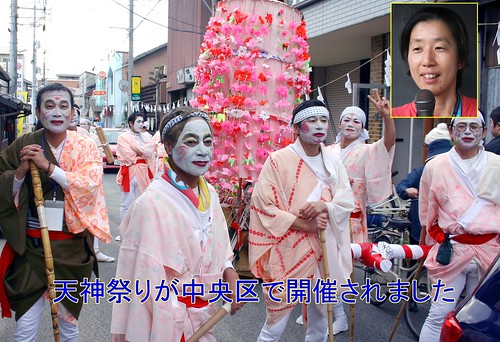
1) The faces of the commentators are seen displayed during the parts of the current affairs program that are filmed on location, so that viewers can SEE the expressions, and see the feelings that are being felt. (c.f. the face, in the top right hand corner)
2) The Japanese is given subtitles so that the viewers can *see* what is being said.
On the other hand, in the West, the viewers are provided with copious amounts of canned laughter so that so that they can know when to laugh. The principle is the same - the folks at home need to be told when to laugh - but while Japanese are stimulated by visual images, Westerners are comparatively "(logo) phonocentric" (Derrida, 1998).
In some Western News shows there are also teletypes providing extra linguistic information rather than a subtitles to what the presenters are saying. The majority of Westerners do not need to see what is being spoken, but they do like to feast upon as much linguistic information as possible.
Derrida, J. (1998). Of grammatology. JHU Press.
Labels: japan, japanese culture, Jaques Lacan, Nacalian, nihonbunka, occularcentrism, theory, 日本文化
Tuesday, July 02, 2013
Ghost in the Shell

With their honed ability at autoscopy (Metzinger) from a third person perspective, a sight apart (riken no ken, Zeami), Japanese can see themselves even without the aid of mirror. Equipped as they are with visual symbols for self they feel themselves "merged" (gattai!) and have overcome Lacan's horrible "hommellette."
However, even seeing themselves, and knowing that they are in there somewhere, but where? They are, even or especially when wearing only their skin, like a ghost in a shell.
Bottom image, promotional poster for Ghost in a Shell copyright held by the producer of the animated film, Production I.G.
Labels: japan, japanese culture, Jaques Lacan, Nacalian, nihonbunka, 日本文化
Japanese Fashion in the Mirror of the Heart
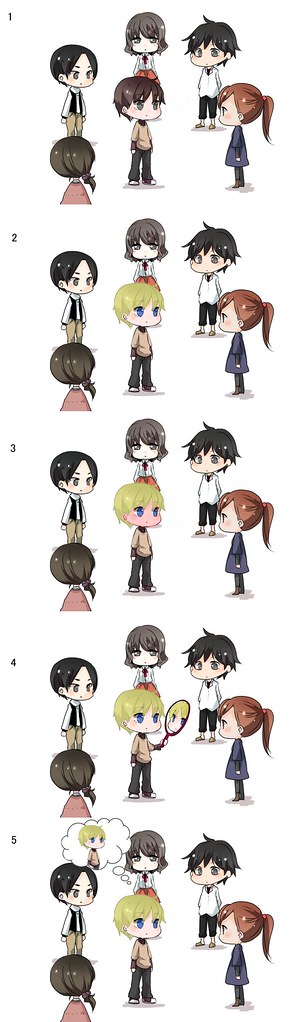
See Taro in the middle of a circle of his friends. The Japanese self is often described as being relational (Watsuji, Bendedict, Markus, Hamaguchi) which boils down to it being non-existent, or at best a nexus of self presentation concerns. The Japanese self is in the eye of the other, we are told.
If this were all there were to the Japanese self then how could the Japanese create and wear the zaniest fashion in the world? If this were the case, then if Taro dyed his hair blonde and wore blue contact lenses to college (picture 2), he would feel the harsh, judgemental gaze of his peers and become embarrassed (picture 3).
How could he avoid embarrassment? How could he remind himself of his preference for blonde hair and blue eyes? He could whip out his mirror (picture 4). As demonstrated by Carver ( 1975) and Carver & Scheier (2001) people with increased "objective self awareness" in front of mirrors, remain truer to their beliefs even in the face of social pressure. The trouble is, with all those eyes upon him, Taro would need to walk around looking in his mirror all the time.
But Taro has no need to do his, because Taro and all Japanese, especially those who have practised some kind of martial art or traditional path, has a mirror in his head (Heine, Takemoto, Moskalenko, Lasaleta, & Henrich, 2008). Taro can see himself without the aid of a mirror, avow his preference for blonde hair and blue eyes, and be done with the eyes of the world (picture 5).
It is because they have a mirror in their heart - originally a present from the Sun Goddess we are told - that the Japanese make the zaniest fashion in the world.
All five images based on an original by Miho Fujimura.
Carver, C. S. (1975). Physical aggression as a function of objective self-awareness and attitudes toward punishment. Journal of Experimental Social Psychology, 11(6), 510–519. Retrieved from www.sciencedirect.com/science/article/pii/0022103175900025
Carver, Charles S., & Scheier, M. F. (2001). On the Self-Regulation of Behavior. Cambridge University Press.
Heine, S. J., Takemoto, T., Moskalenko, S., Lasaleta, J., & Henrich, J. (2008). Mirrors in the head: Cultural variation in objective self-awareness. Personality and Social Psychology Bulletin, 34(7), 879–887. Retrieved from www2.psych.ubc.ca/~heine/docs/2008Mirrors.pdf
Labels: collectivism, individualism, japan, japanese culture, mirror, nihonbunka, occularcentrism, religion, specular, 個人主義, 宗教, 日本文化, 武道, 神道, 集団主義
Thursday, June 27, 2013
Intergroup Comparison versus Intragroup Relationships

The image above, adapted from Yuki (2003, p172) , shows how Americans and Japanese conceive of groups. Westerners concentrate on the name and set of central attributes of that group and all members feel themselves to share that attribute with all other members, in comparison with outgroups and their members who do not share the same attributes. These can be quite simple such as soccer fans may see membership of their teams fan base as derived from their belief that they "Want Chelse/Liverpool to win." They may chant "Chelsea, Chelsea," or "Liverpool, Liverpool," and they may mind merge with the social identity of their group becoming an outgroup hating herd animal. They do this to achieve vicarious self-enhancement through identification with the presumed superiority of their group. Their team wins, and the fans bask in reflected glory. Even if they loose they can believe that the fans are the most "loyal." And either way they can engage in an ego trip believing their group and/equals themselves to be superiority to others. Western group members therefore indulge in intergroup comparison, to enhance beliefs of the form "we are better than them" and "they are worse than us." This herd-like comparative group cognition is illustrated in the top diagram (a).
Japanese on the other hand pay attention to the many and various relationships and the network of relationships *within* their group. They have no interest in making downward comparison to the detriment of other groups. Their groups do not need a scapegoat, an other, to form at all. They are bonded by mutual cooperation, by "give and take" (a loan-expression from English into Japanese), obligation (giri) and ninjou (empathy) towards ingroup members. Rather than compare, they concentrate on maintaining ingroup harmony. Since the name of Japanese group game is cooperation, the individuality of the group members, their many and various talents that they can bring to the mix, are valued rather than ignored. So there is no moronic mind-merge, no hooligan herd, for the Japanese it would seem.
I love this theory and there is a lot of evidence to support it. Westerners are more likely to positively evaluate and be chummy with those that they are similar to (Heine, Foster, & Spina, 2009; Schug, Yuki, Horikawa, & Takemura, 2009), and more likely to remember information regarding inter-group rather than intra-group relationships (Takemura, Yuki, & Ohtsubo, 2010), whereas are more likely to trust someone in the same relationship network as themselves, rather than merely due to the fact of belonging to some nominal group (Yuki, Maddux, Brewer, & Takemura, 2005).
And as I have written before the emphasis for me is upon "nominal." Westerners like myself tend to conceive of others, their groups and themselves linguistically - in the latter case as having some shared characteristics. Whereas Japanese tend to conceive of groups in their imagination which results (as Lacan argues) in groups being conceived in terms of a network of binary relationships.
However, it occurred to me this morning, based upon the above argument, the group of "Americans" should also be that much more mind-merged, herdlike and amalgamous people - believing in common shared characteristics* - whereas the Japanese as a group, should, in so far as they understand themselves as a group at all, be bristling with individuals all cooperating together for the sake of synergy but never, for the sake of the same synergy, becoming the same. The motto of the Japanese group is, the words of Confuscious "harmonise not herd!" (和して同せず).
Thus in a culture with so great a respect for individuality, such as Japan under Yuki's theory, it is not surprising that "harmony" should be heralded and aspired towards. Likewise in a culture with so much mind-mulching, herdery, it is not surprising that individualism be that towards which its members are encouraged to aspire.
Does that satisfy? I think that I have gone a little too far and suggest a slight amendment to diagram (b) above. Yuki probably only drew the relationships as external to the group members in order to draw attention to them. He makes it entirely clear that intra-group attention is based upon the Interdependent model (Markus and Kitayama, 1991, diagram page 226) or in Kasulis (2010, diagram p 225) which provides philosophic, the relationships are shown interior to the selves. Implied by Yuki's analysis, I suggest therefore diagram (c) as a modification to diagram (b). Under this conception, the Japanese cease to be so radically individual, as compared to Americans, since they are aware that their individuality is fostered, created and maintained by virtue of their relationships with others which are self-forming and interpenetrate and overlap with the self.
How is this even possible? How can other person really be part of oneself? If that other person and your relationship is conceived in the visio-imaginary, then as Nishida (see Heisig, 2010) and Mach (1897), argue, it takes place in a place which is, paradoxically, both oneself and the world.
*The American Mantra: We hold these truths to be self-evident, that all men are created equal, that they are endowed by their Creator with certain unalienable Rights, that among these are Life, Liberty and the pursuit of Happiness.
Heine, S. J., Foster, J.-A. B., & Spina, R. (2009). Do birds of a feather universally flock together? Cultural variation in the similarity-attraction effect. Asian Journal of Social Psychology, 12(4), 247–258. Retrieved from onlinelibrary.wiley.com/doi/10.1111/j.1467-839X.2009.0128...
Heisig, J. W. (2010). Nishida’s Deodorized Basho and the Scent of Zeami’s Flower. In Frontiers of Japanese Philosophy 7: Classical Japanese Philosophy (pp. 247–73). Nagoya: Nanzan Institute for Religion and Culture. Retrieved from nirc.nanzan-u.ac.jp/staff/jheisig/pdf/Nishida%20and%20Zea...
Kasulis, T. P. (2010). Helping Western Readers Understand Japanese Philosophy. Dialogue, (34). Retrieved from nirc.nanzan-u.ac.jp/nfile/2124
Markus, H. R., & Kitayama, S. (1991). Culture and the self: Implications for cognition, emotion, and motivation. Psychological Review; Psychological Review, 98(2), 224. Retrieved from www.biu.ac.il/PS/docs/diesendruck/2.pdf
Schug, J., Yuki, M., Horikawa, H., & Takemura, K. (2009). Similarity attraction and actually selecting similar others: How cross-societal differences in relational mobility affect interpersonal similarity in Japan and the USA. Asian Journal of Social Psychology, 12(2), 95–103.
Takemura, K., Yuki, M., & Ohtsubo, Y. (2010). Attending inside or outside: A Japanese–US comparison of spontaneous memory of group information. Asian Journal of Social Psychology, 13(4), 303–307. doi:10.1111/j.1467-839X.2010.01327.x
Yuki, M. (2003). Intergroup comparison versus intragroup relationships: A cross-cultural examination of social identity theory in North American and East Asian cultural contexts. Social Psychology Quarterly, 166–183. Retrieved from www.jstor.org/stable/pdfplus/1519846.pdf
Yuki, Masaki, Maddux, W. W., Brewer, M. B., & Takemura, K. (2005). Cross-cultural differences in relationship-and group-based trust. Personality and Social Psychology Bulletin, 31(1), 48–62. Retrieved from psp.sagepub.com/content/31/1/48.short
Labels: collectivism, culture, image, individualism, japan, japanese culture, logos, Nacalian, 個人主義, 日本文化, 集団主義
Tuesday, June 18, 2013
The Man of Steel and The Masked Rider
Many Western scholars (e.g. Dennet, 1992) claim that we identify with the voice of conscience, the words in our head. One guy (Lacan, 2007) points out, that we also need to identify with our images of our face and body, that give a centre, place, or covering (Baudrillard, 1995), for our thoughts. He also says that identifying with our body image alone is impossible because we'd need to carry a mirror all the time. Language, on the other hand, provides a view on the self from the point of view of another, the Other (Lacan, 2007), the super-ego (Freud, 1913), an impartial observer (Smith, 1812), generalised other (Mead, 1967) or the super addressee (Bakhtin, 1986) of our thoughts. Lacan also claims that we can not identify with our self-images because we have many body images, an arm, our nose, our face in the mirror, a face from years ago. Our body images are a mishmash or human omlette (hommellette).
Recent research has shown however that humans have the ability to see themselves from an external perspective at a neuronal level (Blanke & Metzinger, 2009; Iacoboni, 2009; Metzinger, 2009). This ability to simulate seeing oneself without a mirror is found to be especially strong in East Asians (Heine, Takemoto, Moskalenko, Lasaleta, & Henrich, 2008; Wu & Keysar, 2007). The ability to see oneself is argued to be enhanced by performing fixed poses or kata (Zeami, 1984; Butler, 1993).
I theorise, therefore, that the Japanese identify with their body images, rather than their internal voice. Further, that just as Western body images provide a place for thoughts to take place, language or symbols even symbolic gestures - which are above all reiterable (Butler, 1993): repeatable, enduring in time - provides cohesion to the Japanese imago-self by giving a sort of temporal core that links the aforementioned scrap-book, or omelette, of body-images together.
Now onto superheroes. I theories that they are myths for the development of the self.
The quintessential Western superhero, Superman is someone that spends a lot of his time thinking to himself. His words, as his true identify, fly. He has two fathers. He converses with the memory of his astral father that endowed him with super powers. Superman is a hard-boiled, self narrator. His super suit, the image he presents us, is merely a cover for this true identity.
Many Japanese heroes however transform in front of people with great aplomb. Not for them the telephone box, some of them even transform on stage (Shinkenja). The requirement that heroes transform is universal since they deal with the genesis of the self, but only in the West is transformation required to hide a secret identity. Japanese super heroes use super-symbols (an amulet from a Shrine in Mirror Man; a beta capsule in Ultraman, medals, cards, characters written in the air, or rings in Kamen Rider; a seal in Mitokoumon, and lots of kata or poses: see second video above) which allows them to transform into their super form. Japanese heroes have suits too, or rather and in many ways they are their suits, especially in Kamen Rider (and a more extreme degree in Gundam and Evangelion).
These two genres of superhero, Western and Japanese illustrate the genesis of the self formed of language and image. Superman is his thoughts. His suit or image is merely a covering that allows him to be his true identity. Kamen Rider's super heroism resides in his suit. His symbols are an externally derived catalyst that allows him to transform, and pull his suit together.
Finally this brings me to a further aspect of Japanese superheroes. After they transform (Henshin) They often combine (especially in the Power Rangers series), which illustrates I believe two things: the cohension of various self images or "hommelette", and the combination of various self views, the generalising of the visual other. Gattai.
Upon this analysis, Iron Man is a cross-over hero for Americans and Japanese.
Acknowledgement
Thanks to James Ewing, to whom his post is dedicated, for drawing my attention to Mirror Man, one of the first transforming Japanese superheroes, which provides the link between symbolic transformation, Lacan, and the Japanese Shinto religion. Shinto shrines are sacred mirrors or places that dispense signs (amulets/omamori), Christian churches are houses of sacred language that dispense "the body".
Bibliography
Baudrillard, J. (1995). Simulcra and Simulation. (S. F. Glaser, Trans.). Univ of Michigan Pr.
Blanke, O., & Metzinger, T. (2009). Full-body illusions and minimal phenomenal selfhood. Trends in Cognitive Sciences, 13(1), 7–13. doi:10.1016/j.tics.2008.10.003
Butler, J. (1993). Bodies That Matter: On the Discursive Limits of "Sex. Routledge.
Dennett, D. C. (1992). The self as a center of narrative gravity. Self and consciousness: Multiple perspectives.Freud, S. (1913). Totem and taboo. (A. A. Brill, Trans.). New York: Moffat, Yard and Company. Retrieved from http://en.wikisource.org/wiki/Totem_and_Taboo
Heine, S. J., Takemoto, T., Moskalenko, S., Lasaleta, J., & Henrich, J. (2008). Mirrors in the head: Cultural variation in objective self-awareness. Personality and Social Psychology Bulletin, 34(7), 879–887. Retrieved from http://www2.psych.ubc.ca/~heine/docs/2008Mirrors.pdf
Iacoboni, M. (2009). Mirroring people: the science of empathy and how we connect with others. New York, N.Y.: Picador.
Lacan, J. (2007). Ecrits: The First Complete Edition in English. (B. Fink, Trans.) (1st ed.). W W Norton & Co Inc.
Mead, G. H. (1967). Mind, self, and society: From the standpoint of a social behaviorist (Vol. 1). The University of Chicago Press.
Metzinger, T. (2009). The Ego Tunnel: The Science of the Mind and the Myth of the Self (1st ed.). Basic Books.
Smith, A. (1812). The theory of moral sentiments. Retrieved from http://books.google.co.jp/books?hl=en&lr=&id=d-UUAAAAQAAJ&oi=fnd&pg=PP18&dq=%22The+Theory+of+moral+sentiments%22&ots=mjeEAFSIge&sig=LNXhHkNjKAWc2r9r_KiRDFxn_Pg
Wu, S., & Keysar, B. (2007). The effect of culture on perspective taking. Psychological science, 18(7), 600–606. Retrieved from http://pss.sagepub.com/content/18/7/600.short
Zeami. (1984). On the art of the nō drama: the major treatises of Zeami ; translated by J. Thomas Rimer, Yamazaki Masakazu. Princeton, N.J: Princeton University Press.
Labels: Bandai, Bokenger, henshin, image, japan, japanese culture, Jaques Lacan, Masked Riders, nihonbunka, スパー戦隊, 仮面ライダー
Wednesday, June 12, 2013
The Future Face is Now in Japan
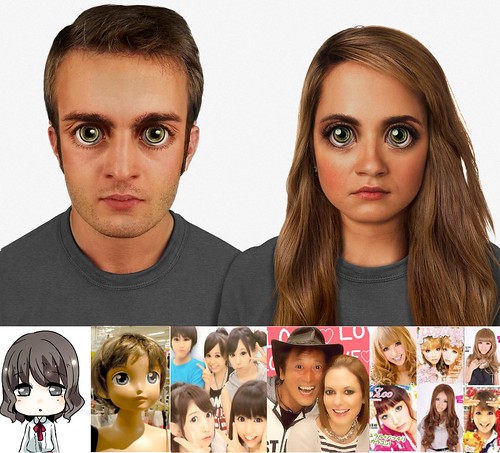
As covered in the Huffington Post, research in to computational genomics carried out by Alan Kwan based primarily upon how faces have changed in the past, lead to the prediction of how faces will look 100,000 years in the future (created by Nickolay Lamm, a Pittsburgh-based artist).
To anyone familiar with Japanese culture, these faces of the future are reminiscent of the faces portrayed in manga, the faces of recent Japanese clothes store mannequins, the downward angle and automatic post-processing of "purikura" (Japanese photo-me?) booths which automatically increase the size of the eyes (as can be seen especially in the photo of the non-Japanese lady whose right eye has been enlarged to protrude from the side of her face), and even the faces of "GAL" style models (gyaru, ギャル)to be seen on the covers of Japanese magazines and even walking the streets.
The hypothesis that humans will tend towards the GAL shape of face suggests that the Japanese have not merely been influenced by Western culture, but have taken the best bits of both cultures to create an amalgam that is objectively superior combining those features that will (Kwan argues) go on to be genetically preferred, and created by generations of humans to come. In Japan the future face is now.
Top Image Copyright Nickolay Lamm, a Pittsburgh-based artist
Bottom row of Images
Left: Detail from a Manga by Miho Fujimura
Centre Left: A mannequin in a local store in Yamaguchi Japan.
Centre: 重体ことり プリクラ #dream5 by Myfavouriteblogs
Centre right: プリクラ渋谷 by Toshi Kanda
Right: Google image search thumbnails for the keyword "ポップティーン" a popular magazine of GAL fashion.
Labels: japan, japanese culture, nihonbunka, 日本文化
Sunday, June 09, 2013
Only One, Free Talk, and Beautiful Silence
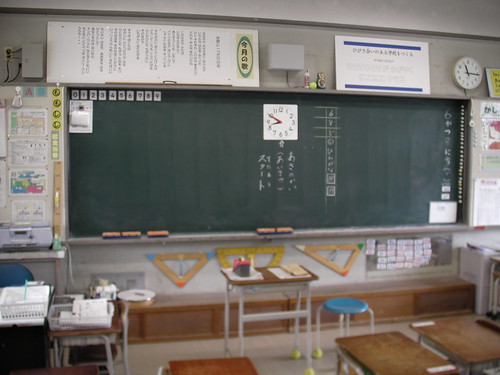
In an attempt to encourage individualism among Japanese primary school students, the text of SMAP's "The only flower (like you) in the world" (sekai ni hitsu dake no hana translated) which encourages us to realise that we are the "only one" like ourselves, and appreciate and nurture our natural beauty, abilities and aspirations. The lyrics are displayed above the blackboard in this Japanese primary school. The children sang it in unison, very loudly at the start of class.
After singing the SMAP homage to individualism, the pupils are encourage to participate in "furi- toruku" (free talk) which is highly structured and anything but "free." Students were allowed to express a preference and then call on another student to express one of their preferences. Only those addressed were allowed to speak, briefly.
Later in the day, every day, the pupils, are required to clean the classroom as a group in complete silence. The school is aiming to carry out the most silent classroom cleaning in Japan.
Toruku (talk) is thus situated as something that should only be carried out in its proper place and only when addressed. At other times it is a distraction that is best eradicated.
At the school open day, at the end of the presentation regarding the schools pedagogy to the assembled parents, there was scheduled ten minutes for questions. After 15 seconds of silence, and not one question from the parents, the meeting was closed.
While the SMAP song does encourage individualism it uses the metaphor of beautiful flowers. I believe that Japanese students are encourage to appreciate and nurture their individual beauty, abilities and dreams as conceived in the imaginary, visual domain. In Japan talk is not "free", it is cheap.
The photograph is blurred so that the names of the children posted below the blackboard can not be read.
Labels: japan, japanese culture, Nacalian, nihonbunka, 日本文化
Atractive Asian Girl and The cultural psychology of the concept of Self.
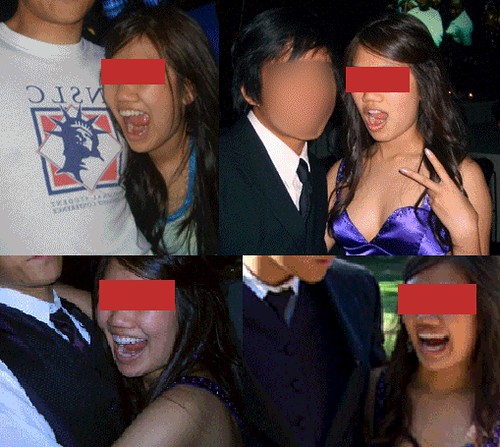
There is an Internet meme that has been doing the rounds for several years featuring pictures an attractive Asian girl who often appears with the same open-mouthed expression in a large number of photos. She has been ridiculed and called lots of offensive names (google) , merely because she chooses to take this pose in several photographs.
It seems clear to me that this attractive Asian young lady has simply decided that she likes this pose, that she looks good doing, and that it expresses her character. So why shouldn't she use the same pose in any or even all the photos that she appears in?
My parents in law are active tourists. The have visited the Pyramids in Egypt, Marble Arch in London, Leeds Castle in Kent, the Rocky Mountains USA, and various locations in Asian. At all of these locations they take a souvenir photograph of themselves, superimposed upon the location, which the same expression, and posing in the neutral, dignified way. Only in one photo that I have seen is even their order reversed: except in one photo in their extensive souvenir travel photo album, my father in law stands on the right.
In some cultures, including Japan, where people are more identified with their self image, people like to present a positive and self-consisistent image of self. For them, visual self-consistency is important.
In other cultures, it is important to present an unchanging narrative of self. Kanagawa, Markus and Cross (2001) demonstrated that when Japanese are asked "Who are you" by a friend, in a group situation, by a teacher, and on their own, their self representations change with the social situation. Presumably they anticipate that each interlocutor seeks different information, and they have no desire to present a consistent (or enhanced) narrative self (Leuers [Takemoto], & Sonoda, 1999). Americans on the other hand, were inclined to narrate themselves in almost exactly the same no matter who is asking, and even when they are on their own, since (like the Asian lady in the above photo) they are concerned to present a consistent and attractive linguistic representation of self.
This is due to the nature of their Gods (super addressees, imaginary friends, hidden intra-psychic others). In the West God is always listening, in Japan God (お天道さま, or the ancestors) are always watching and protecting (見守っている).
Kanagawa, C., Cross, S. E., & Markus, H. R. (2001). “Who am I?” The cultural psychology of the conceptual self. Personality and Social Psychology Bulletin, 27(1), 90-103.
Leuers, T. R., & Sonoda, N. (1999). Independent self bias. Progress in Asian social psychology, 3, 87-104.
Should anyone wish the above photo to be taken down, please leave a comment.
お取り下げご希望の場合は下記のコメント欄か、http://nihonbunka.comで掲示されるメールアドレスにご一筆ください。
Labels: image, japan, japanese culture, Nacalian, nihonbunka, self, 日本文化
Thursday, June 06, 2013
Japanese Culture on Campus


Japanese Culture on Campus, a set on Flickr.
In preparation for the start of this year's Intercultural Communication course, I took some photographs of what I feel to be Japanese cultural phenomena on the campus of my university.
Labels: japan, japanese culture, nihonbunka, 日本文化
Tuesday, June 04, 2013
The School-boy Haiku Poet
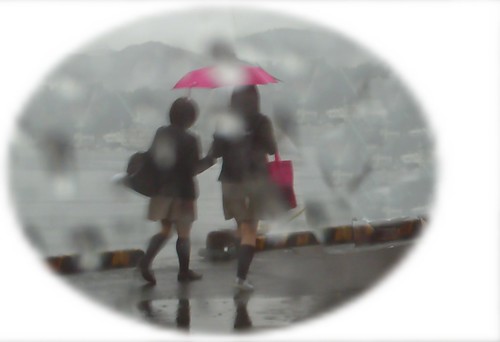
A book of Japanese short verses (Haiku) by a schoolboy has been published recently (Kobayashi, 2013). The haiku that is featured on the cover, and used as the subtitle for the book, is good.
いじめられ
行きたし行けぬ
春の雨
Ijimerare
Ikitashi Ikenu
Haru no Ame
Bullied
I wanted to go but couldn't
Spring rain
The schoolboy poet was bullied at school and stayed at home quite often as a consequence.
As argued in previous posts Haiku poems attemtp to lead the reader to a little bit of Buddhist enlightenment by encouraging them to reach a erroneous interpretation of the poem before returning them to, or hinting at the nature of the poetic experience.
Rain often features in Haiku partly I think because rain can not usually be seen (except in its effects) only inferred. Two other famous haiku by Basho and Buson mention "rain" (encouraging the reading to attempt to imagine it) before admitting that they were in fact looking at a river, or houses on the far side of a river.
Is this schoolboy seeing rain? The poem is effective because it is inconclusive, hinting at another interpretation. School starts in spring in Japan, so one can imagine the schoolboy wanting to go to school but not going because his bullied and his feelings at this his predicament. I think we may imagine him crying. And there arises an alternative interpretation of the "Spring Rain." Is the spring rain the poets tears or not? The reader can imagine that the poet saw a wet spring day, a blurred image trough rain, glass or tears, but the in the face of the absense of a privelidged interpretation, the reader is returned to the uninterpreted image, the purity of the experience itself.
Above image based on detal from a photo by U-Ichiro 雨の港町
Kobayashi, K. 小林凜. (2013). ランドセル俳人の五・七・五 いじめられ行きたし行けぬ春の雨--11歳、不登校の少年。生きる希望は俳句を詠むこと。. ブックマン社.
Labels: japan, japanese culture, nihonbunka, 日本文化
Tuesday, May 07, 2013
Flying Legs Japanese Postmen
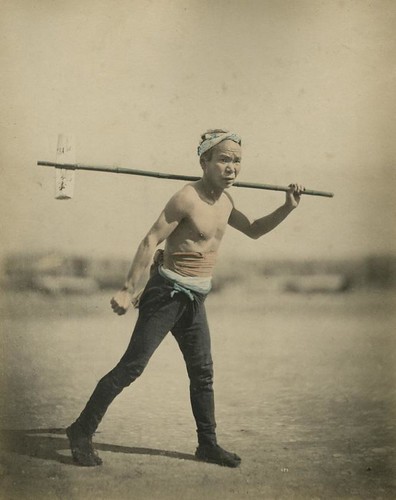
It is said that they ran the Tokyo Osaka route in 6 days or 90km a day, and in 4 and a half days when carrying especially urgent mail. That is 120Km a day.
It is also said that they ran in a special way to conserve energy but the wikipedia site says that it is not clear what this special way is though it is rumoured to be the "Nanba Running/Walking" form in which runners and walkers swing their right hand forward at the same time as their right leg, and vice versa, rather than in time with the opposite leg. There appears to be photographic proof of this theory here. And indeed the position of the postman pictured above is consistent with this theory.
There is a saying in Japanese "Satsuma's Postman," which refers to the Satsuma (current day Kumamoto prefecture) region of Japan and postmen that arrived there were proverbially at least killed, or not allowed to return to whence they came, since the region was planning a revolution (with the Choushu region, current day Yamaguchi Prefecture) and did not wish its secret preparations to become known. So a "Satsuma's Postman" means someone who does not return.
A famous Japanese courier company has a "Hikyaku" postal service which uses its trucks combined with the Japanese postal service' post workers. The company sorts and transports, the postal workers deliver, and they claim faster times than leaving the whole delivery to the postal workers.
I wonder the reason for the pole. At times the pole seems to have served as a kind of rucksack for allowing heavy items to be carried using the muscles in the back, similar to the way in which the English migrant "Dick Wittington" is often portrayed carrying his possessions in a cloth hung from a pole over his shoulder.

This does not explain why these Japanese postmen would carry light items such as that shown in this photo in the same way. The only mention I can see of the pole on the Japanese wikipedia page is the tradition of "Town postmen" to trail a small bell from their pole" so that people would hear them coming (and presumably deposit letters with them). But this man has no bell. Could the pole also have been a letter passer, to allow letters to be received and delivered at a distance, and thus a precursor of the ubiquitous Japanese mask, to prevent the transmission of infectious disease (which was rife in Edo period Japanese cities)?
Labels: japan, japanese culture, 日本文化
This blog represents the opinions of the author, Timothy Takemoto, and not the opinions of his employer.