
Thursday, November 29, 2012
The GAL in the Mirror and The Soul of Japan

The above image is from the cover of Koakuma Ageha (Little Devil Ageha), a fashion magazine for young Japanese women. It shows a certain style of Japanese woman ,or GAL, taking off a mask which is wearing blue contact lenses, white foundation, and red lipstick, to reveal an even more beautiful (so it is suggested) winking GAL.
Adjacent is the caption "This is how everyone creates fake faces," the title of an article on how to avoid being fake.
I have a brief documentary video on Youtube which talks despairingly about the Japanese practice of using glue on their eyes to create "double eyelids" (I call it a "crease") as a result in part of Western influence. Many viewers respond that they do not double their eye lids to look Western. I have gradually become more and more in agreement with my critics.
At the very least, the Japanese GAL has surpassed fakery and Western immitation. The GAL has been influenced by the West, but in true Japanese cultural style, GAL beauty has taken in Western facial aesthetics, mixed this with Japanese sense of facial beauty to create something - to the Japanese at least - better, more beautiful.
This story regarding the creative power of Japanese culture to take in the influence of others cultures, to mix it up and harmonise it with the Japanese sense of taste is to be found in a great many commentaries regarding Japanese culture. And it is not (just) hard cheese. Sure it does have to be admitted that the Japanese Culture owes a very great deal to Chinese culture, and more recently to Western culture. The Japanese are acutely aware of this. But they are right to point out that they are great at improving on things, to create something new, something that themselves at least like better. The GAL has done it again.
How do the Japanese achieve this assimilation-and-improvement ability? One of the best renditions of this theory is to be found in Watsuji's Climaticity (Fuudo) theory, which holds that the Japanese environment and climate was such that it did not create a division between humans and the environment but encouraged their unity. Further, this theory of the unity of the environment the human, of the world and self, finds it is best expression in Kitarou Nishida.
Nishda argues that if you perform phenomenological bracketing, that is to say if you remove all interpretation of your environment, if you silence your (annoying) inner voice, then you reach pure experience, and experience which is contradictorily, both self and the world. Nishida generally used visual metaphor and drew pictures of circles on his blackboard at Kyoto University.
I find it explanatory to consider Ernst Mach's "visual field". The visual field is generally considered to be view (a bounded opening onto something bigger), or at best a viel, but Mach, and Nishida, considered it to be the very stuff of the world and self.
The ability to identify with this mirror itself rather than any characteristic reflected in it, or abstract explanation of it, allows the Japanese to be almost infinitely malleable, almost infinitely good at assimilating. This does not mean that want to become Westerners. They taken in Western looks because they are also Western looks. And they stop taking in when they like what they see, because what they see, is themselves.
Video which may represent a Japanese GAL performing the above described process: Notes in lieu of a Bibliography
室瀬和美(2002)『漆の文化: 受け継がれる日本の美』角川選書. p207-208
文化を取り入れて、日本文化と融合させていけると確信している。どれほど受け入れても、自らを失うことがないと信じている。したがって現代の人々も世界各国と繰り返してきたように思う。飛躍があることは承知の上で、私は日本人が外国からの情報.文化をどれほど受け入れても、自らを見失うことがないと信じている。
鎌田東二(2000)『神道とは何か 自然の霊性を感じて生きる: 自然の霊性を感じて生きる』PHP研究所
自然界の姫産物も文化文明の姫産物も共に贈与と受けとめる感性と哲学があったのだ。その日本人の根本哲学に基づいて、大陸から様々な形で流入してきた新しい文化文明が取り入れられていった。またその混成と習合によって、独自の文化が洗練されていっった。そのプロセスの全体を私は神神習合ととらえている。
神神習合とは。。。様々な部族が奉じていた神々や習俗が、日本列島の特殊な風土条件の中で混血されていたったプロセスをいい、その混成的クレオール的文化を神神習合ととらえるのである。
高坂 節三(2000)『昭和の宿命を見つめた眼: 父・高坂正顕と兄・高坂正堯』PHP研究所
「わが国の風土そのものが人間否定的ではなく、人間と自然が一となるものであった。しかも東海の孤島に位置し、脅かされることはなかった。いかに外国文化を取り入れてもも、自己の民族的に生存を感じさせなかった。今日まで自由に外来文化を取り入れてきた所以のものもここにあると考えられる」として、改めて告ぎのように述べている。
---日本文化は、主体即環境、人間即自然として、自己同一的に発展したものということができ、東西文化の結合を日本に求めることができる (and we know where he got that from, down the corridoor in Kyoto University).
Labels: japan, japanese culture, mirror, morph, Nacalian, nihonbunka, specular, 日本文化


Wednesday, November 28, 2012
My Students Wouldn't Recognised Me

If you met me in Iwakuni, next to the famous kintaikyou bridge shown in the background, would you recognise me? Of course not if you don't know me from Adam.
My Japanese students might not recognise me either, because even though they know me, they store intormation contextually, complete with the context in which it originally appeared: their classroom in Yamaguchi University as opposed to Kitaikyou Bridge in Iwakuni City.
Masuda and Nisbette (2001) demonstrated that Japanese were more likely than Americans to forget target objects (fish and animals) if the background in which they were presented were changed. This difference may also be produced by a tendency for Japanese to store information visually, as opposed to linguistically, in accordance with the theory in this burogu, but I have no data to support this assertion.
Image adapted from the generously licenced 錦帯橋 by Chicatan for a lecture on Masuda and Nisbett's tremendously interesting research (Nisbett, 2004; 増田, 2010; リチャード・E・ニスベット, 2004).
Bibliography
Masuda, T., & Nisbett, R. E. (2001). Attending holistically versus analytically: comparing the context sensitivity of Japanese and Americans. Journal of personality and social psychology, 81(5), 922. Retrieved from psycnet.apa.org/journals/psp/81/5/922/
Nisbett, R. (2004). The Geography of Thought: How Asians and Westerners Think Differently...and Why. Free Press.
増田貴彦. (2010). ボスだけを見る欧米人 みんなの顔まで見る日本人. 講談社.リチャード・E・ニスベット. (2004). 木を見る西洋人 森を見る東洋人思考の違いはいかにして生まれるか. ダイヤモンド社.
Labels: japan, japanese culture, nihonbunka, 日本文化
Monday, November 26, 2012
Kyari Pamyu Pamyu, Kata and Seeing Yourself
 How is it that the Japanese are able to see themselves? Why does Kyari Pamyu Pamyu have eyeballs on her dress and why does her mental self spew them out. Why do these same eyeballs encircle her her corporeal body? Why is her dance so choreographed? Why does she move from one pose to the next, in a triptych of recognisable poses or kata?
And why do Japanese martial artists, such as Karate and Judo practitioners, or sumo wrestlers, stand in rows and make the same poses, or kata over and over again? Why are all Japanese path (michi or dou) practitioners, from martial artists to tea-ceremony aficionados and Noh actors, so keen on repeating one set forms, kata, over an over again? Are they clones? Are they unable to move freely, fluidly? What is the importance of repeating set actions over and over again, and does this have anything to do with Kyari Pamyu Pamyu's eyeballs?
George Herbert Mead argues that it is impossible to have a visual self unless one is an actor (with an audience to react) or unless one has a mirror. Generally speaking visual self representation are for others. Conversely it is only language, the logos, that allows ourselves to take the perspective of others, and create a generalised --other independent-- perspective of self. Language, mead says, is special in that it provides a mirror, because when transmitting a language, even to oneself, the word as stimulus can be understood from the perspective of others.
Derrida argues that the defining characteristic of language, and indeed any sign, is that it can be repeated. If I write a random squiggle on a page, that is not a sign. As soon as it is recognisable, and I or someone else, even in my my absence, can repeat it then the squiggle becomes a sign. Iterability is defining characteristic of signs.
In "Bodies that Matter" Judith Butler extends Derrida's observation to iterable bodily movements. Iterable bodily movements such as gestures, poses, and presumably the iterated movements - kata- of Japanese practitioners, are signs. Repeating and repeated acts allow the body to make signs. Martial artists perform an embodied narrative.
Returning to Mead, looking carefully he does admit that gestures, are also language. And these allow their performers to understand their acts as if from the perspective of others. Iterated and Iterable bodily movements, allow us to see the same from the perspective of others. The movements of the body become a language, a language that demands the eye of the Other.
Japanese martial art practitioners, all Japanese path practitioners, and Kyari Pamyu Pamyu, repeat set actions, practice their embodied language, and their bodies come to matter. Their bodies speak. They come to be able to see their bodies from the point of view of the other. They become able to have an objective view of self, and thus to have a visual self.
Practising the kata of the martial arts, and all other Japanese ways, the practitioner becomes able to see his body from a view apart (riken no ken), to have eyeballs inside her self that yet surround and are able to view her.
Image on right: adapted from Karate Practice by Robert Couse-Baker. Image on Left, Kyari Pamyu Pamyu singing Pon Pon Pon copyright Kyari Pamyu Pamyu (きゃりーぱみゅぱみゅ) the director Jun Tajima, Masuda Sebastianone, and Warner Music Japan.
Thanks to Ryosuke Matsumoto for emphasising the importance of Kyari Pamyu Pamyu, Professor Masamune for reminding me of Judith Butler, Tatsuya Hara for being a great interlocutor, and to Holy Whopper for encouraging me to keep writing.
Labels: culture, gender, image, japan, japanese culture, specular, 日本文化
Freud In Japanese

Freud's triparite division of the pysche into the super-ego ("over I"), ego ("I") and Id ("it"), translated into Japanese.
I believe that this tripartite division of the self applies to the Japanese too, but some (e.g. Kishida Shu) believe that the Japanese do not have a supereg. Not being a monotheistic society, and being instead collectivists, the Japanese equivalent of the super-ego is other people. Instead of guilt (or fear of god 対神恐怖症) the Japanese have social phobia (fear of other people 対人恐怖症).
Still others (such as Dov Cohen) claim that the Japanese have an even greater tendency to see themself from the position of a generalised other (Mead's version of the super-ego) and conversely that this suggests that they are collectivists.
I claim that the Japanese super ego or generalised other is alive and well. It may be a litle weaker, or softer than the Western version. It may be more granular or polytheistic, but that it exists in, or watching, "the imaginary" as represented by the dancing fat lady and the eyeballs in Kyari Pamyu Pamyu's video. For this reason I have added a red eyeball, not in Freud's original diagram.
The Japanese do not share their psyche with a listening father, but with a watching mother or perhaps even a watched mother, まぶたの母. I need to think more about this latter point.
Labels: japan, japanese culture, Jaques Lacan, lacan, Nacalian, occularcentrism, self, specular, theory, 日本文化
Thursday, November 22, 2012
Kyari Pamyu Pamyu through the Looking Glass of Lacan
A super cute character-girl, wearing a dress and gloves decorated with eyes, performs a highly choreographed song and dance routine ina room cluttered with the paraphernalia purchasable in her favourite fashion area. This is Kyari Pamyu Pamyu singing her world wide hit single "Pon Pon Pon". Just one of the several YouTube streams for this video has been viewed (as of 21 November 2012) 29 million times. The things that Kyari purchases, and even her dramatis persona, is not atypical for young girls that frequent Tokyo’s Harajuku shopping district where fashionista's go to parade their manga and anime inspired outfits, especially on Sunday afternoons.
But Kyari Pamyu Pamyu's music video, created by a team of Tokyo’s finest set designers, song and music writers, producers, animators, and the "air:ma"choreography team, goes a lot further way out, or way in, to the technicoloured mindspace of the Harajuku girl, and perhaps even to the heart of contemporary Japan.
Some of the features of this video are the inter-penetrating and strangely reversed duality of Kyari in her room, and pink Kyari shown in the mind outside her room. That her mind is outside her room, is indicated clearly by the descent of a red scull-less brain (0:15) that starts d dance.
The inside of the room is phantasmagorical enough with its mountain of consumer kitsch including glove puppets (0:11), a stuffed unicorn, plat-form shoes, many different stuffed characters, Christmas decorations, a tiger-cub decorated shoulder bag (0:25), a plastic elephant, plastic chains, knocked over chair (0:29),my little pony, 6 dolls, bags (0:32)
Kyari's mind, outside and occasionally overflowing inside her window, is even more outlandishly psychedelic nature of her pink persona that populates, together with one or more dancing fat old ladies, further serves to emphasise that, contra our expectations, outside is in, the psychological world seems to stand outside and encompass reality, rather than felt to be trapped within it.
Karyi's mind is very much in control. The psychedelic fantasies in Kyari's mind have been recreated in consumer purchases inside Kyari's room.Kyari's pink mental persona with even more virulently bleached blonde hair and even longer fake eyelashes only needs to speak in images (such as an apple,eyeballs, birds and a microphone – emerging from her ear) for these objects to appear inside the room.
Kyari in person is very much on stage, controlled, posed, forward facing, jittering, on strings, where as her celestial pink mental self revolves sublime, produces the microphone (0:7) to allow her to sing, and regurgitates the eyes that watch her dance. These eyes are perhaps the true protagonists, appearing everywhere, even after Kyari disappears after the final credits.
The words of the song appear to mean very little. The singer says in an interview that she is unaware of the title’s meaning, it having been presented to her on the day of her performance. None the less it is the words that hold the two worlds (mental and Harajuku) together: Kyari's persona’s sing in unison.
And, just as Kyari’s pink mental personal can produce things from often computer generated images, Harajuku Kyari can produce things by clapping, since the sounds in Japanese onomatopoeia is the same as that for the word for the slices of bread that appear.
Far more than the words, however, the images, symbols and gaze, the whole ocular structure of the video, speaks far more. Pink Kyari's computer generated simulacra, of strawberries, ducks, heart, scull, wasp, flowers, bones, banana, mask, pterodactyl, merry-go-round, red tank, fish, tortoise, dinosaurs, and especially the apple seem to represent her thoughts and desires. When Pink Kyari gets hungry she regurgitates a computer simulation of an apple from her mouth. The Kyri's mind speaks in images and watches her avatar, her character, through her bedroom window and TV set. The eyeballs that she spews surround Harajuku Kyari’s dance and adorn her dress. When pink Kyari arrives in the form of video tape played on a TV set, Harajuku Kyari’s head transforms into an amorphous pink mass.
So, what does it all mean? I shall argue that the video illustrates the Nacalian -- reversed-Lacanian-- theory of Japanese culture proposed by this blog.
I would like to draw attention to two things.
First of all that there are a lot of pretty creepy things going on. The aforementioned microphone appear from an ear, the dancing brain, regurgitated eyeballs (2:24),floating giant eyeball (2:28) , amorphous melty-head (2:42), are not gross enough, there are plenty of things that are conventionally accorded a negative valence, grotesque and horrifying things often associated with death, such as chequered one eyed skulls(0:40, 1:12) that come through the mirror into the room accompanied by a giant skeletal hand (1:17), a fossilized dinosaurs (0:41), giant bones (1:13), black birds flying out of pink Kyari’s mouth (1:18), melting eyes (1:23), a wasp (1:28) and a shark that again protrude fly into the room (2:47), Nightmare on Elm Street style mask (2:57), and what appears to be snot (3;32) . At least Pink Kyari does not attempt come through the window, our out of the TV set into the world. All these rather disgusting things, that originate in the external mental world are kept from being horrifying due to the consummate Harakuju cuteness of the heroine. Harajuku Kyari is so cute (kawaii) that she can turn even the most scary (kowai) into smorgasbordia of candy, flowers and bubblegum.
Secondly, I think it is important to ask, who is the dancing fat lady?
To be continued.
Labels: culture, eye, horror, image, japan, japanese culture, Jaques Lacan, lacan, nihonbunka, occularcentrism, reversal, specular, 日本文化
Thursday, November 15, 2012
Pachinko, The Mandala and Roulette

I think that "illusion of control" can be unpacked in the following way
1) The essential illusion that "I am not an average player. I can beat the odds."
2) That one has a method of beating the odds.
As argued in previous posts it seems to me that (2) has a cultural aspect along the lines of
2.1) The illusion that one can make superior choices.
2.2) The illusion that one can persevere more, rely on ones konjo.
To relate this cultural difference to the overall message of this blog (Nacalianism), I argue that we westerners have illusions about our linguistic thoughts to ourselves, our self-narrative, our 'hearing ourselves speak' (Derrida, 1976). When Westerners think that their choices are better than average, that they can "choose" better numbers on the roulette wheel, they are betting on their internal voice: "This time it is going to be a six," "This time it is going to come up red." "Choice" and verbalisation are, I believe, inextricably linked. Choice is an act of meaning (Stevens, Markus, & Townsend, 2007). Westerners gamblers believe that their words will express the world.
The Japanese do not have any unrealistic expectations about their self-narrative but they do have a similar illusion about what they see and imagine. Japanese style perseverance is seeing a task through to the end. As they look at the pachinko machine, and merge with it as if looking at a Mandala (top right) they think that their imagines and expectations will come true.
The Western linguistic gambler ignores the sights that he sees, and holds onto the notion that his words will come true.
The imaginative gambler ignores the linguistic notions of odds but believes that his visualisation will come true. He negates the linguistic self. He becomes one with with the pachinko machine, and believes that his view will conform to his imagination.
Pachinko machines resemble Buddhist mandalas (top left). They invite the player to realise that the visual world and the self are contradictorily the same (Nishida: see Heisig, 2004).
Roulette tables invite the player to think that the linguistic (34, 33, even) outcomes are the same as the linguistic pronouncements in the mind.
Images
Top left:Tawang Monastery Doorway Mandala by D Momaya. Creative Commons, share alike.
Top right: Pachinko by psd
Bottom:A Nightcap by priskiller. Creative Commons, share alike.
Bibliography
Derrida, J. (1976). Of Grammatology, trans. Gayatri Chakravorty Spivak. Baltimore.
Langer, E. J. (1975). The illusion of control. Journal of personality and social psychology, 32(2), 311.
Heisig, J. W. (2004). Nishida’s medieval bent. Japanese journal of religious studies, 55–72. nirc.nanzan-u.ac.jp/publications/jjrs/pdf/674.pdf
Stephens, N. M., Markus, H. R., & Townsend, S. S. (2007). Choice as an act of meaning: the case of social class. Journal of Personality and Social Psychology; Journal of Personality and Social Psychology, 93(5), 814.
Labels: buddhism, economics, image, japan, japanese culture, Jaques Lacan, Nacalian, nihonbunka, reversal, theory, 日本文化
Tuesday, November 13, 2012
The Japanese Wooden Spoon
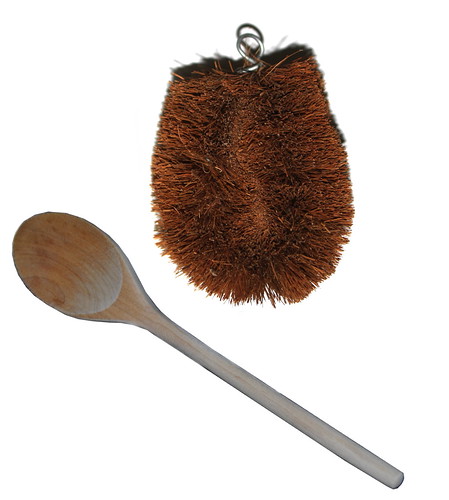
Tawashi are given as consolation or booby prizes (at least in the popular long-running Asahi Television program "Welcome Newly-weds,"新婚さんいらっしゃい) in the same manner as wooden spoons are given to losers in the UK.
Both the tawashi and the wooden spoon are the almost useless item, that everyone almost wants. A tawashi is the sort of item that, like a wooden spoon, one wants but one has, and there is little use in having more than one at home.
In accordance with the Nacalian theory presented by this blog, I suggest that that the wooden spoon is phallic whereas the tawashi may be yonic, and thus each may represent: the hidden but ubiquitous, wanted and yet unwanted, ambivalent part of Western and Japanese culture.
Look at the tawashi and the wooden spoon and tell me I am wrong.
Labels: culture, female, horror, japan, japanese culture, Jaques Lacan, Nacalian, nihonbunka, reversal, ジェンダー, 日本文化
FAIL Promote obligation rather than put your foot in the door
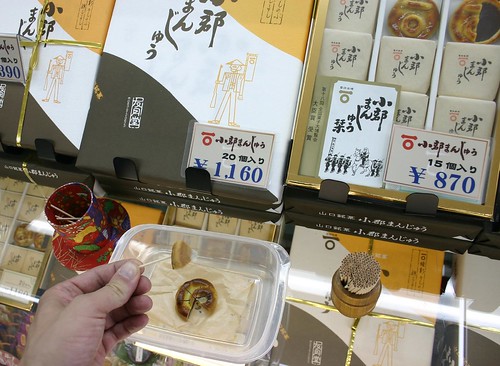
I realised too late that this experimenta was a FAIL - my fault - since the scale was reversed, with "1" meaning most applicable and 5 meaning least applicable. Hence the Japanese in fact believe that they purchase food after tasting it due to information they receive from tasting the food regarding its taste and freshness. It seems to me that this is not true, but that is what the data proved to be the subjects own perception. The following is therefore incorrect.
Many such souvenir shops and department stores allow the customers to taste the wares, from rice cakes to cured ham and sometimes wine. I think that if shops in the UK were similarly generous then the homeless, hungry and otherwise desiring would eat the proprietors into bankruptcy. But in Japan, the land of "giri" or "obligation," those that taste often feel obliged to buy. Indeed supermarkets often employ ladies to push sausage nibbles upon their customers safe in the knowledge that the latter would feel to obliged to stand their with their mouth open.
This year (2012) one of my seminar students investigated the uniquely Japanese (or at least non-Western) sales technique, to see if providing product samples is merely a tasting (providing information) or a way of improving seller-customer relationships and instilling an obligation (giri) to buy.
Higashiyama (2012) asked subjects (40 university students) to recall a time when they purchased something after having tasted it, and were ask to rate the reason for their purchase according to three categories
1) The needed or obtained information about the product.
2) They felt the shop assistant to be attractive.
3) They felt obligation (giri) towards the shop assistant as a result of being allowed to taste the product.
On a scale of 1 to 5, the results were as shown in the graph below.

Information Obligation Seller Attractiveness
It was found that both shop assistant attractiveness and obligation (giri 義理) were very significantly greater (p less than 0.001) than the importance of having gained information to the purchase decision.
This suggests, as argued by previous research, Japanese emphasise human relationships, especially exchange relationship, over product comparisons. This "sales by promoting obligation technique" is a new sales technique to go alongside "door in the face", and perhaps to replace "foot in the door" which may not work on Japanese because they may be less likely to want to maintain a self-consistently positive self concept.
Bibliography
Higashiyama, S. (2012) Title to be decided. Unpublished graduation thesis, Department of Tourism Policy, Faculty of Economics, Yamaguchi University.
Labels: japan, japanese culture, nihonbunka, 日本文化
The Japanese Today
There is considerable research to suggest that many East Asians, at least from Hong Kong (e.g. Morris and Peng, 1994 or Norasakkunkit and Uchida, 2011a for a review on Japan) are bi-cultural in that they retain Asian culture while having been influenced by Western culture.
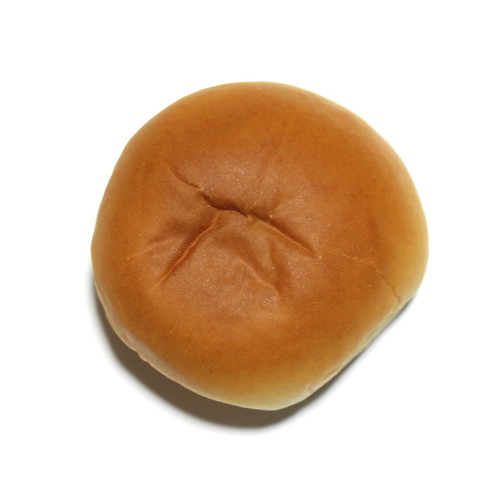
To my mind the Westernisation of the Japanese remains fairly superficial, in that while Japanese, especially young Japanese, now have bleached hair, double eyelids and avow Western values, such as autonomy and choice, they are "eggs", or my neoligism bean-bread-men: white on the outside but still thoroughly Japanese underneath.
An "egg," is a "racial slur" referring to a while male that has Japanised his heart partly in order to date Japanese women. In that sense I am attempting to be an egg. I am definitely white on the outside. I am not sure if I have succeeded 'yellowing' my heart.
The bean bread is made of an outsider layer of bread (often associated with Western society) coating a heart of sweet brown bean paste - a Japanese delicacy that is rather alien, not to say disgusting, to many Westerners. I love it. Like the egg, it is white on the outside, but the centre is the meaning, the truth, and raison d'etre of the brean bread bun.
I think to an extent many Japanese have become superficially Westernised, like bean bread buns. I do not see this as being a slur. The ability to incorporate, innovate, and create a hybrid - such as the bean bread bun - is famed facet of Japanese cultural evolution.
I worry though. It seems to me that bread and sweet bean paste don't mix. Furthermore it seems that some Japanese are becoming melon bread, a sort of soggy sweet bread with none of the important Japanese filling, or gumption, underneath.
In some important research by Norasakkunkit and Uchida (2011b) it was found that while non-marginalised Japanese youth in higher education showed the Japanese pattern of persevering more under critical conditions than under praise (Heine et al., 2001), the marginalised (NEET) youths needed -- like young Americans but possibly not as successfully American as young Americans -- needed to be praised.
The ability to take criticism, be grateful, be motivated and see criticism as a path to self improvement is perhaps the strongest and best part of the Japanese heart.
Bean bread buns - and bean bread men - banzai!
Heine, Steven J., et al. "Divergent consequences of success and failure in japan and north america: an investigation of self-improving motivations and malleable selves." Journal of personality and social psychology 81.4 (2001): 599.
Norasakkunkit, V., & Uchida, Y. (2011) Marginalized Japanese Youth in Post-Industrial Japan: Motivational Patterns, Self-Perceptions, and the Structural Foundations of Shifting Values.
Norasakkunkit, V., & Uchida, Y. (2011b). Psychological consequences of postindustrial anomie on self and motivation among Japanese youth. Journal of Social Issues, 67(4), 774-786.
Labels: japan, japanese culture, nihonbunka, westernisation, 日本文化
Monday, November 12, 2012
Sound Truck Armageddon
The Japanese do not identify with linguistic meaning -- which is just mere fluff (rikutsu, 理屈, herikutsu, 屁理屈 or "fart spiel") -- but with that which they can hear, see or imagine.
The people in this video are doing just that. A politician is driving through the streets of a Japanese town, blaring out his "message" beseeching the local inhabitants to vote for him. But he has no message. All he is saying is, "I am trying hard". "Thank you!" "Thank you!" And even though he is sound-polluting the air, even though he has nothing to say, in a very loud way, his supporter thanks him and expresses her support.
This politicians words are phatic; they mean almost nothing at all.
The politician has no policies, no message, nothing linguistic that might differentiate him from his competitors. The important thing, to his Japanese supporters is that he is out there on the streets, that he can be seen, heard, experienced there giving his all, till his voice runs horse. What kind of politician is this man? His supporters and detractors, his constituents, are not provided with anything, in words, that might help them choose this man over any other.
But the punters do not object (as I once objected, quite vehemently) to his sound pollution because the important thing is this, his act. He is demonstrating his concern. He is there for everyone to see and hear (but not linguistically understand). He demonstrates that his able and willing to shout till his voice is horse. He is thus a man who tries. Like pachinko players, this politician makes no choices, but he perseveres in spades. And it is the demonstrable fact that he perseveres that encourages his constituents vote for him.
Perseverance can been seen and imagined. Choices (or words that one says to oneself) can not.
And so we are invisible to each other. I say my spiel to my Japanese significant others but they do not hear. They are looking at my enthusiasm, posture, bushy tailed health-iness (genkiness). My theories are invisible and thus, to them, do not exist. I might as well be saying "Thank you, thank you, I will try hard," in the manner of this politician.
This attitude is identical to the way in which Westerners fail to see the self expression of Japanese. Generally in my experience Westerners commentators, and many Westernised Japanese, see Japanese politicians as "primitive".
There may come a time however that the Japanese come to think that, as I believe, this is just the way that Japanese politics is, due to a different view of the central message mode, and a different view of self. Where we Westerners feel the existence of self - in language, in politician speeches, and even in closed loop tape recordings - the Japanese see mere language. Where the Japanese see self, in people wearing head-bands proclaiming their gratitude, we see something "primitive" or nothing of significance at all. In this way, we are zombies to each other. This politician is fatuous, vacant, mindless to a Westerner. Western politicians with all their rhetoric can seem mindless, vacant to the Japanese. And this can lead to great misunderstanding and even war, to end all wars.
Labels: japanese culture, nihonbunka, reversal, 日本文化
Japanese Zen Buddhist Karesansui Gravel Garden
This video shows a beautiful Zen Buddhism influenced gravel or karesansui garden. I made a mistake in the video. This garden was not created by the famous artist adopted by this household but an earlier occupant some 300 years ago. Thus the design is as traditional as it gets and not in any way "arty" as I suggested. I have never seen a garden like this that has a rock resembling the crescent moon before, but I can appreciate how the feature could be very attractive especially when the cresent moon rises above the garden.
I argue -- and I don't think that I am being controversial or original -- that the heavily Sen influenced gravel gardens, by resembling landscapes (or even celestial bodies) far large than themselves, cause in the mind of the viewer a sort of optical illusion that encourages the viewer to see the scene neither as a garden, nor as the moon or inland see dotted with islands, but as it is in and of itself, as the visual field (Nishida), or the mirror of the sungoddess, the purity of experience (Nishida), completely bracketed (epoche', Husserl) from all interpretation. These gravel gardens therefore encourage a form of enlightenment.
Or perhaps watching a Japanese Gravel Garden is a bit like attending a Diwali festival. The following is from the wikipedia article on Diwali. "While Diwali is popularly known as the "festival of lights", the most significant spiritual meaning is "the awareness of the inner light". Central to Hindu philosophy is the assertion that there is something beyond the physical body and mind which is pure, infinite, and eternal, called the Atman.
Labels: japan, japanese culture, nature, nihonbunka, 日本文化, 自然
Thursday, November 08, 2012
The Face of Pachinko and the Illusion of Control by True-Grit

This series of films Pachipro Naniwa Ryouzanpaku 1-6 (1996-1998) stars Hiroyuki Watanabe playing the leader of a "professional" pachinko playing group. A gambling group by this name really existed. The name comes from a Chinese legend meaning a place where skilled, aficionado outlaws congregate. The Hole in the Wall meets Fu Man Chu.
Essentially all that Mr. Watanabe's character does is shoot little balls up into a hole. As you can see from his expression, however, Watanabe's character has true grit, guts, or balls, and can put them all out on the table and play to very last one.
The film series also builds on a group motif. The pachinko professionals fight as a team. I would not be surprised if those that are addicted to pachinko believe that they have the uncommon ability, uncommon konjo, to lay it all on the line for those they love, even as they waste their family finances pumping the pachinko machine.
The type of control that pachinko players hold the illusion of having, is almost as Morling (Morling, 2000; Morling & Epstein, 1997; Morling & Evered, 2006, 2007; Morling & Fiske, 1999) describes. Rather than actively changing their environment, the Japanese change or even rather negate the self, but throught doing so they wait out the storm and come through on the other side as, they delude themselves, winners.
I think that the Japanese may be engaging in true-grit-ism (konjoushugi, 根性主義; Yamagishi, 1979) a method of achieving external outcomes through self-control, rather than self-control for its own sake or harmony. No matter how much it may seem that Japanese aerobics is harmoniously self-controlling, it also achieves its stated environmental objective (Morling, 2000) of loosing weight. From the pachinko hall to the sumo stables (heya) and judo club (dojo) one can see Japanese engagining in collective self-denial, but I think that in all cases they have their eyes on the prize. Japanese self negation is not just collectivism, but a means to a personal end.
In any event, I hypothesise that gambling and problem gambling among Japanese will therefore correlate more with true-grit-ism (konjoushugi, 根性主義; Yamagishi, 1979) than illusions of (primary) control, for which scales exist (Moore & Ohtsuka, 1999; Raylu & Oei, 2004).
Possible Items for a True-Grit-ism(根性主義) scale taken from Yamagishi's paper (1979) above (English translations and some revision to the original Japanese are mine).
目標を速成するためには、禁欲すなわち己に克つことが最も大切である。
In order to achieve ones goals abstinence -- being able to achieve a victory over oneself -- is the most important thing.
目標を速成するためには、努力と精神力が大切である。
In order to achieve your goals, endurance and mental strenght are important.
忍耐と持続力、そして自己犠牲の精神があって、義務の遂行すれれば、目標を達成できる。
You will achieve your goals if you carry out your duties with endurance, the power to continue, and a spirit of self-sacrifice.
努力し、苦労すれば、幸福になることができる。
If you endure and toil you can achieve happiness.
幸福を得るためには、強い精神力が必要である。
In order to be happy you need to have a strong spirit.
持続性、つまり同じことを繰り返し行なうことにより人間形成がなされる。
One can grow as a person by persisting - doing the same thing over and over again. 自己犠牲の精神を発揮することにより人間形成がなされる。 One can grow a person through the application of the spirit of self-sacrifice.
精神力すなわち欲望を断ち切り己に克つことのできる力こそが大切なものである。
The most important strength to have is strength of sprit: the strenght to defeat ones desire, and achieve victory even over oneself.
精神力でオリンピックの金メダルを獲得することができる
You can win an olympic goald medal through strength of mind.
Under Langer's formulation those that have "an illusion of control" are those that suffer from the illusion that there is an easy way, a free lunch, a short cut to riches, that gamble. I suggest that in Japan it is precisely the opposite sort of people - those that believe that perseverence can get you anywhere - who end up in front of the pachinko machine. In that sense pachinko hits the best of us. I think that something should be done.
Bibliography
Heine, S. J. (2003). An exploration of cultural variation in self-enhancing and self-improving motivations. Nebraska symposium on motivation (Vol. 49, pp. 101–128). Retrieved from http://www2.psych.ubc.ca/~heine/docs/nebraska.rtf
Langer, E. J. (1975). The illusion of control. Journal of personality and social psychology, 32(2), 311. Retrieved from http://psycnet.apa.org/journals/psp/32/2/311/
Moore, S. M., & Ohtsuka, K. (1999). Beliefs about control over gambling among young people, and their relation to problem gambling. Psychology of Addictive Behaviors, 13(4), 339. Retrieved from http://psycnet.apa.org/journals/adb/13/4/339/
Morling, B. (2000). ‘Taking’ an Aerobics Class in the US and ‘Entering’ an Aerobics Class in Japan: Primary and Secondary Control in a Fitness Context. Asian Journal of Social Psychology, 3(1), 73–85.
Morling, B., & Epstein, S. (1997). Compromises produced by the dialectic between self-verification and self-enhancement. Journal of Personality and Social Psychology, 73(6), 1268.
Morling, B., & Evered, S. (2006). Secondary control reviewed and defined. Psychological Bulletin, 132(2), 269.
Morling, B., & Evered, S. (2007). The construct formerly known as secondary control: Reply to Skinner (2007).
Morling, B., & Fiske, S. T. (1999). Defining and measuring harmony control. Journal of Research in Personality, 33(4), 379–414.
Raylu, N., & Oei, T. P. S. (2004). The Gambling Related Cognitions Scale (GRCS): Development, confirmatory factor validation and psychometric properties. Addiction, 99(6), 757–769. Retrieved from http://onlinelibrary.wiley.com/doi/10.1111/j.1360-0443.2004.00753.x/full
Yamagishi, T. 山岸俊男. (1979). 根性主義-『おれについてこい!』 の内容分析. 一橋論叢, 81(2), 181–197. Retrieved from http://hermes-ir.lib.hit-u.ac.jp/rs/handle/10086/13228
The images are copyright their creators: "Pachipuro Naniwa Ryouzanpaku" (1996-1998) directed by Monna Katuso, starring Watabe HIroyuki, Ozawa Kazuyoshi, Yanagisawa Chou, Ishitsuka Hidehiko and Ishibashi Mamoru, based on a Manga by Hamada Fumio and Go Rikiya. Distributed by KSS 門奈克雄監督(1996-1998)『パチプロ浪花梁山泊(1-6)』。渡辺裕之、小沢和義、柳沢 超、石塚英彦、石橋 保 ほか主演。脚本(漫画)浜田 文太、 郷 力也 (1996)『パチプロ浪花梁山泊』。ケイエスエス
Labels: collectivism, individualism, japan, japanese culture, nihonbunka, 個人主義, 日本文化, 集団主義
Wednesday, November 07, 2012
The Effect of Social Support on Americans and Japanese

I like this paper and consider it relevant to those in the hospitality industry. When I first came to Japan, being a Westerner of low self-esteem, I did not like the way that Japanese hospitality providers would provide me with English language menus, forks or disposable chopsticks, since I felt that their kindness was saying, "you can't read Japanese," "you can't use ordinary chopsticks." I felt their kindness was an attack upon my self-esteem and independence. So, beware of helping Westerners. Some of them, are hinekureteiru or twisted.
At the same time, if the Japanese tendency to try to help prior to any demand (sasshi) is explained first, Japanese style hospitality, such as that provided by traditional inns (ryokan) providing luxury but choice-less food (kaiseki) with mothering helpers (nakai) can be a very rich cultural experience.
Bibliography
Uchida, Y., Kitayama, S., Mesquita, B., Reyes, J. A. S., & Morling, B. (2008). Is Perceived Emotional Support Beneficial? Well-Being and Health in Independent and Interdependent Cultures. Personality and Social Psychology Bulletin, 34(6), 741–754. doi:10.1177/0146167208315157 Retrieved from faculty.washington.edu/janleu/Courses/Cultural%20Psycholo...
Labels: care-givers, collectivism, individualism, japanese culture, nihonbunka, tourism, 個人主義, 日本文化, 集団主義
Sunday, November 04, 2012
The Chrysanthemum and the Bits of Wire
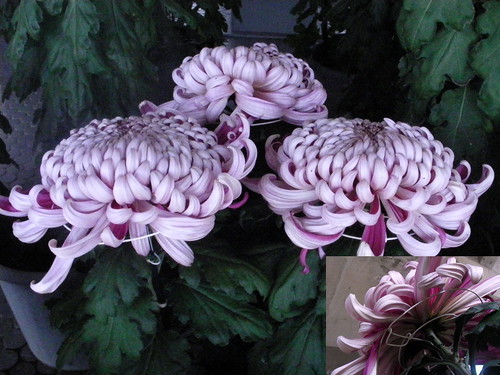
I argue that the Japanese are held in place not by the sword, or the bits of wire under these flowers, but by the beauty of the flowers on top. The Japanese love beauty, and desire to keep producing beautiful flowers, a beautiful people, and a beautiful country. It is in Japan as it is the USA. Society is held together by love, starting with self-love. It is just that visual beauty is of less importance than "good" narratives in the USA.
Benedict, R. (2006). The Chrysanthemum and the Sword (1st ed.). Mariner Books.
Lummis, D. (2007). Ruth Benedict’s Obituary for Japanese Culture. Japan Focus, 23. Retrieved from www.japanfocus.org/-C__Douglas-Lummis/2474
Labels: image, japan, japanese culture, nihonbunka, self, 日本文化
Cultures Amazing Consequences

It is so thick and so expensive that perhaps few people read Hofestede's incredibly famous "Culture's Consequences" (Hofsteded, 1980). This post is a repeat.
If you do read Culture's Consequences you will find that Hofestede's "Masculinity" factor, in which Japan came out way on top is defined in the same way as, and contains questionnaire items entirely applicable to Markus and Kitayama's (1991) Independent Self Construals, that is argued to be typical of Americans! E.g. "How important is it for you to work with people that cooperate well with one another?" or "How important is it for you to have a good working relationship with your manager?" are both items that correspond to femininity, that Japanese rated as being unimportant.
Markus and Hofesteded to agree however, that Independence is a masculine trait. Before she teamed up with Kitayama, Markus (Markus and Cross, 1990) wrote a very similar paper about the differences between men and women, even using most of the same data (such as Cousin's study) to support the assertion that there are two types of self construal, held by men and women. Personally I think that Markus is right on both counts, about the Japanese and about women. How could Hofstede get Japan so wrong? I guess it was because he was surveying Japanese IBM employees. Or is it because Japanese really are by far the most independent culture in the world?
In any event Hofsteded did a good job of spinning his surprising findings.
I admire all the people mentioned in this blog post.
Bibliography
Cousins, S. D. (1989). Culture and self-perception in Japan and the United States. Journal of Personality and Social Psychology, 56(1), 124.
Hofstede, G. (1980). Culture’s Consequences: Comparing Values, Behaviors, Institutions and Organizations Across Nations (2nd ed.). Sage Publications, Inc.
Markus, H. R., & Kitayama, S. (1991). Culture and the self: Implications for cognition, emotion, and motivation. Psychological Review; Psychological Review, 98(2), 224. Retrieved from www.biu.ac.il/PS/docs/diesendruck/2.pdf
Markus, H., & Cross, S. (1990). The interpersonal self.
Labels: collectivism, individualism, japan, japanese culture, self, 個人主義, 日本文化, 集団主義
Friday, November 02, 2012
Heejung Kim vs Japanese Architects and Designers

However, one of my favourite cultural psychologists, Hejung Kim (Kim and Markus, 1999; Kim and Sherman, 2008) had demonstrated that Asians Americans have less of a preference for unque figures than European Americans.
She had Asian and European americans evaluate the 9 parts of each of the digrams in the top of the above photo (Kim and Sherman, 2008, Kim and Markus, 1999) and found that the European Americans were more likely to choose the unique parts (M = 5.36, SD = 2.12) than the Asian Americans (Mean = 4.39, SD = 2.17).
Why is this? Were there in sufficient Japanese in the Asian sample? Or am I am I wrong; Harajuku fashionistas, and product innovators are not-represtentative of Japan.
I think that Japanese self presentation is not only visual, but as such, aesthetic. Just as Americans do not strive to be linguistically unique in naff ways, the Japanese don't choose clothes and products just because they are unique, but also because they look good. Conversely, American visual expressions (think of their bodies!) and Japanese linguistic expressions (think of traditional Japanese politicians) can be....less appealing.
The difference is in which media of self expression is important. Americans believe that appearance is skin deep. Japanese have negative words for language (rikutsu). Both Japanese and Americans admire uniqueness, but it is only in unimportant media of self expresion are people prepared to be naff to achieve uniqueness. The American preference for the sole isoceles triangle among the array of regular triangles in the diagram top left is just not aesthetic. It does not look nice and the Americans know it but they don't care about looks. The American preference for this irregular triangle is comparable to the anti-conformism found in Takano's experiment in Japan but not America. Japanese were prepared to give an incorrect (linguistic) answer in order to be unique, when all the confederates were saying the right answer, whereas Americans were not. The Japanese wanted uniqueness and did not care about being "right." In a medium that mattered to them, the Americans were not prepared to go that far.
I predict that Japanese will prefer the parts that are for instance at the top of the piramid, or centre of a pattern, or which hold an aesthetically privelidged position within the overall form. The Japanese may also demonstrate a preference for figures that are in harmony with the rest of the parts, since in Japan, being unique and yet in harmony are (from the philosophy of interdependence) not contradictory.
Indeed the people that we call unique, such as conductors, fashionistas, designers, and architects of know a lot about and produce a lot of things which demonstrate harmony.
I am going to repeat the experiment in my class and see which parts of the above diagrams the students prefer.
Bibliography
Heine, S.J., Takemoto, T., Moskalenko, S., Lasaleta, J., & Henrich, J. (2008). Mirrors in the head: Cultural variation in objective self-awareness. Personality and Social Psychology Bulletin, 34(7), 879–887. Retrieved from http://www2.psych.ubc.ca/~heine/docs/2008Mirrors.pdf
Heine, Steven J. (2007). Cultural Psychology (First ed.). W. W. Norton & Company.
Kim, H., & Markus, H. R. (1999). Deviance or uniqueness, harmony or conformity? A cultural analysis. Journal of Personality and Social Psychology, 77(4), 785. Retrieved from http://www.psych.ucsb.edu/labs/kim/Site/Publications_files/Kim%26Sherman08.pdf
Kim, H. S., & Sherman, D. K. (2008). What Do We See in a Tilted Square? A Validation of the Figure Independence Scale. Personality and Social Psychology Bulletin, 34(1), 47–60. doi:10.1177/0146167207309198 Retrieved from http://www.psych.ucsb.edu/labs/kim/Site/Publications_files/Kim%26Sherman08.pdf
Leuers, T., & Sonoda, N. (1999). The eye of the other and the independent self of the Japanese. Symposium presentation at the 3rd Conference of the Asian Association of Social Psychology, Taipei, Taiwan. Retrieved from http://nihonbunka.com/docs/aasp99.htm
Labels: collectivism, culture, individualism, japan, japanese culture, Nacalian, nihonbunka, 個人主義, 日本文化, 集団主義
Wednesday, October 31, 2012
Zombies to Each Other
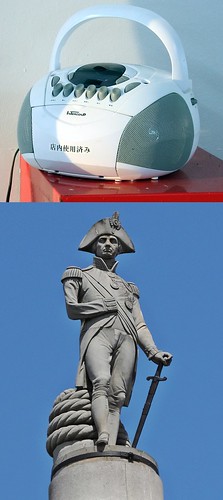
I believe in the possibility of a zombie apocalypse and wish to prevent it. I believe that zombies are, or at least appear to be, evil. I believe zombies come in at least two varieties, and that there are cultures that are zombies to each other.
What are zombies, apart from bad? Zombies are people that are mindless.
As the great (as yet untranslated) work by Nakajima argues, the Japanese are, from a Western, Kantian, point of mindless. The Japanese walk through retail establishments, and bullet trains, and streets almost ignoring the linguistic public announcements, and endless linguistic tape recordings, as if there is nothing worthy of their attention. Language, the holy logos, is just background noise. Further as Kim demonstrates, in her mind blowing paper, language does not improve, but actually gets in the way of East Asian thinking. This is because East Asians or at least Japanese lack the linguistic other, the third person perspective on self that would allow them to linguistically reflect upon their actions (Mori, 1999).
On the other hand, as Masuda and Nisbett (2006) demonstrate demonstrate, Western are zombies in that they are comparatively unaware of what there is to be seen. Westerners only focus upon, only cognise, only notice the central aspects of our environment, because, in my opinion, we focus on those aspects that we can linguistically describe. Further, westerners lack the power to "hansei" or literally reflect because they lack the visual other, the third person perspective on self (Heine, et al. 2008).
From a Western point of view, the Japanese are zombies. They are so caught up in the environment that they hardly notice announcements such as the endless loop tape player pictured above (top), and not feel that these voices are animate, that they are being spoken to.
From a Japanese point of view Westerners are zombies. We, Westerners are so caught up as we are by our (linguistic) thoughts, we do not notice the changes that are going on around us. We do not even notice that gorillas are in our midst (Simons & Chabris, 1999). We can put statues all around our towns and cities, and not feel these statues are animate, or that we are being watched (above bottom).
We are zombies to each other. To the Japanese, the voice is fluff and not the voice of conscience. On the other hand, to Westerners the image is "mere image," and not the mirror of heart (c.f. Chamberlain, 1982, Preface).
I guess therefore that there may eventually be another war between the Japanese and Westerners. I hope that that war is carried out as far as possible in art and literature rather than in physical violence. As Zombie comedy shows, zombies need not be felt to be evil but just wacky and amusing.
Bibliography
Chamberlain, B.H. (1982 [1919]) The Kojiki: Records of Ancient Matters. Tuttle Publishing, Retrieved, 2016/2/11 from http://www.sacred-texts.com/shi/kj/kj007.htm
Heine, S. J., Takemoto, T., Moskalenko, S., Lasaleta, J., & Henrich, J. (2008). Mirrors in the head: Cultural variation in objective self-awareness. Personality and Social Psychology Bulletin, 34(7), 879-887.
Kim, H. S. (2002). We talk, therefore we think? A cultural analysis of the effect of talking on thinking. Journal of personality and social psychology, 83(4), 828.
Masuda, T. & Nisbett, R. E. (2006). Culture and change blindness. Cognitive Sciences, 30, 381-399. Retrieved, on 2012/10/31 from csjarchive.cogsci.rpi.edu/2006v30/2/s15516709HCOG0000_63/...
Mori, A. 森有正. (1999). 森有正エッセー集成〈5〉. 筑摩書房.
Nakashima, Y. 中島, 義道. (1999). うるさい日本の私. 新潮社.
Nakashima, Y. 中島, 義道. (1997). 「対話」のない社会―思いやりと優しさが圧殺するもの. PHP研究所.
Simons, D. J., & Chabris, C. F. (1999). Gorillas in our midst: Sustained inattentional blindness for dynamic events. Perception, 28, 1059–1074. Retrieved, on 2012/10/31 from www.wjh.harvard.edu/~cfc/Simons1999.pdf
Labels: japan, japanese culture, Nacalian, 日本文化
Monday, October 29, 2012
The Mirror of the Japanese is not the Gaze of others
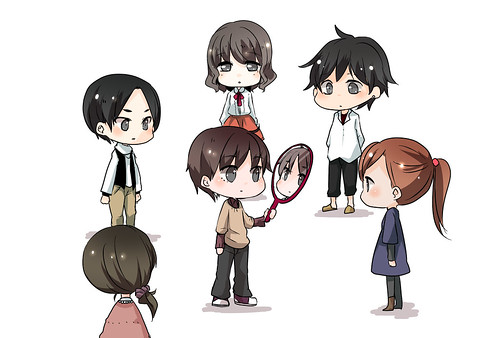
Indeed some research shows that looking at oneself in a mirror produces exactly the opposite effect as being looked at by others. Being looked at by others encourages people to conform to other's expectations. Looking at a mirror generally encourages people to conform to their own internal standards.
There is some research however, that has shown mirrors to increase private self awareness, and at least one paper that has argued that mirrors increase conformance.
So bearing in mind that Japanese are largely unaffected by mirrors (Heine et al, 2008), what does this suggest?
1) That as in the minority of experiments that show mirror's increase public self awareness, and increasing conformance (Diener & Srull, 1979; Govern & Marsch, 1997; Plant & Ryan, 2006; Wheeler, Morrison, DeMarree, & Petty, 2008; Wiekens & Stapel, 2008; Zanna, 1990) the mirror that they are mentally simulating is "the eyes of the world" (seken no me 世間の目). This is quite likely, and I predict in part true. Mirrors are found to increase both public AND private self awareness, so it seems likely that the mental mirror of the Japanese has both of these effects. The "Interdependent self" (Markus and Kitayama, 1991) of the Japanese is not an absense of self but a self that is both aware of itself, and aware of the impact of others upon itself. The dual influence of the Japanese mental mirror would explain the two aspects of the Japanese self.
2) Even if it were the case that the mental mirror of the Japanese is increase private self awareness there is research to suggest that Private self awareness is not a unitary phenomenon (Grant, Franklin, & Langford, 2002; Mittal & Balasubramanian, 1987; Trapnell & Campbell, 1999) but instead
2.1) motivated in different ways by curiosity (leading to self reflection) and a automatic, morbid desire to see the self (rumination)(Trapnell & Campbell, 1999).
2.2) It is also argued that Private self awareness has a motivational and cognitive aspect: on the one hand is an awareness of internal self states and attitudes, and on the other it is the desire to reflect upon the self(Grant, Franklin, & Langford, 2002).
It may be that the Japanese are high in the second ruminatory, motivational element of private self-awareness which is not coupled by an increase in self-cognition, as Ma-Kellams recent research tends to suggest.
3) The Japanese have a different type of independent self, that sees itself from the positition of a super-addressee, Other or God (known in Japan as Amaterasu the sungoddess) visually, with an aesthetic rather than logical impartiality ([Adam]Smith).
Whatever way you cut it however, seeing oneself in a mirror is different from being seen by an audience. In order to unpack this distinction, I claim it will be necessary to reject the argument that the Japanese are "collectivists" in the sense of being socially dependent, since the mirror that the Japanese carry with them also provides a impartial, objective, viewpoint because it is a "riken no ken," a view of self not from that of others, but from a self away from self.
The excellent, for my purposes, image is original artwork by Ms. Miho Fujimura.
Bibliography
Aaker, J. L. (2000). Accessibility Or Diagnosticity? Disentangling the Influence of Culture on Persuasion Processes and Attitudes. Journal of Consumer Research, 26(4), 340–357. doi:10.1086/209567
Brockner, J., Hjelle, L., & Plant, R. W. (1985). Self-focused attention, self-esteem, and the experience of state depression. Journal of personality, 53(3), 425–434.
Carver, C. S. (1975). Physical aggression as a function of objective self-awareness and attitudes toward punishment. Journal of Experimental Social Psychology, 11(6), 510–519. Retrieved from www.sciencedirect.com/science/article/pii/0022103175900025
Carver, Charles S. (1977). Self-awareness, perception of threat, and the expression of reactance through attitude change. Journal of Personality, 45(4), 501–512. doi:10.1111/j.1467-6494.1977.tb00167.x
Carver, Charles S., & Scheier, M. F. (1981). Self-Consciousness and Reactance. Journal of Research in Personality, 15(1), 16–29. Retrieved from www.eric.ed.gov/ERICWebPortal/detail?accno=EJ248215
Carver, Charles S., & Scheier, M. F. (2001). On the Self-Regulation of Behavior. Cambridge University Press.
Davies, M. F. (1982). Self-focused attention and belief perseverance. Journal of Experimental Social Psychology, 18(6), 595–605. doi:10.1016/0022-1031(82)90075-0
Diener, E., & Srull, T. K. (1979). Self-awareness, psychological perspective, and self-reinforcement in relation to personal and social standards. Journal of Personality and Social Psychology, 37(3), 413–423. doi:10.1037/0022-3514.37.3.413
Dijksterhuis, A., & Bargh, J. A. (2001). The perception-behavior expressway: Automatic effects of social perception on social behavior. Advances in experimental social psychology, 33, 1–40. Retrieved from www.sciencedirect.com/science/article/pii/S0065260101800034
Dijksterhuis, A. P., & Knippenberg, A. V. (2000). Behavioral indecision: Effects of self-focus on automatic behavoir. Social Cognition, 18(1), 55–74. Retrieved from search.proquest.com/docview/229595405/abstract/139CDA6646...
Fejfar, M. C., & Hoyle, R. H. (2000). Effect of Private Self-Awareness on Negative Affect and Self-Referent Attribution: A Quantitative Review. Personality and Social Psychology Review, 4(2), 132–142. doi:10.1207/S15327957PSPR0402_02
Froming, W. J., Walker, G. R., & Lopyan, K. J. (1982). Public and private self-awareness: When personal attitudes conflict with societal expectations. Journal of Experimental Social Psychology, 18(5), 476–487. Retrieved from www.sciencedirect.com/science/article/pii/0022103182900671
Froming, William J., & Carver, C. S. (1981). Divergent Influences of Private and Public Self-Consciousness in a Compliance Paradigm. Journal of Research in Personality, 15(2), 159–71. Retrieved from webcache.googleusercontent.com/search?q=cache:PueNQmlstsI...
Gibbons, F. X. (1978). Sexual standards and reactions to pornography: Enhancing behavioral consistency through self-focused attention. Journal of Personality and Social Psychology, 36(9), 976. Retrieved from psycnet.apa.org/journals/psp/36/9/976/
Gibbons, Frederick X., Carver, C. S., Scheier, M. F., & Hormuth, S. E. (1979). Self-focused attention and the placebo effect: Fooling some of the people some of the time. Journal of Experimental Social Psychology, 15(3), 263–274. doi:10.1016/0022-1031(79)90037-4
Gibbons, Frederick X., & Gaeddert, W. P. (1984). Focus of attention and placebo utility. Journal of Experimental Social Psychology, 20(2), 159–176. doi:10.1016/0022-1031(84)90018-0
Goukens, C., Dewitte, S., & Warlop, L. (2007). Me, myself, and my choices: The influence of private self-awareness on preference-behavior consistency. Available at SSRN 1094748. Retrieved from papers.ssrn.com/sol3/papers.cfm?abstract_id=1094748
Govern, J. M., & Marsch, L. A. (1997). Inducing Positive Mood Without Demand Characteristics. Psychological Reports, 81(3), 1027–1034. doi:10.2466/pr0.1997.81.3.1027
Heine, S. J., Takemoto, T., Moskalenko, S., Lasaleta, J., & Henrich, J. (2008). Mirrors in the head: Cultural variation in objective self-awareness. Personality and Social Psychology Bulletin, 34(7), 879–887. Retrieved from www2.psych.ubc.ca/~henrich/Website/Papers/Mirrors-pspb4%5...
Hormuth, S. E. (1982). Self-awareness and drive theory: Comparing internal standards and dominant responses. European Journal of Social Psychology, 12(1), 31–45. doi:10.1002/ejsp.2420120103
Hormuth, S. E. (1991). The Ecology of the Self: Relocation and Self-Concept Change. Cambridge University Press.
Macrae, C. N., Bodenhausen, G. V., & Milne, A. B. (1998). Saying no to unwanted thoughts: self-focus and the regulation of mental life. Journal of personality and social psychology, 74(3), 578–589.
Plant, R. W., & Ryan, R. M. (2006). Intrinsic motivation and the effects of self-consciousness, self-awareness, and ego-involvement: An investigation of internally controlling styles. Journal of Personality, 53(3), 435–449. Retrieved from onlinelibrary.wiley.com/doi/10.1111/j.1467-6494.1985.tb00...
Porterfield, A. L., Mayer, F. S., Dougherty, K. G., Kredich, K. E., Kronberg, M. M., Marsee, K. M., & Okazaki, Y. (1988). Private self-consciousness, canned laughter, and responses to humorous stimuli. Journal of Research in Personality, 22(4), 409–423. doi:10.1016/0092-6566(88)90001-3
Scheier, M. F., & Carver, C. S. (1980). Private and public self-attention, resistance to change, and dissonance reduction. Journal of Personality and Social Psychology, 39(3), 390. Retrieved from psycnet.apa.org/journals/psp/39/3/390/
Scheier, M. F., Carver, C. S., & Gibbons, F. X. (1979). Self-directed attention, awareness of bodily states, and suggestibility. Journal of Personality and Social Psychology, 37(9), 1576. Retrieved from psycnet.apa.org/psycinfo/1981-01346-001
Scheier, Michael F. (1976). Self-awareness, self-consciousness, and angry aggression. Journal of Personality, 44(4), 627–644. doi:10.1111/j.1467-6494.1976.tb00142.x
Scheier, Michael F., Carver, C. S., & Gibbons, F. X. (1981). Self-focused attention and reactions to fear. Journal of Research in Personality, 15(1), 1–15. doi:10.1016/0092-6566(81)90002-7
Sedikides, C. (1992). Attentional effects on mood are moderated by chronic self-conception valence. Personality and Social Psychology Bulletin, 18(5), 580–584. Retrieved from psp.sagepub.com/content/18/5/580.short
Spengler, S., Brass, M., Kühn, S., & Schutz-Bosbach, S. (2010). Minimizing motor mimicry by myself: self-focus enhances online action-control mechanisms during motor contagion. Consciousness and cognition, 19(1), 98–106. Retrieved from biblio.ugent.be/publication/1030838/file/1090307.pdf
Turco, R. M. (1996). Self-referencing, quality of argument, and persuasion. Current Psychology, 15(3), 258–276. Retrieved from www.springerlink.com/index/G43442LN62813201.pdf
Unconscious Facial Reactions to Emotional Facial Expressions. (n.d.). Retrieved October 16, 2012, from pss.sagepub.com/content/11/1/86.full.pdf+html
Wheeler, S. C., Morrison, K. R., DeMarree, K. G., & Petty, R. E. (2008). Does self-consciousness increase or decrease priming effects? It depends. Journal of Experimental Social Psychology, 44(3), 882–889. doi:10.1016/j.jesp.2007.09.002
Wiekens, C. J., & Stapel, D. A. (2008). The Mirror and I: When private opinions are in conflict with public norms. Journal of Experimental Social Psychology, 44(4), 1160–1166. doi:10.1016/j.jesp.2008.02.005
Zanna, M. P. (1990). Advances in Experimental Social Psychology. Academic Press.
Grant, A. M., Franklin, J., & Langford, P. (2002). The self-reflection and insight scale: A new measure of private self-consciousness. Social Behavior and Personality: an international journal, 30(8), 821–835. Retrieved from www.ingentaconnect.com/content/sbp/sbp/2002/00000030/0000...
Mittal, B., & Balasubramanian, S. K. (1987). Testing the dimensionality of the self-consciousness scales. Journal of Personality Assessment, 51(1), 53–68. Retrieved from www.tandfonline.com/doi/abs/10.1207/s15327752jpa5101_5
Trapnell, P. D., & Campbell, J. D. (1999). Private self-consciousness and the five-factor model of personality: distinguishing rumination from reflection. Journal of personality and social psychology, 76(2), 284. Retrieved from psycnet.apa.org/journals/psp/76/2/284/
Labels: eye, japan, japanese culture, mirror, Nacalian, nihonbunka, occularcentrism, reversal, 個人主義, 日本文化, 神道
Two Ways of Seeing a Mirror

The Japanese are found to be unaffected by mirrors (Heine, et al. 2008).
Social psychologists such as Dov Cohen, and Steven Heine, would, or do argue that mirrors are, for the Japanese who seem to have them in their heads, like the boy sees in them, a personification, internalistion of the other. In other words, mirrors can be understood to Japanese raise public self awareness. I argue that the mirror that the Japanese have in their heads is more like that of the girl in this comic.
The mirrors that Japanese do not need, and are are not influenced by, because they have intra-psychically simulated them to the piont that they have a mirror in their head, enables themselves to see themselves from their own point of view.
In other words, Japanese mental mirrors raise private self awareness and the Japanese are in a permanent state of high private self-awareness. This means, I predict that the same Japanese that are unaffected by mirrors are likely to conform less and be more aware of who they themselves are, two behaviour traits which are very inappropriate for collectivists.
Bibliography
Cohen, D., Hoshino-Browne, E., & Leung, A. K. (2007). Culture and the structure of personal experience: Insider and outsider phenomenologies of the self and social world. Advances in experimental social psychology, 39, 1–67.
Heine, S. J., Takemoto, T., Moskalenko, S., Lasaleta, J., & Henrich, J. (2008). Mirrors in the head: Cultural variation in objective self-awareness. Personality and Social Psychology Bulletin, 34(7), 879–887. Retrieved from www2.psych.ubc.ca/~henrich/Website/Papers/Mirrors-pspb4%5...
Labels: collectivism, individualism, japan, japanese culture, mirror, Nacalian, nihonbunka, occularcentrism, 個人主義, 日本文化, 集団主義
Sunday, October 28, 2012
Japanese Aquisitions and Masaki Yuki's Research


I guess that it will depend upon the industry. In manufacturing and hard (as in hardware) industries the Japanese will bring with them praxis that is successful and will be respected by their Western workforce. But in industries whose products are formal (read linguistic) constructions, such as finance, (non-game) software and to a significant extent, advertising, importing Japanese workways may be more fraught.
If the Japanese managers read up on the cultural differences between Westerners and Japanese they may be persuaded that their new British employees need to be taught to be more harmonious, to work better in teams. If they reach this conclusion then I think that they will have been, in my humble opinion, misguided.
I want to recommend to the management at Dentsu the only mainstream research that espouses a qualitative rather than quantitative difference between Western and Japanese ways of thinking: the excellent research by Masaki Yuki (2003).
For the most part Japanese are argued to be more sensitive to the group (Hofsteded, 1991) or more sensitive to context and more information (the varied and also excellent research of Nisbett and Masuda). The mainstream rhetoric regarding the differences between Western and Japanese culture, is quantitative: one of more rather than less.
Masaki Yuki however, argued that the difference between Japanese and Western social behaviour is a qualitative one. Westerners are not more individual or more collective but they interact with groups in different ways to Westerners. Indeed in their group behaviour, it is Westerners that are more inclined to loose their individuality since they identify with their groups, differentiating ingroup (e.g. my company) from outgroup (e.g. competitor company). Japanese on the other hand, in their group behaviour, pay little attention to other groups (other companies) but instead focus on the relationships with other ingroup members, and indeed upon the individuality of other ingroup members. The Japanese managers might therefore even encourage their new British employees to be more individual, to give each other more room for creative freedom and being themselves, as -- according to Yuki's theory -- occurs within Japanese groups.
Masaki Yuki (2003) argues that while Westerner groups have a tendency to focus upon shared group traits and ideals, and identifying with these lose a sense of who they are as individuals, Japanese groups have a tendency to focus upon the symbioses within the group: the fact that the group is made up of a network of many different individuals with different traits and skills.
Jacques Lacan argued that if one *imagines* ones interpersonal relationships then one *see* them as diadic, one-to-one, interpersonal relationships. What he failed to realised - or implicitly rejected - is that one can visualise a group as a whole, as a network, since he believed that it is only in language that one can simulate generalised third person viewpoint (ear-point, superaddressee, impartial auditor) or in his terminology, the "Other". Can one imagine a group? Sure one can, especially if one takes group photographs, as was recommended by recent research on the promotion of group efficiency.
Back in 2003, when I was still almost a researcher, Professor Yuki had me make English correction suggestions on his paper. I was honoured and excited. I recommended to him the connection with Lacan's theory of "diadic relationships" in the imaginaire (world of imaginable representations) but, of course, he did not take it up. Indeed, perhaps due to the extremely controversial nature of his paper, he has undertaken relatively little research in that paper's direction, despite the fact that it was great.
Bibliography
Yuki, M. (2003). Intergroup comparison versus intragroup relationships: A cross-cultural examination of social identity theory in North American and East Asian cultural contexts. Social Psychology Quarterly, 166–183.
Labels: individualism, japan, japanese culture, Nacalian, nihonbunka, 個人主義, 日本文化, 集団主義
This blog represents the opinions of the author, Timothy Takemoto, and not the opinions of his employer.