
Tuesday, February 07, 2012
Varieties of Kamen Rider Forze
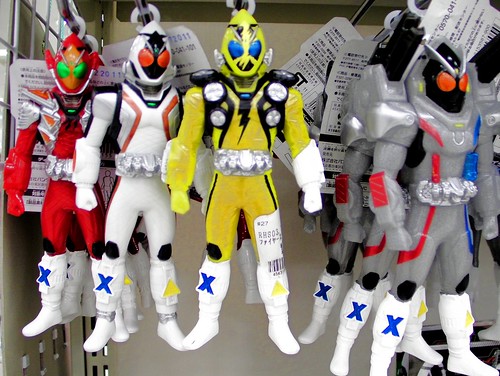
I am in the process of doing an experiment to find out who is more individualistic, the Japanese Superman or the Japanese Clark Kent. In the West it seems that the post-transformational Super form of superheroes is more individualistic than their "alter ego." In Japan on the other hand, folks like Hino Eii, Philip and the Elvis Hairstyled high school student who transform into Masked Riders are individualistic to the point of being weird. Super sentai too, cooperate more in the heroic rather than pre-transitonal (hennshin mae ) form. To understand the situation in Japan, imagine if Clark Kent, Bruce Banner, were really eccentric and that Superman and the Hulk were really square..
But on the other hand, Japanese superheros tend to have a variety of forms or modes, such as the various super forms of "Kamen Rider Forze" as depicted above. In Japan they are all different, but they are all perhaps more upstandingly harmonious than their "yankee" alter-ego. Imagine if Bruce Banner could transform in any of a Green, Red, Yellow and White Hulk, and all these Hulks were square.
Labels: collectivism, individualism, Masked Riders, nihonbunka, Super-Sentai, superhero, スパー戦隊, 仮面ライダー, 個人主義, 日本文化, 欧米化, 集団主義


Valentine's Chocolate at the End of the World
Izanami, the primal female at the beginning of the Japanese creation myth, said to Izanagi, her future spouse, "you are an attractive guy" before they mated and this caused her to give birth to a spineless individual, and required that they repeat their courtship. It was only when dude Izanagi made the first move did creation -- their birthing of the islands of Japan -- go as to plan.
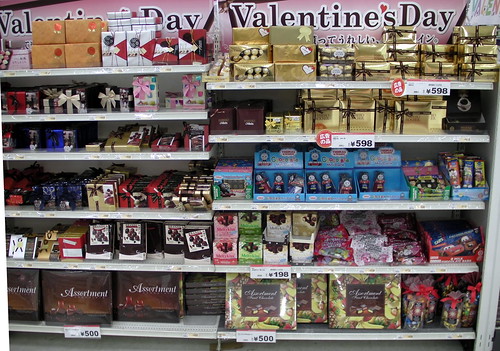
Even today in Japan, women are not meant to make the first move, or express desire of any sort, except on one day of the year, the topsy turvey liminal festival of Valentines Day, when it is traditoinal that women give chocolates to the men they like, and the those they want to get things from.
If the Japanese creation myth is to be believed, one must worry about the fruit of such unions, especially in the face of increasing numbers of "herbivourous," Japanese males. Japan may have fallen into a negative feedback spiral where there are not enough red-blooded males to approach the ladies, and approaches in opposite direction (gyaku-nan, reverse chat-up) have "spineless" result. Creation is unravelling.
Labels: horror, nihobunka, nihonbunka, reversal, Shinto, taboo, 日本文化, 神道
Conflicted Attitudes towards "Violent Groups"

The seperation between honne (what people really think) and tatemae (the front that one shows others) is something that I find very difficult to cope with, or even to know which is which. Do the Japanese really want to get rid of violent groups, or do they just want to make a show of doings so?
"Violent Groups" are legal and registered in Japan. And yet their members are portrayed as animals in the rather shocking poster above. Perhaps the police feel that they can get away with this portrayal because they have represented themselves as the Puffer Fish bottom right? In any event, the police legally register violent gang members and then berate them as being like pigs and baboons. Call me old fashioned, or English, but this does not seem fair.
The poster says No! to violent groups, reporting the fact that there are now laws against doing business with them. Now the public must be scared of the groups and the law.
Labels: honne, japanese culture, nihonbunka, tatemae, 建前, 日本文化, 本音, 欧米化
Saturday, February 04, 2012
The Spirit of Poverty 貧乏神

The Spirit of Poverty is a Japanese diety that, though she tries to help, brings poverty upon those around her. She is generally represented as an old woman but, people may be called a "spirit of poverty" if they are thought to bring bad luck to those around them.
The fall of the Nikkei Stock Index almost conicides with my arrival in Japan. I came just before the bubble burst, when Japan was the land of milk and honey. Twenty some years later people are still wondering what went wrong.
My own theory is that the Japanese lost their way due to their incessant importantion of things Western; they became too Westernized for their own good. If I were clever, or a ponce - I try - I'd say they went the way of the Subaltern.
Put simply the trouble is, it seems to me, that they did not only import Western technology, but also Western ways of thinking which weaken their own. I think that they need to throw the Western, logo-centric, individualistic, moralistic, feel-good, idealism out of their houses, and shake the dust off their feet, but then I may be a bimbogami.
What appears to be sure is that something is ailing the Japanese economic spirit and something needs to be done about it.
Image copyright Yahoo Finance.
Labels: nihobunka, nihonbunka, 日本文化
Martial and Manga Artists
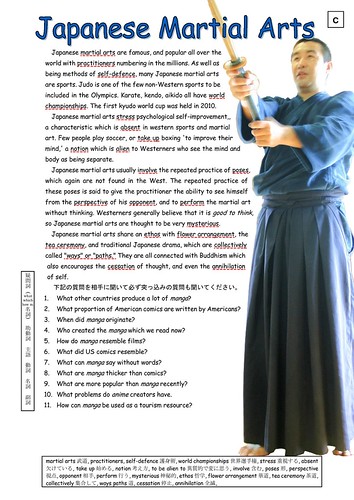
The image is the partner page to the previous Anime and Manga page, which together form an information gap activity.
They are both rather too highbrow for an English conversation class but the course is on "Tourism English" and my part of the course is on explaining Japanese culture.
The explanation is my theory of Japanese culture - that both manga artists, martial artists and all Japanese have 'mirrors in their heads,' a theory which originates in the teaching of the Kurozumi church, my analysis of Japanese mythology, and Japanese common sense. Can you see yourself? Can you draw the room in which now sit from a perspective in the top corner of the room? If you got into a fight would you be able to see yourself from the point of view of your opponent?
The text reads as follows:
Japanese martial arts are famous, and popular all over the world with practitioners numbering in the millions. As well as being methods of self-defence, many Japanese martial arts are sports. Judo is one of the few non-Western sports to be included in the Olympics. Karate, kendo, aikido all have world championships. The first kyudo world cup was held in 2010.
Japanese martial arts stress psychological self-improvement,, a characteristic which is absent in western sports and martial arts. Few people play soccer, or take up boxing to improve their mind - a notion which is alien to Westerners who see the mind and body as being separate.
Japanese martial arts usually involve the repeated practice of poses, which are also not found in the West. The repeated practice of these poses is said to give the practitioner the ability to see himself from the perspective of his opponent, and to perform the martial art without thinking. Westerners generally believe that it is good to think, so Japanese martial arts are thought to be rather mysterious.
Japanese martial arts share an ethos with flower arrangement, the tea ceremony, and traditional Japanese drama, which are collectively called "ways" or "paths." They are all connected with Buddhism which also encourages the cessation of thought, and even the annihilation of self.
Labels: japan, japanese culture, Jaques Lacan, lacan, logos, manga, martial art, occularcentrism, religion, reversal, self, specular
Wednesday, February 01, 2012
Japanese Tourism as Being seen in front of places with a Name

Urry's epic "The Tourist Gaze" has just been republished in this third edition. He is right to point out that there is a strong connection between tourism and the gaze but (at least in the first edition) he largely assumes that the gaze is directed outward, that tourism resource providers are in the business of proving sights for people to gaze upon. And this may be so in the West.
Lacan argues that the self is the crossroads between language and the imaginary, the image and word and that Westerners are healthy when they are more strongly identified with their words. I turn this on its head and argue that the Japanese are permanently in the mirror stage (or that conversely they pass through a linguistic/symbolic stage).
For someone with ego as self-narrative the image is the other, the not-self, mere image, the uncertain, a distraction. The Western tourists gazes upon the sights and allows himself respite from self narration.
To the Japanese however, the image is the self and it is rather symhbols, lanuage, names, and narratives that are titilatly other. Hence, as Hudson points out in "The Ruins of Identity" since Matso Basho and well before Matsuo Basho, Japanese peopel like to go to famous places, places with a story and direct their gaze, and the gaze of others, at themselves, at their feelings in the place. Matuso Basho travelled up to the North of Japan to be beside a rock commemorating the ruins of a castle, and wrote a poem recording his overwhelming sense of history and his tears.
At that time, a haiku was as near as capturing an image as could be achieved, but had Basho had a camera, then perhaps he would have taken a photo, as Japanese tourists are known to do, like that in the bottom right hand side of the photo. This is of a Japanese gentleman visiting one of the "Three Great Disappontments" among Japanese sightseeing spots: Harimaya Bridge. There are many places with a name (meisho) and many "Three great XYZ," spots, including the three best places to visit Cherry Blossom, and even the three places that most disappoint. Hirune, the gentleman in the picture has had himself pictured looking disappointed. The point is not view, nor the viewing, but to be viewed in famous place with a name. Japanese Tourism is about being seen in front of places with a name.
Western tourists like to be named in front of a sight but I will leave a discussion of the differences between postcards and Haiku for another occosion.
Bottom right: Being disappointed in front of the most disappointing of the three great disappointments of Japanese sights by Hirune.Book covers copyright their respective publishers. Taga Castle commemorative stone photo from Wikipedia.
Labels: japanese culture, Jaques Lacan, logos, mirror, nihobunka, nihonbunka, reversal, self, specular, 日本文化
Western Style Groupism in Japan
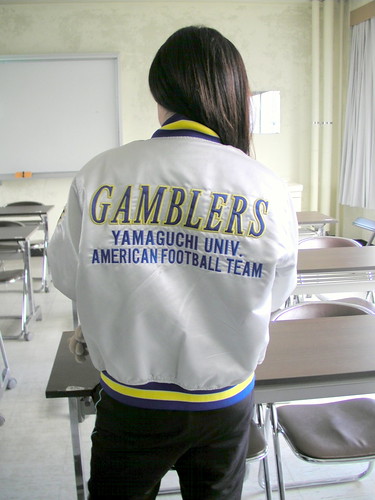
It is very rare to find a Japanese student with a sweatshirt like this.
Americans have a lot of these, where as Japanese university students generally have hardly any University sweats and if they do they are more likely to have a sweat shirt advertising another (often American) university rather than their own. Americans on the other hand have on average about 6 sweatshirts proclaiming the name of their own university and are not ashamed to wear them around campus and especially to varsity (am I using this word correctly) 'football' matches where the crowd appears to be full of clones, all in the same coloured sweat shirts. Despite this fact, there is still a common misperception that it is the Japanese that are conformists. Yuuki Masaki (2003)
Labels: japan, japanese culture, nihobunka, nihonbunka, 日本文化
Friday, December 30, 2011
Derrida,Différance,Oedipus, Ajase and Japanese Re-collection

All sorts of people from Plato to Mead and beyond, have pointed out that self-speech is important to the Western self. Then Derrida came along and derided (his pun) our experience of "hearing ourselves speak." Why do we do it? What could we ever tell ourselves that we do not already know? One needs a difference for communication to take place, so how can self-speach make any sense?
Derrida noted that self-speech makes sense in the form of a memo. "Buy eggs." We can write memos, and postcards, to ourselves in the future. And that is he said what we are always doing, as we listen to ourselves speak, we are differing, putting something off, waiting for something. To coin Roy orbison, in différance I talk to me.
Crossing Derrida with Lacan and the Oedipus complex, the birth of the self in the Oedipus complex takes place as a promise, or defferal. We realise that we will not get mother, that she sleeps elsewhere, but we enter the Oedipus waiting room because we are promised love in the future.
From the Japanese point of view the Western family is a bit like fagging. Adult men brutalise their children, making them sleep alone, but the children stop crying, and learn to love big daddy and the system, because they are promised that they can do the same in future.
The Japanese are doing something similar in reverse. They sleep with the children in between mother and father. Japanese men sleep in this way because that is how they grew up. There is a great nostalgia, a collective recollection going on in Japan. They are promised nothing but recollect everything.
And, as mentioned in recent posts on combining toys, the Japanese re-collect themselves. They create themselves out of the scrap book of images, in mirrors, in photos, in other people's eyes. And when they do so, just as we can only speak to ourselves in différance, a self-image brought to mind is always a re-collection of oneself in the past.
And hence all the nostalgia in Japan, as treated in other posts (Retro Confectionery, Nostalgia).
Left, the cover of Keikgo Okonogi's "Edipusu to Ajase" (Oedipus and Ajase)
Top right Derrida by speedypete312
Labels: culture, image, japan, japanese culture, Jaques Lacan, lacan, nihobunka, nihonbunka, self, specular, 日本文化
Thursday, December 29, 2011
Japanese in the mirror of language: Flaming and the 2ch Cat

Nowhere do posters go as wild as on "2 channel," the massive Japanese anonymous online forum. The mascot of the forum is the cat (shown above) called "Mona," or fully "Omae Mona" which, as well as being a proper noun, means "same to you too." But posters do not stop at that. Normally polite Japanese become frank. They occasionally engage in extremely hostile interaction called "flaming," even telling each other to "die" (the nastiest thing you can say in Japanese).
Flaming occurs all over the world but nowhere with such abandon as in the anonymous forums serving the Japanese. The "festivities" sometimes reach a such a peak that numerous contributors will act in unison to do something like...vote a child pornographer one of Time magazine's most influence people of the decade. But users of 2ch by no means necessarily act in unison. At times everyone will be disagreeing with everyone else, sometimes, as noted above, to the point of gross insult.
So why is it that hostile interaction occurs with such vigor in Japan? Is it because the Japanese are usually so repressed that given the chance to lash out, they do so with all the more force?
Research on self disclosure (Matheson & Zanna,1988 see Sugimoto,2009) in online communication has suggested that the reason for greater self-disclosure on internet forums is due to a decrease in public self awareness (less awareness of the censure of others) and a greater private self awareness. Joinson (2001, again in Sugimoto, 2009) found that only when private self-awareness was high did anonymity, lack of public self-awareness, lack of censure result in increased self disclosure. In other words it is not enough to be be free to insult people. People have to be encouraged to feel their own attitudes and emotions more strongly for them to want to lash out.
So returning to the question, why do the Japanese especially go wild on internet forums? As per the previous research I think that it is because not only does the anonymity free them from the eyes of others, but also because the experience of typing on an Internet forum is especially likely to encourage them to have increased private self awareness, of their attitudes, values and feelings on a particular topic.
In Joinson's research above, private self awareness of the American subjects had to be manipulated visually. Those in a high private self awareness condition were presented with a picture of themselves. Since of course the Japanese are not sitting infront of pictures of themselves at their computers (and my research has shown that they are always in front of a mirror, because they have simulated a mirror in their heads), it must be the experience of typing their thoughts that increases their private self-awareness. Posting to 2ch is like standing in front of a linguistic mirror, a big sound box where ones thoughts echo around and bounce back to you. It is in this situation, combined with the anonymity, that the Japanese really go dylan, off the wall, and radical because usually they do not have a linguistic mirror in their head (unlike the Other found in most anglophones).
Incidentellly, the method used to decrease private self-awareness was to display a cartoon character on the screen. Perhaps this is why Japanese people are so fond of carrying chartoon characters around with themselves -- to decrease their private self awareness. I think that the "same to you too" cat of 2ch may have a calming (private-self-awareness decreasing) influence upon its viewers. Let us look upon Mona and feel calm:-)
The above thanks to Goto Hayabusa's graduation thesis (2011) and the research of Sugitani (2009) as referenced below in Japanese.
杉谷陽子(2009)「インターネットにおける自己呈示、自己開示(第3章)」三浦麻子・森尾博昭・川浦康至編「インターネット心理学フロンティア」誠信書房, Pp.59-85.
Labels: collectivism, individualism, japanese culture, Jaques Lacan, lacan, logos, mirror, nihobunka, nihonbunka, occularcentrism, theory, 個人主義, 集団主義
Wednesday, December 28, 2011
Mophing Transforming Lego Scorpion and the Japanese Self
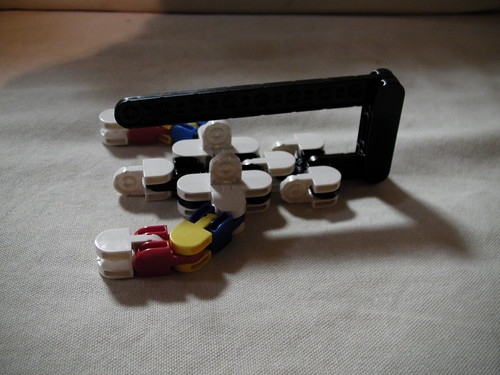
Jurat by Toyda is a kind of Lego for morphing robot makers.
I am not sure why Japanese children especially, and anyone who likes the movie series Transformers, are keen on transforming or morphing.
There is often a morph between something inanimate and something animate, between a something used, a tool or vechicle and a using thing living robot.
The above is a scorpion which morphs from/into a sword made by my son from Jurat morphin lego by Toyda.
I would like to suggest that Japanese children (and anyone fond of Transformers, which is most children everyhwere) but especially Japanese children because they remain in a "mirror stage," may be more aware of the Lacanian dictum that the ego or self, which originates in the self-image, is external, dead, a mere tool, and yet at the same time the only self we have. We see, we are, dead people: at best robots, at worst inanimate tools.
This dual nature of the self, (1) as a mere tool or representation to grasp a centre-less consiciousness, and (2) as the best -- though "robotic" or prosthetic -- self that we have, may be being played out in the morphining animation movies, and toys such as the one above.
Labels: Bandai, go-onger, henshin, japanese culture, Jaques Lacan, lacan, morph, nihobunka, nihonbunka, occularcentrism, self, specular, Super-Sentai, superhero, theory, 合体, 変形, 変身, 日本文化
Monday, December 26, 2011
Mugenbine vs the Hommelette
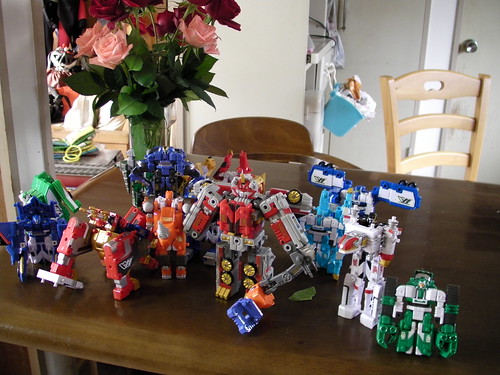
Mugenbine, which means "infinite combination", is type of building block set wherein the pieces are made of robots and parts of robots: extension arms and legs, wheels and weapons of robots. It is like other building block toys for children except that it is specifically designed to create robots, and each of the pieces, or many of them, are themselves robots.
Children who play with Mugenbine make giant robots out of a selection of smaller robots and robot parts. The robots have faces. They are felt to be alive. Mugenbine is Lego for animists.
My son started out having a fascination for combinatory toys such as the combining power rangers toys where two to 12 robots combine to make a larger "Mega Zord." He has moved on towards a preference for infinite combination but remains fascinated with the same trope: animate parts combining to make a giant animate whole.
Jacques Lacan says that young humans generally gain an idea of themselves in two ways. Firstly by looking at themselves directly and in mirrors and secondly by talking about themselves to themselves. He argues that the former, visual representations of self are more primitive. Lacan refers to the self as representated visually as "hommelette" which is on homme (man) with a diminutive ending meaning "little (as in primitive) man" and omelette with homme merged as a prefex suggesting "man-ommlette:" all jumbled up generally a mess like an ommlette.
Lacan argues that the visual self is something that we must grow out of because it made up of a jumble of things without any cohesion. Our self views are still external and worse, incomplete, views of this and that hand. The view of ourselves that we see in the mirror presents a whole body but it is out there in the mirror. Added to that we have many views of self, a scrapbook of self views, that never add up to any sort of coherent unity, unless we can call an omlette coherent, and Lacan suggests that we can't.
As my son makes more and more combinatory toys of made of parts which are like mirror fragments of the whole, mini-robots combining to make a bigger robot, I wonder if this play helps him to combine his self-views each semi-animate part-him, part-robotic, into a coherent self a mega robot that has more coherence and more humanity than an omlette.
Labels: Bandai, culture, japanese culture, Jaques Lacan, lacan, mirror, nihonbunka, specular, Super-Sentai, theory, スパー戦隊, 変身, 日本文化
Sunday, December 25, 2011
Green Communication Apprehension
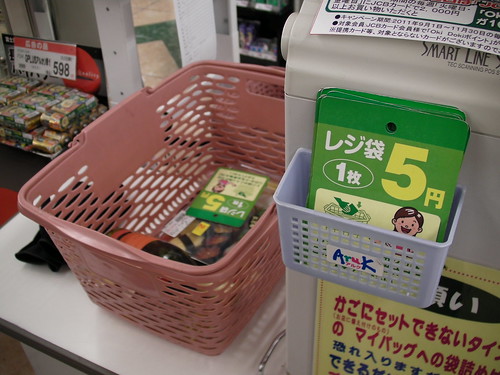
It has been made illegal, by green regional ordinance, to give away free plastic bags at supermarket cash registers.
Anyone who has taught English in Japan knows how difficult it is to get Japanese students to speak. Is it because they are ashamed of their poor English, or suffer from "evaluation anxiety" (Cultrone, 2009)? No, it appears not. Communication research (McCroskey, Gundykunst, Nishida, 1985) has found that Japanese are just as anxious speaking in Japanese as they are in English. In other words the Japanese suffer from a fundamental Language-Communication-Anxiety, rather than any Foreign Language Communication Anxiety, or classroom Evaluation Anxiety.
The Japanese tendency to wish to avoid linguistic communication is shown in their propensity to wish to avoid having to speaking to the staff at supermarket cash registers. Rather than saying "and two polythene bags please" they put two of these green cardboard symbols into their shopping basket to indicate the same thing. The Japanese are happy to communicate with symbols such as these. Perhaps they'd be good at English sign language. I find it works quite well to take a whiteboard to class and have learners translate my Japanese writing into English speech.
So far research (e.g. Kondo, Ying-Ling, 2004) has failed to find the reason for, or strategies to prevent, Japanese communication apprehension. I theorise that it is equivalent to Objective Self Awareness in the linguistic dimension. Westerners feel uncomfortable if they are put infront of mirrors and required to see their visual self representations. Japanese feel uncomfortable if they are required to hear their linguistic self representations. There is no need for any physical mirror, or sound box, forto be reflected to its speaker, but I guess that speech for the speakers sake (as spoken in a conversation class), rather than the listeners sake, is likely to be more 'reflective'.
Labels: collectivism, individualism, japan, japanese culture, logos, mirror, nihobunka, nihonbunka, 個人主義, 日本文化, 集団主義
Friday, December 09, 2011
The Chrysanthemum and the Sword

Ruth Benedict's Chrysanthemum and the Sword is probably still the most famous book about Japan. The theory that Japan is a shame culture, whereas Western countries have a culture of shame is still the most widely used framework for understanding the Japanese. Shame, it is argued, is a non-moral ethic where people behave in such a way as to conform with the expectations and evaluations of their peers. This is precisely the opposite of the definition of a moral man as given for example by Plato in The Republic (someone who appears bad but does good), or as exemplified in the life of Jesus who was crucified amongst thieves. Guilt, we are told, on the other hand is a moral sentiment that derives from within the person, from internal standards, from personally held and identifiable notions of good and bad. The theory that Westerners have such things inside them, whereas Japanese are only concerned with keeping up appearances, maintaining face, pleases Westerners and is continued in cultural psychological theories to this day.
It is clear that the Japanese feel a lot of shame. I think that the shame-culture, guilt-culture framework is meaningful, but that Benedict misrepresented Japanese shame. Japanese have private shame (Sakuta, 1967). "But," you may point out, that "if shame too is private then it is indistinguishable from guilt." I claim that the difference is in the medium. Guilt is when ones internal self-narrative sounds bad. Shame is when ones internal self-cinema looks awful.
It is easy to self narrate, and when we do we hear the words that speak or think. Self-speech has a built in mirror. Sound bounced back and around in the sound box of the mind.
That the Japanese can gaze at themselves, on the other hand, is a more remarkable feat. Like most westerners, I can't do it unless I have a mirror. Mead claimed it is impossible to see oneself without a mirror. Some performers, such as Zeami and Nijinsky, claimed to be able to see themselves from the point of view of their audience. And my research it may be argued that the average Japanese man and woman in the street have a mirror in their head.
Herbert Morris (1976) "On guilt and innocence: essays in legal philosophy and moral psychology" p 62
"In guilt the "voice of conscience" speaks and we formulate in words what is do be done and not to be done, words that are spoken and heard. With shame, the disposition is to hide, to vanish; with shame we want to sink into the ground, we cannot stand the *sight* of ourselves. With guilt the urge is to communicate, to be listened to, to confess."
It seems to be a minor change but, transposing the shame guilt divide from external-internal to vision-voice means that Japan ceases to be a lack, a nothing, a collective. Japan becomes something. It because something that is qualitatively different. The Japanese moral behaviour, and self is not just lost, submerged, controlled, collectivistic but *a different kind of self*.
Morris, H. (1976). On guilt and innocence: Essays in legal philosophy and moral psychology. Univ of California Press.
Labels: collectivism, individualism, japanese culture, mirror, nihobunka, nihonbunka, occularcentrism, religion, reversal, specular, 宗教, 日本文化, 神道
Saturday, December 03, 2011
Everyone is Watching: Manner Up
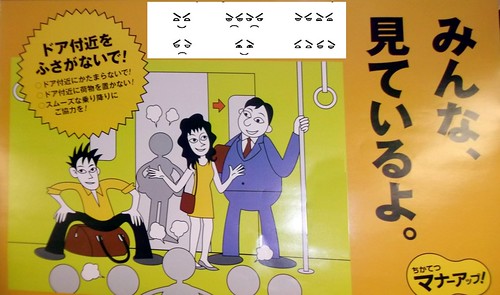
This Japanese subway train is encouraging passengers to mind their manners and not stand or sit in front of the doors, by telling that "Everyone is watching." The fear of being seen doing something ill-mannered is real and motivating to Japanese.
Kitayama, Snibbe, Markus & Suzuki (2004) demonstrate that Japanese need only to be confronted with a poster showing various approving or disapproving gazes (inste top) to change their behaviour.
The change observed in Kitayama's experiment was however, to become more self-enhancing, as measured by a spread of alternatives pre and post being given something. In front of the poster, Japanese (like Westerners with or without poster) became more inclined to up their rating of something that they now posses.
The strange thing about this result is that the standard theory of Japanese manners is that Japanese should be self-deprocating rather than self-serving when in front of others.
So why do the Japanese self-enhance (brag) in when made aware of an evaluating gaze?
I argue that Kitayama's poster encourages self-evaluation, and that in the visual domain, Japanese do have a need for positive self-regard, hence the extreme positivity, and posing, found in Japanese autophotography (puri-kura, peace symbols, etc; Leuers and Sonoda, 1999, see Heine, 217 page 213)
Bibliography
Kitayama, S., Snibbe, A. C., Markus, H. R., & Suzuki, T. (2004). Is There Any ‘Free’ Choice? Psychological Science, 15(8), 527.
Heine, S. J. (2007). Cultural Psychology (First ed.). W. W. Norton & Company.
Leuers, T., & Sonoda, N. (1999). The eye of the other and the independent self of the Japanese. Symposium presentation at the 3rd Conference of the Asian Association of Social Psychology, Taipei, Taiwan.
Labels: collectivism, eye, lacan, logos, mirror, nihobunka, nihonbunka, occularcentrism, reversal, Shinto, specular, 宗教, 日本文化
Monday, November 28, 2011
A Theory about Japanese Mikoshi Festivals
Many or most Japanese festivals feature "O'Mikoshi," but there are few theories as to why the Japanese (and not only the Japanese) are into carrying their gods around on stretchers. The theories I have seen, and agree with, stress unity, solidarity and cohesion (Takezawa, 1998) and prestige (there is a pecking order in who gets to carry the god, before whom: see Kalland, 1995). I respect both theories but here is my take, with thanks to my trainspotting son.
Normally the geographical fixed-ness of the Shinto sacred anchors the word view and society (c.f. theories that Japanese society is spacially organised: Bachnik & Quinn, 1994, Pilgrim 1995, and Nakane, 1970), so when the sacred starts to move on its mikoshi (beir, litter or palanquin) this signals the arrival of a topsy turvy, "liminality" (Turner, 1967) big-time. I suggest in this video that the mikoshi have the same attraction as trains. My son used to really love trains. Trains, with their moving frames of reference, teach us that movement is relative, nothing is stationary, unless something is sacred.
Labels: japanese culture, nihobunka, nihonbunka, religion, Shinto, 宗教, 日本文化, 神道
Thursday, November 17, 2011
In Search of the Japanese Self

Partly as a result of wondering how it is that Japanese can see their relationships with others, including the world, as being internal to themselves, I asked 20 Japanese to rate the extent to which certain things and phenomena are so much you that "If it were changed you would cease to be yourself," and "Not public, or anyone else's." I am not sure if I asked the right questions but I was trying to get to what my subjects thought themselves to be.
I was particularly interested in whether they would deem their view / visual sense percepi as being themselves or out there in the world, as well as the relative selfness (?) of body, self, speech and voice.
I had predicted a greater importance afforded voice since it always seems that in shows featuring suited representations of Japanese cartoon and maskted tokusatsu characters, they have to mime to the voice of the standards voice actor for them to be felt to be the real thing.
The results, shown above, show that Japanese identify most strongly with their head, foollwed by theif feelings, internal self speech, dreams, body, voice, and finally vision. Vision was felt to be way down the list, below the mid point of the scale (1-5) where 5 meant entirely essential and private, whereas 1 meant inessential and public. All the same they were half way to avowing that their vision might be private and that the wold they see might not be shared with anyone else.
I should have included some other, but less, self phenomena such as clothes, name, possessions, home, self-facts (such as being from Saga obviously a 1 on the "not public" part of the scale, but perhaps important to ones identity.)
I think that I should also make the scale a little longer 1-7 perhaps to allow for more variation between the top (head?) and bottom (possessions?) of the scale.
Perhaps the most interesting thing in the above graph is the reversal of the relative heights of the blue and red lines for the three items on the right. It is clear that my two questions are different. In the case of dreams for instance, one might imagine oneself continuing to exist as oneself without dreaming, and yet feel it very strange if anyone else saw, or could see ones dreams. It was interesting however that both voice and vision should be evaluated in the same way. Would I be more surprised if I suddenly had another voice, or if someone else had the same voice as me? I (incorrectly) feel that I have quite a neutral accent, so I am not sure I would be all that surprised to meet someone with my voice.
Finally, I am tempted to think that other people see the same colours as I do, and share the same visual field as I, but I would find it very strange if my experience went dark, if I were to become a philosophical Zombie. Perhaps my subjects' lack of surprise refered to the possibility that they should go blind.
Labels: buddhism, collectivism, eye, image, japanese culture, Jaques Lacan, lacan, logos, mirror, nihobunka, nihonbunka, self, 日本文化
Friday, November 11, 2011
Kasulis' Internal and External Relationships

Kasulis argues that the essence of Zen artistry can be found in the Shinto tradition. He points to three things. First he suggests that contra other forms of Buddhism, the plain, undecorated, inornate nature of Zen artistry is shared with Shinto. More boldly he claims that the "ordinariness" of Zen, which not only shuns being fettered by Buddhist scripture, but sees the philosophy of the Buddha written in all things, mirrors Shinto animism. Finally he argues that Shinto purity of heart (magogoro) is closely related to the state of mind, or no-mind, attained in Zen.
I am one of those people that thinks everything Japanese is Shinto, even if it claims to be Buddhist, I look forward to reading Kasulis' book "Shinto: The way home."
In his introduction to the Japanese section of the book, Kasulis talks about "interior and external relationship" using this diagram above. Kasulis' diagram could be argued to be a detail from Markus and Kitayama's famous diagram which itself has precident in Kimura Bin, Eshun Hamaguchi and Wasuji Tetsuro among others.
Keeping his eye on the relationships however, Kasuli argues that in the West they are seen as being exterior to the person, something that each of the related can objectify, whereas in Japan they are seen as being interior to each and both of the related, consituting them. This means that, he argues, while a Japanese garden may appear "unnatural" in the way that it is cut and pruned into a "surnatural" shape, the gardner is part of nature and nature would loose something of its naturalness if its relationship with the gardner were to be removed.
The interiority of Japanese relationships is part of the cultural psychological cannon (I wonder if cultural psych has become a religion for me) that I ascribe to, and I do not doubt it at all. I can't doubt it because I ask my students, "do you see your relationships as occuring within you", "do you think that in a way others occur within yourself?" and they say "yes." "Other people are inside you?!" I ask them to confirm, and as they nod, I have trouble understanding their reply.
Do they mean that they are simulating intra-psychic others - co called imaginary friends? They may feel very real, as Cathy says, "I am my Heathcliff,"and Celine Dion says "You're here in my heart."
But, I was wondering yesterday whether, if having a mirror in ones head means that one is more inclined to affirm "the veil of perception." The veil of perception is the notion that all that we percieve is internal, our own perceptions, upon a mental screen, no the real world so, as Nietzche quips, we can only ever point to ourselves.
While I am susceptible to this view, generally speaking I do not look at the world in that way and generally feel I am looking at the world and not myself. When I asked my (Japanese) wife, she was quick to affirm the veil of perception, so I wonder if this is part of the origin of the feeling of interiority. Maybe I will be able to do a survey. I have been meaning to for a while but I used to think that the veil would be on us not them.
Heine, S. J., Takemoto, T., *Moskalenko, S., *Lasaleta, J., & Henrich, J. (2008). Mirrors in the head: Cultural variation in objective self-awareness. Personality and Social Psychology Bulletin, 34, 879-887. http://www2.psych.ubc.ca/~henrich/Website/Papers/Mirrors-pspb4%5B1%5D.pdf
Kasulis (1998) "The Self as Image in Asian Theory and Practice" p 338.
Markus. H. & Kitayama, S. (1991). Culture and the Self: Implications for cognition, emotion and motivation. Psychological Review, 98, 224-253. Downloaded from http://www.biu.ac.il/PS/docs/diesendruck/2.pdf on 2011/11/11
Monday, October 31, 2011
The Geography of Thought
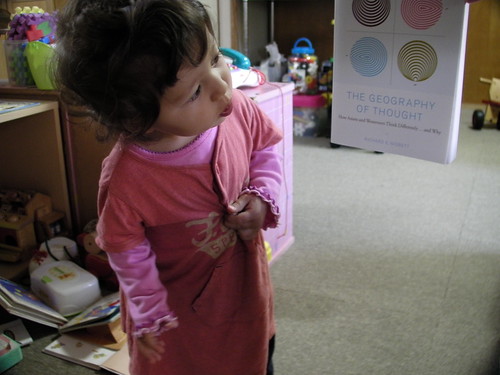
Richard Nisbett's opus, "The Geography of Thought" is already a classic in the field of Cultural Psychology.
Backed up with lot of experimental data, such as the fact when shown a picture of a fish tank Japanese are more likely to talk about the tank than the fish in it, Professor Nisbett demonstrates that Americans analyze the central features of their environment, whereas East Asians are more likely to see the world wholistically, taking in the context.
This tendency to emphasise context among East Asians is, Nisbett argues, due to differences in Argricultural system. Wet rice farming in East Asia encouraged East Asians to cooperate in irrigation systems, and being dependent upon social systems themselves, see the world as being composed of things also dependent upon their environment. Westerners were however able to do argiculture which did not require such high levels of cooperation and cosequently saw themselves and their environment as composed of discrete, independent monads.
The work in the differences in conception is being continued by Takahiro Masuda and the data is now so extensive as to make cognitive difference irrefutable.
I have two problems with the explanation of the origins of the difference that Nisbett provides. Firstly, I don't think that it is true that rice farming is more cooperative than the cows wheat fallow rotation system used in Europe. According to Bray's "The Rice Economies," wet rice farmers, who often use small private ponds for irrigation, were able to be more independent of their peers than wheat farmers who, due to the requirement for cooperation with cattle farming, developed specialisations, and being less isolated and less intensive achieved economies of scale. Secondly, while I agree that agricultural systems do have had some impact on psychology, this explanation is too one-sidely Asian and contextual for me. Such explanations (Watsuji's Monsoon Rice Farming Culture, Tamaki's The Philosophy of Water etc) are tremendously populare in Japan, precisely because Nisbett is right to point out that East Asians see behaviour as a result of contextual factors. The Japanese love environmental interpretaions of cultura and human behaviour. Perhaps Professor Nisbett will one day write another book called, "The Thought of Geography."
Labels: collectivism, individualism, japanese culture, self, theory, 個人主義, 日本文化, 集団主義
Tuesday, October 04, 2011
Former Encyclopedia Britannica Salesman Tells Japanese How to Have moreConfidence

Former Encyclopedia Britannica Salesman Tells Japanese How to Have more Confidence, a photo by timtak on Flickr.
Just as post-war Japanese admire Western looks, they also attempt to import Western psychology. As a result, Japanese today consider themselves ugly if they have traditional Japanese looks(Knowner, 2004). The results of importing Western popular psychology, without the religio-cultural framework, may be even more disasterous.
"Put all negative thoughts out of your mind" the author urges. What of the beauty of reflecting upon ones mistakes (hansei) in order to achieve self improvement (kaizen)? "Praise yourself when you achieve your goals", he says. In the traditional view of things in Japan, the important praise is the gratitude that one gets from others, and self-praise is just "self-satisfaction" (jikomanzoku, a derogatory term). "Setting your goals too high will result in loss of self image" he says. Indeed Westerners are inclined to give up at things that they fail at, and seek tasks that suit their 'individual' aptitudes, wereas Japanese are more inclined to believe that human potential has no limits (Heine et al, 2001).
Sadly, the Japanese feel that they need more confidence, so the book has sold 110,000 copies. Perhaps this book is the intellectual equivalent of hair dye, or eyelid glue. If I were Japanese I would read it with a pinch of Soy Sauce.
Image copyright Hitoshi Aoki (2009)"Jishin no Tsukurikata (How to make self-Confidence)"
Labels: culture, japan, japanese culture, nihobunka, nihonbunka, theory, 日本文化
Friday, September 23, 2011
Money-Wiring Fraud
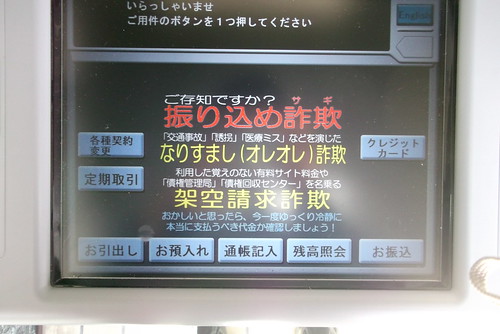
Fraudsters in Japan phone up old people, and not so old people, and persuade them to wire them money.
Fraudesters targetting people in the USA and the UK, also attempt to have their victims wire them money. They often attempt to do this by telling us anglophones that we are very lucky and can come into a massive fortune if we just pay a few thousand dollars/pounds to smooth over the paper work.
Japanese "Furikomi" fraudsterson the other hand, phone up saying "its me, I have had a car crash, please help." The fraudster waits till the person on the other end of the line guesses a name ("Is that you Ichirou?"), says yes, says that he needs some money urgently and to go the bank to wire it straight away. Hence the warnings on Japanese automatically telling machines warning the user against"Its me, me" Fraud.
There in Japan the fraudesters are playing on the assumption that the victims think that they or their relatives are unlucky and that other people depend upon them.
Westerners over estimate their luckiness, chosen-ness, uniqueness, where as Japanese over estimate the extent to which they are embedded in their social networks and that other people depend upon them.
Labels: collectivism, individualism, japanese culture, nihobunka, nihonbunka, 個人主義, 日本文化, 集団主義
This blog represents the opinions of the author, Timothy Takemoto, and not the opinions of his employer.