
Saturday, October 27, 2012
142 Japanese Cultural Artifacts 142 日本文化の物体
Labels: japan, japanese culture, nihonbunka, 日本文化


Friday, October 26, 2012
Individualism and Collectivism in Magazine Photos

"Whatever nit-picking worries anyone has about the Opening Ceremony (for me, it was the almost total absence of the golden thread of British history, the fight for personal liberty), it set a tone that was amplified throughout the games. Could a nation of cussed individualists ever bring off an opening show to rival the spectacular we saw in Beijing?" [my emphasis] (Paxman, 2012)
There can be no doubt that at the level of linguistic philosophy, the Japanese espouse harmony and cooperation, whereas Westerners espouse personal liberty and individualism.
How about in the real world? I find the Japanese to as individual as the English. The excellent review paper by Beth Morling (Morling & Lamoreaux, 2008), "Culture outside the head," however reaches the opposite conclusion, so I thought I had better see what it had to say.
The first paper reviewed paper I could download, claimed that since Japnaese adverts used more imagery and were less likely to mention the product directly, they were therefore colectivistic; trying to build up a relationship with the purchaser (Javalgi, Cutler, & Malhotra, 1995). I thought that this analysis was unfair. Readers of this blog (?!) would know that it is my opinion that Japanese use imagery because they identify with images and have a God (or generalised other) that looks rather than listens (Leuers & Sonoda, 1999b).
While clicking around on analysises of print media, however, I cam up with a result that made me pleased. Wang (2006) noted that Taiwanese magazines are Westernised and that collectivist messages (table page 73) and individualist messages (table page 68) are aboult equal at the linguistic level in adverts in Taiwanese and American magazines. Let us assume that this result is due to Westernisation.
However, Wang also noted that when it comes to photographs, Taiwanese magazines are more likely to show individuals (Taiwan 73.1%, US 59%) and correspondingly far less likely to show groups (Taiwa 26.9%, US 41%) (see table page 65). This is not at all unusual. Japanese magazines are lonely (or narcissistic). Their protagonists are displayed on their own.
This result mirrors that found in my research on autophotography (Leuers & Sonoda, 1999b: see Heine 2007, p213). Japanese autophotography displays not only more positivity, but more pictures of self, whereas American photos show more pictures of other people.
Having a look at some Japanese and American fashion magazines, it seems that the same pattern is repeated. American women want to be kissed and appear with men in US Cosmopolitan. Japanese women are more self-reliant and rarely show men in their magazines (or collages) because men's demands for affection are rather annoying (uzai).
Westerners are linguistically individualist since they consider themselves to be linguistic entities (narratives) and try to differentiate their narratives from those of others (largely unsuccessfully, see Leuers & Sonoda, 1999a). Japanese see themselves as their self-images, first and foremost their face (Watsui), and as seperate embodied existances they yearn for communitas and harmony which they express in their "let's make friends" philosophy of harmony (Yamagishi, 2002).
In any event, I do feel that at a personal level the Japanese are extremely self~possessed, self-reliant and difficult to push around. Anyone married to a Japanese woman should know that, but despite the fact that some famous cultural psychologists are, they do not reach the same conclusion. I guess that they presume that they have married an unusual Japanese. (You know who I am thinking of...Fat chance that he reads my blog).
Bibliography
Heine, S. J. (2007). Cultural Psychology (First ed.). W. W. Norton & Company.
Javalgi, R. G., Cutler, B. D., & Malhotra, N. K. (1995). Print advertising at the component level: A cross-cultural comparison of the United States and Japan. Journal of Business Research, 34(2), 117–124. Retrieved from http://www.sciencedirect.com/science/article/pii/014829639400116V
Leuers, T. R. S., & Sonoda, N. (1999a). Independent self bias. Progress in asian social psychology, 3, 87–104. Retrieved from httyp://www.nihonbunka.com/docs/independent_self.rtf
Leuers, T., & Sonoda, N. (1999a). The eye of the other and the independent self of the Japanese. Symposium presentation at the 3rd Conference of the Asian Association of Social Psychology, Taipei, Taiwan. Retrieved from http://nihonbunka.com/docs/aasp99.htm
Morling, B., & Lamoreaux, M. (2008). Measuring culture outside the head: A meta-analysis of individualism—collectivism in cultural products. Personality and Social Psychology Review, 12(3), 199–221.
Paxman, J. (2012, August 12). London 2012 Olympics: Who thinks Britain is rubbish now? Telegraph.co.uk. Retrieved from http://www.telegraph.co.uk/sport/olympics/9469017/London-2012-Olympics-Who-thinks-Britain-is-rubbish-now.html
Wang, I. C. (2006). I‘ or’ WE"? A comparative analysis of individualism in Taiwanese and US print advertisements. Retrieved from http://etd.lib.nsysu.edu.tw/ETD-db/ETD-search/view_etd?URN=etd-0728106-154652
山岸俊男. (2002). 心でっかちな日本人―集団主義文化という幻想. 日本経済新聞社.
Labels: collectivism, image, individualism, japan, japanese culture, logos, Nacalian, nihonbunka, reversal, theory, 個人主義, 日本文化, 集団主義
Monday, October 22, 2012
Red Lights and Risky Shift
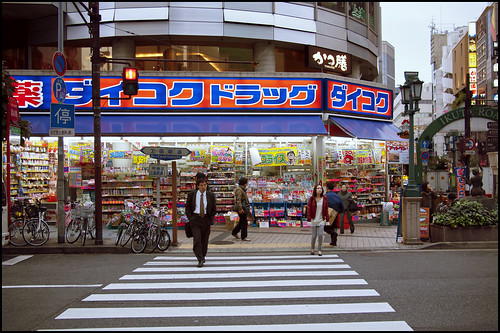
But when it comes to behaviour it seems to me that these labels are sometimes used unfairly since
1) The labels are always applied, in accordance with the stereotype, despite the fact that
2) All social behaviour has both aspects, and can be labelled in both ways.
First of all I would like to justify the second assertion. Markus and Kitayama (1991) in the paper that started cultural psychology, replaced the distinction between individualism and collectivism, with the following more complex distinction:
Westerners tend to think that the self is independent, and that groups are just for joining. The biggest distinction that groups have is that they are dangerous, in that they are seen as having the potential to de-individuate, or de-personalise; make their members forget about the unalienable individuality that they had in the first place.
I have heard cultural psychologists group collectivism with the latter interdependent view of self, not without just cause. But it should be remembered that there is a paradigm shift separating the old "Individualism Collectivism" theory from that of Markus and Kitayama. The latter is a theory about theories. This fact can be forgotten.
Importantly, from a "Interdependent" perspective, individualism and collectivism do not exist , or at least they are not opposed to one another. Every so called "individualist behaviour" is made possible by social relationships, and every collectivist behaviour is formative of and beneficial for individuals. In so far as every human behaviour is social (other than the most basic, and then even those), all behaviours therefore have a collective and individual aspect. Lets consider some examples.
Risky Shift (group polarisation: Stoner, 1961: see e.g. Isenberg, 1986) is something that is found in the US but far less so in Asia. Risky shift is the tendency for Western groups to behave more riskily after group discussion - such as the Bay of Pigs, Cuban invasion disaster. The generals that got together to discuss what to do about Cuba started out moderate but converged on an initially extreme, and risky decision, to invade Cuba.
In Asian on the other hand, Isozaki's research tried hard but failed to find persuasive evidence for risky shift in Japan. Sometimes the opposite -- cautious shift -- is found, in 1/3 of Isogaki (1981) experiments and cautious shift in groups (Hong, 1978) and just by giving reasons (Briley, Morris, & Simonson, 2000a, 2000b) is also found among Chinese.
In accordance with the stereotype, it is explained that extreme actions, appearing unique, are highly evaluated in Western culture so groups tend to converge on the most daring of options, whereas Japanese value harmony and converge on compromises.
On the other hand again, risky shift (group polarisation) may be more similar to the above "Red Light, If everyone crosses, We're not scared" phenomena. All those generals that got together and decided to invade Cuba may have been thinking"well everyone else here thinks it'll be okay". Indeed one explanation of risky shift is that people in groups feel less responsible and make riskier decisions due to the evasion of responsibility.
Both crossing the road in groups and risky shift have their negative aspects. The guy in the photo above may be in a daze too and a truck may be coming along. Unfortunately, there was a truck, called Castro, coming along and the bay of pigs invasion was a disaster.
1) Lack of individual uniqueness (not risky, moderate)
2) Lack of individual mindfulness (just goin' with the flow)
Both these came up in the same factor in a recent study on individualism.
Bibliography
Briley, D. A., Morris, M. W., & Simonson, I. (2000a). Reasons as Carriers of Culture: Dynamic versus Dispositional Models of Cultural Influence on Decision Making. Journal of Consumer Research, 27(2), 157–178. Retrieved from http://www.jstor.org/stable/10.1086/314318
Briley, D. A., Morris, M. W., & Simonson, I. (2000b). Reasons as Carriers of Culture: Dynamic vs. Dispositional Models of Cultural Influence on Decision Making. Journal of Consumer Research, 27(2), 157–178. Retrieved from http://works.bepress.com/briley/1
Hong, L. K. (1978). Risky Shift and Cautious Shift: Some Direct Evidence on the Culture-Value Theory. Social Psychology, 41(4), 342–346. doi:10.2307/3033587
Isenberg, D. J. (1986). Group polarization: A critical review and meta-analysis. Journal of Personality and Social Psychology, 50(6), 1141. Retrieved from http://psycnet.apa.org/psycinfo/1986-24477-001
Isozaki, M. (1984). The effect of discussion on polarization of judgments. Japanese Psychological Research, 26(4), 187–193.
Markus, H. R., & Kitayama, S. (1991). Culture and the self: Implications for cognition, emotion, and motivation. Psychological Review; Psychological Review, 98(2), 224. Retrieved from http://www.biu.ac.il/PS/docs/diesendruck/2.pdf
Stoner, J. A. F. (1961). A comparison of individual and group decisions involving risk Unpublished master’s thesis, School of Industrial Management. MIT.
磯崎三喜年. (1981). 集団分極化現象に関する研究. 心理学研究, 52(4), p248–251. Retrieved from http://ci.nii.ac.jp/naid/40001977542
磯崎三喜年. (1982). 集団分極化とその説明理論について. 愛知教育大学研究報告, 教育科学, p181–191. Retrieved from http://repository.aichi-edu.ac.jp/dspace/bitstream/10424/3474/1/kenkyo31181191.pdf
磯崎三喜年. (1995). 自己生成的態度変化としての極性化効果とその持続性に関する研究. 心理学研究, 66(3), p161–168. Retrieved from http://ci.nii.ac.jp/naid/40001978174
磯崎三喜年, 天根哲治, 上野徳美, & 横川和章. (1980). 521 集団分極化現象に関する研究(1)(社会3,社会). 日本教育心理学会総会発表論文集, (22), 640–641. Retrieved from http://ci.nii.ac.jp/naid/110008128465
岡本浩一. (1986). 社会心理学ショート・ショート―実験でとく心の謎. 新曜社.
橋口捷久. (1974). 集団内の意思決定者数とリスク・テイキングの水準. 実験社会心理学研究, 14(2), 123–131.
上野徳美, 横川和章, 天根哲治, & 磯崎三喜年. (1980). 522 集団分極化現象に関する研究(2)(社会3,社会). 日本教育心理学会総会発表論文集, (22), 642–643. Retrieved from http://ci.nii.ac.jp/naid/110008128466
Labels: collectivism, individualism, japanese culture, nihonbunka, 個人主義, 日本文化, 集団主義
Sunday, October 21, 2012
Hospitality and Regulatory Focus
渡部さま・ご出席者各位、取り下げご希望でありましたら一筆ください。
As demonstrated by Hamamura and Heine (2008;Hamamura, Meijer, Heine, Kamaya & Hori, 2009), the Japanese have a prevention, as opposed to promotion, regulatory focus (Higgins and Spiegel, 2004), or motivation style. This means that the Japanese hare happy when nothing goes wrong, or if all goes smoothly (todokoorinaku 滞りなく) and they don't care if things are especially "wow". Westerners are more inclined to want the "wow"-- something raw and unique -- and they are less concerned if there are a few mishaps along the way.
These differences in what motivates the Japanese and Westerners are especially visible in hospitality preferences, so tourism providers should take note. To Japanese, Western hospitality can seem hapzard, scruffy, or poorly planned. To Westerners, Japanese hospitality can seem clinical, hermetically sealed, mass-produced. Japanese weddings parties are a prime example of flawless, raw-less hospitality of Japan.
This particular wedding party had a spontaenity and uniqueness that I had not experienced before. It should be remembered that the Japanese hold an after-party (ni-ji-kai), and a after-after-party (sanjikai) where there is much more spontaneous "wow". Thank you for inviting me. I had a great time.
Bibliography
Briley, D. A., & Wyer, R. S. (2002). The Effects of Group Membership on the Avoidance of Negative Outcomes: Implications for Social and Consumer Decisions. Journal of Consumer Research, 29(3), 400–415. Retrieved from http://works.bepress.com/briley/3
Hamamura, T. (2008). Approach and avoidance motivations across cultures. In A. J. Elliot (Ed.), Handbook of Approach and Avoidance Motivation (pp. 557–570). Mahwah, NJ, US: Erlbaum. Retrieved from http://www.psych.ubc.ca/%7Eheine/docs/avoidancehandbook.rtf
Hamamura, T., & Heine, S. J. (2006). Self-Regulation Across Cultures: New Perspective on Culture and Cognition Research. International Conference of the Cognitive Science, Vancouver, BC.
Hamamura, T., Meijer, Z., Heine, S. J., Kamaya, K., & Hori, I. (2009). Approach—Avoidance Motivation and Information Processing: A Cross-Cultural Analysis. Personality and Social Psychology Bulletin, 35(4), 454–462. Retrieved from http://www.psych.ubc.ca/%7Eheine/docs/2009approach.pdf
Higgins, E. T., & Spiegel, S. (2004). Promotion and prevention strategies for self-regulation: A motivated cognition perspective. Retrieved from http://psycnet.apa.org/psycinfo/2004-00163-008
Labels: japan, japanese culture, nihonbunka, 日本文化
Tuesday, October 16, 2012
Social Loafing in Japan Revisited
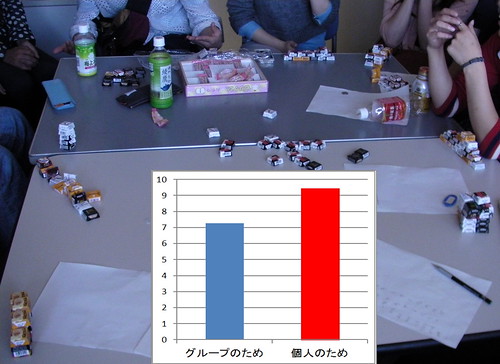
In Nakano's experiment, seminar students were asked to grab as many "BIS" chocolates as they could from a bag under two conditions
1) Being told that they would receive an equal share of the chocolates grabbed by the group as a whole
2) Being told that they would receive all the chocolates that they themselves grabbed.
The results were as shown above, with average number of chocolates grabbed were greater in the individual condition (9.45) than the group condition (7.27) indicating the existence of social loafing in Japan, with statistically significant tendency (p<0 .1=".1" despite="despite" n="11).<!--0--" sample="sample" size="size" small="small" the="the">
Fan as I am of the Koushien Baseball Tournament I was hoping my students to "become one circle," and try harder in the group condition but the conditions for Japanese social effort, did not seem to have been met. Only one student grabbed more chocolates in the group condition. The order of the grabbing and the degree of encouragement received from the experimenter (who was not blind to the experimental conditions, had been persuaded by social loafing research) may have affected the result.
Bibliography
Dick, R. van, Tissington, P. A., & Hertel, G. (2009). Do many hands make light work?: How to overcome social loafing and gain motivation in work teams. European Business Review, 21(3), 233–245. doi:10.1108/09555340910956621
Earley, P. C. (1993). East meets West meets Mideast: Further explorations of collectivistic and individualistic work groups. Academy of management journal, 319–348. Retrieved from http://www.jstor.org/stable/10.2307/256525
Gabrenya, W. K., Wang, Y.-E., & Latane, B. (1985). Social Loafing on an Optimizing Task Cross-Cultural Differences among Chinese and Americans. Journal of Cross-Cultural Psychology, 16(2), 223–242. doi:10.1177/0022002185016002006
Karau, S. J., & Williams, K. D. (1993). Social loafing: A meta-analytic review and theoretical integration. Journal of Personality and Social Psychology, 65(4), 681–706. doi:10.1037/0022-3514.65.4.681
Kravitz, D. A., & Martin, B. (1986). Ringelmann rediscovered: The original article. Journal of Personality and Social Psychology, 50(5), 936–941. doi:10.1037/0022-3514.50.5.936
Kugihara, N. (1999). Gender and social loafing in Japan. The Journal of social psychology, 139(4), 516–526. Retrieved from http://heldref-publications.metapress.com/index/3978hl6682r10877.pdf
Latane, B., Williams, K., & Harkins, S. (1979). Many hands make light the work: The causes and consequences of social loafing. Journal of Personality and Social Psychology; Journal of Personality and Social Psychology, 37(6), 822. Retrieved from http://psycnet.apa.org/journals/psp/37/6/822/
Markus, H. R., & Kitayama, S. (1991). Culture and the self: Implications for cognition, emotion, and motivation. Psychological Review; Psychological Review, 98(2), 224. Retrieved from http://www.biu.ac.il/PS/docs/diesendruck/2.pdf
Matsui, T., Kakuyama, T., & Onglatco, M. U. (1987). Effects of goals and feedback on performance in groups. Journal of Applied Psychology, 72(3), 407. Retrieved from http://psycnet.apa.org/journals/apl/72/3/407/
Shirakashi, S. (1984). Social loafing of Japanese students. Hiroshima Forum for Psychology, 10, 35–40.
Labels: collectivism, culture, economics, individualism, japan, japanese culture, nihonbunka, 個人主義, 日本文化, 集団主義
Sunday, October 14, 2012
Japanese Wedding Chapel
Many Japanese people get married in purpose built marriage complexes, which have reception rooms, banqueting halls, and a wedding chapel which is not a real chapel but a room decorated in such a way as to appear similar to a Western church. Western "celebrants" are employed to performs the role of a priest, giving a presentation in both Japanese and English to give the proceedings an authentic, Western, Christian effect. The organ and the roof vaulting were painted in but, complete with hymns and bible readings, the atmosphere and appearance was definitely church-like. The company that I know of that that supplies celebrants to wedding chapels takes its role seriously and demands that celebrants be theists and believers in the importance of holy matrimony. They insist upon not only appearance but also the message of Christianity.
Until the influence of the West arrived in Japan there was no ritual to celebrate marriage. In place of marriage ceremonies, there was a celebration of the arrival of the bride in the ancestral home and a celebration of the first shrine visiting of newborn children since it was the vertical relationships that are holy and associated with ritual in Japan, rather than the horizontal, romantic ones. That does not, of course, mean that Japanese couples don't love each other. Far from it.
Having made this 'documentary' I was feeling a little removed from the proceedings, and was surprised to see that one of the older gentlemen in the back grow opposite me was crying. "Why is this gentleman so moved?" I thought. Then I realised, that he was one of the bride's grandparents, of which there were but three in attendance, and that he was there on his own. At which point, I started crying too. Love lives on in Japan.
Labels: japan, japanese culture, nihonbunka, Shinto, 日本文化
Friday, October 05, 2012
Dangerous Water Channel
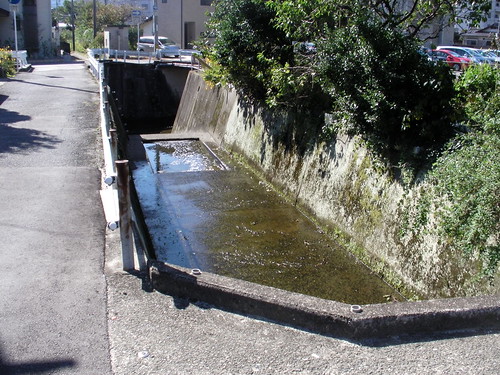
This level of physical danger exists in spite of the fact that saftey from attack is not only non-existent, but there are emergency "I am being attacked" alarm/phone stations every 50 yards along the main street coming from university. Danger caused by others is treated by with great concern, but danger due to personal "negligence" (such as not looking where you are treading) gets short shrift. Who said that Japanese do not allow their populace to do things at their own risk (jiko-sekinin de)? Having said that, I think that this difference is more to do with the prevalence of irrigation channels in this rice farming nation rather than any difference in perceptions of personal safety.
A foreign student at Yamaguchi broke their arm falling into one of these channels. A foreign visitor found a dead Japanese man in one of these channels on a Sunday morning. Those under the influence of alcohol are particularly at risk. Visitors to Japan beware. But also bear in mind that in late May the channels, or this one in Itoyone, are populated by fireflies.
Labels: culture, japan, japanese culture, nihonbunka, 日本文化
An Individualist Poem: Me, a Small Bird, and Bell
KANEKO Misuzu was a poet from Nagato in Northern Yamaguchi who lived at the beginning of the 20th century. She had a tough childhood, being sent to a foster home at the death of her father, then re-fostered by her mother's second husband, she found herself treated as a "foster child" even by her, by now estranged, mother. Leaving home, she ran a bookshop in Shimonoseki, the largest town in Yamaguchi Prefecture and wrote poetry, about 500 poems and songs mainly for children, of which 50 were published in her lifetime.
It was after her marriage however that her life became even more tragic in that her husband requested that she give up poetry and concentrate being a "housewife". When she refused, he took to having mistresses or at least prostitutes, and when he gave her a veneral disease she decided to leave him. At first she thought that she would have custody of her children but when they were taken from her, she committed suicide at the age of 27.
I imagine that she genuinely and fervently wished that her significant others would treat her on her merits, rather than according to her station or role (foster-child, housewife), so her most famous poem, in my translation below strikes me as being, very understated.
Me, a Little Bird, and a Bell
Even if I stretch out both my arms
I can't fly, not one flap, in the sky
But the little bird than can fly so well
Can't run on the ground fast, like I
Even if shake my body about
I won't make a beautiful sound
But the bell that can ring so beautifully
Doesn't know a whole heap of songs, like me
The bell, the small bird, and also me
All different, all good.
(It is much better in the original Japanese)
I often assert that the Japanese are just as individual as Westerners. I still think that this is true but it is also true that there are strong philosophical and cultural encouragements to fulfil ones roles. I think that this is because the Japanese are so individualist and full of self-love that their society would fall apart if they did not promote harmony and role-fulfilment. Perhaps Kaneko Misuzu was not so full of self-love. It is clear that she had a strong desire to be appreciated on her merits. I like to think her poems will become popular in the West.
Labels: collectivism, individualism, japan, japanese culture, 個人主義, 日本文化, 集団主義
Thursday, October 04, 2012
Hashimoto's Japan and the Monkeys

Hashimoto does not claim that anyone ever sprayed cold water on the Japanese. However, the situation described in the penultimate picture, bottom left in which all the members of society of monkeys refrain from doing what they desire because they are, justifiably, afraid of censure is essentially the same as that which Hashimoto claims to exist in Japan. The Japanese all want to behave like individualists, but they are scared to doing so due to their fear of censure. Their fear of censure is probably justified because Japanese believe that anyone who does not censure individualists will themselves be censured.
I don't think that this does in fact describe Japanese society, where both individual (e.g. Sumo and K1 MMA fights) and group (the Koushien baseball tournament) sports are highly admired. Returning to the Orwellian analogy, to the extent that Japanese have grown to love highly cooperative acts, they have learned to love "Big Brother." Learning to love big brother is not however, as sinister as the process described in George Orwell's book. It is rather that the Japanese see their 'ideal of individualism' as will o the wisp (nai mono denari) and are able to stand back and imagine a society in which everyone gave free reign to their individual desire, and realise that it would not look like the group of happy monkeys pictured in the final frame above.
Hashimoto, H. 橋本博文. (2011). 相互協調性の自己維持メカニズム. 実験社会心理学研究, 50(2), 182–193. Retrieved from japanlinkcenter.org/JST.JSTAGE/jjesp/50.182?from=Google
Labels: collectivism, individualism, japan, japanese culture, nihonbunka, 個人主義, 日本文化, 集団主義
Wednesday, October 03, 2012
Yamagishi in the Middle of the Cultural Psychology Feedback Loop

What alternative models are there? One of the most eloquent critics of cultural psychology, who nonetheless mixes with cultural psychologists and performs comparative cultural experiments, is Professor Toshio Yamagishi who has consistently claimed that what cultural psychologists are calling cultural psychology are really a product of "institutional" facets of the social environment.
For example, Yamagishi demonstrated that Japanese people behave cooperatively in a game when they believe that their actions can be observed by others, but not when their actions could not. Hence it is not that Japanese are cooperative per se but that they are employing a "group heuristic model" and anticipate certain patterns of censure and encouragement from their peers (Yamagishi, 2008).
Again, while Markus and Kim (2000) had shown that Japanese show a "preference" for majority and Americans for minority coloured pencils -- when given a choice of say one pencil from four blue and one red pencils -- this "preference" was found to be the result of, again, fear of censure and anticipation of gratitude from those yet to make a choice. Japanese reason to themselves "If I take the last red pencil no one else can. So if there are any others that wanted the red pencil then they are going to be upset with me for taking it, and grateful if I do not." When told that they are the last person to make the choice, or that they are in a shop purchasing a pencil, the Japanese chose the minority (red) pencil as frequently as Americans (Yamagishi, Hashimoto, & Schug, 2008).
Or again, as argued in Hashimoto's recent research (Hashimoto, 2011) why is that Japanese tend to censure individualistic behaviour? Not because they prefer cooperative behaviour (they prefer individualistic behaviour), but because they anticipate that those that praise individualistic behaviour will censured.
Hence, Yamagishi and his colleagues consistently and persuasively argue, there is nothing particularly cooperative about the Japanese psychology, it is just that they are playing a different game according to a different "heuristic," with different "default schema" because they are in a different "institution".
But hold on a second! That which was encouraging Japanese to be cooperative was thought to be psychology. Now we find that it is out there in institutions, in society. I think that in Yamagishi's anti-cultural psychological model, there is non-dual model of how psychology can be out there, in the world in psychology, in a pattern of anticipated interpersonal behaviours. Yamagishi's psychology collapses the duality in the cultural psychological feedback loop. In this sense, perhaps Professor Yamagishi is the most cultural of psychologists?
Yes and no. It could also be said, applying the theory proposed by this blog, that Professor Yamagishi is Japanese.
Speaking as a Westerner, when faced with for instance, the choice of which coloured pencil to choose, the narrative, "I know that someone coming after me may not be able to choose the colour of pencil that they wanted to choose but I know my rights, and I know that therefore I am within them to exercise my preference and that anyone who might censure me will know that I having behaved within my rights, I will choose the red pencil," i.e. the "default schema," "the heuristic" the analytic thought (Nisbett and Masuda) of my "institutional environment," are what I am. These machinations, this narrative, are the most important part of what it is to be me. To me they are, that narratival feedback loop is, "I", my self, my psychology.
Professor Yamagishi on the other hand is Japanese. As we can see from the above photo is about 65 going on 20. Professor Yamagishi is a mountain climber, and if you meet him you (and he) can see, tremendously fit. He does not not identify with such narratival machinations (heuristics, default schema, analyses of his institutional environment). Professor Yamagishi is to himself the man, the beautiful (Abe) man that one can see. All the these analytic/heuristic/schematic/narratival machinations are merely a product of his institutional environment.
Image of Toshio Yamagishi from his website reproduced here without permission. 取り下げご希望でありましたらご一筆いただけらば幸いです。
Yamagishi, T., Hashimoto, H., & Schug, J. (2008). Preferences versus strategies as explanations for culture-specific behavior. Psychological Science, 19(6), 579–584. Retrieved from pss.sagepub.com/content/19/6/579.short
Yamagishi, Toshio, Mifune, N., Liu, J. H., & Pauling, J. (2008). Exchanges of group-based favours: Ingroup bias in the prisoner’s dilemma game with minimal groups in Japan and New Zealand. Asian Journal of Social Psychology, 11(3), 196–207. doi:10.1111/j.1467-839X.2008.00258.x
橋本博文. (2011). 相互協調性の自己維持メカニズム. 実験社会心理学研究, 50(2), 182–193. Retrieved from japanlinkcenter.org/JST.JSTAGE/jjesp/50.182?from=Google
Labels: collectivism, individualism, japan, japanese culture, nihonbunka, 個人主義, 日本文化, 集団主義
Profesional Co-Sleepists

There are a lot of reasons why this services is available in Japan as opposed to anywhere else.
The central theory espoused by this blog (burogu.com) is that the Japanese live in the visio-imaginary. That is to say that the visual and imagined is the most important media/channel and felt to be the most real part of the world. This is because instead of having simulated/internalised a thou, super-addressee, Other, or generalised other of self-speech, the Japanese have internalised a generalised point of view. The Japanese can see themselves from the eye of the Other.
This means that things that look the same, are, for most practical purposes, the same. Thus shrines and temples, foreign villages (gaiku-mura), food (plastic food), art works, offerings (horse sculptures and drawings called ema), and people (robots, and co-sleepists) can be copied and will be felt to be the same as, or almost the same as the original.
This encourages the Japanese to purchase far more copyist services, such as women that sit next to your and laugh at your jokes (the main job of a snack hostess), people who clean our your ears (the typical behaviour of a mother or doting female) or someone to sleep next to you, the behaviour again of a girlfriend. The Japanese do not limit themselves to prostitution (which in its coital form is illegal) but purchase all sorts of soft services that people from Britain would only require from someone who had the correct "internal" states.
The tag line of the website says, "it is just enough to have you sleep next to me". Their major clientèle are tired men in their 30s to 40s.
This brings me to another reason that Japanese are more inclined to purchase co-sleeping services. The Japanese sleep with their children. Children sleep between their parents. They are brought up feeling very secure and loved. This means that the parents on the other hand far more rarely get to sleep with someone of their own size at least. Hence the need for this service.
Labels: authenticopy, image, japan, japanese culture, nihonbunka, sex, 日本文化
Tuesday, October 02, 2012
Hashimoto's Distopian Japan

Following on from research by his mentor, Toshio Yamagishi (e.g. Yamagishi, 2002), Hirofumi Hashimoto (2011) investigated Japanese attitudes towards cooperation and independence.
First he found that while Japanese think that (1a) other Japanese people like cooperation and (2a) they themselves cooperate, they would ideally like to be (3a) independent. In other words, the Japanese appear to be wearing a mask of Japanese cooperativeness over a heart of independence. They continue to wear this mask because they believe others have a dim view of individualists and they believe that they would be ostracised or worse if they came out of the closet. To demonstrate this Hashimoto showed that (1b) Japanese believe that others negatively evaluate individualists. However, he also showed that (2b) Japanese in fact positively evaluate individualistic others.
In research Hashimoto is currently writing, he goes on to ask, "so how does the system remain balanced or intact?" Why isn't there a small boy that says, "the emperor is wearing no clothes!" or rather "Actually, I admire independent people," bringing the ersatz "valuation of cooperation" down like a house of cards?
Hashimoto argues for, and demonstrates, another layer of sham. He further asked (1c) what other people thought of those that admire individulists and (2c) What the subjects thought of people that admire individualists. As closet admirers of individualists, it is not surprising that the subjects said that they liked others that also admire individualists. But once again, they said they believed that others negatively evaulate those that admire individualists. Hence even those that see through the sham, realise the emperor is naked, or at least that they can't see the clothes, and that they like individualists, are afraid to say so.
Hashimoto presumably believes that this web of fear is infinitely nested, lest someone should come out and say "Acutally, I like people that admire individualists," or "Actually, I like people that say that they like people who admire individualists," etc because at every level each individual presumes that they will be ostracised for saying so since at every level they believe that others do not admire individualism.
This situation is a little like that which I presume pertains in a dicatorship. The participants in the Valkerie plot to assinate Hilter where hampered by their (in part erroneous) belief that other people admired the Fuerer. Hashimoto's nested web of fear may have even more in common with that described in George Orwell's "1984," in which the feared dictator -- "big brother" -- may be dead, or may never even have existed.
According to Hashimoto's vision of Japan, collectivism as an aspiration, exists only as a bogeyman, that no one ever aspired towards but everyone was afraid to admit it due to fear of ostracism from others. And this view, inmho, plays towards Western views of Japanese, or indeed everyone else, and the commonly held Western belief that in fact everyone is a freedom and autonomy loving Westerner underneath.
Hashimoto and Yamagishi are very clever, and their data appears irrefutably sound. But, if they are right, that there is this disconnection between culture and psychology, that sheepish East Asians have the private life of woolves, then Cultural Psychology as a mutally constructing feedback system, (Markus and Kitayama, 1991) would need to be thrown out the window. The stakes are high.
Addendum
As usual my attempt to circumvent his dillemma is to argue that the apparent contradictions of the Japanese heart only exist when you are asking them to vocalise, or answer linguistically framed likert tests about cooperation and individualism. There is something so linguistically attractive or imperative about autonomy, that some economists have argued following Kant, that it has the status of a synthetic judgement a priori. How can one make a counter claim against the value of autonomy, without asserting that one does not want what one wants? One runs up into a modied form of the liar paradox, the last guardian of logocentrism.
Thus our words, including Japanese words, claim for themselves freedom, but what is the situation in the minds eye? Are independent people beautiful? Is independent behaviour beautiful? How about cooperation? Have you seen the Koshien Baseball Tournament, and why does anyone watch it? What of people that admire independent people, are they really beautiful too? The Japanese do love the way thinks are in Japan, and discount their unrealistic linguistic aspirations and admiration for independence as will o the wisp (the closest translation I could come up with of ) "nai mono denari" (ないものねだり).
Image above top modified from from Hashimoto, Ohashi and Yamagishi's 2010 presentation to the Social Psychology Association, which has now largely been published in Hashimoto, 2011 (see below).
Bibliography
Markus, H. R., & Kitayama, S. (1991). Culture and the self: Implications for cognition, emotion, and motivation. Psychological Review; Psychological Review, 98(2), 224. Retrieved from http://www.biu.ac.il/PS/docs/diesendruck/2.pdf
Orwell, G. (1949). Nineteen Eighty-four (No Edition Listed.). Harcourt Brace and Co.
Hashimoto, H. 橋本博文. (2011). 相互協調性の自己維持メカニズム. 実験社会心理学研究, 50(2), 182–193. Retrieved from japanlinkcenter.org/JST.JSTAGE/jjesp/50.182?from=Google
Yamagichi, T. 山岸俊男. (2002). 心でっかちな日本人: 集団主義文化という幻想. 日本経済新聞社.
橋本博文・大橋加奈子・山岸俊男 (2010, September). 相互協調行動を支える制度的基盤 第51回日本社会心理学会 (於:広島大学, 口頭発表)
Labels: collectivism, culture, individualism, japan, japanese culture, Nacalian, 日本文化, 集団主義
Saturday, September 29, 2012
The Purported Death of On-The-Job Training in Japan
There are those such as Dr. Greg Story, whose article was quoted in Japan Today, who argue that on the Job Training should be left to die. Dr. Story (shown in the above video) writes,
"Most countries have moved on from this model but, mainly thanks to the OJT, elements of the imperial forces linger here, in the form of giving orders not praise, condemning not complimenting, and criticising mistakes rather than motivating."
I think that Dr. Story, who is president of the Dale complement-people-to-win-friends Carnegie Institute, is trying to sell Western culture in Japan, marketing Western Culture as something that countries "move on" towards. In sum, ego-massage is the future.
First let's recap. Cultural psychologist, Steven Heine's theory of motivation in the USA and Japan is as follows.
Westerners see themselves as being independent "entityl theorists," seeing success or failure as largely a product of innate abilities. They attempt to find the field in which they shine. They are motivated by success and praise, particularly self-praise, which they do liberally and wholly unrealistically. The important thing is that they hype themselves up, win, and feel motivated to hype themselves up and win some more. Think Mohammed "I am the greatest" Ali, or indeed perhaps, Dr. Greg Story.
The Japanese are interdependent, "incremental theorists" believing that the self is malleable and success or failure is largely a product of effort. They attempt to find the ways in which they are not achieving (i.e. their failures) and by correcting them improve and recieve support and integration with their groups. Doing things for self-praise is considered pretty silly (jigajisan 自画自賛). The Japanese are motivated by failure, and the challenge to improve themselves so that they do not fail next time. A good examples of this sort of psychology is found in Japanese baseball players, who are the best in the world. Another is the business philosophy of Uniqlo president Tadashi Yanai who recommends that we forget about our successes and learn from our failures.
Steven Heine's website is here. And the paper which demonstrates that the Japanese are motivated by failure experiences is here.
Alas, legions of very self-confident people Greg Story have convinced Japanese university educators, and the Japanese Governmental Eucation Department that the Japanese need to have higher self esteem, and turn into self-enhancing Westerners, which has rather put a spanner in the works of Japanese culture, as noted in this article. Will the Japanese be able to become people like Mr. Story? Or will they chuck his advice out the window? Is there a third way?
I add a twist to Heine's theory as follows.
The Japanese are able to be self-critical, or "condemning" linguistically. They can take and dish out criticism in words liberally towards themselves and in-group members (e.g. spouses, and co-workers). But they are not completely self-less as the above theory would have it. In the visual domain, that is in their own reflection and reflective imagination (which the Japanese are very good at - as if they carry a mirror with them all the time), they have very positive self-representations.
This is the main reason for the importance of on the job training or "watching and stealing" (見て盗む), because it is only by seeing, doing, copying, and making it there own that the Japanese become ego involved.
Finally while there is a lot of linguistic criticism going around in Japanese companies, there is a lot of love if you turn off the sound as it were. Unfortunately people like Mr. Story can't feel the love, because what matters to him is his self-narrative, his cogito, or "ego".
The paper that shows Japanese are sort of always carrying a mirror with them is here.
I would like to argue that sense can be made of past and future prime minister Abe's policy of a "beautiful Japan," (美しい国) as the goal of perfection through "reflective imagination" (反省).
Labels: economics, japan, japanese culture, nihonbunka, occularcentrism, 日本文化
Tuesday, September 25, 2012
Runes and Rings

1) a characterful setting in an English village, seaside town or country estate; an ancient town in France, Denmark or Sweden; or a venerable abbey or university
2) a nondescript and rather naive gentleman-scholar as protagonist (often of a reserved nature)
3) the discovery of an old book or other antiquarian object that somehow unlocks, calls down the wrath, or at least attracts the unwelcome attention of a supernatural menace, usually from beyond, the grave such as the monster above top.
Casting the Runes was made into The Night of the Demon (The Curse of the Demon) and also inspired "Drag Me to Hell." and Kate Bush's single, The Hounds of Love.
The plot of the book and both movies is essentially similar. The protagonist provokes the anger of a person with supernatural power who casts runes, something written on a piece of paper, or object otherwise invested with symbols (a cursed button) which a certain period of time later, causes them to be dragged into hell.
The protagonist does not realise that the curse is real but the audience does since they have, at the start of the narrative, been shown the curse's effectiveness in killing a previous possessor. The only way to obviate the curse is to pass the symbol onto someone else, ideally the person from whom one received it, which the protagonists do with varying degrees of success.
This structure is exactly that of the famous Japanese horror movie,Ring (1998) (the climatic scene of which starts 4 minutes into this video) except the curse in Ring takes the form of a videotape rather than runes, and the monster, Sadako (above bottom) comes out of a TV screen rather than as called up by a linguistic curse. We are shown the effectiveness of the curse at the beginning of the movie. Some of the protagonists do not really believe the curse. Those that survive do so by passing the curse onto another. The ring continues.
But as predicted by Nacalianism, Western monsters are stored in language (runes, a piece of paper, a linguistic curse) whereas Japanese monsters are stored in images (scrolls, mirrors).
Drag Me to Hell takes on a bit of Asian motif in that in one scene the monster appears to be emerging from the image - the protagonists cell phone screen - and as in Asia, the genders are reversed. In "Drag Me to Hell" and most Asian horror, the monster is a woman.
What is going on? I am not sure but I feel like I have been passed the curse and I still have not passed it on. I am trying though.
Labels: female, horror, japan, japanese culture, Nacalian, nihonbunka, reversal, ring, ringu, 日本文化
Monday, September 24, 2012
The Japanese Love Nature Too
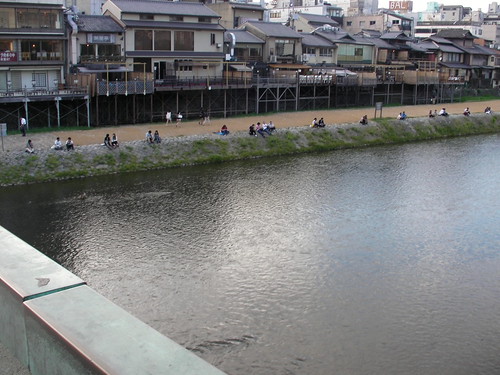
Kyoto is the exception but then Kyoto is also the second biggest tourist attraction in Japan (after Tokyo) which has presumably been influenced by Western culture. Western tourists may have promoted the construction of restaurants along side this river. I think that other cities may achieve increased inbound tourism if they followed suit.
I found that Kyoto citizens had a habit of ignoring red pedestrian traffic signals when there are no cars coming. In my experience, Japanese pedestrians wait, as is the law, even if there are no cars in other parts of Japan. I wonder if this Kyoto dwellers' behaviour is influenced by gaijin too.
Labels: japan, japanese culture, nature, nihonbunka, 日本文化, 自然
Thursday, September 13, 2012
Popteen Gals: The face of Japan

I gradually lean further towards the beauty in averageness hypothesis which holds that people find prototypical faces beautiful perhaps because they are easy to process (Winkielman, Halberstadt, Fazendeiro, and Catty, 2006). According to this theory, exposed as they are to both Asian and American images of beauty, the Japanese will become increasingly attracted towards and aspiring of the Asian-Caucasian average, mid Pacific, GAL looks. And here above they are, in all their average glory.
Images copyright Popteen magazine and their copyright holders. The above image is a screen shot of the result of searching for "Popteen" (ポップティーン) on Google images.
Bibliography
Winkielman, P., Halberstadt, J., Fazendeiro, T. & Catty, S. (2006). Prototypes are attractive because they are easy on the mind. Psychological Science, 17. 799-806. Retrieved from psy2.ucsd.edu/~pwinkiel/winkielman-halberstadt-fazendeiro...
Labels: eye, fashion, female, image, japan, japanese culture, nihonbunka, 日本文化
Monday, August 20, 2012
Manga-esque Mannekins

But the Japanese have Mannequins also partly because the Japanese are sort of animistic, or ego invested in their bodies to the extent that if there were a Japanese looking mannequin it would be so creepy that they would feel oblidged to greet it, or give it a funeral (like dolls) before throwing them away. Other ways of having mannequins that are acceptably non-human is to have headless mannequins or, recently, the manga-esque mannequins like those above. They also have ones with, to Western eyes, have very creepy expressions but in all cases I think it is important that the mannequinns be human enough to model the clothes, but not so realistic as to make the shoppers feel that the mannequins were human. I think that one of the reasons why Western mannequins are now less popular is due to the fact that with increasing numbers of westerners living in Japan, such manequinns, and indeed foreigners themselves, have started to look human.
Labels: japan, japanese culture, nihonbunka, 日本文化
Thursday, August 09, 2012
Face and Culture

In line with Yuki's research (Yuki, 2007), East Asians focus more upon the eyes while Westerners focus more upon the mouth while judging emotion. As Yuki (ibid) points out this difference can be seen in the way that Japanese and Westerners write emoticons as :-) or ^-^ for a happy face in the West and Japan respectively.
When it comes to facial recognition (Blais, Jack, Scheepers, Fiset, & Caldara, 2008), however, it is Westerners that focus more on eyes, and mouths, whereas Japanese focus more on noses (above left, where the parts of faces that Westerners concentrate on is shown in red, and the parts of faces that east Asians stare at is shown in blue). What is going on?
Are there parts of the face that are invariant and representative of character and personality and others that are temporallly variable that are used to convey emotion. If so do Japanese identify themselves and others with their noses!? This might explain the way that the traditional Japanese robber wore a scarf that concealed his nose but not his eyes or mouth. This is not the interpretation proposed by this research team.
Using a "spotlight" technique that allows subjects too see only what they are focusing upon however, Caldara, Zhou, & Miellet (2010) show that while East Asians look at people's noses when they can see normally, when they can only see what they are staring at, they look at eyes and mouth in the same way as Americans. In other words, when East Asians look at noses they are probably looking at the same facial parts but they are doing it wholistically (Masuda & Nisbett).
This centrally focused wholistic processing was found to extend to recognition of sheep faces and even of non-facial, or not very facial objects (Kelly, 2010) and these cultural tendencies are found to get stronger over ages 7-12 demonstrating that they are a result of nurture rather than purely nature (Kelly et al., 2011).
Image from Professor Caldara's website
www.socialinteraction.gla.ac.uk/pdfs/culture_faces.pdf
Bibliography
Blais, C., Jack, R. E., Scheepers, C., Fiset, D., & Caldara, R. (2008). Culture Shapes How We Look at Faces. (A. O. Holcombe, Ed.)PLoS ONE, 3(8), e3022. doi:10.1371/journal.pone.0003022
Caldara, R., Zhou, X., & Miellet, S. (2010). Putting Culture Under the ‘Spotlight’ Reveals Universal Information Use for Face Recognition. (J. Lauwereyns, Ed.)PLoS ONE, 5(3), e9708. doi:10.1371/journal.pone.0009708
Jack, R. E., Blais, C., Scheepers, C., Schyns, P. G., & Caldara, R. (2009). Cultural Confusions Show that Facial Expressions Are Not Universal. Current Biology, 19(18), 1543–1548. doi:10.1016/j.cub.2009.07.051
Kelly, D. (2010). Culture shapes eye movements for visually homogeneous objects. Frontiers in Psychology. doi:10.3389/fpsyg.2010.00006
Kelly, D. J., Liu, S., Rodger, H., Miellet, S., Ge, L., & Caldara, R. (2011). Developing cultural differences in face processing. Developmental Science, 14(5), 1176–1184. doi:10.1111/j.1467-7687.2011.01067.x
Yuki, M., Maddux, W., & Masuda, T. (2007). Are the windows to the soul the same in the East and West? Cultural differences in using the eyes and mouth as cues to recognize emotions in Japan and the United States. Journal of Experimental Social Psychology.
Labels: japan, japanese culture, nihonbunka, 日本文化
Wednesday, August 01, 2012
Cyclist Hand Signals in Japan: Their absence


The other thing I note is that I have never seen a Japanese cyclists make a hand signal! At least I have never seen a university students make a hand signal and this despite the fact that most of the students at my university commute by bicycle, and that most Japanese children are taught hand signals at primary school.
On the face of it, this phenomenon or the lack of it, is very bad for my theory that the Japanese interpersonal and intrapersonal communication particularly emphasises vision. Regarding the lattter intra-personal communication or "communicating to oneself", the Japanese do clearly engage in visual self-communication in the form of the finger pointing checks (please see my video) by transportation workers, and by baseball player Ichiro when he comes to the plate. These finger and bat pointings raise the pointers awareness of what he has done or is about to do and correspond, I believe, in large part to, self directed speech among Westerners. Western train drivers are encouraged to "call the road" saying the names of the colours of the signals that they pass for instance, but attempts to introduce finger pointing checks to Australia failed, despite dramatic increases in safety through their use in Japan.
So why don't the Japanese use cycling signals? Some factors include the fact that most Japanese ride on the pavement rather than the road, using low cross bar "shopper" (or "mother") bicycles at lower speeds. The need for singals increases with speed and the use of roads. But even in the busy roads in my university, I have yet to see anyone signal prior to a turn, and many perhaps most cyclists do not even look behind them either.
Another reason for this to my Western eyes, absurd, behaviour is the emphasis on "paying attention to what is in front of you (先方注意)" treated in a seperate post. As long as Japanese pay attention to their field of responsibility, their visual field in front of them, they feel, and Japanese law to a great extent requires, that it is up to others to ensure that they do not hit the cyclist from behind, even if they turn without making a signal or looking around.
Other possibilities include embarassment (but this was stated as a resason for the Australian train drivers dislike of finger pointing), and a need for visual-self-consistency, and visual-control which I think explain the lack of dancing in Japan (unless very practiced) and perhaps for lack of attention to and use of facial emotional expressions at least around the mouth (Yuki, Others).
A further possibility is that visual signals are thought of as being in some way private, intended for oneself, and people to whom they are addressed (second persons) rather than for otherS in general.
This possibility might mirror and reverse the claim (Nakajima) that in Japan spoken language, in the form of public announcements and signs, is encouraged when public but discouraged when private such as when private opinions are not to be made public in Japanese classrooms, or when mobile phones are not to be used on Japanese trains.
It is possible that there is a Nacalian reversal where Western visual signs are to be made only publically and not to second persons or to oneself. Certainly as already pointed out, finger pointing checks (a visual sign to self) is thought comical in the West, as is the practice of pointing at ones nose to indicate oneself.
This lack of a phenomena needs more thought. In the meantime I must be careful when following Japanese cyclists.
Images
Upper image "Left turn by ♔ Georgie R shows a cyclist signalling to turn left in my native UK.
Lower image: Found unattributed on a Japanese blog, please contact me via the comments below to have it removed. 影像取り下げ希望でありましたら、下記のコメント欄かnihonbunka.comのメールリンクからご連絡ください。
Labels: japan, japanese culture, occularcentrism, self, specular, 日本文化
This blog represents the opinions of the author, Timothy Takemoto, and not the opinions of his employer.