
Tuesday, December 10, 2013
Like a Snow Goggle Doguu: The Origin of Purikura Volume Eyes?

This characteristic, enlarged shoulders, chest and hips, and small hands and feet is shared by Japanese Snow Goggle Doguu figurines from the Joumon period. However what of their massive slit eyes? Some have suggested that they represent the snow goggles worn by Inuit (e.g. Kraus, 1953). Others that they represent the masks of visitors from outer space.
I suggest however that the large size of the eyes in these figurines is explained by the one of the commentators (Elkins, a detractor) on Dr. McDermott's paper who wrote, that if palaeolithic figurines were indeed of autogenus (first person) views then there should be examples resembling the famous first person view by Ernst Mach (1893) above bottom right, which show an enlarged eye and nose. Snow goggles do not especially enlarge the eyes but this figurines eyes are several times larger than anatomical eyes.
My wife tells me that such is the size of a typical Japanese nose it does not impinge upon the the visual field nearly as much as my or Max Ernst's Germanic nose. Likewise being less deep set, it is far more difficult for Japanese to see their eyes. However, if one happens to allow ones eyes to close a little, or even a lot, then one becomes aware of the enormous size of ones eyes that expand to be larger than the breadth of the horizon. Ones visual field, which can itself be considered a self view, may be bigger than mount Fuji if you happen to be looking in that mountain's direction.
These snow goggle figurines may be men. I see myself in the shape of the dogu. And while I am normally unaware of seeing my eyes, I can become aware of them, my self person view, and the visual field itself, that one sided disk that Max Ernst claimed to be the basic stuff of the world. Normally I have lost my disk (Borges, 1975), but looking through the slits of my eyes, helps me to find it.
I think it is clear that we are only dimly aware of our view of the orbits of our eyes and noses, since even in the work of artist that paint or draw first person views the humongous nose and eyes are very rarely represented as can be seen in this gallery. We in fact see our nose twice, semi transparent, pointing in towards, in my close to the centre of our visual field (as seen in this gallery). That fact that one sees two noses, one from each eye, may explain the reason why the figurine above has a cleft nose. You can see the vast orbit your eyes if you narrow your eyes like a snow goggle dougu.
Moving away from artistic representations of self, an awareness of first person views of self is promoted in meditation, most notably that of "The Headless Way," but also, traditionally in Zen. In the Pictures of the Ten Bulls, where the bull represents the experience of the true self, it is "his big nostrils [that] cannot failt to expose his presence.". The promotion of the awareness of the orbits of our eyes, and edgeless darkness surrounding our visual field, may be the reason why Zen meditation is carried out with the eyes half open (e.g. Austin, 1999), and why Zen philosopher Kitarō Nishida drew his "pure experience" (junsui taiken) as concentric circles (see Heisig, 2004, p.8) the outer most of which has no boundary.
The awareness of the large size of ones eyes from a first person perspective may also encourage Japanese women, wishing to present themselves as pure, to enhance the size of their eyes in gal make up, and purikura auto-photography. The eyes are nearly the window frames of the soul.
www.us.penguingroup.com/static/html/features/latino-borge...
Kraus, B. S. (1953). An outline of Japan's prehistoric cultures. Memoirs of the Society for American Archaeology, (9), 12-16.
Heisig, J. W. (2004). Nishida's medieval bent. Japanese journal of religious studies, 55-72.
Mach, E. (1897). Contributions to the Analysis of the Sensations. (C. M. Williams, Trans.). The Open court publishing company. Retrieved from www.archive.org/details/contributionsto00machgoog
McDermott, L. R. (1996). Self-representation in Upper Paleolithic female figurines. Current Anthropology, 37(2), 227–275. Retrieved from www.ucmo.edu/art/facstaff/documents/Self-Representationin...
Reprinted from CURRENT ANTHROPOLOGY published by the University of Chicago Press. Used with permission.
© 1996 by Wenner-Gren Foundation for Anthropological Research. All rights reserved.
Portions of this text may be used and shared in accordance with the fair-use provisions of US and international copyright laws and agreements, and may be archived and redistributed in electronic form, provided that this entire notice, including copyright information, is carried and provided that the University of Chicago Press is notified and no fee is charged for access. Archiving, redistribution, or republication on other terms, in any medium, requires the prior written consent of the University of Chicago Press.


Saturday, December 07, 2013
Get a Third Person to Stare back at You

From a distance wordy, logocentric Western culture can look rule bound, "A society based upon manuals." However, even in the case of McDonalds, the genuine objective of the manual is to go beyond the manual - the manual is only a stepping stone - to "TLC" or Tender Loving Care.
Like wise, from a distance, Japanese society can appear to be "stuck in the mould," formulaic, in so far as so many Japanese praxes emphasize the learning of set forms or "kata." But the objective in so doing, is to go beyond the forms.
So, if in both cases, both Americans with their manuals and Japanese with their forms intend to go beyond them, why do they have them at all?
My answer is that the real reason behind the Western fascination with books and language, is that language provides a generalized other, the ability to take an objective third person perspective upon self.
And the real reason by the Japanese fascination with kata is, as the red "belt" of this book (written by the editor at BAB Japan, as a summary of the contents) claims, that through the practice of a martial art one obtains a third person perspective that stares back at you, a gaze apart (Riken no Ken Zeami), a Mirror in your Head (Heine et al.)
Archimedes said, "Give me a fulcrum, and I shall move the world." I say, give me a third person perspective, and I will create a self. It is about time I started learning Karate.
Labels: japan, japanese culture, Jaques Lacan, nihonbunka, 日本文化
Tuesday, December 03, 2013
Be as Mount Fuji, with a Silent, Attentive, Mirror Mind

This picture bears the words
"When facing up to your opponent before a fight, be attentive (lit distribute your "ki" mind/attention) with a silent mind, and be as Mount Fuji (make the shape of Mount Fuji your own form)."
This picture stands in the entrance hall to the gym where my son learns karate. The caption translated above, expresses the essence of Japanese martial arts and thought. First of all there is the emphasis on the importance of facing off. The fight is won and lost - or better still avoided - in this period before it commences which is typically far longer than the fight itself which it is often over in seconds. I would like to draw attention to several aspects of this pre-fight period.
The pre-fight "tachi ai" period involves both intimidation and analysis. There is no better result than the ability to stand with such bearing as to encourage your opponent to admit defeat, or loose confidence to the extent that the fight is a foregone conclusion. Further that this period of mutual analysis and intimidation involve standing facing the opponent. The significance of this will be considered below.
Mental activity within the pre-fight 'tachi-ai' period should be conducted in silence. I believe that this injunction is specifically directed towards the cessation of all self-narrative, hearing oneself speak, asking oneself questions and replying to them (自問自答), dialectical thought and all other types of linguistic thought.
The next injunction is to be attentive or literally to spread out ones "ki" (attention, mental energy, focus, consciousness) The use of ones "ki" in this way is the core of martial arts and Japanese thought. There are numerous expressions involving "ki" including to be careful (ki wo tsukeru, "attach ki"), be keen on (enter ones ki, ki ni iru), loose consciousness (ki wo ushinau, loose ki).
I suggest that the use of ki is the direct counterpart to Western narratival-self and that it is used for similar things, specifically for helping us to gain a theory of mind, and in this particular instance, read our opponents mind. Westerners use reason to ascertain how other people are thinking. By thinking we put ideas up in the courtroom of the mind for inspection by another, Reason, a super addressee, a generalised other, and in so doing understand how others feel about our predictions.
The Japanese on the other gage how others will behave more directly, by using their ki. There have been books written about ki and I have read one one of them. Since the use of ki is clearly a non linguistic activity, the use of further words to describe it may be in vain. I and others who wish to understand the use of ki, need above all do it. But, counter productively perhaps, I would like to add one more exposition and suggest that using ones "ki" is using ones mirror neurons. Mirror neurons allow us to model seeing, ourselves, are activated when we look at a mirror, and are activated when we look at other people, telling us, by activation of the same neurological states in us as in the object of our vision, what we would be thinking and intending to do if we appeared as the person we are facing.
Finally, there is the injunction to make of our own form the form of Mount Fuji. This echoes the advice of a Buddhist priest to a sumo wrestler, and numerous other philosophies of martial arts (such as Miyamoto Musashi's Book of Five) rings which encourage the practitioner to become as some natural object, animal, element, or in this case the biggest mountain in Japan.
Going for the bulls-eye and concentrating first upon the apparent mismatch in size between our warrior and the tallest mountain in Japan, I think that this draws attention to East Asian Spiritualism in the literal sense: (唯心論) the assertion that there is only mind or spirit. Similar assertions appear in the psychologism of Ernst Mach (1902), or the immaterialism of Bishop Berkeley. At base all things can only be experienced, are only present to humans or other sentient beings, song long as they partake in that sentience, become a part of that consciousness. Thus, the apparent mismatch between the size of mount Fuji and the warrior is only apparent. When warrior realises his true nature as consciousness, then he will be aware that Mount Fuji, the largest thing that he can imagine, is only a part of himself. This realisation, and the falling away of bodily identifications that accompanies it, can give the warrior tremendous courage and strength.
Finally, but less importantly than the realisation I attempt to express in the previous paragraph, the visual identification with the mountain has the dual effect of positive self-speech. Identifications with natural phenomena allows the warrior to tap into and identify with all the meaning and affect associated with the symbol. And at the same time, through his bearing thus effected, strengthen, calmed, drawn to full height, convey the same, wordlessly to the opponent who is also using their ki, or mirror neurons, to see what is on
their opponents mind.
お取り下げご希望でありましたら、下記のコメント欄かnihonbunka.comのメールリンクからご連絡いただければ幸いです。
I can not read the artists name. It looks like Shinya Suzuhiromatsu 鈴廣松臣也 but I am not sure, and would like to be corrected. The picture is dedicated to Hajime Matsumura the head of the Yamaguchi Kendo association and 'other comrades in arms', who are the main users of the same gym, or doujou 山口隣保館別館・和光剣心塾道場).
Mach, E. (1902) The Analysis of Sensations, "Not the things, the bodies, but colours, sounds, pressures, times (what we usually call sensations) are the true elements of the world." p. 23, as quoted in Lenin as Philosopher: A Critical Examination of the Philosophical Basis of Leninism (1948) by Anton Pannekoek, p. 454
Labels: image, japan, japanese culture, martial art, nihonbunka, specular, 日本文化
Monday, December 02, 2013
Dialectic my Drum (日本人は「日と」)

Taiko for example, are some of the biggest drums in the world, played in groups with the most gusto of any traditional instrument and are so loud that they seemed to be drumming inside my head. The fireworks that signal the start of Japanese festivals likewise are just plain loud. Likewise the shouts of Japanese cheer leaders who bend over backwards to get as much sound as possible out of their throats. The shouts of people carrying festival palanquin floats (お神輿) and those of Japanese baseball players in training, or during their matches too, are not designed to convey any meaning.
All these loud noises are appreciated because they are loud and they are loud, so as to obliterate the logos, that impurity or "auto-affection" in the mind, so that the mind is left, like the face of the drum, on fire, a mirror, a circle of light.
Some (e.g. Hamamura, Heine, & Paulhus, 2008) claim that Japanese are tolerant of contradictory beliefs because they are "dialectical." I don't think that this is an apt description. Boom. There are no dialectics going on here! Boom! This man's mind burns like the sun! Boom, boom, boom!
Image: An amalgam of Taiko by John Nakamura Remy and Taiko by Takashi Toyooka. Thanks to the former for the "mind on fire" also.
The "Hito" "日と" with the sun, pun belongs to Kurozumi Munetada the founder of the Kurozumi Sect of Shinto.
Hamamura, T., Heine, S. J., & Paulhus, D. L. (2008). Cultural differences in response styles: The role of dialectical thinking. Personality and Individual Differences, 44(4), 932–942.
Labels: japan, japanese culture, nihonbunka, 日本文化
Sunday, December 01, 2013
Westerners are Homonarans (欧米人は人言)


Lacan famously said that the unconscious is structured like a language. I have not the foggiest what he meant but he may have meant the way in which, as demonstrated by Asch(1946) and Rosenberg et al. (1968: in Okuda 1997), Westerners understand the world, and make evaulations based upon, how language understands the world.
The above shows a two dimentional model of personality from Rosenberg 1968, showing that some character traits are considered close to eatch other in four groupings (1 skillful, industrious, important, practical, trustworthy, honest, serious, decisive, scrupulous, 2 Fun, popular, sociable, warm, good natured, humourous, 3. frivolous, insignificant, untrustworthy, dishonest, not fun, 4. Irritable, Humourless, unpopular, cold, unsociable). These are groupings of the meanings of words, but Westerners tend to make evaluations based apon such groupings. Hence, as demonstrated by Asch (1946), if someone is described as being A.intelligent skilful industrious warm determined practical cautious, as opposed to B. intelligent skilful industrious cold determined practical cautious with only the central warm changed to cold - then they are far more likely to be judged to be good natured with the ratio of people judging them to be so dropping from 94% to 17%.
Doing this in Japan however, we find that people are far less likely to change their opinion based on the change of only one adjective.
East Asians are far more tolerant of linguistic contradiction (see Heine, 2001 for a review). E.g. in a famous study, Peng and Nisbett (1999) analysed for instance evaluations of contradictory Yiddish proverbs (which are common in both China and Japan) and found that Chinese are far more likely to positively evaluate contradictory proverbs. Peng and Nisbett, call this tendency of Asians not to require that evaluations conform to the dictionary dialectical thinking. In my own view it is rather more just that Chinese and Japanese are far less likely to be thinking in language (as demonstrated by Kim, 2002) and are probably imagining the situation. If you do imagine the situation then the platitudes that Westerners are fond of such as "cold people are not good natured" "Warm people are good natured" do not always play out. If you imagine people you know, you will find there are people who are cold in the presentation of their emotions, but who are also good natured in their acts.
Some examples of Japanese (and possibly Chinese) proverbs with contradiction include : Free is the most expensive(ただが一番高い). Friendship ends when the money runs out(金の切れ目が縁の切れ目). Mercy/Compassion does no-one any good (情けは人の為ならず). You should know that suffering is the seed of happiness, happiness is the seed of suffering. (苦は楽の種、楽は苦の種と知るべし,徳川光圀). Suffering and happiness are like an endless ring (禍福は糾える縄の如し. Yes! God I hate positive psychology!).
As Japanese are Westernised, they are encouraged to bring their thinking more in line with language, and not to think in "illogical" contradictory ways. And since language always thinks in the same way, the Japanese are also being encouraged to think like sheep (Leuers & Sonoda, 1999).
Asch, S. E. (1946). Forming impressions of personality. The Journal of Abnormal and Social Psychology, 41(3), 258. Retrieved from psycnet.apa.org/journals/abn/41/3/258/
Heine, S. J. (2001). Self as cultural product: An examination of East Asian and North American selves. Journal of personality, 69(6), 881–905. Retrieved from onlinelibrary.wiley.com/doi/10.1111/1467-6494.696168/full
Kim, H. (2002). We talk, therefore we think? A cultural analysis of the effect of talking on thinking. Journal of Personality and Social Psychology. Leuers, T. R., & Sonoda, N. (1999). Independent self bias. Progress in asian social psychology, 3, 87-104. Peng, K., & Nisbett, R. E. (1999). Culture, dialectics, and reasoning about contradiction. American Psychologist, 54(9), 741. Retrieved from psycnet.apa.org/journals/amp/54/9/741/
Rosenberg, S., Nelson, C., & Vivekananthan, P. S. (1968). A multidimensional approach to the structure of personality impressions. Journal of personality and social psychology, 9(4), 283. Retrieved from psycnet.apa.org/journals/psp/9/4/283/
奥田秀字. (1997). 人をひきつける心: 対人魅力の社会心理学. 東京: サイエンス社.
Labels: japan, japanese culture, nihonbunka, 日本文化
Thursday, November 28, 2013
It was the Neck-tie! Culture and judgement of Causal Relevance

Choi and his collegues (2003) asked Korean and US subjects to consider a murder incident where a student had murdered his research supervisor. They were then shown a list of 40 factors and asked which of them were irrelevant in terms of motive.
The list included items such as the following: "The professor rejected the student's graduation thesis," "The professor criticised the student in front of others," "The professor used a PC not a Mac," "The graduate student did not like the professors' neck-tie." It was found that while North Americans considered only the big life changing factors (such as failing the student's thesis) relevant, the Korean subjects were significantly less likely to strike other items off list, considering in some case, factors such as the colour of professors' tie to be a contributing factor in the occurrence of the murder.
First of all, despite what Westerners say, I think that the Koreans are not being unrealistic. Take the weather for instance. The hero of Camus' The Outsider ended up killing an Arab partly because it was a hot sunny day, and there is well known relationship between elevated temperatures and violent crime. When conflict is brewing, the fact that it is a hot day can be the final straw.
Choi et al. (2003) explain East Asian sensitivity to the complexity of causality in terms of Masuda and Nisbett's (2001) brilliant theory of analytic and holistic thought. The Koreans are being holistic and taking more factors into consideration.
What Choi does not often mention (I asked him at a conference) is that when the method was reversed, and Koreans were asked, after they had imagined the murder, which factors out of this list are relevant, then they chose no more factors than the Americans. Why is this? Why do the Koreans cease to be more 'holistic' when the choice is presented in this way?
My answer is, as always, that the cultural divide hinges on the relative importance of language and vision. Westerners decide that a factor is relevant if they can construct a compelling narrative for the killing. "He murdered his professor because his professor failed his graduation thesis" is compelling, but "He murdered his professor because he did not like his tie" sounds like a joke.
The Koreans on the other hand are trying to get their imagination around the event, putting themselves into the position of the student. Using their visual imagination they can therefore neither reject factors which it is suggested were present - such as the weather, or the neck tie which might have been the breaking point - nor include factors which they had not imagined. This is because, in both Korea and Japan, language is subservient to vision. Language describes the visual world. On its own it is a lot of bumf (rikutsu).
Bibliography
Camus. A. (1942) L’Étranger. Libraire Gallimard.
Choi, I., Dalal, R., Kim-Prieto, C., & Park, H. (2003). Culture and judgement of causal relevance. Journal of personality and social psychology, 84(1), 46. Retrieved from psycnet.apa.org/journals/psp/84/1/46/
Labels: culture, image, japan, japanese culture, Jaques Lacan, Nacalian, nihonbunka, occularcentrism, 日本文化
Marmalade in Japan: From a Nacalian Perspective
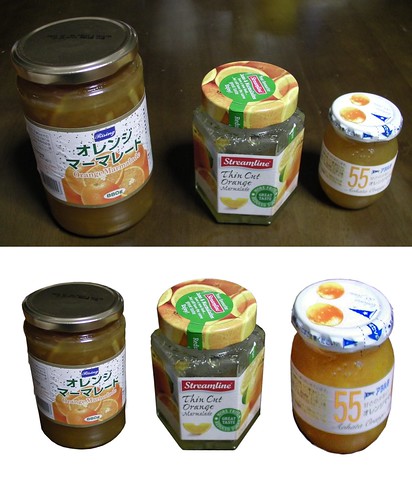
Displayed above are, from the left, 880g of Egyptian orange marmalade at 198 yen, 400g of Danish orange marmalade at and 398 yen, and 45g of Japanese tangerine marmalade 298 yen.
The Danish is my favourite since it is low in sugar. I feel sorry for the Egyptian children who, so keen to get their hands on Sony Playstations perhaps, must forgo their marmalade in this quantity.
The Japanese marmalade is so expensive because of higher labour and land costs, and because Japanese people trust the quality of products that are made within their shores. But this is getting ridiculous. The price per gram of marmalade is: Egyptian .22 yen, Danish 1 yen, Japanese 6.6 yen. In other words the Japanese marmalade is almost exactly 30 times more expensive than the marmalade imported all the way from Egypt!
In addition to the genuine quality of Japanese marmalade, I sense that other factors are a work.
First of all the size of the Egyptian Marmalade jar may work against it due to the "mottainai" feeling-of-wastefulness that it is likely to invoke in Japanese consumers. Most Japanese marmalade purchasers would think twice about buying such a large jar due to the fact that they would foresee having to throw much or most of it away when, unable to finish it, it starts to rot. That Japanese feel this sense of waste so keenly is due to their greater 'animistic,' Nacalian identification with the visual world.
Secondly, most Japanese, identifying in this way as they do far more with their body image, they are keener to avoid obesity. If on the other hand, you think you are your 'mind' ( self-narrative) then you are more likely, like me, to indulge in a little, or a lot of, marmalade.
Thirdly not only are smaller jars, like smaller Japanese bowls and food servings in general, a major reason for the absence of the pudgy marmalade mouth and beef-burger bottom, they are also made possible again by the Japanese tendency to remain in the living, visual present. The 'imaginary' (in Lacan's terms, for the Japanese sight is a lot more concrete) contains no scale information. A bonsai tree if cultivated and trimmed well, looks the same as a giant oak, if you get up close. A Zen garden looks like an inland sea (Stein, 1990). An a tiny pot of Japanese marmalade can present the same visual content as a massive Danish or Egyptian jar (see the lower row of images). As long as you stay away from symbolic considerations of size and weight ("880 vs 45 grams!)" you can see the world in a pot of Japanese marmalade.
This may explain why the Japanese are fond of moving their rice bowls near to their mouths, or rather their eyes, since up close everything looks bigger. It may also explain part of the sushi-grasp (sushi wo tsumamu) praxis noted by Kitayama (his book, 1995-ish); a sushi in the hand is bigger than a whole fish on the plate.
Finally, there is a degree of exclusive mistrust of things that are not Japanese. Some claim that this is because the Japanese are 'deep and profound' racists xenophobes but some foreign companies do attain trust (such as Louis Vuitton) . It is just that trust be earned through (visual) experience, rather than through (linguistic) promises and the acceptance of the threat of (linguistic) litigation.
Lacan argued that humans pass through the mirror stage, in which they identify with their image, to the symbolic where they identify with language. Nacalianism turns that on its head, in Japan.
Blake. W (1863) "Auguries of Innocence" http://en.wikipedia.org/wiki/Auguries_of_Innocence
Labels: japan, japanese culture, Nacalian, nihonbunka, 日本文化
Wednesday, November 27, 2013
Brought to the Courtroom

Japanese people are less likely to adorn their desk at work, or the shelves in their homes with pictures of their relatives, with one exception. Pictures of deceased relatives are often hung above the ancestral altar. This is because, I believe, pictures of people are felt to be so real that it is almost as if they are felt to be present in their picture, as they are felt to be present also inside the altar. Another example of this use of photographs to represent the deceased is the way in which surviving family members of victims and plaintiffs bring pictures of deceased relatives to Japanese courtrooms.
In the above photo (Asahi Newspaper, 17th April, 2013, Photograped by Nishibatake Shirou) Akio Mizoguchi has brought a picture of his mother, deceased, to the High Court of Japan, where it was decided that she was indeed a victim of minamata disease. Mr. Mizoguchi is shown celebrating his, and his mother's victory in the court case. He has brought the photo of his deceased mother so that she may share in the proceedings and eventual victory. Similarly, pictures of deceased victims are sometimes brought by their relatives to murder trials. These behaviours go to demonstrate that contra Westerners, who are meant to grow out of their "mirror stage," the Japanese continue to identify with images even in adult life, and even, in the case of others, post death.
The strong identification between visual images and person hood also explains why so many Japanese ghosts are felt to emerge from images such as hanging scrolls (1,2) lanterns (1,2, 3) and more recently television sets.
取り下げご希望でありましたら、下記のコメント欄またはnihonbunka.comのメールリンクからご連絡いただければ幸いです。Should anyone wish that I remove this image from the Internet, please post a comment below or send an email to me via the link on my homepage, nihonbunka.com.
Labels: autoscopy, culture, image, japan, japanese culture, Jaques Lacan, lacan, mirror, Nacalian, occularcentrism, religion, ring, ringu, specular, 日本文化, 自己視
Tuesday, November 26, 2013
JapanAmerica

Steven Heine's extensive research has shown that the most robust distinction between Americans and Japanese is that the former are full of it - they praise themselves and others way out of proportion to reality. While American's engage in this linguistic ego massage, which in the USA is said to promote health, wealth and well-being, the Japanese have been, traditionally, if anything, linguistically self-critical. The greatest advantages of being self-critical is that it facilities self-improvement. Japanese reflect upon their own flaws (hansei) and then get ride of them (kaizen).
Alas, however, such is the hegemony and attraction of Western culture, (the bs, the auto affective self-narrative) that the Japanese are reading and publishing books instructing mothers to take it easy, get into "co-chingu" and above all indulge in praise, since praise is what decides how happy you are going to be. Praise, praise praise.
They are also writing books that trash upon the last bastion of Japanese culture - Japanese industry - since Japanese industry is not nice to young people -- such as for example, Tadashi Yanai (2009) who (rather than "praising") encourages himself and others to forget their successes as soon as they have achieved them.
Soon alas they may forget how to be Japanese, and end up as really low-grade Americans, since however much they practice they are never going to catch up with us. I grew up with people who are centuries ahead in their skill at auto-ego-massage. I think that if the Japanese go down that route, they are going to get right royally shafted. While it has its drawbacks, the only Japanese way forward is to hansei and kaizen.
The other thing that these JapanAmericans are forgetting is that while their words were always self-critical in the past, the Japanese have traditionally loved what they themselves looked like. They were quite positive enough without all the "self-enhancement".
Labels: japan, japanese culture, nihonbunka, westernisation, 日本文化, 欧米化
Change That Face, Why don't You?

This advert (from the Asahi National Newspaper) for Biteki Magazine asks Japanese readers why they don't change 'that' (their) face, presumably to be more like the tri-racial cover model, Rola, pictured, using "mimic makeup" which will achieve a 80% actress face.
It also says "Now, complex solving make-up is great," which taken together might suggest, and indeed promote, the notion that Japanese who look Japanese should have a complex about that, or in other words that they should feel psychological pain. Indeed, Rutgem Kowner's research (Knowner, 2004) has already shown that Japanese who look Japanese consider themselves to uglier than those that do not, and this despite the fact that the Japanese are the most beautiful people in the world (imho).
Imagine if there were a similar advert in a British newspapers, asking Britons why they don't change their face to make it look more like that of an Asian. I hope that day comes, and that the mimicry is mutual, soon.
Labels: japan, japanese culture, 日本文化
Spot the Japanese Culture
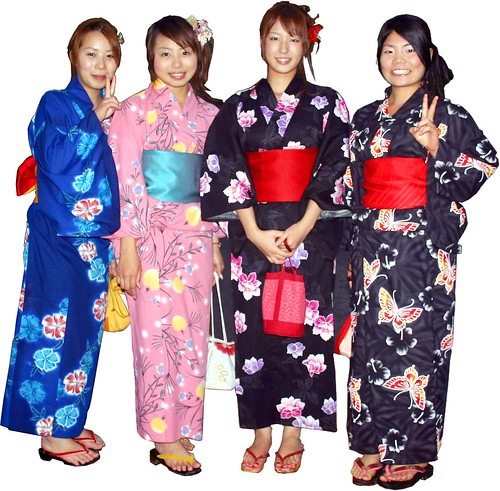
All these things are “Japanese Culture” with a capital “C,” the sort of things that you can learn about at a “Culture Centre.” While These things are also very obvious, or visible, they are not all that common in the everyday lives of Japanese people. How often do you wear the clothes that these girls are wearing?
取り下げご希望でありましたら、下記のコメント欄かnihonbunka.comのメールリンクまでご連絡ください。
Labels: japan, japanese culture, Nacalian, nihonbunka, 日本文化
Wednesday, November 20, 2013
Purikura Enhanced Auto-Photography


Westerners self-enhance linguistically. I believe that the above demonstrates that, in accordance with the Nacalian position of this burogu, Japanese self-enhance (and I don't mean self-improve) in the world of the image.
Labels: japan, japanese culture, Nacalian, 日本文化
Friday, November 15, 2013
Visual Illusion of Uniqueness? After Markus and Kitayama 1991
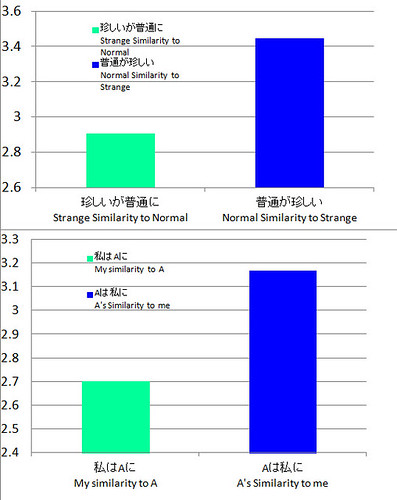
First of all I tested that, as Markus and Kitayama predict, rare things do resemble normal/common things less than the other way around, and (as shown in the graph at the top) it was as Markus and Kitayama predict.
However, I also found that Japanese students felt themselves to resemble others less than others resemble themselves, suggesting an illusion of uniqueness as found among Americans but not Japanese in Markus and Kitayama's study.
This is probably just random because the results are grossly NON significant due to the small sample size (30 students, p=0.4!)
But it could also be because of the experimental method. I have not checked how Markus and Kitayama specified the "other" of comparison, but I am guessing that the other was some sort of abstract other or "others."
I asked my students to pick another student in the same room and have a glance at them. This would have emphasised visual similarity. I am pretty sure that Japanese students are big on visual uniqueness and hate it when for instance someone in the same class is wearing the same clothes as them (it makes them want to go home and change). This is one of the reason why Japanese students do not want to wear insignia sweat-shirts (Yuki, 2003). I hypothesise that if the other of comparison is presented visually then the Japanese will considered themselves to be unique. And perhaps the tendency of Americans, all dressed in their insignia T-shirts, to consider themselves unique will be reduced (but since the question is still a linguistic one, I doubt that there will be a reversal).
I need a bigger sample size.
Yuki, M. (2003). Intergroup comparison versus intragroup relationships: A cross-cultural examination of social identity theory in North American and East Asian cultural contexts. Social Psychology Quarterly, 166-183.
Labels: japan, japanese culture, Nacalian, nihonbunka, 日本文化
Sunday, November 10, 2013
Mammarian Mouse Pads Second-Hand
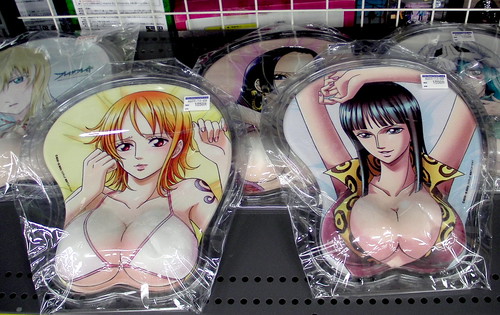
Why is it that the Japanese are more able and willing to produce products of this type?
The Japanese are better at visual design since they identify with their self-image to a greater extent.
The Japanese are more interested in visual designs since, following on from the above, bodies, even plastic and virtual ones are felt to be animate.
Japanese men are also less repressed about their sexuality and admiration of breasts. In Japan there is no such thing as that fantasy, 'the gentleman' who has 'transcended' his sexual desire. Japanese men believe themselves to be and are believed to be male qua male, and as such admirers of breasts.
But who wants to purchase a mammarian mouse pad second hand?
Labels: image, japan, japanese culture, nihonbunka, sex, 日本文化
Monday, November 04, 2013
Terminator 2: Judgment Day

"Terminator 2: Judgement Day" is a great movie. I saw it in a theatre in Okayama City when it came out in 1991, and felt it to be representing a conflict between Japanese and American heroes.
The American hero, a T-800 robot played by Schwarzenegger had been the antagonist in Terminator 1. In Terminator 2, however, Cameron turns Schwarzenegger's T-800 into a robot that wants to be human, a soccer dad, sent to protect a boy by himself in the future. "It" is a 'little tiny, fragile, ceramic wafer' within its own head. Rational but caring, and ultimately self-sacrificial, T-800 struck me as the logos on steroids.
But I was rather rooting for the T-1000. Much more beautiful, cat like, and in appearance feminized (and good at impersonating women) but all in all much stronger, braver, and more advanced. The T-1000 speaks little but can imitate anything, and made of some sort of reflective material: a mirror made flesh that dwelt amongst us.
Since it was an American movie, the beautiful, reflective T-1000 was made out to be the antagonist but perhaps the Japanese could remake the movie with a Japanese actor playing a nice-guy version of the T-1000. In this version the two robots would team up against a Kaiju monster.
Images copyright TriStar Pictures.
Labels: japan, japanese culture, Nacalian, nihonbunka, 日本文化
Japanese Men's Pants are Colourful, Feminized
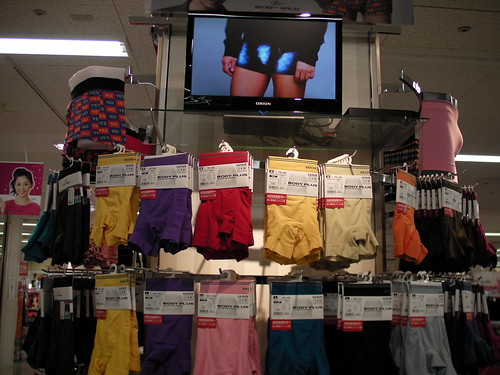
These Gunze pants are for men and are very colourful. They were advertised with copy a "Beautiful body, Wild heart." You can see the video of beautiful men wearing colourful pants here. Matriarchy that it is, Japan converges upon femininity. While they still like to differentiate themselves here by being more "wild," there are plenty of cosmetics for men, there are even man bras .
Some commentators see this feminization of the male form as a recent phenomena (Kuon, 2011) but there is a long tradition of Japanese men dressing in what might be termed feminine clothing. Rearing red underwear recently saw a boom among both men and women, since it was claimed that doing so warmed people up and improves their health and luck (see this online retailer). Japanese men have long been inclined to wear red underwear to battle in pre-modern Japan, and to competitions recently such as when Kouji Yamamoto, the coach of the Japanese World Baseball Classic team, wore red underwear to the WBC tournament - indeed it is said that all the coaches did so (Takayama, 2013).
In Japanese mythology, Japanese heroes and gods have a tendency to cross dress. Amaterasu, the sun goddess dresses as a man, Yamatotakeru, the brave of Japan, dressed as a woman to kill one of his enemies, and Susano'o, the original warrior god, may have dressed as his bride to be (according to one, persuasive reading) to kill the Eight-Forked Serpent, Yamata-no-Orochi. It should also be noted that the Japanese are handed their reflections by the sun goddess - a woman - whose mirror is said to be in all of their minds. That the Japanese do have a mirror in their minds, or heads, has been demonstrated experimentally (Heine et al. 2009).
The feminization of the Japanese male clothing also finds expression in the way in which the soul of Yui Ikari remains in the Eva robotic suit that her son Shinji Ikari controls in the popular anime series Neon Genesis Evangelion. Evangelion explains itself by reference to Lacanian theory - "Mother is the first other," which holds that the first intra-pschic other that is an ontic necessity for the creation of self (see Boszormenyi-Nagy & Framo, 2013 p33 for an overview of similar theories), is an internalisation of mirror which is mother. This blog argues, Nacalianly, that for the Japanese, the mother/mirror is the last other, the one that they take into the world and make their mirror, suited, red-pants wearing selves with.
I don't mean to suggest that Japanese men are any more feminized than Western men, who have a different type of helper.
Boszormenyi-Nagy, I., & Framo, J. L. (2013). Intensive Family Therapy: Theoretical And Practical Aspects. Routledge. Google Books
Heine, S. J., Takemoto, T., Moskalenko, S., Lasaleta, J., & Henrich, J. (2008). Mirrors in the head: Cultural variation in objective self-awareness. Personality and Social Psychology Bulletin, 34(7), 879–887. Retrieved from www2.psych.ubc.ca/~heine/docs/2008Mirrors.pdf
Kuon, S. 久遠さら. (2011). なぜ今どきの男子は眉を整えるのか. 幻冬舎ルネッサンス.
高山通史. (2013, February 28). 浩二ジャパン首脳みんなで赤パン/WBC. nikkansports.com. Retrieved 4 November 2013, from www.nikkansports.com/baseball/wbc/2013/news/p-bb-tp0-2013...
Labels: japan, japanese culture, Nacalian, 日本文化
Sunday, November 03, 2013
Who Needs Guns?
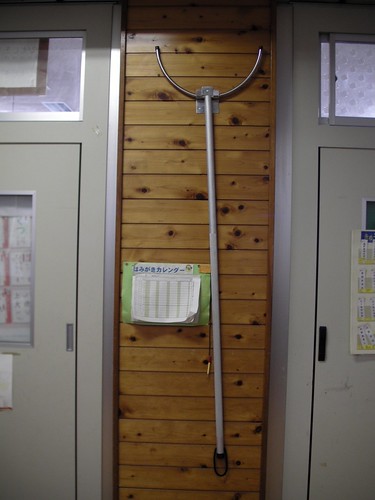
These two pronged forks are attached to the wall of Japanese schools for use in case someone where to come into the school and attempt to kill children.
Since Japan is largely gun free, and swords are likewise restricted by law, the most dangerous weapon that Japanese can get their hands upon is usually a knife. A man, with mental illness, did however break into a Japanese classroom and kill several children with a knife. Mamoru Takuma, since executed by hanging, went on the rampage in Ikeda primary school in Osaka, fatally stabbing 8 children and wounding 15 more, reportedly as a way of having himself killed and exacting revenge on a departed girlfriend.
So at least since that time, these two pronged forks, called sasumata, are kept in schools to enable the teachers to tackle knife wielders by trapping their torso in the prong.
They are especially effective if used by several people from several directions at once, and date back to the Edo Period when likewise guns and swords were illegal among the general population, and the Japanese attempted to apprehend criminals uninjured. These Edo Period sasumata were however equipped with blades or spikes at the U end of the fork to help prevent the criminal from grasping the pole (sasumata).
It is surprising that Japan is not only gun-less but fairly blade-less. Daggers, which are defined as two sided blades, are illegal longer than 5.5cm cm. Most murders are carried out using kitchen knives of which there are plenty. But despite the fact that there are no restrictions on the purchase of one sided kitchen knives, and that they can be had for 1 dollar or more, I know of very few law abiding Japanese that carry or possess blades for use a a self defence weapon. Even a 5.5cm knife would be a significant deterrent if someone came at you with a kitchen knife. The long kitchen knife wielder would win, the victim would probably die, but the attacker would be deterred and sufficiently wounded such that they would not be able to attack many more people. I think that if the victims had small self defence blades, then an attacker would be hard pressed to kill three people since after killing two he would have at least two 5cm wounds in his body.
So why don't Japanese people carry a small self defence blade? Why aren't their such blades in schools?
In line with my usual interpretation of Japan, I suggest that the reason is cultural. There has long been a taboo on blood in Japan. Wounding anyone, especially in such a way as to penetrate their skin and draw blood is an anathema to vast majority of Japanese. There are no guns, few knives, and though many Japanese are karate experts it is even far harder to get yourself beaten up. Why are the Japanese generally so non-violent? There is quite a lot of white collar crime, such as fraud, cartels and other corruption which, though there are a form of violence, are often argued to be forgiveable. I think that the difference lies, as usual, in a difference in what people are thought to be. In the West the body is something that contains the mind. A wound to the body leaves the person intact. In Japan however, as an extension of animism, I believe people identify with their bodies, particularly with their bodily image. Thus to stab someone, to penetrate another's skin, is to penetrate their person. It is a much weightier act, of far greater violence. To deceive another person is however often even a good idea (uso mo houben 嘘も方便) since, contra Westerners, the Japanese do not identify with their self-narrative and words are the mere fluff that allows bodies as people to make jokes to each other.
Labels: culture, japan, japanese culture, 日本文化
Western Mannequins Japanese Rite of Passage
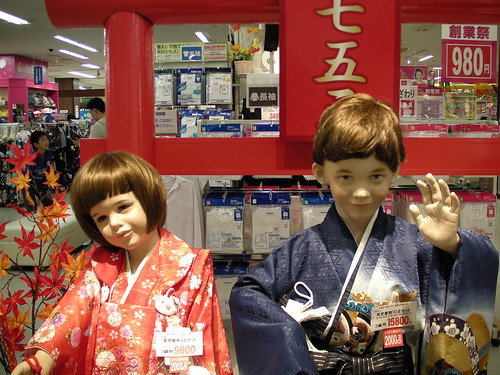
Even the display advertising kimono and hakama (traditional Japanese male formal attire) uses mannequins that are are at least partly Caucasian in appearance.
This is partly because it is cool to look bi-racial, due to the economic influence of the West, and due to the universal human tendency to prefer average faces.
It is also due to the way in which Japanese do not identify with self-narratives but rather with self-images. In Japan it is even more true that "Video Ergo Sum" (Lenggenhager, et al. 2007). If therefore Japanese mannequins were Japanese in feature they would appear eerily animate to Japanese shoppers, as do the status of Buddhas and Gods in Japanese temples and shrines. The use of Caucasian mannequins adds a element of distance, of inanimateness. To the Japanese, Westerners are a little like zombies or Gundam (robotic suits) with with they can identify - possess and control.
Labels: japan, japanese culture, nihonbunka, reversal, westernisation, 日本文化
Japanese Video Game, Western Users
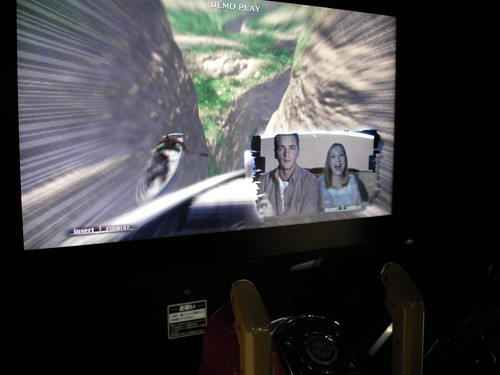
To entice Japanese youth to use this pirate themed Japanese shooting game, a Western couple are shown enjoying its use. Don't Japanese people find this incongurous? Apparently not, and are on the contrary more inclined to identify with caucasians than with a Japanese couple. Other than the influence of caucasian images of beauty, another possible explanation for this use of Westerners is that the Japanese are more animistic, seeing bodies, mannequins and other human effigies, and even things, such as cups of noodles, as animate. If there were Japanese mannequins in Japanese shops then the shoppers might feel inclined to greet them, or wonder who they are. The use of Western bodily images therefore may depersonalise the image to the extent that, rather than being Taro Suzuki and Hanako Tanaka, it is just a body, with which the Japanese observer can identify and inhabit.
Labels: culture, japan, japanese culture, 日本文化
The Curious Cup Noodle
A Japanese variation on basketball arcade game. Instead of throwing mini basketballs through a mini basketball hoop, players are invited to throw balls into a the mouth of a Cup Noodle pot that opens and closes with a tantalising, and rather creepy, smirk. "Ball me!" the pot seems to be imploring. Cup noodles are tasty to humans, small orange balls are tasty to Cup Noodles. The message seems to be in Japan the Cup Noodles bite back. Cup Noodles smile. They are alive. Nissin even produced a Cup Noodle robot to celebrate the 40th anniversary of their invention last year.
There is also something fundamentally strange or incongruous about pot noodle pots even to the Japanese. In a country where to be is to be visible, there is greater expectation for things to be as they appear. Cup Noodles are however, unlike most Japanese food which is eaten with the eyes, in appearances quite unappetizing: a cylinder of expanded polystyrene, industrial lettering, without even an attempted at any imagery that might stimulate the appetite. They are however fairly tasty, and extremely convenient so they have persisted and are sold in great number, all the while arousing a sense of absurdity in their Japanese consumers.
Labels: culture, japan, japanese culture, nihonbunka, 日本文化
This blog represents the opinions of the author, Timothy Takemoto, and not the opinions of his employer.