
Sunday, April 11, 2010
Electronics Graveyard
These days consumer electronics, such as TV sets and refrigerators, do not find their way into the rubbish (garbage), since they have to be taken to recycle centres, in the form of local electronic supplies stores.
Labels: culture, economics, japan, japanese culture, nihonbunka, westernisation, 日本文化


Friday, March 26, 2010
Image and Logos as Sacrificial Supplement
Consider a supplement to a book. It is the bit on the end, extraneous to the main part of the book (and thus of lesser importance) but at the same time may complete the book and by completing the book, be of prime importance. Or again, a vitamin "supplement" is something that is an addition to ones normal diet, that may at the same time contain the minerals and ‘vitamins:' the most important things that the makers of the "supplement" claim we should eat. Or again, there are things that are sacrificed, or made into scapegoats that are at once of lesser importance/value and of prime value. Consider the Jews in Nazi Germany. They were treated as animals, far beneath the "Aryans" but at the same time, by making a scapegoat of the Jews, the Nazis were able to rally the Germans together in the face of the common "enemy within." It could be argued that the Jews, as victims and scapegoats, were the scapegoat that made the fantasy of a pure Aryan race possible.
In his commentary on Plato's Pharmacon, Derrida (On Grammatology) claims that writing, or visual symbols, are a supplement in that sense in the West and that Western philosophers often make use of writing (the visually meaningful) as this kind of supplemental sacrificial, purifying scapegoat. Plato uses writing as an example of impure speech, attached as it is to the visual, and compares it to phonemic language in the mind, which by contrast with written language is claimed to be able to apprehend, or frame, ideas in their purity. Plato speaks of writing as supplemental to phonetic language claiming that it is an imperfect record, in being caught up in the visual world. But Derrida points out that writing has in Plato that other function of the supplement: something which completes by its ability to purify.
I find Derrida's writing very opaque and I don’t mean to attempt to paraphrase him. But I do feel that the visually significant, or corporeal, is used as the "supplement" to the symbolic in the Western tradition. Western philosophers since Plato, point to some visual/corporeal instance and say “well it is lucky that we have thought (ephemeral phonemic language in the head), and the meaning that we can trust". The writing, visually symbolic, acts as scapegoat, a victim that purifies the purely linguistic.
Some examples...Austin claims that some linguistic statements are "speech acts," such as "I promise," or "I bet" is not only speech, it is also an act. The speech act is a piece of dirty speech, that involves itself in the world of things. After going on about these "speech acts" for a while, Austin then claims that, but of course, there is some speech which is not an act, is simply referential. Thus he purifies language and its ability to refer to things without acting upon them in any way, by using example of speech which is also an act, caught up in the phenomenal world. In my view, all statements are acts in a sense. All symbols contain a little corporeality. But by setting up an example of an extremely corporeal example Western philosophers can return to their veneration of language.
Descartes likewise, goes on about how easy it would be for all of "res extensio" (that which is extended, that which can be seen) to be a dream and after going on and on about how all this visual stuff could be an illusion, he returns to language and his cogito as if it is purified from being a mirage, despite the fact that he may be dreaming in gibberish. I think therefore I am, may be "flutch brenden under cellophone."
In Lacan too, the mirror image of the self, acts as kind of supplement, an essential lesser part to the self-narrative of the linguistic self. The image of self is essential, and it is only at the intersection of linguistic and visual self reference that we have a self at all. But the image is the lesser part, the part of self which one should not identify, which language saves us from. The image of self is like the twist in the mobius strip. It allows language to return upon itself, refer to something that is the source of the language, refer almost to itself. The self-image is the veneer that proves that truth is going on “inside".
I think that in Japan, it is language that is the abject, scapegoat, accursed share, or supplement that holds the mobius strip of the specula, Japanese self together. Language is not exactly unimportant in Japan. Language is important as a sacrificee, to purify the mirror.
In Japanese religion language is sacrificed in concrete ways. The central Lord's Prayer of Shinto, the great purification rite speaks of writing all the impurities down on pieces of paper and washing them out to sea. And all the white the prayer itself, is almost meaningless to the listeners and even the speaker who, Bataille argues regarding Noh, says the words only as recitation so that we can feel the paper upon which they are written. The fluffy Shinto wands of zig-zag paper strips, the little pieces of paper tied to trees, and certainly the negative affirmations of Zen, encourage Japanese to think about, concentrate on, write, chant, and then get rid of language.
Japanese language, specifically Japanese poetry is good when you can see it, when it calls to mind images so brightly that the words disappear. Japanese poets are deeply respected in so far as they can write language that extinguishes itself. Later, Nakahara Chuuya's language enjoys itself, draws attention to itself, but Chuuya said to be influenced by the West.
In this climate it is not surprising that there should be few Japanese philosophers as word-system-builders in the Post platonic Western tradition, but perhaps Nishida Kitaro comes closest to being a Japanese Descartes, in Descartes as in Nishida, a sacrifice leads us to a noble certainty.
Descartes draws our attention to the deceptive chimera of res-extensa (the extended, the place?) before returning to his logo linguistic saviour. Nishida (influenced by the phenomological school) goes through a processes of bracketing, doubting and contradicting all linguistic postulates, till at last we return to the purity of experience, where the sacrifice of the logos takes “place.” Language is not unimportant in Nishida. Nishida is a writer after all. But the limitations of language, the more ideal and a a-corporeal the better, is used to make the space where they are sacrificed shine all the more brightly. Instead of being the deceptive chimera, the place is the good. Language instead of being our saviour, it is only through the most extensive linguistic denial that we find ourselves.
Notes
Japanese philosophy reminds me of British Punk Rock. Read Nishida while listening to Siouxie and the Banshees' (“Into the Light”) or PIL's “Rise” “I could be wrong. I could be right. I could be black. I could be white….the written word is a lie…Anger is an energy. Anger is an energy.
I need to find more “supplemental” uses of Language in Japan. There was medical doctor in Kurume university who wrote a "theory of civilisation" in which he seem to be saying that Japanese culture (specifically the example of Tenangu) focused on the expulsion of language. I started writing this because I read Jay's "Downturned Eyes", and wanted to make sense of the logo and occular centrism that Jay seems to think European culture flip flops between. And because Japanese superheroes are always flashing symbols at people, while Western heros like to change their clothes.
Labels: culture, japan, japanese culture, Jaques Lacan, logos, mirror, nihonbunka, theory, 日本文化
Friday, March 05, 2010
Not (Show me your) Willy

Photo originally uploaded by hockadilly.
In English speaking countries the command given to dogs when requiring them to perform this pose is "beg!"
In Japan the same pose is required of dogs with the command "O-chinchin" which is a homonym of "willy."
Etymologists claim that "ochinchin" is from "chinza" which means "seat(ed)".
It seems to me that the motivation for the continued referal of this pose with this phrase, seems to me to be related to the fact, however, that "Ochinchin" it may also be interpreted as "(show me your) Willy" especially bearing in mind that the other commands to dogs are "fuse" (lie) down, "Osuwari" which means "sit", and "O-te" which means, "(put out your) paw/hand". None of the other commands use kanji based expressions (as Chinza would be). And one of them, "ote" similarly uses a part of the body prefixed with the honorific "o" to refer to the presentation of that part of the body.
Furthermore, it appears to be the case that some or many Japanese believe that it refers to the anatomy.
This, like the Japanese word for uvula, illustrates I believe that in Japan, the male sex organ is not as taboo as in the West.
Do not for a minute think that the Japanese are uncivilised but rather that there is a reversal of taboo. Things sexual are not that taboo in Japan, but things related to childbirth and the sexuality of women were traditionally very tabuu. The Japanese would, for instance, never ever call anything a "fanny pack," even if it was associated with female sex organs only in other dialects of their language. No way.
There is no similar word for the felmale sex organ that can be used in polite company (according to the Japanese wikipedia article on chinchin) despite attempts to make one from a neologism using the feminine form of "chinchin."
This photo is "Butch begs for a treat" kindly uploaded with a generous licence by hockadilly.
Labels: culture, japan, japanese culture, lacan, nihonbunka, reversal, sex, taboo, tabuu, 日本文化
Thursday, March 04, 2010
Finger Pointing and the Specular Self of the Japanese
For this reason, when a Japanese person, like Suzuki Ichiro, wants to reinforce conscious decisions and actions he does so by pointing his bat. Railway workers and bus drivers regularly point at signals and other things when they check them, to reinforce the awareness of having performed the act. These finger pointing checks are only carried out in Japan, Korea and Taiwan (as a result of Japanese influence). In the UK on the other hand, train drivers "call the road" that is to say they call out the colour of signals or other signs along the way. They do not point at them.
The western self, as many many psychologists and philosophers will tell you, is centered upon self speech, it is the monologue that we have with ourselves. The Japanese self centers upon however, the awareness of ones self as an image. You could say that the Japanese are permanently in "the mirror stage."
However, while Lacan and other white men claim that it is only through indentification with the symbolic (language) that one can optain a third person, objective perspective on self, it seems to me that the Japanese are quite able to internalise a mirror, to simulate a mirror in their minds eye and take a third persons perspective of themselves.
While men westerners think that appearance is superficial and external, in Japan voice and speech be viewed as that which one does for others. Speech is external, communicative, transfers information from one person to another, and does not get reflected back to Japanese speakers. While Lacan and James Mead seem to think that speach is always heard, understood and cognised by the speaker, in Japan I believe speech, rolls out of mouths like water off a ducks back; it is said and gone. On the other hand again, Japanese would be surprised to hear that we Westerners can not imagine ourselves unless we have a mirror. They do it all the time. How else could they "refect upon their behaviour" (hansei)? There is not even a word in English for hansei in English.
Labels: culture, japan, japanese culture, Jaques Lacan, mirror, nihonbunka, self, specular, 日本文化
Friday, January 15, 2010
Henshin Transformation Through The Ages

When Japanese superheroe transform they do not hide their true identity. They have a human identity but it is often no secret. If there is a secret, then their transformation serves to dispel secrecy, demonstrate a continuity, and reveal their true identity.
The transformation of Japanese superheroes often involves a sort of ritual. Heroes strike a specific pose, say a specific and individual trasnsformatory phrase, and or manipulate a symbol such as brandish a special card, or insert a speaking chip into a slot into their belt. Thus, Japanese superheroes transform, ontologically (please see previous post) after manipulating symbols in a codified way. Irrespective of whether or not there is an ontological change, the pose, invocation of the transformation phrase, and the manipulation of a concrete symbol, are the catalysts for the transformation.
A Typology of the mechanism of Heroic Transformation
The transformation (henshin変身) of Japanese superheroes is precipitated by the first three of the following elements or properies.
1) Transformation Pose
Japanese superheroes strike a pose to transform. Young Japanese boys often imitate these poses. Striking specific poses are popular in Japanese society. Like the "kata" of Noh performers, a "pose" often consists of a specific movement, which freezes, or almost freezes, into a specific bodily position. Japanese strike specified poses when they are having their photographs taken. Japanese baseball players strike specific poses when they come to bat (and not only Ichiro, the one legged stance of Sadaharu Oh is also immediately recognisable). Japanese comedians often have specific poses which draw laughs, such as Beat Takeshi's imitation of the attire of Nadia Comăneci , called the “Komanecchi" pose. Imagine Clark Kent, putting one fist to his chest and his other pointing up into the air.
2) Transformation Phrase
This phrase often designates the process of transformation, so the word "transform" (henshin変身) is commonly heard. Similarly, in the Tomika Rescue Fire series members all say "suits on” (chaku-sou) which is a name for the transformation itself. However, transformatory phrases are often individual and designate the being into which the hero is about to become. Thus the transformatory phrase is often sort of a self-naming. Imagine Clark Kent saying "Transform (me into) Superman."
3) Transformation Symbolic Artefact
Kamen Riders and the Tomika Rescue force used magnetic cards swiped into a reader on their belts. The Tomika Rescue fire heroes use a robot megaphone which on hearing the transformatory command (2) above. Super Sentai Go-Onger heroes insert a small electronic box that speaks certain phrases (called an "engine soul") which are also inserted into their belts. These same devices are used to transform their weapons and vehicles. Ultraman used a pen, spectacles, and even a toothbrush. These objects are signs comprising a physical signifying substrate and a significant, often linguistic, meaning. Taken together, imagine that Clark Kent must take out and present a Superman “S” sign, while performing a Superman salute, while shouting “Transform, Superman.”
4) Putting on a Super Suit
Western superheroes generally don a special costume when they transform. Batman is the "Caped Crusader." Clark Kent would be a strange sort of superhero without his Superman suit. A change in appearance is de rigueur for transformation into a Western style superhero. Japanese superheroes change their suits too but often from one super-suit, to another super equipped one. Further, this super-suiting-up, is the result of the transformation rather than its catalyst. In Japan, symbolic manipulations (posing, shouting, manipulating symbols) give rise to the change in appearance, rather than the change in appearance giving rise to the change to super-hero status.
Precidents
Japanese heroes use of symbols prior to transformation is nothing new. It is also a characteristic of the immensely popular Japanese "period dramas," viewed by adults, such as "Mitokoumon," "Touyama no Kin-san" and "MomoTaroZamurai." In all of these and more, just before the climatic fight or denouement, the heroes undergo a transformation precipitated by the manipulation and presentation of symbols.
Mitokoumon appears to be a harmless old man wandering the country with his companions. At crucial points in the narrative however, one of his companions takes out a badge and points to the seal thereupon, exclaiming “Stand down! Don't you see this seal!" ("Hikaero! konomondokoro ga me ni hairanu ka"控えろ!この紋所が目に入らぬかぁ"). The seal in question is that of the Shogun, indicating that the humble old man is in fact the Shogun's uncle. Mitokoumon and his entourage then proceed to fight, and dispatch a multitude of enemies with their swords.
Momotaro Samurai is similarly unassuming up to immediately prior to the sword-fighting scene where he strikes a pose, and announces his identity with a sort of poem about his origins. It transpires that he is in fact, like Mitokoumon, related to a feudal lord. His enemies quake at his name before Momotaro dispatches them with splendid, seemingly-bloodless, swordsmanship, and heavy handed music (itself another feature of this genre).
Touyama no Kin-san, another wandering would-be-harmless man, but this time a playboy, performs a double transition. Immediately prior to cutting up all but the most powerful of his enemies, he announces himself by showing his tattoos of a cherry blossom snowstorm. At the very end of the same episode however, when the leaders of the baddies kneel to receive judgement from the local feudal lord (?), the feudal lord bears his right shoulder exclaiming "Don't say you don't remember this cherry blossom," (この桜吹雪の刺青に見覚えがねえといわせねえぜ Kono sakura fubuki ni mioboe ga nee to iwasenee ze) at which point the baddies realise that he is none other than the "playboy" that dispatched their minions earlier with his sword, and that their fate is also sealed.
My wife used to wonder why no one attacked these heroes in that moment when they are performing their ritual. It is as if time freezes, all viewers stand agape.
These traditional period drama transformations are of the epistemological type popular in the West. The transformations are not ontological. The samurai are no better swordsmen as a result of their transformation. The transformation of Japanese period play heroes effects only what is known about them. However, in complete opposition to the cape wearing of Batman, the Caped Crusader, and the other super suits of Western superheroes, the transformation Japanese superheroes is always carried out in full view, and the symbols they use serve not to hide a secret identity but to inform enemies of their true identity, and to demonstrate its continuity.
Transformations preceded by Self-Referential Symbols in the Real Word.
Finally, in the real world, Japanese Samurai warriors were required to state their name before attacking their enemies. Before drawing their sword they said something like "I am Tanaka, a warrior retained by the enemy of your leader, Suzuki and I hereby challenge/attack you." While not preceding a transformation Japanese Yakuza were required to go and state their name, in a ritual self naming (knees bent, palm outstretch) to the heads of the Yakuza in the towns through which they pass. The self-naming of “Tora san” at the beginning of the Otoko wa tsurai yo (男はつらいよ, "It's tough being a man") is related to that tradition. While again there is no transformation, Japanese businessmen to this day get down to business after first manipulating their special symbol, their "meishi" or business card.
By Way of Conclusion
I am not at all sure what is going on, but from a structuralist perspective, the differences and similarities with Western heroes and their transformations seem to be systematic. Further in conformance with the Takemoto theory, I suggest that there is a topological shift in the visual-symbolic plane: Japanese superheroes use words and symbols to transform their appearance. Western superheroes use changes of appearance to transform their status and people’s perceptions of who there are.
I also compare the "symbolic transformation" of Japanese superheroes with the way in which Western monsters are outed by symbols, and Western love romances contain a symbolic outing, or declaration of love.
Labels: culture, henshin, japan, japanese culture, Jaques Lacan, nihonbunka, Super-Sentai, superhero, ultraman, 日本文化
Thursday, January 14, 2010
The Ontology and Epistemology of Superhero Transformations
Superheros transform.
Superheros have a tendency to transform, in some sense, the world over.
The transformation of Japanese superheroes has, in a matter of degreee at least, differences from that of those in the West.
Ontological or Epistemological transformation.
Western superheroes are more likely to transform by virtue of what is know about them, in the epistemological plane. Japanese superheros are more likely to transform in terms of what they are, in the ontological plane.
For example, Clark Kent is always super in his being. His transformation into Superman is an epistemoligical one, motivated only by the desire to protect his "secret identity." Clark Kent's being does not change. He is just as strong, just as super-powered, as Clark Kent as he is when he is Superman. Peter Parker likewise can be said to "transform" into Spiderman, but the change is purlely epstemological, one of cloaking, a change of appearance. Peter Parker is just as strong, just as super-powered, as Peter Parker as he is after he dons his spandex suit. His transformation is to protect the secrecy, the epistemoligical aspect of what people know about him. Bruce Wayne's transformation into Batman is predominantly epistemoligical, to protect his "secret identity" but thanks to the technology he dons, effects a change in his powers. His suit is not merely a charade, but change his ontology, who he is. Bruce Banner's epistemological identity as the Incredible Hulk is known to many in the films, but his being changes. He becomes far stronger. The X-men, such as Wolverine likewise transform in a predominantly ontological way. James Howlett or Logan is *known* by many, but not all, to be Wolverine. He changes predominantly in an ontological way; his body changes, he grows claws.
Japanese superheroes are far more likely to transform on the ontological end of the spectrum. The continuity of their two modes of being are more often not a secret. Epstemologically, the two modes of being are far more likely to be known as one and the same. Far more often, it is only their mode of being that changes. That Hayata is Ultraman is not so much a question of secrecy but of his mode of being. He changes at will to his superhuman form in order to fight, but not in order to keep a secret of who he is from day to day.
Many Japanese superheroes, such as those in the Super Sentai range, such as the Go-Onger five, make no secret of the fact that they are able to transform into their super-powered 'alter ego.' Even while human, they are in costume, they give away their identity completely. And yet they *transform*, ontologically, into a more powerful beings.
Labels: bug-eye, culture, Gao-Ranger, japan, japanese culture, Jaques Lacan, nihonbunka, Super-Sentai, superhero, 日本文化
Merging and Morphing Toys
An quick video of some of the merging and morphing toys that are available in my local discount store. I believe them to be evidence of the continuance of Totemism in Japan and that perhaps, the merging may be motivated by the same desire as that which motivates people to create totem poles.
I believe that Shinto is a form of geographical totemism, such as practiced by the Aruda or Arunta of Australia, except that it has been modernised such that the totems in use are ideograms, such as found on tablets for the dead and good luck charms (omamori). For more shinto please see my shinto blog.
Labels: culture, japan, japanese culture, nihonbunka, theory, 日本文化
Wednesday, January 13, 2010
Japanese Bug-Eyed-Superheroes Miming Speech
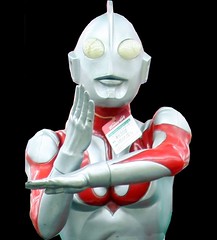
It has puzzled me for a long time why so many Japanese superheroes (Ultra-man, Kamen riders, Voltron or Golion, Go-Onger, Gao-ranger you name ‘em) have bug eyes, unmoving mouths, or no mouth at all and have a strong connection with mime.
I now have a theory about the connection between Japanese superheroes and mime.
Japanese superheroes make many gestures (see image right), like mime artists. And more, in a sense they also speak. But their mouths are always immovable. Often they do not have mouths at all. And yet they do speak: They mime speech!
Typicaly, a group of young males and one female strike poses, press buttons, or contact someone in heaven on a magical mobile phone, and change ("hensin") into a team of superheroes wearing colour coded wetsuits. Why should then even need to change into a super hero suit? There is no secret made of their identity. They then do stylised battle, reminiscent of badly choreographed pro-wrestling, with one or more wetsuited monsters, often with a conspicuously mobile jaw, in a car park.
As the superheroes fight they 'speak', or shout, encouraging each other. But where does their speech come from? Their mouths can not move, nor even open. They mime speech. They take out their magic mobile phones and put them to their motionless mouths. All eyes are focused toward the miming speaker.
In the mimicry of speech they are much like masked performers in the Noh Play. The body language of the players mimes speech to perfection, but the face does not move at all.
Nowhere is the mime aspect of Japanese superheroism more apparent than in the live stage shows performed for children. Performers in coloured mouthless wetsuits come on stage. Someone somewhere presses a button on a ghetto glaster, and off they go, miming their way through an Ultraman epic, never once saying a word, but all the while making it plain who is speaking.
The Japanese boys love it. They imitate the gestures, like the ultra-man laser beam pose above.
So why is miming speech so important?
According to Lacan the human self exists by virtue of two incomplete feedback loops: those provided by voice and vision.
We can look at ourselves in the mirror, but we can never see the minds eye. We can speak ourselves, but Lacan argues, the enunciated "I am" of self speech, never quite coheres with the self that would be saying it.
However, with two ways back to the self, we play a shell game, or two card monte, always satisfied that when the word does not hit the mark, we can see ourselves in a mirror. And when the mirror seems empty, we can call ourselves by name.
The problem remains however, in convincing ourselves that our speech comes from the same place as our mouth. Ventriloquists mime speech even with their lips. The people that we watch on television appear to be speaking when we know that the sound is coming from the speakers at the side of the box.
Sound and vision never come from the same place, but we get used to thinking that they do, and the scumble that links the two together, that overcomes the contradiction of a picture that is attached to words, is paramount in the production of self.
Japanese boys watch their superheroes mime speech. They know that, on the one hand, their heroes are not speaking. All the people at the show, everyone knows that Ultraman is dumb, that the emperor has no clothes. But the little boys also know that everyone loves and admires the superheroes and that everyone assumes that the superheroes are speaking. They learn that if they take up the mime too, then no one will out them, no one will ever say "Hey, you are only miming." Superheroes and humans mime speech. It is important that they do so.
But why the bug eyes? For me the bug-eyes of Japanese superheroes are seen but unseeing eyes. Their eyes are massive. Sometimes the Japanese superhero's face is all eye. But they have no pupils, no in-eye movement to suggest that they see. Their massive eyes emphasise their visuality, but with their lack of inner eye detail, it is though they can not see at all. These eyes are, I suggest, the eyes that stare at us from out of the mirror. Our eyes as reflected mirrors fascinate us, they draw our gaze, we attempt even to look into them, but we know that they are sightless.
As I have argued elsewhere, the Japanese are permanently in "the mirror stage" in that, by virtue of their training in and ability to take multiple visual perspectives upon themselves, they continue to identify with self as reflected. Growing up in an world of uninterrupted and loving gazes, mirror identification presents little problem for the Japanese. But in order to developed a self they must also integrate the voice, attach those vocal symbols to this reflection, and hence all this heroic speech-miming.
Addendum. Something similar should be going on in the West: there should be some attempt to link phoneme and imago being made. But in the West it is the identification with speech that is less fraught. Someone admirable and heroic should be 'speaking mime' rather than miming speech. Please see this post for an example of a Western hero It has puzzled me for a long time why so many Japanese superheroes (Ultraman, Kamen Riders, Voltron or Golion, Go-Onger, Gao-ranger, you name ‘em) have bug-eyes, unmoving mouths, or no mouth at all and have a strong connection with mime.
I now have a theory about the connection between Japanese superheroes and mime.
Japanese superheroes make many gestures (see image above), like mime artists. And more, in a sense they also speak. But their mouths are always immovable. Often they do not have mouths at all. And yet they do speak: They mime speech!
Typicaly, a group of young males and one female strike poses, press buttons, or contact someone in heaven on a magical mobile phone, and change ("hensin") into a team of superheroes wearing colour coded wetsuits. Why should then even need to change into a super hero suit? There is no secret made of their identity.
They then do stylised battle, reminiscent of badly choreographed pro-wrestling, with one or more wetsuited monsters, often with a conspicuously mobile jaw, in a car park.
As the superheroes fight they 'speak', or shout, encouraging each other. But where does their speech come from? Their mouths can not move, nor even open. They mime speech. They take out their magic mobile phones and put them to their motionless mouths. All eyes are focused toward the miming speaker.
In the mimicry of speech they are much like masked performers in the Noh Play. The body language of the players mimes speech to perfection, but the face does not move at all.
Nowhere is the mime aspect of Japanese superheroism more apparent than in the shows performed for children at Japanese festivals. Performers in bug-eye, multi-coloured mouthless wetsuits come on stage. Someone presses a button on a ghetto blaster, and off they go, miming their way through an ultra-man epic, never once saying a word, but all the while making it plain who is speaking.
The Japanese boys love it. They imitate the gestures, like the Ultraman laser beam pose above.
So why is miming speech so important?
According to Lacan the human self exists by virtue of two incomplete feedback loops: those provided by voice (or phonetic language) and vision.
We can look at ourselves in the mirror, but we can never see the minds eye. We can speak ourselves, but Lacan argues, the enunciated "I am" of my self speech, never quite coheres with the self that would be saying it.
However, with two ways back, two feedback paths, to the self, we play a shell game, or two card monte, always satisfied that when the word does not hit the mark, we can see ourselves in a mirror. And when the mirror seems empty, we can call ourselves by name.
The problem remains however, in convincing ourselves that our speech comes from the same place as our mouth. But we get used to it. Get used to thinking that sound and vision come from the same place. E.g. The people that we watch on television appear to be speaking the sounds, even though we know, if we think about it, that the sound is coming from the speakers at the side of the box.
Sound and vision never come from the same place, but we get used to thinking that they do, and the scumble that links the two together, that overcomes the contradiction of a picture that is attached to words, is paramount in the production of self.
Japanese boys watch their superheroes mime speech. They know that on the one hand their heroes are not speaking. All the people at the show, everyone knows that Ultraman is dumb, that emperor has no clothes. But the little boys also know that everyone loves the superheroes and assumes that the superheroes are speaking. They learn that if they take up the mime too, then no one will 'out them', no one will ever say "Hey, you are only miming." Superheroes and humans mime speech. It is important that they do so, and get away with it.
But why the bug eyes? For me, the bug-eyes of Japanese superheroes are seen but unseeing eyes. Their eyes are massive. Sometimes the Japanese superheroes face is all eye (Kamen rider Faizu/555). But they have no pupils, no in-eye movement to suggest that they see. Their massive eyes emphasise their visuality, but with their lack of inner eye detail, it is though they can not see at all. These eyes are, I suggest, the eyes that stare at us from out of the mirror. Our eyes as reflected mirrors fascinate us, they draw our gaze, we attempt even to look into them, but we know that they are sightless.
As I have argued elsewhere, the Japanese are permanently in "the mirror stage" in that, by virtue of their training in and ability to take multiple visual perspectives upon themselves, they continue to identify with self as reflected. Growing up in an world of uninterrupted and loving gazes, mirror identification presents little problem for the Japanese. But in order to develope a self they must also integrate the voice, attach those vocal symbols to this reflection, and hence all this heroic speech-miming.
Something similar should be going on in the West: there should be some attempt to link phoneme and imago being made. But in the West it is the identification with speech that is less fraught. So someone Western, admirable, and heroic should be 'speaking mime' rather than miming speech. I guess that this has something to do with the secret identities of Western Superheros, but for the time being, I don't know what "speaking mime" is.
Addendum. please see the next photo in my photostream. I think that "speaking mime" (the Western equivalent to the mimed speech we see Japanese superheros perform) is all the thought bubbles that we are able to see in Western superhero comics, and all the "hard boiled," coming-from-no-where, narrative that accompanies Western detective movies especially. In the West, the narrative pervades, it is the centre, the truth of the secret identityspeaking his mime
I think, therefore I am Batman.
PPS: Just after writing this I saw the trailer for Avatar, where a super-hero kinda guy controls an "Avatar" by remote control and feel like I am chanelling James Cameron.
Labels: Bandai, Bokenger, bug-eye, culture, eye, Gao-Ranger, go-onger, japan, japanese culture, Jaques Lacan, mime, nihonbunka, Super-Sentai, superhero, ultraman, 日本文化
Tuesday, January 05, 2010
Gattai! Merge!

"Gattai!" the Japanese word for "coalescence", or "merge!" is a common refrain in a number of cartoons/anime for 3 to 7 year old, predominantly male, Japanese children.
Usually, the heroes, or cars, whatever, meet a foe that is too strong for anyone of them to beat, so they shout "Gattai!" and merge together to form a super-unity to vanquish that foe.
My son is into the Tomika Heroes anime called "Rescue Fire," (previously Rescue Force?) in which usually 3 members of a team board vehicles that link together to form one larger, super, powerful vehicle. In fact their cars are stored in trucks, and it is the trucks that then merge to form the Rescue Fire Dragon, I think. There is a detailed article about the series on wikipedia. It seems that the enemy "gattai" too.
The "gattai" phenomina is not limited to this series. In many many children's anime over the years, cars and other vehicles, or even animals I think, link together to form a super unity, a robot, or super-life form. Teams of superheroes merge to form one body, with a clarion call of "Gattai!" In all cases, it really gets the viewers going. Ray's eyes light up, in an extasy of gattai-ing. What is going on?
There is the theory that this is something to do with sex. The trucks look a bit like they are at it, a la canine.
Can a prepubescent realisation of the physical nature of the libido be the root cause of the fascination with "Gattai!"? Is the fascination purely "libidinal"?
I don't think so.
For one thing, in many of these anime the merging beings are often of the same sex. I don't think that the viewers are gay, nor do I think that they are unaware of the sexual (i.e. male-female) nature of much sex. This is not sex. My son is (I am not bragging) one hundred percent hetrosexual, even at three. He has girlfriends. He finds girls attractive.
But the refrain of "Gattai" in this genre of cartoon/anime often or usually occurs when more than one male entity merges.
To cut a long story short, I wonder whether this joyful occurence represents the solidification, or merging of the parts of the self. I am not sure what these parts are. But it seems to me that the self is multi-parted. The games that these youngesters are playing may represent their glee, their desire for and achievement of coalescence. There may still be a libidinal element, but I think that the coalescence is intra-psychic.
That is just a guess. The "Gattai" phenomena is a myth of our times. It is profound.
Do American cartoon characters Gattai?
Labels: Bandai, Bokenger, culture, Gao-Ranger, henshin, japan, japanese culture, nihonbunka, Super-Sentai, superhero, 日本文化
Wednesday, November 25, 2009
A list of Japanese Cultural Phenomena
The ones that I might attempt to explain by the use of my Lacan upside down fallopo-imagocentrism (i.e. the opposite of phallo-logocentrism) theory are marked with a * or a # for more weakly linked, and ? being more problematic or just particularly unclear to me.
Why are the Japanese so good at mathematics, at school at least?
Looking through the list I would like to recommend Nakashima Yoshimichi (Urusai Nihonjin no Watashi) as a great Nihonjinron, theory of Japaneseness.
Hazel Markus, Shinobu Kitayama, Richard Nisbett, Takahiko Masuda, , Jane Bachnik, Kimura Bin and Hamaguchi Eshun are great too.
I have deliberately tried to avoid the use of Japanese language since the list was originally written for Japanese learners of English.
Japanese mannequins (generally with Western features) #
Japanese T-shirts (generally with Western writing)
Plastic food outside of restaurants *
Methods of inputting Japanese characters via the keyboard
The strengths and weaknesses of Japanese software *
The Japanese obsession with having hair #
Japanese dogs, traditionally kept outside
Cute things found in people's cars #
Comic cafe's #
Finger pointing to improve railway safety *
The way in which it is okay to make a noise while eating noodles #
The way in which it is not okay to eat on the street (except ice cream)
The use of seals, instead of signing ones name #
One hundred yen shops
The way in which many students at Japanese universities do not expect to have to study very much #
The use of masks to prevent others from getting ones cold
The existence of yellow number plate small engine cars
The prevalence of mobile phones equipped with the Internet #
The lack of restaurants on the side of Japanese rivers and mountains
The proximity of houses and supermarkets to mountains
The proximity of houses and supermarkets to agricultural land and ditches
The use of "mothers' bicycles" and the relative absence of bicycles with crossbars
The practice of having plastic surgery
The prevalence of unmarried people
The lack of unemployment
The use of excessive employment, such as flag waivers
The lack of Western goods for sale
The size and expense of Japanese vegetables #
The sweetness or tastelessness of Japanese fruit #
The small size of Japanese chocolates #
The prevalence of thin people *
The number or restaurants where one is allowed to smoke #
The number of politicians associated with corruption #
The existence of registered "violent groups"
The love of dolls and robots but not sculpture *
The use of sexual metaphor to describe parts of the body such as cleft chins and the uvula *
The existences of seminar groups at an undergraduate level
The lack of importance placed on the level of university degree #
Bowing on telephones
Saying "aah" after ones first mouthful of beer
The use of plastic bags for umbrellas
The way in which supermarket staff show customers the way to a particular isle (but taking them there, rather than by giving the number) *
The prevalence of superheroes with large families
The lack of theft and violent crime #
The fear of theft and violent crime
The prevalence of suicide
The existence of vending machines
The lack of graffiti and vandalism #
The existence of "its me, its me" fraud
The absence of hand signals by bicyclists #
The sex (gender) of cheerleaders
The tendency to practice dancing or voice training in public
The formation of circles by student groups, outside supermarkets #
The prevalence of vocal announcements *
The tabu on private speech, such as using mobile phones *
The complete lack of architectural harmony #
The lack of litter #
The lack of litter bins
The existence of rooms for taking commemorative photographs in hotels *
The shouts emitted by Japanese sports people to improve their concentration #
The frequency with with Japanese sports-people use image training techniques *
The importance placed on calligraphy *
The importance placed upon set phrases in letters #
The making of pyramids at school sports festivals *
The prevalence of school uniforms #
The vast number of idols *
The use of toilet slippers
The removal of shoes in the home
The removal of shoes in computer rooms
The lack of computers in Japanese offices #
The prevalence of robots in Japanese factories *
The lack of dubbed movies/prevalence of subtitling ?
The speed at which cars travel
The absence of central heating in homes
The use of heated coffee tables
The prevalence of refuse separation
The need to wash uses containers
The size of roads
The lack of road names ?
The system of naming plots of land instead ?
The location of floor numbers between floors ?
The use of smilies that do not smile #
The numbering of tobacco products
The opening hours of ATMs
The prevalence of new cars #
The lack of second hand shops
The love of cleanliness #
The size and shape of Japanese baths
The practice of communal bathing
The strength of gender roles
The ability and confidence at singing #
The lack of confidence at dancing #
The number of auto-photography machines *
The love of auto-photography *
The hesitance towards self aggrandisement or linguistic self expression *
The use of the stones, scissors and paper game
The practice of staring games #
The silence on trains #
The carrying of radios (especially by older gentlemen)
The emptiness of beaches
The number of words for I *
Various Japanese gestures, such as nose pointing **
The average TOEIC score
The strength at mathematics ??
The prevalence of dams and other concrete structures #
The cost of motorway/express-way travel
The "firefly tribe"
The recycling rather than reuse of bicycles
The excellence of Japanese service
The lack of menus at the highest level
The prevalence of choosing the same food as ones co-eaters
The practice of going to the toilet in groups
The preference for group vacations
The preference for separate accommodation #
The love of newspapers ?
The sheer volume of comics *
The practice of community ditch cleaning
The use of health potions
The existence of hostess bars *
The love of sportswear *
The love of cameras *
The lack of debate *
The practice of stomach diplomacy *
The practice of persuading people before meetings *
The emphasis on the privacy of information #
The lack of credit cards and use of cash #
The existence of "pocket money" for wage earners
The number of private universities
The emphasis placed upon university
The length of employment
The lack of meritocracy based wages
The existence of large bonuses
The size of families
The lack of forewarning of death
The ability to compose short poems
The emphasis upon imagery in poetry *
The use of English in pop songs
The popularity of computer games *
The prevalence of 'vertical pinball' as a form of gambling
The lack of choice in Japanese gambling
The use of advertising in children's programs
The use of sign language by children's heroes #
The lack of mouths of popular cartoon characters #
The size of the eyes of popular cartoon characters #
The love of white skin
The ability to tell the season from the sound of insects
The number of new religions
The lack of women politicians
The sheer number of Japanese inventions #
The lack of clear policy statements by politicians *
The use of photographs on political posters *
The use of imagery, rather than comparison, in advertising *
The abundance of curtains and tinted glass in cars #
The lack of story/punchline type jokes #
The use of movement and gesture in humour *
The number of scary female monsters *
Their tendency to come out of images *
The use of photographs to remember the dead *
The lack of family photographs in homes and offices *
The emphasis on the exchange of business cards #
The emphasis on politeness
The emphasis on greetings
The fear of inappropriate or negative words ?
The emphasis on right ways of doing things #
The emphasis on time place and occasion #
The use of mirrors in trains and other public places *
The beauty of Japanese people*
The wackiness and originality of Japanese fashion #
And the list could go on.
Labels: culture, japan, japanese culture, nihonbunka, 日本文化
Thursday, October 01, 2009
The Japanese Culture of Kidnapping Children
Mr. Savoie went to the courts who immediately declared Noriko in breach of their divorce agreement and guilty of abduction, granted Mr. Savoie sole custody and issued a warrant for Noriko's arrest. Mr. Savoie weeps. He finds silence unbearable because he hears the voices of his children.
This sort of case happens a lot. There are many other crying fathers and one can read their tragic stories here and here. Since, such is Japanese law, it is legal for Japanese mothers to "abduct" their own children, bring them to Japan and deny access to the other foreign parent. Japan is not a signatory to the Hague convention, which upholds "the rights of the child to see both parents" and allows for the repatriation of children abducted in this way. Japan is thinking about becoming a member of the Hague treaty at last one day in the next few years, but until then, it is Goodbye daddy. Can you image? I mean, really?
I want to make it clear that the father's side the story makes me cry. However this post is in, in brief and attempt to explain why the Japanese do it. Are they not men? They are. They care.
Under Japanese law, there is no dual custody. When a couple divorces, the law believes that rather than be a ping pong ball between two often warring households, the child should be with one parent, the parent most able to meet the needs of the child. In the past that was often the father. These days, it is usually the mother. If the father pays alimony then mothers may allow the father parental rights. But if he is flaky, hateful, or if one or ther party remarries, then the father is often cut out of the children's lives. Many Japanese fathers, and some mothers, are also crying themselves to sleep at night. This is quite commonplace. Even the immensely popular Ex Prime Minister Koizumi was divorced from his wife. He took custody of one child and the mother the other. Essentially, afaik, each of the children never saw the other parent again.
Is a child happier seeing bother parents? Knowing that a parent is gone, knowing that one of ones parents is not ones own, but not meeting two people who do not love each other anymore, that present, even if unsaid, a criticism of each other. Dual custody says, "here is my father that could not be with that woman". "Here is a Mother that could not be with that man." I think that that most Westerners would say "yes, the child is happier knowing the truth about mummy and daddy". It is not essential that they have a parent to idolise.
CULTURE
In the West marriage centeres on the bond between the parents. Families remain together, at least in theory, due to the strength of this bond. The love of the parents makes or breaks the marriage. Even though the parents love their children, they may get divorced if they no longer love their spouse because they believe it is in the child's interests to see a loving relationship, have a loving relationship to idolise, and model their future relationships upon.
In Japan people are realistic about man-woman love. They know that man-woman love comes from the nether regions and that it does not last, or it burns off and on, and that it is no basis upon which to build a family. On the other hand they deem the bond between parents and childred as sacred, and ignore any physical elements in that relationship. Should the parents not get on with each other they will usually remain together in what is known as "divorce within the home" because they value the happiness of their children. Divorce rates are fairly high prior to the birth of children but very low afterwards.
Indeed in Japan, historically, there was NO SUCH THING AS MARRIAGE. People lived with each other, had sex with each other, and seperated from each other until the birth of a child. The birth of the child signalled the entry of religion. The child would be brought to meet the ancestors and ancestral gods and an inviable bond would be formed.
Now in the latter society, what would happen if there were dual custody?
First of all it would be going against the religious tradition of people having only one set of ancestors. One or other party to the marriage (and not always the woman but that is far more commone) goes to join the lineage of the other spouse.
Secondly, since there are ideals placed upon and few efforts made to preserver and renew the marital bond, then if it were possible to leave ones spouse and still maintain ones all important bond with ones children, then the divorce rate would sky rocket.
FURTHER CULTURAL BACKGROUND
In the west, sex is taboo. Horror (generally male monsters) is related to the sexual (don't take a shower in a horror film), coitus and the penis, especially erect ones are most unholy and unsavoury. Since the garden of Eden, and that fig leaf, the penis is banished. But love, the most pure and everlasting love, remains. In Japan the womb is taboo. In horror monsters are women, who often have some motherly desire either towards their victims (who they drag into their womb) or the babies that they wanted to have. Since Izanagi escaped from Izanami and created a partrition hut (a hut on the hillside where Japanese women gave birth) the womb has been banished. And its place remains an idealised bond between parents and their children. It is because the Japanese idealise parent child love so much that they could not have it sullied in dual custody. It would be like suggesting to a westerner that they put up with a "divorce within the home." Since the bond between man and woman is ideal, it must be there, or seperate. There is no half way house of love. No limp bisket marriages for Westerners, no dual custody for the Japanese.
CONCLUSION
Divorce is damaging to the future prospects of the offspring of marriages that end in divorce, and it has a profound affect upon society. Westerners step on certain relationships and idolise others. The act of making ones baby sleep in another room from the (sacred) marital bed, from the age of a few months is something that Japanes find difficult to see in any way but brutal. As we have seen in this issue, the Japanese step on adults in order to maintain an idealised bond with parents.
When ideals and dreams collide, something has to be sacrificed. In order to confirm with Western culture, should the Japanese destroy theire own?
The Hague convention requires that a child be given the right to see both parents subsequent to a divorce, but I guess that the Japanese will reach some sort of compromise wherein dual custody will be recognised in international marriages but not in domestic ones. But then the fathers in Japan will have a ligitimate reason to complain (how come that gut gets to see his children whereas I do not?).
Labels: culture, horror, japan, japanese culture, nihonbunka, reversal, taboo, tabuu, 日本文化
Wednesday, September 23, 2009
Wide Show Mock-up
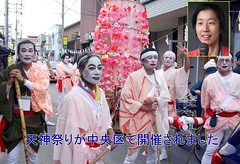
The characteristics of Japanese current affairs programs that I want to emphasise are:
1) The faces of the commentators are seen displayed during the parts of the current affairs program that are filmed on location, so that viewers can SEE the expressions, and see the feelings that are being, or should be felt. (Yasuko's face, in the top right hand corner)
2) The Japanese is given subtitles so that the viewers can SEE what is being said.
American current affairs shows have a ticker tapish thing giving *additional* phono-lingistic information, and faces only when they are talking and often in side view.
However, like Japanese programs, American and Canadian shows often have canned laughter, which like the faces of the commentators in Japanese shows (1 above), lets the phono-centric Westerners know what should be felt via sound rather than vision.
Is there a Western version of the subtitles? David Letterman's late show also has occasional comments or narration from the band guy, Paul Schaffer. Hard boiled detective narrate what they are doing and thinking. But on Western current affairs shows is there extra phono-linguistic commentary on what is going on visually?
Labels: culture, japan, japanese culture, logos, mirror, Nacalian, nihonbunka, specular, 日本文化
Friday, April 24, 2009
The Poo Poo Song
The realease of the music was announed in this news article.
The music can be purchased here. I have ordered a copy at ten dollars plus postage.
Where there is an English version, which can be previewed here. The English words are
How's your tummy, hows your poopy
Dr. Poopalot has this to say,
Chew your breakfast, chew it chew it
After breakfast poopy do,
Shiny poopy, rocky poopy, skinny poopy, slimy pooh
Shiny poopy, rocky poopy, skinny poopy, slimy pooh
Shine pooh is very healthy
when you....
The full Japanese words are listed here.
Labels: culture, horror, japan, japanese culture, nihonbunka, reversal, taboo, tabuu, 日本文化
Monday, April 06, 2009
Hsirgne
hsirgne
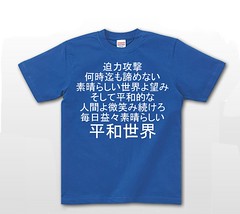
Originally uploaded by timtakA back-translation of a T shirt, with English-like writing on it, sold in Japan.
The original has
"Impact attack never give up
Hope wonderful woeld.
And Peaceful.
All peopel keep smiling
Everyday.
More & More.
Fatastic.
Peace World."
Imagine if all the Tshirts on sale in clothes shops in the US or the UK had designs like the above. That is the situation in Japan. A large proportion of the Tshirts being worn and in the shops have English-like writing on them if they have any sort of print or patter at all. No one seems to think that it is in any way notable. It seems to me to be indicative of the fact that Western, particularly US, culture has become so desirable that Japanese people want to put its signs on their bodies. That the Japanese wear T-shirts like this suggests to me that Western culture is valued so highly that the same people probably also import Western culture into their minds.
イギリスかアメリカの店に入って、そこにあるTシャツの全てがこのようなデザインだったらどう思われるでしょう。日本人が着ているTシャツのほとんどは、上のようなものです。日本では特別視される事態ではありません。欧米、特にアメリカの文化がその表彰を体に一杯付けたいほど高く評価されていることを示唆していると思います。また、このようなTシャツを着ているのであれば、ここまで英語圏の文化が高く拝められるものであれば、欧米の精神的な文化(思想・価値観など)を心の中にも輸入していると思われるでしょう。
Labels: culture, japan, japanese culture, nihonbunka, reversal, westernisation, 日本文化
Tuesday, December 02, 2008
Percent of Japanese cars with cute dolls on the dash
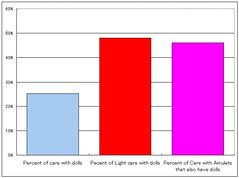
Shinto amulets are in a sense thought to be alive, containing the spirit of shrine at which they were purchased. They are for safety on the roads. It is thought that they somehow act as a "double" or "dummy" (migawari) in the sense that they draw the misfortune that the bearer would otherwise have experienced and bear that misfortune for them, a little like a material version of Jesus or Ambithaba both of whom are said to bear our sins.
It is not clear why it is those that like amulets also like dolls. Are the dolls also sacrificial? Do dolls contribute to road saftey? It would not seem to be due to an indirect effect of gender, since the amulets were found spread equally between the (more often male) non-light cars and the more often female light cars. Is it just that the those people that do not mind cluttered dashboards clutter them with dolls and amulets since it is these that are cultural favoured in Japan.
This phenomenon deserves further research.
You can see the dolls in the following photographs in my photostream.
Labels: culture, japan, japanese culture, nihonbunka, 日本文化
Wednesday, January 16, 2008
The Throat Willy
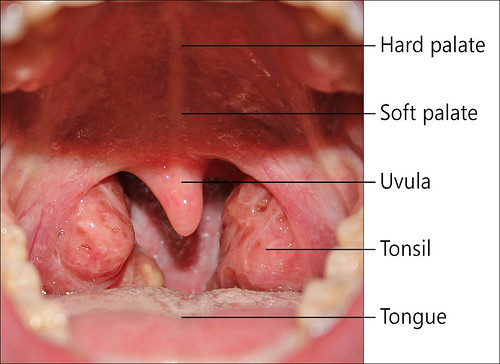
"Nodo-chinko" or "throat-willy,"is the informal Japanese word for uvula, the small pink dumbell that hangs down at the back of the throat; due its resemblance to the male organ.
The medical name is "口蓋垂" Kougaisui. "Nodo-chinko" does not appear in even a large only English-Japanese dictionary. There are however more than 12,000 hits on google for the Japanese word.
Another word is "nodo-chinpo" where chinpo is wang.
Of course, both men and women have nodo-chinko.
I can't imagine a British doctor using the simile even if a patient were not able to understand uvula.
Doctor: You seem to have an infection of your uvula.
Patient: I am sorry, Doctor, but what is an uvula?
Doctor: You know, your throat-willy.
Patient: My what?!
Doctor: The little pink wang shaped thing at the back of your throat.
Patient: [Exeunt]
I think that this is another illustration of the fack that the male organ is not as taboo in Japan as it is in Europe.
This image is from Wikipedia, relased under the GNU licence and was uploaded by KLEM.
By the way, you don't need an online PHD to know what an uvula is :-)
Labels: culture, japan, japanese culture, nihonbunka, sex, tabuu, theory, 日本文化
Thursday, January 03, 2008
King Mukade

These things can be dangerous. To be safe, I recommend you seek medical attention if you are bitten by a mukade.
The American Tarantula Society says
"Much has been alleged on the toxicity of centipede venom, but very little material on the subject has made its way into the scientific literature. As with tarantulas, this vast lack of medical reports on them more than likely indicates they are not medically significant. Like tarantulas, their perceived repulsive appearance by most people is probably the reason they are widely viewed as somehow dangerous and toxic. We do know that some of the larger centipedes, especially in tropical areas, can administer a painful stab, but none are known to be dangerous. All we can say for sure on the subject is that some can cause a painful bite, but that's absolutely all."
The English Wikipedia page says that there has only been one centipede fatality - a child was bitten on the head in a pacific island and even the Scolopendra gigantea (Giant centipedes) found in the Amazon and Trinidad, are rarely fatal, only painful according to this case study paper. They seem to suggest (by extrapolation from mice) that the fatal does in humans is 1000 venom glands. Even if there are two venom glands per centipede, this would require being bitten by 500 of them. If you did not die you would probably want to. They summarise the effects as follows
"The most common scenario includes moderate to severe local symptoms associated with mild systemic symptoms. Local symptoms include pain, erythema, edema, lymphangitis/lymphadenitis, weakness, and paresthesias. Skin necrosis may occur at the site of envenomation during the weeks following the sting, but rarely becomes extensive and heals spontaneously. Systemic symptoms may include anxiety, fever, dizziness, palpitations, and nausea. "
and conclude
"Despite the striking appearance of the offender and the significant pain associated with a sting, treatment for centipede envenomation is essentially pain control and routine wound care."
However, most of the cases being that of one of the (centipede rearing) authors and none of the centipedes were mukade. There is however, at least one paper about mukade bites which reports that they can cause Korsakoff's syndrome!
You know they mean business when, unlike any other bug, they show no fear, and walk towards you.
I was putting on my wetsuit one chilly December afternoon when I felt a movement next to my thigh, my inner thigh. I knew what it was.
And it bit me. The pain was not so great as my panic as I felt it crawl down (could have been worse!) my leg, towards where the wetsuit was tighter and I thought it would bite me more. I used a knife to slit open the wetsuit to my calf, and when it escaped my friends dispatched it.
At first I thought that it had only given me a nibble. I had experienced a mukade nibble in the past, when I awoke to find one on my upper torso. Two red bite marks were all that were left. It did not hurt all that much nor had any ill after effect (Partly perhaps because I used alkaline - ammonia - on the wound).
And neither did it hurt all that much on that day, when a mukade shared my wetsuit.
I continued to wake-board. The thrill of wake-boarding made me forget the pain. No worse than a bee sting I thought. But I was wrong.
The next day, or the day after that, my left thigh had swollen to about 1.3 times it size. This is no mean feat. I do not have thin thighs.
All the same I thought I would brave it out, and went jogging (I do this a lot). I thought I would flush the poison out with a good pump of blood with a little adrenaline. The leg around the bite became hard. By the third day I had a fever and was feeling generally weak.
I went to the doctor. They gave me antibiotics and antihistamines I think. They told me that had I come immediately after the bite I would have saved myself a lot of bother.
I was a 37 year old 70 Kg male. The mukade was not as big as the one in this picture. If your child gets bitten by one of these things, or if you get bitten on the neck, go a hospital immediately. Go to a hospital immediately anyway if you do not want to have serious swelling and general malaise. Who knows what would have happened had I not gone to the hospital at all.
I was only after I had posted the first draft of this that I realised that Todd Baker << technowannabe had kindly linked to another rendition of this story.
ASIDE
I find that insecticide does kill mukade if you douse them in it. But they do not die immediately.
This is hearsay but, I believe that a lot of insecticide uses the same active ingredient which is a nerve gas to bugs. It does something to their nerve receptors or some-such, such that they loose, or gradually loose, muscular (if that is the right word) coordination. Flies sprayed with bug spray also go berserk in a way, changing course at even more regular intervals, bumping into things, flying upwards, downards, upside down.
I seem to remember a mukade sprayed with bug spray loosing the coordination of its legs which, instead of moving in a controlled ripple, started to work all at once. The berserker mukade would probably have died. But in the meantime it went berserk.
I got good with chopsticks and developed an ability to drop them in a jar of oil. When I gave up on the oil (see the other post linked above), I just chopsticked them out of my house. Do not attempt to chopstick a mukade unless you are very confident with chopsticks.
Update A skin doctors advice from 2016
There was a mukade in my crocs one evening this May. I felt that stabbing mukade pain, and while I did not see the culprit, I knoew what species of critter had bitten me. The next morning my foot still ached and was swollen so I went to see a nearby skin specialist. He told me that mukade do not inject their venom but bite and then spray their venom onto the surrounding skin. The venom seeps in both through the puncture wound that the mukade have made, and through the skin itself. However, mukade venom breaks down at high temperatures. The doctor recommended that if bitten by a mukade then immediate wash the surrounding area in water hot even to be just bearable.
Labels: culture, japan, japanese culture, nature, nihonbunka, 日本文化
Wednesday, October 17, 2007
Lacan and Anpanman
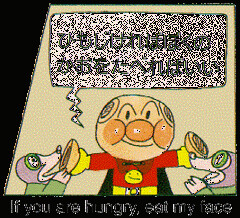
Japanese boys can become quite Anpan-man obsessed. There is a boy in my son's kindergarden that refers to himself as Anpan-man when asked his name. I knew a boy that repeated an "Anpanman" chant in an obsessive complusive fashion when he was nervous, perhaps.
What is this Japanese obsession with Anpan man?
Is there some connection with caniblaism, sacrifice, or self-sacrifice? Possibly Anpan-man has connections with all these things, even with the transubstantiation of the body of Christ, the Eucharist and Mass. After all, Anpan-man is made of a Western import, bread, and not rice.
However, I would like to suggest that the popularity of Anpan-man in Japan may have something to with Japanese boys wishing to identify with their mother. I suggest that Japanese infants want to symbolically suckle (give breast milk to) others. I got the idea for this because a certain Japanese male infant that I know wants to give his (non existant) breast milk to his father. This behaviour is not so strange in itself since young children tend to wish to copy their significant others. The boy in question likes to spoon feed his parents, brush his parents' teeth, and carry a briefcase, all in imitation of his parents.
All the same, the affection for Anpan-man among Japanese males is often obsessive. I suggest that Anpan-man provides the male infant with a imaginary means of identifying with his mother, even after he becomes aware of the fact that his own nipples do not give milk. He can imagine that, in some sense he is, like his mother, in some sense edible. By this manouvre, the Japanese infant manages to identify with his own corporeal objectification as body and image.
Jacques Lacan, the post-Freudian psychoanalyst, argues that infants tend to have two sorts of self-concept: "imaginary" and "symbolic". While it may be doing some injustice to Lacan, I understand these as being visual (imaginable) and linguistic. That is to say that infants come to identify with images that they have of them selves, and and also with the linguistic referent to which they refer to themselves: "I", or their own name. Lacan further argues that the latter type of identification is preferable and normal in Western culture - that we should grow up from identifying with our self-image to indentifying with our self narration. A great number of other "narrative psychologists" working independently, claim that it is intrinsically human to narrate oneself into existance, as the imagined hero of a novel of ones own self telling.
Lacan futher argues that this movement from imaginary to symbolic self identification is motivated in part by the social dynamic of the (Western) family. Mother is the imaginary, the visible parent, the parent with which the child identifies (before perhaps even with his own image in the mirror) visually. Father is the symbolic parent. Father is often absent, but somehow very important. Father is the parent that is narrated into existance for the child, through such statements as "this is your father." [In some societies is its an uncle that takes the role or position of the father. The father is a narrated existance. The "name of the father", his hallowed name, is what makes him a father.]
In the West, in the oediple triangel, the father wins. Lacan argues that children would like to maintain a strong relationship with their mother (to the point of merging even) but fortunately for their development, the father gets in the way of this relationship. The child finds himself repeatedly alone at night, left with only his mother's statement, "I am going to, I have to sleep with daddy." Or "I am daddy's".
The name of the father "daddy," becomse the name or prohibition of the father ("Nom or Non de Pere" -- Lacan makes a cheesy pun on "Nom" - "name" - and "Non" "no!" of the father) in that the arrivale of an awaress of daddy, also signifies an arrival of an awareness that baby will never be what mother really wants, the object of her desire. Instead, daddy, father is a signifier that refers to something that mother really wants, and reason why the infant can not have his or her mother.
After fretting around for a while, the Western infant gives up on trying to be a baby, gives up on trying to be bundle of cuteness that might almost have been the "phallus," the apple of his mother's eye, and instead, identifies with the winner in the triangle of love, daddy, the signified, daddy the linguistic entity. The child starts to identify with his or her name and the first person pronoun in the hope that this signifier also refers to an entity which has, or will one day have, that special something that can make mummy (or a surrogate mummy, a future wife) "mine".
In the West, that special something that daddy has is sexual. While insiting that it is not a real male sex organ , Lacan calls daddy's special something a "phallus". And it is the subject of taboo. I am not sure about Lacanian theory but in reality it seems to me that if the male sex organ were not taboo in Christendom, they would not be raised to the status of the ultimately desirable, and frightening object, that attracts mothers so effectively.
The above may (or may not) be useful when trying to understant out why Westerners identify with their self speech, or why sexual love is held in such high esteem, and yet taboo at the same time, in Western Culture.
Further, Freud and Lacan tell us that the child is "castrated," through the awareness that
1) Mother does not have a phallus
2) Neither does the child have a phallus now
3) That dad has a phallus
The child comes to think that the object of the mother's desire is elsewhere, hidden, daddy's. The phallus, that thing that will enable the child to be loved, is something that even a male child does not yet have. The child looks to the future and dreams of a time when he or she will have a partner, when he or she will have romantic love. Dreams of a time when he will have or she will be given, a phallus, that thing that (hell, why else would she be sleeping elsewhere?) mother seems to lack.
Freudo-Lacanian theory may be incorrect even regard to Western culture. Personally, I am rather persuaded by the Lacanian version. In Freudian theory humans (both adults and infants) are essentially sexual beings. In the Lacanian version it is the upbringing that results in the oh-so-very-high valuation of sex. The child is ejected from the mother's bed, left alone, and told to wait, to wait until one day it will have an opposite sex partner of its own. In the West is thought normal to rear (torture?) young children in this way. Young Western children cry themselves to sleep at night, but stop crying with the dream that one day, they too will have someone, in a sexual relationship of their own, to hug.
While I can see how this theory applies to the West, in my opinion it does not apply to Japan. Japanese parents sleep with their children! This fact needs repeating. Japanese parents let their children sleep in the parental bed until they are about 4 to 11 years old. Where do they have sex? Presumably, sometimes in front of their children! Sometimes, and I know Japanese that have testified to this, the children have watched. This watching is something that Freud claims is enough to drive children mad. But not, obviously, in Japan.
For reasons that I will not go into in this post, in my opinion (or theory of Japanese culture) the Japanese identify with visual self-representations, with the imaginary rather than the symbolic. Again, as argued in other blog posts, the Japanese place taboo on female sexuality, childbirth, rather than upon male sexuality, coitus, and upon the visual (think Sadako) rather than the symbolic. A reversal is going on.
It occurs to me that the awareness, among Japanese children, that the child does not have breasts, that work, that can feed others may represent a sort of castration, or rather mastectomy. This mastectomy does not result in an alienation from identification with the *object* of the mother's desire, but it results in an alienation from identification with the *subject*: mother.
Lacan stresses the child's desire to be the *object* of the mother's desire. A child in a Japanese family could continue to feel, and bearing in mind the love and affection that is lavished upon Japanese children, may often continue to feel, that they are still the prime *object* of their mothers desire. They can continue to feel that they are the "phallus"
However the Japanese child may feel alienated from direct identification with the mother as desiring *subject*. Love is not only about being loved. Love, as in Wuthering Heights for example, is also about identification with the other. "I am my Heathcliff" said Cathy in one of the most famous statements of the essence of love. Being the object of love is important. Being the subject, being the same as, merging with, feeling close, inseperable, bonded with the subject is also important.
For the Japanese child, the realisation of his or her own mastectomy (inability to breast feed), forces the Japanese child to realise that he or she is not the mother, distanced, other. "I can not feed," "I have no breasts". "I am not my/a mother"
Much as the child may attempt to identify with, , and succeed in being the object of his mother's love, he or she wil realise that the love relationship he or she has with mother is not satisfying. Mother loves the child, but is distant. Who wants to be a love object? Being loved is great. But think of being the object of lewd and lavcious love! Being a love object is also rejection.
At this point, for the female infant (as for the male infant in Western society) can dream of a time when she can be a mother, subjectively indentify, identify as subject, and sleep with her own children. For the male infant, however, the father may emphasise this seperation and offer a compromise.
In Japan, as far as seperating mother and infant goes, the role of the father is weak. The child sleeps between mother and father in "the river character" (the Japanese ideogram for river is three verticle lines with the shortest in the middle,), so if anything the child represents a rupture in the relationship between father and mother rather than the other way around. However, the father is not completely without a rupturing function, and the Japanese family is not entirely without "oedipus." The Japanese father reiterates the subjective-alienation of the child from mother, that is to say the father emphasise the fact that the child is not the same type of subject (a feeding subject) as his mother or father.
While basking in the love of, that is being the object of mothers and father's love, the child will also become aware that those two people (mummy and daddy) are parents, whereas I am not. By forming a even visual category ("parents," the-large-bodied) to which the child does not fit, the father serves to emphasise the fact that mother and child are not the same. The father proves that the child is a child, a subjectively alienated other.
The compromise?
According to Lacan, the compromise that the Western child reaches is to believe that he or she one day may have *or* get the "phallus", the object of mother's desire.
The compromise that the Japanese child may reach is to believe that they may eventually be the subject, subjectively united with mother by eventually being able to be edible, eventually being able to feed, or create. As Japanese children grow up they gradually become aware that parents are both in a sense edible, both parents are in a sense mothers. Mothers breast feed and fathers produce food through work.
Anpan-man is an imaginary step in this direction.
As an aside, the Japanese obsession with cooking programs, such as the Iron Chef is perhaps all part of the same compensation for the infantile mastecomy: "one day I will be able to feed people".
Labels: culture, female, japan, japanese culture, Jaques Lacan, lacan, logos, male, nihonbunka, theory, 日本文化
Monday, August 06, 2007
John and Yoko
I doubt the wikipedia assertion only because I also think that John Lennon commented on the photograph saying that it was great because summed up his relationship with Ono perfectly.
So unless Lebowitz also took a instant polariod too it is difficult to see how Lennon could have commented on the photo if it were taken on the morning of his death because the photograph would have not yet been processed (unless he was just commenting on the pose).
The pose says a lot. Lennon is like a foetus or at least a infant, stuck to, almost suckling, and anyway dependent upon Ono. Ono has her arms raised above her head - almost blase' of Lennon's affection - and her eyes slightly open (I think) while Lennon's are shut. This suggest something along the lines of rather absolute trust on the part of Lennon, and "looking out for us both" on the part of Ono.
Lennon was parted from his mother at an early age and raised by his maternal aunt. His mother lived not so far away but Lennon did not know that at first, presuming that the infrequency of her visits was because his mother lived a long way away.
In fact, after the disappearance of Lennon's father (a 'listless' sailor) his mother found another man, and just did not feel able to keep a child from a previous marriage with her new man.
I think that Lennon became aware of this truth (that his mother had chosen a relationship with a new man over himself) before his mother's death.
I think perhaps that Lennon's mother died in sight of Lennon in a automotive accident (hit by a bus??) as she left after one of her visits.
These circumstances, it seems to me, may have produced in Lennon a far bigger than usual oedipus complex in the Lacanian sense.
Freud argued that male children naturally want to have sex with their mothers. This seems silly to me, living as I do in Japan where children share the parental bed. (My son does not try to hump his mother.)
Lacan (an obscurantist twerp at times I think, but also brilliant) argued that (Western) upbringing results in the formation of the oedipus complex. That is to say that because (Western) mothers reject their infants and (mixing in Richard Schweder's "Who sleeps by whom") go and sleep in another room, infants gain the impression that the 'thing that daddy can do' must be wonderful, and wish that they could do it too. This, Lacan argued, results in the oedipal/sexual desire.
In the 'normal' Western household this is predominantly a result of bedroom arrangements, but in Lennon's case his mother opted for a sexual relationship to the extent of not just another bedroom but living completely apart, even to the point of death.
It is no wonder then that early Lennon was super Western and, echoing the pan-sexual-theorist Freud, was fond of saying "It's all dick (according to the movie "Back Beat" at least)."
Indeed, the Beatles, with their songs of sexual love, chanted the Western mantra big-time. "All you need is love." Or perhaps, all you need is a, or many, coital relationships.
But then John Lennon found Yoko Ono who, Japanese as she is, did not idolise sexual love. Even after all the bed-ins and the Ono arranged affair still loved him. This was the mother he always wanted. She was his rock, she looked out for the both of them, his trust was eyes wide shut.
Personally, I thin that Ono was a smidgeon upwardly mobile and don't believe in pure love myself. But I can appreciate Lennon's point of view.
Here is love. A beautiful photo.
Labels: culture, family, female, japan, japanese culture, male, nihonbunka, 日本文化
Monday, January 29, 2007
Thick Soled Shoe
As Suviko points out both these boots and the "ganguro" (sun tanned face to the point of being "black") style of some young girls over the past decade is going out of style. Why is this?
Perhaps it is an example of a reverse hemline rule. The hemline rule in economic theory states that the hemlines of women's skirts move up and down as the state of the economy moves from boom (hemlines up) to depression (hemlines down). This is perhaps because when the economy is good, women can afford to give away their booty, or at least a glipse of it for free, but when times are hard they must demand more dedication, more platonism, more love before they even show their knees.
The ganguro fashion was populare during the long period of depression in Japan from the late nineties to the early two thousands. On the face of it (no pun intended) having a heavily tanned, almost black face, made the fashion victims less attractive in a country that has valued the whiteness of women's skin (partly because white means that one does not have to work in the fields, partly because of a Western influence, as argued in a previous post). Thus Ganguro would seem to be making themselves *overtly* unattractive. The ganguro style was thus a very flamboyant defiance of norms of beauty, and may have been a demand for men who (as with a long hemline) are more dedicated, more loving. Perhaps also the platform shoe was an attempt to put the female form on a pedastle without excentuating sexuality that again demanded care and attention paid to the wearer.
This theory is unlikely to be popular since the long hemline is associated with a lady like purity whereas ganguro is associated with a radical lack of purity, but...this is Japan.
Labels: culture, fashion, female, japan, japanese culture, nihonbunka, 日本文化
This blog represents the opinions of the author, Timothy Takemoto, and not the opinions of his employer.