
Sunday, May 05, 2013
Japanese Shame: No place to hide
This difference can be seen in the way in which Westerners express both shame and guilt as something from which one can hide, whereas Japanese hide when they are embarrassed but since Japanese shame is always private shame, they have no place to hide when they feel it.
Pictures of Westerners Feeling Embarrassment


Pictures of Westerners Hiding in Shame


Pictures of Japanese Feeling Embarrassment


Pictures of Japanese Feeling Shame on Google.Very few are hiding, but there is some self touching.
Labels: japan, japanese culture, Nacalian, reversal, specular, 日本文化


Gateball: Tougher, Timed, Team Techno-Croquet
Gateball is a variation of croquet developed in Japan. It started after WWII as a sport for young people when rubber for making balls was in short supply, but soon became the quintessential sport for old people, such that "salary men", and women, are thought to morph into gateball players upon retirement.
The major differences appear to be that gateball is played with a smaller number of hoops, only three instead of 6 or nine in croquet, to facilitate the use of a smaller playing field. The smaller field means that reaching the goal pole can be achieved too easily for that to be the final object of the game, so games are timed, with the winning team being that which scores the most points in 30 minutes. While croquet is played individually or typically in pairs, gateball is more often played in teams of up to five. Perhaps due to the limited playing area again, one can hold ones own ball fixed in position when playing the bash-your-opponent's-ball-off-the-field gateball ball equivalent of the croquet shot. This can make the gateball croquet shot or "spark," even more ruthless but it is played with typical oriental equanimity. (But, click here for a photo and demonstration, with laughter, in Japanese).

The timed nature of the game, and the Japanese love of technology, results in the use of score watches, the computers that these players are wearing on their forearms, showing the number of points achieved by each of the five balls in each of the two teams.

Gateball mallets are made of carbon fibre and aluminium or titanium.
These differences make gateball a more ruthless, high-tech, high-speed, mini-croquet played by thinner players in larger teams. Like croquet, gateball is played by men and women on an equal footing.
Labels: japan, japanese culture, nihonbunka, 日本文化
Loud Wordless Baseball: Heejun Kim meets the Japanese Little League
When Japanese play sports they make meaningless noises, most famously the kiai shout of karate. Various meaningless shouts and calls are used by Japanese sports persons of all types, from tennis to (in this video) little league baseball. Sports persons are taught to throw out their voice (koe wo dasu) in order that they concentrate. Why?
Heejun Kim (2005) has demonstrated that while Westerners perform marginally better at task when they are required to vocalise their thoughts, when East Asians are required to "vocalise their thoughts" they perform significantly worse because Japanese thoughts are not in language. Conversely, when Westerners are required to make meaningless vocalisations they become significantly worse at a task since it prevents their thoughts, whereas it negatively impacts upon East Asians very little.
It seems clear that making meaningless vocalisations can in fact improve performance among Japanese, such as those playing baseball in this video, since (I argue) these meaningless vocalisations clear the mind of linguistic thought and allows the players to concentrate upon their Japanese-style-thoughts, which I argue are visual.
The throwing out of the voice or destruction of the logos is a common theme in Japanese culture especially Buddhism where people chant the name of the Buddha, count breathes, or simply and directly attempt to silence the mind. I argue that the central ritual act performed at Japanese Shinto Shrines, that of "harai" literally sweeping away, or purification by waving zigzag strips of pure white paper overy people's heads, is also intended to exorcise the mind of the dreaded logos.
Bibliography
Kim, H. S. (2005). We talk, therefore we think? A cultural analysis of the effect of talking on thinking. Social Cognition: Key Readings, 63.http://www.psych.ucsb.edu/labs/kim/kim_2002.pdf
Labels: buddhism, culture, japan, japanese culture, logos, Nacalian, nihonbunka, Shinto, 日本文化, 神道, 自己視
Tuesday, April 30, 2013
Japanese and English

The Japanese lexicon is largely made up of about 2000 building blocks, each of which can be pronounced in a couple of ways. Learning these blocks presents a large problem to Japanese school children who gain the impression that Japanese is difficult. English however has little in the way of blocks. The the simplicity of the alphabet gives the impression that learning English may be an easy task when in fact, each of the words are as unique as stones in a drystone wall. And the wall goes on and on. For fluency in English one would need to know approximately 30,000 unique words. English should be dumped as an international language and Japanese should be used as the international language instead.
And that is without considering the simplicity of the pronunciation, spelling (gohti), or regularity of the verbs.
Test: Lego Wall by keempoo
Drystone wall by Haversack
Drystone Wall copyright Codrington Gardens
Labels: japan, japanese culture, 日本文化
Wednesday, April 24, 2013
The Invasion of Dialogue Vs. Heejun Kimism

It is nothing new. Japanese people who have been abroad marvel at the extent to which Europeans debate, hold dialogue about everything, with everything, even with themselves. And some of them, , such as the authors of this book (Kitagawa and Hirata, 2008) wish to re-import this love of language back to Japan. They lament (in an almost direct emulation of Nakajima) that "Japan has no Dialogue."
Heejun Kim demonstrates however, that language actually gets in the way of East Asian's thought. When encouraged to think and talk Americans perform better. When encouraged to think and talk Asians perform worse. This suggests that Asians are not thinking in language.
When encouraged to think and talk nonsense (e.g. "a, b, c, a, b, c"), and suppress linguistic thought, Japanese are not so put out. They can automatise speech, put it on the back burner. When Americans suppress linguistic thought they almost find it difficult to walk. Western thinking is in language. Japanese thinking is not. It is elsewhere.
But the Japanese, with their endless love of things foreign, attempt to get all that chin wagging brought here. When they succeed, the Japanese will be a pale imitation of the great white whisperers. You are doing it aren't you? Whispering to yourself.
Don't do it Japan! Believe Kim (2002) and repent.
Kim, H. (2002). We talk, therefore we think? A cultural analysis of the effect of talking on thinking. Journal of Personality and Social Psychology. www.psych.ucsb.edu/labs/kim/kim_2002.pdf
Kitagawa, T & HIrata, O. 北川達夫, & 平田オリザ. (2008). ニッポンには対話がない―学びとコミュニケーションの再生. 三省堂.
Nakajima, Y. 中島, 義道. (1997). 「対話」のない社会―思いやりと優しさが圧殺するもの. PHP研究所.
Labels: japan, japanese culture, lacan, logos, theory, 日本文化
The Invasion of Customized Goods Vs Masaki Yukism
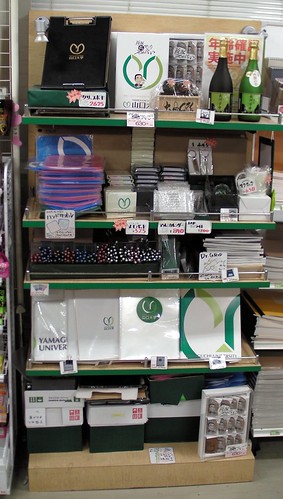
Social and Cultural Psychologist Masaki Yuki, after a spell at Professor Marilynn Brewer 's (presumably Ohio State) university in the US was amazed at the extent to which Americans are proud of and merge with their groups, at least to the extent to which US university students wear university sweat shirts bearing the name of their own institution, and come the day of the university American football game, half the campus would come to the match dressed in the same, university colours, chanting the team name.
As professor Brewer argues, Americans join groups to gain a desirable social identity, as a member of a of a presumed elite with which they merge. Badges and uniforms of membership that enhance the group-individual mind meld, are thus desirable, as are negative evaluations of rival groups. "We are good and/because they are baaad."
The Japanese on the other hand are far more economic in their group membership, preferring to join groups in which they can cooperate to form a unity greater than the sum of its parts. The important thing is the network of exchange relationships between the individuals who physically enhance each other's welling through the synthesis of different skills and aptitudes. Group member uniformity is thus avoided and Japanese group members do not see other groups as rivals, paying little attention to them at all.
While there is a bit of Westernisation going on at my university, and there is a mini invasion of the self-snatching, clone-ware, customised goods, Yuki's cultural psychological theory is probably my favourite (after my own) since it has something qualitative to say about the Japanese side of the cultural equation. In most of the other great cultural theories, Japan is typified by a lack or absence: lack of a internal moral standard (Benedict), lack of individuality (Hofestede), lack of illusion of individuality (Markus and Kitayama), lack of a need for positive self-regard (Heine), lack of linguistic thought (Kim), lack of focus (Masuda and Nisbett).
This post in video: the film of the burogu. Bibliography
Yuki, M. (2003). Intergroup comparison versus intragroup relationships: A cross-cultural examination of social identity theory in North American and East Asian cultural contexts. Social Psychology Quarterly, 166–183. lynx.let.hokudai.ac.jp/COE21/workingpaper/no04abstract.pdf
Labels: collectivism, individualism, japan, japanese culture, nihonbunka, 個人主義, 日本文化, 集団主義
Wednesday, April 17, 2013
Last Tunnel

The thing that strikes me about Kaiten pilots, and those that piloted so called "Kamikaze" (Tokkoutai 特攻隊) planes is their last letters. The philosophy expressed in these letters is that described by Markus and Kitayama (1991) as "interdependence," or as espoused by African Ubuntu philosophy such as expressed in the Zulu proverb, "Umuntu ngumuntu ngamantu" which means "I am a person through other people".
One such last letter, written by Matsuda Mitsuo, was on display in the Kaiten Museum. It reads
恩師先輩親親戚近所の方
皆様有難う
思えば
楽しい20年の人生
皆様の厚意を休して
笑って突っ込みます。
軍人精神
....
若桜萬乃木ノ桜
松田光雄
"To all my teachers, seniors, parents, relatives and those in my neighbourhood
Thank you all. (Lit. "Everyone, it is hard to be")
Thinking about it,
I had a fun 20 years of life
So laying to rest all your generosity
I will laugh as I launch in.
The spirit of a soldier
....
Young Cherry Blossom, Then thousand Cherry Blossom Trees
Matsuda Mitsuo"
This young man is saying in other words that he owes his life to the generosity of those to whom he addresses the letter, a generosity which has enabled to him to be and have fun and which is so great that it will amuse him to return the favour and give that beautiful, terrible, generosity permanent leave. This gives a good example perhaps of the etymological root of the Japanese word for "thank you": "arigatou" or "(your generosity is such that) it is hard to be".
It is difficult to know the circumstances of Petty Officer Mitsuo's death. He may have been crying and scared. However, in those last moments as Matsuda Mitsuo approached an enemy ship, I like to think that he was indeed amused. Mitsuo (lit "man of light") piloted his submarine into the sea near Okinawa on the 25th of April, 1945. He was 21 years old. He was not a man, he was dynamite.
I have read a lot of the last letters of Kaiten and "Kamikaze" pilots, and though they are all very similar they never fail to bring me to tears. I tried to make a video of this one but could not read it to the end. As I become aware of the similarity of the letters and suspect that pilots were schooled in this line of thinking, it does not make it any less moving and even as I grow older, it seems to become if anything even more true. As Madge (Maddona) says, "I am because we are". Realising ones interdependence upon others can facilitate great acts of sacrifice.
There are Christian mystics such as David Harding that say that they see the light, and the interdependence of the self, how it is "open to loving", but somehow they seem to keep their selves at the same time, keep it for God, or coming home to Suffolk. It seems to me that Christian mystics never let go of logos, still see themselves from a linguistic fourth person perspective, but these young men see, in Mitsuo's cherry trees for instance, a far fiercer light, that is all consuming. I am reminded of Robert Oppenheimer words when he witnessed the first atomic bomb, or so he thought...
"I remembered the line from the Hindu scripture, the Bhagavad-Gita. Vishnu is trying to persuade the Prince that he should do his duty and to impress him takes on his multi-armed form and says, "Now I am become Death, the destroyer of worlds. I suppose we all thought that in one way or another."
Bibliography
Markus, Hazel R., and Shinobu Kitayama. "Culture and the self: Implications for cognition, emotion, and motivation." Psychological review 98.2 (1991): 224.
Nietzsche, Friedrich. Ecce homo: how to become what you are. OUP Oxford, 2007.
Listening to
Tom Jones. Hit or Miss.
Labels: japan, japanese culture, 日本文化, 集団主義
Tuesday, April 16, 2013
British Menu Book with No Images
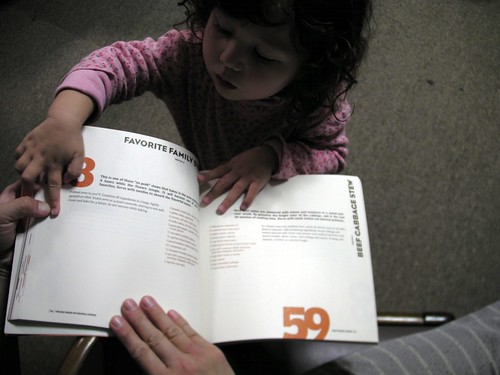
There is no plastic food in showcases at British restaurants. There are rarely even any images in their menus. Even if there are images, these may be just to set the atmosphere rather than be images of the food that one can purchase.
But, especially having lived so long In Japan where there are often visual aids to choosing food at restaurants, and copious photographs in all Japanese cook books, I was surprised to find that this British recipe book should have no images inside its pages at all. The only image is the one that adorns its over and it is not made clear which of the 262 recipes therein contained the image depicts. Even assuming that it is in the small print, the decision as to whether to cook and eat the any of the soups and stews described has to be based on the name, the instructions and the ingredients. This maybe testimony to the power of the British imagination but I think not. I think that rather it shows that the British, compared to the Japanese, do not really care what their food looks like so long as it tastes good and is healthy. This morning we had a yoghurt and broccoli soup which, as you can imagine, looked not unlike some bodily fluid or other, but tasted quite delicious.
I am informed that this recipe book is also quite good for those that wish to learn English.
Labels: image, japan, japanese culture, logos, 日本文化
Tuesday, April 09, 2013
Parents are Brought Up

This catch copy expresses a very Japanese sentiment, philosophy, or I would say central realisation of Japanese culture.
I am not sure of the full standard version of the proverb (will someone tell me?) but it is often said that "parents too are reared", "brought up", or "become adults" (「親も育つ」), since it is believed that is through bringing up children that people learn about the upbringing that they have received, the trials, tribulations, and sentiment of their own parents, and learn what it is to be, and become, an adult.
This sentiment is central to Japanese culture in many ways.
It is often said that Japanese "Buddhism," (or I would say Shinto under the guise of Buddhism), involves "ancestor worship". "Ancestor worship" sounded, to my Western ears, rather grotesque; like as if the Japanese think their ancestors are god almighty. But Japanese worship, and Japanese "gods" are much more down to earth, un all-powerful entities. They are respected, even revered, but they are far removed from the pain-in-in-the-brain (to atheists at least) omniscient, super-good, perfect beings of the likes of Allah and Yaweh. Japanese ancestors and Japanese gods are respectable. They are as holy or cool as saints. The Japanese view their own ancestors as saints. Even that may sound too far fetchededly arrogant to Western ears, but.... to justify the sentiment I would need to digress too much. This was meant to be a post about a children's clothing advert, but it has so many implications. Let it be said that Japanese ancestors, and therefore to an extent Japanese parents, are deemed to be cool, like Elivis and other heroes and saints are cool, so it takes a while to get there. Being a parent is not easy. It takes being brought up to. There is a long and hard progression to becoming a hero. Heroes don't get there on their own. They need help.
Japanese parents get to their exalted position as parents thanks to their children. Japanese ancestors get to their exalted position as ancestors because they have descendants. Japanese deities get to be sacred because people worship them.
Thus far a Japanese person might agree. The following is more controversial.
Japanese culture is "womb-centric" in a similar way to which Western culture is phallocentric. The model of Western culture is the man. "Mankind," we Westerners say, as Simone De Beauviour pointed out. In Japan it is the reverse. The Japanese human is "woman kind". There is no Japanese word (afaik), that like the English "man" or French "homme" that means, in reverse, both woman and human, but the Japanese word for "I" in its many variations is female in its most general form. "I," in elementary Japanese language textbooks "Watashi," is a word for women, and for everyone. Speaking from a reverse Simone DeBeavoir perspective therefore, it is not surprising that it takes upbringing, and effort, for men at least, to become a "watashi." Men at least do not become their first person singular overnight. They learn to become homo-parentis, thanks to the love of their children.
Imagine yourself to be a full on, normal, testosteroned male. Are you, in that guise, a parent? I'd argue not; not at least you have become a father. Fathers only become fathers as a result of their culture, their experience of bringing up children.
I meant to write much more in the above post, but even if I had I would not have gone so far as to connect this 'sentiment' with the Japanese attitude towards time, which as a commenter pointed out is connected, or likewise central, to Japanese culture, including Japanese tourism to places where time can be felt, such to cherry blossom and red leave viewing sites, and "relics," such as Hiraiizumi (夏草や兵達が夢のあと) where there is little more than grass to be seen but, time can be felt, and vividly imagined.
Going even further into the abstract, Nishida the great Japanese philosopher and his acolyte Watsuji, went to Germany to study philosophy and came back astounded at the extent to which Western philosophy emphasised time as being.
So who emphasises time more? Westerners or Japanese? It seems to me that the world is turned inside out.
To Descartes, the founder of Western philosophy, the cogito or self-narrative is the self, whereas "res extensa," the extended or space, the visual world, is out there and dubitable, ephemeral, 'mere image'. Heidegger went so far as to claim that "the meaning of being (as 'discovered' by Western philosophers in the cogito) is time." Derrida argues that the reason for this adulation of time as being, human being, is due to the Western worship of language, in specie, internal self-narrative. Our (Western) words inside our heads, are felt to be ourselves, and occur in time. Time is that which Westerners believe ourselves to be-in*. Space, on the other hand, is 'out there'.
It is perhaps for this reason that Western tourism is largely about going to places where something can be seen. Westerners go to gaze, or gawp, at anything beautiful. Time does not have to be involved. In this sense, Ippei + Janine's photo-travelogue of beaches in Japan, is unusually Western in that it introduces beautiful Japanese places that are largely ignored by many Japanese relic-seeking, time-travelling tourists.
To most Japanese conversely, the self exists in and as the mirror of the mind, while time is out there. I venture to suggest that Janine looks at and loves the image of their travels as Ippei lives or is them.
How can I bring this back to self-rearing-parenthood? I know there is a way :-)
*"be-in." Ha! A philosophical joke.
Labels: japan, japanese culture, 日本文化
This blog represents the opinions of the author, Timothy Takemoto, and not the opinions of his employer.