
Tuesday, September 27, 2005
Chopping off my little finger
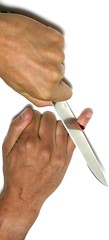
In Korea people remove portions of their fingers by way of protest, sometimes against the Japanese. Such protests would be inclined to backfire since finger removal is so closely associated with criminals.
In one manga i read, a Yakuza debt collector (some Yakuza earn their living in this way) threatened the debtor saying "If I don't take your debt back to my boss he is going to ask for my finger, so I will chop it off here," and proceeded to take out a kitchen knife and prepared to make the cut. The debtor was so alarmed at the prospect of seeing someone cut their finger off that they paid back their debt, before the yakuza drew blood.
Apparently it is "surprisingly painful." I am not sure what that means. It looks painful. How could it be surprising?
A gentleman that I knew with no top finger joint used a prosthetic finger to cover his loss. He was a restaurant manager when I met him but I could not help thinking that he was a Yakuza who had fallen from grace.
Labels: japan, japanese culture, nihonbunka, 日本文化


Monday, September 26, 2005
Sex Related Pharmaceuticals
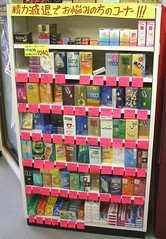
The top rows contain a variety of sexual strength enhancement potions, such as Maca (a peruvian root) and extract of tortoise. There are many varieties of condom beneath. Japanese condoms are smaller and thinner than those sold in the UK.
The Japanese are big users and producers of condoms, with contraceptive pill being illegal until only a few years ago. Feminists see the absense of the pill as further evidence for the servile status of the Japanese woman.
I believe that his is related to the fact that women's sex organs are considerably more taboo than those of men. Men's hang out, and can be encapsulate in latex, but interfering with the dreaded womb would is treasonable.
Sadly, from the point of view of HIV prevention, the Japanese have been using less condoms recently, not apparently because they are using the contraceptive pill, but because they are having unsafe sex. One day soon HIV will hit Japan fairly hard.
Labels: japan, japanese culture, nihonbunka, sex, 日本文化
Monday, September 19, 2005
Apples
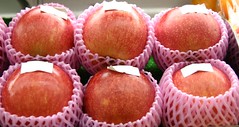
The price tag whited out to obscure producer, but they were shockingly expensive.
Each apple is at least the size of a grapefruit having been nurtured individually by a farmer whose farm is about the size of your back yard.
There is a myth in Japan that foreign produce is more likely to be contaminated with pesticides and herbicides. In fact, as far as I know (and according to a Newsweek or Time article) Japanese farmers, with their labour intensive mini farms producing giant fruit use more chemicals than anyone. I watched farmers of giant grapes (kyohou) from Okayama dip each and every one of their grapes into a solution of some sort of chemical which prevented the grape from creating seeds.
Fruit comes individually wrapped in pink plastic stockings, because it is so shockingly expensive. It may be fair to say that fruit is only eaten as a treat, rather than as a normal part of the Japanese diet.
Labels: japan, japanese culture, nihonbunka, 日本文化
Wednesday, August 17, 2005
Blonde Japanese Dolls
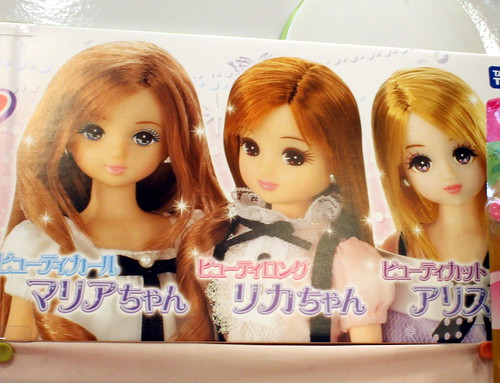
Labels: japan, japanese culture, nihonbunka, westernisation, 日本文化
Little Girl in Gents
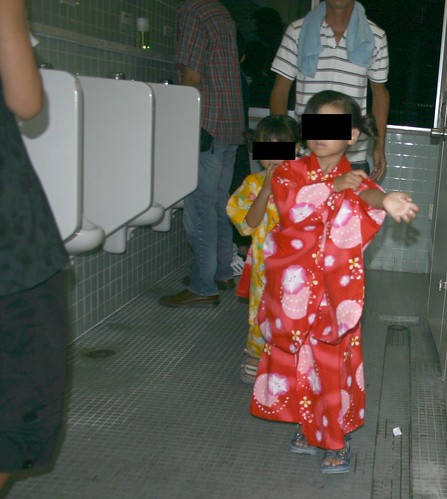
A little girl leaves a stall of the men's and passes behind the men's urinals, rolling up her sleeves perhaps in preparation for washing her hands. I am not sure why she did not go to the women's. She seems big enough to go on her own. Perhaps she needed help with here summer cotton kimono? I don't think that she would be allowed in the gentlemen's' toilet in the UK. The men's toilets smell but they are not a terribly taboo place, here in the land of the naked men.
Labels: japan, japanese culture, nihonbunka, sex, 日本文化
Welcoming Rice Cakes Mukaedango
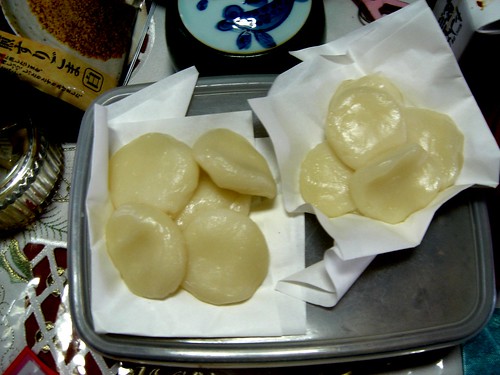
These "welcoming rice cakes" (Mukaedango) are put out at the beginning of the summer festival to welcome the return of the spirits of the ancestors to the family home.
According to the ethnologist Yanagita Kuniyo, the Obon festival is one of two times of the year when the spirits come to the home, the other being the New Years festival. The symmetry between the two festivals, at the festival for the ancestors (obon) in Summer and the New Year Festival (shougatsu), is visible in the details, in the fact for instance that round rice cakes are put out on display.
In my own opinion, I see obon as a Shinto, or Shinto-Buddhist festival.
Labels: japan, japanese culture, nihonbunka, 日本文化
Big Sake (Shouchuu)
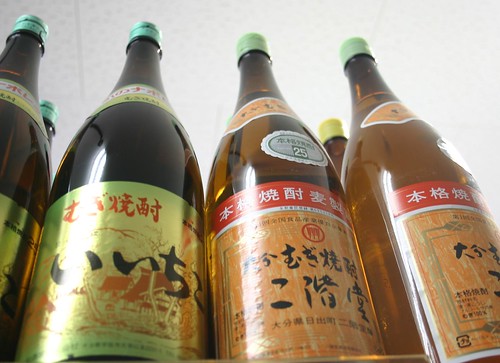
This is not sake but "shouchuu" Japanese vodka, made from potatoes, wheat, or rice and distilled to a fairly potent 25 percent alcohol by volume. It is rumoured not to give the drinker much of a hangover due to its purity. It is drunk straight, with ice, or with hot water (for maximum effect).
The Japanese are not ashamed to say that they drink alcohol for its effect. The bottles are big, and the consumption among middle aged men appears to be quite high.
The brand names and logos of the products in the photograph are copyright their respective manufacturers.
Labels: japan, japanese culture, nihonbunka, 日本文化
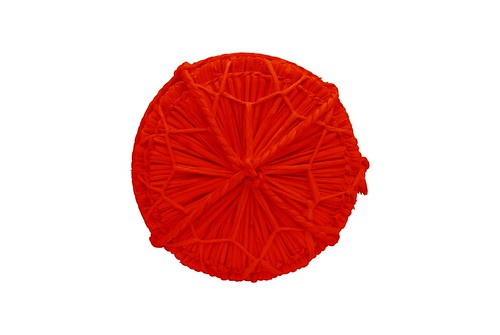
Japanese Flag Made of Rice Barrel
Labels: japan, japanese culture, nihonbunka, 日本文化
Japanese Saw

Labels: japan, japanese culture, nihonbunka, 日本文化
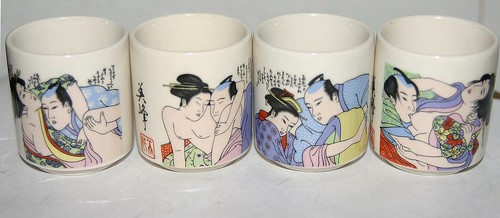
Erotic Cups
Labels: japan, japanese culture, nihonbunka, sex, 日本文化
Big Car Cheap
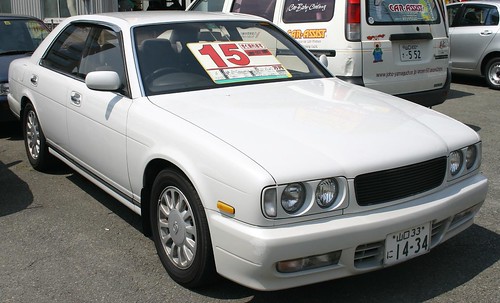
Large second hand cars in Japan are cheap. This Nissan Gloria had 80,000 kilometers on the clock and should run for as much again but it has a price tag of a mere 1500 USD.
The Japanese are very environmentally conscious in some ways. There is a lot of recycling, use of renewable sources of energy such as wind and solar power, investment in energy saving technology such as hybrid cards, very economical cars, use of traditional energy saving devices such as heated coffee tables, bed warmers, and taps that allow one to wash ones hands with the water that fills the toilet cistern. But one area in which the Japanese do not excel is that of using second hand products.
Second hand products are seeing a considerable increase in popularity at the moment, but until a few years ago there were very few second hand clothes and appliance stores. The prices of second hand cars was low. And the "large rubbish" days when Japanese threw away television sets, bicycles and other items that might otherwise find their way to a second hand store were a bonanza of perfectly usable stuff but those that carted it away were often gaijin.
The Japanese seem to feel that second hand goods are in some sense dirty and thus defiled. Perhaps it is the shinto influence. I wonder if Shinto shrines could team up with second hand stores to offer purified (oharai sumi) second hand goods.
Labels: japan, japanese culture, nihonbunka, 日本文化
Model Food

For my explanation of the philosophy behind model food, please see this post on model ice cream
Labels: japan, japanese culture, nihonbunka, 日本文化
In Britain they would be Stolen
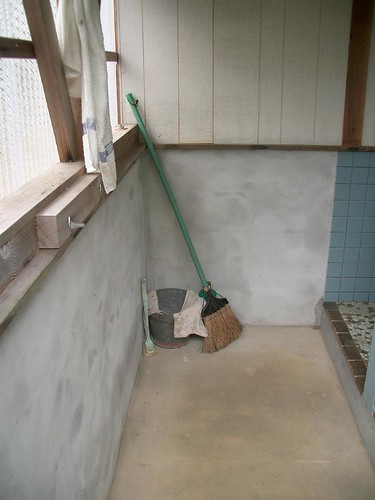
For example it used to amaze me how Japanese can leave cleaning products in public places, such as in the public toilet above, and that no one steals them. The bucket, broom and cloth toilet brush and bleach are perhaps too old and dirty for even Britons to whish to steal them, but placed as they are in an unlocked and isolated public toilet, I predict that they would not long remain intact in the UK. If things are not locked up or nailed down, then they are either stolen, or if they are of little use then they would be destroyed, destroyed. In the UK, if no one was interested in stealing the broom then someone would probably use it to beat in the windows of the toilet, then break it in half and then throw it into the bushes.
Cleaning products and utensils for cleaning such as these can be seen left in toilets, shrines, parks and even bus stops.
But there are some crimes that the Japanese seem to be into such as pork barrelling, confidence trickery, "dangou" cartells, reading books before purchase, and speed limits are liberally interpretted, as are of occasion are the constitution, international treaties, and marriage vows.
All the same though, I generally believe in the moral superiority of the Japanese!
Labels: japan, japanese culture, nihonbunka, 日本文化
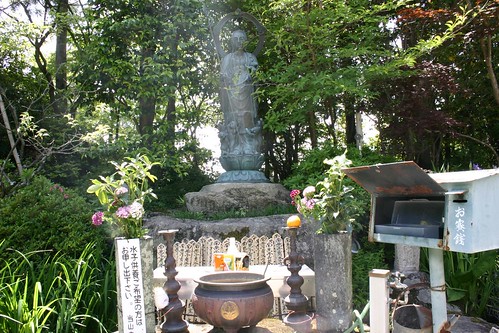
Buddhist Altar to Aborted and Misscarried Children
Labels: japan, japanese culture, nihonbunka, 日本文化
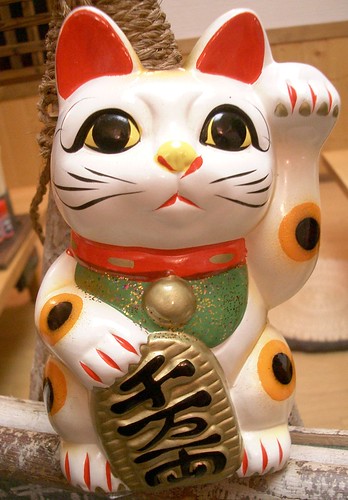
Inviting Cat (Maneki Neko)
Labels: japan, japanese culture, nihonbunka, 日本文化
Talisman and Prayer Beads
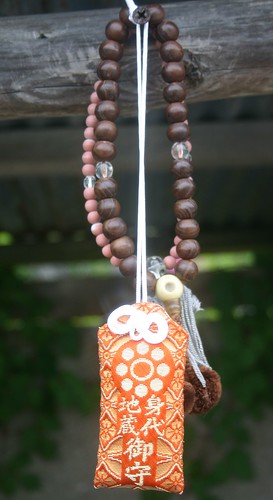
I have a theory that Joudou ShinShuu or "Pure Land" Buddhism may be based upon Catholicism. Or, if not actually based upon Catholicism in inception, taps a similar religious sentiment, and when Catholicism was outlawed in Japan, may have been the religion of choice for those that would otherwise worship Christianity.
Joudoushinshu
1) Simple prayer for any time or occasion
2) "Other power" Buddhism - it is only by worship that humans can reach the Buddha
3) The vow of the Amida Buddha is to bear our sins and lead all into enlightenment.
4) Enlightenment happens post death - those that believe in the Amida Buddha are reborn in the "pure land" (which is in the West!)
5) It is especially for sinners - even the bad can reach enlightenment if they believe in and worship the Amida Buddha.
Interesting difference - The Amida Buddha is neither male nor female.
Labels: japan, japanese culture, nihonbunka, 日本文化
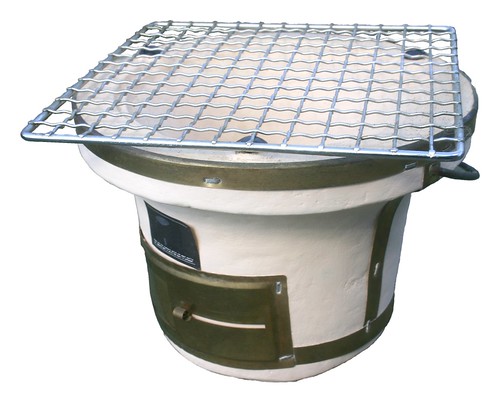
Suicide Barbeque
Labels: japan, japanese culture, nihonbunka, 日本文化
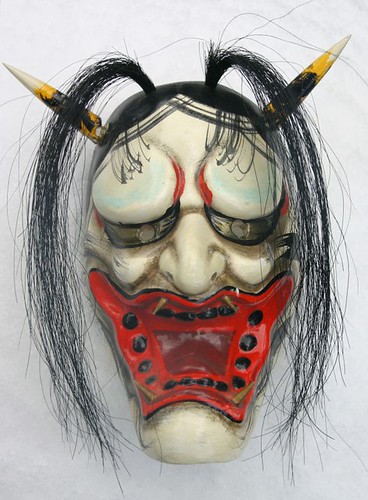
Hanya in the Snow
Talisman/Omamori/Good Luck Charm
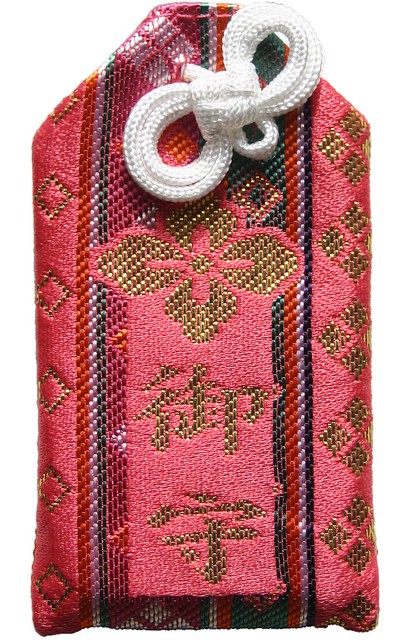
In Japan the lucky charms called "Omamori," (literally "protectors") are said to work by being a decoy-self ("migawari) that attracts bad luck.
Hence any "impurity" or bad luck is collected in the charm instead of in the person. The charm is thrown away once a year, together with the bad luck.
There is quite a lot of theory behind this.
Omamori are basically very similar to the larger tablets bearing the name of the deity "ofuda" that one receives from a Shinto shrine. These larger tablets are enshrined within the home on the Spirit Shelf (Kamidana). Omamori are also basically pieces of paper stamped with the name of the god.
Why should a piece of paper stamped with the name of the god be a decoy-self?
The easiest way to answer this question is by referring to Japanese Buddhism. Japanese Buddhism concentrates on rituals for the dead. The dead are enshrined in the household inside the "butsudan" or buddha cupboard. Inside the buddha cupboard there is an effigy of the buddha, but perhaps more importantly there are a lot of little tablets (called ihai) which represent one's dead relatives. People open the butsudan and say "hello grandpa" to their grandfather in the form of his little tablet.
According to the Japanese ethnologist Yanagita Kunio, the Budda cupboard (Butsudan) and the Spirit Shelf (Kamidana). The spirit shelf was for the living and the bustudan was for the dead but basically in both there was a deity (Shinto Kami or spirit, or Buddhist buddha) and in both there was representations of members of the household, living or dead.
Today in Japan there are few personal tablets for the living (other than omamori) but there are traditions of sticking the names of the living onto the shrine shelf in some parts of Japan. In the past, people recieved a part of the spirit of their local shrine and this in a sense gave them life. In other words a ticket or tag from the shrine represented a person.
This is why a "omamori" is a bit like a spare ID card. If you have some bad luck, like being caught doing a minor misdemeanour then you charge it, or put it down to the spare id, which you throw away at the end of the year.
The new year is said to be a rebirth, everyone gets a new identity. Everyone starts afresh with a clean slate.
Labels: japan, japanese culture, nihonbunka, 日本文化
Shinto Saint Peter of the Pearly Gates
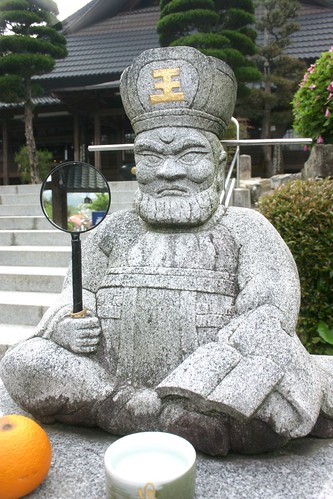
This picture is very much in line with my theory of the Japanese self being "in the mirror."
Labels: japan, japanese culture, nihonbunka, 日本文化
This blog represents the opinions of the author, Timothy Takemoto, and not the opinions of his employer.