
Monday, April 02, 2012
Origin of The Stamp Rally and Japanese Pilgrimage

The stamp rally has more of a history than the goshuinbou (read stamp collection books) required by the Tokugawa government of those that took part in the pilgrimage of the 88 temples in Shikoku. Yes, pilgrims were required to get scrolls stamped at each temple, and yes this may be the direct ancestor of the stamp rally but, the history is considerably older.
The "God Body" (goshintai) or vector of the spirit of the deity received from Shinto shrines is a Shinpu, Ofuda or Spirit containing card as shown at the point of its creation by a shrine priest in the picture above. The most representative example are those of Ise Shrine, seen here in the above photo being created by stamping a pure white piece of Japanese paper with the holy seal (spirit seal) of the shrine.
The piece of paper stamped with a seal, being shown being created above, is a Jingu-Taima, the Shinto holy-of-hollies, representing or containing the spirit of the imperial ancestor; Amaterasu the Goddess of the Sun. When these pieces of paper were rumoured to have rained from the sky (as recently as the late nineteenth century) the Japanese took to mass pilgrimage, in their hundreds of thousands, dancing, and chanting, "there's nowt to complain about!" ("ee ja nai ka").
Prior to the great bureaucratisation of Japan in the ancient Ritsuryou legal system of 701, and for many centuries afterwards, Japanese would receive the spirit of their local diety vectored by the branches and leaves of sacred trees, or stones from around a sacred rock, as do other geographical totemist (Spencer and Gillan, Durkheim, Freud). The Japanese in their bureaucratic massive efficiency, updated this bricolage (Levi-Strauss) to allow shrines to print totem badges using seals. Totemism met and merged with the inkan, seal or stamp. And Japanese go and get these stamped sacred pieces of Japanese paper and card from Shrines to this day. To receive a piece of paper stamped with the name of the deity was the final purpose or proof of pilgrimage*. These totem badges were also, Yanagita argues, constituitive of self.
Japanese Tourists to this day go to famous places, special places with a name (Meisho). There the Japanese tourists receive symbols. The Japanese do not travel to see so much as to receive an indication (kuni no hikari wo shimesu), and in this way collect symbols. If, as Urry and McCannel say, Western travellers go to gaze upon sights and be seminologists, interpret sights, and provide the symbols pronouncing them "Japaneasy," the Japanese go to places where they may be no sight to provide the image go with the symbols.
This difference is due to a difference in the media of self. Westerners identify with the phonic linguistic media. Travel for Westerners is like Husserl's transcendental meditation, removing themselves from the sight as radically other, they return to their cogitus logocentricus, contemplate what they see and pronounce it such and such. The Japanese are on the other hand, a primordial space (Nishida, Watsuji), a mirror (Kurozumi). The Japanese go to places with a name, and provide the images either in their imagination, or their person taking their own picture thus superimposing themselves as image, on the named spot.
"It was just how I imagined it" said one 19th century Japanese pilgrim as she visited historic sites with little to see (Nenzi). Matsuo Basho wept at the rock commemorating the site of an ancient castle and was overjoyed to imagine the scene in times gone by while, borrowing Shelley, all around the lone and level grass stretched far away (Hudson).
Perhaps these Japanese seals are a little like the body of Christ as received at mass? Catholics ingest a little of the body in Church, or in front of a mirror? I am very confused.
*English pilgrims too, before they were stamped out by Protestantism would receive totem or pilgrim badges thought to have magical ( e.g. healing) power.
Labels: japanese culture, Shinto, theory, totemism, tourism, 日本文化, 神道


Wednesday, March 28, 2012
From What Perspective do The Japanese see Themselves: Why I don't want to be Dov Cohen

Numerous reports have argued that the Japanese have the ability to see, or simulate seeing, themselves. But from whose perspective are the Japanese able to see themselves from?
It was with rapt interest that I read another of Dov Cohen’s excellent papers (Cohen & Gunz, 2002, which was submitted in 2000) where he mentions the generalized other in connection with the Japanese internalized external-self-gaze. Dr. Cohen argues that the generalized other is internalized more in collectivist societies. Fortunately I think that this, Dov Cohen's postition, is the reverse of the truth: the generalised other frees us from the gaze, and judgement, of the real others that we face.
That is not to say that I am arguing that the Japanese are more individualist. Perhaps even their generalised others are somewhat less generalised, more of a eyes of the we, the community, or "seken no me" (see Satou, 2001). In any event, as a point of theory, the generalised other should therefore be more prevalent - more commonly simulated and internalised - in individualist societies.
Bakhtin (1986, p.126), the Russian Literary critic used as a basis for Hermans and Kempen’s “Dialogical Self” (which is very similar, or predicts the results found in those who have dialectical thought), argues that communication always presumes an other, is always at least dialogical. However, Bakhtin aslo claims that the communicators meaning is not leftentirely at the mercy of otherS, but rather communicators presume that what they have to say has meaning even if the immediate other (the you) does not understand them, because Bakhit argues they have (he mentions God), presume, or simulate a generalized other or “Super Addressee.”
Mori Arimasa (Mori, 1999) claimed that the Japanese Language and hence Japanese have no linguistic “third person perspective,” and consisisted in only first and second person communication forms, thus “I” is an “you for you.” I agree. The Japanese see language as something with which one communicates; and there is nothing strange in this.
Mead (1967) makes no suggestion that internalization of his famous generalized other is associated with collectivism. Indeed, similar to the logic employed by Bakhtin (ibid), the "generalized other" frees the individual from taking the perspectives of real, second-person others.
Jacques Lacan (2007) argues that the self has to be formed through the use oflinguistic symbols because it is only in language that people can see themselves from the perspective a generalized Other (Lacan) without the existence of real others or mirrors. Similar to Bakhit, Lacan argues that a person that attempts to cognise themselves visually is always at the mercy of others or the presence of mirrors a situation which Lacan portrays in a very negative way.
Mead (1967) goes further to suggest that without a mirror one can not even see oneself from the viewpoint of others.
However,
1) As mentioned above there are theoretical (Mori,1999) and experimental evidence (Leuers and Sonoda, 1999; Kanagawa et al., 2001) to suggest that Japanese speech, even self-narrative, is dialogical, always addressed to an other, not addressed to a generalised other or "third person."
2) On the other hand, there is theoretical and experimental evidence that Japanese can see themselves (Zeami in Yusa, 1987; Cohen et. al. 2007, Masuda et al., 2008), including from the perspecitive of a mirror (Heine et al. 2008). The mirror it should be noted promotes *private* self awareness, not public self awareness (see Fejfar and Hoyle, 2000 for a review), that is to say an objective view of self from the position of self, rather than from real others - which is called public self-awareness.
Private self-awareness is the objective self-awareness which can be achieved through the internalisation of an other with whom one identifies (see Vaz & Bruno, 2003 for a discussion of internalised but non-identified others).
It is probable that people in Japan have far less of a problem with identifying with others. "Hell is other people," is far more true for a Westerner like Satre (1989) than for many East Asians. However, in the case of Japanese, as it is in the West, people only really want to identify with a generalised other, a transcending other, an other who is other but not AN other, thou and not you, other and yet also self.
Or, put another way, in answer to my title, my desire to be Dov Cohen is ambivalent. I want to be Dov Cohen, but at the same time I don't, because he is not me. Though I am not even one of Dr. Cohen's psychological fingernails, I am greedy, I want to to have a general, objective perspective and be right!
Bibliography
Bakhtin, M. M. (1986). Speech Genres and Other Late Essays. (V. W. McGee, Trans.). University of Texas Press.
Cohen, D., & Gunz, A. (2002). As seen by the other...: perspectives on the self in the memories and emotional perceptions of Easterners and Westerners. Psychological Science, 13(1), 55-59. http://web.missouri.edu/~ajgbp7/personal/Cohen_Gunz_2002.pdf
Cohen, D., Hoshino-Browne, E., & Leung, A. K. (2007). Culture and the structure of personal experience: Insider and outsider phenomenologies of the self and social world. Advances in experimental social psychology, 39, 1- 67.
Fejfar, M. C., & Hoyle, R. H. (2000). Effect of Private Self-Awareness on Negative Affect and Self-Referent Attribution: A Quantitative Review. Personality and Social Psychology Review, 4(2), 132-142. doi:10.1207/S15327957PSPR0402_02
Heine, S. J., Takemoto, T., Moskalenko, S., Lasaleta, J., & Henrich, J. (2008). Mirrors in the head: Cultural variation in objective self-awareness. Personality and Social Psychology Bulletin, 34(7), 879-887.
Hermans, H. J. M., & Kempen, H. J. G. (1993). The Dialogical Self: Meaning as Movement. Academic Press.
Hermans, H. J. M. (2001). The Dialogical Self: Toward a Theory of Personal and Cultural Positioning. Culture & Psychology, 7(3), p 243- 281. doi:10.1177/1354067X0173001
Lacan, J. (2007). Ecrits: The First Complete Edition in English (1st ed.). W W Norton & Co Inc.
Leuers, T. R. S., & Sonoda, N. (1999). Independent self bias. Progress in Asian social psychology, 3, 87-104. (Leuers is Takemoto)
Kanagawa, C., Cross, S. E., & Markus, H. R. (2001). ‘Who am I?’ The cultural psychology of the conceptual self. Personality and Social Psychology Bulletin, 27(1), 90-103.
Masuda, T., Gonzalez, R., Kwan, L., & Nisbett, R. E. (2008). Culture and aesthetic preference: comparing the attention to context of East Asians and Americans. Personality and Social Psychology Bulletin, 34(9), 1260-1275.
Mead, G. H. (1967). Mind, self, and society: From the standpoint of a social behaviorist (Vol. 1). The University of Chicago Press.
Mori 森有正. (1999). 森有正エッセー集成〈5〉. 筑摩書房.
Sartre, J.-P. (1989). No Exit and Three Other Plays. Vintage.
Satou 佐藤直樹. (2001). 「世間」の現象学. 青弓社.
Vaz, P., & Bruno, F. (2003). Types of self-surveillance: From abnormality to individuals ‘at risk’. Surveillance & Society, 1(3), 272-291.
Yusa, M. (1987). Riken no Ken. Zeami’s Theory of Acting and Theatrical Appreciation. Monumenta Nipponica, 42(3), 331-345.
Labels: japan, japanese culture, Jaques Lacan, theory, 個人主義, 日本文化, 集団主義
Tuesday, March 27, 2012
Things that foreigners find annoying about life in Japan
1) Loud noises (Nakashima, 1999), especially linguistic noises (announcements, "welcome" etc) are very difficult for Westerners to cope with since it disturbs their self speech, or"selfing" (McAdams, 2006). Japanese do not think in language (Kim, 2002).
2) Not giving reasons (, i.e. some words) for things, or doing or not doing things without a (linguistic) reason pisses Westerners off since they live by their reasons. God forbid that anyone should attempt to point out the obvious fact that something is done simply because a tradition because this does not give a reason for the merit of something, even though so many things (such as driving on the right) are justifiable only only the basis of tradition. Demanding reasons is also fundamentalism.
3) Non semantic utterances ("eee," "nnn" high pitched voices) and facial expressions (e.g. the boxes showing the faces on TV) upset Westerners who can't or don't want to read these communications because they want meaning to be in a linguistic form.
4) Lack of a certain linguistic focused attitude towards individual problem solving (aka "critical thinking"), group problem solving (i.e. debate see Nakashima, 1997), politics (speeches are politics), and wit (god forbid that anything but repartee be funny). 5) Lies, are of course beyond the Cretan pale. How could lies be good? It would be paradoxical!
Western annoyance with second hand smoke is also not independent of a different attitude towards language. Humans are aware of the harm of smoking from statistical, linguistic facts since the harm is largely unseen. On the other hand, smoking keeps people thin, and Japanese people reflect upon their lives visually judging their health by appearances, which is something that obese Westerners often fail to do.
Kim, H. (2002). We talk, therefore we think? A cultural analysis of the effect of talking on thinking. Journal of Personality and Social Psychology. Retrieved from http://www.psych.ucsb.edu/labs/kim/Site/Publicationsfiles/Kim2002.pdf
McAdams, D. P. (2006). The role of narrative in personality psychology today. Narrative Inquiry, 16(1), 11–18. Retrieved from http://www.sesp.northwestern.edu/docs/publications/1049432884490a09930cdc3.pdf
Nakashima, Y. 中島義道. (1997). 「対話」のない社会―思いやりと優しさが圧殺するもの [A society without dialogue: The things that sensitivity and kindness obliterate. my trans]. PHP研究所.
Nakashima, Y. 中島義道. (1999). うるさい日本の私[Urusai Nihon no Watashi, Loud Japanese that I am]. 新潮社.
Labels: japan, japanese culture, logos, nihobunka, nihonbunka, occularcentrism
Monday, March 12, 2012
Big headed Bug-Eyed Figures and the S'Entendre Parler

I also get the feeling that this big head, or rather big face and big eyes, with no mouth, form is rather like the structure of "s'entendre parler."
Skip this next bit if you know what "S'entendre Parler" refers to.
"S'entendre Parler" is French for the experience of hearing and understanding oneself speak which Derrida argues, and I agree, is the "auto-erotic," cogito experience which gives rise to the belief in the Western self. Put another way, "Hearing oneself speak" is the cogito, that bastion of all things logical and white, derided, queered, made pathological. In the silent fish bowl of my mind I can presume to be communicating with myself, that I can thus say myself, frame myself, that I take a point of reference upon myself, that I can speak myself to myself and by this self-distance-requiring, mental Ina Bauer, I can exist. As Derrida points out however, there never was any distance, I can never say anything to myselsf. I can try. "I am hot?" "I am writing?" I say, but did any communication take place? For communication to have taken place I would have had to have transferred something. But what can I say that I don't already know before I have said it? The best I can hope for is a memo, or shopping list. I can write myself memos. But this self speech that I keep on doing is a strange sort of obsession indeed bearing in mind self proximity, the presumed "presence," unity of the enunciator and the enunciated. But by this constant stream of memorandums, this "differance," putting myself off for later, I succeed in something. Talking to oneself in the first person does have real effects. It does create in me the illusion of identity which, since it has real effects, might even be argued to be real.
End of Aside.
And back to this figure, above. Is it like the Western self-narrative?
It reminds me of the "sounded existence" existence that logocentrists like to think they are: completely absent in some ways, and completely present in others. As Derrida points out, logocentrism bound up with phonocentrism because the phoneme always disappears. If were were to write ourselves postcards (Derrida, 1987) then the sicko-silliness of the project would be become apparent. But because we speak to ourselves in phonemes, which disappear, almost without a trace, as soon as they are sounded, we can believe in presence, that we are experiencing thought and meaning itself, un-mediated.
As I am always saying, the Japanese are permanently in the Mirror Stage except for them it is the destination. In order for the same kind of auto-erotic self presence that can be achieved with the self-saying phoneme the Japanese must imagine themeseles to be, rather like this figure: completely unsaid and un-sayable (hence the absence of mouth, the plethora of mime) but only seeing and seen, hence the massive face and massive eyes. So I think this figure may be the cogito, the "S'entendre Parler," my self, reflected in a modality morphin' mirror.
Derrida, J. (1987). The Post Card: From Socrates to Freud and Beyond. (A. Bass, Trans.) (First ed.). University Of Chicago Press.
Wednesday, March 07, 2012
Engrish and Self
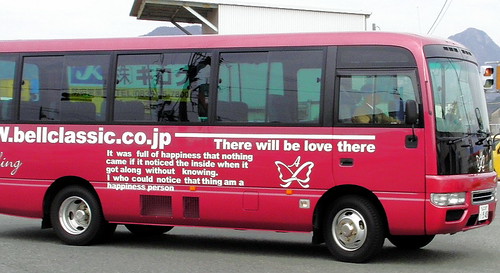
Part of the importance of Engrish for Japanese people is due to the Westernisation of Japan, and idolatry of the West. Relatedly, part of the attractiveness of Engrish is simply that it is not Japanese and thus represents a release from traditional constraints. Things expressed in the English language are thus escapist, cool, modern, free, individual and desirable.
However there is also cultural difference in the attitudes towards language. To the Japanese Engrish "language" is often seen as merely a pattern. Language is image for Japanese people. To Westerners, language is important, animate, self, and meaning itself, but to Japanese it is as Japanese "characters" are to Westerners, merely a form, a plaything, something for children.
"Hello Kitty" and all all the other "characters" or Noh masks, or other disembodied faces that populate the Japanese media are seen or felt as people, animate, important, protectors, (and protected by copyright).
Is the self a narrative, made up of, and constituted by phrases and a name, or is it a collection of images, a picture book, a picture tree, a network of images? Is language (is image) central, and important, or is it external, decoration? In Japan language is a decoration, an other and ignorable (Nakashima, 1999) pleasantry.
Bean-Bread-Man as Self

Via Flickr:
Bean-Bread-Man (Anpanman, e.g. Yanase, 1975) is, according to repeated surveys by myself and Bandai (see Nishikawa, 2010), the most popular Japanese hero, and has a detachable, replaceable, edible face. Both my children show an almost religious reverence for this flying, edible hero.
While the creator claims that he chose name and composition of the titular character from his experience of dreaming of eating a sweat bean filled bun or bean-bread (anpan) while facing starvation during the Second World War, I propose a variety of alternative subconscious significance for his use of bean bread.
The combination of the traditional Japanese sweet bean filling and the Western "bread" face, suggests to me that he may be (in somewhat offensive race terminology, Urban Dictionary def. 3.) akin to an "egg," in being of mixed racial origin. Bean-Bread-Man is white, or rather made of a Western food on the outside, and yellow, or rather made of a traditional Japanese food, on the inside.
The use of bread to symbolise Westerners is perhaps evident from the character of Sliced-Bread-Man in the same series, who is idolised by Bean-Bread-Man's enemy's wife (Dokin-chan), and always looks a bit too gentlemanly for his own good. And the Rice-Ball-Man (Omusubi man, who has a series of his own) and Tempura-Bowl-Man (Tendon man) both animate Japanese foods, are given Japanese style clothing and arguably a Japanese style character.
Bean-Bread Man started as a cartoon in 1973 and was first broadcast as a TV series, in 1988 when the Westernisation of Japan had long been in full swing. Furthermore, Bean-Bread-Man shares certain characteristics with Jesus: he is extremely concerned with justice, while he has tree friends and a family he is a bit of an individualist (compared to the groups of Super Sentai/Power Rangers) and he is edible, being eaten by those in need of sustenance. Jesus sustains his followers by being eaten in body, or symbolically, in Christian places of worship.
Eating, and by eating internalising, deities is far from unique to Christianity; it is shared by Shinto. In the most important Shinto festival, that of the New Year, Japanese enshrine "mirror rice cakes" (see later) in the home and eat them early in the new year, thus symbolically imbuing the spirit of the rice, the mirror and the Sun Goddess. This yearly Shinto mass is considered to be a rebirth and the spirit therein imbibed to be constitutive of self. According to the Shinto Sect-Kurozumi-Kyo, the self of the Japanese is that part of the Sun Goddess mirror that they have taken inside them. Thus not only the purity of the mirror but also as pointed out by Ohnuki-Tierney in "Rice as Self" (1993, p8), the purity of the white rice itself is seen to symbolise the purity of the Japanese self. Having a mind made of food, like Bean-Bread-Man, is thus nothing new.
Bean-Bread-Man's face, consisting of three red circles, is in itself appealing to young infants. My daughter was attracted to Bean-Bread-Man on sight. It seems to me that Bean-Bread-Man also resembles as breast, in being edible, and in appearance, he looks like an attempt to focus two breasts as one.
Bean-Bread-Man's face is both central to his character and super-powers. In every episode his face gets dirty or wet causing him to loose his strength, when his adopted mother, Butter-girl, throws a new bean bread face, baked with by his adoptive father, containing magic from a star, onto his shoulders which spins and sets, and enables him to be strong again. His face is thus both external (something made for him) and the centre of his psyche, in line with Lacanian theories of self (Lacan, 2007), and perhaps Watsuji's theory of "persona." (Wasuji, 2007);
Watsuji Testuro, one of the most famous Japanese thinkers, proposed that the Japanese self, or the Japanese version of what in Westerners is a self, is a "persona" which he describes using the metaphor of a noh mask. noh Masks, like Bean-Bread-Man's face, are central to their characters and are thought to be imbued with the power or spirit of that character. Noh actors (like Bean-Bread-Man immediately prior to receiving a new face) are nothing without their masks. The stare at them for a while in order that they become possessed by the character as contained in the spirit of the mask. Again, the character is invested and centred in the detachable, external face, just as Lacan's infant in the mirror stage misconceives himself to be his appearance in the mirror, which though external she takes to be (and in a sense becomes) the centre of her psyche.
In Japan there are a plethora of animate faces, faces which contain the character, the spirit of the individual. They are often oversized, and sometimes detachable. These include Noh, Kagura and Shishi masks, Sanrio and SanX characters such as "Hello Kitty," Masked Riders whose faces are sometimes bought and displayed in lieu of figurines, and the way that the faces of television personalities (tarento) are used to adorn Japanese products (for examples of all of these see slideshow).
I should also be noted that Japanese point to their face when they mean to point to themselves, and like Bean-Bread-Man, metaphorically at least, place a great deal of effort in an on going attempt to prevent (Hamamura & Heine, 2006) their face from being sullied, and "not to loose face," a phrase originating in Chinese (Heine & Lehman, 1999). "Face" in this sense (kao, mentsu) is not merely metaphorical, it is I believe related to the central, defining, focal aspect of the human form and the nexus of the visual representations of the person.
The centrality of mask and face to the Japanese persona, is I argue (Takemoto,2002; Takemoto, 2003) because the Japanese internalised generalised other (Mead, 1967) is, literally, a mirror (Amaterasu), a mirror with the ability to record the whole life of the person, (Enma Daiou) or an entity that watches from on high as do representations of the Buddha in Japanese Art (Low, 2004). Westerners can hear themselves from the point of view of a generalised other, from the point of view of language, from the point of view of a linguistic deity. Japanese can really see themselves, as if they have a mirror in their heads (Heine, Takemoto, Moskalenko, Lasaleta & Henrich, 2008), as if they are flying over their own heads (Masuda, Gonzalez, Kwan & Nisbett, 2008), from the point of view of a visual generalised other, 'the eyes of the world' (seken no me, Satou, 2001), from the point of view of, not a logo-centric, but a a visual, ocular, specular deity.
Bibliography thanks to Zotero!
Low, M. (2004). The Lens within the Heart: The Western Scientific Gaze and Popular Imagery in Later Edo Japan (review). The Journal of Japanese Studies, 30(1), 163–166. doi:10.1353/jjs.2004.0023
Lacan, J. (2007). Ecrits: The First Complete Edition in English (1st ed.). W W Norton & Co Inc.
Masuda, T., Gonzalez, R., Kwan, L., & Nisbett, R. E. (2008). Culture and aesthetic preference: comparing the attention to context of East Asians and Americans. Personality and Social Psychology Bulletin, 34(9), 1260–1275.
Heine, S., Lehman, D., Markus, H., & Kitayama, S. (1999). Is there a universal need for positive self-regard?. Psychological review.
Heine, S. J., Takemoto, T., Moskalenko, S., Lasaleta, J., & Henrich, J. (2008). Mirrors in the head: Cultural variation in objective self-awareness. Personality and Social Psychology Bulletin, 34(7), 879–887. http://www2.psych.ubc.ca/~henrich/Website/Papers/Mirrors-pspb4%5B1%5D.pdf
Mead, G. H. (1967). Mind, self, and society: From the standpoint of a social behaviorist (Vol. 1). The University of Chicago Press.rel="nofollow">www.urbandictionary.com/define.php?term=egg
Nishikawa, H. 西川ひろ子. (2010). 乳幼児のキャラクター志向に関する研究. 安田女子大学紀要, 38, 147.
Ohnuki-Tierney, E. (1993). Rice as self: Japanese identities through time. Princeton Univ Pr.
Satou, N. 佐藤直樹. (2001). 「世間」の現象学. 青弓社.
Takemoto, T. (2002). 鏡の前の日本人. ニッポンは面白いか (講談社選書メチエ. 講談社.
Takemoto, T. (2003). 言語の文化心理学―心の中のことばと映像(The Cultural Psychology of Language: Language and Image in the Heart). あなたと私のことばと文化―共生する私たち―. 五絃舎.
Urban Dictionary.(n.d.). "egg." 3. Urban Dictionary. Retrieved March 7, 2012, from <a href="http://www.urbandictionary.com/define.php?term=egg"
Watsuji, T. 哲郎和辻. (2007). 偶像再興・面とペルソナ 和辻哲郎感想集. 講談社.
Yanase, T. たかしやなせ. (1975). それいけ!アンパンマン (フレーベルのえほん. フレーベル館.
Hamamura, T., & Heine, S. J. (2006). Self-Regulation Across Cultures: New Perspective on Culture and Cognition Research. International Conference of the Cognitive Science, Vancouver, BC.
Labels: Bandai, buddhism, eye, image, japan, japanese culture, Jaques Lacan, lacan, logos, Masked Riders, mirror, nihobunka, nihonbunka, 日本文化
Tuesday, March 06, 2012
Somnambulant Interaction on Japanese Trains


In the 1997 Japanese film Janku Fudo one of the protagonists dies on the Yamanote Line (in UK parlance, The Circle Line) and circles around and round before anyone notices, thinking he is asleep. Japanese subway carriages can be lonely places.
In some excellent observational research (in Japanese), Dr. Harihara Motoko (2010) studied the behaviour of passengers on three subways, in Tokyo, Seol and New York. She and her confederates stood in subway carriages with clipboards counting the number of times that passengers interacted with each other, and found that the Japanese interacted far less than those in Seol and New York. In New York there were about 26 interactions per 100 stops on the subway, whereas in Tokyo there were only 6. Harihara associates these results with those of Yamagishi's research (see Yamagishi & Yamagishi, 1994 for a review) which show that the Japanese have lower levels of general trust (i.e. they only trust friends and family but not strangers) and this tendency, not to interact with anyone but ones peers, with collectivism.
First of all, as Harihara herself points out, there is research on interpersonal interaction in the field of intercultural communication which finds that country folk are more likely to interact that city dwellers. And at the same time, it is usually argued that City dwellers are more isolated and individualist. In my own experience of travelling from Southern Italy (where passengers on busses talk to each other and even the driver), up through to London (where the passengers are almost as unfriendly as in Japan) and being of the opinion that it was the English, rather than the Southern Italians, that were individualist. As is often the case, the same behaviour - ignoring other passengers - can be interpretted as both individualistic and collectivistic, an indication of the problematic nature of this axis of comparison.
Secondly, and relating to the theory proposed by this author, while I think that Harihara's research is excellent, authentic, and above all very intersting, I wonder if it falls foul of the invisibility of the visible paradigm that I touched on in my recent post about Japanese architecture.
Aside: Invisibility of the Visible Paradigm: To westerners (such as Donald Richie, the author of "The Image Factory, Fads and Fashions in Japan) and perhaps Westernised Japanese, visual images can seem trivial, mere "fads," not worthy of note, and almost invisble. This enables Westerners to come to Asian cities, which are so bristling with individuality that it pokes your eye out, and not even notice! They are blind to all but the linguistic self-representations, and since the Japanese are a quiet lot, that rarely speak, much less express opinions to strangers, the Westerner can go away thinking that 'those Japanese have no individuality.' Since the Japanese are into cooperating with each other and have more individuality than they know what to do with, they are happy for Westerners to mis-represent them in this way. End of Aside.
Of the 21 categories of interaction studied by Harihara Motoko, 14 are either purely linguistic (ask for directions, converse etc) or partly linguistic ('smile or greet someone' as a single category), or a response to what may have been a linguistic request (such as giving money to someone asking for contributions). Dividing the interactions into "possibly-linguistic" and "probably-non-linguistic" we find that the majority of the difference between Japan and New York falls in the former category, with New Yorkers making about 21 and Tokyoites about 3 possibly-linguistic interactions per 100 stops. Regarding the remaining 7 probably-non-linguistic interactions (giving up a seat, moving a seat, letting someone on first, helping in some way, staring, moving seat, negative facial expression) the difference is the number of interactions is drastically reduced, to about 3.5 in Tokyo to about 4.5 in New York. Limiting the interactions again to those which are clearly purely visual (staring/glimpsing and negative facial expressions) we find the situation reversed, with 1.6 interactions in Tokyo to only 0.4 in New York. This is a ratio of 4 to 1 in favour of Tokyo-ites interacting more than people from New York, still not as great as the difference in linguistic interactions (7 to 1 in favour of New Yorkers) but non-linguistic interactions are sometimes very difficult to observe. Or are they....
Thinking back to my experiences in the Tokyo subway, and indeed in a lot of social situations in Japan, it seems to me that a great deal of non-verbal interaction goes on. Leaving aside the glances, expressions, sighs, and postures and moving to the most extreme example, I was surprised to find that on a large number of occasions, the subway travellers fell asleep on each other (please see the photos above). Call me old fashioned but it seemed to me that falling asleep on a stranger seems to be a schockingly brave, and or invasive form of interaction that requires extremely high levels of interpersonal trust. I am quite unable to fall asleep on the shoulder of another traveller, but a young Japanese female has fallen asleep on mine.
Taking another extreme example of non-verbal interaction on Japanese trains, if interpersonal touching could be said to be a form of interaction then Tokyo is way out there in the blue as this next photo illustrates.
After getting use to Japanese subways, and returning to the tube in London, I darted onto a (to Japanified-me 'rather empty') departing train and, nestling my way in, touched the boarded British travellers who complained, vocally of course, at my gross interactive impertinance. "Get on the next train they said." I don't think that they would be able to cope with the levels of interaction in Tokyo.

Japanese trains are silent. They remind me a little of Japanese public baths - where Japanese people 'get naked together' - in the the ferocity, the deafening roar of the non-verbal interaction taking place therein.
Bibliography
Labels: collectivism, individualism, japan, japanese culture, nihobunka, nihonbunka, occularcentrism, specular, 個人主義, 合体, 日本文化, 集団主義
Monday, March 05, 2012
Individualistic Second-Hand Japanese Vinyl

An enthusiastic and intelligent overseas student (Ng, 2012) wrote an interesting term paper about Japanese collectivism and Western Individualism as demonstrated by Japanese and American pop.
It is clear that at the moment in Japan, groups are in, whereas Solo artists (leading armies of backing dancers) are the rage in the US. As Ng points out, the number of people on screen in the videos may not differ but the appellation given to the ensemble is in opposition. Two singers and twelve dancers are called a group (Exile) , or "company", in Japan, whereas Nicki Minaj and her entourage of clones performing Super Bass, is referred to as a work by a solo artist in the USA.
At the moment AKB48 and other mass produced girl bands and boy bands (if they can even be called bands, they are more like a brand or football team) are very popular.
A quick look at the Oricon Charts and the Billboard 100 showed me that while 6 out of 10 of the Japanese top ten were bands, 7 out of the top ten US acts were solo artists.
As I have argued before, the existences of collectivist/individualist heroes does not necessarily portray the reality of a society, but rather what it aspires to. And what a society aspires to, may be that which it lacks, the latter being the position I champion at the present time.
As the Japanese in the digital age return to their roots, they become more and more enamored of groups, just as they loose their ability to join them.
Has it always been that way? I happened to be in second hand store in Japan and went through a bin of second hand vinyl, mainly 80's pop. Of the 14 Japanese LP's that I sampled there was one duet (top right), two bands (The Checkers and The Kaiband) and eleven LP's by ten solo artists. Does this mean that the Japanese in the eighties were individualists? Research by Hamamoto and Harihara, on the contrary argues that individualism is on the rise in Japan.
There also happened to be two Western LP's: Dire Straits' Making Movies (including one of my favorite songs of all time) and an LP by the Carpenters.
Pop music is an area of Japanese culture that is tremendously influenced by the West, so even if it were the case that 80's Japanese liked solo artists, it could easily be argued that this is partly due to the Western influence. In any event it would be interesting to do a historical analysis of the Japanese Oricon charts and Billboard to see which has more groups.
Ng, Y.. (2012) "Analysis of the Music industry in Japan and America via cultural psychology," unpublished term paper.
LP covers copyright their creators. Please leave a comment to have this removed from the Net. 取り下げご希望でありましたら、下記のコメント欄かhttp://nihonbunka.comのメールリンクからご連絡ください。
Labels: collectivism, individualism, japan, japanese culture, nihobunka, nihonbunka, westernisation, 個人主義, 日本文化, 集団主義
Japanese Boots: Form over Function

The Japanese are good at making some things and not at others.
According to my understanding, the Japanese are ego-involved in the image, the imaginable, res-extensa, space and place. Westerners are ego-involved in language.
So generally speaking Westerners are good at making linguistic things, such as retail systems, financial services, institutions, laws, theories, drug formulas, and above all software, except heavily image-dependent game software.
And generally speaking the Japanese and East Asians are good at making things - pretty much all things, especially those which capture and display images, but also cars, robots, lights, bicycle frames, motor bikes, trains, bridges, dams, architecture and computers other than the logical/linguist microprocessor "architectures".
But there are exceptions, especially relating to cultural taboos.
To the Japanese, nature is something rather special, sacred and to a degree taboo. Nature is beautiful and a little scary; not something that until recently, they felt able to go traipsing around in as a leisure activity, enjoying "outdoors". This is why many "outdoor" (they use the English word) goods, such as tents, rucksacks, raincoats, and climbing gear may be branded, if not made, outside of Japan.
Another thing that the Japanese have not been very good at, and continue to import, is shoes. Britain imports very little to Japan but one product that can be purchased in any town are British shoes, made by Doctor Martens for instance. I presume that this may be due to the taboo associated with leather industry. Due to the Buddhism related prohibitions on the killing of animals (or at least land animals, with hair) the leather industry was traditionally considered impure and those that worked in it it likewise. This may have served to dampen the development of Japanese footwear. Who wants to wear wooden clogs (geta) anyone?
But then again, the Japanese are excellent at making footwear for appearances such as those pictured above. They may not last all long, in terms of comfort, grip and walking speed, they may not compete, but they look...well anyway that the customer wants them to look, with heels, patters, toe extenders, and straps galore.
Japanese footwear brings my attention to another aspect of Japanese products: the sometimes place form over function. When it comes to what they do, other than look really cool, they are not always the best. Japanese cars for instance, may look good but they are often not 'drivers cars' because the qualities such as "responsiveness", or "handling" ar,e in so far as they can be communicated or represented, notional, ideational, arguably linguistic, and at least not something that Japanese designers can see or imagine and become ego-involved in.
What about the car I drive, a Subaru Impreza WRX? It is the epitome of functionality over appearance. I can only surmise that there are exceptions to everything and point out that "Scoobies", as they are known and loved in the UK, are not very popular in Japan, and those that drive them are thought to be rather strange, "Subarists." Sadly, from my British point of view, Subaru seems to be in the process of being taken over by Toyota and seem to have given upon on their function above form philosophy.
Labels: athletes foot, image, japan, japanese culture, logos, nature, nihobunka, nihonbunka, taboo, tabuu, theory
Friday, February 24, 2012
Individualistic Japanese Architecture
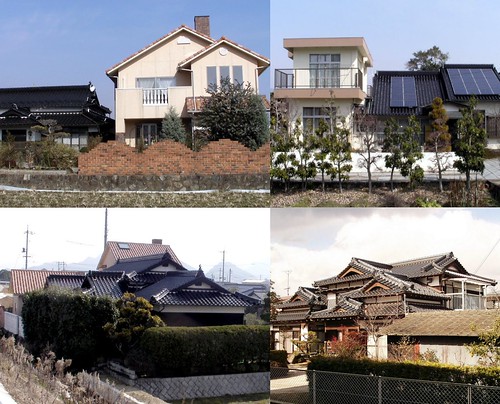
Cultural psychologists (Miyamoto, Nisbett, & Masuda, 2005) have associated Asian urban enviroments with purported Asian collectivism by arguing that Asian cities are diffuse, anonymous, lacking in a focal point, and encourage Asian wholistic modes of thinking.
Be that as it may, it seems to me that Japanese architecture both traditional and modern is 'ruggedly individualistic'. Traditional Japanese architecture, while belonging to a tradition, is often extravagent or even ostentatious in for instance the style of its rooves, gatehouses and entrance halls. More modern articture often, or usually, displays no concern for harmony with the surrounding architecture.
The Japanese are harmonious in regard to the expression of opinions in public sitations. Opinions are to be kept to oneself in Japan. Visual expressions of one ones preferences, proclivities, style, tastes, creativity, are often individual to the point of being obtrusive.
But then again, perhaps, there is nothing obtrusive about Japanese architecture at all. Japanese consider individualistic architectual preferences a common-place. And to a certain exten the individualities of Westerners and Asians are invisible to each other. Though Westerners have original opinions that are they are keen to expound, opinions, theories, policies and linguistic contrusctions in general are trivialised, or even, in the Zen Buddhist tradition especially, but also in common idiom (理屈言うな), perjorative. Similar visual expressions of individuality appear to Western eyes as trivial, mere image, peacocky, or vain. Sometimes it is difficult to see how individual we all are.
取り下げご希望がありましたら下記のコメント欄あるいはnihonbunka.comのメールリンクからご連絡ください
Labels: collectivism, individualism, japan, japanese culture, 個人主義, 日本文化, 集団主義
Monday, February 20, 2012
Onikyan: Friendishly Cambered Car Wheels

The creator of this masterpiece said that he wanted to demonstrate his prowess at customisation (he is particularly good with this area of the car). While the car is currently not road legal he believes that it could be driven to local cities such as Hiroshiima and Fukuoka to take part in "dress up" (Customisation) car shows. Approximately half of the revenue of this garage is for "regular work" and half for show-ization (sho-ka) to make cars ready for "dress up" car-customization shows.
The size of the automotive aftermarket parts market is about the same per capita (about 580 dollars in Japan, 2007 figures, to about 600 dollars per capita in the US) but Japanese cars do fewer miles and are on the road for less time and are of a higher reliability, so presumably a far greater proportion of that market is spent on non-essential, customization of the car.
As another indication of the extent to which Japanese people like to pimp their ride, all of the companies (Mode Parfum (Blow Design), Aimgain, Wald, Junction Produce, Anceltion (RIP)) recommended as offering "Vip Styling kits" in this English language article on how to make your car look like a VIP's (pimp's?) car are Japanese companies.
Additional evidence that the Japanese are the kings car customization includes the fact that Japanese jargon refering to styles of car-customization, such as "hippari" to refer to stretching tyres onto outsized rims for a super low profile tyre/wheel.
It is my contention that people express their individualism not to others, or even specific internalised others, but to their "generalised other" (Mead) their Super-addressee (Bakhtin), the Other (Lacan), or Super-Ego (Freud) of their psyche, "Thou" (Buber/Nishida) or their gods, which in Japan do not listen but look. The Japanese desire to individuate and enhance themselves in the eye of their Other, since it is from this position that they see themselves objectively as lovable, individual human beings.
The Japanese are no so keen, on the other hand, on tuning up their cars so that they go at a fastest speed from point A to point B. Speeds are purely linguistic achievements. Making it look like their cars are going at the fastest speed (e.g. by "drifting") on the other hand, is highly descirble as do cars that simply look individual like the example above.
Videos of "Demon Camber" cars (with swearing)
www.youtube.com/watch?v=H11E0zwI7QA
Video of this particular car at a show in Hiroshima
www.youtube.com/watch?v=2gAlQLH9O0A
Labels: collectivism, culture, eye, fashion, individualism, japan, japanese culture, Jaques Lacan, lacan, mirror, nihobunka, nihonbunka, occularcentrism, theory, 個人主義, 日本文化
Friday, February 17, 2012
Amotsuki, the old word for Mochi-Tsuki or Rice Cake Making is also a Metaphor for Coitus

Amotsuki, the old word for Mochi-Tsuki or Rice Cake Making is also a metaphor for Coitus, a photo by timtak on Flickr.
[Cross posted from Shinto Blog with additions]
The most important festival of the Shinto religion is the New Year Festival. At this time Japanese people will visit a shrine, give their children money, and eat certain foods one of which are rice cakes said to contain the spirit of Amaterasu, the mirror-sun-goddess. In traditional homes, such as farm houses, and in some schools and community centres, the rice cakes are made in a traditional way known as "mochi-tsuki" or rice beating.
In a well known Japanese dictionary (Koujien 4th edition) it says that, "Amotsuki" (餅搗), an old but not defunct word for "mochi-tsuki" which means beating rice to make rice cakes, was used as a metaphor for "boji"(房事) which means coitus.
The rice beating ritual performed at New Year gave me a impression of representing coitus when, as is traditional, a woman turns the rice while her husband beats it.
In the ritual that I saw performed, and took part in, a woman knelt or crouched down beside the "usu" (bowl) and make relatively high pitched noises encouraging a man wielding a big mallet to beat the rice cake, sometimes with a grunt. Apparently quite a lot of males die each year of heart attack as they wield their mallet. The ritual is quite hard work. The men build up a sweat. The rice cake becomes more and more gooey. The thwack, thwack of the mallet (kinu) hitting the gooey rice in the bowl resounds. Finally everyone rejoices partaking of the gooey white rice cake. It is quite a carbohydrate high after all that exertion. Bearing in mind the shape of the tools used, the gender division of labor, their relative positions, and the color and consistency of the final product, I made an interpretation which prompted my my Japanese friends to call me a pervert. Then one day I was reading my dictionary and came across the entry above.
These metaphors may be quite irrelevant and coincidental but since the Shinto-Amaterasu myth is represented in Shinto New-Year's festivities, the fact that a ritual seen as a metaphor for sex (at least in times past) should take a central role in the festivities suggests that perhaps there is a similarly metaphorical episode in the Susano Amaterasu myth. At least one researcher has suggested that the bit where Susano-O throws a backwards skinned horse into the clothing room of Amaterasu such that one of her weavers dies as a result of a shuttle entering her body, may be a metaphor for coitus.
It would not be unusual that sex is represented in Shinto festivities (examples, click with caution and or or parental advice). One commentator (essayist Ei Rokutsukel,2004) expressed the opinion that many or most Shinto festivities were related to sex.
Christian festivals (Christmas and Easter) represent birth and in the Shinto tradition birth is, or was, the dirtiest most defiled thing, as taboo as sex is in the Christian tradition.
With these reversals of the most sacred and the most defiled -- with Japanese and Western religion being so polar -- I used to think that war between Japan and the West would be inevitable.
Similar entries to that photographed above from an other edition of the same dictionary
餅つき 2男女交接の例え Amotsuki (rice beating) is a metaphor for sex
臼と杵 男女の仲がぴったり合うこと Usu to Kinu Pestle and Mortar/mallet very close male female relationship
臼から杵 臼は女、杵は男を象徴する。女から男に働きかけるのは逆であるの意で)逆であるさまにいう
Mortar to Pestle. Women should not approach/influence men.
Ei Rokutsuke et al (2004) "Matsuri ha Eros de Aru"(Festivals are Eros/Erotic), "Nihon no Matsuri" (Japanese Festivals). Asahi Newspaper. publications.asahi.com/ecs/detail/?item_id=6205
Labels: female, gender, male, religion, reversal, sex, Shinto, ジェンダー, 宗教, 日本文化
Thursday, February 16, 2012
Hours Studied Per Week at US and Japanese Universities

The labels indicate the percentage of first year university students that study (out side of class) in each of the time bands. For example nearly ten percent of Japanese students do not study at all, whereas in the US only 0.3% of students avoid study entirely. More than two thirds (66.8%) of Japanese university students study only 1-5 hours per week --at most an hour per weekday-- whereas this percentage is only about 15% in the US. The above graph is based on data collected by the Central Council for Education of the Japanese Department for Education and Science, as reported on the front page of today's (2012/2/16) Asahi Newspaper.
The newspaper reports that, alarmed at these statistics, the Ministry of Sports Science and Technology intends to implement entrance and exit tests to ensure that university students are studying more, with a view to creating graduates that can be major players on the global stage (グローバルに活躍する人材, Asahi, 2012).
There is nothing new in the these type of comparisons. Brian J. McVeigh's comprehensive, though damning and as yet untranslated, "Japanese Higher Education As Myth," as well as many domestic commentators, have been pointing out that academically, Japanese universities are allow students to concentrate on their part time jobs, their club and social activities rather than ensuring they study academically. As Mc.Veigh points out, Japanese academic has no academic ethos, little awareness of the value of study, so as soon as escalator of entrance exams end, so does the motivation to study.
The Japanese education department indends to extend the escalator, adding stricter assessments at the end of university life, forcing students to study while they are university if they are to go on to graduate and get a job.
They are going to require that Japanese university teachers become stricter in their evaluations and refused to allow students to graduate even though they have a job lined up. And even though the company ready to employ that student is not nearly so concerned, when compared with US companies, with the academic achievement of the students it intends to employ.
Japanese companies do not care so much about whether students have studied academically during their time at university. If a student has invested time and energy into their club or part time job, achieved a position of responsibility, or shown intelligent, practical, creative endeavour in any aspect of their lives (including academically) then they are happy to hire them. Some companies shy away from students who are particularly academic, perhaps with the belief that having too many scholarly types in the office does not make for successful business. Japanese companies stress 'on the job training', and learning by experience so that university graduates start at the bottom and do not come into work situations where they are expected to apply the theories that they have learnt at college.
The education that Japanese universities have provided, therefore, may be argued to be in line with the demands of Japanese society. Theories - which is after all what universities teach - are not as useful, or as lauded in Japan. Providing interesting lectres, opportunities to interact with each other, be stimulated, experience academe and the lifestyle of academics in "seminars," and to gain life experience in part time jobs and clubs, has provided Japanese students with the social skills training required of them in (non-theory based, non-logocentric) Japanese society.
I set a large amount of homework in my English classes especially. I use online testing to force my students to study outside of class. I believe for students to be competative in a declining economy, academic study is important. But at the same time I fear that Japanese universities are by their attempt to mimic Western universities are going to present fewer opportunities for students to obtain the flexibility and social skills that Japanese society still requires.
One of the reasons why Japanese students do part time jobs is because there are few immigrants, or a 'working class' doing them instead. University students are the working class of Japan. The man the pumps, wash the dishes, serve at tables, and work in the fast food restaurants. The same lack of an underclass obviates the need for a university educated elite. Japanese fulfill all roles at different ages of their lives.
The University evolved out of seminaries, training schools for priests. Their original specialisations were theological studies of the Bible and the Koran. Westerners, and those of the "book religions" believe that one can live ones life based upon the advice gained from the pages of a book, by applying theories.
It seems to me that Japanese companies and their employees have been major players on the international stage. So major were their plays that British industry was wiped out by competition from Japan. As Japan mimics the West more and more, and as Japanese university graduates wonder become more and more out of phase with the living tradition of their employers, will the Japanese economic miracle continue to function so well?
I try to encourage my students and colleagues to integrate theoretical learning with practical experience. I have argued that we should be teaching "part-time job theory," and "club theory," and encourage students to research and analyse these areas of their lives. I hope there is a middle path.
Labels: economics, japan, japanese culture, nihobunka, nihonbunka, 日本文化, 欧米化
NMB48 and Tarzan

The climax of the chorus of the recent chart topping song by teenage girl-band, 'idol group' NMB48 is "steel panties," refering to their collective intention not to take them off for their boyfriend until they are 20 years of age. The song's title, "Junjou U19" means "Pure (i.e. non sexual) emotion or affection, and the "U19" may mean under or equal to 19, since the lyrics mention adulthood which is considered to be from 20. The boyfriends are going to have a long wait in some instances because at least one of the members is 13 years old. Yes, indeed, only 13 years old.
Having seen the video, it seems that it has been created with the intention to include as many ways as possible of allowing the viewers to feel that they can or will see the "steel panties" refered to the in the lyrics, with low camera angles, miniskirts, rotating girls, somersaulting girls, girls lying down, hanging from wires, rolling over balls, on tightropes, a trapeze, podia, and finally fired from a circus cannon. I think it is very inventive, but not to my taste.
Japan is bursting at its creative seams. Donald Richie's "The Image Factory: Fads and fashions in Japan," details the many ways in which Japan is a powerhouse of creative image making. Alas, the myriad images that Japan makes are different, and often not popular among those with Western sensitivities.
A big problem for human society, perhaps the biggest, is encouraging men and women to cooperate. There are two extremely effective ways of doing this. 1) Persuade all members of society that they are neutred men. 2) Persuade all members of society that they are wombless, bloodless women. The West takes the former route, Japan the latter. In each case it is imperative that the unattractive parts of the idealised sex are banished: their desire in each case is taboo. Jesus was a man in his ability to lead, be righteous, brave, and strong but there was no one iota of lewdness about him. The idealised woman in Japan is similarly, self-sacrificing and supposedly berift of desire. The Western "gentle" man, and Japanese "idol" stop at the waist, they are castrated, spayed, anaemic, and perfect.
This repression however, gives rise to even greater desire for its disolution, for (in the West) a gentleman who is also an ape man; Tarzan/Earl Greystoke a combination of pure male sex and complete gentrified repression. I think that NMB48 are the Japanese equivalent of Tarzan/Greystoke, pure sex, and pure chasity rolled (often literally) into one steel pantie.
The idealized synthesis of purity and sexuality (Ranger, 2011) is also found to an extent in the British lady, such as portrayed by Audredy Hepburn (who was tremendously popular in Japan) in the naivity of the characters played by Marylyn Munroe (though she was a little too sexy, and not quite pure enough for Japanese taste) and the disembodied chamellion Lady Gaga who almost seems a little Japanese. However, In Japan there is a desire for a more extreme synthesis which is why we see thirteen year old chidren, in miniskirts, singing about sex, wearing "steel panties".
Other examples of Tarzan, that the Japanese need to import if they are to enjoy, include the macho heroes such portrayed by Arnold Schwarnegger, and Sylvester Stallone, who are an idealised synthesis of testosterone and righteousness.
NMB48 poster by MadAdminSkilz copyright Kyoraku Yoshimoto Holdings Co., Ltd.
とりさげご希望の場合は下記のコメント欄かnihonbunka.comのメールリンクからご連絡ください。
Labels: fashion, female, gender, male, nihobunka, nihonbunka, taboo, tabuu, theory, ジェンダー, 日本文化
Sunday, February 12, 2012
Does this photo make you feel lenient towards prostitutes?

The answer may depend upon whether you are American or East Asian. I predict that Japanese will be more lenient towards prostitutes after viewing this picture, whereas Americans are likely to be more severe.
Proulx and Heine (2006), in their research on Heine's "meaning maintenance model" found that viewing images that interfere with our expecations about the world, or our meaning frameworks, such as Magritte's surrealist art, and the above photo, have the same effect as thinking about deat. Both are inclinded to make Westerners wish to achieve 'symbolic immortality,' by thinking that they and their culture is good, moral and harsh on prostitutes. American's shown this photo demand that prostitutes pay a higer bail. They argue that death is just one way of loosing ones sense of meaningful-ness, and that being strict towards prostitutes, asserting ones sense of right and wrong, is one way of attempting to regain it.
Recent research by Kellams and Blascovich (2011) has shown that while thinking about death makes Westerners more severe in their punishment of prostitutes replicating the above research, it makes East Asians more lenient. Ma-Kellams argues that since Asians see the self as bound up with other people, they achieve a sort of immortality by helping other people, and increasing these bonds.
If death makes East Asians kinder, then images such as the above where the colours of the cards have been reversed, that threaten our sense meaning, are likely to make East Asians more lenient, and kinder to prostitutes too.
In the wake of the terrible tsunami distater in Japan, the ideogram for intra-human bond (絆 kizuna) was chosen as the character of the year, marriage rates rose and impressions of marriage became more positive. It may be that when reminded of death, and human insignificance in the face of natural disaster, Japanese are more likely to attempt to achieve material, rather than symbolic, immortality.
Ma-Kellams, C. and Blascovich, J. (2011). Culturally divergent responses to mortality salience. Psychological Science. 22(8):1019-24.
Proulx, T., & Heine, S.J. (2006). Death and black diamonds. Meaning, mortality, and the meaning maintenance model. Psychological Inquiry, 17, 309-318.
Original photo Playing Cards by Number 34
Labels: japanese culture, nihobunka, nihonbunka, 個人主義, 日本文化, 集団主義
Friday, February 10, 2012
Anime Girl Face Conformity

They could almost be the same girl, with a variety of hair colours. In the Edo period too, stylised pictures of "beautiful women" looked like they could have been of the same woman but now the woman's face is very different. Images of beauty have changed.
The above is the first page of google images, searching for anime face girl.
It would be interested to ask a pool of subjects whether they think the images are of the same girl by different people, or of different girls, and to compare these results with say, googles first page of impressionist beautiful women. While I do not believe that the Japanese are generally conformist (as is generally believed) I do think that views of feminine beauty are very convergent in Japan because the Japanese idealise and enhance the image more. I have argued (Leuers and Sonoda, 1999) that since Westerners idealise and enhance character traits more, their self-professed character traits are far more convergent than those of Japanese.
It is amazing that there is a photo (or two?) in there.
Copyright their respective copyright holders. please use comments or nihonbunka.com contact link to have this image removed from the net.
Labels: fashion, female, feminism, image, japan, japanese culture, Jaques Lacan, lacan, logos, male, manga, mirror, nihobunka, nihonbunka, occularcentrism, self, sex, specular, ジェンダー, 日本文化
Super Friends East and West

Japanese super friends tend to be wordless, pure body, and yet self: the heroes of the works they star in.
Western supernatural friends tend to be pure mind, with a message, but it is often with their mind-readers that Westerners identify. It would have worked far better for my theory if Westerners had also associated with the supernatural as mind and message, rather than with the human mind-reader but it could just be that the parallel is far from perfect.
The Western superfriend dramas do not feature cultural heroes that many of the Japanese robots are. Japanese children grow up idolising Ultraman but Western children do not generally grow up wanting to be any of these these detectives. The dectives are rather viewed by adults who may be wondering what what sort of mess they have been woven into and why someone is going to die.
I also get the feeling that secrecy of the Western superheroes "alter ego" (not present in most Japanese superhero series) probably has something to do with the secrecy of the message that the detectives are trying to read.
These Western detectives ability to read language from the other world, often from the visual world (Tim Roth in "Lie to me" and Patrick Jane in "The mentalist" read people's faces, Cory from The Sixth Sense sees sadness in a dead man's eyes), parallels the Japanese superheroes ability to write symbols, shown most splendidly in the series "Shinkenja." These Shinkenja power rangers line up in full view of everyone, on a sort of stage, and take out their calligraphic phone (shoudoufon) to write a totemic ideogram on the res-extensia, and it is this ability to write that allows them to henshin, change.
Images from Mazinger-z by joeszilvagyi, Doraemon by Wacko Photographer, Pikachu by ntang, HG 00 Gundam by Chag, Ryuk by Yami Ghor and Ultrama photographed by me but all characters and images copyright their original creators.
Labels: japanese culture, mirror, nihobunka, nihonbunka, self, theory, 日本文化
Western Super-Friends as Pure Mind

"Transformers" started in Japan but has become popular in the US, which also has its own Gundam in "Iron Man". There is an "Iron Giant" based on Ted Hughes story ("The Iron Man"), and Lilo's friend Stitch.
In my opinion, however, the Western imaginary friends that mirror the many super robots in Japan, are the plague of ghosts that have been helping us out recently. The first one I saw was in 1969 on the BBC in the tv series "Randall and Hopkirk (Deceased)".
The basic pattern of Western 'human plus super-friend' dramas is that a detective is helped by a ghost or ghosts. The ghosts have no body only a message, a will, and the human's job is to let their will be done, so that the Ghost can disappear. The genre includes "The Sixth Sense," "The Dead Zone," "Tru Calling," "Ghost Wisperer," "The Medium," "Raines," and "The Listener." "A Gifted Man" though a doctor is along the same lines.
Their protagnoists have a lot in common with the geniuses that read minds in "Lie to Me," "The Mentalist," "Criminal Minds," and the various "CSI."
All of them, by their extrasensory, or extra sensitive powers of perception are able to read the message, the words, the will, of the superbeing that has not been said and act upon it.
The human heros are, contra the Japanese humans, the puppets of their super-natural friends. And yet it is they that are the titular characters. In almost all cases (Dr. Malcolm Crowe from Sixth Sense and Hopkirk as possible exceptions) it is the 'reader' that is the central character, or self with whom the audience identifies. Westerners, perhaps due to the Judeao Christian influence, like to see ourselves as 'readers' who carry out the will of supernatural friends.
In Japan, though the robots are controlled, they are heros, the eponimous/titual characters, the focus of attention. No one buys Amuro Rei dolls, or Nobita Posters. The Japanese robot superheros are body and self at the same time. Will, such as that of Nobita and Light is fallible, external, and leads people astray.
It is interesting, but probably conicidental that in Japan technology and robots are associated with the West, and that human-ghost interaction is the most famous theme in the traditional drama of Japan. It is as these culturals have found imaginary friends in each other. Again coincidentally, or due to the spread of TV, the super robot genre started, as far as I know, in the late 60's early seventies about the same time as Randall and Hopkirk (Deceased).
Images copyright their respective copyright holders. Please comment or contact me via the email link on nihonbunka.com to have this image removed from the Net.
Thanks to Ɲ for inspiring these observations.
Labels: culture, female, gender, henshin, horror, japan, japanese culture, logos, nihobunka, nihonbunka, reversal, self, superhero, theory, 変身, 日本文化
Thursday, February 09, 2012
Japanese Super Friends as pure Body

A sub-genre of superhero fiction are partnerships between super-friends, and a human (often a boy). This genre is particularly popular in Japan.
These super-friends are controlled by an otherwise ordinary mortal man or boy. Mazinger-Z was a giant robot radio controlled by a boy. Pokemon (pocket monster) Pikachu is kept in the pocket of his friend, ready to fight at his bidding. Doraemon, another robot, lives in the closet of a boy called Nobita, ready to help the latter in the many ways he can. Gundam is a robotic suit worn by a boy called Amuro Rei. Ultraman is an extraterestial giant that possesses and is possessed by a squadsman called Hayata; unlike Clark Kent and Superman, Hayata and Ultraman are not quite the same thing.
Others similar entities include Tetsujin-28, the god of death in "Death Note", the mother-possessed (!) suits in Evangelion, the giant mecha that appear in every series of Super-Sentai (Power Rangers), and duality observed in the Masked Riders such as Kamen Rider Denou.
Western superheroes are far more likely to be a unity that only appears dual due to the fact that for some of the time, the superhero poses as a normal, but "secret" "alter ego." Western superheroes are dual only epistemologically. Japanese superheroes are ontologically dual.
Japanese super friends are often but not always giants, and often but not always robots. They are also often unable to speak. Pikachu can only say its name, Ultraman can only pant. Many Japanese superheros and characters (such as hello kitty) do not have mouths at all, or have masks which cover their mouths.
Lacking in language, these super friends often carry out the will of their human partner. The super-friends are *all body* - taken to the extreme in Gundam and Evangelion - that provide the power, or technology to carry out the human will.
Western Imaginary friends on the other other hand, as I will argue in a seperate post, are often all mind and no body. They provide their human friend with information. Western super friends above all speak to their human partner. The human carries out the will of the imaginary super-being.
Images copyright Mazinger-z by joeszilvagyi, Doraemon by Wacko Photographer, Pikachu by ntang, HG 00 Gundam by Chag and ultrama photographed by me but all characters/images copyright their original creators.
取り下げご希望の場合はnihonbunka.comのメールリンクか下記のコメント欄からご連絡ください。
Labels: Bandai, Bokenger, Gao-Ranger, go-onger, henshin, nihonbunka, reversal, Super-Sentai, superhero, ultraman, スパー戦隊, 仮面ライダー, 合体, 変身, 日本文化
Traditional Japanese Beauty

The Japanese in the Edo period had a fairly localised view of beauty, so much so that these beautiful women look very alike to the point of appearing identical. These Traditional Japanese beauties had neither large round eyes, nor double eyelids. Their eyes were slit like and their features were generally small and angular. Pointy noses where in, but not particularly large ones. This leads me to believe that the current Japanese fondness for large round eyes, especially with creased ("double") eyelids is partly the result of the influence of Western, caucasian, images of beauty upon Japan.
Labels: fashion, female, feminism, image, japan, japanese culture, Jaques Lacan, lacan, logos, male, manga, mirror, nihobunka, nihonbunka, occularcentrism, self, sex, specular, ジェンダー, 日本文化
This blog represents the opinions of the author, Timothy Takemoto, and not the opinions of his employer.