
Thursday, March 19, 2015
Trapping Time: Taming Impermance
The Japanese have a fascination with and aesthetic appreciation - wabi - of the passing of time. They enjoy going to see cherry blossom, which marks the beginning of spring, and enjoy cherry blossom most when it is falling in clouds of pink snow; when it is at its most ephemeral. Thus it would seem that the Japanese enjoy an awareness of temporal flow and impermanence. SInce it is true that things are always changing, whereas there is a tendency to think that they are remaining the same, this makes the Japanese sound very Buddhist, very enlightened.
On other hand it might be argued that Britons who like to surround themselves with antiques, old cutlery and china, old houses, and relics of the past, are demonstrating a desire to stop time, and ignore impermanence and temporal flow.
But then it also occurred to me that, according to the central theory of this blog, Westerners are inclined to identify with their self narrative, which as Bruner (1987) emphasises usually has a temporal unfolding, a plot, a history, and are therefore quite happy to be aware of the the movement of time, and the awareness of their development and difference over time. The Japanese on the other hand might be happier to be aware of their changing "kyara" or visually cognised character, in each of several social spaces (Fujimura, 2015), but attempt to maintain temporal intransigence, very successfully often. The Japanese age really well.
And then it occurred to me that even when Japanese are being at their most impermanent, such as when they are enjoying the passing of the seasons and, quintessentially, cherry blossom, they do so situating these seasonal events within a yearly calendar that transforms the natural phenomena into a place within a series of symbols or icons. Cherry blossom are thus yanked out of the immediacy of temporal flow, and tamed to becomes the symbol of March and that spring has arrived again.
This transformation reminded me of the theory of Clifford Geertz (1973) on persons and time and Bali (I say the Trobriand Islands in the video). He argues that since the Balinese emphasise socio-temporal role names (infant, teenage, dad, granddad) as do the Japanese rather than individual names over the course of the lifespan, this de-emphasises the passing of time - except on the days when roles change - and gives the impression of a motionless present. One can gain this impression in Japan. For many years one remains the same until suddenly one because a "granddad," like the end of the Japanese myth "Urashima Taro." There is also something motionless about time in Japan.
Similarly by situating the flow of the seasons within a series of socio-temporal nature-roles, the flow of natural time is at once exposed and hidden. Cherry blossom become permanently flowing and yet not flowing at all, trapped within the expression of March-ness. This reminded me of cine-graph images like that below.
Into the same rivers we step and do not step, we are and are not? I am confused. The Japanese have a different appreciation of time.
Bruner, J. (1987). Life as narrative. Social research, 11-32.
Clifford, G. (1973). The interpretation of cultures. New York: Basic, 412-453.
Fujimura, M. (2015). キャラと視点 (Kyara and Perspective). Unpublished graduation thesis. Yamaguchi University, Department of Economics.
Labels: cultural psychology, culture, japanese culture, nature, nihonbunka, 日本文化, 自然


Friday, September 12, 2014
Fushino River Wasteland: Nature as abject/subject
The Japanese love symbols taken from nature. Japanese surnames are mainly taken from nature (Tanaka middle-field, Honda original-field, Fuji wisteria, Yamamoto foot-of-the-mountain) as are their family crests, pictorial art, letter greetings, fabric designs, religious events, poetic theme, sociological theories, and, of course, arts that deal directly with nature such as bonsai, flower arrangement and garden design.
However when it comes to nature itself, that is to say tauto-pleonastically, natural nature, the muddy stuff with wasps, weeds and waste matter, the Japanese can't stand it. They'd far rather be in a shopping mall or pachinko parlour or the comfort of their hermetically sealed homes. They hate natural nature so much they don't want to look at it, and nature being so abject and horrific to their minds, they are even utterly unaware that they abhor it, believing, to a woman, that nature is absolutely wonderful stuff.
I can see why Japanese might detest nature so much that they think that they love it. Freud calls this reaction formation. Sometimes those that appear the most chaste and demure do so to conceal their lasciviousness. Sadists may hate their cruelty so much that they present themselves as pacifists. But that external commentators should buy into this reaction formation when Japanese mountains, rivers and seas are deserted, or covered with concrete, surprises me.
Perhaps the real surprise is rather that Westerners should want to get down and dirty with nature. As Saito (Saito, 1985) and I have argued, the Japanese the Japanese interest in a "tamed" or "miniaturised" nature is related to their identification with nature. They do not see any separation between themselves and nature. They are natural. Nature is alive. They don't want to live on the edge of a muddy river estuary, much less swim in it (as I do) any more than they want to smell their own sweat. They dislike bugs as much as bodily fluids.
That Westerners, on the other hand, should enjoy swimming in murky water (as I do often), or using a machete to cut a path through a mountain forest to reach its summit (as I did with a visiting Scottish friend), relates conversely to Western alienation from nature. We think, we feel we are not natural, so we immerse ourselves in the wildest most inconvenient aspects of nature both as as a sort of "exposure extinction" behavioural therapy, to conquer nature and our antipathy towards it, and also, conversely, as a sort of aversion therapy, so that we may continue to persuade ourselves that wild, wet, and nasty nature is out there whereas we ourselves are narratives. As I swim through the murky water in Fushino River estuary, blissfully unaware that I am swimming through myself, and my own waste, I indulge in that most Western of pleasures: I listen to myself speak.
Further it is not true to say that the Japanese avoid natural nature, but rather when they brave they are even more extreme. The Japanese practice of "misogi" (禊ぎ) involving swimming in coldest mid-winter or sitting directly under waterfalls with the water pummelling their head, and other spiritual exercises in the most extreme natural environments, are aimed at purification. What is it that they are trying to expunge? At least one of the poems (626, see below) in the 7th century book of ten thousand leaves (Manyoushu) shows that Japanese leaped into rivers in order to purify themselves of linguistic thought, and become one with the water**, "their absolutely contradictory self" (Nishida, see Kozyra, 2013).
君により、言の繁(しげ)きを、故郷(ふるさと)の、明日香(あすか)の川に、みそぎしに行く 八代女王 626
With all those bloomin' words about you my lord, I went to purify myself in my home town's Asuka River. Yashiro no Ookimi Poem number 626 (recent commentators suggest that the blooming words were rumours about the writers relationship with her lord the emperor).
Another early, this time Heian poem, presumably also about purification in water (misogi禊)
「身につもる言葉の罪も洗はれて心澄むみぬる三重(みかさね)の滝」(西行、山家集)
The sinful words that piled on my body were washed away and my heart cleared in gentle Mikasane waterfall. (Saigyou, Sangashuu)
In any event, the good news is that nature loving gaijin (foreigners) can come to Japan and enjoy the unspoilt nature shunned by the Japanese, or even purchase property on the side of rivers, mountains or the sea for a song, which will probably be about nature in Japan. And I will now go and swim in that estuary, and try and let my I become me (mi 身・水) won-with-the-water, wwww.
Bib
Knight, C. (2004). Veneration or Destruction. Japanese Ambivalence Towards Nature, with Special Reference to Nature Conservation, University of Canterbury, Christchurch, NZ.
Kozyra, A. (2013). The Logic of Absolutely Contradictory Self-identity and Aesthetic Values in Zen Art. Retrieved 2014/9/12 from dspace.uni.lodz.pl:8080/xmlui/bitstream/handle/11089/3415...
Saito, Y. (1985). The Japanese appreciation of nature. The British Journal of Aesthetics, 25(3), 239-251. Retrieved 2014/9/12 from bjaesthetics.oxfordjournals.org/content/25/3/239.short
Notes
*All the ancient poems about purification (harai and misogi)
www2u.biglobe.ne.jp/gln/77/7718/771811.htm
**The Kokugakuin University entry on misgo explains that while it is clear that the "sogi" means steep or rinse, the "mi" of misogi has been interpretted to mean both body and water. Too right.
k-amc.kokugakuin.ac.jp/DM/detail.do?class_name=col_dsg&am...
Labels: japan, japanese culture, nature, nihonbunka, 日本文化, 自然
Friday, October 25, 2013
Japanese Style Toilet
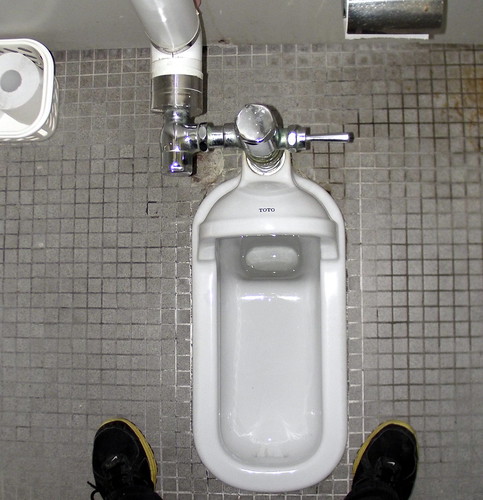
I like some aspects of Japanese toilet culture.
Japanese toilets are free, clean and plentiful. As well as being a relief in times of need, these restroom-facts tell us some thing about Japanese culture. While the Japanese lavatory has changed dramatically, there is still something fundamentally more practical about it. Take, for example, the mixed sex toilets that one still finds in small bars and restaurants. The use of one toilet for both sexes seems so mature, space saving and liberal, but often rather disconcerting. Again, the absence of a seat may be very hygienic but I find it difficult to keep my balance when made to squat. And while, for instance, the French too used to squat, the Japanese do not insert their stool into a small round hole but leave it to lie in a trench between their knees for some kind of inspection. "Very sensible", the colour is very indicative of the state of ones health, apparently. Which brings us to ask: why are "amenities" so rude in the West? Is it not perhaps to do with their connection with sex? Perhaps for the French, the briefly dangling stool was a phallus: deft but dark and fleeting. By contrast, the Japanese have a more tolerant, maternal toilet culture. The stool, resplendent in its narrow china cot - thoughtfully padded with toilet paper - represents a pseudo-baby? In a traditional Japanese toilet, the flush must follow breathless awe in the face of mother nature's proud creation and even the direction of the squat is reversed: Westerners, face the door, as if ready to fight back other would be occupants; the more community spirited, trusting Japanese face the interior toilet wall, their buttocks bare, absorbed in meditation.
In the past ten years however, the Japanese toilet has been "advancing". Corrupted and alienated by the impact of the West, they have developed scatophobia. They too do it sitting down but with even greater hygiene and self abstention. The toilet seat, itself sometimes decadently pre-heated, can be covered with a specially provided, toroidal paper napkin. And, to the horror of unsuspecting observers, the toilets in more wealthy homes may be fitted with an electronically controlled, contractible antennae. "Foul torture! Fearsome syringe!" I thought as I wiped warm water from my eye, but, yes, it was merely a form of space saving bidet. At the touch of a button, the antenna extends and, automatically adjusted to the size of the user, fires a jet upwards into the orifice. Fiendishly clean. "Washlettes" (sic) may not have caused actual bodily harm but they might just represent a neurotic obsession with technology. (Mark my words; in years to come someone will produce a "Wipeman".)
If there is one thing that I regret, it is the complete absence of graffiti. It would be in the interests of free speech if bar owners provided a pen, attached to a string, inside the cubicles. But one might find that the customers did not know what to do with it.
I wrote the above back in 1996
A "wipeman" or portable version of the washlett has in fact been invented (and may have been back in 1996)
Labels: japan, japanese culture, nature, 日本文化, 自然
Saturday, December 08, 2012
Dconstructing Haiku 2

五月雨や 大河を前 に家二軒
Samidare ya, Ookawa o mae, Ni ei ni ken
A May shower 'n,
A big river prior,
To two houses.
At first this haiku may seem intractable to Dconstruction* and a straightforward description of a scene. The poet is just standing in the rain looking a a couple of houses on the far bank of a large river. Yes that is what the poet is doing.
But, also, on further inspection this three phrase poem is managing to do what almost no other haiku achieves - to feed the viewer not one but two interpretation tainted, symbolically produced images, before taking them both away to leave only the emotion and the truth of the image: the terrible purity of the experience.
The first trick in this poem is that the poet makes us think that he is talking about seeing rain. The second is that the "ya" in the first phrase usually means "lo" "look" or "!" Ordinarily, the first line would mean "Lo, it's a May shower," but here it doesn't. Panning poetic exclamations, Buson is just telling it as it is.
As noted the previous post, Basho sets up a poem with "May shower" before telling us that he is talking about the rainwater in the river. Echoing that poem both in subject and style, the immeasurably laconic Buson manages to trick us twice.
By the time we get to the second phrase, we start to realise that the "ya" in the first was not "lo and behold" but simply "and," echoing, more prosaically, the way in which Basho's "quick" turns out to mean the speed of the river, not that of collection.
It is difficult to find a word in English that can mean both "look" and "and" but I have gone with what may sound like a meditative "nnn," which turns into the "'n" of "fish 'n chips."
In any event, by the time we get to the end of the second phrase (o mae) "prior," the penny really starts to drop. Buson wasn't even looking at the river!
The poet wasn't looking at a May shower at all (which are generally invisible, like jumping frogs) or even at a river, but at two houses. We realise that once upon a time a soaking wet poet stood in the rain near a big river looking with longing at the two houses on the far side. He did not see the May shower. There is a good chance he did not even see the big river, though his mind was full of negative thoughts regarding both of them. He was probably wet through. The sound of the shower and the roar of the river were probably amplifying the cold.
All he actually saw, or at least all that he was actually looking at, was two houses. And when we see that pair of houses with Buson, the "May shower" and the "big river", dissolve like raindrops in his boundless, longing gaze.
The use of "ni" (two and to) twice in the final line emphasises the solitariness of the poet and the warm welcoming communion of the houses he wishes he could reach.
*Dconstruction a Nacalian transformation of Derridean Deconstruction, wherein instead of showing how a text uses image tainted signs to purify the sign, shows how sign tainted images are are used to purify the image.
Labels: japan, japanese culture, Jaques Lacan, Nacalian, nature, nihonbunka, 日本文化
Friday, December 07, 2012
Dconstructing Haiku
Here are some specific examples from the first few in this net selection of 100 famous Haiku (in Japanese).
As already discussed possibly the most famous Haiku is
古池や蛙飛び込む水の音
Furuikeya, Kawazu tobikomu, Mizu no oto
An old pond, frogs jump in, the sound of the water.
We are presented with a view of an old, and presumably over-grown, murky pond. The poet then assumes that a frog, or many frogs, have (probably) jumped into the water. This second phrase - frogs jump in - is pure interpretation. In the third phrase we are reminded, in quite shocking fashion, the grounds for second assumption: the sound of the water. The poet had provided an interpretation - that frogs had jumped in - and then shown it for what it was. All that has occurred in truth, in the immediate purity of the experience, was a view of a pond, and the sound of the water. From the image, the frogs -- dread signs that they were -- completely disappear, for they were never there in the first place. Plop!
In the poem
さみだれを集めて早し最上川,
May rain, Collected quick Mogami River,
is quite straightforward in telling us that there may not be any rain at all, only the river which has collected the rain and is running rapidly. The way in which the "quick" falls between the second and third phrase, at first appearing adverbial (to mean fast collection) but finally we realise is probably adjectival referring to the fast river, adds to the switchback, satorific, "vortex" of the poem. Bashou was looking at the river all along, but took us to an interpretation, which while in part true, was not the reality of his experience: a view of a river. As a Buddhist Bashou would not have needed Heraclitus to remind him that a river is all we are ever looking it, though we see so many things collected in it.
閑さや岩にしみ入る蝉の声
Shizukesaya, Iwa ni shimi-iru, Semi no koe
Silence Soaks into the Rocks Sound (or, rather, voice) of Cicadas,
Here it is all too clear that the initial "silence" is not silence at all. It is an interpretation of the monotonous summer sound-scape, the deafening (you need to listen to this if you have not lived in Japan) truth of which we are returned to in the last phrase.
Looking at a field of summer grass, at the site of a once great military castle in Hiraizumi, Bashou writes
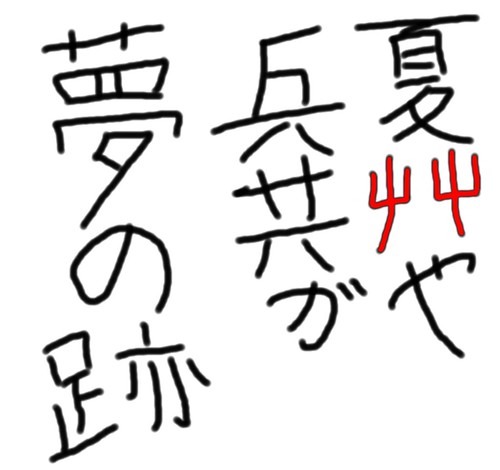
夏草や 兵共が 夢の跡
Natsukusaya, Tsuwamono-domo ga, Yume no ato
Summer Grass Soldiers(') Remains of dreams
The usual interpretation is that the summer grass is all that is left of the the once lofty aspirations of the soldiers. I think that this interpretation is correct, but there is also another. The "ga" (が) or apostrophe (') in my translation can be read as linking word meaning that the dreams are of or possessed by the soldiers. But it also can be read as a subject marker, which is not used in English, hence the apostrophe is in brackets. Taking the "ga" to be a subject marker the final clause comes as a shock because instead of the soldiers being active subjects, or there present, we see that only their field of dreams remain. Further, almost as if the solders have been killed in the middle of the poem, it seems to me, gazing at the field, Bashou himself let his imagination run free, so the "dreams" are not only those of the soldiers but also the dreams Bashou himself who imagined (dreamt) the soldiers. Indeed the summer grass itself may have looked like legions of soldiers. In strong support of this hypothesis is the fact that Bashou wrote the word "kusa" or grass with the non-standard (even for Bashou, even in the same book) ideogram "艸" (Matuso, 1997, pX) which looks a little like soldiers standing in a line. I.e. Bashou realises, and makes us realise, that he has dreamed up solders from his image of the grass, to the truth of which he returns us. Like all the best haiku however, the poem has no incontrovertible interpretation. Basho could be talking about the dreams of the soldiers, or his own dream of soldiers, but we do know, all he sees is a field of grass. Bearing in mind the fact that Basho deliberately edits his poems for poetic effect, I would not be surprised if he thought this one up well before arriving in "the deep north." In any event, it was well worth the journey.
The usual interpretation of
荒海や佐渡に横たふ天の川
Araumiya, Sado ni Yokotau, Amanogawa
Routh Sea, Lies down in Sado, The milky way.
is that Basho is seeing the milky way above the rough waters around the island of Sado but to me the first phrase "荒海" is an optical illusion. First of all, from the historic record, and the fact that Bashou uses the word "milky way" this poem was written on the night of the festival of the Weaver stars who are said to cross the milky way to meat each other on 7th of July. This is the first hint to me that something is amiss. Despite adding this "season word," it would be a a little unseasonal for the sea to be rough on a summer night (though an early typhoon is not an impossibility). Secondly, while there are various interpretations of "lies down," taking a straight forward one, it suggests that rather being over the sea, the milky way is on the surface of the water. The natural explanation for this would be that the mily way is being reflected in the sea, a beautiful image appropriate for the romantic festival night. This would further suggest that the sea was flat, for the starts to be reflected, and therefore that the "rough sea" was an optical illusion created by the white light of the stars brilliantly reflected in the water's surface. What initially Bashou saw as white waves, turned out to be the light of stars lying on the water. Again we are fed a plausible misinterpretation to be returned to the truth of the image.
明けぼのやしら魚しろきこと一寸
Akebonoya, Shiraushirokikotoisun
Dawn! white fish, its whiteness one inch (or very briefly)
This poem was originally "雪薄し”or thin snow which Bashou changed to dawn, in my view because the optical illusion of seeing thin snow as a white fish was a bit too obvious. In other words the poem started out as an optical illusion where the poet claimed/thought he saw snow before realising it was the flash of a white fish in the water, to the optical illusion of thinking one has seen the first rays of sun on the sea, which turned out to be the flash of white fish. In either case the reader is taken from a misinterpretation to the purity of the image. The substitution of "dawn" for "thin snow" - which both might produce flashes of light - shows the deliberate way in which Bashou sets the reader up. What a trickster.
The excellent poem (which I read now for the first time)
この道や行く人なしに秋の暮
Konomichi Ikuhitonashini Akinokure
This road, no one goes along it, late autumn,
was written shortly before Bashou's death at an inn, when he had already fallen terminally ill. The road in question is thought to refer to the poetic path that Bashou had walked throughout his life. The lack of a road goer or goers is usually interpreted to refer to the solitude of the poetic path, but it may also refer to the breakdown of the ultimate illusion: the poets own absence as realised near death, "late autumn." If so then it is more upbeat than usually interpreted, as it implies a lack of fear of death, since Bashou feels himself absent from his own "road" already. Bashou is so cool.
Skipping the two poems related to death, and moving on to Buson
菜の花や月は東に日は西に
Nanoyanaya Tsukihahigashini, Hiha nishi ni
Field mustard (flowers), The moon is in the East, The sun in the West
This poem at first confused me since it could so easily have created an obvious interpretive illusion and return to the truth of the image (the pure experience), by reversing the order of the last two lines. Let me explain. Since the moon is unlikely to produce an affect on Buson's field of vision when behind him, I presume Buson is looking East at the moon over a field of mustard flowers, that are illuminated by the setting sun behind him in the West. In other words it would seem that the poem proceed towards interpretation rather than towards the pure image; The poet sees flowers, sees the moon, and interprets that the sun must be behind him.
Had Buson written instead
菜の花や日は西に月は東に
Field mustard (flowers), Sun in the West, Moon in the East
Then the second line would have created in the reader the impression that the poet was watching the setting sun, but with the final line the reader would be returned to the pure experience, with the realisation that the poet is in fact looking at the moon, and the second line regarding the sun was an interpretation of the setting sunlight falling on the flowers.
However, upon reflection and thinking more deeply regarding the direction that Buson was looking, it is important to ask whether he was looking at the son or the moon. Googling images related to this poem shows views facing both the moon and the setting sun. We are told that this poem was written on Mount Maya in the Rokkou range of mountains overlooking the Koube bay. The field mustard flowers were presumably on the bay (rather than mountainous) side. Since the Koube bay lies to the West of Mount Maya, this suggests that Buson was looking West at the setting sun. In other words, the second line regarding the moon, was an interpretation, based upon the time of day: sunset. The poem does indeed proceeds from image (the flowers) to interpretation, 'the moon (must be) in the East' to the return to purity of the experience, the setting sun in the West.
Reconsidering once again, however, since there is a plain to the East of [the very appropriately named, and conceivably deliberately chosen] Mt Maya, this poem is, like many of those above, left in interpretive abeyance. We know that Buson was looking at a something big and bright above a field of flowers. We know that he can not have been looking at towards both the East and the West, but we do not know in which direction he is looking. No definitive, incontrovertible interpretation is possible. We are left only with the visual experience: the sphere of light above a yellow field. Wow. Buson is very cool too.
Bibliography
Matsuo, B 松尾芭蕉. (1997). 芭蕉自筆奥の細道. (上野洋三 & 桜井武次郎, Eds.). 岩波書店.
Labels: buddhism, japan, japanese culture, Nacalian, nature, nihonbunka, occularcentrism, specular, 日本文化, 自然
Monday, November 12, 2012
Japanese Zen Buddhist Karesansui Gravel Garden
This video shows a beautiful Zen Buddhism influenced gravel or karesansui garden. I made a mistake in the video. This garden was not created by the famous artist adopted by this household but an earlier occupant some 300 years ago. Thus the design is as traditional as it gets and not in any way "arty" as I suggested. I have never seen a garden like this that has a rock resembling the crescent moon before, but I can appreciate how the feature could be very attractive especially when the cresent moon rises above the garden.
I argue -- and I don't think that I am being controversial or original -- that the heavily Sen influenced gravel gardens, by resembling landscapes (or even celestial bodies) far large than themselves, cause in the mind of the viewer a sort of optical illusion that encourages the viewer to see the scene neither as a garden, nor as the moon or inland see dotted with islands, but as it is in and of itself, as the visual field (Nishida), or the mirror of the sungoddess, the purity of experience (Nishida), completely bracketed (epoche', Husserl) from all interpretation. These gravel gardens therefore encourage a form of enlightenment.
Or perhaps watching a Japanese Gravel Garden is a bit like attending a Diwali festival. The following is from the wikipedia article on Diwali. "While Diwali is popularly known as the "festival of lights", the most significant spiritual meaning is "the awareness of the inner light". Central to Hindu philosophy is the assertion that there is something beyond the physical body and mind which is pure, infinite, and eternal, called the Atman.
Labels: japan, japanese culture, nature, nihonbunka, 日本文化, 自然
Monday, September 24, 2012
The Japanese Love Nature Too
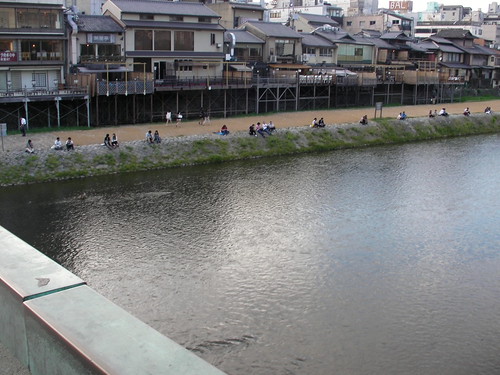
Kyoto is the exception but then Kyoto is also the second biggest tourist attraction in Japan (after Tokyo) which has presumably been influenced by Western culture. Western tourists may have promoted the construction of restaurants along side this river. I think that other cities may achieve increased inbound tourism if they followed suit.
I found that Kyoto citizens had a habit of ignoring red pedestrian traffic signals when there are no cars coming. In my experience, Japanese pedestrians wait, as is the law, even if there are no cars in other parts of Japan. I wonder if this Kyoto dwellers' behaviour is influenced by gaijin too.
Labels: japan, japanese culture, nature, nihonbunka, 日本文化, 自然
Wednesday, July 04, 2012
Surnatural Tree Pruning
Surnatural Tree Pruning a video by timtak on Flickr.
The above animation used an original photo "isolated branches," with kind permission by ecormany.
Labels: japan, japanese culture, nature, nihobunka, 日本文化
Tuesday, June 26, 2012
Points and Places, and Lines and Concepts

Westerners name the streets or lines on maps give the doors on the streets numbers, but do not name the points nor plots of Land. Japanese name the spaces and places but rarely name the lines on the map, giving only a few of the roads numbers.
Points and places are given numbers, secondary to named lines in the West, lines are given numbers in Japan secondary to points and areas in space.
Attempting to summarize....
Japanese society is organized according to spaces
1) There are many geo-climatic theories that are thought to explain Japanese behavior
2) Japanese groups are organized according to spaces and those that are members of those spaces.
3) Shrines are the geo-locational model for the home and other spatial groups.
4) Lines are probably not felt to exist.
5) If there are signs on lines (streets/ boundaries between floors) then it is not to name the non-existent line or boundary but to refer to the surrounding spaces. Sometimes these signs are indexical (in the case of floor signs) and sometimes they are iconic (in the case of plot maps banchizu). Japan is no more "indexical" than it is iconic. The biggest difference is perhaps in whether the sign is thought to signify something visual (space, the place), or something conceptual. Western signs are thought to represent concepts. Japanese and Chinese signs are thought to represent things, and places that one can see (Hansen).
In Western society, space is thought to be empty. It is not used as an organization tool or structuring function, but needs to be organized by named lines. Space exists, is cognizable in so far as it is bounded by lines, and given coordinates, or a street number. The lines are themselves named. The lines are the ideas represented by the names, rather than spatial entities.
Labels: japanese culture, nature, nihobunka, nihonbunka, 日本文化
Monday, March 05, 2012
Japanese Boots: Form over Function

The Japanese are good at making some things and not at others.
According to my understanding, the Japanese are ego-involved in the image, the imaginable, res-extensa, space and place. Westerners are ego-involved in language.
So generally speaking Westerners are good at making linguistic things, such as retail systems, financial services, institutions, laws, theories, drug formulas, and above all software, except heavily image-dependent game software.
And generally speaking the Japanese and East Asians are good at making things - pretty much all things, especially those which capture and display images, but also cars, robots, lights, bicycle frames, motor bikes, trains, bridges, dams, architecture and computers other than the logical/linguist microprocessor "architectures".
But there are exceptions, especially relating to cultural taboos.
To the Japanese, nature is something rather special, sacred and to a degree taboo. Nature is beautiful and a little scary; not something that until recently, they felt able to go traipsing around in as a leisure activity, enjoying "outdoors". This is why many "outdoor" (they use the English word) goods, such as tents, rucksacks, raincoats, and climbing gear may be branded, if not made, outside of Japan.
Another thing that the Japanese have not been very good at, and continue to import, is shoes. Britain imports very little to Japan but one product that can be purchased in any town are British shoes, made by Doctor Martens for instance. I presume that this may be due to the taboo associated with leather industry. Due to the Buddhism related prohibitions on the killing of animals (or at least land animals, with hair) the leather industry was traditionally considered impure and those that worked in it it likewise. This may have served to dampen the development of Japanese footwear. Who wants to wear wooden clogs (geta) anyone?
But then again, the Japanese are excellent at making footwear for appearances such as those pictured above. They may not last all long, in terms of comfort, grip and walking speed, they may not compete, but they look...well anyway that the customer wants them to look, with heels, patters, toe extenders, and straps galore.
Japanese footwear brings my attention to another aspect of Japanese products: the sometimes place form over function. When it comes to what they do, other than look really cool, they are not always the best. Japanese cars for instance, may look good but they are often not 'drivers cars' because the qualities such as "responsiveness", or "handling" ar,e in so far as they can be communicated or represented, notional, ideational, arguably linguistic, and at least not something that Japanese designers can see or imagine and become ego-involved in.
What about the car I drive, a Subaru Impreza WRX? It is the epitome of functionality over appearance. I can only surmise that there are exceptions to everything and point out that "Scoobies", as they are known and loved in the UK, are not very popular in Japan, and those that drive them are thought to be rather strange, "Subarists." Sadly, from my British point of view, Subaru seems to be in the process of being taken over by Toyota and seem to have given upon on their function above form philosophy.
Labels: athletes foot, image, japan, japanese culture, logos, nature, nihobunka, nihonbunka, taboo, tabuu, theory
Thursday, July 07, 2011
Sur-naturalism

Sur-naturalism is the Japanese tendency to attempt to make nature even more natural than nature itself. Here the branches of trees in our garden have been pruned in such a way as to make them more wiggly, by cutting off the main branch and allowing the branch to continue to grow along alternating sub-branches.
The same tendency to reduce the "human" "geometrical" and increase the persceived, natural majesty of plants may be present in the art of Bonsai and the way that garden conifers are cut into bobbly pagodas. In each case a smaller plant is made to emulate a larger one. Garden layouts also deliberate eschew lines and pursue "sur-random" pairings of plants and rocks.
Ruth Benedict pointed out this tendency to attempt to arrange nature to conform with human notions of what nature should be. Quoting from a "A Duahgter of the Samurai" Benedict writes, “every morning Jiya wiped off the stepping stones, and after sweeping beneath the pine trees, carefully scattered fresh pine needles gathered from the forest." (Benedict, 1946) Lummis (2007) points out that it was sur-naturalism that Benedict assumed the Japanese would be glad to be free of. Benedict could not have known how beautiful the Japanese thought it.
Labels: nature, nihobunka, nihonbunka, 日本文化, 自然
Thursday, January 03, 2008
King Mukade

These things can be dangerous. To be safe, I recommend you seek medical attention if you are bitten by a mukade.
The American Tarantula Society says
"Much has been alleged on the toxicity of centipede venom, but very little material on the subject has made its way into the scientific literature. As with tarantulas, this vast lack of medical reports on them more than likely indicates they are not medically significant. Like tarantulas, their perceived repulsive appearance by most people is probably the reason they are widely viewed as somehow dangerous and toxic. We do know that some of the larger centipedes, especially in tropical areas, can administer a painful stab, but none are known to be dangerous. All we can say for sure on the subject is that some can cause a painful bite, but that's absolutely all."
The English Wikipedia page says that there has only been one centipede fatality - a child was bitten on the head in a pacific island and even the Scolopendra gigantea (Giant centipedes) found in the Amazon and Trinidad, are rarely fatal, only painful according to this case study paper. They seem to suggest (by extrapolation from mice) that the fatal does in humans is 1000 venom glands. Even if there are two venom glands per centipede, this would require being bitten by 500 of them. If you did not die you would probably want to. They summarise the effects as follows
"The most common scenario includes moderate to severe local symptoms associated with mild systemic symptoms. Local symptoms include pain, erythema, edema, lymphangitis/lymphadenitis, weakness, and paresthesias. Skin necrosis may occur at the site of envenomation during the weeks following the sting, but rarely becomes extensive and heals spontaneously. Systemic symptoms may include anxiety, fever, dizziness, palpitations, and nausea. "
and conclude
"Despite the striking appearance of the offender and the significant pain associated with a sting, treatment for centipede envenomation is essentially pain control and routine wound care."
However, most of the cases being that of one of the (centipede rearing) authors and none of the centipedes were mukade. There is however, at least one paper about mukade bites which reports that they can cause Korsakoff's syndrome!
You know they mean business when, unlike any other bug, they show no fear, and walk towards you.
I was putting on my wetsuit one chilly December afternoon when I felt a movement next to my thigh, my inner thigh. I knew what it was.
And it bit me. The pain was not so great as my panic as I felt it crawl down (could have been worse!) my leg, towards where the wetsuit was tighter and I thought it would bite me more. I used a knife to slit open the wetsuit to my calf, and when it escaped my friends dispatched it.
At first I thought that it had only given me a nibble. I had experienced a mukade nibble in the past, when I awoke to find one on my upper torso. Two red bite marks were all that were left. It did not hurt all that much nor had any ill after effect (Partly perhaps because I used alkaline - ammonia - on the wound).
And neither did it hurt all that much on that day, when a mukade shared my wetsuit.
I continued to wake-board. The thrill of wake-boarding made me forget the pain. No worse than a bee sting I thought. But I was wrong.
The next day, or the day after that, my left thigh had swollen to about 1.3 times it size. This is no mean feat. I do not have thin thighs.
All the same I thought I would brave it out, and went jogging (I do this a lot). I thought I would flush the poison out with a good pump of blood with a little adrenaline. The leg around the bite became hard. By the third day I had a fever and was feeling generally weak.
I went to the doctor. They gave me antibiotics and antihistamines I think. They told me that had I come immediately after the bite I would have saved myself a lot of bother.
I was a 37 year old 70 Kg male. The mukade was not as big as the one in this picture. If your child gets bitten by one of these things, or if you get bitten on the neck, go a hospital immediately. Go to a hospital immediately anyway if you do not want to have serious swelling and general malaise. Who knows what would have happened had I not gone to the hospital at all.
I was only after I had posted the first draft of this that I realised that Todd Baker << technowannabe had kindly linked to another rendition of this story.
ASIDE
I find that insecticide does kill mukade if you douse them in it. But they do not die immediately.
This is hearsay but, I believe that a lot of insecticide uses the same active ingredient which is a nerve gas to bugs. It does something to their nerve receptors or some-such, such that they loose, or gradually loose, muscular (if that is the right word) coordination. Flies sprayed with bug spray also go berserk in a way, changing course at even more regular intervals, bumping into things, flying upwards, downards, upside down.
I seem to remember a mukade sprayed with bug spray loosing the coordination of its legs which, instead of moving in a controlled ripple, started to work all at once. The berserker mukade would probably have died. But in the meantime it went berserk.
I got good with chopsticks and developed an ability to drop them in a jar of oil. When I gave up on the oil (see the other post linked above), I just chopsticked them out of my house. Do not attempt to chopstick a mukade unless you are very confident with chopsticks.
Update A skin doctors advice from 2016
There was a mukade in my crocs one evening this May. I felt that stabbing mukade pain, and while I did not see the culprit, I knoew what species of critter had bitten me. The next morning my foot still ached and was swollen so I went to see a nearby skin specialist. He told me that mukade do not inject their venom but bite and then spray their venom onto the surrounding skin. The venom seeps in both through the puncture wound that the mukade have made, and through the skin itself. However, mukade venom breaks down at high temperatures. The doctor recommended that if bitten by a mukade then immediate wash the surrounding area in water hot even to be just bearable.
Labels: culture, japan, japanese culture, nature, nihonbunka, 日本文化
This blog represents the opinions of the author, Timothy Takemoto, and not the opinions of his employer.