
Friday, January 25, 2013
Communal Fantasy

The Wikipedia page on the book claims that it is not only a difficult book but also that it is like a Rorschach inkblot test in that different people read into it different things.
Yesterday I read it again and found it in a way of describing that which replace Oedipal, sexual fantasies in Japan.
In the preface Yoshimoto introduces "communal fantasy" (共同幻想) as fantasies or psychological constructs shared by a society. He later uses the example of mythology. Under this interpretation "communal fantasy" is close to Jungs' collective unconscious and the culture of cultural psychology: "shared understandings."
However in the first chapter "communal fantasy" emerges from a discussion of taboo in Freud, as an alternative class of taboo.
Yoshimoto notes that taboo is associated with ambivalence. Those things that taboo are not only rejected and hated but also loved and wanted at the same time. Then as an alternative to the "pair fantasies" manifest in incest taboos - the fantasy of incestual sex - "Communal fantasies" are introduced to describe initially the ambivalence towards kings and chiefs. (Yoshimoto does not need, or can not, mention the emperor since certainly the emperor of Japan is taboo subject in Japan).
Thus, the word "fantasy" (幻想) is used not only to describe psychological contents but also aspiration: fantasy in the sense of what people fantasise about, what they want, what they desire (even if they hate it as the same time).
Secondly, when he talks of sexual fantasies as "pair fantasies," (対なる幻想) the meaning of "pair" is transformed from a subject to an object or objective. Incestual sexual fantasies as "pair-fantasies" are not, necessarily at least, fantasies held by pairs, but fantasies about pairing. I don't think that Freud argues anywhere that Oedipal fantasies are necessarily, or even often, held equally on the part of mothers and fathers - the fantasies are held largely or exclusively on the part of children. Equally, , as a parallel concept, "communal fantasies" are not simply or even necessarily fantasies held by communities so much as fantasies of communing, of merging, melding, being one. And this fantasy may also be taboo, as there may also be taboos associated with the commity represented in the person of a king, or emperor*, for example.
As previously discussed, bearing in mind the bedroom arrangements in Japanese homes, the way that nakedness, communal bathing, touching and sleeping together are all everyday events that are not the subject of taboo, it seems clear that sexual incest taboos are not a prime mover in Japanese development. Children already get to sleep with their mothers. Their fathers do not step in with their paternal prohibition, but rather on the far side of their children, sandwiching their children closer to their mother. So how could the Japanese bow be tightened? How could, how do the Japanese ever grow up?
Cynics might say that the Japanese do not grow up, but it seems to me, with all the studying and almost religious ascetic practising of sports, and martial arts, that the Japanese child's trajectory into Japanese adulthood is no less motivated, the Japanese bow is no less taught. So, to coin a war poem, what made fatuous Japanese toil to break out of mummies bed at all?
My answer is that rather than incestual "pairing fantasies", the Japanese are propelled into the world by "communal fantasies", they desire communitas, they want to merge (合体), with mother, with father, with the community of parents, progenitors, ancestors and even eventually the gods.
Considerations such as the above may also related to the previously discussed way in which images and mothers in the West, and fathers and symbols in Japan, are to blame for, or catalytic in propelling the infant in a quest for something else something more.
The father in Japan, even as he says, go on sleep next to your mother is living symbolic proof - "father" - that the child is not a parent. A child of my acquaintance fantasised that a sibling was that child's own child. But the presence of the father and mother, the fact that they come as a set, presents a different type of prohibition, a parental prohibition that says to the child "No! You are not one of us. You are not a parent too!" And so all that toil, and study, and waiting and sweating and longing begins.
Notes
天皇は、日本國の象徴であり、日本国民の総合の象徴であって、その地位は日本国民の至高の総意に基づく。The emperor is the symbol of Japan and the symbol of the will of the Japanese people, and this status is based in the highest will of the Japanese people.
吉本隆明. (1982). 共同幻想論 (1982年) (改訂新.). 角川書店.
Labels: japan, japanese culture, Jaques Lacan, lacan, sex, 合体, 日本文化


Tuesday, March 06, 2012
Somnambulant Interaction on Japanese Trains


In the 1997 Japanese film Janku Fudo one of the protagonists dies on the Yamanote Line (in UK parlance, The Circle Line) and circles around and round before anyone notices, thinking he is asleep. Japanese subway carriages can be lonely places.
In some excellent observational research (in Japanese), Dr. Harihara Motoko (2010) studied the behaviour of passengers on three subways, in Tokyo, Seol and New York. She and her confederates stood in subway carriages with clipboards counting the number of times that passengers interacted with each other, and found that the Japanese interacted far less than those in Seol and New York. In New York there were about 26 interactions per 100 stops on the subway, whereas in Tokyo there were only 6. Harihara associates these results with those of Yamagishi's research (see Yamagishi & Yamagishi, 1994 for a review) which show that the Japanese have lower levels of general trust (i.e. they only trust friends and family but not strangers) and this tendency, not to interact with anyone but ones peers, with collectivism.
First of all, as Harihara herself points out, there is research on interpersonal interaction in the field of intercultural communication which finds that country folk are more likely to interact that city dwellers. And at the same time, it is usually argued that City dwellers are more isolated and individualist. In my own experience of travelling from Southern Italy (where passengers on busses talk to each other and even the driver), up through to London (where the passengers are almost as unfriendly as in Japan) and being of the opinion that it was the English, rather than the Southern Italians, that were individualist. As is often the case, the same behaviour - ignoring other passengers - can be interpretted as both individualistic and collectivistic, an indication of the problematic nature of this axis of comparison.
Secondly, and relating to the theory proposed by this author, while I think that Harihara's research is excellent, authentic, and above all very intersting, I wonder if it falls foul of the invisibility of the visible paradigm that I touched on in my recent post about Japanese architecture.
Aside: Invisibility of the Visible Paradigm: To westerners (such as Donald Richie, the author of "The Image Factory, Fads and Fashions in Japan) and perhaps Westernised Japanese, visual images can seem trivial, mere "fads," not worthy of note, and almost invisble. This enables Westerners to come to Asian cities, which are so bristling with individuality that it pokes your eye out, and not even notice! They are blind to all but the linguistic self-representations, and since the Japanese are a quiet lot, that rarely speak, much less express opinions to strangers, the Westerner can go away thinking that 'those Japanese have no individuality.' Since the Japanese are into cooperating with each other and have more individuality than they know what to do with, they are happy for Westerners to mis-represent them in this way. End of Aside.
Of the 21 categories of interaction studied by Harihara Motoko, 14 are either purely linguistic (ask for directions, converse etc) or partly linguistic ('smile or greet someone' as a single category), or a response to what may have been a linguistic request (such as giving money to someone asking for contributions). Dividing the interactions into "possibly-linguistic" and "probably-non-linguistic" we find that the majority of the difference between Japan and New York falls in the former category, with New Yorkers making about 21 and Tokyoites about 3 possibly-linguistic interactions per 100 stops. Regarding the remaining 7 probably-non-linguistic interactions (giving up a seat, moving a seat, letting someone on first, helping in some way, staring, moving seat, negative facial expression) the difference is the number of interactions is drastically reduced, to about 3.5 in Tokyo to about 4.5 in New York. Limiting the interactions again to those which are clearly purely visual (staring/glimpsing and negative facial expressions) we find the situation reversed, with 1.6 interactions in Tokyo to only 0.4 in New York. This is a ratio of 4 to 1 in favour of Tokyo-ites interacting more than people from New York, still not as great as the difference in linguistic interactions (7 to 1 in favour of New Yorkers) but non-linguistic interactions are sometimes very difficult to observe. Or are they....
Thinking back to my experiences in the Tokyo subway, and indeed in a lot of social situations in Japan, it seems to me that a great deal of non-verbal interaction goes on. Leaving aside the glances, expressions, sighs, and postures and moving to the most extreme example, I was surprised to find that on a large number of occasions, the subway travellers fell asleep on each other (please see the photos above). Call me old fashioned but it seemed to me that falling asleep on a stranger seems to be a schockingly brave, and or invasive form of interaction that requires extremely high levels of interpersonal trust. I am quite unable to fall asleep on the shoulder of another traveller, but a young Japanese female has fallen asleep on mine.
Taking another extreme example of non-verbal interaction on Japanese trains, if interpersonal touching could be said to be a form of interaction then Tokyo is way out there in the blue as this next photo illustrates.
After getting use to Japanese subways, and returning to the tube in London, I darted onto a (to Japanified-me 'rather empty') departing train and, nestling my way in, touched the boarded British travellers who complained, vocally of course, at my gross interactive impertinance. "Get on the next train they said." I don't think that they would be able to cope with the levels of interaction in Tokyo.

Japanese trains are silent. They remind me a little of Japanese public baths - where Japanese people 'get naked together' - in the the ferocity, the deafening roar of the non-verbal interaction taking place therein.
Bibliography
Labels: collectivism, individualism, japan, japanese culture, nihobunka, nihonbunka, occularcentrism, specular, 個人主義, 合体, 日本文化, 集団主義
Thursday, February 09, 2012
Japanese Super Friends as pure Body

A sub-genre of superhero fiction are partnerships between super-friends, and a human (often a boy). This genre is particularly popular in Japan.
These super-friends are controlled by an otherwise ordinary mortal man or boy. Mazinger-Z was a giant robot radio controlled by a boy. Pokemon (pocket monster) Pikachu is kept in the pocket of his friend, ready to fight at his bidding. Doraemon, another robot, lives in the closet of a boy called Nobita, ready to help the latter in the many ways he can. Gundam is a robotic suit worn by a boy called Amuro Rei. Ultraman is an extraterestial giant that possesses and is possessed by a squadsman called Hayata; unlike Clark Kent and Superman, Hayata and Ultraman are not quite the same thing.
Others similar entities include Tetsujin-28, the god of death in "Death Note", the mother-possessed (!) suits in Evangelion, the giant mecha that appear in every series of Super-Sentai (Power Rangers), and duality observed in the Masked Riders such as Kamen Rider Denou.
Western superheroes are far more likely to be a unity that only appears dual due to the fact that for some of the time, the superhero poses as a normal, but "secret" "alter ego." Western superheroes are dual only epistemologically. Japanese superheroes are ontologically dual.
Japanese super friends are often but not always giants, and often but not always robots. They are also often unable to speak. Pikachu can only say its name, Ultraman can only pant. Many Japanese superheros and characters (such as hello kitty) do not have mouths at all, or have masks which cover their mouths.
Lacking in language, these super friends often carry out the will of their human partner. The super-friends are *all body* - taken to the extreme in Gundam and Evangelion - that provide the power, or technology to carry out the human will.
Western Imaginary friends on the other other hand, as I will argue in a seperate post, are often all mind and no body. They provide their human friend with information. Western super friends above all speak to their human partner. The human carries out the will of the imaginary super-being.
Images copyright Mazinger-z by joeszilvagyi, Doraemon by Wacko Photographer, Pikachu by ntang, HG 00 Gundam by Chag and ultrama photographed by me but all characters/images copyright their original creators.
取り下げご希望の場合はnihonbunka.comのメールリンクか下記のコメント欄からご連絡ください。
Labels: Bandai, Bokenger, Gao-Ranger, go-onger, henshin, nihonbunka, reversal, Super-Sentai, superhero, ultraman, スパー戦隊, 仮面ライダー, 合体, 変身, 日本文化
Wednesday, December 28, 2011
Mophing Transforming Lego Scorpion and the Japanese Self
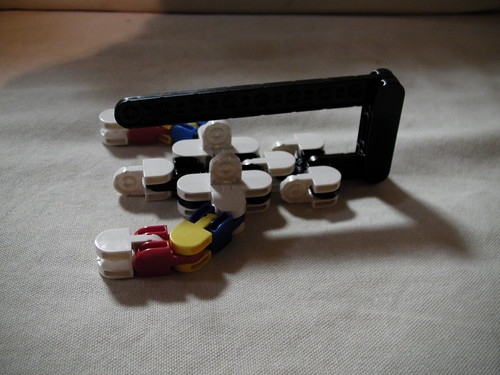
Jurat by Toyda is a kind of Lego for morphing robot makers.
I am not sure why Japanese children especially, and anyone who likes the movie series Transformers, are keen on transforming or morphing.
There is often a morph between something inanimate and something animate, between a something used, a tool or vechicle and a using thing living robot.
The above is a scorpion which morphs from/into a sword made by my son from Jurat morphin lego by Toyda.
I would like to suggest that Japanese children (and anyone fond of Transformers, which is most children everyhwere) but especially Japanese children because they remain in a "mirror stage," may be more aware of the Lacanian dictum that the ego or self, which originates in the self-image, is external, dead, a mere tool, and yet at the same time the only self we have. We see, we are, dead people: at best robots, at worst inanimate tools.
This dual nature of the self, (1) as a mere tool or representation to grasp a centre-less consiciousness, and (2) as the best -- though "robotic" or prosthetic -- self that we have, may be being played out in the morphining animation movies, and toys such as the one above.
Labels: Bandai, go-onger, henshin, japanese culture, Jaques Lacan, lacan, morph, nihobunka, nihonbunka, occularcentrism, self, specular, Super-Sentai, superhero, theory, 合体, 変形, 変身, 日本文化
This blog represents the opinions of the author, Timothy Takemoto, and not the opinions of his employer.