
Sunday, June 06, 2021
Superhero Secret Identity Collectivism

This is our (Nishioka & Takemoto, 2021) survey that attempts to prove that while Western Heroes go from a "mild mannered" secret identity to an individualistic "man of steel" Japanese superheroes often start as odd-balls in their non-super form, and change to upstanding members of the community. Japanese super-hero "secret identities" are not secret. They transform to become strong, not to hide. It seems to me that additionally, the individualism espoused by Westerners and exemplified by their heroes, and the polysemic wa, which means acceptance of difference at least as much as it means conformance, are a sort of camouflage for the odd-ball and mild-mannered reality of Japan and anglophone West respectively.
The images of Kamen Rider Forze before and after transformation and Christopher Reeve (RIP) as Clark Kent and Superman are copyright their respective copyright holders and used for illustrative purposes. If you wish that I cease and desist, please leave a comment below or contact me via the email link on my homepage, nihonbunka.com. We will be collecting Japanese data soon.
Labels: cultural psychology, culture, japanese culture, nihonbunka, Super-Sentai, superhero


Monday, March 08, 2021
JMen's Day Suit

Today is International Women's day but I think it should be men's day in Japan due to the gender reversal pertaining in Japanese culture, including the culture of business suits, which exhibit Simone De Beavouir's theory of "The Second Sex" (1946) in reverse.
Simone De Beauvoir (1946) argued that, bearing mind in the teachings of Western religions, and such facts as that W ”l'homme" (man, mankind) refers to humans in general, the default, standard, archetypal, role model in Western society is male, whereas women are considered to be an inferior second or secondary sex.
In seems to me that in Japan this situation is reversed. For example, while the ratio of girls considering their role model to be their mother to their father is 2 to 1, only 30% more boys consider their role model to be their father (often a "salaryman" or salary delivery machine) than their mother.
Further, as shown in the above image, The main brand (by varieties of suit) of Aoyama one of the two the largest Japanese high street suit store (the other is Haruyama, the equivalents of Moss Bros and Burton in the UK) the majority of whose customers are men, is "Person's" for Men" where "Person's" is a brand of suit for women. The same company also sells two other (Mr. Junko think "Mr. Jane", and Yuki Torii Homme) similarly branded suits for men, whereas there are no such branded suits (XYZ for Women) in the Aoyama women suit range, nor any "XYZ for Men" in the Moss Bros or Burton suit brands.
This is probably due to the fact that Japanese women would not be seen dead in a man's suit, whereas Japanese men, respecting as they do the taste and style of women, are happy to wear a men's version of a "Person's" women's suit, because in Japan the default, model, archetypal role model, of the caring, sharing, autoscopic Jperson is a woman, as is the head of the Japanese pantheon is the Sun Goddess not the Father in Heaven.
Since the most important place in Japanese society is the home, where men generally play second fiddle, and increasingly outside of the home, women are being encouraged to take leading role as well, JMen's Day is likely to be a long time in coming.
Labels: female, feminism, japanese culture, male, nihonbunka, reversal
Wednesday, February 24, 2021
Snow-Watching Very Happy Rice Cake Ice Creams

Fusion!
The white vanilla "Snow-Watching Very Happy" (Yukimi Daifuku) rice cake ice creams have been around since my wife was a child, or before. According to a Japanese press article, however, the chocolate ones were released on 31st August 2020. This is the first time I have noticed chocolate ones. The layer of rice is very thin. They contain 77 calories per cake.
The chocolate ones may have taken so long to be released because there is an association between rice cakes and the Japanese religion, Shinto, wherein rice cakes are use to represent the Sun Goddess, or her mirror, which looks very much like her, are displayed at new year, and are eaten in order to consume and or merge with her, so pure white rice cakes tend to be preferred. But then grass (yomogi) flavored ones are traditionally available, and they are green, so perhaps not.
Labels: japanese culture, nihonbunka, 日本文化
Are the Japanese Dirty or Not?
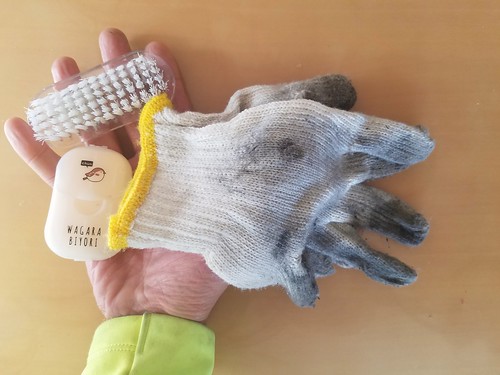
For about thirty years of living in Japan I thought that the Japanese were dirty because they did not have nail brushes (pictured above), before I realised that vast majority of Japanese do not get their hands dirty because they wear disposable cotton gloves (above right) to do dirty chores even when they are at home. I had thought that only taxi drivers, ticket inspectors and others that appear before other people wore these three for a dollar "soldier's gloves."
For even longer I thought that the lack of soap in Japanese public toilets to be a lapse in Japanese hygiene, and to a certain extent at least in so far as providing for ill-equipped foreigners it is, but then I realized that the fastidious Japanese have personal, portable dispensers containing sheets of one-use, "paper soap" (pictured above left) partly because they don't like to use bars of soap and dispensers that have been used by others.
I now use cotton gloves, and carry my own soap, so the lack of nail brushes, and soap in Japanese public toilets, no longer bothers me.
I still like my British nail brush (purchased from China) to scrub my hands, however, in these times of pestilence.
Labels: japanese culture, nihonbunka, 日本文化
Tuesday, February 09, 2021
Choice is a Chore
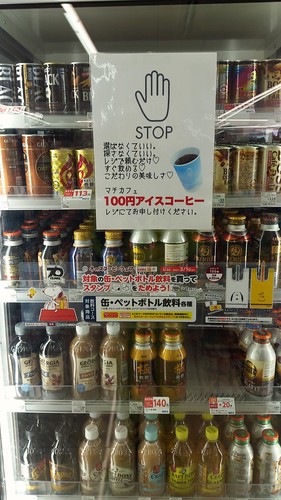
A poster in a convenience store promoting the store-brewed coffee over the wide variety of canned an bottled prepared coffee in the refrigerator, implying a negative, troublesome side to choice, which Japanese are more keenly aware of (Markus & Schwartz, 2010) but also leads to non-optimal outcomes in the West too (Schwartz & Ward, 2004).
My translation of the poster
No need to choose.
No need to search.
Just ask at the till ♡
You'll soon be able to drink ♡
Our specialty taste ♡
High-street Cafe
100 Yen Ice Coffee
Please order at the till.
The second, transparent poster says that customers can collect stamps by purchasing the drinks in the fridge.
Bibliography
Markus, H. R., & Schwartz, B. (2010). Does Choice mean Freedom and Well-Being?. Journal of Consumer Research, 37(2), 344-355.
Schwartz, B., & Ward, A. (2004). Doing Better but Feeling Worse: The paradox of choice. Positive psychology in practice, 86-104.
Labels: japanese culture, nihonbunka
Wednesday, January 27, 2021
Only in the Eyes of God, and Themselves
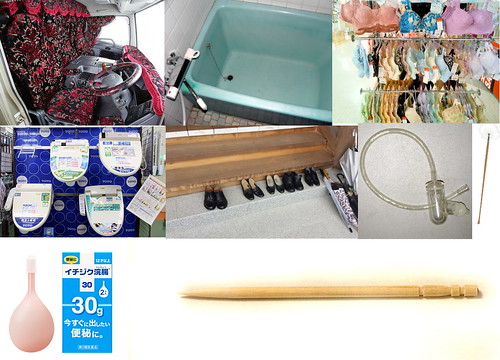
The Japanese are said to be hygienic because they care about how they look to others but many Japanese hygiene and prettifying behaviors such as, decorating the interiors of their cars and trucks, bathing at night, wearing fancy underwear (that sometimes becomes outer wear it is so fancy), bidets, not wearing shoes at home, snot suckers, enemas, the popularity of ear cleaning, the prevalence of toothpicks, and (not pictured) the use of flannels to clean ones hands and face before meals, toilet slippers, and disposable cotton gloves when doing dirty chores at home, are carried out in the eyes of God (the Sun Goddess and ancestors who are always watching) and themselves but are nearly invisible to other people.
The fig shaped enema above is from ichijiku.co.jp お取り下げご希望の場合は下記のコメント欄か、http://nihonbunka.comで掲示されるメールアドレスにご一筆ください。
Labels: autoscopy, japanese culture, Nacalian, 自己視
Friday, September 21, 2018
Kendo and Karate Kata (Forms) as Self Seeing Robots
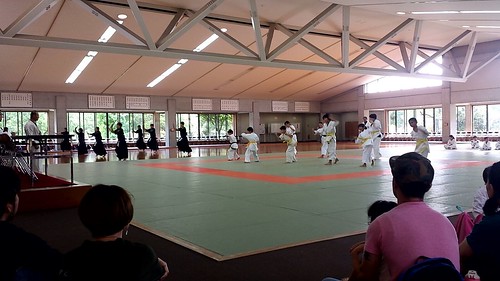
You practice the forms. Eventually they come naturally. Miyanaga claims that there is an intermediate or parallel ability to visualise the forms in her paper on robots.
The paper in English comments on the similarity between form mastering Japanese, and form mastering robots
Miyanaga, K. (1985). POPULARITY OF ROBOTS IN JAPAN── Tradition in Modernization──. 国際基督教大学学報. II-B, 社会科学ジャーナル, 24(1), 111-123.
icu.repo.nii.ac.jp/?action=repository_uri&item_id=366...
However in section 4, entitled "Image and Action," of her paper in Japanese Miyanaga (1987) explains how it is an ability to generate an integrate *image* of ones behaviour, through the practice of forms, that enables Japanese humans (but perhaps* not robots) to move from doing things by rote to doing things freely and naturally.
宮永國子. (1987). 日本のロボットと土着文化 (「ロボット・人間」). 社会心理学研究, 2(2), 7-13.
www.jstage.jst.go.jp/article/jssp/2/2/2_KJ00003724946/_pd...
This Miyanaga's assertion is at the centre of my understanding of Japanese culture and therefore the best Nihonjinron (other than my own!) that I know.
* There is work to create robots with autoscopy
https://www.researchgate.net/publication/326998491_The_Synthetic_Psychology_of_the_Self
Cyberdyne?
Labels: autoscopy, japanese culture, martial art, Nacalian, nacalianism, nihonbunka
Saturday, November 11, 2017
The Heart of Yamato
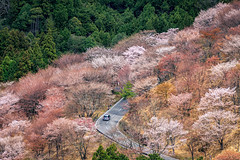
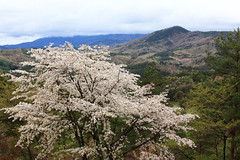
Takemoto, T. R., & Brinthaupt, T. M. (2017). We Imagine Therefore We Think: The Modality of Self and Thought in Japan and America. 山口経済学雑誌 (Yamaguchi Journal of Economics, Business Administrations & Laws), 65(7・8), 1–29. Retrieved from nihonbunka.com/docs/Takemoto_Brinthaupt.pdf
Labels: japanese culture, mirror, Nacalian, nacalianism, nihobunka
Tuesday, October 31, 2017
Face Processing in Japanese and Sign Language Speakers
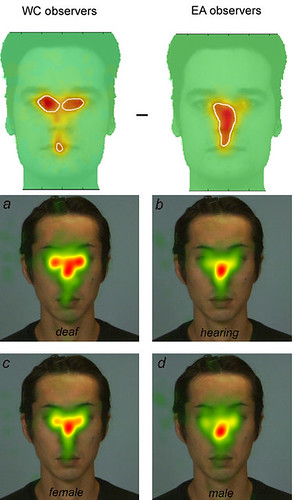
Roberto Caldara and associates find that when recognising faces, Westerners tend to triangulate (in a manner of speaking) analysing the face moving their gaze from eye to eye to mouth, whereas East Asians seem to process faces globally and holistically, perhaps, by focusing upon the nose (upper two images, Miellet, Vizioli, He, Zhou, & Caldara, 2013, p.6).
Bearing in mind that in Lubna Ahmed as yet unpublished research, showing that repeating numbers impedes Westeners but does not reduce the facial processing ability of Japanese, and that repeating numbers impedes analytical but does not impede global processing of Navon figures (Ahmed & W de Fockert, 2012) , conversely improving global recognition, and crossing these results with the fact that research repeating the alphabet is the way of preventing self-talk (Kim, 2002), I presumed that all this demonstrated that East Asian global/holistic face processing is also non-linguistic processing, or conversely that Western triangulation is linguistic processing -- looking for nameable features -- which is impeded by being made to remember and presumably repeat numbers.
Caldera also introduces research (lower four images above from Watanabe, Matsuda, Nishioka, & Namatame, 2011, p.4) that demonstrates that the deaf and women are more likely to use the Western, 'triangulating' style of facial processing, whereas non-deaf and males seem to use the global style method of focussing on the nose. Noted elsewhere the Japanese should resemble the deaf if they are really not whispering -- thinking in words. So why is it that the deaf are using the Western style of face processing?
I think that this further reversal is due to the type of information being processed. The upper image is of Westerner and East Asians recognising the identities of faces whereas the lower four images are of deaf and non deaf, males and females processing emotions.
Emotions and identities may be being processed in opposite ways. As Caldera and colleagues point out (Stoll et al., 2017) the deaf use their faces to speak, so facial expressions and perhaps also emotions of the deaf are more likely to be processed linguistically using the triangulation method. Identities on the other hand are seen as linguistic by Westerners and the non-deaf who process the identities of faces in such a way as enwordify them, where as the Japanese (and I predict the deaf) see identify in the face itself (Watsuji, 2011). In other words, if Matsuda, Nishioka, & Namatame repeated their research except asking deaf and hearing subjects to identify facial identities, I predict they would have found the opposite tendency.
Caldera has further also performed some further fascinating research (Stoll et al., 2017) that finds that both deaf and non-deaf people who use sign language process faces in a different way.
Bingo.
I think that this explains the meaning of Kata, the forms used in everything from Karate to tea ceremony, by which I presume Japanese learn to be Japanese (based on hints from Masamune, Butler, 1993; and Yamamoto, 2009). Kata forms are like sign language by means of which the Japanese learn to speak with their bodies. The Japanese speak at shrines where they clap, and in the kata of martial arts and tea ceremony training rooms, with their bodies. The Japanese have bodies that speak. For the Japanese, this allows them to realise that speaking takes place on the outside of the head, on the forehead even, and this may be how the curse, of the whispering, can be lifted.
I am always attempting to leap to the conclusion.
And, there is a problem with the above line of reasoning in that Lubna Ahmed's unpublished research which showed that repeating numbers did not impede Japanese facial recognition, was upon the recognition of emotions in faces. According to the above reasoning, it is the Japanese who should be impeded if, like the deaf, they are processing emotion in an analytical way.
However, that the differences exhibited by Westerners and East Asians are beginning to be demonstrated in differences between deaf and hearing, and people memorising digits and those who are not, suggests at least tentative support for the Nacalian turn.
Images are from upper two images, Miellet, Vizioli, He, Zhou, & Caldara, 2013, p.6 and Watanabe, Matsuda, Nishioka, & Namatame, 2011, p.4.
お取り下げご希望の場合は下記のコメント欄か、http://nihonbunka.comで掲示されるメールアドレスにご一筆ください。 Should anyone want me to cease and desist, please leave a comment or contact me from the email link at nihonbunka.com
Bibliography
Ahmed, L., & W de Fockert, J. (2012). Working Memory Load Can Both Improve and Impair Selective Attention: Evidence from the Navon Paradigm. Attention, Perception & Psychophysics, 74, 1397–405. doi.org/10.3758/s13414-012-0357-1
Butler, J. (1993). Bodies That Matter: On the Discursive Limits of "Sex. Routledge.
Miellet, S., Vizioli, L., He, L., Zhou, X., & Caldara, R. (2013). Mapping Face Recognition Information Use across Cultures. Frontiers in Psychology, 4, 34. doi.org/10.3389/fpsyg.2013.00034
Stoll, C., Palluel-Germain, R., Caldara, R., Lao, J., Dye, M. W. G., Aptel, F., & Pascalis, O. (2017). Face Recognition is Shaped by the Use of Sign Language. The Journal of Deaf Studies and Deaf Education, 1–9. doi.org/10.1093/deafed/enx034
Watanabe, K., Matsuda, T., Nishioka, T., & Namatame, M. (2011). Eye Gaze during Observation of Static Faces in Deaf People. PLOS ONE, 6(2), e16919. doi.org/10.1371/journal.pone.0016919
Watsuji, T. (2011). Mask and Persona. Japan Studies Review, 15, 147–155.
Yamamoto, I., 山本一輝. (2009). メンタルトレーニング~弓道を通じた自己イメージのあり方~(Mental Training: The way of self imaging achieved through Japanese Archery) (未発表卒論). 山口大学経済学部観光政策学科.
Labels: japanese culture, Nacalian, nihonbunka, 日本文化
No Confidence in their Smile?
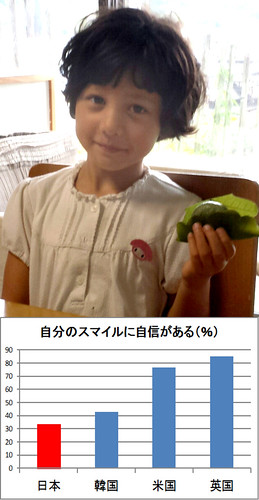
The Japanese are about one third as likely to say that they are confident in their smile (Funaki, 2006, p.29), because I believe and as Hamaguchi, Takemoto and Tobimatsu (in preparation) demonstrates, the Japanese express their confidence with their smile not about it.
Takemoto, Hamaguchi, & Tobimatsu .(in preparation). The Japanese smile as a symbol of positive self-regard.
舩木純三. (2006). クリニカル 笑顔の効用とスマイルトレーニングの必要性. 日本歯科医師会雑誌, 59(7), 631-639.
sunano.whitesnow.jp/pdf/smile-traning.pdf
Labels: japanese culture, Nacalian, nihonbunka, 日本文化
Heroes: All Mouth and No Mouth At All
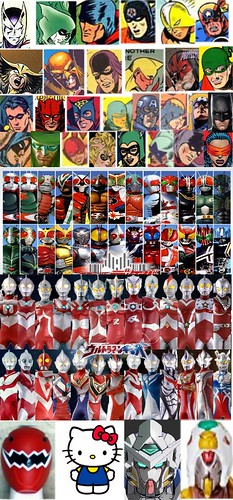
Western superheroes sometimes show their faces, like Superman and sometimes have a full faced mask like Iron man but when they wear a partial mask it always shows their mouth. They appear to be all mouth. On the other hand, Japanese super heroes often have no mouth at all. The mouth and the spoken word is not very important, or even avoided, in Japan but Westerners and their heroes are their pronouns, names and self-narratives. With heroes this different there may be reason to be concerned.
Derrida believes that the war to end all wars will be waged in the name of the name.
"But as it is in the name of something whose name, in this logic of total destruction, can no longer be borne, transmitted, inherited by anything living, that name in the name of which war would take place would be the name of nothing, it would be pure name, the "naked name." That war would be the first and the last war in the name of the name, with only the non-name of "name." It would be a war without a name, a nameless war, for it would no longer share even the name of war with other events of the same type, of the same family. Beyond all genealogy, a nameless war in the name of the name. That would be the End and the Revelation of the name itself, the Apocalypse of the Name. "(Derrida, 1984, p.30-31)
Western Heroes
Citizen V
Spectre
Phantom of the Fair
American Crusader
Keen Detective
Fighting Yank
Hawkgirl
Hawkman
Grim Reaper
Ray
Arrow
Green Mask
The Black Terror
Cat Man
Black Owl
Blue Beetle
New Invaders
Blue Diamond
Captain America
Batman
Father Time
Green Hornet
Flame
Blonde Platinum
Golden Girl
Captain Courageous
Mystic
Crimson Avenger
Japanese Heroes
Masked Riders
Ultramen (mouths suggested, but unmoving and non functional. They express the identity of the ultraman but do not speak.)
Super Sentai
Hell0 Kitty
Gundam
Evangelion
Derrida, J. (1984). No Apocalypse, Not Now (full speed ahead, seven missiles, seven missives). Translated by C. Porter, & P. Lewis, diacritics, 14(2), 20-31. www.uni-giessen.de/faculties/gcsc/media/workshop-feminism...
Labels: japanese culture, Nacalian, nihonbunka, superhero, 日本文化
Indentity: Asians Lower, Westerners Upper
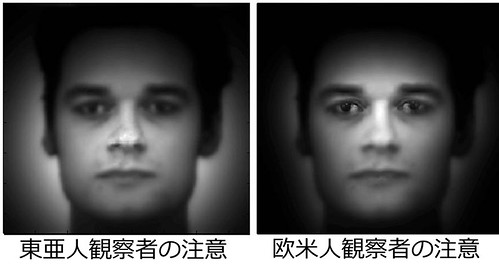
When learning identity, Asians look at the nose and the lower part of the face (above left) whereas Westerners look at the eyes and mouth, triangulating, comparatively focussing more on the upper part of the face (above right).
This is the opposite as I would have predicted bearing in mind that Japanese thieves (dorobo) traditionally used a wrapping cloth to cover the upper part of their face (other than their eyes), whereas Western outlaws traditionally covered the lower part of their face with their scarf.
It is also the opposite of the part of the face that East Asian and Western children use to recognise emotions. I argue that the way in which emotion and identity are perceived may be swapped East to West.
Miellet, S., Vizioli, L., He, L., Zhou, X., & Caldara, R. (2013). Mapping Face Recognition Information Use across Cultures. Frontiers in Psychology, 4, 34. doi.org/10.3389/fpsyg.2013.00034
Labels: japanese culture, Nacalian, nihonbunka, 日本文化
East Asian Children Look at Eyes to Sense Emotion
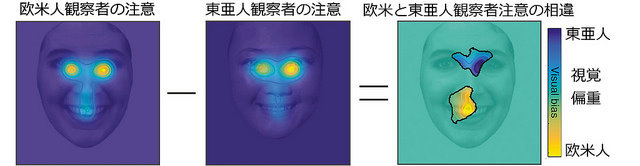
Since Yuki, Maddux and Masuda (2007) we know that Westerners and Asians look at different parts of the face when discriminating and processing emotions. We now know that even in seven month old children, East Asian children fixate on the eyes even or especially when looking at happy faces, whereas Western children look at mouths as illustrated in the image above (Geangu, et al., 2016, p. R663).
お取り下げご希望の場合は下記のコメント欄か、http://nihonbunka.comで掲示されるメールアドレスにご一筆ください。 Should you wish that I cease and desist, please leave a comment here, at flickr, or send me an email to the link on my homepage http://nihonbunka.com
Geangu, E., Ichikawa, H., Lao, J., Kanazawa, S., Yamaguchi, M. K., Caldara, R., & Turati, C. (2016). Culture shapes 7-month-olds’ perceptual strategies in discriminating facial expressions of emotion. Current Biology, 26(14), R663-R664. 下記URL2017/10/28参照 www.sciencedirect.com/science/article/pii/S0960982216306054
Yuki, M., Maddux, W. W., & Masuda, T. (2007). Are the windows to the soul the same in the East and West? Cultural differences in using the eyes and mouth as cues to recognize emotions in Japan and the United States. Journal of Experimental Social Psychology, 43(2), 303-311.
Labels: japanese culture, Nacalian, nihonbunka, 日本文化
Washida is Not his Face, Body or Clothes
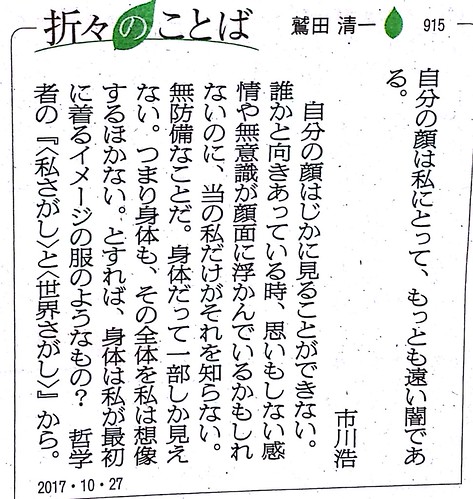
Professor Seichi Washida (2017) often rails against the centrality of face in Japanese perceptions of self (Watsuji. 2011). In this short piece on the front page of the Asahi Newspaper, Washida quotes Ichikawa Hiroshi, who in fact argues the unity of mind and body (Ichikawa, 1975) as saying that this face is that which is farthest from himself. I think perhaps Ichikawa draws a destinction between face, which can not be seen, and the body that can and the place in which it is perceived. Despite this fact, Washida does not distinguish between the body and face, and asks "is the body the first image clothes I wear perhaps?" This metaphor relating the body with clothing can be use to theorize superheroes who are light (Ultraman) or their clothes (Sentai/Power Rangers, Kamen/ Masked riders, Gundam, Eva, and Iron Man). Japanese people, as they become Japanese, grow into their clothes. Professor Washida remains unconvinced.
お取り下げご希望の場合は下記のコメント欄か、http://nihonbunka.comで掲示されるメールアドレスにご一筆ください。
Washida, S. 鷲田清一.(2017/10/27).折々のことば915.朝日新聞朝刊.
市川浩. (1975). 精神としての身体. 勁草書房.
Labels: japanese culture, nihonbunka, Super-Sentai, superhero
One Reason Japanese Waiters Shout
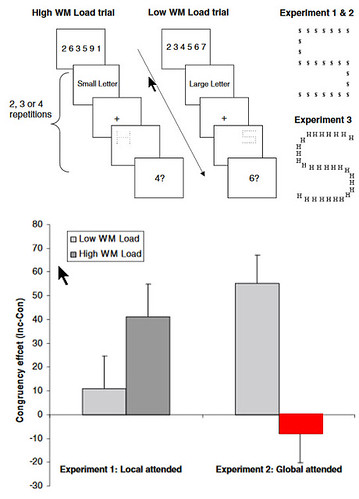
apanese waiters, and Karate practioners, shout as they go about their business. They shout "Welcome" to the customers, and sometimes even shout out the customers orders such as "An extra helping of Ramen!" in voice loud enough for the clientee and staff in the whole restaurant to hear. There are a number of reasons why they are doing this, including the fact that such shouting is approved of by the majority of Japanese customers. Additionally it may the the case that shouting makes them better at their job.
Lubna Ahmed and a colleague (Ahmed & W de Fockert, 2012) gave subjects one of two low difficulty and high difficulty memory tasks, before asking them to respond with either the small or large letter represented by a Navon figure. In the low load condition, the numbers that the subjects remembered where consecutive ascending, whereas in the high load condition the numbers were random. I suggest that the random, but not consecutive number condition, the subjects usually resorted to the typical phone-number memory method of repeating the digits. Under t his condition they became faster at recognising the large letter represented by a Navon figure: "S" in the case of the figure above right. This is because repeating the digits loaded and turned off the linguistic analytical mind, leaving them to react naturally and more quickly to the globally presented "S." Waiter's likewise, whose job it is to attend to the needs of a restaurant full of customers, and Karate practitioners who need to react with speed to movements of an opponent, can benefit from loading their linguistic brain, allowing to respond rapidly, naturally and in a Western sense mindlessly.
The above image is adapted from (Ahmed & W de Fockert, 2012, Fig. 1 and Fig. 2. on p. 1399 and p. 1400 respectively)
Ahmed, L., & W de Fockert, J. (2012). Working memory load can both improve and impair selective attention: Evidence from the Navon paradigm. Attention, Perception & Psychophysics, 74, 1397–405. doi.org/10.3758/s13414-012-0357-1
Labels: japanese culture, Nacalian, nihonbunka, 日本文化
Individualist Rucksacks
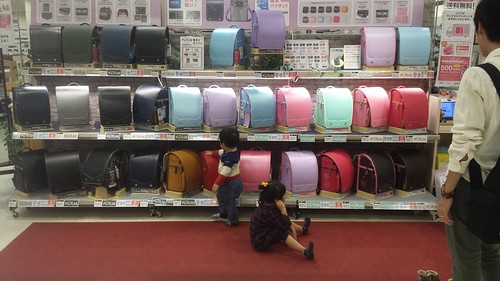
Traditionally these lightweight, stiff rucksacks for primary school children called randoseru, from the Dutch word ransel, came in only two colours: black for boys and red for girls. The colour coding of boys and girls rucksacks continued for more than 100 years since their introduction in 1885 (Penttinen, 2011). Due to the uniformity of their colour and design the use of randoseru has been described as part of the process of "inculcating group values"(Samovar, Porter, & McDaniel, 2011, pp. 402).
Each weekday morning small groups of elementary school students assemble near their homes and set out for their school house in classic military platoon formation... They also carry the ubiquitous backpack (randoseru), identifiable throughout Japan in shape and size and differing significantly in only the color —predominately red and black, but occasionally another color. The back packs mark the wearers as elementary students and the hats denote the school attended.
(Ibid, pp. 402-403)
In the 1990s, however, with the advent of feminism and increasing individualism there was pressure on schools and randoseru makers to provide rucksacks in other colours. It is only in the past decade that non-black non-red randoseru have become popular. A Google image search for images of randoseru stipulating before 2010 shows rucksacks in predominantly the two traditional colours. Primary school children now commonly wear rucksacks in all the colours shown here.
Penttinen, L. (2011) A Research Upon School Uniforms and Personal Style. epublications.uef.fi/pub/urn_nbn_fi_uef-20110453/urn_nbn_...
Samovar, L. A., Porter, R. E., & McDaniel, E. R. (2011). Intercultural Communication: A Reader. Cengage Learning.
Labels: japanese culture, Nacalian, nihonbunka, 日本文化
Speaking in Pictures
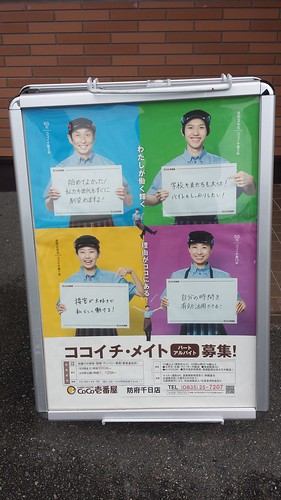
Like the Heptapod in Arrival (2016), the Japanese speak in pictures in adverts like this, on game shows, using smilies, smiles, and large number of other signs, and to a greater extent than Westerners believe language to be external to the mind. Their language is, like their smiles, a gesture or sign to others, and even their first person pronoun is no more or less than a you for you (Mori, 1999) and is not accompanied by a giant, uncanny ear (Nietzsche, see Derrida & McDonald, 1985). That said, Sadako looks out of their eyes (Nishida, 1939; Mumon, 1228).
Derrida, J., & McDonald, C. (1985). The Ear of the Other: Otobiography, Transference, Translation: Texts and Discussions with Jacques Derrida. New York: Schocken Books.
Mori, A. 森有正. (1999). 森有正エッセー集成〈5〉. 筑摩書房.
Mumon, E. (1228). "Koan 42. The Girl Comes Out from Meditation". The Gateless Gate. Poor translation "One wears the mask of god, one a devil's mask." should be just, "God head and Devil mask" afaik. Retrieved from
Nishida, K. (1939). 絶対矛盾的自己同 一(Absolutely Contradictory Self Identity) www.aozora.gr.jp/cards/000182/files/1755.html
www.sacred-texts.com/bud/zen/mumonkan.htm
Labels: japanese culture, Nacalian, nihonbunka, 日本文化
Friday, October 06, 2017
Stopping Momentarily (Ittanteishi)
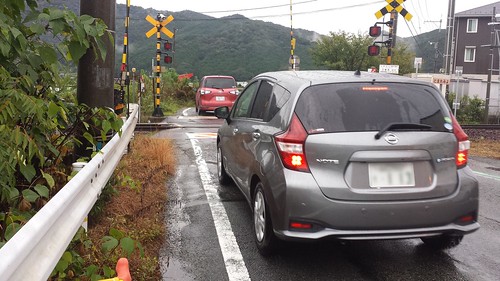
All vehicles stop momentarily (ittanteishi 一旦停止) to check for approaching trains, before crossing railway level crossings even if the barrier is up and the lights are in their favour. This stands in contrast to the fact that even in Japan one is not required to stop ones vehicle momentarily to see if anyone is running a red light at green traffic lights.
Once a long time ago I asked a university professor why the Japanese university professor why this is the case. He suggested that it could be due to the emperor system (which was his axe to grind) such that common folk are required to pay respect to any representative of Japan (such as JR trains) since they are also therefore representatives of, or represented by, the "symbolic emperor". At the time I thought, "surely not" but upon reflection it occurs to me that this practice of paying deference to representatives of the state has a long history.
Consider the Namamugi incident of 1862 where three Britons who refused to dismount to allow the procession of the Lord of Kagoshima (then Satsuma) to pass where attacked by attendant samurai swordsmen who expected deference from commoners, even British ones. Far further back in time the Wajinden or 'Records of Wei', written by Chinese visitors to ancient Japan in the early 6 century, recorded the fact that commoners would move to the side of the road and bow at the passing of aristocracy. 1500 years later the Japanese are still paying their respect to the passing of representatives of the polity, in the form of trains at level crossings.
From a logical point of view, I can see how it could be more important to stop at level crossings rather than at traffic lights if the vehicle stopping has the power to derail the train containing large number of people, resulting in large number of causalities. This could happen in the case of trucks and large cars, but it is difficult to imagine in the case of light cars
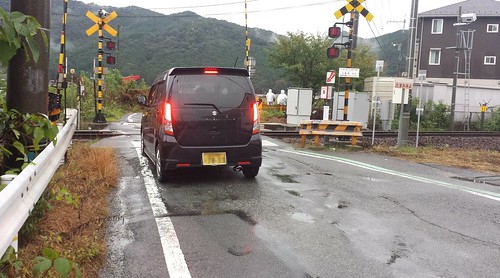
and surely cyclists would be simply swatted off the rails like mosquitoes should they venture onto the tracks at an importune time.
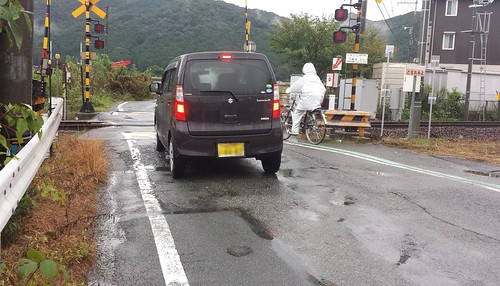
I can therefore think of no logical reason why cyclists should be made to stop momentarily and check for approaching trains at level crossings, but not at green traffic lights. But there is something beautiful about it, so I do it anyway.
Labels: japan, japanese culture, 日本文化
Friday, September 29, 2017
We Imagine Therefore We Think: The Modality of Self and Thought in Japan and America
A brilliant Korean American researcher (Kim, 2002) found that self-talk improved American visual problem solving, and that preventing meaningful self-talk (by making the subjects repeat the alphabet) screwed things up, preventing Americans from solving problems. In East Asians however, she found that self-talk prevented visual problem solving, and that reciting the alphabet did not have a deleterious effect. She concluded that Asians are not thinking in language. We agree But Kim said little about the nature of East Asian thought.
In this paper we hypothesized that Asians do not talk to themselves but show themselves pictures or imagine. We call this a "Nacalian" (Lacan reversed) transformation and we give experimental data to support it.
Experiment 1)
We got Japanese to answer the second author's self-talk scale (Brinthaupt, Hein, & Kramer, 2009) (how much do you talk to yourself when….) and a modified version, the self-image scale (how much do you imagine things when…) and found that Japanese imagine more than they talk to themselves.
Experiment 2)
We reversed, or Nacalianly transformed, Kim's experiment (Kim, 2002), language for image, and found that imagination did not effect American subjects, neither for better, nor for worse if suppressed, but in Japanese imagining improved their ability to think up words, and repressing imagination prevented the same.
We argued that this lent evidence for our hypothesis that Japanese think by showing themselves images as oppose to talking to themselves.
We then discussed the implications for (A) the nature of thought and (B) Japanese culture.
A) Recently thought as self-speech has come under attack (Freud, Left Brain Right brain work, Libet, Nisbett and Wilson) from evidence to show that the reasons that people give for their behaviour are generally bogus, and thoughts are generated after the decision making event. Westerners think our thoughts cause our behaviour, but they do not. "Thoughts are the product, not the process of thought". So why do we have thoughts? Recent psychologists such as Johnathan Haidt (who is brilliant) argue that thought is excuse preparation. We talk to ourselves so as to work out justifications for our actions to say to others. Thinking is for speaking they claim.
However, if Japanese are thinking in pictures, then this communicative theory of thought seems untenable, at least in the Japanese case, since pictures are difficult to convey to others. So what is thought for? We argue that Higgins (1996) notion of thought as a way of becoming emotionally involved and therefore motivated by ones actions is appropriate explanation for thought. Both talking to oneself and showing oneself pictures is a way of mirroring oneself, like standing in front of mirror, or standing on scales (c.f. “the weigh yourself diet”). If you represent yourself to yourself, you try harder.
B) The Japanese are seen as lacking in thought, self and individuality because researchers are always paying attention solely to language. But if you look at the Japanese, their houses, cities, cars, clothes, TV, behaviour, then you see that they are bristling with creative, innovative thought, and individuality.
Brinthaupt, T. M., Hein, M. B., & Kramer, T. E. (2009). The self-talk scale: Development, factor analysis, and validation. Journal of personality assessment, 91(1), 82-92.
Haidt, J. (2012). The righteous mind: Why good people are divided by politics and religion. Vintage.
Kim, H. S. (2002). We talk, therefore we think? A cultural analysis of the effect of talking on thinking. Journal of personality and social psychology, 83(4), 828.
Higgins, E. T. (1996). The" self digest": self-knowledge serving self-regulatory functions. Journal of personality and social psychology, 71(6), 1062.
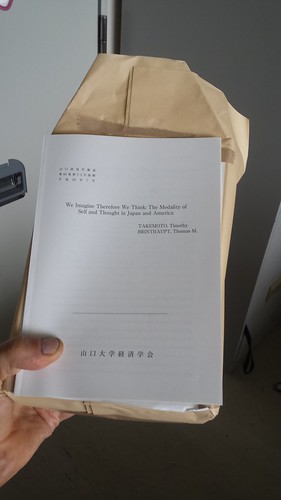
Takemoto, T. R., & Brinthaupt, T. M. (2017). We Imagine Therefore We Think: The Modality of Self and Thought in Japan and America. 山口経済学雑誌 (Yamaguchi Journal of Economics, Business Administrations & Laws), 65(7・8), 1–29. Retrieved from nihonbunka.com/docs/Takemoto_Brinthaupt.pdf
Perhaps the offprints will be valuable one day! They are free now.
Labels: japanese culture, Nacalian, nihonbunka, 日本文化
Tuesday, September 05, 2017
Japanese and Western Art
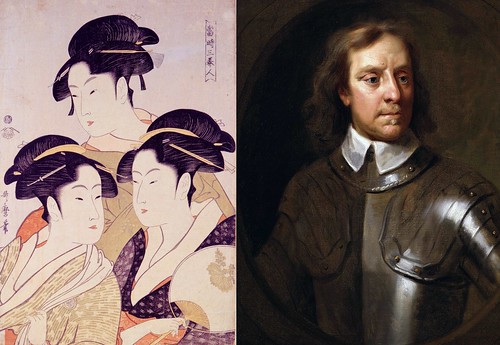
When Western pictorial art arrived in Japan in the late Edo period the Japanese were amazed at how photographic it was. One of the first famous Western-Style Japanese artists, Shiba Koukan, wrote
"What is remarkable is that it (Western Art) enables one to see clearly something that is actually not there. If a painting does not truly portray a thing it is devoid of the wonderful power of art. Fuji-san is a mountain unique in the world, and foreigners who wish to look at it can do so only in pictures. However, if one follows only the orthodox Chinese methods of painting, one’s picture will not resemble Fuji, and there will be node of the magical quality in it that painting possesses. The way to depict Fuji accurately is by means of Dutch painting." (Shiba Koukan see Keene, 1952 p.67)
The traditional Japanese painting, following its Chinese model, attempted to "delineate the spirit" (Keene, 1952, p.66) of the subject resulting in idealised or mangarized representations of "beautiful women" (bijinga) for instance. The women in Japanese biinga (above left) are as uniform as those in Anime, and the mountains in Japanese and Chinese art, sharing essence of beauty or mountain.
To Westerners however, the image is usually seen as superficial, "mere image," (Aristotle, see Brenkman, 1976) a fact which facilitates the pictorial representation of people "warts and all" such as in the famous picture of Oliver Cromwell, above right.
This is the reverse of the situation in verbal, linguistic representations of people wherein Westerners are generally very idealised (braggart) and uniform, whereas Japanese say it how it is (Heine, Lehman, Markus, & Kitayama, 1999; T. R. S. Leuers = Takemoto & Sonoda, 1999; T. Leuers = Takemoto & Sonoda, 1999; T. Takemoto & Iwaizono, 2016; T. R. Takemoto & Brinthaupt, 2017; see also Takemoto, T. 武本, Timothy, 2017).
More notes
From Jay 1993, p13
Monotheistic religions, beginning with Judaism, have been deeply wary of pagan idolatry. The fictional character of artificial images, which can only be false simulators of the "truth," has occasioned distrust among more puritanical critics of representation. St. Pauls celebrate warning against the speculum obscurum, the glass (or mirror) through which we only see but darkly, vividly express this caution about terrestrial sign. Religious distrust was also aroused by teh capacity of vision to inspire what Augustine condemned as conupiscentia ocularum, ocular desire, which diverts our minds from more spiritual concerns. These and like suspicious have at times come to dominate religious movements and dictate long-standing religious taboos. Mose's strugge with Aaron over the Golden Calk, the Islamic rejection of figural representation, the iconoclastic controversy of the ieghth-centruy Byzantine church, the Cistercian monasticism of St. Bernard, the English Lollards, and finale the Protestant Reformation all express the antiocular sub-current of [Western] religious thought. In fact this hostility remains alive today. in the worl of such theologians as Jaqcues Ellul, whos Humiliation of the Word, written in I981, reads like a summa of every imaginable religious complaint against the domination of sight.
Images
Late 17th century Left Beauties by Utamaro Kitagawa
Oilver Cromwell, "Warts and All" by Sir Peter Lely
Bibliography
Brenkman, J. (1976). Narcissus in the Text. Georgia Review, 30(2), 293–327. Retrieved from www.jstor.org/stable/41399656
Heine, S., Lehman, D., Markus, H., & Kitayama, S. (1999). Is There a Universal Need for Positive Self-Regard? Psychological Review, 106(4), 766–794. Retrieved from humancond.org/_media/papers/heine99_universal_positive_re...
Jay, M. (1993). Downcast eyes: The denigration of vision in twentieth-century French thought. Univ of California Press. dq=Downcast+Eyes:+The+Denigration+of+Vision+in+Twentieth-Century+French+Thought&ots=SFqXjWmi3P&sig=HgLHWdIcJGXKiAVAmqMCyioZJD0
Keene, D. (1952). The Japanese Discovery of Europe: Honda Toshiaki and Other Discoverers, 1720-1798. Routledge and Kegan Paul.
Leuers = Takemoto, T. R. S., & Sonoda, N. (1999). Independent self bias. Progress in Asian Social Psychology, 3, 87–104. Retrieved from www.nihonbunka.com/docs/independent_self.rtf
Leuers = Takemoto, T., & Sonoda, N. (1999). The eye of the other and the independent self of the Japanese. In Symposium presentation at the 3rd Conference of the Asian Association of Social Psychology, Taipei, Taiwan. Retrieved from nihonbunka.com/docs/aasp99.htm
Takemoto, T., & Iwaizono, M. (2016). Autoscopic Individualism: A Comparison of American and Japanese Women’s Fashion Magazines. 山口経済学雑誌= Yamaguchi Journal of Economics, Business Administrations & Laws, 65(3), 173–205. Retrieved from ci.nii.ac.jp/naid/40021076383/
Takemoto, T. R., & Brinthaupt, T. M. (2017). We Imagine Therefore We Think: The Modality of Self and Thought in Japan and America. 山口経済学雑誌 (Yamaguchi Journal of Economics, Business Administrations & Laws), 65(7・8), 1–29. Retrieved from nihonbunka.com/docs/Takemoto_Brinthaupt.pdf
Takemoto, T. 武本, Timothy. (2017). ジマンガ:日本人の心像的自尊心を測る試み(Auto-Manga as Prideful-Pictures: An Attempt to Measure Japanese Mental Image Self-Esteem). 山口経済学雑誌= Yamaguchi Journal of Economics, Business Administrations & Laws, 65(6), 107–138. Retrieved from nihonbunka.com/docs/Jimanga.pdf
Labels: japanese culture, Nacalian, nihonbunka, 日本文化
This blog represents the opinions of the author, Timothy Takemoto, and not the opinions of his employer.