
Friday, May 29, 2015
Sazae Tames the Lion

The lion, naked, prostrate and clearly lacking a womb, is scared. Sazae can tame anything and has tamed a sealion too, left. Like most Japanese women most of the time, Sazae appears to be on stage. She alone is fully aware of an audience. The lion is, like the Western wife perhaps, aware of the audience only through Sazae. The young chap with the ball, Katsuo I presume, is as yet oblivious. The audience constrains Sazae as it empowers her. In Japan phallogocentrism is replaced by wombimagocentrism*. When the audience watches, the women are in control, as they are controlled. Give up on the "different voice" (Gilligan, 1962) and get wombimagocentric now.
長谷川町子美術館の著作権です。おちりさげご希望でありましたら、下記のコメント欄かnihonbunka.comのメールリンクまでご連絡ください。
Gilligan, C. (1982). In a different voice. Harvard University Press.
Notes
* I think that this can be pronounced a bit like the Wombles, wom-bi-mago-centrism.
Addenda
What is it about logocentricism that is phallic?
Lacan mentions that mothers are often primary caregivers whereas males are fathers by virtue of their symbolic (linguistic) position in society, and often because of their work. In some societies the brothers are those which work to support sisters and their children and are treated much like fathers to those that they support.
In patriarchal societies, patriarchs may hope that their work, their significant acts, their money is rewarded on an exchange basis, with "presence" and "affection." The "philosophy of presence", where signifier are co-present with meaning in the "car-loving" mind, may be enacted in logocentric bedroom.
Logocentrists place themselves into the imagined dialogue between their parents.
"Car-loving" is one of Derrida's puns on "auto-affection", or onanism.
Labels: autoscopy, culture, feminism, japan, japanese, manga, Nacalian, occularcentrism, self, sex, specular, 日本文化


Monday, June 04, 2012
How to Make a Japanese God

A minimal interpretation of a God surely includes the requirement that God is an entity who is connected with us intra-psychically as well as, or even more so than, externally. That is to say that God is in our minds as well as in the world. God observes us, even in the privacy of our mind, and we address ourselves to him or her in that we are concerned about our behaviour from God's point of view.
Several Western theorists (Adam Smith, Bakhtin, Mead, Lacan, and Freud) argue that we have or model an objective view of ourselves intra-psychically, that is to say, inside our heads. Most Western theorists argue that this "point of view" is a point of "view" only metaphorically. The Western God is associated with language, listening, and understanding.
Adam Smith argues that we all see ourselves from a "impartial spectator." While Adam Smith redacted references to God from his work, after the death of his mother, it seems clear that his impartial spectator is related to his notion of a Christian God and that being above all "reasonable," "impartial spectator" 'spectates' in a "reasonable" (I read linguistic) rather than visual way.
Bakhtin does not explain the origin of his super addressee. He just says that we always presume the presence of another addressee of our language (in addition to the person we are speaking to or writing to). Bakhtin does not state that this super-addressee is a requirement for self, but, in a rare moment of religiosity Bakhtin associates this Super-addressee with God, and its absence with hell.
Mead presents one of the best, most sober, renditions of the need for an objective perspective upon self. Mead argues that in order to have a self we need to see ourselves from an objective point of view. In order to see oneself from an objective point of view, one needs to internalise the viewpoints of others (plural). In order to have a self, an independent self perhaps, one needs to create within oneself a "Generalised other," the perspective of oneself as it were, from nowhere. Mead's sober, Anglo Saxon explanation is almost mathematical or at least logical. The more views that one has of oneself the more one understands oneself. And by combining these views one can achieve objective self-hood, from the viewpoint of *not* one's mother, *not* ones father, but from a sort of mathematically, logically, systematically amalgamated general view point. How is this possible? Mead does not say. It sounds reasonable. But Mead's generalised other is while easy to follow as a theory, not so easy to understand phenomenologically. Where is the generalised in my mental experience? (This question may be a no-brainer for Christians.)
Lacan wavers. On the one had his "Other" seems to personified, sometimes (contra Freud) as a (m)Other, at other times the Other seems to be be language itself, a sort of neo Kantian (these days championed by Chomsky and Pinker) static, systematic, non-persona-ised version of the "generalised other". By non-persona-ized, I mean that the other from which we see the self is non personalised account; something that is not a simulated human. The Other of our self speech, is rather a system, a structure, something that is not seen as a persons. I think that his view is probably very popular among many theorists, or anyone with a scientific outlook. This generalised-other-as-system view does not require anything grotesque. If we understand ourselves from a generalised point of view then it is because we understand language. Language is our other, not a person at all. How nice, how clean and un-queasy that would be if it were the case.
Freud is surprisingly vague, almost mythic in his explanation of the origins of the Super-Ego. The "super ego" is a form of generalised other based on ones father. Freud has written a lot and I do not pretend to have read everything he has written but in one rendition of the origin of the super ego (though he does not use that phrase in the paper in question) he suggest a historical event: that an alpha-male, woman monopolising primal father was killed and eaten by brothers who internalised (not only in that they ate him, but psychologically) the father figure that they had killed, and felt so guilty about that murder that they repressed it. In this rendition there is the horror, the shame or guilt, but towards a concrete act. That slaying of the primal father seems unlikely but Freud's myth mentions *The Horror* that I suggest is essential for "making a god."
We all simulate others all the time. We imagine that we are talking to friends and understand our words from their simulated perspective. We cringe when we feel the gaze of others because we imagine what they have seen, and what we simulate they have felt about what they have seen. But these others that we simulate are others in the plural, others in the particular. How could it be that we might create a perspective, a view from nowhere?
Olaf and Metzinger (2009) propose that our ability to see ourselves from other perspectives is essential to the creation of self (which they argue to be a sort of illusion). In the paper quoted they give a typology of self views. In a "Autoscopic Hallucination" we see ourselves as another, a doppelgänger who is not ourselves and remain aware of the self from which we see the doppelgänger. In "Heautoscopy" we see a doppelgänger and our self, but we are not sure which of the two is our self. In an "Out of Body experience" (perhaps the most godly of the three) we see ourself from an external perspective but still with a "SL" (Subjective Location) floating somewhere above us near the ceiling.
It seems to me that they miss a type of self view: the view from nowhere. We see this view from nowhere represented in many Japanese works of art (Edo period pictures of the floating world, Manga, video games) in self-memories (Cohen) and Japanese behaviour in front of mirrors (Heine, et al.). How is it that the Japanese can have a view from nowhere, up from high in the sky and not feel that they are located in that elvated position?
I suggest that the ability to have a self-view from an external position and at the same time not see that position as a subjective location, nor as another particular viewpoint (of a friend, of family member) requires repression, as Freud argued.
This brings me to the horror. There is a a trope in Japanese horror where (generally female) monsters emerge from images. Traditionally they emerged from lanterns (Oiwasan) scrolls (bottom left), more recently they emerge from mirrors (Juuon, Mirrors), photo developer (Juuon), and most famously a television set (Sadako).
I suggest that perhaps the ability to see oneself from an external, non-particular, generalised perspective, relies less on our ability to generalise a perspective as to find one of them so frightening that we repress it. This explanation suggests that God is some sort of Bogeyman, but that is not my perception. Rather that the total absence of a belief in a generalised view (God), results in a situation which is, as Bakhtin says, hell: well and truly horrifying.
Bibliography to follow
Labels: autoscopy, economics, eye, horror, image, japan, japanese culture, Jaques Lacan, lacan, manga, nihobunka, nihonbunka, occularcentrism, reversal, ring, ringu, self, Shinto, specular, 日本文化
Monday, May 21, 2012
Self Esteem in the Autoscopic Land of Manga: Jimanga

Another reason why I like Kobayashi is because he presents a theory of self not unlike that found in Social psychology and Lacan: Having a self is not innate. One has a self by virtue of internalising self views of others, so self or individual is dependent upon other or "public" in his words.
It is a shame however that the takes the usual logocentrist position of the self being primarily structured by language. This enables him to take a more nationalist view of the self since he believes the self is formed in language, specifically the Japanese language, so the "public" upon which his self is dependent is the community of Japanophones, including some Taiwanese (who he admires).
I wish he would be more Naclanian and to an extent at least universalising since it seems to me he has a autoscopic, specular self: a self created in the gaze rather than the ear, or rather linguistic recognition, of the other.
Not only is he clearly an excellent manga artists with command of images, and viewpoints, and can draw himself, looking at himself in a mirror from a viewpoint behind his own head but also he shows the most give away sign of having a self-in-the-visio imaginary; he draws his own representation in a very postive way. Please compare the two images on the left. The one above in the bottom corner of the manga on the left is Kobayashi's representation of Kobayashi. As you can see the graphic representation looks rather younger, perhaps even more handsome, than the eloquent reality.
This tendency of manga artists to represent themselves in a postive way is far from unique to Kobayashi. In all the self representations or jimanga (a painful pun on "self-manga" 自漫画, and "picture of which one is pround" 自慢画) that I have seen, all appear to be positive. And there is no reason why not.
These jimanga are just one of the many ways that Japanese express that which in language is called "self-enhancement" (Heine, 1999). We westerners have a far stronger tendency to self-enhance when we talk about yourselves. Confined to linguistic self-representations, the Japanese seem to have entirely realistic self-appraisals and comparatively low self-esteem. As my research on autophotography and numerous photographs here of Japanese visual self-representations, Kobayashi as other Japnaese have healthy visual self esteem.
Let is be noted that the Japanese have an autoscopic (Metzinger, 2009) self view, they can see themselves (as Koyahashi's manga on the right shows and see Heine, Takemoto, Moskalenko, Lasaleta, & Henrich, 2008) so their postive self-representations in the visual domain are for self-consumption, as is all healthy self esteem.
Bibliography
Kobayashi, Y. 小林よしのり. (2000). 新・ゴーマニズム宣言SPECIAL 台湾論. 小学館.
Kobayashi, Y. 小林よしのり(n.d.)「愛子さまが皇太子になれるよう皇室典範改正を」 .Infoseek ニュース. Retrieved from http://news.infoseek.co.jp/article/postseven_9592 (I can't find the reference to the manga)
Heine, S., Lehman, D., Markus, H., & Kitayama, S. (1999). Is there a universal need for positive self-regard?. Psychological review.
Heine, S. J., Takemoto, T., Moskalenko, S., Lasaleta, J., & Henrich, J. (2008). Mirrors in the head: Cultural variation in objective self-awareness. Personality and Social Psychology Bulletin, 34(7), 879–887. http://www2.psych.ubc.ca/~henrich/Website/Papers/Mirrors-pspb4%5B1%5D.pdf
Metzinger, T. (2009). The Ego Tunnel: The Science of the Mind and the Myth of the Self (1st ed.). Basic Books.
Labels: autoscopy, individualism, japan, japanese culture, manga, mirror, nihobunka, nihonbunka, occularcentrism, self, specular, theory, 日本文化, 自己視
Friday, February 10, 2012
Anime Girl Face Conformity

They could almost be the same girl, with a variety of hair colours. In the Edo period too, stylised pictures of "beautiful women" looked like they could have been of the same woman but now the woman's face is very different. Images of beauty have changed.
The above is the first page of google images, searching for anime face girl.
It would be interested to ask a pool of subjects whether they think the images are of the same girl by different people, or of different girls, and to compare these results with say, googles first page of impressionist beautiful women. While I do not believe that the Japanese are generally conformist (as is generally believed) I do think that views of feminine beauty are very convergent in Japan because the Japanese idealise and enhance the image more. I have argued (Leuers and Sonoda, 1999) that since Westerners idealise and enhance character traits more, their self-professed character traits are far more convergent than those of Japanese.
It is amazing that there is a photo (or two?) in there.
Copyright their respective copyright holders. please use comments or nihonbunka.com contact link to have this image removed from the net.
Labels: fashion, female, feminism, image, japan, japanese culture, Jaques Lacan, lacan, logos, male, manga, mirror, nihobunka, nihonbunka, occularcentrism, self, sex, specular, ジェンダー, 日本文化
Thursday, February 09, 2012
Traditional Japanese Beauty

The Japanese in the Edo period had a fairly localised view of beauty, so much so that these beautiful women look very alike to the point of appearing identical. These Traditional Japanese beauties had neither large round eyes, nor double eyelids. Their eyes were slit like and their features were generally small and angular. Pointy noses where in, but not particularly large ones. This leads me to believe that the current Japanese fondness for large round eyes, especially with creased ("double") eyelids is partly the result of the influence of Western, caucasian, images of beauty upon Japan.
Labels: fashion, female, feminism, image, japan, japanese culture, Jaques Lacan, lacan, logos, male, manga, mirror, nihobunka, nihonbunka, occularcentrism, self, sex, specular, ジェンダー, 日本文化
Saturday, February 04, 2012
Martial and Manga Artists
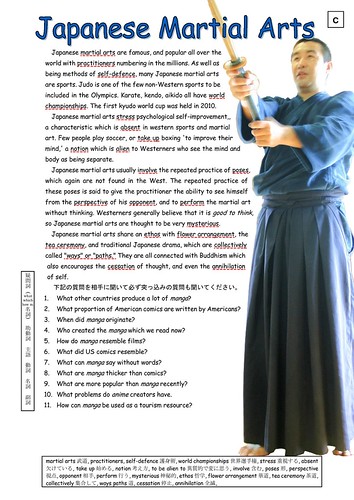
The image is the partner page to the previous Anime and Manga page, which together form an information gap activity.
They are both rather too highbrow for an English conversation class but the course is on "Tourism English" and my part of the course is on explaining Japanese culture.
The explanation is my theory of Japanese culture - that both manga artists, martial artists and all Japanese have 'mirrors in their heads,' a theory which originates in the teaching of the Kurozumi church, my analysis of Japanese mythology, and Japanese common sense. Can you see yourself? Can you draw the room in which now sit from a perspective in the top corner of the room? If you got into a fight would you be able to see yourself from the point of view of your opponent?
The text reads as follows:
Japanese martial arts are famous, and popular all over the world with practitioners numbering in the millions. As well as being methods of self-defence, many Japanese martial arts are sports. Judo is one of the few non-Western sports to be included in the Olympics. Karate, kendo, aikido all have world championships. The first kyudo world cup was held in 2010.
Japanese martial arts stress psychological self-improvement,, a characteristic which is absent in western sports and martial arts. Few people play soccer, or take up boxing to improve their mind - a notion which is alien to Westerners who see the mind and body as being separate.
Japanese martial arts usually involve the repeated practice of poses, which are also not found in the West. The repeated practice of these poses is said to give the practitioner the ability to see himself from the perspective of his opponent, and to perform the martial art without thinking. Westerners generally believe that it is good to think, so Japanese martial arts are thought to be rather mysterious.
Japanese martial arts share an ethos with flower arrangement, the tea ceremony, and traditional Japanese drama, which are collectively called "ways" or "paths." They are all connected with Buddhism which also encourages the cessation of thought, and even the annihilation of self.
Labels: japan, japanese culture, Jaques Lacan, lacan, logos, manga, martial art, occularcentrism, religion, reversal, self, specular
Tuesday, March 29, 2011
The Deaf and The Japanese

If there is any truth in the assertion that there is something visual rather than verbal, about the way that the Japanese sign, i.e. that Japanese culture leans toward the right hand side of the diagram of Dual Coding Theory, then one might expect them to share some similarities with those deaf that use visual sign systems (ASL and JSL). To investigate this hypothesis I read Oliver Sacks’ “Seeing Voices” an excellent, and even moving, introduction to the world of the deaf, and particularly their ability to communicate using sign language, from the perspective of a neurologist.
First of all, Sacks points out that deaf signers are better at interpreting Chinese characters signed in the air, and it is clear that Japanese people are far better at signing and reading characters in the air (p78) but that maybe the single case in point. Deaf people use Sign (ASL, JSL) which, though visual, has meaning. Japanese use Chinese characters which, though visual, have meaning.
Oliver Sacks points out that there are those that deny even this similarity, since there are those (including Roland Barthes) who deny that the visual can have meaning at all. But even accepting the premise of Sacks’ book, that language can be seen, perhaps the similarity between the deaf and the Japanese starts and ends with a trivial resemblance between Sign and Kanji.
Cutting to the chase, Sacks' book being a book about deaf, rather than a book about the deaf and the Japanese, does little to demonstrate similarities between deaf and Japanese culture. "Seeing Voices" does however, point to some possibilities and perhaps the most tantilising of these lies in Sacks observation that Sign language is not only a language for communicating with others, but also for thinking and for communicating with oneself. He provides clear evidence that the deaf Sign to themselves, and sign in their dreams. I have also noted that Japanese have a tendency to sign to themselves, such as Ichiro's famous baseball bat point, or more particularly the safety oriented pointing checks performed by those working on the Japanese railway system, for example. Sack's goes on assert, as a footnote (26) to page 59, given on page 161 of my version of the book, the use of sign as thought, not only to others but to and about oneself, by application of the Sapir-Whorph hyphotesis, may result in a "hypervisual cognitive style". I believe that this phrase may be appropriate to use about the Japanese as well.
Sacks claims that users of Sign, adept as they are at reading, and making (or is that speaking) visual meaning, often become “visual experts,” adept not just at “a visual language but [having] a special visual sensibility and intelligence as well.” (p84) Alas Sacks does not go into concrete cultural details of deaf visual expertise. Sacks does not mention that the deaf are good at anime, manga, computer games, architecture, manufacturing, visually stunning food preparation, becoming highly attractive idols, or many of the other things at which the Japanese may be argued to excel.
Sacks points out that deaf understanding of facial expressions may be better than that of the hearing. Alas research about Japanese interpretation of gesture is mixed. David Matsumoto points out Japanese inability to read “universal” emotions. Keiko Ishii demonstrates that Japanese can be more sensitive to the degree to which people smile (or at least when smiles disappear).
Most surprisingly, the neurological evidence that Sacks presents seems almost to directly contradict any assertion of similarities between the Japanese and the deaf. Sacks points out that deaf process Sign with their left brain, the same hemisphere that the hearing use to understand speec. He shows that deaf signers pull some seemingly non-linguistic (among hearers) processing, such as the processing of facial expressions, into their left/linguistic brain. Sacks further suggests that the left brain is well adapted to language and argues that there are deficiencies in right brain language. Research on neurological differences between Japanese and Westerners, is still fairly new or controversial, but, it is claimed that Japanese visual signs (Kanji) are processed at least in part by the right brain (E.g. Nakagawa 1993) and that Japanese pull the procession of phonic information (such as the sound of insect noises and music) into their linguistic left brain. If this is the case then, it would suggest that Kanji, processed as they are by the side of the brain not well suited to language, would have a deleterious affect upon Japanese language processing. And even that the Japanese are hyper-phonic, as oppose to hyper visual (like the deaf), since it is sounds that the Japanese process with the ‘linguistically superior,’ left hand side of the brain.
In order to achieve the sort of revolution that Sacks describes, being achieved by the deaf: that they, their visual culture, their Sign is not just a pantomime, but equally meaningful, one would have to go further even that Sacks avows. Sacks demonstrates that the visual and the deaf can be just as good as the oral/hearing, just that they do what they do in a different way. How much more difficult would it be to argue that the right brain is just as good at processing the world, but in a different way? This is not a path that Sacks, a Western neurologist, attempts to follow in this book at least (but see his "The Man who Mistook his Wife for a Hat").
Sacks’ description of the revolution underway in the world of the deaf, of how they are achieving a hard-won cultural autonomy, a reappraisal such that they are now different, rather than diseased was particularly moving. Perhaps I am romanticising Japanese culture too much, but it was in the description of the revolution, or the potential for one, that I found the greatest potential similarity between the deaf and the Japanese. It seems to me that being Japanese is not yet “depathologized” (p120), with commentators and educators in Japan still tending to present the West as being advanced, a model that Japan should still (after all these years) be aiming towards.
Sacks argues that deaf were initially non-receptive to the idea that Sign could be a language, or that it could be analysed, and were self-deprecating with regard to their visual culture (p114-115). I find that mystifying, empty-centred, self-deprecating theories of Japanese culture are still fairly mainstream, at least in academe. Will there one day be a Japanese cultural revolution, such as being experienced by the deaf or will Japan Westernise itself out of existence first? Or is this endeavour itself bogus, the product of another white male mind (my own), since the right brain, or where ever Japanese cultural excellence is situated may have no need of affirmative analysis.
Finally, Sacks makes the point that the deaf are not dumb, both in the sense that they are not stupid and in the sense that they can speak. In other words Sacks saves the deaf from perjorative appraisal, by pointing out that the deaf can in fact speak, in their own language, so they are not dumb -- in any sense but-- but rather different. Sacks writes "..for it is only through language that we enter fully into our human estate and culture, communicate freely with our fellows, aquire and share information. If we cannot do this....we may be so little able to realise our intellectual capabilities as to appear mentally defective. It was for this reason that the congenitally deaf, or "deaf and dumb" were considered "dumb" (stupid) for thousands of years...p8" This all sounds very brave and stirring, and it is, because Sacks succeeds in releasing the deaf from this derogatory appelation. But what of the "dumb"? People who can not speak, who are aphaisic, who do not have language remain in Sacks' view, unable to realise their intellectual capabilities. According to Sacks the dumb remain dumb; those without speech are intellectually impaired because speech is required for intellectual functioning.
This is a shame, and I believe unfair. in Sack's earlier book "The Man who Mistook his Wife for a Hat" in the essay "The Presidents' Speech" Sacks describes how even aphaisics, who do not have the ability to understand language, where nevertheless able to understand most of what is going on around them, even a presidential speech, perhaps even more than those that can hear and understand the words. What happened to the possibility that the ability to use language is just another one of many human abilities? Is the mastery of language essential to enter "our human estate" (whatever that may be) and culture? Is the use of a media of interpersonal communication for thought ("self-communication" as if it were not-an oxymoron) an essential prerequisite for thinking? Even assuming that that symbols are necessecessary for thought, is it a given that symbols that are good to think with, are also those that are good to communicate with. If the deaf can manage to think and communicate among themselves using sign and to communicate with the hearing using speech, then perhaps it is possible that the Japanese may be thinking in symbols that the are not using for speaking.
It seems that in the West at least, linguistic ability is considered to be a prerequisite, thinking is regarded as being self-communication using the same linguistic symbols that we use to speak to others, and thus those that can not speak are, even by Oliver Sacks, considered to be unable to think effectively. When reappraising a group that hithertoo been considered inferior, advocates posit the existance of another language (this work), a different voice (Gilligan, 1972 on women), their own words (Meltzer, 1987, on American Blacks) which, when we the outgroup understand it, will allow us to understand their excellence. But perhaps the Japanese do not have another language. Perhaps Japanese excellence is not to be found in any language. All the same the Japanese may be affirmative enough as they are. They just don't talk about it. The may not talk the talk, but they do walk the walk and always have.
The above image containts a cropped version of the cover design of Oliver Sacks' book "Seeing Voices" by Chipp Kidd
Labels: culture, japan, japanese culture, manga, nihobunka, nihonbunka, theory, westernisation, 日本文化, 欧米化
Friday, May 21, 2010
Stamp Rally and Geographical Totemism
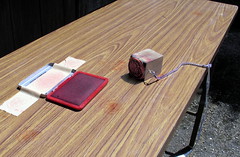
Like the aboriginies the Japanese feel themselves to have descended from a sacred land, created by the spirits in the dream time (mythic time of the Kojiki) and recieve their soul, their breath of life less from their father than from the local shrine spirit. In times past the totemic badge, or symbol which allowed Japanese to transform into living humans, whas a branch from a sacred tree, or a stone from a sacred river bed or mountain. Later, like the Churinga of the Australian aboriginal, and even far far more so, the totemic badges, or names of the Japanese evolved to encompas the use of ideographic language. The "primitive" totemists gradually moved with the times, and imported seals (such as shown in this photograph) from China. No longer did they get a sacred stone or branch from their local shrine, instead they got a piece of paper stamped with the seal of the shrine. These totemic badges live on in the form of Ihai for the dead, the tablets or fuda in household shrines, and the omamori that act as "migawari" or self-replacements, that most Japanese purchase at Shrines every new year.
But why do they need their sacred seals at all? Work in progress.
In the television series "Mirror Man," the hero goes into a mirror and comes back with an amulet. The symbols also seen in all the sumper sentai kamen rider (masked rider) and ultaraman tv programs from the land of the mirror are the meaningful images that allow japanese to identify with their mirror image. They are the images that are always the right way around. The images that have a third person perspective built into them as it were.
Transforming Symbols and Mirrors
Kamen Rider Decade's "Imagin" (Image people jin)
Kamen Rider Decade Mirror world where people are judged!
HImitsu no Akko's compact Mirror
Sailor Moon's compact mirror Chrisis Moon
Super Sentai Shinkenja-'s mirror writing
Super Sentain Shinkenja- inrou maru which shows your face until you insert the symbol, when it shows the super form.
Super Sentai Gaorenja- and the mother-like goddess like person that communicates by mobile phone while looking down through a relfecting surface of a pool of water.
Mirror Man's amulet and reflecting surface
Labels: culture, Jaques Lacan, manga, mirror, nihonbunka, occularcentrism, specular, Super-Sentai, superhero, 日本文化
Sunday, May 14, 2006
Yaoi - No Mountains, No Valleys, No Meaning, Just Gay Sex

Yaoi comics are purchased by young women who find reading books about male-male romantic/sexual relationships, to be less embarassing and more interesting than reading about relationships between men and women. Most commentators suggest that this is because women are repressed and want to identify with males who have a slightly better, freeer, more expressive position in Japanese society. I think that this interpretation only slightly misses the mark.
As I have mentioned elsewhere, it seem that in Japan, expressions of *male* sexuality are not taboo, whereas any expression of female desire has been hidden since the beginning of time. Hence, when young girls want to read about romantic love and sexuality, they find man on man love and lust, pure and innocent and unthreatening.
There is method to this madness. I call it Japan as Lacan in the mirror.
Labels: culture, japan, japanese culture, Jaques Lacan, lacan, manga, nihonbunka, sex, taboo, tabuu, theory, 日本文化
This blog represents the opinions of the author, Timothy Takemoto, and not the opinions of his employer.