
Thursday, February 09, 2012
Japanese Super Friends as pure Body

A sub-genre of superhero fiction are partnerships between super-friends, and a human (often a boy). This genre is particularly popular in Japan.
These super-friends are controlled by an otherwise ordinary mortal man or boy. Mazinger-Z was a giant robot radio controlled by a boy. Pokemon (pocket monster) Pikachu is kept in the pocket of his friend, ready to fight at his bidding. Doraemon, another robot, lives in the closet of a boy called Nobita, ready to help the latter in the many ways he can. Gundam is a robotic suit worn by a boy called Amuro Rei. Ultraman is an extraterestial giant that possesses and is possessed by a squadsman called Hayata; unlike Clark Kent and Superman, Hayata and Ultraman are not quite the same thing.
Others similar entities include Tetsujin-28, the god of death in "Death Note", the mother-possessed (!) suits in Evangelion, the giant mecha that appear in every series of Super-Sentai (Power Rangers), and duality observed in the Masked Riders such as Kamen Rider Denou.
Western superheroes are far more likely to be a unity that only appears dual due to the fact that for some of the time, the superhero poses as a normal, but "secret" "alter ego." Western superheroes are dual only epistemologically. Japanese superheroes are ontologically dual.
Japanese super friends are often but not always giants, and often but not always robots. They are also often unable to speak. Pikachu can only say its name, Ultraman can only pant. Many Japanese superheros and characters (such as hello kitty) do not have mouths at all, or have masks which cover their mouths.
Lacking in language, these super friends often carry out the will of their human partner. The super-friends are *all body* - taken to the extreme in Gundam and Evangelion - that provide the power, or technology to carry out the human will.
Western Imaginary friends on the other other hand, as I will argue in a seperate post, are often all mind and no body. They provide their human friend with information. Western super friends above all speak to their human partner. The human carries out the will of the imaginary super-being.
Images copyright Mazinger-z by joeszilvagyi, Doraemon by Wacko Photographer, Pikachu by ntang, HG 00 Gundam by Chag and ultrama photographed by me but all characters/images copyright their original creators.
取り下げご希望の場合はnihonbunka.comのメールリンクか下記のコメント欄からご連絡ください。
Labels: Bandai, Bokenger, Gao-Ranger, go-onger, henshin, nihonbunka, reversal, Super-Sentai, superhero, ultraman, スパー戦隊, 仮面ライダー, 合体, 変身, 日本文化


Friday, May 21, 2010
Transformatory sacred items accross the ages
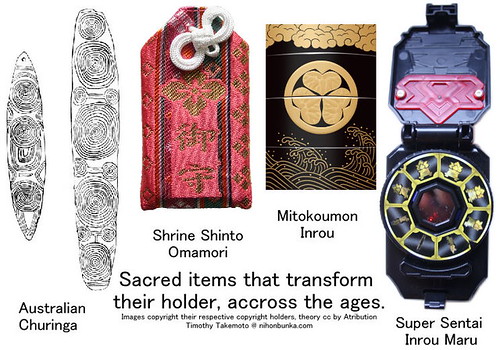
I noted in a previous post that the history of transofmatory items (変身アイテム) such as used by Ultraman (pens and glasses), Super Sentai (Power Rangers), Sailor Moon, Himitsu no Akko-chan, and Kamen Riders (Masked Riders), has a history in the transformatory symbols of Mitokoumon, Touyama no Kin and Samurai Momotarou. Japanese superheroes are always flashing a special symbol and transforming by means of its use.
The history is much older. I ague that Shinto is a geographical totemism, like that of the Arunda/Arunta/Arenda of Australia. In totemic religions the faithful recieve totemic badges which represent their owners and the ancestral spirits of their ancestors. The Arunda of the central Australia destert are one of many such groups found worldwide. Unlike most totemic religions, but in common with the Japanese, these "most primitive" (Freud, Durkheim) of totemists believed that the totem was associated with a place.
That the japanese recieve totemic badges from Shinto shrines almost goes un-noticed. More visible are the symbolic, soul containing badges that are given to the dead (mitama, Ihai). However, as Yanagita Kunio points out, once upon a time, there were "ikimitama" symbols given to the living. These were originally leaves branches of sacred trees and rocks from sacred mountains. They were believed to give their bearer life and were recieved from the time of first shrine visiting.
However in my view, and as Yanagita hints, the symbols were gradually replaced by kanji ideograms and piece of paper.
Yanagita writes, "in this reigion also the Nusa (gohei, zigzag strips of Shinto paper) were originally I think to be distributed among participants. This is similar to the leaves and branches of Japanese cedar and nagi (a evergreen tree/shrub) that were given to the faifthful from sacred trees on Mount Inari and Mount Ise" (Yanagita Kunio Collection No. 14 p 51, my translation.)
「この地方でも小さい幣を関係者に頒(わか)つのが本当の趣旨であったろうと思う。もししかりとすれば、後に言わんとする稲荷山の杉・伊豆山の梛(なぎ)のごとく、信者が神木の木の枝を追って行く風習と、著しく類似する点があるのである」柳田國夫全集14p51
These days Japanese still recieve omamori or amulets from shrines that are said to represent a stand-in or self-replacement and protect the bearer from bad luck and impurity.
And as shrines become less significant, Mitokoumon, Ultramen, Masked Riders, Super Sentai (Power rangers) brandish their sacred symbols and transforms with them.
Before we call the Japanese primitive bricoleurs, let us not forget that "in the beginning was the word," and that I have a "Christian name."Am I transformed by it?
Labels: henshin, Masked Riders, morph, nihobunka, religion, Shinto, specular, Super-Sentai, totemism, ultraman, アニミズム, スパー戦隊, トテミズム, 仮面ライダー, 変身, 宗教, 神道
Friday, January 15, 2010
Henshin Transformation Through The Ages

When Japanese superheroe transform they do not hide their true identity. They have a human identity but it is often no secret. If there is a secret, then their transformation serves to dispel secrecy, demonstrate a continuity, and reveal their true identity.
The transformation of Japanese superheroes often involves a sort of ritual. Heroes strike a specific pose, say a specific and individual trasnsformatory phrase, and or manipulate a symbol such as brandish a special card, or insert a speaking chip into a slot into their belt. Thus, Japanese superheroes transform, ontologically (please see previous post) after manipulating symbols in a codified way. Irrespective of whether or not there is an ontological change, the pose, invocation of the transformation phrase, and the manipulation of a concrete symbol, are the catalysts for the transformation.
A Typology of the mechanism of Heroic Transformation
The transformation (henshin変身) of Japanese superheroes is precipitated by the first three of the following elements or properies.
1) Transformation Pose
Japanese superheroes strike a pose to transform. Young Japanese boys often imitate these poses. Striking specific poses are popular in Japanese society. Like the "kata" of Noh performers, a "pose" often consists of a specific movement, which freezes, or almost freezes, into a specific bodily position. Japanese strike specified poses when they are having their photographs taken. Japanese baseball players strike specific poses when they come to bat (and not only Ichiro, the one legged stance of Sadaharu Oh is also immediately recognisable). Japanese comedians often have specific poses which draw laughs, such as Beat Takeshi's imitation of the attire of Nadia Comăneci , called the “Komanecchi" pose. Imagine Clark Kent, putting one fist to his chest and his other pointing up into the air.
2) Transformation Phrase
This phrase often designates the process of transformation, so the word "transform" (henshin変身) is commonly heard. Similarly, in the Tomika Rescue Fire series members all say "suits on” (chaku-sou) which is a name for the transformation itself. However, transformatory phrases are often individual and designate the being into which the hero is about to become. Thus the transformatory phrase is often sort of a self-naming. Imagine Clark Kent saying "Transform (me into) Superman."
3) Transformation Symbolic Artefact
Kamen Riders and the Tomika Rescue force used magnetic cards swiped into a reader on their belts. The Tomika Rescue fire heroes use a robot megaphone which on hearing the transformatory command (2) above. Super Sentai Go-Onger heroes insert a small electronic box that speaks certain phrases (called an "engine soul") which are also inserted into their belts. These same devices are used to transform their weapons and vehicles. Ultraman used a pen, spectacles, and even a toothbrush. These objects are signs comprising a physical signifying substrate and a significant, often linguistic, meaning. Taken together, imagine that Clark Kent must take out and present a Superman “S” sign, while performing a Superman salute, while shouting “Transform, Superman.”
4) Putting on a Super Suit
Western superheroes generally don a special costume when they transform. Batman is the "Caped Crusader." Clark Kent would be a strange sort of superhero without his Superman suit. A change in appearance is de rigueur for transformation into a Western style superhero. Japanese superheroes change their suits too but often from one super-suit, to another super equipped one. Further, this super-suiting-up, is the result of the transformation rather than its catalyst. In Japan, symbolic manipulations (posing, shouting, manipulating symbols) give rise to the change in appearance, rather than the change in appearance giving rise to the change to super-hero status.
Precidents
Japanese heroes use of symbols prior to transformation is nothing new. It is also a characteristic of the immensely popular Japanese "period dramas," viewed by adults, such as "Mitokoumon," "Touyama no Kin-san" and "MomoTaroZamurai." In all of these and more, just before the climatic fight or denouement, the heroes undergo a transformation precipitated by the manipulation and presentation of symbols.
Mitokoumon appears to be a harmless old man wandering the country with his companions. At crucial points in the narrative however, one of his companions takes out a badge and points to the seal thereupon, exclaiming “Stand down! Don't you see this seal!" ("Hikaero! konomondokoro ga me ni hairanu ka"控えろ!この紋所が目に入らぬかぁ"). The seal in question is that of the Shogun, indicating that the humble old man is in fact the Shogun's uncle. Mitokoumon and his entourage then proceed to fight, and dispatch a multitude of enemies with their swords.
Momotaro Samurai is similarly unassuming up to immediately prior to the sword-fighting scene where he strikes a pose, and announces his identity with a sort of poem about his origins. It transpires that he is in fact, like Mitokoumon, related to a feudal lord. His enemies quake at his name before Momotaro dispatches them with splendid, seemingly-bloodless, swordsmanship, and heavy handed music (itself another feature of this genre).
Touyama no Kin-san, another wandering would-be-harmless man, but this time a playboy, performs a double transition. Immediately prior to cutting up all but the most powerful of his enemies, he announces himself by showing his tattoos of a cherry blossom snowstorm. At the very end of the same episode however, when the leaders of the baddies kneel to receive judgement from the local feudal lord (?), the feudal lord bears his right shoulder exclaiming "Don't say you don't remember this cherry blossom," (この桜吹雪の刺青に見覚えがねえといわせねえぜ Kono sakura fubuki ni mioboe ga nee to iwasenee ze) at which point the baddies realise that he is none other than the "playboy" that dispatched their minions earlier with his sword, and that their fate is also sealed.
My wife used to wonder why no one attacked these heroes in that moment when they are performing their ritual. It is as if time freezes, all viewers stand agape.
These traditional period drama transformations are of the epistemological type popular in the West. The transformations are not ontological. The samurai are no better swordsmen as a result of their transformation. The transformation of Japanese period play heroes effects only what is known about them. However, in complete opposition to the cape wearing of Batman, the Caped Crusader, and the other super suits of Western superheroes, the transformation Japanese superheroes is always carried out in full view, and the symbols they use serve not to hide a secret identity but to inform enemies of their true identity, and to demonstrate its continuity.
Transformations preceded by Self-Referential Symbols in the Real Word.
Finally, in the real world, Japanese Samurai warriors were required to state their name before attacking their enemies. Before drawing their sword they said something like "I am Tanaka, a warrior retained by the enemy of your leader, Suzuki and I hereby challenge/attack you." While not preceding a transformation Japanese Yakuza were required to go and state their name, in a ritual self naming (knees bent, palm outstretch) to the heads of the Yakuza in the towns through which they pass. The self-naming of “Tora san” at the beginning of the Otoko wa tsurai yo (男はつらいよ, "It's tough being a man") is related to that tradition. While again there is no transformation, Japanese businessmen to this day get down to business after first manipulating their special symbol, their "meishi" or business card.
By Way of Conclusion
I am not at all sure what is going on, but from a structuralist perspective, the differences and similarities with Western heroes and their transformations seem to be systematic. Further in conformance with the Takemoto theory, I suggest that there is a topological shift in the visual-symbolic plane: Japanese superheroes use words and symbols to transform their appearance. Western superheroes use changes of appearance to transform their status and people’s perceptions of who there are.
I also compare the "symbolic transformation" of Japanese superheroes with the way in which Western monsters are outed by symbols, and Western love romances contain a symbolic outing, or declaration of love.
Labels: culture, henshin, japan, japanese culture, Jaques Lacan, nihonbunka, Super-Sentai, superhero, ultraman, 日本文化
Wednesday, January 13, 2010
Japanese Bug-Eyed-Superheroes Miming Speech
It has puzzled me for a long time why so many Japanese superheroes (Ultra-man, Kamen riders, Voltron or Golion, Go-Onger, Gao-ranger you name ‘em) have bug eyes, unmoving mouths, or no mouth at all and have a strong connection with mime.
I now have a theory about the connection between Japanese superheroes and mime.
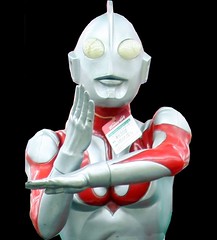
Japanese superheroes make many gestures (see image right), like mime artists. And more, in a sense they also speak. But their mouths are always immovable. Often they do not have mouths at all. And yet they do speak: They mime speech!
Typicaly, a group of young males and one female strike poses, press buttons, or contact someone in heaven on a magical mobile phone, and change ("hensin") into a team of superheroes wearing colour coded wetsuits. Why should then even need to change into a super hero suit? There is no secret made of their identity. They then do stylised battle, reminiscent of badly choreographed pro-wrestling, with one or more wetsuited monsters, often with a conspicuously mobile jaw, in a car park.
As the superheroes fight they 'speak', or shout, encouraging each other. But where does their speech come from? Their mouths can not move, nor even open. They mime speech. They take out their magic mobile phones and put them to their motionless mouths. All eyes are focused toward the miming speaker.
In the mimicry of speech they are much like masked performers in the Noh Play. The body language of the players mimes speech to perfection, but the face does not move at all.
Nowhere is the mime aspect of Japanese superheroism more apparent than in the live stage shows performed for children. Performers in coloured mouthless wetsuits come on stage. Someone somewhere presses a button on a ghetto glaster, and off they go, miming their way through an Ultraman epic, never once saying a word, but all the while making it plain who is speaking.
The Japanese boys love it. They imitate the gestures, like the ultra-man laser beam pose above.
So why is miming speech so important?
According to Lacan the human self exists by virtue of two incomplete feedback loops: those provided by voice and vision.
We can look at ourselves in the mirror, but we can never see the minds eye. We can speak ourselves, but Lacan argues, the enunciated "I am" of self speech, never quite coheres with the self that would be saying it.
However, with two ways back to the self, we play a shell game, or two card monte, always satisfied that when the word does not hit the mark, we can see ourselves in a mirror. And when the mirror seems empty, we can call ourselves by name.
The problem remains however, in convincing ourselves that our speech comes from the same place as our mouth. Ventriloquists mime speech even with their lips. The people that we watch on television appear to be speaking when we know that the sound is coming from the speakers at the side of the box.
Sound and vision never come from the same place, but we get used to thinking that they do, and the scumble that links the two together, that overcomes the contradiction of a picture that is attached to words, is paramount in the production of self.
Japanese boys watch their superheroes mime speech. They know that, on the one hand, their heroes are not speaking. All the people at the show, everyone knows that Ultraman is dumb, that the emperor has no clothes. But the little boys also know that everyone loves and admires the superheroes and that everyone assumes that the superheroes are speaking. They learn that if they take up the mime too, then no one will out them, no one will ever say "Hey, you are only miming." Superheroes and humans mime speech. It is important that they do so.
But why the bug eyes? For me the bug-eyes of Japanese superheroes are seen but unseeing eyes. Their eyes are massive. Sometimes the Japanese superhero's face is all eye. But they have no pupils, no in-eye movement to suggest that they see. Their massive eyes emphasise their visuality, but with their lack of inner eye detail, it is though they can not see at all. These eyes are, I suggest, the eyes that stare at us from out of the mirror. Our eyes as reflected mirrors fascinate us, they draw our gaze, we attempt even to look into them, but we know that they are sightless.
As I have argued elsewhere, the Japanese are permanently in "the mirror stage" in that, by virtue of their training in and ability to take multiple visual perspectives upon themselves, they continue to identify with self as reflected. Growing up in an world of uninterrupted and loving gazes, mirror identification presents little problem for the Japanese. But in order to developed a self they must also integrate the voice, attach those vocal symbols to this reflection, and hence all this heroic speech-miming.
Addendum. Something similar should be going on in the West: there should be some attempt to link phoneme and imago being made. But in the West it is the identification with speech that is less fraught. Someone admirable and heroic should be 'speaking mime' rather than miming speech. Please see this post for an example of a Western hero It has puzzled me for a long time why so many Japanese superheroes (Ultraman, Kamen Riders, Voltron or Golion, Go-Onger, Gao-ranger, you name ‘em) have bug-eyes, unmoving mouths, or no mouth at all and have a strong connection with mime.
I now have a theory about the connection between Japanese superheroes and mime.
Japanese superheroes make many gestures (see image above), like mime artists. And more, in a sense they also speak. But their mouths are always immovable. Often they do not have mouths at all. And yet they do speak: They mime speech!
Typicaly, a group of young males and one female strike poses, press buttons, or contact someone in heaven on a magical mobile phone, and change ("hensin") into a team of superheroes wearing colour coded wetsuits. Why should then even need to change into a super hero suit? There is no secret made of their identity.
They then do stylised battle, reminiscent of badly choreographed pro-wrestling, with one or more wetsuited monsters, often with a conspicuously mobile jaw, in a car park.
As the superheroes fight they 'speak', or shout, encouraging each other. But where does their speech come from? Their mouths can not move, nor even open. They mime speech. They take out their magic mobile phones and put them to their motionless mouths. All eyes are focused toward the miming speaker.
In the mimicry of speech they are much like masked performers in the Noh Play. The body language of the players mimes speech to perfection, but the face does not move at all.
Nowhere is the mime aspect of Japanese superheroism more apparent than in the shows performed for children at Japanese festivals. Performers in bug-eye, multi-coloured mouthless wetsuits come on stage. Someone presses a button on a ghetto blaster, and off they go, miming their way through an ultra-man epic, never once saying a word, but all the while making it plain who is speaking.
The Japanese boys love it. They imitate the gestures, like the Ultraman laser beam pose above.
So why is miming speech so important?
According to Lacan the human self exists by virtue of two incomplete feedback loops: those provided by voice (or phonetic language) and vision.
We can look at ourselves in the mirror, but we can never see the minds eye. We can speak ourselves, but Lacan argues, the enunciated "I am" of my self speech, never quite coheres with the self that would be saying it.
However, with two ways back, two feedback paths, to the self, we play a shell game, or two card monte, always satisfied that when the word does not hit the mark, we can see ourselves in a mirror. And when the mirror seems empty, we can call ourselves by name.
The problem remains however, in convincing ourselves that our speech comes from the same place as our mouth. But we get used to it. Get used to thinking that sound and vision come from the same place. E.g. The people that we watch on television appear to be speaking the sounds, even though we know, if we think about it, that the sound is coming from the speakers at the side of the box.
Sound and vision never come from the same place, but we get used to thinking that they do, and the scumble that links the two together, that overcomes the contradiction of a picture that is attached to words, is paramount in the production of self.
Japanese boys watch their superheroes mime speech. They know that on the one hand their heroes are not speaking. All the people at the show, everyone knows that Ultraman is dumb, that emperor has no clothes. But the little boys also know that everyone loves the superheroes and assumes that the superheroes are speaking. They learn that if they take up the mime too, then no one will 'out them', no one will ever say "Hey, you are only miming." Superheroes and humans mime speech. It is important that they do so, and get away with it.
But why the bug eyes? For me, the bug-eyes of Japanese superheroes are seen but unseeing eyes. Their eyes are massive. Sometimes the Japanese superheroes face is all eye (Kamen rider Faizu/555). But they have no pupils, no in-eye movement to suggest that they see. Their massive eyes emphasise their visuality, but with their lack of inner eye detail, it is though they can not see at all. These eyes are, I suggest, the eyes that stare at us from out of the mirror. Our eyes as reflected mirrors fascinate us, they draw our gaze, we attempt even to look into them, but we know that they are sightless.
As I have argued elsewhere, the Japanese are permanently in "the mirror stage" in that, by virtue of their training in and ability to take multiple visual perspectives upon themselves, they continue to identify with self as reflected. Growing up in an world of uninterrupted and loving gazes, mirror identification presents little problem for the Japanese. But in order to develope a self they must also integrate the voice, attach those vocal symbols to this reflection, and hence all this heroic speech-miming.
Something similar should be going on in the West: there should be some attempt to link phoneme and imago being made. But in the West it is the identification with speech that is less fraught. So someone Western, admirable, and heroic should be 'speaking mime' rather than miming speech. I guess that this has something to do with the secret identities of Western Superheros, but for the time being, I don't know what "speaking mime" is.
Addendum. please see the next photo in my photostream. I think that "speaking mime" (the Western equivalent to the mimed speech we see Japanese superheros perform) is all the thought bubbles that we are able to see in Western superhero comics, and all the "hard boiled," coming-from-no-where, narrative that accompanies Western detective movies especially. In the West, the narrative pervades, it is the centre, the truth of the secret identityspeaking his mime
I think, therefore I am Batman.
PPS: Just after writing this I saw the trailer for Avatar, where a super-hero kinda guy controls an "Avatar" by remote control and feel like I am chanelling James Cameron.
Labels: Bandai, Bokenger, bug-eye, culture, eye, Gao-Ranger, go-onger, japan, japanese culture, Jaques Lacan, mime, nihonbunka, Super-Sentai, superhero, ultraman, 日本文化
This blog represents the opinions of the author, Timothy Takemoto, and not the opinions of his employer.