
Tuesday, December 09, 2014
May’s Pink Mirror as Goshintai

Labels: blogger, Flickr, japanese culture, mirror, Nacalian, nihonbunka, Shinto, 日本文化, 神道


Tuesday, July 02, 2013
Japanese Fashion in the Mirror of the Heart
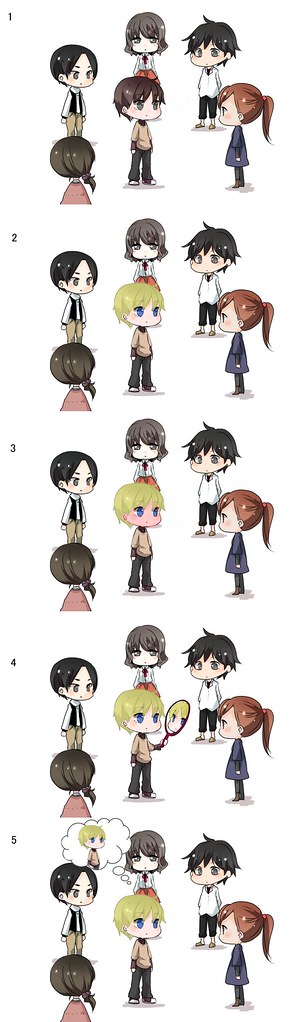
See Taro in the middle of a circle of his friends. The Japanese self is often described as being relational (Watsuji, Bendedict, Markus, Hamaguchi) which boils down to it being non-existent, or at best a nexus of self presentation concerns. The Japanese self is in the eye of the other, we are told.
If this were all there were to the Japanese self then how could the Japanese create and wear the zaniest fashion in the world? If this were the case, then if Taro dyed his hair blonde and wore blue contact lenses to college (picture 2), he would feel the harsh, judgemental gaze of his peers and become embarrassed (picture 3).
How could he avoid embarrassment? How could he remind himself of his preference for blonde hair and blue eyes? He could whip out his mirror (picture 4). As demonstrated by Carver ( 1975) and Carver & Scheier (2001) people with increased "objective self awareness" in front of mirrors, remain truer to their beliefs even in the face of social pressure. The trouble is, with all those eyes upon him, Taro would need to walk around looking in his mirror all the time.
But Taro has no need to do his, because Taro and all Japanese, especially those who have practised some kind of martial art or traditional path, has a mirror in his head (Heine, Takemoto, Moskalenko, Lasaleta, & Henrich, 2008). Taro can see himself without the aid of a mirror, avow his preference for blonde hair and blue eyes, and be done with the eyes of the world (picture 5).
It is because they have a mirror in their heart - originally a present from the Sun Goddess we are told - that the Japanese make the zaniest fashion in the world.
All five images based on an original by Miho Fujimura.
Carver, C. S. (1975). Physical aggression as a function of objective self-awareness and attitudes toward punishment. Journal of Experimental Social Psychology, 11(6), 510–519. Retrieved from www.sciencedirect.com/science/article/pii/0022103175900025
Carver, Charles S., & Scheier, M. F. (2001). On the Self-Regulation of Behavior. Cambridge University Press.
Heine, S. J., Takemoto, T., Moskalenko, S., Lasaleta, J., & Henrich, J. (2008). Mirrors in the head: Cultural variation in objective self-awareness. Personality and Social Psychology Bulletin, 34(7), 879–887. Retrieved from www2.psych.ubc.ca/~heine/docs/2008Mirrors.pdf
Labels: collectivism, individualism, japan, japanese culture, mirror, nihonbunka, occularcentrism, religion, specular, 個人主義, 宗教, 日本文化, 武道, 神道, 集団主義
Sunday, May 05, 2013
Loud Wordless Baseball: Heejun Kim meets the Japanese Little League
When Japanese play sports they make meaningless noises, most famously the kiai shout of karate. Various meaningless shouts and calls are used by Japanese sports persons of all types, from tennis to (in this video) little league baseball. Sports persons are taught to throw out their voice (koe wo dasu) in order that they concentrate. Why?
Heejun Kim (2005) has demonstrated that while Westerners perform marginally better at task when they are required to vocalise their thoughts, when East Asians are required to "vocalise their thoughts" they perform significantly worse because Japanese thoughts are not in language. Conversely, when Westerners are required to make meaningless vocalisations they become significantly worse at a task since it prevents their thoughts, whereas it negatively impacts upon East Asians very little.
It seems clear that making meaningless vocalisations can in fact improve performance among Japanese, such as those playing baseball in this video, since (I argue) these meaningless vocalisations clear the mind of linguistic thought and allows the players to concentrate upon their Japanese-style-thoughts, which I argue are visual.
The throwing out of the voice or destruction of the logos is a common theme in Japanese culture especially Buddhism where people chant the name of the Buddha, count breathes, or simply and directly attempt to silence the mind. I argue that the central ritual act performed at Japanese Shinto Shrines, that of "harai" literally sweeping away, or purification by waving zigzag strips of pure white paper overy people's heads, is also intended to exorcise the mind of the dreaded logos.
Bibliography
Kim, H. S. (2005). We talk, therefore we think? A cultural analysis of the effect of talking on thinking. Social Cognition: Key Readings, 63.http://www.psych.ucsb.edu/labs/kim/kim_2002.pdf
Labels: buddhism, culture, japan, japanese culture, logos, Nacalian, nihonbunka, Shinto, 日本文化, 神道, 自己視
Wednesday, December 19, 2012
The Chinese are Japanese Too

Subjects, looking at the front (left) of the shelves is faced with a choice (A) of moving the block on the left up, or (B) the block on the right up. But if they think about it, they should be aware that the "instructor" can not see the darker block on their right, and must therefore mean the block on the left. American (and no doubt British) subjects are often too dumb to work this out!
Chinese are not so dumb. They almost never move the wrong block because they look at the shelves from the point of view of the "instructor." In other words, the researcher point out, the Chinese are good at "perspective taking". They are able to see things from an auto-focused or autoscopic perspective. The Chinese, like Kyari Pamyu Pamyu and Japanese martial artists, can look at themselves from the position of the world, as if they have extra eyes pointed inwards towards themselves.
Scholars such as Iacoboni (2009) and Metzinger (2009) show us that all humans can see themselves, take out of body perspectives (Blanke & Metzinger, 2009) but from the above research it is clear some cultures can see themselves more clearly.
This ability to see from autoscopic perspectives pointed towards oneself, as if equipped with a freely positionable mental mirror (Heine, Takemoto, Moskalenko, Lasaleta, & Henrich, 2008) is the defining characteristic of Japanese culture. It represents a different type of "perspective taking" to that refereed to by Mead (1967) since it is not carried out in language. It does, like Meadian linguistic perspective taking result in a sense of self and it may be encouraged by choreographed, repetitive (see Butler, 1993), set-behaviours (kata and dance routines) that through their performance turn the body into a sign and encourages the performer to see these signs from the point of view of the other, and to establish an auto-focused gaze.
This culture of the eye of the other, is due in part to the influence of the Shinto religion, the primary deity of which sees herself as, refers to herself as, and is represented as, a mirror. This mirror is said, by at least one Japanese religious leader (Kurozumi, 2000), to be in the heart of the Japanese.
The experimental evidence points to it being found in the hearts of Chinese too. The first mirrors that were treated with reverence in Japan were imported from China so it is probably fair to say that this ability, to take external auto-focused perspectives, is as Chinese as it is Japanese. I have no doubt that it is engendered as much by Taichi (太極拳) as it is by Karate, or Kyari's dancing. The Chinese and Japanese need to realise their similarities and learn to be friends.
Lower image copyright Kyari Pamyu Pamyu (きゃりーぱみゅぱみゅ) the director Jun Tajima, and Warner Music Japan.
Blanke, O., & Metzinger, T. (2009). Full-body illusions and minimal phenomenal selfhood. Trends in Cognitive Sciences, 13(1), 7–13. doi:10.1016/j.tics.2008.10.003
Butler, J. (1993). Bodies That Matter: On the Discursive Limits of "Sex. Routledge.
Heine, S. J., Takemoto, T., Moskalenko, S., Lasaleta, J., & Henrich, J. (2008). Mirrors in the head: Cultural variation in objective self-awareness. Personality and Social Psychology Bulletin, 34(7), 879–887. Retrieved from www2.psych.ubc.ca/~heine/docs/2008Mirrors.pdf
Iacoboni, M. (2009). Imitation, Empathy, and Mirror Neurons. Annual Review of Psychology, 60(1), 653–670. doi:10.1146/annurev.psych.60.110707.163604
Kurozumi, M. (2000). The Living Way: Stories of Kurozumi Munetada, a Shinto Founder. (W. Stoesz & S. Kamiya, Trans.). Altamira Pr.
Mead, G. H. (1967). Mind, self, and society: From the standpoint of a social behaviorist (Vol. 1). The University of Chicago Press.
Metzinger, T. (2009). The Ego Tunnel: The Science of the Mind and the Myth of the Self (1st ed.). Basic Books.
Wu, S., & Keysar, B. (2007). The effect of culture on perspective taking. Psychological science, 18(7), 600–606. Retrieved from pss.sagepub.com/content/18/7/600.short
Labels: autoscopy, eye, image, individualism, japan, japanese culture, mirror, Nacalian, nihonbunka, occularcentrism, Shinto, specular, 日本文化, 神道, 自己視
Monday, October 29, 2012
The Mirror of the Japanese is not the Gaze of others
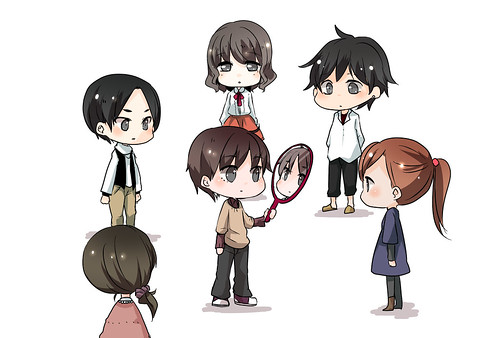
Indeed some research shows that looking at oneself in a mirror produces exactly the opposite effect as being looked at by others. Being looked at by others encourages people to conform to other's expectations. Looking at a mirror generally encourages people to conform to their own internal standards.
There is some research however, that has shown mirrors to increase private self awareness, and at least one paper that has argued that mirrors increase conformance.
So bearing in mind that Japanese are largely unaffected by mirrors (Heine et al, 2008), what does this suggest?
1) That as in the minority of experiments that show mirror's increase public self awareness, and increasing conformance (Diener & Srull, 1979; Govern & Marsch, 1997; Plant & Ryan, 2006; Wheeler, Morrison, DeMarree, & Petty, 2008; Wiekens & Stapel, 2008; Zanna, 1990) the mirror that they are mentally simulating is "the eyes of the world" (seken no me 世間の目). This is quite likely, and I predict in part true. Mirrors are found to increase both public AND private self awareness, so it seems likely that the mental mirror of the Japanese has both of these effects. The "Interdependent self" (Markus and Kitayama, 1991) of the Japanese is not an absense of self but a self that is both aware of itself, and aware of the impact of others upon itself. The dual influence of the Japanese mental mirror would explain the two aspects of the Japanese self.
2) Even if it were the case that the mental mirror of the Japanese is increase private self awareness there is research to suggest that Private self awareness is not a unitary phenomenon (Grant, Franklin, & Langford, 2002; Mittal & Balasubramanian, 1987; Trapnell & Campbell, 1999) but instead
2.1) motivated in different ways by curiosity (leading to self reflection) and a automatic, morbid desire to see the self (rumination)(Trapnell & Campbell, 1999).
2.2) It is also argued that Private self awareness has a motivational and cognitive aspect: on the one hand is an awareness of internal self states and attitudes, and on the other it is the desire to reflect upon the self(Grant, Franklin, & Langford, 2002).
It may be that the Japanese are high in the second ruminatory, motivational element of private self-awareness which is not coupled by an increase in self-cognition, as Ma-Kellams recent research tends to suggest.
3) The Japanese have a different type of independent self, that sees itself from the positition of a super-addressee, Other or God (known in Japan as Amaterasu the sungoddess) visually, with an aesthetic rather than logical impartiality ([Adam]Smith).
Whatever way you cut it however, seeing oneself in a mirror is different from being seen by an audience. In order to unpack this distinction, I claim it will be necessary to reject the argument that the Japanese are "collectivists" in the sense of being socially dependent, since the mirror that the Japanese carry with them also provides a impartial, objective, viewpoint because it is a "riken no ken," a view of self not from that of others, but from a self away from self.
The excellent, for my purposes, image is original artwork by Ms. Miho Fujimura.
Bibliography
Aaker, J. L. (2000). Accessibility Or Diagnosticity? Disentangling the Influence of Culture on Persuasion Processes and Attitudes. Journal of Consumer Research, 26(4), 340–357. doi:10.1086/209567
Brockner, J., Hjelle, L., & Plant, R. W. (1985). Self-focused attention, self-esteem, and the experience of state depression. Journal of personality, 53(3), 425–434.
Carver, C. S. (1975). Physical aggression as a function of objective self-awareness and attitudes toward punishment. Journal of Experimental Social Psychology, 11(6), 510–519. Retrieved from www.sciencedirect.com/science/article/pii/0022103175900025
Carver, Charles S. (1977). Self-awareness, perception of threat, and the expression of reactance through attitude change. Journal of Personality, 45(4), 501–512. doi:10.1111/j.1467-6494.1977.tb00167.x
Carver, Charles S., & Scheier, M. F. (1981). Self-Consciousness and Reactance. Journal of Research in Personality, 15(1), 16–29. Retrieved from www.eric.ed.gov/ERICWebPortal/detail?accno=EJ248215
Carver, Charles S., & Scheier, M. F. (2001). On the Self-Regulation of Behavior. Cambridge University Press.
Davies, M. F. (1982). Self-focused attention and belief perseverance. Journal of Experimental Social Psychology, 18(6), 595–605. doi:10.1016/0022-1031(82)90075-0
Diener, E., & Srull, T. K. (1979). Self-awareness, psychological perspective, and self-reinforcement in relation to personal and social standards. Journal of Personality and Social Psychology, 37(3), 413–423. doi:10.1037/0022-3514.37.3.413
Dijksterhuis, A., & Bargh, J. A. (2001). The perception-behavior expressway: Automatic effects of social perception on social behavior. Advances in experimental social psychology, 33, 1–40. Retrieved from www.sciencedirect.com/science/article/pii/S0065260101800034
Dijksterhuis, A. P., & Knippenberg, A. V. (2000). Behavioral indecision: Effects of self-focus on automatic behavoir. Social Cognition, 18(1), 55–74. Retrieved from search.proquest.com/docview/229595405/abstract/139CDA6646...
Fejfar, M. C., & Hoyle, R. H. (2000). Effect of Private Self-Awareness on Negative Affect and Self-Referent Attribution: A Quantitative Review. Personality and Social Psychology Review, 4(2), 132–142. doi:10.1207/S15327957PSPR0402_02
Froming, W. J., Walker, G. R., & Lopyan, K. J. (1982). Public and private self-awareness: When personal attitudes conflict with societal expectations. Journal of Experimental Social Psychology, 18(5), 476–487. Retrieved from www.sciencedirect.com/science/article/pii/0022103182900671
Froming, William J., & Carver, C. S. (1981). Divergent Influences of Private and Public Self-Consciousness in a Compliance Paradigm. Journal of Research in Personality, 15(2), 159–71. Retrieved from webcache.googleusercontent.com/search?q=cache:PueNQmlstsI...
Gibbons, F. X. (1978). Sexual standards and reactions to pornography: Enhancing behavioral consistency through self-focused attention. Journal of Personality and Social Psychology, 36(9), 976. Retrieved from psycnet.apa.org/journals/psp/36/9/976/
Gibbons, Frederick X., Carver, C. S., Scheier, M. F., & Hormuth, S. E. (1979). Self-focused attention and the placebo effect: Fooling some of the people some of the time. Journal of Experimental Social Psychology, 15(3), 263–274. doi:10.1016/0022-1031(79)90037-4
Gibbons, Frederick X., & Gaeddert, W. P. (1984). Focus of attention and placebo utility. Journal of Experimental Social Psychology, 20(2), 159–176. doi:10.1016/0022-1031(84)90018-0
Goukens, C., Dewitte, S., & Warlop, L. (2007). Me, myself, and my choices: The influence of private self-awareness on preference-behavior consistency. Available at SSRN 1094748. Retrieved from papers.ssrn.com/sol3/papers.cfm?abstract_id=1094748
Govern, J. M., & Marsch, L. A. (1997). Inducing Positive Mood Without Demand Characteristics. Psychological Reports, 81(3), 1027–1034. doi:10.2466/pr0.1997.81.3.1027
Heine, S. J., Takemoto, T., Moskalenko, S., Lasaleta, J., & Henrich, J. (2008). Mirrors in the head: Cultural variation in objective self-awareness. Personality and Social Psychology Bulletin, 34(7), 879–887. Retrieved from www2.psych.ubc.ca/~henrich/Website/Papers/Mirrors-pspb4%5...
Hormuth, S. E. (1982). Self-awareness and drive theory: Comparing internal standards and dominant responses. European Journal of Social Psychology, 12(1), 31–45. doi:10.1002/ejsp.2420120103
Hormuth, S. E. (1991). The Ecology of the Self: Relocation and Self-Concept Change. Cambridge University Press.
Macrae, C. N., Bodenhausen, G. V., & Milne, A. B. (1998). Saying no to unwanted thoughts: self-focus and the regulation of mental life. Journal of personality and social psychology, 74(3), 578–589.
Plant, R. W., & Ryan, R. M. (2006). Intrinsic motivation and the effects of self-consciousness, self-awareness, and ego-involvement: An investigation of internally controlling styles. Journal of Personality, 53(3), 435–449. Retrieved from onlinelibrary.wiley.com/doi/10.1111/j.1467-6494.1985.tb00...
Porterfield, A. L., Mayer, F. S., Dougherty, K. G., Kredich, K. E., Kronberg, M. M., Marsee, K. M., & Okazaki, Y. (1988). Private self-consciousness, canned laughter, and responses to humorous stimuli. Journal of Research in Personality, 22(4), 409–423. doi:10.1016/0092-6566(88)90001-3
Scheier, M. F., & Carver, C. S. (1980). Private and public self-attention, resistance to change, and dissonance reduction. Journal of Personality and Social Psychology, 39(3), 390. Retrieved from psycnet.apa.org/journals/psp/39/3/390/
Scheier, M. F., Carver, C. S., & Gibbons, F. X. (1979). Self-directed attention, awareness of bodily states, and suggestibility. Journal of Personality and Social Psychology, 37(9), 1576. Retrieved from psycnet.apa.org/psycinfo/1981-01346-001
Scheier, Michael F. (1976). Self-awareness, self-consciousness, and angry aggression. Journal of Personality, 44(4), 627–644. doi:10.1111/j.1467-6494.1976.tb00142.x
Scheier, Michael F., Carver, C. S., & Gibbons, F. X. (1981). Self-focused attention and reactions to fear. Journal of Research in Personality, 15(1), 1–15. doi:10.1016/0092-6566(81)90002-7
Sedikides, C. (1992). Attentional effects on mood are moderated by chronic self-conception valence. Personality and Social Psychology Bulletin, 18(5), 580–584. Retrieved from psp.sagepub.com/content/18/5/580.short
Spengler, S., Brass, M., Kühn, S., & Schutz-Bosbach, S. (2010). Minimizing motor mimicry by myself: self-focus enhances online action-control mechanisms during motor contagion. Consciousness and cognition, 19(1), 98–106. Retrieved from biblio.ugent.be/publication/1030838/file/1090307.pdf
Turco, R. M. (1996). Self-referencing, quality of argument, and persuasion. Current Psychology, 15(3), 258–276. Retrieved from www.springerlink.com/index/G43442LN62813201.pdf
Unconscious Facial Reactions to Emotional Facial Expressions. (n.d.). Retrieved October 16, 2012, from pss.sagepub.com/content/11/1/86.full.pdf+html
Wheeler, S. C., Morrison, K. R., DeMarree, K. G., & Petty, R. E. (2008). Does self-consciousness increase or decrease priming effects? It depends. Journal of Experimental Social Psychology, 44(3), 882–889. doi:10.1016/j.jesp.2007.09.002
Wiekens, C. J., & Stapel, D. A. (2008). The Mirror and I: When private opinions are in conflict with public norms. Journal of Experimental Social Psychology, 44(4), 1160–1166. doi:10.1016/j.jesp.2008.02.005
Zanna, M. P. (1990). Advances in Experimental Social Psychology. Academic Press.
Grant, A. M., Franklin, J., & Langford, P. (2002). The self-reflection and insight scale: A new measure of private self-consciousness. Social Behavior and Personality: an international journal, 30(8), 821–835. Retrieved from www.ingentaconnect.com/content/sbp/sbp/2002/00000030/0000...
Mittal, B., & Balasubramanian, S. K. (1987). Testing the dimensionality of the self-consciousness scales. Journal of Personality Assessment, 51(1), 53–68. Retrieved from www.tandfonline.com/doi/abs/10.1207/s15327752jpa5101_5
Trapnell, P. D., & Campbell, J. D. (1999). Private self-consciousness and the five-factor model of personality: distinguishing rumination from reflection. Journal of personality and social psychology, 76(2), 284. Retrieved from psycnet.apa.org/journals/psp/76/2/284/
Labels: eye, japan, japanese culture, mirror, Nacalian, nihonbunka, occularcentrism, reversal, 個人主義, 日本文化, 神道
Tuesday, June 19, 2012
The Dark Side of Japanese Recycling: The Lack of Reuse
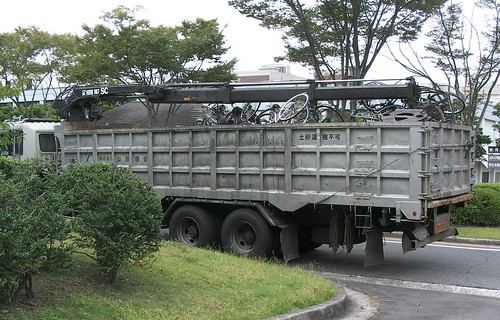
Japanese recycling is thorough. We have to separate our garbage into several types: cans, bottles, plastic, paper, burnable, poisonous, large etc.
But when someone throws away a bicycle, it is against the law to take that bicycle from the garbage dump and ride it away and keep it. The bicycles are not reused, but recycled into steel.
The Japanese are avid recyclers. Reuse is very much more environmentally friendly than recycling the raw materials but the Japanese are not nearly so keen on reuse. I can think of two reasons for this.
Japanese people have a bit of a phobia about second-hand. Things are seen as becoming imbued with some psychological or spiritual aspect of their own, and of their owner. This Shinto related, animistic phobia is dwindling and the use of second hand things is becoming more popular.
Secondly the Japanese have a tendency to see the world as being made up of material rather than items. When Japanese look at things, from bicycles to pieces of plumbing (which of these are identical to you?), they see the material rather than the item itself. They are influenced in part by the Japanese language (M. Imai & Masuda, in press; M. Imai & Mazuka, 2007; Mutsumi Imai & Gentner, 1997; Mutsumi Imai, Gentner, & Uchida, 1994) in which nouns are almost all akin to English uncountable nouns, like "sugar," "flour," and "water," that is to say designating materials.
But still the powers that be in my university consider it expedient to recycle rather than reuse not only bicycles but vast quantities of reusable rubbish
Bibliography
Imai, M., & Masuda, T. in press). The Role of Language and Culture in Universality and Diversity of Human Concepts. Retrieved from www.ualberta.ca/~tmasuda/ImaMasudaAdvancesCulturePsycholo...
Imai, M., & Mazuka, R. (2007). Language-Relative Construal of Individuation Constrained by Universal Ontology: Revisiting Language Universals and Linguistic Relativity. Cognitive science, 31(3), 385–413.
Imai, Mutsumi, & Gentner, D. (1997). A cross-linguistic study of early word meaning: universal ontology and linguistic influence. Cognition, 62(2), 169–200. doi:10.1016/S0010-0277(96)00784-6
Imai, Mutsumi, Gentner, D., & Uchida, N. (1994). Children’s theories of word meaning: The role of shape similarity in early acquisition. Cognitive Development, 9(1), 45–75. doi:10.1016/0885-2014(94)90019-1
Labels: nihobunka, nihonbunka, occularcentrism, Shinto, 日本文化, 神道
Japanese Tea Flavoured Ice Cream
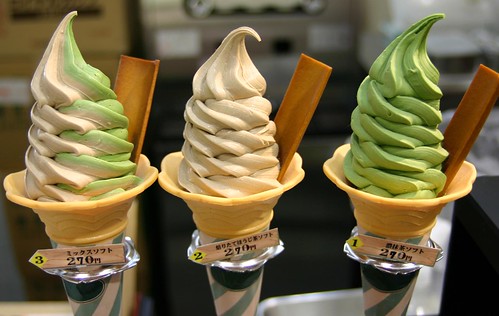
A set of model plastic Japanese ice cream in buckwheat (soba) and green tea (maccha) flavours. Japanese like to see the food their are ordering before ordering it. The brown things stuck into the ice cream are not chocolate flake but traditional Japanese biscuits.
That the Japanese eat buckwheat and green tea flavoured ice-cream is less surprising than the fact that they are so good at copying things. I take the liberty of writing about Japanese "authenticopies" again since the above is my most popular photograph.
The culture of copying things in Japan is sufficiently widespread and revered as to have received academic attention (Cox, 2007). The Japanese copy everything from mirrors, horses, and cars, to foreign villages and especially food. While no one will attempt to eat these plastic ice cream cornets, they are seen as being delicious: sufficiently identical to the real thing as to arouse desire. Copies of things are given as offerings to Japanese deities at shrines where they are seen as sufficiently identical to sate desire.
I think that the practice can be understood by reference to the way in which Westerners believe in the copying power of the sign (Derrida, 2011). Words are thought to create a copy in the mind of their recipients of the meaning of the their sender. I have an idea and translate it into the "signified" the word "sender" for instance, and you read it and recreate an identical copy of the idea that I had in my mind. If I did not believe in this identical copies - these words that arise in my mind and yours - then I would be faced with an identity crisis since one of the ideas, the one corresponding to the phoneme "I" spoken to myself, is myself (Benveniste, 1971).
But how is it that you, dear reader, can understand my words in the same way as I do? The ability for humans to believe in the transference of meaning in this way, for meanings to be objective is due to their belief in God, or a simulation of the same. Gods too can be simulated (Baudrillard, 1995). Words "exist in", or are pegged to their understanding - a sort of gold standard - in the mind of an intra-psychic third party: someone that is always listening. As we speak to real others, we believe that we also speak to an impartial spectator (Adam Smith, 1812), a generalised other (Mead, 1967), an Other (Lacan, 2007), superego (Freud, 1913) or superaddressee (Bakhtin, 1986): all these are either words for a sort of imaginary friend or a deity (see Marková, 2006, for a downloadable review). By this device, since words are always public, as well as being in our heads we believe in their identical copy-ability.
In Japan the gods look rather than listen. The visual world is always shared. The visual world in Japan, which relegated to the nether land, a "mere image" or "veil" in the West, has the same properties as the Western sign: it is both in the world and in the head. The world and mind meet at the plane of the mirror that is seen with Japanese deities, especially the sun-goddess, who is that mirror itself.
We think nothing of copying signs. The Japanese think nothing of copying food.
Bibliography
Baudrillard, J. (1995). Simulcra and Simulation. (S. F. Glaser, Trans.). Univ of Michigan Pr.
Benveniste, E. (1971). Problems in General Linguistics. (M. E. Meek, Trans.) (Vol. 3). University of Miami Press Coral Gables, FL.
Cox, R. (2007). The Culture of Copying in Japan: Critical and Historical Perspectives. Routledge.
Bakhtin, M. M. (1986). Speech Genres and Other Late Essays. (V. W. McGee, Trans.) (Second Printing.). University of Texas Press.
Freud, S. (1913). Totem and taboo. (A. A. Brill, Trans.). New York: Moffat, Yard and Company. Retrieved from en.wikisource.org/wiki/Totem_and_Taboo
Lacan, J. (2007). Ecrits: The First Complete Edition in English. (B. Fink, Trans.) (1st ed.). W W Norton & Co Inc.
Marková, I. (2006). On the inner alter in dialogue. International Journal for Dialogical Science, 1(1), 125–147.
Mead, G. H. (1967). Mind, self, and society: From the standpoint of a social behaviorist (Vol. 1). The University of Chicago Press.
Derrida, J. (2011). Voice and Phenomenon: Introduction to the Problem of the Sign in Husserl’s Phenomenology. Northwestern Univ Pr.
Labels: autoscopy, culture, eye, japan, japanese culture, mirror, nihobunka, nihonbunka, occularcentrism, self, Shinto, specular, 日本文化, 神道
Talisman/Omamori/Good Luck Charm
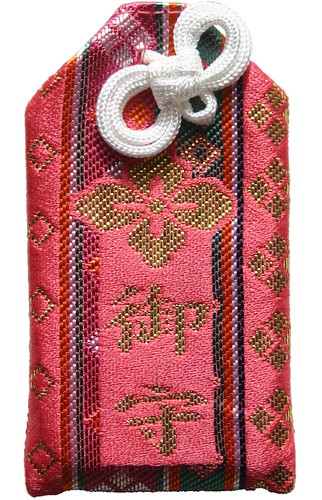
The following is my explanation of the philosophy behind the good luck charms, or "Omamori" received from shrines and temples in Japan.
In Japan the lucky charms called "Omamori," (literally "venerated protectors") are said to work by being a decoy-self ("migawari) that attracts bad luck.
Hence any "impurity" or bad luck is collected in the charm instead of in the person. The charm is thrown away once a year, together with the bad luck.
There is quite a lot of theory behind this.
Omamori are basically very similar to the larger tablets bearing the name of the deity "ofuda" that one receives from a Shinto shrine. Both are termed "Shinpu" or deity tablets. These larger tablets are enshrined within the home on the Spirit Shelf (Kamidana). Omamori are also basically pieces of paper stamped with the name of the god.
Why should a piece of paper stamped with the name of the god be a decoy-self?
The easiest way to answer this question is by referring to Japanese "Buddhism". Japanese Buddhism concentrates on rituals for the dead. The dead are enshrined in the household inside a "Buddhist" altar or "butsudan" or (literally Buddha cupboard). Inside the Buddha cupboard there is an effigy of the Buddha, but perhaps more importantly there are a lot of little tablets (called ihai) which represent dead relatives. People open the butsudan and say "hello grandpa, hello grandma" to their grandfather, and grandmother (if deceased) in the form of their little tablets.
According to the Japanese ethnologist Yanagita Kunio, the Budda cupboard (Butsudan) and the Spirit Shelf (Kamidana) originate in the same practice. The spirit shelf was for the living and the "Bhuddist altar" was for the dead but basically in both there was a deity (Shinto Kami or spirit, or Buddhist Buddha) and in both there was representations of members of the household, living or dead. Before the introduction of Buddhism, people would receive spirit containing tags or earlier still branches and stones from their shrine. These would be periodically renewed, and eventually returned to the shrine after the death of its holder. With the separation of Shinto and Buddhism this cycle of spirit has been obscured.
Today in Japan there are few personal tablets for the living (other than omamori) but there are traditions of sticking the names of the living onto the shrine shelf in some parts of Japan. In the past, people received a part of the spirit of their local shrine and this in a sense gave them life. In other words a ticket or tag from the shrine represented a person, it was or is, another me.
This is why perhaps a "omamori" is a bit like a spare ID card. If you have some bad luck, like being caught doing a minor misdemeanour's then you charge it, or put it down to the spare ID, which you throw away at the end of the year.
The new year is said to be a rebirth, everyone gets a new identity. Everyone starts afresh with a clean slate.
Labels: japan, japanese culture, nihobunka, nihonbunka, Shinto, 日本文化, 神道
Monday, May 28, 2012
Robo Cat: Cute, Uncanny or Horrible
This robo-cat moves, it makes noises when you stroke it, but does it have feelings? The Japanese do not seem to care so much(J. Robertson, 2001; Jennifer Robertson, 2007; Schodt, 1988).
This cat looks to me that it is right bang in the middle of the "Uncanny Valley" (Mori, 1970) but the Japanese store goers seemed to like it and think it "cute". Strange, amusing, uncanny, yes, but "cute" was one thing it was not from my viewpoint. But then I grew up in a culture where people tend to think that they are not their body but their mind. I argue that The Japanese do not believe that they are their bodies, the Japanese also firmly believe in the heart, but heart (kokoro) is also at least in part visual, a space of imagination.
The absense of heart (kokoro) absence from the body, as it is often in sleep, makes less of a difference.
And as mentioned in recent blog posts, generally speaking, in the realms of shrines, rebuilt shrines, miniature shrines, horses sculpted and pictorial, copied pilgrimages, and foreign villages, sports stadia, and perhaps even cats, if it looks the same then it is the same: an authenticopy, a subcategory of simulacra (Baudrilliard, 1995) in the the presumed mirror mind of Japanese gods.
To have a "mirror" mind, both god and human, to see the mind and world meet at a "tain-less mirror" I think that all you need is to have a presumed co-gaze (kyoushi) (Kitayama, 2005). Internalising a gaze is no weirder than presuming that an intra-psychic other is listening to and understand our self-speech, which is what we, Westerners, are argued to be doing (Bakhtin, 1986; Hermans, 2001; Hermans & Kempen, 1993; Mead, 1967).
The ability to imbed someone else's perspective inside oneself is not difficult. We are always wondering 'how this would sound to', 'how this would look to' various otehrs others. But the ability to create another persons perspective inside oneseld and then forget it is that of *an other* but believe instead that it is the perspect of the Other, a generalised other, a super addressee, a super ego, depends, as Freud points out, on taboo (Freud, 1913): on the horror and guilt associated with the deed. I do not see Freud's explanation, that we feel guilt towards a historical act of killing the primal father, as being anything other than alegorical. The explanation that the internalisation of another may be associated with guilt and horror is, however, a valid explanation as to how one might wish to forget that internalisation: thus generating a general internalised view, a view as it were from nowhere.
The robo cat is cute, but he makes me feel a horror, which will be the subject of a subsequent post.
Bibliography
Bakhtin, M. M. (1986). Speech Genres and Other Late Essays. (V. W. McGee, Trans.) (Second Printing.). University of Texas Press.
Baudrillard, J. (1995). Simulcra and Simulation. (S. F. Glaser, Trans.). Univ of Michigan Pr. Freud, S. (1913). Totem and taboo. (A. A. Brill, Trans.). New York: Moffat, Yard and Company. Retrieved from http://en.wikisource.org/wiki/Totem_and_Taboo
Hermans, H. J. M. (2001). The Dialogical Self: Toward a Theory of Personal and Cultural Positioning. Culture & Psychology, 7(3), 243–281. doi:10.1177/1354067X0173001
Hermans, H. J. M., & Kempen, H. J. G. (1993). The Dialogical Self: Meaning as Movement. Academic Press.
Kitayama, 北山修. (2005). 共視論 (Co-Gaze Theory, my trans). 講談社.
Mead, G. H. (1967). Mind, self, and society: From the standpoint of a social behaviorist (Vol. 1). The University of Chicago Press.
Mori, M. (1970). The Uncanny Valley. Energy, 7(4), 33–35. Retrieved from http://www.movingimages.info/mit/readings/MorUnc.pdf
Robertson, J. (2001). Japan’s first cyborg? Miss Nippon, eugenics and wartime technologies of beauty, body and blood. Body & Society, 7(1), 1–34.
Robertson, Jennifer. (2007). Robo Sapiens Japanicus: Humanoid Robots and the Posthuman Family. Critical Asian Studies, 39(3), 369–398. doi:10.1080/14672710701527378
Schodt, F. L. (1988). Inside the robot kingdom. Kodansha International.
Labels: autoscopy, eye, japan, japanese culture, Jaques Lacan, mirror, nihobunka, nihonbunka, occularcentrism, reversal, Shinto, specular, taboo, 宗教, 日本文化, 神道
Sunday, May 27, 2012
Where Ancestors Watch and Protect
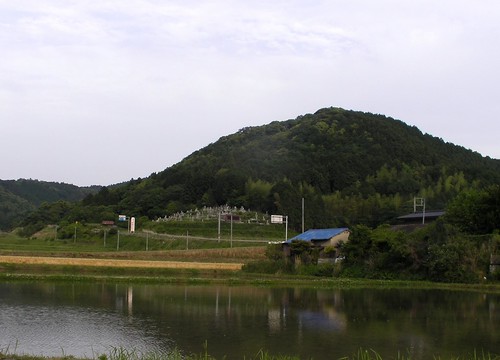
The names in the hills (like those signs that popup out of the landscape in video games) and the 'watching and protecting' eyes in the hills, have the same effect; they cast (as one casts a net), spread (as one spreads a sheet), or wrap (Hendry) the "mental mirror" out into a into a visual world.
The way in which located names function like a self-directed gaze relates also to the way in which Japanese tourists collect two different things at tourism destinations. Either they collect an auto-scopic, self-directed gaze in the from of a "Kinen shashin" or they collect a 'concrete name' in the form of a stamp at a stamp rally, stamped-sacred card (Shinpu, ofuda, omamori,) at a shrine, stamped scroll in a pilgrimage, or a souvenir "named-thing" (meibutsu), in the form of a represtative food or product of that region. Ideally they collect both.
The duality of name and self directed gaze is the same as that just mentioned with respect to the post card. The post card provides its purchaser, Mary (Jackson), with a self directed ear (the recipient of the postcard and the senders "super-adressee," Other, "generalised other") and with a sight that she find there. "Ah, so this is the red, or Frenchiness that I have heard about it." This expands the world of science, the words, out of books and spreads them out into the world.
Labels: japan, japanese culture, mirror, Nacalian, Shinto, specular, 日本文化, 神道
Wednesday, May 23, 2012
Authenticopy of Ise Shrine
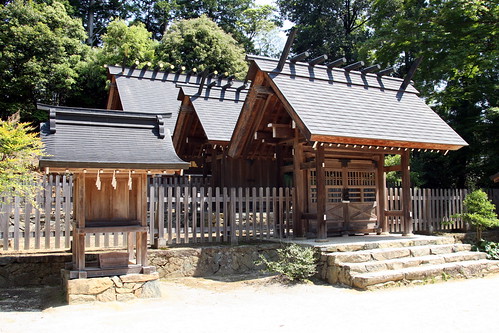
The sacred mirror enshrined at Ise was used to trick the Sun-Goddess out of a cave, with the words, "See there is someone as beautiful as you outside" and was latter passed, by the Sun Goddess to emperor of Japan with the words "See this as if it were my soul and worship it as if it were me." Description of the Sun Goddess as a mirror in Shinto Mythology may have preceded these two occurrences - The Sun Goddess was always a mirror. The mirror of the sun-goddess is believed by some to be in, or to be the heart of every Japanese (Kurozumi, 2000). In more literal terms, it is found that even today, the Japanese are able to simulate the presence of a mirror in their minds (Heine, Takemoto, Moskalenko, Lasaleta, & Henrich, 2008).
Some people believe that words mean ideas and that these ideas are somehow both in the mind and in the world (or the mind of god). They believe furthermore that the meanings of words are not copies, but always authentic or (co)present (Derrida, 1011) with the authentic in each and every instantiation.
The Japanese may believe that the world they see is both in the mind and in the world, or in the mind of a different type of seeing God. In that case perhaps "copies", such as copied horses or copied shrines, are not copies at all but authenticopies, and like Simulacra (Baudrillard, 1995) as close as one gets to the real thing.
The real thing after all is a river (Heraclitus), so if there is anything it has to be a simulacra or authenticopy.
Baudrillard did not differentiate between imaginary and symbolic copies but referred to both. However when he talks about the "mind of God" as that which insures the authenticity of these copies, presumably he is talking about his culture's logocentric God. In any event, I am using Authenticopy to refer to a subset of Simulacra, an authentic copy in the omnipresent (at least in Japan) mirror of the other.
Bibliography
Derrida, J. (2011). Voice and Phenomenon: Introduction to the Problem of the Sign in Husserl’s Phenomenology. Northwestern Univ Pr.
Baudrillard, J. (1995). Simulcra and Simulation. (S. F. Glaser, Trans.). Univ of Michigan Pr.
Heine, S. J., Takemoto, T., Moskalenko, S., Lasaleta, J., & Henrich, J. (2008). Mirrors in the head: Cultural variation in objective self-awareness. Personality and Social Psychology Bulletin, 34(7), 879–887.
Heraclitus (n.d) "Everything changes and nothing remains still... and... you cannot step twice into the same stream"
Kurozumi, M. (2000). The Living Way: Stories of Kurozumi Munetada, a Shinto Founder. (W. Stoesz & S. Kamiya, Trans.). Altamira Pr.
Labels: autoscopy, image, japanese culture, Jaques Lacan, mirror, nihonbunka, occularcentrism, reversal, self, Shinto, specular, 日本文化, 神道, 自己視
The Fabric of the Universe: Made of the Logos or Made of the Light?

The Japanese feel they can copy shrines, horses, food, and foreign countries in form of the popular foreign villages (gaikoku mura. See Graburn, Ertl, & Tierney, 2010; Hendry, 2000, 2005). Perhaps all this 'copying' started with a special mirror. With regard to shrines at least the Japanese claim it is not copying, but like "dividing a fire" (Norinaga see Herbert, 2010, p99) .
At least, when the Japanese see these "copies" they feel they are experiencing the same thing an authenticopy, or Simulacra (Baudrillard, 1995). I argue that they are the same thing to the Japanese because the world is the light. To borrow Heisig's words, the Japanese (or at least Nishida) believe the world meets the self at the plane of that "tainless mirror"(Heisig, 2004).
One can tell that the "copying" is visual because, for instance, the Japanese often like to change the size (Lee, 1984) or taste (Graburn, Ertl, & Tierney, 2010, p. 231) of the "copies". This matters not one bit in the plane of the mirror, where there is no size; get up close to a Bonsai and it could be a massive tree.
Westerners feel that the meanings behind their words are replicated in the minds of others (Nietzshe, 1888; Derrida, 2011) because the world, for Mary (Jackson, 1986), Dennet (2007) and I at least, is made of Logos: our dream of language made real. Occasionally some of us get out of our room and see the light, which makes us shiver.
So who are the copyists now, the word copiers or the light copiers?
Imai & Gentner (1997; see Imai & Masuda, in press or Genter & Boroditsky, 2001) showed Japanese and American children and adults, an image like the above. My version shows a half-moon shape made of plasticine and red playdough, and some lumps of plasticine. In the original experiment the subjects were told that the thing at the top was a "dax" and to bring the experimenter another dax. The Japanese were more likely than Americans to bring the pieces of plasticine. This is not surprising in view of the fact that Japanese nouns do not have plurals and need counters to refer to number, as English does for materials. The Japanese seem to be seeing the world as materials.
But then later Imai and her associates performed the same experimenters tried getting Americans (Imai & Gentner, 1997) and then Japanese (Imai & Mazuka, 2007) to "bring the same as this," again pointing to the green shape at the top, without giving that thatness a name.
Without a name, both the Americans and the Japanese were more likely to behave like the Japanese choosing more green plasticine rather than the red shape or entity, because they have got the words out of their heads to an extent. Imai interprets the data in a different way specifically rejecting the "perceptual" hypothesis. But I claim that deprived of words for a novel experience, both Americans and Japanese had started to see the light - or the colours that we anticipate Mary will enjoy so much - a little more clearly - hence the choice of plasticine rather than the half moon shape.
The floating world, the one that the Japanese believe in at the same time know (or are told) does not really exist is often referred to as "colour" (shiki) in Japanese Buddhism.
Being presented with these novel shapes is perhaps like a little journey, a minor tourism experience where the Japanese tourist wants to be given the name first, whereas the Western tourists wants to go and see the sights and give it a name afterwards.
Bibliography (thanks Zotero)
Baudrillard, J. (1995). Simulcra and Simulation. (S. F. Glaser, Trans.). Univ of Michigan Pr.
Dennett, D. (2007). What RoboMary Knows. Phenomenal Concepts and Phenomenal Knowledge: New Essays on Consciousness and Physicalism, 15–31.
Derrida, J. (2011). Voice and Phenomenon: Introduction to the Problem of the Sign in Husserl’s Phenomenology. Northwestern Univ Pr.
Genter, D., & Boroditsky, L. (2001). Individuation, relativity and early word learning. In M. Bowerman & S. C. Levinson (Eds.), Language Acquisition and Conceptual Development (pp. 215–256). Cambridge University Press.
Lee 李御寧. (1984). 「縮み」志向の日本人. 講談社.
Graburn, N., Ertl, J., & Tierney, R. K. (2010). Multiculturalism in the New Japan: Crossing the Boundaries Within. Berghahn Books.
Heisig, J. W. (2004). Nishida’s medieval bent. Japanese journal of religious studies, 55–72. Retrieved from nirc.nanzan-u.ac.jp/staff/jheisig/pdf/Nishida%20Medieval%...
Hendry, J. (2000). Foreign Country Theme Parks: A New Theme or an Old Japanese Pattern? Social Science Japan Journal, 3(2), 207–220. doi:10.1093/ssjj/3.2.207
Hendry, J. (2005). Japan’s Global Village: A View from the World of Leisure. A Companion to the Anthropology of Japan, 231–243.
Herbert, J. (2010). Shinto: At the Fountainhead of Japan. Taylor & Francis.
Imai, M., & Masuda, T. (n.d.). The Role of Language and Culture in Universality and Diversity of Human Concepts. Retrieved from www.ualberta.ca/~tmasuda/ImaMasudaAdvancesCulturePsycholo...
Imai, M., & Mazuka, R. (2007). Language-Relative Construal of Individuation Constrained by Universal Ontology: Revisiting Language Universals and Linguistic Relativity. Cognitive science, 31(3), 385–413.
Imai, Mutsumi, & Gentner, D. (1997). A cross-linguistic study of early word meaning: universal ontology and linguistic influence. Cognition, 62(2), 169–200. doi:10.1016/S0010-0277(96)00784-6
Imai, Mutsumi, Gentner, D., & Uchida, N. (1994). Children’s theories of word meaning: The role of shape similarity in early acquisition. Cognitive Development, 9(1), 45–75. doi:10.1016/0885-2014(94)90019-1
Jackson, F. (1986). What Mary didn’t know. The Journal of Philosophy, 83(5), 291–295.
Nietzsche, F. (1888)“Reason in Philosophy.” Twilight of the Idols. transl. Walter Kaufmann and R.J. Hollingdale. Retreived from http://www.handprint.com/SC/NIE/GotDamer.html#sect3
Labels: japan, japanese culture, nihobunka, nihonbunka, occularcentrism, Shinto, specular, theory, tourism, 日本文化, 神道
Breadshop or Cake Shop?

Yasuko is in a Japanese "breadshop" about to purchase the last "baguette". To me most Japanese bread tastes like cake even though it looks deceptively the same as its European counterpart. As my French professor used to say, "soft" (read texture-less) Japanese bread can be quite a disappointment (Louyot, 1999) for Europeans.
In Japan the important thing is that copies or things look the same. I think that the Japanese may even delight in having things look the same but taste different, or not taste of anything at all - such as in the case of plastic food. Certainly they like to copy things at different sizes, particularly in miniature (Lee, 1984), but sometimes as giants. This is because in the visual world in which Japanese live, there is no taste, nor size, nor even body (Ma-Kellams, Blascovich, & McCall, 2012).
Louyot, M (c. 1999) Personal Communication.
Lee 李御寧. (1984). 「縮み」志向の日本人. 講談社.
Ma-Kellams, C., Blascovich, J., & McCall, C. (2012). Culture and the body: East–West differences in visceral perception. Journal of Personality and Social Psychology, 102(4), 718–728. doi:10.1037/a0027010
Labels: japan, japanese culture, mirror, occularcentrism, specular, 日本文化, 神道
Tuesday, May 22, 2012
Unlit Lamps Remind us they are never Extinguished
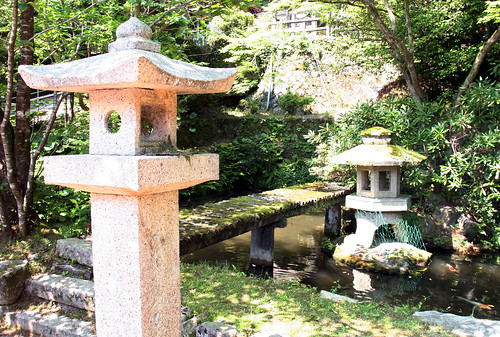
In front of many Shinto shrines there are many stone lanterns. They have the shape of lanterns. They have windows in them representing the sun and the moon. But perhaps it is more appropriate to say that they are copies of lanterns because, in the vast majority of cases the simulated lanterns are never lit. They may appear to be fake lanterns, containing nether candle, nor any sort of lamp. So what are they doing there?
It seems to me that these lamps draw attention the visual or qualia field of consciousness, or in other terms, "the mirror of the sun goddess".
It was this mirror that became the first copy-that-was-not-a-copy, in Shinto mythology. Amaterasu, the Sun-Godess appeared to have been fooled by it, tricked out of her cave, but was she? Was she perhaps not a mirror all along? Certainly when the first imperial ancestor left her company for Japan he was given, as a senbestu of sorts or keepsake, a mirror, which the first emperor was told to worship as if it were the original.
This mirror or field always extended, and in a sense alight, while we are awake, and can not be turned off other than globally by death, unconsciousness and sleep. The lanterns in front of Shinto shrines are thus never extinguished and in a way shiny brightly, even or especially in daylight. So bearing that in mind, are these lanterns copies of lanterns, or really lanterns after all?
Some people believe that words mean ideas and that these ideas are somehow both in the mind and in the world (or the mind of god). They believe furthermore that the meanings of words are not copies, but always authentic in each and every instantiation. The Japanese may believe that the world they see is both in the mind and in the world (or the mind of a different type of God). In that case perhaps "copies", such as copied horses or copied shrines, are not copies at all but the real thing.
Further Reading
Derrida, J. (2011). Voice and Phenomenon: Introduction to the Problem of the Sign in Husserl’s Phenomenology. Northwestern Univ Pr.
Baudrillard, J. (1995). Simulcra and Simulation. (S. F. Glaser, Trans.). Univ of Michigan Pr.
Labels: culture, mirror, nihobunka, nihonbunka, occularcentrism, religion, Shinto, 日本文化, 神道
Monday, April 02, 2012
Origin of The Stamp Rally and Japanese Pilgrimage

The stamp rally has more of a history than the goshuinbou (read stamp collection books) required by the Tokugawa government of those that took part in the pilgrimage of the 88 temples in Shikoku. Yes, pilgrims were required to get scrolls stamped at each temple, and yes this may be the direct ancestor of the stamp rally but, the history is considerably older.
The "God Body" (goshintai) or vector of the spirit of the deity received from Shinto shrines is a Shinpu, Ofuda or Spirit containing card as shown at the point of its creation by a shrine priest in the picture above. The most representative example are those of Ise Shrine, seen here in the above photo being created by stamping a pure white piece of Japanese paper with the holy seal (spirit seal) of the shrine.
The piece of paper stamped with a seal, being shown being created above, is a Jingu-Taima, the Shinto holy-of-hollies, representing or containing the spirit of the imperial ancestor; Amaterasu the Goddess of the Sun. When these pieces of paper were rumoured to have rained from the sky (as recently as the late nineteenth century) the Japanese took to mass pilgrimage, in their hundreds of thousands, dancing, and chanting, "there's nowt to complain about!" ("ee ja nai ka").
Prior to the great bureaucratisation of Japan in the ancient Ritsuryou legal system of 701, and for many centuries afterwards, Japanese would receive the spirit of their local diety vectored by the branches and leaves of sacred trees, or stones from around a sacred rock, as do other geographical totemist (Spencer and Gillan, Durkheim, Freud). The Japanese in their bureaucratic massive efficiency, updated this bricolage (Levi-Strauss) to allow shrines to print totem badges using seals. Totemism met and merged with the inkan, seal or stamp. And Japanese go and get these stamped sacred pieces of Japanese paper and card from Shrines to this day. To receive a piece of paper stamped with the name of the deity was the final purpose or proof of pilgrimage*. These totem badges were also, Yanagita argues, constituitive of self.
Japanese Tourists to this day go to famous places, special places with a name (Meisho). There the Japanese tourists receive symbols. The Japanese do not travel to see so much as to receive an indication (kuni no hikari wo shimesu), and in this way collect symbols. If, as Urry and McCannel say, Western travellers go to gaze upon sights and be seminologists, interpret sights, and provide the symbols pronouncing them "Japaneasy," the Japanese go to places where they may be no sight to provide the image go with the symbols.
This difference is due to a difference in the media of self. Westerners identify with the phonic linguistic media. Travel for Westerners is like Husserl's transcendental meditation, removing themselves from the sight as radically other, they return to their cogitus logocentricus, contemplate what they see and pronounce it such and such. The Japanese are on the other hand, a primordial space (Nishida, Watsuji), a mirror (Kurozumi). The Japanese go to places with a name, and provide the images either in their imagination, or their person taking their own picture thus superimposing themselves as image, on the named spot.
"It was just how I imagined it" said one 19th century Japanese pilgrim as she visited historic sites with little to see (Nenzi). Matsuo Basho wept at the rock commemorating the site of an ancient castle and was overjoyed to imagine the scene in times gone by while, borrowing Shelley, all around the lone and level grass stretched far away (Hudson).
Perhaps these Japanese seals are a little like the body of Christ as received at mass? Catholics ingest a little of the body in Church, or in front of a mirror? I am very confused.
*English pilgrims too, before they were stamped out by Protestantism would receive totem or pilgrim badges thought to have magical ( e.g. healing) power.
Labels: japanese culture, Shinto, theory, totemism, tourism, 日本文化, 神道
Tuesday, February 07, 2012
Valentine's Chocolate at the End of the World
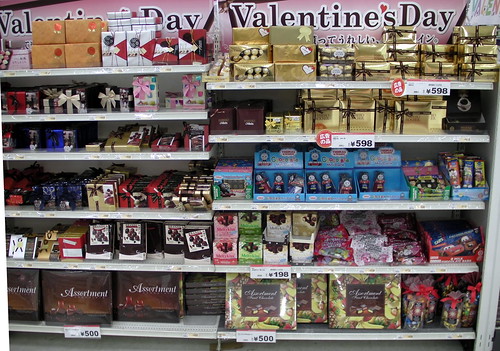
Izanami, the primal female at the beginning of the Japanese creation myth, said to Izanagi, her future spouse, "you are an attractive guy" before they mated and this caused her to give birth to a spineless individual, and required that they repeat their courtship. It was only when dude Izanagi made the first move did creation -- their birthing of the islands of Japan -- go as to plan.
Even today in Japan, women are not meant to make the first move, or express desire of any sort, except on one day of the year, the topsy turvey liminal festival of Valentines Day, when it is traditoinal that women give chocolates to the men they like, and the those they want to get things from.
If the Japanese creation myth is to be believed, one must worry about the fruit of such unions, especially in the face of increasing numbers of "herbivourous," Japanese males. Japan may have fallen into a negative feedback spiral where there are not enough red-blooded males to approach the ladies, and approaches in opposite direction (gyaku-nan, reverse chat-up) have "spineless" result. Creation is unravelling.
Labels: horror, nihobunka, nihonbunka, reversal, Shinto, taboo, 日本文化, 神道
Friday, December 09, 2011
The Chrysanthemum and the Sword

Ruth Benedict's Chrysanthemum and the Sword is probably still the most famous book about Japan. The theory that Japan is a shame culture, whereas Western countries have a culture of shame is still the most widely used framework for understanding the Japanese. Shame, it is argued, is a non-moral ethic where people behave in such a way as to conform with the expectations and evaluations of their peers. This is precisely the opposite of the definition of a moral man as given for example by Plato in The Republic (someone who appears bad but does good), or as exemplified in the life of Jesus who was crucified amongst thieves. Guilt, we are told, on the other hand is a moral sentiment that derives from within the person, from internal standards, from personally held and identifiable notions of good and bad. The theory that Westerners have such things inside them, whereas Japanese are only concerned with keeping up appearances, maintaining face, pleases Westerners and is continued in cultural psychological theories to this day.
It is clear that the Japanese feel a lot of shame. I think that the shame-culture, guilt-culture framework is meaningful, but that Benedict misrepresented Japanese shame. Japanese have private shame (Sakuta, 1967). "But," you may point out, that "if shame too is private then it is indistinguishable from guilt." I claim that the difference is in the medium. Guilt is when ones internal self-narrative sounds bad. Shame is when ones internal self-cinema looks awful.
It is easy to self narrate, and when we do we hear the words that speak or think. Self-speech has a built in mirror. Sound bounced back and around in the sound box of the mind.
That the Japanese can gaze at themselves, on the other hand, is a more remarkable feat. Like most westerners, I can't do it unless I have a mirror. Mead claimed it is impossible to see oneself without a mirror. Some performers, such as Zeami and Nijinsky, claimed to be able to see themselves from the point of view of their audience. And my research it may be argued that the average Japanese man and woman in the street have a mirror in their head.
Herbert Morris (1976) "On guilt and innocence: essays in legal philosophy and moral psychology" p 62
"In guilt the "voice of conscience" speaks and we formulate in words what is do be done and not to be done, words that are spoken and heard. With shame, the disposition is to hide, to vanish; with shame we want to sink into the ground, we cannot stand the *sight* of ourselves. With guilt the urge is to communicate, to be listened to, to confess."
It seems to be a minor change but, transposing the shame guilt divide from external-internal to vision-voice means that Japan ceases to be a lack, a nothing, a collective. Japan becomes something. It because something that is qualitatively different. The Japanese moral behaviour, and self is not just lost, submerged, controlled, collectivistic but *a different kind of self*.
Morris, H. (1976). On guilt and innocence: Essays in legal philosophy and moral psychology. Univ of California Press.
Labels: collectivism, individualism, japanese culture, mirror, nihobunka, nihonbunka, occularcentrism, religion, reversal, specular, 宗教, 日本文化, 神道
Monday, November 28, 2011
A Theory about Japanese Mikoshi Festivals
Many or most Japanese festivals feature "O'Mikoshi," but there are few theories as to why the Japanese (and not only the Japanese) are into carrying their gods around on stretchers. The theories I have seen, and agree with, stress unity, solidarity and cohesion (Takezawa, 1998) and prestige (there is a pecking order in who gets to carry the god, before whom: see Kalland, 1995). I respect both theories but here is my take, with thanks to my trainspotting son.
Normally the geographical fixed-ness of the Shinto sacred anchors the word view and society (c.f. theories that Japanese society is spacially organised: Bachnik & Quinn, 1994, Pilgrim 1995, and Nakane, 1970), so when the sacred starts to move on its mikoshi (beir, litter or palanquin) this signals the arrival of a topsy turvy, "liminality" (Turner, 1967) big-time. I suggest in this video that the mikoshi have the same attraction as trains. My son used to really love trains. Trains, with their moving frames of reference, teach us that movement is relative, nothing is stationary, unless something is sacred.
Labels: japanese culture, nihobunka, nihonbunka, religion, Shinto, 宗教, 日本文化, 神道
Tuesday, June 28, 2011
The Mind of Manufacturers

Via Flickr:
This is a book intending to encourage university graduates to go into the "thing-making, " manufacturing industry, introducing the mindset of those in the industry. Manufacturing as a profession is popular in Japan, not considered back stage and a little dirty as it may be in the UK.
Japanese people that work in manufacturing are proud to wear their manufacturing workers uniforms, as shown on the image on this cover. Those that take pride in expressing themselves, their apititutes, their creations, and their affiliations visually, as the Japanese do, are good at making-things as the Japanese are.
While I love Brian McVeigh's book "Wearing Ideology" it tends to over-emphasise the external source and oppressiveness of the "ideology," (though he does talk about negotiation) rather than "wearing" as authentic, creative self-expression. If an American Lawyer or Computer programer were to say "I am (proud of being) a computer programmer," then this would be seen as an autonomous belief rather than a engendered ideology, because we logocentricists see words as spring from the mind. Images too spring from the mind, and find expression in Japanese manufactured goods, and uniforms.
This cover image is copyright of Recruit a Japanese recruiting company that edited and published this book.
Labels: nihobunka, nihonbunka, occularcentrism, self, specular, 日本文化, 武道, 神道
Tuesday, June 07, 2011
Totem badges Old and New

Top row: Shinto shrine amulets (omamori)
Bottom row: Kamen Rider OOO medals, Kamen Rider W Gaia Memories
Please see also an even longer history of totem badges from Australian bull roarers, through shrine amulets, seals (mitokoumon's inro) to the seal of the Shinkenja- Super sentai.
My son plays with various totem badges that are said to transmit the spirit of a supernatural entity to a person allowing them to transform into a superman of sorts. These "totem badges" seem to have much in common with the good luck amulets (omamori) available at shrines.
The seem to contain some information (written - omamori, in an RFID chip - OOO's medals, in a USB memory - gaiai memory), connected with a super-human spirit (in the case of the omamori a shinto spirit or kami, in the case of OOO's medals and gaiai memory a super animal or 'ancestral' kamen rider). This information acts as a vector between the super-being and the holder, endowing the latter with power to conquer foes, such as exams diseases and enraged aliens. They often make a noise. Rattles are popular totem badges in North America (Levi-Strauss has a page of rattles in one of his books on totemism). Bull-roarers or Churinga roar when waved around ones head. Omamori are often fitted with bells. OOO's medals, and various transformatory cards make a noise when read with a special purpose reader. Gaiai memory (and engine souls) make a noise when a button is pushed or when inserted into a sort of reader.
Do amulets change (henshin!) people? Surely not?
They all contain a message, information, or symbols, representing a supernatural entity as noted above. They are also the double of their owners. Masked Rider OOO is the double of Hino Seiji. Shoutaro Hidari uses two Gaiai memory to transform into Kamen Rider "W" (double), his double, in more ways than one. Omamori are said to work as a self-replacement (migawari), taking on the bad luck that might otherwise befall their owner.
Shintoists believed that getting a totem badge from their shrine, the sacred space of their religion, gave them a life or self or spirit. The spirit was themselves and also it was the spirit of the shrine. About 70 years after they die, the spirit merged with the spirit of the shrine, or now Buddhist temple since the cycle of spirit has been broken.
Christians have "Christian names." My name is "Timothy", which is a name from the Bible. It is primarily a phoneme. I get it from the sacred space of my ancestor's religion, and I apply it to myself, thereby perhaps taking on board bit of the God, maybe. Does having a name change me? Does it give me anything, such as a self or life (no way, surely?).
The symbols, in all cases, come from the supernatural to give something special to their recipients.
One of the first Japanese superheroes that appeared on TV, was Mirror Man (Mira-man, 1971). Appearing at the same time as the original Ultraman, he shared many of the typical characteristics of Japanese superheroes, and with Shinto. He used a Transormatory item (henshin aitem) to transformed (henshin). Mirror man use a Shinto shrine amulet (omamori). He could only transform when in front of a reflective surface, usually a mirror. He was possessed, as it were, not by a giant from outer space, but his super-human father who lives in the world of two dimensions. (Thank you James)
Image top row far left: 貝で作られたお守り :) by kozika and far right: ハローキティのお守り :) by kozika
Labels: henshin, Masked Riders, nihobunka, nihonbunka, Shinto, superhero, totemism, トテミズム, 仮面ライダー, 変身, 日本文化, 神道
This blog represents the opinions of the author, Timothy Takemoto, and not the opinions of his employer.