
Monday, November 02, 2015
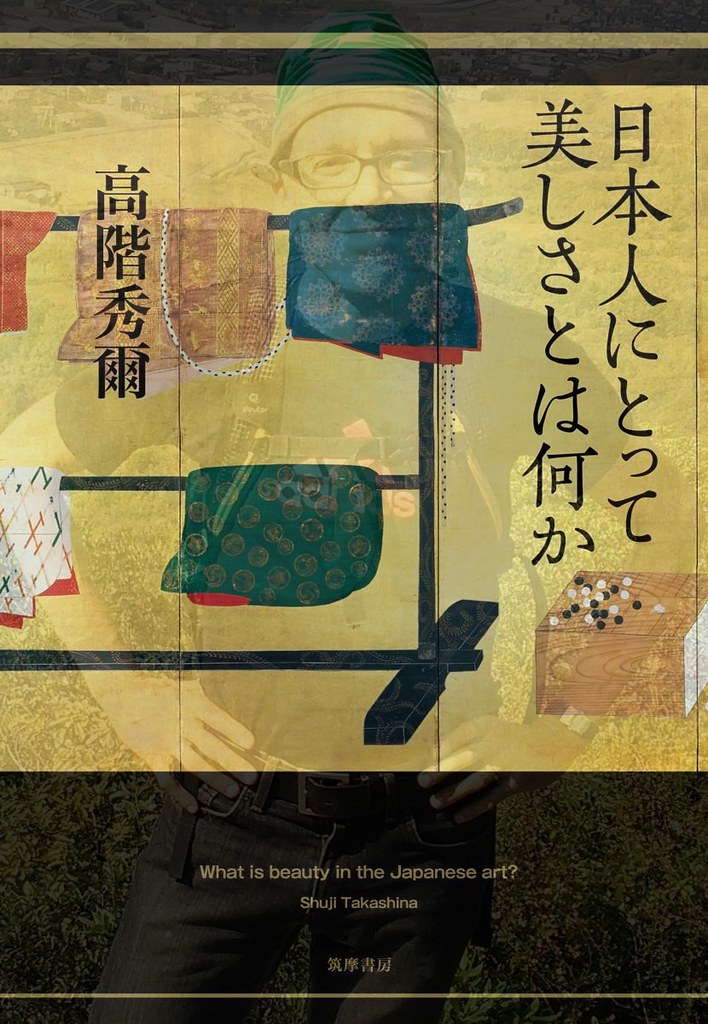
What is Beauty to the Japanese
Labels: blogger, Flickr, image, japaneseculture, lacan, nacalianism, nihonbunka, 日本文化


Wednesday, November 27, 2013
Brought to the Courtroom

Japanese people are less likely to adorn their desk at work, or the shelves in their homes with pictures of their relatives, with one exception. Pictures of deceased relatives are often hung above the ancestral altar. This is because, I believe, pictures of people are felt to be so real that it is almost as if they are felt to be present in their picture, as they are felt to be present also inside the altar. Another example of this use of photographs to represent the deceased is the way in which surviving family members of victims and plaintiffs bring pictures of deceased relatives to Japanese courtrooms.
In the above photo (Asahi Newspaper, 17th April, 2013, Photograped by Nishibatake Shirou) Akio Mizoguchi has brought a picture of his mother, deceased, to the High Court of Japan, where it was decided that she was indeed a victim of minamata disease. Mr. Mizoguchi is shown celebrating his, and his mother's victory in the court case. He has brought the photo of his deceased mother so that she may share in the proceedings and eventual victory. Similarly, pictures of deceased victims are sometimes brought by their relatives to murder trials. These behaviours go to demonstrate that contra Westerners, who are meant to grow out of their "mirror stage," the Japanese continue to identify with images even in adult life, and even, in the case of others, post death.
The strong identification between visual images and person hood also explains why so many Japanese ghosts are felt to emerge from images such as hanging scrolls (1,2) lanterns (1,2, 3) and more recently television sets.
取り下げご希望でありましたら、下記のコメント欄またはnihonbunka.comのメールリンクからご連絡いただければ幸いです。Should anyone wish that I remove this image from the Internet, please post a comment below or send an email to me via the link on my homepage, nihonbunka.com.
Labels: autoscopy, culture, image, japan, japanese culture, Jaques Lacan, lacan, mirror, Nacalian, occularcentrism, religion, ring, ringu, specular, 日本文化, 自己視
Wednesday, April 24, 2013
The Invasion of Dialogue Vs. Heejun Kimism

It is nothing new. Japanese people who have been abroad marvel at the extent to which Europeans debate, hold dialogue about everything, with everything, even with themselves. And some of them, , such as the authors of this book (Kitagawa and Hirata, 2008) wish to re-import this love of language back to Japan. They lament (in an almost direct emulation of Nakajima) that "Japan has no Dialogue."
Heejun Kim demonstrates however, that language actually gets in the way of East Asian's thought. When encouraged to think and talk Americans perform better. When encouraged to think and talk Asians perform worse. This suggests that Asians are not thinking in language.
When encouraged to think and talk nonsense (e.g. "a, b, c, a, b, c"), and suppress linguistic thought, Japanese are not so put out. They can automatise speech, put it on the back burner. When Americans suppress linguistic thought they almost find it difficult to walk. Western thinking is in language. Japanese thinking is not. It is elsewhere.
But the Japanese, with their endless love of things foreign, attempt to get all that chin wagging brought here. When they succeed, the Japanese will be a pale imitation of the great white whisperers. You are doing it aren't you? Whispering to yourself.
Don't do it Japan! Believe Kim (2002) and repent.
Kim, H. (2002). We talk, therefore we think? A cultural analysis of the effect of talking on thinking. Journal of Personality and Social Psychology. www.psych.ucsb.edu/labs/kim/kim_2002.pdf
Kitagawa, T & HIrata, O. 北川達夫, & 平田オリザ. (2008). ニッポンには対話がない―学びとコミュニケーションの再生. 三省堂.
Nakajima, Y. 中島, 義道. (1997). 「対話」のない社会―思いやりと優しさが圧殺するもの. PHP研究所.
Labels: japan, japanese culture, lacan, logos, theory, 日本文化
Friday, January 25, 2013
Communal Fantasy

The Wikipedia page on the book claims that it is not only a difficult book but also that it is like a Rorschach inkblot test in that different people read into it different things.
Yesterday I read it again and found it in a way of describing that which replace Oedipal, sexual fantasies in Japan.
In the preface Yoshimoto introduces "communal fantasy" (共同幻想) as fantasies or psychological constructs shared by a society. He later uses the example of mythology. Under this interpretation "communal fantasy" is close to Jungs' collective unconscious and the culture of cultural psychology: "shared understandings."
However in the first chapter "communal fantasy" emerges from a discussion of taboo in Freud, as an alternative class of taboo.
Yoshimoto notes that taboo is associated with ambivalence. Those things that taboo are not only rejected and hated but also loved and wanted at the same time. Then as an alternative to the "pair fantasies" manifest in incest taboos - the fantasy of incestual sex - "Communal fantasies" are introduced to describe initially the ambivalence towards kings and chiefs. (Yoshimoto does not need, or can not, mention the emperor since certainly the emperor of Japan is taboo subject in Japan).
Thus, the word "fantasy" (幻想) is used not only to describe psychological contents but also aspiration: fantasy in the sense of what people fantasise about, what they want, what they desire (even if they hate it as the same time).
Secondly, when he talks of sexual fantasies as "pair fantasies," (対なる幻想) the meaning of "pair" is transformed from a subject to an object or objective. Incestual sexual fantasies as "pair-fantasies" are not, necessarily at least, fantasies held by pairs, but fantasies about pairing. I don't think that Freud argues anywhere that Oedipal fantasies are necessarily, or even often, held equally on the part of mothers and fathers - the fantasies are held largely or exclusively on the part of children. Equally, , as a parallel concept, "communal fantasies" are not simply or even necessarily fantasies held by communities so much as fantasies of communing, of merging, melding, being one. And this fantasy may also be taboo, as there may also be taboos associated with the commity represented in the person of a king, or emperor*, for example.
As previously discussed, bearing in mind the bedroom arrangements in Japanese homes, the way that nakedness, communal bathing, touching and sleeping together are all everyday events that are not the subject of taboo, it seems clear that sexual incest taboos are not a prime mover in Japanese development. Children already get to sleep with their mothers. Their fathers do not step in with their paternal prohibition, but rather on the far side of their children, sandwiching their children closer to their mother. So how could the Japanese bow be tightened? How could, how do the Japanese ever grow up?
Cynics might say that the Japanese do not grow up, but it seems to me, with all the studying and almost religious ascetic practising of sports, and martial arts, that the Japanese child's trajectory into Japanese adulthood is no less motivated, the Japanese bow is no less taught. So, to coin a war poem, what made fatuous Japanese toil to break out of mummies bed at all?
My answer is that rather than incestual "pairing fantasies", the Japanese are propelled into the world by "communal fantasies", they desire communitas, they want to merge (合体), with mother, with father, with the community of parents, progenitors, ancestors and even eventually the gods.
Considerations such as the above may also related to the previously discussed way in which images and mothers in the West, and fathers and symbols in Japan, are to blame for, or catalytic in propelling the infant in a quest for something else something more.
The father in Japan, even as he says, go on sleep next to your mother is living symbolic proof - "father" - that the child is not a parent. A child of my acquaintance fantasised that a sibling was that child's own child. But the presence of the father and mother, the fact that they come as a set, presents a different type of prohibition, a parental prohibition that says to the child "No! You are not one of us. You are not a parent too!" And so all that toil, and study, and waiting and sweating and longing begins.
Notes
天皇は、日本國の象徴であり、日本国民の総合の象徴であって、その地位は日本国民の至高の総意に基づく。The emperor is the symbol of Japan and the symbol of the will of the Japanese people, and this status is based in the highest will of the Japanese people.
吉本隆明. (1982). 共同幻想論 (1982年) (改訂新.). 角川書店.
Labels: japan, japanese culture, Jaques Lacan, lacan, sex, 合体, 日本文化
Thursday, December 06, 2012
Kyari, Super Suits and Symbols

Eschewing telephone boxes and toilets, Japanese superheroes transform in front of everyone with great aplomb, sometimes on stage. They use symbols to transform. And they also have, and sometimes become, suits. Often what the Japanese Clark Kenta changes into is a super suit. Their super form that -- vectored by the symbol -- possess them is often a sort of exoskeleton. They have bug eyes, but no mouths. Speaking, even mumbling, is quite out of the question. Ultramen are pure body, pure light.
Both types of super hero use the image and the symbol but in different directions, with reversed means and ends. The Western suit is the *means* to conceal and continue the objective: the super identity that the hero always was. The Japanese transformatory symbol, and Kyari Pamyu Pamyu's choreographed "Kata," are a means to transforming into ones super suit, or assuming the visual three-eyed* identity that Kyari represents.
*Kyari has two eyes on her face and another, that looks at her sometimes a "riken no ken" (Zeami). Zeami emphasised too that the Kata, the ritualised symbolic movements, are a means. One learns the kata, one manipulates the symbols, to go beyond them. The Japanese stop narrating themselves almost as soon as they started, but hey are not zombies (Rudd, 2009).
Image top left: Superman frente al espejo by Greenog, bottom right HG 00 Gundam by Chag
Baudrillard, J. (1995). Simulcra and Simulation. (S. F. Glaser, Trans.). Univ of Michigan Pr.
Lacan, J. (2002). The mirror stage as formative of the function of the I as revealed in psychoanalytic experience. In B. Fink (Trans.), Ecrits (pp. 75–81). WW Norton & Company.
Rudd, A. (2009). In defence of narrative. European Journal of Philosophy, 17(1), 60–75. Retrieved from http://onlinelibrary.wiley.com/doi/10.1111/j.1468-0378.2007.00272.x/full
Labels: autoscopy, culture, eye, henshin, image, japan, japanese culture, Jaques Lacan, lacan, logos, Masked Riders, morph, occularcentrism, reversal, specular, superhero, 仮面ライダー, 変形, 自己視
Monday, November 26, 2012
Freud In Japanese

Freud's triparite division of the pysche into the super-ego ("over I"), ego ("I") and Id ("it"), translated into Japanese.
I believe that this tripartite division of the self applies to the Japanese too, but some (e.g. Kishida Shu) believe that the Japanese do not have a supereg. Not being a monotheistic society, and being instead collectivists, the Japanese equivalent of the super-ego is other people. Instead of guilt (or fear of god 対神恐怖症) the Japanese have social phobia (fear of other people 対人恐怖症).
Still others (such as Dov Cohen) claim that the Japanese have an even greater tendency to see themself from the position of a generalised other (Mead's version of the super-ego) and conversely that this suggests that they are collectivists.
I claim that the Japanese super ego or generalised other is alive and well. It may be a litle weaker, or softer than the Western version. It may be more granular or polytheistic, but that it exists in, or watching, "the imaginary" as represented by the dancing fat lady and the eyeballs in Kyari Pamyu Pamyu's video. For this reason I have added a red eyeball, not in Freud's original diagram.
The Japanese do not share their psyche with a listening father, but with a watching mother or perhaps even a watched mother, まぶたの母. I need to think more about this latter point.
Labels: japan, japanese culture, Jaques Lacan, lacan, Nacalian, occularcentrism, self, specular, theory, 日本文化
Thursday, November 22, 2012
Kyari Pamyu Pamyu through the Looking Glass of Lacan
A super cute character-girl, wearing a dress and gloves decorated with eyes, performs a highly choreographed song and dance routine ina room cluttered with the paraphernalia purchasable in her favourite fashion area. This is Kyari Pamyu Pamyu singing her world wide hit single "Pon Pon Pon". Just one of the several YouTube streams for this video has been viewed (as of 21 November 2012) 29 million times. The things that Kyari purchases, and even her dramatis persona, is not atypical for young girls that frequent Tokyo’s Harajuku shopping district where fashionista's go to parade their manga and anime inspired outfits, especially on Sunday afternoons.
But Kyari Pamyu Pamyu's music video, created by a team of Tokyo’s finest set designers, song and music writers, producers, animators, and the "air:ma"choreography team, goes a lot further way out, or way in, to the technicoloured mindspace of the Harajuku girl, and perhaps even to the heart of contemporary Japan.
Some of the features of this video are the inter-penetrating and strangely reversed duality of Kyari in her room, and pink Kyari shown in the mind outside her room. That her mind is outside her room, is indicated clearly by the descent of a red scull-less brain (0:15) that starts d dance.
The inside of the room is phantasmagorical enough with its mountain of consumer kitsch including glove puppets (0:11), a stuffed unicorn, plat-form shoes, many different stuffed characters, Christmas decorations, a tiger-cub decorated shoulder bag (0:25), a plastic elephant, plastic chains, knocked over chair (0:29),my little pony, 6 dolls, bags (0:32)
Kyari's mind, outside and occasionally overflowing inside her window, is even more outlandishly psychedelic nature of her pink persona that populates, together with one or more dancing fat old ladies, further serves to emphasise that, contra our expectations, outside is in, the psychological world seems to stand outside and encompass reality, rather than felt to be trapped within it.
Karyi's mind is very much in control. The psychedelic fantasies in Kyari's mind have been recreated in consumer purchases inside Kyari's room.Kyari's pink mental persona with even more virulently bleached blonde hair and even longer fake eyelashes only needs to speak in images (such as an apple,eyeballs, birds and a microphone – emerging from her ear) for these objects to appear inside the room.
Kyari in person is very much on stage, controlled, posed, forward facing, jittering, on strings, where as her celestial pink mental self revolves sublime, produces the microphone (0:7) to allow her to sing, and regurgitates the eyes that watch her dance. These eyes are perhaps the true protagonists, appearing everywhere, even after Kyari disappears after the final credits.
The words of the song appear to mean very little. The singer says in an interview that she is unaware of the title’s meaning, it having been presented to her on the day of her performance. None the less it is the words that hold the two worlds (mental and Harajuku) together: Kyari's persona’s sing in unison.
And, just as Kyari’s pink mental personal can produce things from often computer generated images, Harajuku Kyari can produce things by clapping, since the sounds in Japanese onomatopoeia is the same as that for the word for the slices of bread that appear.
Far more than the words, however, the images, symbols and gaze, the whole ocular structure of the video, speaks far more. Pink Kyari's computer generated simulacra, of strawberries, ducks, heart, scull, wasp, flowers, bones, banana, mask, pterodactyl, merry-go-round, red tank, fish, tortoise, dinosaurs, and especially the apple seem to represent her thoughts and desires. When Pink Kyari gets hungry she regurgitates a computer simulation of an apple from her mouth. The Kyri's mind speaks in images and watches her avatar, her character, through her bedroom window and TV set. The eyeballs that she spews surround Harajuku Kyari’s dance and adorn her dress. When pink Kyari arrives in the form of video tape played on a TV set, Harajuku Kyari’s head transforms into an amorphous pink mass.
So, what does it all mean? I shall argue that the video illustrates the Nacalian -- reversed-Lacanian-- theory of Japanese culture proposed by this blog.
I would like to draw attention to two things.
First of all that there are a lot of pretty creepy things going on. The aforementioned microphone appear from an ear, the dancing brain, regurgitated eyeballs (2:24),floating giant eyeball (2:28) , amorphous melty-head (2:42), are not gross enough, there are plenty of things that are conventionally accorded a negative valence, grotesque and horrifying things often associated with death, such as chequered one eyed skulls(0:40, 1:12) that come through the mirror into the room accompanied by a giant skeletal hand (1:17), a fossilized dinosaurs (0:41), giant bones (1:13), black birds flying out of pink Kyari’s mouth (1:18), melting eyes (1:23), a wasp (1:28) and a shark that again protrude fly into the room (2:47), Nightmare on Elm Street style mask (2:57), and what appears to be snot (3;32) . At least Pink Kyari does not attempt come through the window, our out of the TV set into the world. All these rather disgusting things, that originate in the external mental world are kept from being horrifying due to the consummate Harakuju cuteness of the heroine. Harajuku Kyari is so cute (kawaii) that she can turn even the most scary (kowai) into smorgasbordia of candy, flowers and bubblegum.
Secondly, I think it is important to ask, who is the dancing fat lady?
To be continued.
Labels: culture, eye, horror, image, japan, japanese culture, Jaques Lacan, lacan, nihonbunka, occularcentrism, reversal, specular, 日本文化
Wednesday, June 27, 2012
Japanese Interiors: Japanese Art and Artifice

Through the use of a lot of rectangular spaces, such as the rice mats (tatami), and the squares in the sliding doors (shouji), traditional Japanese interiors at once emphasise perspective and depth but at the same time, due to the fact that these rectangles are of difference sizes, and additionally due to the inclusion of gaps in walls (ranma) and partitions, one is never sure whether one is seeing depth (through a gap for instance) or seeing something miniaturised.
(See for example the area of in the outer corridor see through the window in the wall, highlighted with a note on the photo page).
Hence Japanese interiors encourage their viewers to make incorrect spatial interpretation and so confuse - like walking into an Escher - that their viewers cease spatial interpretation altogether. This cessation leads us to see the interior as the primal space (Mochizuki, 2006), visual field (Mach, 1894), or mental mirror (Heisig, 2004) that is the purity of its experience (Nishida, 1979).
Japanese gardens also produce a similar Zen experience by confounding the viewers sense of scale, not using by using perspective lines and rectangles, but by using rocks and gravel that can and are interpreted as islands or an ocean respectively.
Japanese poetry – particularly haiku – achieves the same effect by encouraging the viewer to make an interpretation before returning them to the purity of the experience shared with the poet. E.g. most famously in Basho's poem: “An old lake” (we imagine it), “Frogs jump in” (we imagine them), “The sound of the water” (wham!), we are told that the poet did not see any frogs, perhaps not even the ripples; the sound of the water was all there ever was: "frogs jump in" was only an interpretation. Pound (1914) recognises that Japanese poetry layers images in a "vortex" but he does not mention that both"hokku" example he cites, and even, though Pound may not have realised it, the poem he wrote himself ("In the Station of a Metro", see the paper online, p4), contain a misinterpretation in the vortex of images.
In all three cases (interiors, gardens, poems) the artist encourages the viewer or reader to make a interpretation, or draw to mind an image, that is not based in the pure experience, and by confounding it, leads the viewer back to the purity of experience, to the 'ecstatic' ‘thou art that’ (Lacan, 2002)
Afterword
Does Japanese architecture, gardening and poetry lead to a sort of enlightenment? I think that it may at once be a sort of enlightenment, and at the same time furthest from it. The experience of traditional Japanese house interiors for Japanese returns their consciousness to that state of transcendental meditation which corresponds to (and is directly opposite from) Husserl's phenomenological state (Husserl, 1960) in which Western consciousness removes itself from phenomena and attends only to an interior narrative. Husserl's transcendental meditation is a return to the self, to the purity of self narrative, to that "Ravine" (Ace Of Base, 1995) where there is only self and 'Other', or 'super-addressee'. The Japanese architectural interior likewise returns the Japanese mind to the purity of the mental mirror (Heisig, 2004) ’where to abide with their creator god’ (see Claire, 1986), the looking together (Kitayama, 2005), eye-in-the-sky (see Masuda, Wang, Ito, & Senzaki, 2012; Cohen & Gunz, 2002; Takemoto, T., 2002).
Bibliography
Ace Of Base. (1995). Ravine. Retrieved from www.youtube.com/watch?v=dgBBFlvRdRc&feature=youtube_g...
Clare, J., Williams, M., & Williams, R. (1986). John Clare: selected poetry and prose. Routledge. Retrieved from books.google.co.jp/books?hl=en&lr=&id=Hebg8BrvCP4...
Cohen, D., & Gunz, A. (2002). As seen by the other...: perspectives on the self in the memories and emotional perceptions of Easterners and Westerners. Psychological Science, 13(1), 55–59. Retrieved from web.missouri.edu/~ajgbp7/personal/Cohen_Gunz_2002.pdf
Heisig, J. W. (2004). Nishida’s medieval bent. Japanese journal of religious studies, 55–72. Retrieved from nirc.nanzan-u.ac.jp/staff/jheisig/pdf/Nishida%20Medieval%...
Husserl, E. (1960). Cartesian meditations: An introduction to phenomenology. Translated by Dorion Cairns. M. Nijhoff.
Kitayama, O. 北山修. (2005). 共視論. 講談社.
Lacan, J. (2002). The mirror stage as formative of the function of the I as revealed in psychoanalytic experience. In B. Fink (Trans.), Ecrits (pp. 75–81). WW Norton & Company.
Mach, E. (1897). Contributions to the Analysis of the Sensations. (C. M. Williams, Trans.). The Open court publishing company. Retrieved from www.archive.org/details/contributionsto00machgoog
Masuda, T., Wang, H., Ito, K., & Senzaki, S. (2012). Culture and the Mind: Implications for Art, Design, and Advertisement. Handbook of Research on International Advertising, 109.
Mochizuki, T. (2006). Climate and Ethics: Ethical Implications of Watsuji Tetsuro’s Concepts:‘ Climate’ and‘ Climaticity’. Philosophia Osaka, 1, 43–55. Retrieved from ir.library.osaka-u.ac.jp/metadb/up/LIBPHILOO/po_01_043.pdf
Nishida, K. 西田幾多郎. (1979). 善の研究 (Vol. 33). 岩波書店.Nishida, K. 西田幾多郎. (1979). 善の研究 (Vol. 33). 岩波書店.
Pound, E. (1914). Vorticism. Fortnightly Review, 1, 461. Retrieved from matthuculak.com/wp-content/uploads/2012/05/POUND%20Vortic...
Takemoto, T. (2002). 鏡の前の日本人. ニッポンは面白いか (講談社選書メチエ. 講談社.
Labels: image, japan, japanese culture, Jaques Lacan, lacan, nihobunka, nihonbunka, reversal, self, specular, 日本文化
Monday, June 04, 2012
How to Make a Japanese God

A minimal interpretation of a God surely includes the requirement that God is an entity who is connected with us intra-psychically as well as, or even more so than, externally. That is to say that God is in our minds as well as in the world. God observes us, even in the privacy of our mind, and we address ourselves to him or her in that we are concerned about our behaviour from God's point of view.
Several Western theorists (Adam Smith, Bakhtin, Mead, Lacan, and Freud) argue that we have or model an objective view of ourselves intra-psychically, that is to say, inside our heads. Most Western theorists argue that this "point of view" is a point of "view" only metaphorically. The Western God is associated with language, listening, and understanding.
Adam Smith argues that we all see ourselves from a "impartial spectator." While Adam Smith redacted references to God from his work, after the death of his mother, it seems clear that his impartial spectator is related to his notion of a Christian God and that being above all "reasonable," "impartial spectator" 'spectates' in a "reasonable" (I read linguistic) rather than visual way.
Bakhtin does not explain the origin of his super addressee. He just says that we always presume the presence of another addressee of our language (in addition to the person we are speaking to or writing to). Bakhtin does not state that this super-addressee is a requirement for self, but, in a rare moment of religiosity Bakhtin associates this Super-addressee with God, and its absence with hell.
Mead presents one of the best, most sober, renditions of the need for an objective perspective upon self. Mead argues that in order to have a self we need to see ourselves from an objective point of view. In order to see oneself from an objective point of view, one needs to internalise the viewpoints of others (plural). In order to have a self, an independent self perhaps, one needs to create within oneself a "Generalised other," the perspective of oneself as it were, from nowhere. Mead's sober, Anglo Saxon explanation is almost mathematical or at least logical. The more views that one has of oneself the more one understands oneself. And by combining these views one can achieve objective self-hood, from the viewpoint of *not* one's mother, *not* ones father, but from a sort of mathematically, logically, systematically amalgamated general view point. How is this possible? Mead does not say. It sounds reasonable. But Mead's generalised other is while easy to follow as a theory, not so easy to understand phenomenologically. Where is the generalised in my mental experience? (This question may be a no-brainer for Christians.)
Lacan wavers. On the one had his "Other" seems to personified, sometimes (contra Freud) as a (m)Other, at other times the Other seems to be be language itself, a sort of neo Kantian (these days championed by Chomsky and Pinker) static, systematic, non-persona-ised version of the "generalised other". By non-persona-ized, I mean that the other from which we see the self is non personalised account; something that is not a simulated human. The Other of our self speech, is rather a system, a structure, something that is not seen as a persons. I think that his view is probably very popular among many theorists, or anyone with a scientific outlook. This generalised-other-as-system view does not require anything grotesque. If we understand ourselves from a generalised point of view then it is because we understand language. Language is our other, not a person at all. How nice, how clean and un-queasy that would be if it were the case.
Freud is surprisingly vague, almost mythic in his explanation of the origins of the Super-Ego. The "super ego" is a form of generalised other based on ones father. Freud has written a lot and I do not pretend to have read everything he has written but in one rendition of the origin of the super ego (though he does not use that phrase in the paper in question) he suggest a historical event: that an alpha-male, woman monopolising primal father was killed and eaten by brothers who internalised (not only in that they ate him, but psychologically) the father figure that they had killed, and felt so guilty about that murder that they repressed it. In this rendition there is the horror, the shame or guilt, but towards a concrete act. That slaying of the primal father seems unlikely but Freud's myth mentions *The Horror* that I suggest is essential for "making a god."
We all simulate others all the time. We imagine that we are talking to friends and understand our words from their simulated perspective. We cringe when we feel the gaze of others because we imagine what they have seen, and what we simulate they have felt about what they have seen. But these others that we simulate are others in the plural, others in the particular. How could it be that we might create a perspective, a view from nowhere?
Olaf and Metzinger (2009) propose that our ability to see ourselves from other perspectives is essential to the creation of self (which they argue to be a sort of illusion). In the paper quoted they give a typology of self views. In a "Autoscopic Hallucination" we see ourselves as another, a doppelgänger who is not ourselves and remain aware of the self from which we see the doppelgänger. In "Heautoscopy" we see a doppelgänger and our self, but we are not sure which of the two is our self. In an "Out of Body experience" (perhaps the most godly of the three) we see ourself from an external perspective but still with a "SL" (Subjective Location) floating somewhere above us near the ceiling.
It seems to me that they miss a type of self view: the view from nowhere. We see this view from nowhere represented in many Japanese works of art (Edo period pictures of the floating world, Manga, video games) in self-memories (Cohen) and Japanese behaviour in front of mirrors (Heine, et al.). How is it that the Japanese can have a view from nowhere, up from high in the sky and not feel that they are located in that elvated position?
I suggest that the ability to have a self-view from an external position and at the same time not see that position as a subjective location, nor as another particular viewpoint (of a friend, of family member) requires repression, as Freud argued.
This brings me to the horror. There is a a trope in Japanese horror where (generally female) monsters emerge from images. Traditionally they emerged from lanterns (Oiwasan) scrolls (bottom left), more recently they emerge from mirrors (Juuon, Mirrors), photo developer (Juuon), and most famously a television set (Sadako).
I suggest that perhaps the ability to see oneself from an external, non-particular, generalised perspective, relies less on our ability to generalise a perspective as to find one of them so frightening that we repress it. This explanation suggests that God is some sort of Bogeyman, but that is not my perception. Rather that the total absence of a belief in a generalised view (God), results in a situation which is, as Bakhtin says, hell: well and truly horrifying.
Bibliography to follow
Labels: autoscopy, economics, eye, horror, image, japan, japanese culture, Jaques Lacan, lacan, manga, nihobunka, nihonbunka, occularcentrism, reversal, ring, ringu, self, Shinto, specular, 日本文化
Thursday, May 31, 2012
The Western and Japanese Ego in Lacan's Borromean Knot,

According to Lacan the real, imaginary and symbolic are related in like manner to the rings of a borromean knot (see this page) in which no one of the the three rings passes through the others, but the three rings are held together. Cutting any of the rings causes the knot to fall apart.
I have interpreted this to mean that we experience, or believe in ourselves (and the world) at the presumed intersection between the imaginary (that which we can see and imagine) and the symbolic (that which we can say). The borromean knot illustrates this "presumption" in the fact that the rings do not in fact intersect.
I have also related this presumption, and the failure to maintain it, to the anguish of characters in two scenes in David Lynch's movies: the scene in "Blue Velvet" (1986) were Ben (played by Dean Stockwell) mimes "In dreams" and the "Club Silencio" scene in "Mulholland Dr." (2001) where, Frank in the former, and Diane and Camilla in the later become visibly distraught to realise that the performer they are watching is lip-synching. I also read that Australia has outlawed lip-synching at "live concerts" (specifically those of Britney Spears) unless the tickets come with a disclaimer. Why should lip-synching be so distressing?
At the phenomenological level however, it can be claimed that (I have a reference for this claim somewhere, thanks to one of my seminar students) that sound can not come from vision and that experientially we are always, as it were, aligning an audio track with a visual track, and in a sense all performers are lip-synchers or ventriloquists, though in some situations we deem their voices and their images to be coming from the same place.
At the level of the "symbolic" and the "imaginary", however, I did not have any clear understanding of what Lacan was referring to.
Rather than being a "card holding Lacanian," I just find the most basic level interpretation of theories useful for interpreting Japanese culture, and rightly or wrongly, I tend to think that he the man, Lacan himself, was a ranting obscurantist! Even worse than me perhaps.
But I have been thinking about this knot a little more, while reading the Edgar Allen Poe short story that Lacan so recommends (The Purloined Letter). While I find Lacan's interpretation of this detective story almost impossibly opaque, the detective story itself is very instructive. Notably there are persona in the story who appear to be able to see and not be seen, and others to manipulate signs but not see, and an independence and interaction among these persona, which leads me to the following vague hypothesis, which may well have been what Lacan was saying all along.
Perhaps the faculties of speaking and imagining can only appreciate themselves in their opposite? Like an invisible ghost that can see a blind man that can only speak of ghosts? This reminds me of "The Sixth Sense" and all those imaginary friends I wrote about on an earlier post.
I am not sure how to make this any more clear but perhaps it can be unpacked in to the following 4 assertions
A) Imagination can not imagine itself (c.f. Nietzsche's remarks on eyes not being able to see themselves)
B) Imagine only reaches a self perception via language (those trasformatory symbols that Jpanese collect)
C) Speech can not say itself c.f. Emile Benveniste's papers on the subject of utterance and the subject of enunciation. One of the two crucial papers by Benveniste can be found online.
D) The speaking subject of "utterance" can only represent itself by taking a detour via the image (as body visible)
I am not sure how to make the these four claims more persuasive but I find myself rather taken by the idea. The above would suggest a more divided self.
Random thoughts
1) People who have had their inter-hemispheric neural highway, the corpus callosum, cut cease to dream, and their right and left arms sometimes even fight each other. As per the last photo, Poe has considerable hemispherical asymmetry
2) Images in my dreams seem often to be rebuses as if my dream images are trying desperately to speak.
Finally relating this to Japanese culture
3) Proposition (A) above might be more unacceptable to Japanese who feel that they can imagine themselves without loss of fidelity, and proposition (C) more unacceptable to Westerners who, according to many (Bruner, Benveniste, MacAdams etc) narrate themselves into existence.
4) Lacan argued (see the aforemented page) the Western ego exists at the intersection between the symbolic and the real. Transposing Nacalianly, the Japanese self exists at the intersection between the (visio) imaginary and the real, as Nishida (see Heisig, 2004) argues.
[The above borromean knot is probably drawn from a Western perspective with the symbolic rather than the imaginary above the real].
Bibliography
Heisig, J. W. (2004). Nishida’s medieval bent. Japanese journal of religious studies, 55–72. Retrieved from nirc.nanzan-u.ac.jp/staff/jheisig/pdf/Nishida%20Medieval%...
Labels: autoscopy, image, japan, japanese culture, Jaques Lacan, lacan, logos, nihobunka, nihonbunka, occularcentrism, reversal, self, theory, 日本文化
Friday, May 25, 2012
Field of Responsibility, Zenpouchuui, and "I am only Looking"
In the UK there are laws which stipulate that one pay attention to that which one can "reasonably" predict. E.g. in British contract law one may enter into a contract even if one does not sign on the line which is dotted, when one can reasonably expect to have entered into a contract. E.g. If you go into a posh restaurant and drink the water on the table, even though you may not have been told that the water costs money, if you can reasonably expect, that water to cost money, for it to have come from a bottle and not the tap, then one will be held responsible for paying for it. British people are required to be reasonable, to exercise their reason, to engage perhaps in an internal dialogue with themselves, and act in accordance with the results of that "discussion."
In Japan however, (performing a Nacalian transformation) one is required far more to exercise care over that which one can see. This especially applies in road traffic laws, and road behaviour, where one is expected to "zenpouchuui," (前方注意) sometimes translated as "proceed with caution" but literally, "Pay attention to that which is in front of you." This means that in Japan more than in the West, if you see someone standing at the side of the road in front of you, then as you proceed towards them, to make sure you see them, and make sure that you imagine that they may walk out in front of you, even if it is not "reasonable" for them to do so.
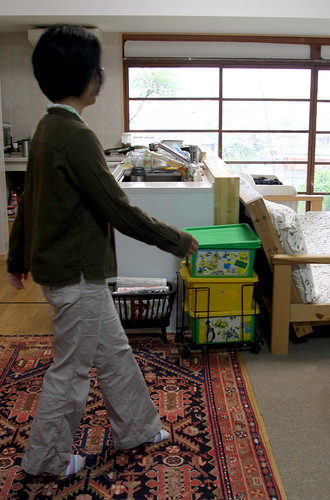
I sometimes find that Japanese people come out in front of me, when I am on my bicycle for instance, especially if they are travelling at an oblique angle (just greater than 90 degrees and slightly in the same direction as the road as travelled by the possibly oncoming traffic). In this situation, from the visual perspective of the person crossing the road at a slightly oblique angle, there is nothing in their line of vision. Their field of vision and their field of responsibility is clear. Twisted Westerner that I am, I sometimes feel that Japanese people deliberately cross roads at oblique angles (in the above photo, imagine that the carpet is the road) deliberately not looking anywhere but in front of them so as to give themselves right of way. This can, and has, resulted in disastrous consequences when the Westerner proceeding forwards expects those in front to use their reason to anticipate things that are not in their field of vision.
This formula: that one is responsible for that which one can see and imagine from that visual data, rather than that which one can reasonably predict from the facts of the situation, may have implications in other areas of cultural behaviour.
I wonder if the way in which, for instance, Japanese family law privileges the rights, and responsibilities of the parent with whom the children are living (that can see the child) is partly motivated by the above consideration.
The cultural psychologist Takahiko Masuda (light years above me research wise, highly perceptive of cultural differences, and a nice guy) argues that the Japanese are more aware of context , whereas Westerners are more analytical thus focal, concentrating only one the "important" data. This is demonstrated for instance in his superb experiments on change blindness (Masuda & Nisbett, 2006) where Westerners only notice changes in foreground, focal objects whereas Japanese notice changes in the background. I am not sure how this could be operationalized (made verifiable, the subject of an experiment) but I predict that in situations where one can rationally predict events based upon present data, it may be Westerners, not Japanese, that are paying more attention to the (rational, linguistically predictable) context. In other words, perhaps everyone is paying attention to context, but the context to which Japanese and Westerners are paying attention to is Nacalianly transposed.
The way in which Japanese feel able to ignore that which they can not see is perhaps illustrated in this television commercial (called, poignantly "I am only looking") in which a group of Japanese ladies feel able to ignore sales staff partly by moving obliquely in front of them, keeping the sales staff out of their field of vision. In my interactions with Japanese road users I sometimes feel like the I would expect the shop attendants to feel, if they were British.
Bibliography
Masuda, T., & Nisbett, R. E. (2006). Culture and change blindness. Cognitive Science, 30(2), 381–399.
Acknowledgements
Thanks to my wife Yasuko for posing for this photo. Thanks to Lacan for his theory the human self. Since I have started using his name (reversed) for my take on Japanese culture, I feel much better about using it.
Labels: crime, culture, japan, japanese culture, Jaques Lacan, lacan, nihobunka, nihonbunka, occularcentrism, reversal, specular, 日本文化
Thursday, May 17, 2012
Nacalianism and Climaticity

But then, I have a socio-historic theory of my own. It seems to me that Japan is Nacalian. Nacal is Lacan backwards, and Nacalian refers to the theory that Lacan's theory of the human explains Japanese behaviour quite well if it is turned upside down or back to front.
Lacan (2002, [1949]) argued that the human self is created as an external identification with the image, before later, as a result of being unable to demand their mothers affection, they identify with their symbolic parent - their father - and so we go on to narrate ourselves into existance. The advantage of this is is, Western theorist claim, the visual self representation is locked in binary relationships with real external others or mirrors, whereas language provides us with the means to hear ourselves speak, understand ourselves from the point of view of others (plural) and also finally, from the point of view of the Other (Lacan, 2002), the "generalised other," (Mead, 1967) the "superadressee" (Bakhtin, 1986).
Lacan's theory explains the Japanese self too, if topologically reversed. The Japanese self orginiates in an external identification with the symbol, before later, as a result of being unable to demand 'assimilation with their mother'*, Japanese identify with the their visual parent, and imagine, or animate, themselves into existence. The advantage of this is that while self-imagary requires that one visualise oneself from the outside, it is not as external as language which is external in both the spatial and social sense. As Wittenstien (1973) famously argued there can not be a private language, and meaning is realised in "language games" - that is to say communicative encounters that require not only an outside, but also other people**.
Whille there is no linguistic third person perspective (Mori, 1999) or even narrative (Kim, 2002) in the mind of the Japanese, a sort of capitalised/generalised Other, or super-addressee is also present in Japan: the Japanese simulate a mirror in their heads (Heine, Takemoto, Moskalenko, Lasaleta, & Henrich, 2008; Takemoto, 2002).
The universality of visio-imaginary self-apprehension may be more fractal, but it is no less objective. In addition to the temporal ephemerality of the linguistic sign (Derrida, 1998), it is the relative ease with which the noiseless ear, compared to the visible eye, can be merged and hidden that conceals the fact that it is no more easy to gain a universalised linguistic aprehension of oneself (through dialetic perhaps) than it is to gain a universalised apprehension of oneself through self imagination. At the very least as communication theorists (Mehrabian, 2007) and common knowledge teach us, a picture speaks... or signifies, at least as well as, words.
Though the best Western philosophers blithely assert that language provides, apriori, a means of perceiving oneself from the point of view of others, in fact to understand oneself from another persons' lnguistic point of view requires a simulation, of comparable complexity to that required by the act of simulating the literal, visual view of an other.
And so it is that Westerners narrate themselves into existance based around their "Je", whereas Japanese have a collage of self ways, a geography of self, not limited to, but centering on their face.
Convinced as I am of the limited power of language, the existence of my own cultural baggage, and the prevalence of contradiction in the world, the fact that Nacalianism is to some extent contradictory is to be expected. And one of the many applications of Nacalianism is as a metatheory that applies to, and to an extent contradicts, itself.
Due to their heighted powers of visual imagination, and their self indentificiation with their own image, the Japanese are inclined to open their eyes and look about them when they want to explain human behaviour. As a result, the Japanese, including Japanese academics, have a great love of theories of climaticity. Here climate refers to the visual environment including the weater and seasons. It is also translated as "environment", and "milleue." The originator of the term and the most famous examplar of which is that of Watsuji Tetsuro who argued that culture can be explained by the geo-climatic conditions of its origin, seperating cultures into desert cultures, monsoon cultures etc (Watsuji, 1961).
Other examples geo-climatic theories of human society include the following.
Tamaki's explanation of regional variations in Japanese culture by the geographically induced varieties of irrigation (Tamaki, 1979), such as collectivism and harmony among flatplain canal irrigationists, to individualism among those in more mountainous regions that use individual lakes to flood their rice fields.
Various scholars -- and the Japanese general public -- use Watsuji's divisions of people's into 'agriculturalists (The japanese) vs hunter gathers (the British!?)', or 'agriculturalists vs. herders.'
These geo-climatic theory of culture too sometimes touch on similarly self-contradictory meta-theories of theory. In the introduction to Tamaki's work in which he describes climatic theories as being Japanese. The geo-climatic theory of Aida (1990) below, also attempts to explain the origin of climaticity (which he refers to as attention to area).
"This tendency of Japanese (to think interms of areas as opposed to points and lines) originates in the Japanese geo-climatic environment and the characteristics of the type of agriculture theirin employed. Compared to Europe, Japanese land is clearly more fertile, and as a result the special Japanese agricultural style gave birth to a belief in the mysterious creative power in the land [the area] itself.
In European agriculture however, herding is always required [for crop rotation]. Europeans hardly ever believe in the mysterious creative power of the land. Herders are always like this. The supremacy of herders gives rise to [a philosophy of] points and lines, and not areas." (Aida, 1990,p 199, my rough translation, with omissions and [additions]).
The hightly influential Laurel Forest Culture theory proposed Sasaki Koumei (佐々木, 2007) and Nakao Sasuke's (Nakao, 2006) proposes that the form of forest found in places like Japan and Taiwan have resulted in considerable cultural similarity.
Yuki's use of the frontier mentality in the USA to explain behaviour in Hokkaidou, and generally to explain social beahviour by social mobility (how much people move around) and by implication I feel, the existance of space in which they are free to do so (e.g. Schug, Yuki, Horikawa, & Takemura, 2009). This theory too (and that of Nisbett below), uses space to explain valuations of space -- spatially defined relationships, or holistic thought patterns -- is as self-applicable and self-contradictory as my own theory, it seems to me.
Climatic theories are of course not absent in the West. Two of note are those of Richard Nisbett (2004) and Francesa Bray(1994), each coming to the opposite conclusion regarding the effect of rice agriculture upon culture. Nisbett argued that rice agriculture encouraged cooperation, whereas Bray argues that it encouraged independence, lack of cooperation and the late arrival of the industrial revolution in Japan.
To these climatic theories I would like to add my own, only partly toungue in cheek. In geographies which are fairly flat, and the horizon is low, humans can generally only see the sky, ground, and the immediate social environment, and as such tend to interpret the world in terms of sociological tendencies. In geographies where there are steep mountains, such as in the above photo, humans are always able to see nature, the movement of the seasons, and can but be aware of its impact upon their lives. Thus the Japanese are more inclined to interpret human behaviour in terms of geo-climatic theories. I am serious. Living in Japan, and always made forcefully aware of the presence of nature by being surrounded by sheer mountains, does make me more "area," spacially focused.
Westerner that I am, I prefer a social, historical theory -- Nacalianism -- to explain the prevalence of geo-visual theories of human behaviour in Japan, although I recognise the contradiction, and believe in that human behaviour can be explained in more than one way.
Notes
*I have struggled for a long time to explain why, in the absense of oedipal conflict, the Japanese bother to grow up at all. It seems to me that the Lacanian emphasis on possesion ones mother misses another, more Western (Schug, Yuki, Horikawa, & Takemura, 2009) aspect of love towards ones primary caregiver: the desire for similarity. Yes, in the Western family children are denied possession of the mother, especially by being ejected from the family bed. In Japan the children often possess, or monopolize the attention of their mother but, they are not able to identify with her, be similar to her. In Japan the apparent lack of conflict between the children and the father, combined with focus of both parents in the Japanese family towards the children, presents to the children the appearance of their having exaclty that two parents (even two mothers). This parentalism heightens the sense of dis-similarity between parents and children, and the generation gap, makes the family more "verticle" (Nakane) even as it makes it more peaceful. If Western children grow up because they want to possess their mothers, Japanese children grow up because they want to be them, become mothers/parents themselves.
**:Come to think of it, the logic here is flawed. Both Language and vision require simulation of other people in order to approach an objective general view of the self. I have engaged in a bit of polemic because I find it so difficult to get anglophones to realise that language is from outside the self.
Bibliography
Aida, Y. (1990). Nihonjin no ishiki. Tokyo: Kodansha.
Bakhtin, M. M. (1986). Speech Genres and Other Late Essays. (V. W. McGee, Trans.) (Second Printing.). University of Texas Press.
Bray, F. (1994). The Rice Economies: Technology and Development in Asian Societies. University of California Press.
Nisbett, R. (2004). The Geography of Thought: How Asians and Westerners Think Differently...and Why. Free Press.
Heine, S. J., Takemoto, T., Moskalenko, S., Lasaleta, J., & Henrich, J. (2008). Mirrors in the head: Cultural variation in objective self-awareness. Personality and Social Psychology Bulletin, 34(7), 879–887.Lacan, J. (2002 [1949]). The mirror stage as formative of the function of the I as revealed in psychoanalytic experience. In B. Fink (Trans.), Ecrits (pp. 75–81). WW Norton & Company.
Mead, G. H. (1967). Mind, self, and society: From the standpoint of a social behaviorist (Vol. 1). The University of Chicago Press.
Mehrabian, A. (2007). Nonverbal communication. Aldine.
Mori, 森有正. (1999). 森有正エッセー集成〈5〉. 筑摩書房.
Nakao, S. 中尾佐助. (2006). 中尾佐助著作集〈第6巻〉照葉樹林文化論. 北海道大学出版会.
Takemoto, T. (2002). 鏡の前の日本人. ニッポンは面白いか (講談社選書メチエ. 講談社.
Tamaki 玉城哲. (1979). 水の思想(A Philosophy of Water). 論創社.
Watsuji, T. (1961). A climate: a philosophical study. Print. Bureau, Japanese Govt.
Sasaki, K. 佐々木高明. (2007). 照葉樹林文化とは何か―東アジアの森が生み出した文明. 中央公論新社.
Schug, J., Yuki, M., Horikawa, H., & Takemura, K. (2009). Similarity attraction and actually selecting similar others: How cross-societal differences in relational mobility affect interpersonal similarity in Japan and the USA. Asian Journal of Social Psychology, 12(2), 95–103.
Labels: japan, japanese culture, Jaques Lacan, lacan, logos, Nacalian, nihobunka, nihonbunka, occularcentrism, reversal, self, specular, 日本文化
Tuesday, April 24, 2012
Nostalgia in Premodern Japan

I claim that the the Japanese love of historical theme parks, such as Furusato (home-towns/villages), Heide in Switzerland, Beatrix Potter in the UK, Anne of Green Gables in Prince Edward Island Canada, is indeed because the Japanese are attracted to nostalgia. But I believe the Japanese always have been wallowing in nostalgia because nostalgia is just pandemic in Japan. In the UK nostalgia is for old folks like myself, but in Japan even young people - e.g. my students - like to proclaim that something is "natsukashii!" (nostalgic). Things do not need to be all that old to be nostalgic. Indeed it helps if they are not so that young people can remember them.
The Japanese love of nostalgia has nothing to do with the West.
The point I want to make is that the Japanese interest in nostalgia has little to do with a yearning for a pre-modernised, pre-Westernised Japan. The Japanese have been into nostalgia for a long time, well before anything that might be described as modern or western and an impact upon Japanese society. Nostalgia lies on the same emotional seam as wabi, sabi and aware, the wet, masochistic love of the unfolding of time, as manifested in solitude and decay, and the Japanese were into this aesthetic since the dawn of recorded history.
In one of the earliest travelogues (Zouki, c975) and the earliest poetic diary describing a pilgrimage the author visits places significant in Japanese mythology, and reminisces about the time of the gods all the while typically Japanese aesthetic enjoying the impermanence of things.
ねがはくはわれ、春は花を見、秋はもみぢを見るとも、にほひにふれ色にめでつる心なく、朝の露夕の月をみるとも、せけんのはかなきことををしへ給へ。
If possible I would like watch flowers in spring, and the red leaves in autumn, smelling nature and yet without a wish to make any of these my prize, look upon the dew at dawn and the moon in the evenings sky and from them learn of the impermanence of the world.
Seven hundred years later, in 1689, the post travelling poet, Matsuo Basho waxes lyrical about ancient "ruins" (see Hudson, 1999, p1-2) as mentioned in a previous post. Basho visits sites where there is nothing to see but grass, and is moved to weeping by a sense of nostalgic impermanence.
At a stone commemorating a castle long since destroyed, Basho writes, "Time passes and the world changes. The remains of the past are shrouded in uncertainty. And yet, here before my eyes was a monument which none would deny had lasted a thousand years. I felt as if I were looking into the minds of the men of old...I forgot the weariness of my journey and was moved to tears of Joy." (Keene, 1955, p366 in Hudson, 1999, p1) .
And in one of his most famous poems composed at site of a once famous samurai family, where now only summer grass remains, he writes (Basho, 1997):
夏艸や兵どもが夢の跡 Summer Grass, Warriors, Trace of their dreams
Donald Keene (1999) claims that Basho was so into nostalgia, or at least reliving literary precedent, that he only commented on scenes that had been mentioned by previous poets.
"He (Basho) had absolutely no desire to be the first ever to set foot atop a mountain peak or to notice some site that earlier poets had ignored. On the contrary, no matter how spectacular a landscape might be, unless it had attracted the attention of his predecessors, the lack of poetic overtones deprived it of charm for Basho. When, for example, he travelled along a stretch of the sear of Japan coast that inspired no important poems, he did not mention the scenery" (Keene, 1999, p 311 in Watkins, 2008, p101).
Another 250 years later a cultured traveller Kikushi Tamiko (1821) set off "in a cultural quest for the locations and events made famous by the texts that she had read"(Nenzi, 2004, p). Once again, her criteria of selection "in terms of its presence (or absence) in the pages of classical literature," (Ibid, p291). The innate beauty of the destination did not matter because, according to Nenzi (ibid), "For culture travellers, the essence of the experience of meisho [named-places] was to recover "the idea behind" rather than to delve into the present substance of the sight."
Basho was clearly not alone, but part of an immense tradition that he helped to perpetuate. When a lowly warrior was sent from Kurume City (my old town) to Tokyo, then Edo, in 1839 as part of the alternate attendance/hostage system (Sankinkoutai), he wrote in his diary "While in Edo, we may also go to see the places where Basho visited, and this brings on great nostalgia."(Aoki, 2005, in Vaporis, 1996, p296)
At about the same period, more than a decade before the opening of Japan to the Wet, the Suma Diary (Kagawa, 1847) details a trip to Sumaura in what is now Hyougo Prefecture, to the ruins of the palace of one of the poets whose poem was featured in the famous collection of 100 poets used on Japanese playing cards, originally from the second most famous old book of poetry (Saeki, 1981).
Here below is the excerpt from the travel diary above, translated with a little help from my Japanese wife, and with my attempt at a modern Japanese, non poetic version in brackets.
願ひし須磨の浦につく。 (願った行き先である須磨の浦に到着しました。)
I arrive at Suma Bay, the place I had been yearning to reach.
先ここよりの見渡し。海上のけしき。(この先からの見渡しは海上の景色)
The view from here is out over the sea.
更に類なし。只あはれあわれと見るのみ。(類がないほど、ただ哀れみな光景だけを見る)
There is nothing like it. Just a wilderness of water.
中々に事の葉に。言続けむも。今更びたり。(書き続けてもなかなか言葉になりません。)
It is not easy to put into words, even if I go on talking. And even now??
家毎に。かの竹簾かげ下ろして。故ありげに住みなしたる。(家ごとにその竹のすだれが下ろされて、理由があるかのように住み。。。。?)
At each house the bamboo blinds are down. As if they have a reason for (not) living here?? (Maybe suggesting that they are waiting).
いかでかゝげ寄らまほしきまで。なつかし。(さっぱり分かりません。懐かしい!)
???? Nostalgic.
案内の翁を雇ひ出たり。先にたして行く行く語らく。あれ見給へ。かの小さき山こそ。(おじいさんの案内者を雇って出発しました。語りながら先に進んでいった。あれ見てよ。この小さい山こそ!
I hired an old man guide. We went on together talking. Look at that. At that little mountain there.
中納言行平の君。この浦に汐くみしておはせし時。(中納言行平という昔の偉い詩人がこの浦から汐をくみにきたとき)
When Lord Yukihira Chunagon went to get water from the bay.
立帰りいなばの山のと。((百人一首にでる)「立ち別れの因幡の山」のことですよ!)
This is the Inaba Mountain in the poem (one of the 100 that are told at new year).
ながめ給し濱にて侍れ。(眺めて、濱においで??)
Stare and go (come?) from/to the beach.
いでとく書きとめ給へなどを。?えもあらぬくさぐさの事をいふなむ。(??)
?????
中々興ある。さるあひだ。(中々興味深い。???)
Very interesting! ???
須磨寺を始め。内裏の跡。一の谷。(須磨というお寺を始め、中納言の宮殿の奥の部分の跡。一の谷?)
Starting with Suma Temple, the ruins of the palace, and the Ichinotani battlefield.
上の秋草をさへ。かぞへ見廻りて。(その跡の上に生える草をさえ数えるかように見回っていた)
I even started to count the autumn grass above (the ruins) with my eyes.
海ばたの松陰なる。(海辺の松影になるように)
Becoming like the shadow of a pine (this may be another reference to the woman in the aforemented poem who was told to wait like a pine tree for her lord to come back to her.)
敦盛りぬしの塚を拝む。(あつもりの塚を拝む)
I prayed at the burial mound of Taira no Atsumori.
たえず浪風の音。ひヾき通ひて。(浪と風の音がたえず響き通って)
And all the while, the sounds of the wind and waves, runs through me.
昔のおもかげ。目の前に浮かびつ。(昔の面影が目の前に浮かびうがってきた)
And the memory of you, (my lord) rises before my eyes.
たちよれば君を忍ぶの草おひてあらぬ露さへおきそはりけり (たちよったら中納言の君を忍ぶ草にあった露さえ落ち添わった。)
Having paid my visit, even the dew on the grass that remembers you has increased.
(This is a reference to another ancient poem --kokinshuu, 545 -- and suggests that the author is crying and thus increasing the dew)
見る處なつかしかるぬはなし。(見るところ、光景は懐かしく思わずにいられない。)
I can't but be nostalgic about the place I am seeing.
(Corrections gratefully received!)
In other words, the author, went to some lonely spot on the coast of Japan in what is now Hyougo Prefecture, to the site of the residence of one of the poets who had been famous almost one thousand years years previously, and then, staring at sea and grass, he felt an image of that lonely, ancient, love-struck poet spring to mind. And imagining the ancient poet, this tourist wept, mega-nostalgically. Contra Urry (2002), in this most quintessentially Japanese touristic experience, there was nothing to be seen. There was only grass, only sea. There was nothing that the tourist or traveller could not have seen in many other places far nearer to home. But at the same time, the author did see, did experience nostalgia and the pity of things (mono no aware), because the traveller called images to mind.
Japanese "site-seeing" (thing seeing: kenbutsu, 見物) is about seeing but not of sights, not of external visual images, but rather of visions: physical absence juxtaposed with images in the heart.
Afterword
In order to bring the observations above back to a theory of the visual-imaginary (Takemoto, 2002), or "lococentrism" (Lebra, 2004) of the Japanese self, I might perhaps go via "phallocentrism"(Spivak, 1976). The narratival, linguistic self is that which is accompanies identification with the symbolic parent. whereas the visual-imaginary self is that which accompanies identification with the primary care giver (Lacan, 1949). I could then link nostalgia with "pay-forward" and pay-back families as I did in my last post. In order to link nostalgia with lococentrism directly, would have to create a deconstruction of the theory of place (Nishida, 1987)!
Western theorists (Mead, 1967; Lacan, 1949) insist that visual self-identification can only take place in the presence of a real other (mirror or person) and that the subject is thus never free to develop or simulate an objective, generalised view on self. While the visual is decried in this way language is seen to provide a "generalised" (Mead, 1967), capitalised (Other, Lacan, 1998), "super" (Bakhtin, 1986) objective 'perspective' on self a priori. Above all, visual self-views are almost always considered to be external (e.g. Cohen & Gunz, 2002), whereas linguistic representations of self are seen to be somehow inherently private or at least internalisable (for exceptions see Duranti, 1986; Koster, 2009; Wittgenstein, 1973, and to an extent Derrida).
Derrida sees nostalgia (Derrida, 1998, p240) as a desire for time before language, "[The] Dream of a mute society, of a society before the origin of languages, that is to say, strictly speaking, a society before society." From a position within the logocentric tradition that he is critiquing, Derrida, sees this nostalgic longing for self presence, or authenticity, as a longing for self before self. This critique is founded in the impossibility of non-linguistic self-reference (or even non-referential self-reference).
Accepting this contradiction, Nishida (1987) argues that a phenomenological -- and I would say viso-imaginary -- self-experience can be achieved even as, or especially once, language is expunged. Once language is externalised, it is possible to experience an "absolutely contradictory self indentity:" self as the immediate environment, self as place. Japanese tourists aim to achieve this kind of pre-symbolic authenticity, by visiting the symbolic sites, sights which have themselves become markers, deliciously, from a Japanese viewpoint, "encrusted with renown" (Culler, 1988, p8 in the online version).
Words do always result in "differance" (Derrida, 1998), but images are not "timed"(contra Fenollosa & Pound, 1936). Whereas words are always differed, mean something in the future, images are always of something recalled, already in the past. The Japanese tourist is not loving any image real or imagined, but the place in which it appears.
Hmm, really riffing here...Derrida says that the phoneme results in differance. But while phonemes do exist in time they only point forwards in time under the assumption of a static presence or place. If he insists on any before and after then Derrida is as nostalgic as Rousseau, or our tourist. It is the admixture of place that makes the phoneme forward speaking. Conversely it is the removal of temporally differing language that makes the place, the mirror shine brightest in recollection of the past.
Incidentally, the opposite of nostalgia is hope and we, Westerners, are awash with it. I am hoping I make sense one day:-)
Bibliography
Ashkenazi, M. (2001). Omiyage: Constructed Memories and Reconstructed Travel in Japan. In H. Walker (Ed.), Food and the Memory: Proceedings of the Oxford Symposium on Food and Cooking, 2000 (p. 31). Oxford Symposium.
Aoki, N. 青木直己. (2005). 幕末単身赴任 下級武士の食日記. 日本放送出版協会.
Askew, R. K. (2007). The politics of nostalgia: museum representations of Lafcadio Hearn in Japan. museum and society, 5(3), 131–147.
Bakhtin, M. M. (1986). Speech Genres and Other Late Essays. (V. W. McGee, Trans.) (Second Printing.). University of Texas Press.
Cohen, D., & Gunz, A. (2002). As seen by the other...: perspectives on the self in the memories and emotional perceptions of Easterners and Westerners. Psychological Science, 13(1), 55–59. Retrieved from http://web.missouri.edu/~ajgbp7/personal/Cohen_Gunz_2002.pdf
Culler, J. D. (1988). The Semiotics of Tourism. Framing the sign. Univ. of Oklahoma Pr.
Derrida, J. (1998). Of Grammatology. JHU Press.
Hudson, M. (1999). Ruins of identity: ethnogenesis in the Japanese Islands. University of Hawaii Press.
Fenollosa, E., & Pound, E. (1936). The Chinese written character as a medium for poetry: a critical edition. Fordham University Press.
Gerster, R. (2006). The past as a foreign country: nostalgia and nationalism in contemporary Japanese tourism. Tourism Review International, 9(3), 293–301.
Keene, D. (1999). Travelers of a Hundred Ages. Columbia University Press.
Koster, J. (n.d.). Meaning and the extended mind. 2009. Retrieved from http://www.let.rug.nl/koster/papers/extended%20mind.pdf
Lacan, J. (1949). The mirror stage as formative of the function of the I as revealed in psychoanalytic experience. Cultural Theory and Popular Culture. A Reader, 287–292.
Mead, G. H. (1967). Mind, self, and society: From the standpoint of a social behaviorist (Vol. 1). The University of Chicago Press.
Nishida, K. 西田幾多郎 (1987). 場所. in 上田閑照編 西田幾多郎哲学論集〈1〉場所・私と汝 他六篇. 岩波書店.
Nenzi, L. (2004). Cultured Travelers and Consumer Tourists in Edo-Period Sagami. Monumenta Nipponica, 59(3), 285–319.
Rea, M. H. (2000). A Furusato Away from Home. Annals of tourism research, 27(3), 638–660.
Robertson, J. (1988). Furusato Japan: the culture and politics of nostalgia. International Journal of Politics, Culture, and Society, 1(4), 494–518.
Saeki, U. 佐伯梅友. (1981). 古今和歌集. 岩波書店.
Spivak, G. C. (1976). Translator’s preface. Of Grammatology, 9–38.
Takemoto, T. (2002). 鏡の前の日本人. ニッポンは面白いか (講談社選書メチエ. 講談社.
Vaporis, C. N. (1996). A Tour of Duty: Kurume hanshi Edo kinban nagaya emaki. Monumenta Nipponica, 51(3), 279–307.
Urry, J. (2002). The Tourist Gaze. SAGE.
Watkins, L. (2008). Japanese Travel Culture: An Investigation of the Links between Early Japanese Pilgrimage and Modern Japanese Travel Behaviour. New Zealand Journal of Asian Studies, 10(2), 93–110.
Diary and Poems
Kagawa, K. 香川景周. (1847). 須磨日記 (Suma Diary my trans). In 岸上質賢 (Ed.) "續紀行文集". Retrieved from books.google.co.jp/books?id=qKk9as-h84kC&printsec=fro...
【百人一首講座】立ち別れいなばの山の峰に生ふる まつとしきかば今かへり来む─中納言行平 京都せんべい おかき専門店【長岡京小倉山荘】. (n.d.). Retrieved April 24, 2012, from www.ogurasansou.co.jp/site/hyakunin/016.html
Kokinshuu 古今和歌集の部屋. (n.d.). Retrieved April 25, 2012, from http://www.milord-club.com/Kokin/uta0545.htm
Matuso, B. 松尾 芭蕉. (1997). 芭蕉自筆奥の細道. (上野 洋三 & 桜井 武次郎, Eds.). 岩波書店.
Labels: image, japan, japanese culture, Jaques Lacan, lacan, logos, mirror, nihobunka, nihonbunka, occularcentrism, specular, westernisation, 日本文化
Wednesday, March 07, 2012
Bean-Bread-Man as Self

Via Flickr:
Bean-Bread-Man (Anpanman, e.g. Yanase, 1975) is, according to repeated surveys by myself and Bandai (see Nishikawa, 2010), the most popular Japanese hero, and has a detachable, replaceable, edible face. Both my children show an almost religious reverence for this flying, edible hero.
While the creator claims that he chose name and composition of the titular character from his experience of dreaming of eating a sweat bean filled bun or bean-bread (anpan) while facing starvation during the Second World War, I propose a variety of alternative subconscious significance for his use of bean bread.
The combination of the traditional Japanese sweet bean filling and the Western "bread" face, suggests to me that he may be (in somewhat offensive race terminology, Urban Dictionary def. 3.) akin to an "egg," in being of mixed racial origin. Bean-Bread-Man is white, or rather made of a Western food on the outside, and yellow, or rather made of a traditional Japanese food, on the inside.
The use of bread to symbolise Westerners is perhaps evident from the character of Sliced-Bread-Man in the same series, who is idolised by Bean-Bread-Man's enemy's wife (Dokin-chan), and always looks a bit too gentlemanly for his own good. And the Rice-Ball-Man (Omusubi man, who has a series of his own) and Tempura-Bowl-Man (Tendon man) both animate Japanese foods, are given Japanese style clothing and arguably a Japanese style character.
Bean-Bread Man started as a cartoon in 1973 and was first broadcast as a TV series, in 1988 when the Westernisation of Japan had long been in full swing. Furthermore, Bean-Bread-Man shares certain characteristics with Jesus: he is extremely concerned with justice, while he has tree friends and a family he is a bit of an individualist (compared to the groups of Super Sentai/Power Rangers) and he is edible, being eaten by those in need of sustenance. Jesus sustains his followers by being eaten in body, or symbolically, in Christian places of worship.
Eating, and by eating internalising, deities is far from unique to Christianity; it is shared by Shinto. In the most important Shinto festival, that of the New Year, Japanese enshrine "mirror rice cakes" (see later) in the home and eat them early in the new year, thus symbolically imbuing the spirit of the rice, the mirror and the Sun Goddess. This yearly Shinto mass is considered to be a rebirth and the spirit therein imbibed to be constitutive of self. According to the Shinto Sect-Kurozumi-Kyo, the self of the Japanese is that part of the Sun Goddess mirror that they have taken inside them. Thus not only the purity of the mirror but also as pointed out by Ohnuki-Tierney in "Rice as Self" (1993, p8), the purity of the white rice itself is seen to symbolise the purity of the Japanese self. Having a mind made of food, like Bean-Bread-Man, is thus nothing new.
Bean-Bread-Man's face, consisting of three red circles, is in itself appealing to young infants. My daughter was attracted to Bean-Bread-Man on sight. It seems to me that Bean-Bread-Man also resembles as breast, in being edible, and in appearance, he looks like an attempt to focus two breasts as one.
Bean-Bread-Man's face is both central to his character and super-powers. In every episode his face gets dirty or wet causing him to loose his strength, when his adopted mother, Butter-girl, throws a new bean bread face, baked with by his adoptive father, containing magic from a star, onto his shoulders which spins and sets, and enables him to be strong again. His face is thus both external (something made for him) and the centre of his psyche, in line with Lacanian theories of self (Lacan, 2007), and perhaps Watsuji's theory of "persona." (Wasuji, 2007);
Watsuji Testuro, one of the most famous Japanese thinkers, proposed that the Japanese self, or the Japanese version of what in Westerners is a self, is a "persona" which he describes using the metaphor of a noh mask. noh Masks, like Bean-Bread-Man's face, are central to their characters and are thought to be imbued with the power or spirit of that character. Noh actors (like Bean-Bread-Man immediately prior to receiving a new face) are nothing without their masks. The stare at them for a while in order that they become possessed by the character as contained in the spirit of the mask. Again, the character is invested and centred in the detachable, external face, just as Lacan's infant in the mirror stage misconceives himself to be his appearance in the mirror, which though external she takes to be (and in a sense becomes) the centre of her psyche.
In Japan there are a plethora of animate faces, faces which contain the character, the spirit of the individual. They are often oversized, and sometimes detachable. These include Noh, Kagura and Shishi masks, Sanrio and SanX characters such as "Hello Kitty," Masked Riders whose faces are sometimes bought and displayed in lieu of figurines, and the way that the faces of television personalities (tarento) are used to adorn Japanese products (for examples of all of these see slideshow).
I should also be noted that Japanese point to their face when they mean to point to themselves, and like Bean-Bread-Man, metaphorically at least, place a great deal of effort in an on going attempt to prevent (Hamamura & Heine, 2006) their face from being sullied, and "not to loose face," a phrase originating in Chinese (Heine & Lehman, 1999). "Face" in this sense (kao, mentsu) is not merely metaphorical, it is I believe related to the central, defining, focal aspect of the human form and the nexus of the visual representations of the person.
The centrality of mask and face to the Japanese persona, is I argue (Takemoto,2002; Takemoto, 2003) because the Japanese internalised generalised other (Mead, 1967) is, literally, a mirror (Amaterasu), a mirror with the ability to record the whole life of the person, (Enma Daiou) or an entity that watches from on high as do representations of the Buddha in Japanese Art (Low, 2004). Westerners can hear themselves from the point of view of a generalised other, from the point of view of language, from the point of view of a linguistic deity. Japanese can really see themselves, as if they have a mirror in their heads (Heine, Takemoto, Moskalenko, Lasaleta & Henrich, 2008), as if they are flying over their own heads (Masuda, Gonzalez, Kwan & Nisbett, 2008), from the point of view of a visual generalised other, 'the eyes of the world' (seken no me, Satou, 2001), from the point of view of, not a logo-centric, but a a visual, ocular, specular deity.
Bibliography thanks to Zotero!
Low, M. (2004). The Lens within the Heart: The Western Scientific Gaze and Popular Imagery in Later Edo Japan (review). The Journal of Japanese Studies, 30(1), 163–166. doi:10.1353/jjs.2004.0023
Lacan, J. (2007). Ecrits: The First Complete Edition in English (1st ed.). W W Norton & Co Inc.
Masuda, T., Gonzalez, R., Kwan, L., & Nisbett, R. E. (2008). Culture and aesthetic preference: comparing the attention to context of East Asians and Americans. Personality and Social Psychology Bulletin, 34(9), 1260–1275.
Heine, S., Lehman, D., Markus, H., & Kitayama, S. (1999). Is there a universal need for positive self-regard?. Psychological review.
Heine, S. J., Takemoto, T., Moskalenko, S., Lasaleta, J., & Henrich, J. (2008). Mirrors in the head: Cultural variation in objective self-awareness. Personality and Social Psychology Bulletin, 34(7), 879–887. http://www2.psych.ubc.ca/~henrich/Website/Papers/Mirrors-pspb4%5B1%5D.pdf
Mead, G. H. (1967). Mind, self, and society: From the standpoint of a social behaviorist (Vol. 1). The University of Chicago Press.rel="nofollow">www.urbandictionary.com/define.php?term=egg
Nishikawa, H. 西川ひろ子. (2010). 乳幼児のキャラクター志向に関する研究. 安田女子大学紀要, 38, 147.
Ohnuki-Tierney, E. (1993). Rice as self: Japanese identities through time. Princeton Univ Pr.
Satou, N. 佐藤直樹. (2001). 「世間」の現象学. 青弓社.
Takemoto, T. (2002). 鏡の前の日本人. ニッポンは面白いか (講談社選書メチエ. 講談社.
Takemoto, T. (2003). 言語の文化心理学―心の中のことばと映像(The Cultural Psychology of Language: Language and Image in the Heart). あなたと私のことばと文化―共生する私たち―. 五絃舎.
Urban Dictionary.(n.d.). "egg." 3. Urban Dictionary. Retrieved March 7, 2012, from <a href="http://www.urbandictionary.com/define.php?term=egg"
Watsuji, T. 哲郎和辻. (2007). 偶像再興・面とペルソナ 和辻哲郎感想集. 講談社.
Yanase, T. たかしやなせ. (1975). それいけ!アンパンマン (フレーベルのえほん. フレーベル館.
Hamamura, T., & Heine, S. J. (2006). Self-Regulation Across Cultures: New Perspective on Culture and Cognition Research. International Conference of the Cognitive Science, Vancouver, BC.
Labels: Bandai, buddhism, eye, image, japan, japanese culture, Jaques Lacan, lacan, logos, Masked Riders, mirror, nihobunka, nihonbunka, 日本文化
Monday, February 20, 2012
Onikyan: Friendishly Cambered Car Wheels

The creator of this masterpiece said that he wanted to demonstrate his prowess at customisation (he is particularly good with this area of the car). While the car is currently not road legal he believes that it could be driven to local cities such as Hiroshiima and Fukuoka to take part in "dress up" (Customisation) car shows. Approximately half of the revenue of this garage is for "regular work" and half for show-ization (sho-ka) to make cars ready for "dress up" car-customization shows.
The size of the automotive aftermarket parts market is about the same per capita (about 580 dollars in Japan, 2007 figures, to about 600 dollars per capita in the US) but Japanese cars do fewer miles and are on the road for less time and are of a higher reliability, so presumably a far greater proportion of that market is spent on non-essential, customization of the car.
As another indication of the extent to which Japanese people like to pimp their ride, all of the companies (Mode Parfum (Blow Design), Aimgain, Wald, Junction Produce, Anceltion (RIP)) recommended as offering "Vip Styling kits" in this English language article on how to make your car look like a VIP's (pimp's?) car are Japanese companies.
Additional evidence that the Japanese are the kings car customization includes the fact that Japanese jargon refering to styles of car-customization, such as "hippari" to refer to stretching tyres onto outsized rims for a super low profile tyre/wheel.
It is my contention that people express their individualism not to others, or even specific internalised others, but to their "generalised other" (Mead) their Super-addressee (Bakhtin), the Other (Lacan), or Super-Ego (Freud) of their psyche, "Thou" (Buber/Nishida) or their gods, which in Japan do not listen but look. The Japanese desire to individuate and enhance themselves in the eye of their Other, since it is from this position that they see themselves objectively as lovable, individual human beings.
The Japanese are no so keen, on the other hand, on tuning up their cars so that they go at a fastest speed from point A to point B. Speeds are purely linguistic achievements. Making it look like their cars are going at the fastest speed (e.g. by "drifting") on the other hand, is highly descirble as do cars that simply look individual like the example above.
Videos of "Demon Camber" cars (with swearing)
www.youtube.com/watch?v=H11E0zwI7QA
Video of this particular car at a show in Hiroshima
www.youtube.com/watch?v=2gAlQLH9O0A
Labels: collectivism, culture, eye, fashion, individualism, japan, japanese culture, Jaques Lacan, lacan, mirror, nihobunka, nihonbunka, occularcentrism, theory, 個人主義, 日本文化
Friday, February 10, 2012
Anime Girl Face Conformity

They could almost be the same girl, with a variety of hair colours. In the Edo period too, stylised pictures of "beautiful women" looked like they could have been of the same woman but now the woman's face is very different. Images of beauty have changed.
The above is the first page of google images, searching for anime face girl.
It would be interested to ask a pool of subjects whether they think the images are of the same girl by different people, or of different girls, and to compare these results with say, googles first page of impressionist beautiful women. While I do not believe that the Japanese are generally conformist (as is generally believed) I do think that views of feminine beauty are very convergent in Japan because the Japanese idealise and enhance the image more. I have argued (Leuers and Sonoda, 1999) that since Westerners idealise and enhance character traits more, their self-professed character traits are far more convergent than those of Japanese.
It is amazing that there is a photo (or two?) in there.
Copyright their respective copyright holders. please use comments or nihonbunka.com contact link to have this image removed from the net.
Labels: fashion, female, feminism, image, japan, japanese culture, Jaques Lacan, lacan, logos, male, manga, mirror, nihobunka, nihonbunka, occularcentrism, self, sex, specular, ジェンダー, 日本文化
This blog represents the opinions of the author, Timothy Takemoto, and not the opinions of his employer.