
Monday, June 06, 2016
Masked Rider's Icon: Eye-soul

The latest masked rider symbolic transformation item from the 2016 series Masked Rider Ghost (仮面ライダーゴースト) is called an "icon" using the characters for eye and soul (目魂). That the transformation item is some sort of symbol is common to all the transformation items of super sentai (power rangers), ultraman, masked riders, Mirrorman, Mito Kōmon, real members of totemistic tribes such as the Aranda, as well as the symbol collecting Japanese Shinto practitioners. The Japanese traditionally believed they received their soul vectored by a symbol received from shines in the form of shinpu, ofuda,or omamori amulet. Mirrorman, the closest to the Shinto tradition, would transform to his super form thanks to a shrine amulet, while standing in front of a mirror.
That these iconic amulets vector something supernatural from the country of light (Ultraman) is also clear. With this particular symbolic transformation item it is becoming increasing clear that these icons vector an "eye" or perspective such that their wearer or consumer may be transformed into the heroic suit or mask, representing visual appearance. One could only identify with a visual appearance by also internalising another. In the case of masked rider Ghost, these others are heroes such as Isaac Newton, Miyamoto Musashi, and the protagonist's father. Internalising the icon of the father allows the protagonists to internalise the father's eye. The "icon" as "eye soul" pun is Tsuburaya genius.
Another commonality shared by many transformatory symbols, such as Masked Rider Orz Medals, Masked Rider Ghost's Icons, and the Tjurunga or "bull roarers" of the Aranda (I made one) is that they are symbols that make a noise, as if reading themselves. If there were ever a visual symbol that could read itself it would 'prove' that the symbol is not merely formal (arbitrary) but an ontological part of a real world, and perhaps that there is of necessity a third person viewer to read it. Intrinsic icons that combine sound and vision, introduce that gap or distance into the world required for self sight. Icons that can read themselves do indeed therefore contain (or would if such things existed) "eye souls," the eye of the soul, that allow those possessed to transform into the seen.
These symbolic catalysts have the same, but 'Nacalianly transformed,' function as the Lacanian mirror image which is or appears to be a image that sees itself. The Lacanian mirror image, Superman's suit and indeed our own faces, is something that misguides or conceals our whispered identity, but it is also the condition for linguistic self-hood. The catalyst or condition for the linguistic world is that two things are the same. That is the importance of Jackson's red, all the images that Western pilgrims go to see, or the wafer in mass. They prove identity. The catalyst or condition for the visual world is that there is something that is two things, a symbol that reads itself, that can intrinsically be read. The Japanese need to prove an intrinsic distance. Westerners need to prove an intrinsic identity.
Both world views are magical but which is best? Keeping ones symbols on the outside, on ones forehead, or in ones watch or belt, is imho a lot more healthy.
Labels: Bandai, japanese culture, Jaques Lacan, kamenrider, Masked Riders, religion, self, Shinto, Super-Sentai, superhero, スパー戦隊, 日本文化


Tuesday, April 05, 2016
Doutaku and Doguu: Destroying the internal Other

Doutak bells are a quite mystery to me.
They are found dating from the Yayoi period when, I believe the previous, indigenous Japanese Joumon ("rope pattern") Japanese culture that had existed in Japan for millennia was invaded by horse mounted invaders from the continent. These bells were probably originally horse-bells, to allow horse mounted warriors to know where their horses are in the dark for instance. They started out being about the size of the bell that Ray is holding in the above photo, but were gradually made in larger and larger sizes.
My guess is that these larger and larger bells were in part to prove regal (or invader) hereditary, "My father or (great great..) grandfather was a horse mounted warrior." And with each passing generation the bells were made in larger sizes, perhaps.
The Japanese themselves have a tendency to believe that there was no "invasion" and that the Joumon people evolved into Yayoi people, and subsequently Kofun people, due to the arrival of "technology" from the continent rather than due to subjugation. The Japanese tend to believe, traditionally at least, imho, that their culture is continuous or contiguous from the year dot. And they may be right.
The genetic record however seems to point to a considerable differences (in height for instance) with at the same time much overlap, so at least there was interbreeding between an indigenous and arriving race. On the other hand, I suppose that genes might also be described as a "technology," and Japanese culture may have survived changes to the gene pool. I think it very likely.
I imagine Yayoi warriors arriving and breeding (no offence intended) with the indigenous Joumon people, and then later a second wave of invaders (related to the first) arriving in the Kofun (ancient burial mound) period. This two wave hypothesis is suggested by some (Korean) historical interpretations of Japanese mythology. After the latter wave vast tombs were created. The creation of vast tombs, all around Japan, makes me think that there was great stratification within society. I imagine that those that were related to the invaders rounded up and forced vast numbers of indigenous and mulatto stock Japanese and had them build tombs the size of the Egyptian pyramids for their new masters. But this is all my imagination. Korean and Western historians tend to present a sort of "Japan was invaded" type of history, whereas, as I say, the Japanese tend to portray their history as one of continuous evolution with changes in society being attributed to the arrival of new technologies such as for rice farming. I guess that the difference in historical outlook is one of degree. The Japanese are, and their culture is, great at maintaining continuity, of which a great deal remains. This post is about the possibility of continuity between doutaku (as held by my son Ray) and dogu (pictured above right).
Returning to the dotaku bells, they have peculiar characteristics. They appear to have been kept, while not in use, buried in the ground, being unearthed at specific occasions. One theory has it that they were buried in order to soak up and be replenished with the spirit of the earth. The bells often have pictorial inscriptions that may be rebuses, punning on that which they represent. They seem to have a lot of water related imagery and a preponderance of images of deer.
Ah yes, I remember now (I make the same observations over and over again): it seems to me that these doutaku bells may be the origin of the temple bells that are used to ring in the new year in Japan in the "joya no kane" (除夜の鐘) ritual, which are even more massive than the largest doutak. They look similar. They are likewise inscribed. These "joya no kane" bells are now associated with Buddhist ritual to purify the ringers of sins, of which there are said to be 108.
The "rope pattern", Joumon culture indigenous Japanese, who existed for millennia, seem to have created first person body view (McDermott, 1996) figurines or dogū (土偶) which have similarities with the Venus figurines found all over the palaeolithic world. These figurines in Japan were often destroyed. I wonder if they were destroyed (and perhaps buried) in an attempt to exorcise their owners from the mother that occupied their, and perhaps all our, minds.
If so then, by a vast leap of conjecture, it might be argued that the practice of making first person body view figurines and then breaking and burying them, may have evolved into the practice of making vast bells and ringing then (at first) burying them.
This conjecture parallels the hypothesis of Lacanian (and Freudian but less explicitly) psychology which has it that the self evolves by first being represented visually as a body view, then narrativally in phonemes.
In each stage the self is paired with an other-of-the-self that witnesses the self representation.
Lacanian psychology seems to lack reference to self-person body views. The visual or "mirror-stage" is purported to be one in which the the mirror self, or third person body image such as represented in mirrors, and the form of other children with whom infants identify, is seen from the perspective of real others and is therefore groupist, and interpersonal, rather than intra-psychic (in the mind).
It is only, according to Lacan and Mead, with the arrival of language that humans internalise an imaginary friend or Other or ear (of the Other). In Lacan and Mead, and Western philosophers in general, ears are argued to be internalisable but eyes are not. They claim that one can speak, whisper and eventually "think" in words to "oneself," or rather that hidden friend, a generalised other, super ego, super addressee. Eyes are always, interpersonal, groupist, social, out there in the world.
Till the discovery of mirror neurons, our paper on Mirrors in the Head, McDermott's first person, Nishida's Mephistopheles in 'active direct vision', and the lyrics of David Bowie ("Your Eyes" in Blackstar) it was not realised that people can create a watcher within their minds.
Western theorists seem to have missed out on autoscopic potential of the mirror neuron, or McDermottian possibility that eyes are just as internalisable.
Until recently I had thought that the "eye of the Other" was internalised in an abstract, ineffable way. Japanese pictorial art is often represented from the perspective of "an eye apart," typically looking down, from the sky such as one can experience when playing Mariokart, Final Fantasy or other third person view Japanese video games (Masuda, et al., in preparation).
At the same time however, it also seems possible to model an eye within the self in a more concrete way, as the the first person view of self, such as may be represented by dogū, and the first person view that we have of their own brow nose and limbs. When I look at myself in the mirror I can see the noses and brow of the person on this side of the mirror. I can hold out my hand and caresses the surface of the mirror. Narcissus is portrayed attempting to scoop up his image from the surface of water, using his this-side-of-the-mirror hands.
In a sense perhaps the phonic equivalent of the nose and brow is the voice. I can narrate myself and when I do, when I call myself names, such as "Tim" or "I," the in that situation, there is likewise a "this side of the mirror" in the voice that expresses these names. Mead, and Derrida, rightly point out that hearing oneself speak (s'entendre parler in Derrida) introduces a believable duality. But I think that Nishida is right to point out (at least I think he is pointing out) that a similarly believable, or en-actable (kouiteki) duality exists in seeing. Since we can see our brow, and our nose(s), and often our hands, we see ourselves see. We do not even need a mirror to do so.
So, aware of the fact that self always presupposes and entails a self loving drama (with [less than/not?] one actor and two personae), in an attempt to rid themselves of their self-loving sin, the Japanese may have moved from destroying images of the self-person view in the act of destroying and burying dogū figurines, to destroying the phoneme in the act of a DONNGG, of a doutaku or joya no kane bell.
One can hear the sound of a bell on the Japanese joya no kane wikipedia page and in this Youtube Video.
Bibliography
McDermott, L. R. (1996). Self-representation in Upper Paleolithic female figurines. Current Anthropology, 37(2), 227–275. websites.rcc.edu/herrera/files/2011/04/PREHISTORIC-Self-R...
I have also argued that Japanese attempted to destroy inner ears (converting them to external ones) by snapping their earrings. The more you love others the less you love yourself, and vice versa.
Labels: autoscopy, cultural psychology, image, japanese culture, Jaques Lacan, nihonbunka, psychology, religion, reversal, 宗教, 日本文化
Monday, March 23, 2015
Curved Jewels as (Internal) Ears

Children and adults can make curved jewels at the Yoshinogari museum of ancient Japanese culture in Saga (吉野ヶ里歴史公園) for about 2USD a jewel. My children enjoyed making one each this weekend.
Curved jewels (magatama) are one of the few things mentioned in Japanese mythology that are also found in reality.
As 'transitional object' in both myth and reality, they form one of the three sacred items symbolic of the Japanese imperial lineage the other two being a mirror, of the Sun Goddess, and the sword, that was found inside the tail of a multi-headed snake.
In Japanese mythology, the Sun Goddess is wearing a necklace of curved jewels when she meets her brother Susano who takes some of these jewels, puts them into his mouth, chews (onomatopoeically "kami-kami") them to bits and spits them out into the 'central well of heaven' to create other gods (kami) and imperial ancestors.
This act continues the Japanese mythological theme of "creation via dripping" often onto a reflective surface. The creative act of chewing symbols and spitting them out onto a mirror making the noise of what one is making ("kami" or deities), struck me as being a pagan expression of creation via the word - we speak to internalised other in the mirror of our mind, thereby making the world, speciated, en-wordified.
In Japanese mythology this act of creation, however, ends in disaster. Susano commits all manner of "sins" and his sister the Sun Goddess is lost to the world, since she hides in her cave. When the sun goddess has hidden in her cave, Amenouzume (lit "the headdress wearing woman of heaven) the founder of Japanese masked theatre (and I believe Susano in drag) wears a special headdress including curved jewels, to encourage the sun goddess to come back out of her cave by performing an erotic dance on top of a drum which made all present laugh, which encourages the Sun Goddess to come out of her cave again.
[My interpretation is that this is Susano attempting to return from the hell of the narrative self, by enacting it as an erotic solo, transsexual, auditory - hence the drum - dance to achieve enlightenment through satire and humour. Derrida represents the tragedy in a book of self addressed loving, erotic postcards. Japanese mythology and dance is more behavioural. ]
The curved jewels are said to have first have been made by deity by the name of "Parent of the Jewels" whose shrine is about 20 km from where I live in Yamaguchi Prefecture near Hōfu City (Tamanooya Jinja 玉祖神社).
This brings me to the occurrence of curved jewels in reality. They are found widely in ancient Japanese Joumon (lit. "string pattern" [pottery]) archaeological sites and in ancient burial mounds and in ancient archaeological royal sites from Korea.
The Japanese claim that the curved jewels spread from Japan to Korea, whereas Koreans claim that they spread from Korea to Japan. In Korea they are called gogok or comma shaped jewels and are found paired with mirrors on the regalia of Korean Kings in decidedly ear shaped forms, hanging from a tree shaped crown (similar that worn by Ameno-Uzume, the head-dress-woman, my "Sunsano in drag").
The fact that they hang from a tree has suggested that they represent a fruit.
[A fruit reminds me of Adam's apple, which gets stuck in our throat. I would also be inclined to suggest that the tree crown may also have had a practical purposes as a primitive "selfie-stick" to enable its wearer to see himself reflected, and echoed, in mirrors and jewels, there dangling.]
There are several other theories as to the significance of the shape of curved or comma jewels, all of the following from Wikipedia.
The shape of an animal tusk
The shape of the moon
The shape of a two or three part tomoe (as represented in the above image top row)
The shape of the moon
The shape of the soul
The shape of ear decorations
I had liked the part tomoe (Taoist and Shinto symbol) interpretation, for no good reason, but the ear decoration theory is more persuasive.
According to recent research (Suzuki, 2006) on curved jewels unearthed in Korea and Japan, curved jewels are found alongside "nearly circular ear jewellery split into two halves. The visual evidence for ear jewellery as the origin of curved jewels appears to be strong (see the above link and bottom left in the above image).
This interpretation does not conflict with the tomoe or soul interpretation. Various scholars (Mead, Bakhtin, Freud, Lacan, Derrida) claim that the self is dependent upon the assumption of an ear into the psyche. As such, a fitting together (either as a circle or tomoe) ear-shaped or ear-associated jewel may have represented a transitional, partial-self-object.
It is known that mirrors were given to others as remembrance tokens or keepsakes by the ancient Japanese from poems in the Book of Ten Thousand Leaves (manyoushuu). Looking at a mirror presented by a loved one, one might feel their gaze. Hearing the sound of the clinking of a curved jewel, made from the earring of ones mother or girlfriend, one might imagine the attention of their loving ear.
I have also claimed that headless deformed Venus figurines, including ancient Japanese dogu and and ancient Jewish Ishtar idols, may have represented the represented part of an autoscopic visual self. 'The ancients' may have known more about the parts from which the self is created, or at least been more fully aware that the self is created from parts. Moderns may have become more prudish, and lost our sense of humour.
In Japanese mythology, when Susano chewed the Sun Goddesses' curved jewels and spat them out into a reflective surface (in which he may have been reflected as his sister, I claim), she took his sword and chewed it and spat it out likewise into the well of heaven. The curved jewels therefore form a pair with swords. In a myth parallel to that in which the sword (Kusanagi no Tsurugi) was found in the tail of a snake, the sword is associated with the naming of its owner. Indeed it could be argued that the sword that Susano finds in the snake is his symbolic self-representation. If jewels represent internalised ears, then it would be appropriate that they be paired with swords as self symbols or names. Mirrors can represent the perspective/gaze, and the transitional, part-self image that is gazed at, and the world-heart in which it takes place.
It seems to me that my self-narrative and any internal ear take place on or in the mirror of my consciousness which sees as it is seen.
In China, "nearly circular" earrings (I thought that they were "butt" shaped earrings in an earlier version of this post!) are sometimes represented as a snake or dragon biting its own tail. Out out damn butt (! I jest, ketsu, 玦) snake! My self narrative is gay.
That in Japan the "incomplete circle" 玦 "pig dragon" earrings are broken into two, and worn as necklaces seems to me to represent the way in which language and the linguistic self in Japan does not form an "incomplete circle," completed by the reality of the ear or face, nor go around in Japanese people's minds but is broken. The linguistic self, the "I" of the cogito, is in Japan, as Mori claims, broken, a "you for you."
Under this reading, the myths of Susano - with his sister and in Izumo - are about how one form of selfing defeated another: in Japan the paradoxical circle of light defeated the incomplete snake circle of speaking. Or paraphrasing the myth from Guam, some humans managed to escape from hell to live in the light of the sun, without physically or imaginatively nailing themselves to a tree.
Perhaps I should dress up in drag and dance in front of a mirror. I did in fact recommend dancing in front of a mirror to a schizophrenic many years ago. That patient showed remarkable but only temporary improvement.
Images
http://shiga-bunkazai.jp/%E8%AA%BF%E6%9F%BB%E5%93%A1%E3%81%AE%E3%81%8A%E3%81%99%E3%81%99%E3%82%81%E3%81%AE%E9%80%B8%E5%93%81%E3%80%80no-84/
Suzuki, K. 鈴木克彦 (2006) "縄文勾玉の起源に関する考証."『玉文化』3号.
Labels: autoscopy, cultural psychology, culture, image, japan, japanese culture, Jaques Lacan, mirror, religion, 宗教, 文化心理学, 日本文化, 自己, 自己視
Friday, January 16, 2015
I am Charlie: Not a mere image

With the tragic slaying of French journalists, and caricature artists, most of the world mourns, myself included.
In Japan however, the reaction was tempered. The Asahi Newspaper, normally quite vociferous regarding the protection of freedom of expression, even featured the following satirical poem (which are, I would argue, the linguistic Japanese equivalent of "mere image" satirical cartoons) this morning
表現の自由に混入する憎悪
Freedom of expression
Includes added
Hatred
The hatred referred to in the satirical poem may refer also perhaps to the murders, but I am afraid it refers primarily to the "Freedom of expression" in which the Japanese satirical writer felt there was an admixture of hatred.

Joe Sacco, the artist of this second image implied in his cartoon "Joe Sacco: On Satire – a response to the Charlie Hebdo attacks" that as a result of the geopolitical situation in the Middle East, then even if there was no hatred in Charlie Hebo's expressions, Muslims have geopolitical reasons, and suffering, to be especially sensitive towards being represented in a humiliating way, as blacks and Jews do, or did especially in the past.
It is my view, however, there are additionally enduring cultural reasons why Asians are more sensitive to humiliating images, because unlike Westerners, they do not see them as "mere" images but rather even representations with which they may identify. Images bear meanings, soul, love and even hate.
This difference in the cultural perception of images may be one possible factor in the tragedy. There are laws against "hate speech" in many Western countries, but when it comes to images, they are thought/seen to be "mere" images.
Since at least the time of Plato and Aristotle, Westerners have believed that they and the world are not "mere images", nor any part of this fleeting photostream of sense impressions, but that there is another world of "forms", "concepts", or more recently "physical matter", that underpins the image. In Japan, on the other hand, Tetsuro Watsuji (1937) argued that it is the face, or mask, that provides the "centre of gravity" of the Japanese self, not a concept, nor a self-narrative.
Westerners believe the self to be a product of the self-narrative, the experience of hearing themselves speak. This is related to the nature of the "generalised other" (Mead, 1967) or "superaddressee" (Bakhtin) to whom Westerners, but not Japanese, address themselves in language-as-thought (Kim, 2002).
In other places, where there are more literal "impartial spectators," -- the Japanese have a mirror, or the Sun Goddess, in their heads -- people exist as seen (see Heine, Takemoto, Moskalenko, Lasaleta, & Henrich, 2008). People, groups, and things do not centre upon shared concepts, but are a network of binary relations (Yuki, 2003; Lacan, 2007, see e.g. Pile, 2013 p. 130), usually with a representative "character" such as Kumamon, "persona" or face such as that of his Royal Highness the Emperor and symbol of Japan.
The image above top is not the man but "merely" an image in the West. Here in Japan, however, the deceased are represented as images(iei, 遺影)in which their souls are thought to an extent to inhere.
May the man, his soul, those that loved him and the world, have peace.
Bibliography
Bakhtin, M. M. (1986). Speech Genres and Other Late Essays. (V. W. McGee, Trans., C. Emerson & M. Holquist, Eds.) (Second Printing.). University of Texas Press.
Heine, S. J., Takemoto, T., Moskalenko, S., Lasaleta, J., & Henrich, J. (2008). Mirrors in the head: Cultural variation in objective self-awareness. Personality and Social Psychology Bulletin, 34(7), 879–887. Retrieved from http://www2.psych.ubc.ca/~heine/docs/2008Mirrors.pdf
Kim, H. S. (2002). We talk, therefore we think? A cultural analysis of the effect of talking on thinking. Journal of Personality and Social Psychology, 83(4), 828.
Lacan, J. (2007). Ecrits: The First Complete Edition in English. (B. Fink, Trans.) (1st ed.). W W Norton & Co Inc.
Mead, G. H. (1967). Mind, self, and society: From the standpoint of a social behaviorist (Vol. 1). The University of Chicago Press.
Pile, S. (2013). The Body and the City: Psychoanalysis, Space and Subjectivity. Routledge. https://books.google.co.jp/books?id=X1qN4siP0AcC&lpg=PA130&ots=lrX_8UPWUn&dq=lacan%20%22binary%20relationships%22%20Imaginary&pg=PA130#v=onepage&q=lacan%20%22binary%20relationships%22%20Imaginary&f=false
Yuki, M. (2003). Intergroup comparison versus intragroup relationships: A cross-cultural examination of social identity theory in North American and East Asian cultural contexts. Social Psychology Quarterly, 166–183. Retrieved from http://www.jstor.org/stable/pdfplus/1519846.pdf
Watsuji, T 和辻哲郎. (1937). 面とぺルソナ. 岩波書店.
See Also
One Japanese article suggests that the leniency towards cartoons has something to do with the Western ego.
adishakti.org/_/goddess_remains_the_esoteric_heartbeat_of...
Labels: autoscopy, cultural psychology, culture, image, japan, japanese culture, Jaques Lacan, Nacalian, nihonbunka, 日本文化, 自己, 自己視
Wednesday, August 06, 2014
Not quite yet a Visual Turn

Is cultural psychology at last taking a visual turn? Yes, and at the same time, not quite. There is the 'theory of Dov Cohen' which integrated the notion of the visual other into the main "collectivist" interpretation of Japanese culture based upon, imho, a misunderstanding of the consequences of a generalised other.
The highly interesting and thorough research of Uskul and Kikutani (2014) appears to follow this Co-hen-ian ;-; trend demonstrating that taking a third person perspective on ones self is related to public self awarenes, motivating actions that are social but not those that are private.
And yet, mirrors -- the easiest way of promoting a third person perspective on self -- are found to promote private self awareness, and the tendency to reject social expectations. Mirrors provide another type of generalised other, and another type of individuality not heightened collectivism.
Who is right? This research (Uskul & Kikutani, 2014) presents hard data, demonstrating the connection between third person perspectives and motivation to conform to social expecations.
Perhaps the problem is the "person." In my opinion, the Japanese do not have a third person perspective, but see themselves from eye of their god (generalised other, super ego, Other, (m)other, superadressee, impartial spectator). The generalised, impartial, super, unconscious, de-personalised nature of the Other (verbal or visual) is the key to making a "god", and commcomitant (verbal or visual) self.
But basically I am all washed up. Kind professor Steven Heine already gave me some work. Perhaps, in the words of the late great Satoshi Kon, when I am starving I can ask for some more work, but by then they may ask "he was a Co(-author w)hen?"
Sorry.
写真お取り下げご希望でありましたら、ご連絡ください。Please contact me if you would like me to remove your photos, taken from your homepages via the comments or email link at nihonbunka.com
Uskul, A. K., & Kikutani, M. (2014). Concerns about losing face moderate the effect of visual perspective on health-related intentions and behaviors. Journal of Experimental Social Psychology. works.bepress.com/ayse_uskul/31
Labels: collectivism, individualism, japanese culture, Jaques Lacan, Nacalian, nihonbunka, reversal, specular, theory, 日本文化, 集団主義
Wednesday, July 09, 2014
Visual Conscience Displayed Visually

In the DVD come mirror of her conscience the woman's face is transformed into that of an ogre.
The Japanese have a visual, rather than linguistic conscience, and their self esteem is stored and cognised largely in their self-appraisal (generalised other's/impartial spectator's/ superego's appraisal) of their own face.
Labels: autoscopy, crime, culture, japan, japanese culture, Jaques Lacan, mirror, Nacalian, occularcentrism, religion, reversal, specular, 日本文化, 自己視
Monday, February 24, 2014
Japan May Be Somewhat Autistic
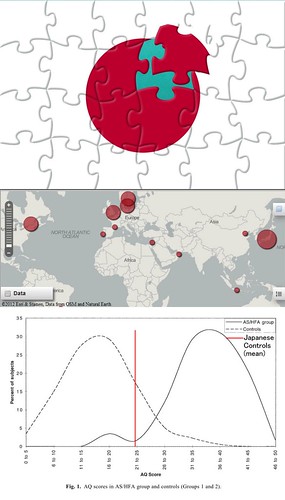
As testified by Temple Grandin (2006), however, those with autism may develop a superior ability to "think in pictures". Indeed the Autism Spectrum Questionnaire (AQ) contains some items that relate directly to the mental ability to create and manipulate images. From the Nacalian perspective of this blog -- that Japanese have a self in the mirror 'stage' rather than a self as narrative -- one would predict that Japanese would be 'somewhat autistic' or share some commonalities with those that are deemed to have autism.
What does the science say? First of all one finds that, though autism is increasing worldwide especially in the West, the prevalence of autism is argued to be higher in Japan than anywhere else in the world with, 118 cases per 10,000 children (see Hughes, 2011). Secondly comparisons of scores on the above mentioned Autism Spectrum Questionnaire, which gives a score between 1 and 50, finds that average Japanese student score of 22.4* is 6 points above that of British students (16.4) and lies almost in the middle between British students, and British in the Aspergers Syndrome or High Functioning Autism group (Baron-Cohen, Wheelwright, Skinner, Martin, & Clubley, 2001; Kurita, Koyama, & Osada, 2005).
Some of this difference may be due to the possibility that" the Japanese translation might have changed the meaning of some items to be more agreeable for the Japanese to score 1, although the back translation was satisfactory"(Kurita, Koyama, & Osada, 2005, p495). While translation issues may be responsible for some of the difference, I suggest that an increased tendency in Japan to think in pictures rather than words is likely also to explain some of the difference.
By pointing out this data I in no way mean suggest that the Japanese are in any way "disordered", but rather, as those with autism are themselves sometimes found to claim, the ability to think in pictures as opposed to words - if that is a characteristic difference found in autism - is not a disorder, but a difference, especially perhaps in the land of anime, manga, the zaniest fashion, and making things (monodukuri), not words.
Image top: ‘Flag of Japan made into a Jigsaw’, n.d. Jigsawplanet
Image middle: (Hughes, 2011)
Image Bottom: Baron-Cohen, Wheelwright, Skinner, Martin, & Clubley, (2001 p.9), with added data from Kurita, Koyama, & Osada, (2005)
*The average for Japan of 22.4 was created by averaging the Japanese male and female averages given in the text.
Bibliography
Baron-Cohen, S., Wheelwright, S., Skinner, R., Martin, J., & Clubley, E. (2001). The autism-spectrum quotient (AQ): evidence from Asperger syndrome/high-functioning autism, males and females, scientists and mathematicians. Journal of Autism and Developmental Disorders, 31(1), 5–17.
Flag of Japan made into a Jigsaw. (n.d.). Jigsaw Planet. Retrieved 24 February 2014, from www.jigsawplanet.com/?rc=play&pid=07b457ea244c
Grandin, T. (2006). Thinking in pictures: and other reports from my life with autism. New York: Vintage Books.
Hughes, V. (2011, April 7). Researchers track down autism rates across the globe — SFARI.org - Simons Foundation Autism Research Initiative. Retrieved 24 February 2014, from sfari.org/news-and-opinion/news/2011/researchers-track-do...
Kurita, H., Koyama, T., & Osada, H. (2005). Autism-Spectrum Quotient–Japanese version and its short forms for screening normally intelligent persons with pervasive developmental disorders. Psychiatry and Clinical Neurosciences, 59(4), 490–496. Retrieved from onlinelibrary.wiley.com/doi/10.1111/j.1440-1819.2005.0140...
Labels: japan, japanese culture, Jaques Lacan, Nacalian, 日本文化
Monday, February 17, 2014
The One Ring Scam from Hell

Missed call scams, where criminals ring mobile phones for one ring, then cut off in the hope that the receiver will ring back and be connected to a number that costs them money, have just hit the USA in early 2014 (CNN Money, KLTV, CBNC). They had a very brief life in the UK in 2004(BBC). But as any Japanese mobile phone user (over the age of about 30) is aware, "one ring scams" (Or "wan giri" one (ring and) cut=kiri) have a far longer history. The one ring scam (wangiriワンギリ) originated in Japan at about the turn of the millennium, and were still prevalent at least in 2013 (see mobile phone au carrier's warning, in Japanese, update history).
The Japanese are generally so honest (at least according to OECD crime statistics) and cautious (e.g. with higher "uncertainty avoidance", Hofstede, 1980) than other nations. The Japanese are so bright and bushy tailed, it is strange that a scam of this type should originate in the land of the rising sun.
That these calls started in Japan is I feel because the Japanese are more susceptible. Japanese people are more likely to see that missed call and ring back. Is it because the Japanese are more polite, feeling obliged to respond to missed calls? Or is it that Westerners can rely on genuine callers leaving voice-mail, but the shy, and somewhat tongue-tied Japanese can not. These are probably both part of the motivation, but I think that something else is going on. As a Texas TV station opines.,"They [the scammers] are preying on the victim's curiosity," and the Japanese are that much more curious about missed phone calls. This is because, I believe, Japan is, collectively, missing a phone call, missing a connection.
As often argued on this blog the main difference between the psychology of Japanese and Westerners is in the medium of their "generalised other." Western psychologists argue that humans, or at least all Westerners, have or have simulated an imaginary friend (Wyndham, 1968) in their head. If you are Christian you believe that you have a friend in Jesus, and a psychic hot-line to God. If you are a Western psychologist then you theorise this entity in secular terms as a "super ego" (Freud, 1913) Other (Lacan, 1967 [2007]), alter ego (Derrida, 1978) "generalised other" (Mead, 1967), "impartial spectator" (Smith, 1812; see also Brat, 2005) "super addressee" (Bakhtin, 1986. p126).
Taking the last example, Bakhtin was a Russian literary critic who dabbled in psychology (and inspired a branch of psychology: Hermans and Kempen, 1993), He argues that language is always understood in dialogue. Even when we are on our own we imagine how our statements would be understood by those to whom we will address them. Bakhtin goes on to say, since the self is also understood via self-speech, if we were incapable of understanding who we ourselves are without real others, we would be in hell. We would be continually dependent upon the understanding of whomever we are talking, or plan to talk, to. If we are not understood then we would not understand ourselves. Our meaning, our thoughts, and desires, would be lost in a fog of confusion. Fortunately, Bakhtin says (along with all the other Western commentators) even when we are talking to someone present, and more so when we are on our own, we are always also 'talking off' to a super-addressee. Taking the metaphor of email, Bakhtin argues we are always also sending a "BCC" - by mistake or on purpose - to one of our parents, or God.
As argued by Mori Arimasa (1999) , and myself, in Japan there is no such generalised ear of the Other. Japanese people just talk to other people. They send just email to other people. They do not absent mindedly BCC. Their words are for, and only for, the person that they are sent to. Japan is therefore a Western hell, since the Japanese are not wired up to the ear in the sky. Yahew-san's phone is off the hook. There is nothing but 'Silence,' (Or perhaps white noise. c.f. the phone call that Sanada Hrioyuki's role receives before he he is visited by the Other from the image - Sadako!).
Lacking a psychic hot-line, the Japanese are I argue, that much more curious about missed calls. "One day someone is going to phone", they think. One day they will be connected. And this is why the one ring scam works that much better on Japanese and is (or was, even the Japanese tire of it) that much more prevalent. It is probably also linked to Japanese susceptibility to that other form of Japanese scam "Its me, its me" (ore ore) phone calls. The Japanese are, in the solitude of their silence, always hoping that someone who loves them and needs them, will ring them up.
Fortunately, the Japanese are not in Japanese hell at all because they have another type of more maternal, impartial spectator or super-addressee: Mirrors in their Heads (Heine, Takemoto, Moskalenko, Lasaleta, & Henrich, 2008).
Bakhtin, M. M. (1986). Speech Genres and Other Late Essays. (V. W. McGee, Trans., C. Emerson & M. Holquist, Eds.) (Second Printing.). University of Texas Press.
Brat, D. (2005). Adam Smith’s God: The End of Economics. Virginia Economic Journal, 59. Retrieved from faculty.rmc.edu/dbrat/researchpapers/2005VAEAdamSmithPape...
Derrida, J. (1978). Edmund Husserl’s origin of geometry: An introduction. U of Nebraska Press. Retrieved from http://books.google.co.jp/books?hl=en&lr=&id=pW9PQxAOo0sC&oi=fnd&pg=PP9&dq=Origin+of+Geometry&ots=cxr_EUp0d5&sig=8cjF6mBUi60BuZEUBK_0blBL1sUFreud, S. (1913). Totem and taboo. (A. A. Brill, Trans.). New York: Moffat, Yard and Company. Retrieved from en.wikisource.org/wiki/Totem_and_Taboo
Heine, S. J., Takemoto, T., Moskalenko, S., Lasaleta, J., & Henrich, J. (2008). Mirrors in the head: Cultural variation in objective self-awareness. Personality and Social Psychology Bulletin, 34(7), 879–887. Retrieved from www2.psych.ubc.ca/~heine/docs/2008Mirrors.pdf
Hermans, H. J. M., & Kempen, H. J. G. (1993). The Dialogical Self: Meaning as Movement. Academic Press.
Hofstede, G. (1980). Culture’s Consequences: Comparing Values, Behaviors, Institutions and Organizations Across Nations (2nd ed.). Sage Publications, Inc.
Lacan, J. (2007). Ecrits: The First Complete Edition in English. (B. Fink, Trans.) (1st ed.). W W Norton & Co Inc.
Mead, G. H. (1967). Mind, self, and society: From the standpoint of a social behaviorist (Vol. 1). The University of Chicago Press.
Smith, A. (1812). The theory of moral sentiments. Retrieved from books.google.co.jp/books?hl=en&lr=&id=d-UUAAAAQAA...
Wyndham, J. (1968). Chocky.
Mori, A. 森有正. (1999). 森有正エッセー集成〈5〉. 筑摩書房.
Labels: japan, japanese culture, Jaques Lacan, Nacalian, nihonbunka, 日本文化
Wednesday, February 12, 2014
Kata as The Japanese Mirror Stage

No, infants do not first become aware of themselves via mirrors, their mirror self-awareness is concomitant with their linguistic self awareness. Lacan himself prevaricated and or re(?) described the "stage" as a logical stage, not necessarily prior but necessarily implicated in the formation of a narrative self.
Lacan's theory of the mirror stage is useful at least as a metaphor to explain how the narrative self is also an other.
The majority of Western theories of self, at least those trending currently (Dennet), and probably since Plato, certainly in Mead, and probably in Adam Smith, see the self as a product of self narrative. These same, seemingly down-to earth, non-Lacanian, non-French, almost common sense and widely applied theories introduce otherness, the "impartial spectator" or the "generalised other" and have even the most staid economists and psychologists persuaded that our selves, are like others even to ourselves.
Here, Lacan's theory of "the mirror stage" is useful to explain, at least as a metaphor, how our narrative self is also an other. How could it be that the self is an other? Isn't this a grammatical error, a contradiction? Lacan's theorey provides a metaphorical solution. The self as narrative is routed in the self as mirror image, and as a replacement for the mirror image, a self representation. The self as narrative is a replacement for the self as mirror image, but while replacing the mirror image it remains at a distance, a wordy version of oneself in a mirror.
That said, according to Lacan (and implicitly in Mead and others) the self as narrative is superior to the self as image, in that it can be achieved, held, recognised, without the cooperation of real people or real reflecting surfaces outside oneself.
To use an analogy from chemistry, the "mirror stage", for the Western self, is a sort of catalyst. The need for a catalyst demonstrates a hurdle, a gap, but catalytic action does not occur prior, but concomitantly, it gets the ball rolling, but even as it gets the ball rolling it is accompanied by the reaction that it is there to ignite.
Recent work in neuro psychology (mirror neurons) and the philosophy of self (ego tunnel) has shown however that the common sense assumption that you need a mirror (or other people's faces, a reaction, an audience) to see yourself
is just not true. Humans can see themselves from the point of view of others just as clearly as they can hear themselves from the point of view of others.
As an aside, the surprising lesson from this recent mirror neuron related research for me, is not so much that "Wow, we have found that humans have the ability to see ourselves from the point of view of an other!" but rather, "Oh, come to think of it, hearing ourselves, our self-narration, from the point of view of an other is pretty darn amazing. How did we come to be able to do this?" Lacan's answer "Because, we saw ourselves in mirrors" goes only part of the way towards an answer.
Now to the point of this post which is merely a modification of a previous one using the same image, above, Judith Butler argues in "Bodies that Matter," that iterable (repeatable) movements allow for bodily, self representation. Taken on face value, this seems to imply that the (Japanese, I assert) self is a sort of sign language. I groaned inwardly as I contemplated Butler, and wondered if the Japanese are narrating themselves using bodily movements.
The point of this post is to suggest that no, that Japanese autoscopy, the Japanese imaginary, mirror self is not a self represented by Kata, of symbols that are moved rather than spoken. Rather, the Japanese iterable movements, their Kata, are equivalent to the mirror image, catalyst of the narrative self.
In other words, Kata to the Japanese, and mirror images to the Westerner, are a catalyst that kick-starts a fluid, independent (as it gets), self cognition.
Westerners see the mirror image and learn to narrate it, the Japanese say, or sign, their Kata and learn to see them. Or, rather, the mirror image, self as image, is catalyst for the narrative self, the Kata self as signs, a catalyst for the mirror self.
In Sumo, Judo, Karate, there are names for all the moves. But people who have learnt the kata, and know the moves, go beyond them. The kata are a stepping stone, a stage, a catalyst, like the Lacanian "imago" in the mirror.
I have been doing Karate, badly.
Labels: japan, japanese culture, Jaques Lacan, Nacalian, 日本文化
Monday, December 16, 2013
Japanese High School Girls and the Real Visual

Risa Risa research institute has just published a list of the top 8 most popular things among Japanese high school girls. Get your pens ready! The top eight are as follows
1 Line (Skype for Smart Phones?)
2 Funasshi- (a cuddly character representing Funahashi City)
3 Twitter
4 Pretending to be "Attack Giant" in trick photography (above bottom)
5. TwitCasting (Twitter for Android?)
6. Makankou Sappou (Hadouken-ing, or Vadering) pretending to use the power of the force to move people in group versions of fast exposure "Yowayowa Kamera" style flying photography (above top).
7. Daisy Patterned Fabric
8. "Director Wrapped" jumpers (wrapping ones sweater or jumper around ones neck, with its arms used as a scarf).
All the above are important in informing investment decisions, and new product ideas. I would like to draw attention to the inclusion of two forms of trick photography (illustrated in the above photo), that emulate scale and motion through trick photography. Why should this be popular in Japan? I think that images have always been very popular in Japan, so much so that the Japanese identify them. Westerners tend to think of the real, scientific world being a linguistic construction, or mapping one to one with language, and images as merely the cover or "wrapping." In Japan however, words are the fluff, and reality is the in the image. If it looks real, then to most intents and purposes it is. Hence the popularity of Japanese idols, foreign villages, robots, look-good-but-tasteless-cakes, sweet curry-looking-custard, smiles, characters, manga, anime and as above, trick photography. The real is visual, the visual is real in Japan.
Images copyright their respective owners from the google image search for マカンコウサッポウ and 進撃の巨人ごっこ.
Labels: japan, japanese culture, Jaques Lacan, Nacalian, 日本文化
Saturday, December 07, 2013
Get a Third Person to Stare back at You

From a distance wordy, logocentric Western culture can look rule bound, "A society based upon manuals." However, even in the case of McDonalds, the genuine objective of the manual is to go beyond the manual - the manual is only a stepping stone - to "TLC" or Tender Loving Care.
Like wise, from a distance, Japanese society can appear to be "stuck in the mould," formulaic, in so far as so many Japanese praxes emphasize the learning of set forms or "kata." But the objective in so doing, is to go beyond the forms.
So, if in both cases, both Americans with their manuals and Japanese with their forms intend to go beyond them, why do they have them at all?
My answer is that the real reason behind the Western fascination with books and language, is that language provides a generalized other, the ability to take an objective third person perspective upon self.
And the real reason by the Japanese fascination with kata is, as the red "belt" of this book (written by the editor at BAB Japan, as a summary of the contents) claims, that through the practice of a martial art one obtains a third person perspective that stares back at you, a gaze apart (Riken no Ken Zeami), a Mirror in your Head (Heine et al.)
Archimedes said, "Give me a fulcrum, and I shall move the world." I say, give me a third person perspective, and I will create a self. It is about time I started learning Karate.
Labels: japan, japanese culture, Jaques Lacan, nihonbunka, 日本文化
Thursday, November 28, 2013
It was the Neck-tie! Culture and judgement of Causal Relevance

Choi and his collegues (2003) asked Korean and US subjects to consider a murder incident where a student had murdered his research supervisor. They were then shown a list of 40 factors and asked which of them were irrelevant in terms of motive.
The list included items such as the following: "The professor rejected the student's graduation thesis," "The professor criticised the student in front of others," "The professor used a PC not a Mac," "The graduate student did not like the professors' neck-tie." It was found that while North Americans considered only the big life changing factors (such as failing the student's thesis) relevant, the Korean subjects were significantly less likely to strike other items off list, considering in some case, factors such as the colour of professors' tie to be a contributing factor in the occurrence of the murder.
First of all, despite what Westerners say, I think that the Koreans are not being unrealistic. Take the weather for instance. The hero of Camus' The Outsider ended up killing an Arab partly because it was a hot sunny day, and there is well known relationship between elevated temperatures and violent crime. When conflict is brewing, the fact that it is a hot day can be the final straw.
Choi et al. (2003) explain East Asian sensitivity to the complexity of causality in terms of Masuda and Nisbett's (2001) brilliant theory of analytic and holistic thought. The Koreans are being holistic and taking more factors into consideration.
What Choi does not often mention (I asked him at a conference) is that when the method was reversed, and Koreans were asked, after they had imagined the murder, which factors out of this list are relevant, then they chose no more factors than the Americans. Why is this? Why do the Koreans cease to be more 'holistic' when the choice is presented in this way?
My answer is, as always, that the cultural divide hinges on the relative importance of language and vision. Westerners decide that a factor is relevant if they can construct a compelling narrative for the killing. "He murdered his professor because his professor failed his graduation thesis" is compelling, but "He murdered his professor because he did not like his tie" sounds like a joke.
The Koreans on the other hand are trying to get their imagination around the event, putting themselves into the position of the student. Using their visual imagination they can therefore neither reject factors which it is suggested were present - such as the weather, or the neck tie which might have been the breaking point - nor include factors which they had not imagined. This is because, in both Korea and Japan, language is subservient to vision. Language describes the visual world. On its own it is a lot of bumf (rikutsu).
Bibliography
Camus. A. (1942) L’Étranger. Libraire Gallimard.
Choi, I., Dalal, R., Kim-Prieto, C., & Park, H. (2003). Culture and judgement of causal relevance. Journal of personality and social psychology, 84(1), 46. Retrieved from psycnet.apa.org/journals/psp/84/1/46/
Labels: culture, image, japan, japanese culture, Jaques Lacan, Nacalian, nihonbunka, occularcentrism, 日本文化
Wednesday, November 27, 2013
Brought to the Courtroom

Japanese people are less likely to adorn their desk at work, or the shelves in their homes with pictures of their relatives, with one exception. Pictures of deceased relatives are often hung above the ancestral altar. This is because, I believe, pictures of people are felt to be so real that it is almost as if they are felt to be present in their picture, as they are felt to be present also inside the altar. Another example of this use of photographs to represent the deceased is the way in which surviving family members of victims and plaintiffs bring pictures of deceased relatives to Japanese courtrooms.
In the above photo (Asahi Newspaper, 17th April, 2013, Photograped by Nishibatake Shirou) Akio Mizoguchi has brought a picture of his mother, deceased, to the High Court of Japan, where it was decided that she was indeed a victim of minamata disease. Mr. Mizoguchi is shown celebrating his, and his mother's victory in the court case. He has brought the photo of his deceased mother so that she may share in the proceedings and eventual victory. Similarly, pictures of deceased victims are sometimes brought by their relatives to murder trials. These behaviours go to demonstrate that contra Westerners, who are meant to grow out of their "mirror stage," the Japanese continue to identify with images even in adult life, and even, in the case of others, post death.
The strong identification between visual images and person hood also explains why so many Japanese ghosts are felt to emerge from images such as hanging scrolls (1,2) lanterns (1,2, 3) and more recently television sets.
取り下げご希望でありましたら、下記のコメント欄またはnihonbunka.comのメールリンクからご連絡いただければ幸いです。Should anyone wish that I remove this image from the Internet, please post a comment below or send an email to me via the link on my homepage, nihonbunka.com.
Labels: autoscopy, culture, image, japan, japanese culture, Jaques Lacan, lacan, mirror, Nacalian, occularcentrism, religion, ring, ringu, specular, 日本文化, 自己視
Thursday, September 19, 2013
Pokémon Demonstrates the Futility

My daughter May is at the age where she has got the language bug and goes around mumbling to herself, in a perpetual monologue, often based on the theme of Pokémon, a cartoon series that she watches with her elder brother.
Pokémon are pocket monsters: little creatures with large superpowers that live in the pockets of their human trainers. The most famous pictured (poorly) above is Pikachu, a cross between a mouse (that say "chu chu" in Japanese) and a lightening flash, "pika", in Japanese onomatopoeia.
The interesting thing about these monsters is that while they speak, the only thing that they say is their name. Pikachu only ever says "Pikachu," or "Pika" for short, in various tones of voice, often by means of self-encouragement or self-comfort. Pokémon are bundles of auto-affective cuteness that use language solely to remind themselves of themselves and how cute they are.
Various theorists have argued that language is useful for communication (Dessailes, 2007), and the most famous that language must be useful for cognition (Chomsky, 2002). But the truth is Pikachu.
The mental mirror that language provides when we use it, the means, is the end. Futility!
Incidentally, the nuclear bombs were called "pika don" (flash boom) by the Japanese children upon whose cities they dropped on. Perhaps even, through Pokémon, they will have peaceful, but mind-blowing retribution. Pika!
I note that Pokémon can even dangerous to Japanese children.
Radford, B., & Bartholomew, R. (2001). Pokémon contagion: photosensitive epilepsy or mass psychogenic illness?. Southern medical journal, 94(2), 197-204.
Labels: japan, japanese culture, Jaques Lacan, Nacalian, 日本文化
Thursday, August 01, 2013
Japanese Wide Show Mock-up
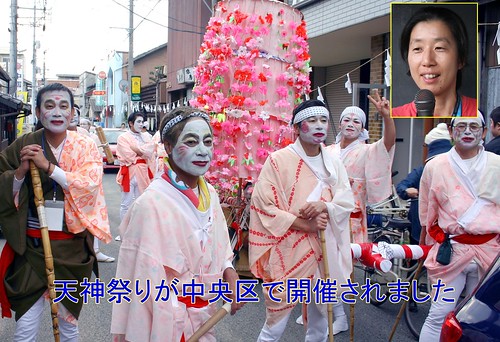
1) The faces of the commentators are seen displayed during the parts of the current affairs program that are filmed on location, so that viewers can SEE the expressions, and see the feelings that are being felt. (c.f. the face, in the top right hand corner)
2) The Japanese is given subtitles so that the viewers can *see* what is being said.
On the other hand, in the West, the viewers are provided with copious amounts of canned laughter so that so that they can know when to laugh. The principle is the same - the folks at home need to be told when to laugh - but while Japanese are stimulated by visual images, Westerners are comparatively "(logo) phonocentric" (Derrida, 1998).
In some Western News shows there are also teletypes providing extra linguistic information rather than a subtitles to what the presenters are saying. The majority of Westerners do not need to see what is being spoken, but they do like to feast upon as much linguistic information as possible.
Derrida, J. (1998). Of grammatology. JHU Press.
Labels: japan, japanese culture, Jaques Lacan, Nacalian, nihonbunka, occularcentrism, theory, 日本文化
Tuesday, July 02, 2013
Ghost in the Shell

With their honed ability at autoscopy (Metzinger) from a third person perspective, a sight apart (riken no ken, Zeami), Japanese can see themselves even without the aid of mirror. Equipped as they are with visual symbols for self they feel themselves "merged" (gattai!) and have overcome Lacan's horrible "hommellette."
However, even seeing themselves, and knowing that they are in there somewhere, but where? They are, even or especially when wearing only their skin, like a ghost in a shell.
Bottom image, promotional poster for Ghost in a Shell copyright held by the producer of the animated film, Production I.G.
Labels: japan, japanese culture, Jaques Lacan, Nacalian, nihonbunka, 日本文化
Tuesday, June 18, 2013
The Man of Steel and The Masked Rider
Many Western scholars (e.g. Dennet, 1992) claim that we identify with the voice of conscience, the words in our head. One guy (Lacan, 2007) points out, that we also need to identify with our images of our face and body, that give a centre, place, or covering (Baudrillard, 1995), for our thoughts. He also says that identifying with our body image alone is impossible because we'd need to carry a mirror all the time. Language, on the other hand, provides a view on the self from the point of view of another, the Other (Lacan, 2007), the super-ego (Freud, 1913), an impartial observer (Smith, 1812), generalised other (Mead, 1967) or the super addressee (Bakhtin, 1986) of our thoughts. Lacan also claims that we can not identify with our self-images because we have many body images, an arm, our nose, our face in the mirror, a face from years ago. Our body images are a mishmash or human omlette (hommellette).
Recent research has shown however that humans have the ability to see themselves from an external perspective at a neuronal level (Blanke & Metzinger, 2009; Iacoboni, 2009; Metzinger, 2009). This ability to simulate seeing oneself without a mirror is found to be especially strong in East Asians (Heine, Takemoto, Moskalenko, Lasaleta, & Henrich, 2008; Wu & Keysar, 2007). The ability to see oneself is argued to be enhanced by performing fixed poses or kata (Zeami, 1984; Butler, 1993).
I theorise, therefore, that the Japanese identify with their body images, rather than their internal voice. Further, that just as Western body images provide a place for thoughts to take place, language or symbols even symbolic gestures - which are above all reiterable (Butler, 1993): repeatable, enduring in time - provides cohesion to the Japanese imago-self by giving a sort of temporal core that links the aforementioned scrap-book, or omelette, of body-images together.
Now onto superheroes. I theories that they are myths for the development of the self.
The quintessential Western superhero, Superman is someone that spends a lot of his time thinking to himself. His words, as his true identify, fly. He has two fathers. He converses with the memory of his astral father that endowed him with super powers. Superman is a hard-boiled, self narrator. His super suit, the image he presents us, is merely a cover for this true identity.
Many Japanese heroes however transform in front of people with great aplomb. Not for them the telephone box, some of them even transform on stage (Shinkenja). The requirement that heroes transform is universal since they deal with the genesis of the self, but only in the West is transformation required to hide a secret identity. Japanese super heroes use super-symbols (an amulet from a Shrine in Mirror Man; a beta capsule in Ultraman, medals, cards, characters written in the air, or rings in Kamen Rider; a seal in Mitokoumon, and lots of kata or poses: see second video above) which allows them to transform into their super form. Japanese heroes have suits too, or rather and in many ways they are their suits, especially in Kamen Rider (and a more extreme degree in Gundam and Evangelion).
These two genres of superhero, Western and Japanese illustrate the genesis of the self formed of language and image. Superman is his thoughts. His suit or image is merely a covering that allows him to be his true identity. Kamen Rider's super heroism resides in his suit. His symbols are an externally derived catalyst that allows him to transform, and pull his suit together.
Finally this brings me to a further aspect of Japanese superheroes. After they transform (Henshin) They often combine (especially in the Power Rangers series), which illustrates I believe two things: the cohension of various self images or "hommelette", and the combination of various self views, the generalising of the visual other. Gattai.
Upon this analysis, Iron Man is a cross-over hero for Americans and Japanese.
Acknowledgement
Thanks to James Ewing, to whom his post is dedicated, for drawing my attention to Mirror Man, one of the first transforming Japanese superheroes, which provides the link between symbolic transformation, Lacan, and the Japanese Shinto religion. Shinto shrines are sacred mirrors or places that dispense signs (amulets/omamori), Christian churches are houses of sacred language that dispense "the body".
Bibliography
Baudrillard, J. (1995). Simulcra and Simulation. (S. F. Glaser, Trans.). Univ of Michigan Pr.
Blanke, O., & Metzinger, T. (2009). Full-body illusions and minimal phenomenal selfhood. Trends in Cognitive Sciences, 13(1), 7–13. doi:10.1016/j.tics.2008.10.003
Butler, J. (1993). Bodies That Matter: On the Discursive Limits of "Sex. Routledge.
Dennett, D. C. (1992). The self as a center of narrative gravity. Self and consciousness: Multiple perspectives.Freud, S. (1913). Totem and taboo. (A. A. Brill, Trans.). New York: Moffat, Yard and Company. Retrieved from http://en.wikisource.org/wiki/Totem_and_Taboo
Heine, S. J., Takemoto, T., Moskalenko, S., Lasaleta, J., & Henrich, J. (2008). Mirrors in the head: Cultural variation in objective self-awareness. Personality and Social Psychology Bulletin, 34(7), 879–887. Retrieved from http://www2.psych.ubc.ca/~heine/docs/2008Mirrors.pdf
Iacoboni, M. (2009). Mirroring people: the science of empathy and how we connect with others. New York, N.Y.: Picador.
Lacan, J. (2007). Ecrits: The First Complete Edition in English. (B. Fink, Trans.) (1st ed.). W W Norton & Co Inc.
Mead, G. H. (1967). Mind, self, and society: From the standpoint of a social behaviorist (Vol. 1). The University of Chicago Press.
Metzinger, T. (2009). The Ego Tunnel: The Science of the Mind and the Myth of the Self (1st ed.). Basic Books.
Smith, A. (1812). The theory of moral sentiments. Retrieved from http://books.google.co.jp/books?hl=en&lr=&id=d-UUAAAAQAAJ&oi=fnd&pg=PP18&dq=%22The+Theory+of+moral+sentiments%22&ots=mjeEAFSIge&sig=LNXhHkNjKAWc2r9r_KiRDFxn_Pg
Wu, S., & Keysar, B. (2007). The effect of culture on perspective taking. Psychological science, 18(7), 600–606. Retrieved from http://pss.sagepub.com/content/18/7/600.short
Zeami. (1984). On the art of the nō drama: the major treatises of Zeami ; translated by J. Thomas Rimer, Yamazaki Masakazu. Princeton, N.J: Princeton University Press.
Labels: Bandai, Bokenger, henshin, image, japan, japanese culture, Jaques Lacan, Masked Riders, nihonbunka, スパー戦隊, 仮面ライダー
Friday, January 25, 2013
Communal Fantasy

The Wikipedia page on the book claims that it is not only a difficult book but also that it is like a Rorschach inkblot test in that different people read into it different things.
Yesterday I read it again and found it in a way of describing that which replace Oedipal, sexual fantasies in Japan.
In the preface Yoshimoto introduces "communal fantasy" (共同幻想) as fantasies or psychological constructs shared by a society. He later uses the example of mythology. Under this interpretation "communal fantasy" is close to Jungs' collective unconscious and the culture of cultural psychology: "shared understandings."
However in the first chapter "communal fantasy" emerges from a discussion of taboo in Freud, as an alternative class of taboo.
Yoshimoto notes that taboo is associated with ambivalence. Those things that taboo are not only rejected and hated but also loved and wanted at the same time. Then as an alternative to the "pair fantasies" manifest in incest taboos - the fantasy of incestual sex - "Communal fantasies" are introduced to describe initially the ambivalence towards kings and chiefs. (Yoshimoto does not need, or can not, mention the emperor since certainly the emperor of Japan is taboo subject in Japan).
Thus, the word "fantasy" (幻想) is used not only to describe psychological contents but also aspiration: fantasy in the sense of what people fantasise about, what they want, what they desire (even if they hate it as the same time).
Secondly, when he talks of sexual fantasies as "pair fantasies," (対なる幻想) the meaning of "pair" is transformed from a subject to an object or objective. Incestual sexual fantasies as "pair-fantasies" are not, necessarily at least, fantasies held by pairs, but fantasies about pairing. I don't think that Freud argues anywhere that Oedipal fantasies are necessarily, or even often, held equally on the part of mothers and fathers - the fantasies are held largely or exclusively on the part of children. Equally, , as a parallel concept, "communal fantasies" are not simply or even necessarily fantasies held by communities so much as fantasies of communing, of merging, melding, being one. And this fantasy may also be taboo, as there may also be taboos associated with the commity represented in the person of a king, or emperor*, for example.
As previously discussed, bearing in mind the bedroom arrangements in Japanese homes, the way that nakedness, communal bathing, touching and sleeping together are all everyday events that are not the subject of taboo, it seems clear that sexual incest taboos are not a prime mover in Japanese development. Children already get to sleep with their mothers. Their fathers do not step in with their paternal prohibition, but rather on the far side of their children, sandwiching their children closer to their mother. So how could the Japanese bow be tightened? How could, how do the Japanese ever grow up?
Cynics might say that the Japanese do not grow up, but it seems to me, with all the studying and almost religious ascetic practising of sports, and martial arts, that the Japanese child's trajectory into Japanese adulthood is no less motivated, the Japanese bow is no less taught. So, to coin a war poem, what made fatuous Japanese toil to break out of mummies bed at all?
My answer is that rather than incestual "pairing fantasies", the Japanese are propelled into the world by "communal fantasies", they desire communitas, they want to merge (合体), with mother, with father, with the community of parents, progenitors, ancestors and even eventually the gods.
Considerations such as the above may also related to the previously discussed way in which images and mothers in the West, and fathers and symbols in Japan, are to blame for, or catalytic in propelling the infant in a quest for something else something more.
The father in Japan, even as he says, go on sleep next to your mother is living symbolic proof - "father" - that the child is not a parent. A child of my acquaintance fantasised that a sibling was that child's own child. But the presence of the father and mother, the fact that they come as a set, presents a different type of prohibition, a parental prohibition that says to the child "No! You are not one of us. You are not a parent too!" And so all that toil, and study, and waiting and sweating and longing begins.
Notes
天皇は、日本國の象徴であり、日本国民の総合の象徴であって、その地位は日本国民の至高の総意に基づく。The emperor is the symbol of Japan and the symbol of the will of the Japanese people, and this status is based in the highest will of the Japanese people.
吉本隆明. (1982). 共同幻想論 (1982年) (改訂新.). 角川書店.
Labels: japan, japanese culture, Jaques Lacan, lacan, sex, 合体, 日本文化
Saturday, December 08, 2012
Dconstructing Haiku 2

五月雨や 大河を前 に家二軒
Samidare ya, Ookawa o mae, Ni ei ni ken
A May shower 'n,
A big river prior,
To two houses.
At first this haiku may seem intractable to Dconstruction* and a straightforward description of a scene. The poet is just standing in the rain looking a a couple of houses on the far bank of a large river. Yes that is what the poet is doing.
But, also, on further inspection this three phrase poem is managing to do what almost no other haiku achieves - to feed the viewer not one but two interpretation tainted, symbolically produced images, before taking them both away to leave only the emotion and the truth of the image: the terrible purity of the experience.
The first trick in this poem is that the poet makes us think that he is talking about seeing rain. The second is that the "ya" in the first phrase usually means "lo" "look" or "!" Ordinarily, the first line would mean "Lo, it's a May shower," but here it doesn't. Panning poetic exclamations, Buson is just telling it as it is.
As noted the previous post, Basho sets up a poem with "May shower" before telling us that he is talking about the rainwater in the river. Echoing that poem both in subject and style, the immeasurably laconic Buson manages to trick us twice.
By the time we get to the second phrase, we start to realise that the "ya" in the first was not "lo and behold" but simply "and," echoing, more prosaically, the way in which Basho's "quick" turns out to mean the speed of the river, not that of collection.
It is difficult to find a word in English that can mean both "look" and "and" but I have gone with what may sound like a meditative "nnn," which turns into the "'n" of "fish 'n chips."
In any event, by the time we get to the end of the second phrase (o mae) "prior," the penny really starts to drop. Buson wasn't even looking at the river!
The poet wasn't looking at a May shower at all (which are generally invisible, like jumping frogs) or even at a river, but at two houses. We realise that once upon a time a soaking wet poet stood in the rain near a big river looking with longing at the two houses on the far side. He did not see the May shower. There is a good chance he did not even see the big river, though his mind was full of negative thoughts regarding both of them. He was probably wet through. The sound of the shower and the roar of the river were probably amplifying the cold.
All he actually saw, or at least all that he was actually looking at, was two houses. And when we see that pair of houses with Buson, the "May shower" and the "big river", dissolve like raindrops in his boundless, longing gaze.
The use of "ni" (two and to) twice in the final line emphasises the solitariness of the poet and the warm welcoming communion of the houses he wishes he could reach.
*Dconstruction a Nacalian transformation of Derridean Deconstruction, wherein instead of showing how a text uses image tainted signs to purify the sign, shows how sign tainted images are are used to purify the image.
Labels: japan, japanese culture, Jaques Lacan, Nacalian, nature, nihonbunka, 日本文化
Thursday, December 06, 2012
Kyari, Super Suits and Symbols


Eschewing telephone boxes and toilets, Japanese superheroes transform in front of everyone with great aplomb, sometimes on stage. They use symbols to transform. And they also have, and sometimes become, suits. Often what the Japanese Clark Kenta changes into is a super suit. Their super form that -- vectored by the symbol -- possess them is often a sort of exoskeleton. They have bug eyes, but no mouths. Speaking, even mumbling, is quite out of the question. Ultramen are pure body, pure light.
Both types of super hero use the image and the symbol but in different directions, with reversed means and ends. The Western suit is the *means* to conceal and continue the objective: the super identity that the hero always was. The Japanese transformatory symbol, and Kyari Pamyu Pamyu's choreographed "Kata," are a means to transforming into ones super suit, or assuming the visual three-eyed* identity that Kyari represents.
*Kyari has two eyes on her face and another, that looks at her sometimes a "riken no ken" (Zeami). Zeami emphasised too that the Kata, the ritualised symbolic movements, are a means. One learns the kata, one manipulates the symbols, to go beyond them. The Japanese stop narrating themselves almost as soon as they started, but hey are not zombies (Rudd, 2009).
Image top left: Superman frente al espejo by Greenog, bottom right HG 00 Gundam by Chag
Baudrillard, J. (1995). Simulcra and Simulation. (S. F. Glaser, Trans.). Univ of Michigan Pr.
Lacan, J. (2002). The mirror stage as formative of the function of the I as revealed in psychoanalytic experience. In B. Fink (Trans.), Ecrits (pp. 75–81). WW Norton & Company.
Rudd, A. (2009). In defence of narrative. European Journal of Philosophy, 17(1), 60–75. Retrieved from http://onlinelibrary.wiley.com/doi/10.1111/j.1468-0378.2007.00272.x/full
Labels: autoscopy, culture, eye, henshin, image, japan, japanese culture, Jaques Lacan, lacan, logos, Masked Riders, morph, occularcentrism, reversal, specular, superhero, 仮面ライダー, 変形, 自己視
This blog represents the opinions of the author, Timothy Takemoto, and not the opinions of his employer.