
Tuesday, April 05, 2016
Doutaku and Doguu: Destroying the internal Other

Doutak bells are a quite mystery to me.
They are found dating from the Yayoi period when, I believe the previous, indigenous Japanese Joumon ("rope pattern") Japanese culture that had existed in Japan for millennia was invaded by horse mounted invaders from the continent. These bells were probably originally horse-bells, to allow horse mounted warriors to know where their horses are in the dark for instance. They started out being about the size of the bell that Ray is holding in the above photo, but were gradually made in larger and larger sizes.
My guess is that these larger and larger bells were in part to prove regal (or invader) hereditary, "My father or (great great..) grandfather was a horse mounted warrior." And with each passing generation the bells were made in larger sizes, perhaps.
The Japanese themselves have a tendency to believe that there was no "invasion" and that the Joumon people evolved into Yayoi people, and subsequently Kofun people, due to the arrival of "technology" from the continent rather than due to subjugation. The Japanese tend to believe, traditionally at least, imho, that their culture is continuous or contiguous from the year dot. And they may be right.
The genetic record however seems to point to a considerable differences (in height for instance) with at the same time much overlap, so at least there was interbreeding between an indigenous and arriving race. On the other hand, I suppose that genes might also be described as a "technology," and Japanese culture may have survived changes to the gene pool. I think it very likely.
I imagine Yayoi warriors arriving and breeding (no offence intended) with the indigenous Joumon people, and then later a second wave of invaders (related to the first) arriving in the Kofun (ancient burial mound) period. This two wave hypothesis is suggested by some (Korean) historical interpretations of Japanese mythology. After the latter wave vast tombs were created. The creation of vast tombs, all around Japan, makes me think that there was great stratification within society. I imagine that those that were related to the invaders rounded up and forced vast numbers of indigenous and mulatto stock Japanese and had them build tombs the size of the Egyptian pyramids for their new masters. But this is all my imagination. Korean and Western historians tend to present a sort of "Japan was invaded" type of history, whereas, as I say, the Japanese tend to portray their history as one of continuous evolution with changes in society being attributed to the arrival of new technologies such as for rice farming. I guess that the difference in historical outlook is one of degree. The Japanese are, and their culture is, great at maintaining continuity, of which a great deal remains. This post is about the possibility of continuity between doutaku (as held by my son Ray) and dogu (pictured above right).
Returning to the dotaku bells, they have peculiar characteristics. They appear to have been kept, while not in use, buried in the ground, being unearthed at specific occasions. One theory has it that they were buried in order to soak up and be replenished with the spirit of the earth. The bells often have pictorial inscriptions that may be rebuses, punning on that which they represent. They seem to have a lot of water related imagery and a preponderance of images of deer.
Ah yes, I remember now (I make the same observations over and over again): it seems to me that these doutaku bells may be the origin of the temple bells that are used to ring in the new year in Japan in the "joya no kane" (除夜の鐘) ritual, which are even more massive than the largest doutak. They look similar. They are likewise inscribed. These "joya no kane" bells are now associated with Buddhist ritual to purify the ringers of sins, of which there are said to be 108.
The "rope pattern", Joumon culture indigenous Japanese, who existed for millennia, seem to have created first person body view (McDermott, 1996) figurines or dogū (土偶) which have similarities with the Venus figurines found all over the palaeolithic world. These figurines in Japan were often destroyed. I wonder if they were destroyed (and perhaps buried) in an attempt to exorcise their owners from the mother that occupied their, and perhaps all our, minds.
If so then, by a vast leap of conjecture, it might be argued that the practice of making first person body view figurines and then breaking and burying them, may have evolved into the practice of making vast bells and ringing then (at first) burying them.
This conjecture parallels the hypothesis of Lacanian (and Freudian but less explicitly) psychology which has it that the self evolves by first being represented visually as a body view, then narrativally in phonemes.
In each stage the self is paired with an other-of-the-self that witnesses the self representation.
Lacanian psychology seems to lack reference to self-person body views. The visual or "mirror-stage" is purported to be one in which the the mirror self, or third person body image such as represented in mirrors, and the form of other children with whom infants identify, is seen from the perspective of real others and is therefore groupist, and interpersonal, rather than intra-psychic (in the mind).
It is only, according to Lacan and Mead, with the arrival of language that humans internalise an imaginary friend or Other or ear (of the Other). In Lacan and Mead, and Western philosophers in general, ears are argued to be internalisable but eyes are not. They claim that one can speak, whisper and eventually "think" in words to "oneself," or rather that hidden friend, a generalised other, super ego, super addressee. Eyes are always, interpersonal, groupist, social, out there in the world.
Till the discovery of mirror neurons, our paper on Mirrors in the Head, McDermott's first person, Nishida's Mephistopheles in 'active direct vision', and the lyrics of David Bowie ("Your Eyes" in Blackstar) it was not realised that people can create a watcher within their minds.
Western theorists seem to have missed out on autoscopic potential of the mirror neuron, or McDermottian possibility that eyes are just as internalisable.
Until recently I had thought that the "eye of the Other" was internalised in an abstract, ineffable way. Japanese pictorial art is often represented from the perspective of "an eye apart," typically looking down, from the sky such as one can experience when playing Mariokart, Final Fantasy or other third person view Japanese video games (Masuda, et al., in preparation).
At the same time however, it also seems possible to model an eye within the self in a more concrete way, as the the first person view of self, such as may be represented by dogū, and the first person view that we have of their own brow nose and limbs. When I look at myself in the mirror I can see the noses and brow of the person on this side of the mirror. I can hold out my hand and caresses the surface of the mirror. Narcissus is portrayed attempting to scoop up his image from the surface of water, using his this-side-of-the-mirror hands.
In a sense perhaps the phonic equivalent of the nose and brow is the voice. I can narrate myself and when I do, when I call myself names, such as "Tim" or "I," the in that situation, there is likewise a "this side of the mirror" in the voice that expresses these names. Mead, and Derrida, rightly point out that hearing oneself speak (s'entendre parler in Derrida) introduces a believable duality. But I think that Nishida is right to point out (at least I think he is pointing out) that a similarly believable, or en-actable (kouiteki) duality exists in seeing. Since we can see our brow, and our nose(s), and often our hands, we see ourselves see. We do not even need a mirror to do so.
So, aware of the fact that self always presupposes and entails a self loving drama (with [less than/not?] one actor and two personae), in an attempt to rid themselves of their self-loving sin, the Japanese may have moved from destroying images of the self-person view in the act of destroying and burying dogū figurines, to destroying the phoneme in the act of a DONNGG, of a doutaku or joya no kane bell.
One can hear the sound of a bell on the Japanese joya no kane wikipedia page and in this Youtube Video.
Bibliography
McDermott, L. R. (1996). Self-representation in Upper Paleolithic female figurines. Current Anthropology, 37(2), 227–275. websites.rcc.edu/herrera/files/2011/04/PREHISTORIC-Self-R...
I have also argued that Japanese attempted to destroy inner ears (converting them to external ones) by snapping their earrings. The more you love others the less you love yourself, and vice versa.
Labels: autoscopy, cultural psychology, image, japanese culture, Jaques Lacan, nihonbunka, psychology, religion, reversal, 宗教, 日本文化


Friday, April 03, 2015
Sanitary Towels Galore, but Few Tampons NOW

In Japan sanitary towels or "napkins" are tremendously popular in comparison to tampons. The above image and the image at this link show the vast selection of sanitary towels available to the Japanese buying public. On the other hand this image shows the tiny selection of tampons on sale in the same shop. While Japanese tampons are fairly primitive, generally lacking aplicators, Japanese sanitary towels are extremely advanced, thin, absorbent and body-hugging.
Japanese sanitary towels come in different sizes, shapes, thicknesses and for niche markets such as "sanitary towels to wear at night" (see note). Sanitary towels used not to be advertised on television but over the past ten years there has been a proliferation of television adverts showing smiling women walking with large strides, and blue liquid disappearing to leave only white body-shaped cotton pads.
It is not clear why Japanese prefer sanitary towels so much more than tampons. The reverse is the case in the US 70% of women used tampons in 2001 (Kohen). Use of tampons in the US depends upon race. 71% of European, 29% African American, 22% of English-speaking Latina, and only 5% of Spanish-speaking Latina women use them (Romo & Berenson, 2012).
The reasons for this difference can be traced to their history. There was initial reaction against tampons in the West by their association with sex. Bishops in the British House of Lords complained about these "sinful" products, and tampons were required to display a warning that they are not suitable for unmarried women till the 1950s (AHPMA, 2007). Likewise presumably due to the taboos on premarital sex and the importance of maintaining the hymen intact, tampons are less popular in Catholic countries (AHPM, ibid) and Latina women in the USA (Romo & Berenson, 2012).
First of all I think that the lack of popularity of tampons may be related to the lack of popularity of the contraceptive pill compared to condoms. Japan is one of the worlds biggests producers and consumers of condoms, but it was only in the late 1990's, after the legalisation of Viagra, that the contraceptive pill was introduced. Many feminists claimed that it was Japanese men that prevented the contraceptive pill from being legalised. This seems unlikely to me bearing in mind the negative effect they have on male enjoyment of sex, and the positie consequences that condoms have in the protection of women. The lack of use of the pill needs to be explained in other ways.
I think that both the lack of the popularity of the pill and tampons is reflective of the taboo on Women's sexuality (childbirth and menstruation) and sex organs in Japan. Far more than the dreaded phallus (the focus of sexual taboo in the West), in Japan it is women's sex organs that are intrinsically scary and not to be seen, thought, or interfered with.
Till the Meiji period, Japanese women would isolate themselves at childbirth and during menstruation in "parturition huts" mention in the mythology (Chamberlain, 1882//2005 p. xxxii) called "birth houses" (ubuya). The isolation of women during menstruation similar huts often on mountainsides decreased from the Meiji period but there is a report that the wives of Shinto priests living in Tsuruga City in Fukui Prefecture would live in a seperate wing for one week during menstruation even in 1979 (Fujisawa, 2008).
Upon further reading I find that the first disposable mensturation products, introduced in the 1930 (prior to which women had used reusable cotton undergarments) were tampons. There had been a history of the use of tampons like products among prostitutes in the Edo period which were refered to as "red balls," (akadama) "plugging balls" (komedama) and "packing paper"(tusmegami). Post Meiji, the use of cotton wool became more popular. Then in 1961, Anne Corp released the sanitary towels marketed as a liberation from the discomfort of blocking menstrual flow, using catch copy such as "Sorry to have kept you waiting 40 years," and please call it "Anne Day." Since that time sanitary towels have become far more popular than tampons (Takana, 2003: see Fujisawa, 2008) in Japan. According to a Yunicharm survey (2010) of 10.000 Japanese women, 76% used sanitary napkins, and only 23% tampons (including those who use both). Only 1.2% of Japanese women use only a tampon! A majory of Japanese women feel a psychological "resistance" (teikou) to using tampons, and would not use them even under special circumstances such as when entering a hot spring, pool, or the sea (Yunicharm, 2008: see chart 2).

This vast difference in the use of sanitary products between the US and Japan reflects I believe the different nature of taboos. Mensturation is *relatively* non-taboo in the West, regarded as a "curse," punishment or inconvenience. Sex on the other hand is far more taboo so there was an initial resistance towards the use of "sinful" (AHPM, 2007) tampons due to their association with sex. As taboos became less strict, and mensturation merely an inconvenience, tampons became popular.
In Japan on the other hand birth and menstruation have always been associated with the most severe taboos (Chamberlain, 1882/2005) whereas sex far less so. Chamberlain was unable to translate Shinto mythology into English due to the explicit nature of the descritpions of coitus. Such was the great taboo upon birth and menstruation however, at first Japanese women were required to isolate themselves at the time of childbirth and menstruation in huts on houses (Chamberlain, 2005, p.xxxii). Until 1979 women married to Shinto Priests would isolate themselves from their husbands for the duration of their mensturation (Fujisawa, 2008). This strong taboo required initially that menstruation be blocked. As taboos weaken Japanese women liberated their menstrual flow and moved to sanitary towels, which remain overarching popular. The "resistence" (Yunicham, 2010) felt by Japanese women towards the use of tampons is related to the fact that rather than being a "phallocentric" (Derrida, 2013) culture, Japan is the reverse (wombcentric, fallopocentric) so the taboos and reverence (Freud) for the phallus are directed instread towards women's sex organs, requiring that they be interfered with as little as possible in Japan. The taboo on things feminine in Japan, also explains why so much more Japanese horror, in traditional legend, fiction and cinema, focuses above all upon the monstrous feminine.
The above line of arguement suggests that is the Japanese Women who are behaving irrationally, while Western women are free from irrational taboos. Another possibility may be that while Western tampon manufacturers claim that "A tampon is neither felt during wearing nor does it restrict movement or hinder a woman from engaging in any sporting activities" (Edana, 2006), tampons may be indeed, as Japanese (Fujisawa, 2008) claim, intrusive and a little uncomfortable to use. Due to the way in which Western society is modeled on the man ("Mankind" see De Beauvoir) and phallocentric, women are encouraged (and internalise the desire) to get in line with men even if that involves some discomfort. In Japan however, the model of the human is I believe the mother, and so demanding that women undergo the discomfort in order to man-up as it were, is neither appropriate or allowed. In Japan men are encouraged, and (and internalise the desire) to get in line with women even to the point of wearing man bras.
The packaged designs marks and brand names, such as
Elis, 'New Bare Skin Feeling'
Elis, Ultra Guard
Elis, Perfect Block
Elis, Rustling Silk
Shiseidou, Center-In Daytime Use Snug/Downy Touch
Shiseidou, Center-In Nighttime Use
are trademarks of their respective owners.
Chamberlain, B.H.(2005/1882). Kojiki. Record of Ancient Matters. Tuttle Books. Retrieved, 2015/04/03 books.google.co.jp/books?hl=en&lr=lang_en|lang_ja&...
Fujisawa. M. 藤澤美和子.(2008). 生理用品 (ナプキン) の選択基準. ~消者が重要視するポイ ントと、 生理用品に. 対する意識の違い.流通科学大学.修士論文.http://blog.nikkeibp.co.jp/nb/academic/university/pdf/ryutsu1_ryutsu_yamashita11.pdf
European Disposables and Nonwovens Association (EDANA) (2006). Tampons for menstrual hygiene; modern products with ancient roots,
AHPM, Absorbent Hygene Products Manufacturers Association. (2007). Menstruation and Sanpro/Femcare Market Facts and Fig’s. Retrieved 2015/04/03 www.ahpma.co.uk/docs/Menstruation Facts and Figs.pdf
Kohen, J. (2001). The History of the Regulation of Menstrual Tampons. Retrieved 2015/04/03 dash.harvard.edu/bitstream/handle/1/8852185/Kohen.pdf?seq...
Romo, L. F., & Berenson, A. B. (2012). Tampon Use in Adolescence: Differences among European American, African American and Latina Women in Practices, Concerns, and Barriers. Journal of pediatric and adolescent gynecology, 25(5), 328-333.
Yunicharm ユニチャーム(2008). 生理と生理用品に関する1万人女性の意識調査. Retrieved 2015/04/03 http://www.unicharm.co.jp/company/news/2010/__icsFiles/afieldfile/2010/05/06/nr100506_01.pdf
Labels: culture, horror, japanese culture, ring, ringu, sex, taboo, tabuu, 宗教, 日本文化
Tuesday, March 31, 2015
The Gates of Hell

I wrote recently about the creation myth of Guam. To recap, it goes like this.
Human souls were all slaves in hell but due to a conflagration, one soul managed to escape to Guam where he made a human child out of soften rock and gave it a soul made of the sun. When the king of hell came looking for his lost soul he thought it must be that of the child and tried to bring him back down to hell, but hard as he tried, he could take the child to hell, because its soul was made from the sun.
The creation myth of Guam is almost a paraphrase of that of the Japanese in the Kojiki where it relates that soul of the Japanese is also made from the sun -- the mirror of the sun -- and that the creator of this sun-mirror-soul went to hell - or the underworld - and came back.
Indeed, the deities and heroes of Japanese mythology are always going somewhere rather under-worldly. Susano'o visits the Sun who hides in a cave with hellish consequences. Yamasachi HIko goes down to the kingdom in the sea. But they always manage to come back. And their soul remains, according Heisig's reading of Nishida, visual, self-seeing, in the light, made of the sun. How did the Japanese achieve this?
Consider first the alternative. What is hell or "the underworld." Having at last worked out what Derrida means by "mourning," and what Freud was hinting at by his "acoustic cap," I now realize that hell is that which was nearest and dearest to me, and where in large part I live. Hell is a place where there are dead people. I don't see them, I talk to them. I talk principally to a dead woman, a woman who was never really alive, or even a woman, in my head. This is the essence of the narrative self. Mead calls it a Generalized other, Bakhtin a "super-addressee," Freud the super ego, Lacan (m)other, Adam Smith "the impartial spectator" and I think that the Bible refers to it at first as "Eve." A dead woman to keep you company, for you to get to know, and have relations with. Hell indeed. (There is a Christian solution, that involves replacing the internal interlocutor, with another "of Adam" and, quite understandably, hating on sex.)
So how did the Japanese manage to avoid talking to the dead woman? There are various scenes in the mythology. Izanagi runs throwing down garments which change into food (this chase with dropped objects turning into things that slow down ones attacker is repeated all over the world. I have no idea what it means). And in the next myth cycle, as mentioned recently, the proto-Japanese get the woman to come out of her cave with a sexy dance, a laugh, a mirror and a some zizag pieces of paper to stop her going back in again. In this post I concentrate on the last two, shown in the images above.
The mirror was for her to look at her self. She became convinced it was her self and told the Japanese to worship it as if it was her, which they had done every since, eating her mirror every New Year, until quite recently.
The zigzag pieces of paper have two functions. One in purification rituals where I think they are used to soak up words since the woes of humans are in large part the names given to those woes (e.g. of the proliferation of mental illnesses). As blank pieces of paper are waved over Japanese heads a priest may also chant a prayer about how impurities were written onto little pieces of wood which are used to take all them back to the underworld where they belong.
The other use of zigzag strips is that they can also be used for all the sacred stamped pieces of paper which are used to symbolize identity in Japan, and to encourage the Japanese to realise that words are things in the world - not things that should be in your head. And until recently (Kim, 2002) the Japanese managed to keep the words out of their mirror soul.
But alas it seems to me that the Gates of Hell are opening and the children of the sun are in danger of being sucked back in. How might this be achieved?
The following is the beginning of a recent Japanese journal article (Iwanaga, Kashiwagi, Arayama, Fujioka & Hashimoto, 2013) in my translation (the original is appended below) which, intentionally or not, aims to import Western psychology into Japan.
"As typified by the way in which the phrase "dropouts" (ochikobore) was reported in Japanese newspapers and became a social problem initiated by the report from the national educational research association in 1971, the remaining years of the 1970's saw the symbolic emergence of a variety of educational problems. Thereafter there was an increase in problems such as juvenile delinquency (shounen hikou), school violence (kounaibouryoku), vandalism (kibutsuhason), academic slacking (taigaku), the 1980s saw the arrival of problems such as the increasingly atrocious nature of adolescent crimes including the murder of parents with a metal baseball bat (kinzokubatto ni yoru ryoushin satugaijiken) and the attack and murder of homeless people in Yokohama (furoushashuugekijiken), domestic violence, and bullying, and then in the 1990's the seriousness of educational problems such as the dramatic increase in delinquency (futoukou), dropping out of high school (koukou chuutai), and a series of murders by adolescents steadily increased. "(Iwanaga, Kashiwagi, Arayama, Fujioka & Hashimoto, 2013, p.101)
As you can see the writers are partially aware that all the "problems" that have assailed Japan since the 1970's are in part an "emblematic emergence" or impurities. While some of these problem have worsened in fact, many of them are simply the sort of thing that should be tractable to purification. The Japanese are not for instance assailed by an increase in adolescent crime which as Youro (2003) in his book "the Wall of Foolishness" points out, has decreased and become less violent post war in Japan.
The Japanese are assailed by a variety of emblems - names of problems - which nonetheless cause real suffering.
If it were only this plague of names of social ailments swarming out of hell, then I think that the Japanese would be
fairly safe. The problem is that the above paper, Japanese Education Department, and a great many Japanese clinical psychologists and educators, are offering the Japanese the infernal equivalent of the mirror: self-esteem, a dialogue with the dead woman that allows one to enjoy "mourning," telling oneself for instance, that one is beautiful as one stuffs one's face. The title of the paper (Iwanaga, Kashiwagi, Arayama, Fujioka & Hashimoto, 2013) is "Research on the Determining Factors of the Present State of Childrens' Self-esteem," in which the authors blame the lack of Japanese self-esteem -- the Japanese hardly sext themselves at all-- on the emergence of all the social ailments. What fiendish genius: the cause is being represented as a cure! The Japanese may indeed be dragged back in.
Note Opening paragraph of (Iwanaga, Kashiwagi, Arayama, Fujioka & Hashimoto, 2013) in the original
1971年に出された全国教育研究所連盟の報告書(1を契機として,「落ちこぼれ」という言葉が新聞で報道され,社会問題化したことに象徴的に現れているように,1970年代以降,わが国においては教育問題が顕在化することになる.その後,少年非行,校内暴力,器物破損,怠学へと問題は拡散し,80年代には金属バットによる両親殺害事件,浮浪者襲撃事件など青少年犯罪の凶悪化が問題視され,家庭内暴力,いじめ問題が,そして90年代にはいると不登校の急増,高校の中途退学問題,連続的に起こった青少年の殺人事件など,教育問題は深刻さを増していく
Bibliography
Iwanaga, S., Kashiwagi, T., Arayama, A., Fujioka Y., & Hashimoto, H. 岩永定, 柏木智子, 芝山明義, 藤岡泰子, & 橋本洋治. (2013). 子どもの自己肯定意識の実態とその規定要因に関する研究. Retrieved from reposit.lib.kumamoto-
Yourou T. 養老孟司. (2003). バカの壁. 新潮社. Retrieved from 218.219.153.210/jsk02/jsk03_toshin_v1.pdf
Image bottom
お祓い串 by Una Pan, on Flickr
Labels: autoscopy, japan, japanese culture, nihonbunka, psychology, religion, reversal, self, sex, Shinto, specular, 宗教, 日本文化, 自己, 自己視
Monday, March 23, 2015
Curved Jewels as (Internal) Ears

Children and adults can make curved jewels at the Yoshinogari museum of ancient Japanese culture in Saga (吉野ヶ里歴史公園) for about 2USD a jewel. My children enjoyed making one each this weekend.
Curved jewels (magatama) are one of the few things mentioned in Japanese mythology that are also found in reality.
As 'transitional object' in both myth and reality, they form one of the three sacred items symbolic of the Japanese imperial lineage the other two being a mirror, of the Sun Goddess, and the sword, that was found inside the tail of a multi-headed snake.
In Japanese mythology, the Sun Goddess is wearing a necklace of curved jewels when she meets her brother Susano who takes some of these jewels, puts them into his mouth, chews (onomatopoeically "kami-kami") them to bits and spits them out into the 'central well of heaven' to create other gods (kami) and imperial ancestors.
This act continues the Japanese mythological theme of "creation via dripping" often onto a reflective surface. The creative act of chewing symbols and spitting them out onto a mirror making the noise of what one is making ("kami" or deities), struck me as being a pagan expression of creation via the word - we speak to internalised other in the mirror of our mind, thereby making the world, speciated, en-wordified.
In Japanese mythology this act of creation, however, ends in disaster. Susano commits all manner of "sins" and his sister the Sun Goddess is lost to the world, since she hides in her cave. When the sun goddess has hidden in her cave, Amenouzume (lit "the headdress wearing woman of heaven) the founder of Japanese masked theatre (and I believe Susano in drag) wears a special headdress including curved jewels, to encourage the sun goddess to come back out of her cave by performing an erotic dance on top of a drum which made all present laugh, which encourages the Sun Goddess to come out of her cave again.
[My interpretation is that this is Susano attempting to return from the hell of the narrative self, by enacting it as an erotic solo, transsexual, auditory - hence the drum - dance to achieve enlightenment through satire and humour. Derrida represents the tragedy in a book of self addressed loving, erotic postcards. Japanese mythology and dance is more behavioural. ]
The curved jewels are said to have first have been made by deity by the name of "Parent of the Jewels" whose shrine is about 20 km from where I live in Yamaguchi Prefecture near Hōfu City (Tamanooya Jinja 玉祖神社).
This brings me to the occurrence of curved jewels in reality. They are found widely in ancient Japanese Joumon (lit. "string pattern" [pottery]) archaeological sites and in ancient burial mounds and in ancient archaeological royal sites from Korea.
The Japanese claim that the curved jewels spread from Japan to Korea, whereas Koreans claim that they spread from Korea to Japan. In Korea they are called gogok or comma shaped jewels and are found paired with mirrors on the regalia of Korean Kings in decidedly ear shaped forms, hanging from a tree shaped crown (similar that worn by Ameno-Uzume, the head-dress-woman, my "Sunsano in drag").
The fact that they hang from a tree has suggested that they represent a fruit.
[A fruit reminds me of Adam's apple, which gets stuck in our throat. I would also be inclined to suggest that the tree crown may also have had a practical purposes as a primitive "selfie-stick" to enable its wearer to see himself reflected, and echoed, in mirrors and jewels, there dangling.]
There are several other theories as to the significance of the shape of curved or comma jewels, all of the following from Wikipedia.
The shape of an animal tusk
The shape of the moon
The shape of a two or three part tomoe (as represented in the above image top row)
The shape of the moon
The shape of the soul
The shape of ear decorations
I had liked the part tomoe (Taoist and Shinto symbol) interpretation, for no good reason, but the ear decoration theory is more persuasive.
According to recent research (Suzuki, 2006) on curved jewels unearthed in Korea and Japan, curved jewels are found alongside "nearly circular ear jewellery split into two halves. The visual evidence for ear jewellery as the origin of curved jewels appears to be strong (see the above link and bottom left in the above image).
This interpretation does not conflict with the tomoe or soul interpretation. Various scholars (Mead, Bakhtin, Freud, Lacan, Derrida) claim that the self is dependent upon the assumption of an ear into the psyche. As such, a fitting together (either as a circle or tomoe) ear-shaped or ear-associated jewel may have represented a transitional, partial-self-object.
It is known that mirrors were given to others as remembrance tokens or keepsakes by the ancient Japanese from poems in the Book of Ten Thousand Leaves (manyoushuu). Looking at a mirror presented by a loved one, one might feel their gaze. Hearing the sound of the clinking of a curved jewel, made from the earring of ones mother or girlfriend, one might imagine the attention of their loving ear.
I have also claimed that headless deformed Venus figurines, including ancient Japanese dogu and and ancient Jewish Ishtar idols, may have represented the represented part of an autoscopic visual self. 'The ancients' may have known more about the parts from which the self is created, or at least been more fully aware that the self is created from parts. Moderns may have become more prudish, and lost our sense of humour.
In Japanese mythology, when Susano chewed the Sun Goddesses' curved jewels and spat them out into a reflective surface (in which he may have been reflected as his sister, I claim), she took his sword and chewed it and spat it out likewise into the well of heaven. The curved jewels therefore form a pair with swords. In a myth parallel to that in which the sword (Kusanagi no Tsurugi) was found in the tail of a snake, the sword is associated with the naming of its owner. Indeed it could be argued that the sword that Susano finds in the snake is his symbolic self-representation. If jewels represent internalised ears, then it would be appropriate that they be paired with swords as self symbols or names. Mirrors can represent the perspective/gaze, and the transitional, part-self image that is gazed at, and the world-heart in which it takes place.
It seems to me that my self-narrative and any internal ear take place on or in the mirror of my consciousness which sees as it is seen.
In China, "nearly circular" earrings (I thought that they were "butt" shaped earrings in an earlier version of this post!) are sometimes represented as a snake or dragon biting its own tail. Out out damn butt (! I jest, ketsu, 玦) snake! My self narrative is gay.
That in Japan the "incomplete circle" 玦 "pig dragon" earrings are broken into two, and worn as necklaces seems to me to represent the way in which language and the linguistic self in Japan does not form an "incomplete circle," completed by the reality of the ear or face, nor go around in Japanese people's minds but is broken. The linguistic self, the "I" of the cogito, is in Japan, as Mori claims, broken, a "you for you."
Under this reading, the myths of Susano - with his sister and in Izumo - are about how one form of selfing defeated another: in Japan the paradoxical circle of light defeated the incomplete snake circle of speaking. Or paraphrasing the myth from Guam, some humans managed to escape from hell to live in the light of the sun, without physically or imaginatively nailing themselves to a tree.
Perhaps I should dress up in drag and dance in front of a mirror. I did in fact recommend dancing in front of a mirror to a schizophrenic many years ago. That patient showed remarkable but only temporary improvement.
Images
http://shiga-bunkazai.jp/%E8%AA%BF%E6%9F%BB%E5%93%A1%E3%81%AE%E3%81%8A%E3%81%99%E3%81%99%E3%82%81%E3%81%AE%E9%80%B8%E5%93%81%E3%80%80no-84/
Suzuki, K. 鈴木克彦 (2006) "縄文勾玉の起源に関する考証."『玉文化』3号.
Labels: autoscopy, cultural psychology, culture, image, japan, japanese culture, Jaques Lacan, mirror, religion, 宗教, 文化心理学, 日本文化, 自己, 自己視
Friday, March 20, 2015
Food Autonomy in the Matrivisual
Not withstanding the superb research by Hazel Marcus (Kitayama, Snibbe, Markus, & Suzuki, 2004; Markus, 2008; Markus & Schwartz, 2010; Savani, Markus, & Conner, 2008; Savani, Markus, Naidu, Kumar, & Berlia, 2010) on the way in which non W.E.I.R.D (White Educated Industrial Rich Democratic) (Henrich, Heine, & Norenzayan, 2010) persons are not so interested in making choices, it is my opinion that the cultural desire to exercise ones autonomy depends upon the medium or channel in which the choice is to be made.
"Choices" generally refer to verbal expressions, vocalised or thought. Westerners look at menus and make orders and people bring them things. Westerners like to do this. They feel that it increases their self-esteem, empowers them, and makes them feel like God, in whose image they were made, with the word.
The Japanese however often say "I'll have that too" copying the first person to order, and feel less desire to make choices as expressed in verbal orders for food. The Japanese even feel that making choices and orders to be a burden so that good service in Japan, as shown in the above video is often believed to be one in which the verbal choices are made by an expert host who serves his guests with the food that is in that season and locale, the most delicious, and it was indeed delicious and looked great.
But at the same time, the Japanese are very keen to express their autonomy in the visio-behavioural domain. For this reason it is another strong characteristic of Japanese food as served at Japanese restaurants, that it allows the patrons to make it themselves, there on the table according to their proclivities.
Making a sexist assumption, which I believe largely underpins these differences, Japanese restaurants allow and facilitate mummy-autonomy rather than daddy-autonomy. If you want to bark orders to a wife, do not come to Japan. If you want to be free to make food how you like it, then Japan is heaven. Strangely, among feminists, Japan has a bad press.
I also note that the Japanese creation myth or mix starts with what might be called celestial cooking. The first deities mix the 'oily' primal soup and make the first island by dripping salty water. Christians believe in and enjoy creation 'ex-nihilo' by vocalisation. Japanese enjoy creation ex-soup by stirring, and dripping -- a common creative trope in Shinto mythology -- and a lot of fun at the farewell party banquet table.
Notes
'ex-nihilo' is a lie, about a lie!
Bibliography
Henrich, J., Heine, S. J., & Norenzayan, A. (2010). The weirdest people in the world? Behavioral and Brain Sciences, 33(2-3), 61–83. Retrieved from http://journals.cambridge.org/abstract_S0140525X0999152X
Kitayama, S., Snibbe, A. C., Markus, H. R., & Suzuki, T. (2004). Is There Any ‘Free’ Choice? Psychological Science, 15(8), 527.
Markus, H. R. (2008). Does Choice Mean Freedom and Well-Being?. Presented at the International Society for Cross-Cultural Psychology, Melbourne, Australia. Retrieved from http://www.jstor.org/stable/10.1086/651242
Markus, H. R., & Schwartz, B. (2010). Does Choice Mean Freedom and Well-Being? Journal of Consumer Research, 37(2), 344–355. Retrieved from http://www.jstor.org/stable/10.1086/651242
Savani, K., Markus, H. R., & Conner, A. L. (2008). Let your preference be your guide? Preferences and choices are more tightly linked for North Americans than for Indians. Journal of Personality and Social Psychology, 95(4), 861–876.
Savani, K., Markus, H. R., Naidu, N. V. R., Kumar, S., & Berlia, N. (2010). What Counts as a Choice?: U.S. Americans Are More Likely Than Indians to Construe Actions as Choices. Psychological Science, 21(3), 391–398. http://doi.org/10.1177/0956797609359908
Labels: choice, collectivism, cultural psychology, culture, feminism, hazel markus, japan, japanese culture, psychology, specular, theory, 宗教, 日本文
Christmas Illuminations
It was partly thanks to the Japanese that the Christians became the scourge of the earth! The Jesuits -- officially the Society of Jesus -- were not great in number. Inspired by the founder Ignatius of Loyola - a former soldier from Spain - a group of six friends set sail with traders to spread the word, and Francisco Xavier found himself in Japan.
There it was the Jesuits' initial success with the Japanese, who initially found the Jesuits very compelling, that inspired Europeans to make large monetary donations to the Jesuits and for the Jesuits and other Christian religious orders to set off proselyting around the world, and -- as the Japanese had been warned by the British inhabitant of Japan William Adams -- subsequently colonizing some, or many of the countries in which there were Christian converts.
In Japan initially the the Jesuits and the Japanese were mutually appreciative of each other. The Jesuits wrote back with glowing praise regarding the Japanese people. Xavier wrote "[Japan] surpasses in goodness any of the nations lately discovered...none that has more natural goodness than the Japanese" (Xavier in Coleridge, 1872, p237) and "They are wonderfully inclined to all that is good and honest, and have an extreme eagerness to learn" (ibid, p238).
According to Francisco's writing - which can be read online -- the Japanese appeared to have been impressed with the humility, poverty, chastity, bravery (in the face of Buddhist repression) and helping the poor - perhaps in contradistinction to the lay appreciation of Buddhist priests. The Buddhists also had no explanation for how the world was created, the Buddha having refused to answer the question regarding the origin of the illusory world, telling people to get over it. The Christians who as we know, claim that God created the world with his word. Impressed by all this initially, there were a great many Japanese converts including among their leaders. Later Jesuits were less popular.
After the long period of Christian repression, when Christian missionaries returned in the post revolution, Meiji period, there were far fewer converts and Japanese remain largely disinterested in Christianity to this day. There is however, a great consumerist splurge at Christmas, a reinterpretation of the message of love as one related to Erotic love, and a great many illuminations especially in my town of Yamaguchi, where Francisco Xavier preached.
Coleridge, H. J. (1872). The life and letters of St. Francis Xavier : in two volumes. Asian Educational Services. https://archive.org/details/thelifeandletter02coleuoft
Labels: japan, japanese culture, 宗教, 日本文
Tuesday, July 02, 2013
Japanese Fashion in the Mirror of the Heart
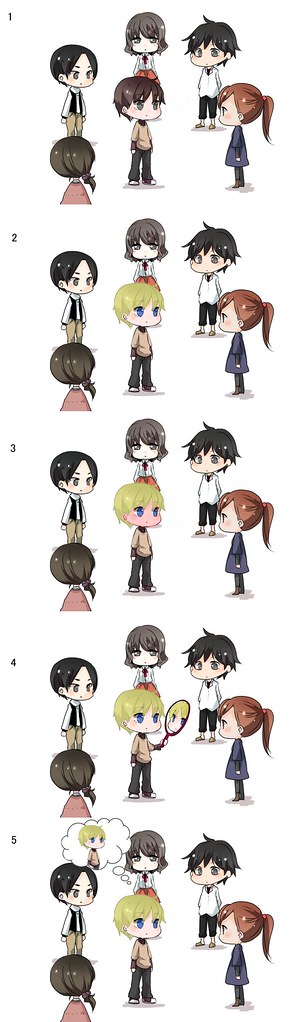
See Taro in the middle of a circle of his friends. The Japanese self is often described as being relational (Watsuji, Bendedict, Markus, Hamaguchi) which boils down to it being non-existent, or at best a nexus of self presentation concerns. The Japanese self is in the eye of the other, we are told.
If this were all there were to the Japanese self then how could the Japanese create and wear the zaniest fashion in the world? If this were the case, then if Taro dyed his hair blonde and wore blue contact lenses to college (picture 2), he would feel the harsh, judgemental gaze of his peers and become embarrassed (picture 3).
How could he avoid embarrassment? How could he remind himself of his preference for blonde hair and blue eyes? He could whip out his mirror (picture 4). As demonstrated by Carver ( 1975) and Carver & Scheier (2001) people with increased "objective self awareness" in front of mirrors, remain truer to their beliefs even in the face of social pressure. The trouble is, with all those eyes upon him, Taro would need to walk around looking in his mirror all the time.
But Taro has no need to do his, because Taro and all Japanese, especially those who have practised some kind of martial art or traditional path, has a mirror in his head (Heine, Takemoto, Moskalenko, Lasaleta, & Henrich, 2008). Taro can see himself without the aid of a mirror, avow his preference for blonde hair and blue eyes, and be done with the eyes of the world (picture 5).
It is because they have a mirror in their heart - originally a present from the Sun Goddess we are told - that the Japanese make the zaniest fashion in the world.
All five images based on an original by Miho Fujimura.
Carver, C. S. (1975). Physical aggression as a function of objective self-awareness and attitudes toward punishment. Journal of Experimental Social Psychology, 11(6), 510–519. Retrieved from www.sciencedirect.com/science/article/pii/0022103175900025
Carver, Charles S., & Scheier, M. F. (2001). On the Self-Regulation of Behavior. Cambridge University Press.
Heine, S. J., Takemoto, T., Moskalenko, S., Lasaleta, J., & Henrich, J. (2008). Mirrors in the head: Cultural variation in objective self-awareness. Personality and Social Psychology Bulletin, 34(7), 879–887. Retrieved from www2.psych.ubc.ca/~heine/docs/2008Mirrors.pdf
Labels: collectivism, individualism, japan, japanese culture, mirror, nihonbunka, occularcentrism, religion, specular, 個人主義, 宗教, 日本文化, 武道, 神道, 集団主義
Monday, May 28, 2012
Robo Cat: Cute, Uncanny or Horrible
This robo-cat moves, it makes noises when you stroke it, but does it have feelings? The Japanese do not seem to care so much(J. Robertson, 2001; Jennifer Robertson, 2007; Schodt, 1988).
This cat looks to me that it is right bang in the middle of the "Uncanny Valley" (Mori, 1970) but the Japanese store goers seemed to like it and think it "cute". Strange, amusing, uncanny, yes, but "cute" was one thing it was not from my viewpoint. But then I grew up in a culture where people tend to think that they are not their body but their mind. I argue that The Japanese do not believe that they are their bodies, the Japanese also firmly believe in the heart, but heart (kokoro) is also at least in part visual, a space of imagination.
The absense of heart (kokoro) absence from the body, as it is often in sleep, makes less of a difference.
And as mentioned in recent blog posts, generally speaking, in the realms of shrines, rebuilt shrines, miniature shrines, horses sculpted and pictorial, copied pilgrimages, and foreign villages, sports stadia, and perhaps even cats, if it looks the same then it is the same: an authenticopy, a subcategory of simulacra (Baudrilliard, 1995) in the the presumed mirror mind of Japanese gods.
To have a "mirror" mind, both god and human, to see the mind and world meet at a "tain-less mirror" I think that all you need is to have a presumed co-gaze (kyoushi) (Kitayama, 2005). Internalising a gaze is no weirder than presuming that an intra-psychic other is listening to and understand our self-speech, which is what we, Westerners, are argued to be doing (Bakhtin, 1986; Hermans, 2001; Hermans & Kempen, 1993; Mead, 1967).
The ability to imbed someone else's perspective inside oneself is not difficult. We are always wondering 'how this would sound to', 'how this would look to' various otehrs others. But the ability to create another persons perspective inside oneseld and then forget it is that of *an other* but believe instead that it is the perspect of the Other, a generalised other, a super addressee, a super ego, depends, as Freud points out, on taboo (Freud, 1913): on the horror and guilt associated with the deed. I do not see Freud's explanation, that we feel guilt towards a historical act of killing the primal father, as being anything other than alegorical. The explanation that the internalisation of another may be associated with guilt and horror is, however, a valid explanation as to how one might wish to forget that internalisation: thus generating a general internalised view, a view as it were from nowhere.
The robo cat is cute, but he makes me feel a horror, which will be the subject of a subsequent post.
Bibliography
Bakhtin, M. M. (1986). Speech Genres and Other Late Essays. (V. W. McGee, Trans.) (Second Printing.). University of Texas Press.
Baudrillard, J. (1995). Simulcra and Simulation. (S. F. Glaser, Trans.). Univ of Michigan Pr. Freud, S. (1913). Totem and taboo. (A. A. Brill, Trans.). New York: Moffat, Yard and Company. Retrieved from http://en.wikisource.org/wiki/Totem_and_Taboo
Hermans, H. J. M. (2001). The Dialogical Self: Toward a Theory of Personal and Cultural Positioning. Culture & Psychology, 7(3), 243–281. doi:10.1177/1354067X0173001
Hermans, H. J. M., & Kempen, H. J. G. (1993). The Dialogical Self: Meaning as Movement. Academic Press.
Kitayama, 北山修. (2005). 共視論 (Co-Gaze Theory, my trans). 講談社.
Mead, G. H. (1967). Mind, self, and society: From the standpoint of a social behaviorist (Vol. 1). The University of Chicago Press.
Mori, M. (1970). The Uncanny Valley. Energy, 7(4), 33–35. Retrieved from http://www.movingimages.info/mit/readings/MorUnc.pdf
Robertson, J. (2001). Japan’s first cyborg? Miss Nippon, eugenics and wartime technologies of beauty, body and blood. Body & Society, 7(1), 1–34.
Robertson, Jennifer. (2007). Robo Sapiens Japanicus: Humanoid Robots and the Posthuman Family. Critical Asian Studies, 39(3), 369–398. doi:10.1080/14672710701527378
Schodt, F. L. (1988). Inside the robot kingdom. Kodansha International.
Labels: autoscopy, eye, japan, japanese culture, Jaques Lacan, mirror, nihobunka, nihonbunka, occularcentrism, reversal, Shinto, specular, taboo, 宗教, 日本文化, 神道
Friday, February 17, 2012
Amotsuki, the old word for Mochi-Tsuki or Rice Cake Making is also a Metaphor for Coitus

Amotsuki, the old word for Mochi-Tsuki or Rice Cake Making is also a metaphor for Coitus, a photo by timtak on Flickr.
[Cross posted from Shinto Blog with additions]
The most important festival of the Shinto religion is the New Year Festival. At this time Japanese people will visit a shrine, give their children money, and eat certain foods one of which are rice cakes said to contain the spirit of Amaterasu, the mirror-sun-goddess. In traditional homes, such as farm houses, and in some schools and community centres, the rice cakes are made in a traditional way known as "mochi-tsuki" or rice beating.
In a well known Japanese dictionary (Koujien 4th edition) it says that, "Amotsuki" (餅搗), an old but not defunct word for "mochi-tsuki" which means beating rice to make rice cakes, was used as a metaphor for "boji"(房事) which means coitus.
The rice beating ritual performed at New Year gave me a impression of representing coitus when, as is traditional, a woman turns the rice while her husband beats it.
In the ritual that I saw performed, and took part in, a woman knelt or crouched down beside the "usu" (bowl) and make relatively high pitched noises encouraging a man wielding a big mallet to beat the rice cake, sometimes with a grunt. Apparently quite a lot of males die each year of heart attack as they wield their mallet. The ritual is quite hard work. The men build up a sweat. The rice cake becomes more and more gooey. The thwack, thwack of the mallet (kinu) hitting the gooey rice in the bowl resounds. Finally everyone rejoices partaking of the gooey white rice cake. It is quite a carbohydrate high after all that exertion. Bearing in mind the shape of the tools used, the gender division of labor, their relative positions, and the color and consistency of the final product, I made an interpretation which prompted my my Japanese friends to call me a pervert. Then one day I was reading my dictionary and came across the entry above.
These metaphors may be quite irrelevant and coincidental but since the Shinto-Amaterasu myth is represented in Shinto New-Year's festivities, the fact that a ritual seen as a metaphor for sex (at least in times past) should take a central role in the festivities suggests that perhaps there is a similarly metaphorical episode in the Susano Amaterasu myth. At least one researcher has suggested that the bit where Susano-O throws a backwards skinned horse into the clothing room of Amaterasu such that one of her weavers dies as a result of a shuttle entering her body, may be a metaphor for coitus.
It would not be unusual that sex is represented in Shinto festivities (examples, click with caution and or or parental advice). One commentator (essayist Ei Rokutsukel,2004) expressed the opinion that many or most Shinto festivities were related to sex.
Christian festivals (Christmas and Easter) represent birth and in the Shinto tradition birth is, or was, the dirtiest most defiled thing, as taboo as sex is in the Christian tradition.
With these reversals of the most sacred and the most defiled -- with Japanese and Western religion being so polar -- I used to think that war between Japan and the West would be inevitable.
Similar entries to that photographed above from an other edition of the same dictionary
餅つき 2男女交接の例え Amotsuki (rice beating) is a metaphor for sex
臼と杵 男女の仲がぴったり合うこと Usu to Kinu Pestle and Mortar/mallet very close male female relationship
臼から杵 臼は女、杵は男を象徴する。女から男に働きかけるのは逆であるの意で)逆であるさまにいう
Mortar to Pestle. Women should not approach/influence men.
Ei Rokutsuke et al (2004) "Matsuri ha Eros de Aru"(Festivals are Eros/Erotic), "Nihon no Matsuri" (Japanese Festivals). Asahi Newspaper. publications.asahi.com/ecs/detail/?item_id=6205
Labels: female, gender, male, religion, reversal, sex, Shinto, ジェンダー, 宗教, 日本文化
Friday, December 09, 2011
The Chrysanthemum and the Sword

Ruth Benedict's Chrysanthemum and the Sword is probably still the most famous book about Japan. The theory that Japan is a shame culture, whereas Western countries have a culture of shame is still the most widely used framework for understanding the Japanese. Shame, it is argued, is a non-moral ethic where people behave in such a way as to conform with the expectations and evaluations of their peers. This is precisely the opposite of the definition of a moral man as given for example by Plato in The Republic (someone who appears bad but does good), or as exemplified in the life of Jesus who was crucified amongst thieves. Guilt, we are told, on the other hand is a moral sentiment that derives from within the person, from internal standards, from personally held and identifiable notions of good and bad. The theory that Westerners have such things inside them, whereas Japanese are only concerned with keeping up appearances, maintaining face, pleases Westerners and is continued in cultural psychological theories to this day.
It is clear that the Japanese feel a lot of shame. I think that the shame-culture, guilt-culture framework is meaningful, but that Benedict misrepresented Japanese shame. Japanese have private shame (Sakuta, 1967). "But," you may point out, that "if shame too is private then it is indistinguishable from guilt." I claim that the difference is in the medium. Guilt is when ones internal self-narrative sounds bad. Shame is when ones internal self-cinema looks awful.
It is easy to self narrate, and when we do we hear the words that speak or think. Self-speech has a built in mirror. Sound bounced back and around in the sound box of the mind.
That the Japanese can gaze at themselves, on the other hand, is a more remarkable feat. Like most westerners, I can't do it unless I have a mirror. Mead claimed it is impossible to see oneself without a mirror. Some performers, such as Zeami and Nijinsky, claimed to be able to see themselves from the point of view of their audience. And my research it may be argued that the average Japanese man and woman in the street have a mirror in their head.
Herbert Morris (1976) "On guilt and innocence: essays in legal philosophy and moral psychology" p 62
"In guilt the "voice of conscience" speaks and we formulate in words what is do be done and not to be done, words that are spoken and heard. With shame, the disposition is to hide, to vanish; with shame we want to sink into the ground, we cannot stand the *sight* of ourselves. With guilt the urge is to communicate, to be listened to, to confess."
It seems to be a minor change but, transposing the shame guilt divide from external-internal to vision-voice means that Japan ceases to be a lack, a nothing, a collective. Japan becomes something. It because something that is qualitatively different. The Japanese moral behaviour, and self is not just lost, submerged, controlled, collectivistic but *a different kind of self*.
Morris, H. (1976). On guilt and innocence: Essays in legal philosophy and moral psychology. Univ of California Press.
Labels: collectivism, individualism, japanese culture, mirror, nihobunka, nihonbunka, occularcentrism, religion, reversal, specular, 宗教, 日本文化, 神道
Saturday, December 03, 2011
Everyone is Watching: Manner Up
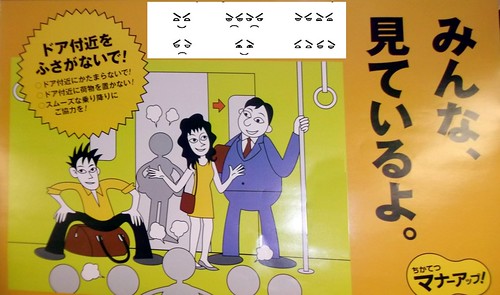
This Japanese subway train is encouraging passengers to mind their manners and not stand or sit in front of the doors, by telling that "Everyone is watching." The fear of being seen doing something ill-mannered is real and motivating to Japanese.
Kitayama, Snibbe, Markus & Suzuki (2004) demonstrate that Japanese need only to be confronted with a poster showing various approving or disapproving gazes (inste top) to change their behaviour.
The change observed in Kitayama's experiment was however, to become more self-enhancing, as measured by a spread of alternatives pre and post being given something. In front of the poster, Japanese (like Westerners with or without poster) became more inclined to up their rating of something that they now posses.
The strange thing about this result is that the standard theory of Japanese manners is that Japanese should be self-deprocating rather than self-serving when in front of others.
So why do the Japanese self-enhance (brag) in when made aware of an evaluating gaze?
I argue that Kitayama's poster encourages self-evaluation, and that in the visual domain, Japanese do have a need for positive self-regard, hence the extreme positivity, and posing, found in Japanese autophotography (puri-kura, peace symbols, etc; Leuers and Sonoda, 1999, see Heine, 217 page 213)
Bibliography
Kitayama, S., Snibbe, A. C., Markus, H. R., & Suzuki, T. (2004). Is There Any ‘Free’ Choice? Psychological Science, 15(8), 527.
Heine, S. J. (2007). Cultural Psychology (First ed.). W. W. Norton & Company.
Leuers, T., & Sonoda, N. (1999). The eye of the other and the independent self of the Japanese. Symposium presentation at the 3rd Conference of the Asian Association of Social Psychology, Taipei, Taiwan.
Labels: collectivism, eye, lacan, logos, mirror, nihobunka, nihonbunka, occularcentrism, reversal, Shinto, specular, 宗教, 日本文化
Monday, November 28, 2011
A Theory about Japanese Mikoshi Festivals
Many or most Japanese festivals feature "O'Mikoshi," but there are few theories as to why the Japanese (and not only the Japanese) are into carrying their gods around on stretchers. The theories I have seen, and agree with, stress unity, solidarity and cohesion (Takezawa, 1998) and prestige (there is a pecking order in who gets to carry the god, before whom: see Kalland, 1995). I respect both theories but here is my take, with thanks to my trainspotting son.
Normally the geographical fixed-ness of the Shinto sacred anchors the word view and society (c.f. theories that Japanese society is spacially organised: Bachnik & Quinn, 1994, Pilgrim 1995, and Nakane, 1970), so when the sacred starts to move on its mikoshi (beir, litter or palanquin) this signals the arrival of a topsy turvy, "liminality" (Turner, 1967) big-time. I suggest in this video that the mikoshi have the same attraction as trains. My son used to really love trains. Trains, with their moving frames of reference, teach us that movement is relative, nothing is stationary, unless something is sacred.
Labels: japanese culture, nihobunka, nihonbunka, religion, Shinto, 宗教, 日本文化, 神道
Tuesday, June 21, 2011
Externalized-Self-Gaze in Japanese Martial Arts
Noh Master Zeami points out that to master the art of Noh drama one must, through repeated attention to mimicry and form, cultivate a "Riken no Ken" (離見の見, see Yusa, 1987), a sort of out of body experience of Self.
Miayamoto Musashi in The Book of Five Rings (五輪書)says that the swordsman must learn to become and thus see himself from the point of view of his enemy (敵になると云ハ、我身を敵になり替りておもふべきと云所也).
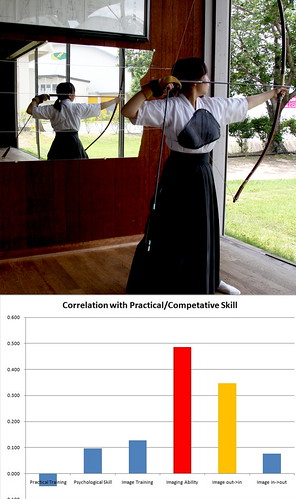
And in kyuudo (the Japanese art of archery), as demostrated by my seminar Student Ikki Yamamoto (2009) in this graduation thesis, nothing is more correlated with kyuudo performance than the ability to see oneself from the outside.
To achieve this end practioners of kyuudo practice form incessently, in front of mirros, using a sort of catapult device before they are even allowed to pick up a bow, and with a sort of brace to ensure that their feet are in the right position.
Through minute attention to form, and repeated mimicry of set positions, they gradually become so aware of their form that they are able to see it from what might be called a "third person perspective," or equally, an externalised self gaze. This ability to see oneself from what Mc Veigh aptly calls the poisition of an "invisible spook" (Wearing Ideaology, 2000) correlates most highly - more than frequency of psychical training or psychological skills and traits such as power of concentration, or desire to succeed, with the ability to do, and win at kyuudo.
I liken the Japanese martial, and Noh, "Path" (michi, 道, dou, do) to a 'different kind of trancendental dialetic." There are those such as Hegel, Plato and Lacan in the Western tradition that one can discourse ones way to a sort of higher plane. By stepping further and further back from the subjective position, one can, they claim, achieve a depersonalised, truer, transcendental. A similar thing may be going on in the Japanese martial arts.
Yamamoto, I. (2009) "Mental Training: Self Image in kyuudo." Unpublished Gradutation Thesis, The department of Tourism Studies, Faculty of Economics, Yamaguchi University.
山本一輝(2009)「メンタルトレーニング~弓道を通じた自己イメージのあり方~」未発表卒論。山口大学経済学部可能政策学科
Labels: image, japan, japanese culture, logos, martial art, nihobunka, nihonbunka, specular, theory, 宗教, 日本文化, 武道
Tuesday, August 17, 2010
Savage Thought and Myth in the Structure of Japanese

Levi Strauss argued that "savages" are "bricoleurs" (people that use the tools and materials to hand to get a job done), in that they use things, usually found in the natural world, to categorise and organise their societies.
Thus *savages* in totemistic societies may have "Black Hawk" and "White Hawk" groups, and be called by names like "Sitting Bull." They use species of bird and animal as names for clans, families and individuals, because these things are useful to get the job of social categorisation done, and thus "good to think."
Had Levi-Strauss been more rigorous (I jest) he would have noted that some totemist use mythical and corporeal, artificial signs. There are "Water Flask" and "Dragon" tribes. Concentrating on these man-made signs Levi-Straus' definition of "the savage as bricoleur" starts to become rather vague. If the savage can make up entities (such as dragons) to use as names then how is the savage different from "Levi" named after some ancient Jews Straus? If the savage can use man made objects as names, then why not use patterns, and write his name "LEVI" and be done with it. And if he did, would he still be a savage? The problem with Levi-Strauss for me is that I can't find the place where he compares savages to himself, or where he explains what we are doing, and whether and in what way what they are doing is different. (As far as I am aware, I am a bricoleur too. My name is Timothy, the name of a semi-mythical 'beast' found in the Bible.)
Then Roland Barthes comes to the rescue with his theory of "Mythological" signs. I think that despite the fact Barthes analyses magazine covers and pasta advertisements,he uses the word "Mythologiges" because he is harking back to Levi-Strauss above, and providing a semiotic distinction between us and them, between anthropologist and the mythologist, the scientist and the bricoleur. The distinction of myth, mythological thought, and the savage mind is that it uses signs in combination at a two teired level of "denotation" and "connotation." The briocoleur/mythologists uses second level, connotative signs, that is to say signs in combination that are already signs for other things (see diagram, inset bottom right).
Hence, the black boy and the saluting (a flag) shown on the cover of Paris Match, are in themselves signs. We recognise them and their meanings, of respect, youth, and Africa etc. The cover becomes mythic because it combines these signs to present a new meaning: imperialism is good, all of France's colonial subjects respect the French flag.
Suzuki Takao argues that the Japanese language is appropriate for use as an International Language. I happen to agree. The principle reason he gives is interesting, one that I had not grasped, and relates to the discussion of myth, or savage thought above. Suzuki argues that the advantage of Japanese is in the two-teired way that it is "agglutinative". A simple definition of aggluntinative is that, in ancient greek (soci-ology) and modern German (auto-bahn) one can form words by joining other words together. In Japanese however, the situation is a little more mythological, the process of agglutination often involves an extra layer. In Japanese, while there are cases in which one simply joins words together (e.g. torihiki, pull-push meaning negotiations), one can form complex words by combining the signs, or Kanji, for everyday words.
This layering of Japanese can be discussed at two levels.
At the level of discussion of the merits of the Japanese language, or German and Japanese respectively, the layered nature of Japanese makes it a lot more compact. Complex German words are formed by joining shorter simple, everyday words together, resulting in some very long compound words. Japanese on the other hand uses the signs, or Kanji, for the everyday words and joins these together instead. Since the Kanji have shorter (kun yomi) names of their own, long compounds can be said using far fewer syllables. In Suzuki Takao's example the round lighting devise used above operating tables in hospitals is "Schattenfreie Lampe" (Shadow-Free-Lamp) in German, and "mu-kei-tou"(無影灯)in Japanese. It gets to be a lot shorter in Japanese because mu, kei and tou are the names for the signs that represents "no shadow lamp" (nai, kage, akari). So while learners of Japanese may think it a pain in the neck that Japanese not only has Kanji, but also has more than one name for each, Suzuki argues, quite successfully in my view, that it is this layered structure that makes Japanese so successful in expressing complicated meanings, using few simple buildings blocks, without resulting in some very long words.
At another level, it seems to mean that Japanese are always being "mythologists" or "bricoleuers" as defined by Roland Barthes and Levi-Strauss in that they are using the denotive signs for every-day things in combination to connote new meanings. They are still engaging in "savage thought."
And so what? I am not sure, but I think that it relates to:
Roland Barthes claim that Japan is "The Empire of the Signs"
Jane M. Bachnik's discussion of the prevalance and importance of "indexes" in Japan, in her opening chapter of "Situated Meaning." (Would Barthes have written "The empire of the indexes" had he been more precise? Are totems indexes? Are indexes always dual, dennotive and connotive?)
My claim that Shinto is a form of totemism that stopped using stones and branches and grass (as related in detail by Kunio Yanagita, back in the days when "everything used to talk") as their totemic badges, and started to use Kanji for their names (when, thanks to the ordered rule of the emperoro "everything stopped talking")
The fact that Japanese superheros are totemists.
Labels: nihobunka, nihonbunka, religion, superhero, theory, totemism, アニミズム, トテミズム, 宗教, 日本文化
Friday, May 21, 2010
Transformatory sacred items accross the ages
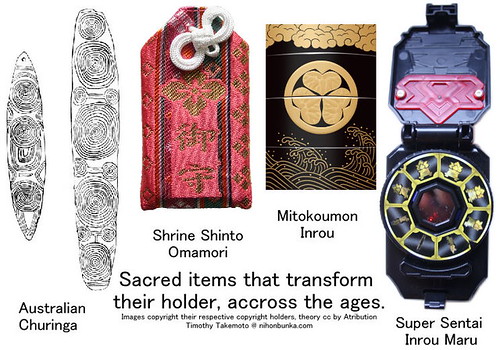
I noted in a previous post that the history of transofmatory items (変身アイテム) such as used by Ultraman (pens and glasses), Super Sentai (Power Rangers), Sailor Moon, Himitsu no Akko-chan, and Kamen Riders (Masked Riders), has a history in the transformatory symbols of Mitokoumon, Touyama no Kin and Samurai Momotarou. Japanese superheroes are always flashing a special symbol and transforming by means of its use.
The history is much older. I ague that Shinto is a geographical totemism, like that of the Arunda/Arunta/Arenda of Australia. In totemic religions the faithful recieve totemic badges which represent their owners and the ancestral spirits of their ancestors. The Arunda of the central Australia destert are one of many such groups found worldwide. Unlike most totemic religions, but in common with the Japanese, these "most primitive" (Freud, Durkheim) of totemists believed that the totem was associated with a place.
That the japanese recieve totemic badges from Shinto shrines almost goes un-noticed. More visible are the symbolic, soul containing badges that are given to the dead (mitama, Ihai). However, as Yanagita Kunio points out, once upon a time, there were "ikimitama" symbols given to the living. These were originally leaves branches of sacred trees and rocks from sacred mountains. They were believed to give their bearer life and were recieved from the time of first shrine visiting.
However in my view, and as Yanagita hints, the symbols were gradually replaced by kanji ideograms and piece of paper.
Yanagita writes, "in this reigion also the Nusa (gohei, zigzag strips of Shinto paper) were originally I think to be distributed among participants. This is similar to the leaves and branches of Japanese cedar and nagi (a evergreen tree/shrub) that were given to the faifthful from sacred trees on Mount Inari and Mount Ise" (Yanagita Kunio Collection No. 14 p 51, my translation.)
「この地方でも小さい幣を関係者に頒(わか)つのが本当の趣旨であったろうと思う。もししかりとすれば、後に言わんとする稲荷山の杉・伊豆山の梛(なぎ)のごとく、信者が神木の木の枝を追って行く風習と、著しく類似する点があるのである」柳田國夫全集14p51
These days Japanese still recieve omamori or amulets from shrines that are said to represent a stand-in or self-replacement and protect the bearer from bad luck and impurity.
And as shrines become less significant, Mitokoumon, Ultramen, Masked Riders, Super Sentai (Power rangers) brandish their sacred symbols and transforms with them.
Before we call the Japanese primitive bricoleurs, let us not forget that "in the beginning was the word," and that I have a "Christian name."Am I transformed by it?
Labels: henshin, Masked Riders, morph, nihobunka, religion, Shinto, specular, Super-Sentai, totemism, ultraman, アニミズム, スパー戦隊, トテミズム, 仮面ライダー, 変身, 宗教, 神道
Wednesday, May 12, 2010
Children are Staples (Ko wa Kasugai)
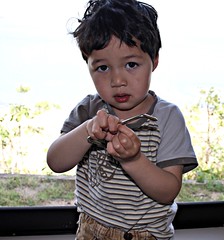

My son here is seen above holding a staple or "kasugai," shown in close up in photo bottom left, which is used to hold two pieces of wood together, see photo bottom right.
In Japanese culture, the love between men and women is seen as being beautiful and natural, but like most things in nature, not particularly permanent. Love, between women and men does not last forever. There is no bridge across forever, no soulmate, no happy end. Japanese love stories tend, or tended, to end in double suicide: the most romantic outcome that one can hope for, at least far more so than domestic bliss.
The love or at least the relationship between parents and children, between ancestors and their descendants is however seen as being eternal. Parents and offspring are considered to be indivisible. No one is born again. This goes for the relationship between children and both mothers and fathers.
So when a couple have a child, while their own emotions for each other may wax and wane, they will be irretrievable linked forever in the flesh of their flesh, their child.
Hence, just as a staple can be used to join two pieces of wood together, so a children are considered to be like staples that join their parents together forever.
Westerners on the other hand are more likely to believe in the possibility of enduring love between men and women, through the transcendence of sexual difference. This hope, that there can be a bridge across forever, is perhaps dependent upon the repression of sex (much less festivals which celebrate sex), which is taboo, repressed, something to be sublimated into a unisex, shareable, idealised "love". I don't think that I need to refer to any particular cultural phenomenon to persuade Anglophones that Western culture is awash dreams of love. Oh, love.
While the Japanese believe that their view is natural, it may be dependent upon the repression of childbirth (seeing it, the desire for it, expressions of child birth, much less festivals which celebrate childbirth), which is taboo, repressed, and sublimated into a unisex, shareable and idealised "parent-child-love". While ancestor worship, or ancestor veneration, is carried out behind closed doors, the clearest expression of the cult of parent child love in Japan, is in the "monstrous" hegemony of cute found in Japan.
Related there are
Children are the shackles of this world and the next (ko ha sankai no kubikase 子は三界の首枷, こはさんかいのくびかせ) which refers to pretty much the same thing.


Labels: family, gender, nihobunka, nihonbunka, sex, Shinto, 宗教, 日本文化
This blog represents the opinions of the author, Timothy Takemoto, and not the opinions of his employer.