

Thursday, September 13, 2012
Popteen Gals: The face of Japan

I gradually lean further towards the beauty in averageness hypothesis which holds that people find prototypical faces beautiful perhaps because they are easy to process (Winkielman, Halberstadt, Fazendeiro, and Catty, 2006). According to this theory, exposed as they are to both Asian and American images of beauty, the Japanese will become increasingly attracted towards and aspiring of the Asian-Caucasian average, mid Pacific, GAL looks. And here above they are, in all their average glory.
Images copyright Popteen magazine and their copyright holders. The above image is a screen shot of the result of searching for "Popteen" (ポップティーン) on Google images.
Bibliography
Winkielman, P., Halberstadt, J., Fazendeiro, T. & Catty, S. (2006). Prototypes are attractive because they are easy on the mind. Psychological Science, 17. 799-806. Retrieved from psy2.ucsd.edu/~pwinkiel/winkielman-halberstadt-fazendeiro...
Labels: eye, fashion, female, image, japan, japanese culture, nihonbunka, 日本文化


Monday, February 20, 2012
Onikyan: Friendishly Cambered Car Wheels

The creator of this masterpiece said that he wanted to demonstrate his prowess at customisation (he is particularly good with this area of the car). While the car is currently not road legal he believes that it could be driven to local cities such as Hiroshiima and Fukuoka to take part in "dress up" (Customisation) car shows. Approximately half of the revenue of this garage is for "regular work" and half for show-ization (sho-ka) to make cars ready for "dress up" car-customization shows.
The size of the automotive aftermarket parts market is about the same per capita (about 580 dollars in Japan, 2007 figures, to about 600 dollars per capita in the US) but Japanese cars do fewer miles and are on the road for less time and are of a higher reliability, so presumably a far greater proportion of that market is spent on non-essential, customization of the car.
As another indication of the extent to which Japanese people like to pimp their ride, all of the companies (Mode Parfum (Blow Design), Aimgain, Wald, Junction Produce, Anceltion (RIP)) recommended as offering "Vip Styling kits" in this English language article on how to make your car look like a VIP's (pimp's?) car are Japanese companies.
Additional evidence that the Japanese are the kings car customization includes the fact that Japanese jargon refering to styles of car-customization, such as "hippari" to refer to stretching tyres onto outsized rims for a super low profile tyre/wheel.
It is my contention that people express their individualism not to others, or even specific internalised others, but to their "generalised other" (Mead) their Super-addressee (Bakhtin), the Other (Lacan), or Super-Ego (Freud) of their psyche, "Thou" (Buber/Nishida) or their gods, which in Japan do not listen but look. The Japanese desire to individuate and enhance themselves in the eye of their Other, since it is from this position that they see themselves objectively as lovable, individual human beings.
The Japanese are no so keen, on the other hand, on tuning up their cars so that they go at a fastest speed from point A to point B. Speeds are purely linguistic achievements. Making it look like their cars are going at the fastest speed (e.g. by "drifting") on the other hand, is highly descirble as do cars that simply look individual like the example above.
Videos of "Demon Camber" cars (with swearing)
www.youtube.com/watch?v=H11E0zwI7QA
Video of this particular car at a show in Hiroshima
www.youtube.com/watch?v=2gAlQLH9O0A
Labels: collectivism, culture, eye, fashion, individualism, japan, japanese culture, Jaques Lacan, lacan, mirror, nihobunka, nihonbunka, occularcentrism, theory, 個人主義, 日本文化
Thursday, February 16, 2012
NMB48 and Tarzan

The climax of the chorus of the recent chart topping song by teenage girl-band, 'idol group' NMB48 is "steel panties," refering to their collective intention not to take them off for their boyfriend until they are 20 years of age. The song's title, "Junjou U19" means "Pure (i.e. non sexual) emotion or affection, and the "U19" may mean under or equal to 19, since the lyrics mention adulthood which is considered to be from 20. The boyfriends are going to have a long wait in some instances because at least one of the members is 13 years old. Yes, indeed, only 13 years old.
Having seen the video, it seems that it has been created with the intention to include as many ways as possible of allowing the viewers to feel that they can or will see the "steel panties" refered to the in the lyrics, with low camera angles, miniskirts, rotating girls, somersaulting girls, girls lying down, hanging from wires, rolling over balls, on tightropes, a trapeze, podia, and finally fired from a circus cannon. I think it is very inventive, but not to my taste.
Japan is bursting at its creative seams. Donald Richie's "The Image Factory: Fads and fashions in Japan," details the many ways in which Japan is a powerhouse of creative image making. Alas, the myriad images that Japan makes are different, and often not popular among those with Western sensitivities.
A big problem for human society, perhaps the biggest, is encouraging men and women to cooperate. There are two extremely effective ways of doing this. 1) Persuade all members of society that they are neutred men. 2) Persuade all members of society that they are wombless, bloodless women. The West takes the former route, Japan the latter. In each case it is imperative that the unattractive parts of the idealised sex are banished: their desire in each case is taboo. Jesus was a man in his ability to lead, be righteous, brave, and strong but there was no one iota of lewdness about him. The idealised woman in Japan is similarly, self-sacrificing and supposedly berift of desire. The Western "gentle" man, and Japanese "idol" stop at the waist, they are castrated, spayed, anaemic, and perfect.
This repression however, gives rise to even greater desire for its disolution, for (in the West) a gentleman who is also an ape man; Tarzan/Earl Greystoke a combination of pure male sex and complete gentrified repression. I think that NMB48 are the Japanese equivalent of Tarzan/Greystoke, pure sex, and pure chasity rolled (often literally) into one steel pantie.
The idealized synthesis of purity and sexuality (Ranger, 2011) is also found to an extent in the British lady, such as portrayed by Audredy Hepburn (who was tremendously popular in Japan) in the naivity of the characters played by Marylyn Munroe (though she was a little too sexy, and not quite pure enough for Japanese taste) and the disembodied chamellion Lady Gaga who almost seems a little Japanese. However, In Japan there is a desire for a more extreme synthesis which is why we see thirteen year old chidren, in miniskirts, singing about sex, wearing "steel panties".
Other examples of Tarzan, that the Japanese need to import if they are to enjoy, include the macho heroes such portrayed by Arnold Schwarnegger, and Sylvester Stallone, who are an idealised synthesis of testosterone and righteousness.
NMB48 poster by MadAdminSkilz copyright Kyoraku Yoshimoto Holdings Co., Ltd.
とりさげご希望の場合は下記のコメント欄かnihonbunka.comのメールリンクからご連絡ください。
Labels: fashion, female, gender, male, nihobunka, nihonbunka, taboo, tabuu, theory, ジェンダー, 日本文化
Friday, February 10, 2012
Anime Girl Face Conformity

They could almost be the same girl, with a variety of hair colours. In the Edo period too, stylised pictures of "beautiful women" looked like they could have been of the same woman but now the woman's face is very different. Images of beauty have changed.
The above is the first page of google images, searching for anime face girl.
It would be interested to ask a pool of subjects whether they think the images are of the same girl by different people, or of different girls, and to compare these results with say, googles first page of impressionist beautiful women. While I do not believe that the Japanese are generally conformist (as is generally believed) I do think that views of feminine beauty are very convergent in Japan because the Japanese idealise and enhance the image more. I have argued (Leuers and Sonoda, 1999) that since Westerners idealise and enhance character traits more, their self-professed character traits are far more convergent than those of Japanese.
It is amazing that there is a photo (or two?) in there.
Copyright their respective copyright holders. please use comments or nihonbunka.com contact link to have this image removed from the net.
Labels: fashion, female, feminism, image, japan, japanese culture, Jaques Lacan, lacan, logos, male, manga, mirror, nihobunka, nihonbunka, occularcentrism, self, sex, specular, ジェンダー, 日本文化
Thursday, February 09, 2012
Traditional Japanese Beauty

The Japanese in the Edo period had a fairly localised view of beauty, so much so that these beautiful women look very alike to the point of appearing identical. These Traditional Japanese beauties had neither large round eyes, nor double eyelids. Their eyes were slit like and their features were generally small and angular. Pointy noses where in, but not particularly large ones. This leads me to believe that the current Japanese fondness for large round eyes, especially with creased ("double") eyelids is partly the result of the influence of Western, caucasian, images of beauty upon Japan.
Labels: fashion, female, feminism, image, japan, japanese culture, Jaques Lacan, lacan, logos, male, manga, mirror, nihobunka, nihonbunka, occularcentrism, self, sex, specular, ジェンダー, 日本文化
Monday, January 29, 2007
Thick Soled Shoe
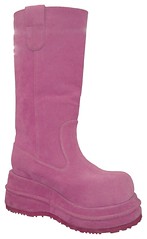
As Suviko points out both these boots and the "ganguro" (sun tanned face to the point of being "black") style of some young girls over the past decade is going out of style. Why is this?
Perhaps it is an example of a reverse hemline rule. The hemline rule in economic theory states that the hemlines of women's skirts move up and down as the state of the economy moves from boom (hemlines up) to depression (hemlines down). This is perhaps because when the economy is good, women can afford to give away their booty, or at least a glipse of it for free, but when times are hard they must demand more dedication, more platonism, more love before they even show their knees.
The ganguro fashion was populare during the long period of depression in Japan from the late nineties to the early two thousands. On the face of it (no pun intended) having a heavily tanned, almost black face, made the fashion victims less attractive in a country that has valued the whiteness of women's skin (partly because white means that one does not have to work in the fields, partly because of a Western influence, as argued in a previous post). Thus Ganguro would seem to be making themselves *overtly* unattractive. The ganguro style was thus a very flamboyant defiance of norms of beauty, and may have been a demand for men who (as with a long hemline) are more dedicated, more loving. Perhaps also the platform shoe was an attempt to put the female form on a pedastle without excentuating sexuality that again demanded care and attention paid to the wearer.
This theory is unlikely to be popular since the long hemline is associated with a lady like purity whereas ganguro is associated with a radical lack of purity, but...this is Japan.
Labels: culture, fashion, female, japan, japanese culture, nihonbunka, 日本文化
This blog represents the opinions of the author, Timothy Takemoto, and not the opinions of his employer.