
Thursday, March 26, 2020
Survive the Pandemic by Turning Japanese
 Here are some of things that may have helped the Japanese to have suffered fewer deaths in the coronavirus pandemic so far include perhaps (I am not connected with medicine):
 1. wearing face masks which have been de rigueur for those who are suffering from respiratory illnesses perhaps since the influenza pandemic of 100 years ago,
2. a greater attention to covering ones mouth when one coughs (Japanese ladies cover their mouths even when they laugh),
3. far less dancing and discos,
4. bathing in the evening when arriving home dirty rather than the next morning (having passed the evening and night dirty at home!),
6. drying oneself using single use towels rather than bath towels that may not be washed for a week,
7. high interpersonal distance,
8. boiled sweets (candy) provided at customer service locations partly to reduce customer coughing,
9. generally lots of cleaning and sweeping by everyone from school children to monks,
10. food wrapping or the lack of unwrapped food sales, polythene bagging of unwrapped foods such as fruit at the checkout,
11. non-food product wrapping so that even if the packaging has been handled purchased products are sterile when unwrapped at home,
12. changing of clothing upon returning to the home and arriving at school (school uniforms are worn only on the way there. Pupils often change to track suits in class),
13. removal of shoes indoors,
14. use of a separate pair of slippers inside toilets,
15. passing things to other people with both hands thus interpersonal maintaining distance,
15. the use of semi disposable gunte cotton gloves by service personnel such as ticket inspectors, taxi drivers and anyone doing a dirty task even at home*,
11. the Japanese housewives' love of aprons which keep their clothes clean,
12. the way that Japanese taxi drivers open taxi doors for passengers so they don't need to touch the door handle**,
13. the predominance of uniforms in any job that may involve even a little dirt such as on any sort of manufacturing industry,
14. preference for the "one room mansion" over shared houses and flats,
15. more vending machines allowing purchases without human interaction,
16. the practice of sterilizing ones mattress (futon) by hanging it out in the sun,
17. taking rubbish home rather than littering or even using (non-existent) public waste bins,
18. plastic fairings along the sides of car windows to allow windows to be open a little refreshing car interior air even when it is pouring with rain,
19. a general preference for fresh air over closed air-conditioned rooms.
20. a preference for new things rather than second hand,
21. a greater belief that "cleanliness is next to godliness" and conversely that sin is a sort of defilement,
22,regarding cleaning is a sort of spiritual practice (that at least teaches the importance of cleanliness),
23. respect paid to homes, temples, martial arts gyms and other spaces with cleaning and bowing and greetings at the entrance to such spaces, emphasising the importance of keeping them in all ways good and pure,
24. traditionally according to Shinto scripture considering (skin) disease to be one of the deadly sins,
25. the integration of hand and mouth washing (chouzu, temizu) into Shinto prayer ritual,
26. shame-culture severity towards mistakes and not things that one does intentionally (infection is generally unintentional caused by a lack of vigilance such as in failing to cover ones mouth when one coughs),
27. the traditional provision of hot hand washing wet towels (oshibori) and disposable chopsticks at restaurants (that remain open even now),
28. individual bowls and chopsticks rather than sharing a common stock of cutlery even within the home,
29. sitting next to partners and friends rather than facing them and enjoying their company side by side (e.g. using counter seats),
30 enjoying the presence of others without feeling the need to keep talking all the time,
31. swallowing ones nasal mucus rather than blowing ones nose,
32. the consumption of many healthy foods. An urban myth has it that natto (rotten soya beans) is preventative but the notion that it may help has been rejected by Japanese specialists. Something about the Japanese diet (which is higher in rice, soy, and) may help. Natto contains a serine protease (nattokinease) which may encourage the production of serine protease inhibitors (serpins) which may block infection, or do the opposite. I am not a doctor.
33. Washlet (and other brand) bidets fitted to toilets keeping coronavirus from wiping hands,
34. the avoidance of touchy feely greetings such as handshakes, hugging and kissing,
35. less petting at least in public and less sex out of courtship and procreation, and a greater use of prophylactic sheaths,
36. a greater use of the seated position by males when urinating (sometimes by order in public toilets) thus avoiding urine on the floor and seat and hand to genital contact (male genitals may act as a fomites and while it is not a Japanese tradition, I have taken to washing my hands before and after using the toilet),
37. washing ones hands inside toilet cubicles using a raised flush-cistern faucet/spigot or tiny sinks before touching the toilet door handle,
38. the provision of disposable paper toilet seat covers and or disinfectant for cleaning toilet seats in public toilets,
39. spitting is unacceptable,
40. flatulence is beyond the pale,
41. drinking green tea and various medicinal teas,
42. perhaps the practice of getting neck deep in clean hot baths (Japanese wash before soaking) almost every night,
43. the use of hot spas as a folk treatment for almost everything.
The last two would be my Japan-influenced suggestions for attempting to treat the virus even in the face of WHO "myth busting", but I am not connected with medicine in any way.
I thought that the Japanese would be especially inclined to catch the coronavirus due to their genetics but Japanese culture proved me wrong.
I hope and pray that everyone worldwide stays safe. When Japanese schools reopen in April, the Japanese may face a resurgence of the coronavirus, so, I am praying for Japan too. Perhaps prayer should be added to the list of hygienic behaviours. Many Japanese people pray in the face of adversity (kamidanomi) even if they do not believe in the existence of that which they are praying to. This I think promotes awareness of the strength of ones yearning, and lack of ones power, thereby promoting a kind of humble diligence, hopefully.
The above inaccurate image was drawn freehand by me based on an accurate graph in the New York times.
*One hygiene product that I felt to be lacking Japan is the (Great British!) nail-brush. Upon reflection, however, I have come to realise that there are few nail brushes in Japan because Japanese would always wear gloves before performing a task that is so dirty as to result in dirt getting behind their nails. Oops.
**I now think back with regret at the number of times I have opened Japanese taxi doors for myself, in an expression of autonomy, as if to say I don't need you to open the door for me, and thereby putting my nasty germ ridden hands on the taxi probably forcing the taxi driver to get out and disinfect the door.
Labels: japan, sex, taboo, tourism, ホスピタリティ, 日本文化


Friday, October 06, 2017
Stopping Momentarily (Ittanteishi)
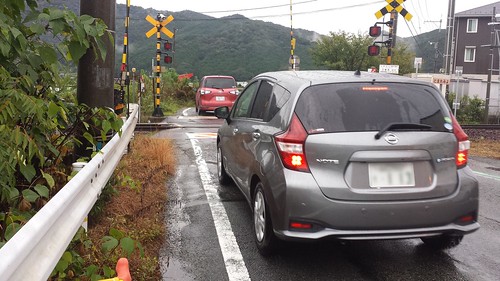
All vehicles stop momentarily (ittanteishi 一旦停止) to check for approaching trains, before crossing railway level crossings even if the barrier is up and the lights are in their favour. This stands in contrast to the fact that even in Japan one is not required to stop ones vehicle momentarily to see if anyone is running a red light at green traffic lights.
Once a long time ago I asked a university professor why the Japanese university professor why this is the case. He suggested that it could be due to the emperor system (which was his axe to grind) such that common folk are required to pay respect to any representative of Japan (such as JR trains) since they are also therefore representatives of, or represented by, the "symbolic emperor". At the time I thought, "surely not" but upon reflection it occurs to me that this practice of paying deference to representatives of the state has a long history.
Consider the Namamugi incident of 1862 where three Britons who refused to dismount to allow the procession of the Lord of Kagoshima (then Satsuma) to pass where attacked by attendant samurai swordsmen who expected deference from commoners, even British ones. Far further back in time the Wajinden or 'Records of Wei', written by Chinese visitors to ancient Japan in the early 6 century, recorded the fact that commoners would move to the side of the road and bow at the passing of aristocracy. 1500 years later the Japanese are still paying their respect to the passing of representatives of the polity, in the form of trains at level crossings.
From a logical point of view, I can see how it could be more important to stop at level crossings rather than at traffic lights if the vehicle stopping has the power to derail the train containing large number of people, resulting in large number of causalities. This could happen in the case of trucks and large cars, but it is difficult to imagine in the case of light cars
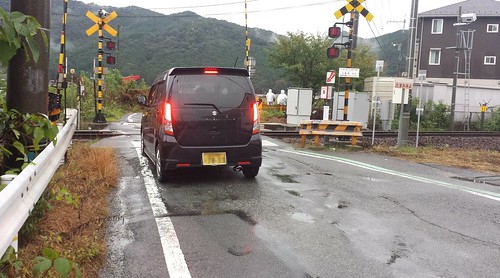
and surely cyclists would be simply swatted off the rails like mosquitoes should they venture onto the tracks at an importune time.
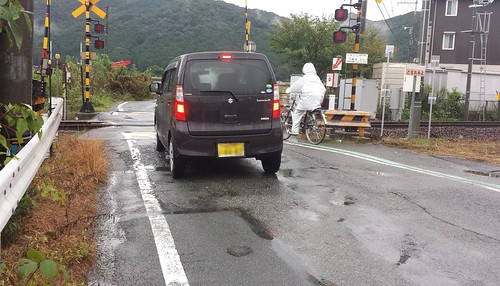
I can therefore think of no logical reason why cyclists should be made to stop momentarily and check for approaching trains at level crossings, but not at green traffic lights. But there is something beautiful about it, so I do it anyway.
Labels: japan, japanese culture, 日本文化
Monday, July 27, 2015
Hoopa: The hooper that that could not loop
I thought "Pokémon the Movie: Hoopa and the Clash of Ages" was a Japanese commentary on Western culture personified in "Hoopa, the hooper that could not loop" (my subtitle).
Hoopa has two forms (as do many Pokémon), and as are believed to exist in the Buddhist view of ourselves: the small (unenlightened) and large (enlightened) self. We see the giant form of Hoopa first who uses giant hoops to move (or steal) things from anywhere in the world. Hoopa's power rests in this telekinetic ability. Herein lies the first parallel with Western culture. The Japanese have a bit of a tendency, in my limited experience, to see the British and their descendants as thieves, or "vikings" as they tactfully put it, conquering the world and taking it home. The seven hoops of Hoopa (one around each of his six arms, and one around his waist) may correspond to the sense of Buddhism (although there is one too many) which include the sense of the heart. From some Japanese points of view Westerners look upon nature and the world as a source of things to take, rather than as something with which one feels in harmony, to an extent unified.
Hoopa finds himself internally conflicted and unable to evolve into his large self who remains trapped in a bottle by a religious organisation that bears more than a passing resemblance to Judeo-Christianity. From a Japanese perspective Western culture separates God and humankind whereas in Japan, the enlightened, a supreme martial artist for instance, becomes one with God or the Buddha - which tend to be seen as the same things.
This inability to evolve into his large self, and being in conflict with it, parallels Hoopa's inability to pass through his own hoop. As we have seen Hoopa has six hoops (plus one around his body) that he uses to move or plunder the cosmos. He seems partially able to pass through one of his hoops (the one around his middle) but unable to pass through any of his others.
This inability to pass through his own hoops is due to Hoopa's lack of gratitude. Through his experience of growing up once again as small Hooper, however, Hoopa learns to love and feel gratitude and finally, when he does this he is able to pass through one of his own hoops. In this sequence, before the triumphant auto-looping-hooping the hoop, and overcoming self-conflict, Hoopa imagines himself growing up and all the love he has received. This introspection - literally seeing himself - works on a lot of levels as the defining characteristic of Japanese culture. The Japanese believe their heart to be a mirror, are found to literally have a mirror in their heart, they are (through the practice of Noh and Karate forms) able to see themselves from a perspective outside, and use this ability to see themselves from the points of view of others. Autoscopy is also especially noticeable in the last letters of suicide pilots and the Japanese version of psychoanalysis: Naikan therapy.
This self-seeing, or self perception may be what the whole "Pocket Monster" mythology is about as represented by the Pikachu Satoshi Diad. There is a monster within us, sitting on our shoulder, who sees us, but at some level, or in some way, Satoshi and Pikachu are one. Perhaps in a final Pokémon movie this fact will be revealed. Or perhaps it already has. I have only seen two Pokémon movies.
Reading perhaps far too much into the iconography, it seems proper that Hoopa should be appear from out of one of his hoops (little Hoopa), have hoops on his ears (little Hoopa) or have one of his hoops as a hole at his centre (Big Hoopa) since Westerners do feel able to perceive themselves, linguistically. Only being able to perceive ourselves through this especially dark mirror, we are able to wreck destruction on an unparalleled scale, believing that anything that can be linguistically justified is acceptable. Hence a Briton feels able in saying that the British enforced importation of narcotics into China, for more than a hundred years, was acceptable because "the Chinese chose to smoke (opium). Or, in my experience, Americans (and others from the allied nations) generally continue to approve of the bombings of Hiroshima and Nagasaki, as just since 'the Japanese started it.' It is only when one starts to see oneself, hear the crying children, smell the stench of results of what one does, it is only when one passes through other hoops, that such justifications become untenable. We need to learn other forms of insight fast.
Hoopa learns gratitude, becomes able to perceive himself, is no longer conflicted, walks in the light, or becomes Japanese, in harmony with, not apart from the world. In the last part of the movie giant Hoopa spends his time rebuilding that which he has destroyed, only plundering the occasional doughnut.
I was moved by the compassion with which Hoopa the destroyer was viewed. Even though he destroyed the humans that fed him, Hoopa was not punished with death, but merely part of him kept in a bottle, since after all, as grandfather says, Hoopa is one of the family.
(I have a Japanese family, and lack gratitude, so this notion moves me to tears.)
Labels: autoscopy, cultural psychology, culture, japan, japanese, nihonbunka, occularcentrism, self, specular, 日本文化
Tuesday, July 14, 2015
Western Release from proactive interference
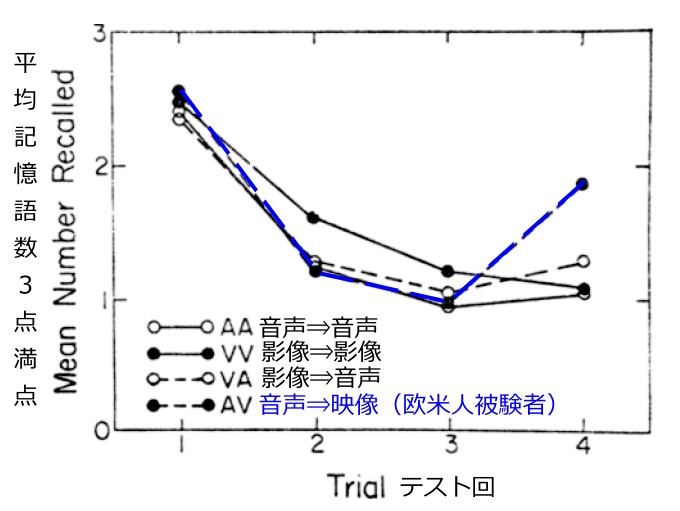
"Release from proactive interference" (Wickens, 1973) describes the way in which after a series of similar memory tests one is given a novel set of items to remember, then ones short term memory returns almost to fresh, first test or second test levels, since the novel stimuli are not confused or "interfered with" by the previous tests sets.
"Release from proactive interference" between visual and audio modalities, mentioned previously, is only found, in Western subjects, when moving from audio to visual stimuli and not when moving from visual to audio stimuli (Hopkins, Edwards, Tamayo, Holman, & Cook, 1973).
In other words, if Western subjects are given three memory tests with three pictures of fruit followed by a memory test using fruit words, their performance does not return to previous levels.
But if Western subjects are given three tests using fruit words, and an a fourth with pictures of fruit their performance does improve to previous levels.
The reason for this asymmetry may be due to the fact that, even when shown pictures of fruit, Western subjects are likely to think, or hear themselves speak (Derrida), the words for the fruit, so that their short term memory of fruit words is being depleted ('proactively interfered' with) even in the visual pre-test condition.
In the case where Western subjects are first given fruit word memory tests however, the Western subjects may not generally imagine the fruit corresponding to the fruit words, so if on the fourth trial they are shown fruit images, these images are felt to be novel stimuli, that are not "proactively interfered" with by the previous verbal trials.
I predict that Japanese may show the reverse pattern in that moving from audio fruit words to visual fruit pictures may not result in a "release from proactive interference" since in the audio condition Japanese may imagine the fruit that is presented in words.
However in the visual pretest condition, the Japanese may not bother to say the words for the fruit to themselves (see Kim, 2002 for evidence), so if the fourth trial is of fruit words, then they may show a release from proactive interference -- an improvement in recall -- since the fruit words will be felt to be novel stimuli.
This would be easier to test than self-related stimuli.
The test response method (getting subjects to say or draw the fruit) and distractor task between trials (getting subjects to add visually and verbal presented digits) may also confound results.
Interestingly a mixed audio and visual filler task (adding visually presented digits) produced the same results as an audio tasks adding orally presented digits. Again, I think that this is because Western subjects would be likely to self-speak the images of digits, so images are always mixed mode for Westerners. Following the reasoning in Kim (2002) the same may not be the case in Japan. According to a Nacalian transformation, a mixed filler task would be equivalent to a visual filler task since Japanese will provide the visuals when presented with oral stimuli. Oral stimuli are likely to be always mixed mode for Japanese.
I wonder if there is pre-existing Japanese research on this paradigm, and whether a reversal has already been found. Or whether the same tendency was found. No this paper (Hopkins, Edwards, Tamayo, Holman, & Cook, 1973) seems to be cited only three times, and only by researchers in the West. Searching for the authors surnames and Japanese keywords likewise yields no hits.
Addendum
There is some Japanese research by Tadashi Fujita (Fujita, 1995; 藤田正, 1985, 1988) and the results are not good from the point of view of my hypotheses.
In the main the research I have found is not testing audio visual modality shifts and repression of proactive inhibition but in the one article which did investigate modality (Fujita, 1995), to a degree, by looking at the way in which kanji characters interfere with each other, it was found that similar kanji pronunciations do result in proactive interference (suggesting that Japanese do not process kanji by image alone, as is well known) whereas different pronunciations result in a release from proactive inhibition. And even worse for my hypothesis, changing the radical of kanji did not however result in a release from proactive interference, whereas semantic differences between tests did. This suggests, contra my hypotheses, that Japanese are thinking in phonemes and semantics (meaning) more than purely in kanji morphology. In a more recent paper (Fujita, 2007) it was found that Japanese (kun) reading of the kanji has more effect than the Chinese (on) reading.
I would be more interested to know what happens when Japanese remember non linguistic images or icons, other than kanji. Fujita's research used a different methodology, with successive tests being in the same or different groupings rather than three tests in the same followed by one in a different group.
Bibliography
Fujita, T., & others. (1995). Buildup of proactive interference in Japanese Kanji learning. Retrieved from near.nara-edu.ac.jp/handle/10105/703
藤田正. (1985). 順向抑制の形成に及ぼすリスト類似性の効果. Retrieved from libneardspace.nara-edu.ac.jp/handle/10105/2221
Fujita, T. 藤田正. (1988). 順向抑制の形成に及ぼす隣接試行の類似性の効果. Retrieved from dspace.nara-edu.ac.jp/handle/10105/2042
藤田正. (2007). 訓主漢字と音主漢字の記憶における分散効果. Retrieved from dspace.nara-edu.ac.jp/handle/10105/637
Hopkins, R. H., Edwards, R. E., Tamayo, F. M. V., Holman, M. A., & Cook, C. L. (1973). Presentation modality and proactive interference in short-term retention using a mixed-morality distractor task. Memory & Cognition, 1(4), 439–442.
link.springer.com/article/10.3758%2FBF03208905
Kim, H. (2002). We talk, therefore we think? A cultural analysis of the effect of talking on thinking. Journal of Personality and Social Psychology.
doi.org/10.3758/BF03208905
Wickens, D. D. (1973). Some characteristics of word encoding. Memory & Cognition, 1(4), 485–490. Retrieved from link.springer.com/article/10.3758/BF03208913
Labels: cultural psychology, culture, japan, japanese, japanese culture, nihonbunka, 日本文化
Monday, June 22, 2015
Paedo Nation, Paedo Fantasy, or Child God

What then of the prevalence of very young women appearing as scantily clad "idols" on Japanese television and in magazines? The important difference may be that they are not real. Buunk, Dijkstra., Kenrick, and Warntjes (2001) surveyed Americans to regarding their stated minimum age preferences for marriage partners, relationship partners, someone with whom one could fall in love, partners in a causal affair and sexual fantasy partners. They found that only those males in their twenties saw women below twenty as a potential partner even in a fantasy (approximately 18). Bearing in mind that the average age of AKB48 was approximately 22 years, they would seem on that basis of appropriate age for a US band. The average age of the HTK28 idol group based in Fukuoka was however 13.8 at their formation and 16.6 more recently. This is lower than any of the stated ages in the above American male focused research (Buunk, Dijkstra., Kenrick, and Warntjes, 2001) .
An important point may be however that Japanese "idol" groups stress their purity -- they are fired if they have a relationship -- and it is argued that they may be thought of under the literal meaning of "idol," an object of veneration or worship, and not a potential partner of any kind. On the other hand however, the particular appeal of the recent spate of XYZ48 idol groups is that they appear on stages and even shake hands with their fans. They have brought a greater degree of reality to the idol genre (Nishio, 2013, p90). Even so this may mean that simply, like shrine visiting, the fans now can get up close to their idols in the literal sense. It may still be the case that they are not seen as partners in any kind of fantasy, but that they are in a sense child gods. Indeed the depiction of children as gods in Japanese festivals has a long tradition.
The truth is that I do not have data on the extent to which fans of idols see them purely as objects of veneration or partners but the difference in attitudes reflects a massive difference in cultures.
www.japantoday.com/category/entertainment/view/one-finali...
11歳のAKBメンバーが登場したことについての英語話者のコメント
No. Wrong. Stop. Now. いや!悪い!止めろ!今!
twelve years old do those creepy predatory bikini pics 12歳でビキニ姿の卑怯で強奪的な写真も撮る
Sick...病気
The utter debasement of a child.子供の心を踏み潰している
what the f. are the parents thinking? 両氏は何を考えているだろう?
Disgusting! This is soft kiddy porn. If the fans were the same age it would not be a problem but the fans are older men! ぞっとする!これはソフトな児童ポルノ。ファンが同じ年齢ならまだしも、しかしファンがおやじだ。
The peadophiles who watch these girls will be so happy!
AKBを見るのは、小児愛者・子どもを性的に虐待する犯罪者で
喜びそうだ
Stepping up the ante from "quite very creepy" to "incredibly creepy".かなりキモイから、驚くほどキモイへ
Paedogeddon is upon us 小児性愛の悪と善の最終決戦開始前
お取り下げご希望でありましたら、コメント欄、またはnihonbunka.comのメールリンクからご連絡ください。
Kenrick, D. T., & Keefe, R. C. (1992). Age preferences in mates reflect sex differences in human reproductive strategies. Behavioral and Brain Sciences, 15(01), 75-91.
西尾久美子. (2013). エンターテイメント事業の比較分析: 宝塚歌劇と AKB48.
小田亮. (2000). 日本人における配偶相手の好みにみられる性差: 結婚相手募集広告の分析から.
Buunk, B. P., Dijkstra, P., Kenrick, D. T., & Warntjes, A. (2001). Age preferences for mates as related to gender, own age, and involvement level. Evolution and Human Behavior, 22(4), 241-250.
Labels: japan, japanese, japanese culture, sex, 日本文化
Friday, June 19, 2015
Bathing with Daughter: Daddy Arrested

It seems that my warning was appropriate. This recent Asahi Newspaper article relates that the Japanese Foreign Ministry has now issued a warning on its homepage saying that in a Japanese national living in an "advanced / first world" nation wrote an school essay entitled "I am looking forward to bathing with daddy," as a result of which the school informed the police and the father was arrested under suspicion of sexual abuse.
The foreign office homepage is here, complete with cartoons showing the co-bathing father being reprimanded by a policeman suggesting that photos (no one takes photos) or memories of bathing with his daughter are pornographic. Another cartoon warns against leaving children in cars.
The above article also states that the average age to which Japanese daughters bathe with their father is 9 years of age, reducing to about 10% of eleven year old daughters. 10% of eleven year old Japanese daughters are getting into a 1.5m square bath with their father partly because (so one person mentioned in the article opines) Japanese fathers are estranged due to the amount of time they spend working. Since they can only spend a smaller amount of time with their children it is appropriate, it is argued, that they spend it closer proximity with their offspring.
My favourite philosopher, Derrida (2008) writes that shame regarding nakedness is fundamental condition of being human and having morality.
"It is generally thought, although none of the philosophers that I am about to examine actually mention it, that the property unique to animals what is in the last instance distinguishes them from man (sic), is their being naked without knowing it. Not being naked therefore, not having knowledge of their nudity, in short, without consciousness of good and evil." (Derrida, 2008, p4-5; Derrida, 2002
That is not to say that the Japanese are animals, but not "men." It is my belief that the Japanese are humans in a different way.
Derrida, J., & Wills, D. (2002). The animal that therefore I am (more to follow). Critical Inquiry, 369–418. Retrieved from www.englweb.umd.edu/englfac/KChuh/Clark.Seminar.Doc.1.Der...
Labels: cultural psychology, culture, japan, japanese, japanese culture, sex, taboo, tabuu, 日本文化
Thursday, June 11, 2015
Flashed Face Distortion Effect and Japanese Self-Caricaturization

What is it to identify with a self-representation? Many psychologists claim that in order to have or cognise a self we need to see it from the point of view of another within self, "the generalised other" of Mead, the "super-addressee" of Bakhtin, the "alter ego" of Derrida, the "Other" of Lacan, the "impartial spectator" of Smith, "the third person perspective" of Mori (1999), and the "super ego" of Freud.
Bataille (1992, p31) for example says "We do not know ourselves distinctly and clearly until the day we see ourselves from the outside as another."
The Flashed Face Distortion (FFD) effect (Tangen, Murphy, & Thompson, 2011) is a trippy newly discovered illusion in which when faces are flashed side by side we seem distorted, to an extent in caricature (see videos here and here).
It is not clear why. I suggest that it is probably that this caricaturization of faces is not limited to times when faces are flashed, but that we become aware of the caricaturisation when faces are flashed.
Still more recent brain neuro-imaging research (Wen and Kung, 2014) finds that the FFD effect is mediated by at least two neural networks: "one that is likely responsible for perception and another that is likely responsible for subjective feelings and engagement".
Why should subjective feelings and engagement processing take place? Again, it is not clear to me, but it seems likely that "subjective feelings and engagement" would differ for ones own face as opposed to the faces of others.
I created therefore a similar video except with my own face as one of the target faces. The video is far from ideal (as you can see) but it seems that the FFD is much weaker in this situation. The face that I am comparing various versions of my own face to is only slightly distorted or caricaturized whereas my own face does not appear to be caricaturized at all. I presume that this is a function of a variation in subjective feelings and engagement, and because I do not see my own face as the face of another, and either do not bother or feel inclined to caricaturize my own face. But then, I don't think of my face is my self. I think of that which is described by my self narrative as my self.
I hypothesize that from the way in which Japanese enhance their self representations, from the way it is claimed that their "mask" is the centre of their persona (Watsuji, 2011), and from in their self-enhancing self-manga ("jimanga") that Japanese will feel the Flashed Face Distortion (Tangen, Murphy, & Thompson, 2011) effect even when watching a video of their own faces. This is because they are seeing their own face as another and this is, paradoxically, a condition of seeing ones face as ones "self."
Bibliography
Bakhtin, M. M. (1986). Speech Genres and Other Late Essays. (C. Emerson & M. Holquist, Eds., V. W. McGee, Trans.) (Second Printing). University of Texas Press. Retrieved from pubpages.unh.edu/~jds/BAKHTINSG.htm
Bataille, G. (1992). Theory of Religion. (R. Hurley, Trans.). New York: Zone Books.
Derrida, J. (1978). Edmund Husserl’s origin of geometry: An introduction. U of Nebraska Press. Retrieved from books.google.co.jp/books?hl=en&lr=&id=pW9PQxAOo0s...
Freud, S. (1961). The ego and the id. Standard Edition, 19: 12-66. London: Hogarth Press.
Heine, S., Lehman, D., Markus, H., & Kitayama, S. (1999). Is there a universal need for positive self-regard?. Psychological Review. Lacan, J. (2007). Ecrits: The First Complete Edition in English. (B. Fink, Trans.) (1st ed.). W W Norton & Co Inc.
Leuers, T., & Sonoda, N. (1999). The eye of the other and the independent self of the Japanese. In Symposium presentation at the 3rd Conference of the Asian Association of Social Psychology, Taipei, Taiwan. Retrieved from nihonbunka.com/docs/aasp99.htm
Mead, G. H. (1967). Mind, self, and society: From the standpoint of a social behaviorist (Vol. 1). The University of Chicago Press. Nelson, T. O., Metzler, J., & Reed, D. A. (1974). Role of details in the long-term recognition of pictures and verbal descriptions. Journal of Experimental Psychology, 102(1), 184–186. doi.org/10.1037/h0035700
Mori, 森, 有正. (1999). 森有正エッセー集成〈5〉. 筑摩書房.
Smith, A. (1812). The theory of moral sentiments. Retrieved from books.google.co.jp/books?hl=en&lr=&id=d-UUAAAAQAA...
Takemoto, T. (2002). 鏡の前の日本人. In 選書メチエ編集部, ニッポンは面白いか (講談社選書メチエ. 講談社.
Tangen, J. M., Murphy, S. C., & Thompson, M. B. (2011). Flashed face distortion effect: Grotesque faces from relative spaces. Perception-London, 40(5), 628. Retrieved from expertiseandevidence.com/wp-content/uploads/2013/01/TanMu...
Tversky, B., & Baratz, D. (1985). Memory for faces: Are caricatures better than photographs? Memory & Cognition, 13(1), 45–49. Retrieved from link.springer.com/article/10.3758/BF03198442
Wen, T., & Kung, C. C. (2014). Using functional magnetic resonance imaging to explore the flashed face distortion. Retrieved from jov.arvojournals.org/data/Journals/JOV/933545/i1534-7362-...
Watsuji, T. (2011). Mask and Persona. Japan Studies Review, 15, 147–155. Retrieved from asian.fiu.edu/projects-and-grants/japan-studies-review/jo...
Labels: autoscopy, culture, japan, japanese culture, self, 日本文化, 自己, 自己視
Friday, May 29, 2015
Sazae Tames the Lion

The lion, naked, prostrate and clearly lacking a womb, is scared. Sazae can tame anything and has tamed a sealion too, left. Like most Japanese women most of the time, Sazae appears to be on stage. She alone is fully aware of an audience. The lion is, like the Western wife perhaps, aware of the audience only through Sazae. The young chap with the ball, Katsuo I presume, is as yet oblivious. The audience constrains Sazae as it empowers her. In Japan phallogocentrism is replaced by wombimagocentrism*. When the audience watches, the women are in control, as they are controlled. Give up on the "different voice" (Gilligan, 1962) and get wombimagocentric now.
長谷川町子美術館の著作権です。おちりさげご希望でありましたら、下記のコメント欄かnihonbunka.comのメールリンクまでご連絡ください。
Gilligan, C. (1982). In a different voice. Harvard University Press.
Notes
* I think that this can be pronounced a bit like the Wombles, wom-bi-mago-centrism.
Addenda
What is it about logocentricism that is phallic?
Lacan mentions that mothers are often primary caregivers whereas males are fathers by virtue of their symbolic (linguistic) position in society, and often because of their work. In some societies the brothers are those which work to support sisters and their children and are treated much like fathers to those that they support.
In patriarchal societies, patriarchs may hope that their work, their significant acts, their money is rewarded on an exchange basis, with "presence" and "affection." The "philosophy of presence", where signifier are co-present with meaning in the "car-loving" mind, may be enacted in logocentric bedroom.
Logocentrists place themselves into the imagined dialogue between their parents.
"Car-loving" is one of Derrida's puns on "auto-affection", or onanism.
Labels: autoscopy, culture, feminism, japan, japanese, manga, Nacalian, occularcentrism, self, sex, specular, 日本文化
Friday, April 24, 2015
Do Foreigners make more Gestures?

It is a common perception in Japan that non Japanese make more and more exaggerated gestures while talk to each other than Japanese. This excerpt from a comic (Oguri, 2010, p.8) on the differences between a Japanese woman and her foreign husband includes the copy "Well of course foreigners have much more exaggerated gestures, as we all know."
On the other hand, Western perception of Japanese gestures is mixed. On the one hand there is a perception that the Japanese wear for instance a "mask of inscrutability" and are covered "beneath courteous reserve" (Craigie, 2004, p. 172). In Japan "people have to suppress their true feelings practically all the time" (Rice, 2004, p144).

At the other extreme, caricatures of Japanese such as in the Directors Cut of Grand Blue where a Japanese diving coach works his diver so hard the later feints, or Isuro "Kamikazi" Tanaka played by Takaaki Ishibashi "who helps excite the team" with his frantic overwrought gestures in Major League 2. Japanese gestures can appear exaggerated to Westerners too. Part of the reason for both Japanese and Westerners thinking that the other's gestures are exagerrated is likely due to the fact that the gestures themselves are different, and phenomena to which one is not accustomed stand out.
Surprising though it may seem to Japanese, research on nodding beat gestures (Maynard, 1987: see also Kita, 2009) generated during speech production, showed that Japanese approximately four times more nods, once ever 5.57 seconds whereas Americans nod only every 22.5 seconds (informal study, Maynard, 1987, p602, note 4). Both Japanese and Americans nod at the beats, and baton touch turn-taking position. But Japanese nod, not only at these times and in the back channel, but also in the middle of their own statements.
So who does make more gestures. A quick comparison of a couple of wedding speakers in Japanese in English on Youtube demonstrates the source of this difference. Americans wave their hands more and use obvious exaggerated, semi iconic facial gestures (like those caricatured above) more liberally but Japanese use a great deal of nodding and bowing to emphasise what their are saying, demonstrate sincerity and as beats. No wonder Japanese speakers get "shoulder ache" (katakori). Conclusive research on the relative importance of gesture remains to be done.
The Japanese, like Italians, also have a wide lexicon of iconic gestures that can be used in place of speech. And as always, I argue that Japan is NOT a high context culture (Hall, 1966; Honna, 1988: see Tsuda, 1992) but that visual communication is the central media and in Japan language is considered to be part of the context. This means that language will often be used to express flattery and other pleasantries (tatemae, such saying "I'll think about it") in stead of "no". Whereas the true meaning (honne) is expressed in the face, posture, pause and expression. Returning to Major League 2, for all his exaggeration, famed Japanese comedian Takaaki' Ishibashi's caricature of the Japanese is faithful. His expressions move from one form to the next like a Kabuki actor, or Kyari Pamyu Pamyu, nothing is left to chance, there is in Barthes' words "perfect domination of the codes" (1989, p.10)
The closest that a Western scholar gets to recognising that gesture and the non-verbal could be central to self and meaning in Japan is Roland Barthes' "Empire of Signs" (1983) (based in part on the observations of Maurice Pinguet).
Now it happens that in this country (Japan) the empire of signifiers is so immense, so in excess of speech, that the exchange of signs retains of a fascinating richness, mobility, and subtlety, despite the opacity of the language, sometimes even as a consequence of that opacity. The reason for this is that in Japan the body exists, acts, shows itself, give itself, without hysteria, without narcissism, but according to a pure - though subtly discontinuous - erotic project. It is not the voice (with which we identify the "rights" of the person) which communicates (communicates what? our-necessarily beautiful-soul? our sincerity? our prestige?) but the whole, body (eyes, smile, hair, gestures, clothing) which sustains with you a son of babble that the perfect domination of the codes strips of all regressive, infantile character. To make a date (by gestures, drawings on paper, proper names) may take an hour, but during that hour, fur a message which would. be abolished in an instant if it were to be spoken (simultaneously quite essential and quite insignificant), it is the other's entire body which has been known, savoured, received, and which has displayed (to no real purpose) its own narrative, its own text. (Barthes, 1983, p.10)
Barthes comes close. He can't help making a "text" of the Japanese body, the only way that he can admit it has meaning since in his hierarchy only language can truly mean (see Barthes, diagram p. 113).

Barthes famously claims that "the centre (of Japan, the Japanese subject) is empty," and in the above passage that its communication has "no real purpose," but at the same time Japan has forced him to question the purpose of his own vocalisations. And he is wrong that the body talk is erotic. He is talking to and about himself. Japanese signs and selves are cute. The relative absence of words, and the erotic beguiled him to conclude that the centre of Japan is empty. The self and centre of Japan does not have or needs words, but is is far from empty rather visual and raging, fury Kyari Pamyu Pamyu barfing eyeballs full.
Finally, while Merbihain's 93% (Mehrabian & Ferris, 1967) has been rejected even by Mehrabian (Mehrabian, 1995: see Lapakko, 1997) it is clear that non-verbal communication is extremely important. Bearing this in mind the pressing question for me is how Hall (1976) had the gall (!) to claim that those cultures that do not see language as central to human communication are "high context" at all? That nonverbal communication is contextual assumes that language is central, privileged when in fact in Japan, it is often the reverse.
Taking one example, Hall claims that in Japan people expect more of others.
"It is very seldom in Japan that someone will correct you or explain things to you. You are supposed to know and they get quite upset when you don’t. ... People raised in high context cultures expect more of others than to the participants in low-context systems. When talking about something that they have on their minds, a high context individual will expect his interlocutor to know what is bothering him, so that he doesn't have to be specific." (Hall, 1976, p98)
Do Westerners really expect less of others?
I find that in interaction with Japanese I often expect them to have heard my words, the generalities that I have stated, and to apply them across multiple situations. I expect this of them. When I bothered about some situation where previously expressed verbal wishes and requirements are not being met, I expect others to know and get quite upset (like a arrogant fool) when they don't. Americans expect others to understand their generalities - their linguistic expressions - as Japanese expect others to look, mirror and behave appropriate to the situation. This is due to the fact that the central mode of meaning is different not because members of either culture place greater or lesser expectations upon others.
Dumping the hierarchy of the old Western text/context word/world dualism will help us to understand the Japanese and ourselves.
Bibliography
Barthes, R. (1972). Mythologies. (A. Lavers, Trans.). Farrar, Straus and Giroux.
Barthes, R. (1983). Empire of Signs. (R. Howard, Trans.). Hill and Wang.
Craigie, R. (2004). Behind the Japanese Mask: A British Ambassador in Japan, 1937-1942. Routledge.
Hall, E. T. (1976). Beyond Culture. Anchor Press.
Kita, S. (2009). Cross-cultural variation of speech-accompanying gesture: A review. Language and Cognitive Processes, 24(2), 145–167. doi.org/10.1080/01690960802586188
Knapp, M., Hall, J., & Horgan, T. (2013). Nonverbal Communication in Human Interaction. Cengage Learning.
Lapakko, D. (1997). Three cheers for language: A closer examination of a widely cited study of nonverbal communication. Communication Education, 46(1), 63–67. Retrieved from www.tandfonline.com/doi/abs/10.1080/03634529709379073
Maynard, S. K. (1987). Interactional functions of a nonverbal sign Head movement in japanese dyadic casual conversation. Journal of Pragmatics, 11(5), 589–606. doi.org/10.1016/0378-2166(87)90181-0
Mehrabian, A., & Ferris, S. R. (1967). Inference of attitudes from nonverbal communication in two channels. Journal of Consulting Psychology, 31(3), 248. Retrieved from psycnet.apa.org/journals/ccp/31/3/248/
Oguri, S. (2010). Dārin wa gaikokujin.
Rice, J. (2004). Behind the Japanese mask--: how to understand the Japanese culture-- and work successfully with it. Oxford: HowToBooks.
Labels: collectivism, culture, image, individualism, japan, japanese, japanese culture, 日本文化, 自己視
Monday, April 20, 2015
Sorting by Words and Images

Norenzayan, Smith, Kim, & Nisbett (2002) cool research on how Westerners and Asians sort shapes into groups (figure 4 of which reproduced above without permission) is described as a preference for formal or intuitive reasoning. Masuda (2010) describes it under the rubric of his and Nisbett's (2004) distinction between "analytic and holistic thought." Asians sort the left target images into the left hand groups and the right target images into the right hand groups whereas North Americans sort them in the reverse ways.
The reason for this difference is, it seems to me, that the Asians are sorting the target images according to visual similarity according to their face since the visual is felt to be important and alive.
W.I.E.R.D. (Henrich, Heine & Norenzayan, 2010) Westerners, infected as they are by the addiction to hearing themselves speak are looking for a linguistic rule to apply and find it in the 'hair' of the shapes right and the stalks of the flowers left and apply that rule. The hair and the stalks are in a sense in the background. The faces of the little men and flowers are focal and yet, Westerners are not talking to the "The Boss" (Masuda, 2010) the faces of the men and flowers, but to the "trees" (Nisbett, 2004) the minor background details. The reason for this is that Westerners believe that language is the vector of meaning and life.
To humans, life is meaning (Heine, Proulx, & Vohs, 2006) but Westerners hear meaning in words, and Japanese see meaning in faces and characters.
Image based upon figure 4 page 664 of (Norenzayan, Smith, Kim, & Nisbett, 2002)
Henrich, J., Heine, S. J., & Norenzayan, A. (2010). Most people are not WEIRD. Nature, 466(7302), 29–29.
Heine, S. J., Proulx, T., & Vohs, K. D. (2006). The meaning maintenance model: On the coherence of social motivations. Personality and Social Psychology Review, 10(2), 88–110.
Masuda. 増田貴彦. (2010). ボスだけを見る欧米人 みんなの顔まで見る日本人. 講談社.
Nisbett, R. (2004). The Geography of Thought: How Asians and Westerners Think Differently...and Why. Free Press.
Norenzayan, A., Smith, E. E., Kim, B. J., & Nisbett, R. E. (2002). Cultural preferences for formal versus intuitive reasoning. Cognitive Science, 26(5), 653–684.
Labels: cultural psychology, culture, japan, japanese culture, 日本文化
Reciprocal Resurrection of Simulacra

This essay explores the intersection between Derrida's Post Card (1987), and Baudrillard's simulacra (1995) in Western and Japanese culture: word/idea pairs and images respectively.
Most Western philosophers are unintentionally obfuscating. They want to tell their readers that it is okay, That the way we understand the world is not a grotesque lie. A few, larger French philosophers such as Baudrillard (1995) and Derrida (1987, 1998, 2011) attempts to pull the lie apart, to expose its untruth. But, because they are polite and the lie ingrained, they is not quite persuasive enough. Obfuscators take the mickey out of their "Parisian logic" (Mulligan, 1991).
In order to see oneself it is self-evident that one has to model the perspective of an other and or mirror. However, when talking about oneself to oneself, this need for another, real or simulated, is not apparent. Many clever people (I am thinking of Steven Heine e.g. in Heine, 2003) claim that face, or image is essentially for others whereas language, (that most social of media!) and our Western narratives selves are for ourselves.
Indeed, most Westerners think, that when they think they are thinking, talking simply to themselves (and not to Mel Gibson's Satan, above right). Seeing oneself requires a spatial distance that makes the alterity of self-observer far more apparent. But speaking, hearing oneself speak, does not seem necessarily to involve anyone else, real or imagined, at all. Derrida rejects this possibility forcefully (Garver, 1973).
The truth in my humble opinion, and experience is, that as Derrida argues, speaking to oneself does require an other, simulated or real. But few people, or atheists at least, seem to realise this. How can I convince folks of the truth, that self-narrative requires an other to be meaningful?
Derrida's gambit is something on the lines of the following.
When I talk about myself I use signs, signs like "Tim" and "I". Each time I say or think a sign I may be slurred or abbreviate but for the phoneme to mean, it needs to be one of a group of other iterations of the same sign. Signs are iterative. I can say Tim TIM Tm, tem, timu, timm, with all sorts of slurings and blurrings but for "tim" to mean me it must be member of the set of signs that are iterable. It must be one of the sayings of "Tim." "Tim" as a sign is a sign by virtue of the fact that it is recognisable and distinguishable from tin (can).
Therefore, Derrida opines, since signs have this property in themselves of being repeatable and recognisable their use implies a distance or disappearance of the subject that uses them. Derrida fundamental insight is I think that this iterability implies speech is no different from writing.
Mulligan (1998) is right to point out that it is going to be difficult to convince anyone that the iterability of signs implies anything threatening about the Western self. Conversely, the fact that signs are iterable (repeatable in time) is a phenomena that obfuscating philosophers have used as evidence for the existence of "presence:" the co-temporal, co-presence of "ideas".
That signs are essentially "iterable" is a proposition that Derrida gets from Husserl who he paraphrases in the following way.
"When in fact I effectively use words, and whether or not I do it for communicative ends (let us consider signs in general, prior to this distinction), I must from the outset operate (within) a structure of repetition.... A sign is never an event, if by event we mean an irreplaceable empirical particular. A sign which would take place but “once” would not be a sign; a purely idiomatic sign would not be a sign. A signifier (in general) must be formally recognizable in spite of, and through, the diversity of empirical characteristics which may modify it. It must remain the same, and be able to be repeated as such, despite and across the deformations which the empirical event necessarily makes it undergo. A phoneme or grapheme is necessarily always to some extent different each time that it is presented in an Operation or perception. But, it can function as a sign, and in general as language only if a formal identity enables it to be issued again and to be recognized. (Derrida, 1967, p55—56; Derrida, 2001, p.42 see Mulligan, 1992, p.5.)
Derrida also states more pithily “a sign which would take place but `once’ would not be a sign”
Hansen (1993) traces this distinction too, between sign tokens or instantiations and signs, and points out Western philosophers since Plato and Aristotle have claimed that (Aristotle writes, see Hansen, 1993) "spoken sounds are symbols of affections in the soul, and written marks symbols of the spoken sounds. And just as written marks are not the same for all men, neither are spoken sounds. But what these are in the first place signs of-affections in the soul-are the same for all; and what these affections are likenesses of - actual things - are also the same."
This is basically the same argument as presented by Husserl about 2000 years earlier. Our feeling of their being identity in difference, of a unity, despite multiple instantiations, demonstrates to us that there must be existences underpinning them. Words are somehow the same every time we use them. This is not true, but we feel it strongly.
I think it is possible to be far more persuasive, and threatening, by taking a detour through Japanese culture. The use of Japanese culture as an analogy is similar to writing a book of self addressed postcards (Derrida, 1987) to illustrate the weirdness of self-addressed speech, except that the Japanese, unlike the postcard writer of Derrida's book (ibid), are not fictional, and I believe they send themselves blank postcards - images without words (Kim, 2002) in the form of selfies, purikura (Toriyama et al., 2014), souvenir photos (kinenshashin: see Davidson, 2006 p36), third person memories (Cohen, Hoshino-Browne, & Leung, 2007), and autoscopic video games (Masuda and Takemoto in preparation).
I argue that whereas Westerners hear a shared, identical unity behind multiple slightly differing sound tokens, Japanese may feel the same way about images. A copy of a shrine, horse, bonsai tree, karate form or a face, though it changes in each instantiation call to the Japanese mind a similar sense of unity as called to the mind of Westerners when they hear words.
Despite, upon consideration there being a plurality of word phenomena, each instantiation is as good as the others. No word is inferior to another, no word is a copy of another word, since they all refer to a (illusionary) underlying unity. All words are authentic because they match up to ghostly metaphysical meanings. Westerners until Dennet (1992) find it difficult to deny the existence of these idealities, because they are one of their number. Our self, existed traditionally as an idea in the mind of God, or according to Dennet, who somehow manages to obfuscate even as he reveals the truth, is an abstraction or fiction.
Similarly Japanese may be able to feel that "foreign villages" (in Japan - gaikokumura 外国村) are as good or the same as villages abroad, or that video tapes of a deceased grandfather require funeral services just as did the body (image) of their grandfather, or that a sculpture or even a picture of a horse (ema 絵馬) is as pleasing to a god as real horse, or that a mask or face can represent the underlying unity of a person (Watsuji, 2011).
Nowhere are simulacra, or authenticopies, more visible than the Japanese religion, Shinto. Shinto shrines, especially that of the sungoddess are rebuilt (senguu 遷宮) made in miniature for household shrine shelves (神棚), and replicated (e.g. the replica of Ise shrine in Yamaguchi city's main shrine) but in all cases thought to be authentic. Japanese deities are infinity divisible (bunrei 分霊) and and transportable (kanjou 勧請) to be enshrined elsewhere (bunsha 分社). Originally this would require the copying of the object felt to contain the spirit/deity (goshintai 御神体), but more often now simply by stamping the characters on a piece of wood, card or paper to form a sacred token (神符), as in the case of the sacred talisman that serve to transport the deity into household shrines (ofuda お札) and inside protective amulets (omamoriお守り). Sometimes these sacred stamped tokens (shinpu/ofuda神符/お札) were felt to fall from the sky causing great merriment, singing, dancing and tourism("("good isn't it?" or "hang loose" ええじゃないか). Just as the Lords prayer on the lips of one bishop is the same as that on the other so the stamped names of Japanese deities are the same in all their instantiations. Conversely, in Japan words without material representation are felt to be hot air, as the Jesuits lamented being required to bring presents and not express gratitude in words.
It does not matter that faces age, seals smudge, or that there are minor differences between sculpted and real horses, just as it does not matter that I might say my name, or I, with a hoarse voice (To the Japanese the voice is always horse..!). That is not to say that the Japanese are fully identified with their bodies. Traditionally the Japanese were also aware of the field of vision, that which which sees, the mirror as soul. But that space is no different from that which is seen, or rather contains the authenticopies as they are, without their need to be unified and represented by an idea.
Narcissus is a fool for mistaking his reflection for himself but there is identity, Echo, in his voice (Brenkman, 1976). Likewise Susano'o is a fool for repeating his words but there is identity, Amaterasus, in his image. Iterability in time is like copiability in space - there is a ridiculous distance. When Narcissus falls in love with his self reflected in the water we want to shout "but that isn't you!" There is an obvious plurality, a painful not-one-ness. It is as ridiculous to a Japanese person to hear someone speaking to themselves or praising themselves as it is to a Westerner watching Narcissus love his image. in each case evaluating subject can not escape from evaluated object, and the loop is felt incomplete.
These differences in perception depend upon culture not some inherent superiority of one or other media. Writing is no more a record of speech than speech refers to writing.
This is due to the nature of the Other being simulated in the mind. There never was a layer of ideas, or metaphysical realm, just a partner in the heart. Westerners from Plato to Baudrillard (1995) tell us that is God that In the West we feel (and or do not feel) as if a super-addressee is always listening and Japanese feel (and or do not feel) as if someone is always watching.
By "and or do not feel" I mean that the Other is both felt and hidden. That on the one hand I "feel" someone is listening make this preposterous self-speech that I do, even in my head, meaningful, pleasurable but on the other if the door were to open and I were to see what I am speaking to, I would recoil in horror. So in that sense I do not feel the presence of the other. I will come back to this.
I think that the two forms of ridiculous distance should start to erase each other in those that experience them. The way in which Post Cards and images destabilise the structure of the word/idea complex is also discussed by Baudrillard (1995).
Baudrillard writes "[Iconoclasts] predicted this omnipotence of simulacra, the faculty simulacra have of effacing God from the conscience of man, and the destructive, annihilating truth that they allow to appear—that deep down God never existed, that only the simulacrum ever existed, even that God himself was never anything but his own simulacrum—from this came their urge to destroy the images.rage to destroy images." (1995, p4)
Baudrillard's term "simulacra" seems too broad, being used to mean words, images, simulated subject positions and even perhaps the imminent universe. Nevertheless he has a point. It seems to me that the two types of simulacra that I differentiate (Western words, and Japanese images or "authenticopies") should have a tendency to draw attention to the limitations of each, and not so much erase but resurrect (!) or make people aware of God, in one person or another, as intra-psychic other.
By consideration of Edo period artwork and research on Japanese artistic representation (Masuda, Wang, Ito, & Senzaki, 2012) third person memories (Cohen, Hoshino-Browne, & Leung, 2007) the Other of the Japanese is not "in the head" but outside of it, a spatial distance but still in their psyche, that is to say a simulated, undead viewpoint. Japanese ancestors look down and protect. Though simulated, I don't think they could ever be as dead as words and images since it is a simulated subject position, but in the title I am using "simulacra" to be simulated subject positions, a viewer, or hearer. It is really these that have ensured the meaning of Western Words and Japanese images.
Theists experience these subject positions as their Gods: ancestors or Amaterasu, and Jesus. Atheists may experience them as the monsters shown above Sadako of "Ringu", (Nakata, 1998) and Satan of "The Passion of the Christ" (Gibson, 2004).
When Baudrillard further writes "If they [iconoclasts] could have believed that these images only obfuscated or masked the Platonic Idea of God, there would have been no reason to destroy them. One can live with the idea of distorted truth. But their metaphysical despair came from the idea that the image didn't conceal anything at all, and that these images were in essence not images, such as an original model would have made them, but perfect simulacra, forever radiant with their own fascination. Thus this death of the divine referential must be exorcised at all costs." (1995, p4) he is correct to say that images do not require a second term, a "divine referential:" ideas. However, both word/ideas and images do require a third term a simulated hearer/view point. Images exist in the mind of their god unmediated.
Returning to the way in which the Other is and is not here.
Husserl is adamant that no one is listening to thought, and it is precisely this fact, coupled with the fact that he can yet understand himself, that convinces him that something other than what happens when we speak to others must be going on. "He believes that he finds pure expression [of another layer of ideal things] in interior monologue because, in interior monologue, my thoughts seem to be present to me at the very instant that I say them." (VP, p. xxv). This argument convinces cleverer people than me, such as Mulligan.
When a Japanese person is looking at a mirror (which she may not need), or imagining herself, she may feel that that the person in the mirror or the image in her mind is herself. Looking at a Japanese person looking at a mirror I may want to to say "no, that is not you! Look you are on this side of the mirror not that thing over there!" But the Japanese lady is cleverer than me. She "knows", like Husserl "knows", there is no one else in her head, so there is no way someone can watch from the wings to claim "You are not the person reflected in the mirror."
To me sight is always seen by someone (an eye) just as to the Japanese (Mori, 1999) language is always heard by someone (an ear). Language in Japan is always contextual. Sight in the West is always contextual. Conversely, the "third person perspective" (Mori, ibid) exists in language in the West, and in those birds eye views that the Japanese see, feel and represent.
The experience of hearing oneself speak proves to Husserl that speech can be heard and understood without another listener (other than the one speaking) because he feels he is absolutely alone. Specifically Husserl can understand the word "I" to refer to himself.
The experience of seeing oneself imagined proves to Japanese that images can be seen and understood without another viewer (other than the one seen) because she feels she is absolutely alone facing the mirror. Specifically she can understand the image to be herself.
Addressing Husserl, Derrida says that consciousness is temporised, and that the other needed and simulated to understand the interior I is deferred in time. "You don't realise that you are writing letters to yourself in the future/ reading letters from yourself in the past." You are not alone at the level of simulacra.
Addressing the Japanese person I want to say that consciousness is spatialised, and that the other needed and simulated to understand the interior self image is distanced. "You don't realise that you are signing to yourself at a distance/ seeing yourself from a distance." You are not alone at the level of simulacra.
It is so obvious to me, a Westerner, that one can see imagine oneself from the outside. That is obvious to the Japanese too. But if the Japanese have an extra viewpoint that is horrifying, then erasing that viewpoint, and yet at the same time viewing themselves from it, they can misunderstand themselves as that which is seen, forgetting that they are not turning to meet the gaze of a monster, distanced, in the image.
It is obvious to a Japanese person that I can defer understanding, when I practice justifying myself for instance (Haidt, 2001). That is obvious to me too. But I if I have an extra ear-point, a super-addressee that is horrifying, then erasing that ear-point, and at the same time hearing myself from it, I can misunderstand myself as that I am that which is said, forgetting that all I am doing is deferring speaking to a monster deferred. Who am I going to meet?
All is needed for self is an other in mind which is too horrible to be fully aware of. That one is aware of but can not admit of, nor gaze at. Someone you know is there behind a door. Someone that will open a door one day, when Japanese people go somewhere.
That there are two ways of doing this auto-affection (which are interlinked) may at the boundary between the two make obfuscation apparent.
Am I oversimplifying? Regarding Derrida, his translator writes "In other words, if we think of interior monologue, we see that difference between hearing and speaking is necessary, we see that dialogue comes first. But through dialogue (the iteration or the back and forth) of the same, a self is produced. And yet, the process of dialogue, differentiation-repetition, never completes itself in identity; the movement continues to go beyond to infinity; the movement continues to go beyond to infinity so that identity is always deferred. always a step beyond." That sounds very complicated.
But if self-speech is just practice speech (Haidt, 2001) that we do all the time before meeting people to whom we explain ourselves to, then self speech is surprisingly mundane. Self speech might be compared to a love-song to a lover that we'll never meet, or a series of amorous post cards to yourself in the future (Derrida, 1987), or those letters that remain unopened in a Chronicle of a Death Foretold.
Bibliography
Baudrillard, J. (1995). Simulcra and Simulation. (S. F. Glaser, Trans.). Univ of Michigan Pr.
Brenkman, J. (1976). Narcissus in the Text. Georgia Review, 30(2), 293–327. Retrieved from www.jstor.org/stable/41399656
Cohen, D., Hoshino-Browne, E., & Leung, A. K. (2007). Culture and the structure of personal experience: Insider and outsider phenomenologies of the self and social world. Advances in Experimental Social Psychology, 39, 1–67.
Davidson, C. N. (2006). 36 Views of Mount Fuji: On Finding Myself in Japan. Duke University Press.
Dennett, D. C. (1992). The Self as a Center of Narrative Gravity. Self and Consciousness: Multiple Perspectives. Retrieved from ase.tufts.edu/cogstud/papers/selfctr.htm
Derrida, J. (1987). The Post Card: From Socrates to Freud and Beyond. (A. Bass, Trans.) (1 edition). Chicago: University Of Chicago Press.
Derrida, J. (1998). Of grammatology. (G. C. Spivak, Trans.). JHU Press.
Derrida, J. (2011). Voice and Phenomenon: Introduction to the Problem of the Sign in Husserl’s Phenomenology. Northwestern Univ Pr.
Haidt, J. (2001). The emotional dog and its rational tail: a social intuitionist approach to moral judgment. Psychological Review, 108(4), 814. Retrieved from psycnet.apa.org/journals/rev/108/4/814/
Hansen, C. (1993). Chinese Ideographs and Western Ideas. The Journal of Asian Studies, 52(02), 373–399. doi.org/10.2307/2059652
Heine, S. J. (2003). An exploration of cultural variation in self-enhancing and self-improving motivations. In Nebraska symposium on motivation (Vol. 49, pp. 101–128). Retrieved from books.google.co.jp/books?hl=en&lr=&id=UCl0stabm54...
Husserl, E. (2001). Logical Investigations Volume 1 (Revised Edition). London ; New York: Routledge.
Kim, H. S. (2002). We talk, therefore we think? A cultural analysis of the effect of talking on thinking. Journal of Personality and Social Psychology, 83(4), 828.
Masuda, T., Wang, H., Ito, K., & Senzaki, S. (2012). Culture and the Mind: Implications for Art, Design, and Advertisement. Handbook of Research on International Advertising, 109.
Mulligan, K. (1991). How not to read: Derrida on Husserl. Topoi, 10(2), 199–208.
Watsuji, T. (2011). Mask and Persona. Japan Studies Review, 15, 147–155. Retrieved from asian.fiu.edu/projects-and-grants/japan-studies-review/jo...
Toriyama et al. 烏山史織, 齋藤美保子, カラスヤマシオリ, サイトウミホコ, KARASUYAMA, S., & SAITO, M. (2014). Awareness of Purikura in youths: A comparison of high school and university student’s. 鹿児島大学教育学部教育実践研究紀要=Bulletin of the Educational Research and Practice, Faculty of Education, Kagoshima University, 23, 83–94. Retrieved from ci.nii.ac.jp/naid/120005434882
Mori, A. 森有正. (1999). 森有正エッセー集成〈5〉. 筑摩書房.
Labels: cultural psychology, culture, derrida, eye, horror, image, japan, japanese culture, 日本文化, 自己, 自己視
Saturday, April 18, 2015
Symmetry on Mars

Labels: art, blogger, Flickr, japan, japanese, japaneseculture, matriarchy, nihonbunka, psychology, symmetry
Wednesday, April 15, 2015
Predicting Japanese Earthquakes Again
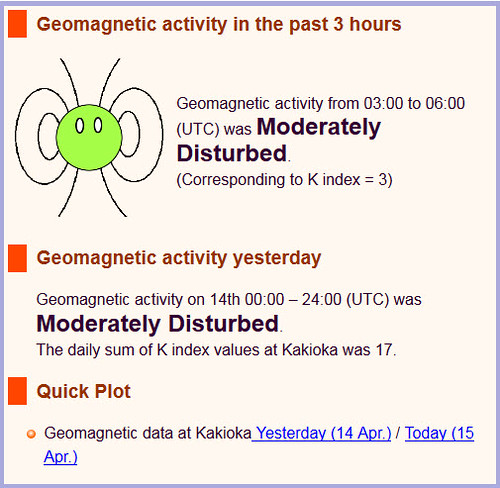
The homepage of the Kakioka Magnetic Observatory shown above says that geomagnetic activity is not a good predictor of earthquakes.
But, what with all the dolphins (Melon Head Whales), 150 of them that washed up on a beach North of Tokyo I was reminded of the brilliant research by Motoji Ikeya, on the way that catfish (thought to cause earthquakes in Japanese legend), oar fish (thought to predict them in Japanese legend) and other sea and land mammals sense the rock crushing piezoelectric activity causing magnetic fields and ionization of the air and can be used to predict earthquakes.
An American company uses the same principle to attempt to predict earthquakes using magnetometers and publishes world wide data (mainly for California and Taiwan) on their Quakefinder web site. However, they do not have any sensors in Japan. QuakeFinder does have a great Google Tech Talk video explaining their quake prediction research.
There appear to be however a few places in Japan that publish electromagnetic activity, particularly the Kakioka Magnetic Observatory in Kakioka north of Tsukuba (i.e. about 100km north of Tokyo). Their main English page shown in the screen shot above says that "Geomagnetic activity from 03:00 to 06:00 (UTC) was Moderately Disturbed." I am not sure if that is near enough to Tokyo to be of any use at all, even if if magnetic activity were of use. The same site offers data from The same site has another page that shows detailed data from four places in Japan
Kakioka About 100km north of Tokyo
Memambetsu (top of Hokkaoido)
Chichijima Island a LONG way south of Tokyo in the Pacific
Kanoya (nr Kagoshima) But I am not sure how to read the plots, and there is no cute graphic (as in the above image) to show whether the readings are high or not.
A Japanese space agency measures "Sporadic E propagation" and has traffic lights indicating the level of activity at four sites in Japan (Hokkaido, Tokyo, Kagoshima and Okinawa). None of them are red right now.
None of these measuring stations are anywhere near me. Perhaps I should look at our pet goldfish, or go to see if the carp in the university pond are jumping out of the water, or arranged in lines. Fish may arrange themselves in lines so as to avoid placing their bodies across the direction of greatest magnetic field, or jump out of the water when the magnetic field becomes unbearable.
Or I could keep a catfish. Americans are blissfully unaware that catfish are earthquake predictors, so when catfish die they think it was something to do with the water despite there being no harm to another water creature. See the mystery that occurred in Texas that preceded earthquakes, and Virginia at about the same time. I am not entirely sure whether it is a good idea to be aware or not but, the late professor Ikeya felt that paying attention to pets and other animals could save lives as explained in his short children's book.
The reason for melon head whales, and other marine mammals beaching, themselves is entirely different and explained on Captain David Williams' excellent website The Truth about Why Whales Strandings. Since, he claims and I believe him, that whale strandings are more to do with sonic seismic events, it is less likely that they would predict imminent earthquakes, but rather the fact that a submarine earthquake has already occurred. He suggests that the recent beachings in Japan are due to there having been a seismic event near Guam about a month ago. However, since seismic events occur in groups, and there were beachings prior to the big Fukushima Tsunami, and whales are linked with earthquakes in North American Mythology, there is that possibility and the connection between abnormal whale activity and earthquakes is common knowledge (see this auto translation) in whaling earthquake prone Japan.
Labels: japan, japanese culture, 日本文化
Sunday, April 05, 2015
Funerals for Video Tapes and Symbolic Immortality

The image above is part of an advert by a company offering VHS (etc) analogue tape to DVD dubbing services. People send their tapes and photograph albums to the company, which converts the analogue formats to digital and sends the data back to the customers in DVD form.
But what happens to the video tape itself? Should it just go in the trash? What happens if the video tape is of someone deceased? This Japanese company offers an additional service, in the case of one video tape at twice the price of the dubbing itself, funereal mourning rites, at an affiliated Buddhist temple. Customers pay for about $30 USD for a Buddhist priest to chant Buddhist prayers over up to twenty of their VHS video tapes, several times, before eventually disposing of them.
This question would not occur to a Westerner. But in Japan there is a far greater reticence towards destroying visual representations of people since these visual representations are far closer to the persons videoed. Similarly, for example there are also funereal rites for dolls in Japan because dolls are far more felt to have had lives.
So, is there a Nacalian transformation? Do Westerners pay our respects towards diaries, or voice recordings, especially of the dead, for instance?
Funeral rites for visual representations of persons (real or otherwise) may suggests a desire for visual representations of persons to live on - to go to a pictorial heaven as it were, where images live forever in an eternal light.
While I am unaware of a direct transformation, where Westerners pay respect to the linguistic representations of the dead, while they are alive it is found that at least Westerner strive towards 'symbolic immortality,' in the face of "mortality salience" - being required to think about their own death.
When required to think about their death, humans -- or at least Westerners -- attempt to live on in their narratives. The question as to whether Asians attempt to achieve "symbolic immortality" is controversial. Heine, Harihara, and Niiya (2002) found that Japanese do. Kashima, Halloran, Yuki, and Kashima (2004) found that mortality salience produced different effects in Japanese and Westerners. Yen & Cheng (2010) found that Taiwanese do not. Ma-Kellams and Blascovich (2012) found that Asians do other things in the face of death: rather than focus upon symbolic immortality they attempt to enjoy life more.
I hypothesise that Japanese would aim not for symbolic immortality but for vision-imaginable immortality. In the real world this may translate to the attempt to enjoy that picture book which is life more, or leave descendants that they can watch and protect forever. In the lab I hypothesise that Japanese will draw more positive "jimanga" (Takemoto, 2017) (prideful auto portraiture) should they be required to think about their death.
Heine, S. J., Harihara, M., & Niiya, Y. (2002). Terror management in Japan. Asian Journal of Social Psychology, 5(3), 187–196. Retrieved from
http://onlinelibrary.wiley.com/doi/10.1111/1467-839X.00103/full
Kashima, E. S., Halloran, M., Yuki, M., & Kashima, Y. (2004). The effects of personal and collective mortality salience on individualism: Comparing Australians and Japanese with higher and lower self-esteem. Journal of Experimental Social Psychology, 40(3), 384–392.
http://doi.org/10.1016/j.jesp.2003.07.007
Ma-Kellams, C., & Blascovich, J. (2012). Enjoying life in the face of death: East–West differences in responses to mortality salience. Journal of Personality and Social Psychology, 103(5), 773–786. http://doi.org/10.1037/a0029366
Yen, C.-L., & Cheng, C.-P. (2010). Terror management among Taiwanese: Worldview defence or resigning to fate? Asian Journal of Social Psychology, 13(3), 185–194.
http://doi.org/10.1111/j.1467-839X.2010.01328.x
武本, Timothy. (2017). ジマンガ:日本人の心像的自尊心を測る試み(Auto-Manga as Prideful-Pictures: An Attempt to Measure Japanese Mental Image Self-Esteem). 山口経済学雑誌= Yamaguchi Journal of Economics, Business Administrations & Laws, 65(6), 351–382. http://nihonbunka.com/docs/Jimanga.pdf
Labels: buddhism, culture, image, japan, japanese culture, nihonbunka, 日本文化, 自己, 自己視
Friday, April 03, 2015
Flying Tiger Fish that Barf Water
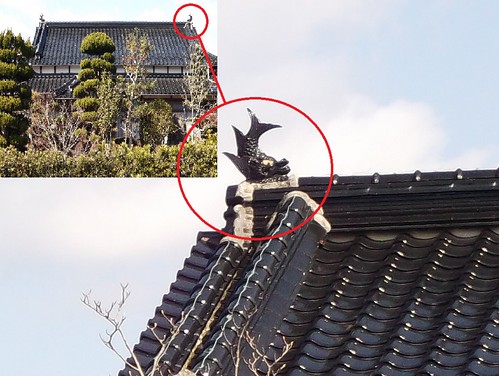
The fish mounted at the ends of Japanese rooves, where the ridge meeds the gable, are in fact a mythical beast called a "tiger fish" (shachihoko) with the body of a carp and the head of a tiger. Should their be a fire the tiger will cause rain to fall, or spit water from its mouth to put it out.
These days they are made of ceramic or cement and some are guilded. The largest roof top tiger fish, on a temple, is over 2 metres tall.
I see that Japanese rooves are teaming with fish symbols. There are also the fish gable end ornaments, just below the peak called "cast fish" (gegyo 懸魚), and Skipjack tuna poles (Katsuogi 鰹木) pointing upwards from the ends of shrine and temple gable peaks. The "cast fish"gable ornaments, were, like the tiger fish a form of sympathetic magic to encourage water to fall or be cast upon rooves in the event of fire. It is claimed that the skipjack tuna poles (katsuogi) on shrine rooves were an architectural reinforcement that merely resembled skipjack tuna.
Sympathetic magical thinking - that like attracts like - is popular in Japan. For example guests not meant to mention "parting" or "returning" at Japanese weddings since the utterance of these words is said to encourage the parting of the couple or returning (to the parental home) of the bride. So I do not doubt that part of the reason for these various types of fish being on Japanese rooves is by their association with water, which occupants hope would put out fire.
However, I think that I also once heard a theory that the shape of Japanese shrine rooves was related to their having originally been made by overturned boats. That may be related to the presence of water barfing tiger-fish on their ridges.
Labels: culture, japan, nihonbunka, 日本文化
Thursday, April 02, 2015
Graven Images as Expressions of Self
There is a strong tendency even among psychologists, to believe that the visual is presentational and external and therefore not really pyschological in the same way as linguistic thought.
There is no denying that the visual is external. The environment in which we were raised (Mori's fields and mountains), our faces or mask (Watsuji) are on our outsides as well. To say that the visual is psychological is not to deny its exteriority, but to assert the following:
1) One can imagine oneself and world of vision in ones psyche. This is obvious
2) In order to imagine oneself one needs the viewpoint of an Other who is physically external but simulated within the psyche.
3) Language likewise requires an other interluctor, who is external (or should be!) simulated within the self.
I think that the horror that (3) entails - that they are sharing their heads with someone, something else - is so great for atheisits at least, it tends to be rejected, or concealed behind claims of a metaphysical presence of "ideas," or "meanings."
Once one can accept these three assumptions however, it is clear that visual expressions are equally psychological and of self. In this video I introduce the dolls made by my wifes mother to express her aspirations for her granddaughters - things like health, wealth, happiness and a happy marriage - throught the use of graven images. In Japan I believe that these expressions are felt to be "paired-images" (guuzou,偶像) or like words, authenticopies of the aspirations which they represent. These are not worshipped in the same way as a Catholic worships Yahweh, but regarded fondly, important, and sincere. As such I think that they fall under the definition of graven image as defined by the Catechism of the Catholic Church.
http://www.scborromeo.org/ccc/para/2113.htm
Labels: autoscopy, cultural psychology, culture, cute, family, japan, japanese culture, kawaii, 日本文化, 自己, 自己視
Myself Vs Others Scale: Japanese for the Win

The "Me versus Others Scale" (Campbell, et al., 2004) shown above (without permission) is a non-verbal measure of self-importance which is found to correlate positively with entitlement and narcissism. More than one paper on narcissim, that uses the scale on US subjects does not however mention the median score on the scale.
In fact among US subjects, which contain a lot of Western style - I would say verbal/linguistic - narcissists (Twenge & Campbell, 2009), the mean score is only 4.15 (Piff, 2014) just a fraction higher than the fourth picture, in which the self is shown to be the same size as others. How can this be?
Japaense usually rate themselves at a similar just-above-the-middle point in linguistic scales of self-worth such as the Rosenberg Self-Esteem scale (Heine, et. al. 1999). I predict that if given this test, the Japanese will rate themselves at approximately where Americans rate themselves on verbal scales, at the boundary of the upper 4th quartile, at about the 6 on this scale.
Please try it on your Japanese friends and family. My informant scored a six.
Campbell, W. K., Bonacci, A. M., Shelton, J., Exline, J. J., & Bushman, B. J. (2004). Psychological entitlement: Interpersonal consequences and validation of a self-report measure. Journal of personality assessment, 83(1), 29-45.
www.researchgate.net/profile/Brad_Bushman/publication/527...
bathtubbulletin.ning.com/profiles/blogs/4569347:BlogPost:...
Twenge, J.M. & Campbell K. W.(2009) The Narcissism Epidemic: Living in the Age of Entitlement, Free Press.
Labels: japan, japanese culture, psychology, reversal, 日本文化
This blog represents the opinions of the author, Timothy Takemoto, and not the opinions of his employer.