
Thursday, December 06, 2012
Kyari, Super Suits and Symbols

Eschewing telephone boxes and toilets, Japanese superheroes transform in front of everyone with great aplomb, sometimes on stage. They use symbols to transform. And they also have, and sometimes become, suits. Often what the Japanese Clark Kenta changes into is a super suit. Their super form that -- vectored by the symbol -- possess them is often a sort of exoskeleton. They have bug eyes, but no mouths. Speaking, even mumbling, is quite out of the question. Ultramen are pure body, pure light.
Both types of super hero use the image and the symbol but in different directions, with reversed means and ends. The Western suit is the *means* to conceal and continue the objective: the super identity that the hero always was. The Japanese transformatory symbol, and Kyari Pamyu Pamyu's choreographed "Kata," are a means to transforming into ones super suit, or assuming the visual three-eyed* identity that Kyari represents.
*Kyari has two eyes on her face and another, that looks at her sometimes a "riken no ken" (Zeami). Zeami emphasised too that the Kata, the ritualised symbolic movements, are a means. One learns the kata, one manipulates the symbols, to go beyond them. The Japanese stop narrating themselves almost as soon as they started, but hey are not zombies (Rudd, 2009).
Image top left: Superman frente al espejo by Greenog, bottom right HG 00 Gundam by Chag
Baudrillard, J. (1995). Simulcra and Simulation. (S. F. Glaser, Trans.). Univ of Michigan Pr.
Lacan, J. (2002). The mirror stage as formative of the function of the I as revealed in psychoanalytic experience. In B. Fink (Trans.), Ecrits (pp. 75–81). WW Norton & Company.
Rudd, A. (2009). In defence of narrative. European Journal of Philosophy, 17(1), 60–75. Retrieved from http://onlinelibrary.wiley.com/doi/10.1111/j.1468-0378.2007.00272.x/full
Labels: autoscopy, culture, eye, henshin, image, japan, japanese culture, Jaques Lacan, lacan, logos, Masked Riders, morph, occularcentrism, reversal, specular, superhero, 仮面ライダー, 変形, 自己視


Wednesday, December 28, 2011
Mophing Transforming Lego Scorpion and the Japanese Self
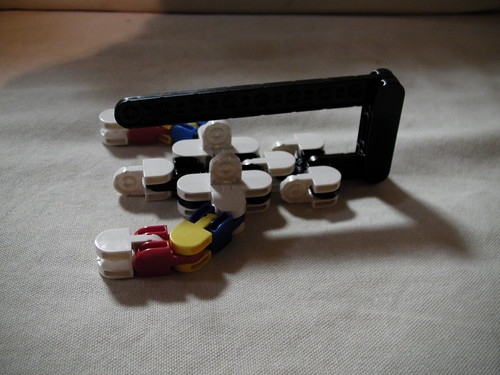
Jurat by Toyda is a kind of Lego for morphing robot makers.
I am not sure why Japanese children especially, and anyone who likes the movie series Transformers, are keen on transforming or morphing.
There is often a morph between something inanimate and something animate, between a something used, a tool or vechicle and a using thing living robot.
The above is a scorpion which morphs from/into a sword made by my son from Jurat morphin lego by Toyda.
I would like to suggest that Japanese children (and anyone fond of Transformers, which is most children everyhwere) but especially Japanese children because they remain in a "mirror stage," may be more aware of the Lacanian dictum that the ego or self, which originates in the self-image, is external, dead, a mere tool, and yet at the same time the only self we have. We see, we are, dead people: at best robots, at worst inanimate tools.
This dual nature of the self, (1) as a mere tool or representation to grasp a centre-less consiciousness, and (2) as the best -- though "robotic" or prosthetic -- self that we have, may be being played out in the morphining animation movies, and toys such as the one above.
Labels: Bandai, go-onger, henshin, japanese culture, Jaques Lacan, lacan, morph, nihobunka, nihonbunka, occularcentrism, self, specular, Super-Sentai, superhero, theory, 合体, 変形, 変身, 日本文化
This blog represents the opinions of the author, Timothy Takemoto, and not the opinions of his employer.