
Sunday, June 06, 2021
Superhero Secret Identity Collectivism

This is our (Nishioka & Takemoto, 2021) survey that attempts to prove that while Western Heroes go from a "mild mannered" secret identity to an individualistic "man of steel" Japanese superheroes often start as odd-balls in their non-super form, and change to upstanding members of the community. Japanese super-hero "secret identities" are not secret. They transform to become strong, not to hide. It seems to me that additionally, the individualism espoused by Westerners and exemplified by their heroes, and the polysemic wa, which means acceptance of difference at least as much as it means conformance, are a sort of camouflage for the odd-ball and mild-mannered reality of Japan and anglophone West respectively.
The images of Kamen Rider Forze before and after transformation and Christopher Reeve (RIP) as Clark Kent and Superman are copyright their respective copyright holders and used for illustrative purposes. If you wish that I cease and desist, please leave a comment below or contact me via the email link on my homepage, nihonbunka.com. We will be collecting Japanese data soon.
Labels: cultural psychology, culture, japanese culture, nihonbunka, Super-Sentai, superhero


Sunday, September 17, 2017
Hidden by Awe: Asian Positivity almost out of the Closet
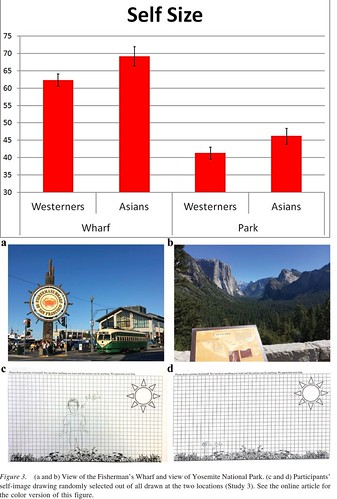
In recent research (Takemoto, 2017 in Japanese) I have argued that the size and positivity of self-drawings are a better measure of Japanese positive self regard that self-esteem scale scores and found that self-drawing size correlates with perceived social support in Japanese males, and that positivity of self drawing (as measure by independent evaluators) correlates with perceived social support in both Japanese male and female students, whereas self-esteem is not predictive of social support at all. In the vernacular, Japanese people who 'stand tall' with good comportment and positive, large body image are popular, but people with 'big mouths' and high self-esteem are not especially popular at all.
In a recent esteemed study (Bai et al., 2017), in the most impactful social psychological journal, a similar result was hidden in a paper on "awe". First of it reported that in an initial 7 item scale selection of self-size, where participants were asked to circle a self-drawing that was appropriate in size to themselves from large (like the above bottom left) or small (like bottom right) was found to correlate strongly with linguistic measures of, above all self-esteem (r=.64**), perceived power (r=.61), general self-efficacy (r=.5**), sociometric-status (r=.47**) and self-entitlement (r=.2**) but not with height nor weight.
The fact, however, that Asian perceived self-sizes, when measured with a self-drawing at least, were larger than those of Westerners hardly receives attention at all, hidden as it was in considerations of "awe," which Westerners are more sensitive to, in Yosemite Park for instance. May the Gods of social psychology forbid that Asians are ever found to be more positive than Westerners! The above graph shows the average number of squares covered by self drawings adapted from Table 2 (Bai, et al., 2017 p.6) where Westerners are the average of North American and European respondents.
The same pattern was found for the size of "signature" (me, 我, 私)but since this will depend upon the script only in-country correlations would be meaningful, and provides an interesting connection between Asian self-esteem and calligraphy.
For how much longer will Asian visual positivity remain hidden? It will not be long now. The problem then arises, if the self is both linguistically and visually represented, who is it represented to?
The bottom half of the above image is reproduced without permission from Bai et al., 2007, figure 3, page 10. Should you wish for me to cease and desist please leave a comment or drop me an email to the email link at nihonbunka.com
Bai, Y., Maruskin, L. A., Chen, S., Gordon, A. M., Stellar, J. E., McNeil, G. D., … Keltner, D. (2017). Awe, the Diminished Self, and Collective Engagement: Universals and Cultural Variations in the Small Self. Retrieved from psycnet.apa.org/psycinfo/2017-20208-001/
Takemoto, T. 武本, Timothy. (2017). ジマンガ:日本人の心像的自尊心を測る試み(Auto-Manga as Prideful-Pictures: An Attempt to Measure Japanese Mental Image Self-Esteem). 山口経済学雑誌= Yamaguchi Journal of Economics, Business Administrations & Laws, 65(6), 107–138. Retrieved from nihonbunka.com/docs/Jimanga.pdf
Labels: cultural psychology, culture, mirror, Nacalian, nihonbunka, 日本文化
Wednesday, September 14, 2016
Idiotropic or Visual Up Swayed by Images of Self and Others


Which of the grey partially illuminated disks looks the most convex?
Since humans tend to feel that light comes from above, then disk which is "illuminated" from direction that the subject feels to be "above" will appear to be the most convex. This will be likely to be the uppermost disk if one bases ones judgement upon all the information outside the picture, such as the pressure on your skin from your chair, and the historical/narratival information regarding where you know up to be, "idiotropically" (Oman, 2003), and the lowest disk should appear convex if one bases the decision regarding "up" on the visual information in the photograph.
The Japanese are often described as being context dependent, this being due to their "groupist/conformist" tendency to pay attention to others around them (Nisbett & Masuda, 2007). While I accept that there is some truth in this, and that certainly a philosophy of "harmony" is very prevalent in Japan, and that of individualism equally in the West, I argue that in fact the Japanese have a strong visual sense of self and attend to themselves and others visually, largely because their self love and self-division (Smith, 1770/2002, pp.101,102) is in the visio-spatial, rather than in the linguistic domain. Whereas Westerners whisper to themselves in order to evaluate themselves (Bakhtin, 1986; Mead, 1967; Vygotsky, 1986), Japanese imagine themselves using the mirror in their head (Heine, Takemoto, Moskalenko, Lasaleta, & Henrich, 2008).
The philosophies of independence and collectivism are I believe secondary to the differences in mode of self-cognition being due to the way in which members of each culture can obfuscate the self-division. Westerners think that they think because they are talking to themselves, as true individualists might, when in fact they are talking to a horrific intra-psychic "ear of the other" (Derrida & McDonald, 1985). Japanese think that they are concerned with the gaze of real external others as conformists are, when in fact they are watching themselves from a horrific intra-psychic "seeing of detached perception" ("離見の見", Yusa, 1987, p.331). The horror and purported social philosophy (individualism or collectivism) function to keep the self-love hidden, and the self intact.
If Japanese contextualism were driven by a groupist tendency to conform then pictures of people should encourage them to reorientate the direction of up towards the direction of the picture more than those of photos which do not contain people but do contain "intrinsically polarised" objects (Howard, 1982). If Japanese visio-contextuality is motivated as I suggest, by autoscopic self-love, then pictures of other people would be little more likely to influence decisions regarding orientation more than pictures of people-less cityscapes, whereas pictures of themselves would be the most likely to interfere with their visual self-identification and swing the direction of "up" the most.
However, the "Honi Phenomenon" (Dion & Dion, 1976) found that there was less context induced optical illusion in an Ames Room when viewing a loved spouse rather than a stranger, at least in women. This is presumably because people are more likely cut significant, loved others out of the total context, in a way parallel to the "cocktail party effect" (Pollack & Pickett, 1957) wherein, out of a buzz of conversation, one can pick out utterances of ones own name.
The strength of sway of the perceived direction of "up" may therefore be inversely proportional to the significance of the “intrinsically polarized” (Howard, 1982) objects in the visual background.
Image adapted from figure 2 in (Jenkin, Dyde, Zacher, & Jekin et al., 2005)
Bibliography
Bakhtin, M. M. (1986). Speech Genres and Other Late Essays. (C. Emerson & M. Holquist, Eds., V. W. McGee, Trans.) (Second Printing). University of Texas Press. Retrieved from pubpages.unh.edu/~jds/BAKHTINSG.htm
Dion, K. L., & Dion, K. K. (1976). The Honi phenomenon revisited: Factors underlying the resistance to perceptual distortion of one’s partner. Journal of Personality and Social Psychology, 33(2), 170. Retrieved from psycnet.apa.org/journals/psp/33/2/170/
Heine, S. J., Takemoto, T., Moskalenko, S., Lasaleta, J., & Henrich, J. (2008). Mirrors in the head: Cultural variation in objective self-awareness. Personality and Social Psychology Bulletin, 34(7), 879–887. Retrieved from www2.psych.ubc.ca/~heine/docs/2008Mirrors.pdf
Howard, I. P. (1982). Human visual orientation. John Wiley & Sons.
Jenkin, H. L., Dyde, R. T., Zacher, J. E., Zikovitz, D. C., Jenkin, M. R., Allison, R. S., … Harris, L. R. (2005). The relative role of visual and non-visual cues in determining the perceived direction of ‘up’: experiments in parabolic flight. Acta Astronautica, 56(9), 1025–1032. Retrieved from www.sciencedirect.com/science/article/pii/S0094576505000445
Mead, G. H. (1967). Mind, self, and society: From the standpoint of a social behaviorist (Vol. 1). The University of Chicago Press.
Nisbett, R. E., & Masuda, T. (2007). Culture and point of view. Intellectica, (46–47), 153–172.
Oman, C. M. (2003). Human visual orientation in weightlessness. In Levels of perception (pp. 375–398). Springer. Retrieved from link.springer.com/chapter/10.1007/0-387-22673-7_19
Pollack, I., & Pickett, J. M. (1957). Cocktail party effect. The Journal of the Acoustical Society of America, 29(11), 1262–1262. Retrieved from scitation.aip.org/content/asa/journal/jasa/29/11/10.1121/...
Smith, A. (2002). Adam Smith: The Theory of Moral Sentiments. Cambridge University Press. Retrieved from www.ibiblio.org/ml/libri/s/SmithA_MoralSentiments_p.pdf# (Original work published 1770)
101 When I endeavour to examine my own conduct, when I endeavour to pass sentence upon it, and either to approve or condemn it, it is evident that, in all such cases, I divide myself, as it were, into two persons; and that I, the examiner and judge, represent a different character from that other I, the person whose conduct is examined into and judged of. The first is the spectator, whose sentiments with regard to my own conduct I endeavour to enter into, by placing myself in his situation, and by considering how it would appear to me, when seen from that particular point of view. The second is the agent, the person whom I properly call myself, and of whose conduct, under the character of a spectator, I was endeavouring to form some opinion. The first is the judge; the second the person judged of. But that the judge should, in every respect, be the same with the person judged of, is as impossible, as that the cause should, in every respect, be the same with the effect. pp.101,102
Vygotsky, L. S. (1986). Thought and Language. (A. Kozulin, Trans.). Cambride, Massachusetts: MIT Press.
Labels: cultural psychology, japanese culture, nihonbunka, 日本文化
Friday, August 12, 2016
Eyes or the Law

There is quite a lot of research to show that Westerners become pro-social (nicer, more moral) when they are faced with drawings of eyes (Bateson, Nettle, & Roberts, 2006; Francey & Bergmüller, 2012; Haley & Fessler, 2005). Westerners cooperate more (Bateson, Nettle, & Roberts, 2006), pick up litter more (Francey & Bergmüller, 2012), and are more generous in "dictator games" (Haley & Fessler, 2005).
Since my shtick is that the Japanese are always watching themselves, or that in Japan the kind old sun is always watching, I had anticipated a cultural difference in the extent to which pictures of eyes would motivate the Japanese to be prosocial.
First of all I have noted that posters encouraging the Japanese to be prosocial (don't steal, litter, block the doors) often feature eyes, so that is one notch against my theory.
However, reviewing the literature on the effect of eyes on Japanese behaviour, the results are ambivalent.
Kitayama, Snibbe, Markus, & Suzuki, (2004) found that Japanese showed the mere exposure effect, enhancing the value of their own possessions, only in the presence of pictures of eyes. This is noteworthy in that the prosocial norm would be to be humble and efface ones possessions in the presence of others' gaze. I hypothesized that eyes encourage Japanese to evaluate themselves, and that since they show visual self-enhancement, the eyes encouraged them to self-enhance. In other words, the eyes in the poster were felt to be the subject's own eyes rather than the eyes of others.
More recent research (三船 & 山岸, 2015; 三船, 橋本, & 山岸, 2008) found that Japanese favoured an ingroup (a group to which they belong) rather than an outgroup when faced with a diagram of eyes. Without the eyes the Japanese subjects were, if anything, more generous to strangers. The eyes, or at least the Kabuki ones hardly seem to have increased overall average generosity and ingroup favouritism can hardly be described as prosocial. On the contrary nepotism is something that one might expect Westerners to avoid when faced with the gaze of others.
Finally a study published last year (阿部 & 藤井, 2015) attempted to use posters with eyes to encourage Japanese to park their bicycles in the right place. The research had a result but only with the first (left) of the three posters shown above. All three posters have pictures of eyes but only the first poster has a large central pair of ideograms (highlighted by me in red) saying "ILLEGAL." Could it be this rather than the eyes that encouraged those near the first poster to park their bicycles more diligently.
As I argued in respect of Ma Kellam's research (Ma-Kellams & Blascovich, 2013) which found that in a multi-ethnic group, thinking about science made subjects more moral might be due to non-WEIRD subjects being encouraged to think in a more sciencey, category or law bound, way, like the left most "ILLEGAL!" poster above.
So perhaps, mirrors and eyes are to Westerners, what science and the law are to the Japanese. And that is why, even more than posters with eyes, Japan is covered public sooths (標語, see Nakajima, 1999), telling them to buckle up, drive safely, and greet each other. These sooths probably really have an effect! They get the Japanese to appraise themselves linguistically, which is something that the Japanese do not usually do (Kim, 2002).
Bibliography
Francey, D., & Bergmüller, R. (2012). Images of Eyes Enhance Investments in a Real-Life Public Good. PLoS ONE, 7(5), e37397. doi.org/10.1371/journal.pone.0037397
Haley, K. J., & Fessler, D. M. . (2005). Nobody’s watching?: Subtle cues affect generosity in an anonymous economic game. Evolution and Human Behavior, 26(3), 245–256. Retrieved from www.sciencedirect.com/science/article/pii/S1090513805000036
Kim, H. S. (2002). We talk, therefore we think? A cultural analysis of the effect of talking on thinking. Journal of Personality and Social Psychology, 83(4), 828. Retrieved from https://labs.psych.ucsb.edu/kim/heejung/kim_2002.pdf
Ma-Kellams, C., & Blascovich, J. (2013). Does ‘Science’ Make You Moral? The Effects of Priming Science on Moral Judgments and Behavior. PLoS ONE, 8(3), e57989. doi.org/10.1371/journal.pone.0057989
Nakajima, Y. 中島, 義道. (1999). うるさい日本の私. 新潮社.
Bateson, M., Nettle, D., & Roberts, G. (2006). Cues of being watched enhance cooperation in a real-world setting. Biology Letters, 2(3), 412–414. Retrieved from rsbl.royalsocietypublishing.org/content/2/3/412.short
Kitayama, S., Snibbe, A. C., Markus, H. R., & Suzuki, T. (2004). Is There Any ‘Free’ Choice? Psychological Science, 15(8), 527.
三船恒裕, & 山岸俊男. (2015). 内集団ひいきと評価不安傾向との関連. 社会心理学研究, 31(2), 128–134. doi.org/10.14966/jssp.31.2_128
三船恒裕, 橋本博文, & 山岸俊男. (2008). 内集団への利他行動に対する「目」の効果. Presented at the 日本社会心理学会第49回大会, かごしま県民交流センター.
阿部正太朗, & 藤井聡. (2015). 他者の監視を想起させる「目」の絵を用いたポスターによる放置駐輪抑制効果の検証. 都市計画論文集, 50(1), 37–45. doi.org/10.11361/journalcpij.50.37
Labels: cultural psychology, japanese culture, nihonbunka, 日本文化
The Authenticopiable and the Unique
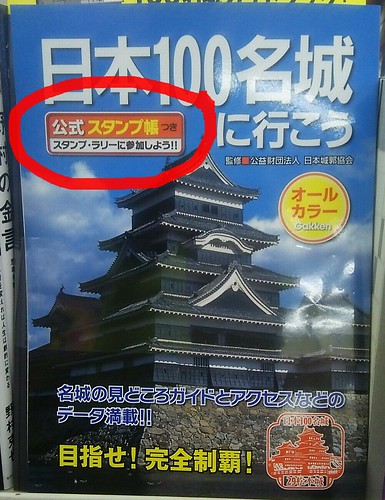
Many Japanese castles, such as those in Oosaka and Nagoya are, like the "foreign villages" (gaikokumura) scattered around Japan, scale models, replicas or fakes, made out of concrete, not the real ting at all, to the Western whispering mind. To the Japanese if they look the same they are the same. The Japanese are going to collect the unique words as stamps. This guide book to the 100 famouse ("named-") castles of Japan contains an "official" stamp collection book. An example of a stamp is shown in red bottom right. To us the situation is reversed: words are the same whereever they are said, but views are unique so we go to see them. How can the world be so inverted?
Each construal depends simply upon whether from out of that cave or 'crypt' of the mind (Abrahama & Torok, 2005), one is looking or listening with 'mother.' For the Japanese the collectable names are on the outside of the head. There is no Other (Lacan, Mori, 1999, p.163) to authenticate them.
Abraham, N., & Torok, M. (2005). The wolf man's magic word: A cryptonymy (Vol. 37). U of Minnesota Press.
Mori, A. 森有正. (1999). 森有正エッセー集成〈5〉. 筑摩書房. See here with quote.
Labels: cultural psychology, japanese culture, nihonbunka, tourism, 日本文化, 観光
Monday, June 20, 2016
Asian Holisim is Happier: And how happy are you?
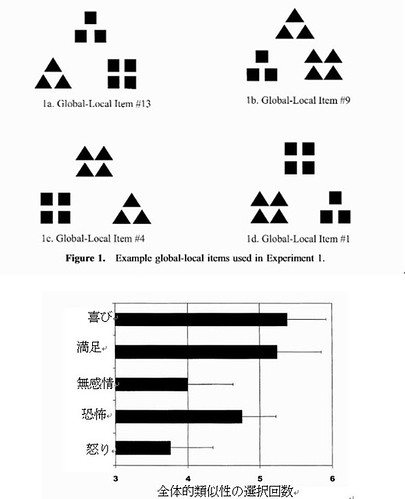
In each of 1a, 1b, 1c and 1d in the above image, which of the two (left or right) figures resembles most the figure above them? This is a test of happiness!
Fredrickson & Branigan(2005)had subjects watch videos of penguins, nature, abstract sticks, a climbers fall, and bullying to promote: pleasure, contentment, the absence of emotion, fear and anger respectively.
Subjects were then shown the four diagrams 1a, 1b, 1c and 1d above which show a single figure above two others and asked which of the two, left or right most resembles the one above. The right hand figure is made up of the same fundamental building block ■ or ▲, whereas the left hand figure is made of the opposite building block but is arranged holistically in the same way as the figure above.
It was found that the more positive emotions resulted in more holistic (left hand) resemblances as per the graph below (with the emotions in the same order as given above). This suggests that those that see the world holistically are happier and those that see it parts, may be in a more negative affective state.
Due to the higher suicide rate in Japan, and naff surveys purporting to guage the well-being of a nation based on one culturally laden question, one is often led to believe that the Japanese are bunch of unhappy people. I think this is very misleading. The higher suicide rate in Japan is due in large part to less negative appraisals of choosing the time and place of ones own death. It is further noted that East Asians in particular and Japanese in general tend to see the world in a more holistic way (Masuda & Nisbett, 2001; McKone et al., 2010). I think that this may be in part because the Japanese are in fact happier.
Fredrickson & Branigan(2005)は、ペンギン・自然・抽象的な模様・登山家の事故とイジメのビデオを使って、喜び・満足・無感情・恐怖と怒りの感情を被験者に持たせ、どれだけ全体的⇔局所的な注意を行っているかを調べた。下記のそれぞれの1a, 1b, 1c, 1dにおいて、上にある形状は下の右か左のどちらに似ているかという質問に対して
全体的局所的
1 a左右
1 b左右
1 c左右
1 d左右
それぞれの4つの設問の下にある2つの形状の右側は、上の物と同じ■か▲かの構成部員からできているから局所に似ているが、左側の形状は構成部員が違っているが全体的には上と同じ三角か四画の配置になっているので全体的に似ている。
その結果
つまり、肯定的感情があるときは全体的な類似性(つまり左側)を選択することが多いです。
Bibliograp;hy
Fredrickson, B. L., & Branigan, C. (2005). Positive emotions broaden the scope of attention and thought‐action repertoires. Cognition and Emotion, 19(3), 313–332. http://doi.org/10.1080/02699930441000238
Masuda, T., & Nisbett, R. E. (2001). Attending holistically versus analytically: comparing the context sensitivity of Japanese and Americans. Journal of Personality and Social Psychology, 81(5), 922. Retrieved from http://psycnet.apa.org/journals/psp/81/5/922/
McKone, E., Aimola Davies, A., Fernando, D., Aalders, R., Leung, H., Wickramariyaratne, T., & Platow, M. J. (2010). Asia has the global advantage: Race and visual attention. Vision Research, 50(16), 1540–1549. http://doi.org/10.1016/j.visres.2010.05.010
Labels: cultural psychology, culture, japanese culture, nihonbunka, 文化心理学, 日本文化
Tuesday, April 05, 2016
Doutaku and Doguu: Destroying the internal Other

Doutak bells are a quite mystery to me.
They are found dating from the Yayoi period when, I believe the previous, indigenous Japanese Joumon ("rope pattern") Japanese culture that had existed in Japan for millennia was invaded by horse mounted invaders from the continent. These bells were probably originally horse-bells, to allow horse mounted warriors to know where their horses are in the dark for instance. They started out being about the size of the bell that Ray is holding in the above photo, but were gradually made in larger and larger sizes.
My guess is that these larger and larger bells were in part to prove regal (or invader) hereditary, "My father or (great great..) grandfather was a horse mounted warrior." And with each passing generation the bells were made in larger sizes, perhaps.
The Japanese themselves have a tendency to believe that there was no "invasion" and that the Joumon people evolved into Yayoi people, and subsequently Kofun people, due to the arrival of "technology" from the continent rather than due to subjugation. The Japanese tend to believe, traditionally at least, imho, that their culture is continuous or contiguous from the year dot. And they may be right.
The genetic record however seems to point to a considerable differences (in height for instance) with at the same time much overlap, so at least there was interbreeding between an indigenous and arriving race. On the other hand, I suppose that genes might also be described as a "technology," and Japanese culture may have survived changes to the gene pool. I think it very likely.
I imagine Yayoi warriors arriving and breeding (no offence intended) with the indigenous Joumon people, and then later a second wave of invaders (related to the first) arriving in the Kofun (ancient burial mound) period. This two wave hypothesis is suggested by some (Korean) historical interpretations of Japanese mythology. After the latter wave vast tombs were created. The creation of vast tombs, all around Japan, makes me think that there was great stratification within society. I imagine that those that were related to the invaders rounded up and forced vast numbers of indigenous and mulatto stock Japanese and had them build tombs the size of the Egyptian pyramids for their new masters. But this is all my imagination. Korean and Western historians tend to present a sort of "Japan was invaded" type of history, whereas, as I say, the Japanese tend to portray their history as one of continuous evolution with changes in society being attributed to the arrival of new technologies such as for rice farming. I guess that the difference in historical outlook is one of degree. The Japanese are, and their culture is, great at maintaining continuity, of which a great deal remains. This post is about the possibility of continuity between doutaku (as held by my son Ray) and dogu (pictured above right).
Returning to the dotaku bells, they have peculiar characteristics. They appear to have been kept, while not in use, buried in the ground, being unearthed at specific occasions. One theory has it that they were buried in order to soak up and be replenished with the spirit of the earth. The bells often have pictorial inscriptions that may be rebuses, punning on that which they represent. They seem to have a lot of water related imagery and a preponderance of images of deer.
Ah yes, I remember now (I make the same observations over and over again): it seems to me that these doutaku bells may be the origin of the temple bells that are used to ring in the new year in Japan in the "joya no kane" (除夜の鐘) ritual, which are even more massive than the largest doutak. They look similar. They are likewise inscribed. These "joya no kane" bells are now associated with Buddhist ritual to purify the ringers of sins, of which there are said to be 108.
The "rope pattern", Joumon culture indigenous Japanese, who existed for millennia, seem to have created first person body view (McDermott, 1996) figurines or dogū (土偶) which have similarities with the Venus figurines found all over the palaeolithic world. These figurines in Japan were often destroyed. I wonder if they were destroyed (and perhaps buried) in an attempt to exorcise their owners from the mother that occupied their, and perhaps all our, minds.
If so then, by a vast leap of conjecture, it might be argued that the practice of making first person body view figurines and then breaking and burying them, may have evolved into the practice of making vast bells and ringing then (at first) burying them.
This conjecture parallels the hypothesis of Lacanian (and Freudian but less explicitly) psychology which has it that the self evolves by first being represented visually as a body view, then narrativally in phonemes.
In each stage the self is paired with an other-of-the-self that witnesses the self representation.
Lacanian psychology seems to lack reference to self-person body views. The visual or "mirror-stage" is purported to be one in which the the mirror self, or third person body image such as represented in mirrors, and the form of other children with whom infants identify, is seen from the perspective of real others and is therefore groupist, and interpersonal, rather than intra-psychic (in the mind).
It is only, according to Lacan and Mead, with the arrival of language that humans internalise an imaginary friend or Other or ear (of the Other). In Lacan and Mead, and Western philosophers in general, ears are argued to be internalisable but eyes are not. They claim that one can speak, whisper and eventually "think" in words to "oneself," or rather that hidden friend, a generalised other, super ego, super addressee. Eyes are always, interpersonal, groupist, social, out there in the world.
Till the discovery of mirror neurons, our paper on Mirrors in the Head, McDermott's first person, Nishida's Mephistopheles in 'active direct vision', and the lyrics of David Bowie ("Your Eyes" in Blackstar) it was not realised that people can create a watcher within their minds.
Western theorists seem to have missed out on autoscopic potential of the mirror neuron, or McDermottian possibility that eyes are just as internalisable.
Until recently I had thought that the "eye of the Other" was internalised in an abstract, ineffable way. Japanese pictorial art is often represented from the perspective of "an eye apart," typically looking down, from the sky such as one can experience when playing Mariokart, Final Fantasy or other third person view Japanese video games (Masuda, et al., in preparation).
At the same time however, it also seems possible to model an eye within the self in a more concrete way, as the the first person view of self, such as may be represented by dogū, and the first person view that we have of their own brow nose and limbs. When I look at myself in the mirror I can see the noses and brow of the person on this side of the mirror. I can hold out my hand and caresses the surface of the mirror. Narcissus is portrayed attempting to scoop up his image from the surface of water, using his this-side-of-the-mirror hands.
In a sense perhaps the phonic equivalent of the nose and brow is the voice. I can narrate myself and when I do, when I call myself names, such as "Tim" or "I," the in that situation, there is likewise a "this side of the mirror" in the voice that expresses these names. Mead, and Derrida, rightly point out that hearing oneself speak (s'entendre parler in Derrida) introduces a believable duality. But I think that Nishida is right to point out (at least I think he is pointing out) that a similarly believable, or en-actable (kouiteki) duality exists in seeing. Since we can see our brow, and our nose(s), and often our hands, we see ourselves see. We do not even need a mirror to do so.
So, aware of the fact that self always presupposes and entails a self loving drama (with [less than/not?] one actor and two personae), in an attempt to rid themselves of their self-loving sin, the Japanese may have moved from destroying images of the self-person view in the act of destroying and burying dogū figurines, to destroying the phoneme in the act of a DONNGG, of a doutaku or joya no kane bell.
One can hear the sound of a bell on the Japanese joya no kane wikipedia page and in this Youtube Video.
Bibliography
McDermott, L. R. (1996). Self-representation in Upper Paleolithic female figurines. Current Anthropology, 37(2), 227–275. websites.rcc.edu/herrera/files/2011/04/PREHISTORIC-Self-R...
I have also argued that Japanese attempted to destroy inner ears (converting them to external ones) by snapping their earrings. The more you love others the less you love yourself, and vice versa.
Labels: autoscopy, cultural psychology, image, japanese culture, Jaques Lacan, nihonbunka, psychology, religion, reversal, 宗教, 日本文化
Monday, July 27, 2015
Hoopa: The hooper that that could not loop
I thought "Pokémon the Movie: Hoopa and the Clash of Ages" was a Japanese commentary on Western culture personified in "Hoopa, the hooper that could not loop" (my subtitle).
Hoopa has two forms (as do many Pokémon), and as are believed to exist in the Buddhist view of ourselves: the small (unenlightened) and large (enlightened) self. We see the giant form of Hoopa first who uses giant hoops to move (or steal) things from anywhere in the world. Hoopa's power rests in this telekinetic ability. Herein lies the first parallel with Western culture. The Japanese have a bit of a tendency, in my limited experience, to see the British and their descendants as thieves, or "vikings" as they tactfully put it, conquering the world and taking it home. The seven hoops of Hoopa (one around each of his six arms, and one around his waist) may correspond to the sense of Buddhism (although there is one too many) which include the sense of the heart. From some Japanese points of view Westerners look upon nature and the world as a source of things to take, rather than as something with which one feels in harmony, to an extent unified.
Hoopa finds himself internally conflicted and unable to evolve into his large self who remains trapped in a bottle by a religious organisation that bears more than a passing resemblance to Judeo-Christianity. From a Japanese perspective Western culture separates God and humankind whereas in Japan, the enlightened, a supreme martial artist for instance, becomes one with God or the Buddha - which tend to be seen as the same things.
This inability to evolve into his large self, and being in conflict with it, parallels Hoopa's inability to pass through his own hoop. As we have seen Hoopa has six hoops (plus one around his body) that he uses to move or plunder the cosmos. He seems partially able to pass through one of his hoops (the one around his middle) but unable to pass through any of his others.
This inability to pass through his own hoops is due to Hoopa's lack of gratitude. Through his experience of growing up once again as small Hooper, however, Hoopa learns to love and feel gratitude and finally, when he does this he is able to pass through one of his own hoops. In this sequence, before the triumphant auto-looping-hooping the hoop, and overcoming self-conflict, Hoopa imagines himself growing up and all the love he has received. This introspection - literally seeing himself - works on a lot of levels as the defining characteristic of Japanese culture. The Japanese believe their heart to be a mirror, are found to literally have a mirror in their heart, they are (through the practice of Noh and Karate forms) able to see themselves from a perspective outside, and use this ability to see themselves from the points of view of others. Autoscopy is also especially noticeable in the last letters of suicide pilots and the Japanese version of psychoanalysis: Naikan therapy.
This self-seeing, or self perception may be what the whole "Pocket Monster" mythology is about as represented by the Pikachu Satoshi Diad. There is a monster within us, sitting on our shoulder, who sees us, but at some level, or in some way, Satoshi and Pikachu are one. Perhaps in a final Pokémon movie this fact will be revealed. Or perhaps it already has. I have only seen two Pokémon movies.
Reading perhaps far too much into the iconography, it seems proper that Hoopa should be appear from out of one of his hoops (little Hoopa), have hoops on his ears (little Hoopa) or have one of his hoops as a hole at his centre (Big Hoopa) since Westerners do feel able to perceive themselves, linguistically. Only being able to perceive ourselves through this especially dark mirror, we are able to wreck destruction on an unparalleled scale, believing that anything that can be linguistically justified is acceptable. Hence a Briton feels able in saying that the British enforced importation of narcotics into China, for more than a hundred years, was acceptable because "the Chinese chose to smoke (opium). Or, in my experience, Americans (and others from the allied nations) generally continue to approve of the bombings of Hiroshima and Nagasaki, as just since 'the Japanese started it.' It is only when one starts to see oneself, hear the crying children, smell the stench of results of what one does, it is only when one passes through other hoops, that such justifications become untenable. We need to learn other forms of insight fast.
Hoopa learns gratitude, becomes able to perceive himself, is no longer conflicted, walks in the light, or becomes Japanese, in harmony with, not apart from the world. In the last part of the movie giant Hoopa spends his time rebuilding that which he has destroyed, only plundering the occasional doughnut.
I was moved by the compassion with which Hoopa the destroyer was viewed. Even though he destroyed the humans that fed him, Hoopa was not punished with death, but merely part of him kept in a bottle, since after all, as grandfather says, Hoopa is one of the family.
(I have a Japanese family, and lack gratitude, so this notion moves me to tears.)
Labels: autoscopy, cultural psychology, culture, japan, japanese, nihonbunka, occularcentrism, self, specular, 日本文化
Tuesday, July 14, 2015
Western Release from proactive interference
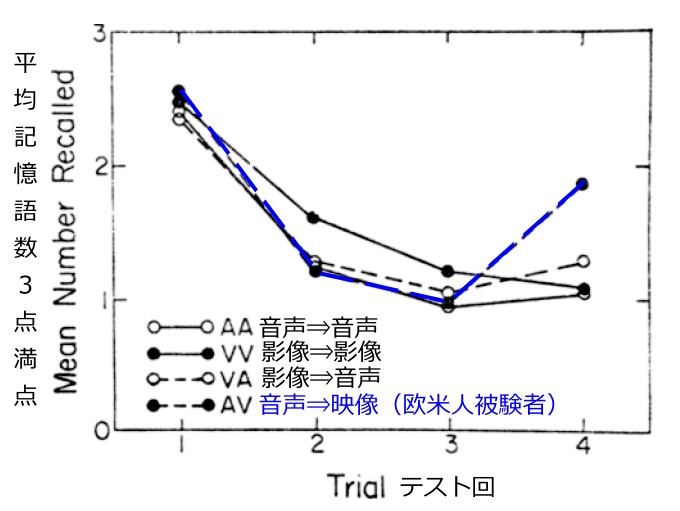
"Release from proactive interference" (Wickens, 1973) describes the way in which after a series of similar memory tests one is given a novel set of items to remember, then ones short term memory returns almost to fresh, first test or second test levels, since the novel stimuli are not confused or "interfered with" by the previous tests sets.
"Release from proactive interference" between visual and audio modalities, mentioned previously, is only found, in Western subjects, when moving from audio to visual stimuli and not when moving from visual to audio stimuli (Hopkins, Edwards, Tamayo, Holman, & Cook, 1973).
In other words, if Western subjects are given three memory tests with three pictures of fruit followed by a memory test using fruit words, their performance does not return to previous levels.
But if Western subjects are given three tests using fruit words, and an a fourth with pictures of fruit their performance does improve to previous levels.
The reason for this asymmetry may be due to the fact that, even when shown pictures of fruit, Western subjects are likely to think, or hear themselves speak (Derrida), the words for the fruit, so that their short term memory of fruit words is being depleted ('proactively interfered' with) even in the visual pre-test condition.
In the case where Western subjects are first given fruit word memory tests however, the Western subjects may not generally imagine the fruit corresponding to the fruit words, so if on the fourth trial they are shown fruit images, these images are felt to be novel stimuli, that are not "proactively interfered" with by the previous verbal trials.
I predict that Japanese may show the reverse pattern in that moving from audio fruit words to visual fruit pictures may not result in a "release from proactive interference" since in the audio condition Japanese may imagine the fruit that is presented in words.
However in the visual pretest condition, the Japanese may not bother to say the words for the fruit to themselves (see Kim, 2002 for evidence), so if the fourth trial is of fruit words, then they may show a release from proactive interference -- an improvement in recall -- since the fruit words will be felt to be novel stimuli.
This would be easier to test than self-related stimuli.
The test response method (getting subjects to say or draw the fruit) and distractor task between trials (getting subjects to add visually and verbal presented digits) may also confound results.
Interestingly a mixed audio and visual filler task (adding visually presented digits) produced the same results as an audio tasks adding orally presented digits. Again, I think that this is because Western subjects would be likely to self-speak the images of digits, so images are always mixed mode for Westerners. Following the reasoning in Kim (2002) the same may not be the case in Japan. According to a Nacalian transformation, a mixed filler task would be equivalent to a visual filler task since Japanese will provide the visuals when presented with oral stimuli. Oral stimuli are likely to be always mixed mode for Japanese.
I wonder if there is pre-existing Japanese research on this paradigm, and whether a reversal has already been found. Or whether the same tendency was found. No this paper (Hopkins, Edwards, Tamayo, Holman, & Cook, 1973) seems to be cited only three times, and only by researchers in the West. Searching for the authors surnames and Japanese keywords likewise yields no hits.
Addendum
There is some Japanese research by Tadashi Fujita (Fujita, 1995; 藤田正, 1985, 1988) and the results are not good from the point of view of my hypotheses.
In the main the research I have found is not testing audio visual modality shifts and repression of proactive inhibition but in the one article which did investigate modality (Fujita, 1995), to a degree, by looking at the way in which kanji characters interfere with each other, it was found that similar kanji pronunciations do result in proactive interference (suggesting that Japanese do not process kanji by image alone, as is well known) whereas different pronunciations result in a release from proactive inhibition. And even worse for my hypothesis, changing the radical of kanji did not however result in a release from proactive interference, whereas semantic differences between tests did. This suggests, contra my hypotheses, that Japanese are thinking in phonemes and semantics (meaning) more than purely in kanji morphology. In a more recent paper (Fujita, 2007) it was found that Japanese (kun) reading of the kanji has more effect than the Chinese (on) reading.
I would be more interested to know what happens when Japanese remember non linguistic images or icons, other than kanji. Fujita's research used a different methodology, with successive tests being in the same or different groupings rather than three tests in the same followed by one in a different group.
Bibliography
Fujita, T., & others. (1995). Buildup of proactive interference in Japanese Kanji learning. Retrieved from near.nara-edu.ac.jp/handle/10105/703
藤田正. (1985). 順向抑制の形成に及ぼすリスト類似性の効果. Retrieved from libneardspace.nara-edu.ac.jp/handle/10105/2221
Fujita, T. 藤田正. (1988). 順向抑制の形成に及ぼす隣接試行の類似性の効果. Retrieved from dspace.nara-edu.ac.jp/handle/10105/2042
藤田正. (2007). 訓主漢字と音主漢字の記憶における分散効果. Retrieved from dspace.nara-edu.ac.jp/handle/10105/637
Hopkins, R. H., Edwards, R. E., Tamayo, F. M. V., Holman, M. A., & Cook, C. L. (1973). Presentation modality and proactive interference in short-term retention using a mixed-morality distractor task. Memory & Cognition, 1(4), 439–442.
link.springer.com/article/10.3758%2FBF03208905
Kim, H. (2002). We talk, therefore we think? A cultural analysis of the effect of talking on thinking. Journal of Personality and Social Psychology.
doi.org/10.3758/BF03208905
Wickens, D. D. (1973). Some characteristics of word encoding. Memory & Cognition, 1(4), 485–490. Retrieved from link.springer.com/article/10.3758/BF03208913
Labels: cultural psychology, culture, japan, japanese, japanese culture, nihonbunka, 日本文化
Friday, June 19, 2015
Bathing with Daughter: Daddy Arrested

It seems that my warning was appropriate. This recent Asahi Newspaper article relates that the Japanese Foreign Ministry has now issued a warning on its homepage saying that in a Japanese national living in an "advanced / first world" nation wrote an school essay entitled "I am looking forward to bathing with daddy," as a result of which the school informed the police and the father was arrested under suspicion of sexual abuse.
The foreign office homepage is here, complete with cartoons showing the co-bathing father being reprimanded by a policeman suggesting that photos (no one takes photos) or memories of bathing with his daughter are pornographic. Another cartoon warns against leaving children in cars.
The above article also states that the average age to which Japanese daughters bathe with their father is 9 years of age, reducing to about 10% of eleven year old daughters. 10% of eleven year old Japanese daughters are getting into a 1.5m square bath with their father partly because (so one person mentioned in the article opines) Japanese fathers are estranged due to the amount of time they spend working. Since they can only spend a smaller amount of time with their children it is appropriate, it is argued, that they spend it closer proximity with their offspring.
My favourite philosopher, Derrida (2008) writes that shame regarding nakedness is fundamental condition of being human and having morality.
"It is generally thought, although none of the philosophers that I am about to examine actually mention it, that the property unique to animals what is in the last instance distinguishes them from man (sic), is their being naked without knowing it. Not being naked therefore, not having knowledge of their nudity, in short, without consciousness of good and evil." (Derrida, 2008, p4-5; Derrida, 2002
That is not to say that the Japanese are animals, but not "men." It is my belief that the Japanese are humans in a different way.
Derrida, J., & Wills, D. (2002). The animal that therefore I am (more to follow). Critical Inquiry, 369–418. Retrieved from www.englweb.umd.edu/englfac/KChuh/Clark.Seminar.Doc.1.Der...
Labels: cultural psychology, culture, japan, japanese, japanese culture, sex, taboo, tabuu, 日本文化
Monday, June 08, 2015
Sexual Risk Taking: Japan is Fairly Safe
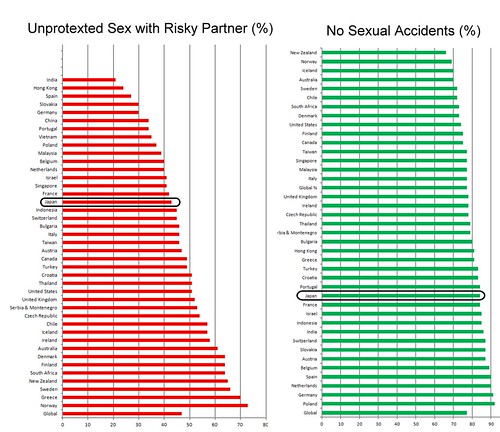
The Japanese rate themselves to be the most risk averse nation in the world with more than 70% of Japanese saying that they are NOT someone who enjoys taking risks (World Values Survey). I believe that the differences between Japan and other developed nations are qualitative rather than quantitative so there should be some area of Japanese behaviour in which they are shown to take risks. I think it unlikely that they would say that they enjoy taking risks since this would be similar to standing out in their linguistic self expressions - something that they have no interest in doing.
Eating blowfish and getting on roller coasters are both not very risky behaviours when compared to skydiving (the 5th most dangerous sport after BASE jumping, swimming, cycling and running).
Guzman and Pohlman (2014) highlight the following classes of risky behaviour among youth worldwide: "Self-Injurious Behaviours, Violence, and Suicide, Substance Use, Risky Sexual Behaviour, and Behaviours Related to Obesity and Unhealthy Dieting." Only suicide is clearly elevated in Japan but that is a special case of risky behaviour. I am not sure that self annihilation is actually "taking a risk," but may on the contrary be a way of avoiding risk, and heightening certainty. The only other risky behaviour on that list that might be high in Japan is risky sexual behaviour.
However, Japanese sexual behaviour does not appear to be all that risky. While no where near as risk averse as their self rating would appear to indicate, the Japanese are below the global average (47%) of percent of adults who have had unprotected sex with a person whose sexual history one is unaware at 42%. And the Japanese have better than the global average (77%) of persons who have never had a sexual accident, my term for unwanted pregnancy or sexually transmitted disease, at 84%. Both sets of data are from the Durex World Sex Survey (2005).
So where is Japanese risky behaviour?
Labels: cultural psychology, culture, japanese, japanese culture, nihonbunka, 日本文化
Monday, April 20, 2015
Sorting by Words and Images

Norenzayan, Smith, Kim, & Nisbett (2002) cool research on how Westerners and Asians sort shapes into groups (figure 4 of which reproduced above without permission) is described as a preference for formal or intuitive reasoning. Masuda (2010) describes it under the rubric of his and Nisbett's (2004) distinction between "analytic and holistic thought." Asians sort the left target images into the left hand groups and the right target images into the right hand groups whereas North Americans sort them in the reverse ways.
The reason for this difference is, it seems to me, that the Asians are sorting the target images according to visual similarity according to their face since the visual is felt to be important and alive.
W.I.E.R.D. (Henrich, Heine & Norenzayan, 2010) Westerners, infected as they are by the addiction to hearing themselves speak are looking for a linguistic rule to apply and find it in the 'hair' of the shapes right and the stalks of the flowers left and apply that rule. The hair and the stalks are in a sense in the background. The faces of the little men and flowers are focal and yet, Westerners are not talking to the "The Boss" (Masuda, 2010) the faces of the men and flowers, but to the "trees" (Nisbett, 2004) the minor background details. The reason for this is that Westerners believe that language is the vector of meaning and life.
To humans, life is meaning (Heine, Proulx, & Vohs, 2006) but Westerners hear meaning in words, and Japanese see meaning in faces and characters.
Image based upon figure 4 page 664 of (Norenzayan, Smith, Kim, & Nisbett, 2002)
Henrich, J., Heine, S. J., & Norenzayan, A. (2010). Most people are not WEIRD. Nature, 466(7302), 29–29.
Heine, S. J., Proulx, T., & Vohs, K. D. (2006). The meaning maintenance model: On the coherence of social motivations. Personality and Social Psychology Review, 10(2), 88–110.
Masuda. 増田貴彦. (2010). ボスだけを見る欧米人 みんなの顔まで見る日本人. 講談社.
Nisbett, R. (2004). The Geography of Thought: How Asians and Westerners Think Differently...and Why. Free Press.
Norenzayan, A., Smith, E. E., Kim, B. J., & Nisbett, R. E. (2002). Cultural preferences for formal versus intuitive reasoning. Cognitive Science, 26(5), 653–684.
Labels: cultural psychology, culture, japan, japanese culture, 日本文化
Reciprocal Resurrection of Simulacra

This essay explores the intersection between Derrida's Post Card (1987), and Baudrillard's simulacra (1995) in Western and Japanese culture: word/idea pairs and images respectively.
Most Western philosophers are unintentionally obfuscating. They want to tell their readers that it is okay, That the way we understand the world is not a grotesque lie. A few, larger French philosophers such as Baudrillard (1995) and Derrida (1987, 1998, 2011) attempts to pull the lie apart, to expose its untruth. But, because they are polite and the lie ingrained, they is not quite persuasive enough. Obfuscators take the mickey out of their "Parisian logic" (Mulligan, 1991).
In order to see oneself it is self-evident that one has to model the perspective of an other and or mirror. However, when talking about oneself to oneself, this need for another, real or simulated, is not apparent. Many clever people (I am thinking of Steven Heine e.g. in Heine, 2003) claim that face, or image is essentially for others whereas language, (that most social of media!) and our Western narratives selves are for ourselves.
Indeed, most Westerners think, that when they think they are thinking, talking simply to themselves (and not to Mel Gibson's Satan, above right). Seeing oneself requires a spatial distance that makes the alterity of self-observer far more apparent. But speaking, hearing oneself speak, does not seem necessarily to involve anyone else, real or imagined, at all. Derrida rejects this possibility forcefully (Garver, 1973).
The truth in my humble opinion, and experience is, that as Derrida argues, speaking to oneself does require an other, simulated or real. But few people, or atheists at least, seem to realise this. How can I convince folks of the truth, that self-narrative requires an other to be meaningful?
Derrida's gambit is something on the lines of the following.
When I talk about myself I use signs, signs like "Tim" and "I". Each time I say or think a sign I may be slurred or abbreviate but for the phoneme to mean, it needs to be one of a group of other iterations of the same sign. Signs are iterative. I can say Tim TIM Tm, tem, timu, timm, with all sorts of slurings and blurrings but for "tim" to mean me it must be member of the set of signs that are iterable. It must be one of the sayings of "Tim." "Tim" as a sign is a sign by virtue of the fact that it is recognisable and distinguishable from tin (can).
Therefore, Derrida opines, since signs have this property in themselves of being repeatable and recognisable their use implies a distance or disappearance of the subject that uses them. Derrida fundamental insight is I think that this iterability implies speech is no different from writing.
Mulligan (1998) is right to point out that it is going to be difficult to convince anyone that the iterability of signs implies anything threatening about the Western self. Conversely, the fact that signs are iterable (repeatable in time) is a phenomena that obfuscating philosophers have used as evidence for the existence of "presence:" the co-temporal, co-presence of "ideas".
That signs are essentially "iterable" is a proposition that Derrida gets from Husserl who he paraphrases in the following way.
"When in fact I effectively use words, and whether or not I do it for communicative ends (let us consider signs in general, prior to this distinction), I must from the outset operate (within) a structure of repetition.... A sign is never an event, if by event we mean an irreplaceable empirical particular. A sign which would take place but “once” would not be a sign; a purely idiomatic sign would not be a sign. A signifier (in general) must be formally recognizable in spite of, and through, the diversity of empirical characteristics which may modify it. It must remain the same, and be able to be repeated as such, despite and across the deformations which the empirical event necessarily makes it undergo. A phoneme or grapheme is necessarily always to some extent different each time that it is presented in an Operation or perception. But, it can function as a sign, and in general as language only if a formal identity enables it to be issued again and to be recognized. (Derrida, 1967, p55—56; Derrida, 2001, p.42 see Mulligan, 1992, p.5.)
Derrida also states more pithily “a sign which would take place but `once’ would not be a sign”
Hansen (1993) traces this distinction too, between sign tokens or instantiations and signs, and points out Western philosophers since Plato and Aristotle have claimed that (Aristotle writes, see Hansen, 1993) "spoken sounds are symbols of affections in the soul, and written marks symbols of the spoken sounds. And just as written marks are not the same for all men, neither are spoken sounds. But what these are in the first place signs of-affections in the soul-are the same for all; and what these affections are likenesses of - actual things - are also the same."
This is basically the same argument as presented by Husserl about 2000 years earlier. Our feeling of their being identity in difference, of a unity, despite multiple instantiations, demonstrates to us that there must be existences underpinning them. Words are somehow the same every time we use them. This is not true, but we feel it strongly.
I think it is possible to be far more persuasive, and threatening, by taking a detour through Japanese culture. The use of Japanese culture as an analogy is similar to writing a book of self addressed postcards (Derrida, 1987) to illustrate the weirdness of self-addressed speech, except that the Japanese, unlike the postcard writer of Derrida's book (ibid), are not fictional, and I believe they send themselves blank postcards - images without words (Kim, 2002) in the form of selfies, purikura (Toriyama et al., 2014), souvenir photos (kinenshashin: see Davidson, 2006 p36), third person memories (Cohen, Hoshino-Browne, & Leung, 2007), and autoscopic video games (Masuda and Takemoto in preparation).
I argue that whereas Westerners hear a shared, identical unity behind multiple slightly differing sound tokens, Japanese may feel the same way about images. A copy of a shrine, horse, bonsai tree, karate form or a face, though it changes in each instantiation call to the Japanese mind a similar sense of unity as called to the mind of Westerners when they hear words.
Despite, upon consideration there being a plurality of word phenomena, each instantiation is as good as the others. No word is inferior to another, no word is a copy of another word, since they all refer to a (illusionary) underlying unity. All words are authentic because they match up to ghostly metaphysical meanings. Westerners until Dennet (1992) find it difficult to deny the existence of these idealities, because they are one of their number. Our self, existed traditionally as an idea in the mind of God, or according to Dennet, who somehow manages to obfuscate even as he reveals the truth, is an abstraction or fiction.
Similarly Japanese may be able to feel that "foreign villages" (in Japan - gaikokumura 外国村) are as good or the same as villages abroad, or that video tapes of a deceased grandfather require funeral services just as did the body (image) of their grandfather, or that a sculpture or even a picture of a horse (ema 絵馬) is as pleasing to a god as real horse, or that a mask or face can represent the underlying unity of a person (Watsuji, 2011).
Nowhere are simulacra, or authenticopies, more visible than the Japanese religion, Shinto. Shinto shrines, especially that of the sungoddess are rebuilt (senguu 遷宮) made in miniature for household shrine shelves (神棚), and replicated (e.g. the replica of Ise shrine in Yamaguchi city's main shrine) but in all cases thought to be authentic. Japanese deities are infinity divisible (bunrei 分霊) and and transportable (kanjou 勧請) to be enshrined elsewhere (bunsha 分社). Originally this would require the copying of the object felt to contain the spirit/deity (goshintai 御神体), but more often now simply by stamping the characters on a piece of wood, card or paper to form a sacred token (神符), as in the case of the sacred talisman that serve to transport the deity into household shrines (ofuda お札) and inside protective amulets (omamoriお守り). Sometimes these sacred stamped tokens (shinpu/ofuda神符/お札) were felt to fall from the sky causing great merriment, singing, dancing and tourism("("good isn't it?" or "hang loose" ええじゃないか). Just as the Lords prayer on the lips of one bishop is the same as that on the other so the stamped names of Japanese deities are the same in all their instantiations. Conversely, in Japan words without material representation are felt to be hot air, as the Jesuits lamented being required to bring presents and not express gratitude in words.
It does not matter that faces age, seals smudge, or that there are minor differences between sculpted and real horses, just as it does not matter that I might say my name, or I, with a hoarse voice (To the Japanese the voice is always horse..!). That is not to say that the Japanese are fully identified with their bodies. Traditionally the Japanese were also aware of the field of vision, that which which sees, the mirror as soul. But that space is no different from that which is seen, or rather contains the authenticopies as they are, without their need to be unified and represented by an idea.
Narcissus is a fool for mistaking his reflection for himself but there is identity, Echo, in his voice (Brenkman, 1976). Likewise Susano'o is a fool for repeating his words but there is identity, Amaterasus, in his image. Iterability in time is like copiability in space - there is a ridiculous distance. When Narcissus falls in love with his self reflected in the water we want to shout "but that isn't you!" There is an obvious plurality, a painful not-one-ness. It is as ridiculous to a Japanese person to hear someone speaking to themselves or praising themselves as it is to a Westerner watching Narcissus love his image. in each case evaluating subject can not escape from evaluated object, and the loop is felt incomplete.
These differences in perception depend upon culture not some inherent superiority of one or other media. Writing is no more a record of speech than speech refers to writing.
This is due to the nature of the Other being simulated in the mind. There never was a layer of ideas, or metaphysical realm, just a partner in the heart. Westerners from Plato to Baudrillard (1995) tell us that is God that In the West we feel (and or do not feel) as if a super-addressee is always listening and Japanese feel (and or do not feel) as if someone is always watching.
By "and or do not feel" I mean that the Other is both felt and hidden. That on the one hand I "feel" someone is listening make this preposterous self-speech that I do, even in my head, meaningful, pleasurable but on the other if the door were to open and I were to see what I am speaking to, I would recoil in horror. So in that sense I do not feel the presence of the other. I will come back to this.
I think that the two forms of ridiculous distance should start to erase each other in those that experience them. The way in which Post Cards and images destabilise the structure of the word/idea complex is also discussed by Baudrillard (1995).
Baudrillard writes "[Iconoclasts] predicted this omnipotence of simulacra, the faculty simulacra have of effacing God from the conscience of man, and the destructive, annihilating truth that they allow to appear—that deep down God never existed, that only the simulacrum ever existed, even that God himself was never anything but his own simulacrum—from this came their urge to destroy the images.rage to destroy images." (1995, p4)
Baudrillard's term "simulacra" seems too broad, being used to mean words, images, simulated subject positions and even perhaps the imminent universe. Nevertheless he has a point. It seems to me that the two types of simulacra that I differentiate (Western words, and Japanese images or "authenticopies") should have a tendency to draw attention to the limitations of each, and not so much erase but resurrect (!) or make people aware of God, in one person or another, as intra-psychic other.
By consideration of Edo period artwork and research on Japanese artistic representation (Masuda, Wang, Ito, & Senzaki, 2012) third person memories (Cohen, Hoshino-Browne, & Leung, 2007) the Other of the Japanese is not "in the head" but outside of it, a spatial distance but still in their psyche, that is to say a simulated, undead viewpoint. Japanese ancestors look down and protect. Though simulated, I don't think they could ever be as dead as words and images since it is a simulated subject position, but in the title I am using "simulacra" to be simulated subject positions, a viewer, or hearer. It is really these that have ensured the meaning of Western Words and Japanese images.
Theists experience these subject positions as their Gods: ancestors or Amaterasu, and Jesus. Atheists may experience them as the monsters shown above Sadako of "Ringu", (Nakata, 1998) and Satan of "The Passion of the Christ" (Gibson, 2004).
When Baudrillard further writes "If they [iconoclasts] could have believed that these images only obfuscated or masked the Platonic Idea of God, there would have been no reason to destroy them. One can live with the idea of distorted truth. But their metaphysical despair came from the idea that the image didn't conceal anything at all, and that these images were in essence not images, such as an original model would have made them, but perfect simulacra, forever radiant with their own fascination. Thus this death of the divine referential must be exorcised at all costs." (1995, p4) he is correct to say that images do not require a second term, a "divine referential:" ideas. However, both word/ideas and images do require a third term a simulated hearer/view point. Images exist in the mind of their god unmediated.
Returning to the way in which the Other is and is not here.
Husserl is adamant that no one is listening to thought, and it is precisely this fact, coupled with the fact that he can yet understand himself, that convinces him that something other than what happens when we speak to others must be going on. "He believes that he finds pure expression [of another layer of ideal things] in interior monologue because, in interior monologue, my thoughts seem to be present to me at the very instant that I say them." (VP, p. xxv). This argument convinces cleverer people than me, such as Mulligan.
When a Japanese person is looking at a mirror (which she may not need), or imagining herself, she may feel that that the person in the mirror or the image in her mind is herself. Looking at a Japanese person looking at a mirror I may want to to say "no, that is not you! Look you are on this side of the mirror not that thing over there!" But the Japanese lady is cleverer than me. She "knows", like Husserl "knows", there is no one else in her head, so there is no way someone can watch from the wings to claim "You are not the person reflected in the mirror."
To me sight is always seen by someone (an eye) just as to the Japanese (Mori, 1999) language is always heard by someone (an ear). Language in Japan is always contextual. Sight in the West is always contextual. Conversely, the "third person perspective" (Mori, ibid) exists in language in the West, and in those birds eye views that the Japanese see, feel and represent.
The experience of hearing oneself speak proves to Husserl that speech can be heard and understood without another listener (other than the one speaking) because he feels he is absolutely alone. Specifically Husserl can understand the word "I" to refer to himself.
The experience of seeing oneself imagined proves to Japanese that images can be seen and understood without another viewer (other than the one seen) because she feels she is absolutely alone facing the mirror. Specifically she can understand the image to be herself.
Addressing Husserl, Derrida says that consciousness is temporised, and that the other needed and simulated to understand the interior I is deferred in time. "You don't realise that you are writing letters to yourself in the future/ reading letters from yourself in the past." You are not alone at the level of simulacra.
Addressing the Japanese person I want to say that consciousness is spatialised, and that the other needed and simulated to understand the interior self image is distanced. "You don't realise that you are signing to yourself at a distance/ seeing yourself from a distance." You are not alone at the level of simulacra.
It is so obvious to me, a Westerner, that one can see imagine oneself from the outside. That is obvious to the Japanese too. But if the Japanese have an extra viewpoint that is horrifying, then erasing that viewpoint, and yet at the same time viewing themselves from it, they can misunderstand themselves as that which is seen, forgetting that they are not turning to meet the gaze of a monster, distanced, in the image.
It is obvious to a Japanese person that I can defer understanding, when I practice justifying myself for instance (Haidt, 2001). That is obvious to me too. But I if I have an extra ear-point, a super-addressee that is horrifying, then erasing that ear-point, and at the same time hearing myself from it, I can misunderstand myself as that I am that which is said, forgetting that all I am doing is deferring speaking to a monster deferred. Who am I going to meet?
All is needed for self is an other in mind which is too horrible to be fully aware of. That one is aware of but can not admit of, nor gaze at. Someone you know is there behind a door. Someone that will open a door one day, when Japanese people go somewhere.
That there are two ways of doing this auto-affection (which are interlinked) may at the boundary between the two make obfuscation apparent.
Am I oversimplifying? Regarding Derrida, his translator writes "In other words, if we think of interior monologue, we see that difference between hearing and speaking is necessary, we see that dialogue comes first. But through dialogue (the iteration or the back and forth) of the same, a self is produced. And yet, the process of dialogue, differentiation-repetition, never completes itself in identity; the movement continues to go beyond to infinity; the movement continues to go beyond to infinity so that identity is always deferred. always a step beyond." That sounds very complicated.
But if self-speech is just practice speech (Haidt, 2001) that we do all the time before meeting people to whom we explain ourselves to, then self speech is surprisingly mundane. Self speech might be compared to a love-song to a lover that we'll never meet, or a series of amorous post cards to yourself in the future (Derrida, 1987), or those letters that remain unopened in a Chronicle of a Death Foretold.
Bibliography
Baudrillard, J. (1995). Simulcra and Simulation. (S. F. Glaser, Trans.). Univ of Michigan Pr.
Brenkman, J. (1976). Narcissus in the Text. Georgia Review, 30(2), 293–327. Retrieved from www.jstor.org/stable/41399656
Cohen, D., Hoshino-Browne, E., & Leung, A. K. (2007). Culture and the structure of personal experience: Insider and outsider phenomenologies of the self and social world. Advances in Experimental Social Psychology, 39, 1–67.
Davidson, C. N. (2006). 36 Views of Mount Fuji: On Finding Myself in Japan. Duke University Press.
Dennett, D. C. (1992). The Self as a Center of Narrative Gravity. Self and Consciousness: Multiple Perspectives. Retrieved from ase.tufts.edu/cogstud/papers/selfctr.htm
Derrida, J. (1987). The Post Card: From Socrates to Freud and Beyond. (A. Bass, Trans.) (1 edition). Chicago: University Of Chicago Press.
Derrida, J. (1998). Of grammatology. (G. C. Spivak, Trans.). JHU Press.
Derrida, J. (2011). Voice and Phenomenon: Introduction to the Problem of the Sign in Husserl’s Phenomenology. Northwestern Univ Pr.
Haidt, J. (2001). The emotional dog and its rational tail: a social intuitionist approach to moral judgment. Psychological Review, 108(4), 814. Retrieved from psycnet.apa.org/journals/rev/108/4/814/
Hansen, C. (1993). Chinese Ideographs and Western Ideas. The Journal of Asian Studies, 52(02), 373–399. doi.org/10.2307/2059652
Heine, S. J. (2003). An exploration of cultural variation in self-enhancing and self-improving motivations. In Nebraska symposium on motivation (Vol. 49, pp. 101–128). Retrieved from books.google.co.jp/books?hl=en&lr=&id=UCl0stabm54...
Husserl, E. (2001). Logical Investigations Volume 1 (Revised Edition). London ; New York: Routledge.
Kim, H. S. (2002). We talk, therefore we think? A cultural analysis of the effect of talking on thinking. Journal of Personality and Social Psychology, 83(4), 828.
Masuda, T., Wang, H., Ito, K., & Senzaki, S. (2012). Culture and the Mind: Implications for Art, Design, and Advertisement. Handbook of Research on International Advertising, 109.
Mulligan, K. (1991). How not to read: Derrida on Husserl. Topoi, 10(2), 199–208.
Watsuji, T. (2011). Mask and Persona. Japan Studies Review, 15, 147–155. Retrieved from asian.fiu.edu/projects-and-grants/japan-studies-review/jo...
Toriyama et al. 烏山史織, 齋藤美保子, カラスヤマシオリ, サイトウミホコ, KARASUYAMA, S., & SAITO, M. (2014). Awareness of Purikura in youths: A comparison of high school and university student’s. 鹿児島大学教育学部教育実践研究紀要=Bulletin of the Educational Research and Practice, Faculty of Education, Kagoshima University, 23, 83–94. Retrieved from ci.nii.ac.jp/naid/120005434882
Mori, A. 森有正. (1999). 森有正エッセー集成〈5〉. 筑摩書房.
Labels: cultural psychology, culture, derrida, eye, horror, image, japan, japanese culture, 日本文化, 自己, 自己視
Thursday, April 02, 2015
Graven Images as Expressions of Self
There is a strong tendency even among psychologists, to believe that the visual is presentational and external and therefore not really pyschological in the same way as linguistic thought.
There is no denying that the visual is external. The environment in which we were raised (Mori's fields and mountains), our faces or mask (Watsuji) are on our outsides as well. To say that the visual is psychological is not to deny its exteriority, but to assert the following:
1) One can imagine oneself and world of vision in ones psyche. This is obvious
2) In order to imagine oneself one needs the viewpoint of an Other who is physically external but simulated within the psyche.
3) Language likewise requires an other interluctor, who is external (or should be!) simulated within the self.
I think that the horror that (3) entails - that they are sharing their heads with someone, something else - is so great for atheisits at least, it tends to be rejected, or concealed behind claims of a metaphysical presence of "ideas," or "meanings."
Once one can accept these three assumptions however, it is clear that visual expressions are equally psychological and of self. In this video I introduce the dolls made by my wifes mother to express her aspirations for her granddaughters - things like health, wealth, happiness and a happy marriage - throught the use of graven images. In Japan I believe that these expressions are felt to be "paired-images" (guuzou,偶像) or like words, authenticopies of the aspirations which they represent. These are not worshipped in the same way as a Catholic worships Yahweh, but regarded fondly, important, and sincere. As such I think that they fall under the definition of graven image as defined by the Catechism of the Catholic Church.
http://www.scborromeo.org/ccc/para/2113.htm
Labels: autoscopy, cultural psychology, culture, cute, family, japan, japanese culture, kawaii, 日本文化, 自己, 自己視
Honest Japanese, Proud Americans?

In linguistic scales of self worth, such as self esteem, Japanese are inclined to rate themselves on average a little above the median point of the scale. This is to be expected if they are rating their worth honestly and accurately.
The above results show the self-esteem distribution of Japanese (who have never been abroad, since just visiting the west is inclined to inflate pride) and for North Americans (Canadians, I believe a US sample would be even more extreme). In the USA the only population that evaluates themselves realistically are the clinically depressed (Taylor and Brown, 1988).
When Japanese are asked to rate themselves using manga - a visual test of self worth - there is a similar self-evaluation distribution to Americans, quewed towards the positive, boastful side of the graph.
The above image is reproduced without permission from pages 776 and 777 from Heine et. al. (1999). I am always quoting this research so I felt that it should be viewable on the Internet, as it already is in pdf form but, I will cease and desist immediately should you require m(_ _ )m.
Bibliography
Heine, S. J., Lehman, D. R., Markus, H. R., & Kitayama, S. (1999). Is there a universal need for positive self-regard?. Psychological review, 106(4), 766.
humancond.org/_media/papers/heine99_universal_positive_re...
www.psych.ubc.ca/~heine/docs/1999universal_need.pdf
Taylor, S. E., & Brown, J. D. (1994). Positive illusions and well-being revisited: separating fact from fiction.
Labels: cultural psychology, japanese culture, self, specular, 日本文化, 自己, 自己視
Thursday, March 26, 2015
Life, Time and Identity

I take the liberty of using a Japanese newspaper article announcing the tragedy of Germanwings flight 9525 to illustrate differences in the way that Japanese view time.
First of all with regard to the two lines below the article. There is research to show that when Japanese and Westerners are asked to draw a time line and put their life - a mark for their birth and a mark for their death - upon it, Westerners put the two marks close together whereas Japanese put their marks at either end of the line - 57.9% of Japanese females are classified as having an egocentric time perspective using 90% of the line on their lives, significantly more than among Australians(Shiraishi, 1996). Shiraishi suggests that this is because the Japanese were older than the Australians. Cottle (1976: see Cottle, Howard, & Pleck, 1969) however found that older Western children have a less egocentric time perspective so the fact that the Western adolescents were younger makes this difference even more striking. Speaking for myself, the reason why I would be put the two marks close together is because, compared to the enormity of time itself, my life is but a blip upon it. Why do the Japanese put their marks at either end of the line?
With regard to the Japanese newspaper article announcing the recent tragedy, one characteristic is that it announced from the very first, as a headline the number of Japanese persons presumed to be on the flight. My condolences to their families. While Japanese newspapers are a little more self absorbed, British newspapers also mentioned the number of British passengers.
Another characteristic of Japanese, but not British, newspaper articles is that they always say both the local time, and in the small red rectangle above the equivalent time in Japan. Japanese international newspaper articles and television reports, always do this: give both the time at where the event occurred, and the corresponding Tokyo time.
Taken together with the differences in how Japanese mark their time lines, I suggest that the reason for both the egocentric time perspective, and the incessant reminders of the equivalent local time in Japan, is that the Japanese do not believe time to be something unitary and objective but a subjective quality of experience (a sort of qualia). So there is not one massive march of time but there are many times, their own which began at their birth and ends at their death, and that shared to and extent by people in the Tokyo time zone but not by people in France. For the Japanese, time is not the sort of thing that has an "itself."
This relates to how Westerners conceive of their identities to exist in time or space. The Japanese identity is exists at a place in space and centres on the face (Watsuji). That the Japanese have many "kyara" in each of these places, one for home, another for work does not make them any less self consistent. The Japanese have a spatial (Nishida) geography of the self (Miyamoto, Nisbett & Masuda, 2006; Nisbett, 2010; ), that is no less consistent than the self-narrative.
On the contrary, while I think am the same in all spaces and places, I am "sometimes" something and sometimes something else in any one place ( Cousins, 1980), since for my self is my self-narrative, a history, which exists in Time which is itself which is extended and objective. Thus, for the Japanese their selves in the absence of a spatial situation is merely a "default," (Yamagishi, et. al) for me it is my first and primary self in time: who I am.
Similarly again, conversely, for me space, res extensa, the image is merely a qualia, a quality of subjective experience. For me, space does not have an itself, indeed if empty it is nothing at all.
Bibliography
Cottle, T. J. (1976). Perceiving time: a psychological investigation with men and women. John Wiley & Sons Australia, Limited.
Cottle, T. J., Howard, P., & Pleck, J. (1969). Adolescent perceptions of time: The effect of age, sex, and social class1. Journal of Personality, 37(4), 636–650. http://doi.org/10.1111/j.1467-6494.1969.tb01770.x
Cousins, Steven D. "Culture and self-perception in Japan and the United States." Journal of Personality and Social Psychology 56.1 (1989): 124.
Miyamoto, Y., Nisbett, R. E., & Masuda, T. (2006). Culture and the physical environment holistic versus analytic perceptual affordances. Psychological Science, 17(2), 113-119.
Nisbett, R. (2010). The Geography of Thought: How Asians and Westerners Think Differently... and. Simon and Schuster.
Yamagishi, T., Hashimoto, H., Cook, K. S., Kiyonari, T., Shinada, M., Mifune, N., ... & Li, Y. (2012). Modesty in self‐presentation: A comparison between the USA and Japan. Asian Journal of Social Psychology, 15(1), 60-68.
Shiraishi, T. 白井利明. (1996). 日本の女子青年の時間知覚における Cottle の仮説の検討―サークル・テストとライン・テストの結果から―. Retrieved from https://150.86.125.91/dspace/handle/123456789/2830
Labels: cultural psychology, culture, image, japanese culture, nihonbunka, specular, 文化心理学, 日本文化
Monday, March 23, 2015
Curved Jewels as (Internal) Ears

Children and adults can make curved jewels at the Yoshinogari museum of ancient Japanese culture in Saga (吉野ヶ里歴史公園) for about 2USD a jewel. My children enjoyed making one each this weekend.
Curved jewels (magatama) are one of the few things mentioned in Japanese mythology that are also found in reality.
As 'transitional object' in both myth and reality, they form one of the three sacred items symbolic of the Japanese imperial lineage the other two being a mirror, of the Sun Goddess, and the sword, that was found inside the tail of a multi-headed snake.
In Japanese mythology, the Sun Goddess is wearing a necklace of curved jewels when she meets her brother Susano who takes some of these jewels, puts them into his mouth, chews (onomatopoeically "kami-kami") them to bits and spits them out into the 'central well of heaven' to create other gods (kami) and imperial ancestors.
This act continues the Japanese mythological theme of "creation via dripping" often onto a reflective surface. The creative act of chewing symbols and spitting them out onto a mirror making the noise of what one is making ("kami" or deities), struck me as being a pagan expression of creation via the word - we speak to internalised other in the mirror of our mind, thereby making the world, speciated, en-wordified.
In Japanese mythology this act of creation, however, ends in disaster. Susano commits all manner of "sins" and his sister the Sun Goddess is lost to the world, since she hides in her cave. When the sun goddess has hidden in her cave, Amenouzume (lit "the headdress wearing woman of heaven) the founder of Japanese masked theatre (and I believe Susano in drag) wears a special headdress including curved jewels, to encourage the sun goddess to come back out of her cave by performing an erotic dance on top of a drum which made all present laugh, which encourages the Sun Goddess to come out of her cave again.
[My interpretation is that this is Susano attempting to return from the hell of the narrative self, by enacting it as an erotic solo, transsexual, auditory - hence the drum - dance to achieve enlightenment through satire and humour. Derrida represents the tragedy in a book of self addressed loving, erotic postcards. Japanese mythology and dance is more behavioural. ]
The curved jewels are said to have first have been made by deity by the name of "Parent of the Jewels" whose shrine is about 20 km from where I live in Yamaguchi Prefecture near Hōfu City (Tamanooya Jinja 玉祖神社).
This brings me to the occurrence of curved jewels in reality. They are found widely in ancient Japanese Joumon (lit. "string pattern" [pottery]) archaeological sites and in ancient burial mounds and in ancient archaeological royal sites from Korea.
The Japanese claim that the curved jewels spread from Japan to Korea, whereas Koreans claim that they spread from Korea to Japan. In Korea they are called gogok or comma shaped jewels and are found paired with mirrors on the regalia of Korean Kings in decidedly ear shaped forms, hanging from a tree shaped crown (similar that worn by Ameno-Uzume, the head-dress-woman, my "Sunsano in drag").

The fact that they hang from a tree has suggested that they represent a fruit.
[A fruit reminds me of Adam's apple, which gets stuck in our throat. I would also be inclined to suggest that the tree crown may also have had a practical purposes as a primitive "selfie-stick" to enable its wearer to see himself reflected, and echoed, in mirrors and jewels, there dangling.]
There are several other theories as to the significance of the shape of curved or comma jewels, all of the following from Wikipedia.
The shape of an animal tusk
The shape of the moon
The shape of a two or three part tomoe (as represented in the above image top row)
The shape of the moon
The shape of the soul
The shape of ear decorations
I had liked the part tomoe (Taoist and Shinto symbol) interpretation, for no good reason, but the ear decoration theory is more persuasive.
According to recent research (Suzuki, 2006) on curved jewels unearthed in Korea and Japan, curved jewels are found alongside "nearly circular ear jewellery split into two halves. The visual evidence for ear jewellery as the origin of curved jewels appears to be strong (see the above link and bottom left in the above image).
This interpretation does not conflict with the tomoe or soul interpretation. Various scholars (Mead, Bakhtin, Freud, Lacan, Derrida) claim that the self is dependent upon the assumption of an ear into the psyche. As such, a fitting together (either as a circle or tomoe) ear-shaped or ear-associated jewel may have represented a transitional, partial-self-object.
It is known that mirrors were given to others as remembrance tokens or keepsakes by the ancient Japanese from poems in the Book of Ten Thousand Leaves (manyoushuu). Looking at a mirror presented by a loved one, one might feel their gaze. Hearing the sound of the clinking of a curved jewel, made from the earring of ones mother or girlfriend, one might imagine the attention of their loving ear.
I have also claimed that headless deformed Venus figurines, including ancient Japanese dogu and and ancient Jewish Ishtar idols, may have represented the represented part of an autoscopic visual self. 'The ancients' may have known more about the parts from which the self is created, or at least been more fully aware that the self is created from parts. Moderns may have become more prudish, and lost our sense of humour.
In Japanese mythology, when Susano chewed the Sun Goddesses' curved jewels and spat them out into a reflective surface (in which he may have been reflected as his sister, I claim), she took his sword and chewed it and spat it out likewise into the well of heaven. The curved jewels therefore form a pair with swords. In a myth parallel to that in which the sword (Kusanagi no Tsurugi) was found in the tail of a snake, the sword is associated with the naming of its owner. Indeed it could be argued that the sword that Susano finds in the snake is his symbolic self-representation. If jewels represent internalised ears, then it would be appropriate that they be paired with swords as self symbols or names. Mirrors can represent the perspective/gaze, and the transitional, part-self image that is gazed at, and the world-heart in which it takes place.
It seems to me that my self-narrative and any internal ear take place on or in the mirror of my consciousness which sees as it is seen.
In China, "nearly circular" earrings (I thought that they were "butt" shaped earrings in an earlier version of this post!) are sometimes represented as a snake or dragon biting its own tail. Out out damn butt (! I jest, ketsu, 玦) snake! My self narrative is gay.
That in Japan the "incomplete circle" 玦 "pig dragon" earrings are broken into two, and worn as necklaces seems to me to represent the way in which language and the linguistic self in Japan does not form an "incomplete circle," completed by the reality of the ear or face, nor go around in Japanese people's minds but is broken. The linguistic self, the "I" of the cogito, is in Japan, as Mori claims, broken, a "you for you."
Under this reading, the myths of Susano - with his sister and in Izumo - are about how one form of selfing defeated another: in Japan the paradoxical circle of light defeated the incomplete snake circle of speaking. Or paraphrasing the myth from Guam, some humans managed to escape from hell to live in the light of the sun, without physically or imaginatively nailing themselves to a tree.
Perhaps I should dress up in drag and dance in front of a mirror. I did in fact recommend dancing in front of a mirror to a schizophrenic many years ago. That patient showed remarkable but only temporary improvement.
Images
http://shiga-bunkazai.jp/%E8%AA%BF%E6%9F%BB%E5%93%A1%E3%81%AE%E3%81%8A%E3%81%99%E3%81%99%E3%82%81%E3%81%AE%E9%80%B8%E5%93%81%E3%80%80no-84/
Suzuki, K. 鈴木克彦 (2006) "縄文勾玉の起源に関する考証."『玉文化』3号.
Labels: autoscopy, cultural psychology, culture, image, japan, japanese culture, Jaques Lacan, mirror, religion, 宗教, 文化心理学, 日本文化, 自己, 自己視
This blog represents the opinions of the author, Timothy Takemoto, and not the opinions of his employer.