
Wednesday, December 28, 2016
How Unnverving is Conformance?
The American social news media site, Digg says that this video is unnerving. I guess that is because Westerners do not like conformance. On the other hand, the majority of Japanese comments on YouTube below the video are positive. This could be due to the prevalence of individualism vs collectivism and to an extent I would agree but, according to me, it is because Westerners lack individuality and must strive for difference lest they mind-meld, whereas Japanese are loaded with quirkiness -- as is clearly Professor Ikeguchi, the inventor -- and admire those individuals and metronomes that strive towards harmony.
See for example Masaki Yuki's research (Yuki, Brewer & Takemura, 2005) on Japanese and American groups for proof.
同調は不気味でしょうか。
ディッグというソーシャルニュースサイトによれば、このビデオは不気味です。同調するものが好きではないからでしょうかな。下記日本人のコメントは主に肯定的です。個人主義 対 集団主義で解釈されそうですが、それもありでしょうが、欧米人は個性が不足しているから努力して反発しなければ考えが同化してしまいそうですが、池口先生を初め、日本人は逆に個性に富むので協和に励む人間(やメトロノーム)を肯定的に思うというのは持論です。
結城雅樹(Yuki, Brewer & Takemura, 2005)の米国と日本の集団のあり方についての実証的研究をご参照ください。
Yuki, M., Maddux, W. W., Brewer, M. B., & Takemura, K. (2005). Cross-cultural differences in relationship-and group-based trust. Personality and Social Psychology Bulletin, 31(1), 48-62. Retrieved from http://kokoro.kyoto-u.ac.jp/en/cultureko_net/pdf/Yuki_et_al_2005PSPB.pdf
Labels: collectivism, individualism, japanese culture, 個人主義, 文化心理学, 日本文化, 集団主義


Monday, June 20, 2016
Asian Holisim is Happier: And how happy are you?
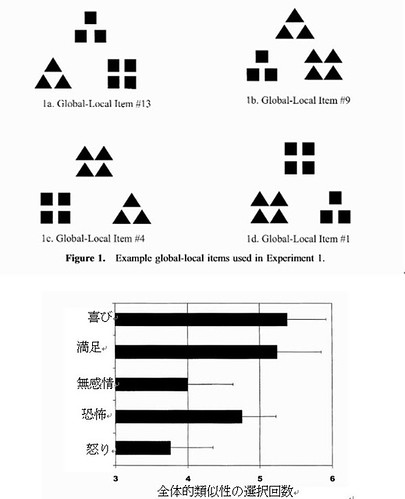
In each of 1a, 1b, 1c and 1d in the above image, which of the two (left or right) figures resembles most the figure above them? This is a test of happiness!
Fredrickson & Branigan(2005)had subjects watch videos of penguins, nature, abstract sticks, a climbers fall, and bullying to promote: pleasure, contentment, the absence of emotion, fear and anger respectively.
Subjects were then shown the four diagrams 1a, 1b, 1c and 1d above which show a single figure above two others and asked which of the two, left or right most resembles the one above. The right hand figure is made up of the same fundamental building block ■ or ▲, whereas the left hand figure is made of the opposite building block but is arranged holistically in the same way as the figure above.
It was found that the more positive emotions resulted in more holistic (left hand) resemblances as per the graph below (with the emotions in the same order as given above). This suggests that those that see the world holistically are happier and those that see it parts, may be in a more negative affective state.
Due to the higher suicide rate in Japan, and naff surveys purporting to guage the well-being of a nation based on one culturally laden question, one is often led to believe that the Japanese are bunch of unhappy people. I think this is very misleading. The higher suicide rate in Japan is due in large part to less negative appraisals of choosing the time and place of ones own death. It is further noted that East Asians in particular and Japanese in general tend to see the world in a more holistic way (Masuda & Nisbett, 2001; McKone et al., 2010). I think that this may be in part because the Japanese are in fact happier.
Fredrickson & Branigan(2005)は、ペンギン・自然・抽象的な模様・登山家の事故とイジメのビデオを使って、喜び・満足・無感情・恐怖と怒りの感情を被験者に持たせ、どれだけ全体的⇔局所的な注意を行っているかを調べた。下記のそれぞれの1a, 1b, 1c, 1dにおいて、上にある形状は下の右か左のどちらに似ているかという質問に対して
全体的局所的
1 a左右
1 b左右
1 c左右
1 d左右
それぞれの4つの設問の下にある2つの形状の右側は、上の物と同じ■か▲かの構成部員からできているから局所に似ているが、左側の形状は構成部員が違っているが全体的には上と同じ三角か四画の配置になっているので全体的に似ている。
その結果
つまり、肯定的感情があるときは全体的な類似性(つまり左側)を選択することが多いです。
Bibliograp;hy
Fredrickson, B. L., & Branigan, C. (2005). Positive emotions broaden the scope of attention and thought‐action repertoires. Cognition and Emotion, 19(3), 313–332. http://doi.org/10.1080/02699930441000238
Masuda, T., & Nisbett, R. E. (2001). Attending holistically versus analytically: comparing the context sensitivity of Japanese and Americans. Journal of Personality and Social Psychology, 81(5), 922. Retrieved from http://psycnet.apa.org/journals/psp/81/5/922/
McKone, E., Aimola Davies, A., Fernando, D., Aalders, R., Leung, H., Wickramariyaratne, T., & Platow, M. J. (2010). Asia has the global advantage: Race and visual attention. Vision Research, 50(16), 1540–1549. http://doi.org/10.1016/j.visres.2010.05.010
Labels: cultural psychology, culture, japanese culture, nihonbunka, 文化心理学, 日本文化
Thursday, March 26, 2015
Life, Time and Identity

I take the liberty of using a Japanese newspaper article announcing the tragedy of Germanwings flight 9525 to illustrate differences in the way that Japanese view time.
First of all with regard to the two lines below the article. There is research to show that when Japanese and Westerners are asked to draw a time line and put their life - a mark for their birth and a mark for their death - upon it, Westerners put the two marks close together whereas Japanese put their marks at either end of the line - 57.9% of Japanese females are classified as having an egocentric time perspective using 90% of the line on their lives, significantly more than among Australians(Shiraishi, 1996). Shiraishi suggests that this is because the Japanese were older than the Australians. Cottle (1976: see Cottle, Howard, & Pleck, 1969) however found that older Western children have a less egocentric time perspective so the fact that the Western adolescents were younger makes this difference even more striking. Speaking for myself, the reason why I would be put the two marks close together is because, compared to the enormity of time itself, my life is but a blip upon it. Why do the Japanese put their marks at either end of the line?
With regard to the Japanese newspaper article announcing the recent tragedy, one characteristic is that it announced from the very first, as a headline the number of Japanese persons presumed to be on the flight. My condolences to their families. While Japanese newspapers are a little more self absorbed, British newspapers also mentioned the number of British passengers.
Another characteristic of Japanese, but not British, newspaper articles is that they always say both the local time, and in the small red rectangle above the equivalent time in Japan. Japanese international newspaper articles and television reports, always do this: give both the time at where the event occurred, and the corresponding Tokyo time.
Taken together with the differences in how Japanese mark their time lines, I suggest that the reason for both the egocentric time perspective, and the incessant reminders of the equivalent local time in Japan, is that the Japanese do not believe time to be something unitary and objective but a subjective quality of experience (a sort of qualia). So there is not one massive march of time but there are many times, their own which began at their birth and ends at their death, and that shared to and extent by people in the Tokyo time zone but not by people in France. For the Japanese, time is not the sort of thing that has an "itself."
This relates to how Westerners conceive of their identities to exist in time or space. The Japanese identity is exists at a place in space and centres on the face (Watsuji). That the Japanese have many "kyara" in each of these places, one for home, another for work does not make them any less self consistent. The Japanese have a spatial (Nishida) geography of the self (Miyamoto, Nisbett & Masuda, 2006; Nisbett, 2010; ), that is no less consistent than the self-narrative.
On the contrary, while I think am the same in all spaces and places, I am "sometimes" something and sometimes something else in any one place ( Cousins, 1980), since for my self is my self-narrative, a history, which exists in Time which is itself which is extended and objective. Thus, for the Japanese their selves in the absence of a spatial situation is merely a "default," (Yamagishi, et. al) for me it is my first and primary self in time: who I am.
Similarly again, conversely, for me space, res extensa, the image is merely a qualia, a quality of subjective experience. For me, space does not have an itself, indeed if empty it is nothing at all.
Bibliography
Cottle, T. J. (1976). Perceiving time: a psychological investigation with men and women. John Wiley & Sons Australia, Limited.
Cottle, T. J., Howard, P., & Pleck, J. (1969). Adolescent perceptions of time: The effect of age, sex, and social class1. Journal of Personality, 37(4), 636–650. http://doi.org/10.1111/j.1467-6494.1969.tb01770.x
Cousins, Steven D. "Culture and self-perception in Japan and the United States." Journal of Personality and Social Psychology 56.1 (1989): 124.
Miyamoto, Y., Nisbett, R. E., & Masuda, T. (2006). Culture and the physical environment holistic versus analytic perceptual affordances. Psychological Science, 17(2), 113-119.
Nisbett, R. (2010). The Geography of Thought: How Asians and Westerners Think Differently... and. Simon and Schuster.
Yamagishi, T., Hashimoto, H., Cook, K. S., Kiyonari, T., Shinada, M., Mifune, N., ... & Li, Y. (2012). Modesty in self‐presentation: A comparison between the USA and Japan. Asian Journal of Social Psychology, 15(1), 60-68.
Shiraishi, T. 白井利明. (1996). 日本の女子青年の時間知覚における Cottle の仮説の検討―サークル・テストとライン・テストの結果から―. Retrieved from https://150.86.125.91/dspace/handle/123456789/2830
Labels: cultural psychology, culture, image, japanese culture, nihonbunka, specular, 文化心理学, 日本文化
Monday, March 23, 2015
Curved Jewels as (Internal) Ears

Children and adults can make curved jewels at the Yoshinogari museum of ancient Japanese culture in Saga (吉野ヶ里歴史公園) for about 2USD a jewel. My children enjoyed making one each this weekend.
Curved jewels (magatama) are one of the few things mentioned in Japanese mythology that are also found in reality.
As 'transitional object' in both myth and reality, they form one of the three sacred items symbolic of the Japanese imperial lineage the other two being a mirror, of the Sun Goddess, and the sword, that was found inside the tail of a multi-headed snake.
In Japanese mythology, the Sun Goddess is wearing a necklace of curved jewels when she meets her brother Susano who takes some of these jewels, puts them into his mouth, chews (onomatopoeically "kami-kami") them to bits and spits them out into the 'central well of heaven' to create other gods (kami) and imperial ancestors.
This act continues the Japanese mythological theme of "creation via dripping" often onto a reflective surface. The creative act of chewing symbols and spitting them out onto a mirror making the noise of what one is making ("kami" or deities), struck me as being a pagan expression of creation via the word - we speak to internalised other in the mirror of our mind, thereby making the world, speciated, en-wordified.
In Japanese mythology this act of creation, however, ends in disaster. Susano commits all manner of "sins" and his sister the Sun Goddess is lost to the world, since she hides in her cave. When the sun goddess has hidden in her cave, Amenouzume (lit "the headdress wearing woman of heaven) the founder of Japanese masked theatre (and I believe Susano in drag) wears a special headdress including curved jewels, to encourage the sun goddess to come back out of her cave by performing an erotic dance on top of a drum which made all present laugh, which encourages the Sun Goddess to come out of her cave again.
[My interpretation is that this is Susano attempting to return from the hell of the narrative self, by enacting it as an erotic solo, transsexual, auditory - hence the drum - dance to achieve enlightenment through satire and humour. Derrida represents the tragedy in a book of self addressed loving, erotic postcards. Japanese mythology and dance is more behavioural. ]
The curved jewels are said to have first have been made by deity by the name of "Parent of the Jewels" whose shrine is about 20 km from where I live in Yamaguchi Prefecture near Hōfu City (Tamanooya Jinja 玉祖神社).
This brings me to the occurrence of curved jewels in reality. They are found widely in ancient Japanese Joumon (lit. "string pattern" [pottery]) archaeological sites and in ancient burial mounds and in ancient archaeological royal sites from Korea.
The Japanese claim that the curved jewels spread from Japan to Korea, whereas Koreans claim that they spread from Korea to Japan. In Korea they are called gogok or comma shaped jewels and are found paired with mirrors on the regalia of Korean Kings in decidedly ear shaped forms, hanging from a tree shaped crown (similar that worn by Ameno-Uzume, the head-dress-woman, my "Sunsano in drag").

The fact that they hang from a tree has suggested that they represent a fruit.
[A fruit reminds me of Adam's apple, which gets stuck in our throat. I would also be inclined to suggest that the tree crown may also have had a practical purposes as a primitive "selfie-stick" to enable its wearer to see himself reflected, and echoed, in mirrors and jewels, there dangling.]
There are several other theories as to the significance of the shape of curved or comma jewels, all of the following from Wikipedia.
The shape of an animal tusk
The shape of the moon
The shape of a two or three part tomoe (as represented in the above image top row)
The shape of the moon
The shape of the soul
The shape of ear decorations
I had liked the part tomoe (Taoist and Shinto symbol) interpretation, for no good reason, but the ear decoration theory is more persuasive.
According to recent research (Suzuki, 2006) on curved jewels unearthed in Korea and Japan, curved jewels are found alongside "nearly circular ear jewellery split into two halves. The visual evidence for ear jewellery as the origin of curved jewels appears to be strong (see the above link and bottom left in the above image).
This interpretation does not conflict with the tomoe or soul interpretation. Various scholars (Mead, Bakhtin, Freud, Lacan, Derrida) claim that the self is dependent upon the assumption of an ear into the psyche. As such, a fitting together (either as a circle or tomoe) ear-shaped or ear-associated jewel may have represented a transitional, partial-self-object.
It is known that mirrors were given to others as remembrance tokens or keepsakes by the ancient Japanese from poems in the Book of Ten Thousand Leaves (manyoushuu). Looking at a mirror presented by a loved one, one might feel their gaze. Hearing the sound of the clinking of a curved jewel, made from the earring of ones mother or girlfriend, one might imagine the attention of their loving ear.
I have also claimed that headless deformed Venus figurines, including ancient Japanese dogu and and ancient Jewish Ishtar idols, may have represented the represented part of an autoscopic visual self. 'The ancients' may have known more about the parts from which the self is created, or at least been more fully aware that the self is created from parts. Moderns may have become more prudish, and lost our sense of humour.
In Japanese mythology, when Susano chewed the Sun Goddesses' curved jewels and spat them out into a reflective surface (in which he may have been reflected as his sister, I claim), she took his sword and chewed it and spat it out likewise into the well of heaven. The curved jewels therefore form a pair with swords. In a myth parallel to that in which the sword (Kusanagi no Tsurugi) was found in the tail of a snake, the sword is associated with the naming of its owner. Indeed it could be argued that the sword that Susano finds in the snake is his symbolic self-representation. If jewels represent internalised ears, then it would be appropriate that they be paired with swords as self symbols or names. Mirrors can represent the perspective/gaze, and the transitional, part-self image that is gazed at, and the world-heart in which it takes place.
It seems to me that my self-narrative and any internal ear take place on or in the mirror of my consciousness which sees as it is seen.
In China, "nearly circular" earrings (I thought that they were "butt" shaped earrings in an earlier version of this post!) are sometimes represented as a snake or dragon biting its own tail. Out out damn butt (! I jest, ketsu, 玦) snake! My self narrative is gay.
That in Japan the "incomplete circle" 玦 "pig dragon" earrings are broken into two, and worn as necklaces seems to me to represent the way in which language and the linguistic self in Japan does not form an "incomplete circle," completed by the reality of the ear or face, nor go around in Japanese people's minds but is broken. The linguistic self, the "I" of the cogito, is in Japan, as Mori claims, broken, a "you for you."
Under this reading, the myths of Susano - with his sister and in Izumo - are about how one form of selfing defeated another: in Japan the paradoxical circle of light defeated the incomplete snake circle of speaking. Or paraphrasing the myth from Guam, some humans managed to escape from hell to live in the light of the sun, without physically or imaginatively nailing themselves to a tree.
Perhaps I should dress up in drag and dance in front of a mirror. I did in fact recommend dancing in front of a mirror to a schizophrenic many years ago. That patient showed remarkable but only temporary improvement.
Images
http://shiga-bunkazai.jp/%E8%AA%BF%E6%9F%BB%E5%93%A1%E3%81%AE%E3%81%8A%E3%81%99%E3%81%99%E3%82%81%E3%81%AE%E9%80%B8%E5%93%81%E3%80%80no-84/
Suzuki, K. 鈴木克彦 (2006) "縄文勾玉の起源に関する考証."『玉文化』3号.
Labels: autoscopy, cultural psychology, culture, image, japan, japanese culture, Jaques Lacan, mirror, religion, 宗教, 文化心理学, 日本文化, 自己, 自己視
Thursday, January 22, 2015
Manga Social Support Scale
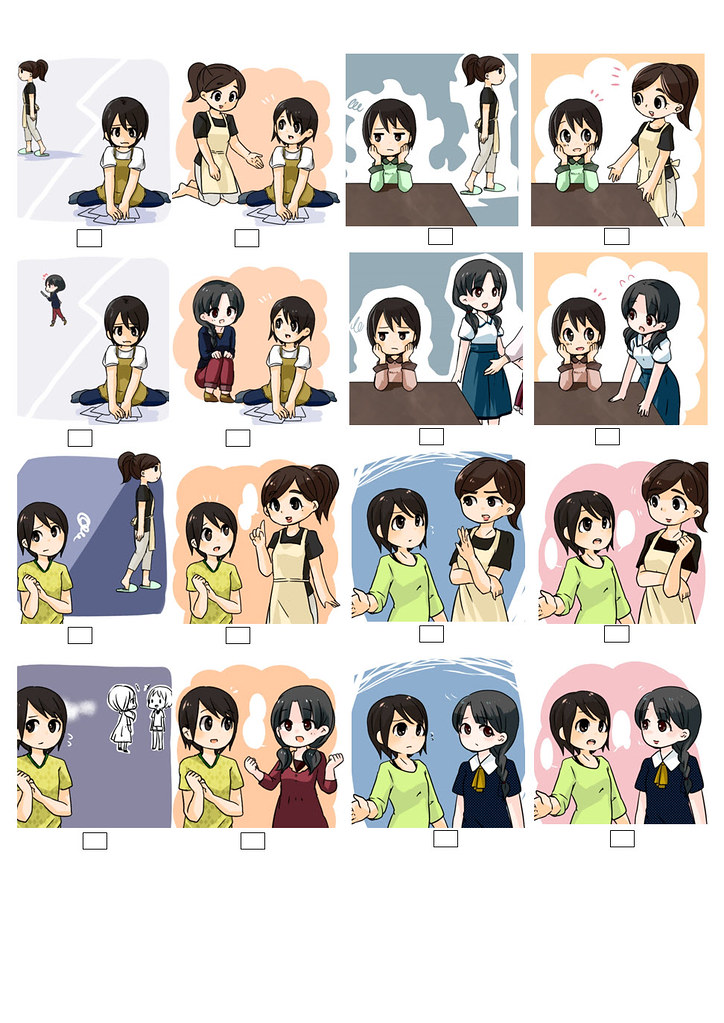
The correlation between self-esteem and percieved social support is very strong among American. For example a Pearson correlation coefficient of a massive r= 0.82 was found by Budd, Buschman, & Esch, (2009). People who talk the talk, and are typically positive about themselves, have lots of friends, or say that they have lots of friends. This is all as it should be since self-esteem may be a "sociometer" (Leary & Baumeister, 2000) measuring ones social worth.
Japanese show only a weak correlation between self-esteem and perceived social support. In a recent survey of mine in Japan, the correlation between perceived social support and self-esteem was found to be 0.36. This is assumed to be because as "collectivists," the Japanese are thought to place a greater emphasis on humility and social censure and unpopularity may be heaped upon those who talk themselves up.
All the same, the lack of self-esteem among Japanese, with levels at about 63% of Americans, is thought to be a problem. I think that problemitization of the lack of self esteem among Japanese, as measured by the Rosenberg Self Esteem scale is "Because of the pivotal and often grossly exaggerated role attributed to verbal language"(Furth, 1973) which is as unimportant to the Japanese (Kim, 2002) as it is to the deaf (Furth, ibid).
The correlation between Manga Social Support and the Jimanga Manga Self esteem Scale, was however a more robust 0.52. Not as strong as found linguistically among Americans, but at least those that represent themselves positively in manga, represent their social support positively in manga as well. I hope to be able to have the artist, Ms. M. Fujimura, make a male version of the above scale with a male protagonist and male friends, which should improve the correlation.
Thanks to Ms. Fujimura and Professor Yoshiko Tanno of Tokyo University, whose invitation to present to his seminar students, about 10 years ago, inspired this research.
Bibliography
Budd, A., Buschman, C., & Esch, L. (2009). The correlation of self-esteem and perceived social support. Undergraduate Research Journal for the Human Sciences, 8(1). Retrieved from http://ift.tt/1yOMVh6
Furth, H. G. (1973). Further thoughts on thinking and language. Psychological Bulletin, 79(3), 215–216. doi:10.1037/h0034011
Kim, H. (2002). We talk, therefore we think? A cultural analysis of the effect of talking on thinking. Journal of Personality and Social Psychology.
Leary, M. R., & Baumeister, R. F. (2000). The nature and function of self-esteem: Sociometer theory. Retrieved from http://ift.tt/1AQEj4E http://flic.kr/p/qBhJpH
Labels: cultural psychology, japanese culture, nihonbunka, 文化心理学, 日本文化
This blog represents the opinions of the author, Timothy Takemoto, and not the opinions of his employer.