
Tuesday, July 02, 2013
Japanese Fashion in the Mirror of the Heart
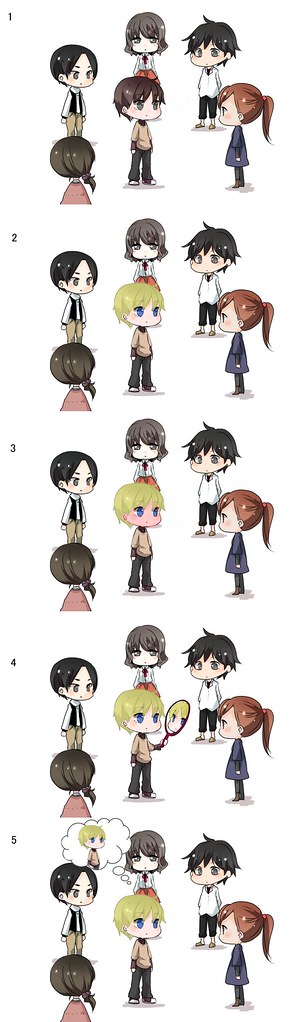
See Taro in the middle of a circle of his friends. The Japanese self is often described as being relational (Watsuji, Bendedict, Markus, Hamaguchi) which boils down to it being non-existent, or at best a nexus of self presentation concerns. The Japanese self is in the eye of the other, we are told.
If this were all there were to the Japanese self then how could the Japanese create and wear the zaniest fashion in the world? If this were the case, then if Taro dyed his hair blonde and wore blue contact lenses to college (picture 2), he would feel the harsh, judgemental gaze of his peers and become embarrassed (picture 3).
How could he avoid embarrassment? How could he remind himself of his preference for blonde hair and blue eyes? He could whip out his mirror (picture 4). As demonstrated by Carver ( 1975) and Carver & Scheier (2001) people with increased "objective self awareness" in front of mirrors, remain truer to their beliefs even in the face of social pressure. The trouble is, with all those eyes upon him, Taro would need to walk around looking in his mirror all the time.
But Taro has no need to do his, because Taro and all Japanese, especially those who have practised some kind of martial art or traditional path, has a mirror in his head (Heine, Takemoto, Moskalenko, Lasaleta, & Henrich, 2008). Taro can see himself without the aid of a mirror, avow his preference for blonde hair and blue eyes, and be done with the eyes of the world (picture 5).
It is because they have a mirror in their heart - originally a present from the Sun Goddess we are told - that the Japanese make the zaniest fashion in the world.
All five images based on an original by Miho Fujimura.
Carver, C. S. (1975). Physical aggression as a function of objective self-awareness and attitudes toward punishment. Journal of Experimental Social Psychology, 11(6), 510–519. Retrieved from www.sciencedirect.com/science/article/pii/0022103175900025
Carver, Charles S., & Scheier, M. F. (2001). On the Self-Regulation of Behavior. Cambridge University Press.
Heine, S. J., Takemoto, T., Moskalenko, S., Lasaleta, J., & Henrich, J. (2008). Mirrors in the head: Cultural variation in objective self-awareness. Personality and Social Psychology Bulletin, 34(7), 879–887. Retrieved from www2.psych.ubc.ca/~heine/docs/2008Mirrors.pdf
Labels: collectivism, individualism, japan, japanese culture, mirror, nihonbunka, occularcentrism, religion, specular, 個人主義, 宗教, 日本文化, 武道, 神道, 集団主義


Wednesday, December 26, 2012
The Martial Arts are Back!

Martial arts, such as Judo, Kendo and Karate (in order of popularity) are back on the middle school compulsory curriculum in Japan, thanks to education reforms brought into place the last time Abe was in power, with the stated objective of familiarizing youth with the traditional culture of Japan.
I argue on this blog that it is in part the practicing of "kata" in these martial arts that encourages their performers to feel the gaze of the Other via the simulation of an autoscopic gaze. Even if Japanese do not practice martial arts however, they tend to practice kata in other sports and dance. I was a member of a Japanese tennis club once briefly and about three quarters of the tennis club time was spend on practicing tennis "kata," such a drop shot followed by lob, often without a ball.
Labels: japan, japanese culture, nihonbunka, 日本文化, 武道
Tuesday, June 28, 2011
The Mind of Manufacturers

Via Flickr:
This is a book intending to encourage university graduates to go into the "thing-making, " manufacturing industry, introducing the mindset of those in the industry. Manufacturing as a profession is popular in Japan, not considered back stage and a little dirty as it may be in the UK.
Japanese people that work in manufacturing are proud to wear their manufacturing workers uniforms, as shown on the image on this cover. Those that take pride in expressing themselves, their apititutes, their creations, and their affiliations visually, as the Japanese do, are good at making-things as the Japanese are.
While I love Brian McVeigh's book "Wearing Ideology" it tends to over-emphasise the external source and oppressiveness of the "ideology," (though he does talk about negotiation) rather than "wearing" as authentic, creative self-expression. If an American Lawyer or Computer programer were to say "I am (proud of being) a computer programmer," then this would be seen as an autonomous belief rather than a engendered ideology, because we logocentricists see words as spring from the mind. Images too spring from the mind, and find expression in Japanese manufactured goods, and uniforms.
This cover image is copyright of Recruit a Japanese recruiting company that edited and published this book.
Labels: nihobunka, nihonbunka, occularcentrism, self, specular, 日本文化, 武道, 神道
Tuesday, June 21, 2011
Externalized-Self-Gaze in Japanese Martial Arts
Noh Master Zeami points out that to master the art of Noh drama one must, through repeated attention to mimicry and form, cultivate a "Riken no Ken" (離見の見, see Yusa, 1987), a sort of out of body experience of Self.
Miayamoto Musashi in The Book of Five Rings (五輪書)says that the swordsman must learn to become and thus see himself from the point of view of his enemy (敵になると云ハ、我身を敵になり替りておもふべきと云所也).
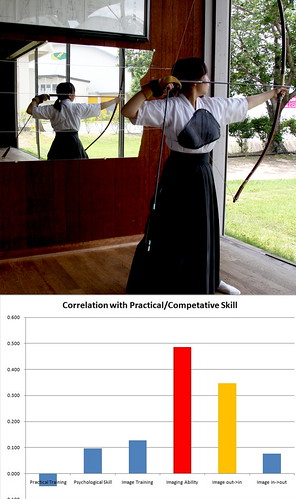
And in kyuudo (the Japanese art of archery), as demostrated by my seminar Student Ikki Yamamoto (2009) in this graduation thesis, nothing is more correlated with kyuudo performance than the ability to see oneself from the outside.
To achieve this end practioners of kyuudo practice form incessently, in front of mirros, using a sort of catapult device before they are even allowed to pick up a bow, and with a sort of brace to ensure that their feet are in the right position.
Through minute attention to form, and repeated mimicry of set positions, they gradually become so aware of their form that they are able to see it from what might be called a "third person perspective," or equally, an externalised self gaze. This ability to see oneself from what Mc Veigh aptly calls the poisition of an "invisible spook" (Wearing Ideaology, 2000) correlates most highly - more than frequency of psychical training or psychological skills and traits such as power of concentration, or desire to succeed, with the ability to do, and win at kyuudo.
I liken the Japanese martial, and Noh, "Path" (michi, 道, dou, do) to a 'different kind of trancendental dialetic." There are those such as Hegel, Plato and Lacan in the Western tradition that one can discourse ones way to a sort of higher plane. By stepping further and further back from the subjective position, one can, they claim, achieve a depersonalised, truer, transcendental. A similar thing may be going on in the Japanese martial arts.
Yamamoto, I. (2009) "Mental Training: Self Image in kyuudo." Unpublished Gradutation Thesis, The department of Tourism Studies, Faculty of Economics, Yamaguchi University.
山本一輝(2009)「メンタルトレーニング~弓道を通じた自己イメージのあり方~」未発表卒論。山口大学経済学部可能政策学科
Labels: image, japan, japanese culture, logos, martial art, nihobunka, nihonbunka, specular, theory, 宗教, 日本文化, 武道
This blog represents the opinions of the author, Timothy Takemoto, and not the opinions of his employer.