
Friday, September 21, 2018
Kendo and Karate Kata (Forms) as Self Seeing Robots
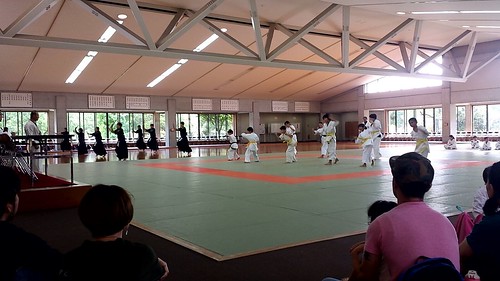
You practice the forms. Eventually they come naturally. Miyanaga claims that there is an intermediate or parallel ability to visualise the forms in her paper on robots.
The paper in English comments on the similarity between form mastering Japanese, and form mastering robots
Miyanaga, K. (1985). POPULARITY OF ROBOTS IN JAPAN── Tradition in Modernization──. 国際基督教大学学報. II-B, 社会科学ジャーナル, 24(1), 111-123.
icu.repo.nii.ac.jp/?action=repository_uri&item_id=366...
However in section 4, entitled "Image and Action," of her paper in Japanese Miyanaga (1987) explains how it is an ability to generate an integrate *image* of ones behaviour, through the practice of forms, that enables Japanese humans (but perhaps* not robots) to move from doing things by rote to doing things freely and naturally.
宮永國子. (1987). 日本のロボットと土着文化 (「ロボット・人間」). 社会心理学研究, 2(2), 7-13.
www.jstage.jst.go.jp/article/jssp/2/2/2_KJ00003724946/_pd...
This Miyanaga's assertion is at the centre of my understanding of Japanese culture and therefore the best Nihonjinron (other than my own!) that I know.
* There is work to create robots with autoscopy
https://www.researchgate.net/publication/326998491_The_Synthetic_Psychology_of_the_Self
Cyberdyne?
Labels: autoscopy, japanese culture, martial art, Nacalian, nacalianism, nihonbunka


Tuesday, December 03, 2013
Be as Mount Fuji, with a Silent, Attentive, Mirror Mind

This picture bears the words
"When facing up to your opponent before a fight, be attentive (lit distribute your "ki" mind/attention) with a silent mind, and be as Mount Fuji (make the shape of Mount Fuji your own form)."
This picture stands in the entrance hall to the gym where my son learns karate. The caption translated above, expresses the essence of Japanese martial arts and thought. First of all there is the emphasis on the importance of facing off. The fight is won and lost - or better still avoided - in this period before it commences which is typically far longer than the fight itself which it is often over in seconds. I would like to draw attention to several aspects of this pre-fight period.
The pre-fight "tachi ai" period involves both intimidation and analysis. There is no better result than the ability to stand with such bearing as to encourage your opponent to admit defeat, or loose confidence to the extent that the fight is a foregone conclusion. Further that this period of mutual analysis and intimidation involve standing facing the opponent. The significance of this will be considered below.
Mental activity within the pre-fight 'tachi-ai' period should be conducted in silence. I believe that this injunction is specifically directed towards the cessation of all self-narrative, hearing oneself speak, asking oneself questions and replying to them (自問自答), dialectical thought and all other types of linguistic thought.
The next injunction is to be attentive or literally to spread out ones "ki" (attention, mental energy, focus, consciousness) The use of ones "ki" in this way is the core of martial arts and Japanese thought. There are numerous expressions involving "ki" including to be careful (ki wo tsukeru, "attach ki"), be keen on (enter ones ki, ki ni iru), loose consciousness (ki wo ushinau, loose ki).
I suggest that the use of ki is the direct counterpart to Western narratival-self and that it is used for similar things, specifically for helping us to gain a theory of mind, and in this particular instance, read our opponents mind. Westerners use reason to ascertain how other people are thinking. By thinking we put ideas up in the courtroom of the mind for inspection by another, Reason, a super addressee, a generalised other, and in so doing understand how others feel about our predictions.
The Japanese on the other gage how others will behave more directly, by using their ki. There have been books written about ki and I have read one one of them. Since the use of ki is clearly a non linguistic activity, the use of further words to describe it may be in vain. I and others who wish to understand the use of ki, need above all do it. But, counter productively perhaps, I would like to add one more exposition and suggest that using ones "ki" is using ones mirror neurons. Mirror neurons allow us to model seeing, ourselves, are activated when we look at a mirror, and are activated when we look at other people, telling us, by activation of the same neurological states in us as in the object of our vision, what we would be thinking and intending to do if we appeared as the person we are facing.
Finally, there is the injunction to make of our own form the form of Mount Fuji. This echoes the advice of a Buddhist priest to a sumo wrestler, and numerous other philosophies of martial arts (such as Miyamoto Musashi's Book of Five) rings which encourage the practitioner to become as some natural object, animal, element, or in this case the biggest mountain in Japan.
Going for the bulls-eye and concentrating first upon the apparent mismatch in size between our warrior and the tallest mountain in Japan, I think that this draws attention to East Asian Spiritualism in the literal sense: (唯心論) the assertion that there is only mind or spirit. Similar assertions appear in the psychologism of Ernst Mach (1902), or the immaterialism of Bishop Berkeley. At base all things can only be experienced, are only present to humans or other sentient beings, song long as they partake in that sentience, become a part of that consciousness. Thus, the apparent mismatch between the size of mount Fuji and the warrior is only apparent. When warrior realises his true nature as consciousness, then he will be aware that Mount Fuji, the largest thing that he can imagine, is only a part of himself. This realisation, and the falling away of bodily identifications that accompanies it, can give the warrior tremendous courage and strength.
Finally, but less importantly than the realisation I attempt to express in the previous paragraph, the visual identification with the mountain has the dual effect of positive self-speech. Identifications with natural phenomena allows the warrior to tap into and identify with all the meaning and affect associated with the symbol. And at the same time, through his bearing thus effected, strengthen, calmed, drawn to full height, convey the same, wordlessly to the opponent who is also using their ki, or mirror neurons, to see what is on
their opponents mind.
お取り下げご希望でありましたら、下記のコメント欄かnihonbunka.comのメールリンクからご連絡いただければ幸いです。
I can not read the artists name. It looks like Shinya Suzuhiromatsu 鈴廣松臣也 but I am not sure, and would like to be corrected. The picture is dedicated to Hajime Matsumura the head of the Yamaguchi Kendo association and 'other comrades in arms', who are the main users of the same gym, or doujou 山口隣保館別館・和光剣心塾道場).
Mach, E. (1902) The Analysis of Sensations, "Not the things, the bodies, but colours, sounds, pressures, times (what we usually call sensations) are the true elements of the world." p. 23, as quoted in Lenin as Philosopher: A Critical Examination of the Philosophical Basis of Leninism (1948) by Anton Pannekoek, p. 454
Labels: image, japan, japanese culture, martial art, nihonbunka, specular, 日本文化
Saturday, February 04, 2012
Martial and Manga Artists
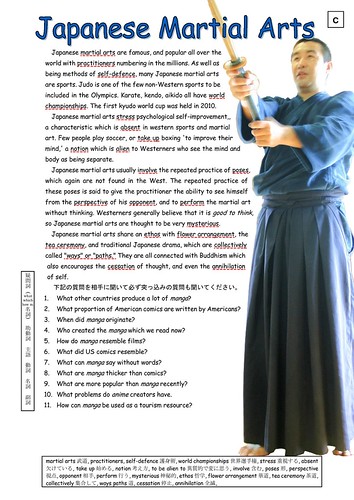
The image is the partner page to the previous Anime and Manga page, which together form an information gap activity.
They are both rather too highbrow for an English conversation class but the course is on "Tourism English" and my part of the course is on explaining Japanese culture.
The explanation is my theory of Japanese culture - that both manga artists, martial artists and all Japanese have 'mirrors in their heads,' a theory which originates in the teaching of the Kurozumi church, my analysis of Japanese mythology, and Japanese common sense. Can you see yourself? Can you draw the room in which now sit from a perspective in the top corner of the room? If you got into a fight would you be able to see yourself from the point of view of your opponent?
The text reads as follows:
Japanese martial arts are famous, and popular all over the world with practitioners numbering in the millions. As well as being methods of self-defence, many Japanese martial arts are sports. Judo is one of the few non-Western sports to be included in the Olympics. Karate, kendo, aikido all have world championships. The first kyudo world cup was held in 2010.
Japanese martial arts stress psychological self-improvement,, a characteristic which is absent in western sports and martial arts. Few people play soccer, or take up boxing to improve their mind - a notion which is alien to Westerners who see the mind and body as being separate.
Japanese martial arts usually involve the repeated practice of poses, which are also not found in the West. The repeated practice of these poses is said to give the practitioner the ability to see himself from the perspective of his opponent, and to perform the martial art without thinking. Westerners generally believe that it is good to think, so Japanese martial arts are thought to be rather mysterious.
Japanese martial arts share an ethos with flower arrangement, the tea ceremony, and traditional Japanese drama, which are collectively called "ways" or "paths." They are all connected with Buddhism which also encourages the cessation of thought, and even the annihilation of self.
Labels: japan, japanese culture, Jaques Lacan, lacan, logos, manga, martial art, occularcentrism, religion, reversal, self, specular
Tuesday, June 21, 2011
Externalized-Self-Gaze in Japanese Martial Arts
Noh Master Zeami points out that to master the art of Noh drama one must, through repeated attention to mimicry and form, cultivate a "Riken no Ken" (離見の見, see Yusa, 1987), a sort of out of body experience of Self.
Miayamoto Musashi in The Book of Five Rings (五輪書)says that the swordsman must learn to become and thus see himself from the point of view of his enemy (敵になると云ハ、我身を敵になり替りておもふべきと云所也).
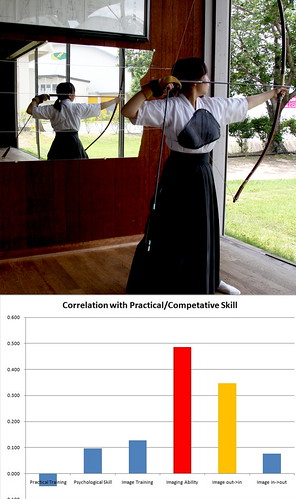
And in kyuudo (the Japanese art of archery), as demostrated by my seminar Student Ikki Yamamoto (2009) in this graduation thesis, nothing is more correlated with kyuudo performance than the ability to see oneself from the outside.
To achieve this end practioners of kyuudo practice form incessently, in front of mirros, using a sort of catapult device before they are even allowed to pick up a bow, and with a sort of brace to ensure that their feet are in the right position.
Through minute attention to form, and repeated mimicry of set positions, they gradually become so aware of their form that they are able to see it from what might be called a "third person perspective," or equally, an externalised self gaze. This ability to see oneself from what Mc Veigh aptly calls the poisition of an "invisible spook" (Wearing Ideaology, 2000) correlates most highly - more than frequency of psychical training or psychological skills and traits such as power of concentration, or desire to succeed, with the ability to do, and win at kyuudo.
I liken the Japanese martial, and Noh, "Path" (michi, 道, dou, do) to a 'different kind of trancendental dialetic." There are those such as Hegel, Plato and Lacan in the Western tradition that one can discourse ones way to a sort of higher plane. By stepping further and further back from the subjective position, one can, they claim, achieve a depersonalised, truer, transcendental. A similar thing may be going on in the Japanese martial arts.
Yamamoto, I. (2009) "Mental Training: Self Image in kyuudo." Unpublished Gradutation Thesis, The department of Tourism Studies, Faculty of Economics, Yamaguchi University.
山本一輝(2009)「メンタルトレーニング~弓道を通じた自己イメージのあり方~」未発表卒論。山口大学経済学部可能政策学科
Labels: image, japan, japanese culture, logos, martial art, nihobunka, nihonbunka, specular, theory, 宗教, 日本文化, 武道
This blog represents the opinions of the author, Timothy Takemoto, and not the opinions of his employer.