
Wednesday, December 26, 2012
The Martial Arts are Back!

Martial arts, such as Judo, Kendo and Karate (in order of popularity) are back on the middle school compulsory curriculum in Japan, thanks to education reforms brought into place the last time Abe was in power, with the stated objective of familiarizing youth with the traditional culture of Japan.
I argue on this blog that it is in part the practicing of "kata" in these martial arts that encourages their performers to feel the gaze of the Other via the simulation of an autoscopic gaze. Even if Japanese do not practice martial arts however, they tend to practice kata in other sports and dance. I was a member of a Japanese tennis club once briefly and about three quarters of the tennis club time was spend on practicing tennis "kata," such a drop shot followed by lob, often without a ball.
Labels: japan, japanese culture, nihonbunka, 日本文化, 武道


Thursday, December 20, 2012
Noh, Kyari and Mario playing Call of Duty: Can you see your own back?

As concerns the dance, it is say that "the eyes look ahead and the spirit looks behind." This expression means that the actor looks in front of him with this physical eyes, but his inner concentration must be directed to the appearance of his movements from behind [think Super Mario, rather than Call of Duty (Masuda, 2010)]. This is a crucial element in the creation of what I have referred to above as the movement beyond consciousness. The appearance of the actor, seen from the spectator in the seating area, produces a different image than the actor can have of himself. What the spectators sees is the outer image of the actor. What an actor sees, on the other hand, forms his own internal image of himself. He must make still another effort in order to grasp his own internalized outer image, a step possible only through assiduous training [Kyari's dance routines may look easy but she too has done assiduous training.] Once he obtains this, the actor and the spectator can share the same image. Only then can it actually be said that an actor has truly grasped the nature his appearance. For an actor to grasp his true appearance implies that he has under his control the space to the left and to the right of him, and to the front and to the rear of him. In many cases, however, an average actor looks only to the front and to the side, and so never sees what he actually looks like from behind. If the actor can not somehow come to a sense of how he looks from behind, he will not be able to become conscious of any possible vulgarities in his performance. Therefore, an actor must look at himself using his internalised outer image, come to share the same view as the audience, examine his appearance with his spiritual eyes (see image above), and so maintain a graceful appearance with his entire body. Such an action truly represents "the eyes of the spirit looking behind." (p. 81)
Beautiful stuff! The genius, but more pedestrian, George Herbert Mead (1967), lacking the information that we now have regarding mirror neurons, claims that what Zeami proposes above is impossible (the below quoted from "Mind, Self and Society":
It is only the actor who uses bodily expressions as a means of looking as he wants others to feel. He gets a response which reveals to him how he looks by continually using a mirror. He registers anger, he registers love, he registers this that or the other attitude and he examines himself in a glass to see how he does so. (Mead, 1967, pp. 66-67)
and hence Mead argues that the creation of the self, can only be done in language.
"If we exclude vocal gestures, it is only by the use of the mirror that one could reach the position where he responds to his own gestures as other people respond." (Mead, 1967, p. 66)
"What is peculiar to the latter is that the individual responds to his own stimulus in the same way as the other person responds." p67 "It is only the vocal gesture that is fitted for this fort of communication, because it is only the vocal gesture to which one responds or tends to respond as another person tends to respond to it." p67 "The critical importance of language in the development of human experience lies in this fact, that the stimulus is one that can react upon the speaking individual as it reacts upon the other. " p69
Mead did not know that there are those who have a mirror in their heads (Heine et al. 2008), who are spacemen (間人, Nishida⇒Watsuji; see Hamaguchi, 1982), "res extensa."
Image top A Necessary Man by raichovak, on Flickr
Image centre, Kyari Pamyu Pamyu singing Pon Pon Pon copyright Kyari Pamyu Pamyu (きゃりーぱみゅぱみゅ) the director Jun Tajima, Masuda Sebastianone, and Warner Music Japan.
Image bottom, Mario playing Call of Duty (see Masuda, 2010)
Hamaguchi 浜口恵俊. (1982). 間人主義の社会日本. 東洋経済新報社.
Masuda 増田貴彦. (2010). ボスだけを見る欧米人 みんなの顔まで見る日本人. 講談社.
Mead, G. H. (1967). Mind, self, and society: From the standpoint of a social behaviorist (Vol. 1). The University of Chicago Press.
Zeami. (1984). On the art of the nō drama: the major treatises of Zeami ; translated by J. Thomas Rimer, Yamazaki Masakazu. Princeton, N.J: Princeton University Press.
Labels: culture, japan, occularcentrism, reversal, Shinto, specular, 日本文化
Wednesday, December 19, 2012
The Chinese are Japanese Too

Subjects, looking at the front (left) of the shelves is faced with a choice (A) of moving the block on the left up, or (B) the block on the right up. But if they think about it, they should be aware that the "instructor" can not see the darker block on their right, and must therefore mean the block on the left. American (and no doubt British) subjects are often too dumb to work this out!
Chinese are not so dumb. They almost never move the wrong block because they look at the shelves from the point of view of the "instructor." In other words, the researcher point out, the Chinese are good at "perspective taking". They are able to see things from an auto-focused or autoscopic perspective. The Chinese, like Kyari Pamyu Pamyu and Japanese martial artists, can look at themselves from the position of the world, as if they have extra eyes pointed inwards towards themselves.
Scholars such as Iacoboni (2009) and Metzinger (2009) show us that all humans can see themselves, take out of body perspectives (Blanke & Metzinger, 2009) but from the above research it is clear some cultures can see themselves more clearly.
This ability to see from autoscopic perspectives pointed towards oneself, as if equipped with a freely positionable mental mirror (Heine, Takemoto, Moskalenko, Lasaleta, & Henrich, 2008) is the defining characteristic of Japanese culture. It represents a different type of "perspective taking" to that refereed to by Mead (1967) since it is not carried out in language. It does, like Meadian linguistic perspective taking result in a sense of self and it may be encouraged by choreographed, repetitive (see Butler, 1993), set-behaviours (kata and dance routines) that through their performance turn the body into a sign and encourages the performer to see these signs from the point of view of the other, and to establish an auto-focused gaze.
This culture of the eye of the other, is due in part to the influence of the Shinto religion, the primary deity of which sees herself as, refers to herself as, and is represented as, a mirror. This mirror is said, by at least one Japanese religious leader (Kurozumi, 2000), to be in the heart of the Japanese.
The experimental evidence points to it being found in the hearts of Chinese too. The first mirrors that were treated with reverence in Japan were imported from China so it is probably fair to say that this ability, to take external auto-focused perspectives, is as Chinese as it is Japanese. I have no doubt that it is engendered as much by Taichi (太極拳) as it is by Karate, or Kyari's dancing. The Chinese and Japanese need to realise their similarities and learn to be friends.
Lower image copyright Kyari Pamyu Pamyu (きゃりーぱみゅぱみゅ) the director Jun Tajima, and Warner Music Japan.
Blanke, O., & Metzinger, T. (2009). Full-body illusions and minimal phenomenal selfhood. Trends in Cognitive Sciences, 13(1), 7–13. doi:10.1016/j.tics.2008.10.003
Butler, J. (1993). Bodies That Matter: On the Discursive Limits of "Sex. Routledge.
Heine, S. J., Takemoto, T., Moskalenko, S., Lasaleta, J., & Henrich, J. (2008). Mirrors in the head: Cultural variation in objective self-awareness. Personality and Social Psychology Bulletin, 34(7), 879–887. Retrieved from www2.psych.ubc.ca/~heine/docs/2008Mirrors.pdf
Iacoboni, M. (2009). Imitation, Empathy, and Mirror Neurons. Annual Review of Psychology, 60(1), 653–670. doi:10.1146/annurev.psych.60.110707.163604
Kurozumi, M. (2000). The Living Way: Stories of Kurozumi Munetada, a Shinto Founder. (W. Stoesz & S. Kamiya, Trans.). Altamira Pr.
Mead, G. H. (1967). Mind, self, and society: From the standpoint of a social behaviorist (Vol. 1). The University of Chicago Press.
Metzinger, T. (2009). The Ego Tunnel: The Science of the Mind and the Myth of the Self (1st ed.). Basic Books.
Wu, S., & Keysar, B. (2007). The effect of culture on perspective taking. Psychological science, 18(7), 600–606. Retrieved from pss.sagepub.com/content/18/7/600.short
Labels: autoscopy, eye, image, individualism, japan, japanese culture, mirror, Nacalian, nihonbunka, occularcentrism, Shinto, specular, 日本文化, 神道, 自己視
Saturday, December 08, 2012
Dconstructing Haiku 3

The haiku poet, Buson is full of tricks. Here is another of his most famous haiku.
月天心 貧しき町 通りけり
Tsuki tennshin, Mazushiki machi, Toorikeri
The Moon mid-sky,
A miserable town,
Passed
I feel sure that wry old Buson is playing with us.
Two things are happening. One is that a big bright moon has passed over a poor town. The other is that Buson has passed through a town of people who were too poor, and I think he hints *too mean*, to let him stay for the night.
The word "mid" in the first phrase, written with the character for "heart" is the centre and key to understanding the poem.
It is pronounced "shin", so is a little too long for the standard Haiku form. By Japanese reckoning, since "n"s are felt to be voiced syllables, "Tsu ki te n shi n" is six syllables as opposed to the standard five.
Similarly, the next phrase "Ma zu shi ki ma chi" meaning (at first glance) "poor town", has only six syllables too, one less than the standard seven, so the "mid"/"heart" character hangs, or vibrates between the two phrases, when with the second hinting at another meaning.
Phonetically it is far to long to fit into the haiku structure, but any Japanese reader will surely feel, consciously or not, the possibility of putting the "heart" character in the second phrase to produce "心貧しい町" (pronounced "kokoro mazushii") meaning "mean-spirited town". I have translated the "poor town" as "miserable town" to hint at the mean-spirited meaning as well.
The moon is very important too. Judging by the high regard and poetic attention placed upon in it the Manyoushuu, the moon is, even more than the sun, the poetic equivalent of the poet's heart. And it is to the moon that the poet, his heart, and the character for heart return.
After looking at the moon, Buson takes us away to the town, to his feeling of rejection, and eventually passing out of it, the poor town, the mean people and the travelling poet's reaction have all "passed". We are left with the image of the full moon which, like the poet's heart, remains as big and round as it ever was.
Buson, who was a fan of Bashou's, uses more devices, such as the double meaning here above, but under my interpretation, the intention is same as a ritual purification at Japanese shrine. Symbolic interpretations are 'swept' away, to return us to a big round, pure mirror: the purity of experience that Nishida refers to as the meeting point between the self and the world.
Dconstructing Haiku 2

五月雨や 大河を前 に家二軒
Samidare ya, Ookawa o mae, Ni ei ni ken
A May shower 'n,
A big river prior,
To two houses.
At first this haiku may seem intractable to Dconstruction* and a straightforward description of a scene. The poet is just standing in the rain looking a a couple of houses on the far bank of a large river. Yes that is what the poet is doing.
But, also, on further inspection this three phrase poem is managing to do what almost no other haiku achieves - to feed the viewer not one but two interpretation tainted, symbolically produced images, before taking them both away to leave only the emotion and the truth of the image: the terrible purity of the experience.
The first trick in this poem is that the poet makes us think that he is talking about seeing rain. The second is that the "ya" in the first phrase usually means "lo" "look" or "!" Ordinarily, the first line would mean "Lo, it's a May shower," but here it doesn't. Panning poetic exclamations, Buson is just telling it as it is.
As noted the previous post, Basho sets up a poem with "May shower" before telling us that he is talking about the rainwater in the river. Echoing that poem both in subject and style, the immeasurably laconic Buson manages to trick us twice.
By the time we get to the second phrase, we start to realise that the "ya" in the first was not "lo and behold" but simply "and," echoing, more prosaically, the way in which Basho's "quick" turns out to mean the speed of the river, not that of collection.
It is difficult to find a word in English that can mean both "look" and "and" but I have gone with what may sound like a meditative "nnn," which turns into the "'n" of "fish 'n chips."
In any event, by the time we get to the end of the second phrase (o mae) "prior," the penny really starts to drop. Buson wasn't even looking at the river!
The poet wasn't looking at a May shower at all (which are generally invisible, like jumping frogs) or even at a river, but at two houses. We realise that once upon a time a soaking wet poet stood in the rain near a big river looking with longing at the two houses on the far side. He did not see the May shower. There is a good chance he did not even see the big river, though his mind was full of negative thoughts regarding both of them. He was probably wet through. The sound of the shower and the roar of the river were probably amplifying the cold.
All he actually saw, or at least all that he was actually looking at, was two houses. And when we see that pair of houses with Buson, the "May shower" and the "big river", dissolve like raindrops in his boundless, longing gaze.
The use of "ni" (two and to) twice in the final line emphasises the solitariness of the poet and the warm welcoming communion of the houses he wishes he could reach.
*Dconstruction a Nacalian transformation of Derridean Deconstruction, wherein instead of showing how a text uses image tainted signs to purify the sign, shows how sign tainted images are are used to purify the image.
Labels: japan, japanese culture, Jaques Lacan, Nacalian, nature, nihonbunka, 日本文化
Japanese Culture in Photos
Whether or not Japanese culture is really "occularcentric" or not remains to be proved but, while often difficult to explain, it is often very interesting to look at. On flickr I recommend my Japanese Culture set in which all photos can be used in education and all non-commercial uses, Japanology 日本文化論 in which the photos have brief explanations, Japan-o-phillia, Japanese Lovers, Japan Images, We Love Japan and Only in Japan.
Labels: japan, nihonbunka, 日本文化
Friday, December 07, 2012
Dconstructing Haiku
Here are some specific examples from the first few in this net selection of 100 famous Haiku (in Japanese).
As already discussed possibly the most famous Haiku is
古池や蛙飛び込む水の音
Furuikeya, Kawazu tobikomu, Mizu no oto
An old pond, frogs jump in, the sound of the water.
We are presented with a view of an old, and presumably over-grown, murky pond. The poet then assumes that a frog, or many frogs, have (probably) jumped into the water. This second phrase - frogs jump in - is pure interpretation. In the third phrase we are reminded, in quite shocking fashion, the grounds for second assumption: the sound of the water. The poet had provided an interpretation - that frogs had jumped in - and then shown it for what it was. All that has occurred in truth, in the immediate purity of the experience, was a view of a pond, and the sound of the water. From the image, the frogs -- dread signs that they were -- completely disappear, for they were never there in the first place. Plop!
In the poem
さみだれを集めて早し最上川,
May rain, Collected quick Mogami River,
is quite straightforward in telling us that there may not be any rain at all, only the river which has collected the rain and is running rapidly. The way in which the "quick" falls between the second and third phrase, at first appearing adverbial (to mean fast collection) but finally we realise is probably adjectival referring to the fast river, adds to the switchback, satorific, "vortex" of the poem. Bashou was looking at the river all along, but took us to an interpretation, which while in part true, was not the reality of his experience: a view of a river. As a Buddhist Bashou would not have needed Heraclitus to remind him that a river is all we are ever looking it, though we see so many things collected in it.
閑さや岩にしみ入る蝉の声
Shizukesaya, Iwa ni shimi-iru, Semi no koe
Silence Soaks into the Rocks Sound (or, rather, voice) of Cicadas,
Here it is all too clear that the initial "silence" is not silence at all. It is an interpretation of the monotonous summer sound-scape, the deafening (you need to listen to this if you have not lived in Japan) truth of which we are returned to in the last phrase.
Looking at a field of summer grass, at the site of a once great military castle in Hiraizumi, Bashou writes
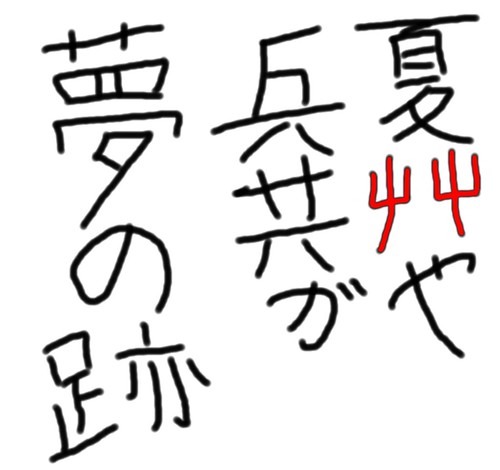
夏草や 兵共が 夢の跡
Natsukusaya, Tsuwamono-domo ga, Yume no ato
Summer Grass Soldiers(') Remains of dreams
The usual interpretation is that the summer grass is all that is left of the the once lofty aspirations of the soldiers. I think that this interpretation is correct, but there is also another. The "ga" (が) or apostrophe (') in my translation can be read as linking word meaning that the dreams are of or possessed by the soldiers. But it also can be read as a subject marker, which is not used in English, hence the apostrophe is in brackets. Taking the "ga" to be a subject marker the final clause comes as a shock because instead of the soldiers being active subjects, or there present, we see that only their field of dreams remain. Further, almost as if the solders have been killed in the middle of the poem, it seems to me, gazing at the field, Bashou himself let his imagination run free, so the "dreams" are not only those of the soldiers but also the dreams Bashou himself who imagined (dreamt) the soldiers. Indeed the summer grass itself may have looked like legions of soldiers. In strong support of this hypothesis is the fact that Bashou wrote the word "kusa" or grass with the non-standard (even for Bashou, even in the same book) ideogram "艸" (Matuso, 1997, pX) which looks a little like soldiers standing in a line. I.e. Bashou realises, and makes us realise, that he has dreamed up solders from his image of the grass, to the truth of which he returns us. Like all the best haiku however, the poem has no incontrovertible interpretation. Basho could be talking about the dreams of the soldiers, or his own dream of soldiers, but we do know, all he sees is a field of grass. Bearing in mind the fact that Basho deliberately edits his poems for poetic effect, I would not be surprised if he thought this one up well before arriving in "the deep north." In any event, it was well worth the journey.
The usual interpretation of
荒海や佐渡に横たふ天の川
Araumiya, Sado ni Yokotau, Amanogawa
Routh Sea, Lies down in Sado, The milky way.
is that Basho is seeing the milky way above the rough waters around the island of Sado but to me the first phrase "荒海" is an optical illusion. First of all, from the historic record, and the fact that Bashou uses the word "milky way" this poem was written on the night of the festival of the Weaver stars who are said to cross the milky way to meat each other on 7th of July. This is the first hint to me that something is amiss. Despite adding this "season word," it would be a a little unseasonal for the sea to be rough on a summer night (though an early typhoon is not an impossibility). Secondly, while there are various interpretations of "lies down," taking a straight forward one, it suggests that rather being over the sea, the milky way is on the surface of the water. The natural explanation for this would be that the mily way is being reflected in the sea, a beautiful image appropriate for the romantic festival night. This would further suggest that the sea was flat, for the starts to be reflected, and therefore that the "rough sea" was an optical illusion created by the white light of the stars brilliantly reflected in the water's surface. What initially Bashou saw as white waves, turned out to be the light of stars lying on the water. Again we are fed a plausible misinterpretation to be returned to the truth of the image.
明けぼのやしら魚しろきこと一寸
Akebonoya, Shiraushirokikotoisun
Dawn! white fish, its whiteness one inch (or very briefly)
This poem was originally "雪薄し”or thin snow which Bashou changed to dawn, in my view because the optical illusion of seeing thin snow as a white fish was a bit too obvious. In other words the poem started out as an optical illusion where the poet claimed/thought he saw snow before realising it was the flash of a white fish in the water, to the optical illusion of thinking one has seen the first rays of sun on the sea, which turned out to be the flash of white fish. In either case the reader is taken from a misinterpretation to the purity of the image. The substitution of "dawn" for "thin snow" - which both might produce flashes of light - shows the deliberate way in which Bashou sets the reader up. What a trickster.
The excellent poem (which I read now for the first time)
この道や行く人なしに秋の暮
Konomichi Ikuhitonashini Akinokure
This road, no one goes along it, late autumn,
was written shortly before Bashou's death at an inn, when he had already fallen terminally ill. The road in question is thought to refer to the poetic path that Bashou had walked throughout his life. The lack of a road goer or goers is usually interpreted to refer to the solitude of the poetic path, but it may also refer to the breakdown of the ultimate illusion: the poets own absence as realised near death, "late autumn." If so then it is more upbeat than usually interpreted, as it implies a lack of fear of death, since Bashou feels himself absent from his own "road" already. Bashou is so cool.
Skipping the two poems related to death, and moving on to Buson
菜の花や月は東に日は西に
Nanoyanaya Tsukihahigashini, Hiha nishi ni
Field mustard (flowers), The moon is in the East, The sun in the West
This poem at first confused me since it could so easily have created an obvious interpretive illusion and return to the truth of the image (the pure experience), by reversing the order of the last two lines. Let me explain. Since the moon is unlikely to produce an affect on Buson's field of vision when behind him, I presume Buson is looking East at the moon over a field of mustard flowers, that are illuminated by the setting sun behind him in the West. In other words it would seem that the poem proceed towards interpretation rather than towards the pure image; The poet sees flowers, sees the moon, and interprets that the sun must be behind him.
Had Buson written instead
菜の花や日は西に月は東に
Field mustard (flowers), Sun in the West, Moon in the East
Then the second line would have created in the reader the impression that the poet was watching the setting sun, but with the final line the reader would be returned to the pure experience, with the realisation that the poet is in fact looking at the moon, and the second line regarding the sun was an interpretation of the setting sunlight falling on the flowers.
However, upon reflection and thinking more deeply regarding the direction that Buson was looking, it is important to ask whether he was looking at the son or the moon. Googling images related to this poem shows views facing both the moon and the setting sun. We are told that this poem was written on Mount Maya in the Rokkou range of mountains overlooking the Koube bay. The field mustard flowers were presumably on the bay (rather than mountainous) side. Since the Koube bay lies to the West of Mount Maya, this suggests that Buson was looking West at the setting sun. In other words, the second line regarding the moon, was an interpretation, based upon the time of day: sunset. The poem does indeed proceeds from image (the flowers) to interpretation, 'the moon (must be) in the East' to the return to purity of the experience, the setting sun in the West.
Reconsidering once again, however, since there is a plain to the East of [the very appropriately named, and conceivably deliberately chosen] Mt Maya, this poem is, like many of those above, left in interpretive abeyance. We know that Buson was looking at a something big and bright above a field of flowers. We know that he can not have been looking at towards both the East and the West, but we do not know in which direction he is looking. No definitive, incontrovertible interpretation is possible. We are left only with the visual experience: the sphere of light above a yellow field. Wow. Buson is very cool too.
Bibliography
Matsuo, B 松尾芭蕉. (1997). 芭蕉自筆奥の細道. (上野洋三 & 桜井武次郎, Eds.). 岩波書店.
Labels: buddhism, japan, japanese culture, Nacalian, nature, nihonbunka, occularcentrism, specular, 日本文化, 自然
Thursday, December 06, 2012
Japanese Dconstruction

The same deconstruction may perhaps be applied to Western feelings towards dolphins and whales. Their "song" is another imperfect language, a pharmacon, that serves to purify our own. Perhaps Hitler is used in a similar way. Hitler is human. But Hitler was evil. Therefore there are good humans. But these real world examples are just an aside. Is there a Japanese cultural equivalent of deconstruction?
It seems to me that the Japanese, like their super heroes, want go in the opposite direction. Performing a Nacalian inversion of Derridean deconstruction, I propose that Japanese artists present to the viewer images that are sullied with signs, that is to say images that invite, come complete with, misinterpretation. Japanese artists show us gravel gardens that look like inland seas. Or drawings of rocks that turn out to be mountains. Or ink drawings that are so sparse that though we provided the interpretation ("that is a branch") we are brought back to the reality of the ink and paper. They show us room interiors that again, play with our sense of scale. And finally Haiku poetry never tires of presenting an image (such as an old lake) with a interpretation (that a frog has jumped in) that turns out to be no more than interpretation - whammy - all there was was the sound of the water. There are no end of haiku that show us images tainted with (mis)interpretations: snowflakes that turn out to be cherry blossom, or cherry blossoms that turns out to be snowflakes. Even Ezra Pound seemed to be aware of the trick, when in "In a Station of the Metro," he confounds petals with his apparition of faces. To achieve the Japanese image-purifying affect however, he need to title his haiku "A walk in the woods." In all cases the Japanese artists shows us tainted, sullied, images, in order to purify the image or place which, according to Nishida, is both self and world. This is Japan Dconstructed.
Western philosophers present their readers with signs sullied with the image, to purify the sacred sign: the holy living logos. Japanese artists, who are also philosophers, present their viewers with images sullied by signs, to purify the sacred image, its space or place: the mirror in their minds.
Image bottom left: Japanese house traditional style interior design / 和室(わしつ)の内装(ないそう) by TANAKA Juuyoh (田中十洋
Labels: culture, japan, japanese culture, superhero, theory, 日本文化
Kyari, Super Suits and Symbols

Eschewing telephone boxes and toilets, Japanese superheroes transform in front of everyone with great aplomb, sometimes on stage. They use symbols to transform. And they also have, and sometimes become, suits. Often what the Japanese Clark Kenta changes into is a super suit. Their super form that -- vectored by the symbol -- possess them is often a sort of exoskeleton. They have bug eyes, but no mouths. Speaking, even mumbling, is quite out of the question. Ultramen are pure body, pure light.
Both types of super hero use the image and the symbol but in different directions, with reversed means and ends. The Western suit is the *means* to conceal and continue the objective: the super identity that the hero always was. The Japanese transformatory symbol, and Kyari Pamyu Pamyu's choreographed "Kata," are a means to transforming into ones super suit, or assuming the visual three-eyed* identity that Kyari represents.
*Kyari has two eyes on her face and another, that looks at her sometimes a "riken no ken" (Zeami). Zeami emphasised too that the Kata, the ritualised symbolic movements, are a means. One learns the kata, one manipulates the symbols, to go beyond them. The Japanese stop narrating themselves almost as soon as they started, but hey are not zombies (Rudd, 2009).
Image top left: Superman frente al espejo by Greenog, bottom right HG 00 Gundam by Chag
Baudrillard, J. (1995). Simulcra and Simulation. (S. F. Glaser, Trans.). Univ of Michigan Pr.
Lacan, J. (2002). The mirror stage as formative of the function of the I as revealed in psychoanalytic experience. In B. Fink (Trans.), Ecrits (pp. 75–81). WW Norton & Company.
Rudd, A. (2009). In defence of narrative. European Journal of Philosophy, 17(1), 60–75. Retrieved from http://onlinelibrary.wiley.com/doi/10.1111/j.1468-0378.2007.00272.x/full
Labels: autoscopy, culture, eye, henshin, image, japan, japanese culture, Jaques Lacan, lacan, logos, Masked Riders, morph, occularcentrism, reversal, specular, superhero, 仮面ライダー, 変形, 自己視
Wednesday, December 05, 2012
The Homo Narrans are coming! Kim and Kyari vs the Ningen

All these great and erudite scholars will tell you that the logos the narrative is alive, and universally so: that humans narrate themselves into temporal existence. Humans are, they tell us, their words, not their faces, nor what they see. These Western scholars are to themselves at least, to coin an ideogram, 人言 ningen people-words.
Fortunately, Hejung Kim (Kim, 2002; Kim & Sherman, 2007) has already demonstrated that East Asians do not narrate themselves unless asked to do so, and then they find it a chore. It should be noted however, that professor Kim does not believe that East Asians think using their imagination. Personally, I think that that is because the medium of our selves is the water in which we swim, and as Bruner argues "the fish will, indeed, be the last to discover water unless he gets a metaphysical assist" (Bruner, 1987, p31-32).
Kyari Pamyu Pamyu shows how life can be lived almost without a linguistic narrative at all (her song is at least partly "weah" and "pop" repeated over and over again), splendidly, with zest, in the visio-imaginary.
But then, finally, if Clifford Geertz (Geertz, 1977, p448) can call a cockfight a narrative, then Kyari Pamyu Pamyu's mind may be said to be narrating, just in a different way, in apples, turtles, dinosaurs, sculls, sharks and masks. Contral the majority of Homo Narrans theorists however, Pamyu Pamyu's narrative is not temporal, however but takes place (Nishida).
Bibliography
Bruner, J. (1987). Life as narrative. Social research, 11–32. Retrieved from www.jstor.org/stable/10.2307/40970444
Bruner, J. (1990). Acts of meaning.
Geertz, C. (1977). The interpretation of cultures (Vol. 5019). Basic books.
Gottschall, J. (2012). The Storytelling Animal: How Stories Make Us Human. Houghton Mifflin Harcourt.
Kerby, A. P. (1991). Narrative and the Self. Indiana University Press. (Kerby gave up philosophy and became a musician)
Kim, H. (2002). We talk, therefore we think? A cultural analysis of the effect of talking on thinking. Journal of Personality and Social Psychology.
Kim, H. S., & Sherman, D. K. (2007). “ Express Yourself”: Culture and the Effect of Self-Expression on Choice. Journal of Personality and Social Psychology, 92(1), 1.
MacIntyre, A. (1997). After Virtue (New.). Gerald Duckworth & Co Ltd.
Niles, J. D. (2010). Homo Narrans: The Poetics and Anthropology of Oral Literature. University of Pennsylvania Press.
Plummer, D. K. (1995). Telling Sexual Stories: Power, Change, and Social Worlds. Psychology Press.
Ricoeur, P., & Blamey, K. (1990). Time and Narrative (Reprint.). Univ of Chicago Pr (T).
Some sooths from the homo narrans.
Rudd, A. (2009). In defence of narrative. European Journal of Philosophy, 17(1), 60–75. Retrieved from http://onlinelibrary.wiley.com/doi/10.1111/j.1468-0378.2007.00272.x/full
(Rudd, 2009)
For a narrative is not just something I tell retrospectively; it is something that I am acting out as I live my life. Insofar as I am not in a zombie-like state of automatism, I am aware of myself (even if only implicitly) as acting in a certain way in order to bring about certain results, which I want because they fit in with certain plans or ambitions that I have. Insofar as I, the world around me, and the other people I interact with, make sense to me at all, it is because I can (and at least implicitly do) locate them in such a narrative. [My emphasis. Mind your mouth, Professor Rudd!]
(Plummer, 1995)
The ceaseless nature of story telling in all its forms in all societies has come to be increasingly recognised. We are, it seems, homo narrans: humankind the narrators and story tellers. Society itself may be seen as a textured but seamless web of stories emerging everywhere through interaction: holding people together, pulling people apart, making societies work.
(Geertz, 1977)
448 What sets the cockfight apart from the ordinary course of life...Its function, if you want to call it that, is interpretive: it is a Balinese reading of Balinese experience, a story they tell themselves about themselves.
452 The culture of a people is an ensemble of texts, themselves ensembles, which the anthropologist strains to read over the shoulders of those to whom they properly belong.
(Ricoeur & Blamey, 1990, p52)
between the activity of narrating a story and the temporal character of human experience exists a correlation that is not merely accidental but that presents a trans-cultural form of necessity.
(Niles, 2010)
"The point that human time is created through narrative is a key one in the work of the French philosopher Paul Ricoeur, who has articulated it in his three volume study Time and Narrative (1984-1988). By the end of that work Ricoeur arrives at the conclusion that identity, whether it be of an individual person or of a historical community, is acquired through the mediation of narrative and thus is a function of fiction.
(MacIntyre, 1997, p212)
It is because we all live out narratives in our lives and because we understand our own lives in terms of the narratives that we live out that the form of narrative is appropriate to understanding human action. Stories are lived before they are told - except in the case of fiction.
Addenda
1)The ideogram(s), 人言(pronounced "ningen", in the same way as human 人間) may be a good way of expressing Japanese humanity since it is a graphically/visually/imaginary meaningful representation of a phonetic word, and is a bit like Derrida's "différance" a word that means, something other than the usual difference, only in the visual domain, by virtue of it being spelt (graphed, written, visually represented) incorrectly.
2) The big question. Are the Japanese just plain visual, or are they visually symbolic? In my posts about Jane Bachnik's indexes, and Kyari Pamyu Pamyu's kata, I have been opting for the Japanese being visually symbolic.
It is very clear to me that the Japanese are into symbols. This is especially clear when considering their super-heros that transform by virtue of having a symbol. One of the earliest, Mirror-Man, transformed by holding an amulet (symbol) in front of a mirror.
Accepting that the Japanese use visually symbolism then:
2.1) Is visual symbolism of the Japanese just simply symbolic in another media? Are the Japanese, as Clifford Geertz would argue, telling stories with their bodies? This might make homo narrans theorist happy-ish. We'd all be able to agree that narrative is essential, it is just that some (Westerners) speak in phonemes while others (Japanese) in ideograms and bodily movements.
2.2) Or is the visual-symbolism of the Japanese -- their "kata," Kyari Pamyu Pamyu's corregraphed dance, which ends up being able to speak -- a means, or stepping stone, to an a-symbolic visuallity? Lacan's (Westerner's) "mirror stage" is a stepping stone on the path towards symbolic existence. Is Japanese visual *symbolism*, similarly a stepping stone, towards visual-imaginary-ism?
I go for 2.2. When learning a path (karate, tea ceremony, archery, what have you) the "kata" or visual symbols are to be learnt and then surpassed. My take is that the visual symbolism of the Japanese is a symbol-stage (the converse of a mirror stage) in the path towards visio-imaginary-ness. While I can't stand (and don't understand) Lacan, what I like about him is his insistence upon a "borromean knot", or a need for two (incomplete) feedback paths. We can not really cognise ourselves in either plane/world "imaginary" or "symbolic" (=linguistic. Lacan's word 'symbolic' is fraught since that we can imagine can symbolise too as noted above in 2.1), but because we have both incomplete feedback loops we can play a sort of shell game ("which cup is the shell hidden under" game) which convinces us that our favourite feedback loop is complete. I can not say myself, enunciate the enuciated. I can not imagine myself, the imaginer. But with both of these ways of cognising myself I dream that I can do one or the other.
Oh boy....The above all sounds(!) like(?) bullshit. I write when I have something visual to describe, that I have created visually. When I have to talk to the silence, to the super-addressee, to the Other (that I want to dissolve), then it hurts. Hence I write on flickr, describing my photos first. I empathise with ex-philosopher, Mr. A. P. Kerby who became a musician. His music is beyond the logodome.
Labels: japan, japanese culture, Nacalian, nihonbunka, 日本文化
Monday, December 03, 2012
And so it was with the Best Intentions in the World

The above left newspaper advertisement (from today's Asahi newspaper) is for a book (Ogiue, 2012) that argues that Japanese should stop looking to find, reject and improve failing (dame-dashi) but instead, to think positively, and come up with positive ideas (poji-dashi), because the former is "enough already" (mou), "critical" (hihan) "character attacking" (jinkaku-kougeki), and "bashing" (basshingu).
I just read the book,(『僕らはいつまで「ダメ出し社会」を続けるのか...』) which was an interesting read and nothing at all like I thought. Instead of arguing that Japanese give up on getting rid of the bad, the book even had a section recommending "dame-dashi" except under a different name. In the section "Finding Social Bugs" (社会のバグを見つけ出す)(p 156) the author recommends that readers "get rid of the bugs (problems) in front of your eyes" 「目の前に存在するバグを潰していく」(ibid) and says that if we do that, society will become a better place. The author also says that this "bug squashing" is at the very basis of his thinking*. My guess is that the editor, in an attempt to make the book sell well with disenfranchised youth, put an anti-establishment title on the book which in fact promotes realism over idealism, more than anything else, a stance which is a Japanese tradition.
There are other books however that do recommend that Japanese stop looking for bugs, however.
One of the most surprising experimental results in the field of cultural psychology is that of (Heine, et al. 2001: above right) which showed that Japanese put more effort into tasks in which they were told they had failed. Japanese and Americans subjects were given a simple task and divided into two groups. Half of the subjects were told (irrespective of the truth) that they had done well compared to their peers, half of the subjects were told that they had done badly (again irrespective of the truth) compared to their peers. The Americans, who want to bolster their self esteem, were less likely to continue with a task that they were told that they performed badly at. The Japanese on the other hand were more likely to continue pursuing a task in which they thought that they had performed badly. Heine and colleagues went on to demonstrate that this difference was related to the extent to which subjects in each culture believed the abilities to be innate and in-transient, or dependent upon effort. American subjects that believe that their performance is a result of innate and unchangeable characteristics felt that tasks at which they had performed badly were damaging to their self esteem and their results were not something that they could do anything about. Japanese subjects, who believed that results are largely a product of effort, felt that tasks at which they performed badly were tractable to effort. They believed that in the face of negative self awareness (hansei) if they did the task again and tried harder they could improve (kaizen) their performance. The Japanese felt their selves to be radically malleable (mugendai).
This ability to take criticism, to see it as an opportunity (hansei no tane) to improve (kaizen) is a defining characteristic of Japanese culture. For millennia, or at least a millennia and a half, the Japanese have assimilated external cultural influences, put them in the cooking pot of the Japanese creative mind, and by mixing and choosing that mixture which they prefer, actively produced a superior (at least to the Japanese) hybrid. There are many examples of such behaviour. Japanese, and Western, commentators regularly reference this ability to assimilate and improve. This ability is argued, by thinkers such as Watsuji and Nishida, to grow out of the Japanese view of self as being inseparable from the world. As argued here on this blog, the Japanese self is the field, or mirror upon which the "mixing" is played out, as opposed to any that-isn't-me/this-is-me characteristic within the field.
The richest man in Japan, the chairman of the Uniqlo group of clothing stores, Tadashi Yanai (63yrs) recommends that Japanese continue to forget their successes and concentrate on their failings so as to keep improving themselves. Alas however, as recent research by Norasakkunit and Uchida (2011) has shown that disenfranchised Japanese youth are loosing this ability to take criticism and see it as an opportunity for self-improvement. It may be that they have taken to seeing such "imperfection-removing" ("dame dashi") criticism as being an "attack on their character" (as the author of the book advertised top left argues). So alas, social critics, presumably influenced by Western self-asserting (egoist, arrogant) culture write popular books recommending that the Japanese stop thinking about their failings.
And so also it is that there is a self-contradiction implied in the Japanese path. The Japanese have imported and improved, and imported more and improve again. But now, the Japanese are importing Western philosophy that rejects the whole import and improve process. In my humble opinion the Japanese are, with the best intentions in the world, destroying their own culture.
Notes
* 「...社会制度設計上の「穴」「バッグ」を発見し、改善するという活動をし続ける。そのことで、社会の不幸の数を減らすことができれば、「今よりもマシ」な社会に近づけることはできる。僕の根本思想には、そういう発送が染み付いています。」p157
Bibliography
Ogiue 荻上 チキ(2012)『僕らはいつまで「ダメ出し社会」を続けるのか 絶望から抜け出す「ポジ出し」の思想』幻冬舎 (拝読していません)
S.J. Heine, S. Kitayama, D.R. Lehman, T. Takata, E. Ide, C. Leung, H. Matsumoto (2001), "Divergent consequences of success and failure in Japan and North America: An investigation of self-improving motivations and malleable selves", Journal of Personality and Social Psychology, Vol. 81 pp.599 - 615. www.psych.ubc.ca/~heine/docs/persist.rtf
Norasakkunkit, V., & Uchida, Y. (2011). Psychological consequences of postindustrial anomie on self and motivation among Japanese youth. Journal of Social Issues, 67(4), 774-786.
Labels: japan, japanese culture, nihonbunka, 日本文化
Manga Mannequins

Better or more beautiful is a matter of taste but Japanese mannequins are one step beyond. Recent Japanese mannequins demostrate the power of the Japanese creative imagination, and present a new model of beauty, influenced by both Western (big eyes, blonde hair) and Japanese (thin ness, small features), but different from and going beyond both.
Japanese aesthetics have largely rejected blue eyes (or blue contact lenses), large lips (or extensive lipstick), and white faces (although a traditional aesthetic) in favour of a full on appeal to cuteness as seen charactured in these mannequinns and expressed in the faces "characterised" Japanese GALs (ギャル) as shown in my previous blog entry.
Labels: japan, japanese culture, 日本文化
Thursday, November 29, 2012
The GAL in the Mirror and The Soul of Japan

The above image is from the cover of Koakuma Ageha (Little Devil Ageha), a fashion magazine for young Japanese women. It shows a certain style of Japanese woman ,or GAL, taking off a mask which is wearing blue contact lenses, white foundation, and red lipstick, to reveal an even more beautiful (so it is suggested) winking GAL.
Adjacent is the caption "This is how everyone creates fake faces," the title of an article on how to avoid being fake.
I have a brief documentary video on Youtube which talks despairingly about the Japanese practice of using glue on their eyes to create "double eyelids" (I call it a "crease") as a result in part of Western influence. Many viewers respond that they do not double their eye lids to look Western. I have gradually become more and more in agreement with my critics.
At the very least, the Japanese GAL has surpassed fakery and Western immitation. The GAL has been influenced by the West, but in true Japanese cultural style, GAL beauty has taken in Western facial aesthetics, mixed this with Japanese sense of facial beauty to create something - to the Japanese at least - better, more beautiful.
This story regarding the creative power of Japanese culture to take in the influence of others cultures, to mix it up and harmonise it with the Japanese sense of taste is to be found in a great many commentaries regarding Japanese culture. And it is not (just) hard cheese. Sure it does have to be admitted that the Japanese Culture owes a very great deal to Chinese culture, and more recently to Western culture. The Japanese are acutely aware of this. But they are right to point out that they are great at improving on things, to create something new, something that themselves at least like better. The GAL has done it again.
How do the Japanese achieve this assimilation-and-improvement ability? One of the best renditions of this theory is to be found in Watsuji's Climaticity (Fuudo) theory, which holds that the Japanese environment and climate was such that it did not create a division between humans and the environment but encouraged their unity. Further, this theory of the unity of the environment the human, of the world and self, finds it is best expression in Kitarou Nishida.
Nishda argues that if you perform phenomenological bracketing, that is to say if you remove all interpretation of your environment, if you silence your (annoying) inner voice, then you reach pure experience, and experience which is contradictorily, both self and the world. Nishida generally used visual metaphor and drew pictures of circles on his blackboard at Kyoto University.
I find it explanatory to consider Ernst Mach's "visual field". The visual field is generally considered to be view (a bounded opening onto something bigger), or at best a viel, but Mach, and Nishida, considered it to be the very stuff of the world and self.
The ability to identify with this mirror itself rather than any characteristic reflected in it, or abstract explanation of it, allows the Japanese to be almost infinitely malleable, almost infinitely good at assimilating. This does not mean that want to become Westerners. They taken in Western looks because they are also Western looks. And they stop taking in when they like what they see, because what they see, is themselves.
Video which may represent a Japanese GAL performing the above described process: Notes in lieu of a Bibliography
室瀬和美(2002)『漆の文化: 受け継がれる日本の美』角川選書. p207-208
文化を取り入れて、日本文化と融合させていけると確信している。どれほど受け入れても、自らを失うことがないと信じている。したがって現代の人々も世界各国と繰り返してきたように思う。飛躍があることは承知の上で、私は日本人が外国からの情報.文化をどれほど受け入れても、自らを見失うことがないと信じている。
鎌田東二(2000)『神道とは何か 自然の霊性を感じて生きる: 自然の霊性を感じて生きる』PHP研究所
自然界の姫産物も文化文明の姫産物も共に贈与と受けとめる感性と哲学があったのだ。その日本人の根本哲学に基づいて、大陸から様々な形で流入してきた新しい文化文明が取り入れられていった。またその混成と習合によって、独自の文化が洗練されていっった。そのプロセスの全体を私は神神習合ととらえている。
神神習合とは。。。様々な部族が奉じていた神々や習俗が、日本列島の特殊な風土条件の中で混血されていたったプロセスをいい、その混成的クレオール的文化を神神習合ととらえるのである。
高坂 節三(2000)『昭和の宿命を見つめた眼: 父・高坂正顕と兄・高坂正堯』PHP研究所
「わが国の風土そのものが人間否定的ではなく、人間と自然が一となるものであった。しかも東海の孤島に位置し、脅かされることはなかった。いかに外国文化を取り入れてもも、自己の民族的に生存を感じさせなかった。今日まで自由に外来文化を取り入れてきた所以のものもここにあると考えられる」として、改めて告ぎのように述べている。
---日本文化は、主体即環境、人間即自然として、自己同一的に発展したものということができ、東西文化の結合を日本に求めることができる (and we know where he got that from, down the corridoor in Kyoto University).
Labels: japan, japanese culture, mirror, morph, Nacalian, nihonbunka, specular, 日本文化
Wednesday, November 28, 2012
My Students Wouldn't Recognised Me
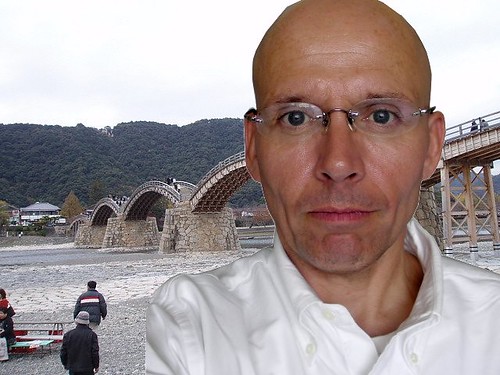
If you met me in Iwakuni, next to the famous kintaikyou bridge shown in the background, would you recognise me? Of course not if you don't know me from Adam.
My Japanese students might not recognise me either, because even though they know me, they store intormation contextually, complete with the context in which it originally appeared: their classroom in Yamaguchi University as opposed to Kitaikyou Bridge in Iwakuni City.
Masuda and Nisbette (2001) demonstrated that Japanese were more likely than Americans to forget target objects (fish and animals) if the background in which they were presented were changed. This difference may also be produced by a tendency for Japanese to store information visually, as opposed to linguistically, in accordance with the theory in this burogu, but I have no data to support this assertion.
Image adapted from the generously licenced 錦帯橋 by Chicatan for a lecture on Masuda and Nisbett's tremendously interesting research (Nisbett, 2004; 増田, 2010; リチャード・E・ニスベット, 2004).
Bibliography
Masuda, T., & Nisbett, R. E. (2001). Attending holistically versus analytically: comparing the context sensitivity of Japanese and Americans. Journal of personality and social psychology, 81(5), 922. Retrieved from psycnet.apa.org/journals/psp/81/5/922/
Nisbett, R. (2004). The Geography of Thought: How Asians and Westerners Think Differently...and Why. Free Press.
増田貴彦. (2010). ボスだけを見る欧米人 みんなの顔まで見る日本人. 講談社.リチャード・E・ニスベット. (2004). 木を見る西洋人 森を見る東洋人思考の違いはいかにして生まれるか. ダイヤモンド社.
Labels: japan, japanese culture, nihonbunka, 日本文化
Monday, November 26, 2012
Kyari Pamyu Pamyu, Kata and Seeing Yourself
 How is it that the Japanese are able to see themselves? Why does Kyari Pamyu Pamyu have eyeballs on her dress and why does her mental self spew them out. Why do these same eyeballs encircle her her corporeal body? Why is her dance so choreographed? Why does she move from one pose to the next, in a triptych of recognisable poses or kata?
And why do Japanese martial artists, such as Karate and Judo practitioners, or sumo wrestlers, stand in rows and make the same poses, or kata over and over again? Why are all Japanese path (michi or dou) practitioners, from martial artists to tea-ceremony aficionados and Noh actors, so keen on repeating one set forms, kata, over an over again? Are they clones? Are they unable to move freely, fluidly? What is the importance of repeating set actions over and over again, and does this have anything to do with Kyari Pamyu Pamyu's eyeballs?
George Herbert Mead argues that it is impossible to have a visual self unless one is an actor (with an audience to react) or unless one has a mirror. Generally speaking visual self representation are for others. Conversely it is only language, the logos, that allows ourselves to take the perspective of others, and create a generalised --other independent-- perspective of self. Language, mead says, is special in that it provides a mirror, because when transmitting a language, even to oneself, the word as stimulus can be understood from the perspective of others.
Derrida argues that the defining characteristic of language, and indeed any sign, is that it can be repeated. If I write a random squiggle on a page, that is not a sign. As soon as it is recognisable, and I or someone else, even in my my absence, can repeat it then the squiggle becomes a sign. Iterability is defining characteristic of signs.
In "Bodies that Matter" Judith Butler extends Derrida's observation to iterable bodily movements. Iterable bodily movements such as gestures, poses, and presumably the iterated movements - kata- of Japanese practitioners, are signs. Repeating and repeated acts allow the body to make signs. Martial artists perform an embodied narrative.
Returning to Mead, looking carefully he does admit that gestures, are also language. And these allow their performers to understand their acts as if from the perspective of others. Iterated and Iterable bodily movements, allow us to see the same from the perspective of others. The movements of the body become a language, a language that demands the eye of the Other.
Japanese martial art practitioners, all Japanese path practitioners, and Kyari Pamyu Pamyu, repeat set actions, practice their embodied language, and their bodies come to matter. Their bodies speak. They come to be able to see their bodies from the point of view of the other. They become able to have an objective view of self, and thus to have a visual self.
Practising the kata of the martial arts, and all other Japanese ways, the practitioner becomes able to see his body from a view apart (riken no ken), to have eyeballs inside her self that yet surround and are able to view her.
Image on right: adapted from Karate Practice by Robert Couse-Baker. Image on Left, Kyari Pamyu Pamyu singing Pon Pon Pon copyright Kyari Pamyu Pamyu (きゃりーぱみゅぱみゅ) the director Jun Tajima, Masuda Sebastianone, and Warner Music Japan.
Thanks to Ryosuke Matsumoto for emphasising the importance of Kyari Pamyu Pamyu, Professor Masamune for reminding me of Judith Butler, Tatsuya Hara for being a great interlocutor, and to Holy Whopper for encouraging me to keep writing.
Labels: culture, gender, image, japan, japanese culture, specular, 日本文化
Freud In Japanese

Freud's triparite division of the pysche into the super-ego ("over I"), ego ("I") and Id ("it"), translated into Japanese.
I believe that this tripartite division of the self applies to the Japanese too, but some (e.g. Kishida Shu) believe that the Japanese do not have a supereg. Not being a monotheistic society, and being instead collectivists, the Japanese equivalent of the super-ego is other people. Instead of guilt (or fear of god 対神恐怖症) the Japanese have social phobia (fear of other people 対人恐怖症).
Still others (such as Dov Cohen) claim that the Japanese have an even greater tendency to see themself from the position of a generalised other (Mead's version of the super-ego) and conversely that this suggests that they are collectivists.
I claim that the Japanese super ego or generalised other is alive and well. It may be a litle weaker, or softer than the Western version. It may be more granular or polytheistic, but that it exists in, or watching, "the imaginary" as represented by the dancing fat lady and the eyeballs in Kyari Pamyu Pamyu's video. For this reason I have added a red eyeball, not in Freud's original diagram.
The Japanese do not share their psyche with a listening father, but with a watching mother or perhaps even a watched mother, まぶたの母. I need to think more about this latter point.
Labels: japan, japanese culture, Jaques Lacan, lacan, Nacalian, occularcentrism, self, specular, theory, 日本文化
Thursday, November 22, 2012
Kyari Pamyu Pamyu through the Looking Glass of Lacan
A super cute character-girl, wearing a dress and gloves decorated with eyes, performs a highly choreographed song and dance routine ina room cluttered with the paraphernalia purchasable in her favourite fashion area. This is Kyari Pamyu Pamyu singing her world wide hit single "Pon Pon Pon". Just one of the several YouTube streams for this video has been viewed (as of 21 November 2012) 29 million times. The things that Kyari purchases, and even her dramatis persona, is not atypical for young girls that frequent Tokyo’s Harajuku shopping district where fashionista's go to parade their manga and anime inspired outfits, especially on Sunday afternoons.
But Kyari Pamyu Pamyu's music video, created by a team of Tokyo’s finest set designers, song and music writers, producers, animators, and the "air:ma"choreography team, goes a lot further way out, or way in, to the technicoloured mindspace of the Harajuku girl, and perhaps even to the heart of contemporary Japan.
Some of the features of this video are the inter-penetrating and strangely reversed duality of Kyari in her room, and pink Kyari shown in the mind outside her room. That her mind is outside her room, is indicated clearly by the descent of a red scull-less brain (0:15) that starts d dance.
The inside of the room is phantasmagorical enough with its mountain of consumer kitsch including glove puppets (0:11), a stuffed unicorn, plat-form shoes, many different stuffed characters, Christmas decorations, a tiger-cub decorated shoulder bag (0:25), a plastic elephant, plastic chains, knocked over chair (0:29),my little pony, 6 dolls, bags (0:32)
Kyari's mind, outside and occasionally overflowing inside her window, is even more outlandishly psychedelic nature of her pink persona that populates, together with one or more dancing fat old ladies, further serves to emphasise that, contra our expectations, outside is in, the psychological world seems to stand outside and encompass reality, rather than felt to be trapped within it.
Karyi's mind is very much in control. The psychedelic fantasies in Kyari's mind have been recreated in consumer purchases inside Kyari's room.Kyari's pink mental persona with even more virulently bleached blonde hair and even longer fake eyelashes only needs to speak in images (such as an apple,eyeballs, birds and a microphone – emerging from her ear) for these objects to appear inside the room.
Kyari in person is very much on stage, controlled, posed, forward facing, jittering, on strings, where as her celestial pink mental self revolves sublime, produces the microphone (0:7) to allow her to sing, and regurgitates the eyes that watch her dance. These eyes are perhaps the true protagonists, appearing everywhere, even after Kyari disappears after the final credits.
The words of the song appear to mean very little. The singer says in an interview that she is unaware of the title’s meaning, it having been presented to her on the day of her performance. None the less it is the words that hold the two worlds (mental and Harajuku) together: Kyari's persona’s sing in unison.
And, just as Kyari’s pink mental personal can produce things from often computer generated images, Harajuku Kyari can produce things by clapping, since the sounds in Japanese onomatopoeia is the same as that for the word for the slices of bread that appear.
Far more than the words, however, the images, symbols and gaze, the whole ocular structure of the video, speaks far more. Pink Kyari's computer generated simulacra, of strawberries, ducks, heart, scull, wasp, flowers, bones, banana, mask, pterodactyl, merry-go-round, red tank, fish, tortoise, dinosaurs, and especially the apple seem to represent her thoughts and desires. When Pink Kyari gets hungry she regurgitates a computer simulation of an apple from her mouth. The Kyri's mind speaks in images and watches her avatar, her character, through her bedroom window and TV set. The eyeballs that she spews surround Harajuku Kyari’s dance and adorn her dress. When pink Kyari arrives in the form of video tape played on a TV set, Harajuku Kyari’s head transforms into an amorphous pink mass.
So, what does it all mean? I shall argue that the video illustrates the Nacalian -- reversed-Lacanian-- theory of Japanese culture proposed by this blog.
I would like to draw attention to two things.
First of all that there are a lot of pretty creepy things going on. The aforementioned microphone appear from an ear, the dancing brain, regurgitated eyeballs (2:24),floating giant eyeball (2:28) , amorphous melty-head (2:42), are not gross enough, there are plenty of things that are conventionally accorded a negative valence, grotesque and horrifying things often associated with death, such as chequered one eyed skulls(0:40, 1:12) that come through the mirror into the room accompanied by a giant skeletal hand (1:17), a fossilized dinosaurs (0:41), giant bones (1:13), black birds flying out of pink Kyari’s mouth (1:18), melting eyes (1:23), a wasp (1:28) and a shark that again protrude fly into the room (2:47), Nightmare on Elm Street style mask (2:57), and what appears to be snot (3;32) . At least Pink Kyari does not attempt come through the window, our out of the TV set into the world. All these rather disgusting things, that originate in the external mental world are kept from being horrifying due to the consummate Harakuju cuteness of the heroine. Harajuku Kyari is so cute (kawaii) that she can turn even the most scary (kowai) into smorgasbordia of candy, flowers and bubblegum.
Secondly, I think it is important to ask, who is the dancing fat lady?
To be continued.
Labels: culture, eye, horror, image, japan, japanese culture, Jaques Lacan, lacan, nihonbunka, occularcentrism, reversal, specular, 日本文化
Thursday, November 15, 2012
Pachinko, The Mandala and Roulette

I think that "illusion of control" can be unpacked in the following way
1) The essential illusion that "I am not an average player. I can beat the odds."
2) That one has a method of beating the odds.
As argued in previous posts it seems to me that (2) has a cultural aspect along the lines of
2.1) The illusion that one can make superior choices.
2.2) The illusion that one can persevere more, rely on ones konjo.
To relate this cultural difference to the overall message of this blog (Nacalianism), I argue that we westerners have illusions about our linguistic thoughts to ourselves, our self-narrative, our 'hearing ourselves speak' (Derrida, 1976). When Westerners think that their choices are better than average, that they can "choose" better numbers on the roulette wheel, they are betting on their internal voice: "This time it is going to be a six," "This time it is going to come up red." "Choice" and verbalisation are, I believe, inextricably linked. Choice is an act of meaning (Stevens, Markus, & Townsend, 2007). Westerners gamblers believe that their words will express the world.
The Japanese do not have any unrealistic expectations about their self-narrative but they do have a similar illusion about what they see and imagine. Japanese style perseverance is seeing a task through to the end. As they look at the pachinko machine, and merge with it as if looking at a Mandala (top right) they think that their imagines and expectations will come true.
The Western linguistic gambler ignores the sights that he sees, and holds onto the notion that his words will come true.
The imaginative gambler ignores the linguistic notions of odds but believes that his visualisation will come true. He negates the linguistic self. He becomes one with with the pachinko machine, and believes that his view will conform to his imagination.
Pachinko machines resemble Buddhist mandalas (top left). They invite the player to realise that the visual world and the self are contradictorily the same (Nishida: see Heisig, 2004).
Roulette tables invite the player to think that the linguistic (34, 33, even) outcomes are the same as the linguistic pronouncements in the mind.
Images
Top left:Tawang Monastery Doorway Mandala by D Momaya. Creative Commons, share alike.
Top right: Pachinko by psd
Bottom:A Nightcap by priskiller. Creative Commons, share alike.
Bibliography
Derrida, J. (1976). Of Grammatology, trans. Gayatri Chakravorty Spivak. Baltimore.
Langer, E. J. (1975). The illusion of control. Journal of personality and social psychology, 32(2), 311.
Heisig, J. W. (2004). Nishida’s medieval bent. Japanese journal of religious studies, 55–72. nirc.nanzan-u.ac.jp/publications/jjrs/pdf/674.pdf
Stephens, N. M., Markus, H. R., & Townsend, S. S. (2007). Choice as an act of meaning: the case of social class. Journal of Personality and Social Psychology; Journal of Personality and Social Psychology, 93(5), 814.
Labels: buddhism, economics, image, japan, japanese culture, Jaques Lacan, Nacalian, nihonbunka, reversal, theory, 日本文化
Tuesday, November 13, 2012
The Japanese Wooden Spoon
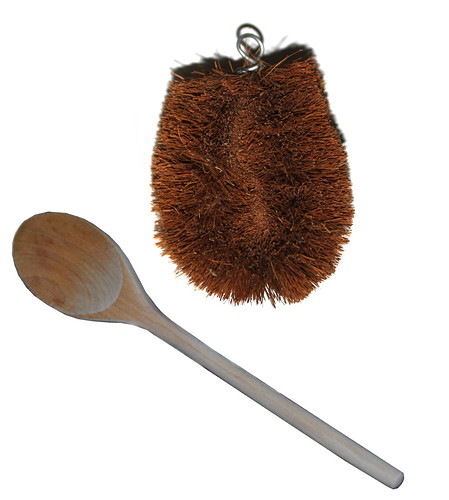
Tawashi are given as consolation or booby prizes (at least in the popular long-running Asahi Television program "Welcome Newly-weds,"新婚さんいらっしゃい) in the same manner as wooden spoons are given to losers in the UK.
Both the tawashi and the wooden spoon are the almost useless item, that everyone almost wants. A tawashi is the sort of item that, like a wooden spoon, one wants but one has, and there is little use in having more than one at home.
In accordance with the Nacalian theory presented by this blog, I suggest that that the wooden spoon is phallic whereas the tawashi may be yonic, and thus each may represent: the hidden but ubiquitous, wanted and yet unwanted, ambivalent part of Western and Japanese culture.
Look at the tawashi and the wooden spoon and tell me I am wrong.
Labels: culture, female, horror, japan, japanese culture, Jaques Lacan, Nacalian, nihonbunka, reversal, ジェンダー, 日本文化
FAIL Promote obligation rather than put your foot in the door

I realised too late that this experimenta was a FAIL - my fault - since the scale was reversed, with "1" meaning most applicable and 5 meaning least applicable. Hence the Japanese in fact believe that they purchase food after tasting it due to information they receive from tasting the food regarding its taste and freshness. It seems to me that this is not true, but that is what the data proved to be the subjects own perception. The following is therefore incorrect.
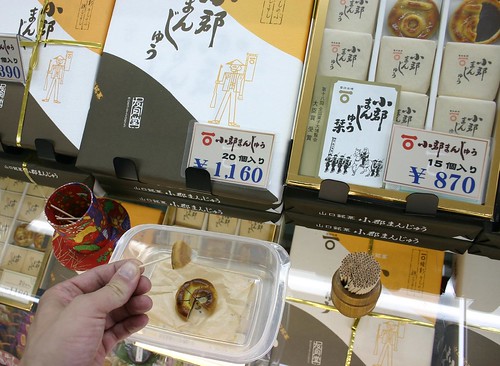
Many such souvenir shops and department stores allow the customers to taste the wares, from rice cakes to cured ham and sometimes wine. I think that if shops in the UK were similarly generous then the homeless, hungry and otherwise desiring would eat the proprietors into bankruptcy. But in Japan, the land of "giri" or "obligation," those that taste often feel obliged to buy. Indeed supermarkets often employ ladies to push sausage nibbles upon their customers safe in the knowledge that the latter would feel to obliged to stand their with their mouth open.
This year (2012) one of my seminar students investigated the uniquely Japanese (or at least non-Western) sales technique, to see if providing product samples is merely a tasting (providing information) or a way of improving seller-customer relationships and instilling an obligation (giri) to buy.
Higashiyama (2012) asked subjects (40 university students) to recall a time when they purchased something after having tasted it, and were ask to rate the reason for their purchase according to three categories
1) The needed or obtained information about the product.
2) They felt the shop assistant to be attractive.
3) They felt obligation (giri) towards the shop assistant as a result of being allowed to taste the product.
On a scale of 1 to 5, the results were as shown in the graph below.

Information Obligation Seller Attractiveness
It was found that both shop assistant attractiveness and obligation (giri 義理) were very significantly greater (p less than 0.001) than the importance of having gained information to the purchase decision.
This suggests, as argued by previous research, Japanese emphasise human relationships, especially exchange relationship, over product comparisons. This "sales by promoting obligation technique" is a new sales technique to go alongside "door in the face", and perhaps to replace "foot in the door" which may not work on Japanese because they may be less likely to want to maintain a self-consistently positive self concept.
Bibliography
Higashiyama, S. (2012) Title to be decided. Unpublished graduation thesis, Department of Tourism Policy, Faculty of Economics, Yamaguchi University.
Labels: japan, japanese culture, nihonbunka, 日本文化
This blog represents the opinions of the author, Timothy Takemoto, and not the opinions of his employer.