
Sunday, May 23, 2010
Japanese Nutritional Supplement Energy Drinks
The Japanese drink a lot of nutritional supplement energy drinks, containing royal jelly, ginseng, maka, various vitamins and minerals and their prime effective ingredient: caffine and nicotine. Their effect is I believe, therefore equivalent to the esspresso and cigarette so popular in Italy and France. These drinks are advertised on prime time television, on sale in prime locations even in convenience stores, and can be consumed on the premises of chemists. I think that the Japanese love of energy drinks may be related to the tradition of Eastern medicine and the herbal potions provided by its practioners.
Labels: japanese culture, nihonbunka, 日本文化


Engrish T-Shirts
About half of the T-shirts on sale in Japan have lettering on them. Of those that do, 99% have English or rather Engrish printed upon them. It is almost impossible to find T-shirts with Japanese language written on them. Imagine if it were impossible to purchase English language T-shirts in the UK, and that all lettering on them were in Bad Japanese. There would be riots.
Perhaps this is not just the effect of Westernization, but also something to do with the way in which Japanese have always imported languages from other nations? Perhaps even if there were no Western influence upon Japan, the Japanese would not wish to write in Japanese upon their own T-shirts. Be that as may, I find the Engrish T-shirts a little more troubling than many of the locals.
At the same time, lately, I have taken to wearing a T-shirt upon which is emblazoned "Do! Something on your own way."
Labels: westernisation, 日本文化, 欧米化
Medicines for Atheletes Foot or Dhobi Itch (Jock Itch)
Due to the high degree of humidity, particularly during the rainy season, many Japanese are afflicted with athlete's foot and Dohbi Itch (scrot rot, or jock itch) caused by bacteria infecting moist skin. Fortunately there are a lot of excellent medicines available over the counter that are capable of killing the bacteria with one application. Application can be quite painful, but these medicines often also contain painkillers that dumbs the affected region after the first few seconds. One of the reasons that Japanese use small one-use towels after having a bath is perhaps because bacteria can be stored on any towel that is used more than once.
Labels: athletes foot, culture, dhobi itch, japan, jock itch, たむし, 日本文化, 水虫, 薬
Friday, May 21, 2010
Transformatory sacred items accross the ages
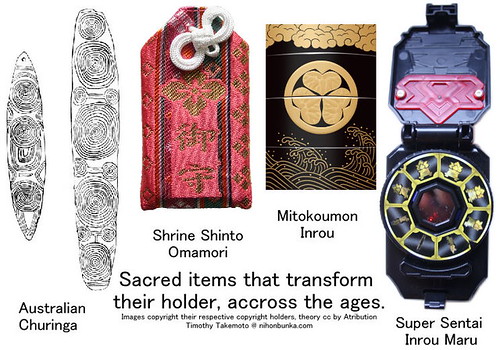
I noted in a previous post that the history of transofmatory items (変身アイテム) such as used by Ultraman (pens and glasses), Super Sentai (Power Rangers), Sailor Moon, Himitsu no Akko-chan, and Kamen Riders (Masked Riders), has a history in the transformatory symbols of Mitokoumon, Touyama no Kin and Samurai Momotarou. Japanese superheroes are always flashing a special symbol and transforming by means of its use.
The history is much older. I ague that Shinto is a geographical totemism, like that of the Arunda/Arunta/Arenda of Australia. In totemic religions the faithful recieve totemic badges which represent their owners and the ancestral spirits of their ancestors. The Arunda of the central Australia destert are one of many such groups found worldwide. Unlike most totemic religions, but in common with the Japanese, these "most primitive" (Freud, Durkheim) of totemists believed that the totem was associated with a place.
That the japanese recieve totemic badges from Shinto shrines almost goes un-noticed. More visible are the symbolic, soul containing badges that are given to the dead (mitama, Ihai). However, as Yanagita Kunio points out, once upon a time, there were "ikimitama" symbols given to the living. These were originally leaves branches of sacred trees and rocks from sacred mountains. They were believed to give their bearer life and were recieved from the time of first shrine visiting.
However in my view, and as Yanagita hints, the symbols were gradually replaced by kanji ideograms and piece of paper.
Yanagita writes, "in this reigion also the Nusa (gohei, zigzag strips of Shinto paper) were originally I think to be distributed among participants. This is similar to the leaves and branches of Japanese cedar and nagi (a evergreen tree/shrub) that were given to the faifthful from sacred trees on Mount Inari and Mount Ise" (Yanagita Kunio Collection No. 14 p 51, my translation.)
「この地方でも小さい幣を関係者に頒(わか)つのが本当の趣旨であったろうと思う。もししかりとすれば、後に言わんとする稲荷山の杉・伊豆山の梛(なぎ)のごとく、信者が神木の木の枝を追って行く風習と、著しく類似する点があるのである」柳田國夫全集14p51
These days Japanese still recieve omamori or amulets from shrines that are said to represent a stand-in or self-replacement and protect the bearer from bad luck and impurity.
And as shrines become less significant, Mitokoumon, Ultramen, Masked Riders, Super Sentai (Power rangers) brandish their sacred symbols and transforms with them.
Before we call the Japanese primitive bricoleurs, let us not forget that "in the beginning was the word," and that I have a "Christian name."Am I transformed by it?
Labels: henshin, Masked Riders, morph, nihobunka, religion, Shinto, specular, Super-Sentai, totemism, ultraman, アニミズム, スパー戦隊, トテミズム, 仮面ライダー, 変身, 宗教, 神道
Stamp Rally and Geographical Totemism
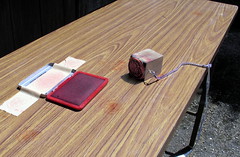
Like the aboriginies the Japanese feel themselves to have descended from a sacred land, created by the spirits in the dream time (mythic time of the Kojiki) and recieve their soul, their breath of life less from their father than from the local shrine spirit. In times past the totemic badge, or symbol which allowed Japanese to transform into living humans, whas a branch from a sacred tree, or a stone from a sacred river bed or mountain. Later, like the Churinga of the Australian aboriginal, and even far far more so, the totemic badges, or names of the Japanese evolved to encompas the use of ideographic language. The "primitive" totemists gradually moved with the times, and imported seals (such as shown in this photograph) from China. No longer did they get a sacred stone or branch from their local shrine, instead they got a piece of paper stamped with the seal of the shrine. These totemic badges live on in the form of Ihai for the dead, the tablets or fuda in household shrines, and the omamori that act as "migawari" or self-replacements, that most Japanese purchase at Shrines every new year.
But why do they need their sacred seals at all? Work in progress.
In the television series "Mirror Man," the hero goes into a mirror and comes back with an amulet. The symbols also seen in all the sumper sentai kamen rider (masked rider) and ultaraman tv programs from the land of the mirror are the meaningful images that allow japanese to identify with their mirror image. They are the images that are always the right way around. The images that have a third person perspective built into them as it were.
Transforming Symbols and Mirrors
Kamen Rider Decade's "Imagin" (Image people jin)
Kamen Rider Decade Mirror world where people are judged!
HImitsu no Akko's compact Mirror
Sailor Moon's compact mirror Chrisis Moon
Super Sentai Shinkenja-'s mirror writing
Super Sentain Shinkenja- inrou maru which shows your face until you insert the symbol, when it shows the super form.
Super Sentai Gaorenja- and the mother-like goddess like person that communicates by mobile phone while looking down through a relfecting surface of a pool of water.
Mirror Man's amulet and reflecting surface
Labels: culture, Jaques Lacan, manga, mirror, nihonbunka, occularcentrism, specular, Super-Sentai, superhero, 日本文化
Japanese Insecticides
I have long been confused by the name "no mat" or "no-matto" refering to a type of insectide product. In the video above there is a wrist attached device that takes small briquettes of insecticide. I therefore presumed that "no-matto" means "No! mat," a mat, or briquette of insecicide, that says "no!" to mosquitoes.
However, I am reliably informed by my wife that on the contrary, Earth (the company) started using the trademark "No-matto" to refer to the vaporisers containing liquid insecticide, rather than their banner product "Eart Matto" (see photo below) which were indeed little mats soaked in an insectide. Later,as shown in the video, even products which contain briquettes of insecticide are sold under the "No Mat" trademark.

All photos and trademarks copyright Earth chemical co Limited.
Labels: culture, japanese culture, 日本文化
Tuesday, May 18, 2010
Nature in Phallocentric and Uterocentric Cultures
Rural Japan is suffering from a lack of inhabitants because the Japanese prefer to live in cities. Upstart gaijin (foreigners) with only a modicum of income are able to purchase beach side houses.
Beaches are not visited.
City-central riverside parks are - apart from certail ritual times of year (such as hanami) - empty.
Riverside cafes and restaurants almost do not exist. There are mountains near and overlooking cities, without paths to their peaks.
The Japanese that love nature, do not go there, or do they?
Japan is a uterocentric (my term for Japan), not phallocentric (Lacan's term for the West), culture. Maybe the late great Hayao Kawaii's terms "boseigenri" (mother architypical) and fuseigenri (father architypical) are better. Not least because, in "phallocentric" cultures, phalli, are hidden. In uterocentric cultures the uterus and its doings are taboo.
"Phallocentric" refers to a idealisation of the male adult who, "castrated," made gentle, a gentleman, Christ-like, is everyone's friend and idol. The Father. Not allowed to be lewd and laviscious, he sublimates himself, kills dragons, champions causes, makes money, creates, becomes rich, fulfills the American dream, and as his (or her) reward, purchases a house in the "stockbroker belt," in nature, on a river, over-looking the sea.
Uterocentric refers to the idealisation of the female adult who is perfected, removed of any hint of womb or menstrual blood, has no desire to give birth, and is every Japanese persons' idol. The Mother. Not alllowed to be base and cowlike (forgive me) she sublimates herself and attends to her (or his) children. As a reward she surfs the ocean of "childhood animism," she sets sail into the uncharted waters of the less-than-seven-year-old infant who, as the Japanese saying goes, is "among the Gods."
Uterocentrists have no need of a haven. They can live in apartments by the station. But in those apartments, and in nearby parks, the Japanese infant Gods frolic, and there is nature in spades.
Labels: japan, japanese culture, Jaques Lacan, lacan, taboo, tabuu, theory, 日本文化
Wednesday, May 12, 2010
Children are Staples (Ko wa Kasugai)
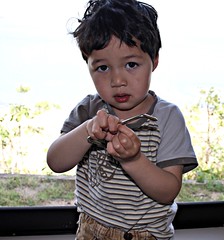
My son here is seen above holding a staple or "kasugai," shown in close up in photo bottom left, which is used to hold two pieces of wood together, see photo bottom right.
In Japanese culture, the love between men and women is seen as being beautiful and natural, but like most things in nature, not particularly permanent. Love, between women and men does not last forever. There is no bridge across forever, no soulmate, no happy end. Japanese love stories tend, or tended, to end in double suicide: the most romantic outcome that one can hope for, at least far more so than domestic bliss.
The love or at least the relationship between parents and children, between ancestors and their descendants is however seen as being eternal. Parents and offspring are considered to be indivisible. No one is born again. This goes for the relationship between children and both mothers and fathers.
So when a couple have a child, while their own emotions for each other may wax and wane, they will be irretrievable linked forever in the flesh of their flesh, their child.
Hence, just as a staple can be used to join two pieces of wood together, so a children are considered to be like staples that join their parents together forever.
Westerners on the other hand are more likely to believe in the possibility of enduring love between men and women, through the transcendence of sexual difference. This hope, that there can be a bridge across forever, is perhaps dependent upon the repression of sex (much less festivals which celebrate sex), which is taboo, repressed, something to be sublimated into a unisex, shareable, idealised "love". I don't think that I need to refer to any particular cultural phenomenon to persuade Anglophones that Western culture is awash dreams of love. Oh, love.
While the Japanese believe that their view is natural, it may be dependent upon the repression of childbirth (seeing it, the desire for it, expressions of child birth, much less festivals which celebrate childbirth), which is taboo, repressed, and sublimated into a unisex, shareable and idealised "parent-child-love". While ancestor worship, or ancestor veneration, is carried out behind closed doors, the clearest expression of the cult of parent child love in Japan, is in the "monstrous" hegemony of cute found in Japan.
Related there are
Children are the shackles of this world and the next (ko ha sankai no kubikase 子は三界の首枷, こはさんかいのくびかせ) which refers to pretty much the same thing.


Labels: family, gender, nihobunka, nihonbunka, sex, Shinto, 宗教, 日本文化
Wednesday, May 05, 2010
Achieving Three Dimensions by Spinning
If you you have a specular self, permanently in the mirror stage, like mirrorman, and according to me, all Japanese, then being three dimensional can present a conceptual problem, since images only have one dimension. Origami paper folding, so popular in Japan, allows one conceptualisation of the two dimensional becoming three - like cubism.
Another is the ability to spin. Spinning is rife among the heros of young Japanese such as the "Inrou Maru" of Shinkenger and the wheel helmets of Goonger (both types of Power Ranger or super sentai).
And as shown in the video above, young Japanese people like to spin. Later Japanese children perform these ("saka-agari") loops on horizontal steel bars, (tetsubou), provided at Japanese schools. I do not have to ask Ray to spin. At three, he seem to want to do it everyday.
The ability to perform a reverse spin (saka-agari) like this on the inverted U, steel bar (testubou) is a rite of passage, and a requirement of Japanese primary school children. Here is a 5 year old Japaense girl performing serial loops on a horizontal steel pole.
AFAIK we WASPs do not require our children to spin, nor do our children show much inclination to do so. I can't remember there being any spin bars at any of my schools in Britain but perhaps I am mistaken.
Until the Japanese child can, by perspective taking (but in a more literal sense that Mead had in mind), and developing the ability to mirror in the mind, she feels perhaps a sense of lonliness or unease at the back of her neck which she can touch but never see. She can overcome this sense of lack through the games mentioned above.
Labels: culture, japan, japanese culture, nihonbunka, occularcentrism, specular, theory, 日本文化
Japanese Buddhist Chanting
In the above video, some lay practioners chant Buddhist scripture. None of the people that are chanting know the meaning of what they are chanting, but they know it is meaningful. I am not sure which scripture they are chanting. Often it is Hanya Shinkyou or Lotus Heart Sutra, which is a pretty philosophical exposition about emptiness. I think that they are chanting to achieve a bit of enlightenment, purification.
I think that the fact that they do now know what they are saying is important and effective. They are destroying language. Repeat anything, even ones own name, even the most meaningful phonemes, and they will become meaningless after a while. By repeating, chanting, these Buddhists are entering, the mumbo-jumbo, language-free-land, and freeing themselves, purifying themselves of the symbol, the group, society, and returning to their un-symbolised, un-analysed Buddha nature.
They feel that they are praying to the Buddha enshrined here. I think that the Buddha here enshrined approves of their self-and-language-anihilation. They are generally older people. People who do not want to die with this-worldly-public things on their mind. They shake noise-makers, to remind themselves that the soul has many voices, not only the one that they are destroying in their heads.
If Japan is so occularcentric then wouldn't it be a good idea for these Japanese Buddhists to work on their self image more? To disassociate themselves from the image? This ia weak link in Takemoto Theorey of Japan. A great deal (but not all) Japanese Buddhist spiritual practice (shugyou) focuses upon eradicating language, via silence (Za-zen), chanting (all forms of Japanese Buddhism), and unsayable sayings (Zen Koans). At the present time my only answer is that perhaps language is the weakest link in the borromean knot that ties the Japanese self together.
Labels: buddhism, culture, japan, japanese culture, logos, nihonbunka, occularcentrism, theory, 日本文化
Japanese Election Posters
Japanese election posters are the other way (see previous post) in which the electorate gain information about the candidates.
In Japan actions speak louder than words. Indeed, I think that being wordy is viewed in a somewhat negative light. For this reason, none of the election posters contain any detail of policy. Many use the same brief phrases promising action, and at least one stating soley, "Action more than words." Instead, the electorate are provided with the names and large photographs of the candidates striking various positive poses. They were also treated to the greetings broadcast from sound trucks.
Those candidates 45 or so candiates, out of about 55, that were elected recieved only about 1500 votes each.
Bearing in mind the small number of votes required for election, those who were elected may have been successful not because their photo, or name was attractive, or because their sound trucks reached an audience persuadable in this way, but rather because of the votes from those with whom they are connected in one way or another. Thus both the posters, and the sound trucks may be a phatic act, going through the motions of canvassing, whereas the real canvassing may have occured in other ways, not herein described.
Labels: culture, japan, japanese culture, nihonbunka, specular, theory, 日本文化
Wednesday, April 21, 2010
Election Sound Trucks, Yoshimichi Nakajima, and Architecture
I can't blame this politician but I really used to hate these election cars. Twenty years ago, when I was learning Japanese these beasties would come by blaring someone’s name and saying thank you, I would, or did on one occasioning run after the truck shouting "Urusai!" (You are being loud/shut up!) to which the politician replied, with thanks.
These days, I have become used to the election cars. I almost feel fond of them.
The western part of me still feels, however, that these announcements would be okay if the politicians said something, such as what their policies are but in general all they say are greetings, the name of the politician and an appeal to vote for me.
There is also a "mythology"(Barthes) to these announcement in that their speech serves to tell the residents, through whose street the car travels, that the politician cares about that particular street.
This politician, running for office in the Yamaguchi City Town hall. Yamaguchi City is now very large. The politician whose sound truck appears in this video, comes from this particular part of town and has and will, I presume, represent the wishes of this his locality or "constituency." So in a sense it makes sense to vote for the politician whose name one hears blaring out of the most sound trucks. There, I never thought I would say it: election sound trucks make sense. If I had a vote, I might even vote for this politician )I do not have a vote because I am not a naturalised Japanese citizen).
The existence of sound trucks is another demonstration of the fact that Japanese do not care a flip about words, in the sense of what they mean - the locutionary act. The meaning of words is almost only in their illocutionary, performative aspect. The performative meaning of this speech at is loud and clear; "I, Mr. H, the politician am making an announcement in your street because I cares about getting the votes of its residents." The politician could simply repeat his name and some mumbo jumbo. Indeed, that is what the vast majority of Japanese politicians do.
Yoshimichi Nakajima’s Japanology which points out the prevalence of verbal announcements in Japan is very good. Not only does he point out the prevalence of linguistic pollution in Japan but also he goes on to show that words must be public, not private in Japan. The Japanese are very tolerant of all sorts of announcements and endless tapes and motto-signs (e.g. those that encourage road safety, or that we greet each other). At the same time they are very intolerant of the expression of personal opinion in a vocal way. E.g. it is the very worst of form to use a mobile phone in a public area, even if one talks in a low voice and I have to pay my students to ask a question in class.
However, what Nakashima does not point out is the Japanese equivalent of the word, or the Western equivalent of the suppression of private speech.
The latter (Western suppression of individual freedom), is observed, I believe in Western architecture. One is free to express oneself verbally in the UK, because speech is yours, it belongs to the individual. In Japan one can express oneself freely in ones house architecture and Japanese cities bristle with some of the most un-harmonious individualism known to man. But, in the UK, if you change anything about the appearance of your house, even the window sills, then you will be fined by the local council, because appearances are public. The situation is reversed in Japan: the word is public, but appearance belongs to the holder.
Labels: culture, image, japan, japanese culture, logos, nihonbunka, 日本文化
Monday, April 12, 2010
Uniqlo Management Theory
The chairman of Fast Retailing, the power behind the Uniqlo Clothing stores throughout Japan and the world, Yanai Tadashi has written a book called "Forget Your Successes in a Day," about the way that he runs his company: never becoming self satisfied. I mention chairman Yanai's philosophy in cultural psychology classes.
The cultural psychologist, Steven Heine has two interlinked theories about why the Japanese are more likely to engage in self-criticism (rather than pumping up their self-esteem).
1) The Japanese don't care so much about being there (because they are not "entity theorists) as getting there (becuase they are incremental theorists). Hence they don't mind forgetting their current success, an concentrating on their failiures for the purpose of continued self improvement.
2) The Japanese don't care much about being great as being loved. Being "successful" is just an ego trip. But making customers and employees happy, that is what success is really about. So they forget their successes and concentrate on their failiures because love, friendship and social relations is what life is really about.
I have another theory why Japanese do no mind cricising themselves, because if they do it linguistically, words are like is water off a ducks back. If they were to loose face however, to imagine themselves, visually, in a negative light then it is painful.
Generally speaking Western psychologists would be inclined to claim that Yanai's philosophy is very unhealthy and likely to lead to depression (Taylor and Brown). Zelligman, the former head of the American Association of Psychology and founder of "Positive Psychology" encourages passing the buck, blaming others, negating the contributions of others and the effect of chance, and doing pretty much anything to get a buzz out of ones successes.
Here is a man showing that remembering ones successes can work too.
And not all Western Psychologists recommend high self esteem, particularly "Sociemeter Theory" by Rory Baumeister and friends.
http://www.psychologicalscience.org/journals/pspi/pdf/pspi411.pdf
Labels: culture, japan, japanese culture, nihonbunka, theory, 日本文化
Sunday, April 11, 2010
Electronics Graveyard
These days consumer electronics, such as TV sets and refrigerators, do not find their way into the rubbish (garbage), since they have to be taken to recycle centres, in the form of local electronic supplies stores.
Labels: culture, economics, japan, japanese culture, nihonbunka, westernisation, 日本文化
Friday, March 26, 2010
Image and Logos as Sacrificial Supplement
Consider a supplement to a book. It is the bit on the end, extraneous to the main part of the book (and thus of lesser importance) but at the same time may complete the book and by completing the book, be of prime importance. Or again, a vitamin "supplement" is something that is an addition to ones normal diet, that may at the same time contain the minerals and ‘vitamins:' the most important things that the makers of the "supplement" claim we should eat. Or again, there are things that are sacrificed, or made into scapegoats that are at once of lesser importance/value and of prime value. Consider the Jews in Nazi Germany. They were treated as animals, far beneath the "Aryans" but at the same time, by making a scapegoat of the Jews, the Nazis were able to rally the Germans together in the face of the common "enemy within." It could be argued that the Jews, as victims and scapegoats, were the scapegoat that made the fantasy of a pure Aryan race possible.
In his commentary on Plato's Pharmacon, Derrida (On Grammatology) claims that writing, or visual symbols, are a supplement in that sense in the West and that Western philosophers often make use of writing (the visually meaningful) as this kind of supplemental sacrificial, purifying scapegoat. Plato uses writing as an example of impure speech, attached as it is to the visual, and compares it to phonemic language in the mind, which by contrast with written language is claimed to be able to apprehend, or frame, ideas in their purity. Plato speaks of writing as supplemental to phonetic language claiming that it is an imperfect record, in being caught up in the visual world. But Derrida points out that writing has in Plato that other function of the supplement: something which completes by its ability to purify.
I find Derrida's writing very opaque and I don’t mean to attempt to paraphrase him. But I do feel that the visually significant, or corporeal, is used as the "supplement" to the symbolic in the Western tradition. Western philosophers since Plato, point to some visual/corporeal instance and say “well it is lucky that we have thought (ephemeral phonemic language in the head), and the meaning that we can trust". The writing, visually symbolic, acts as scapegoat, a victim that purifies the purely linguistic.
Some examples...Austin claims that some linguistic statements are "speech acts," such as "I promise," or "I bet" is not only speech, it is also an act. The speech act is a piece of dirty speech, that involves itself in the world of things. After going on about these "speech acts" for a while, Austin then claims that, but of course, there is some speech which is not an act, is simply referential. Thus he purifies language and its ability to refer to things without acting upon them in any way, by using example of speech which is also an act, caught up in the phenomenal world. In my view, all statements are acts in a sense. All symbols contain a little corporeality. But by setting up an example of an extremely corporeal example Western philosophers can return to their veneration of language.
Descartes likewise, goes on about how easy it would be for all of "res extensio" (that which is extended, that which can be seen) to be a dream and after going on and on about how all this visual stuff could be an illusion, he returns to language and his cogito as if it is purified from being a mirage, despite the fact that he may be dreaming in gibberish. I think therefore I am, may be "flutch brenden under cellophone."
In Lacan too, the mirror image of the self, acts as kind of supplement, an essential lesser part to the self-narrative of the linguistic self. The image of self is essential, and it is only at the intersection of linguistic and visual self reference that we have a self at all. But the image is the lesser part, the part of self which one should not identify, which language saves us from. The image of self is like the twist in the mobius strip. It allows language to return upon itself, refer to something that is the source of the language, refer almost to itself. The self-image is the veneer that proves that truth is going on “inside".
I think that in Japan, it is language that is the abject, scapegoat, accursed share, or supplement that holds the mobius strip of the specula, Japanese self together. Language is not exactly unimportant in Japan. Language is important as a sacrificee, to purify the mirror.
In Japanese religion language is sacrificed in concrete ways. The central Lord's Prayer of Shinto, the great purification rite speaks of writing all the impurities down on pieces of paper and washing them out to sea. And all the white the prayer itself, is almost meaningless to the listeners and even the speaker who, Bataille argues regarding Noh, says the words only as recitation so that we can feel the paper upon which they are written. The fluffy Shinto wands of zig-zag paper strips, the little pieces of paper tied to trees, and certainly the negative affirmations of Zen, encourage Japanese to think about, concentrate on, write, chant, and then get rid of language.
Japanese language, specifically Japanese poetry is good when you can see it, when it calls to mind images so brightly that the words disappear. Japanese poets are deeply respected in so far as they can write language that extinguishes itself. Later, Nakahara Chuuya's language enjoys itself, draws attention to itself, but Chuuya said to be influenced by the West.
In this climate it is not surprising that there should be few Japanese philosophers as word-system-builders in the Post platonic Western tradition, but perhaps Nishida Kitaro comes closest to being a Japanese Descartes, in Descartes as in Nishida, a sacrifice leads us to a noble certainty.
Descartes draws our attention to the deceptive chimera of res-extensa (the extended, the place?) before returning to his logo linguistic saviour. Nishida (influenced by the phenomological school) goes through a processes of bracketing, doubting and contradicting all linguistic postulates, till at last we return to the purity of experience, where the sacrifice of the logos takes “place.” Language is not unimportant in Nishida. Nishida is a writer after all. But the limitations of language, the more ideal and a a-corporeal the better, is used to make the space where they are sacrificed shine all the more brightly. Instead of being the deceptive chimera, the place is the good. Language instead of being our saviour, it is only through the most extensive linguistic denial that we find ourselves.
Notes
Japanese philosophy reminds me of British Punk Rock. Read Nishida while listening to Siouxie and the Banshees' (“Into the Light”) or PIL's “Rise” “I could be wrong. I could be right. I could be black. I could be white….the written word is a lie…Anger is an energy. Anger is an energy.
I need to find more “supplemental” uses of Language in Japan. There was medical doctor in Kurume university who wrote a "theory of civilisation" in which he seem to be saying that Japanese culture (specifically the example of Tenangu) focused on the expulsion of language. I started writing this because I read Jay's "Downturned Eyes", and wanted to make sense of the logo and occular centrism that Jay seems to think European culture flip flops between. And because Japanese superheroes are always flashing symbols at people, while Western heros like to change their clothes.
Labels: culture, japan, japanese culture, Jaques Lacan, logos, mirror, nihonbunka, theory, 日本文化
Friday, March 05, 2010
Not (Show me your) Willy

Photo originally uploaded by hockadilly.
In English speaking countries the command given to dogs when requiring them to perform this pose is "beg!"
In Japan the same pose is required of dogs with the command "O-chinchin" which is a homonym of "willy."
Etymologists claim that "ochinchin" is from "chinza" which means "seat(ed)".
It seems to me that the motivation for the continued referal of this pose with this phrase, seems to me to be related to the fact, however, that "Ochinchin" it may also be interpreted as "(show me your) Willy" especially bearing in mind that the other commands to dogs are "fuse" (lie) down, "Osuwari" which means "sit", and "O-te" which means, "(put out your) paw/hand". None of the other commands use kanji based expressions (as Chinza would be). And one of them, "ote" similarly uses a part of the body prefixed with the honorific "o" to refer to the presentation of that part of the body.
Furthermore, it appears to be the case that some or many Japanese believe that it refers to the anatomy.
This, like the Japanese word for uvula, illustrates I believe that in Japan, the male sex organ is not as taboo as in the West.
Do not for a minute think that the Japanese are uncivilised but rather that there is a reversal of taboo. Things sexual are not that taboo in Japan, but things related to childbirth and the sexuality of women were traditionally very tabuu. The Japanese would, for instance, never ever call anything a "fanny pack," even if it was associated with female sex organs only in other dialects of their language. No way.
There is no similar word for the felmale sex organ that can be used in polite company (according to the Japanese wikipedia article on chinchin) despite attempts to make one from a neologism using the feminine form of "chinchin."
This photo is "Butch begs for a treat" kindly uploaded with a generous licence by hockadilly.
Labels: culture, japan, japanese culture, lacan, nihonbunka, reversal, sex, taboo, tabuu, 日本文化
Thursday, March 04, 2010
Finger Pointing and the Specular Self of the Japanese
For this reason, when a Japanese person, like Suzuki Ichiro, wants to reinforce conscious decisions and actions he does so by pointing his bat. Railway workers and bus drivers regularly point at signals and other things when they check them, to reinforce the awareness of having performed the act. These finger pointing checks are only carried out in Japan, Korea and Taiwan (as a result of Japanese influence). In the UK on the other hand, train drivers "call the road" that is to say they call out the colour of signals or other signs along the way. They do not point at them.
The western self, as many many psychologists and philosophers will tell you, is centered upon self speech, it is the monologue that we have with ourselves. The Japanese self centers upon however, the awareness of ones self as an image. You could say that the Japanese are permanently in "the mirror stage."
However, while Lacan and other white men claim that it is only through indentification with the symbolic (language) that one can optain a third person, objective perspective on self, it seems to me that the Japanese are quite able to internalise a mirror, to simulate a mirror in their minds eye and take a third persons perspective of themselves.
While men westerners think that appearance is superficial and external, in Japan voice and speech be viewed as that which one does for others. Speech is external, communicative, transfers information from one person to another, and does not get reflected back to Japanese speakers. While Lacan and James Mead seem to think that speach is always heard, understood and cognised by the speaker, in Japan I believe speech, rolls out of mouths like water off a ducks back; it is said and gone. On the other hand again, Japanese would be surprised to hear that we Westerners can not imagine ourselves unless we have a mirror. They do it all the time. How else could they "refect upon their behaviour" (hansei)? There is not even a word in English for hansei in English.
Labels: culture, japan, japanese culture, Jaques Lacan, mirror, nihonbunka, self, specular, 日本文化
Friday, January 15, 2010
Henshin Transformation Through The Ages

When Japanese superheroe transform they do not hide their true identity. They have a human identity but it is often no secret. If there is a secret, then their transformation serves to dispel secrecy, demonstrate a continuity, and reveal their true identity.
The transformation of Japanese superheroes often involves a sort of ritual. Heroes strike a specific pose, say a specific and individual trasnsformatory phrase, and or manipulate a symbol such as brandish a special card, or insert a speaking chip into a slot into their belt. Thus, Japanese superheroes transform, ontologically (please see previous post) after manipulating symbols in a codified way. Irrespective of whether or not there is an ontological change, the pose, invocation of the transformation phrase, and the manipulation of a concrete symbol, are the catalysts for the transformation.
A Typology of the mechanism of Heroic Transformation
The transformation (henshin変身) of Japanese superheroes is precipitated by the first three of the following elements or properies.
1) Transformation Pose
Japanese superheroes strike a pose to transform. Young Japanese boys often imitate these poses. Striking specific poses are popular in Japanese society. Like the "kata" of Noh performers, a "pose" often consists of a specific movement, which freezes, or almost freezes, into a specific bodily position. Japanese strike specified poses when they are having their photographs taken. Japanese baseball players strike specific poses when they come to bat (and not only Ichiro, the one legged stance of Sadaharu Oh is also immediately recognisable). Japanese comedians often have specific poses which draw laughs, such as Beat Takeshi's imitation of the attire of Nadia Comăneci , called the “Komanecchi" pose. Imagine Clark Kent, putting one fist to his chest and his other pointing up into the air.
2) Transformation Phrase
This phrase often designates the process of transformation, so the word "transform" (henshin変身) is commonly heard. Similarly, in the Tomika Rescue Fire series members all say "suits on” (chaku-sou) which is a name for the transformation itself. However, transformatory phrases are often individual and designate the being into which the hero is about to become. Thus the transformatory phrase is often sort of a self-naming. Imagine Clark Kent saying "Transform (me into) Superman."
3) Transformation Symbolic Artefact
Kamen Riders and the Tomika Rescue force used magnetic cards swiped into a reader on their belts. The Tomika Rescue fire heroes use a robot megaphone which on hearing the transformatory command (2) above. Super Sentai Go-Onger heroes insert a small electronic box that speaks certain phrases (called an "engine soul") which are also inserted into their belts. These same devices are used to transform their weapons and vehicles. Ultraman used a pen, spectacles, and even a toothbrush. These objects are signs comprising a physical signifying substrate and a significant, often linguistic, meaning. Taken together, imagine that Clark Kent must take out and present a Superman “S” sign, while performing a Superman salute, while shouting “Transform, Superman.”
4) Putting on a Super Suit
Western superheroes generally don a special costume when they transform. Batman is the "Caped Crusader." Clark Kent would be a strange sort of superhero without his Superman suit. A change in appearance is de rigueur for transformation into a Western style superhero. Japanese superheroes change their suits too but often from one super-suit, to another super equipped one. Further, this super-suiting-up, is the result of the transformation rather than its catalyst. In Japan, symbolic manipulations (posing, shouting, manipulating symbols) give rise to the change in appearance, rather than the change in appearance giving rise to the change to super-hero status.
Precidents
Japanese heroes use of symbols prior to transformation is nothing new. It is also a characteristic of the immensely popular Japanese "period dramas," viewed by adults, such as "Mitokoumon," "Touyama no Kin-san" and "MomoTaroZamurai." In all of these and more, just before the climatic fight or denouement, the heroes undergo a transformation precipitated by the manipulation and presentation of symbols.
Mitokoumon appears to be a harmless old man wandering the country with his companions. At crucial points in the narrative however, one of his companions takes out a badge and points to the seal thereupon, exclaiming “Stand down! Don't you see this seal!" ("Hikaero! konomondokoro ga me ni hairanu ka"控えろ!この紋所が目に入らぬかぁ"). The seal in question is that of the Shogun, indicating that the humble old man is in fact the Shogun's uncle. Mitokoumon and his entourage then proceed to fight, and dispatch a multitude of enemies with their swords.
Momotaro Samurai is similarly unassuming up to immediately prior to the sword-fighting scene where he strikes a pose, and announces his identity with a sort of poem about his origins. It transpires that he is in fact, like Mitokoumon, related to a feudal lord. His enemies quake at his name before Momotaro dispatches them with splendid, seemingly-bloodless, swordsmanship, and heavy handed music (itself another feature of this genre).
Touyama no Kin-san, another wandering would-be-harmless man, but this time a playboy, performs a double transition. Immediately prior to cutting up all but the most powerful of his enemies, he announces himself by showing his tattoos of a cherry blossom snowstorm. At the very end of the same episode however, when the leaders of the baddies kneel to receive judgement from the local feudal lord (?), the feudal lord bears his right shoulder exclaiming "Don't say you don't remember this cherry blossom," (この桜吹雪の刺青に見覚えがねえといわせねえぜ Kono sakura fubuki ni mioboe ga nee to iwasenee ze) at which point the baddies realise that he is none other than the "playboy" that dispatched their minions earlier with his sword, and that their fate is also sealed.
My wife used to wonder why no one attacked these heroes in that moment when they are performing their ritual. It is as if time freezes, all viewers stand agape.
These traditional period drama transformations are of the epistemological type popular in the West. The transformations are not ontological. The samurai are no better swordsmen as a result of their transformation. The transformation of Japanese period play heroes effects only what is known about them. However, in complete opposition to the cape wearing of Batman, the Caped Crusader, and the other super suits of Western superheroes, the transformation Japanese superheroes is always carried out in full view, and the symbols they use serve not to hide a secret identity but to inform enemies of their true identity, and to demonstrate its continuity.
Transformations preceded by Self-Referential Symbols in the Real Word.
Finally, in the real world, Japanese Samurai warriors were required to state their name before attacking their enemies. Before drawing their sword they said something like "I am Tanaka, a warrior retained by the enemy of your leader, Suzuki and I hereby challenge/attack you." While not preceding a transformation Japanese Yakuza were required to go and state their name, in a ritual self naming (knees bent, palm outstretch) to the heads of the Yakuza in the towns through which they pass. The self-naming of “Tora san” at the beginning of the Otoko wa tsurai yo (男はつらいよ, "It's tough being a man") is related to that tradition. While again there is no transformation, Japanese businessmen to this day get down to business after first manipulating their special symbol, their "meishi" or business card.
By Way of Conclusion
I am not at all sure what is going on, but from a structuralist perspective, the differences and similarities with Western heroes and their transformations seem to be systematic. Further in conformance with the Takemoto theory, I suggest that there is a topological shift in the visual-symbolic plane: Japanese superheroes use words and symbols to transform their appearance. Western superheroes use changes of appearance to transform their status and people’s perceptions of who there are.
I also compare the "symbolic transformation" of Japanese superheroes with the way in which Western monsters are outed by symbols, and Western love romances contain a symbolic outing, or declaration of love.
Labels: culture, henshin, japan, japanese culture, Jaques Lacan, nihonbunka, Super-Sentai, superhero, ultraman, 日本文化
Thursday, January 14, 2010
The Ontology and Epistemology of Superhero Transformations
Superheros transform.
Superheros have a tendency to transform, in some sense, the world over.
The transformation of Japanese superheroes has, in a matter of degreee at least, differences from that of those in the West.
Ontological or Epistemological transformation.
Western superheroes are more likely to transform by virtue of what is know about them, in the epistemological plane. Japanese superheros are more likely to transform in terms of what they are, in the ontological plane.
For example, Clark Kent is always super in his being. His transformation into Superman is an epistemoligical one, motivated only by the desire to protect his "secret identity." Clark Kent's being does not change. He is just as strong, just as super-powered, as Clark Kent as he is when he is Superman. Peter Parker likewise can be said to "transform" into Spiderman, but the change is purlely epstemological, one of cloaking, a change of appearance. Peter Parker is just as strong, just as super-powered, as Peter Parker as he is after he dons his spandex suit. His transformation is to protect the secrecy, the epistemoligical aspect of what people know about him. Bruce Wayne's transformation into Batman is predominantly epistemoligical, to protect his "secret identity" but thanks to the technology he dons, effects a change in his powers. His suit is not merely a charade, but change his ontology, who he is. Bruce Banner's epistemological identity as the Incredible Hulk is known to many in the films, but his being changes. He becomes far stronger. The X-men, such as Wolverine likewise transform in a predominantly ontological way. James Howlett or Logan is *known* by many, but not all, to be Wolverine. He changes predominantly in an ontological way; his body changes, he grows claws.
Japanese superheroes are far more likely to transform on the ontological end of the spectrum. The continuity of their two modes of being are more often not a secret. Epstemologically, the two modes of being are far more likely to be known as one and the same. Far more often, it is only their mode of being that changes. That Hayata is Ultraman is not so much a question of secrecy but of his mode of being. He changes at will to his superhuman form in order to fight, but not in order to keep a secret of who he is from day to day.
Many Japanese superheroes, such as those in the Super Sentai range, such as the Go-Onger five, make no secret of the fact that they are able to transform into their super-powered 'alter ego.' Even while human, they are in costume, they give away their identity completely. And yet they *transform*, ontologically, into a more powerful beings.
Labels: bug-eye, culture, Gao-Ranger, japan, japanese culture, Jaques Lacan, nihonbunka, Super-Sentai, superhero, 日本文化
Merging and Morphing Toys
An quick video of some of the merging and morphing toys that are available in my local discount store. I believe them to be evidence of the continuance of Totemism in Japan and that perhaps, the merging may be motivated by the same desire as that which motivates people to create totem poles.
I believe that Shinto is a form of geographical totemism, such as practiced by the Aruda or Arunta of Australia, except that it has been modernised such that the totems in use are ideograms, such as found on tablets for the dead and good luck charms (omamori). For more shinto please see my shinto blog.
Labels: culture, japan, japanese culture, nihonbunka, theory, 日本文化
This blog represents the opinions of the author, Timothy Takemoto, and not the opinions of his employer.