
Friday, August 12, 2016
The Authenticopiable and the Unique
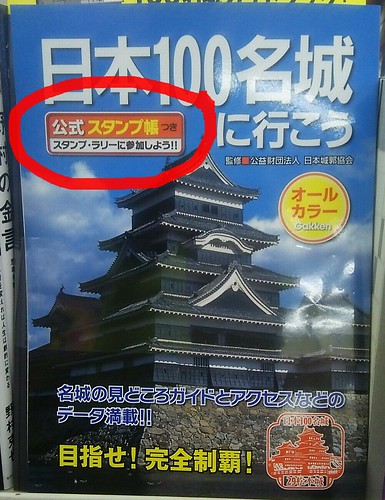
Many Japanese castles, such as those in Oosaka and Nagoya are, like the "foreign villages" (gaikokumura) scattered around Japan, scale models, replicas or fakes, made out of concrete, not the real ting at all, to the Western whispering mind. To the Japanese if they look the same they are the same. The Japanese are going to collect the unique words as stamps. This guide book to the 100 famouse ("named-") castles of Japan contains an "official" stamp collection book. An example of a stamp is shown in red bottom right. To us the situation is reversed: words are the same whereever they are said, but views are unique so we go to see them. How can the world be so inverted?
Each construal depends simply upon whether from out of that cave or 'crypt' of the mind (Abrahama & Torok, 2005), one is looking or listening with 'mother.' For the Japanese the collectable names are on the outside of the head. There is no Other (Lacan, Mori, 1999, p.163) to authenticate them.
Abraham, N., & Torok, M. (2005). The wolf man's magic word: A cryptonymy (Vol. 37). U of Minnesota Press.
Mori, A. 森有正. (1999). 森有正エッセー集成〈5〉. 筑摩書房. See here with quote.
Labels: cultural psychology, japanese culture, nihonbunka, tourism, 日本文化, 観光


Thursday, January 21, 2016
Henro: Sightseen Tourism and Pilgrimage

Urry (2002) , (Turner & Turner, 1995) and others persuade us that Western tourism is sightseeing: gazing upon things. I have argued elsewhere (40,000 views and zero comments. I took it off the Net!) that this gazing may in part be a form of reconstruction (the focus of Derridean Deconstruction) after the model of Mary, Jackson's fantasy (1986) that had never seen red. When Mary sees red for the first time we are persuaded by philosophical dualism: of (1) an ideal scientific world, in our heads and in spooky things in themselves, and (2) chimerical mere phenomenal like red. Mary's word "red" and the description of Frenchness in a guidebook, unaccompanied by qualia is like all the other castrated signs that Derrida (2011) argues Western philosophers parade before us (writing, speech acts, foreign words, indicative signs) before showing us the full dual sign and meaning in that moment when e.g. Culler's tourists (Culler, 1988) find a Breton wearing clogs and pronounce upon her. Behold! Frenchiness (it wasn't just a world but a Platonic ideal)! The Japanes have a tendency to go on tours with out looking. One commentator (Araki,1973, p10 below) bewails their tendency to get on trains and busses travelling through magnificent scenery which they ignore. The book above (Mori, 2014) has a "belt" telling potential purchasers that it will tell them the "hilstorical truth" of the protypical pilgrimage, the "Shikoku Henro" tour of 88 temples: a truth that pilgrims who walk the route will not be able to see. The temples themselves are above all named, possed of stamps, that pilgrims press on on a pad that they carry around their necks. Japanese pilgrims such show on the book belt, or such as monks in various blindfolding straw hats (above right), and Japanese travellers in pallanquins (top left) also have a tendency not even to try to look at the scenery. Travlling is about going to places of historical truth, picking up names rather than gazing at images. Japanese tourism is conversely about being seen. Japanese tourism is sightseen, *auto*photographed. Tatsuno (2001) writes that after completing the Henro pilgrimage he becomes, like Mario, able to see his own back. To (re)construct a Japapnese self one can practice a lot of set moves in a Japanese art, or visit a lot of named places on a set route picking up names. In either case one develops within oneself the eye in the sky of the Other. The tendency to collect names and engage in other Japanese tourism practices shows a negative correlation with feeling autoscopic, like Mario. So perhaps, when Japanese stop feeling like Mario, and need their autoscopy topped up, they cover their eyes, and go on tour. "歩いたあとは自分の後姿が少しは見えてきた。" (Tatsuno, 2001, p.3) http://ift.tt/1Sye6ph 私は旅しながら考えていた。。。日本人にとって旅とはいったいなんなのだろうか。指定車のの中である。車内は団体客でほぼいっぱいであった。賑やかな一行を乗せて列車は宮崎へと向かっていた。盃(さかずき)を汲み交わすもの手拍子で変声を張り上げるもの、通路を左往右往するもの、等々。 だが、その喧騒をよそに左手には昼下りの陽光をきらめかせながら春の豊後水道がのびやかにひろがっていた。窓外いっぱいに溢れるめくるめくような瑠璃色の空と海。-この壮麗さと無関係な旅が、いったいどうしてありうるのだろうか。。。車内のだれ一人として窓外に目をくれるものがなかったからである。(荒木,1973, p10) Culler, J. D. (1988). The Semiotics of Tourism. In Framing the sign. Univ. of Oklahoma Pr. Derrida, J. (2011). Voice and Phenomenon: Introduction to the Problem of the Sign in Husserl’s Phenomenology. Northwestern Univ Pr. Jackson, F. (1986). What Mary didn’t know. The Journal of Philosophy, 83(5), 291–295. Retrieved from http://ift.tt/1ZCX5JA... Turner, V., & Turner, E. (1995). Image and Pilgrimage in Christian Culture (0 ed.). Columbia University Press. Urry, J. (2002). The Tourist Gaze. SAGE. 森正人. (2014). 四国遍路 - 八八ヶ所巡礼の歴史と文化. Tōkyō: 中央公論新社. 辰濃和男. (2001). 四国遍路. 東京: 岩波書店. http://flic.kr/p/CMt7xX
Labels: autoscopy, blogger, Flickr, Nacalian, nihonbunka, tourism, 日本文化, 観光
Thursday, March 26, 2015
City Views and the Horror of Impartial Spectation
This video shows the the view over Yamaguchi City from Elephant Head Mountain at the entrance to Oouchi Mihori area of Yamaguchi City. You can climb this mountain from the rear of Toushiro Tea Shop opposite Yellow Hat and Uniqlo in Oouchi Mihori, or from the rear of Itukushima Shrine next to Shinwaniishibashi junction with the four legged pedestrian overpass. There car parks the beginning of both paths. The path from the shrine is wooded and natural. The path from behind the tea shop is made of concrete.
In this video I argue that Japanese people tend to avoid places with good panoramic views since they associate them with the divine which, in the Japanese case, visually spectates rather than listens. The Japanese simulate birds eye views of themselves and their situations in their minds but since this Other is that which allows them to have a self they also hide from themselves that they are doing this 'impartial spectating' (Smith, 1759). As a result of which, while the Japanese are happy and inclined to create imaginative artworks, such as pictures of the floating world and childrens' paintings, from the point of view of the birds eye view (Masuda, Gonzalez, Kwan, & Nisbett, 2008), the Japanese do not actually want to go there, to the dreaded viewing platform.
Often times Japanese are even unaware that viewpoints exist in reality. One of my colleagues was of the opinion that there is nowhere from where our town could be viewed, but in addition to this viewing platform, I live on a mountain or hill of 118m, which taller than the viewing platform shown in this video, at a mere 85m, right in the centre of Yamaguchi City overlooking both the older part of the city and the Hot Spa area. The under-utilization of Japanese viewpoints represents a tremendous potential tourism industry.
The the birds eye viewpoint is an abject place, a terrifying location that should not exist since it always exists as hidden simulation. In Japanese Horror monstresses (a neologism I use because generally Japanese monsters are female) often hang out on ceilings, looking down, or emerge from mirrors and other images. They also hang out on mountain tops as mountain aunties (yamanba).
There should be a Western equivalent of this phenomenon "Nacalianly" transformed from the visual into the linguistic. As a Westerner I should have a horror of "going" to the place where I can 'impartially' hear myself speak, the equivalent of the Japanese birds eye view. But, logophonic "places" are not really "places," but discursive 'viewpoints' or logical 'positions' (ronten 論点 not shiten 視点), so I was (until I am writing this now) confused as to where the "real" equivalent of the "impartial spectator" that I simulate in my mind might be situated in the world. Where is the linguistic version of a mountain top? Where am I scared to go?
I hypothesize now that the place that I am scared of visiting is "the text," or a particular type of text that is addressed to no one in particular. I can write a blog, here, since I imagine that I am speaking to someone, that this burogu is a dialogue with a real other. But as soon as I attempt to write, objectively, for publication, I face "The Problem of the Text" (Bakhtin, 1986) and the absence of a dialogical other and must confront -- or not confront by not writing -- my super-addressee: a monster in my mind. In fact, as I attempt to write, I often find myself going to look at visual views, especially that from the balcony at the end of my fourth floor corridor at Yamaguchi University, perhaps in order to escape *the horror of linguistic impartial spectation*.
This realisation may make it easier for me to write. Perhaps I should write on top of mountains.
Viewing platform in Google Earth
https://goo.gl/maps/SocFV
Viewing platform in Google Maps
https://goo.gl/maps/SqQXt
Bibliography
Bakhtin, M. (1986). The Problem of the Text in Linguistics, Philology, and the Human Sciences: An Experiment in Philosophical Analysis. Speech Genres and Other Late Essays, 103-31.
Masuda, T., Gonzalez, R., Kwan, L., & Nisbett, R. E. (2008). Culture and aesthetic preference: Comparing the attention to context of East Asians and Americans. Personality and Social Psychology Bulletin, 34(9), 1260-1275.
Smith, A. (1759). Theory of Moral Sentiments. Retrieved 2015/03/26 from http://www.ibiblio.org/ml/libri/s/SmithA_MoralSentiments_p.pdf
Labels: autoscopy, japan, japanese culture, Nacalian, theory, 日本文化, 自己視, 観光
Thursday, December 11, 2014
Omotenashi may be Unwelcome and Unwelcoming

The Japanese are proud of their Omotenashi, "service of the heart", where the server not only provides what the customer asks for but provides what the server judges the customer needs may not be as bad as a kick in the teeth, and will often be an interesting cultural experience, but it may not be felt to be entirely welcoming, or welcome to Westerners. Westerners like to fool themselves that they are young, independent, and capable. So when people offer them help without their asking, it is like becing told that they are incabable and they find this to be stressfu than receiving help only when they ask for it (left hand two bars). More grateful, realistic East Asians on the other hand are aware that they need help, and that others will often know when to help them before they know it themselves. They also do not want to be a burned upon others so, they do not like asking for things. Hence East Asians tend to find it less stressful to be helped without having to ask for help (right hand two bars in the above graph). In other words, while East Asians may find "Omotenashi," service of the heart, welcoming, it may be unwelcome to Westerners. Image from p92 of Mojaverian, T., & Kim, H. S. (2013). Interpreting a Helping Hand Cultural Variation in the Effectiveness of Solicited and Unsolicited Social Support. Personality and Social Psychology Bulletin, 39(1), 88–99. doi:10.1177/0146167212465319 http://flic.kr/p/qnvNqe
Labels: blogger, Flickr, nihonbunka, self, tourism, おもてなし, 日本文化, 自己, 観光
This blog represents the opinions of the author, Timothy Takemoto, and not the opinions of his employer.