
Saturday, December 27, 2014
Visualness Vs. Continuity
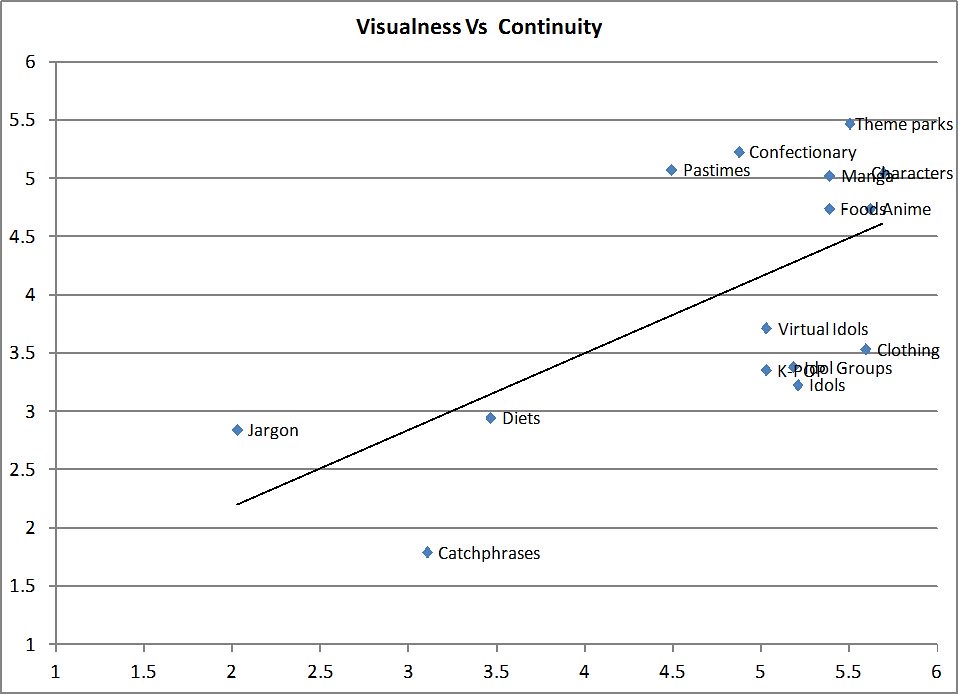
In Japan continuity, identity and soul resides in the visual and my seminar student, Masaki Abe (2014) appears to have proved it. In an initial experiment we asked for social phenomenon that have longevity and continuity and those that do not, those that are faddish. In a second experiment, subject were required to rate these phenomenon according to the extent to which they were visual and had continuity. It was found as predicted that there is a strong positive correlation (r=0.64) between visuality and continuity in Japan.
Jargon included also "modes of speech" such as speaking like a posh person, and was considered, along with diets, and the catch phrases of comedians to be the most faddish phenomenon there are. Maruyama Masao claimed that this faddishness extended to theories too. Perhaps my theory will have its day.
Hello Kitty, a recognisable face and little more, is 40 years old this year.
Abe, M. 安部将輝. (2015). 音と流行の心理学 (未発表卒論). 山口大学経済学部観光政策学科, 山口市.
Labels: blogger, Flickr, japanese culture, nihonbunka, self, 日本文化, 自己, 自己視


Omonenashi: Like the Graceful Swan Flapping its Legs Under Water

Labels: blogger, Flickr, hospitality, nihonbunka, おもてなし, ホスピタリティ
Friday, December 26, 2014
Spectre Watch's Bicultural Hero

The title (like many elements of the oeuvre) is a pun meaning (1) "spectre summoning wrist watch." This device is used by next generation Satoshi, to summon not Pokemon but Youkai - ghouls or spectres - and is not dissimilar to all the transformatory watches and belts used by Masked Riders and Power Rangers. Youkai Watch also means (2) the ability to see the same ghouls or spectres. It may also have the sense of "Neighbourhood Watch" in that Keita looks out for ghouls and spectres haunting his environs, based on the town of Tsukuba, in which I have lived. Importantly Keita Amano "watches" in both senses of the word/neologism: he sees and he plays with time.
I have argued that the dual nature of Japanese super heroes -- either they are possessed by something outside of them, or accompanied by a super friend --- reflects the way in which the Japanese self is visual, autoscopic (日人hito) rather than narrative (人間 ningen, "homonarans").
The Japanese super heroes' suit does not hide his mumbling 'secret identity," in which the Western super hero spends some of the time, but rather the Japanese super hero is spatially separate but often almost equivalent to the suit (Masked Riders, Evangelion, Gundam) and suiting up is done in public sometimes with great aplomb (Mitokoumon, Shinkenja). Traditionally, Words, names and symbols only have importance, as do images Lacanian theory, as transformatory 'stages' or catalysts. These medals, coins, cards with bar codes, etc. transform or summon the super visual form. The Japanese only need names to convince themselves that they are the sum total of their images (henshin! gattai!), their mask, or persona (Watsuji), as we only need images as a covering(Baudrillard), to convince ourselves that we are the hero of this narrative, behind that mask.
But Youkai Watch's Keita Amano is a little different. He is possessed or accompanied by two imaginary friends. The second, Jibanyan, a twin tailed cat, is strikingly similar to all the other cute but strong, round characters that accompany Japanese boys (from Doraemon to Pikachuu). The first friend above right, however, who provided the titular wrist watch, is more rare. This friend, "Whisper," is in name, constant attention to a encyclopaedic spectral i-Pad, very linguistic, garrulous. He is also fairly weak. In these respects he is pre-dated by Masked Rider Double, Philip, another weak, autodidactic wordy possessed or possessing familiar often seen walking around a spectral library or "Gaia Memory." I did not notice at that time, but I think that at least, after about 70 years of trying, the Japanese have succeed inviting the word to become flesh and dwell amongst them. Since originally in Shinto, words were things that one jumped in to rivers to wash out, this may be a bit of a shame.
But to today's bi-cultural Japanese children, raised in a mix of traditional Japanese and Western culture, to be concerned not only about how things look but how things narrate, Keita Amano and his two imaginary friends is a runaway cultural mega-phenomenon. Even more than Satoshi (who is accompanied, but off-stage, by a narrating professor) of Pokemen, Keita with his twin friends in Jibannyan and Whisper, should be successful in uniting children all over the globe.
I went to see the recent movie "Yo-Kai Watch the Movie: The Secret is Created, Nyan!" with my children. It featured the origins of the watch (previously appearing to be a present from Whisper, and at the same time random) in the promise of Keita's grandfather to his unborn grandson. It also featured a trinity of evil, industrial, villains that were always turning time backwards with horrific effect. In order to defeat these devils it was required that Jibanyan and Whisper merge. Bearing in mind that Derrida argues that the Western self is "deferred" in time (as opposed to displaced, seen from the outside) - we are always receiving spoken messages sent to ourselves, by ourselves from the past, the news is not all good. Keita Amano appeared to me to be a sort of Jappo-Western (和魂洋魂?) hybrid to beat nasty, industrial, watch-making Western culture.
Labels: blogger, Flickr, japanese culture, kamenrider, Nacalian, nihonbunka, psychology, self, 変身, 日本文化
Sunday, December 21, 2014
In my Day it was a Tick: Japanese positivity in the face of Opium War III

There is not enough positivity in Japan, we are told. About ten years ago cultural psychologists toyed with the idea that Japanese people replace high-self evaluation with high other evaluation. But when asked to evaulate their peers it is found that Japanese subjects do not evaluate others as highly as North Americans.
North Americans will tell you that they are great, and that their family members are great too. Japanese will only say that they are average and their mothers are a bit better than average (Endo, Heine, Lehman, 2000). So interpretations of Japanese culture moved away from positivity to social embededness. Japanese do not praise themselves, nor each other, as much as Americans, but they feel a part of the socius. The Japanese live, we are told, to help the hive.
This might be enough. Christian even. The Japanese traverse this vale of tears helping each other, finding meaning in their social contributions rather than their personal positivity, their happiness.
But Westerners have gone on the attack. Chillingly similar to perhaps the greatest holocaust in history -- the Opium Wars-- the sale or pushing of drugs to East Asians to make a buck, Western pharmaceutical companies have succeeded in persuading Japanese that they need to be able tell themselves that they are happy. And if they can not then they need to take Western anti-depression drugs. And sales of anti-depression drugs have increased massively. During the same period Japanese suicide levels have increased by 50%. It is sickening.
My take is always the same. I am not sure if it is true. But to me, above all, Japan is beautiful. Positivity abounds in Japan. It is just that Japanese positivity does not take place in words.
The above image is my son's homework having been 'marked' by his teacher. Personally I don't think that my son has done his homework all that well. But the teacher who is quiet, dour and as thin as a Japanese primary school student in this 40's, has drawn a sort of flower by way of evaluation and encouragement. No ticks or linguistic praise for Japanese students, who work like cattle, only red flowers that explode like suns! Japan is harsh linguistically, but when you look at her, Japan is beautiful.
Endo, Y., Heine, S. J., & Lehman, D. R. (2000). Culture and positive illusions in close relationships: How my relationships are better than yours. Personality and Social Psychology Bulletin, 26, 1571-1586. http://www.psych.ubc.ca/%7Eheine/docs/2000rsb.pdf
Sunday, December 14, 2014
The Interdependence of the Visual Self

I often make out that the Japanese are just as independent as Westerners it is just that they percieve themselves from the point of view of an eye rather than an ear, a visual rather than linguistic intra-psychic Other (super-addressee, super-addressee, super-ego, impartial spectator, generalised other, cranial comforter, Eve).
Having a visual self makes possible very close-knit, "inderdepended," inter human bonds as these Japanese comics illustrate.
The above is a very Japanese two page spread from "Emblem Take 2" (Kiuchi & Watanabe, 1991, pp 22-23) where a group of three Japanese mafiosi (yakuza) reaffirm their unity, and intention to seek revenge for one of their number who has been shot. The comic is read from the top right and I first translate the words, but the very Japanese bit occurs in the frames where nothing is said.
On the top of the right page, one of the two underlings -- who both look older and tougher than their boss -- says "Though we were born seperately we can die at the same time time. That is the oath of "wine bowl" isn't it?
To which the boss replies mid left "Ha...What "Oat"? You have been watching too many Yakuza movies!"
The underlings then reply, shocked "Big brother!" (how can you be so cold, cynical?).
The remaining frames are almost silent, except for a little laughter, and the three mafiosi leave the hospital as one, in a vendetta kind of mood, we presume.
What is going on? First of all it should be explained that the plege of alliegence to the yakuza gang is performed via an oath where one accepts a bowl (sakazuki) of rice wine from the mafia boss. The recipient keeps the bowl, generally close to their heart, as well as the wine and becomes as one with the boss, the group, and at least one of the family - hence the exclamations of "big brother," by the underlings even though they are not conventionally related.
It is my view that in a sense they are married, and that the ritual of the rice bowl is the same as that shared by Japanese couples when they marry under with the two sips and a gulp rice bowl ritual (san san ku dou 三々九度), where the bride ang groom share a similar bowl of rice wine.
From having performed the ritual, the shape of the bowls, the fact that a diety drinks a reflection in the Kojiki Myth, and my uderstanding of the Japanese visio-imaginary self, I think that both the Sakazuki oath performed by yakuza, and the sansankudou oath performed by marrying couples, represent the drinking of other's reflection, in recognition of the fact that each will exist, interdependently, as seen an imagined in the mirror of each other's heart. But that is all talk.
The actual bonding takes place in the remaining frames where the yakuza look at each other, sweat, laugh, and leave together. If you live in the light then you need and have your companions since, to a large extent, without them you would not have a face.
But at the same time to an extent, the Japanese have a god, an imaginary friend (in two ways), their very own view of themselves, and to that extent their autoscopy, and our, Western, "hearing ourselves speak," facilitates an independent self of sorts. But, they way in which the self facilitates bonding and provides for an illusory independence are two sides of the same coin. The self is social. That Yahew made Eve - the original comforter - out of a piece of our chest results in our cleaving to others and institution of marriage (as illustrated in the next image).
Image page 22 and 23 of Kazumasa Kiuchi (story), Jun Watanabe (Artwork) (1991) "代紋TAKE2." ("Emblem Take 2") Koudansha. www.amazon.co.jp/%e4%bb%a3%e7%b4%8bTAKE2-5-%e3%83%a4%e3%8....
Thursday, December 11, 2014
Admonishing Japan Style

Mirror neuron specialists have shown that we activate the muscles, if only slightly, of the actions that we see other's make. Further, the more we are adept and the movements we see the more this reaction is activated. Pianists jiggle their fingers when they see other pianists playing. Go to a jazz club with a musician to see. Mirror neurons allow us to identify with visual representations of bodies. Experiments demonstrate that subjects feel prosthetic limbs to be their own if they watch a prosthetic limb being poked at the same time as have a poke on their own limb. Indeed, perhaps it is only a matter of tradition or culture that we identify with our own bodily visual representation. My face may be my face by virtue of convention. It is not as if our consciousness, our being, has a face. On another planet or another culture, the faces of our family members could be just as much, or more even, "our own".
The 'centre of gravity' of the human psyche is malleable. At the very least it can be the hero of ones self narrative, or ones face, and very possibly the "I" or face of another. Returning to mirror neurons, and Japanese culture there is a saying in Japan that one should, or that one does, look at the behaviour of others and in so doing see oneself. or that one can see oneself by looking at the behaviour of others (人のふり見て我が身を振り返る). This is general Japanese advice.
It is also a method of admonishing others. If you see a friend or colleague doing something that you do not approve of, then you can tell that person so. Another, Japanese, method of changing someone's behaviour is to impersonate If, for example, your colleague puts his feet on a the canteen table and you do not approve, then, assuming that your colleague has mirror neurons, then all you need to do is mimic your colleague's behaviour. It works. Your colleague will suddenly become Japanese and see their own behaviour, modelled by yours, as their own. http://flic.kr/p/q6en8v
Addendum
Firstly, this "Japanese method of admonishing" is essentially the same as holding up a mirror to the offender, so that the increase in objective self awareness cause a pro-social modification of behaviour. It is probably only necessary to admonish children and foreigners like me, since most Japanese have a mirror in their heads. But this gives me an idea. If it is true that Japanese do not have a generalised linguistic other in their heads, then perhaps they can be provided with one if an interlocutor repeats their linguistic responses back to them. "So, we should hide this air bag defect".
Seconding, what is happening here? It is less that the subject is being provided with a generalised other/impartial spectator but more that the subject is simply being separated from their actions/utterances by the mimicry of another. The "generalised other" comes naturally when one is represented with ones actions and utterances in the person of someone else. In a strange sense then it is the break causes the evaluation, and if it is true that I evaluate myself linguistically and Japanese visually, then that would suggest contradictorily, that there is a break between me and my voice, and a break between the Japanese and their self-images. If my voice were just me then it would be like my breath and I would ignore it. It is because my voice is *another me* that hear, evaluate, and care about it. Presumably it is because their face is not me but "another me" that the Japanese pay attention to, evaluate, and care about it.
Labels: blogger, Flickr, japanese culture, nihonbunka, 日本文化
Omotenashi may be Unwelcome and Unwelcoming

Labels: blogger, Flickr, nihonbunka, self, tourism, おもてなし, 日本文化, 自己, 観光
21 Century Fumie

Labels: blogger, Flickr, japanese culture, Nacalian, nihonbunka, self, 日本文化, 自己
Noh Kata And the Eye Apart

Labels: autoscopy, blogger, Flickr, japanese culture, mirror, nihonbunka, 日本文化, 自己視
Noh Kata And the Eye Apart
Labels: autoscopy, blogger, Flickr, japanese culture, mirror, nihonbunka, 日本文化
Tuesday, December 09, 2014
Interation in Space
 Interation in Space by Timtak @ Flickr
In "Bodies that Matter" Judith Butler argues that the repeated creation of bodily forms aids in the identification with a material self since the principal, defining characteristic of signification is iterability (after Derrida, 1978): the possibility, or guarantee, of exact repetition, sameness, at a later time. In order to be or become a "body that matters", that signifies, that has meaning, bodies must also be repeatable "iterable" in time, she argues.
I believe that Japanese achieve identification with their bodies through the awareness of their bodies iterability in space. Forms (kata) are practised by rows of practitioners in emulation of an instructor, and or in front of mirrors, as is the case in Kyuudou (Japanese archery). The practioner is multiplied, iterated, and the form (kata) is felt to be authenticopied in space. The Japanese do not hear themselves in the future, but see themselves from outside. The Japanese Other is not deferred but displaced.
Butler, J. (2013). "Bodies That Matter"
Derrida, J. (1978). Writing and difference. University of Chicago Press.
Labels: autoscopy, blogger, derrida, Flickr, japanese culture, judith butler, mirror, Nacalian, nihonbunka, 日本文化, 自己視
Misery Matters Less in Japan: Or its okay to say "I am sad"

The above graph shows the relationship between those that report negative affect and those that report negative physical conditions (the first two sets of data) and positive psychological conditions. As one can see, there is less of a positive direct correlation between feeling sad and being ill, and less of a negative inverse correlation between feeling sad and having low self-esteem or psychological well being.
It should also be noted that the whole research paradigm is based upon self reports and may not have a lot of meaning in reality. That people say they are happy, or have psychological well being only proves that they say they are happy, and say that they have psychological well being. In Japan it is okay to say that one is sad, blue or upset.
Image, reproduced without permission, from p3 of Curhan, K. B., Sims, T., Markus, H. R., Kitayama, S., Karasawa, M., Kawakami, N., ... & Ryff, C. D. (2014). Just How Bad Negative Affect Is for Your Health Depends on Culture. Psychological science, 0956797614543802. http://ift.tt/1vI7zML http://flic.kr/p/q4QUZk
Labels: blogger, Flickr, japanese culture, nihonbunka, psychology, 日本文化
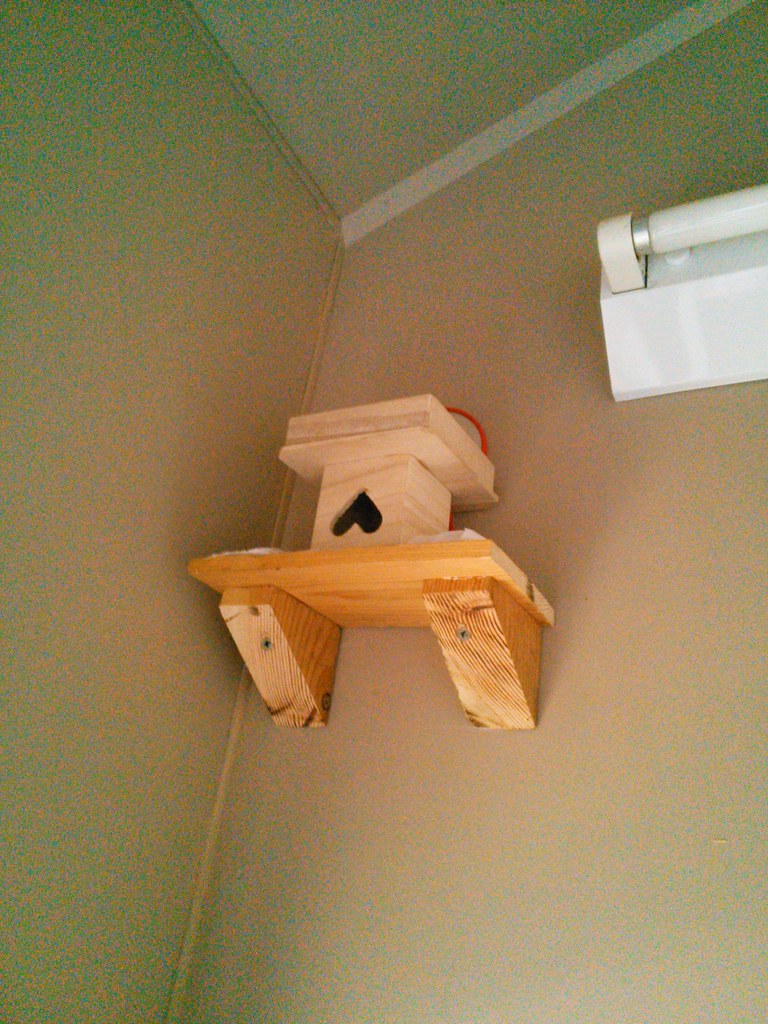
May’s Pink Mirror as Goshintai
Labels: blogger, Flickr, japanese culture, mirror, Nacalian, nihonbunka, Shinto, 日本文化, 神道
Friday, September 26, 2014
Why so Little Air in Japanese University Student Bicycle Tyres?
I was waiting for the lights to change at the main entrance to my university, when I noticed that almost all of the rear bicycles tyres of the students waiting at the lights were very low on air. They are in danger of having "pinch flats."
It was only the rear tyres that were almost flat. Could it be that rear tyres are out of sight and therefore out of the Japanese mind? Or is that bicycles in general -- almost always of the step through, shopper or in Japanese parlance "mama" variety -- are given short thrift in Japanese culture, and to take care of ones bike is a rather nerdy thing to do? Or was it just a coincidence, and in general Japanese students' bicycle tyres are no less inflated than those of any other nation?
Labels: japanese culture, nihonbunka, 日本文化
Saturday, September 20, 2014
Dark Vegetables
These bitter gourds grew all of their own accord from the seeds that fell from the vine last year. There were only 4 edible bitter gourds but I love them, and they are less bitter when they are fresh. But at the same time, I wonder if they are "challenge food" or "dark food" (as in the sense of dark tourism) or benign masochism (Rozin, Guillot, Fincher, Rozin, & Tsukayama, 2013) that I eat less because they are delicious but because, like live fish, snakes blood, bludgeoned dogs, and very hot curry, there is an excitement in the very unpleasantness of the thing. I do not eat bludgeoned dog, but some people do, and I can only explain that behaviour in this way.
For the western visitor at least, Japan has a lot of dark, challenging foods but unable to grasp that tourism is also dark (the word for tourism in Japan suggests only light, nice activities) the Japanese insist upon serving the visitor only things that they will like. Worse still they will even attempt to serve cuisine as similar as possible to that which the visitor eats a home such as (in my case) roast beef, and fish tempura (deep fried fish in batter - all I need is the chips).
Rozin, P., Guillot, L., Fincher, K., Rozin, A., & Tsukayama, E. (2013). Glad to be sad, and other examples of benign masochism. Judgment and Decision Making, 8(4), 439–447. Retrieved from journal.sjdm.org/12/12502a/jdm12502a.html>
Friday, September 12, 2014
Fushino River Wasteland: Nature as abject/subject
The Japanese love symbols taken from nature. Japanese surnames are mainly taken from nature (Tanaka middle-field, Honda original-field, Fuji wisteria, Yamamoto foot-of-the-mountain) as are their family crests, pictorial art, letter greetings, fabric designs, religious events, poetic theme, sociological theories, and, of course, arts that deal directly with nature such as bonsai, flower arrangement and garden design.
However when it comes to nature itself, that is to say tauto-pleonastically, natural nature, the muddy stuff with wasps, weeds and waste matter, the Japanese can't stand it. They'd far rather be in a shopping mall or pachinko parlour or the comfort of their hermetically sealed homes. They hate natural nature so much they don't want to look at it, and nature being so abject and horrific to their minds, they are even utterly unaware that they abhor it, believing, to a woman, that nature is absolutely wonderful stuff.
I can see why Japanese might detest nature so much that they think that they love it. Freud calls this reaction formation. Sometimes those that appear the most chaste and demure do so to conceal their lasciviousness. Sadists may hate their cruelty so much that they present themselves as pacifists. But that external commentators should buy into this reaction formation when Japanese mountains, rivers and seas are deserted, or covered with concrete, surprises me.
Perhaps the real surprise is rather that Westerners should want to get down and dirty with nature. As Saito (Saito, 1985) and I have argued, the Japanese the Japanese interest in a "tamed" or "miniaturised" nature is related to their identification with nature. They do not see any separation between themselves and nature. They are natural. Nature is alive. They don't want to live on the edge of a muddy river estuary, much less swim in it (as I do) any more than they want to smell their own sweat. They dislike bugs as much as bodily fluids.
That Westerners, on the other hand, should enjoy swimming in murky water (as I do often), or using a machete to cut a path through a mountain forest to reach its summit (as I did with a visiting Scottish friend), relates conversely to Western alienation from nature. We think, we feel we are not natural, so we immerse ourselves in the wildest most inconvenient aspects of nature both as as a sort of "exposure extinction" behavioural therapy, to conquer nature and our antipathy towards it, and also, conversely, as a sort of aversion therapy, so that we may continue to persuade ourselves that wild, wet, and nasty nature is out there whereas we ourselves are narratives. As I swim through the murky water in Fushino River estuary, blissfully unaware that I am swimming through myself, and my own waste, I indulge in that most Western of pleasures: I listen to myself speak.
Further it is not true to say that the Japanese avoid natural nature, but rather when they brave they are even more extreme. The Japanese practice of "misogi" (禊ぎ) involving swimming in coldest mid-winter or sitting directly under waterfalls with the water pummelling their head, and other spiritual exercises in the most extreme natural environments, are aimed at purification. What is it that they are trying to expunge? At least one of the poems (626, see below) in the 7th century book of ten thousand leaves (Manyoushu) shows that Japanese leaped into rivers in order to purify themselves of linguistic thought, and become one with the water**, "their absolutely contradictory self" (Nishida, see Kozyra, 2013).
君により、言の繁(しげ)きを、故郷(ふるさと)の、明日香(あすか)の川に、みそぎしに行く 八代女王 626
With all those bloomin' words about you my lord, I went to purify myself in my home town's Asuka River. Yashiro no Ookimi Poem number 626 (recent commentators suggest that the blooming words were rumours about the writers relationship with her lord the emperor).
Another early, this time Heian poem, presumably also about purification in water (misogi禊)
「身につもる言葉の罪も洗はれて心澄むみぬる三重(みかさね)の滝」(西行、山家集)
The sinful words that piled on my body were washed away and my heart cleared in gentle Mikasane waterfall. (Saigyou, Sangashuu)
In any event, the good news is that nature loving gaijin (foreigners) can come to Japan and enjoy the unspoilt nature shunned by the Japanese, or even purchase property on the side of rivers, mountains or the sea for a song, which will probably be about nature in Japan. And I will now go and swim in that estuary, and try and let my I become me (mi 身・水) won-with-the-water, wwww.
Bib
Knight, C. (2004). Veneration or Destruction. Japanese Ambivalence Towards Nature, with Special Reference to Nature Conservation, University of Canterbury, Christchurch, NZ.
Kozyra, A. (2013). The Logic of Absolutely Contradictory Self-identity and Aesthetic Values in Zen Art. Retrieved 2014/9/12 from dspace.uni.lodz.pl:8080/xmlui/bitstream/handle/11089/3415...
Saito, Y. (1985). The Japanese appreciation of nature. The British Journal of Aesthetics, 25(3), 239-251. Retrieved 2014/9/12 from bjaesthetics.oxfordjournals.org/content/25/3/239.short
Notes
*All the ancient poems about purification (harai and misogi)
www2u.biglobe.ne.jp/gln/77/7718/771811.htm
**The Kokugakuin University entry on misgo explains that while it is clear that the "sogi" means steep or rinse, the "mi" of misogi has been interpretted to mean both body and water. Too right.
k-amc.kokugakuin.ac.jp/DM/detail.do?class_name=col_dsg&am...
Labels: japan, japanese culture, nature, nihonbunka, 日本文化, 自然
Monday, September 01, 2014
The Only Symbolic Self Assertion in Japan
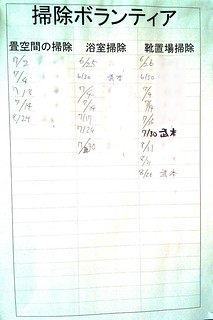
(Cleaning Volunteer Chart)
In general the Japanese do not tend to assert themselves linguistically, being in general very self-effacing. There is one exception to this. Japanese people, and pocket monsters, take great pride in their names, and will put their names to themselves and their positive acts. Despite being so self-effacing, when it comes to their names, they are very in your face.
For example individual names appear on houses (where Britons have only numbers), stating the name of the patriarch who provided for it, at Shinto shrines the names of companies and individuals that donate lanterns and other stonework will be carved into the same, Japanese sometimes stick labels with their names onto temples and shrines in the "senja fuda" tradition, Japanese school-rooms are often bristling with student names, they take great pride in their business cards, and in this photo, they and I write their name in a chart detailing who has cleaned what part of the changing room when. I have left only my name showing. "Take Take, Takemoto (said in the style of Pikachuu)!"
I think that the Japanese name may be the equivalent of the Western smile. In general Westerners do not assert ourselves visually, with our bodies, poses and posture. To do so would be considered vain. On the other hand we are allowed to smile. The smile -- being the shape of the mouth and source of language - the most linguistic of visual expressions, the written name is the most visual mark in language, the point of intersection between the worlds of language and vision, the tip of the brush pen.
Labels: japan, japanese culture, logos, Nacalian, nihonbunka, 日本文化
Wednesday, August 06, 2014
Not quite yet a Visual Turn

Is cultural psychology at last taking a visual turn? Yes, and at the same time, not quite. There is the 'theory of Dov Cohen' which integrated the notion of the visual other into the main "collectivist" interpretation of Japanese culture based upon, imho, a misunderstanding of the consequences of a generalised other.
The highly interesting and thorough research of Uskul and Kikutani (2014) appears to follow this Co-hen-ian ;-; trend demonstrating that taking a third person perspective on ones self is related to public self awarenes, motivating actions that are social but not those that are private.
And yet, mirrors -- the easiest way of promoting a third person perspective on self -- are found to promote private self awareness, and the tendency to reject social expectations. Mirrors provide another type of generalised other, and another type of individuality not heightened collectivism.
Who is right? This research (Uskul & Kikutani, 2014) presents hard data, demonstrating the connection between third person perspectives and motivation to conform to social expecations.
Perhaps the problem is the "person." In my opinion, the Japanese do not have a third person perspective, but see themselves from eye of their god (generalised other, super ego, Other, (m)other, superadressee, impartial spectator). The generalised, impartial, super, unconscious, de-personalised nature of the Other (verbal or visual) is the key to making a "god", and commcomitant (verbal or visual) self.
But basically I am all washed up. Kind professor Steven Heine already gave me some work. Perhaps, in the words of the late great Satoshi Kon, when I am starving I can ask for some more work, but by then they may ask "he was a Co(-author w)hen?"
Sorry.
写真お取り下げご希望でありましたら、ご連絡ください。Please contact me if you would like me to remove your photos, taken from your homepages via the comments or email link at nihonbunka.com
Uskul, A. K., & Kikutani, M. (2014). Concerns about losing face moderate the effect of visual perspective on health-related intentions and behaviors. Journal of Experimental Social Psychology. works.bepress.com/ayse_uskul/31
Labels: collectivism, individualism, japanese culture, Jaques Lacan, Nacalian, nihonbunka, reversal, specular, theory, 日本文化, 集団主義
Wednesday, July 09, 2014
Visual Conscience Displayed Visually

In the DVD come mirror of her conscience the woman's face is transformed into that of an ogre.
The Japanese have a visual, rather than linguistic conscience, and their self esteem is stored and cognised largely in their self-appraisal (generalised other's/impartial spectator's/ superego's appraisal) of their own face.
Labels: autoscopy, crime, culture, japan, japanese culture, Jaques Lacan, mirror, Nacalian, occularcentrism, religion, reversal, specular, 日本文化, 自己視
Gaze Synchrony even during Sex

Professor Kitayama almost but does not quite reach the conclusion that I would like him to reach that, Japanese here pictured and viewing, are always still gazing with mother because they have simulated the gaze of their mother in their minds.
Bakhtin, M. M. (1986). Speech Genres and Other Late Essays. (V. W. McGee, Trans., C. Emerson & M. Holquist, Eds.) (Second Printing.). University of Texas Press.
Freud, S. (1913). Totem and taboo. (A. A. Brill, Trans.). New York: Moffat, Yard and Company. Retrieved from http://en.wikisource.org/wiki/Totem_and_Taboo
Kanagawa, C., Cross, S. E., & Markus, H. R. (2001). ‘Who am I?’ The cultural psychology of the conceptual self. Personality and Social Psychology Bulletin, 27(1), 90–103.
Mead, G. H. (1967). Mind, self, and society: From the standpoint of a social behaviorist (Vol. 1). The University of Chicago Press.
Smith, A. (1812). The theory of moral sentiments. Retrieved from http://books.google.co.jp/books?hl=en&lr=&id=d-UUAAAAQAAJ&oi=fnd&pg=PP18&dq=%22The+Theory+of+moral+sentiments%22&ots=mjeEAFSIge&sig=LNXhHkNjKAWc2r9r_KiRDFxn_Pg
北山修. (2005). 共視論. 講談社.
森有正. (1999). 森有正エッセー集成〈5〉. 筑摩書房.
Labels: japan, japanese culture, nihonbunka, 日本文化
This blog represents the opinions of the author, Timothy Takemoto, and not the opinions of his employer.