
Wednesday, October 26, 2016
Reading the Customers Mind
Reading the Customers Mind
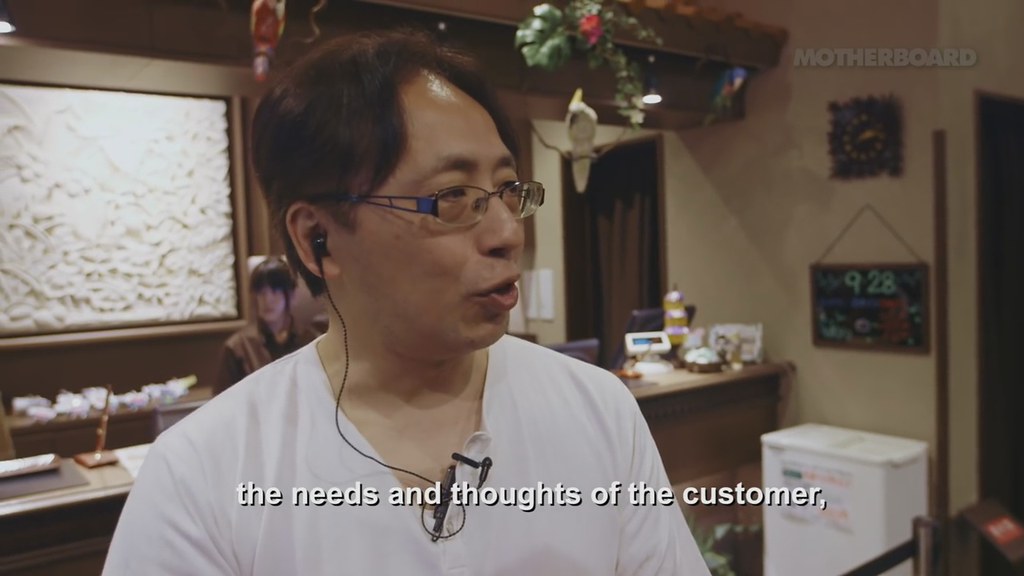
A Japanese capsule hotel manager, Akikazu Fukumoto, explains the essence of Japanese style hospitality (omotenashi) and why it would be impossible to replace his staff with robots in two sentences,
at the three minute mark in a video on robot staffed hotels in Japan by Motherboard.
My translation (for the original Japanese see below)
"Our hotel has the heart of Japanese hospitality (omotenashi no kokoro) and must therefore be staffed by humans. Our staff must be human because we behave proactively anticipating the thoughts and needs of the customer. "
The Motherboard translation is slightly off the mark since the hotelier does not "respond" to the needs and thoughts of the customer but pre-empt -- saki mawari, literally go around in front of -- them. If it were merely a case of "responding" to the needs and thoughts of their guests, the hotel could wait for the guests to express them verbally, and use robots, or untrained staff working to a manual, as is the case in Western style, customer makes overt choices, "help yourself" (Doi, 1973, p.13) hospitality.
Japanese hospitality is, when it works, a sort of "mirror dance" (Krieger, 1983) where the providers read the minds of their customers via their faces and behaviour, adjusting their own behaviour on the fly accordingly.
Contra what I have written elsewhere however, this hotelier seems to be implying that the thoughts of the customer are not expressed by their behaviour but come afterwards, perhaps in linguistic form. At its most effective, Japanese hospitality should preempt, and even prevent, the arrival of such thoughts by satisfying the need before the thought arises. The manager also mentions however, a "heart" (kokoro) that exist prior to the thought, at least in the hotelier. This Japanese heart has traditionally been refereed to as a mirror such as in the preface to the record of ancient matters (Kojiki).
Bibliography
Doi, T. (1973). The Anatomy of Dependence. Kodansha USA.
Krieger, S. (1983). The Mirror Dance: Identity in a Women’s Community. Philadelphia: Temple Univ Press.
うちのホテルにはおもてなしの心があるんで、人間じゃないとだめです。お客様のほしいこと、もしくは思っていることを先回りして考えてこうどうするんで、やっぱりおもてなしのこころは人間じゃないとだめだと
The "please help yourself" that Americans use so often had a rather unpleasant ring in my years before I became used to English conversation. The meaning, of course, is simply "please take what you want without hesitation," but literally translated it has some a flavour of "nobody else will help you," and I could not see how it came to be an expression of good will. The Japanese sensibility would demand that, in entertaining, a hose should should sensitivity in detecting what was required and should himself "help" his guests. To leave a guest unfamiliar with the house to "help himself" would seem excessively lacking in consideration. This increased still further my feelings that Americans were a people who did not show the same consideration and sensitivity towards others as the Japanese. As a result, my early days in American, which would have been lonely at any rate, so far from home, were made lonelier still. (Doi, 1973, p.13)
A Japanese capsule hotel manager, Akikazu Fukumoto, explains the essence of Japanese style hospitality (omotenashi) and why it would be impossible to replace his staff with robots in two sentences,
at the three minute mark in a video on robot staffed hotels in Japan by Motherboard.
My translation (for the original Japanese see below)
"Our hotel has the heart of Japanese hospitality (omotenashi no kokoro) and must therefore be staffed by humans. Our staff must be human because we behave proactively anticipating the thoughts and needs of the customer. "
The Motherboard translation is slightly off the mark since the hotelier does not "respond" to the needs and thoughts of the customer but pre-empt -- saki mawari, literally go around in front of -- them. If it were merely a case of "responding" to the needs and thoughts of their guests, the hotel could wait for the guests to express them verbally, and use robots, or untrained staff working to a manual, as is the case in Western style, customer makes overt choices, "help yourself" (Doi, 1973, p.13) hospitality.
Japanese hospitality is, when it works, a sort of "mirror dance" (Krieger, 1983) where the providers read the minds of their customers via their faces and behaviour, adjusting their own behaviour on the fly accordingly.
Contra what I have written elsewhere however, this hotelier seems to be implying that the thoughts of the customer are not expressed by their behaviour but come afterwards, perhaps in linguistic form. At its most effective, Japanese hospitality should preempt, and even prevent, the arrival of such thoughts by satisfying the need before the thought arises. The manager also mentions however, a "heart" (kokoro) that exist prior to the thought, at least in the hotelier. This Japanese heart has traditionally been refereed to as a mirror such as in the preface to the record of ancient matters (Kojiki).
Bibliography
Doi, T. (1973). The Anatomy of Dependence. Kodansha USA.
Krieger, S. (1983). The Mirror Dance: Identity in a Women’s Community. Philadelphia: Temple Univ Press.
うちのホテルにはおもてなしの心があるんで、人間じゃないとだめです。お客様のほしいこと、もしくは思っていることを先回りして考えてこうどうするんで、やっぱりおもてなしのこころは人間じゃないとだめだと
The "please help yourself" that Americans use so often had a rather unpleasant ring in my years before I became used to English conversation. The meaning, of course, is simply "please take what you want without hesitation," but literally translated it has some a flavour of "nobody else will help you," and I could not see how it came to be an expression of good will. The Japanese sensibility would demand that, in entertaining, a hose should should sensitivity in detecting what was required and should himself "help" his guests. To leave a guest unfamiliar with the house to "help himself" would seem excessively lacking in consideration. This increased still further my feelings that Americans were a people who did not show the same consideration and sensitivity towards others as the Japanese. As a result, my early days in American, which would have been lonely at any rate, so far from home, were made lonelier still. (Doi, 1973, p.13)
Labels: blogger, hospitality, japanese culture, japaneseculture, nihonbunka, 日本文化


Saturday, December 27, 2014
Omonenashi: Like the Graceful Swan Flapping its Legs Under Water

In his excellent book "Recommending Hospitality Studies" (2008) Professor Katsuhito Hattori, head of the Japanese Association of Hospitality Management provides a great many interesting distinctions between hospitality, service and Japanese hospitality (omotenashi). However his assertion that the biggest difference between Western hospitality and Japanese omotenashi is that the former is active while the latter is passive, is not a conclusion that I can agree with. Certainly omotenashi has a reserved grace and modesty. Sushi chefs form sushi with an expression of calm. The (female) heads of Japanese traditional hotels welcome their guests with and un-ruffled grace. Banquet hall staff provide Japanese meals silently in such a way as to avoid drawing attention to themselves. These service providers may seem therefore to be more "passive" than the garrulous one-upmanship provided by Western hosts, but this is merely an appearance. Even while obeying the silver rule - one should not treat others in ways that one would not like to be treated - omotenashi professionals are always attempting to put themselves in the position of their guests, use their creative imagination, and empathise. As the famous phrase from the Manga "Star of the Giants" puts it, "the gracefully swimming swan is paddling her legs fiercely beneath the surface of the water". Similarly Japanese hospitality/omotenashi professionals are expected to be equally ardent in their attempts to provide psychological services to their guests while maintaining that typical Japanese grace and poise. 日本ホスピタリティ・マネジメント学会の会長である服部勝人先生は、その良書『ホスピタリティー学のおすすめ』で、ホスピタリティー・サービスやおもてなしについての、そしてそれらの違いについてかずかずの示唆を与えてくれている。しかし、欧米のホスピタリティと日本のおもてなしは最大の違いを、前者が能動的で後者が受動的だとしている。これにはどうしても賛成できない。たしかにおもてなしには、閑雅で奥ゆかしいところがある。板前は動揺のない顔で寿司を握る。旅館のお上は、優雅で騒ぎのない態度でお客を招き入れる。会場の中井はお客に気にさわる話や動作をされずたんたんと静かに会席料理のしたくをする。このように日本のおもてなし専門家は、積極的な話しかけをしたり+αを提供しようとする欧米のホストと比べて、受納的に見えるが実はそうではない。自分がほしくないことを相手にしないというだけでも、もてなす側は常にお客に思いやり、気遣い、《察し》を行っている。漫画『巨人の星』の名セリフ「優雅に泳ぐ白鳥も水面下では激しく足を動かしている」のように、優雅にもてなそうとする側も、思いやり・気遣い・察しのような精神的な奉仕を行っているというのが少なくともおもてなしの理想であると思われる。 Images 板前的野村裕二師傅 by 黑欣爺, on Flickr かわじま白鳥飛来地 2014 #3 by kobaken++, on Flickr http://flic.kr/p/qgzbfw
Labels: blogger, Flickr, hospitality, nihonbunka, おもてなし, ホスピタリティ
This blog represents the opinions of the author, Timothy Takemoto, and not the opinions of his employer.